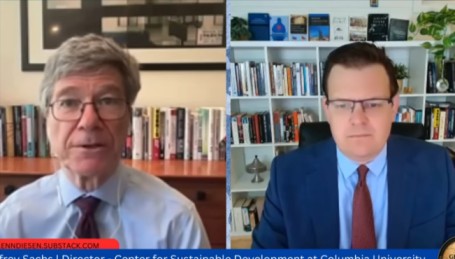
Read the full transcript of Professor Jeffrey Sachs’ interview on Greater Eurasia Podcast, May 31, 2026.
Editor’s Note: In this episode, host Glenn Diesen welcomes back Professor Jeffrey Sachs to discuss his latest open letter to German Chancellor Friedrich Merz regarding the escalating proxy war in Ukraine. Sachs delivers a sharp critique of European leadership, arguing that Germany has failed to uphold its post-1990 historical responsibilities by repeatedly backing NATO expansion and abandoning diplomatic avenues with Russia. Warning that the current trajectory is leading Europe blindly toward a catastrophic World War III, Sachs and Diesen emphasize the critical, urgent need to restore communication and accept Ukrainian neutrality before the crisis spirals completely out of control.
Germany’s Role in the Ukraine Crisis: Jeffrey Sachs on Diplomacy and Responsibility
GLENN DIESEN: Welcome back to the program. Today we are joined again by Professor Jeffrey Sachs to discuss an open letter to the German Chancellor, Friedrich Merz. You wrote a letter 6 months ago urging the Chancellor to do some diplomacy, or yes, restart diplomacy after merely 4 years now of having minimal contact with Russia. And now you wrote yet another open letter to the German Chancellor, which has been republished in the German media. I wanted first to ask, why you wrote a second letter. What do you feel has changed in the proxy war in Ukraine?
Why a Second Letter to Chancellor Merz?
PROFESSOR JEFFREY SACHS: Well, to put it simply, things are worse now than they were 6 months ago. So that was the reason for the letter. The first time I wrote the open letter, which was December 2025, the situation was rather grim. There was warmongering and escalation, and I wrote that Germany had a special responsibility in this context as the most powerful country of Europe, the most populous country of Europe, the country that has lots of historical responsibilities regarding the issues that we’re facing right now.
And in January 2026, just a couple of weeks after that letter was published, I saw glimmers of hope. Chancellor Merz made a couple of speeches where he somewhat surprisingly said in an open way, well, Russia’s part of Europe, that we’re going to have to live together with Russia after this war. We need to speak with Russia. And he and President Macron and some other leaders in Europe started to opine in January about the need for some kind of new diplomacy.
And Europe, in a rather clumsy way, started to publicly look for who it might be that could serve as a diplomatic envoy from Europe. By the way, it’s rather sad and strange that the person designated for that job, Kayakalis, is deemed by both sides to be inadequate for this because she’s an open Russophobe. And every day hate speech comes out of her mouth. Anti-Russian speech, making it not really possible for her to fulfill her job, which is to be Europe’s chief diplomat.
Well, after January, and despite this rather bizarre public opining about who could serve as our emissary — should it be former Chancellor Merkel, should it be former European Central Bank President Mario Draghi, should it be former Chancellor Schroeder — it was a rather bizarre process, I have to say. Nothing has come of it.
Escalation and the Attack on Starobilsk
But what has occurred in the last few weeks, and really in the last couple of weeks to a startling degree, is an escalation of rhetoric and the Ukrainian attack on the girls’ school in Starobilsk with many deaths of young students. And Europe not only not apologizing for that or explaining why a missile went in the wrong direction, actually in denial or silence about this horrible event.
And in response, Russia has said through Foreign Minister Lavrov in a call to U.S. Secretary of State Marco Rubio that Russia is going to attack the capital, Kiev. It’s going to attack control centers and areas of operations control in the capital, and Minister Lavrov advised the Western diplomats to take care and be safe and clear out. That attack has not come yet despite the warnings, but I think we can expect that it will. So these are alarming days.
And the response in Europe has been escalatory in rhetoric and non-apologetic for disasters that have clearly occurred. There are many mysterious events of drones in Baltic airspace and a drone hitting in Romania near the border with Ukraine that are contested, unexplained, but also raising tensions and a sense of escalation. The rhetoric out of the Baltic states about perhaps attacking Kaliningrad or being ready to be a base for drone operations into Northwest Russia are all shocking.
None of this is the kind of behavior that we need in a nuclear age. All of it is incredibly irresponsible, incredibly neglectful of your and my life and those of all the rest of us on the planet. It’s truly shocking.
Europe’s Failure to Engage in Diplomacy
I put the principal responsibility on Europe. It has not shown the slightest interest, the slightest capacity to engage in any kind of diplomacy except to whine when the US and Russia speak. “Why aren’t we there?” As if a union of 450 million people can’t get its act together to find someone to speak with the counterpart in Russia.
So, Glenn, I wrote the letter because the situation is alarming now, not because I have any special hopes that what I say will be heeded, but because the situation is completely alarming.
Germany’s Broken Promises Since 1990
And just to underscore the point of the letter, the point I’m making in the letter is not only that diplomacy is correct, but that Germany has a particular responsibility. And before people jump to conclusions, I’m talking about responsibility from 1990 onward. I want to be clear, I’m talking about specifics of the events that are taking place in Ukraine.
And I happen to know firsthand and in many other ways, Germany has cheated on German reunification in a fundamental way.
Because the terms of German reunification in 1990, which required the approval of the Soviet Union and the other occupying powers of Germany after World War II, was that Germany and the West more generally would not take advantage of German reunification by moving the military forces eastward into Central and Eastern Europe, much less to Ukraine and the South Caucasus, Georgia — another aim of this absolutely irresponsible alliance called NATO — and they cheated.
And so Germany has a responsibility, given that solemn commitments were made to Germany’s advantage. Promises made in February 1990, that in the context of German reunification to end World War II — believe it or not, because there had been no treaty after 1945 until the Two Plus Four agreement in 1990 — that Germany would not take advantage of German reunification by moving its military and the NATO alliance eastward. And Germany and the United States cheated.
And this, to my mind, is the underlying reason why tensions rose for more than 30 years, and we saw them happening, and we saw repeated duplicity. Because I mentioned 6 episodes in this letter where Germany did not follow through honestly in a geopolitical context that was completely harrowing.
Merz’s Responsibility to Act
And so it’s not just general historical responsibility. It’s not only that Germany is a big and powerful country, the biggest and most powerful in Europe. It is that Germany gained advantages vis-à-vis Russia starting in 1990 with unification premised on the neutrality of the countries to the east, not extending NATO. And then time and again, Germany violated not only that promise, but many other specific commitments that it undertook.
So as a chancellor of Germany, Merz has a responsibility to know this and to act upon it before Europe is embroiled in another war. And all this chest-thumping of Europe about how saintly Europe is and how evil Russia is, and this one-sided narrative that is unending — “we’re pure, they’re evil, everything they do is unprovoked” — this is what is going to get us to complete and total disaster.
And Europe should start, first of all, by apologizing or expressing condolences for the attack on Starobilsk and for trying to understand what happened. That’s the first. When you kill young girls, whether it’s the United States doing it brutally because of this crazy AI targeting of sites in Iran that killed more than 160 schoolgirls, or what’s happened reportedly in Lugansk, in the Starobilsk girls’ school — we need civility, honesty, humanity, decency, discussion, not further warmongering and hate speech.
NATO’s Role in Triggering the Conflict
GLENN DIESEN: Right, I tend to not just blame NATO but also see that they have a key role in resolving this. Because where we’re sitting now is — I accept that Russia faces an existential threat, so at least sees it this way, with NATO’s incursion into Ukraine. But also recognize that as a result of the Russian invasion, the Ukrainians also face an existential threat. So I understand the motivation of both sides to fight to the, I guess, bitter end and be willing to absorb such horrible costs.
But the ones that can solve this are the NATO countries because we are the ones who triggered the security competition. If we go back to 2014, when we toppled the government in Ukraine, only a minority of Ukrainians wanted to be a part of NATO. And more importantly, we knew it would trigger a war. I mean, this is well documented among Europeans, among the Americans, and we decided to do it nonetheless. So this is my concern, I guess, that we continue to push ahead here.
The Bucharest Summit and NATO’s Fatal Promise
PROFESSOR JEFFREY SACHS: We know, and it’s so interesting and ironic given what former Chancellor Merkel has just said in the last few days again, how much we knew about the provocations that NATO was making. Because this goes back to 2014 when the US really gave a big nudge to a coup in support of a coup that turned Ukraine from a neutral country to a very dramatically pro-NATO expansionist country.
But before that coup, 6 years before, came the decisive event that even triggered what happened in 2014. And that was the commitment that NATO made that it would enlarge to Ukraine and to Georgia, made at the Bucharest NATO Summit in 2008. And at that summit, George W. Bush Jr. was pushing — and especially here, this was because of his neoconservative gang around him led by his Vice President Cheney — that NATO would enlarge.
And the Europeans then knew how dangerous and reckless this was. And in fact, I’ve been told by one of Europe’s leaders today, whom I won’t name so as not to embarrass, but I was told very explicitly that the European leadership was promised just before the Bucharest Summit that the United States would pull no such stunt of trying to demand an enlargement of NATO to Ukraine. But when they got to the Bucharest Summit, the US was out in full force. George Bush said, “We will commit.”
And Chancellor Merkel has written about this in detail. And she says that she knew that committing to a timeline for NATO enlargement to Ukraine was tantamount to a declaration of war on Russia, that that’s how the Russians would see it. And she resisted this commitment the first day of the summit. But then the Americans wore her down. And on the second day, while the NATO summit did not commit to a specific timeline, a so-called map, which would lay out precisely the timeline, it committed in no uncertain terms to the enlargement to NATO. And she wrote in her memoirs that she knew that such a commitment was reckless.
Merkel’s 10-Year War Horizon
The reason I say that this is ironic is that just in recent days she said that she hopes that the war in Ukraine stops sometime within the next 10 years. What? Are we so incapable as human beings that we accept a timeline of 10 more years of war? Why not 10 days or 10 hours, understanding all of the mistakes that have been made, and come up with a formula to end this?
That has to be based, by the way, on what was, is, and remains the core issue of this war, which is Ukraine’s neutrality. The West should understand this. Absolutely must, or we’ll have a war if it doesn’t understand this. We’ll have a war in Europe, I mean.
The December 2021 Security Proposal and Jake Sullivan
By the way, I think we’ve talked about it, but I’d like to discuss it in this context, because the warmongering and irrationality and danger and recklessness and shallowness and immaturity of the people who lead us is something to behold.
In December 2021, when President Putin, in a final attempt to press the new Biden administration to recognize the commitment of no NATO enlargement that had been made 30 years earlier, and to stop this war that was already 7 years underway in Ukraine, to press the United States to say NATO won’t enlarge — President Putin put a draft security arrangement between Russia and the United States on the table in mid-December. I think it’s December 17th, if I remember correctly, 2021.
And well, there were things that I don’t think NATO would ever have accepted or the US would have accepted about rolling back some of the existing placements. What absolutely struck me as correct was that the United States at that point should say, “Yes, you know, NATO’s not going to enlarge any farther into Ukraine, much less into the South Caucasus region” — which by the way is still in play by the CIA and the United States, even as we speak right now. They’re playing games in Armenia. They’re playing games in the South Caucasus. But let me not digress.
I called the White House and I spoke to the National Security Advisor, Jake Sullivan, and I had the most surrealistic conversation imaginable. I think we may have talked about it, but we spoke for an hour. We spoke in detail, and I said, “Jake, take the deal. Say NATO’s not going to enlarge. It’s a terrible idea. It’s not in America’s interest. It’s not in Ukraine’s interest. Take the deal.”
And he said to me, “Jeff, NATO’s not going to enlarge to Ukraine.”
I said, “Jake, what? NATO’s not going to enlarge? Fine, say it.”
“No, no, we can’t say it. It’s our open door policy.”
I said, “Jake, you’re going to have a war over something that isn’t going to happen.”
He said, “Jeff, Jeff, there’s not going to be a war. We’re going to handle this diplomatically. Don’t worry, there’s not going to be a war.”
What can one make of this almost 5 years later? First, the incompetence is shocking. The brazenness is shocking. The naïveté is shocking. It’s so distressing to have conversations like that. Not one word of it made sense. Yet I think that actually was American policy. NATO’s not going to enlarge. But we’re not going to say it, but we’re not going to have a war. Every premise of it made no sense and was quickly disproved.
A Continent Normalized to War
And here we are with an ongoing war that’s now — the war has been going since 2014, let’s be clear — but this escalation is since February 2022, so more than 4 years. And now we have here Chancellor Merkel, who I always liked, I have to say. She’s saying, well, she hopes it won’t be 10 more years. What is it? Is something so wrong in the European mentality that war is so normalized?
You can believe it. Europe has been at war essentially since maybe 300 AD, since the Germanic tribes made their incursions into the Roman Empire, and since 476, when Western Europe splintered with the end of the Roman Empire, it’s never been really at peace as it should be. It’s had stretches that were much better. But what kind of mentality, rather than saying, “Oh my God, this could go on for another 10 weeks, that’s horrible, we have to do something,” says, “I hope that it won’t go on for another 10 years.”
I may be misunderstanding the quote. I tried to get the exact meaning of it, but whatever it is, it was a rather plaintive, complacent — not complacent, but plaintive — view that, oh, we’re just stuck by these forces of opposition, and it’s just a long, hard slog. Well, try sitting down diplomatically. Understand all of the lies that were told.
The 2014 Coup and the Minsk Betrayal
And just to say some of the others that I mentioned that are of relevance in the context of the coup in Maidan. On February 21st, 2014, the German foreign minister and his French and Polish counterparts negotiated with President Yanukovych that there would be no coup, that President Yanukovych would remain in power under the constitutional order, and that there would be elections late in 2014. The next day, a violent coup came.
You might think that the United States and Germany and Poland and France would say, “No, we don’t accept a violent coup. Ukraine is a constitutional democracy and President Yanukovych remains president.” Of course they didn’t say that. The US was rubbing its hands together. “We got ’em. Now we’re going to go for NATO enlargement.” Immediately the post-coup regime said, “Well, maybe Russia shouldn’t stay in Sevastopol and Crimea. Maybe it’s time to unwind that lease for their naval base and so forth.” You saw the plot straight out. What did Germany do in that context? Nothing except go along. So that was another cheat.
And then a year later, in February 2015, when the war had already started, when people were dying in the Donbas, Chancellor Merkel and President Hollande personally negotiated an arrangement to end the war called the Minsk II agreement. And it happened to be based on an idea of autonomy for the ethnic Russian population of eastern Ukraine.
And I happen to know also, interestingly, that Chancellor Merkel viewed that as quite a good alternative because she knew about the German enclave in South Tyrol in northern Italy, which is another case of an autonomous region in Europe at peace, but given autonomy because it’s an ethnically autonomous part of Italy. Italy had taken some territory of the Austro-Hungarian Empire at the end of World War I, a German-speaking part near Bolzano or around Bolzano, and they now have autonomy and everything works out well. So Chancellor Merkel said, “This is how to end the crisis in the Donbas — give autonomy.”
Well, Germany negotiated it. Germany presented itself as the guarantor together with France in the so-called Normandy Process. And Germany reneged on its guarantor role. I happen to know the United States didn’t like it. “Ukraine should be a unitary state. We don’t want this autonomy. Don’t weaken Ukraine.” In other words, don’t follow through on exactly what you’ve just signed and what has just been unanimously ratified by the UN Security Council. Because the Minsk II agreement is not only an agreement inside Ukraine, but it was an agreement endorsed by the UN Security Council and then blown off.
Years later, Chancellor Merkel said, “Well, yes, we didn’t really expect it to work. It was going to give time for Ukraine to build up its strength.” I actually don’t believe that that was her motivation back in February 2015. I think that’s a strange kind of ex post rationalization of events. But whatever it is, there was duplicity in the end.
Chancellor Merz’s Responsibility
Well, all of this, Glenn, is to say, I don’t know whether Chancellor Merz knows any of this. I don’t know whether he does his homework. I don’t know whether he’s aware of history, but he is the chancellor of Germany and he has a responsibility to all of us actually to behave like a responsible chancellor of Germany. And that means knowing these events, understanding that there’s no purity of the European side, that there’s plenty to talk about for true mutual security in Europe, and that as chancellor, he has a responsibility not to be a warmonger. He has a responsibility to pick up the phone or dial his Zoom and connect with his counterpart, President Putin.
Europe’s Deliberate Rejection of Diplomacy
GLENN DIESEN: Yeah, the lack of diplomacy has been shocking to me though. That is, as you said, the fact that the Germans were guarantors to this unity government in 2014, which they then walked back. The fact that the Minsk peace agreement was sabotaged for 7 years. Also the 2019 election when the Ukrainians were actually allowed to vote for a no-war platform and to make up with Donbas and Russia, and essentially our government, 500 NGOs, made sure that — now that Zelensky reversed this, of course also with the backing of our financed and trained right-wing forces — then ignoring all the possibilities of finding an out in 2021, then sabotaging the Istanbul peace negotiations, and then of course boycotting diplomacy for 4 years.
I mean, it is something unique that this is very deliberate, the lack of willingness to find a solution. I’m just, again, you say you recently spoke to European leaders and you often engage with them. I’m just curious what they actually think, because I know for a fact that something has changed now in Moscow, that this incremental escalation over the past 4 years has now crossed a line.
That is, the Europeans speaking openly about war with Russia, the goal of destroying its energy, striking military installations deep inside Russia, backing this up by mass-producing the weapons, openly saying the intent, developing the capabilities, using their territory for attacks. I mean, I spoke with Mearsheimer, a common friend of ours, and he was making the point, “This is not a proxy war anymore. We are now at war. We attacked Russia, and the Russians know this.”
So I know that they’re going to change their posture now to a huge extent. Attacking Kyiv in a very brutal way is one way, but I don’t think we have the luxury anymore of just putting the Ukrainians in front of us and letting them die for us, because I think they’re going to also increasingly possibly deter the Europeans more directly as well.
So I just — anyways, if you see the path we’ve gone on for 4 years, it’s hard to ignore that we’re heading towards a war and that we’re still not doing diplomacy. 12 years of this nonsense sabotaging every diplomatic path, and we’re still going to do it even now that we might fight the world’s largest nuclear power. It’s beyond insane.
The Breakdown of Democratic Accountability
PROFESSOR JEFFREY SACHS: It is. And one wonders, how can this happen in a world of open communication, our discussion, or the ability, thank goodness, that I can still publish an open letter in an important German outlet, the Berliner Zeitung.
But what I can tell you, what we know is our governments are in a bunker already. They don’t talk to the public. They don’t engage in any discussion of what we’re discussing right now. They won’t answer. Of course, Chancellor Merz is not going to answer me. That goes without saying. But in general, they simply have hunkered down and operate without responsibility.
It’s hard to imagine because we have all of the trappings of democracy. We have the trappings of accountability. But I know, because I experience it daily, you do as well, there simply is no response. If I call a senior official in the European Commission, I don’t get an answer. I don’t get a callback. They know who I am. I’ve been dealing with the European Commission for 40 years, in one way or another. I’ve been dealing at a personal level with many of these people. They simply will not speak anymore. Leaders that I know will not speak. They are hunkered down. They cannot defend their position. They cannot rationalize it.
All they can do is propagandize in one direction and call the rest of us whatever names they want, or use sanctions or whatever they do, which they do occasionally as well against certain people. But what we don’t have even within our own countries right now is open discussion. And this, I think, is just an explanation of how we go day by day with falsehoods hanging in the air unresolved, because they don’t try to resolve them. There’s no independent look or commissions or responses or answers to Parliament. There’s no inquiries into anything.
It’s a very, very dangerous situation because the normal processes of truth-telling or analysis, or what diplomats are especially important for — understanding how the other side thinks and explaining that straightforwardly — and if there is something wrong with how the other side thinks, discussing it together with the other side to try at least to clarify. None of these processes happens right now.
So I was, again, this is anecdotal and it’s years ago, but for me, it’s what we see every moment. I was invited by the host country at the time, which was Indonesia, to speak to the G20 foreign ministers. And this was after the invasion. They would not speak with Foreign Minister Lavrov. So here are foreign ministers — it’s their job, that’s why they’re there — and they would not even speak to the Russian foreign minister. This is the idea. You do not engage in actual communication, much less diplomacy and negotiation.
And I don’t really understand what the motivations are. People have various explanations. We can say the publics are disgusted by this. Broadly speaking, Merz’s popularity is essentially in complete collapse. Macron’s popularity is essentially in complete collapse. Starmer’s popularity is essentially in complete collapse. It’s not as if these people are expressing the will of their publics. Absolutely the opposite.
And so then it raises all sorts of questions. Some people say, well, Merz, he’s BlackRock. I don’t know if that’s the explanation or not. He’s the German military industry. Who knows? It seems doubtful to me. These explanations, so simplistic. But frankly, I don’t have a better one. Because the behavior is so bizarre at this point, so counterproductive and so dangerous.
And we have to keep the core message to the Europeans: You said you were going to talk. You said you were going to find an intermediary. For heaven’s sake, 450 million people in the European Union — find someone and get started.
Closing Remarks
GLENN DIESEN: Yeah. No, it’s incredible. Again, we have diplomats who don’t believe in diplomacy, leaders who ignore their basic national interests and seemingly have some contempt for their own public, and journalists who think it’s their job to defend narratives. I think at the end of this, we also risk a legitimacy crisis when, as you said, they’re not actually doing their jobs. Anyways, I hope we will have an opportunity to discuss some positive development in the future, but thank you very much, and I really enjoyed your open letter, and I will leave a link to it in the description, and I would encourage everyone to read it. So thanks again.
PROFESSOR JEFFREY SACHS: Glenn, thank you so much. See you soon.
Related Posts