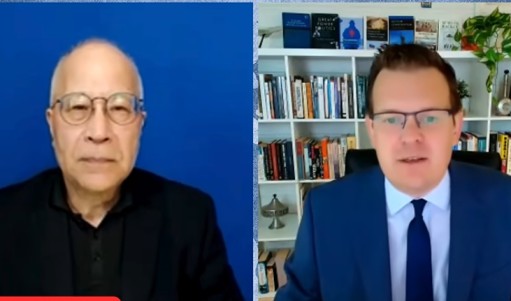
EDITOR’S NOTE: In this interview (Sep 1, 2026), host Glenn Diesen speaks with analyst Einar Tangen about the Shanghai Cooperation Organization summit in Kyrgyzstan, where leaders from Russia, China, India, Iran and other member states are deepening cooperation. Tangen describes the gathering as part of a broader effort to reduce dependence on the United States and move toward a multipolar order built on sovereignty, regional trade and consensus rather than hegemony. The discussion examines how energy deals, alternative payment systems and shared security concerns are binding these countries together even as they navigate different relationships with the West.
TRANSCRIPT:
Introduction
GLENN DIESEN (00:00:00 – 00:00:22): Welcome back. Today is September 1st, 2026, and we have the great privilege of being joined by Einar Tangen, a senior fellow at the Taihe Institute and also a senior fellow at the Centre for International Governance Innovation. He also publishes excellent articles on his Substack, and I have left a link in the description. So thank you for coming back on.
EINAR TANGEN (00:00:23 – 00:00:40): Well, thank you for having me. I hope I don’t scare anyone away from actually going to my Substack. We’ll see if my efforts are worth it, but it is always a pleasure to be here. Not always in terms of topics, but at least talking to somebody who’s sane and cares about the future of mankind.
The SCO: From Security to Geoeconomics
GLENN DIESEN (00:00:42 – 00:02:49): Well, on the future of mankind, a lot of this is, well, used to be decided in Washington and to some extent Brussels, or at least in Europe through the past centuries. But we now see a new world emerging though, that is a multipolar world where many of the new centres of powers are in the East.
And there’s always this question how to organise this new economic connectivity, the political cooperation, and we tend to focus on BRICS. And the Shanghai Cooperation Organisation, the SCO, gets much less attention. But again, this is a key component of this emerging multipolar world, and well again the reason why we’re talking today is the SCO is now having a summit in Kyrgyzstan.
And well, for viewers not familiar with this organization, the Shanghai Cooperation Organization, it well began in 2001 with Russia, China, and four of the Central Asian states. But they focused then primarily on security in Central Asia — that is terrorism, secessionism. But also implicitly, it was supposed to manage security competition between China and Russia in that region to make sure it was a region of cooperation instead of competition.
But then we saw a transition gradually towards, from security to more geoeconomics. It took on more economic competencies. By doing so, it also took on more members. So today we see the SCO having many members, that is China, Russia, India, Iran, Pakistan, Belarus, and the original Central Asian states, that is Kazakhstan, Kyrgyzstan, Tajikistan, and Uzbekistan.
So it’s really become an important again institution to facilitate this post-hegemonic world order and accommodate this new many centres of power. And again, the SCO summit is now going and ongoing. It’s supposed to finish today, and well. What is significant though for you with this summit?
The Significance of the SCO Summit
EINAR TANGEN (00:02:52 – 00:11:12): Well, I mean, excellent synopsis there. What’s significant is a lot of it is the pictures that’s coming out of it. Nothing gets Washington more upset than seeing the leaders of Russia, India, and China all laughing and exchanging words in a group and being very clear that their communications are strong and that they are very much interested in each other.
It goes back to what you were originally talking about, framing this kind of multipolar world. Now, one of the things I always talk to you is, well, multipolar doesn’t mean good. Multipolar means actually there’s a lot more room for disagreement. You can have conflicts and things like that. So how do you avoid them? You have to have some sort of shared values.
And this is really important. I think this is something that China has been pushing a lot, this idea that there has to be some basics, that everyone is entitled to be secure. No one’s security can be purchased at the insecurity of another country. Every country has to have its own path to development, which they determine. It’s not determined in some other capital or by a group of bankers who are sitting in America or in Europe. And there has to be basic respect. This is the respect for sovereignty and for the cultures that are involved.
And the old days, all you really needed to know was maybe Russia and the United States, a few of your neighbors, because no one else mattered. The currency system was in US dollars. If you need contracts, they’re generally in English. Knowing about other countries because you weren’t doing that much trade with them unless they’re your neighbors just wasn’t relevant.
But in an interconnected world where supply chains run on resources that come from one end of the earth and then go to the other, and then value is added and then they’re sold, you have to have an understanding of who you’re dealing with, especially if you want to do more business. So things have changed dramatically. Countries need to know each other, and it’s not just for trade.
If you’re going to maintain peace, you have to understand where the other person or the other country is coming from. You have to understand their history. It’s not just enough to know the language. That is a mistake. There’s too much that’s lost in translation. If you don’t know the Quran and you are dealing in the Middle East, you’re going to have a problem. If you don’t know the Bible when you’re dealing in the United States, you’re going to have a problem because you’re going to miss a lot of the inferences, part of the language that goes unsaid but is implicit in what words people choose.
And the same thing is in China.
Governance, Hegemony, and the New World Order
And the last part is this idea that you have to have some sort of governance system. There has to be a way in which instead of throwing tanks at one another, you can sit across a table and figure out how to get things done. Now implicit in this is you don’t have a hegemony. What it is is countries come together either regionally or internationally and they reach consensus because no more is there going to be this policeman who dictates what should be or shouldn’t be in the best interest of other countries while in fact taking as much as they possibly can.
You know, we’re seeing a repeat of that right now in Venezuela. I’m sure the Venezuelans didn’t happily all get together and decide as a democracy, “What a great idea to give our oil resources to the United States and to a private company that has nothing to do with our government or our people.”
So those old ways of mercantilism, colonialism, domination, hegemony are still very, very apparent in the approach of the United States. But meanwhile, the area that we’re talking about, the SCO, Shanghai Cooperation Organization, what you see is a coming together of very powerful nations, Russia, China, India, and the other ones that you mentioned. And they’re coming together because they need to figure out how they can work together.
And absolutely essential — this is a regional bloc. And in part, I believe the regional blocs are forming, whether it’s in Africa or South America. Their strength can go up and down, but the fact is they’re protective. They want to know how they can continue to do business even in the face of a hostile country.
Modi, Xi, and Putin: The Picture Washington Fears
So when you start looking at these 3 countries, and I’m not trying to ignore the other countries that are involved — I’m just saying that the picture that I saw and the impression I got was the 3 — Modi, Xi, and Putin — laughing, shaking hands, being very cordial. As I said, this is the stuff of nightmares in Washington, D.C. The 2 most populous countries together with the country that has the most resources coming together when the U.S. desires them to be apart.
They want India to be a doorstop against China. They want to split Russia and China apart because China is obviously a peer competitor, or I shouldn’t say peer anymore, vastly outproduces the United States and they need resources. And guess what? Russia is a huge resource nation. Having this combination is exactly what Donald Trump fears.
Donald Trump is a bully. I don’t think anybody is going to, even those who like him, think that him being a bully is great. But the fact is he is a bully. And what do bullies fear? They fear a bigger bully, a bigger power.
And Donald Trump has made it perfectly clear, not so much just against the SCO, but those members who are also part of the BRICS nations — I don’t think it was coincidence that every single one of the BRICS major five nations got 50% tariffs. Even though — what did South Africa do? What did Brazil do? Obviously India was shocked. Here they are supposedly a stalwart ally of the United States standing in against China. What happens? They get treated the same as if they’re the worst enemy.
Danger in a Fragile America
So you have a situation where much of the world is looking past the hegemonic period and they say, “Well, we’re already here. When does America wake up? When does it realize you don’t go to your neighbor Canada and threaten it with economic warfare and then arbitrarily start changing names of lakes and things like this?” People think this is nonsense. It’s a circus. And Donald Trump seems to be the chief clown.
So in those kinds of circumstances, what do countries do? They do not want a confrontation with the U.S. The U.S. is stretched thin and there is a real fear that desperation is going to drive them to actually use nukes. It is very unsettling to me that in the past few weeks, the Pentagon has started talking about battlefield nukes, not in some sort of, “Well, what circumstances would we think about it theoretically?” They have been talking about it in terms of using it in Iran as a way of subduing the Iranian people. These are the types of things that we should all be aware of and nightmares.
So when I look at this coming together, I see optics, I see hope, the sense that there’s regionalism, but I also see danger in the sense that an increasingly fragile America — I mean economically, politically, and militarily — might feel itself pushed towards a line and start doing things that are unthinkable.
Enlarging the Club: Russia, China, and the Balance of Power
GLENN DIESEN (00:11:13 – 00:12:51): Well, it’s important also what you said that it’s trying to look away from hegemony because often the rhetoric you get is that China’s attempting to essentially replace the US as the global hegemon. And well, I think that in Moscow there were some concerns though when the SCO initially shifted from a security institution to becoming more economic, because it meant handing the — if it’s security, it would implicitly be Russia being number one, but once it’s economy, it transfers into China being the leading economy.
But it seemed that the Russians were comfortable with China being the leading economy as long as it wasn’t dominant. But if it’s only 2 major powers, then it could become a competition. But if you enlarge the club, take in more large powers, then China will still be the leading economy, but it won’t be able to dominate, that is to dictate. And I think that’s also something that made the Russians much more comfortable, as well as the SCO, that is when they brought in India, Pakistan, Iran, all of these countries.
As you said, to see the leaders of China, Russia, India, Iran, all states stand together cooperating, it kind of shows that the hegemonic system, which is very dependent on alliances that divides regions into dependent allies and balanced adversaries, that this all essentially — peace is breaking out, and the alliance systems then begin to weaken, and suddenly — Unbearable. Yes. Peace.
EINAR TANGEN (00:12:51 – 00:12:52): Who, who, who needs that?
Russia and China: Working Out the Relationship
GLENN DIESEN (00:12:52 – 00:13:15): But it has, as you said, it’s a messy construct because there are a lot of participants and relations that have to be managed. And well, to look at the 2 original members, Russia and China, what do you see being worked out between the 2 of them? What are the main objectives?
The SCO’s Economic Evolution and the Virtuous Cycle
EINAR TANGEN (00:13:17 – 00:24:37): Well, this is what’s so interesting is everybody who comes to the SCO this time and then goes onto BRICS has a slightly different agenda and it reflects the needs of their country. China is continuing to push this idea that the best way to combat the US is not to confront it, but to do well, to do well economically. So they’re pushing economics as the key, especially for the SCO.
I mean, as mentioned initially it was all about anti-terrorism, anti-extremism, anti-separatism. But now then, because it was regulating things and it embraced these means by which you can lock up a container in Europe and then ship it to China without fear of something being lost, if you know what I mean, and there wouldn’t be any tax or any kind of bottlenecks along the way that was preventing your cargo from getting there. It made a huge bit of difference, not only to the destination and ends there, but it became basically a two-way traffic for the countries which it was going through.
Because there you needed to have these protocols in place, increasingly the economics became more and more important. And I think this is where Russia said, well, this is good for us. We do trade with these countries as well. It is better to have countries that have more disposable income because at the same time as there’s trade going through, there are also these economic development zones, industrial zones that are being built.
A lot of the industries that are going there are industries that are no longer profitable in China because of higher wages and higher costs in some instances. So they have naturally migrated to places where it’s— and that’s good. It creates jobs. It creates disposable income. Disposable income creates more trade. More trade creates more jobs. It’s a virtuous cycle. And this is what I think has made it easier for everybody involved to see this as a positive thing.
Russia’s Energy Ambitions: The Power of Siberia 2
Now, China continues to say, “Hey guys, let’s continue on that basis.” Russia, on the other hand, has other fish to fry. They would very much like to conclude the Power of Siberia 2, which would be double the size of the Power of Siberia 1 in terms of gas transportation. It makes sense. Obviously seaborne LNG is much more expensive because you have to compress it and everything like that, but pipelines themselves are not inexpensive. It’s basically mostly upfront cost, but thereafter the price of gas goes down dramatically.
But China is taking it slowly. They don’t want to be buffaloed into negotiating during a time of crisis when LNG prices are high. I think they’re waiting for the right time, but they’re not against it. And we saw the last time that Putin was in China, this was mentioned, but instead of being, well, unless you sign this, we’re going to walk away, it was a very mature attitude. It says, well, we have differences. We’re going to settle them at the negotiation table. This is important to both countries. It will probably happen, 99% sure it will happen. The question is the timing and terms.
So Russia is trying to solidify its economic outputs, especially to China, given that the rest of Europe has turned away from them and they need economies that they can work with. Obviously China continues to do that, but they also want to make sure that the world knows very clearly that Russia does not stand alone.
Russia’s Strategic Messaging and the Ukraine Context
Years and years of attempts, first covertly through NATO and the slow sliding salami slicing approach to the previous Warsaw Pact countries, and then more recently, of course, with Ukraine, when Russia decided to openly fight back after sending many, many warnings in Georgia and other places that you were encroaching, you’re coming in. Everybody knew there would be a fight if NATO threatened or was expanding into Ukraine.
So they have a slightly different take on it. They also want to make sure that everyone sees that they have very, very powerful groupings there, not just Iran, but also India.
India’s Dilemma: Caught Between East and West
So coming to India, what does India want? India is kind of in a tough situation. They threw a lot of their eggs into the US basket. They were willing to be a proxy against China, basically a doorstop to Chinese expansion. But lately they’ve been treated, in their opinion, extremely poorly. There’s suspicions that there was US involvement in the general election, which cost Modi his majority. Also in Nepal and Bangladesh, which also have turned countries that were at one time sort of neutral to friendly to somewhat neutral to unfriendly, or let us say not unfriendly but more friendly towards China.
This has pushed a situation where China and India’s economic relationship has been growing by leaps and bounds. China’s now the number one trade partner, but it’s unbalanced. So India has to figure out what to do about it. And I always like to remind people, this is not a decision by governments to do favors by other governments by buying their stuff. Indian consumers buy Chinese goods because it matches their idea of quality, and price, and that’s a competitive factor.
So all this pearl clutching that is being done in New Delhi and saying, oh, China’s stealing, they’re overselling to us. Well, if they weren’t buying from China, they would be buying from somewhere else.
The US Trade Deficit and the Pipe Dream of Reindustrialization
This is the same thing with the United States. I often talk to trade representatives and I say, well, okay, so you have a problem with China, all right? And then you have a problem with Vietnam, but you don’t have a problem with the fact that you import $4.3 trillion worth of goods each year. And if you didn’t buy from those countries, you’d have to buy from some other countries because you don’t produce them.
And the idea that you’re going to start producing these intermediate goods, chemicals, nuts, bolts, screws, all the things, plastics, all the things that are not practical in terms of cost in the United States, it’s a pipe dream. No one’s going to invest 15 years to get a 3% return. No bank would lend them money. No one would say, this is a good investment of my resources. So there are very, very different ideas about profit and what is going to happen.
The Declining Hegemon and America’s Inner Turmoil
So a lot of what we see here, the thrashing around of the United States, this talk about Make America Great Again. Well, it’s just that, it’s thrashing. It’s not attacking the problem. Certainly no one’s come forward and said, we have a real plan to deal with the $40 trillion in growing debt. Bessent coming forward and saying, well, we’ll grow out of it. Okay, how? How are you going to grow out of it? Through your reindustrialization plan, which isn’t working. In fact, you’ve actually lost jobs in those areas. So there’s no realistic plan there.
But that, as I said, is dangerous. You have a hegemon who thinks everyone else wants to be a hegemon. It’s kind of, we’ve talked about this before. If I’m a thief, I believe everyone else is a thief or they’re dumb. All right? And I am just taking stuff from other people before they take stuff from me. So this is the way the United States is. We’re a hegemon and we know that anyone else becomes a hegemon, they’re going to do to us what we did to them. And this is the real underlying fear.
And I’ve talked to people about that. He says, are you afraid that China might do to us what we did to many other countries? And I say, well, we were doing it for the right reasons. China will do it just because they want power and money. And they want our power and money, and therefore we have the right to defend ourselves. And, kind of interesting coming from the most richest, most powerful country on earth, largest military. Somehow they have been cheated by the rest of the world, including countries that can’t even feed themselves, don’t have infrastructure and all this type of stuff.
But this is unfortunately the psychological reality of the United States. They feel cheated. Unfortunately, they don’t reflect and realize that they have been cheated, but it’s by their own political system. You’ve had Democrats and Republicans who’ve promised for years that they’re going to make America better, and it didn’t happen.
Instead, the middle class has tumbled in terms of numbers. The number of people who are unemployed has gone up. Even illiteracy has gone up. Life expectancy has gone down. Child infant mortality continues to rise. The US is still number one in the number of percentage of its citizens incarcerated. I mean, these are not the numbers of a proud nation. This is the numbers of a nation that is in deep inner turmoil.
It’s trying to figure out what’s wrong. Unfortunately, kind of like a wild animal that has been wounded. It’s tearing at itself as opposed to trying to find a way to fix it and be part of a world which it’s not going to dominate, but it’s still going to be a major factor in.
A Time of Profound Change
So I don’t know where I started and left off, but at this point, I just want to end this particular segment by saying that we’re in an area of profound change, which exacerbated, a declining hegemon exacerbated by the fact that we have a technological revolution, which is equivalent in my mind to the Industrial Revolution, which is changing the way that people live, work, and perceive things. So this is a time of great fragility for all nations.
And what I see when I look at the SCO are nations and leaders who are trying to come together and figure out how to work together. Whereas in Washington, I just see more of the same. How can we dominate or destroy?
Technology, Industrial Revolution, and the SCO’s Common Ground
GLENN DIESEN (00:24:39 – 00:27:09): Yeah. Oh, well, again, I think the technological aspect of this is, as you said, is quite important. That is, you said comparable to the Industrial Revolution. And again, the argument is now, of course, that we’re in this 4th Industrial Revolution. As we see digital technologies being able to manipulate the physical world in various forms.
And it is quite important for the shifts in the great powers because in the First Industrial Revolution, we know that the Russians and the Chinese fell behind and they paid a heavy price. Both in the mid-19th century, the Russians were defeated in Crimea and the Chinese were essentially broken and had their hundred years of — what was that? Yeah, humiliation. Humiliation. Yeah, humiliation. So it is. So you know that they kind of learn from this, but also industrial revolution is really when the Western powers further strengthen their asymmetrical power with the rest of the world.
But this time around, you see the — yeah, in this new industrial revolution, a lot of other countries are leaping ahead. And a lot of the Western countries are falling back, especially when the US tech bubble begins to burst. There’s going to be some real problems.
But my question though was about, you mentioned these 4 leaders of China, Russia, India, and Iran standing together. And obviously the Chinese, the Russians, and the Iranians are all being targeted heavily by the United States. And while India obviously is, well, profoundly disappointed and doesn’t care about this aggression by the US, like most of America’s allies these days, you know, this is what you could expect from a declining hegemon, to take a bit harder stance against its, well, let’s call them allies.
But that being said, India still stands out though, that they’re quite cautious. They don’t want to join an anti-Western or an anti-American club. And I guess the common ground could be, let’s just make it anti-hegemonic. That is, we don’t have to be against the US, but we should agree that we don’t only use the dollar, we don’t only use American banks, we can’t only use American tech, or only American transportation corridors, and so forth.
But do you see this being a key challenge for the Shanghai Cooperation Organization, that they have different relationships with the United States?
EINAR TANGEN (00:27:11 – 00:34:30): Well, whether it’s the United States or let’s say the United States is just one other member of the world, the fact is that the problems will still be there. Each country will have a slightly different take on what it sees as important depending on its economic situation. So that part never goes away. The question is, how do you resolve it?
Eastern Consensus vs. Western Coercion
The Eastern way is you resolve it through consensus. You sit down and keep talking and keep talking until you reach at some point a means by which you say, “Okay, we agree. This is something I can live with. I don’t necessarily like it 100%. Maybe the other party doesn’t like it 100% either, but that’s the nature of compromise.”
That as opposed to invading countries and taking their oil or saying that you’re going to, you want to annex another country and make it our 51st state or just simply take Greenland and say it’s mine, or Panama or Cuba. Now, they’re even threatening the British or the Falkland Islands. It’s just, it’s almost unbelievable.
India’s Dilemma
But let’s come back to India. India’s problem is that they have a very large trade surplus with the United States. A lot of it is based on job, body shops, e.g., they provide services that are being, phone callers from Mumbai, that type of thing, and they don’t want to give it up.
There’s also, even though it’s down 20% overall of foreign students in the United States this year, there’s still a tremendous number of Indian students in the United States. It’s still aspirational. Aspirational for many, but the door is closing very firmly in terms of their ability to actually stay in the US even if they do put a completed degree or an advanced degree.
That’s because, $100,000 to the company that has to pay to bring you in, and then there’s no guarantees as to what that will mean. And if you get fired, you basically are starting all over again. You have to literally leave and then be rehired, and they’d have to go through the lottery. So the US is becoming extremely insular, so it’s not satisfying that.
But India is in the situation where they still feel they need the dollar. They want to have alternatives, but here’s the problem: if they do not embrace 100% of what Washington is selling, they’re the enemy.
China’s Position vs. America’s Ultimatum
Because China has never said to any country — they said that if you trade with us, you can’t trade with the US. All they said is, “Look, if you trade with us, you cannot be part of a coalition that is trying to isolate us or go to war with us.” Now, I think that’s pretty reasonable.
But the US is absolutely adamant. You’re either with us or against us. And if you’re against us, we’re going to hurt you. We’re a bully. We’re bigger than you are. You need to be afraid of us because we have things we can do to you that will be extremely painful. And we don’t have to look far for that. Just talk to anybody in the world in South America right now about what that means.
Modi’s Balancing Act
So unfortunately, India thinks they have a middle line. Unfortunately, they don’t. Anything they do thinks — I mean, right now Modi, I think he believes that he’s playing his cards very, very carefully, that he’s using Russia, China, and Iran as some sort of way of saying, “Hey, looky here, I have big friends over here. Be careful. You should be nice to me.”
But it hasn’t worked. He’s tried this before, the same picture minus Iran. It was just a year and a half ago. What happened? Nothing. They got more pressure from Washington. They didn’t get any relief whatsoever.
Washington’s Victim Mentality
So unfortunately, as I was saying, you’re dealing with an increasingly fragile but absolutely rigid Washington elite who believe that everybody is out there to betray them because these are the same people who’ve been cheating them for years. And once you have this victim mentality — and you can hear it, all you have to do is switch on CNN or Fox News and all you’re going to hear is about who the victims are, not who we’re victimizing.
And it’s a trap. You cannot get out of it because you’re the one who’s been aggrieved. You don’t think about how other people are suffering. You only think that I have been wronged and therefore I have to get back whatever it is that I want. And then the Washington elites have embraced this 100%.
Germany and Europe’s Energy Crisis
You see same shades of it with Europe. I mean, the German official at the G20 finance ministers meeting was just apoplectic that the US invited Russia. And he said, “There can be no relations until Russia’s defeated.” I mean, come on. This is going to happen. But this kind of rigidity in the face of the economic realities — Germany’s not doing well. It needs cheap energy.
It doesn’t have to have Russian gas, but it certainly needs to have gas that’s not as expensive as the LNG that’s coming from the US. They can go to alternative green renewables. And they are, they’re putting in tons of solar and wind and anything that they can to stabilize their energy system. But it may be too late.
I mean, once an industry leaves, it’s not as simple as “let’s go back to the old factory and fire up the furnaces.” It’s not the way it works. New supply lines have been drawn, and then they have to look very closely at the difference between wages in Germany versus wages somewhere like Indonesia or Malaysia or India for that matter. And then it becomes very, very difficult to justify a corporate decision to in essence take a loss or not make as much profit. So especially given that they have lost a lot of money over these last few years because of the situation.
A Counterbalance to Bullying — But Nukes on the Table
So we’re heading in a difficult direction. I do think that these powers are doing the right thing by showing that there is a counterbalance to the bullying and the kind of idea of self-victimization that is going on in the US. But it has to be done very, very carefully because, as I said, it really worries me. And I know it worries you too, because I know you mentioned this idea that tactical nukes are now on the table.
GLENN DIESEN (00:34:32 – 00:37:34): Yeah, no, I think Trump made a statement that, well, we’re no longer considering tactical nuclear weapons. I thought something along that line, but that means they were sitting there discussing it. And also what he’s saying today might not be what he’s thinking tomorrow. So it’s kind of been confirmed already to a large extent.
India’s Quest for Independent Power
But on the Indian issue that you mentioned, that the Indians thought they could negotiate better relations with the US — I think at the core of the problem is the Indians want to find, or to establish themselves, or to act as an independent pole of power. And I think towards this end, this is the benefit of institutions like BRICS, because they can diversify their partnerships. They won’t be beholden to anyone.
And I think it was on this basis they want to try to improve their relations with the US. But as you said, the US isn’t accepting this. There will be no independent polar power because that goes against the hegemonic policies of the United States.
The Wolfowitz Doctrine and Global Primacy
I mean, you can go back to 1992 when you had this Wolfowitz Doctrine come out where they made it clear that even a strong Japan, even a strong Germany — even this is unacceptable because once they become too strong, the hegemon is over. So this was kind of a recognized thing.
But this is also why I think, in the Chinese-mediated relations between Saudi Arabia and Iran, this was a concern for the US because, if again, if peace breaks out, would the Saudis be obedient to the United States? And how would Iran be weakened?
And the same in Europe. I mean, they always were concerned if the 2 largest countries in Europe, Germany and Russia, came too close — well, why would Germany be obedient to the US? How would Russia be weakened? So you always need these continuous tensions.
Tensions Between India and China — A U.S. Opportunity?
Which is also why whenever there’s a border conflict between India and China, you can see the excitement between every line in every media in the United States. “Oh, they’re fighting again.” But it makes sense if your goal is global primacy, which they very openly state is — some conflicts is good because then India will have to rely more on the United States. Perhaps it gives up its dreams of acting as an independent pole of power. And then, as you said, the Americans can use the Indians as a powerful doorstop to try to weaken or balance off the Chinese.
So if you’re a hegemon, peace breaking out really is a huge problem. So you don’t need war, but you do need tensions to continue. And I think this is the problem.
But the question I was going to was India and China. They have had all this, some tensions with the borders, but this seems to be improving now. Do you see any advancements in that area to put some of this to rest?
India’s Media Narrative and the Nepal Incident
EINAR TANGEN (00:37:36 – 00:45:03): Well, yeah, I did for a while. And then you had this situation in Nepal. I’ve spent the last, what, 4 or 5 nights on Indian television with just unhinged ideas that somehow China created this or that they did it deliberately and nothing rational gets through.
I said, well, the ice sheet came down on the Nepal side. No, it didn’t. It came down on the China side. Well, how do you negate that? I said, look, you can look at Reuters, you can look at AP, you can look at Fox News. They all said it happened on there. These aren’t entities that are prone to either making stuff up or being nice to China. If it happened on the Chinese side and it could be verified, they would be showing that, but they don’t. They show it happening on the Nepal side.
And then it goes from, it happened on the Chinese side and it was deliberate. They knew that this was going to happen, so they slaughtered these Nepalese. And they’re saying that China has to take responsibility for everything that happened. The fact is there are many projects on the Nepal side. This is a seismically unstable area. Yes, scientists and geologists have said, hey, be very, very careful. Not only do you have the regular seismic activity, but you also have these ice sheets, which because of global warming are in danger of calving and doing exactly what happened. They just didn’t know the extent.
In fact, China had been trying to prepare for some sort of event like this, but they could not prepare for a cataclysmic event like this. And the question is, will it happen again? But I pointed out, I said, listen, the Nepalese have about 6 projects, dam projects where they’re trying to collect hydroelectric power. Why? Because they need it. They don’t have lots of money and easy access to oil or gas.
30% of Nepal’s import and exports go through that town that was deluged. I mean, the port, the inland port, as they called it. It was $2.7 billion, which may not sound like a lot to some, but this is a major part of the Nepalese economy. China put 8 billion renminbi into the infrastructure was there. There were Chinese citizens that were there. There were foreign people. This was not something that was planned, but you cannot get over it.
So why am I mentioning this? Because just prior to that, the same people were saying, well, it looks like there’s going to be an icebreaker that we’re going to get along better, that we can work this out. The government is tamping down the tensions. But I can tell you that on many, many occasions I can go on to different channels and yet the talking points are almost exactly the same. I mean, exactly in the same order. And this has always made me wonder, is it coincidence that this can happen, 10, 20 times, or is there a kind of consensus about what the questions that need to be asked, and then who’s pushing it.
It is no secret that the press is owned mostly by very wealthy people who are very close to the government. And I’ve had friends who said, well, we give them suggestions. They like us, we like them, and we get along very well — indicating that the free press perhaps isn’t as free as it appears. And that’s a reality. Australia, England, and America, you had one dominant player who was in essence using the press to basically create power for himself, and he did very, very well by it. And so this has become a standard way of doing politics. Keep them in power and they will keep you wealthy. And this seems to be the formula today for a lot of very, very wealthy people.
But my point being that if there were a series of talking points that were given to these stations, it means that India is playing both sides. That, well, on one side they’re saying, oh, let’s be friends, let’s figure it out. But on the other hand, maybe saying, okay, let’s play up this particular incident and see if this creates some leverage for us. India likes leverage. They think that they’re very good at negotiations, and part of negotiations is throwing off your opponent. Are they doing this? I don’t know, but I’m just saying that quite frankly, to insist something that is factually wrong, I mean, contrary to the physics of nature, and then using that to say that China wants to slaughter thousands of people, it just seemed unhinged in my book. It seemed one step too far. And it’s just hard to argue.
If I’d say the moon is made of green cheese, well, you haven’t been there. I haven’t been there. You say, no, it isn’t. Well, my opinion is just as good as yours. Okay, I don’t have any proof of it. It’s the old philosophical thing. How do you disprove a negative? And you can’t because it doesn’t exist. So how do you prove that it doesn’t exist? So it’s very, very, very difficult.
India’s Strategic Balancing Act
So India is, I think, trying to play what they think is a smart game and try to balance between. But as I said earlier, I don’t think their efforts will amount to much unless they give in completely to Washington or go completely independently. If they did go independent, I think there’s concerns in India that they would be too reliant on Russia and China. And that’s something, it’s a psychological part of the Indian nature. They say, no, India’s strong and we’re proud. We don’t rely on anybody.
You remember how Modi really, really got angry with the idea that Donald Trump kept saying that we created the peace between Pakistan and India during the last war. And Modi got very angry and said a number of things about how this wasn’t true and things like that. But I mean, it really hit a nerve. And it’s not just him as a strongman politician. It really has to do with the psychology of India that very independent, non-aligned, that they make their own rules, they follow their own path. So India is caught psychologically between this idea of the US and the rest of the world and their place in it.
Iran, the SCO, and the Strait of Hormuz
GLENN DIESEN (00:45:05 – 00:46:27): Well, yeah, the Indians, though, irrespective of how they feel towards China and their border issues, they should be cautious, though, because their hostility towards China makes them very vulnerable to be exploited by the United States as a frontline state. I mean, in Europe, I see here that the European hostility towards Russia, it also made the Europeans very vulnerable. I mean, the Americans essentially set up their openness, what they were going to do. Oh, well, we can destroy Nord Stream, we can do this, that. And as soon as the conflict started, it’s not just that we’re thrown into a conflict with the Russians, but we become completely beholden to the US where they can do anything without any repercussions. So it is, one should avoid being pulled into these things.
Just my last question though is from Iran, President Pezeshkian, he is obviously attending, but this is while now the war between the US and Iran — well, not returning. It never ended, but the fighting is escalating, and especially around the Strait of Hormuz. But how does this affect the SCO, or does it affect the SCO in any way?
The SCO as a Counterweight: Small Nations and the Fear of Big Powers
EINAR TANGEN (00:46:29 – 00:51:48): Well, I would argue that it strengthens it. All these countries can picture themselves in the same way as Iran. I mean, it’s not just Iran. If that was it, you say, oh, there’s longstanding enmity. They took over the embassy. Oh yeah. Well, in ’54, CIA got the duly elected democratic government out. You can go back with a lot of history, a lot of water on that. But you can’t say the same thing about Cuba or Venezuela. These are not threats to the United States. Canada is not a threat to the United States. Greenland is not a threat to the United States. Panama is not a threat to the United States. Falklands are not a threat to the United States.
So every country in the world — and I can confirm this, I talked to many ambassadors, I’m not going to say who — but they’re all of the opinion that they can see themselves under the heel of the American boot if they do something wrong. And they’re scared to death. They want to be non-aligned. They don’t want to join any blocs. They just want to trade and do as well as they can for their country without attracting this big hammer, the US, which sees everything as a nail. And they’re petrified of that.
They say, well — I asked them, I said, well, how do you feel about China’s approach? Oh, we like it. We have concerns. It’s a big country. They seem to be doing a lot of things. We don’t want to be swallowed up whole. They still think that any new big power is going to be like the old big power. People’s mindset is that China is going to be the new hegemon and they’ll just be a new policeman on the block who’s taking things from them. They haven’t quite got their head around the fact that China might be different. So they still are operating under the old normative thinking. Big powers just do what they want.
They’re not thinking that there could actually be a civilized world where we say, okay, if we work together, we can do more. It can be win-win and we can have a shared future. I mean, they think when you say this to them, it says, well, it sounds great, but sounds like pie in the sky. We all know big powers, they say stuff like this, and then when it comes down to it, they just take things. And we’re the little guys and we always get taken. And they’re used to what, over 500, 600 years of this through colonization. It’s very hard to change the mindset.
So they’re just, they want to stay as far away as possible. They want to keep their head down. They don’t want to attract any attention if they can possibly avoid it. And they just want these big powers to figure it out and at some point leave them alone.
China’s Economic Model and the Politics of Plenty
They still though want to trade with China, and China’s at the heart of a vast economic machine that is not only buying resources from all parts of the world, but also exporting value-added goods to them. It’s different. And when I asked them, I said, well, what do you think about China’s willingness to share technology? And they say, well, that’s good. That’s good. But I said, well, if they’re a hegemon, don’t you think they would just copy what Europe and America does, which is we invented, the factories stay here and you have to buy it from us. We will extract everything we possibly can from you. So yeah, that’s different, but who knows what China will do in the future?
So once again, when you start looking at the world, you are actually trapped by your own worldview. If you believe nothing changes, unfortunately it’s very hard to create change. If you believe that there are things that can change for the better and that the politics of plenty can in fact be a substitute for the politics of want, because remember, around behind everything you said about America, our position is that we can extract more value if we create shortages. Right? If everything’s plentiful, wow, that’s no good. How are you going to get a fair value for that, right?
So for a long period of time, colonial attitudes have been about creating shortages, control. You want cloth, you buy it from Britain. Doesn’t matter that the cotton was grown in your backyard. It has to be taken to Britain and then you can buy cloth from Britain and we take a tax on it. It was extraction. It’s always been that way, right? But those were the days of empire. China is not an empire. It’s not trying to be an empire. It sees the mistakes of empires, that empires start out great, but in the end they fail because the sheer inertia of everything that they do to take things from groups ends up coming back to them.
So hopefully China’s lessons are something that other countries can take to heart and maybe start believing that the future can in fact be better. It doesn’t have to be about who’s the biggest bully.
The American System and the Legacy of Economic Protectionism
GLENN DIESEN (00:51:50 – 00:52:18): Yeah, well, I think the Americans learned this from the British. I forgot it was in the beginning of the 19th century when the Americans were pushing this American system to industrialize, and I forgot, yeah, the British Prime Minister made the point that if the Americans as much as create, build their own horseshoe, I will fill their ports with troops, something along these lines. So there was a kind of a, yeah, it’s not a new thought about.
The Barbarians and the Civilized World
EINAR TANGEN (00:52:18 – 00:53:46): Well, you can go, the Dutch, the Spanish, you can go Portuguese, you can go back a long way with things and then you can talk about the Crusades. The fact is, and this is something that’s very hard for Europeans to understand, we were the barbarians. We’re not the civilized people. The civilized people were the ones we came in and took stuff from.
The Persian Empire was a place of peace and prosperity where different religions were allowed to practice under their own terms. They all had to pay taxes, but they could live according to their own values. They had medicine, astrology, libraries. What did we do? We went and burned them. Why? We don’t understand that stuff. We were the barbarians, and now unfortunately the barbarian time period is running out.
It doesn’t work well anymore because the global economics have changed. Controlling trade is not possible unless you have the logistics, the efficiency, the energy, the resources, and the know-how to create value. That wasn’t the way in the old way. It was just, can I get some spices and how long is it going to take and how much can I charge and things like that? So the world changes, we need to change with it. The question is, how long will it take the United States to realize that the old ways are not the new ways? Yeah.
Closing Thoughts on the SCO Summit
GLENN DIESEN (00:53:46 – 00:54:28): Well, it was 2 years ago, President Putin, when he referred to the end of the Western-dominated international order. He said that “the vampire’s ball is coming to an end” or has come to an end. So essentially referring to this era of exploitation. Anyways, I’ll be watching the SCO Summit finishing off and it’s interesting. I mean, one shouldn’t expect the world to change overnight, but there are these incremental steps which are quite important. It will always be, 2 steps forward, one step back, but nonetheless, a lot of these changes, they don’t seem like they can be reversed. So thank you very much for taking the time. I appreciate it. Thank you for having me, Glenn.
EINAR TANGEN (00:54:28 – 00:54:30): Always a pleasure. Take care.
Related Posts
- Pepe Escobar: Rise of a Post-Western World at the SCO Summit (Transcript)
- Alexander Mercouris: Ukraine Unravelling – War Enters New & Dangerous Phase (Transcript)
- Transcript of Nepal Floods: China’s Silence, Medog Dam And India’s Himalayan Nightmare w/ Abhijit Iyer-Mitra
- Chas Freeman: U.S. & Iran Back at War & NATO’s Abuse of Ukraine (Transcript)
- Transcript: ‘China Had 20 Minutes to Warn People’ – Lobsang Sangay on Nepal–Tibet Floods’