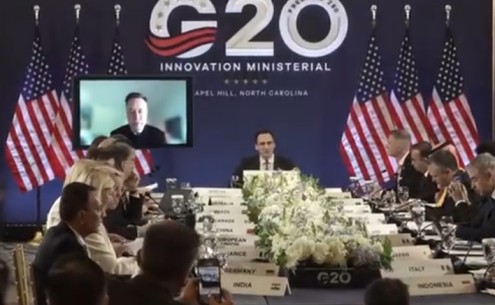
EDITOR’S NOTE: At the G20 Innovation Ministerial in Chapel Hill, Elon Musk joins other technology leaders for a discussion on how AI, robotics, and new energy sources can drive global growth. Musk argues that a permission-first regulatory environment, massive power buildout, and rapid adoption of digital and physical AI will expand the world economy by tens of trillions of dollars while humanoid robots eventually outproduce humanity. The conversation frames the United States as the center of this next industrial wave and warns against heavy-handed rules that could stall it. Read the full transcript of this meeting below:
Elon Musk on Innovation and Regulation
UNIDENTIFIED SPEAKER: Amazing. So our first speaker is Elon Musk, the CEO of Tesla and SpaceX. Elon has shown that conquering challenges of physics and engineering can be easier than cutting through red tape. And I think his dedication to doing both continues to inspire people around the world. So thank you, Elon, for joining us.
We were just wrapping up our introductory session where we made clear that under this presidency, we believe that economic growth is one of the most important drivers for all of us, and we believe that technology is a big piece of that. So you’ve been on the front lines of this for quite a while. And I think one of the key questions for the group, and something that we want to talk to you about, was: as you have driven innovation across multiple countries around the world, what in your opinion separates countries where innovators can successfully turn breakthroughs into deployed technologies from those where progress actually stalls? Because I think there’s a lot of lessons learned about what governments should be doing and what maybe they shouldn’t be.
ELON MUSK: I think a lot of people have talked about this, and I think some of it frankly is pretty straightforward. You have to have an environment that’s relatively free of regulation, meaning that new things must be default legal as opposed to default illegal. So in the EU, for example, we find that the regulation level is extraordinarily high and things are generally default illegal, and this inhibits progress with new technologies. It slows it down.
It doesn’t ultimately stop it, but it slows it down quite considerably. Of course, you need to have venture capitalists and an environment that is supportive of new companies. You can think of new companies like small saplings in a forest. So what most countries tend to do is they tend to provide too much support to the large existing trees in the forest and not enough to the small saplings. But the large trees don’t need the support.
It’s the small saplings that do — the startups. The system should be generally biased towards supporting the small trees as opposed to the large ones. But that is rarely the case, because the large companies usually have access to the leadership of the countries, and the small startups do not. You really need to foster the growth of young companies and take active steps in that regard. And like I said, make things default legal, not default illegal.
On Technology Adoption
UNIDENTIFIED SPEAKER: One question that a lot of the countries here face is a question around adoption. I think there’s a general recognition that adopting emerging technologies can be very beneficial to economic growth no matter what shape or size of any country. How do you think about adoption? What should countries be doing to encourage adoption? Does it go back to the same sort of regulatory structures, or how do you think about adoption as a key driver for growth?
ELON MUSK: I think you want to have a lean-forward, try-new-technologies approach to new technologies, as opposed to being somewhat stuck in the past. Naturally, new technologies need some encouragement, and I think should be embraced. We are going to see, and are in fact seeing, significant productivity gains from artificial intelligence, and we’ll see very dramatic gains in productivity from robotics.
Things like the Tesla self-driving car is going to be a tremendous boon, or is a tremendous burn already, to users. And I think humanoid robotics will be just an incredible change. I think, just to give you some sense of scale here, I think AI will probably increase the global economy by 20 to 30%. That’s my rough estimate — meaning on the order of 20 to 30 trillion dollars per year.
And AI will be able to do anything digital, anything that does not require shaping of atoms by hand, probably by the end of next year. So, as I’m sure people know, AI is already incredibly good at software. And it’s getting to the point where AI won’t just be good at software — it’ll be what I call Stockfish-level good. Stockfish is a chess program that can beat the world’s best chess players very easily.
In fact, at this point, you could run Stockfish on your phone and beat Magnus Carlsen at chess. So somewhat next year is my prediction: software will be so good, AI software will be so good, that it will be Stockfish-level good, meaning that it is impossible for a human to compete in writing software with AI. AI will just crush all humans at software. And I think it will be extremely good, possibly Stockfish-level, but certainly extremely good at all forms of vision and anything digital, literally in twelve to eighteen months.
I’ll just add one more thing. Toward a 30% increase of the total global economy — this is quite a lot of prosperity we’re talking about here, just from digital AI. But from robotics, from humanoid — basically think of it like a general-purpose robot AI — I think we’ll see many multiples of the global economy, meaning you can increase the economy by a factor of 10 or more. These are mind-boggling numbers.
Yes, I was just about to say that.
I mean, one of the stats we gave to the group here was that in the four years since ChatGPT was launched, we think there’s over a billion people around the world already using AI.
On Physical AI and Robotics
UNIDENTIFIED SPEAKER: There’s been very quick uptake around the world on that. I guess the question to you is — I think a lot of people think about the next chapter being in this sort of applied, or physical, AI. Where do you see robotics trending? How quickly is it going to be implemented? I remember in the first Trump administration, we were talking about automated factories, and now, a year later — ten years later —
ELON MUSK: So anything physical always takes longer than anything which is digital. Digital — it’s the software that you can easily copy across other computers. When it’s physical, you’ve got to build up an entire massive supply chain.
You’ve got to move a lot of atoms. Supply chains are very much global at this point; that’s why it takes longer. Nonetheless, when you think of humanoid robotics, I think the right framework is to consider that the usefulness of a humanoid robot, a general-purpose robot, is going to be roughly: how good is the AI software, times how good is the AI chip in the robot, times how good is the electromechanical dexterity, especially of the hands. Now, all three of those things are improving exponentially. The usefulness of the robot is those three things multiplied by each other.
Then, when you make the robots, robots will start manufacturing the robots. So you get a recursive effect. It starts off very slowly, but then it grows at an explosive rate. So if you say, ten years from now, I would say there are well over a billion humanoid robots.
And the productivity per robot will be probably five times that of a human. The productivity, in ten years, of humanoid robots — and I think this is a conservative estimate, by the way — this is what I wouldn’t be willing to put serious money betting against: that there will be at least a billion robots in ten years, and that those robots will be at least five times the output of a human, meaning the billion humanoid robots will be more productive than all humans combined.
On Power and Data Center Capacity
UNIDENTIFIED SPEAKER: Shifting gears just a little bit to a question that’s kind of facing the United States today: data centers have been a big political issue over the last six to eight months here in The United States. And I think there’s a general understanding that in order to drive and power the AI revolution that’s coming, we need to have the electricity and the data center compute capacity to do the training and the inference of all this AI. How do you think about this particular issue? Where are we on the curve of how much we’ve built versus how much we need?
And as government leaders here think about how to prepare their economies and build the right power and data infrastructure, how should they be thinking about where compute and power needs are going to be in the next few years?
ELON MUSK: Well, there actually is quite a crisis of power. If you just follow the AI topic on the X platform, which by the way is where almost all of the AI discourse takes place, I think you get a very good sense for where things are headed. That’s how I get my news, and it’s incredibly good.
Everyone who’s anyone in AI posts on X. So that’s why I recommend just go on the AI topic on X and you’ll understand all these things and get a day-by-day account of things. What the consensus is at this point is that there will be a significant power shortfall next year — not a distant future. I believe the consensus estimate among analysts that follows the AI space very closely is that there will be at least a 15 gigawatt shortfall of power in 2027 for AI chips.
So this is perhaps an obvious thing that one would expect to occur, because the rate at which AI chips is being produced has been rising incredibly rapidly. They’re rising on the order of 40 to 50% a year. But power available outside of China has been rising at 10% to 20% a year. Obviously, the faster-rising thing will eventually overwhelm the slower-rising thing. In fact, even at this point, there are challenges with power even before next year, which is why Google and Anthropic and many other companies are actually leasing compute from SpaceX, because we’ve been able to turn on AI faster than anyone else so far.
But this is by constructing our own power plants. It’s the only way we were able to do it. China does have a tremendous amount of electricity, but due to GPU export bans, one cannot establish data centers with the latest chips in China. So really, the consideration is: what electricity growth is there outside of China? And that is currently a significant shortfall relative to AI chip production.
So this creates an opportunity, I think, for countries around the world — if they’re interested in AI data centers, construct a lot of power, offer that to AI companies. And in exchange, of course, these data centers would be taxed and have to pay reasonable fees and so on. But it does create an opportunity for a lot of countries.
UNIDENTIFIED SPEAKER: Absolutely. Well, thank you so much for your time.
It meant a lot that you could join us here, and we really appreciate it. Thank you so much.
ELON MUSK: You’re most welcome. Thank you.
David Sacks on AI Regulation
UNIDENTIFIED SPEAKER: Great. Now we’ll be hearing from David Sacks, former White House AI Czar and my co-chair on the President’s Council of Advisors for Science and Technology. He’s a successful investor, and I think David understands intimately the importance of regulatory clarity and certainty for the development of new industries built on emerging technologies. So I think he’s going to join us in a second.
UNIDENTIFIED SPEAKER: Great to see you, David. How are you?
DAVID SACKS: Good. Good to be here. Thanks for having me.
UNIDENTIFIED SPEAKER: Well, we’re excited to have you here. I think you and I have worked together for a while now on ensuring that The U.S. can continue to be a home of great innovation, technological discovery. I think the opening question for you, just to set the stage a little: the core theme that the president is driving for the G20 is a return to growth. And how all of us as G20 economies can think about growth as a North Star, and particularly for this meeting, how technology can be a driver of that growth. So I guess the opening question for you is, when you think about the policy conditions that need to be in place to allow innovators to innovate, to invest, to experiment, to bring new technologies to market — how should all of these ministers here be thinking about that? What are the types of regulatory conditions we should have in place in our countries?
DAVID SACKS: Well, I think, first of all, we do have an AI boom going on in The United States. I mean, the AI boom is already here.
And I think this is a very positive thing. It’s something that we should be trying to nurture as opposed to hamstring. Just a couple of quick numbers on this: roughly 800 billion dollars is being invested in The U.S. this year on CapEx related to building out the infrastructure for AI, the compute capacity.
And that number is expected to be 1.4 trillion dollars next year. And every time I see the numbers, they keep getting revised up. We really haven’t seen a build-out of this kind of infrastructure — you have to go all the way back to the railroads in the 1800s to see something of equal scale. It’s actually even bigger than the fiber build-out of the internet.
It’s a new industrial revolution. And I think that if we harness this correctly, it’s an opportunity for The US to re-industrialize, to upgrade its power grid, to bring back some manufacturing in these cutting-edge areas, which has been a priority of President Trump. But obviously, I think it’s also something that all the other countries in the world can benefit from as well, if they lean into it.
UNIDENTIFIED SPEAKER: Yes. I think one of the things that is covered in our Carolina Principles is thinking about the policy environment that we can set up to support innovation.
And I think we have quite a diverse set of members in the G20 who think about how to approach regulation in kind of unique ways that can ultimately support their people. When you think about how, as tech ministers, we should be thinking about the regulatory construct — are there general lessons in the types of things we should be thinking the government should be working more on, or less? What is your general advice or thoughts on broad tech regulation?
DAVID SACKS: Well, I think when we talk about AI regulation, we should just first understand that we’re not bereft of regulation in this area. You hear a lot of the demands that we have to regulate AI, we have to regulate AI. Look — there’s already a lot of laws that apply to AI.
So if you talk about harms like fraud, or discrimination, or privacy violations, defective products, copyright infringement, non-consensual imagery, and many other types of harms — they’re already illegal under existing statutes in The United States, and I’m sure there are similar types of laws in other countries.
So we already think there’s a lot of laws that apply to AI. And if we’re going to build on them, we should try to build on the laws and regulatory agencies that we already have. So, for example, greater transparency, disclosures, audits — things like that might be a good idea. We also have antitrust law to prevent anticompetitive behavior by monopolies or duopolies. I think it’s a little early in the development of this market to say that that is the current situation, but we do know that technology markets sometimes have a tendency to monopolize or become duopolies.
And if that does happen, we have tools against preventing anticompetitive behavior. So there’s already, I think, a thicket of laws that apply to AI. The one approach that I think we would really oppose, that we think would be a disaster for us in The US, is this so-called “FDA for AI,” where you model a new approval process for AI models after what the FDA has for drugs, or what the FAA in The US has for airplanes. The issue there is that new drugs or airplanes take years to get approved — sometimes it’s five years plus.
Whereas if you’re talking about the AI industry, the AI companies are rolling out new models every two months. It’s just too dynamic and fast-moving for that type of approach, and I don’t think we want to hamstring our innovation that way. I’ve kind of called it — I don’t know if the ministers there will know what our DMV is, but it’s our Department of Motor Vehicles, and it’s kind of notorious in The U.S.
for taking a long time when you go to get your driver’s license or something like that. And I think that any new regulatory agency that has to approve AI product releases will become like a DMV for AI, where new models get stuck in a long queue waiting for approval. Just one final point on this: a lot of people wonder what is the secret sauce behind Silicon Valley — what has made this such a crown jewel of the American economy?
And if I had to boil it down to one principle, it would be permissionless innovation. That is really the principle that’s made Silicon Valley so successful — that you can have that founder who’s a college dropout who just creates their product in a dorm room, or two founders who could be PhD students who build their product in a garage. Two-trillion-dollar companies were founded this way. You had Meta, and then you had Google. And if those founders had to go to Washington to get approval for their products, I just don’t know that those founders would have been able to navigate the bureaucratic maze to get their products approved.
So this idea of just allowing innovation to happen, and then we regulate it later once it becomes more successful — I think that really has been fundamental to Silicon Valley’s success, and I’d hate to see us lose that through some sort of pre-approval approach.
On Data Centers and Local Communities
UNIDENTIFIED SPEAKER: Yes, absolutely. I think one last question for you is — we heard from Elon just before you, and asked him about the data center and power needs that are coming our way, both in The U.S.
and globally, to power the AI revolution. And I know you have thought a lot about this data center issue in The United States. President Trump put out a statement yesterday on data centers as well. I’d love your thoughts, and this group’s thoughts, on advice as they think about this build-out and the best way to be able to provide the infrastructure that we need for AI, but also do so in a way where we can bring communities along. So how do you think about this data center issue, both in The US and globally?
DAVID SACKS: Well, it’s certainly a hot topic today. I know it’s become controversial. Let me just make a couple of points about this. So, echoing what President Trump said — here are some facts about it: data centers, if done right, bring electricity costs down, not up, because the AI companies will generate net new power generation. That’s really the key. Obviously, if you make the AI companies compete for power, electricity, with local residents, and just plug into the grid, that could cause electricity prices to go up.
But if you allow them to generate their own power, then they will not only generate what they need — and they can do that so-called “behind the meter” — but they can actually contribute the excess back to the grid, and that brings electricity costs down. It also provides, you could say, the sponsorship to make a long-needed grid upgrade — it provides the investment to do that. So I think that, again, if done right, what we’re seeing is that local communities benefit from these data centers. We’re seeing hundreds of thousands of new construction and skilled trade jobs as a result of them.
And we’re seeing that counties that embrace data centers are seeing reduced property taxes. For example, residents of Loudoun County in Virginia in The US are paying $6,000 less on average in property taxes because they have the AI companies picking up that tab. Now, just one last point on this: even though I think the administration, and President Trump, have pointed out the ways in which data centers can be a very good deal for local communities, we haven’t done anything to try to force local communities to accept data centers they don’t want. I think I’m seeing some fake news around this.
Michael, as you know, because we worked on our national AI policy framework, and then the President signed an executive order in December of last year — the President expressly said in his executive order that the federal government should not preempt the decision of states with respect to data centers. It is fundamentally a local decision, and we respect that, and have done nothing to change that, even though we do think that ultimately there is a good deal to be had there for local communities if they lean into it.
UNIDENTIFIED SPEAKER: Absolutely. Well, thank you so much for your time, and it means a lot that you could join us today.
DAVID SACKS: Really appreciate it, Michael.
UNIDENTIFIED SPEAKER: Thanks, David.
DAVID SACKS: Thanks for having me. Thanks.
Bob Mumgaard on Fusion Energy
UNIDENTIFIED SPEAKER: And for our last speaker, it is my privilege to introduce Bob Mumgaard.
As the Co-Founder and Chief Executive Officer of Commonwealth Fusion Systems, the world’s largest fusion energy company, Dr. Mumgaard is the perfect person to talk to about the full life cycle of emerging technologies and moving innovation from experiments and laboratory to commercialization and world transformation. So thank you so much for joining us, Dr. Mumgaard.
BOB MUMGAARD: Glad to be here. Thank you very much.
UNIDENTIFIED SPEAKER: Doctor, gracias. Wonderful. Well, in the Carolina Principles that the G20 nations have agreed to, we outline how governments can accelerate the development of emerging technologies.
And I think what’s so unique about your technology is, years ago, there wasn’t a lot of private sector investment in it. How do you see the policy decisions in The US, or the policy environment here, having allowed you to raise capital to build and to ultimately develop fusion tech?
BOB MUMGAARD: Right. So, fusion tech, it doesn’t suffer from a market pull issue. In the future, we know that intelligence and energy are the drivers of the economy.
So there’s plenty of people that want advanced energy technologies. Those markets are well established. But the barrier to creating products in those markets is: how do you take deep science, how do you couple that with capital, how do you put that into organizations that can both stay true to that science, build on it, scale, and get to the point where they can demonstrate meaningful results and eventually a product?
And these products are billion-dollar-level products. These are not consumer-grade or software products. As Elon said, moving atoms is very, very different than moving bits, and moving atoms at 100 million degrees is different than just moving atoms. And so that requires a really well-tuned innovation environment. You have to have the capital sources.
You have to have the scientific expertise. Then you also have to have the grease, the glue, that the government can provide to string that together. So in the fusion industry today, there’s over 50 companies, over 14 billion dollars of private investment. If you go back ten years ago, that did not exist at all. And of that 14 billion, the vast majority of that, and of the companies, is in The United States.
And CFS — we’re the largest of those, about 4 billion dollars — and we’re building a facility outside of Boston that, in the previous generation, would have been like a Manhattan Project, government-sized facility. The reason that’s been able to happen is because the government has been a partner in this, not a restraint. So a couple of examples: one, on the regulatory side — how do you license a fusion power plant? That was, four years ago, a completely untested question.
And it would have been easy to say, well, let’s figure all that out exactly and build a whole new structure, all upfront, that was very prescriptive. That would have been wrong, because we don’t know what this technology is at the detailed level, but we do know enough to protect the public. So instead, we said, in The United States and The UK, let’s look at the hazards. Let’s take the closest relevant example that ever exists — in our case, particle accelerators — and make sure fusion fits in there, and provide the certainty that regulation is not going to stop this at the infant, early stage.
We’re going to have enough room to be able to get the first products out. And that gave the certainty to investors to put billions of dollars into this, by removing an obstacle that everyone has seen in advanced new technologies before. Another piece of this was taking the existing publicly funded research that has built up expertise, and finding ways to partner with that between the private and public sector. It would be easy to say, well, the government should go and build the first generation of power plants. But that’s a path to nowhere.
Those power plants never make it to the market. We sort of throw it over the fence, and there’s no one to catch it. Instead, we can say, let’s take the expertise that’s been developed, and through public-private partnerships, provide access to that expertise in ways that preserve intellectual property so that companies can form and build on top of that. Let’s make it so that the capital, some help for the earliest ideas, can flow into the bigger ideas that can attract additional private capital on top of public capital. And that bootstraps up almost all of The US fusion companies.
On Fusion Timelines
UNIDENTIFIED SPEAKER: Yeah, no, I think that’s a really great point. I think one that we stress a lot is that as these new technologies start to be commercialized, the knee-jerk reaction of regulators should not be to create entirely new constructs for regulating them, but to think very carefully about what regulations are already on the books that can apply to that particular technology first. And I think David made that point; I think Elon, to some degree, made it.
I guess maybe the last question for you — and I think something we’re all curious about — is timelines. With fusion, that’s always been the question historically. We’ve had two important conversations with David and Elon about how important power is going to be for the AI revolution that is here, and is only going to be accelerating in the years ahead. Obviously, having fusion as part of the energy mix would be one of the greatest unlocks in human history. So all of us are eagerly awaiting commercialization.
So how do you think about it? And when do you see the real impact happening on our grid?
BOB MUMGAARD: Well, the first is to avoid the fallacy that the past is prologue. We’re dealing with a situation today in fusion, and other advanced physical technologies, where the tool set that’s available to the innovator is just so much broader and deeper than it was even five years ago. And so when we look at what we can do with large-scale compute, with AI, with advanced materials, but also what we can do with how we organize ourselves —
what, who all do you pull into the tent? What’s their previous experience? How have they been trained? That’s a whole new generation of people. And when you put those two together, we’re seeing that you can drastically accelerate things that we used to think took a long time.
We saw that course first in software. We’re seeing it now in large-scale compute and AI — things that even six years ago, we thought were a long way off. And so we shouldn’t deceive ourselves into thinking that things have to go slow. Now, when you look at the timelines that are happening, it’s basically: how fast can you build things? So we are just finishing up this facility in Massachusetts, and we’re getting ready to start the first commercial power plant construction in Virginia, just up the road from you.
And so that could put fusion on the grid in the early 2030s. There’s a lot of technology that has to be worked out as we go, but the tool set is well adapted to that technology. If we plan for a longer horizon — say fusion is not going to be here until the 2050s — like, we’re not going to go faster. We’re going to make it happen in the 2050s. So we should plan for the most aggressive speed we can do, and bring all the tools to bear on that.
And I think The US has done a good model of that, and it’s an example around the world where we’re seeing countries shorten up their timelines for fusion, systematically, year over year, as they see the progress primarily happen in The United States.
UNIDENTIFIED SPEAKER: No, I think it’s been incredible to see, and the amount of private sector investment in the industry has been unbelievable. And I think for any of you who have extra time in The United States, I highly recommend you go visit Bob. Outside of Bob, it’s truly incredible what is being built by our private sector.
So thank you so much for your time. It means a lot that you could join us here today.
BOB MUMGAARD: Thank you.
UNIDENTIFIED SPEAKER: So I think we’re going to let press flow out, and then we can have our closed-press discussion as a group.
Related Posts