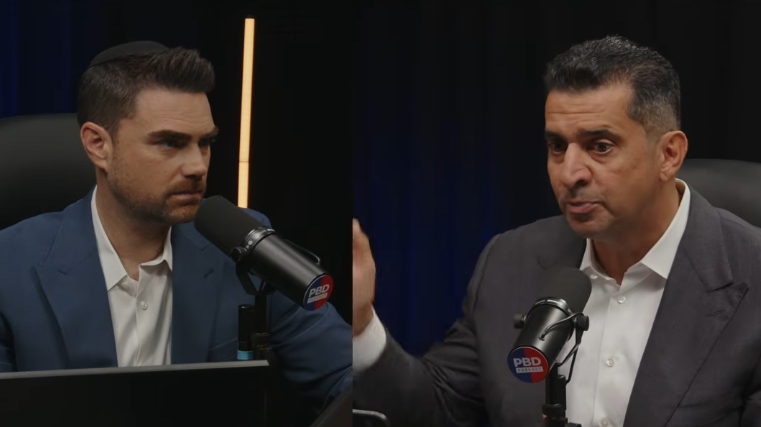
Read the full transcript of political commentator Ben Shapiro’s interview on PBD Podcast #842, August 12, 2026.
EDITOR’S NOTES: In this episode of the PBD Podcast, Patrick Bet-David sits down with Ben Shapiro—one of the most influential voices in modern conservative media and co-founder of The Daily Wire—for a candid conversation at a pivotal moment for the American right. They explore the growing fractures within the conservative movement, Shapiro’s biggest personal and ideological blind spots, and what the battle for the future of conservatism may look like heading into 2028.
Reconnecting for a Third Conversation
PATRICK BET-DAVID: Yeah, we’re doing this. So I know the first time we sat down was in your LA studio in 2018, right? And then, that was the podcast we did when I asked you, I said, so who do you think is going to be president in 2020? You said, I think Joe Biden’s got a chance of becoming president. And then next time around I came to you, we did a podcast in the great city of Boca, and then we’re doing it here, part 3, with the two of us. So I appreciate you making the time to come down here.
BEN SHAPIRO: I appreciate it. And I think very cool studio, by the way.
PATRICK BET-DAVID: Well, thank you. You guys were playing basketball right before. You guys need to know this, Ben asked for tissue because in case he gets emotional, so we brought him some tissue. Adam was here since 4 o’clock in the morning waiting for you. He doesn’t get here at 9 o’clock, but he wanted to see you.
But, open question for you to think about. When I talk to kids, when I talk to folks who are in their 30s or 40s, and I’ll say, what was your transition of becoming a conservative? I used to be a liberal and all this stuff. I don’t know how many of them will tell you, I watched Ben Shapiro. I was watching Ben Shapiro, who was the OG guy on campuses before Crowder or Charlie, was Ben.
The first time I watched him on Piers Morgan a month after Sandy Hook when he talked about, hey, it’s not about the semi-automatic weapons, why don’t you take the guns? And you brought him the Constitution. Oh, that went viral, right? Or, hey, the guy that puts his arm on your shoulder and you said that’s mildly inappropriate. Transgender over Caitlyn Jenner. And I think that was Dr. Drew. And then the physicist — I’m a mathematician, you are not a biologist. All these clips that would go.
So you were a hero. You were the guy that people looked up to. You were the guy that people would share with others and say, this is why I’m a conservative, watch this guy. And then all of a sudden, an evolution happened after October 7th where you went from being the hero to, on the conservative side, you became a villain a little bit to some of the folks — to a certain segment for sure, not all of them. You still have a massive following that people follow you.
What do you think was that turning point of going from the guy that everybody looks up to and shares to all of a sudden, wait a minute, is this guy a villain? Is this guy on my side? What do you think happened there?
BEN SHAPIRO: Well, I think that there’s been some underlying fragmentation in the conservative movement that you’re seeing reflected all over the place. I’m not sure there’s anybody who’s now sort of acclaimed as a universal hero inside of conservatism.
PATRICK BET-DAVID: I agree. Used to be Charlie, right?
BEN SHAPIRO: It was Charlie, right? But even Charlie had people who disagreed with him. And the truth is that if you went back to 2017, 2018, Tucker was a hero to everybody. If you went back to 2017, 2018, Trump was a hero to everybody, right? The reality is that as these tides of politics move, there are moments when a movement starts to crack up or fragment, and it’s easier, I will say, for people to be unified in opposition.
So when Barack Obama was president, which is when some of this stuff was happening — Sandy Hook was 2012, the appearance on Piers Morgan was 2013 — being in the opposition tends to unify you. Being in power tends to disunify you. And so when that happens, you start to see a bit of a crackup.
As far as the 2023, 2024 of it, I think that there was a lot of roiling inside the conservative movement about what the future of the conservative movement was going to look like, because President Trump is a pragmatist. He doesn’t have a set of ideological values for everybody to gather around. He’s also sui generis, meaning that his brand encompasses everybody. I can vote for him and Tucker could vote for him, right? So he was open to interpretation by everybody. And so all of those politics were roiling under the surface.
After October 7th, when I spoke out very strongly about Israel and Hamas and the position of various parties in the Middle East, I think that some of my detractors saw an opportunity to latch onto my position on that and then try to make the claim that the predominant feature about me, despite the fact that I’ve been doing this since I was 17 years old, was focus inordinately on Israel. I think some of that was code for “he’s Jewish.” But it doesn’t really matter. People can think what they want to think.
My positions have been exactly the same for about 25 years. I think the thing that people don’t maybe know about my career trajectory — because most of them got acquainted with me in like 2013 — I’ve been in this since 2004.
So I’ve been doing this since I was 17. I’m now 42. That is a very long arc. And so you see times when you’re the hero, you see times when you’re the villain, times when you’re unknown, times when you’re known. I think it’s a little bit much to expect that you’re always going to be the universal hero in every circumstance. And again, politics is necessarily oppositional. When people watch a clip of me on a college campus dealing with a wokester, it’s very easy to say, ah, I’m rooting for that guy. But what do you do when you have to take a nuanced or complex position about what America’s foreign policy ought to be going forward in the bloodiest region of the world, or where do we go from here in terms of our economics? That’s a debate that’s getting very little coverage, but is actually very core to what’s happening right now. I’m very much free-market oriented. Many of the people who are against me are very much not free-market oriented. These are open debates.
PATRICK BET-DAVID: Is that true?
BEN SHAPIRO: Tucker does not like free markets.
PATRICK BET-DAVID: Okay, tell me more.
The Break With Tucker Carlson
BEN SHAPIRO: I mean, by any stretch of the imagination. Actually, my first indicator of serious political disagreement with Tucker — he was on my show in maybe 2018, and his book was, I’d say, very negative toward innovation and capitalism in general. The idea he had said on the air, I believe by that point, or he would soon, was that capitalism is just a system put in place by powers that be, and the economy needs to work for us — which to me is left-wing language, because when I’m thinking about how the economy works, there are basic realities of human nature. We are acquisitive people, we are creative people, we wish to own the property that we produce. Based on those fundamental truths, you get property rights in a free market economy. And when you encroach upon those fundamental truths, what you end up with is a form of statism.
So in that interview, I asked Tucker specifically, because he’d written about this in his book, about self-driving cars, because he had said that he was anti-self-driving cars because it would take away trucker jobs. I asked him, would you ban self-driving vehicles? And he said yes. I was a little surprised by that because I’m of the opinion that self-driving vehicles are one of the great inventions to come along in the last 50 years. They’re incredible.
My father is 70. A few months ago he got hit in a car crash. He’ll be fine. But when he went to get a new car, I told him, you’re 70 years old, you should get a Tesla because it’s self-driving and it’s going to perceive things on the road, particularly at night, that you’re not going to be able to perceive. It’s amazing. And he’s much safer now. And the truth is, obviously, self-driving cars, if we all had them, would radically cut down on the amount of motor vehicle death in the United States. Tens of thousands of people die in car accidents.
So I said this to Tucker: on what basis would you ban self-driving cars? And he said, on the basis of safety. I said, well, Tucker, they’re safer than human drivers. And he said, you asked me on what basis I would ban them, not what’s true. That does not bespeak, shall we say, a faith in innovation.
He’s part of a movement that has arisen on the right that basically says capitalism empties the soul. It’s an almost Marxist materialist conception of the universe where economic circumstances are supposedly responsible for your spiritual fulfillment. And as a very religious person, I don’t think that’s true. I have ancestors who were poor. I have ancestors, I’m sure, who were rich at some point. People were forming families under a wide variety of circumstances. Many of the most impoverished places on earth have high levels of family formation and child rearing. There are lots of places that live under tyranny where people are getting married and having children. And there are lots of places like the United States where for a long period of time capitalism was the predominant way of life and people were getting married and having children. The attempt to say that the government’s job is to get involved in creating a spiritually fulfilling life for you, and that it’s somehow a shortcoming of economics if you’re not spiritually fulfilled — I think these are category errors.
PATRICK BET-DAVID: Do you think, like the way you said, I’ve been like this for 25 years, and I’ve been at it since ’04 — do you think Tucker’s always been like this, or did he become like this?
BEN SHAPIRO: You know, I hesitate to speculate about what people secretly believed. I can only speak to his public statements. I know that he was not oriented toward capitalism since at least the mid-2010s. As far as his orientation on foreign policy, that seems to have shifted and moved over time in a wide variety of ways. All I know is that right now I think he is spewing an enormous number of untruths about the state of the world and conspiracy theories about systems that are rigged against you by nefarious powers, most of whom seem in his mind to have conflated with Israel — which again, I think is part of the underlying tenor of a certain level of politics on the right.
The Israel Question
PATRICK BET-DAVID: So let’s go to the Israel topic. When the Israel event happened, October 7th, you came out, you had your statements that you made, then the Candace situation took place, and that went on for a while. And then Charlie Kirk — I think we’re coming up to the one-year anniversary in about a month or so.
BEN SHAPIRO: Yeah.
PATRICK BET-DAVID: And we all remember where we were there. Do you think the Israel topic is still as big of an issue as it was during October 7th? Meaning in the 2028 election that comes around, do you think it’ll be one of those topics where people are going to say, hey, are you pro-Israel? Or do you think that’s probably going to play a role?
BEN SHAPIRO: No, I think that it’s going to continue to percolate. Because many of the theories about what Israel is in the world are not actually connected to the reality of what Israel is in the world, which is a fairly small state, and by regional standards, a very small state, located in one of the most violent areas of the world with a robust economy and a significant military capacity.
And the rumor about Israel that people have been putting forward is that Israel controls our politics — that everything happening from a Moroccan migrant invasion of a Spanish city to how people vote on economics to the NYPD, all of that is being manipulated by Israel. That’s just conspiracism.
PATRICK BET-DAVID: Well, let’s do this. To me, I think there are three camps. There’s those that anything happens, it’s Israel — it’s like the same as anything happens, it’s Trump, anything happens, it’s socialists. So there’s a camp here, and they lack the ability to reason. Then you’ve got the guys that say nothing is Israel’s fault. I think both of them have a problem here. Both these camps have a problem.
BEN SHAPIRO: I would say those are not equivalent problems, but sure. One of those is closer to the truth and one is much further from the truth. I’m not saying nothing is Israel’s fault — obviously Israel is a country that makes mistakes and does bad things like any other country. But if you’re talking about a spectrum: if I were to say there are two camps, one says Nigeria is responsible for literally all of our problems, and one says Nigeria is responsible for none of our problems, both of these are untrue. These are not equal levels of untruth.
PATRICK BET-DAVID: I don’t know if I’m putting equal, but I’m saying that both of them lack reason for me. They both lack the ability to reason. If you can’t sit there and say this guy’s 100% innocent, he never does anything wrong, this guy’s 100% guilty, he does everything wrong — I have a hard time hearing you. Both camps, they lose a guy like me. Then I get to a guy in the middle. The fact that they’re out there, fighting the tough guys around them, you have to worry about Iran, you have to worry about this small little place. These guys have been surviving their entire lives. They’re a little bit more paranoid than us, a little bit more careful of what’s going on. Imagine if your neighbor wanted to kill you all the time.
That’s a good argument. And then the other side is, well, they got a hold of politicians — instead of taking the money and maybe winning the youth over, they took the money and tried to win over politicians. AIPAC comes up, all these things that come up, right?
BEN SHAPIRO: Right.
PATRICK BET-DAVID: And then you’ll say, well, it’s really Bibi. Bibi’s the guy we got to get rid of because Bibi is a fanatical — you heard what Mamdani said about Bibi, if he comes to New York, this is what I’m going to do. Then he realized he can’t do any of it. So talk to the reasonable community in the middle. I can’t hear these guys, I can’t hear anything they’re saying. But to the reasonable community in the middle, they’re like, look, I get along with Jews, I do business with them, it’s easy, they’re very good business people. But I also realize they’ve got certain motives they’re trying to protect. What did Israel do wrong, or Bibi do wrong, or the Jewish community do wrong on the right? Not the ADL — that’s a very different game. I’m talking specifically conservative Jews, or Israel, or Bibi. What did they do wrong to all of a sudden get blasted on social media by the youth the way that they did the last couple of years?
BEN SHAPIRO: Again, I will say that I think to discuss Israel outside of the context of the broader political environment in which conspiracy theories are rife would be a mistake. To say that Israel is driving, for example, Tucker Carlson to become radically anti-Israel — that Israel did something different October 8th than it had done October 6th, and that’s what drove Tucker Carlson to where he is, or Candace Owens to where she is — I just don’t think that’s true. As far as things Israel has done wrong, are we talking internally or externally? I could name a dozen problems inside of Israel.
PATRICK BET-DAVID: Give me any direction you want to go.
BEN SHAPIRO: Okay, fine. Internally, Israel has major problems, including the fact that they have an entire sector of the population that is ultra-religious that refuses to serve in the army, and that’s terrible. That’s an internal Israeli problem.
PATRICK BET-DAVID: They refuse to serve in the army?
BEN SHAPIRO: Yes. This is probably the number one issue in Israel and explains a lot of the chaos you see inside the Israeli government, and also the reason why Bibi leads a coalition that is very unpopular in Israel but also can’t be electorally defeated. The thing people should understand about Bibi is that if Bibi did not exist, the Israeli government would be following essentially the same playbook. In fact, the people who are running against him right now in an election slated to happen in October are running to his right.
PATRICK BET-DAVID: They’re running to his right?
BEN SHAPIRO: Yes, that’s correct. Gadi Eisenkot, Naftali Bennett. There’s a perception in American politics that Bibi is a radical right-wing figure. In Israeli politics, Bibi is actually slightly right of center and quite incrementalist in his approach. One of the big critiques of Bibi has been that he actually hasn’t gone hard enough — for example in Lebanon, or in Gaza — because the idea was you should move faster and get fewer Israeli soldiers killed.
PATRICK BET-DAVID: And these are the people further right than Bibi who are not happy with the actions he took?
BEN SHAPIRO: Even the people campaigning theoretically to his left, like Naftali Bennett or Gadi Eisenkot, on foreign policy are actually where he is or to the right, because the entire Israeli population has reacted to October 7th by saying we’re not going to take a defensive step backward — we’re going to lean forward and preemptively hit threats, we’re not going to wait for those to materialize.
PATRICK BET-DAVID: So stay on that. What percentage of the population, of the people running, are aligned on that topic?
BEN SHAPIRO: On that topic?
PATRICK BET-DAVID: That we should have reacted even stronger?
BEN SHAPIRO: In different ways, to Iran, to Lebanon — I would say there is a coalition that represents probably 80% of the population that is somewhere between just barely to Bibi’s left all the way to his right.
PATRICK BET-DAVID: Wow.
BEN SHAPIRO: So there’s widespread agreement on foreign policy in Israel. There are a couple of fringes that don’t agree. I’d say the Arab population of Israel is one, which is about 20% of the population there, and there’s a left-wing party run by Gideon Golan.
So those are internal problems in Israel. Then there’s how Israel has addressed the world. I would say that Israel is operating in a mode that, when it comes to PR, is past its sell-by date. They’ve continued to try to make a moralistic argument with regards to foreign policy that I don’t think has a lot of traction in a world where people are significantly more realpolitik in their approach.
I’ve said this openly: I think the reasons the United States ought to be allied with Israel — obviously there’s moral alignment with a democratic state allied with the United States, literally flying planes alongside the United States against common enemies like Iran. But put that aside — the real reason we ought to be allied with Israel from a realpolitik standpoint is that Israel is an extraordinarily technologically advanced military power in the region that has oversight and overwatch in a bunch of other areas where terrorist groups percolate. Israel’s intelligence-gathering capacity is extraordinarily high. Israel acts as what some generals have called a non-floating aircraft carrier for the United States.
And if you’re going to talk about aid to Israel, I’ve been talking about phasing out aid to Israel for probably 20 years. So that really is not the issue. Why? Because I think it’s good for our allies to be militarily capable on their own. Israel has enough of an economy to support itself. In emergency situations, obviously — like post-October 7th, when you have to ramp up your defense because you’re on a war on seven fronts — the United States very often will fund our friends and allies. We did that in Ukraine. I was an advocate of funding Ukraine, by the way. That’s another unpopular position on some parts of the right.
PATRICK BET-DAVID: You were for funding Ukraine?
BEN SHAPIRO: Absolutely, 100%, because I think the Russians are our enemies, and I think the Russians do not have America’s interests at heart.
PATRICK BET-DAVID: Which, by the way, in a weird way today you’re seeing conservatives who would have never defended Zelensky defending Zelensky now, because they’re realizing Putin was giving different military bases of the U.S. to Iran. They were given that intel, and that’s caused folks to unify against Putin.
BEN SHAPIRO: This sort of bizarre willingness to look over or hug Putin for years is bizarre to me. I’m old enough to remember when Mitt Romney was saying that Russia was the number one geopolitical threat to the United States, and the right was totally unified about that. And then that went away. One of the things I’ve learned about politics over the last 15, 20 years is just how reactionary everything is. Everything is bouncing off of something else. Very few people in the political sphere have the same principles they did when they were 17.
I think that if there’s something that separates me from other pundits, it’s that if you look at the through line of what I’ve believed since I was 17 years old, it’s basically the same. Nobody ever looks at what I say and goes, man, when did he change, when did that happen? I’m the same guy I was in 2013, 2014. So when you ask what made me more unpopular post-October 7th, it’s not as though I hadn’t said anything on October 8th that I’d never said before. That’s silly.
Hero or Villain?
PATRICK BET-DAVID: Do you see yourself as a villain right now, or do you see yourself as a hero right now?
BEN SHAPIRO: I hesitate to label — I see myself as the same person I always was, speaking truths that I think are important. How people perceive me is of very little relevance to me.
PATRICK BET-DAVID: Why are you an easy villain for a lot of people on the right right now? Specifically the youth — why are you an easy villain?
BEN SHAPIRO: I think there is a tendency to blame external actors for the problems in your life. And there’s something fun about the idea that your problems are not your fault. If there’s one message I’ve been perfectly consistent about — and there are many — but this is the number one message: most of your problems in your life are solvable by you. This is an unpopular political message. It varies very strongly from people like Tucker, who says that most of the problems in your life are the fault of somebody else and are unsolvable, maybe altogether.
PATRICK BET-DAVID: We’re on the same page with that message.
BEN SHAPIRO: But it’s becoming an increasingly unpopular message, which I think is tragic. If there’s no one left in American politics who says most of your problems are solvable — you live in the freest system in the history of mankind, the most prosperous system in the history of mankind, and you’re sitting there complaining because you don’t want to make decisions that will make your life better. That doesn’t mean we can’t do things politically that will alleviate some of the roadblocks. That’s the job of politics. But most of your successes or failures in life, like 97% of them, are going to be up to your personal decision-making.
I’ll give you a villain moment. One of the things I said — I was on Konstantin Kisin’s podcast —
PATRICK BET-DAVID: They do a great job, by the way.
BEN SHAPIRO: Yeah, he’s great. The Triggernometry guys are really good. We were talking about affordability in New York. One of the things I said is: there are things you could do to alleviate housing prices in New York somewhat. New York is a limited piece of territory that is very highly built up. You’re not going to double the housing stock in New York — it’s not going to happen because there’s not enough space. So if the rent is too high there for you, and you’re a young person who doesn’t have a job that can pay for the rent, if you want to improve your life, you might think about moving out of New York.
I thought that was relatively uncontroversial. I’ve moved many times in my life in pursuit of a job, in pursuit of a better career opportunity. That was kind of the norm, and I thought that’s how you pursue success — if you’re not succeeding in a particular situation, look for another situation in which you can succeed.
This became uber viral because the idea was that I was telling people they did not have a right to live where they grew up. Listen, you have a right to live where you grew up, but you don’t have a right to not pay rent there. You don’t have a right to a $200,000 salary.
PATRICK BET-DAVID: Who criticized you?
BEN SHAPIRO: Tucker was very heavy on this. He played this clip. This went very viral online — a huge percentage of the right was trying to make the argument. And then it telescoped into an issue where — because I’m wearing a yarmulke — there’s something to the targeting. They tried to telescope it into Israel. The first thing my opponents did is they lied about what I was saying. They said I said you have no right to be where you grew up, which is not what I said. And then they said, but you have a right to be in Israel — you have a right for Israel to exist, but you don’t have a right for America. What in the world are you talking about?
PATRICK BET-DAVID: Is this the clip?
BEN SHAPIRO: Yes.
PATRICK BET-DAVID: Okay, go for it.
“If you’re a young person and you can’t afford to live here, then maybe you should not live here. That is a real thing. I know that we’ve now grown up in a society that says you deserve to live where you grew up, but the reality is that the history of America is almost literally the opposite of that. The history of America is you go to a place where there is opportunity. And if the opportunities are limited here and they’re not changing, then you really should try to think about other places where you have better opportunities. If you’re a young person and you can’t afford to live here, then maybe you should not live here.”
PATRICK BET-DAVID: You can pause it. So that’s what you got heat for?
BEN SHAPIRO: Yes.
PATRICK BET-DAVID: Because you’re asking people to leave where they can’t afford to live?
BEN SHAPIRO: Correct.
PATRICK BET-DAVID: I mean, that’s what everybody’s family’s ever done.
BEN SHAPIRO: I know, but it’s stuff like that.
PATRICK BET-DAVID: So who villainized you? Who was on your side? Who looked at this and said, what a jerk Ben Shapiro is?
BEN SHAPIRO: Well, I believe Tucker has used that one a lot. He’s also used a clip where I talked about how I think it’s better for people to retire later, unless you have backbreaking labor and physical problems.
PATRICK BET-DAVID: And that one can actually be debated.
BEN SHAPIRO: What I was speaking about there was the idea of life fulfillment. What I was saying is it’s actually a bad idea in life to think that you’re going to hit 65 and go golfing and be on the beach for the rest of your life and be happy. There’s no social science data to back that. You need a feeling of—
PATRICK BET-DAVID: Somebody can twist that and say, you want me to live till 75 years old? I’ve even made the argument further than you on that one — I’ve said I think we need to raise the Social Security age from 65 to 72, because you can’t afford it.
BEN SHAPIRO: So that’s exactly what I was talking about in that clip. But go back to—
PATRICK BET-DAVID: That’s not a popular issue. You’ll never win on that.
BEN SHAPIRO: Correct. But the idea is, if this is the stuff that makes me unpopular on the right — how many of these people are on the right? This was traditional conservatism. Traditional conservatism was the idea of free market economics, personal responsibility, virtue, and recognizing the shortcomings of the welfare state. These were all traditional conservative opinions. People today were suggesting — I think it was Dave Smith — that I was on the left. There’s not a single position on which I am somehow to Dave Smith’s left. That’s a bizarre characterization.
PATRICK BET-DAVID: Where are you at with gay couples adopting kids? What’s your position there?
BEN SHAPIRO: I think that is not good. I’m against that.
PATRICK BET-DAVID: You’re against that? Has that always been the case since ’17?
BEN SHAPIRO: Yes. I literally was on Joe Rogan talking about how I would not attend a gay wedding. He did an entire episode on it. He could Google it.
PATRICK BET-DAVID: You wouldn’t attend a gay wedding?
BEN SHAPIRO: Correct. I’m a religious Jew. I would go to — I have gay friends who have adopted kids or surrogated. I’ll go to their house, they’re my friends. But do I think that what they did is morally right? No.
Again, one of the things people have a bit of a tough time understanding about where I’m coming from is that my political stances are not consonant with — that does not obviate me being a decent person to people with whom I disagree. I’m friends with a lot of people I disagree with, it turns out. I’m not a child. I can be friends with people I disagree with. I can treat them well. And also, why are people looking for my moral imprimatur? This is the thing I’ve never really understood.
People like Joe got very upset at me on one episode — I think it was the second time I was on his show — because I said I wouldn’t attend a same-sex wedding. My question to him was, why do you want me at your same-sex wedding? Do you need my moral imprimatur for your lifestyle? I don’t need your moral imperatives for my lifestyle. If you said, I don’t respect your marriage, I’d say, okay, and? Can’t you be confident in your own choices enough that you don’t need mine? I’m not the one stepping in and telling you you can’t do X, Y, or Z. My perspective on marriage — on gay marriage — is that the state has an incentive for people to get married and have children. That means there’s an additional incentive for heterosexual couples because they get married and have children.
Role Model, Not Popularity Contest
PATRICK BET-DAVID: Do you remember, back in the days, Charles Barkley had that commercial, “I am not a role model”? Do you think, in the position you’re in as an influencer, you are a role model? Should you play a role model?
BEN SHAPIRO: Yes. Yes.
PATRICK BET-DAVID: Tell me more.
BEN SHAPIRO: Okay, so I am a married father of 5.
PATRICK BET-DAVID: Congratulations on the 5th.
BEN SHAPIRO: I appreciate it. I’ve lived as clean a life as it is possible to live, and I say that with pride because that’s a series of decisions. Now again, I was given the ultimate privilege, which is great parents. That is the ultimate privilege — not white privilege, not economic privilege, the privilege of awesome parents. I grew up in a small house in Burbank, California, about 1,100 square feet, with 3 younger sisters. We all shared a bedroom until I was 11, and we had 1 bathroom for 6 people. We weren’t economically privileged. We were probably middle, lower-middle class.
PATRICK BET-DAVID: What high school did you go to?
BEN SHAPIRO: I went to a Jewish day school. But I was in and out of public school — I went to public school from 1st through 4th, at Edison Elementary in Burbank. I skipped 3rd. Then I went to a Jewish school for 5th and 6th. Then I went back to public school, Walter Reed Middle School, for 7th and 8th. I was in the IHP program, the magnet program. And then I went to a Jewish day school that my parents were on scholarship for, for 10th, 11th, 12th — I skipped 9th. So I graduated high school when I was 16. Then I went to UCLA for college and then Harvard Law.
All of that is predicated on trying to make good decisions. That’s why I put a lot of focus on good decisions — there ain’t no substitute for it. When I’m speaking to people as a role model, I feel it incumbent on me to try to tell the truth about things, even when it’s unpopular.
One of the things I’ve noticed about a certain number of people critical of me is that if I criticize them, their defense will be, well, look at my numbers, look at how many clicks I’m getting, I’m more successful than you. That has never been something — I have never measured morality by popularity. It isn’t. I’m glad a lot of people listen to me, I prefer that more people listen to me than fewer, but I’m not going to change any of my moral precepts based on the number of people who listen to me. If it’s one person or a million people, I’m the same.
PATRICK BET-DAVID: Who do you think has shifted based on clicks?
BEN SHAPIRO: Without directly ascribing motivations, people who definitely have shifted their perspectives and cite their clicks a lot — Megyn Kelly is the most obvious example. Tucker, I don’t know whether it’s genuine or whether he’s just aiming for clicks, but he’s changed a lot of his positions, and he will very frequently cite statistics about his listenership or viewership as defense.
Piers Morgan does it too, but I don’t expect anything from Piers because that’s what Piers is. Piers is not particularly a political creature. What’s funny about Piers being angry at me is that he’s angry at me for saying something he kind of admits is true — I said he’s basically the Jerry Springer of political talk, because that’s what he is. It’s like a 5-person panel: here’s Hitler, here’s Air Bud, here’s a left-winger, here’s some crazy homeless hobo screaming from the street, and now let’s have an open and honest conversation. Again, that’s his business model. Good for you, you can do it.
PATRICK BET-DAVID: Robert Downey Jr. used to do that 30 years ago.
BEN SHAPIRO: Exactly. And then he’ll say he respects Jerry Springer, but then he’s angry at me for saying that. And he’ll say I owe him an appearance on his show, which I don’t. If I don’t want to come on your show, I’m not going to come on your show.
PATRICK BET-DAVID: Some people may say Piers had a position defending Israel, then all of a sudden — I don’t know which podcast — he changes the position and says, you know, I saw a good argument, this is not fair what Bibi is doing. Some people may say he has the ability to see a new argument and adjust his positions. What would you say?
BEN SHAPIRO: I’d say that mostly what Piers acts like on his show is a slightly foolish child who is just discovering the world anew every day. Whatever puts him in the position where he can assume moral superiority in any conversation, he’ll take. I don’t think there’s any consistent through line.
PATRICK BET-DAVID: Do you think there’s a net positive to society with Piers Morgan’s show?
BEN SHAPIRO: It’s hard for me to say yes, but I also don’t think there’s a net positive to society for most of social media. If I could hit a red button and make social media disappear tomorrow, I probably would.
PATRICK BET-DAVID: Would you really?
BEN SHAPIRO: Yeah, absolutely. At great personal cost to myself, sure.
PATRICK BET-DAVID: Because of what?
BEN SHAPIRO: Because I think it’s made people stupid. I think nobody reads a book anymore. I think people don’t have any depth of knowledge on issues about which they speak. They go to sources who don’t know what the hell they’re talking about three-quarters of the time. Even those kinds of shows have now been telescoped down to 30-second segments on YouTube Shorts or TikTok. I think the attention span of the public has been radically reduced, and I think people are frankly dumber in their engagement with politics than they were when I was growing up. And I don’t think they were particularly smart when I was growing up, so I think it’s really gotten bad now.
The Fracturing of Conservative Media
PATRICK BET-DAVID: I like the debate, I like seeing the conversation because I think that’s a good thing. One thing that made Charlie [Kirk] — I went to AmFest a few times and spoke a couple times there, and I would see he was able to bring guys and talk. One time Dave Smith went against — what’s the guy’s name — Josh Hammer.
BEN SHAPIRO: Josh Hammer.
PATRICK BET-DAVID: I thought it was great that he had the courage to bring the guys to do it. And I know one time you went up — this was about a year ago, maybe in December — where you called out Megyn Kelly. And that’s when everything started, after you called out Megyn Kelly.
BEN SHAPIRO: That was about the Candace Owens attacks on Erica and all that.
PATRICK BET-DAVID: Right, right. So in regards to going back to hero-villain, and I want to move on to the next topic — who would you say had the biggest impact of causing somebody to look at you as a villain? Let me give the names and then you tell me. Is it the exit of Candace, how it happened? Is it October 7th, Israel, you defending Israel? Is it Tucker? Is it more the fact that there is no real enemy today on the right because Trump won? Who do you think had the biggest impact of you becoming a villain?
BEN SHAPIRO: Again, I will attribute this to giant fissures that have emerged inside the conservative movement. Let’s put Nick [Fuentes] in their spot. All those people are detractors of mine. Some of them personally hate me, I assume, or have spoken about personally hating me. I’m sure that’s had an impact. I’m sure there are things I’ve said that I could have said better, because that’s true for everybody.
As far as the Israel of it, I do think there’s been disproportionate focus placed on that issue that is not in consonance with what I even talk about on the show. One of the great lies about my show — and this is where social media has made people dumber — is that people who don’t like me will clip from my show as though I only talk about Israel. We’ve actually gone back and measured how much I talk about Israel. The answer is very, very little. I talked about Israel a lot right after October 7th. By the time we hit mid-2024, when the war had been going for a while, we went back to talking about not-Israel. Even on my show today, the amount I’ll talk about Iran, which is very much in the news, might be 3 or 4 minutes out of a 45-minute or hour-long show.
PATRICK BET-DAVID: Why do you think that is? Is it just because strategically people are burned out, or you’re burned out?
BEN SHAPIRO: I think some of both, but I also think there hasn’t been a lot of movement there. I try to cover the news, and the stasis we’re currently in with regard to Iran — there’s nothing happening. If something big happens, like the MOU breaks, we’ll lead with it. But the implication in the online world is that I do nothing but talk about Israel.
PATRICK BET-DAVID: What I’m trying to find out is—
BEN SHAPIRO: I’d love to hear your theories, because honestly it’s been a mystery to me to a certain extent. If you say the same thing for 25 years and then the perception of you changes, then I hesitate to say it’s because I said something different — because I really didn’t. So the question becomes, what changed?
I think the answer is all of the above. The way that I thought — when Jeremy and Caleb, who were the decision-makers, fired Candace, I thought they should have publicly explained why they fired her. I advocated for that at the time. I think in retrospect it was a huge mistake not to explain to the public why they had decided to fire Candace. I think they thought it was self-evident, and it turns out there’s no such thing as self-evident. That was a mystery to a lot of people. Maybe they hadn’t been watching her show.
One of the things I’ve learned about politics is that because I’m so in it, every single day, with all the details, I assume a level of knowledge on the part of the audience that I shouldn’t assume. I assume people know that Tucker Carlson has changed many of the things and the kinds of things he says since 2020. People don’t know that because they don’t engage at that level with politics. Most people watching politics are not watching your show or my show every episode — they might engage once every 3, 4 episodes, and even then maybe for 10 minutes. You have a core of people who are very solid, but that’s a fairly small core.
PATRICK BET-DAVID: Yeah, there are guys that watch the shorts, and there’s a smaller percentage that watch the whole thing every day.
BEN SHAPIRO: Exactly.
PATRICK BET-DAVID: Those are 2 different audiences. And I wish there was a way of knowing exactly who it is and doing a focus group on your core guys versus the others — that’d be so valuable.
BEN SHAPIRO: That’s exactly right. This is one of the things I think has been really negative about the direction of social media — there has been, and you can see it in everybody’s numbers, a movement from the long to the short. The migration of eyeballs from a 2-hour show or a 3-hour show or a 1-hour show to a 30-second short is very obvious — the TikTokification.
Politics is very hard to do in a 30-second soundbite. There are certain issues you can do — the ones most popular on the right are the ones you can do in 30 seconds: man is man, woman is woman. That’s a unifying thing on the right because you can explain it in one sentence. But how do you explain laissez-faire economics versus so-called common good conservatism? That’s going to require a dissertation. You can’t do that in 30 seconds. So it turns into a bunch of sloganeering on either side — you have the common-good conservatives calling the laissez-faire people a bunch of cruel-hearted libertarians who want to rob you of your soul, and the cruel-hearted libertarians calling the common-good conservatives Francoist fascists. There’s probably a grain of truth to all of these things to a certain extent, but these are robust and long debates that require somebody to read and know things. The shortening of the attention span is quite a tragedy.
PATRICK BET-DAVID: I remember when I was running the insurance company, if I went hard after one of my guys and called them out from stage because they had a bad quarter, I would see, well, you can’t call this guy out too much because 50% of the company sides with him. You just upset 50% of the company. They respect you but they love him. So I had to be careful. I don’t know whether—
BEN SHAPIRO: That distinction is a really important one. When we survey the broader conservative audience, what we very often see is that the audience has high levels of respect for me, but higher levels of love for smaller portions — for say Candace or Tucker.
PATRICK BET-DAVID: Exactly. And that’s a very important point you’re making, because the respect is there for your brilliance, right?
BEN SHAPIRO: But I think a lot of that love is predicated on the idea that Tucker and Candace are, quote unquote, taking the side of the audience. They’re on my side, and they’re on my side because they’re telling me that nothing I do in my own life is my fault — it’s everybody else’s fault. This is why it’s easy — every cult movement starts with “I’m on your side,” not with “you’re on my side.”
PATRICK BET-DAVID: That’s not an easy thing to win. I had kids come over here the other day from school, giving them a tour of campus — guys who want to get into media, lawyers, all this stuff. So I’m walking with them and I say, tell me, who do you watch right now online? Oh, Nick Fuentes. Who else? Oh, Tucker. And they’re giving me streamers’ names. “I watch what he says because I can’t stand him, but I watch what Piker has to say.” I said, who’d you watch 2 years ago? Oh, it was only Charlie Kirk.
BEN SHAPIRO: Really?
PATRICK BET-DAVID: Yeah. So you went from Charlie to this? Yes. All right, who else? “Used to be Ben Shapiro, but I don’t like the position he took with Israel.” These are 17-, 18-year-old kids with a 4.5 GPA. It’s not like they’re—
BEN SHAPIRO: So this is — again, I think one of the tactics played with the Israel thing is: if you go back to that model where my thing is to say true things, and a lot of other people in the space, their idea is “I’m on your side” — what’s a great way to alienate somebody from their audience? Say they’re not on your side, they’re on a foreign body’s side. They’re not speaking on behalf of truth. They’re not saying things they think are true. They’re actually secretly motivated by a dual loyalty, or by a loyalty to another party, and it just so happens that party’s manipulating all world events. That’s a really good way to do it, honestly — strategically it’s very smart. It’s dishonest, but it’s smart.
PATRICK BET-DAVID: So going back to respect, fear, love — you think you’re in the respect community? You think Candace and Tucker are in the love and like community?
BEN SHAPIRO: Yes.
A Fracturing Media Landscape
PATRICK BET-DAVID: Okay, and so the difference is the love-and-light community feels like they’re on their side, and you’re not — you’re part of now the mainstream establishment name that, you know, “Israel first,” all that. Okay, so let me ask you a different question.
Let’s say we had the technology to take everyone’s — New York Times has this article that just came out, I’m sure you saw this, a couple days ago. The MAGA media machine is fracturing. YouTube views down — this is from early 2025 to today, across the board. X views down across the board. Rumble views down across the board. Probably that big drop-off is when Dan Bongino took the job. Podcast listens down. It explains different things by millions — Johnson, Bongino, Megyn Kelly, Tucker, Crowder, Walsh, Candace, Bannon, Fuentes, Shapiro, Pool, and Kirk. Those are the main names they’re looking at. It seems everyone in the space is experiencing a drop-off in views from 2025. Fuentes said it seems as though 2025 was an anomaly, either due to organic interest or potentially artificial boosting. And a part of it is Charlie Kirk passed away — Candace talked about that. She saw her YouTube channel and podcast audience surge amid the controversy. She’s stoked other conspiracy theories before, including falsehoods about the sex of Brigitte Macron, wife of the French president, etc.
BEN SHAPIRO: Right, right.
PATRICK BET-DAVID: And then she responds, it might be a conspiracy to some people, but it’s not to me.
BEN SHAPIRO: Yeah, that’s—
PATRICK BET-DAVID: I think I do a very good job, thorough in what I present to people. We spend hours and hours and hours on research. I would disagree with that assessment.
Anyway, if we had the ability to take everyone’s audience — Candace’s, yours, Fuentes’s, Tucker’s — and put 100 people in a room representing those millions, who’s in the room? What do they look like? How old are they? What denomination are they? Where are they from? What’s their economic status? You understand the question I’m asking?
BEN SHAPIRO: I mean, it would be a different 100 people for each room.
PATRICK BET-DAVID: I know it is, but what’s your guesstimation of what that audience is that they’ve captured?
BEN SHAPIRO: Like the broader conservative ecosystem, or are you talking about each individual host? In some cases these audiences are almost completely bifurcated, in some cases you have crossover.
PATRICK BET-DAVID: I understand that, but I don’t think they’re all the same audience.
BEN SHAPIRO: No, I agree. I think there’s a pool that’s been — that was very large. Off-election years, it’s sort of like asking how NFL ratings are in the middle of the offseason. When it gets to ’27, ’28, people will reengage because we’ll be in a presidential race. And also, it’s a little unfair in the sense that ’24 was probably the single greatest political year in the history of American politics. It was psychotic — you had the sitting president go completely defunct in the middle of a presidential debate, drop out, be replaced in the middle of the campaign. You had President Trump make probably the single greatest political comeback in American history. Combined with all of that, you had inflation raging out of control, social issues that were really hot like trans. It was kind of a once-in-a-lifetime opportunity for ratings. Then you come off of that, and it’s not going to be as good.
PATRICK BET-DAVID: Maybe I’m not doing a good job asking the question. My guys used to put on conventions in December or January. I’d go — one was 48% African-American, 28% Hispanic, average age 42, married with kids. The other, average age 24, young, white.
BEN SHAPIRO: The other—
PATRICK BET-DAVID: So what I’m trying to ask — those main names, who do you think is watching?
BEN SHAPIRO: I mean, I can go down the list. I’d say our audience is typically millennial, males predominantly, probably 70/30 or 65/35 male. Their earning power, by the data we have, is that they make more than $100,000 a year typically. They are more college-educated rather than less. The audience tends to be larger in cities because that’s also where more people are. I’m not sure we have a racial or ethnic breakdown. If I had to speculate for Nick Fuentes, I’d say it’s a lot of 17-to-24-year-old young white men, which I think he’d probably agree with. If you’re talking about Candace Owens, it’s a heavily female audience, much more heavily female.
PATRICK BET-DAVID: What do you think the number is? 80-plus?
BEN SHAPIRO: I don’t know, probably 70-30, to be fair — this is total speculation, I have no insight into it.
PATRICK BET-DAVID: Absolutely, totally get it.
BEN SHAPIRO: Candace’s show is very gossipy, largely rooted in gossip and conspiracism, so I’d imagine she has the same audience breakdown as gossipy shows in the entertainment sector, because her show is more in the entertainment line than the political line. Tucker is going to be predominantly older people who watch him on Fox, or predominantly younger people who are Fuentes-adjacent, shall we say.
PATRICK BET-DAVID: So you think he’ll have some of the 17-to-24? Tucker?
BEN SHAPIRO: Sure, of course. Which is why I think he’s treated with Fuentes alternatively warmly and coldly, to apparently Nick’s great consternation.
PATRICK BET-DAVID: What would you speculate for Bongino?
BEN SHAPIRO: I think Bongino’s audience and my audience are probably fairly similar, although Dan’s audience is probably a little more blue-collar than mine.
PATRICK BET-DAVID: How about Walsh and Knowles?
BEN SHAPIRO: Knowles would be the same age range, maybe cut slightly younger. Walsh is probably more along Bongino’s lines in terms of income and educational breakdown.
PATRICK BET-DAVID: And with this article, when you see something like this, what do you think is going to happen next?
BEN SHAPIRO: I think there will be ebbs and flows that go along with the success of a particular political movement. I also think there’s some fun to oppositionality — it’ll be interesting to see what happens. There’s what’s good for America, and there’s what’s good for the conservative media landscape. What’s always good for the conservative media landscape is opposition. Which is why I think so many people on the conservative media landscape, like Tucker, are pretty openly rooting for Democrats to do well in the upcoming elections. I would prefer to have lower ratings and not have Democrats run the country, but I think that’s a rarity.
PATRICK BET-DAVID: You’ve been in it 25 years — who have you seen rise, fall, disappear? Have you seen any guys that were rock stars, killing it, and then boom, they’re out?
BEN SHAPIRO: Sure, that’s happened a few times. A good example, maybe Milo Yiannopoulos. There was a point where Milo was super hot, back in 2015, 2016, and then he had a bit of a scandal with some audio talking about a priest abusing him, I believe, and then he disappeared and went to fringy places. But I think the new way the internet works is that nobody fully disappears. Everybody kind of sticks around. Old conservative media stars never die, they just fade away. You see that with a wide variety of people. There are people who were very prominent, now they’re still kind of prominent, just not as prominent as they were. And that happens to everybody. Maybe my show is doing better this year than last, slightly — maybe that’s a sign I’m about to explode out, maybe it’s a sign I’m about to crater. I don’t know. We’ll find out.
PATRICK BET-DAVID: It’s the beautiful part about the free market — if you don’t adjust, you don’t pivot. But then does pivoting and adjusting sometimes mean you compromise your morals and values?
BEN SHAPIRO: This is a thing I said while on stage at TPUSA — for me, I don’t watch this like a sport. The reason I say that is because in a sport, in the end, your team wins, your team loses, and you go about your daily life where actually you have problems. For me, these are real problems that have real solutions or real answers and require serious conversation. That requires a higher level of responsibility than simply aiming for the clicks.
Let’s say, for example, that October 7th somehow made me a villain among a certain segment of the audience. The obvious thing to do would’ve been to swivel on my heel and turn on all my principles and reverse course. I didn’t do that. Why not? The easy solution would’ve been to do that. The answer is, that’s not how this works for me. I’ve taken a bunch of positions my audience does not like, including the position that Donald Trump did not win the 2020 election. He did not win the 2020 election. I took the position that January 6th was bad, because January 6th was bad. I’m willing to say that stuff, and maybe it cost me audience, but this is—
The Vaccine Position
PATRICK BET-DAVID: You had a vaccine position as well, because my guys were typically, when I ask about Ben — well, let me tell you, why don’t you ask him about the vaccine?
BEN SHAPIRO: Yeah, please ask me about the vaccine, for the love of God, ask me about the vaccine.
PATRICK BET-DAVID: What was your position about the vaccine?
BEN SHAPIRO: My position on the vaccine from the beginning was that I was following what the data was and what the government was saying about the data and what Pfizer was saying about the data. So I was very pro-vaccine for people who were older and had obesity. My own children I did not vaccinate. I was never in favor of children being vaccinated. My company sued the federal government — unlike any of these other people, including Fox News, who mandated that many of their employees get the vaccine. We never mandated the vaccine at our company, and we sued the federal government to stop a vaccine mandate. My own personal view on whether you should take the vaccine or not is irrelevant to my public policy view as to whether you should be forced to take it.
Now, there’s a tweet that people clip and goes viral every so often from, I don’t know, January 2021 maybe, where I said “this means you should take the vaccine, idiots.” What that was, was a response to a misinterpretation of data being put out at the time that suggested you were safer, that you were somehow less likely to get COVID from not taking the vaccine than from taking it. The current data did not suggest that. It was a misinterpretation of the data.
PATRICK BET-DAVID: So it was a mistake based on the data they presented to you at the time?
BEN SHAPIRO: Correct. And then the data turns out—
PATRICK BET-DAVID: You trusted the data at the time?
BEN SHAPIRO: Correct. And this always runs—
PATRICK BET-DAVID: Somebody could question that and say, come on, Ben, you know it was propaganda. How did you buy into it?
BEN SHAPIRO: Well, I didn’t know it was propaganda at the time, and neither did the Trump administration, which was pushing it at the time. President Trump still says Operation Warp Speed was one of his greatest accomplishments.
PATRICK BET-DAVID: It’s always confusing when it’s—
BEN SHAPIRO: Well, and by the way, the data tend to show that it did lower death rates among the elderly and the obese. It didn’t do much for people who were 40 and healthy, and it had counterproductive effects for people who were young.
PATRICK BET-DAVID: Okay, but somebody might say, well, Ben, that’s why I question your instinct.
BEN SHAPIRO: You were off on that.
PATRICK BET-DAVID: We followed you and you got people to say—
BEN SHAPIRO: Yes, I think that’s a great way to put it — I question your instinct. Okay, here’s my view. People’s instincts are less reliable over the course of time than the data. I will change my opinion as evidence and data comes in. The evidence will change and so will my opinion on these things.
I came out very early on — this is like April 2020 — and said there should not be lockdowns, that we should start tranching people back in. I said we should not be locking anybody down, kids should go back to school. The data coming out of Sweden suggested there was not open-air transmission and the virus was not particularly damaging to people who were young. So we should tranche back young people into the workforce, let them get COVID, develop natural immunity, and then start tranching other people. This is the debate — you’re right, December 8th, 2020, you have to go back to—
PATRICK BET-DAVID: December 8th, 2020 is what?
BEN SHAPIRO: This is right when Pfizer was announcing that the — and when the administration was announcing that the vaccine not only prevented death but also prevented transmission, which turns out was not rooted in data. They were just lying. Now, you could say, I think the government’s lying to me all the time. That is a heuristic. That is stupid. Sometimes the government is lying to you, sure, but I can’t use the absence of data to just form an opinion.
The game online right now that I find bewildering and stupid is a game where somebody makes 100 predictions, 99% of them are outlandish and insane, one of them is outlandish and correct. Everyone forgets the 99 and remembers the one that was outlandish and correct, and says this person is now a good person to trust going forward on all things because they had a good instinct. But would you put your money with a money manager who fails 99 out of 100 times but nailed one big call? On net, he lost you a shitload of money, but on that one, man, he nailed it. Or are you going to go with the person who follows the data and has a pretty steady and solid rate of return, right say 95 out of 100 times, but sometimes the underlying data is wrong and problematic?
The instinct in politics is always to go with the outlandish prediction that comes true. To take another example, I thought Trump was going to lose the 2016 election, because every piece of data suggested Trump was going to lose. There were people out there saying, no, no, I’ve been checking the lawn signs, Trump’s for sure going to win. Okay, that’s fine, you were right, I was wrong, Trump won, and I’m happy he won — I voted for him in 2020 and endorsed him in 2020 and campaigned for him in 2024. When that happened, a lot of people then went to, okay, we can’t trust any poll ever again. That’s a bad heuristic.
So again, there are rules we ought to approach the world with. That doesn’t mean you’re right every single time, it doesn’t mean all polls forever cannot be trusted. One of the things that happened in the vaccine space is that we went from “we ought to be skeptical of the experts,” which I agree with, to — and if I committed a sin there, the sin was not being skeptical enough of the people purported to have the expertise. Fine, that’s a fair critique, and in the future I’ll be even more skeptical.
But we went from be-skeptical-of-the-experts to be totally unskeptical of morons — people who are total non-experts, who don’t know their ass from their elbow on epidemiology or vaccines, saying don’t listen to that doctor. We should be even more skeptical of the doctor than we would be of Bob down the street who says the measles vaccine is going to kill your kids. That’s just a bad way to approach data, a bad way to approach the world.
Alex Jones is a great example. He says outlandish stuff all the time. But one time he said something about maybe an airplane hitting the World Trade Center, and that means he’s Nostradamus. This game is really, really dumb. If you’ve predicted, say, 15 recessions and hit 2 of them, you missed 13 times.
PATRICK BET-DAVID: There’s a guy named Harry Dent that’s known for that. He predicted a recession and kept saying it.
BEN SHAPIRO: Or Nouriel Roubini, Dr. Doom, right?
PATRICK BET-DAVID: We had him on. He’s always saying we’re 5 seconds away from complete collapse.
BEN SHAPIRO: Collapse, right?
PATRICK BET-DAVID: That’s right. So, okay, so that’s fair — but it’s not a position that earns love, right?
BEN SHAPIRO: Love positions tend to be based on “that guy has my instincts, that guy is confirming what I always knew, what I always thought.”
Facts, Feelings, and Building an Audience
PATRICK BET-DAVID: Let me ask you this — you got a salesperson, they’ll say facts tell, stories sell. So logic — you can sell a person that’s super systematized, structured, with logic, you can sell an analytical, technical person with logic, but that’s less than 20%. It’s not a big percentage. Now we know the youth, not all of them, but they’re more emotional and more relationship- and action-oriented. So you’ve got to communicate with them differently. When you’re looking right now at the DSA, the way the DSA is communicating with them, or even a Tucker or a Fuentes, they’re able to connect with them emotionally.
BEN SHAPIRO: Right, because of the “I’m on your side” thing.
PATRICK BET-DAVID: I’m on your side.
BEN SHAPIRO: And again, the slogan that was famous was “facts don’t care about your feelings.” It turns out the right liked “facts don’t care about your feelings” when it was the left’s feelings being hurt. When it was my facts not caring about the left’s feelings, it was fine. Turns out when my facts don’t care about some people on the right’s feelings, they get very offended.
PATRICK BET-DAVID: So how do you overcome that?
BEN SHAPIRO: Can you?
PATRICK BET-DAVID: Or do you just let it—
BEN SHAPIRO: I think the answer is there are certain things that are not overcomeable from my perspective, because I’m not going to lie. Now I think there are better ways to tell the story. What I’d say is that the people who pretend to be empathetic to you, to understand your plight, are giving you advice that’s going to make you poorer, stupider, and less well-off. I have a real problem with untruth. I do care about my listeners, but I’m not going to pretend I care about them the same way I care about my immediate family. I care about people in general, and it’s foolish, but I think very often that’s what people are looking for. So I’d say my affect is often considered cold — because I basically say pretty openly, I care about public policy and I care about you to the extent that I want you to succeed, but your success is dependent on your own decision-making.
PATRICK BET-DAVID: No problem. Do you think you have any blind spots?
BEN SHAPIRO: I’m sure I have tons of them.
PATRICK BET-DAVID: What do you think you have?
BEN SHAPIRO: I mean, I think I’m always—
PATRICK BET-DAVID: I think that dishonesty remains a blind spot.
BEN SHAPIRO: When people are dishonest with me, I think they can get away with it for a while before I figure it out. Because truth is such a core value for me — one of the names we gave our latest kid is rooted in the Hebrew word for truth. Because I care so much about the truth, when people are purely willing to be dishonest, or openly greedy, or just venal and corrupt, I’m still taken aback by that. There’s a core naivete, I think, that I may never get over. It does not compute for me, because my parents raised me in a particular way where honesty was the number one value. If anything, my relentless honesty has gotten me in trouble from time to time. It’s also done a world of good for me. My great hope, and the hope of all politics, is that eventually the truth wins out. But the key word there is eventually.
Business, Blind Spots, and Daily Wire
PATRICK BET-DAVID: And how about with business, running a business? What blind spots do you have running a business? I asked this of Jeremy too, off camera — I told you how much I enjoy talking to him, and it was very complimentary of you. Is being a talent and a business owner operating — I remember one time Glenn Beck said, man, I realized when I started Blaze, I don’t want to operate, I just want to be talent. What blind spots do you have as the face? We were doing a podcast 2 months ago, and one of the guys on it, Elon, said he believes Daily Wire without Ben Shapiro shuts down the next day — that 70-80% of Daily Wire is Ben Shapiro. The debate went to, well, no, Michael Knowles — which I love, I think he’s phenomenal — Matt Walsh plays a very important role with his attitude and personality, the way he talks. There’s something there.
BEN SHAPIRO: His documentaries are huge.
PATRICK BET-DAVID: Jordan Peterson, I hope he’s doing better with the family things he’s going through. You guys got a couple other people there as well. But how would you respond to that?
BEN SHAPIRO: For the vast majority of the early days of the business, I was not an operator of the business. Jeremy and Caleb were the co-CEOs for the entire foundational period, from 2015 up until about 2025. Caleb was still the CEO when Jeremy was moved out.
PATRICK BET-DAVID: You prefer that, not being on the operational side?
BEN SHAPIRO: I’m down here in Florida and the business is located up in Nashville. Absolutely — on a lifestyle level, absolutely. I’d much rather go do my show, think about the issues I actually care about, and not worry about marketing strategy or budgets or outstanding lenders or any of that. I don’t want to do any of that. If I’d wanted to, I could have — I went to Harvard Law School, I was the executive vice president of a major company when I was 26 years old. I can do that if I want to. I really do not want to do that. There’s always this bizarre divide where I’ve not been in a managing position. I don’t have a management position with the company. I’m on the board. I don’t have a management position with the company.
PATRICK BET-DAVID: When’s the last time you had it?
BEN SHAPIRO: I never had it. I was not president. I was not vice president. I was never in an executive position.
PATRICK BET-DAVID: That was intentional — you just want to be a talent.
BEN SHAPIRO: Yes. And that doesn’t mean I didn’t have 30,000-foot input. I did. But I was routinely outvoted — we had like a 3-man majority in terms of the ownership structure.
PATRICK BET-DAVID: Do you think that’s sustainable long-term?
BEN SHAPIRO: Obviously not. I think I needed to get more involved, unfortunately, when the business experienced troubles. That’s why you make a change. If the business is experiencing no troubles, you don’t make a change. That has nothing to do with my personal love for Jeremy as a human. This is true for politics and it’s true for business — it’s business, sonny, it ain’t personal. I can love people, I can like people, that’s irrelevant to whether the bottom line is coming in where it needs to come in, or whether the decisions being made allow for future success. That’s not the same thing. And that’s true for politics too. A lot of people who are angry at me in the political sphere say, well, I thought we were friends. I’m not criticizing you for being on a friendship level or a personal level. I’m criticizing the things you’re saying publicly, because that’s literally our job. That’s true in business and it’s true in politics. Politics is closer to business for me than it is to friendship or personal relationship.
Relationships vs. Principle
PATRICK BET-DAVID: Where would you score yourself, if you’re comfortable talking about this — how good would you say you are at building relationships with others in the space?
BEN SHAPIRO: On a personal level, I think it depends who we’re talking about.
PATRICK BET-DAVID: Charlie Kirk, ridiculous how the guy was at relationships, right?
BEN SHAPIRO: So it’s ridiculous.
PATRICK BET-DAVID: I’m talking that — you know what, I would say like a unifier.
BEN SHAPIRO: He played — I would say, I would say good, not great.
PATRICK BET-DAVID: Good, not great. Okay, intentional — you don’t want to do it, it’s not natural, no interest.
BEN SHAPIRO: I’ll put it this way. It’s very funny to say this, but Candace actually said this when she left — I had never had a cross conversation with Candace, ever.
PATRICK BET-DAVID: Means you guys never had a falling out?
BEN SHAPIRO: We never had a bad conversation where we were yelling at each other or really going at each other. The same is true for people like Brett Cooper, who said this publicly at the time. I’m actually, interpersonally, I get along fine with people. In some cases I get along great with people. But business is business, and friendship is friendship, and they’re not quite the same thing. What Charlie was really good at was combining the two. A huge number of people felt they were Charlie’s closest friend. I never said that I was, because I wasn’t. I have an actual family with 5 kids, 2 sisters who live nearby, my parents and in-laws who live nearby, and actual friends I go out to dinner with.
PATRICK BET-DAVID: Do you think it’s something you ought to adjust — see yourself as a powerhouse where, for the sake of the conservative movement, there needs to be more relationships instead of just transactional business?
BEN SHAPIRO: Probably. Probably yes. Because — you asked about blind spots — this is a peculiar blind spot of mine. I don’t even understand why you’d want to do that. The people I hang out with when I’m not at work is a different set of people than when I’m at work. I think that may be unusual.
PATRICK BET-DAVID: You’re assuming everybody’s wired like you. They’re not.
BEN SHAPIRO: Right, exactly.
PATRICK BET-DAVID: No, trust me, I’ve screwed this up many times too. What I’m bringing to you is, I’m wondering what needs to happen next. If you talk to Tucker — I wonder, you know how Megyn Kelly all of a sudden made a shift?
BEN SHAPIRO: Yes.
PATRICK BET-DAVID: When something happened to Charlie, I came out and said the person I think can unify is Megyn, because she was getting along with everybody. Megyn is very fair-minded and respected — everybody’s like, that’s Megyn Kelly. She’ll call out Trump, but she’s fair. And then it’s like, well, if there were 2 people who were going to be in her ear post-Charlie — you and Tucker — if she talks to you, it goes one direction; if she talks to Tucker, it goes a different direction. Do you think she sided with Tucker because Tucker’s better at building relationships than you?
BEN SHAPIRO: I think she sided with Tucker because, for whatever reason, she did not want to alienate people who are saying terrible things. This is one area where I think our standards are different. For Megyn, a lot of politics seems to be relational; for me, politics is principle-driven. My critique of Megyn was that she was allowing personal relationships with some people to trump the truth and basic decency. I don’t even understand the idea that you can’t say that your friend, who happens to be a public figure saying public things, is saying something wrong and bad.
PATRICK BET-DAVID: Do you ever, before calling out somebody who’s a peer, call them and say, hey, I’m going to say this, you’re probably not going to like it, but I’m giving you a warning?
BEN SHAPIRO: Yes.
PATRICK BET-DAVID: You do that? Is that common?
BEN SHAPIRO: Yes.
PATRICK BET-DAVID: Did you do that with Megyn before you hit the stage?
BEN SHAPIRO: Yes.
PATRICK BET-DAVID: So you told her you were going to call her out?
BEN SHAPIRO: I said, if you ask me questions about Tucker Carlson or about any of these topics, I’m going to have to say what I think.
PATRICK BET-DAVID: No, no, no. When you went on stage to give the talk, did you tell her?
BEN SHAPIRO: Oh, at TPUSA? No, not before TPUSA, because we already had this conversation behind the scenes a couple days before — it was like 2 weeks before, when she had said it. And then I didn’t say anything differently on the stage at TPUSA than I had said right in front of her, on stage, in front of an audience where — again, we went there because we have a good relationship, or had a good relationship. She openly talks about the fact that I helped restart her career when she was on the outs with the network after getting fired from NBC, and she came to our — none of this is personal animus. Well, this is — no, I know, but they think this. Megyn will think it’s like I have personal animus for her, which is why I’m critical of her. Megyn is a public figure. It’s very difficult in the public-figure space. I don’t think it’s correct to have a stance that if a public figure is your friend and does something wrong, they’re somehow immune to criticism. I think that’s a bad way to do public figuring, shall we say, in the political space.
PATRICK BET-DAVID: Maybe there’s an element of etiquette in how to do it.
BEN SHAPIRO: I think there is an element. The element of etiquette I’ve applied, and try to apply to literally everyone — I’ve done it here today — is I don’t attribute motivation. I’m just characterizing your public view, and saying what you are doing and saying is wrong. I’m not attributing motivation. I’m not saying you’re doing it because you’re evil. I might say that what you’re doing is evil. I think it’s evil what Candace Owens has done to Charlie Kirk’s family. I think it’s an evil thing to do. I’m not going to get into why I think she’s doing it, because I’m not a psychiatrist.
PATRICK BET-DAVID: No, I get that. But I’m wondering — one of the things a unifier is very good at is building relationships. And you can have another guy who is brilliant, has read 100 times more books than most people — how many books do you think Trump’s read in his lifetime? Speculate. Do you think he’s finished 1,000 books? Do you think he’s finished 100 books cover to cover?
BEN SHAPIRO: No. Probably.
PATRICK BET-DAVID: Maybe, give or take. Yeah, he’s probably an article guy — Wall Street Journal.
BEN SHAPIRO: He’s probably that guy.
PATRICK BET-DAVID: But my God, he’s good at relationships.
BEN SHAPIRO: He is amazing. That’s the point. I feel like I’m in a bit of a different industry than everybody else in this sense. What is my job? Is it to build relationships toward a political end? Charlie was 2 things at once, and he was good at both, but I think they’re actually very difficult to handle at once, which is what made Charlie unique, and also I think was going to lead to some internecine warfare inside the conservative movement, which had already started to happen. He was a very good principled speaker on college campuses, similar to what I was doing years before, and he was great at it. And the other thing he was great at was relationship building — which meant that very often he was texting 2 totally conflicting things to 2 totally different people at the same time.
PATRICK BET-DAVID: Such as?
BEN SHAPIRO: If you see some of the texts Candace has been releasing about what Charlie and Candace were saying about, for example, Daily Wire — Charlie texted with us too, and I don’t release private texts, but I can say he was not saying the same thing to everybody at the same time that was entirely identical. That’s one way you presumably build relationships — by telling people what they want to hear in a wide variety of circumstances. That’s what you do if you’re a coalition builder. Charlie was a coalition builder. I’m not begrudging him that, that’s just the reality — that’s what TPUSA was, a coalition.
But at the same time, if you got into this the way I did, because you’re less interested in coalition building than in what the coalition is built around — saying true things — there are certain bright lines I will not cross. One of those bright lines: I will not lie. I won’t tell people I agree with their positions when I don’t. And I’m not going to hide the ball when someone very publicly takes a stance I think is wrong, just because I happen to be friendly with that person. Usually I’ll give them a heads-up that that’s going to happen, particularly if we’re about to be on stage together, which is what happened with Megyn. But this bizarre notion that has taken hold — that actors in public life whose job it is to comment on each other’s views and steer a movement owe it to somebody to call them before a normal basic political critique — I find that unconvincing. And by the way, I’m not offended when people do it to me. People attack me all the time on a political level. I’ve never once said, why didn’t you text me first?
PATRICK BET-DAVID: But I think that’s your personality. I don’t think it bothers you a second.
BEN SHAPIRO: It does not bother me one iota.
PATRICK BET-DAVID: And I believe you.
BEN SHAPIRO: I don’t give any shits about it.
PATRICK BET-DAVID: Because that’s your personality.
BEN SHAPIRO: And also because, again, I am not looking for love here.
Vision, Faith, and Purpose
PATRICK BET-DAVID: What’s your long-term vision?
BEN SHAPIRO: My long-term vision is to continue to grow Daily Wire — with its plethora of viewpoints, because there are major disagreements inside our company. I disagree with Knowles, I disagree with Walsh, we disagree with each other, this happens all the time. To continue to grow the company, take on larger projects, push points of view I think are within the conservative Overton window and that are true, and grow our constituency.
Now, I think I’m going to take your critique well — I think you’re right, I think I need to spend more time on the interpersonal side of it, because that’s just not the kind of person I am. I think I’m a weird introvert-extrovert. If you give me a choice between going to a dinner party with a bunch of politicos or spending time with my family at home, that’s not even a question. I’ve minimized travel because of it. There’s very little in life I’d like to do less than go to a political dinner party in Washington, DC. I despise it. But maybe I need to do that.
PATRICK BET-DAVID: Do you see your long-term vision as purely being a capitalist running a business? Do you have any aspirations of doing anything with politics? I know you’ve addressed this many times.
BEN SHAPIRO: Like running for office? I think I’d be a horrible political candidate, so probably not. I could see a circumstance where I’d feel compelled to do it, but I’d hate it beyond measure, because it involves saying different things to different audiences, going out and trying to get donors to give money to you. None of those aspects appeal to me in the slightest. I don’t think I’d be incredibly good at it either. I think I’d be great on a debate stage, and I’d give a good stump speech, and that’d be pretty much it. I’m good in a photo line, I suppose. But the pressing of the flesh, the backroom dealings — no.
PATRICK BET-DAVID: When you pray, do you see the relationship as a responsibility — that God is using you at a time when you’re living in a country going through a very interesting time, where the DSA is making a ton of momentum, communism in a way is making a comeback, the Republican side is a little fractured, although MAGA’s got $410 million put up in their campaign and the other side doesn’t have anything — the Democrats are really going through it. Do you see yourself as God using you as a vessel? Is that at all how you see it?
BEN SHAPIRO: I think God uses everybody as a vessel.
PATRICK BET-DAVID: No, specifically you. It’s different — you’re a heavyweight.
BEN SHAPIRO: Specifically me. So I have prayed every day since I was about 13 years old. When you’re Orthodox, you say a silent prayer called the Amidah — omed means to stand, so you’re standing when you say this prayer, or the Shemoneh Esrei. Jewish prayer is very programmatic, it’s all written out in a book, and you say it. But there’s a section where you can insert your own prayer at the very end of the Shemoneh Esrei. The thing I’ve said every day since I was 13 is: God, let me fulfill my potential in every way. That’s what I’m here to do. I’m grateful to God that I have the opportunity to speak to so many people. I take it very seriously, and that’s probably why I take the truth very seriously.
If there’s a balance between maximizing audience and saying 80% of the truth versus having a smaller audience and saying 100% of the truth, what do you do? For me, I would rather say 100% of the truth. Because I’m not running for office — this is why I would hate running for office, because I don’t think you can probably win saying 100% of the truth. There’s a lot of futzing and fibbing and gamesmanship. It’s not something I would particularly like.
Tucker Carlson, Post-Kirk
PATRICK BET-DAVID: When’s the last time you spoke to Tucker?
BEN SHAPIRO: Probably at Charlie’s memorial service.
PATRICK BET-DAVID: What was that exchange like?
BEN SHAPIRO: That day I was on Fox that morning because I was at the memorial service, and got a call from the VP’s office asking me to be in the box, the luxury box next to the president’s luxury box. When the VP asks you to do something like that, you do it. So I was there, Tucker was there. It was friendly, it was fine. We talked about him hunting, a little bit about Charlie. He’s phenomenal one-on-one.
PATRICK BET-DAVID: He’s off — tremendous, phenomenal relationship guy.
BEN SHAPIRO: Tremendous, tremendous one-on-one. Excellent one-on-one. Absolutely.
PATRICK BET-DAVID: Yeah. So I’m sure you saw the tweet they posted — Marjorie Taylor Greene posted first, a picture of them at the house in Maine. I think it was Joe Kent, Thomas Massie, MTG, and some conservative spouses. And then Tucker said, “MAGA was betrayed. We all were. It’s time for a new path forward. More tomorrow night, 6 PM.” What do you think we’re going to get with Tucker next?
BEN SHAPIRO: He’s talked about a political party. I think it’s very unlikely he’s going to launch a full-scale political party — that requires a certain amount of time and effort I don’t think Tucker is probably willing to put into it, and third parties have a pretty negative history in this country in terms of electoral success. I think what he’s probably going to launch is some sort of DSA-lite for the right — an internal horseshoe-right movement that tries to nominate primary candidates in particular districts, tries to sound off loudly in the primaries. That’d be the smartest thing for him to do, for sure.
PATRICK BET-DAVID: Not that I want to give him advice, but do you think there’s any chance he runs? Because they’re saying right now that they feel J.D. Vance has been compromised.
BEN SHAPIRO: I think it’s very, very unlikely that he runs. I think it’s extremely unlikely.
PATRICK BET-DAVID: Yeah, apparently they’re saying they went there to convince him to run because they think it was supposed to be J.D., and now they don’t trust JD because they think he’s been compromised with the Iran War and all that.
BEN SHAPIRO: If that’s what JD Vance gets for all of his loyalty to Tucker Carlson, that’d be kind of astonishing. The vice president obviously has a very close relationship with Tucker. That’s his prerogative.
PATRICK BET-DAVID: His son used to work for him, right?
BEN SHAPIRO: Yeah, Buckley was in his office. I have nothing against Buckley, I’ve heard he’s a nice guy. So yeah, that relationship is obviously quite close. I’d be quite shocked if Tucker were to turn around and stab JD right in the back. I think that would be bizarre.
PATRICK BET-DAVID: Did you read the book Regime Change?
BEN SHAPIRO: I didn’t. I saw some of the excerpts.
PATRICK BET-DAVID: It’s actually pretty interesting.
BEN SHAPIRO: Yeah, it looked well reported.
PATRICK BET-DAVID: Yeah, I couldn’t put it down — you heard so many stories, one point when Trump was trying to get a message across to Maduro, apparently they used Tucker to try to find a way to get there because Tucker had an in with Maduro.
BEN SHAPIRO: Yeah, Jonathan’s a good reporter. I know a lot of people are pissed when I say stuff like that, but Jonathan happens to be a good reporter.
PATRICK BET-DAVID: It was actually very interesting.
BEN SHAPIRO: Do I think these are good ideas? I think they’re very not good ideas, and I’ve said that openly to the vice president’s team — not to the vice president himself, we’re not texting buddies, but to people on his team. Everything I’ve said privately I’ve also said publicly and vice versa. When I say to the vice president that I think it’s a bad way to build a coalition around 6% of the American body politic, which is precisely where the polls have Tucker Carlson’s peculiar viewpoints — it’s a move, I suppose, but I don’t think it’s a wise one. I think I know the logic driving it, which is he’s hoping to duplicate President Trump’s coalition. But the biggest mistake you can make in electoral politics is assuming you can just pick up the other guy’s coalition. It doesn’t work that way. You’ve got to build your own. Trump’s coalition is unique because Trump is unique.
PATRICK BET-DAVID: Some would say he is doing that, not successfully. He’s definitely trying to. He started kind of slow, saying “I never said anything about Trump, all I’m saying is this,” and now it’s very in the open — he’s no longer holding back. He’s probably the biggest conservative going after the guy he helped elect, saying the promises weren’t kept.
BEN SHAPIRO: Again, tactically that’s very smart. If you’re going to launch a political movement, launching it in opposition to the current party is a very successful strategy. Trump did it in 2016 — ran against the Republican Party and then against the Democrats. Barack Obama in 2008 basically ran against the Democratic Party and then against the Republicans. I think that’s what the DSA is doing now — running against the Democratic Party. Running against whatever is status quo is always a highly lucrative political strategy. So I don’t think it’s stupid what Tucker is doing. That picture is kind of hilarious, though — Tucker’s sitting there like Al Pacino in The Devil’s Advocate, and they stole the chandelier from Gaston’s pub in Beauty and the Beast. This sort of blue-collar cosplay from somebody as silver-spoon as Tucker I always find amusing, but apparently people like it.
PATRICK BET-DAVID: Devil’s Advocate, great movie.
BEN SHAPIRO: What, Beauty and the Beast?
PATRICK BET-DAVID: Have you seen Devil’s Advocate?
BEN SHAPIRO: Of course I’ve seen it, yeah. That’s why the reference.
2028 and the Republican Field
PATRICK BET-DAVID: 2028, who do you like? You got Vance, Rubio, some outsiders.
BEN SHAPIRO: I think it’s very unlikely that Vance does not become the nominee — unless the president withdraws his tacit endorsement of JD, the notion that somebody’s going to run from the outside and overtake him in the primaries is probably a pipe dream. I have nothing against JD Vance on a personal level. I disagree with some of the political stances he’s taken. I encourage him to take different stances, openly and privately. He disagrees with me a lot of the time — that’s his prerogative, it’s a free country.
The biggest thing about JD is I don’t think he’ll have trouble winning the primaries, but I think he’s going to have real trouble in the general. Donald Trump’s 2024 election, the right likes to tell ourselves it was a broad sweeping victory — it wasn’t. It was a fairly narrow victory by historical standards. He won the swing states by a relatively limited number of votes — Michigan, Pennsylvania, Wisconsin, Arizona, Georgia, North Carolina. Please name the group JD Vance will overperform with versus Trump. I don’t think there is a single group in American politics you can name that he’ll overperform Trump with. Now, with a different coalition — for example, with Marco Rubio, I could have a theory that he’d lose certain Trump voters in certain areas but gain voters in other areas. I think he could outperform Trump with Hispanics, and could easily outperform Trump with women. Is JD Vance going to outperform Trump with Hispanics? No way. With women? I don’t think so. With blue-collar voters, his bread and butter? I don’t think it’s possible to outperform Trump there.
PATRICK BET-DAVID: And independents, libertarians—
BEN SHAPIRO: I think there are 2 libertarians in all of America. Libertarianism is the biggest myth in American politics.
PATRICK BET-DAVID: You don’t think some of these libertarians would get behind JD — the Dave Smiths, Rogan?
BEN SHAPIRO: I think it’s far less likely that Rogan would get behind JD than that he gets behind the Democrat, as long as it’s not Gavin Newsom.
PATRICK BET-DAVID: You think a Theo Von wouldn’t side with—
BEN SHAPIRO: No, I think Theo Von would, but I’m not sure that’s a huge — Theo Von already went for Trump, that’s sort of my point. You’re going for a base you already got.
PATRICK BET-DAVID: So if you’re going to expand your voting base — Theo’s a little bit against Trump’s position right now.
BEN SHAPIRO: Right, this is the difficulty for JD too — he’s both running against Trump and running with Trump. That’s an unenviable political position for him.
PATRICK BET-DAVID: Is there any outsider you think about, in the primary?
BEN SHAPIRO: In a primary, I find it very difficult to believe somebody’s going to overtake JD. I think he’s a prohibitive favorite.
PATRICK BET-DAVID: Do you buy any of those stories that Rubio may not even run? You believe that? Why?
BEN SHAPIRO: Because I think the Secretary of State — he may well run, but I think it’s unlikely, because if you look at his political history, he’s a pretty risk-averse politician. If you’re Marco gaming out the next few years: you run against JD, you lose, you’re done. You run against JD, you win — it’s a rough election cycle anyway because the president’s riding in the 30s and the country’s in the mood for something new — and you lose, you’re done. You don’t run, JD may pick you as his VP candidate; JD loses, you’re next. JD doesn’t pick you and JD loses, you’re also next. If you’re doing a game-theory prisoner’s dilemma here, I think it suggests Rubio will probably not run, out of risk aversion.
PATRICK BET-DAVID: Because it would be a shame if that happens.
BEN SHAPIRO: I agree, I would like to see an open and robust debate on the stage between all of these positions, where people are actually held to account, because I prefer clarity.
PATRICK BET-DAVID: Who else do they have after DeSantis?
BEN SHAPIRO: DeSantis is all the way down at 4.6, and Donald Trump Jr. is not running.
PATRICK BET-DAVID: Tucker, 3.5?
BEN SHAPIRO: And then back to Trump, who constitutionally cannot run.
PATRICK BET-DAVID: He’s so funny — “I’m here to announce” — two weeks ago. So, okay, DeSantis no chance — you think this is a Rubio-JD thing?
BEN SHAPIRO: A lot can happen, it’s still early. But if I were putting my money on it — if I were in the Kalshi markets — I’d put my money on Vance.
PATRICK BET-DAVID: Have you guys ever had him on? Sat down with him at Daily Wire?
BEN SHAPIRO: The last time I talked with the vice president was at Charlie’s memorial. We’ve invited him many times — he’s been on with a bunch of our other hosts. I don’t know if it’s reticence or just failure of scheduling, but we’ve invited him on many times.
PATRICK BET-DAVID: So you would like to have him on?
BEN SHAPIRO: Of course.
PATRICK BET-DAVID: And he’s not done it yet? Why do you think?
BEN SHAPIRO: Perhaps he suspects I might ask him a tough question or two about his run.
PATRICK BET-DAVID: Interesting. And on the left, who do you think will be in the primary? You think AOC is a real thing?
BEN SHAPIRO: I think she’s a real thing. I think she’s going to have some difficulty with the Black voting base in the Democratic Party. One of the mistakes—
PATRICK BET-DAVID: Black voting base?
BEN SHAPIRO: Yeah, she doesn’t outperform — like most other DSA candidates, because she’s basically DSA — far-left progressive candidates do not tend to do very well with the Black voting base in the Democratic primary.
PATRICK BET-DAVID: Why is that?
BEN SHAPIRO: Black Democrats are kind of traditional Democrats — they want bigger government, but they’re definitely not interested in abolish the police, abolish ICE, open borders, trans-the-kids. I don’t think Black voters are typically very invested in that. You saw this in South Carolina — Bernie ran, won New Hampshire, did well in Iowa, and then got to South Carolina and the entire party mobilized. You had a dead man as the nominee in 2020 because James Clyburn stepped up and said, guys, we represent almost 60% of the primary voting electorate in South Carolina — Black voters, come on out and vote for Joe.
So I think that’s going to be a problem for AOC. The rejiggering of the schedule is going to be interesting too — they’ve moved South Carolina up, giving it disproportionate weight in the process. I think it goes South Carolina, then Nevada — eliminating Iowa and New Hampshire as the first states.
PATRICK BET-DAVID: They just did that? Why?
BEN SHAPIRO: I think because they understand the Black voting base is so vital for the Democratic Party, they wanted an outsized impact in the early states — Iowa, New Hampshire are kind of up for grabs but kind of not, and also very small Electoral College states. So when you look at the calendar, if you want to know why Kamala Harris is still sniffing out 2028, that’s the reason — she’s figuring she’ll outperform in South Carolina. She’s a Black candidate, people have voted for her before, why not make that run? She’s almost guaranteed to win South Carolina unless there’s a candidate like a Wes Moore who comes out of Maryland and is similarly competitive with the Black vote.
PATRICK BET-DAVID: You think Newsom is done, done?
BEN SHAPIRO: I don’t think he’s done done, but I think peaking too early is a real thing. If you go back to 2012, Tim Pawlenty was one of the early candidates people said would be a thing.
PATRICK BET-DAVID: Scott Walker was a candidate.
BEN SHAPIRO: Right, Scott Walker was a big thing. Kamala Harris was a thing in 2020, she flamed out. When you get all the headlines this early, it’s very difficult to sustain that momentum for that amount of time. The thing for AOC is she’s going to lock about a third of the Democratic Party voting base if she runs — that takes a third off the table minimum.
PATRICK BET-DAVID: And so it’s an automatic VP position if she wanted it — you need her as a VP, maybe?
BEN SHAPIRO: I think so. First of all, I don’t think VPs tend to matter very much in general elections. People didn’t vote for Trump because JD was the VP—
PATRICK BET-DAVID: You don’t think he won because of Pence? Pence is the GOAT — you think Pence is the reason Trump won in ’16?
BEN SHAPIRO: I do not think Pence is the reason Trump won in ’16.
PATRICK BET-DAVID: Yeah, exactly. So I don’t think JD played a good role when he talked to—
BEN SHAPIRO: He did a great job in the debate. But the reality is Trump could have picked anybody out of a lineup and probably won that election.
PATRICK BET-DAVID: 2024 was a magical year.
BEN SHAPIRO: It was. That was wild.
The Groyper Problem and Nick Fuentes
PATRICK BET-DAVID: Okay, another article from Politico a couple days ago — GOP staffers say the party has a “Groyper problem,” referring to Fuentes. Polling shows the overwhelming majority of young conservatives reject anti-Semitic views, though their support for Israel has dropped significantly from prior generations. They’re also more skeptical of military intervention than their forebears. The oldest members of Gen Z were toddlers on 9/11, grew up in an era of multi-decade, multi-trillion-dollar wars, and found themselves unable to afford homes as they reached adulthood — many come by their mistrust of GOP orthodoxy honestly. So do you think there’s a Groyper problem on the right?
BEN SHAPIRO: Obviously Nick has built himself a nice-sized audience, and I think a lot of this edgy, half-comedy, half-not-comedy stuff he’s doing has traffic. Transgressive politics is always attractive to young people — whether it’s Hasan Piker saying he loves Mao on the left, or Fuentes saying he loves Hitler on the right. Violating the rules is always sexy to people — it bespeaks authenticity, or humor, or whatever it is. So yeah, I think there’s a legitimate issue with people who believe some of these things. You see this with the DSA on the left the same way you’re seeing it with the Groyper right — it’s all joking until it’s not joking. You joke about Hitler, and at a certain point you’re like, am I really joking about Hitler? Was he really kind of okay? Was he really kind of an OG?
PATRICK BET-DAVID: You think he’s joking?
BEN SHAPIRO: No, I don’t think Fuentes is joking. I think he likes to use humor as a cover for the fact that he is not joking, actually. I’ll grant him the courtesy of sincerity — I think he’s sincere in his belief systems. I think he’s wrong, and I think much of what he says is quite morally terrible, but I think he comes by it honestly.
PATRICK BET-DAVID: You worked with him?
BEN SHAPIRO: I did not.
PATRICK BET-DAVID: So what was the relationship with you guys back in the day? I know he came on, I asked him the question.
BEN SHAPIRO: He has this whole weird villain-origin story he’s come up with regarding his rise and Daily Wire. I’ll be honest, I don’t remember pretty much any of this because it was not important to me at any point in my life. The only thing I remember is that Cassie Dillon, now Cassie Akiva, was friends with Fuentes, I believe, and she texted me a debate he’d done — I think at BU — on immigration, and he did a tremendous job, because Nick is a smart guy. What he believes is quite terrible, but he has some IQ. So I had Daily Wire cover that debate.
Then some tweet of his came up where he was basically accusing anybody who was pro-Israel of dual loyalty. I said that’s an antisemitic trope — that everybody who supports Israel is loyal to the state of Israel over the United States, or as loyal to Israel as to the United States. He uses that now as sort of, “and that’s when I decided I had to go don the dark cape.” Which is oddly illogical — if the idea is that if somebody called me a thing I’d become more of it — I’ve been labeled alt-right a thousand times wrongly, because the alt-right despises me and hates me, and a significant portion of my death threats come from the alt-right. At no point have I said, okay, the left called me alt-right, so I’m going to become it.
My critique of Nick, whenever it was I tweeted that he was engaging in antisemitism, and his response was “Hitler was an OG” — was I wrong? And why would that drive you to that? There’s literally no political position I find despicable that you could force me to take simply out of oppositionality. That’s a very weird thing. So from my perspective, that’s literally all I recall of any of this — you’ll have to ask Cassie, she probably recalls more. But the idea he was ever an intern with us, or slated for a job with us — none of that’s true.
PATRICK BET-DAVID: How much of what you’re seeing — his recreation as he’s going through the space, hero, first guy to go up against Israel, a lot of people followed his lead, and now he’s like, well, I’m going to vote Democrat, no, we got to vote Republican — what do you think he’s solving for? I had him on here, I actually enjoy talking to the guy. He’s a smart guy, like you said. Not somebody who’s not smart. He’s funny, entertaining, he’s got the talent.
BEN SHAPIRO: Of course, he’s a very funny broadcaster for sure. Lots of people I disagree with and think are terrible are funny at their jobs. So what’s he gaming for? He’s gaming for personal loyalty. One of the great tragedies of my political life is the recognition that people don’t follow ideas, they follow people. It makes me very sad, because I’m not the kind of person who wants that. This kind of goes back to blind spots — I’ve always thought I’m grateful for my position because I get to espouse ideas that I care about. The idea that people are “Ben Shapiro stans,” that they love Ben Shapiro — this has never been a motivating factor for me. When people come up and say, I love you, but I disagree with a lot of what you say — cool, I’m glad. I prefer you agree with everything I say and not love me as much, meaning I actually care about the positions.
For Nick, when you’re trying to build a movement, the unpredictability and loyalty tests of it — I’m going left, no I’m going right, follow me around — that’s all part of the game. I think that’s true for Tucker too, and a lot of these people. The more you can get people to buy into mutually contradictory assertions in loyalty to you, the more loyal they are. I’m very internally coherent in my politics, so I’m never going to ask you to buy into 2 contradicting propositions to prove your loyalty to me.
PATRICK BET-DAVID: Are you surprised that him and Tucker are not more united?
BEN SHAPIRO: I think that’s a business thing — Tucker largely probably agrees with Fuentes, and I think Fuentes would probably think that too. I think Fuentes was taken aback that Tucker treated him really well and basically hugged him on his show, and the next thing you know, Tucker was disassociating from him because he realized it was bad business to be associated with Fuentes.
PATRICK BET-DAVID: You think deep down Tucker admires Nick, for being a little more free to say whatever he wants, doesn’t give a shit about making money, just says whatever’s on his mind?
BEN SHAPIRO: I think to a certain extent Tucker thinks Fuentes is going to drink his milkshake.
PATRICK BET-DAVID: So you think Fuentes is eventually going to join him? Tucker thinks Nick is going to join?
BEN SHAPIRO: No, the opposite — I think Tucker is deeply afraid Nick is going to take his audience. That he sees him in a competitive space, and that’s why he’s constantly doing the “I’m patting you on the head, no I don’t want to see you again, I’m going to pat you on the head, no you’re a gay little FBI fed” routine.
PATRICK BET-DAVID: Can’t do that to Nick. Nick is not that guy.
BEN SHAPIRO: I tend to agree, by the way.
PATRICK BET-DAVID: Nick is not that guy. There’s some guys that have the street-talk gangster side to them — they don’t need flattery. I don’t think Nick’s part of the flattery camp. I don’t think that’s going to work.
BEN SHAPIRO: I tend to agree with that.
PATRICK BET-DAVID: So what role do you think he’s going to play in ’28?
BEN SHAPIRO: Not much. I think he’ll play a role insofar as the GOP refuses to distance itself from people. I think he’ll be used as a weapon — this is the way politics works. Hasan Piker campaigning with the Democrats is a weapon for Republicans.
PATRICK BET-DAVID: Sure.
BEN SHAPIRO: And refusal to disavow people, or to say you don’t want the support of people who openly stan Hitler, doesn’t end well for people, typically speaking. And I think the mistake the vice president is making — he’ll condemn Fuentes, he won’t condemn Tucker — I think that’s a very difficult line to draw.
PATRICK BET-DAVID: Backfired when he criticized Fuentes.
BEN SHAPIRO: Yes.
PATRICK BET-DAVID: Do you remember what he said?
BEN SHAPIRO: “Eat shit”?
PATRICK BET-DAVID: Yeah, yeah, yeah.
BEN SHAPIRO: He sort of had to. But the problem is you can’t play that game and then—
PATRICK BET-DAVID: That was a bad move on the VP, honestly.
BEN SHAPIRO: If you’re going to do it, do it, man. What I mean is, if you’re going to condemn Fuentes, then condemn everybody who holds that point of view. I’ll do that.
PATRICK BET-DAVID: Not the VP.
BEN SHAPIRO: I understand, but I don’t think that’s the audience he needs to be chasing. Let me construct an alternative JD Vance for you. If I were JD Vance, somebody with blue-collar appeal, going back to Appalachia — here’s where I would not be aiming: at the Fuentes-Tucker Catholic-integralist crowd. That’s a very small percentage of the population. I would be the version of JD Vance you saw on stage with Tim Walz — politically moderate, avuncular, kind, a person who loves his wife and kids, in all my pictures. I’d be talking in friendly terms about what I plan to do for you. Significantly less acerbic and dyspeptic, less of the sour face you see on JD sometimes. He could do better with women than Trump — it’s possible, but he needs to actually make that move. He could do better with college-educated voters than Trump did. JD is a Yale Law School graduate who’s very smart — he could make more intellectual appeals. Instead he’s trying to drive home the blue-collar-ness of him, but those voters are likely to vote for JD anyway — that’s his home base. I think there’s a way he could be running that he’s choosing not to. I think that’s a foolish strategy.
PATRICK BET-DAVID: What’s more likely to happen — a sit-down with you and Tucker, or you and Nick?
BEN SHAPIRO: Neither is particularly likely, I’d imagine. Tucker — I’ve offered a thousand times, open invite. Nick is a bit of a different story, because Nick’s entire mode — and I admire it, I even sometimes get a bizarre kick out of it — is that he’s a comedian. He has political views, but in essence he’s a comedian, and you can’t really have an honest political conversation with a comedian. It’d be more like interviewing Dave Chappelle, but like Nazi Dave Chappelle. What does Nick believe? What does he not believe? It depends on what’s funny at the moment.
PATRICK BET-DAVID: You don’t think he has core beliefs?
BEN SHAPIRO: No, I think he does have core beliefs, but one of the tactics he uses to avoid being pinned down on them is defusing with humor. When you try to pin him down, the idea is you’re an uncool person for even asking. So there’s no honest conversation to be had about what his core beliefs are and whether they’re right or wrong, because that’s not what he does. When he’s asked a tough question, he immediately reverts to 17-year-old humor — people can find it transgressively funny, I on occasion find it transgressively funny — but that is not an honest conversation about his politics or principles.
PATRICK BET-DAVID: I think he’s different when he’s on the mic and camera versus one-on-one.
BEN SHAPIRO: Also, obviously, his incentive structure if we were to sit down together would be to get the “own the Shapiro” moment and blow it up all over the internet, clearly.
PATRICK BET-DAVID: Would you ever have him on?
BEN SHAPIRO: I mean, it depends. The answer is no, I think — but the reason I’m hesitating is because if I got the impression he were willing to have an actual serious sit-down conversation, without the “now I’m just going to call you a Jew for the shits and giggles of it so the audience goes crazy” — I’m just not interested in that. Why would I be interested in having on somebody who just calls me a Jew for the shits and giggles of it?
PATRICK BET-DAVID: Because I actually don’t think he’ll do that.
BEN SHAPIRO: I actually don’t think he’ll do it either. If you could convince me otherwise, I would do it.
PATRICK BET-DAVID: I think it would be a really good debate, a good conversation, and I think a lot of the youth would say, good for Ben for having him on — it would be what a lot of people would never see coming, and you’d be more surprised how he is one-on-one. By the way, from the day he was here with me for the interview, till today, him and I haven’t spoken at all. It’s not like a conversation or anything. I just think it would be a good one to have. And selfishly, I’d also like to see you and Tucker sitting down — you on his show or him on yours.
BEN SHAPIRO: I know, and that’s not happening. I’ve offered Tucker that about a thousand times.
PATRICK BET-DAVID: I have seen that.
BEN SHAPIRO: I really doubt that’s going to happen. I think there’s a misalignment of incentives. Nick does not want to be pinned down on his ideological beliefs with data or serious counterargument. So his incentive structure would strongly be to do the Piers Morgan interview thing — if you watch Nick’s interview with Piers Morgan, I found it amusing too, because Nick’s really good at that game — Piers is trying to pin him down on his beliefs about the Holocaust, and Nick immediately launches into a bunch of jokes about the Holocaust. Those jokes may be transgressively funny, but that doesn’t actually get to the root of the issue. Is everyone smarter for having heard that? I think everyone might be stupider for having heard it. A certain level of debate requires a sincere revelation of your interior beliefs and a willingness to defend them. If what you’re going to do is run away to comedy, humor, or insult, that’s not worthwhile — it doesn’t advance the ball.
PATRICK BET-DAVID: There’s a difference between comedy and rage-baiting comments that you know are going to get under your skin. When I was at AmFest and somebody asked me, why won’t you sit down with Nick, I said, I’m not comfortable with him saying the N-word all the time. I said it from stage — I just want you to be respectful. I listened to hip-hop for many years, maybe a little too much when I was a kid, but I chose to change and went a different direction in my life. And then we had a very respectful conversation together. Crowder’s funny, one of the most talented guys — I know you guys had something happen many years ago, but I think Crowder’s super talented.
BEN SHAPIRO: Of course, of course.
PATRICK BET-DAVID: He’s funny as hell — the stuff they used to do back in the day, you’d say, who is this guy, super brilliant, but also able to do this.
BEN SHAPIRO: I think it’s important for me to say at this point — because I know how the internet works — I’m not saying anybody should take away Nick Fuentes’s microphone or anyone else’s microphone. Whether I choose to be on a podcast with somebody or not is an aspect of free speech, the same as whether I want to or don’t want to. There are circumstances under which I would do something like that, but I’d have to believe certain things about how he’d approach it for me to think it’s worthwhile. Other people might think it’s worthwhile — but they’re not me.
PATRICK BET-DAVID: I think it’s a way to get in front of the youth that right now isn’t getting a platform, because they’re listening to him more than you. Sitting down with you, you’d get in front of his audience, and if your argument is more logical, his audience is going to say, you know, he’s actually got a good point. Even if it’s just 5% that’s reasonable and willing to shift.
BEN SHAPIRO: That is definitely the strongest steel-manned argument in favor. And the strongest steel-manned argument against is that it’s a setup.
PATRICK BET-DAVID: Yeah, but if it’s on your territory, there’s no risk. You’re controlling the territory.
BEN SHAPIRO: I don’t think that’s true, because I’m honest enough that I would not slice and dice it — anything we taped, we would put out.
PATRICK BET-DAVID: Yeah, no, no, no — I came to your territory, so I’ve seen how you guys do things.
BEN SHAPIRO: We’re so kind with our interviews that if somebody feels they didn’t articulate something properly in the moment, we’ll say, go back and articulate it better. We want people to present the best form of their argument.
Florida Politics
PATRICK BET-DAVID: Last thing before we wrap up. Florida — both you and I live here. I wonder how you feel about this. Byron Donalds, capable, talented, I’ve had him on, I like him — running for governor, doesn’t want to do a primary debate. We held a debate here locally with Paul Renner, Jay Collins, and James Fishback, and I had no clue who Renner was — by the time I was on, I thought, this guy is impressive. I don’t know if you know Renner, the Speaker of the House of the state of Florida. He did very well in the debate, and Byron Donalds said if anybody hits double digits, I’ll do the debate. Now he’s not sitting down for a debate with anybody, and the Florida GOP — run by Evan, I think, I won’t try to say the last name properly — doesn’t think there needs to be a debate on the primary side. Where do you stand on this?
BEN SHAPIRO: President Trump did this too, so my view is—
PATRICK BET-DAVID: President Trump was already president.
BEN SHAPIRO: Well, even during the first round of debates in 2015-2016, there came a point where he said, I’m not going to participate.
PATRICK BET-DAVID: But he did a couple of them.
BEN SHAPIRO: He did a couple, yeah. Listen, would I like to see a debate between the gubernatorial candidates? Sure. Do I think it’s incumbent on Byron Donalds to do it when he’s the prohibitive frontrunner? No.
PATRICK BET-DAVID: [Governor] DeSantis disagrees with you.
BEN SHAPIRO: I know the governor disagrees with me. Sure. But that’s just what I’d like to see in the best of all possible worlds. Everybody’s running for governor, I’d like to see their opinions. Am I going to rip on the guy who’s probably going to win anyway?
PATRICK BET-DAVID: Not rip on him.
BEN SHAPIRO: No, but am I going to say he’s doing something morally deficient by not debating James Fishback? If the public feels that way, they won’t vote for him.
PATRICK BET-DAVID: You know what my feedback on that is — the more you avoid the sit-down, the more credibility you give Fishback. It’s like saying, you’re scared. That flips the audience.
BEN SHAPIRO: This is the other thing — I think everybody is way too online.
PATRICK BET-DAVID: Way too what?
BEN SHAPIRO: Online. Right now Fishback in the polls is what, 8%, 7%?
PATRICK BET-DAVID: I think Collins is at 14 — I don’t know the exact numbers, maybe 12, 13, 14 depending on the poll, and Fishback somewhere between 8 and 12.
BEN SHAPIRO: They’re way the hell behind. So the idea that, oh my God, we need to hear from the guy who can’t draw a tenth of the Republican primary vote — I think this is applicable to a lot of the prior conversation. There’s this dumb thing that’s happened — call it the Marty McFly in Back to the Future 2 thing: come on, McFly, you chicken. If you won’t debate this person, it’s because you’re chicken. What if I think the debate is stupid and a waste of time? That’s possible too.
PATRICK BET-DAVID: Yeah, but you think debating the lieutenant governor and Fishback is stupid? I don’t know if it’s stupid — I think there’s a difference. You can make the argument, I don’t want to sit down with Piers Morgan, okay, great.
BEN SHAPIRO: Yeah, right.
PATRICK BET-DAVID: I don’t want to go on Nick Fuentes, I get it. Tucker doesn’t want to talk to Ben Shapiro — we’ve invited Tucker many times, he has no desire.
BEN SHAPIRO: No problem. Exactly. If Tucker doesn’t want to come on my show, that’s his right, he does not have to.
PATRICK BET-DAVID: When it comes down to winning over the GOP, this position is unattractive.
BEN SHAPIRO: It’s a fair critique. And it ain’t going to bother him one ounce on his way to becoming governor.
PATRICK BET-DAVID: I agree, I don’t think it’s going to make a difference on that part.
BEN SHAPIRO: So this goes back to — maybe your blind spot is idealism, and how much you’d like to see people talk together, and now I’m being the pragmatist saying, well, he’s going to win anyway.
PATRICK BET-DAVID: That’s why these conversations are good. But, yeah, Ben, great having you on. Is there anything you want to share about what you guys are working on right now, project-wise?
What’s Next for Daily Wire
BEN SHAPIRO: We have tons of stuff coming, so I’m really excited about what’s coming. We have a movie we’ve already announced called Run, Hide, Fight, Infidels, which is just a banger, coming out at the beginning of September. The essential premise is a college campus where an ISIS cell decides to take it over — it’s a full-on 1980s-style Red Dawn, Toy Soldiers kind of shoot-’em-up starring Jonathan Majors. This is a Jonathan Majors movie.
PATRICK BET-DAVID: When does it come out?
BEN SHAPIRO: I believe September 16th.
PATRICK BET-DAVID: Oh nice, that’s a month from now.
BEN SHAPIRO: Yeah, we’re pumped about it. The movie’s fun, it’s great.
PATRICK BET-DAVID: Are you in it at all?
BEN SHAPIRO: No, no cameo. It’s an actual movie. My view of movies is that the people at Daily Wire, with some exceptions, should not be in them. I’m a horrible actor.
We have another movie that’s coming — I can’t announce it yet — but that’s likely to come out by Black Friday. That’s probably the most star-studded conservative movie ever made, most anti-communist film ever made for sure. We have another film in production. We have a major host who we cannot announce contractually, but will be joining us next year. We’re in heavy negotiations with another major host who I hope we’ll get into business with in the near future. All of that’s coming in the next 6 months. Plus we have a Matt Walsh documentary in production for next year, a couple other documentaries — they’re phenomenal. We have a project from Michael Knowles coming. We have some religious content coming for Christmas. It’s a plethora of content between now and next year.
PATRICK BET-DAVID: That’s good.
BEN SHAPIRO: It’s a big pipeline. This was the main consideration when we rebuilt the business — we had to have a pipeline. The main failing of our business, between say end of 2024 and now, is that there was no pipeline. It was totally dry. You’ve got to provide people with content they actually want to see or you’re going to start losing audience and subscribers. So that was the thing we had to cure. We had to clean up a bunch of business issues to make that happen, which is why you’ve seen some of the headlines you’ve seen. And I am more confident about the status of our company going forward than probably I’ve been since the inception of the company, because of the exciting pipeline of projects coming. Some of the stuff’s going to blow people’s socks off — it’s really, really good, high quality, it’s going to surprise people, and it kind of kicks ass. We’re pumped about it.
PATRICK BET-DAVID: Well, looking forward to checking all of them out. Is the website dailywire.com?
BEN SHAPIRO: Yep.
PATRICK BET-DAVID: Okay, if you want to learn more, guys, go to dailywire.com. Ben, great having you on. Really enjoyed it.
BEN SHAPIRO: Definitely. Take care.
Related Posts
- Transcript: Krystal Ball and Saagar Enjeti Interview on The Weekly Show
- Transcript of Catherine Austin Fitts Interview on Tucker Carlson Show
- Transcript: President Trump Remarks at Oval Office Vaccine Event
- Transcript of Hunter Biden Interview on Tucker Carlson Show
- Transcript of Hunter Biden Interview on VladTV