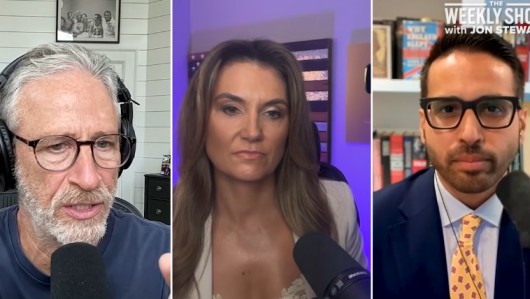
EDITOR’S NOTES: In this episode of The Weekly Show, Jon Stewart sits down with Krystal Ball and Saagar Enjeti, the co-hosts of Breaking Points, for a wide-ranging discussion on the rising tide of populism across the political spectrum. They examine how both the left and right have grown disillusioned with the establishment, what independent new media gets right that traditional outlets often miss, and what it would take for genuine economic populism to break through. The conversation digs into the forces reshaping American politics and the challenges of building real accountability in an era of fragmented media. READ THE FULL TRANSCRIPT BELOW:
Opening
JON STEWART: Ladies and gentlemen, welcome to The Weekly Show Podcast. My name is Jon Stewart. The final podcast of the year. Uh, we will be gone for the rest of August and I think, uh, coming back in, in early September. So, uh, been a delightful year. Obviously tonight I think is the Wisconsin, uh, primary. We don’t know what’s going to happen. We’ll probably discuss it during the episode even though we have no idea what it’s going to be. And then, you know, we’ll, we’ll, we’ll, we’ll talk about the other things.
It’s the dog days of summer. There’s not a whole lot going on right now. It’s a little bit quiet. Senate is on recess, the House on recess. I am going to go away. I’ve got a lovely, like a snorkel vacation planned in this beautiful, crystal clear— it’s— I probably am not pronouncing this right— Hormuz Strait of Hormuz. Uh, where we’re gonna see the, uh, oh, that’s never gonna fucking end.
Uh, but we got a great show for today. I, I wanted to bring on, uh, a couple of folks that I feel like have been doing the kind of “I’m on the left, I’m on the right,” uh, discussion. I feel like they do it in a way that engenders good faith, and so I wanted to highlight them, uh, on today’s program. So let me, let me, let me get to them. Right now. We’ll discuss all things left, right, populist, and otherwise.
Please welcome to the program the hosts of Breaking Points. Uh, ladies and gentlemen, here we are, the final, uh, weekly show podcast, uh, before summer break. And we have the co-hosts of Breaking Points, Krystal Ball and Saagar Enjeti, are joining us today to discuss all that is happening in the world. Uh, first of all, welcome Krystal, welcome Saagar.
KRYSTAL BALL: Thank you so much for having us, Jon.
SAAGAR ENJETI: Thanks for having us.
JON STEWART: I want to start by saying I don’t feel comfortable seeing you two in separate spaces.
KRYSTAL BALL: We had a debate about that actually, but it just was a little bit technically easier this way. So I’m sorry that we made you uncomfortable.
SAAGAR ENJETI: And same for you, to see you at home in a t-shirt. It’s, it’s throwing me off from my childhood.
JON STEWART: Let— oh dear God, if only you knew, Saagar, how painful it was for me to put on the suit for my, for my one 20 minutes a day and all that. That’s actually why I left the show in 2015. I just decided, hey man, I couldn’t take that anymore. I’m done with the button-down. This is over.
Uh, but, but we’re delighted that, uh, you’re both here. And I, I want to ask you, because you’re both— you’re such an interesting dynamic as you guys have worked together. Do you find that your political opinions are starting to converge? Because I think the, the point of it was sort of at a, a guy a little bit on the right, you know, Saagar, you’d worked at Daily Caller, you’d done some things. Krystal, more on the left. But as I listen to you guys, I find there is a great deal not just of respect but convergence. And I can’t think of another show where sort of the idea is to get those contrasting viewpoints that has had that. Is that how you’re experiencing it?
Convergence, Good Faith, and the Roots of Breaking Points
KRYSTAL BALL: Um, I would say it depends very much on the moment of the news cycle. So if you had been watching us regularly leading up to Trump’s victory or after Trump’s victory when we were talking about immigration and mass deportation and ICE, or even today we had a big debate about like Woke 1.0, you might get a different impression.
But the concept of the show, you know, from the beginning, even predating the current iteration of Breaking Points, was, okay, if we got the best faith interpretation of the populist right in conversation with the populist left, what would that look like? And my theory is that there would be different overlap than you might find on sort of the traditional, like, Crossfire, to name a throwback.
JON STEWART: I just got a— something just back of the neck hairs.
KRYSTAL BALL: The typical Crossfire sort of cable news dynamic. And so I think that’s what you’re picking up on. And certainly on the Iran war, on changing the relationship with Israel, uh, on, you know, economic issues, there is a lot of overlap there.
JON STEWART: I think the thing you said, Krystal, that resonates the most with me is “best faith,” “good faith.” I think, and Saagar, maybe that’s what I’m thinking of.
SAAGAR ENJETI: I think that’s what you’re picking up on.
JON STEWART: It might not be a convergence of opinion. It’s that it’s a good faith discussion.
SAAGAR ENJETI: Yeah, I mean, one of the things that we both really built our show around is like a rejection of cable news and just not only the format but the very way in which they want to increase division. And we have plenty of division, which we showcase very openly and honestly, as you just pointed out, Krystal, about our Woke 1.0 debate.
I also, whenever you’re talking about convergence, I think that one of the things that really comes with respect is understanding. And so we’ve been doing this, you know, not just this show but our previous iteration of the show for almost like 7 or 8 years now.
JON STEWART: What was the, the first one?
KRYSTAL BALL: Rising.
SAAGAR ENJETI: Rising.
JON STEWART: The Rise. That’s it, Rising, over at The Hill.
SAAGAR ENJETI: And one of the things that comes with that is you come to understand very deeply where other people are coming from. And it’s really useful, uh, because it helps not only in your interactions politically, but like even in your everyday life. Like when you hear somebody say something, you can understand where previously it would’ve been like, “what an idiot.” You’re like, “okay, I see how you got to that conclusion because of the information you took in,” or your worldview is just fundamentally really different than my worldview. And there’s a level of acceptance with that.
One of the best compliments that we both get, you know, if we’re in public or something is like, “you really helped my relationship with my dad.” You know, you just helped me understand like where my dad was coming from whenever he would rant about X, Y, and Z, like I understood why. And then, or vice versa, you know, like “help my relationship with my kid.” And like “my kid’s really into DSA and like I don’t understand,” you know, what that is, but when I hear Krystal talk about it, it’s like, “okay, like I, I kind of start to make sense to me.” And so, you know, in that way it’s, it’s really edifying and part of the reason why I love doing the show.
JON STEWART: As, as you’ve come together, and now it’s been, as you said, I think 7 years, or does it help you also identify the bad faith actors in our political and, and media hellscape? Has, has there been a way for you to discern, “oh, these people are performative, these people are bad faith”? And do you, do you avoid that now, avoid those folks, or do you expose? What’s your—
SAAGAR ENJETI: Both.
KRYSTAL BALL: It’s a mix. Yeah, I mean, definitely that is certainly the case. And look, I have become less tolerant of a lot of pundits on the right. There are very few, um, who are actually on the right that I would work with at this point because I just think there’s so much lies and propaganda there that to deal with that on a daily basis would not be productive. You know, if you’re doing a debate and you’re having engagement, you’re trying to expose, that’s one thing. But to work together with someone every day, as you know, is an entirely different relationship. So for example, in the wake of your John Fetterman interview, I don’t think that is someone I could work with every day because there’s—
JON STEWART: John Fetterman? I’m not sure John Fetterman is working with John Fetterman every day.
KRYSTAL BALL: Just bad faith arguments, a lack of an ability to really even grapple with the questions that you’re asking, et cetera.
JON STEWART: Yeah.
KRYSTAL BALL: But what has made it work with Saagar is we’ve had some very heated debates, very hot, and over issues that we both care a lot about and I think are very consequential. What makes it work over the long term is that we’re both capable of saying, “you know what, I got it wrong there. You were right. You had a point.” And I think over the long term, that’s part of what has built the trust that enables it.
SAAGAR ENJETI: I totally agree. And it’s like, you know, vice versa, I think, you know, especially at the height of a lot of pretty crazy moments, 2020 and others, there are not a lot of people I think who I could have stomached. But yeah, I mean, as Krystal said, it can get hot and that’s fine. I actually think it’s healthy. It’s normal. It’s reflective of literally the nature of the country. We’re literally living through one of the most tumultuous times, I think, in modern American history. It’s probably akin to the 1960s, in a lot of different ways. Or actually, maybe the ’70s is a better comparison.
JON STEWART: Here’s what’s sad. I think I’m, I’m the only one who’s lived through both of those.
SAAGAR ENJETI: That’s true. I’ve only read about it, Jon.
JON STEWART: If you have any questions, I am happy. I’m happy to tell you about it.
KRYSTAL BALL: Right.
Media, Politics, and the Iraq-to-Iran Throughline
SAAGAR ENJETI: But I mean, Jon, since you were there, you know that that was a moment of very actually limited public debate. And in my opinion, one of the reasons why things went really wrong was because of the convergence of the mass media era. Like, for me, this is honestly surreal to be able to talk to you because you were so instrumental for me as a kid who is growing up in Bush country, hearing these lies about the Iraq War. There is only one place that I could go to, to expose this level of hysteria and nonsense, which I just hear propagated all day long on all 3 cable networks. And that was at a time of total ubiquity in mass media.
Part of the reason that we got into the war that we did and it went as long as we did — I think that the Iran War is, look, it’s a disaster, but it is a hopeful story in that the poll numbers went south immediately. A huge amount of the American public is getting their information from sources or, you know, different from sources like us, many others who are out there who are able to expose the absolute holes in all of the propaganda that the Pentagon or the White House is able to put out. And so look, it’s a disaster that we’re in this, but it’s actually a hopeful story that the public turned on it almost immediately. And so that we didn’t have that edifice to prop it up that we did at that time.
JON STEWART: Well, let me ask you a question because it brings up sort of the incentives of those systems that created that, because I think you’re— you make a nice point about the ’60s and ’70s being tumultuous in that same way. I think the Iran War has gone south in some ways because this administration doesn’t respect us enough to lie to us.
SAAGAR ENJETI: Yeah.
JON STEWART: They kind of don’t give a shit what we think. And in the ’60s and ’70s, the lies were generally, you know, media has found a way, the incentives of it to get weaponized. Bad faith actors weaponize it, right? The ubiquity of cable news was at first, and TV in general in the ’60s and ’70s, politicians weren’t quite sure what to do with TV. I mean, you remember the debate between Kennedy and Nixon, uh, and Kennedy went out there and he understood that television is a visual medium, and Nixon was like, “I don’t need makeup, I look great.”
SAAGAR ENJETI: Sweaty and clammy, right?
JON STEWART: And he got his ass kicked on the TV side, but if you listen to it on the radio, people thought Nixon won. Do you think it’s in some respects the media has just— politics has figured out how to weaponize media. Is that fair to say? Like you just talked about all these bad faith actors, right? They exist as part of a political ecosystem as a way of, you know, Roger Ailes very famously said, “I want to create something so that what happened to Nixon could never happen to another Republican president.” You know, sometimes we separate media and politics, but isn’t it true that in a lot of ways there’s a symbiosis? A lot of it’s been co-opted by politics. And I’m curious what you think of that. And we can talk a little bit about breaking down those ecosystems.
KRYSTAL BALL: Yeah. I mean, I think it’s a double-edged sword. On the one hand, absolutely. And the amount of propaganda, the amount of lies, you know, you go on Twitter now, X, and there’s all these accounts that are just AI slop accounts feeding all kinds of nonsense. It makes it very difficult actually to sort out what’s happening in the war, not to mention there’s a total censorship lockdown on, um, the US’s part of what is happening in the region.
On the flip side of it though, there’s also a hopeful story there because in its best incarnation, you know, they haven’t been able to cover up the horrors and genocide. People watched that in 4K themselves and they took their own moral opinion of what was happening there and it went directly against what the bipartisan elite consensus had been for years and years. I think you’re right that it’s insulting that they didn’t even bother to lie to us this time before the war. I think it also reflects the fact that Donald Trump doesn’t feel that he needs to go through the mechanisms of democracy. We just have to swallow whatever insanity he’s going to do.
But I also think the fact that you have so many dissenting voices in new media that were critical from the beginning and able to expose the very thin level of propaganda that had been fed to us has also been a positive point. Now, I get concerned because there are also— legacy media has its advantages. There was a real tradition and a firewall between opinion and the, you know, and the journalist part and the advertising, and those walls fall down in new media. But overall, I think when you look at those 2 stories in particular, you can see that it has helped to create a better atmosphere for democratic— under small-d democratic understanding of what these wars and what this genocide actually are.
SAAGAR ENJETI: I think that’s a really important point. It’s a double-edged sword, as Krystal said. I compare it to the invention of the printing press. I mean, that’s how the internet— I’m seriously— that’s what the internet— yeah, because I mean, what did that actually do? Is it decentralized media? We literally had something called a Hundred Years’ War, a Protestant, you know, Reformation, chaos. Millions of people died. But of course nobody would say, well, yeah, the invention of the printing press was bad. It was just— it unleashed a new medium of debate. Much of it was propaganda, actually pornography, one of the original inventions of the printing press, of mass distribution, just like the internet. But what it demonstrated, I think, on a long enough timeline was a more informed public.
And that’s the thing, we’re working things out, as Krystal said. And this is where I think all of us can be upfront and honest. Like, we are in a difficult position because we are people who do the news, but Krystal and I are also business owners. We co-own our company, but we set, you know, rules at the very beginning. We do not read ads. Period. Because we believe that if we did so, it could potentially compromise things in the future. Now we know that we have sacrificed literally like multiple zeros of income. However, what we’ve decided instead was to build a more antifragile business. For example, like we have a premium subscription program, we have YouTube revenue, you know, we have like dynamic ads, which are not ads that we read, which we have no negotiation or interest in, but it took a level of intentionality. However though, there’s no reason that we had to do that. If we wanted to read Manscaped ads, we could.
KRYSTAL BALL: And most people are not doing that and are not going to do that. Exactly. No.
SAAGAR ENJETI: And most people are not doing that and are much richer than us, uh, as a result. But we believe in the long run it’ll work out.
Independence, Incentives, and Audience Capture
JON STEWART: Saagar, so this is, this is really interesting to me because we’re talking about media independence. And when you think of independence, I think writ large you think of it as media independence from corporate interest. We’re not owned by Universal or GE or any of these things. But independence is also, are you independent from a political motivation?
SAAGAR ENJETI: Yes.
JON STEWART: That’s another form of independence. And a lot of people, I think, are captured by that. But the third avenue of independence, and I wonder about this for you, is what are your incentives to the audience?
SAAGAR ENJETI: Yeah.
JON STEWART: You know, when you say we have a subscription model and all that, and, and do the incentives of, look, we all know in an attention economy what sells the most is probably outrage.
SAAGAR ENJETI: Mm-hmm.
JON STEWART: Anger and those things. So how do you and your model avoid being captured by the rage of the townspeople? You know, how, how do you avoid pitchforks and torches?
SAAGAR ENJETI: Well, that’s why we’re really blessed, honestly. It’s a right-left show, uh, so, you know, at any given time, a decent portion of the audience is mad.
KRYSTAL BALL: And one or the other of us—
JON STEWART: it works well.
SAAGAR ENJETI: It works really well.
KRYSTAL BALL: So we’re gonna be hated no matter what by some portion.
SAAGAR ENJETI: Yeah, perfect. We are very often hated by our own paying subscribers. We might have one of the most ignominious, you know, honors of being often hated by the people who pay us, uh, but that’s built in, as I said. So at various different times, we’ve gone through these, you know, types of events before. People are mad that you said X, Y, or Z, but because of our political independence and the right-left kind of dynamic that is baked into the heart of the program, it means that there are always new people who also show up.
That’s one of the things where a lot of the— and you actually can see this, there’s a lot of articles about MAGA media and how it’s collapsing as enthusiasm in MAGA and the project with Donald Trump, especially with younger men, starts to go down, people who went all in on just Trump alone or on right-wing so-called media are seeing a dramatic reduction in their overall revenue and views because that’s just not really what people want to hear right now. That is just not something that could ever happen to us because Krystal would always represent a side of somebody who’s critical of MAGA, right? Or I mean, even I am obviously as well, but vice versa. Let’s say whenever Joe Biden was president. And so we are very lucky, honestly, in the way that we designed everything. But what you’re laying out is a very real problem, and it explains grifterism, which is basically people who have to continue it going, manufacture and create new type of controversies purely for an economic incentive, which is enough of a cancer that we have today.
KRYSTAL BALL: Yeah, I mean, audience capture is very real. You can kind of, if you’re watching channels closely, you can tell who’s just catering to their audience and what they think, you know, an algorithm wants them to produce. But I also want to say with regard to the fury and the pitchforks, like, I think people have good reason to be furious right now. I think both on an economic level, you know, we’ve been thrust into this war that basically no one wanted that is devastating for the global economy. It’s first and foremost devastating for Iranians and Iranian civilians. We have had our taxpayer dollars used to fund a genocide that, again, the public has vociferously turned against, and we have a system that is rigged by an oligarch class.
So I think talking about those things, the way that the AI oligarchs literally want to take everyone’s jobs, yeah, people should get angry about that. Those are things that should infuriate you. And so we don’t shy away from that. You know, I think to be informed right now is to be angry and furious about the state of affairs.
SAAGAR ENJETI: I agree.
The Culture War as Distraction
JON STEWART: Let me ask you, because it’s, you know, it’s such an interesting thing to point out how many real things there are that can shock the conscience of people. And yet I think if I’m being fair about where the real energy of the debate is right now, it’s whether or not Enes Kanter is going to get drafted into the WNBA. Like, the real outrage in this country and culture doesn’t seem to be about those very real points you just articulated, Krystal.
KRYSTAL BALL: Well, and to me, Saagar may have a different take on this, but to me it’s very obvious what’s going on here. Trump’s approval is in the toilet. His war is a disaster. The economic numbers are trash. People are furious. Republicans—
JON STEWART: I think it’s the greatest economy this country’s ever had.
KRYSTAL BALL: I forgot about that. Yes. According to Fox News. Absolutely. And Republicans are facing what is likely to be a landslide defeat in the midterms. So what are they doing? They’re going back to the culture war bag of tricks. Here’s a shiny object that I can dangle over at Fox News to get our own base back in line. But I actually don’t think that that’s what’s driving, for example, the electoral results that we’re seeing in Democratic primaries across the country and likely to see in the general election in the fall. There, to me, the number one issue is very likely the economy, but it’s also horror at a foreign policy that is both expensive and deeply immoral.
SAAGAR ENJETI: Yeah, Jon, I would push back a bit. I agree with you.
KRYSTAL BALL: What?
JON STEWART: How dare you, sir?
SAAGAR ENJETI: Well, I just think it’s reflective maybe of a cable news bias because you’re right. I believe the WNBA was the most mentioned, second most mentioned topic on Fox News this week. And that’s probably true of the 65+ crowd if I were to go and ask them. However, the segments that perform best on our channel are things about the housing crisis, are about flock cameras, data centers, AI displacement and job loss, foreign policy. I mean, I never thought I would have my dream job of being able to speak to guys like Professor John Mearsheimer, who was my literal idol, for over like an hour and a half and have him describe like great power politics and the Iran War and watch millions of people want to engage with that type of content.
And so I do think like, look, are we amusing ourselves to death empirically? Yes. I mean, not just in terms of sports, but with gambling and many of the other vices which are exploding in our current society. However, what we always also point out on the show, that is derivative of real problems like housing, which is the one I would say we see the most consistent rage in terms of not just our audience, but in our demographic, and is downstream of so many of the other problems that we face as a society.
KRYSTAL BALL: Can I also just say, Jon, that I think too, the revelation — this will feel like a bit of a left turn, but the revelations in the Epstein Files of the way that this powerful elite actually has this incredible class solidarity and the way that they operate, I think it’s blown some of the lid off of this idea that, you know, what we should really be focused on is trans people or these culture war debates, because we’ve been able to see the way the powerful actually work in the world and the view that they have of the rest of us. And so I think that that has been a very educational and illuminating experience for people as well as they process some of these like new red meat culture war debates that are thrown into the mix.
JON STEWART: Yeah, it’s just hard to imagine, you know, when we talk about and the importance of it, all these things that you’re bringing up are truly important and yet there’s been no accountability for, right, for any of it. Correct. And it seems like what there is accountability for, either legislatively or otherwise, are culture war issues that— like, I’ll give you an example. You know, the SAVE Act being, you know, at the forefront of so much of the problems that were going on in the Senate right now. And the liberals, they don’t want— they want illegals who are voting in millions of numbers not to, you know, show an ID, you know, just utter nonsense that gets thrown out there. Or the trans debate as being at the forefront of what’s in everybody’s minds about that. Like, nuance is utterly removed through the process of our media and our politics. Yet the things that you talk about that are facing Americans or are making them question the legitimacy of our institutions are never addressed, seemingly with no accountability. Yeah.
KRYSTAL BALL: Yeah.
SAAGAR ENJETI: I mean, that’s kind of the core of our show.
Guilt by Association and Accountability
KRYSTAL BALL: Can I give you another example of that, Jon, which is very much top of news cycle right now? So there’s this whole controversy about Hasan Piker and whether or not candidates should associate with him. And Abdul El-Sayed famously had a rally with him. So he’s being targeted right now as like, “how dare you associate with this guy who said all these terrible things?” The clip that they usually point to is where he says that we, quote unquote, “deserve 9/11.” He’s talking about the concept of blowback. And for which he has since apologized.
Meanwhile, Abdul El-Sayed is running against a guy who literally was in Congress after 9/11, who authorized the Iraq War, who supported mass surveillance, who defended torture. But where that guy is fine, but associating with someone who said something that was edgy one time, that’s what’s out of bounds. That’s what should be off limits. That’s not just me, but I think most people, is insane.
JON STEWART: Well, I’ll do you one better. J.D. Vance’s spiritual advisor, you know, the preacher that J.D. Vance considers one of his sort of spiritual advisors, talks about male dominion over women. You know, there are all kinds of extremes in terms of association. I remember with Obama.
KRYSTAL BALL: Just think about, though, the contrast between “Hasan Piker said a thing in response to 9/11” versus “this guy actually was in power and was involved in the horrific lies leading up to that war, the authorization of the war, the torture, the murder of Iraqi civilians.” And so when you talk about accountability, where is the accountability for that? Where is the moral weight on that versus— I mean, many of these guys that were villains on your show when you were covering the Iraq War are still around today to propagandize us and push us in the Iran war. So I think that lack of accountability you point to is a big failing in our society. And in my opinion, it has to be corrected in the next administration. People have to go to prison for the crimes that were committed, whether it’s rogue ICE agents, whether it’s insider trading within this regime. That has to happen for us to reestablish anything approaching a healthy society.
SAAGAR ENJETI: And I will say, Jon, for me, um, I know I’m on with two liberals here, so I’m trying to pick my battles.
KRYSTAL BALL: How dare you call me a liberal?
SAAGAR ENJETI: Careful. Sorry, a leftist and a liberal. A leftist and a liberal. And I’m gonna have to fact— I’m gonna have to check on that JD Vance spiritual advisor one.
JON STEWART: Uh, Hegseth’s spiritual advisor.
SAAGAR ENJETI: Sorry, I was gonna say, I was like, I’m, I’m fairly certain that’s not true.
JON STEWART: That was Hegseth, but JD Vance was Peter Thiel, who like, when asked by Ross Douthat, “should human beings continue to exist”—
SAAGAR ENJETI: Long pause.
JON STEWART: Paused for like 8 seconds to be like, “I don’t know about humans.” And, unbelievably, you know, the other people that are in those rooms. My point being, guilt by association, uh, which is often thrown in Democrats’ faces, whether it was, uh, Obama’s spiritual advisor, can be thrown into the right’s faces, but it never seems to be done in that way.
SAAGAR ENJETI: What was it? Pastor Wright. Is that right? Pastor Wright? Now that I think about it. Yes.
JON STEWART: Pastor Wright.
SAAGAR ENJETI: That was a long time ago.
KRYSTAL BALL: Oh, with Obama you’re talking about?
SAAGAR ENJETI: Yeah. Anyway, I think the vein I’m picking up on, and this is where I’m— I mean, I would say this is like the great disappointment, political disappointment of my life, as I said, was I was inspired to get involved in politics because of Iraq and watch and, you know, the centerpiece of the 2024 campaign — and it’s fair for people to say that you were fooled — was “no more foreign wars.” I mean, the vice president, as you said, wrote an op-ed endorsing Trump. Trump’s best legacy, no new wars. Stephen Miller famously said, “Kamala will send your sons to war.” A significant contingent in the 2024 campaign was, “we are not going to go to war with Iran.”
And so to live in a reality where Trump dastardly and disgracefully attacks Iran under the cover of negotiations twice, kills 168 schoolgirls, delivers the greatest strategic disaster to the United States potentially either since Vietnam or eclipsing it if you talk to one of our guests, Professor Robert Pape — to live in that reality with those people who I really did trust, and I’m saying this on a personal level, I know many of them, I came up in politics in the same cohort — it has been the greatest betrayal of my lifetime. And I think what’s really disappointing is how much of it is clearly BS in that I believed that the voters believed that the wars were bad. And so to live in a reality where Thomas Massie loses his House primary purely because of AIPAC and pro-Israel money and a boomer Republican base who, if you’d polled them under—
JON STEWART: Well, and that Trump, I mean, let’s not deny that Trump—
SAAGAR ENJETI: Right. Those two together, like those two forces together.
The “Reality Distortion Field”: From Iraq to Iran
JON STEWART: Saagar, I want to ask you a question, and I mean this, and this is for Krystal too. The dynamic that you’re describing is a politics that distorts reality, that creates an impression, and then makes policy choices to ameliorate the damage of this false reality. And you’re saying that your dividing line for that was Iraq and now Iran. I think maybe the disconnect here for whatever you would call liberals or the left or any of those things is that the entirety of Trump’s operation has been that.
SAAGAR ENJETI: Is a con is what you’re saying.
JON STEWART: That’s right. Has been the same dynamic you’re describing that has disappointed you in Iraq and Iran — I would say has disappointed me. When you say the Haitian community is eating cats and dogs, right? Well, that’s the same, immigration-wise, as “Saddam Hussein is using these aluminum tubes to enrich uranium, and that’s why we have to go in there.” In other words, the reason that has been given for so many of these policy decisions that I would disagree with is also a distortion of reality.
SAAGAR ENJETI: I think that’s entirely fair, Jon.
JON STEWART: So I find it interesting that it’s— but somehow Iran, it’s like the whole Tucker Carlson of it.
SAAGAR ENJETI: Okay.
JON STEWART: “I’ve had enough.” Really? Because it looks to me like it’s the same shit that’s been happening from day one.
SAAGAR ENJETI: I think that’s entirely fair. Again, to take a step back, and I can only speak from my perspective — like, the Haitian thing, yeah, it was a lie. The truth is a lot of us sat and swallowed it because we wanted less immigration and we’re like, “okay, well, I mean, this highlights a topic and an issue which we can fight on. We can put the left on the back foot because they want mass amnesty and we don’t.” And that was a tactical political decision that people in politics make all the time.
JON STEWART: But I’m not even sure they want mass amnesty. I even think that’s a red herring. I don’t know that they do want mass amnesty, but we don’t have a politics in this country that’s functional enough or literate enough to have an actual conversation about what immigration in this country should look like.
SAAGAR ENJETI: I think that, again, I totally take your point. And this is where— this is the most common—
JON STEWART: Look at me. Look at me. Yeah. Come on.
SAAGAR ENJETI: You’re— my parents are loving this. My parents are loving this.
KRYSTAL BALL: Me put—
SAAGAR ENJETI: —me being put in my place. But I do think, like, with the Iran thing, and again, I can explain it from my perspective, which was these were people whose entire careers literally were kind of built on opposition to the neoconservative agenda. And did we know Trump is a liar, a con, often says various different things? Absolutely. Many of us knew that or would say it in private. What we also knew is that in his first term, he was incredibly deferential to a lot of his staff. A lot of the people we were hiring, he was hiring, I knew for a fact, you know, at the very least had a genuine belief we shouldn’t go to war with Iran.
So, but, but, but what was extremely blackpilling, to use an online term, was to see those same people have to defend the war and in some cases use, you know, Iraq rhetoric. I mean, I remember the vice president, who I’d seen give lectures against the war with Iran, or, you know, against neoconservatism — he was in the Oval. It was in the middle of the Iran War. And he’s like, “it’s like a suicide bomber. We’re not going to wait till the suicide bomb goes off to disarm it.”
JON STEWART: And I was like, “oh my God,” like, we don’t want the smoking gun to be a mushroom cloud, right?
SAAGAR ENJETI: Right. It’s Condoleezza Rice all over again. I actually couldn’t believe it. And then, you know, Mark Thiessen is back on my television screen and Ari Fleischer is back on my television screen and the same liars are justifying this, like, and to watch that happen, like I would say, fine, I was fooled. I didn’t think it would happen. I thought that the lesson was learned. And there’s a major mea culpa that has had and has to be had by people who thought that it would be different and said so publicly. So that’s kind of where I am currently.
JON STEWART: Krystal, what do you think of that? Because it’s, it’s hard for me to hear a mea culpa about an Iran war when the entire regime is that. There’s an inevitability to the reality distortion field and the actions that they take based on a reality that they are creating.
KRYSTAL BALL: Yeah, well, this is something Saagar and I have had it out over on our show quite a lot and have sorted through in many conversations. And I’ve certainly had my “I told you so’s.”
JON STEWART: Um, and, and in fairness to Saagar, it’s not even an “I told you so.” I, I don’t mean it that way. Honestly, it’s not that.
KRYSTAL BALL: No, I get what you’re saying, though. And I think one of the biggest differences in my view going into Trump 2.0 and Saagar’s view, apart from the fact that we have different ideologies and so we have different things that we consider to be good or bad, specifically on immigration in particular — but Saagar’s view was that there were institutional constraints the first time and there will be some institutional constraints this time.
SAAGAR ENJETI: That’s true.
KRYSTAL BALL: I looked at the— what had been done in the offseason, whether it was Project 2025, whether it was all of the plans to fire, mass fire government workers, whether it was the Supreme Court, taking control of the Supreme Court, and then the Supreme Court giving Trump a green light to commit whatever crimes in office that he wants to, whether it was the mass loyalty tests and fealty that he demanded and demanded that people back up his “2020 election stolen” lies.
I looked at that and said, no, this is going to be gloves off. It is going to be a most maximalist version of what he would want to do, of what his id is. And it’s going to be horrifying. Now, even I don’t think could have anticipated all of the DOGE and ICE and murdering random fishermen in the Caribbean. I could have anticipated and did anticipate the Iran War, but those were, I think, two of the very different frames that we had, um, coming into this.
And, you know, for me, I’m very much caught between people who now are seeing some of the problems — I want to say, great, come along. But I agree with you that there has to be some reckoning with, okay, how did you get it wrong? And again, I think Saagar has actually done this, but how did you get it wrong? How did you end up in this place? And what are we doing going forward? Because if you’re now just all of a sudden pretending like you had nothing to do with his rise, if you aren’t reckoning with the other lies and horrors that unfolded during Trump 1.0 and in the offseason and in the buildup to Iran, then it’s going to be very difficult to have any sort of coming together or certainly coalition formed around that group.
The MAGA Diaspora and the “Real MAGA” Theory
JON STEWART: My concern is that this, uh, awakening is actually just strategic.
SAAGAR ENJETI: What do you mean by that?
JON STEWART: So, all right, let’s go to the photograph in the Cracker Barrel, the Thomas Massie, Marjorie Taylor Greene, Tucker Carlson photo of the diaspora, the Republican diaspora, the, those that have woken to the Iran War. And now they sit in this room and they’re going to come up with the— it’s not— this is the real Make America Great Again. That was fake. That we, we enabled it. We worked our asses off to, uh, amplify the lying, to help create a reality distortion field that has given us all of these bad outcomes, from, uh, invading Iran to a shitty reflecting pool. Because they’re all one and the same. They’re part of the same process, quite frankly.
SAAGAR ENJETI: Uh-huh.
JON STEWART: It’s all the same. It’s the real “great replacement theory.” Let’s take all the partisans and replace them with ideologues, because partisans are part of the game. Ideologues are a whole different version. And now what they’ve done is they’ve created a little isolated group that can say, “oh no, we didn’t go along with it.” So whoever kind of rises up to next lead MAGA, that group can bless and provide cover to, to say, “oh no, these guys have it right now, this is the real MAGA and we’ll provide cover.” And I don’t think any of it isn’t intentional. I think the entirety of the design of this — and it’s not just the last 10 years, it’s the last 50 or 60 years.
SAAGAR ENJETI: So, I mean, obviously a very cynical interpretation. You know, I know some of the people I think—
JON STEWART: Please tell me why I shouldn’t be cynical about that interpretation. Please tell me why these bad faith actors are suddenly acting in good faith.
SAAGAR ENJETI: You have every right to think that. I don’t think that there’s nearly the incentive that you necessarily are impu— like, you have people who all lost their elections and are not exactly like — well, let’s say Marjorie Taylor Greene’s and Thomas Massie’s case, like, actually lost their entire careers. Or Joe Kent, for example, who I know personally and is not somebody who—
JON STEWART: I don’t think, I don’t think they’re the progenitors of it. I think Tucker is. I think he’s, he’s the one who has to be— he feels he must be. It’s very telling. He said, “I couldn’t believe how little influence I have.” His whole thing is I have to be in proximity to power.
SAAGAR ENJETI: I see. Look, I’ve known Tucker for a long time. Uh, I just don’t really agree with that analysis, having spoken to him. Uh, I would say that he does feel genuinely burned, uh, by Donald Trump, not just with Iran, but actually with a lot more. I know you’re skeptical. I think he is.
JON STEWART: I mean, how do you— how are you burned by a guy that 10 years ago you said, “this man is corrupt to the core and I hate him”? How are you burned by that?
KRYSTAL BALL: Sure.
SAAGAR ENJETI: I mean, the vice president said that as well. Uh, I think, right, people can change.
JON STEWART: Right. And is also a cynical, cynical person manipulating himself into the halls of power. You can’t convince me otherwise because I’ve seen no evidence of it.
SAAGAR ENJETI: Let’s take the vice president out because you’re right, he’s literally the vice president. So he had something to gain. I don’t see necessarily the same Tucker gain. I guess whenever it comes to the third party or let’s even take the Trump criticism, I again think it’s genuine. It has lost him, uh, any like genuine friendships, cachet, I think, in terms of his ability to project power in a Republican Party. I mean, I’m not sure if you’ve seen some of the approval polling on Tucker, like after Trump—
JON STEWART: Did they do approval polling on pundits?
SAAGAR ENJETI: They did. Yes, they did, because they were testing this exact theory of what you’re discussing, which is like, “hey, does Tucker independently have juice amongst Republicans without Trump?” And his net negatives went much higher. Obviously he’s independent on his show, like in terms of his, like, you know, away from partisanship or his own economic situation.
JON STEWART: But, but Saagar, the same could be said about Republicans who were apostate about the Iraq War. In other words, people look to the future, and he’s always been a guy that has looked to what’s in it. Look, explain to me a guy who says, “I’m all about liberty and America and Make America Great Again,” and, “you know who’s really a great leader? Putin.” Like, it just— I just— there’s an incoherence to this that has to be cynical because it’s incoherent.
SAAGAR ENJETI: I understand how you get there, but again, for— but, but it’s like what— and this is kind of like we were— because I work with Krystal, like, I could see your brain pathways.
JON STEWART: Yes, yes, you get there.
SAAGAR ENJETI: So I’ll explain the way that we would get there, and the way we would get there is like Tucker, or not even just Tucker, a lot of MAGA — and you’re talking about Putin, I assume, in terms of like the war in Ukraine or admiration or whatever for the Russian system, some of which, by the way, I do think goes too far. But a lot of it is about— no, I’m saying in terms of like people who like, “oh, like Russia is the, you know, this pinnacle of Western greatness.” And it’s like, well, just look at their demographics and their economy. Like, that’s not exactly true.
But the point that I think where it came from — again, just to try to explain this — is a lot of the original 2016 energy in particular was a Buchananite rejection of globalism. And in particular, I think what people tried to see in Putin or slash like admiration or whatever of Putin or the Russian system was somebody who stands athwart, like, the neoliberal West, right? So if I were to look at it through that frame, it’s a little bit different. Like, I don’t think it is necessarily as incongruent as you’re thinking, because if you’re a nationalist and your primary, you know, view of the world is that sovereignty itself is one of the things you should promote and not just promote, but to cherish and to hold dear as much as possible, then you’re going to look at different countries which have rejected like a Western global hegemon and say, “oh, that’s admirable, I guess, in a sense.” Again, I’m not saying I agree with this.
JON STEWART: Sure.
SAAGAR ENJETI: But I’m trying to explain how somebody would get there.
Left-Wing vs. Right-Wing Populism
JON STEWART: Well, Krystal, let me ask you, because it is, you know, this gets us into a whole other thing, but maybe this is the distinction between left-wing and right-wing populism, because I always think of populism through a much more economic lens. But there really is a nationalist lens that you have to look through it as well. And the thing that’s interesting about the right-wing populism is, and again, I view it as cynical, it’s the Bannon theory of power. I’m going to combine left-wing economic populism because I think that gives me a large group of people to pull from, and I’m going to combine it with right-wing, “we must protect white Anglo-Saxon culture and Western civilization,” which is their, I guess, sort of euphemism for that homogeneity.
I think the second part of that, the white homogeneity, is more important to them than the economic populism. And the reason that I think that is because they didn’t tell their judges to be economic populists. Like, every Supreme Court decision that comes down basically favors corporate interest.
KRYSTAL BALL: Yeah.
JON STEWART: Rather than workers’ interests.
KRYSTAL BALL: The economic part of it, at least, you know, putting the voters aside, but in the expression of right-wing populism in Trump and I would say other right-wing populist leaders around the world, the economic part is basically fake. I mean, this has been an incredible administration for billionaires in the oligarch class. They’ve never made more money or had more power or been deregulated. They’re getting everything they want. And that’s part of why it was easier for Trump to take over the Republican Party than it has been for the left to take over the Democratic Party. Because the left-wing populism, that class dynamic you’re talking about, that is the whole thing, right? It is — in populism, you’re basically doing “the people” versus “who is the villain.” For the left, the villain is the billionaires, it’s the trillionaires, it’s the Epstein class, it’s the oligarchs. For the right, it’s typically, you know, to frame it — I think you’re right in your framing — there’s usually a lot of scapegoating of various minority groups. And so you can use a sort of “sloppulist,” faux-populist rhetoric when it comes to the economics, but that has all been cast aside.
And in Trump 1.0, it was as well. I mean, their biggest economic accomplishment was this big tax cut for the rich that was cooked up by the Heritage Foundation and Paul Ryan. So I think that is an important distinction here. And I think that’s increasingly becoming clear to many Americans, which is why Trump’s approval rating on the economy is in the toilet, why there is such disgust with him, why you see this real rise of left-wing populist candidates who are overcoming a lot of money and establishment rejection of them and attempts to smear and demagogue against them. But they’re able to succeed anyway because the establishment has lost so much credibility with the Democratic base and also because these economic and oligarchic forces have become so abundantly apparent to so many Americans.
SAAGAR ENJETI: Yeah, Jon, and, and I think, look, again, I hear your critique, uh, and, and, you know, I’ve had my mea culpa.
JON STEWART: By the way, Saagar, you really are like— your way of dealing with me is exactly how now I’m gonna go home and deal with people in my family. I hear, I hear what you’re saying, right?
SAAGAR ENJETI: Uh, I see how you got there.
JON STEWART: I see how you got there.
SAAGAR ENJETI: I mean, because I spend my time with Krystal and, and, you know, I’ve been in that way, Mo.
JON STEWART: And I understand it’s taken you—
SAAGAR ENJETI: right.
JON STEWART: Yeah.
SAAGAR ENJETI: You took one route. We’re taking another.
JON STEWART: Exactly.
SAAGAR ENJETI: If you were to take my route, my preferred route — so, you know, you’re imbuing kind of an ideology of just, uh, in your original analysis there about economics and about white identity politics. But I actually think, and I would take it further, is it’s actually worse. It’s really just about Trump. And I think it really took the Iran War to fully kick that in for me, is that the voters fundamentally, they just really like Trump. And it’s actually not as much about policy or any of the things that you might think. It really hit home for me in terms of like when I talked to some of these people, still all on board the Trump train, especially the older voters, they really just love how he drives people like you crazy. And that’s actually just all it is.
JON STEWART: That may be the saddest thing I’ve ever heard.
SAAGAR ENJETI: But it’s true. It is kind of empirically true is what you see is like liberal cultural rejection of Trump.
JON STEWART: He hates the right people.
SAAGAR ENJETI: Or no, he’s hated by the right people. That’s, that’s actually what it’s about.
JON STEWART: All right.
SAAGAR ENJETI: And so that’s the truth, I think, at the beating heart of a lot of the remaining MAGA coalition.
JON STEWART: So if we start to like him, they’ll abandon him?
SAAGAR ENJETI: I don’t know about that. The damage has probably been done, but I don’t know if they would cling necessarily as hard as you think. But, you know, this is where, though, to kind of break my own analysis, the one thing that does appear to, quote unquote, trump that is the economic situation, which is a validation, I think, of the economic framing of what you’re talking about. For the very first time, we see Trump’s net approval rating or approval rating with Republicans on the economy begin to dip down as a result both of the way that the tariffs were handled, and because of the Iran War and $4 gasoline. That is beginning to pierce what I would say is the cultural veneer, and it already has, you know, definitely for a lot of, let’s say, the younger men or voters who went along with Trump in 2024.
Project 2025 and Who’s Really Designing the Agenda
JON STEWART: But I’d rather talk about the designers of this program than those that have to live through it. I think I’m talking more about the designers, okay, the Project 2025 designers. There is a, uh, there is a Christian nationalist bent to it that I think is the driving force of it, and everything else is strategic and intentional about how do we get there, how do we get to the power, how do we get to control everything, when our ultimate goal is that.
SAAGAR ENJETI: So I actually see, I think it’s much more economic, like, well, and even Project 2025 itself is kind of a complicated story, right? Because Project 2025 was written by the Heritage Foundation. It was explicitly disavowed by Donald Trump on the campaign trail who was like, “I have nothing to do—”
JON STEWART: Oh, come on, man.
SAAGAR ENJETI: Now you’re, now you’re— I’m not saying it was real. I’m saying he did disavow it. Correct. Like he did.
JON STEWART: But cynically, he didn’t disavow it. He tried not— he gave it plausible deniability, as he does with— that’s my point, okay, is when you act like, “wow, this Iran thing really caught me off guard,” and then you tell me, you know, with earnestness, “oh no, he disavowed 2025,” he did nothing of the kind. He in no way wanted to deal with the particulars of it because he knew how politically damaging it was.
SAAGAR ENJETI: No, no, I’m actually— I’m— I was about to get there. So I was saying he disavowed it only then to hire many of the people who were signatories of Project 2025. So there wasn’t an acknowledgment going into the campaign that this is politically damaging, this type of product, the Heritage Foundation, etc. But then that became the general policy, at least in some areas. It’s been kind of complicated because a lot of it is just Trump himself deciding what the tariff rate on China should be, uh, whenever he wakes up in the morning. I’m not joking, that’s actually how it works.
JON STEWART: I like when he did— he, he didn’t like a conversation he had in Switzerland and he was like, “50% on chocolate,” right?
SAAGAR ENJETI: Yeah, 50% on chocolate and watches. Uh, for the watch community, that was devastating, uh, as a member of that. So like when we talk about the designers, I don’t know if it’s as intentional though as you say. I do think all political coalitions have like people who are insider organizations in Washington who are jockeying for power. That’s literally the job of the Heritage Foundation or of these neoconservative think tanks. So you’re saying like what you’re talking about, how you think the Iran War came out of nowhere, you know, that’s kind of a foolish thought, but it’s just really hard for somebody who lives in the town, knows some of the most senior appointees or some of the people who were there, who in private and in public spoke against war with Iran, made good cases against war with Iran, why we should disengage from the Middle East — to say that that was disingenuous the whole time, I’m still just having a hard time with that.
JON STEWART: No, what I’m saying is not that it was disingenuous. And I’ll ask you this, Krystal. The idea wasn’t that they really didn’t believe they would go into Iran. My point is that all these other policy decisions that have gone along with the intentional design of moving us more towards this intentional heritage American version, non-creedal America of a people who belong here more than other people, who are more American than other people. Real America. That’s all been driven by a very intentional planning group that is trying to figure out ways to maximize their power and in doing so have created this group that is manufacturing a reality to get them to do that. Now, the Iran War, whether it fits into that framing or not, that’s the reality of it. It’s a cynical manipulation to get to a certain goal. And my problem is, and Krystal, I’m going to ask you this, is it your problem as well that you look at this sudden, like, “I can’t believe the tiger ate my face” when the rest of us have been faced with this cynical manipulation of policy the whole time? Whether it got them the results they wanted on immigration, but not the result they wanted on Iran. Yeah.
KRYSTAL BALL: I mean, at the risk of ganging up on Saagar, I feel very similarly to you.
JON STEWART: No, no, no, no, no. And by the way, and then we’ll talk about how the left sucks.
KRYSTAL BALL: So, okay, we’ll do that in a moment. But no, I mean, look, I look at the track record from Trump 1.0. I look at J.D. Vance’s speech, to your point about the, like, heritage American Christian nationalist vision for the country, his speech at the RNC where he laid down an explicitly blood-and-soil conception, said “America is not an idea.” And then you look at Stephen Miller, who is so powerful that he’s been called the prime minister within the administration. And this guy is a diehard ideologue who loves to Nazi-post on Maine. Um, you know, there is no doubt what his priorities are. So, and so far as Trump even has said, like, “oh, this guy would like there to just be 100 million people in the country that all look like him.” So it’s not a secret what his priorities are, and he’s been given a free hand in order to execute that sort of policy.
So I think you have that strain, and then I think you have a Trump who is just the most self-dealing, corrupt person on the entire planet who also has Kushner and Witkoff and these other characters who are also focused on looting and self-dealing as the other primary impetus within the administration. And I think when you put all of that together — and also Trump’s desire to be this big man in history and he wants this world-changing legacy, whether that is for good or for ill — I think that’s part of what explains the Iran War in particular. But when you put the ideologues together with the self-dealing together with the total lack of any guardrails on this train at this point, that’s how you end up with this situation. And yes, to your point, I mean, not only was it predictable, it was predicted.
Why the Democrats Are Struggling
JON STEWART: So given all that, and I think that’s a summation that I would not disagree with, why is it that the Democrats are having such a difficult time? They don’t control anything. They don’t control the Senate, they don’t control the Congress, they don’t control the court, and they don’t control the White House. So what is it about the way that Democrats have governed that has allowed this, in my mind, cynical and corrupt experiment to take such hold? And when will accountability come for that? Because I don’t think Trump arose for no reason. I think people were dissatisfied with a government that did not seem to be responsive to the needs of the people and was at a remove.
KRYSTAL BALL: Yes, I agree. And I think what we’ve seen at this point is a sort of limp, status-quo, decorum-obsessed liberalism is not going to be sufficient to fight what I see as rising forces of fascism in the country. They weren’t historically. You know, when we had a previous rise of a fascist movement in this country, it took FDR, it took the New Deal coalition, a sort of experiment in social democracy here in the US to beat that back.
JON STEWART: Forget about rising fascism, though. How about just, like, rural broadband? Like, I’m not even— I’m not even talking about a party that is not up to the task of fighting the Nazis. Yeah, I’m talking about a party that is not up to the task of competently governing and easing the difficulties that people are facing in their day-to-day lives, not being responsive to their needs.
SAAGAR ENJETI: See, I would pick up on that.
KRYSTAL BALL: Not only not responsive to their needs, but actively gaslighting them about their needs. I mean, we could go back to, you know, the financial crisis and the response to that.
JON STEWART: Yes. Okay.
KRYSTAL BALL: Which was too little, where there was zero accountability to Wall Street criminals, where homeowners were completely screwed. And you can see the seeds of that dissatisfaction. And now we’ve got 2 generations, millennials and Zoomers, and soon it’ll be Gen Alpha as well, who are being shut out of the American dream, who can’t aspire to buy a house, who see education costs — you know, they’re told to go get a college degree, that college degree is wildly expensive, they’re saddled with debt and then they can’t get a good job out of it. A bunch of AI oligarchs are telling them they’re gonna take their jobs anyway. And there has been a wildly insufficient at best response from the Democratic Party establishment who have been more interested in palliative care for America and the working class of America in particular than actually solving problems.
JON STEWART: Wait, they put us in hospice?
KRYSTAL BALL: And governing pretty much and governing effectively. And so, you know, one of the things that we’ve seen in the small pilot experiment of Zohran Mamdani in New York City, where, look, you’re the mayor of a city, it’s a big city, but you’ve got limited powers, is I do think you see a different approach to governance where there’s a real commitment to, “no, we’re going to make promises, we’re going to deliver on those promises.” People are going to feel the impact of government in a positive way.
I’m sure you probably saw the story — someone posted a picture of a pothole on, I think it was Instagram, and by the end of the day he had come and filled that pothole. It’s something small, but it makes people feel like, “oh, the tax dollars that I’m paying, the government that I elected, they actually are trying to make my life better in a way that materially improves my quality of life.” And Democrats have become completely divorced from that.
And then, you know, the other part of this, of course, that hangs over all of it is money in politics. I mean, this is really the root cause of so much of it, where they are beholden to corporations, they’re beholden to special interests, whether it’s AIPAC or big tech, etc., that keeps them at odds with the needs and the desires of the American people. And so that’s why I’ve been so heartened to see this reckoning that is happening between the Democratic base and the Democratic establishment in the party.
What the “Left” Gets Wrong
JON STEWART: Saagar, is that— how do you see the left now? Do you buy into the framing? You know, there’s a lot of talk about “now they’re socialists,” and very rarely does anyone ever talk about what socialism is. It’s just a word, and no one really describes, you know, in terms of specific policy, what’s socialist about it. How do you see the left? What would be your, you know, greatest criticism of them? And what would be your fix to that? How could you see them, right, recovering from that?
SAAGAR ENJETI: So, I mean, look, I do not speak for the right. So I’m a very unique person. I don’t really care about Hasan Piker. I did an event with him. He was fine. We were perfectly cordial. I actually think he’s not nearly as radical as a lot of people think that he is. And so, you know, I don’t know if I’m the best person to answer, but like, from my perspective, here’s what I would say: fundamentally, you know, you guys talked about, you know, there’s been a lot of like, “oh, cultural issues and all of that are nonsense.” At the end of the day, there’s only one movement in recent history that won households under $100,000. That was Donald Trump in the 2024 campaign, which he won the popular vote.
The DSA and leftists is predominantly a coalition of downwardly mobile white liberals. A lot of people who don’t have a 4-year college degree find the movement distasteful or distrust them. We saw that just what happened in the Abdul El-Sayed campaign in the primary election, where you had older Black voters, a traditional political constituency, and households that don’t have a 4-year college degree did not vote for him.
JON STEWART: But still vote. I mean, that was a Democratic primary, but go ahead.
SAAGAR ENJETI: Right. But that’s emblematic also in the general election results of 2024. So if we try to transpose those 2 things, the most likely predictor of what your politics are in this country is whether you have a 4-year college degree or not. And if a 4-year college degree is also correlated highly with income, the Democratic Party, while maybe having economic positions that supposedly benefit the working class, has not convinced the working class of that. That’s just empirically true. And so that’s kind of like my criticism, if you will. If, you know, Krystal gave her speech, so I’ll give my worst-case — you know, my worst-faith interpretation would be, sure, it’s class cosplay. I mean, fundamentally it is cosplay of dressing up, you know, said, you know, basically Woke 1.0 type policy and/or rhetoric.
JON STEWART: To explain that, what is Woke 1.0?
SAAGAR ENJETI: Yeah, this is the whole thing, right?
JON STEWART: I mean, also, let’s be fair, like, yeah, I mean, Trump is the one who puts on the apron and sits in the McDonald’s window. Like, talk about cosplay. Like, I don’t think anybody does it.
SAAGAR ENJETI: Depends what type of cosplay we’re cosplaying.
JON STEWART: You know, how many times can you hear “he’s a blue-collar billionaire” and you’re like, “yeah, I don’t think that’s a—” He’s cosplaying Norman Rockwell America, obviously, which is, you know, highly effective.
SAAGAR ENJETI: All right. So you have to grapple with that if you want to win in America and American politics today.
JON STEWART: Right.
SAAGAR ENJETI: And so, yeah, I mean, I think— and we’re talking to the whole Woke One debate and Chris Wylie literally had it today.
JON STEWART: Yeah. What— tell me what you mean by that, because I’m not sure I understand.
SAAGAR ENJETI: So AOC recently went on television and she said, quote, “Woke One was crazy.” And it was in relation to Francesca Hong, who was a DSA candidate who is very likely to win, I think, tonight in Wisconsin, in the gubernatorial election, in which — I don’t have the exact tweet in front of me — had said something along the lines of critical of Thanksgiving. She gives an interview in which they said, “so do you want to cancel Thanksgiving?” And gives a word-salad level of an answer.
KRYSTAL BALL: Okay.
SAAGAR ENJETI: Might seem nonsensical. Jon, you and I both know that in this country, that is not exactly how you’re going to appeal, quote unquote, to the very working class.
JON STEWART: Uh, that we’re talking about. My favorite holiday.
SAAGAR ENJETI: Yeah, it’s most people’s favorite holiday. It’s most normal people’s favorite holiday. And so that comes across as deeply disconnected and obsessed with, you know, what some activist is either going to say towards you or your genuine belief that Thanksgiving or just like white society — which she’s also talked a lot about her own like biracial son and potentially being ashamed of that — like, that is deeply off-putting, I think, to a lot of people. And so that is where, like, to the extent that I have a critique, I guess, is they’re saying, “oh, Woke One was crazy.” And it’s like, no, but you still believe many of the things that Woke One consisted of.
JON STEWART: She’s still saying that now?
SAAGAR ENJETI: No, no, no. What I’m saying is AOC had said Woke One was crazy, as in the rhetoric that we used. There was an Overton window, and she made it clear that much of the rhetoric that was used from 2020 was bad. Oh, okay.
JON STEWART: All right. I see what you’re saying. Was dumb.
SAAGAR ENJETI: And I’m like, okay, that’s fine. Um, but, you know, kind of, Jon, as you’re saying, if the rhetoric was bad, well, what about the idea? Like, do you still believe, like, in “defund the police”? Zohran explicitly apologized to the cops and said, “no, I’m sorry I said that.” Um, right. And so, okay, that’s fine, you know, for people like—
JON STEWART: but isn’t on the flip side of that, isn’t going through people’s old tweets, isn’t that what the right hated about?
SAAGAR ENJETI: Absolutely fair. So fair. You’re right. It’s part of cancel culture. Has the right embraced cancel culture? Yes, especially—
JON STEWART: Oh yeah, whenever it comes to antisemitism, uh, and all of this, or, or Bud Light. But yeah, I get what you’re saying. Yeah. Um, is so much of woke now, or cancel culture, or anything, also just the ubiquity of social media? Meaning we’ve democratized criticism. So social media makes its money on outrage, conflict, all those different things. Isn’t it just a reflection of there is no such thing as, uh, non-cancel-culture because everything that you say, somebody will try and seek advantage of it and highlight it and amplify it to help them do that?
KRYSTAL BALL: Certainly.
JON STEWART: And I also don’t understand how the idea that, “well, she said Thanksgiving should be canceled, so she’s crazy,” but “he said Trump won the 2020 election,” but that’s fine, we’re all just going to go along with it.
SAAGAR ENJETI: Is it fine, though?
JON STEWART: Well, no, but I’m saying, like, it is.
SAAGAR ENJETI: I think people who say that get plenty of criticism, though. I don’t think it’s fine. I don’t think that’s true.
JON STEWART: Get it? But they get criticism, but there’s no accountability. It’s not like they don’t still get confirmed by the Senate. It’s not that they could— they can sit in a confirmation hearing.
KRYSTAL BALL: For example, Mike Rogers. Mike Rogers is an election denier, and I haven’t seen all the hand-wringing about like, “oh my God, is he going to be able to win and win over moderate voters because he’s such an extremist on this?”
SAAGAR ENJETI: See, I’m not sure that’s true. I saw that story like 2 days ago.
KRYSTAL BALL: What I’ve heard is all about how extreme Abdul is because, “oh my God, he hung out with Hasan Piker, how dare he,” versus Mike Rogers, who actually holds these views himself and has expressed them multiple times, that’s not framed as being too extreme for a moderate voter.
JON STEWART: But I’m sure he doesn’t actually hold those views, Krystal. He doesn’t. Again, it’s cynical. He doesn’t actually hold them. I’m sure he’s not an idiot.
KRYSTAL BALL: Right. But it doesn’t really matter at the end of the day whether he believes it in his heart of hearts or whether it’s a cynical posture. He’s going to act and behave in the same way because he’s going to be a rubber stamp for Donald Trump at the end of the day. So no, I think woke is, um, you know, especially the current iteration of woke coming from the Trump administration.
JON STEWART: Now what’s the current— so what’s— if that’s Woke Point 1, what’s Woke Point 2?
KRYSTAL BALL: Well, that’s, I think, up for debate, but currently we’re living through a Trump regime that wants to, um, crush any sort of dissent. The place where they’ve come down the hardest is on any sort of criticism of Israel, which is characterized as being antisemitic. And they’ve used it as an excuse to jail, to crush protests, to deport. And, you know, as part of their NSPM-7 project, they also use that to label you as effectively a terrorist and subject to, you know, potential government action and surveillance. So it goes far beyond some like social media cancellation campaign at this point. And I think really does expose how at its core this is really about controlling the bounds of debate, about scaring people into compliance, you know, against an unpopular policy and about maintaining power. So I think that’s the way that it’s really been deployed by Trump.
JON STEWART: Does that sound like Woke 2.0 to you, Saagar?
SAAGAR ENJETI: It’s— see, this is the difficulty. I accept Krystal’s entire critique as that is the definition of woke. I’ve described the antisemitism, you know, freak-out in the administration as like Ibram X. Kendi’s dream come true, like going after, uh, you know, universities and saying “you’re not sufficiently,” uh, “not anti-antisemitic enough.” I think it’s outrageous. I think it’s obviously a violation of free speech.
Woke 2.0 is what I think is, uh, you know, for example, Abdul El-Sayed, the candidate in Michigan, literally claimed that he’d never said “defund the police.” He did say it. He lied about that. Now, that’s an important thing. And okay, but, but, Jon, he said it and he lied that he didn’t say it. He deleted his tweet and that’s fine. And that may not be objectionable to you, but it certainly is objectionable.
JON STEWART: We’ve all lived through the campaign ads of guys on the left having to like walk with police and go like, “it’s actually quite nice.”
SAAGAR ENJETI: Well, I actually think that’s healthy and good because it establishes good norms in society as opposed to, you know, like wanting to defund and/or ban police.
JON STEWART: Well, that’s— I never understood why progressives reject safety, public safety, as a non-progressive value. I always look at it as, don’t people in the most economically devastated areas deserve the same level of law and order that people in Beverly Hills enjoy? I never understood why you would hold back on that.
But the antisemitism thing is kind of interesting to me. As someone who’s received pretty good antisemitic stuff and been accused of being it myself — if you look at the Twitter feed, I’ll always get “you’re a dirty Jew,” along with “you’re a capo.” You get it all. I’m interested — on the right, this idea of “they fight antisemitism” when very clearly they hire people — there’s the Republican young Republican club in New York where they go through their chat history and it’s just vile, like flat-out antisemitism. Or J.D. Vance will say, “look, the Nazi jokes, who doesn’t like to have a Nazi joke?” I don’t think we should hold that against people while basically forcing universities to pay them millions and millions of dollars. It’s — again, can you understand why the whole thing feels cynical?
SAAGAR ENJETI: Sure. Yeah. And you’re right, because it is cynical because it’s not about antisemitism. It’s about Israel. That’s what it’s about. It’s about the unholy alliance.
JON STEWART: But can’t you understand now how, writ large, the whole operation seems cynical?
SAAGAR ENJETI: Yeah, but I would say that a lot of Democratic stuff is just as cynical. Right. And so then—
JON STEWART: But then it very well be — but you’d have to, you’d have to tell me those. You’d have to make those points to me as well. Right. And I could tell you what’s cynical and what’s not. But I don’t, I don’t hear a lot of specificity in the criticism.
SAAGAR ENJETI: 100% fair. How much time do we have?
JON STEWART: I think not much. You’re busy people.
SAAGAR ENJETI: Yeah, I think, to your— I do want to pick up on the antisemitism point just because I do want people to— I want this to be emphasized, is it does expose the lie at the heart of it. As you just said, that any of this is really about antisemitism or any genuine concern. It’s about Israel, and it is just the pro-Israel alliance with the Trump administration. And, you know, Krystal, you eloquently talked about Woke 2.0 and how it’s about power. I think Woke 1.0 was also about power, cultural takeover, in order to defend an unpopular policy. So I think they both have 2 things in common, and in both cases, I think both are genuinely not about what they allegedly were, you know, supposed to be. Antisemitism and/or racism — I think both are about cultural power, who gets to have said power in our society.
Again, I would say I would never have predicted it, Jon, uh, and perhaps that’s the dupe in me. But, you know, how can you come up with people who’ve been talking about free speech for 10 years only to then, when they have power, deport people for what they have said? I would not have predicted that, never in a million years. And so I do have to be forced to accept some of your own criticism of what you’re saying.
JON STEWART: I’m just saying, like, Donald Trump said to Zuckerberg, Mark Zuckerberg, uh, “Zuckerberg is what threw the election. And so if he tries that again, I’m going to put him in jail.” I said that to Elon Musk. I said, “so you’re— you said free speech is your line. You’re supporting a guy who’s literally threatened to jail somebody if they exercise their free speech while you are, as a social media mogul, doing far more direct electioneering, giving away $1 million here, setting up an algorithm that favors conservative content. How can you justify that?” And he says, “oh, Trump is just, that’s just talk.” So I, I guess my point is you see the clues you want to see, Krystal. And the same could be said from the left. If somebody was saying, “yeah man, I’m going to open all the borders,” and then that’s what happens, and you say— wouldn’t you say, well, they said it, how could— how can you pretend that they didn’t?
KRYSTAL BALL: Well, yeah, I mean, I think to me it’s not just about listening to the rhetoric, it’s also looking at the actions. And, you know, I mean, look, it’s no secret Trump behaves like an authoritarian. He does it in his business. He did it in Trump 1.0. He wanted to shoot protesters in the knees. That’s hardly pro-First-Amendment, pro-free-speech type of activity. And on antisemitism specifically, I mean, there’s always been, even at the height of, “oh, we’re pro-free speech,” et cetera, there’s always been a carve-out for Israel. I mean, just look at these anti-BDS laws across the country. Look at the number of professors who had their careers attacked by free speech maven Bari Weiss as one example. So there’s always been a carve-out there because it’s about protecting Israel. And it’s also about a lot of the influence they’ve successfully been able to wield, which is not unique to the Israel lobby, but is very central to the way that our politics ultimately operate.
SAAGAR ENJETI: I totally agree.
JON STEWART: Saagar, you were going to say something. I’m sorry, I cut you off.
SAAGAR ENJETI: Oh, I honestly, I don’t even remember.
JON STEWART: That’s a perfect place to stop.
Closing Banter
KRYSTAL BALL: Hold on, Jon. If I don’t say that my husband Kyle Kulinski wants you to run for president and is your biggest booster, then he’s going to divorce me. So.
JON STEWART: Oh dear God! Don’t, don’t let the divorce— that’s that. Oh, I so want you two to work out, but I don’t want to.
KRYSTAL BALL: Come on, the country needs you, Jon.
JON STEWART: Saagar, who you got? Who, who, who are you? Have you— do you guys talk about, uh, in your mind, is there a leader that you think could arise that could put behind us this weaponized environment we currently live in, run on a platform of sane policy competently executed? Do you think they could do that? And is there someone out there that you view as having that potential?
KRYSTAL BALL: There is an agenda for the taking for someone. I don’t know who that someone is.
JON STEWART: No question. Certainly on the left, it’s wide open.
KRYSTAL BALL: There is an agenda for the taking that is about economic populism. Yes. It’s about pushing back against the tech oligarchs, fighting back against these data centers that are taking over communities and which are hated by left, right, center, doesn’t matter. About a foreign policy which is about investing in America rather than fighting these horrific, immoral foreign wars and backstopping a genocide. To me, there is a broad FDR-style coalition that is there for the taking if you have the right person who has credibility in expressing those values in the right way.
JON STEWART: Saagar?
SAAGAR ENJETI: I don’t know about a specific person. I do have a general kind of theory. I love to read history books — we talked about the ’60s and the ’70s, and one of the most unique parts of Jimmy Carter’s rise is that if you had gone a few years before, nobody would have predicted that somebody like him could have been elected. Now let’s ignore how he actually governed and kind of the promise of Carter itself.
JON STEWART: It was an oil shock, Saagar.
SAAGAR ENJETI: Come on, man. All right, yeah, sure, it wasn’t just oil.
JON STEWART: No.
SAAGAR ENJETI: Yeah, uh, but I do think a really interesting idea is that the Trump era began with the escalator. The celebrity politics era began with Obama, that we’ve now lived with 20-some years of celebrity politics, that an inevitable swing back would be to the type of thing you’re talking about. An executive, a level of seriousness, an anti-charisma, a level of, like, nerdish, you know — this almost in the way that Carter’s sheer moral impeccability was so important to the country in a post-Watergate, post-Nixon, post-LBJ environment.
JON STEWART: Governor of Iowa type dude. Governor of Iowa.
SAAGAR ENJETI: But, but with the right politics. So that’s the key. The key to those 2 things is many of what Krystal just said.
JON STEWART: And the right ability to communicate those politics. I think there might be some people that exist without that.
SAAGAR ENJETI: If you put those together, the country is desperate for genuine leadership.
JON STEWART: Desperate.
SAAGAR ENJETI: That’s what I think.
JON STEWART: So thirsty. Final question. Trump famously chose the escalator, which to me is maybe the least authoritative mode of transportation there is. It’s literally, it’s gravity and you don’t even have to move your legs.
SAAGAR ENJETI: But it’s cinematic.
JON STEWART: Yeah. You just, you’re, you’re heading down. What would be, for our next great leader, what would be the mode of conveyance that they could choose? Would it be a PeopleMover? A chariot? What? Anything.
KRYSTAL BALL: The Segway.
SAAGAR ENJETI: They should announce it on Breaking Points. Breaking Points, that’s what they should call it.
KRYSTAL BALL: Majestic.
JON STEWART: Yeah, the final plug. Yeah, the final damn plug. Uh, I can’t thank you guys enough. Uh, Krystal Ball and Saagar Enjeti of Breaking Points, please check out the show because it is— and I don’t say this lightly, uh, good faith, good faith conversation that you may not agree with some of it. You may have arguments, but it never feels cynical. It never feels manipulated, and it never feels performative.
SAAGAR ENJETI: That’s extremely kind, Jon.
JON STEWART: And I really do appreciate that for the both of you. It’s not an easy trick to pull.
SAAGAR ENJETI: Thank you. Thank you very much.
KRYSTAL BALL: Means a lot coming from you, Jon. Thank you so much.
JON STEWART: Thanks, guys.
SAAGAR ENJETI: My last plug. My parents adore you.
JON STEWART: I love them.
SAAGAR ENJETI: I think my mom met you in an airport once. And so—
JON STEWART: wait, for real? Yes.
SAAGAR ENJETI: She said you were extremely kind to her. So thank you. And I was in the front row at the Rally to Restore Sanity at age 18 while I was in college.
KRYSTAL BALL: Did it work? Did we restore the sanity? It didn’t work.
JON STEWART: Clearly didn’t take.
SAAGAR ENJETI: But I was there. I was there.
The Off-the-Cuff Segment
JON STEWART: Thank you guys both for being with us. Folks, you know, I am nothing if not a generator of ideas that may never work. Obviously, we’ve talked a little bit on this show about the Crumple, which is the portable dog bed that you throw on the ground that makes a different topographical shape each time you do it. Think of it as the way your dog likes to sit on your coat, although, uh, officially a more dog-appropriate blanket-type thing hasn’t come into production or fruition yet.
You can so tell Saagar’s parents do not agree with him, but he’s learned the gentle art of accepting his parents’ wrongness, but dealing with them in a kind way. Like, I can’t tell you how many times he said to me, like, “I see how you got there. Well, I certainly— I could— I can understand why you might think that.” But like, that, that is a guy trying to get through the weekend he is spending at home.
KRYSTAL BALL: I’m gonna steal some of those, like, rhetorical flourishes. Yeah, that’s, um— he has the patience, first of all, of a saint. Like, just—
JON STEWART: fantastic.
KRYSTAL BALL: It’s really admirable what he does, what they both do, but what he did in this conversation because it was a bit of 2-on-1. So shout out.
JON STEWART: I did feel bad on that. There was a certain point, but when he would say like, “it’s not cynical,” and I’d be like, “come on, God, yourself.” Yeah, how could it not be cynical?
KRYSTAL BALL: Yeah, when he said “they love how much it drives you crazy,” that really hit me because I was like, “so that’s why my family behaves this way in the group chat.” Last week I left the group chat because they’re just like, the memes, the, you know, the Fauci stuff — oh my God, it just like surged. And I was like, “I’m out. I can’t, I can’t.” I’ve highly suspected for years that this was all just to own the libs. And just for that to be confirmed in that moment was gratifying, but also really upsetting. Yeah.
JON STEWART: Right. But it’s also in some ways, uh, it’s verified my decision to never join group chats.
KRYSTAL BALL: Oh yeah.
JON STEWART: I do not have— there are no long, strange— the largest group chat I have is literally with the guys that I play music with.
KRYSTAL BALL: Okay.
SAAGAR ENJETI: That’s a reasonable number.
JON STEWART: There’s 4 of us. Yeah. And the only discussions are— the discussions are always like, “Tuesday night?”
KRYSTAL BALL: And then it’s a bunch of thumbs ups.
JON STEWART: “What about Wednesday?”
SAAGAR ENJETI: Right?
JON STEWART: “Can’t.” You know, it’s that there’s not a lot of, you know, “fuck COVID,” like none of that stuff.
KRYSTAL BALL: I see where you’re coming from.
JON STEWART: That’s, that’s, that’s exactly right.
SAAGAR ENJETI: Yeah.
JON STEWART: Uh, Brittany, what do we, what do we got on this, our final episode of the summer?
KRYSTAL BALL: Okay, Jon, do you think the White House press corps is cool with taking a bullet or a surface-to-air missile for Trump?
JON STEWART: Absolutely. I have— of course they would say to themselves, “if we can be the decoy” — if we— if killing us makes you safe, however that would be. “Do you want one of us to put on the Trump wig? Do you want us to put on the red tie and do that?”
KRYSTAL BALL: I’ll jump in front of the catering cart myself. Sure.
JON STEWART: “Whatever it is you want us to do, sir. Do you want us to taste your food to make sure that it is in no way contaminated?” Although now, uh, with Kennedy running HHS, you don’t know if it’s contaminated because of a foreign act of assassination, or there’s just diarrhea parasites and everything.
KRYSTAL BALL: Common misconception.
JON STEWART: That was a wild story. Although Caitlin Collins, again, because Caitlin Collins, she does her research, she says, you know, that is not unprecedented that a president has had to change plans based on a certain threat. And it wasn’t until afterwards that it was explained to the people who remained on the targeted conveyance: “hey, by the way, just wanted to let you guys know, now that we’re here safely, um, there were a lot of lasers being pointed and we weren’t sure which one was—”
KRYSTAL BALL: it’s so fucking crazy. Also, the irony of it being a catering truck is just like— it’s just like what’s always in the movies too. They’re like, “how do we get you out of here?” And then there’s like a little catering cart and you’re like, “oh, it’s perfect.”
JON STEWART: Here’s the question: did he have to put on the cater-waiter outfit?
KRYSTAL BALL: He had a disguise. He dressed as a bellhop.
JON STEWART: Put on the thing. Actually, here’s what they did. They brought him on the big table and it had the little cloche on it. And then they pulled it in, they got the table to the safe location, and then they lifted the cloche. “Are you okay now, Mr. President?” And put it back down.
KRYSTAL BALL: And then it’s just such a screwball comedy.
JON STEWART: It’s perfect, isn’t it? It’s very, it’s very Clouseau.
KRYSTAL BALL: I also love him saying, “if I go, you go,” afterwards. And it’s like, actually not—
JON STEWART: actually, that was, “if they go, they go.” Yeah.
SAAGAR ENJETI: “If I go, I go.”
KRYSTAL BALL: “You stay.”
JON STEWART: Right. “If I go, I go, and you don’t go.”
KRYSTAL BALL: “You go bye-bye.”
JON STEWART: Yeah, “you go bye-bye.” That’s for sure. What, what else they got?
KRYSTAL BALL: All right, Jon, whose weave is better, Trump or Fetterman?
JON STEWART: Oh, whose weaves?
KRYSTAL BALL: Well, weave. Weave.
JON STEWART: Well, yeah, I was gonna say Fetterman, no. I mean, Fetterman, I think, gave up on whatever hairstyle. Trump at least is experimenting. That’s kind of what I dig about him. Like, with Trump, you literally could imagine, like, “where was he this morning?” And somebody’d be like, “I think the beauty parlor.” Like, he’s— because he’s got a hairdo now that’s like, like when my, you know, when I was younger, all the old ladies would go to this guy Joe. Joe would—
KRYSTAL BALL: he—
JON STEWART: it was the beauty parlor, and Joe would be at the beauty parlor and he would take care of the ladies. And he’s got that— like, I imagine Trump sitting under that little dome after getting his thing up and just coming out and going like, “oh my God, wait till I play bridge.”
Uh, Trump is the master of the weave because he’s in control of it. Fetterman, unfortunately, I think— look, to be fair to him, like, he had a stroke. I do think that creates processing issues. I don’t think it’s a great environment for him in long form necessarily. I don’t want to lay all of it on that because I don’t think all of it should be laid on that. But I definitely think, um, he may have a more thoughtful mode of communicating that we are not necessarily privy to, if that would be— is that the nicest way to say it? Fairest way to say it?
KRYSTAL BALL: It is.
JON STEWART: That’s—
SAAGAR ENJETI: I would say it’s too generous.
JON STEWART: In fact, I’m not, I’m not suggesting that the opinions should not be, uh, criticized and looked at with astonishment, because I do think they are his real opinions. I just think I don’t know if that was necessarily his best at defending them. I— that’s all.
SAAGAR ENJETI: I—
JON STEWART: that’s all I’m saying.
KRYSTAL BALL: I haven’t seen better, and I did look around quite a bit, so I haven’t seen him articulate the point better than he did.
JON STEWART: All right.
KRYSTAL BALL: I actually think he’s taking— I think Fetterman is taking like some of Trump’s playbook where it’s like when he’s talking to some of the media, just like completely throwing lobs back. Like when I think it was Drop Site that caught him in the hallway and was asking him questions about Israel and he was like, “who do you work for? Like, that’s not a real organization.”
JON STEWART: Oh, right. You know what? Yeah, I’m, I’m giving him too much credit. I am giving him too much credit.
KRYSTAL BALL: But I think that’s like, uh, he’s, you know, copying Trump a little bit.
JON STEWART: Like, I see there’s some tendencies there, but yeah, I think it’s because in the conversation, like, I did get to a place where I felt bad. I know that’s not—
SAAGAR ENJETI: he’s a senator.
JON STEWART: I should— there’s no amount of having that, you know, but having diminished ability, but yeah, but having power not be diminished — that’s a scary place for people to be, but it’s hard not to, on a human level, have a conversation at that length with somebody in that situation where you don’t go like, “oh, I—” it’s like I have to not— let me just not be.
KRYSTAL BALL: Yeah, I think that you have to. Yeah, I think it’s really good to like hold space for that kind of empathy.
JON STEWART: Um, whoa, did you just say “hold”? I’ve never used—
KRYSTAL BALL: I’ve never heard “hold space” used before in a non— um, but I don’t, I don’t know that it’s warranted necessarily.
JON STEWART: I agree. And the reason why it’s not warranted is the amount of power that the individual wields. In the same way for, uh, Mitch McConnell.
SAAGAR ENJETI: Yeah.
JON STEWART: Where you can go like, “wow, that must suck to be infirmed to the point where you literally can’t be filmed saying you’re okay.”
SAAGAR ENJETI: Yeah.
JON STEWART: And then also think to yourself, “fuck that guy for still having that much power.”
KRYSTAL BALL: Yeah, 100%.
JON STEWART: I feel better. Thank you for helping me work through this because I did. I had— I was feeling guilty.
KRYSTAL BALL: You should.
JON STEWART: I can’t— I cannot think that I was feeling a bit guilty.
KRYSTAL BALL: That’s all. No.
JON STEWART: All right, what’s fun?
KRYSTAL BALL: Resolved. Uh, last one. Jon, please settle this for me and my wife.
JON STEWART: Done. I can do that, no problem.
KRYSTAL BALL: McDonald’s fries or Burger King onion rings?
JON STEWART: Uh, McDonald’s fries. Yes, they’re the quintessential. Why would anybody even— yeah, why, why would someone throw that even into the— the Burger King onion ring is not, I don’t believe, in the same weight class. That’s like, you know, Manchester City or, you know, somebody, the Galaxy. Like, it’s not even—
KRYSTAL BALL: they can do a friendly every now and again, but they shouldn’t be competing.
JON STEWART: A friendly. Yeah, they can, they can play. And you know what, we’ll even pretend that we’re gonna referee it, but we all know what the real situation is. Now, uh, the McDonald’s fry— I will say this, my view on the size of a McDonald’s fry has changed over the years. Uh, in the old days, if you would supersize a fry, or “get me, get me the largest container of fries that they will allow me to take out of the restaurant.” Yes. “Do you have— I’m sorry, do you have a bucket o’ fries? May I have a bucket? May I?” How about this? I’ll hold my arms like this and you load it with fries and I will walk out with — oh, you know what? I’ll have the sack o’ fries, like a little Santa sack filled with fries.
SAAGAR ENJETI: Yeah.
JON STEWART: As I have gotten older, I can actually feel the amount of salt enter my body and slowly begin to change the chemical makeup of what I’m experiencing. And I can’t do it.
KRYSTAL BALL: Oh, that sucks. Just to know that that’s coming. Yeah.
JON STEWART: Oh, oh, it’s coming.
KRYSTAL BALL: Nothing hits like a medium French fry and a medium Diet Coke. Yeah.
JON STEWART: Oh, but now you say medium French fry, that is a respectable amount of fries. But the large fry, 3/4 of the way through, I think to myself, “I believe I’m having a pulmonary embolism.”
SAAGAR ENJETI: I’ll eat a bucket of fries for the both of us, Jon.
JON STEWART: Thank you so much. And I, and I miss it. You know what I’ve taken to doing at times? You get the fries and you do this. No. Yeah, yeah, yeah.
KRYSTAL BALL: I get the fries and I do this with a little—
JON STEWART: oh no, no, no, I have to, I have to clear out whatever they put on.
KRYSTAL BALL: Dark. Wait, have you had a Burger King onion ring?
JON STEWART: Oh sure. Oh, listen, I’ve traveled. Is that what you’re asking me?
SAAGAR ENJETI: Has he traveled the world?
KRYSTAL BALL: Of course he has.
JON STEWART: Am I a bon vivant? Am I a sophisticate? Of course I’ve had the, uh, and I’ve, by the way, I’ve even had when they try shit like “let’s do cheesy tots.” Like when they’ll introduce new fried items or things like that, I’ll try them all.
KRYSTAL BALL: Why not?
JON STEWART: I’ll try the Cinnabon with the little frosting in the center of it.
KRYSTAL BALL: Yeah, fuck yeah.
JON STEWART: Taco Bell tried to throw out a chocolate empanada for a little while.
KRYSTAL BALL: Yeah, sort of like a Choco Taco. I always wondered who those advertisements worked on. You’re looking at him. Me.
JON STEWART: I’ll try ’em all. I’ll throw it, but I am always searching for the perfection of, in my old days when I ate red meat, the McDonald’s cheeseburger, a large fry, Coke, and an apple pie.
KRYSTAL BALL: Okay.
JON STEWART: That, that was the quintessential American lab-made — I’m sure it was made in a lab, like the same lab where you made creepy crawlies, where you poured the stuff into the thing and then you heated it up and out came a worm. Yeah, I’m sure it was the same lab. The ’60s and ’70s were nothing if not monosodium glutamate and whatever else they could throw in there.
KRYSTAL BALL: They figured it out.
Sign-Off
JON STEWART: So good. All right, well, that’s all for us. And this is it, the show. We are done until— when do you know when the next one is? September?
KRYSTAL BALL: September 10th, Thursday. We’ll be out on a Thursday that week. Switching it up.
JON STEWART: We’re switching it up. September 10th. Uh, to all the people that have been listening throughout the year, thank you all so much for doing so. Uh, we’re excited to come back in September and, uh, infuriate you even further.
Uh, as always, we could not do it without our exceptional team, and we have added a new team member, I would like to say — a new associate producer by the name of Rebecca Rotenberg. She’ll be joining us, doing a wonderful job. But our producer Brittany Mamedovic, our producer Jillian Spear, our video editor and engineer Rob Vitolo, who, uh, made a headroom call today that I thought was well worth it — I got a little lax and I came in hot with a shit ton of headroom, and Rob said, “not on my watch, my friend, not gonna happen.” Audio editor and engineer Nicole Boyce, associate producer Rebecca Rotenberg, as we mentioned earlier, and our executive producers Chris McShane and Katie Gray. Thank you guys so much, and we shall see you in September.
The Weekly Show with Jon Stewart is a Comedy Central podcast. It’s produced by Paramount Audio and Busboy Productions.