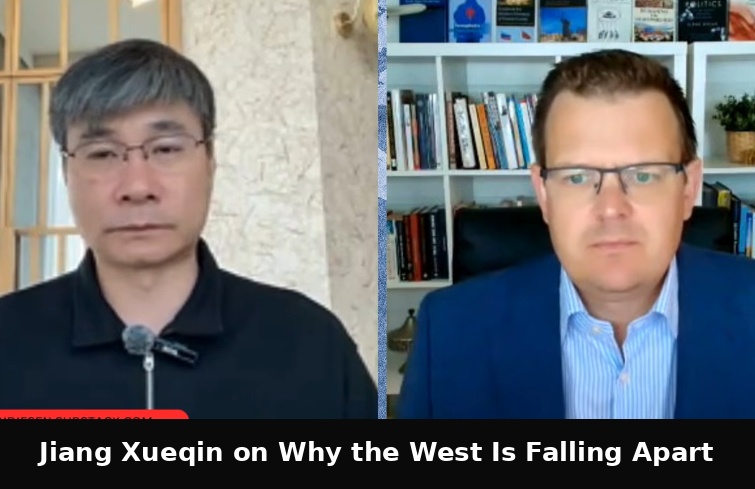
Read the full transcript of Predictive History host Jiang Xueqin’s interview with host Glenn Diesen on Greater Eurasia Podcast, August 11, 2026.
EDITOR’S NOTES: In this interview, Professor Glenn Diesen speaks with Jiang Xueqin, host of the Predictive History channel, about the mounting signs of Western imperial decline. Drawing on Jiang’s recent observations in Los Angeles and historical parallels to Rome, they examine extreme inequality, social decay, endless wars, elite detachment, and the economic pressures that are pushing the United States and its allies toward a breaking point. The conversation offers a sharp, unflinching look at the geopolitical and societal forces reshaping the global order.
Introduction
GLENN DIESEN (00:00:00 – 00:00:09): Welcome back. We are joined today by Jiang Xueqin, a very popular host of the program Predictive History. So thank you for coming back on the program.
JIANG XUEQIN (00:00:09 – 00:00:10): Thanks, Glenn.
GLENN DIESEN (00:00:11 – 00:01:23): And you’re joining us from Los Angeles today. And I did want to ask you about how you see the developments now for the United States, because it seems that, well, more and more Americans seem to believe that their country is, well, going in the wrong direction. At least this is what we see from polling.
This is largely due to stagnant wages, rising oligarchy, economic inequality, social problems, decline in trust in both media and government, diminishing freedoms. Of course, we have the endless wars, political polarization, the crippling national debt is of course a huge problem, and the list tends to go on.
And I’m reminded of Paul Kennedy’s book from 1987 on the rise or fall of the great powers. And he also was good at presenting this concept of imperial overstretch, in which the strategic commitments will far exceed the economic strength.
And I was wondering, to what extent do you see there now in the United States any indications of this imperial decline? I mean, well, what are the symptoms you would look at?
Signs of Decline: A First Impression of Los Angeles
JIANG XUEQIN (00:01:24 – 00:06:14): Yeah, so I’ve been in Los Angeles for 4 days. It’s my first time actually in Los Angeles, and I was invited by the Theo Von Show. So I did a podcast with Theo Von, and he was very generous in flying me over and having me stay in a very nice hotel.
So I’ll share some of my impressions of Los Angeles, and I will then explain what the signs of imperial decline are. So the first thing that struck out at me is I’m staying at a 5-star luxury hotel. Like, Theo Von was very generous with me.
And in the morning I went for a walk around the West Hollywood area. And West Hollywood is one of the most prosperous areas of not just Los Angeles, but also the United States. Just gorgeous buildings and the people are beautiful. And as I’m walking in one of the residential neighborhoods, I see a pile of dog shit in front of me and I walk around it and it takes me a couple minutes before I realize that it didn’t actually come from a dog.
And I just think to myself how in a society you have people who don’t care, who just feel, you know, I can just in broad daylight just take a dump in the middle of the street. And no one cares. And what this tells us is this is really a breakdown of the social contract. I feel as though people don’t feel that they’re part of society. I feel that society has abandoned a lot of people.
So I went to a dinner party last night in the Pacific Palisades, which is where all the movie stars live. And the mansion where the party was at, it was a $20 million mansion. It was just beautiful, huge mansion. And the thing that struck me was how extreme and outrageous it was to have a $20 million apartment because you can’t actually use the space. It was just one family, and their army of domestic staff, but you can fit like 100 people in there easily. And I look up the hill and there’s a $200 million mansion, which I assume is like 10 times bigger.
At the dinner party, I run into Max Blumenthal. We’re sitting together and we’re complaining about the outrageous luxury of the Pacific Palisades. So we decided to go to Skid Row as a comparison. So we drive to Skid Row for the night, and Skid Row is literally a scene from an apocalyptic movie. I mean, it is just dark. And there was a woman running around naked in the streets. And these are people, I think, I believe there’s about 4,000 of them who have been completely abandoned by society. The government pretends they don’t exist.
In the evening, I’ll take a walk around my hotel and there are homeless people everywhere. So another very important sign of imperial decline is just the inequality and the moral decay. Like these people have just been abandoned by society and they’re just left to their own devices. The massive inequality is a major indicator.
The third thing is I went for breakfast and I tried to find the cheapest place I could find, and I ended up paying $17, $17 for avocado toast. I’m not sure if you had avocado toast, but it’s not $17. And I don’t know how people can afford the prices in this country.
So there’s inflation. Well, what inflation really tells us it’s just basically the degrading of the currency. The US dollar isn’t really worth anything anymore because they’ve just printed out trillions these past 10 years and they continue to print out trillions in order to sustain the economy. You have the AI debt bubble that everyone thinks it’s going to pop sooner or later. You have this war in Iran where tens of billions are being spent every week, with no actual purpose and with no strategy in sight.
And meanwhile, you have political polarization in Washington, DC, where rather than focus on core issues, both the Democrats and Republicans are pointing the fingers at each other.
An Economy That No Longer Serves Society
GLENN DIESEN (00:06:17 – 00:08:16): It’s very strange, the whole economic philosophy they now have, because it used to be a time when an economy was assessed by the ability to serve society. That is, in the 19th century, you would have all these American economists, including liberal economists, who would point out that it’s important to tax the rent seekers to prevent the rise of an oligarchy, and these taxes should finance infrastructure. Not just to enhance competitiveness in international markets, but also enhance the standard of living for the average citizen.
But these days you get the impression that, well, I remember there was an article in the ’90s was, you know, there’s a solution to all these towns dying out in America was, you know, U-Haul, just move. If you can’t adapt, then, you know, then either you adapt or die.
So as you said, all these people, who fell behind and there’s no room for them anymore in the economy. They’re essentially ignored by the state, pretend they don’t exist. But, you know, this can create a revolutionary mood if you have a significant part of the population that no longer believes it has a vested interest in preserving the status quo. You’re willing to throw a wrench into the system. I guess for many people, voting for Trump was this wrench.
And but one thing that I wanted to ask as well was the proclivity for using military force, because I often talk to people of, well, retired colonels and all from the US military, and they always make the point that, you know, this is, we’re ahead of an economic crisis, we can’t afford this empire anymore, we should retrench, we should avoid these forever wars. Again, why people voted for Trump.
But instead, we tend to see that declining, uh, great powers, uh, they, they seem more likely to use military force at a time when they essentially can’t afford it. Uh, how do you explain this dynamic?
The Elite’s Bubble and Imperial Hubris
JIANG XUEQIN (00:08:18 – 00:11:17): Um, I, I, I think that, um, the use of military force is just another sign of imperial decline where you have an elite who live in their bubbles and they’re not the ones who are being sent to fight, uh, overseas. They’re not the ones who suffer the consequences for military losses. If the United States loses a war in Iran, the taxpayers have to foot the bill, not the billionaire class.
So I think you have this absurd situation where the elite live in their mansions, their fortresses in the Pacific Palisades, and they host their fabulous dinner parties and they only know each other. They live in a bubble. And they’re intent on maintaining their imperial hubris. They want to maintain their standard of living. They wanna make more money for themselves, and they’re willing to sacrifice all of society. They’re willing to burn all of society in order to maintain their imperial privilege.
They wanna feel good about themselves. They want to live in a world where America is the only superpower. They have this nostalgia for the United States of the ’90s during the unipolar moment when really the entire world was looking to the United States for salvation. The Soviet Union had collapsed and the United States was seen as a fundamental force for good in the world. And these people, the elite, they are stuck in that world. And meanwhile, the American society has declined and become much more corrupt because of the extravagant greed of the billionaire class.
And so even though we on the outside see this as folly, even though we believe that the United States cannot possibly defeat Iran in a war, and this will cause economic turmoil, not just in the United States, but throughout the world, the elite themselves live in a separate reality. They think that America is doing good by getting rid of a fundamentalist terror regime who is intent on nuclear weapons and who is intent on dominating and destroying the Middle East. So it is important, it is good that Iran be destroyed. And they also believe that the war is going well for the United States, that it’s crippling the Iranian economy. The leadership is in disarray. And any day now, the Iranians will surrender.
So, you know, what Donald Trump has said is, we’re winning the war. It’s not our fault if the Iranians don’t recognize they’re losing, right? So these are people who are essentially the baby boomer billionaire class, and they just live in their own separate reality, completely divorced from, um, our reality.
Lessons from the Fall of the Soviet Union
GLENN DIESEN (00:11:20 – 00:12:48): Yeah, well, it’s often made the point that the collapse of the Soviet Union also introduced, uh, disaster for the US. So again, when it was celebrated that adversary was defeated, but what’s often missed was that adversary balanced the US. It forced the US to embrace strategic thinking, to constrain itself, to, uh, to be measured.
Afterwards, essentially, the strategy of the US, the hegemonic strategy, was to be everywhere. This diminishes strategic thinking because now suddenly you don’t have to make priorities. You can absorb a lot of pain if you make a lot of mistakes. And also the whole idea that you don’t have to, well, that you don’t have to know everything about all the backgrounds, the complexities, because there’s this arrogance that you already have all the answers.
I mean, in short, I think the US, yeah, the whole imperial overstretch in terms of having obligations everywhere on the planet, every corner of the world, the US should have final say. This unavoidably would exhaust the US. Many people did warn about this in the ’90s, though. They would exhaust themselves and all the resources from the core would be siphoned off to the periphery to run an empire.
That’s largely what you’re talking about, though, isn’t it? That is, all the infrastructure, all the poverty increasing, all this money that can be spent on the population is going abroad to run an empire.
The Roman Republic and the Destruction of Carthage
JIANG XUEQIN (00:12:49 – 00:15:42): Yeah, you’re absolutely right. So a very good historical analogy is the Roman Republic. So there’s been a lot of debate about why the Roman Republic fell, but the Romans themselves believed the Roman Republic fell because they destroyed Carthage.
Like right before the Third Punic War, there was a huge debate in the Roman Senate as to whether to actually attack Carthage. And people like Cato the Elder wanted to destroy Carthage once and for all because they saw Carthage as the final and ultimate threat to the supremacy of the Roman Republic. But there were others who cautioned, listen, we need an enemy to balance us out. If we destroy Carthage, then we will become arrogant like every other empire in the past. And we will be torn apart by civil war, civil strife. We will embark on pointless military adventures overseas. We’ll expand too fast. We will financialize the economy and bankrupt most of our population while an elite become corrupt, arrogant, and insular. And that’s exactly what happened. So they destroyed Carthage and the Roman Republic fell maybe 150 years afterwards.
And so this is a very similar situation to the United States. You know, there’s been reporting that when Donald Trump ordered the attack against Iran, he did not believe the Iranians would close the Strait of Hormuz. He did not believe the Iranians could maintain cohesion. He did not believe that the Iranians would strike GCC energy infrastructure. He didn’t believe any of this stuff. In fact, they didn’t have a Plan B. They didn’t have a plan to continue the war for more than 4 weeks. They thought that aerial bombardment, decapitation would be enough. And this is reporting from the Trump White House. And everyone’s like, this makes no sense. They can’t possibly be that stupid. They’re not that stupid, but they are that arrogant.
Remember, it was not just the collapse of the Soviet Union that fed the arrogance of the Americans. It was really the 2003 Iraq War where in about a couple of weeks, the Americans went in, bombed the crap out of the Iraqi military, and they were able to decapitate the regime and impose their will. Then you have on January 3rd of this year, that Delta Force strike on Venezuela where they were able to very smoothly, with no casualties, capture, kidnap the president, the sovereign head of state Maduro, and now Maduro is standing trial in New York City. So I know that a lot of things don’t make sense, but that’s because we’re not living in their world. In their world, everything is perfect and everything will go their way.
What Happened to “America First”?
GLENN DIESEN (00:15:44 – 00:17:37): I think that was a disaster for them. Again, that success, if you will, in Venezuela. Probably they wouldn’t have gone into, you know, Iran with guns blazing and full of optimism if it hadn’t been preceded by that victory.
But again, a lot of Americans did recognise though that there was indications of imperial overstretch. At least I assume that’s part of the reasons why many people voted for Trump. That is, the whole principle of America First can be interpreted as, you know, if we have an imperial overstretch, if our commitments around the world has now exceeded our economic capabilities, then what would the solution be? You would shed some of those international commitments. You know, this is essentially how America First was initially communicated, it seemed. That is, let’s just put this country first and, you know, we can’t protect Europeans, we can’t, you know, this and that.
And at least, well, Trump didn’t want to walk away from empire, but he indicated he wanted a return on investment. That is, all of their satellite states should at least pay him for the privilege of being protected. So, but it didn’t go this way, it seems. I mean, he’s got more wars now. Initially was going to cut costs with Musk, then this kind of went a bit out the window as well.
How do you explain, I guess, what happened to America First? Because I thought that he had a good point during his campaign. I recognized the disease that is the imperial overstretch. I thought, well, what do they need to do? They need to scale back the empire, restore some fiscal discipline, and shed some of their international commitments. What went wrong there, you think?
The Israel Lobby’s Enduring Influence
JIANG XUEQIN (00:17:38 – 00:20:25): Yeah, so when a president comes into power in the United States, it’s usually because he’s supported by many different factions. So in Trump’s second term, he was supported by 2 major factions. You had the America First faction of people like Tucker Carlson, Tulsi Gabbard, J.D. Vance. And they wanted America to withdraw its commitments from the world and focus on building up the manufacturing capacity of the United States. And that’s one faction.
But then you also had another faction that people didn’t appreciate, which was the Israel lobby or the Israel First people. And they still were always around. And so in this administration, they’re represented by people like Peter Hegseth, Mike Waltz, who started out as national security advisor and now he’s UN ambassador. And then you have people like Howard Lutnick, Jared Kushner. And people didn’t really appreciate the influence of Israel in the Trump administration.
And what’s interesting is that if you go back to the first term, the presence of the Israel First lobby was always there. So remember in his first term, even though there was a chaotic foreign policy, Trump declared a trade war against China and he was trying to withdraw troops from Syria. But one policy, one foreign policy directive that was fairly consistent was a pro-Israel sentiment in the first term, right? So Trump withdrew right away from the JCPOA. He basically destroyed the Iran nuclear treaty. Then he moved the American embassy from Tel Aviv to Jerusalem, which is something that Israel has been asking for decades and no American administration agreed to it because they knew how volatile politically it would be. But Trump did it. Trump promoted the Abraham Accords. Trump also recognized the Golan Heights, Israel’s control of the Golan Heights.
And the most dramatic thing that Trump did, the most consequential of course, was he ordered the assassination of General Qassem Soleimani, which is what precipitated this crisis with Iran. So in his first term, he was very much Israel first. And what’s interesting is that when he lost power, the people around him who stayed loyal, who stayed the most loyal, were actually Israel First people.
GLENN DIESEN (00:20:25 – 00:20:25): Okay?
JIANG XUEQIN (00:20:25 – 00:23:31): And these included people like Sheldon and Miriam Adelson. Sheldon Adelson was Trump’s biggest financial backer, both in 2016 and 2020. People like Sean Hannity, who is this Fox TV, news host who is very close with Trump. They speak on the phone every day, I believe. And, but also he’s an ardent Christian Zionist. Okay. So he’s not, he’s not an Israeli, he’s not a Jew, but he believes in Zionism.
So the Israel lobby never gave up on Trump. And I think that when Trump was in exile in Mar-a-Lago, those, during those 4 years when he was under siege, right? Remember the FBI raided his Mar-a-Lago house looking for classified documents. There was lawfare, Democratic lawfare against him. And there were times when he almost seemed on the verge of bankruptcy, right? So he was in his worst days during those 4 years in exile. And the Israel First lobby continued to support him.
And so I think that he feels his loyalty to Israel. And in many ways, I feel that Trump launching this war against Iran is a way to thank Israel’s support for the past 8 years, because there’s only one country in the Middle East that benefits from any of this, and it’s Israel. The United States doesn’t benefit. The GCC are really suffering. And because I think that Trump is sort of beholden to Israel for whatever reason, we don’t know why, he’s beholden to Israel, but it’s clear that he’s beholden to Israel.
I think this war can only escalate until it engulfs the entire Middle East. And already we’re seeing that because the Houthis have been brought into the war and the Houthis represent an existential crisis to Saudi Arabia. So Saudi Arabia has recently signed a mutual defense pact with Turkey and with Pakistan, and there’s even talk of bringing Egypt into this pact. You can imagine the main purpose of such a pact would be to launch a multinational coalition against the Houthis. So imagine Saudis aligned with the Egyptians and the Pakistanis and the Turkish launching a ground invasion against the Houthis. This could only end in disaster because the Houthis are heavily fortified in the mountains and the Houthis are being supported by the Iranians, and the Houthis have access to drones and ballistic missiles, and it’s very easy for them to destroy the energy infrastructure of Saudi Arabia. And that’s already what’s happening.
So again, there’s complete chaos and turbulence in the Middle East. And again, the only country that seems to be benefiting from this is Israel. So we have to imagine that Israel, for whatever reason, has a hold over Donald Trump, such a hold that Donald Trump is willing to abandon his allies, Tucker Carlson, um, you know, MTG, Joe Kent, these people, Thomas Massie. And now he’s completely all in, uh, in Israel.
Outsourcing Empire: Europe, the Gulf, and Redundant Weapons
GLENN DIESEN (00:23:32 – 00:25:27): Yeah, very much seems to be the case. Um, well, if he can get these Arab states to fight his wars though, this would be one, uh, I guess one achievement in terms of, uh, the US reducing its global commitments. That is, you would expect the US to shift burden onto allies to make them carry the weight, which is very different from what you saw after World War II when the US looked after the security of all other states. It had generous trade agreements to its frontline states, and now essentially they have to get allies to carry their weight. Essentially, in Europe you see the same, the attempt to outsource the Ukraine war to the Europeans. I noticed Trump talks about ending the war, but at the same time he’s using this war to push the Europeans to arm themselves to the teeth though.
And well, that’s also why I want to ask you about Europe, because again, this continent destroyed itself in 2 world wars, and you can argue it had its life extended by hitching its wagon to the United States. Although as a junior partner, but it’s also, of course, trapped the Europeans in this very strong strategic dependency. The goal over the past decades has obviously been to elevate itself through this collective bargaining power to have some kind of equality with the US. I think over the past 20 years, this has faded away, any possibility of achieving this.
But what we see is a very interesting period in history, though. That is, the US is losing interest in an increasingly irrelevant Europe, while the Europeans seem to be only increasing their dependency on the United States. What does this tell you about Europe’s future?
JIANG XUEQIN (00:25:29 – 00:28:20): Yeah, so what’s happening around the world is a very common pattern of imperial decline. So what the United States is doing is not shifting the security burden onto its allies. What the United States is doing is cannibalizing its allies.
And so there’s a very important distinction because if you think about it, there’s absolutely no reason why Europe should be at war with Russia. Left to their own devices, I’m pretty sure the Europeans would conclude a peace treaty with Russia that would be mutually beneficial to all sides and which would bring peace to Europe. Left to their own devices, Saudi Arabia, the GCC, they would seek an accommodation with Iran as soon as possible, right? Because the UAE, Kuwait, Bahrain, Qatar, they can’t afford much longer for the Strait of Hormuz to remain closed. They would want an immediate ceasefire, and they would probably be willing to pay trillions of dollars to ensure a ceasefire with Iran. Left to their own devices, you would have peace.
But the American empire has a problem, which is the $40 trillion national debt. So if America were to retreat from the world, this national debt would collapse and the American economy would collapse. The fiat currency, the US dollar, would go to zero without global demand. So the only way to resolve this is to force the Europeans, the GCC, the Japanese, the South Koreans, so-called American allies, to continue to subsidize the American economy by continuing to buy US debt. And the best way to do that is to force them into conflict with their neighbors, Japan versus China, Europe versus Russia, the GCC and Israel versus Iran. And you sell them weapons that are overpriced and which are redundant and which aren’t very useful. And then this is a way to continue the easy money or continue financing the US national debt.
There was a news story of the GCC nations, I believe they were Bahrain and Kuwait, who bought 5,000 Patriot missiles from the United States. We should see more of these news items as we go along. And these Patriot missiles, remember, it’s been proven these past 3 months, these Patriot missiles don’t actually work. Patriot defense systems do not work against Iranian ballistic missiles. You have a fantastic guest, Ted Postol of MIT, who has very clearly explained that these air defense systems don’t actually do anything, that it’s very easy to circumvent them. But again, the point is not to win this war. The point isn’t even to force this war on American allies. The point is just to cannibalize American allies by forcing them to buy redundant and useless American defence systems.
Can the United States Reverse Its Decline?
GLENN DIESEN (00:28:23 – 00:29:11): Well, to what extent do you think that American plan could be a recipe for, I guess, reversing the decline of the United States? Because if I would look towards the future of the US versus Europe, I would want to see what made them successful to begin with. And well, which one of these variables are still present? It looks as if the US, though, it would have more to fall back on, as opposed to the Europeans at the moment with these deindustrializing economies, the lack of cohesion among the different states. Overall, I don’t see a good economic model, even a clear place in the world as the world is now multipolar. So how do you see those two?
JIANG XUEQIN (00:29:12 – 00:31:18): Well, I wouldn’t call the Europeans giants anymore, but these two actors, yeah, so I think the United States wants the Europeans to go fight the Russians, and there’s no appetite among the European public to fight this war. And what’s going to happen is that the European political leadership is going to sleepwalk into a war with Russia. Possibly by sending in special forces in the beginning to aid the Ukrainians. But eventually you will have a conscription. You will have young men be conscripted to fight this pointless war in the trenches of Ukraine. This will lead to political revolution in Europe.
And the reality is, and it is, people are sleepwalking into tragedy and disaster. It’s almost like on remote control. It’s almost like a zombie political system that they have in Europe nowadays. And they do this not because they hate Russia. They do this not because the Americans are forcing them to do this. They do this because it’s a path of least resistance because it is too hard conceptually and mentally and psychologically for them to seek an accommodation with Russia. They’ve been, in their minds, they believe that Russia is the Great Satan and they have to defeat Russia. So it’s a lack of imagination, it’s a lack of political will. It’s just a lack of energy now. I mean, the reality is that the Europeans are controlled by these bureaucrats who are looking forward to their huge pensions and who spend most of their day and their time planning their vacation. And so, I mean, Europe, it’s just an austere bureaucracy right now. They’re just sleepwalking into disaster and there’s no way around it.
Europe: Elections or Regime Change?
GLENN DIESEN (00:31:21 – 00:32:05): No. Well, what you suggest though is the need for domestic political change. Do you see it? Because I can kind of interpret the current events in 2 ways. On one hand, you see the political leadership being, well, weakened severely. That is, it’s not just unpopular, it has a legitimacy crisis. On the other hand, whoever seems to replace the former ones, for example, the best case would be in the UK, where Starmer is effectively replaced with a younger Starmer, but more or less the same. It’s just a facelift. And one gets the impression even in France, if Macron would give way to someone like Le Pen, would she really be that different?
JIANG XUEQIN (00:32:07 – 00:32:07): Uh, how—
GLENN DIESEN (00:32:08 – 00:32:17): I mean, do you, do you see simply elections, or does it have to be a shift, like a regime change, essentially a shift in the entire political system?
JIANG XUEQIN (00:32:18 – 00:34:17): I think Europe is heading into a lot of trouble. I, I think like a lot of opposition in Europe is controlled, as you point out. And so you look at Spain. So a couple weekends ago, there were 50,000 migrants who flooded Ceuta, which is an enclave of Spain on the African continent. And this is something that was coordinated and directed by Moroccan authorities as a sort of political leverage. And this put tremendous pressure on a left-wing coalition led by Pedro Sanchez in Spain. And so you can imagine that given all this pressure, they’ll probably lose the election to who? Vox. And the leader of Vox has proven to be pro-Zionist, pro-Israel, pro-war individual.
So it’s kind of an absurd situation where if you opposed the American empire, they will fund opposition groups and then they will use all their resources to undermine your credibility and put tremendous pressure on your population. And so there’s still a lot of tools that the empire has in their kit to impose their will on European populations. So, and I think that for the Europeans, the next 10 years, they will be stuck doing the bidding of the American empire and Zionist forces. And this is not a very optimistic future for the Europeans. The reality is that when you have a society in decline, and the United States and Europe are very much societies in decline, it is impossible to arrest the decline. It’s only a question of how fast does it die.
The War in Ukraine: A NATO-Russia Conflict
GLENN DIESEN (00:34:20 – 00:36:08): Well, if you look at, again, a declining great power will engage in more wars. One of them, of course, is the Ukraine war. Um, how do you— again, the Europeans will be more dependent on the United States as long as this war goes on. But at the same time, how long can this war really go on? Because at the moment it’s escalating quite fast within the format of only being Ukraine.
Uh, if again in a few months’ time now Ukraine begins to collapse and there’s a— I’m not saying it would happen this winter of ’26, but nonetheless, one would see huge problems on the front line, the manpower issue. Obviously now, they don’t have air defences anymore, and the Russians have decided to retaliate heavily against the NATO escalations and Ukraine escalations by really pummelling Ukrainian cities and even putting a naval blockade along its entire Black Sea coast. So it doesn’t seem very stable anymore. That is this ideal scenario for the United States and the Europeans where the front lines would remain somewhat unchanged and the Ukrainians and Russians would just gradually bleed each other white. This appears to be coming to an end as we seem to be reaching a breaking point.
How do you see this war progressing? Because it seems too soon for the Europeans to send in their own public. There’s no willingness, even some of the most Russophobic countries still don’t want to send their own men in yet, it seems.
JIANG XUEQIN (00:36:09 – 00:38:28): So this is not a war between Ukraine and Russia. If it were a war between Ukraine and Russia, this war would not have started in the first place. Zelensky would’ve signed a treaty with Russia from day one to avoid conflict. This is clearly a war between NATO and Russia. Zelensky is clearly a paid actor. He’s literally a paid actor. He’s a proxy for NATO. And you’re absolutely right in that the Ukrainian frontline, they’re exhausted. They’re out of manpower. They’re very corrupt. The morale is very low. But as long as they keep on getting support from NATO, this war can drag on for a long time.
A really worrying development is that a couple weeks ago, there was a Ukrainian drone strike on an Iranian cargo ship transporting goods in the Caspian Sea. The Caspian Sea is actually pretty far from Ukraine. So the Ukrainians went out of their way to attack this ship and then Zelensky announced it. And I think that a lot of people are saying that his ambition is to draw the Americans into the war in Ukraine by uniting both fronts, right? By showing that Russia and Iran are allies. And if you want to defeat Iran, you have to defeat Russia as well. The Americans aren’t interested in merging both fronts. So Zelensky had to apologize to the Iranians, but we can imagine that these sort of stunts will continue. Because NATO is desperate to force the Americans to support this war in Ukraine.
And so I think that these strikes in the Caspian Sea, this strike against Iranian interests will continue. So I don’t think this war will end. I think it’s much more likely that this war in Ukraine will merge with the war in Iran and this contagion, the domino effect, will continue to spread. Another area of contention, another flashpoint in the world is the South China Sea. So Taiwan will always be a flashpoint between Japan and China, and I think that North Korea may enter the battlefield sooner or later.
Russia, China, and Iran: The Three Rivals
GLENN DIESEN (00:38:31 – 00:39:09): Well, that’s interesting because the North Koreans have already in a big way entered the Ukrainian battlefield. But you do see that these 3 powers, Russia, China, and Iran, they represent the 3 main powers on the Western part of Eurasia, the Eastern part, and the Southern part. So these are the main 3 rivals of the United States. But to what extent, well, we see the Russians and Iran getting quite close, but how deeply involved do you think the Chinese might get in either the Iran War or the Ukraine War, or how deeply involved are they?
JIANG XUEQIN (00:39:10 – 00:41:51): So it is this, um, classic Chinese geopolitical strategy to maintain neutrality, uh, so as to maximize options. So for the longest time, China was trying to keep aloof from this war in Ukraine and from this war in the, um, the Middle East. So China has always, um, kept its distance from this war in Ukraine, and China has been very compliant with American sanctions against Russia.
This war in the Middle East directly affects Chinese interests because China gets a lot of oil and energy from the Middle East. And so China was working very hard behind the scenes to seek a diplomatic solution. I don’t think the first ceasefire would’ve happened without Chinese intervention. And I think that China was very insistent on both parties, both the Iranians and Americans, respecting the MOU. One really interesting thing that the Chinese did was cut off oil imports by at least 50%. And the reason why the Chinese did that was to stabilize oil prices, to give Trump the sort of political incentive to seek peace as soon as possible with the Iranians. So the Chinese have done a lot to try to end the war in Iran as soon as possible.
But the Americans, what they’re doing is they’re aggravating China by imposing new tariffs, by sanctioning a lot of Chinese companies, and by encouraging Japan to remilitarize. Right now, there’s a Quad happening in East Asia: Japan, India, the Philippines, and Australia. We can imagine that the United States is pulling a lot of strings behind the scenes. So even though China wants to seek an accommodation with the United States, the United States seems intent on strangling China. And there’s many in the United States who see China as the real threat. So when an empire is in decline, it sleepwalks into disaster. So there’s absolutely no reason for China to help Iran and Russia, but the United States is giving China a lot of reasons to do so. So we can expect a lot more points of cooperation between Russia and Iran.
Something really interesting to look at is the Arctic route, right? So China has something called the Strait of Malacca dilemma, which is to say that most of Chinese trade transits through the Strait of Malacca, and the Strait of Malacca can be easily closed off. So for the past few years, China has tried to create an Arctic Silk Road, and that is going very well, but it entails direct cooperation with Russia.
China, Taiwan, and North Korea as Leverage
GLENN DIESEN (00:41:53 – 00:43:12): Yeah, well, we always see that, yeah, somehow China is included in all these conflicts. For example, when General Keith Kellogg, he was arguing for why it was such a good idea to fight this war against Russia, he was making the point that, you know, we use Ukrainians to remove Russia, you know, from the chessboard of, you know, major rivals, and this will allow us to focus on China. And at the same time, you have all these U.S. senators and different commentators who make the point that, well, at least as the war goes on in Iran, we’re able to cut off the Chinese from important resources. Scott Bessent was making this point as well. So it does seem like China is well, again, the ultimate target here.
So, well, I did want to ask about the mood in China because if the Chinese recognize that a key goal of weakening Russia or cutting off key resources from Iran is to harm the Chinese, how do you see that China is preparing for a possibility of a conflict with the United States? Or what are the possible pathways here? Because we can already see a possible World War III being unleashed through the Middle East. We can see it starting perhaps in Europe, of this war with Russia, but do you see a pathway in Asia as well.
JIANG XUEQIN (00:43:14 – 00:47:23): So I, I think that the major flashpoint in East Asia will be North Korea, and so here’s my logic. Right now, China wants to reunify with Taiwan, and this is the major political agenda for China, but China doesn’t want to retake power militarily. That would be disaster, and it would not end well. China wants to create economic and political leverage in order to reunify with Taiwan.
The opposition leader of Taiwan, a woman named Cheng Li-wun, visited China a few months ago, and she was welcomed by President Xi Jinping. And she is very much interested in reunification, and she’ll probably win the next general election in Taiwan. So China believes that over time Taiwan and China would reunify peacefully, and that very much would be the major political triumph for the Communist Party. It would end China’s century of humiliation when the Western powers came to divide China up, when they carved China up into different pieces.
The problem is that the Japanese have stated that Taiwan is core to Japanese strategic interests, meaning that Japan relies on global trade. And if China were to take over Taiwan, then China could use Taiwan to embargo Japan and block Japan from Southeast Asia. So Japan would not allow the unification of Taiwan and China. And in fact, these past few months, Prime Minister Takaichi has launched a frenzy of remilitarization, and she’s been fostering close military cooperation with India, with the Philippines, and with Australia to counter what they perceive as the, um, China threat.
Now, Chinese geopolitical strategy is to try to avoid kinetic warfare. China does not like to fight wars for a variety of reasons. And so what happened was that, uh, in May, right after Trump and Putin visited China, uh, President Xi Jinping made a personal visit to North Korea. And I think the logic of this is to use North Korea as a point of leverage against Japan, right? Because if North Korea is lobbing missiles into the Sea of Japan, it’s going to freak out the Japanese population. And already the Japanese population do not want to remilitarize. There’s been lots of protests against Japan’s aggression.
And so hopefully the great hope is that by using North Korea as a point of leverage, Japan and China can come to a compromise, uh, via Taiwan. Um, but unfortunately, I think that the Americans are trying to co-opt the Japanese political system. So Japan recently announced they were forming a CIA, which is modeled— which of course we model off the American CIA. We can also imagine, like, eventually Japan will form an FBI, an NSA, basically create within Japan the infrastructure of the American deep state so that America can impose its will through these intelligence agencies in Japan. So America is trying to vassalize Japan and use Japan as a pawn in this great game against China.
So I think this is how the geopolitical situation will turn out in East Asia. And the Chinese understand this, and the Chinese are very patient, and they think long-term strategically. And if China were to bring North Korea into the picture, there’s very little Japan can do about North Korea.
Powder Kegs: What Keeps Him Up at Night
GLENN DIESEN (00:47:27 – 00:47:47): Yeah, it’s not a country you want to go to war with either. Well, what is there to gain? Well, just as a last question, because you’ve been quite successful in many of your predictions, what is it that, well, you keep your eye on at the moment, or what is it that keeps you up at night? Do you see any worrying trends?
JIANG XUEQIN (00:47:49 – 00:49:35): Yeah, I think that society is much more volatile than we think. So we’re focusing on the geopolitical picture. But these societies are powder kegs. So if you go to England, if you go to France, if you go to Germany, if you go to Spain, the population is really unhappy with the way things are.
I’m in Los Angeles and it’s my first time in the United States in 2 years. And the signs of imperial decline are everywhere. And I can’t believe Americans are happy with outrageous food prices. Also, by the way, I’m not sure if you had a chance to visit the United States recently. The food is pure poison in the United States. I’ve been here for 4 days and every single day I’ve had diarrhea. And I pay a lot of money for this food. I make sure to go to like good restaurants, but they put something in the food, whether it’s GMOs or some sort of growth hormones or whatever, but it’s causing my stomach to rebel against me. And my system is having problems dealing with American food. And all the Europeans say this. The Europeans come to the United States and they can’t believe the poison that the Americans are eating.
So I don’t understand why the American people are putting up with this crap. And I think that eventually there’ll be a trigger and you’re going to have a lot of violence in the United States. So I think that is something that people are not aware of. We’re too focused on these flashpoints and we don’t recognize that within all these societies, the people, the population is extremely restive, extremely frustrated with the political leadership. And at any point, things can blow up.
Europe in 2026: Echoes of 1848
GLENN DIESEN (00:49:36 – 00:50:55): Do you see something similar in Europe though? Because, well, again, I guess Britain doesn’t look very stable. In France, every now and then you have some generals who’s predicting civil war. And of course, in Germany, there’s also, I guess, the political culture is looking a bit dark. That is, once you begin to refer to your political opposition as enemies or traitors, you can’t really have peaceful change in power anymore.
You know, the Germans just— well, Merz, the chancellor, recently made these secret deals where he was looking at how to essentially strip some of the states in the republic of its autonomy if they vote the wrong way, because they saw them as being, well, too friendly to Russia, which means, you know, they’re not gung-ho on war apparently.
So how do you see the political stability in Europe? And of course, you have this separate layer where they have the EU, which is trying to make sure people don’t vote the wrong way and keep everything in place. However, the more it holds everything in place, the more tensions are building up. So it just looks as if this can’t really last forever.
JIANG XUEQIN (00:50:56 – 00:52:16): Yeah, so a good historical analogy is the 1848 revolutions in Europe. And you go to the year 1840, it’s very similar to what Europe is like today. You have economic malaise, you have a lot of inequality, you have a lot of corruption, you have an aloof elite, but there’s peace in Europe. And it seems as though the population, they’re not happy, but they won’t rebel.
But a few years later, because of climate change, because of weather patterns, there’s a famine throughout Europe. And then what happens is, I can’t remember the exact starting point, but in one nation there’s popular unrest and, like, the very next day, the entire, all of Europe is engulfed in flames.
So I think that this war in Iran will create famines throughout the world, especially in Africa. It’s going to cause food prices to skyrocket in the United States. And I’m not sure what the pain tolerance is among the American population. So these things are impossible to predict when they’ll happen, but I think the ingredients are in place and all you need is a spark. And that spark could possibly be massive inflation caused by this war in Iran.
Closing: Heading Toward Financial Collapse
GLENN DIESEN (00:52:18 – 00:52:35): Yeah, that’s an issue we didn’t cover. That is the pending economic crisis. I mean, this is another thing that seemingly can’t go on forever. But yeah, we’re going to have to leave that for next time unless you have a quick answer for it. Where are we headed?
JIANG XUEQIN (00:52:36 – 00:53:06): Well, I think we’re heading towards total financial collapse. I think that the economy in the United States, it’s just a Ponzi scheme. You’ve got both the private credit bubble, which is worth about $2 trillion. And you’ve got the AI bubble, which is also trillions of dollars. And these are not sustainable bubbles. And I think that once these bubbles pop, then the full brunt of economic pain will manifest itself.
GLENN DIESEN (00:53:09 – 00:53:14): Well, on that happy note, thank you very much for taking the time. And I always appreciate speaking with you.
JIANG XUEQIN (00:53:14 – 00:53:15): Okay, thanks a lot.
Related Posts
- Transcript of Boris Johnson Interview on School of War Podcast
- Transcript of Professor Jiang Interview with Raj Shamani: World Order Is a Lie
- Karin Kneissl: Energy Wars & the Coming Collapse of Europe (Transcript)
- Seyed M. Marandi: Iran-Oman Hormuz Deal & the Saudi-Turkey-Pakistan Defence Pact (Transcript)
- Transcript: Jeffrey Sachs Keynote Speech at Singapore Economic Review Conference 2026