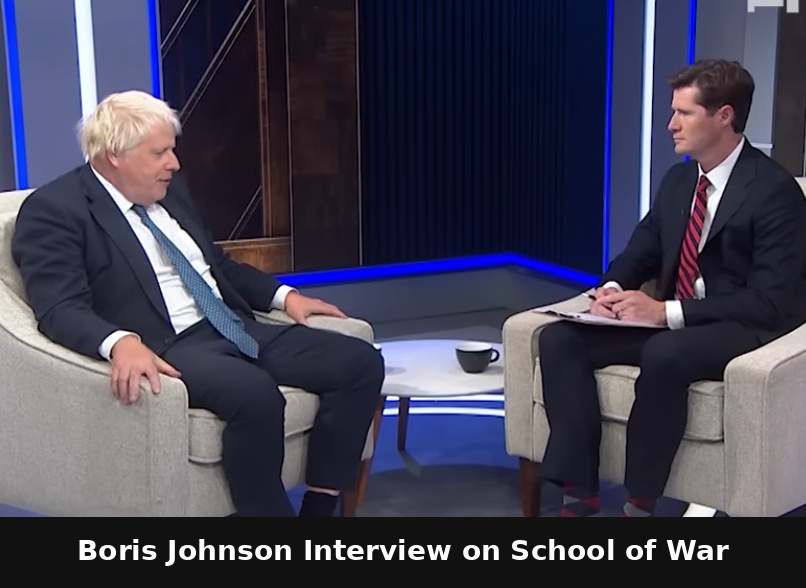
The following is the full transcript of former British Prime Minister Boris Johnson’s interview on School of War Podcast, August 11, 2026.
EDITOR’S NOTES: In this episode of the School of War Podcast, former British Prime Minister Boris Johnson joins the conversation as the war in Ukraine enters its fifth year and strains on the transatlantic alliance deepen. He argues that the West still holds the power to prevail—insisting “Putin has got to lose”—while explaining how to pressure Russia to the negotiating table, dismissing Europe’s pursuit of “strategic autonomy” as a sham, and challenging the narrative of American decline in favor of continued U.S. leadership.
INTRODUCTION
AARON MACLEAN: Today on School of War, we talk to Boris Johnson, who was Prime Minister of the United Kingdom from 2019 to 2022, a period that saw Brexit, the Russian invasion of Ukraine, and much more besides. We’ll talk about Ukraine, his experiences there recently, but also his leadership back in 2022, elements of which were quite controversial. We’ll talk about the Atlantic relationship between the United States, the UK, and Europe. European complaints about President Trump, American complaints about the Brits. Things get a little bristly at times. Let’s get into it.
AARON MACLEAN: Hi, I’m Aaron Maclean. Thanks for joining School of War. I am delighted to welcome to the show today Boris Johnson, once Prime Minister of the United Kingdom. He’s been twice Mayor of London, the Foreign Secretary, leader of the Conservative Party, led Britain through a tumultuous period of Brexit, COVID, and the Russian full-scale invasion of Ukraine. Thank you so much, sir, for coming on the show.
BORIS JOHNSON: Pleasure. Nice to see you.
The Road to War
AARON MACLEAN: Let’s start with Ukraine. I know you travel there frequently, and I want to get to where we are and the road ahead. But before we do that, I want to take you back to 2021, 2022, when you were in office.
BORIS JOHNSON: Yeah.
AARON MACLEAN: And just talk through those events, because I think it will be very interesting to listeners and viewers. Do you remember when you first realized that the invasion was going to happen, that it was real?
BORIS JOHNSON: Well, it’s a very good question, because I’ve got to pay tribute to my defense secretary, a guy called Ben Wallace. Back in the summer of ’21, he read Putin’s crazy Nostradamus essay about how Ukraine is part of Russia, all this nonsense. He came to me and said, look, I really think he’s serious. I really think he’s going to invade.
So over that autumn, I read it too, and I could see that something very nasty was going to happen. We decided to see what we could do to help, because we’d been helping Ukraine for a long time, since the first invasion in 2014. The UK was always very heavily pro-Ukraine, trying to keep Putin under control and back the Ukrainians.
To answer your question — when did we know? By the end of ’21, beginning of ’22, we had very little doubt. To be frank, the SIGINT and the intelligence we were getting from your guys, our guys — it was overwhelming. We knew he was planning something very bad.
The funny thing was that we couldn’t convince our best friends. We couldn’t convince the French. We couldn’t convince the Germans — maybe because they had so much emotionally invested in the idea that this wasn’t going to happen. Even on the eve of war, it still wasn’t clear to them. I remember in February 2022 going to Ukraine, just before the invasion, talking to Volodymyr Zelensky. Even then, he was being ambiguous about whether he thought it was actually going to happen. But that was because he didn’t want to scare people in his own country. I think he knew it was going to happen.
So I would say turn of the year ’21, beginning of ’22 — certainly by the Munich Security Conference — we were pretty sure.
AARON MACLEAN: And British policy was really leaning into the prospect of this invasion. You supplied anti-tank weapons to the Ukrainians quite early on in 2022.
BORIS JOHNSON: To be fair, don’t forget — we did. I’m very proud of what we did. We sent them something called NLAWs, a very useful anti-tank shoulder-launch weapon made in Belfast by what was Short Brothers, now Thales. But the credit for really breaking the taboo on sending important lethal weaponry belongs to Trump. I can’t remember exactly who — maybe it was John Bolton or somebody who told him — but he sent them the Javelins.
AARON MACLEAN: Yeah.
BORIS JOHNSON: Fantastic thing to do.
AARON MACLEAN: Yeah, it was in that era.
BORIS JOHNSON: I think it was. And that made a real difference — it enabled us to do it and to make the case to our friends.
European Skepticism
AARON MACLEAN: Do you remember, on the other side of the ledger, speaking to folks who were skeptics? Because there were a lot of skeptics right up to essentially the moment of the invasion that it was actually going to happen. Do you remember conversations you had, perhaps with Macron or others, where they expressed skepticism that this was going to come? What was the nature of European skepticism? I think it was a desperate hope that it wouldn’t come.
BORIS JOHNSON: Wasn’t going to come, and I was saying, come on, we’ve got to put sanctions on these guys to stop them doing it. I remember Olaf — the German guy — was very much against that. Emmanuel too.
If you remember what happened with the Ukraine dossier — from 2014 onwards, we basically messed up the Normandy commemorations, I think it was in July. We hadn’t been at the right meeting. The Normandy format was France, Germany, Russia, and Ukraine, treating the conflict as though it was a domestic dispute between Russia and Ukraine.
They were very much against it — they couldn’t accept that Putin was really going to do this. We had to say, look, you should hear what we’re hearing. We can hear them giving the orders to the battalion tactical groups to move to the front. We can hear all this stuff. And they didn’t want to hear it.
I do remember one conversation in particular with the Germans — I won’t tell you who it was — but there was one particular senior representative of the chancellor’s staff who said, if this is going to happen, wouldn’t it be better if it just happened quickly and the Ukrainians lost and it was all over? I can see why he said that. I profoundly disagreed, but whatever we are now — four and a half years after the outbreak of that invasion by Putin, with so many people killed and injured and so much disaster and suffering — I can see why he said that. I still think he was wrong. He was trying to say, look, this is going to be a disaster for the whole world, for Ukraine, for Russia — maybe we’d better get it over quickly. I thought that was profoundly wrong. I thought we should help the Ukrainians to resist.
AARON MACLEAN: Yeah.
BORIS JOHNSON: So there was a lot of that. They wanted to resist. They wanted to fight. They wanted to defend their country. That is amongst the most powerful human emotions.
AARON MACLEAN: Yeah.
BORIS JOHNSON: There was no stopping it. People now say — and this is absolute nonsense, if I can use a milder word than the one I want to on your show —
AARON MACLEAN: You may. You can use worse if you like.
BORIS JOHNSON: Maybe I will. Some people — the Kremlin, sometimes — accuse me of this. You may have seen it. They say that after the invasion, after their forces had been repelled from the Kyiv area, there was a period in April when there was real progress being made on a negotiated outcome, a solution.
AARON MACLEAN: And this was your first trip — you’re famously the first, certainly, European leader.
BORIS JOHNSON: They said that my trip to Kyiv that April was responsible for stopping those peace negotiations — that I queered the pitch, that I made it impossible for a peace deal to be done. It’s total and utter nonsense. There was no European leader, no Western leader, who could conceivably have stopped the Ukrainians from fighting for their country. It just wasn’t going to happen.
All I was saying to Volodymyr Zelensky, after this appalling thing they had been through — when they’d succeeded against all the odds in pushing the second-biggest army in the world out of the Kyiv area, pushed them back in the east a bit too, done wonders — all I wanted to say to him was: look, I can’t be more Ukrainian than the Ukrainians. But if you want to fight on, we’re going to be with you. That’s all I said. And I had a strong mandate from my cabinet and from Parliament to say that. That remains the position of the British people.
A Long War
AARON MACLEAN: Let me ask you this then. Four and a half years on, even supporters of the Ukrainian cause have to confront the fact that it’s been a bit of a stalemate. At times the pendulum swings more in the Russian direction, at times more in the Ukrainian direction. Recent months have seemed more favorable to the Ukrainians — it’s possible that pendulum will swing back. Do you think there was a moment — maybe spring of 2022 wasn’t the right one, maybe fall of 2022 when the Russians really were on the run? That was a rough time for Putin — they had lost a great deal of what they had already captured, Ukrainians were pushing. Was there a time when —
BORIS JOHNSON: He wouldn’t have done it. Look, at every stage it has been open to Putin to bank his gains and say no more. At every stage, I’ve no doubt at all that Volodymyr Zelensky would do a deal. He wouldn’t say this and he couldn’t say this, but I’ve no doubt he would de facto trade land for peace — not de jure, but de facto. He’d accept that Putin freezes it at the point of contact, provided the West gave some sort of guarantee that Ukraine would be protected, fortified — a sort of steel porcupine strategy.
But Putin has never come close to accepting that. Show me any time in the last four and a half years when he’s actually said he will stop fighting, stop sending his troops. The only reason he moved out of the areas he was in was because the Ukrainian forces heroically repelled him. That’s all. He’s done nothing for peace.
I think you’ve completely accurately characterized the state of the war at the moment. A lot of people in the last couple of months have gotten the impression that Ukraine is doing a lot better. It is — it’s doing fantastically. Their technology is amazing, they’re doing spectacular things. But on the ground, it’s a nightmare. Absolute nightmare.
AARON MACLEAN: You were just there earlier this year. What did you see?
BORIS JOHNSON: Of course I was. I saw the horror of what it’s like to be a Ukrainian soldier in those forward positions. You realize how hugely the drones have changed the face of war.
AARON MACLEAN: Yeah.
BORIS JOHNSON: And how terrifying they are. It really affects people’s psychology — that at any moment, death can come from the sky, this buzzing little mosquito that can kill you. I saw all that, and I saw how hard-pressed they are.
Putin was trying, really hard, to take Zaporizhzhia — the city to the south, a famous city in the south of Ukraine, built largely with American help. The dam was built with American help in the ’30s. It’s an incredible story.
AARON MACLEAN: We did that for most of Afghanistan too.
BORIS JOHNSON: This was in the 1930s, the Herbert Hoover era. Incredible place. Putin wants it because he’d control the route through to Odessa and could really damage Ukraine. So the fighting is very hard there.
Some of the villages I saw — you’re in a house in a village, and of course the other villagers — one of the sad features of the war is that the soldiers are defending the village but have to find somewhere to stay, so they end up in the bunkers in people’s houses. That means homes in that village get bombed.
AARON MACLEAN: Yeah.
BORIS JOHNSON: So if you’re a civilian, you start to resent that your life is being destroyed in that way. Places I visited a few months ago, in February, have now been overrun. So you’re right to say the Ukrainians are doing better, but Russia’s pushing on and on.
Putin doesn’t have the incentive now — or has never had, in his mind, an incentive — to stop. It’s good news that today we’ve got this thing in the Senate, in Congress — the Lindsey Graham bill going through. It hasn’t quite passed yet, but it’s going to happen, I hope. It’s looking promising. That’s a serious instrument of pressure on Putin — a 100% tariff on anybody who buys Russian oil and gas or oil and gas products. There are five big countries that do — China, India, and so on. That should really hurt Putin.
AARON MACLEAN: Is this your prescription — economic warfare?
BORIS JOHNSON: Yeah, it’s got to be done. It’s great that the United States is doing this today. Since I’m here in Washington, I should make a general point about the United States: for all the criticism leveled at the White House over the handling of Ukraine, if it were not for the USA, Ukraine would not today be an independent country. Be in no doubt — America remains the arsenal of democracy. The intelligence support, Starlink, all of that — that commitment continues to keep Ukraine going.
What we need — and I think it would be great if this came from the US — is a far clearer commitment that Putin has got to lose. I think Donald Trump has done some great things in this area. The Javelins I mentioned, this bill going through — that’s tough stuff, bigger than what the Europeans have done in terms of sanctions.
AARON MACLEAN: It will be — secondary sanctions, should they get enforced. I think the issue is less whether it can pass the vote than whether it gets enforced.
BORIS JOHNSON: Aaron, that’s right, that’s what I’m coming to. Trump has the sticks right now — this is a massive club with which to hit Putin, and he needs to use it. The problem is, from where Putin sits, he’s not entirely sure the United States is committed to a free, sovereign, and independent Ukraine. There are moments when I’m not sure Americans are entirely sure they’re committed either.
If the president were to use this tool seriously, and mean it — to say to Putin, look, this has been going on too long, I want you out, I want you to stop, I want you to recognize that Ukraine’s a free country — and coupled that declaration with a real willingness to use the sanctions in this bill, I think that would have a powerful effect in the Kremlin. We haven’t seen that yet. This is a massive opportunity for him.
The Transatlantic Relationship
AARON MACLEAN: Warm praise for transatlanticism, the US-European, US-British relationship. Just to step back and put this in context — it’s harder and harder to find on both sides of the Atlantic. The remarks you just gave, encouraging American policy from a position of warm friendliness — I see less and less of it. I think that’s a mistake.
BORIS JOHNSON: Well, let me be frank — it’s been a lot worse in the past. Under no illusions about the transatlantic relationship, it’s been through some terrible times. We had to deal with Jeane Kirkpatrick over the Falklands and all sorts of things. Reagan invaded Grenada. Terrible things happen. There’s constant friction.
But honestly, I agree with Tony Blair about a lot of this, I’m afraid — not a popular thing to say in the UK. You don’t necessarily have to agree with or endorse American strategy in Iran, or see exactly how it’s supposed to work. But if the president of the United States says, folks, fellow members of NATO, we’ve got a problem — I didn’t realize they were going to close the Strait of Hormuz, we need help, can you help us sort it out logistically — the job of NATO is to say, you bet. I think that’s certainly what would have happened if I’d been Prime Minister of the UK.
What I mean is: you don’t have to endorse the methods, you don’t have to take part in strikes on Iran. But when you’ve got a grade-A global economic problem like an Iranian closure of a vital artery, you’ve got to respond. I think we were slow — that’s my view.
AARON MACLEAN: Could the British Navy help now? What is the situation with your Navy?
BORIS JOHNSON: Of course we could help, and we should have done more. I wouldn’t — there’s too much running down of Britain. I’ve noticed a bit of this. There’s a bit of deep-seated snickering about the Royal —
AARON MACLEAN: For me it’s not snickering, it’s genuine concern about British defense spending.
BORIS JOHNSON: Honestly, I think we have fantastic armed forces. I think they need to be expanded. I don’t want to pretend it was all much easier and better when I was in power, but we certainly had a plan to go up to 3% of GDP very quickly. If you talk to our mutual friend John Bew, who was writing the strategy back in the day, there was no way we could avoid it. We were spending money on so many things. Now, the difficulty with defense spending is you spend a trillion dollars a year, pretty much — that’s where we are.
AARON MACLEAN: The president wants to go to $1.5 trillion.
BORIS JOHNSON: Well, that’s easily done, because you can buy a huge amount of very flashy-looking machines — F-35s, supercarriers, tanks. It’s not clear to me that tanks have so far been decisive in Ukraine. In fact, heavy armor — a big-ticket item — hasn’t been. Drones have been very important. So you mustn’t fetishize spending for spending’s sake. You’ve got to find the right kit.
There was a Labour minister who made some good points on this — I think he resigned, actually. It’s very easy to spend prodigious sums on defense and get very bad value for money. So spending alone is not the answer.
American Critiques of Europe
AARON MACLEAN: You characterize it as snickering. If we talk about the American critique of Europe right now, which mostly comes from the right — we could talk about the European side too, but —
BORIS JOHNSON: No, I’m not saying it’s only from the right. I’m just speaking as a proud Brit who wants to help.
AARON MACLEAN: Let me sharpen the critique for you. Think about, for example, the Vice President, J.D. Vance, and what he says from time to time about Europe. We could go through the European critique of the United States right now — Greenland, sharp-elbowed diplomacy — but from Vance, it seems —
BORIS JOHNSON: I think the European critique —
AARON MACLEAN: It’s more of a critique at a civilizational level, that’s what I get from the Vice President. Not small-ball stuff — it’s a sense that progressivism has run amok in Europe, and as a civilization it is lost.
BORIS JOHNSON: Yes. I suppose there’s two things. I’m partly nettled because I know there’s an element of truth in it. Last night somebody said on stage, just before I went on, that Britain had 12,000 people arrested for stuff on Twitter or something like that. I thought that can’t possibly be true, so I quickly started googling it before I had to go on. It turned out it wasn’t just Twitter — it was online extremism, viewing extreme child material, and various other things. But the basic point is right. I think there probably is, in our country, too much interference with free speech now. I think that’s a fair criticism.
But to talk about our civilization being erased — there I draw the line. I don’t think that’s true. When I look at London and New York, I actually see very analogous cities. When I was running London, which I did for eight years, about 40% of the population was born abroad. It’s roughly the same in New York. Here in America, about 30% of people are first- or second-generation immigrants. This is by tradition a country of immigration. The question is, what happens when you come here — are you made to believe in the country?
Where J.D. has a point, I think, is that in the UK we’ve sometimes been a bit limp-wristed in enforcing our culture and values. I think it’s probably true that female genital mutilation goes on in the UK — not a huge amount, but probably too much. I think it’s probably true that left-liberal people feel it’s colonialist and imperialist to try to stamp out that sort of thing. I think we should be a lot tougher in insisting that people speak English and so on.
But just for the benefit of viewers, I see no risk that British civilization is going to be wiped out. In fact, in this 250th anniversary of the American Revolution, I’d remind you that your civilization is built entirely on our civilization. We invented you. You are the product of eighteenth-century British Enlightenment, and remain so — thank God for that. The strengths that we have together are still far greater than our weaknesses.
Culture, Education, and the Jason Arday Controversy
AARON MACLEAN: I’m curious what you think the countermeasures to this kind of thing should be. Your thoughts went to policy, but you’re a classically educated guy — I’m curious about your thoughts on the role of education in all this. One incident that caught my eye this week — not that there’s tremendous policy relevance to this silly story — was this Cambridge professor who appears to have been a fraud, a total fraud. What caught my eye in the story was the Times reporter who got called by the police for sending him questions.
BORIS JOHNSON: That was terrible. No, that was terrible.
AARON MACLEAN: I’m referring to Jason Arday, allegedly a professor at Cambridge University. All sorts of details about his biography appear to be essentially manufactured. His academic work appears to be largely invented from whole cloth.
BORIS JOHNSON: Who are the racists in this thing? Who are the racists? In my view, it’s the people at Cambridge University — which I did not attend, just so you know — who decided to appoint this guy. It would have been a terrible fate.
I’ve got to tell you, this is one of the top five or ten universities in the world.
AARON MACLEAN: And “professor” means something different in the UK than it does in the United States. Professor can be a junior role there.
BORIS JOHNSON: A professorial chair is a very big deal at a great university like Cambridge. He was given this chair at the age of 37. He had done nothing of any conceivable academic interest. They did it because of the color of his skin — that was the truth, and they admitted it. They wanted to feel better about themselves, having a companionable young Black guy on the faculty, being a professor. They wanted to signal their virtue by doing that.
It was deeply cruel, because they didn’t care about the students who wouldn’t learn anything from it, or the taxpayers who were paying for it. Above all, they didn’t care about him, because he was bound to be found out, and he has been very cruelly found out. It’s sad for him, sad for everybody, but they did it just for political correctness. I think that was a massive mistake.
And by the way — the same is true of America. I look at some of the things happening on American campuses.
AARON MACLEAN: It’s very peculiar. It was a genuine question about what role you think education and culture could play in all this, because I agree — I think there are issues here as well.
BORIS JOHNSON: There are, but I think we’ve got to believe in our — that’s a slightly different thing. This guy, I’m sure he’s not a bad guy at all. I feel genuinely very sorry for him. He’s a bit of a fabulist, but he’s been used by these people. Do you remember Trading Places? Remember Randolph and Mortimer Duke?
AARON MACLEAN: Yes, I remember very clearly.
BORIS JOHNSON: He’s their Eddie Murphy. It’s terrible — a cynical, callous thing that they’ve done. Anyway, it’s not the end of the world, certainly not the end of Cambridge — it’ll recover.
I think you’re onto something. I think the UK has too much wokery, it’s too expensive, the police shouldn’t be wasting their time on it. In America, you’ve got the First Amendment. Would a police officer ever ring you up if you put something out on Twitter?
AARON MACLEAN: It would be legally very difficult. What you put out on Twitter would have to be more than the expression of a political opinion.
BORIS JOHNSON: It would have to involve threats of violence and things like that. The 12,000 figure sounded like a lot, and when I dug into it, the headline number was real. What wasn’t clear was what type of suspected offenses were actually involved.
European Strategic Autonomy and NATO
AARON MACLEAN: So, to take it back to strategy and military policy — whenever I talk to our friends across the channel, the Europeans, the Germans especially, the French, there’s a great deal of discussion of so-called strategic autonomy.
BORIS JOHNSON: More on that after the break.
AARON MACLEAN: What you’re proposing — if these turbulent times between the United States, the UK, and Europe continue to be turbulent — is that the solution is for Europe to become somehow its own thing in world affairs, to move past NATO. That’s what I take the upshot to be, and your response is one of skepticism. Can you flesh that out?
BORIS JOHNSON: Look, the first thing is — fine, if you’re willing to spend much more of your GDP on defense and equip yourself with the kind of capability America currently provides. At the moment, Europe’s nuclear umbrella is provided virtually 100% by the United States, depending on whether you believe in the French force de frappe. We have an independent nuclear deterrent, but ever since the Second World War, we’ve been in a state of dependence on you.
Second, the fundamental problem is that any kind of military pact, since the Peloponnesian War or long before, depends on a hegemonic power. There has to be a hegemonic power in Europe, and that is the United States, and has been ever since the Second World War. SACEUR is the most important military figure in Europe, and that’s an American — because America has the numbers. What have you got — eleven nuclear-powered supercarriers, the Chinese only have one or two. A hundred bases around the world, some of them absolutely huge, bases in every NATO country, five thousand nuclear warheads, a trillion dollars a year on defense.
If the Europeans want strategic autonomy, they’re going to have to try to match that, and they’re going to have to find a leader. Is it going to be the French? I don’t think the Italians will be very keen. The Germans? I think a lot of people won’t be keen. The Brits? I think a lot of people weren’t very keen on that either — though that would be a very good idea, of course. Who’s it going to be? The Belgians? Give me a break, my friends.
European strategic autonomy is a sham, a snare, and a delusion. The best strategy for Europe is the one the British have been urging for a long time: we should all spend more on defense — certainly my government, not necessarily the Labour government. We should listen to what President Trump has been saying, which hasn’t been foolish at all, that Europeans need to spend more on defense. And we should carefully manage and keep alive the transatlantic alliance.
Because the transatlantic alliance, whatever you say about it, has won two world wars. It defeated appalling Soviet tyranny in the Cold War. It liberated literally dozens of countries from communist oppression. It remains a fantastic thing. I hope that standing together on problems like Ukraine, we will continue to back freedom and succeed. The Europeans can talk about strategic autonomy, but if it actually undermines NATO and the reality of the way the world operates, that would be very foolish in my view.
AARON MACLEAN: You’re familiar with the horror movie trope that the bad guy’s inside the house — that’s a very interesting critique of these European calls.
BORIS JOHNSON: Who’s the bad guy in the house?
AARON MACLEAN: Well, there’s a lot of discussion here in Washington about the utility of NATO. You say SACEUR is the most important military figure, but there’s always been —
BORIS JOHNSON: That’s always been the case.
AARON MACLEAN: It’s more acute now.
BORIS JOHNSON: Dwight D. Eisenhower said, don’t let Uncle Sam become Uncle Sucker, or whatever.
AARON MACLEAN: Yeah, I agree, it’s a recurring phenomenon, but it is acute right now. There are people, rightly —
BORIS JOHNSON: And I’m conscious, as I’ve said all that — if I were an American taxpayer watching this guy, I’d think, you’re picking my pocket so we can look after you. Make the case to that taxpayer.
AARON MACLEAN: Because there are people at the Pentagon right now who don’t want SACEUR to be American. They want to give it back.
BORIS JOHNSON: I can understand that. I would just say to Americans that I really think it’s to our collective advantage to have a strong transatlantic alliance, to stop the erosion of the eastern boundaries of Europe by Putin, to prevent the collapse of those countries back into communism. Whatever you’re paying now — and America has huge commitments all over the world — if this crumbles again, remember what happened in 1917, and remember what happened in 1942, and how you had to come in twice to pull our chestnuts out of the fire when things went wrong. Go to those beaches at Omaha and look at the sacrifice Americans made because the Europeans got it wrong.
Keep the lid on this thing — it’s relatively cheap to do so. Keep American leadership, keep it that way. I think the world’s better off, America’s better off, and you have masses of loyal friends and supporters in Europe as a result.
The Chagos Islands
AARON MACLEAN: One of the more specific controversies in terms of the structure of American power around the world and the European relationship is the Chagos Islands — the American base, Diego Garcia, a British base too, out there. Strategically, if the Iran war made anything clear, locations like this — you look at it on the map, it seems to be in the middle of nowhere in the Indian Ocean, but it matters a great deal for the Middle East, for the future with China. What’s going to happen? The Brits — well, the Labour government — have been trying to divest themselves of this. What’s going on, and what’s going to happen?
BORIS JOHNSON: It’s insane. So, the Mauritians have a theoretical claim to the Chagos Islands, which arose mysteriously when the UK government decided it was no longer going to pay overseas development aid to Mauritius. Out of revenge, they started a completely unmerited case against us for the sovereignty of the Chagos Islands. It was a scam.
The Chinese weighed in — I remember watching it, and I could see how they manipulated the situation, because they’re friends with Mauritius and have a big bloc, as you know, in the UN General Assembly. They manipulated various UN resolutions and a ruling from the International Court of Justice so as to make it look as though the UK had to hand the Chagos Islands over to Mauritius, when of course that was rubbish.
When I was Prime Minister, we just batted it all aside. We had very good relations with Mauritius — hi, how are you, lovely to see you, no, don’t worry about the Chagos, that’s a separate matter, we’ll talk about that some other time. That’s the thing to do. It was insane.
Labour gets in — it’s full of people who hate the British Empire, which was a wonderful thing, by the way, who hate the vestiges of colonialism of any kind. The British Empire wasn’t altogether a wonderful thing, it had lots of bad aspects too, but possession of the Chagos Islands was one of the good ones. There’s hardly anybody living there, and we should hang on to it.
One of the most absurd things in this whole conversation was that it was always posed as the need to respect the rights of the Chagos Islanders to return to their island. Of course, actually, they didn’t want to return to their island at all — they wanted to come and live in Croydon, as it turns out. It’s nothing to do with their right to return. It’s crazy left-wing nonsense.
I hoped the House of Lords was going to kill it. I thought it was dead. I thought President Trump had done a brilliant job of killing it, with Starmer. But I see that Andy Burnham says he wants to revive it. So I don’t know where we are with Chagos, I’m afraid. My strong advice to the president would be: if the Brits continue with this mad policy, cut out the middleman — make a deal with Mauritius directly.
AARON MACLEAN: And somehow buy it for the United States?
BORIS JOHNSON: Whatever. He’s an acquisitive sort of guy.
AARON MACLEAN: So we’ve noticed. On this theme of the British Empire, I have to say — this may be a minority view — you caught a lot of flak at the time, but when you were Foreign Secretary, traveling in Myanmar, there was this wonderful incident I’ve treasured ever since. I don’t know if you have fond memories of reciting Kipling in Mandalay at a temple.
BORIS JOHNSON: It became this press storm, and I thought, what’s the issue? “Looking lazy at the sea, there’s a Burma girl a-sitting, and I know she thinks of me. When the wind is in the palm trees and the temple bells they say, come you back, you English soldier, come you back to Mandalay.”
The only reason I recited that was because we were in this huge pagoda, and the guides were ringing the bell, so I thought it was an apt thing to mention. I felt confident to say it, even though it was written by Rudyard Kipling — whom everybody now deprecates — because I knew, and got on very well with, Aung San Suu Kyi, a wonderful woman. She and I used to recite these things to each other, back and forth, like a tennis rally, about the old Moulmein Pagoda.
AARON MACLEAN: So I thought you were okay, but not the Guardian — and didn’t the ambassador disapprove too? Yes, there’s a great video of the ambassador disapproving strongly.
BORIS JOHNSON: Yes, he recovered. Well, this is the issue, of course, in the United States, at a very high level — there is basically no element within US politics that wants to accept something like the responsibilities of the British Empire. And to the extent that the United States de facto does — the ideology and rhetoric of it entirely rejected, for good reason — but that doesn’t mean the strategic hegemonic responsibilities aren’t there.
Sparta, Athens, and the Thucydides Trap
BORIS JOHNSON: Let me just throw this out — big picture. The other day, President Trump goes to see Xi Jinping in China, and Xi Jinping says — don’t want me to imitate him, but he says — we must solve the Thucydides trap.
AARON MACLEAN: Indeed, yes.
BORIS JOHNSON: And we must make sure we don’t fall into the Thucydides trap. I don’t know whether he’s read Thucydides, but I’ve never heard such rubbish in all my life, because it’s totally the wrong way around. The idea that America is Sparta — the entrenched but sinking, falling power — and China is Athens, the rising power. Rubbish! Other way around.
It’s China that’s Sparta — the closed, autocratic society. It’s America that is, and always has been, the Athenian-style open society. Open democracy — say what you want, live your life as you please provided you do no harm to others, vote for your leaders. That’s Athens. That’s America.
What’s actually happening in the world is not the decline of America and the rise of China. Look at the numbers. I disagree totally with Elon Musk and all these people on this. America continues, unbelievably, to be about 25% or more of global GDP, 65% of world stock market value, 58% of world currency reserves held in dollars. We’ve discussed the size of the US armed forces.
China is the old, ancient center of population, long ruled as an autocracy, and the demographics are very striking. America is already vastly richer, even though it’s a much younger country — 250 years — with roughly $93,000 a head per capita, versus about $15,000 per head in China. Look at the birth rates, look at the population densities. This beautiful country, incredible place, no one here — you fly over America, which I do a lot, and you look down: where is everybody? Enormous cultivable plains, shaded forests, navigable rivers. No one here by comparison with Europe, India, or China.
So the population of America is going to keep rising, probably hitting 430 to 500 million by the end of the century. China, on the contrary, is entering a serious demographic downturn — one baby per woman of childbearing age now. The numbers suggest that by the end of the century, they’ll be down to about 680 million from 1.4 billion now.
America already has a huge per capita GDP advantage, which I don’t think it will lose as rapidly as some predict. China is visibly getting older before it gets richer — or certainly not getting richer fast enough to catch up with America. So when Xi Jinping talked about the Thucydides trap, that’s what I think Trump should have said back — he should have hit the ball straight back over the net. Because when you read Thucydides, he’s saying something very different.
Go and look at the remains of Athens and Sparta. Compare what Athens left behind and what Sparta left behind. Sparta the autocracy, Athens the democracy. You go to the ruins of Sparta — just a few tumbledown bits of masonry and some goats. Athens: history, philosophy, comedy, tragedy, lyric poetry, everything.
AARON MACLEAN: Architecture, sculpture. So much of your answer depends on this distinction in regime type — that we’re a democracy, the Chinese are an autocracy. Graham Allison, the originator of the Thucydides trap idea, would reject all of this — that whole school of international relations thought.
BORIS JOHNSON: Was he thinking about America and China? I’ve read his stuff. I just think he needs to rethink it.
AARON MACLEAN: The Mearsheimers of the world, the IR realists — they don’t think the fact that we’re a democracy and they’re an autocracy matters at all. It’s all raw power calculations, billiard balls intersecting on the table.
BORIS JOHNSON: Well, fine — go and look at what the democracies have left behind, what Athenian democracy left behind, and what Spartan oligarchy left behind. That’s what I would tell the Mearsheimers and the Allisons of this world. I’m sure they’re very distinguished and brilliant people. But seriously — with effort and with guidance, Soviet Russia could produce a Concordski, and it can produce medical and scientific breakthroughs dictated by party cadres, and China can certainly produce some incredible things. China is an amazing country full of many millions of brilliant people.
But when I look at America, I still see the environment of freedom we were talking about before. I think there’s a direct link between freedom of speech — which is so important — freedom of thought, and the ability to innovate. It’s unbelievable what America has done in the last few years — America’s way in the lead on AI. China’s doing well, but America’s still way in the lead. China’s doing well because the state is directing Chinese entrepreneurs to catch up, whereas America is doing well because someone says, hey, we could do that — or we could go to Mars, some crazy thing — and then they try to do it.
So I still put my money on the democracies — in raw power terms, in terms of producing the economic results that let you pay for the Navy on the scale I was talking about. Who produces the music? Where is Hollywood? Hollywood’s obviously in Hollywood — though there’s a lot in London now too. There’s a link between democratic freedom, innovation, people of talent wanting to live in your country, population growth, and long-term economic prosperity.
Closing: Homer at the Movies
AARON MACLEAN: I’ve been pushing you on strategy and defense policy, all these areas of high politics, but I want to ask you the question that’s most on my mind before we wrap. How long have we got? Just a couple of minutes. Have you seen Christopher Nolan’s Odyssey?
BORIS JOHNSON: I loved it.
AARON MACLEAN: Say more. Because a lot of people, apparently — a lot of people with classical educations — apparently didn’t.
BORIS JOHNSON: Look, nobody’s ever really done the Odyssey. You can’t do it on film. It’s impossible. But Christopher Nolan has come closer than anybody I’ve ever seen to producing a genuine cinematic tribute to Homer — and that’s only one aspect of the Odyssey.
The terrible truth about Odysseus — which wasn’t clear from Nolan’s version — is that he’s not particularly faithful to Penelope. I’m sorry, I’ve got to break it to your sensitive viewers.
AARON MACLEAN: They can fast forward, there are children in the car.
BORIS JOHNSON: Well, just cover your ears a little. He has an affair with Calypso — a long one. He has an affair with Circe. That wasn’t at all clear in the film.
There was also one fundamental thing wrong — well, several things wrong, this is Hollywood, they were doing their best — but they turned it into a weird sort of guilt trip. He gets these terrible flashbacks about the fall of Troy, blames himself for the Trojan War, wakes up sweating over the terrible things he did. That’s total nonsense.
Odysseus was polymêtis, polytropos — a man of many wiles. He thought it was brilliant to come up with schemes like the Trojan Horse. He rejoiced in deceiving Polyphemus the Cyclops — and there’s the most famous joke, the earliest joke in literature. I’ll tell you anyway, even though it’ll take too long and you’ll have to cut it.
Odysseus is trapped in the cave of the Cyclops, who starts eating his men, like Cronus eating his children. Odysseus blinds him — the Cyclops has only one eye — by driving a sharpened stake through it. Earlier, the Cyclops asks, “Who are you?” and Odysseus says, “Nobody” — Utis. So after he’s blinded, the Cyclops rushes outside screaming, “Help me, somebody’s blinded me!” And the other Cyclopes ask, “Who’s done it to you?” And he says, “Nobody has done it to me.” So they say, “Well, if nobody’s done it to you, what are you complaining about?”
Anyway — that’s the first joke in Western literature. Probably rightly cut, given how long it’s taken me to tell it.
AARON MACLEAN: It’s already a three-hour movie.
BORIS JOHNSON: By Christopher Nolan.
AARON MACLEAN: Boris Johnson, Prime Minister of the United Kingdom from 2019 to 2022 — this has been a really fun conversation, and an informative one. Thank you so much for your time.
BORIS JOHNSON: Thank you.
Related Posts
- Transcript of Professor Jiang Interview with Raj Shamani: World Order Is a Lie
- Jiang Xueqin: Breaking Point – Why the West Is Falling Apart (Transcript)
- Karin Kneissl: Energy Wars & the Coming Collapse of Europe (Transcript)
- Seyed M. Marandi: Iran-Oman Hormuz Deal & the Saudi-Turkey-Pakistan Defence Pact (Transcript)
- Transcript: Jeffrey Sachs Keynote Speech at Singapore Economic Review Conference 2026