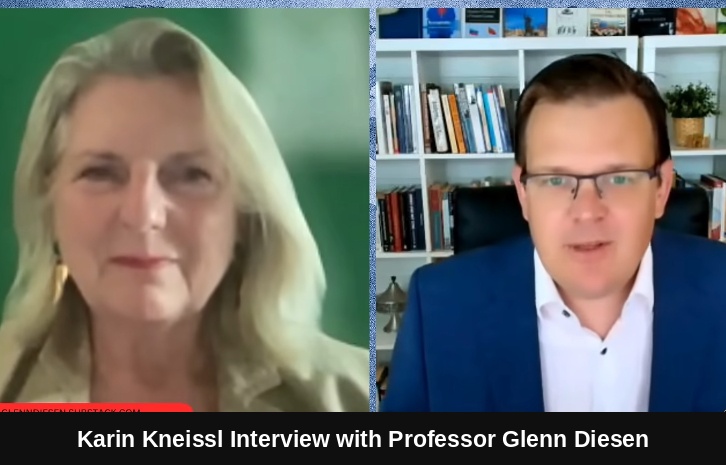
Read the full transcript of Austria’s former Foreign Minister Karin Kneissl’s interview on Greater Eurasia Podcast, August 10, 2026.
EDITOR’S NOTES: In this insightful discussion, Professor Glenn Diesen sits down with Karin Kneissl, Austria’s former Foreign Minister and head of the GORKI think tank, to examine the shift from geopolitics to geoeconomics amid intensifying global energy conflicts. Kneissl unpacks Europe’s self-inflicted vulnerabilities—from abandoning affordable Russian energy supplies to de-industrialization and eroding rule of law—warning of a broader continental decline in a multipolar world. The conversation highlights how energy wars, disrupted trade corridors, and failed adaptation to new power centers are accelerating Europe’s path toward potential collapse.
Introduction
GLENN DIESEN (00:00:00 – 00:00:11): Welcome back. We are joined today by Karin Kneissl, the former foreign minister of Austria, who now heads the think tank GORKI. So thank you for coming back on the program. It’s great to see you again.
KARIN KNEISSL (00:00:12 – 00:00:18): Thank you, Professor Diesen, for the invitation. And also the pleasure is mutual. Very glad to see you again.
From Geopolitics to Geoeconomics: Are We in an Energy War?
GLENN DIESEN (00:00:20 – 00:01:38): Well, we know that after the Cold War and the end of communism, a lot of scholars such as Edward Luttwak, they were arguing that we were now transitioning a bit from geopolitics to geoeconomics. That is that the countries would increasingly compete over the control of markets again. That is seeking technological leadership, industrial might, control over energy resources, physical transportation corridors, banks, payment systems, the currencies we trade in, et cetera. That is the economic instruments of power.
I guess with the overall logic that others should be more dependent on you and you should be less dependent on others. This is essentially how they extract political power. Anyways, as we now see the United States decline, these economic conflicts take on a much more coercive format. And again, not just with the tariffs, but we also now see with the war against Iran, against Russia, against Venezuela, they all seem to have a very strong economic component. And especially as strong energy component.
I was wondering, how are you reading, I guess, the commonality here? Are we in an energy war?
KARIN KNEISSL (00:01:40 – 00:02:45): Well, energy is the name of the game, and it has been at least for the last 120 years that way when we speak about fossil energy. Most probably when we think about energy in terms of water and grazing grounds for animals, because over millennia it was animals which produced energy, then it was always about energy to a certain extent.
But you correctly pointed out this shift from pure geopolitics to a more subtle form of geoeconomics. For at least 2 decades, I was teaching in my different courses the return of geography. From the end of an ideological confrontation, from the end of some sort of culture wars, Huntington’s clash, etc., geography was back.
And now we can say that energy as the basis of any economic activity, of any human existence, is definitely what is at stake. I would fully agree with you on that assessment.
Europe’s Energy Miscalculation
GLENN DIESEN (00:02:47 – 00:03:53): Well, for the Europeans though, they don’t seem to appreciate the central role of energy, which is ironic because the Industrial Revolution began in Europe. It has, well, energy has fueled all the different industrial revolutions and been the source of economic as well as military might, at least the economics.
So how easy the Europeans gave up on the cheap Russian energy and redefined effectively what is energy security. In the past, any academic in Europe would’ve cited energy security as meaning cheap and reliable supply of energy. Now energy security means cutting yourself off from Russia, even if it makes you more dependent on less reliable energy and more expensive energy from the US.
But does it surprise you how the Europeans essentially cut themselves off from energy in this way? I mean, this has been one of the sources of European success over the years.
KARIN KNEISSL (00:03:54 – 00:09:41): Yeah, well, I don’t want to dwell too much into the colonial history of Europe, but we all know that the continent of Europe, wherever it starts, wherever it ends, but let’s say it starts somewhere on the British Isles, it ends somewhere on what EU foreign borders are, Black Sea. Let’s assume this is Europe, then this is a poor continent. It’s not the wealthy continent like Africa. It’s not as wealthy as Southern America.
Why do I quote these 2? Because there we have arable soil, which is abundant. We have water resources and we do have all sorts of minerals. So the African continent is wealthy. And this was very much in the back of the mind of the European colonial powers. Everybody wanted to go to Africa. At a certain point in the 19th century, Germany was the latecomer among the colonial powers. They just grasped a little bit just before World War I.
But this is all due to the fact that Europe is a poor continent. Europe had to export its surplus of population, especially its, if I may say, angry young men who had to find some sort of activity. At a certain point in history, it was the Crusades to just get the second and third born out of the farm that was given to the firstborn. And at a later stage in history, it was the colonial empires that absorbed this surplus of European population.
But Europe as such is and was not a wealthy continent when we speak of arable soil. And when we speak of minerals, so speaking in financial terms, both hard and soft commodities. Hard commodities, minerals, soft commodities, agricultural products. And this is now coming very much to the surface.
I see a very explosive mix in Europe, not only when it comes to shortage of gas for the next heating season because the gas reserves, the gas storage basins are not filled as they should be.
But also right now because of the various problems, it’s a mix of problems that we see, water situation in the Rhine and Danube River, the not cooling of nuclear reactors in France, not for the first time. I remember 2003, 2018, it was already an issue, but the French nuclear plants are so old, if I may say, that it’s even too expensive to decommission them, not to speak about bringing in some innovative cooling system.
So the mix is very, very dangerous. It’s explosive because in the absence of energy, how do you want to organize any kind of economic life? And this is the current situation of the Europeans, by and large, be they in the Union, be they not in the European Union.
And in contrast to Europe, if I may go back to the African continent, we see there a race for arable soil. It has been going on for 20, 30 years. Uganda is an example at stake where sovereign wealth funds, especially from the Arab Emirates, but also beyond that, are eager to get hold of arable soil.
2 weeks ago here in the district town where I live in Russia, it’s a little ancient Tatar town called Kasimov, I organized together with my institute, the GORKI, and Regional University of Ryazan, a seminar on food sovereignty, food security, supply lines. And we have here a surplus of dairy production, of food production. It’s a very rural and in theory wealthy region when it comes to water, when it comes to grazing grounds.
I mentioned that in particular because I see with sadness the slaughtering of animals for dairy production in a country like Austria or Switzerland because simply cannot buy, they cannot find hay now. And this is a dramatic situation.
So what I would like to point at is the following. We are not only speaking about Europe being dependent on energy imports, be it from Northern America, be it from Russia. That was always the case and that will always be the case. But it’s also about how can the European Union, which let us remember in the late 1940s was all about food. And then we had the surplus of the 1970s, ’80s. So we had a very distorted European agricultural policy that they tried to reform, they never managed.
But I come back to food because in the end we all have to eat. And this is very much on the agenda of sovereign wealth funds, which are buying arable soil wherever they can find it. And Central Europe, Southern Europe is really right now in a very big quagmire.
The Breakdown of Free Passage and Global Trade
GLENN DIESEN (00:09:44 – 00:10:27): But besides the energy though, we also see again another, I guess, historical economic competition being over these physical transportation corridors. Again, much of geopolitics has been about this over the years, that is controlling key sea lanes, also land corridors.
We do see this playing out to some extent as well. That is the blockade on Venezuela, the Strait of Hormuz, the attempt to seize Russian ships in the Baltic Sea, the attacks on shipping in the Black Sea. Essentially, the shipping lanes are essentially down as well. Do you see this in the same context then as the energy wars?
KARIN KNEISSL (00:10:28 – 00:15:49): Yeah. What is at stake, and maybe we will really lose it completely, is free passage. You know, it’s a principle of shipping. You come from a maritime tradition, a country with a maritime tradition. I come from a landlocked country, but I always had a keen interest in the United Nations Convention on the Law of the Sea. I was teaching the topic also for many years.
UNCLOS, as the acronym of this convention, was drafted, negotiated for decades. It really took a long time until negotiators could sign it. And then it took another, I think, nearly 2 decades until there were enough ratifications so that it would enter into force, sometimes in the early 1990s.
Why do I mention the United Nations Convention on the Law of the Sea and free passage, innocent passage, free passage, high sea waters, international waterways, and all what it — you name it, you have it. The principle of free passage is, if I may say, the oldest principle of maritime law, customary law. Before the United Nations Convention on the Law of the Sea, we had mostly customary law. And what the negotiators did, they codified existing customary law to a large extent. And the main principle was free passage.
So merchant ships could go through the Bosphorus, for instance. Merchant ships could cross the Gulf of Aden, would cross the Strait of Hormuz, the Strait of Malacca, would cross the channel between the British Isles and France. That was necessary. Why? Because for centuries, Europeans above all had been fighting each other with all sorts of piracy. There was no security for merchant shipping. There were pirates. They were sitting somewhere on the shores of what is today Netherlands. They were sitting somewhere in southern Italy. But you had a huge business of piracy run by different European dynasties also.
And at a certain point in time, the Europeans came to the conclusion, we have to establish free passage for merchant shipping. Otherwise, we will all drown in our recurrent acts of piracy and there is no global trade. So global trade was only possible with the recognition of this principle of freedom of shipping, innocent passage.
Right now, what we see, is the dismantling of this principle. The Strait of Hormuz negotiations, and it’s all about the Strait of Hormuz in the confrontation between the US and Iran. It’s definitely not anymore about the uranium enrichment program. Oman and Iran are close to an outcome according to the latest information. Iran wants 5 to 7% fee per cargo, and of the cargo that goes through the Strait of Hormuz, Oman wants 3%.
The Sultanate of Oman was not very delighted to go into these negotiations of fees, because the Sultanate of Oman being a country of, a state of high top-notch diplomacy, and a state with a huge old maritime tradition. So all they want actually is freedom of navigation, innocent passage. And now there is this bilateral agreement which would eventually put the Strait of Hormuz under bilateral control with a fee. This fee did not exist prior to February 28th.
So we see on a global level a dismantling of a major principle of international law of maritime shipping. This for me is quite something, even though, again, I come from a landlocked country. I’m not as alert to that topic, but it was always a topic of interest for me in my courses.
Now, what I see is not only a deglobalization that started in my estimate, in 2008 with the then financial crisis. It started with a decoupling between the US and China. That’s really a long time ago. It didn’t start in the last few years. We see a regionalization, a fragmentation, whatever you call it. For sure, it’s a deglobalization.
When you add to that freedom of navigation is put into question by piracy, by fees, by all sorts of military actions, let’s bring to that also the acts of piracy exercised by British and French authorities against Russian ships, then we can say goodbye to global trade.
Unipolarity to Multipolarity
GLENN DIESEN (00:15:52 – 00:17:41): Yeah, well, goodbye to global trade is, again, this is a dramatic development how the whole system is breaking down because, well, geo-economic rivalry is supposed to be about shaping the dependence in one’s favor. But what we’re seeing now is essentially, as you say, the breakdown of the entire system, which everyone relies on. So this is going to be very bad for everyone.
It does seem though that one of the challenges is, well, historically when the British dominated, was economic hegemon dominating the seas in the 19th century or the United States in the 20th century, that the hegemon has an interest in keeping the sea lanes open because, well, it administers them and extracts a lot of benefits from this. But a concern is always what happens when that hegemon is in decline. It will use this administrative control over the international economy in a coercive manner to prevent the rise of rivals. And then of course everything falls apart.
And so, you know, this could be a symptom of our time. That is, the unipolar moment of the US being the sole superpower has already come to an end, and we effectively live in a multipolar world. And without an agreement that replaces the idea that everything is simply under, you know, Uncle Sam’s control, we’re going to continue to see the international economic system break down.
But I guess if we take a step back, what is the wider consequences then of this shift from unipolarity to multipolarity? Not as a policy, but just as a reality of the distribution of power.
KARIN KNEISSL (00:17:43 – 00:23:42): Well, let me bring in here a very concrete example of yesterday. It’s a security alliance brokered between Türkiye, the Kingdom of Saudi Arabia, and Pakistan. Interesting, 3 powerful Sunni Muslim countries, which work together in larger entities like also the Conference of Islamic States. To a certain extent, they’re all connected also via BRICS. To a certain extent, they are connected via other regional forms of cooperation. And it’s interesting that they are heading for a closer military alliance.
So we see this kind of regionalisation, which is one form of multipolarity, on many levels. And it’s very often about security. So it’s interesting that these 3, which especially Saudi Arabia and Türkiye were at loggerheads a few years ago because of the killing of this Saudi-American journalist, Mr. Khashoggi, in the Saudi consulate in Istanbul. So they were really at loggerheads for various reasons. Türkiye as a steadfast supporter of the Muslim Brotherhood, while Saudi Arabia considering the Muslim Brotherhood as a terrorist organization.
There is now this kind of cooperation, which is one form of multipolarity as a reaction to the breakdown of the larger guarantees that existed. And a country like Saudi Arabia has definitely understood that a US military basis is not a guarantee for security, but it’s a risk. It can be a casus belli. So there are changes happening and these we see in West Asia, a.k.a. Middle East.
We see that also in terms of when we go back also once more to the BRICS, which is not a legal institution, it’s just some sort of larger marketplace. But still, let me highlight that BRICS started in the early 2000s as an object. I remember commodity conferences which I attended where investors like Jim Rogers would say, go for BRICS, there you can make money, you can make a fortune. It’s all about commodities, you know, it was all about hard and soft commodities.
These were the early 2000s and it was investors who created this term of BRICS. BRIC, it was back then only, it was Brazil, Russia, India, China. Having their important commodity producers and important commodity importers, namely China and India, with their tremendous industrial rise some 20 years ago. And BRICS back then was just an object.
BRICS became, with the adding of South Africa and also enlarged cooperation with others, it became over the years an actor, so a subject, not just remaining the object of investors’ ambitions. And again, it’s a far cry away from having a statute, from being a full-fledged organization, because there is no charter, there is no statute. I believe it should have one, but I also understand the reasons why certain countries refrain from writing one and adopting one.
But this is definitely the largest example where new venues are identified. And even so, we don’t have something like a BRICS Secretariat, we don’t have a BRICS Secretary-General, but there’s plenty of all sorts of cooperation in the academic area, sports, even they’re trying to find their alternative reserve currencies. I think this will not work the way some are writing about. But it’s interesting because there are other venues to test.
And what I don’t know whether I mentioned this in our last conversation, but let me quote it here once again because it puts in a nutshell the narrow-minded thinking in many EU capitals. When I assumed my office in December 2017, one of my first questions was to my colleagues, can you please provide me with our position, with the EU position on BRICS and Shanghai Cooperation? They looked at me and said, we have never written, we have never discussed that at any moment.
I was really profoundly astonished because I myself in the previous years before that, I had been teaching that topic at least once a week. And then I had to understand that the practitioners, those working for the European Commission in terms of Asian neighborhood and I don’t know what, there was not a single position paper. And this is just a reflection of, well, I call it the frog pond in which they are sitting and not understanding that there are lakes outside, there are rivers, and there’s even an ocean.
Europe’s Failure to Adapt
GLENN DIESEN (00:23:44 – 00:24:59): Well, this is something that often characterises how European leaders behave, though, it seems. That is, in order to hold on to the unipolar moment, pretend that there is no multipolarity. And, you know, for all these years we saw, for example, NATO did not want to have any relationship with the Russian-led CSTO. You will not have any cooperation between EU and NATO with, uh, yeah, BRICS or the Shanghai Cooperation or any other one which would, um, well, signal a shift to multipolarity.
But the problem is, by holding on to the unipolar and ignoring the new realities emerging, the — well, especially the Europeans are failing to adjust to this new distribution of power in a way which would strengthen Europe. It just seems not working in any way with BRICS. It’s hard to explain why this would be in the EU interests if, again, the only interest is to ignore BRICS and pretend it doesn’t exist. In other words, try to undermine it.
But do you see a challenge there, the inability to, I guess, adjust to a multipolar world?
KARIN KNEISSL (00:25:01 – 00:26:55): You know, it’s for — if I put myself now into the shoes of an EU official, how can I really engage in multipolarity if I, as an official, my task every day is to make sure that this multipolar Europe — you know, there is Paris, there’s Rome, there’s Berlin. For centuries, they had their own different way of looking at the world. How to bring them into one monolithic position? Because Europe, by history, by geography, is multipolar as well. Of course, it’s tiny polars, but it’s bigger than Qatar and Emirates and so on, which are also part of this multipolar activity.
And so there’s a lot of talking about it. I remember former German Chancellor Olaf Scholz admitting, yes, there is a multipolar world. He made a watershed speech just before he left office on that. But they try to act as one monolithic actor. They try.
Of course, on the one hand, they say — let me go back to wealthy Africa — they say EU-Africa cooperation, it’s fantastic, it’s wonderful, we have to do it. But in addition to these EU-Africa summits, we have the French Africa Summit, we have the British Africa Summit, we have the German Africa Summit. Even tiny Austria did its Africa Summit, you know. So everybody does its own African summits and African policy in addition to the EU-Africa cooperation. And there we see how I think they’re standing in their own way when it comes to some sort of a sincere implementation of a multipolar policy.
Europe’s Diminishing Role: “A Museum”
GLENN DIESEN (00:26:58 – 00:28:37): Well, I guess as my last question, or one of my last questions at least, is on how Europe is dealing with other countries adjusting to this, I guess, because we see from the American side that they’re more or less recognising that the world has become multipolar, and if they now, as a consequence, have to make priorities, then they can’t be everywhere at the same time.
They seem to be accepting that, well, something has to be prioritised over others, so they would like to look more towards the Western Hemisphere and East Asia. In short, what the impression we get, not just from the Trump administration alone, but also in the new national security strategy, that Europe is not that important anymore. And again, this is quite evident by now.
But you also see Russia, that it’s not just a war now in Ukraine, which is forcing a divorce from the Europeans because of sanctions. But beyond that, the Russians in general see a lot of the economic rise coming in the East, and they’re more accommodated there. The economies there are seen more dynamic. So even the Russians are, well, would do an economic pivot to the East irrespective of what would happen in Ukraine. So I guess a lot of this is pushed under this, you know, the Greater Eurasian Partnership, that the Russians are pushing.
So what does this mean for the Europeans? What is Europe’s role now in this multipolar world?
KARIN KNEISSL (00:28:38 – 00:28:39): A museum.
GLENN DIESEN (00:28:40 – 00:28:41): A museum, yeah.
KARIN KNEISSL (00:28:43 – 00:34:12): A museum. Factories are turning into museums. There’s even no need to buy any more Louis Vuitton or certain Chanel products in Paris. You have top-notch cosmetic brands now in Asian countries which are more popular among clients. But there are the museums. They are nice.
And I visited once upon a time the House of Industry in Chemnitz, and only there I understood that Chemnitz, which in between was called Karl-Marx-Stadt when it was the German Democratic Republic, but Chemnitz, what I didn’t know, was the most important industrial town across Europe before 1945. So that’s quite something. Today it’s a museum, a nice museum.
Same holds true for Fiat, the Fiat Museum in Torino, northern Italy. Torino, Fiat, Fabbrica Italiana Automobili Torino was what I didn’t know until I visited that museum. It was the most innovative and largest car factory in the world before World War One. So we see the decline with Fiat, which then merged with Chrysler already some time ago.
We see what happened to Chemnitz. We see a lot of other. The story is long. I mean, there was an effort a few years ago to return to made in England, made in Germany, fabriqué en France. But they then sanctioned themselves with this series of sanctions. And it’s not only about sanctioning Russia. And I refrain from speaking about cheap energy. It was affordable energy. It was not that cheap, but it was affordable and it was predictable because there were long-term contracts. They didn’t have to hedge and compete with other better clients on the global market to buy LNG every day in some stock exchange market. No, there was a predictable delivery of gas volumes thanks to long-term contracts. I think that made life much easier for the industry.
The other thing is that Europe is marginalizing itself because many people, and this is not only China, it’s not only Russia, I’m thinking also here of many Arab countries, in particular countries like Qatar and the Arab Emirates, they don’t want to be lectured by the Europeans anymore. They don’t want to be given certain conditions on how they should produce their oil and gas.
For instance, there was this one EU order on, I think it had — I forgot now the exact name of the technical name — but what it was all about was to prove in the supply line of the product that everything was fine, you know, in terms of climate change, in terms of labor regulation, et cetera. Qatar and the Emirates said, sorry, we are not going to deliver you a vessel of LNG because we cannot meet your requirements on that EU order. So, you see, they’re putting themselves into the out because people prefer not to make business with Europe. They say, we can sell our LNG to another partner who is not putting so many stones on our path, you know.
And I think this is not really understood in the Commission. The European Commission some 30 years ago had a lot of legal people. These lawyers were replaced by political scientists who have become very ideological, and many of them haven’t seen the world before starting working for the Commission.
So this is, I think, the underlying drama. And what is interesting, in inverted commas, is that when I read now statements by Chamber of Commerce, heads of industrial associations of certain EU countries, they are constantly warning their governments against deindustrialization. Because of red tape, because of EU regulations. And recently I haven’t heard, it’s Russia’s fault. You know, they stopped referring to Putin inflation, they stopped referring to the, I quote, “unprovoked Russian aggression against Ukraine,” etc.
They just, when you listen to some of these heads of industrial associations, they name bureaucracy, they name the absence of skilled labor, they name underinvestment, they name insecurity, geopolitical insecurity by and large. Yes, these are the problems why there is a very high degree of deindustrialization going on. So deindustrialized Europe, which had been happening already for some decades, will turn into a series of museums.
Living in a Museum: A Recipe for Instability?
GLENN DIESEN (00:34:15 – 00:36:24): Yeah, a problem there though would be how the European public feel about living in a museum because again, if you remember back in the early 2000s, how much optimism there was in Europe about its future. I remember reading articles, even books on the topic, how this century would essentially belong to the Europeans because everything was looking quite well.
They tried to define what makes Europe so unique now. And, you know, they were a normative power, they were a civilian power, a moral power, a regulatory power, different definitions, but at least they all agreed that the EU was destined for greatness. And this, through the unity and the end of war and cooperation, Europe united would be the central pillar in the world, altogether with the United States, forming this collective hegemon.
But again, it’s in a relatively short period of time, we now see the US partnership declining, likely Europe will fragment without this common political and economic interests. The political class is increasingly unpopular, even worse, I would say many times also illegitimate. And the Europeans don’t seem to have a clear economic model in terms of its, especially its digital technologies or where the energy comes from.
You know, what is the role of Europe in the new world? Some would argue the moral compass as well is gone. And this was, you know, for a group of very different countries who define themselves, a common identity based on being liberal democracies. It’s not great when the liberal aspect is challenged in terms of growing authoritarianism at home or support for genocide abroad.
Again, you have no crystal ball and we should always be careful about making predictions, but where is this headed? Because living in a museum, remembering better times, it’s not a recipe for stability, it seems.
KARIN KNEISSL (00:36:24 – 00:39:50): No, not at all. And I remember very well what you just described, the so-called Lisbon Strategy of the year 2000. It was, I think, in March 2000, Portuguese EU presidency, they signed and then did the utmost potential work, the so-called Lisbon Strategy, which said by the year 2020, I quote, “European Union would be the most progressive, innovative, stable, and important actor on a global level.” So that was the ambitious goal in the year 2000.
In the year 2020, well, there happened to be a pandemic for everybody, but before already and afterwards, certainly the EU has not been reaching these ambitions even by far. So I would add to that, EU officials can’t keep the promise to the younger generations which expect to have work, which expect to have high-quality infrastructure, medical service, etc. It’s in decline.
And all that, I would not only focus here now on the political level. Politics is tough, but I come from administration. I never was so much in politics, even though people consider me a politician because I was a minister. I was an expert minister and I am a firm believer in effective administration. Civil administration, this is the world I come from. You know, I served in a foreign ministry for some years. I had the tremendous privilege to attend the École Nationale d’Administration in France, which was abolished by Mr. Macron, but we were brought up there for 2 years in efficient, high-level civil administration.
And people who work in civil administration are not supposed to be changing every few years because there are elections or whatever. They are there. They should not be in the limelight. They do their work. An ambassador doesn’t run for elections, and a civil administrator in a justice ministry should not be involved in politics. Should not. We know that has a different story. But that’s what efficient civil administration for me was always about.
And a state that can claim that it has efficient bureaucracy, and bureaucracy as such is not a bad word, but bureaucracy should be a powerful apparatus that puts into action political announcements. Now, we lack that. We lack efficient administrators. We have a highly ideological European Commission, which is not that efficient. And we have national administrations which are underpaid. People miss career perspectives or they don’t recruit well, whatever.
So I would say in addition to economics, it’s the administrative system as such that is in crisis. And that adds to the whole thing. And what I said in my book, Reckoning for Europe, 2 years ago, and I would like to highlight it here once again, for me, the biggest trauma for Europe is the loss of law.
The Loss of the Rule of Law
GLENN DIESEN (00:39:52 – 00:39:53): Loss of law, yeah.
KARIN KNEISSL (00:39:53 – 00:41:58): Yeah, the loss of law, the loss of the rule of law, and lists have replaced laws. No, it’s lists. All these compliance things, when you look at the sanctions, etc., people have no idea what is the current legal situation within which they can work as a company, as a bank, whatever, because most of these things are not published. They are just somewhere in the drawers, the compliance. And when they close your bank account, the bank will tell you, we can’t tell you why. So you just read about it.
And currently in my case, I don’t want to bring up any personal things, but just for you and your viewers, the procedure has been started to take away my citizenship. I have only one citizenship. It would make me stateless. The Austrian law foresees statelessness, but Austria is also party to several conventions, by the Council of Europe, which forbids statelessness. Because Austria, for instance, has a long tradition of kicking out its own citizens for whatever reasons.
I happened to meet some of them, like the assistant to the creator of the Austrian Constitution, Professor Kelsen. He was kicked out. He went to Berkeley. And Professor Klinghoffer, who was a very, very good mentor for me when I lived in Jerusalem. He was his assistant and he was also ousted from Austria. So it’s a long tradition, but this is just to highlight where do we stand today.
You know, you can lose your citizenship, you can be turned stateless by your own state. What is your crime? In my case, the crime is that I work for St. Petersburg State University. That is my crime.
GLENN DIESEN (00:42:02 – 00:42:59): Now, I remember, yeah, was it back in 2018? You were then, yeah, still a foreign minister of Austria and you got married and Putin came to Austria for your wedding and danced with you. And this is still brought up as a demonization. You know, the idea that a foreign minister would cultivate good relations with foreign leaders, it’s quite extraordinary.
But that was on the diplomatic side. But again, even after leaving diplomacy, well, and working at the university of your choice, that this is a reason for stripping your citizenship. As you said, when the rule of law goes away, we seem to have lost something very important.
KARIN KNEISSL (00:43:01 – 00:45:02): And in my opinion, this is the worst that can happen to a society, the loss of law. You can overcome an economic crisis, you can overcome an energy crisis, but the loss of law, it destroys your society from inside. And this is what I’ve been observing from far away, luckily, because when I left, I said in a few years it might be too late. And I was unfortunately right.
A few days ago, the European Commission ordered a new rule that Ukrainians between the age of 23 and 65 who want to apply for asylum in the European Union are not allowed to get asylum because they should fight the war. This is in blunt violation of the 1951 UN Convention on Refugees.
And you know, the weird thing is, a Russian who would come to Germany or France and say, I don’t want to fight the war, he would get asylum. The Ukrainian would not get asylum because he should fight. This is what Zelensky tells all his EU partners, bring me back all the men who came to your countries. 3.4 million Ukrainians are living in the EU. Not all of them are men between 20 and 65, but a large bunch.
And here we see the wonderful European Union, you know, the Olymp of human rights and rule of law, is violating in a way the UN Convention on Refugees. You know, I was always critical of mass illegal immigration of economic migrants. They were all looking for a better life. It’s legitimate, but it’s not covered by the UN Convention on Refugees to look for better circumstances, while wishing to flee a country where there is a war is the basic case for a refugee status.
GLENN DIESEN (00:45:06 – 00:45:56): Yeah, no, especially for the moral superpower, this is quite extraordinary. But again, it’s all instrumental. Zelensky says we need more manpower, we have to fight Russia, the Europeans have them. I mean, if they don’t have weapons, they can send Ukrainian refugees, deporting them.
So no, it is sad to see the rule of law collapse, and also the whole, I guess, what they define as standing with Ukraine means, because obviously they stand with Zelensky but not the actual Ukrainian people who do not want to fight, the ones who went to Europe at least, and also who now want immediate negotiations while the EU doesn’t even want to talk to the Russians. It’s quite shocking.
Anyways, do you have any final thoughts before we finish off?
Closing Thoughts
KARIN KNEISSL (00:45:57 – 00:46:27): Well, we should not leave our guests, viewers, in such a dramatic state. I don’t know what the weather is like in your place. Thank God here we have some soft sunshine and we have green grass. For which I’m very grateful because I have animals and I really feel sorry for the farmers and the animals which don’t have hay these days in many European countries with the situation that it is. What can we kind of wrap—
GLENN DIESEN (00:46:27 – 00:46:29): I have to say that was not a very happy note.
KARIN KNEISSL (00:46:30 – 00:48:03): Yeah, I know that is not a happy note. What can be the more — the better note? I’m trying to think of something. I can only say please, everybody, use your critical mind. Don’t be cowards. You know, there are so many cowards. The two of us, if I may say, I mean, you have to prove backbone every day also in your situation. I went through hell, not one, but I saw in all those chapters of my life around me too many cowards. That’s how we got that far.
So I can only ask people to be a little bit less coward and don’t think that social media is the battlefield. There are some other more important fields, areas where one should speak up, prove a backbone, and remind your respective government of what is written in the Constitution, what is written in certain instruments that we have. And when it comes to taking away the citizenship of your citizen, Article 9 of the UN Declaration of Human Rights, 1948, says every human has the right to a citizenship. But this is something that is not at all in the back of the mind of a government party in Austria. Not to say about the administration. So there’s something wrong.
GLENN DIESEN (00:48:05 – 00:48:11): Yeah, I’m not sure what the purpose would be. At least very petty, that’s for sure. Anyways, thanks again for taking the time.
KARIN KNEISSL (00:48:11 – 00:48:17): You’re welcome, and I wish everybody a peaceful summer. And please try not to be a coward.
Related Posts