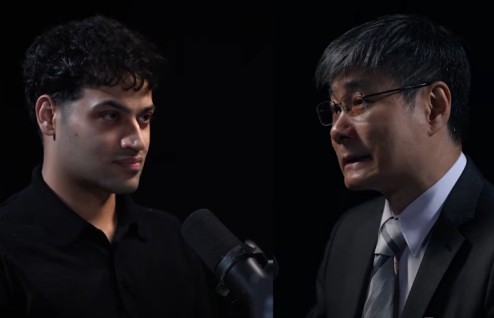
The following is the full transcript of geopolitics analyst Professor Jiang Xueqin’s interview on Figuring Out With Raj Shamani, August 11, 2026.
EDITOR’S NOTES: In this episode of Figuring Out, host Raj Shamani sits down with Professor Jiang Xueqin for a wide-ranging conversation that challenges the foundations of the current global system. Jiang argues that the established world order is largely an illusion sustained by hidden power networks, America’s three-pillar strategy of dominance, and deeper historical and financial forces, while offering bold predictions for the transformative upheavals expected over the next 50 years. From empire decline and geopolitical realignments to the roles of figures like Trump and Epstein, the discussion delivers a provocative look at the forces shaping our collective future.
The Making of a Geopolitical Skeptic
Raj Shamani (00:02:17 – 00:03:26): What got you into geopolitics and the game of prediction?
Professor Jiang Xueqin (00:03:30 – 00:03:41): In politics was the election of Donald Trump in 2016, because for me that was a very traumatic event.
Raj Shamani (00:03:42 – 00:03:42): Why?
Professor Jiang Xueqin (00:03:43 – 00:04:07): Well, because it didn’t make any sense to me. You know, I went to Yale. I did one school. You were taught that everyone’s reasonable, the world is logical, the best and the brightest reach the very top. So how could Donald Trump win? So that forced me to reexamine my worldview and reconstruct a new political understanding.
Raj Shamani (00:04:08 – 00:04:09): And why do you think he won?
Professor Jiang Xueqin (00:04:10 – 00:05:07): I think he won because the elite screwed up. I think he won because the elite became incestuous, they became insular, they became arrogant, they became self-righteous, they became corrupt and incompetent, and people were sick of it. I mean, he won. I’ll tell you exactly the reason why he won. Because in 2008, Obama promised hope and change. And this was a time when Wall Street bankrupted the American economy and they were blatantly corrupt. They should have all gone to jail and Obama promised hope and change and there was just a tremendous optimism in the air and he won by a landslide.
Raj Shamani (00:05:07 – 00:05:07): Yeah.
Professor Jiang Xueqin (00:05:08 – 00:06:30): And he comes into office and he appoints Larry Summers, Tim Geithner, these people who caused the Wall Street collapse in the first place, and they bail out their best friends, Goldman Sachs, these bankers. So, these guys, these bankers on Wall Street, they bankrupted the American economy, They almost caused the global economy to collapse and they got bailed out by the US government and they gave themselves huge bonuses at the end of the year.
Meanwhile, millions of average American homeowners lost their homes. People don’t remember this. They remember Obama as the first African American president, but during his tenure, We saw the greatest destruction of wealth among African Americans. They worked decades, centuries to build up all this wealth. In a matter of years, a lot of them lost it all. And this was during the first African American president who also won the Nobel Peace Prize for being the first African American. President. So there was a lot of anger.
Raj Shamani (00:06:30 – 00:06:31): There—
Professor Jiang Xueqin (00:06:31 – 00:07:13): it was a sense of betrayal. In 2016, Donald Trump said that he would clean house, that he would clean the swamp, he would build a wall, and he would stop the Chinese, uh, from taking advantage of the Americans. And it was a message that resonated with a lot of people. It didn’t resonate with me because I thought this guy was a clown. It probably didn’t resonate with you, but it resonated with a lot of people. And I remember in 2016, I didn’t pay much attention because I was told that it was mathematically impossible for Donald Trump to win.
Raj Shamani (00:07:13 – 00:07:13): Why?
Professor Jiang Xueqin (00:07:14 – 00:07:38): Because Democrats had 3 states, Wisconsin, Pennsylvania, and Michigan. And they were pro-worker. Obama won them by landslide in 2008 and 2012. And as long as they stayed loyal to the Democrats, Trump had no chance. So I didn’t pay much attention. And Trump on election night won all 3.
Raj Shamani (00:07:39 – 00:07:39): Yeah.
Professor Jiang Xueqin (00:07:40 – 00:08:12): And, um, No one bothered to ask them, like, why did you vote for Trump? And all that happened was the elite said, well, they voted for Trump because they were racist. And no one bothered to point out that, no, no, no, no, these people in Wisconsin, Pennsylvania, and Michigan voted for Obama twice, and then they voted for Donald Trump. Why did that happen? And it happened because the people felt betrayed by the elite.
Raj Shamani (00:08:13 – 00:08:48): And, um, but don’t you think then actually voting Donald Trump just is like voting another elite? Because he was— he, he’s literally a billionaire running for the office. And a normal average middle-class person hates all these elites, hate all of these people who are these crony capitalists, who are the people with big money, billionaires, because they all got saved at and they got big fat bonuses, right? So that was the anger. Why would they then choose another guy who’s exactly like them in a different suit?
Professor Jiang Xueqin (00:08:48 – 00:12:07): Right. So it’s interesting because we look at Donald Trump today and we think that he’s just one of the elite. He’s no different. And his policies are really no different from that of another Republican, right? Why did he start this war in Iran? Why is he so supportive of Israel? He seems like another elite.
But in 2016, he was revolutionary because he talked not like you and me, but like the average American. He used simple words to describe deep emotions that captured the imagination of the American people.
And at this— and also, um, people don’t remember, but Obama humiliated Donald Trump, um, in— I believe it’s 2011. I can’t, I can’t remember, but maybe 2011. There was the White House Correspondents’ Dinner And Barack Obama was speaking and he made fun of Donald Trump. And Donald Trump was in the audience and everyone was just laughing at Donald Trump. And Obama was angry at Donald Trump because Donald Trump led a campaign and accused Obama of being born in Kenya. And so therefore he cannot qualify to be president of the United States. And obviously if you’re Obama, you’re angry about this and he took the opportunity Um, the White House Correspondents’ Dinner to just make fun of Donald Trump. And Donald Trump never went back to the White House Correspondents’ Dinner again after that. Uh, he did go this year, but before, he, he refused to go. And so the people can feel this animosity of the elite towards Donald Trump.
Also, during the election, um, the entire news media was ganging up on Donald Trump. There was that Billy Bush, um, scandal where Trump basically in a private interview said to Billy Bush, grab him by the pussy. And before in American politics, if you said something so crass and vulgar, you were done. Yeah, you were forced to resign. He didn’t do so. So the people saw a fighter. The people saw someone like them who talked like them, who thought like them, who felt like them. They also saw someone who was persecuted by the elite, and they saw someone who was a fighter who would not give up. And so many have come to believe that he is the best hope for America. He’s the Messiah. He’s come to make America great again. True.
Raj Shamani (00:12:07 – 00:12:09): Do people still believe that?
Professor Jiang Xueqin (00:12:10 – 00:13:35): Unfortunately, you have millions of people who still believe that. MAGA has become a cult. And so what’s interesting is that, um, during the presidency of Donald Trump, a new movement came into being called the QAnon movement. And we now know today because of the Epstein Files that was actually orchestrated by Jeffrey Epstein and Steve Bannon.
Okay, but what’s the essence of the QAnon, um, conspiracy? The idea is that first of all, Washington, D.C. is run by pedophiles. It’s run by these deep state sexual degenerates, and they control the entire deep state apparatus. They also believe that Donald Trump is a chosen one, the Messiah who’s going to come in and clean house and make America great again. But to do so, he has to play 5-dimensional chess. He has to pretend to work with them so that he can eventually betray them and have the Second American Revolution. And that was the QAnon conspiracy. And so what that did and what’s very clever is it makes everyone question whether or not Donald Trump is playing 5-dimensional chess.
Raj Shamani (00:13:36 – 00:13:37): Right. Yeah.
Professor Jiang Xueqin (00:13:37 – 00:14:23): So it’s clear to most people that Donald Trump, by invading Iran, by supporting Israel, he’s been co-opted by the deep state and he is now a servant of the Zionist forces. It’s pretty clear to people. But if you are— but if you were deep in the QAnon conspiracy, if you’re part of MAGA, in your head you think, No, this is 5-dimensional chess. He’s just fooling everyone. And at the right time, at the right moment, he will show his true colors and we will all come together to overthrow the deep state pedophile network.
Raj Shamani (00:14:25 – 00:14:25): Do you believe so?
Professor Jiang Xueqin (00:14:25 – 00:18:51): So what I do is I try to study historical patterns. And if you look at all these great individuals that have changed the course of human history, whether they’re Julius Caesar, Alexander the Great, Joseph Stalin, Adolf Hitler, Napoleon, they all came into power or they were elevated into power because of elite forces.
So let’s use the example of Adolf Hitler. Most people don’t know this, but we have a lot of documentation that suggests that he was, at the beginning of his career, a spy for the German army, okay? The Wehrmacht. And the Wehrmacht embedded Adolf Hitler into a new fringe political party called the National Socialists, the Nazis. And at this time in Germany, the 1920s, there’s a whole range of radical revolutionary groups that the Wehrmacht wanted to keep an eye on but also wanted to co-opt. Because the Wehrmacht, the German military elite, they wanted vengeance for World War I. They thought World War I was humiliating and they wanted to change the status quo. And avenge Germany’s humiliation in World War I. So they were embedding all these spies into these fringe political groups in order to influence domestic politics in Germany.
And Adolf Hitler was a military spy. And because he was receiving money from the military, he eventually became the leader of the Nazis because the Nazis was just a very small fringe group with no real financing. And eventually, because of his personal charisma, because of his passion and belief, he started to accumulate more and more power. And there were 3, 4 groups that supported his rise. They were the Catholic Church, the landowners, the industrialists, and the German military. And these 4 groups supported him because they were afraid of the communists. The communists were going to take over Germany democratically, and the right-wing elite, the oligarchs, had to provide an alternative to the communists. And these were the National Socialists, right? The communists were international socialists. The Nazis were national socialists. And so that’s what propelled Hitler into power.
Once Hitler was into power, he started to divide and conquer the elite, and the Nazi Party started to infiltrate these groups and become the government itself. And we’re seeing a very similar process in America where the elite, the Zionist elite, think that Donald Trump is a useful pawn in regime change in the Middle East, in changing the map of the Middle East to benefit America. But if you see what Donald Trump is doing domestically, Project 2025 they call it, it’s very similar to what Hitler did, which is Hitler created these parallel organizations that eventually came to replace the government bureaucracy. So you look at in America, ICE, Right? That’s almost like, like, um, uh, Trump’s personal Gestapo, um, SS. Um, and, um, so the real fear is that the longer Trump stays in power, um, the more Trump will bend the government to his will in the same way that Hitler, uh, warped the German bureaucracy to his will. And so the big question for the world is, will Trump get a third term? And if he does get a third term, then he’s going to be able to carry out his vision of revolutionizing the American bureaucracy and expanding the American empire.
Raj Shamani (00:18:54 – 00:19:14): I have too many threads to talk about on this. Third term is interesting. We’ll talk about this and come back later. But first we go, you’re talking about Epstein and the DC world and everything, right? And you have a class which says Epstein World.
Professor Jiang Xueqin (00:19:14 – 00:19:14): Yes.
Raj Shamani (00:19:14 – 00:19:17): Where you explain how the power of the world works.
Professor Jiang Xueqin (00:19:18 – 00:19:18): Yes.
Raj Shamani (00:19:18 – 00:19:20): What is it about? What are you trying to say in that?
Unpacking the Jeffrey Epstein Mystery
Professor Jiang Xueqin (00:19:20 – 00:19:41): So this Epstein case is really puzzling and there are certain mysteries involved. The first mystery is how this guy rise from nowhere to the very top of the world.
Raj Shamani (00:19:41 – 00:19:41): Yeah, right.
Professor Jiang Xueqin (00:19:42 – 00:20:49): So we know he started at the Dalton School, and, um, Donald Barr, who is Bill Barr’s father— um, so this is a CIA family— Donald Barr was headmaster of Dalton and hired Jeffrey Epstein to be a math teacher. And then Jeffrey Epstein was there for a few years, and then he went to Bear Stearns to work in finance, to learn the financial world. And after Bear Stearns, he went to work for a man named Douglas Leese, L-E-E-S-E, who was a British arms trafficker involved with Iran-Contra. Okay, and then during this time Um, David Rockefeller, the chairman of Chase Manhattan Bank, invited Jeffrey Epstein to join the Trilateral Commission at age 30. And Jeffrey Epstein tells Steve Bannon in a media interview, it’s because I’m a math wizard, like I’m good at math, and that’s why they wanted me on the board. Clearly nonsense, okay? But it’s like, why would David Rockefeller invite this, yeah, 30-year-old to join the Trilateral Commission.
Raj Shamani (00:20:49 – 00:20:52): Exactly. He could have anyone from the world, but why him?
Professor Jiang Xueqin (00:20:52 – 00:23:39): Exactly. The bigger mystery is in the year 1991, um, an Ohio billionaire, owner of Victoria’s Secret, named, um, Les Wexner, he signed over the power of attorney to Jeffrey Epstein. Okay, well, most, most people would say no one, because the power of attorney gives the person the power of life and death over you. And that’s very scary, right? So we don’t know the actual relationship between Wexner and Epstein, but it couldn’t have been that close, right? They didn’t really know each other well. So why would Wexner sign over the power of attorney, again, which is the power of life and death over you, to Epstein? It’s a huge mystery for us.
And then if you read the Epstein Files, there are all these code words in there that no one can decipher. So for example, um, he and his friends, who are billionaires by the way, they love pizza and grape soda. I, I, I don’t know anyone who loves pizza and grape soda, but like, that’s like their favorite food, pizza and grape soda. Okay. Um, they also like to send their kids to the dentist once a month? Like, why would you do that? Why would you send your child to the dentist every month? Every month, right? And so the Epstein files are very confusing, and there seems to be a lot of code words, um, in there.
But a bigger mystery is this, uh, where people like Bill Gates, Bill Clinton, and Elon Musk, they were trying to become Epstein’s friend, right? So it wasn’t— it was not that Epstein was trying to become their friend, it was they were trying to become his friend. And so Reid Hoffman and Bill Gates, both billionaires, were asked, why do you associate with this guy? And both said, well, because we wanted his money for our charities. So these are billionaires begging Epstein for money. Okay, and then Epstein would also say, uh, to people like Peter Thiel, I represent the Rothschilds. He would also write an email to the Rothschilds and says that, you know, there are 3 families that, um, um, are— were very powerful in European banking. They were the Rothschilds, the Epsteins, and the Guttmans. So he’s saying that he comes from a pedigree that’s similar to the Rothschilds. So the big question for us is, who is this guy?
Raj Shamani (00:23:40 – 00:23:40): Exactly.
Professor Jiang Xueqin (00:23:40 – 00:23:50): Okay, who is this? Who is this guy? Okay, so, um, I’m going to now explain my theory to you.
Raj Shamani (00:23:51 – 00:23:51): Okay.
Professor Jiang Xueqin (00:23:52 – 00:23:57): And, uh, it’s a weird theory, so feel free to interrupt or challenge me.
Raj Shamani (00:23:57 – 00:23:58): Okay.
A Theory of Occultists, Financiers, and Politicians
Professor Jiang Xueqin (00:23:58 – 00:24:35): All right. But let me get the whiteboard and show you how I think the world works. Okay. So, a lot of conspiracy theorists believe that the world is controlled by secret societies and they are able to pass their ideas from one generation to the next. And they’ve been conspiring for hundreds of years in order to achieve their plans. I don’t think it’s that simple. Okay, so I have an alternative theory, and so I’m going to present it to you. Okay, all right. So the first I’m going to do is I’m going to present to you the general theory.
Raj Shamani (00:24:35 – 00:24:35): Okay.
Professor Jiang Xueqin (00:24:35 – 00:24:43): And then I’ll give you the concrete example, the concrete, um, case study in order to validate this theory.
Raj Shamani (00:24:43 – 00:24:43): All right.
Professor Jiang Xueqin (00:24:43 – 00:26:18): Okay, so for all of human history, every society has been obsessed with the occult. Okay, the occult, especially India, right? What is a cult? A cult is trying to figure out the secrets of the universe, right? The Vedas. Um, and in, in the occult, you’ll have astrology, you have alchemy, um, you have sacred geometry, um, you have, um Reincarnation, demonic possession. So these are all things that the occult is obsessed with. Okay, there are certain occultists who are obsessed with the idea of eschatology. Eschatology is the understanding of how the world may end. Okay, and eschatology is important because it answers the 3 fundamental questions, uh, for humans, which is, where do we come from? Why are we here? And where are we going? And so eschatology, if you know what God’s plan is, right, if you know what God’s plan is, then you know that you are here to achieve God’s plan. And so people who believe in eschatology, they tend to be more energetic, they tend to be to be more fanatical and more determined than other people because they believe they are part of God’s plan and they see the finish line, so they’re working towards it.
Raj Shamani (00:26:18 – 00:26:19): Okay, okay, right.
Professor Jiang Xueqin (00:26:19 – 00:27:21): So that’s the occult, right? Now the occult is only concerned about the spiritual mystical, uh, realm, right? So these Vedic priests only care about, um, what God’s— how God’s mind works. You don’t care about the material world. But you have individuals that only care about the material world, and these are people who work in finance or business, okay? And if you are very successful in finance and business, you’re a billionaire, right? What are you concerned about? You’re concerned about immortality. You’re concerned about um, living forever. You’re concerned about how to maintain your wealth, how to take your wealth into the spiritual realm. So now you have to work with these occultists, right? So they say billionaires don’t believe in astrology, but billionaires do, right? I’m sure every billionaire has an astrologer.
Raj Shamani (00:27:21 – 00:27:22): Yeah, or a numerologist.
Professor Jiang Xueqin (00:27:23 – 00:28:59): Exactly right. Okay, so now we have this possible alliance between financiers who are looking for the secrets of the universe in order to conquer the material world, in order to conquer life and death. You have these occultists who are interested in achieving God’s plan. And again, I’m not saying every occultist, every financier is like this, but it’s a subset of these people. And these people come together and form secret societies. Right? And these secret societies is a platform for these occultists to further their study and to promote their eschatology. And it’s a platform for these financiers, these billionaires, to access the secrets of the universe. Okay, now the question then is, how do they achieve their plan? And the answer is you have to, uh, co-opt politics, right? So you go into politics and you identify possible potential individuals that could help you promote your plan. And I would argue people like Donald Trump and Vladimir Putin, even J.D. Vance, were individuals that were identified early on as potential Um, Messiah figures that could achieve their vision politically, right? So that is how I think, generally speaking, the world works. Is this clear?
Raj Shamani (00:28:59 – 00:29:02): Yeah, yeah. Okay, all right, it makes sense.
Professor Jiang Xueqin (00:29:03 – 00:29:08): Okay, so now what I’m going to do is I’m going to go into a specific example.
Raj Shamani (00:29:09 – 00:29:09): Okay.
Professor Jiang Xueqin (00:29:09 – 00:29:15): All right, and then, and then this specific example explained to us Jeffrey Epstein was and where he came from.
Raj Shamani (00:29:15 – 00:29:17): Exactly, like that’s what I meant, because this is pretty general.
Professor Jiang Xueqin (00:29:18 – 00:29:30): Yes. Okay, all right, so, so now we see the lines between the occultists, the financiers, and the politicians, right? Now I’m gonna apply this and figure out where Jeff Epstein came from and what he’s trying to do, right?
Raj Shamani (00:29:30 – 00:29:44): Okay, all right, but before you go there, do you think this is absolutely true or this is just some, some conspiracy theory which people like you and me and like 500 other people just have our own version because we don’t understand how the world works fully?
Professor Jiang Xueqin (00:29:45 – 00:29:51): I think, I think this is true, um, because it explains— it helps us explain too much. Um, okay, right.
Raj Shamani (00:29:52 – 00:29:55): There’s no chance that this can be purely bullshit made out of story.
Professor Jiang Xueqin (00:29:55 – 00:30:01): Okay, so what— again, we have the general theory, and then I’m going to provide you this specific example.
Raj Shamani (00:30:01 – 00:30:01): Okay.
Rebbe Schneerson and the Kabbalah’s Political Program
Professor Jiang Xueqin (00:30:01 – 00:31:49): And this specific example will tell us how true this is. Okay. Right, because of the specifics. Because like, what I’m trying to do is I don’t know these people. I’m not involved in this world, but I’m trying to connect the dots. I’m trying to answer the mysteries created by the Epstein Files, right?
Okay, now we will look at a very specific example. Okay, so there’s a man named Rebbe Schneerson. Okay, okay. And he, he’s dead now, but for a long time, maybe over 50 years, he was the main rabbi, the main leader of an organization called Chabad Lubavitch. And this was an organization that is Hasidic Jews. Okay, so Hasidic Jews are these Jews who practice a mystical form of Judaism. So very similar to Sufis in the Islamic world. And so they’re trying to figure out what the secret of the universe is, and they’re trying to figure out what God’s plan is. And for, for them, the main source of wisdom would be the Kabbalah. So, um, the Kabbalah, what is— what it’s doing is it’s taking all these great mystical traditions, and they include, uh, Vedic philosophy, they include Hermeticism, which comes from Egypt. It includes Gnosticism, it includes Sufism, but all these great mystical traditions. And they’re trying to apply these traditions in order to understand the stories of the Bible.
Raj Shamani (00:31:50 – 00:31:50): Okay.
Professor Jiang Xueqin (00:31:50 – 00:33:09): Okay. So the example is, why did Adam and Eve have to eat that fruit? God gave them just exactly one order, right? Don’t eat that fruit and you live in paradise forever. And they had to disobey God. And so how the Kabbalists understand this is they try to construct a cosmology to explain this. And the idea is this. The idea is that In the beginning, God is everything. But when you are everything, you become very lonely and you become incomplete. So in order to complete itself, God decided to create the universe and create a cosmic being named Adam Kadmon. And God as pure love, pure generosity, pure wisdom, it seeks to impart itself in another being, right? So God is the will to bestow, the will to give. That’s what love is, right?
Raj Shamani (00:33:09 – 00:33:09): Yeah, giving.
Professor Jiang Xueqin (00:33:10 – 00:33:41): So it created a being, Adam Kadmon, in order to receive, and Adam Kadmon becomes the will to receive. And so God is trying to unify with Adam Kadmon in order for God to complete itself and know itself more. The problem though is that Adam Kadmon, as the will to receive, by definition it is— it has an ego, and the ego looks at the world from a selfish lens.
Raj Shamani (00:33:41 – 00:33:41): Yeah.
Professor Jiang Xueqin (00:33:42 – 00:35:29): So Adam Kadmon does not appreciate God’s generosity. That’s what happened between God and Adam Kadmon, where God was trying to give him love, and Adam Kadmon didn’t appreciate God’s generosity. So Adam Kadmon ran away. That’s why Adam and Eve disobeyed God, because they did not appreciate, understood God’s intentions because they were so egotistical. Right? And so This is what’s called the Tree of Life. Okay, Adam Kadmon is the Tree of Life. Okay, and the Tree of Life is, um, a representation of Adam Kadmon, and God’s trying to fill Adam Kadmon with the Divine Spirit, and it’s working pretty well.
But then eventually, um, Adam Kadmon rejects God, and this is what’s called the breaking of the world. Okay, so the world breaks. And the— and so the divine spark now is scattered throughout the world. And so the purpose of the Jews, the purpose of everyone in this world, is to repair the world. And how do you repair the world? You bring all the sparks together, and then you abandon your ego and you welcome God in your heart. And when God comes into you and you welcome him with open arms, that is when the world is repaired and that is when the world ends. Okay, so this is the major teaching of the, uh, Kabbalah. And, um, obviously there are different interpretations of the Kabbalah, and Reform Jews interpret this just to mean love thy neighbor.
Raj Shamani (00:35:30 – 00:35:30): Right?
Professor Jiang Xueqin (00:35:30 – 00:35:56): Love thy neighbor. It’s that simple. Social justice. We have to commit ourselves to doing social good. When we do that, we repair the world and God can come and be with us, and that will end the world. Other Jews believe that this requires them to spend all their lives reading and understanding the Torah. To understand the mind of God.
Raj Shamani (00:35:56 – 00:35:57): Okay?
Professor Jiang Xueqin (00:35:57 – 00:37:44): But then there are these extreme religious Jews, and Rabbi Schneerson is part of them, that interprets the Kabbalah literally. And they think in order to achieve the Kabbalah, you have to actually, in this world, follow God’s plan and allow God to come to this world. And this plan, there are 3 major elements to this plan that is literal. The first is to bring the entire Jewish diaspora back to Jerusalem and have them all convert to Judaism. There are too many Jews that are secular. There are too many Jews who are following heresies. They all have to return to Jerusalem. Every single Jew Because you have to repair the world and they have to follow the Torah to the letter. Okay, that’s number one. Number 2 is Israel has to achieve the Greater Israel Project because that is what God promised Abraham in the Bible. And number 3 is the Third Temple has to be built because that is the house of God. When The Jews are ready to receive God, and God comes to our world. He needs a place to live. The Third Temple is God’s house. Once these three conditions are met, the world will end. The world will be repaired. And so what he’s saying is the Kabbalah is not just a religious idea; it is a political program that must be implemented. Okay. That’s what Rabbi Schneerson believes.
Raj Shamani (00:37:45 – 00:37:45): But he’s no more.
Professor Jiang Xueqin (00:37:46 – 00:38:01): Okay, he’s dead, but they believe in reincarnation. All right, so, so, so, so now let me explain to you, um, who he is and where he came from. Okay, so there’s some funny things about Rabbi Schneerson. No one’s ever heard of him.
Raj Shamani (00:38:02 – 00:38:08): Okay, before we actually go there, can you just in short brief, can you tell me what’s the Greater Israel plan?
The Greater Israel Project
Professor Jiang Xueqin (00:38:08 – 00:39:50): All right, okay. So these religious Jews, they’re trying to have God return— sorry, these Jews who are religious, these extremists, they believe that the Bible is God’s words. They literally come from the mind of God. And so everything in the Bible must be interpreted literally, but not only that, but it must be implemented to the letter, literally. And so in Genesis, God promised Abraham a land for his descendants, and this land stretches from the Nile in Egypt to the Euphrates in Mesopotamia. It also includes parts of Anatolia. Okay, so if you like look at a map of Greater Israel, it’s entire Middle East. And, um, there are many elements in Israel who believe it is their destiny to achieve the Greater Israel project, and that’s why, um, Israel is so aggressive That’s why they are attacking Lebanon right now. That’s why they’re threatening Turkey. That’s why they’re threatening Egypt. That’s why the Zionists want Trump to destroy Iran, because it’s all part of this Greater Israel project. And again, for these religious Jews, they believe it is their duty to God to achieve God’s promise to Abraham.
Raj Shamani (00:39:51 – 00:39:52): Got it.
Professor Jiang Xueqin (00:39:52 – 00:41:53): And that’s the Greater Israel Project. Okay, so now let’s talk about Rabbi Schneerson. Okay, so Rabbi Schneerson, um, is really interesting because there’s not much we know about him, but there’s certain things in politics that we’ve seen in politics that make us question who he is.
So the first thing I’ll say is this: have you— have there been Malay Who is the president of Argentina? When he became president, the first foreign visit he made was to the grave of Rabbi Schneerson in Brooklyn. Who does that? He— Javier Milei is not Jewish. He’s not part of the Chabad Lubavitch movement, and only about 1% of Argentinians are actually Jewish. So the Jews are not a huge presence in Argentina. They’re a huge presence in Brooklyn, but not in Argentina. So first question is, why would a head of state, Javier Milei, on his first foreign visit, go pay his respects to the grave of Rebbe Schneerson? Okay, that’s number one.
Okay, number 2 is there’s a video on YouTube where, um, and this is like the maybe the early ’90s, and this is before Benjamin Netanyahu becomes Prime Minister of Israel. He goes and pays his respect to Rebbe Schneerson, and he’s basically asking for the Rebbe’s patronage. He’s saying to the Rebbe, I wish you to bless me both professionally and personally. And Rebbe Schneerson says to him, When is Messiah coming? And Netanyahu is like, soon. And Schneerson is like, we need to hurry it up.
Raj Shamani (00:41:54 – 00:41:55): This is a video.
Professor Jiang Xueqin (00:41:56 – 00:42:01): You can do it right now. You can go on YouTube and look for this. Schneerson, Netanyahu. You can watch the video now.
Raj Shamani (00:42:03 – 00:42:04): And where was this? In America?
Professor Jiang Xueqin (00:42:05 – 00:42:12): It was in Brooklyn. Yes. He never leaves Brooklyn. Everyone has to go visit him in Brooklyn. So if you want—
Raj Shamani (00:42:12 – 00:42:14): So when he was alive, this is what happened?
Professor Jiang Xueqin (00:42:14 – 00:46:36): That’s right. This is like the early ’90s. So that’s number 2. Why would Benjamin Netanyahu need his blessing? And why is Schneerson like, you have to bring back the Messiah. Sorry, you have to accelerate the coming of our Messiah. That’s number 2.
Number 3 is Jared Kushner. His family is very close to Rabbi Schneerson. And we know Jared Kushner married Ivanka Trump. This is after Schneerson is dead. But this really strange coincidence where Chabad Lubavitch, it is this messianic religious movement that is global in scope, and they got one of their members, Jared Kushner, to marry the daughter of the future president of the United States. What a strange coincidence that is.
All right, so these 3 things make us wonder, right? Number one, what would happen in the Malay? President of Argentina, first state visit, he pays his respects to the grave of Schneerson. Number 2 is Schneerson tells basically Netanyahu, hurry up the coming of the Messiah. And number 3 is Jared Kushner, who is a member of Chabad Lubavitch, marries Um, the daughter of the future president of the United States, Donald Trump. Okay, so again, these are mysteries and we’re trying to connect the dots.
Okay, so now, um, um, I want to go into some background of Rebbe Schneerson. So Rebbe Schneerson, he was actually born not in the United States, uh, he was born in, um, Marnay, Ukraine. And Chabad Lubavitch was actually founded in the 1850s, uh, or the late, um, uh, 19th century in, uh, the Belarus area in Eastern Europe. And, um, they spread, uh, over time. And, um, during Soviet Russia And during the Nazi regime, Chabad Lubavitch was under tremendous threat. A lot of Soviets thought that Chabad Lubavitch was a dangerous political movement because they were messianic. They believed that the Messiah would come to bring them back to Jerusalem.
So there’s a very, really interesting story associated with Chabad Lubavitch. Okay, so this is about the year 1939. So let me tell you the story. 1939, and the Nazis are about to take over Poland. They’ve invaded Poland, and in Warsaw is where Rebbe Schneerson’s predecessor, the former head of the Chabad Lubavitch movement, was located, and he was an elderly Jew. And so what happened was an international coalition came into being to rescue the Rebbe and bring him to America. The problem is, first of all, you have the Nazis all around Warsaw. Second of all, you need a lot of paperwork to get him to America. And third of all, for the Rebbe to go to America, he would have to cross through a lot of enemy territory.
So the person who took it upon himself to get the Rebbe, not Rebbe Schneerson, but the predecessor, to America, his name is Louis Brandeis. Why is he important? Louis Brandeis is the first Jewish member of the US Supreme Court. He’s a really powerful individual, probably the most powerful Jew in America at this time. Okay? And he— there’s a university named after him, by the way, Brandeis University, and it’s a Jewish university. Okay? So this is probably the most influential Jew One of the most influential Jews in American history. But he takes it upon himself, Louis Brandeis—
Raj Shamani (00:46:36 – 00:46:39): At the time when he was the member of Supreme Court?
Professor Jiang Xueqin (00:46:39 – 00:49:00): Yes. He took it upon himself to rescue the Rebbe and bring him to America. The problem— So he started to use all his international contacts, and he had friends in German intelligence, German Nazi intelligence, military intelligence. And they found these half-Jews who were war heroes, and therefore Hitler gave them honorary Aryan membership. These are half-Jews. And these half-Jews came together as a military unit to go into Warsaw dressed as Nazi officers and locate the Rebbe and take him to America. On Nazi trains, right?
Now, when these Nazis went into Warsaw, you can imagine the Rebbe was not like, oh, they’re here to help me, okay? So he’s hiding himself for a long time. So it took a long time actually to send a message and says like, these Nazi soldiers, they’re actually on our side. They’re not here to send you to a concentration camp. And then the Nazi soldiers found him and then transported him across enemy territory and then put him on a steamship in France and sailed all the way to America. And then Rabbi Schneerson followed him, and the Chabad Lubavitch movement then set up shop in Brooklyn.
And what they did that had tremendous foresight is they pooled their money together. They were not very rich people, but they pooled all their money together and tried to buy as much Brooklyn real estate as possible. Now they’re an extremely wealthy organization because they did that, because they pulled their resources together and bought as much Brooklyn real estate as possible. And now they are one of the wealthiest, uh, religious organizations in the world. Meanwhile, back in the Soviet Union, they became friends with the Soviet authorities And they grew as well in Russia. And now they are very close to Vladimir Putin. Who are these people? Like, it’s really strange, right? It’s, it’s, it’s so strange.
Raj Shamani (00:49:00 – 00:49:09): Weird. Yeah. Because isn’t like all the people they’re friends with, they’re essentially against the whole idea of what these guys do.
Professor Jiang Xueqin (00:49:10 – 00:49:34): It makes you wonder how the world really works. Okay, everything I’ve told you is factually correct. You can go, you watch this on YouTube, you can do research. Everything I’ve told you is documented, it’s all true. So now what I’m going to do, okay, let’s keep all this in mind, okay? Jeffrey Epstein, Rabbi Schneerson, right? Now I want to tell you the history of these Messianic Jews, all right?
Raj Shamani (00:49:34 – 00:49:37): Okay, but we don’t know how these guys are so well connected, right?
Professor Jiang Xueqin (00:49:37 – 00:49:44): We don’t know, we don’t know, we don’t need gas. Okay, but I’m telling you what are factually correct. What was information that’s factually correct?
Raj Shamani (00:49:44 – 00:49:50): Okay, now friends, they have contacts, they’re, they’re just deeply connected people, but we don’t know how.
Professor Jiang Xueqin (00:49:50 – 00:49:52): Exactly, exactly.
Raj Shamani (00:49:52 – 00:50:01): And openly, people who are against them, who are sort of their enemies, and open— not sort of, like certain enemies— they’re friends with them as well.
Professor Jiang Xueqin (00:50:01 – 00:50:08): Yes. So my next step is I’m going to tell you the history.
Raj Shamani (00:50:09 – 00:50:09): Okay.
From Sabbatai Zevi to Jacob Frank: A History of Messianic Movements
Professor Jiang Xueqin (00:50:10 – 00:51:03): And then I’m going to gather everything into a narrative that helps explain. This narrative is my interpretation. Okay. Based on these facts. All right. So I want to provide some history and some background. Okay. The year is 1492. 1492 is when the Jews are expelled from Spain. This is traumatic for Jews because for centuries they lived in Spain as extremely successful individuals— sorry, they lived in Spain as extremely successful members of their Muslim society. But then the Christians reconquered Spain and then expelled the Muslims, and then they forced the Jews to either convert or leave. Okay, so this is the 1492 expulsion of the Jews.
Raj Shamani (00:51:03 – 00:51:03): Okay.
Professor Jiang Xueqin (00:51:04 – 00:53:24): There were a lot of Jews who went to the Ottoman Empire because the Ottoman Empire welcomed them because the Muslims at this time were very respectful towards Jews. Most Muslims today are still very respectful towards Jews. So the Jews are people of the book and they were welcomed into the Ottoman Empire. But there were many Jews who chose to convert instead. Okay, these are called conversals, and these conversals will help found— I’m going to call it Jesuits. Okay, again, this is all factually correct. Okay, right. These conversals will help found the Jesuits, who are responsible for the Spanish Inquisition.
Okay, um, this creates a major crisis of faith in Judaism, because in the Jewish faith there is one commandment, one sin above all else, which is you must not worship false idols, right? That’s the first commandment. And so if you do that, if you worship other gods than Yahweh, You’ll burn in hell for all eternity. But do you want to believe that your cousin, your uncle, your brother-in-law, they’re all going to burn in hell for the rest of your life? So this creates a major crisis of faith in the Jewish diaspora, and no one knows how to resolve this. And at the same time, Jews are being under attack everywhere. So for example, in the Polish-Lithuania Commonwealth, Jews were able to find success in this area, but then they were attacked by other powers, and the Jews suffered tremendously in these wars. And when the Jews face a crisis of faith, they face calamity after calamity, They believe the Messiah is coming to save them. And at this time, in the year 1666, there’s a man named Sabbatai Zevi. Sabbatai Zevi.
Raj Shamani (00:53:25 – 00:53:25): Okay.
Professor Jiang Xueqin (00:53:25 – 00:54:08): Who declares himself the Jewish Messiah. And a third to half of the entire Jewish diaspora— we’re talking about at least a million people— follow him and believe he is the Jewish Messiah. The problem is the Jewish Messiah What he will do is take the Jews back to Jerusalem and conquer the world. So the Sultan is offended by this. And so the Sultan says to Sabbatai Zevi, either your head or the turban. You either convert to Islam or I will behead you. And at this point, most Jews are expecting their Messiah to take up arms and kill the Sultan.
Raj Shamani (00:54:08 – 00:54:08): Yeah, revolt.
Professor Jiang Xueqin (00:54:09 – 00:57:30): Instead, he converts, which again, is the worst crime you can commit in Judaism. And the question then is, why does he convert? And the answer is because as Messiah, his major responsibility is to redeem the Jewish people from their sin, from their original sin. In the Christian tradition, Jesus redeemed humanity from the original sin of disobedience in the Garden of Eden. But in the Jewish tradition, their Messiah redeems them from the original sin of conversion. So by converting, what he’s telling all Jews around the world is, it doesn’t matter what your faith is on the outside. What matters is your faith in the inside. If you practice Judaism at home, you can practice Christianity, you can practice Islam outside. It doesn’t matter. Okay?
And so there’s a people called the Donmeh, okay? The Donmeh in the Ottoman Empire who follow him and recognize that that’s what the true message is. Okay, but what they also believe that’s very important is the Messiah has come and the Messiah will reincarnate himself. Okay, so the, so the second iteration of Sabbatai Zevi, not the first iteration, but the second iteration of Sabbatai Zevi is called Jacob Frank. And Jacob Frank preached an idea Um, called redemption by sin. Redemption by sin. The idea of redemption by sin is this: we know that God is coming. We know because of the Kabbalah that, um, the Jews and God will reunite when the Jews are ready, but It could take a very long time for the Jews to be ready, right? It could take a very long time for the Jews to love all their neighbors and for the Jews, all Jews, to be religiously devoted to the Torah. What Jacob Frank argues is that if you are a true believer in God, you have true faith, you will accelerate the process. How do you accelerate the process? By destroying the world, which forces God’s hand. If you commit sin and the world becomes so corrupt, God, because he’s pure love, will have to come and save his people. Redemption by sin. Also, by sinning, you are releasing all your creativity, right? Viktor Frankl talks about this is what’s holding you back from your true potential are these social taboos, these social conventions that restrict your creativity. Who says you shouldn’t sleep with children? Who says you shouldn’t steal? Who says you shouldn’t kill? Other people tell you this, but God— does God tell you this?
Raj Shamani (00:57:31 – 00:57:31): No.
Professor Jiang Xueqin (00:57:32 – 00:57:49): So look in your heart and ask yourself what God wants you to do. And God wants you to be the best possible person. God will want you to be successful. That requires you to steal, and kill and plunder, you should do so. You should follow what is in your heart.
Raj Shamani (00:57:49 – 00:57:50): He says it.
Professor Jiang Xueqin (00:57:50 – 00:57:51): He says it. Yes.
Raj Shamani (00:57:52 – 00:57:54): He literally said that. There’s documents.
Professor Jiang Xueqin (00:57:54 – 00:59:40): Yes. It’s called— so he wrote a book called Words of Our Lord. Okay. And you can find it online. And he tells stories that explain that what’s holding you back are these social taboos. And so he has these great sayings. He’s a poet, really. And so he asks you, he asks riddles, he asks paradox. There’s one thing 10,000 people cannot lift, but I would teach you how to lift it as light as a feather. What is this thing? It’s the idea of taboo. It’s taboo. Taboos, a million people cannot defeat. But you, once you have the right mentality, you can easily defeat it. It’s as light as a feather. And that’s what he teaches you.
As you can imagine, for powerful people, this is very, very interesting. It’s very seductive, right? If you’re a powerful person. So the people who follow Jacob Frank become the richest people in Europe, bankers, aristocrats, all followed Jacob Frank, including a family called the Rothschild family. Right? And remember, from the Epstein Files, we know the Rothschilds were close with 2 other families, the Guttmanns and the Epsteins. These were all Frankist families. And Jacob Frank had a follower in America, and his name was Louis Brandeis. Right? You see how all this connects now?
Raj Shamani (00:59:40 – 00:59:41): Yeah.
Professor Jiang Xueqin (00:59:41 – 01:00:04): Right? And what they believe is that Jacob Frank will reincarnate one day and lead them to the promised land. And in our Contemporary history, who is the person that is most similar to Jacob Frank? Rabbi Schneerson, right? You see how all this connects now?
Raj Shamani (01:00:05 – 01:00:05): Yeah.
Professor Jiang Xueqin (01:00:05 – 01:00:09): Okay, so everything I’ve told you is factually correct.
Raj Shamani (01:00:09 – 01:00:09): Okay.
Professor Jiang Xueqin (01:00:09 – 01:00:19): All right, nothing I’ve said, um, is something I made up. I’m just telling you what most people agree on and what you can find on the internet and what can be supported by documents.
Raj Shamani (01:00:19 – 01:00:19): Okay.
Professor Jiang Xueqin (01:00:19 – 01:00:38): Okay. All right, so now what I’m going to do is I’m going to connect everything together. All right, so one thing that is not documented, but what we could— what we can assume is Jacob Frank, um, helped to found secret societies in order to promote his idea— ideas.
Raj Shamani (01:00:38 – 01:00:39): Okay, accelerating too, right?
Professor Jiang Xueqin (01:00:40 – 01:01:51): So he, he encouraged his followers to infiltrate organizations and other secret societies in order to achieve their Messianic mission. Okay. And because they’re not restrained by social convention, right? Who says you have to be, um, you have to be a true believer in Christianity to be a Christian? Yeah, right. So you can infiltrate any, anyone, anything. And so they, their follower, his followers will go infiltrate the Freemasons. They go build an organization called the Illuminati. They will go and infiltrate the Hasidic Jews. Which forms the Chabad Lubavitch movement. Okay, so his followers are everywhere and they are united by a secret code: redemption by sin. Right? And like, think about how powerful that is because like most people can’t do this. Most people cannot sleep with their daughter when she is 3 years old. These guys do, but they don’t— but most people can’t do that. It goes against human nature. And so they’ll have these rituals where they will engage in ritual incest. And again, this is on Wikipedia, okay? This is on Wikipedia.
Raj Shamani (01:01:52 – 01:01:56): It is a just a documented fact that these guys will engage in incest and stuff.
Professor Jiang Xueqin (01:01:56 – 01:02:02): Yes, ritual incest. That’s part of their bonding experience.
Raj Shamani (01:02:02 – 01:02:02): Okay.
Professor Jiang Xueqin (01:02:03 – 01:02:42): And the way that they sealed the deal. Because Jacob Frank encouraged his followers to spread out and join other secret societies and infiltrate other religions, right? The way that they did this in order to build a covenant is they engaged in a ritual orgy. So all his followers together, before they would go on their separate ways, they engaged in a ritual orgy. To forever seal their contract with each other. And this contract is a blood contract that would pass on to their descendants as well.
Raj Shamani (01:02:42 – 01:02:44): How is it tying up to the world of today?
Professor Jiang Xueqin (01:02:45 – 01:02:45): Okay.
Raj Shamani (01:02:45 – 01:02:46): And how is it working out today?
Connecting the Theory to Jeffrey Epstein and Donald Trump
Professor Jiang Xueqin (01:02:47 – 01:03:52): Okay. So if we believe that Jacob Frank will reincarnate as Rebbe Schneerson, Rebbe Schneerson is basically the modern-day reincarnation of Jacob Frank. Well, his followers from all around the world will follow him, right? Because of this blood contract they signed centuries before. And so now what I’m going to do is— and this is my own narrative interpretation, okay? Everything before is all factually correct, okay? But now what I’m going to do is I’m going to put all the pieces together for you to explain where Jeffrey Epstein came from and why he did what he did. Okay? So what I’m going to do is I’m going to do a thought experiment. Let’s just say I’m Rabbi Schneerson and I’m the reincarnation of Jacob Frank. And I’m on a mission in order to fulfill the prophecy, in order to bring God back to Earth, in order to repair the world.
Raj Shamani (01:03:53 – 01:03:53): Redemption by sin.
Professor Jiang Xueqin (01:03:54 – 01:05:17): In order to bring, bring about the coming of the Messiah, right? Okay, how would I do so? Okay, so I’m Rebbe Schneerson, and right now I’m in Brooklyn, and I have a lot of money, I have a lot of followers. This is 1980s, okay? But I need to infiltrate American politics. I need to figure out where American politics is heading and I need to have people in place in order to achieve my vision, okay? And so I’m looking at different possibilities. One person I’m interested in is Donald Trump, right? This is 1980s. Why? Well, because in the 1980s, Donald Trump is like our first reality TV star. He’s on the tabloids every single day. These kids in Africa, in Asia, they read about Donald Trump and they’re like, I want to be like Donald Trump. I want to be a billionaire who sleeps with Playboy models every single day. He is the American dream. Donald Trump has also said in the 1980s, if he were to run for president of the United States, he would win easily. So clearly he has political ambitions. Also, his family are real estate developers.
Raj Shamani (01:05:18 – 01:05:18): Yeah.
Professor Jiang Xueqin (01:05:18 – 01:08:04): So, and what’s really important for me is everyone underestimates this guy. Everyone thinks he’s a clown. The really rich people, like people like Rupert Murdoch, have absolutely nothing, have nothing but contempt for this guy. So he has a grudge against society. He’s been humiliated over and over by these people. People consider him a clown. From my perspective as Rebbe Schneerson, he has potential. I can invest in him. I could help build up his political career, and when he’s president of the United States, I can then influence him. But I can never do this Um, directly because he has a huge ego, right? I need people around him who can influence him. So I might need someone to marry into his family. And I have people like Jared Kushner, the Kushner family, who I control. And maybe it’d be good if Kushner were to marry, uh, Ivanka Trump. And I’m just speculating here. I’m every scenario. I’m thinking about how I get to the point where I want. And I’m thinking Donald Trump might be a useful pawn, but I have others as well. But I’m looking at Donald Trump.
At the same time, I need secret agents in order to help me move the chess pieces in place in order to create the world I want. And I’m thinking this guy, Jeffrey Epstein. Jeffrey Epstein, his family’s Sabbatean Frankist. The Frankist— sorry, the Rothschilds, the Guttmanns, the Epsteins are all Sabbatean Frankist. So his family’s loyal to me. And Jeffrey Epstein is a charismatic young man who I can develop in order to be a secret agent in order to achieve my plans. So not talking directly, because again, I don’t want to work with these people directly. I want to influence them because that’s the most effective way to manipulate people. So if I, Rabbi Schneerson, were to call my friend, another rabbi who is Les Wexner’s rabbi, and told Les Wexner to give Jeffrey Epstein power of attorney, Would Les Wexner listen to me? The answer is yes, of course. That’s how these things work, right? So now we understand how Epstein became so powerful because he was used as an agent in order to achieve certain political ends, right?
Raj Shamani (01:08:04 – 01:08:05): Yeah, go ahead.
Professor Jiang Xueqin (01:08:06 – 01:09:19): And now we understand why Jeffrey Epstein did what he did. Epstein Island, all that, to influence the American political landscape in a way that could help the Chabad Lubavitcher movement achieve their messianic mission. And not only that, but I can also identify a man, Netanyahu, and give him a lot of patronage through the Adelson family. Sheldon Adelson funded basically Netanyahu’s political career in Israel. Right? So you see what this is about. A man with a lot of religious influence is able to identify certain key characters in his plan and promote them slowly and gradually over time in order to achieve his vision. Right? And this specific example helps us validate the theory. The occultists are the ones who imagine the world. The financiers are the ones who help promote this world. And it is the politicians who go implement this vision.
Raj Shamani (01:09:19 – 01:09:25): So you’re telling me, or this is your assumption according to you—
Professor Jiang Xueqin (01:09:25 – 01:09:28): this is my narrative, this entire interpretation, like this, absolutely no evidence—
Raj Shamani (01:09:29 – 01:09:40): this narrative. So all the wars and these things that are happening right now It’s getting accelerated beyond means, beyond understanding, beyond logic because of this.
Professor Jiang Xueqin (01:09:41 – 01:11:09): Yes. Okay, so let me clarify what, what I’m doing. Okay. All right. I’m Rabbi Schneerson. Never do I believe I can manipulate political events. That’s God. I’m not God. I’m just your servant, right? But what I can do is I can accelerate events. There’s a huge difference, right? Manipulating events versus accelerating events. So I know because I have access to God’s mind, I have my eschatology, I know how empires decline over time. Empires go fight stupid wars overseas. Empires cannibalize their allies. Empires become politically polarized, empires collapse economically. I know all this because I see into the future. I’m an occultist, right? My question is, how do I put my people in the right place to accelerate all this process to achieve my vision? Okay? That’s very different from like, there’s a secret society at the very top and they are controlling everything. No, no, that’s how it works. It’s much more subtle than that. Again, this idea of you have the occult force working with the financial force, working with the political force together, that’s what drives events. But it’s a very subtle thing. And what they’re doing is not actually changing the course of events. All they’re doing is accelerating the course of events.
Raj Shamani (01:11:09 – 01:11:20): I’m not fully buying this. I’m not convinced, but there can be a small percentage of chance where what you’re saying makes sense. Okay, like it can be true.
Professor Jiang Xueqin (01:11:20 – 01:11:34): So that’s fantastic. Okay, I want this down. And so there are certain things that could happen that would validate all of this. Okay. And so based on this, I’m going to make certain predictions about the future.
Raj Shamani (01:11:35 – 01:11:35): Okay.
Three Predictions: A Third Term, Iran, and the Al-Aqsa Mosque
Professor Jiang Xueqin (01:11:35 – 01:11:55): If these predictions turn out to be correct, then my theory has a lot more validity. If it doesn’t work out this way, then my theory is just nonsense. You can dismiss it. Okay. So I’m explaining to you certain predictions based on this theory. My first major prediction is Trump will get a third term. This is crucial.
Raj Shamani (01:11:56 – 01:11:58): How? But he won’t. It’s not allowed, right?
Professor Jiang Xueqin (01:11:58 – 01:12:08): America has something called the 22nd Amendment. The 22nd Amendment is explicit and says that a president can only serve for 2 terms.
Raj Shamani (01:12:09 – 01:12:09): Yes.
Professor Jiang Xueqin (01:12:09 – 01:13:17): Okay. Also, the 22nd Amendment says that if you’re a vice president, and you inherit their office for more than 2 years, you can only run for 1 more term. But if you inherit the office for less than 2 years, you can run for 2 terms. So what the 22nd Amendment says is a president can only serve 2 terms and any person at most can serve no more than 10 years. Okay, that’s the 22nd Amendment. There is nothing in the Constitution that says that a president cannot run as vice president and then the president resigns and he becomes the president. There’s nothing in the Constitution that forbids this. It is— it would be, um, insane, dangerous, evil for Donald Trump to run as vice president in 2028, but it would not be illegal for him to do so.
Raj Shamani (01:13:17 – 01:13:19): Do you believe that Trump’s gonna run and he’s gonna get it?
Professor Jiang Xueqin (01:13:20 – 01:13:36): I think Trump will get a third term, and there are different pathways for him to get to that point. He could, he, he could run as vice president in 2028, or he could declare martial law and suspend the Constitution because, because of The Emergency War Powers Act. There are lots of things he can do.
Raj Shamani (01:13:36 – 01:13:36): Yeah.
Professor Jiang Xueqin (01:13:39 – 01:13:40): But I think he’ll get a third term.
Raj Shamani (01:13:40 – 01:13:42): I don’t believe it will happen. Okay.
Professor Jiang Xueqin (01:13:43 – 01:13:44): We’ll see. Right?
Raj Shamani (01:13:44 – 01:13:45): Yeah.
Professor Jiang Xueqin (01:13:45 – 01:13:58): If it doesn’t happen, I am just as relieved as you are because the world is not as crazy as I think it is. All right. It’s like, good. Right? Donald Trump is gone. I mean, that’s 80 years old, right?
Raj Shamani (01:13:58 – 01:14:02): Exactly. I think this is not going to happen. This will be nonsense.
Professor Jiang Xueqin (01:14:02 – 01:14:32): Okay, well, I put it out there. Okay, so we’ll wait 2 years and see what happens in 2 years’ time, because we’ll know in 2 years’ time. And again, I am praying for this not to happen, because you can imagine what a dumpster fire it would be if it were to happen, right? It’d be civil war in America if this were to happen. Okay, that’s number one, my first prediction. My second prediction is there’ll be a ground invasion A United States ground invasion of Iran.
Raj Shamani (01:14:35 – 01:14:39): Wait, United States will invade Iran?
Professor Jiang Xueqin (01:14:39 – 01:14:39): Yes.
Raj Shamani (01:14:40 – 01:14:46): Boots on ground. Why do you say so?
Professor Jiang Xueqin (01:14:47 – 01:14:58): Because for Israel to achieve the Greater Israel project, Israel needs both the United States and Iran destroyed, right?
Raj Shamani (01:14:59 – 01:15:01): They need United States destroyed. Why?
Professor Jiang Xueqin (01:15:02 – 01:16:08): Because United States right now is a major power in the Middle East, and the United States is aligned with all actors in the Middle East, including Egypt, including Turkey, including Israel, including Saudi Arabia, including, uh, Qatar, UAE. All these countries are American allies. But Israel wants to be the top dog in the Middle East in order to achieve the Greater Israel Project. It’s talked about invading Egypt, it’s talked about invading Turkey, it’s talked about invading Saudi Arabia. As long as the United States is in place, Israel can’t do that. So Israel, in order to achieve the Greater Israel Project, needs to create a situation where the United States and Iran destroy each other in conflict. And the best way to do that is by having the United States Commit boots on the ground in Iran. Again, this is crazy. I’m like you. I’m praying this doesn’t happen. But if it were to happen, you have to ask yourself, why would the Americans do something so stupid and insane and suicidal as send boots on the ground? Okay, that’s my second prediction.
Raj Shamani (01:16:09 – 01:16:09): Okay.
Professor Jiang Xueqin (01:16:09 – 01:16:34): And my third prediction is this: the Al-Aqsa Mosque is destroyed. In order for Israel to build the Third Temple, they need the foundation stone that the Al-Aqsa Mosque right now stands on. They need that site. So they need to destroy the Al-Aqsa Mosque in order to build the Third Temple.
Raj Shamani (01:16:36 – 01:16:36): Really?
Professor Jiang Xueqin (01:16:37 – 01:16:37): They have no choice.
Raj Shamani (01:16:41 – 01:16:42): Why would they do so?
Professor Jiang Xueqin (01:16:42 – 01:17:07): According to the Kabbalah. The only thing that matters is the Jewish relationship to God. Everything else— nuclear war, uh, and Islamic crusade— doesn’t matter. It’s not a factor. All that matters is your personal faith in God, and God will, um, have the answer for everything.
Raj Shamani (01:17:09 – 01:17:20): See, for this to happen, they’ll have to figure out a way to beat America. No, no, destroy America as well, because they won’t let any of this happen.
Professor Jiang Xueqin (01:17:22 – 01:17:47): Okay, so let’s imagine what hap— what a ground invasion means. A ground invasion would mean a national draft in America, because how else could you have the forces necessary in order to fight this war in Iran. You would need a national draft. A national draft would create a Vietnam situation in America where—
Raj Shamani (01:17:48 – 01:17:49): They’d start recruiting left, right, center.
Professor Jiang Xueqin (01:17:50 – 01:17:59): Where millions of young Americans are in revolt. They’re burning their draft card, they’re taking up arms, and it’s civil war in America.
Raj Shamani (01:18:01 – 01:18:02): But that won’t happen.
Professor Jiang Xueqin (01:18:03 – 01:18:24): No, I’m praying like you it doesn’t happen. But I’m saying that if this theory is correct, these 3 things will happen. If this theory is correct. And again, I’m praying to you. So I’m praying with you that this is— none of this happens. If none of this happens, this theory is just complete nonsense. But these 2 things happen.
Raj Shamani (01:18:26 – 01:18:58): See, You’re talking about the most powerful nation in the world getting influenced in some way by just small nation for their ways, for their goal, for their mission. It’s very unlikely because it’s not run— though even though we call it the most powerful person in the world or most powerful person in that country is a president, it’s not run by one person. There are so many pieces which actually run the whole system, right?
Professor Jiang Xueqin (01:18:58 – 01:20:02): Okay, so this is a great question, and let me try to explain this slowly. Um, first of all, I never said that Israel controls America. I don’t believe that. Okay, that’s point number one. Um, point number 2 is These people behind the scenes, they don’t think they’re actually controlling events. All they’re doing is accelerating events. Okay, so what— so what I’m saying is this: everything that we’re seeing on the board would happen naturally anyway, but these people want to control the speed, the acceleration of this process. In order to maximize their personal benefit in the process. Okay, does that make sense? All right, what we’re seeing is not necessarily the fulfillment of an eschatological vision. What it really is, is an empire in decline.
Why America Cannot Be Defeated
Raj Shamani (01:20:03 – 01:20:20): One of the most fascinating things that we have said is if all the countries come together And then they attack America, even then America will outlast them. Like all the countries in the world can’t beat just one country.
Professor Jiang Xueqin (01:20:20 – 01:20:21): Yeah.
Raj Shamani (01:20:21 – 01:20:22): Why?
Professor Jiang Xueqin (01:20:22 – 01:21:01): Okay. The major reason why America has become the most powerful country in the world is geography. Okay. So first of all, if you look at this map, America is protected by two major oceans, the Atlantic and the Pacific. So it’s impossible for these countries in this region, okay, Eurasia, to reach the Western Hemisphere. America has the world’s greatest navy and air force. You cannot possibly stage a landing in, um, the Western Hemisphere.
Raj Shamani (01:21:02 – 01:21:08): But all the resources coming here even if they come together, then also they can’t— they can’t beat this navy.
Professor Jiang Xueqin (01:21:08 – 01:21:27): That’s right. Okay, that’s number one. Number 2 is the United States is completely self-sufficient, meaning everything that it needs to become a modern industrial economy, it has already in the United States and in the Western Hemisphere. Okay, so it is completely self-sufficient.
Raj Shamani (01:21:28 – 01:21:35): So you can’t even economically, or through energy or resources also, you can’t claim them or you can’t actually dominate them.
Professor Jiang Xueqin (01:21:35 – 01:23:00): Yeah, you cannot blockade America. It is impossible for you to embargo America. But this is really important, I’ll explain this later on, is America can blockade everyone else. You can’t blockade America, but America can blockade everyone else. Okay, that’s number 2. Number 3 is the character of the American population is rugged individualism. Meaning Americans believe in liberty. They believe in the First and Second Amendment. The First Amendment is the right to speak your mind. Second Amendment is the right to bear arms. So even if you were to land your forces in America, like maybe take over New York City, you have to fight the entire population. You don’t fight the military, you fight the entire population. Because everyone has a gun in America. It’s impossible to defeat America in a war because then even if you were to defeat the military and land your forces, you have to deal with a guerrilla insurgency, which was the American Revolution basically. So because of these 3 reasons, number 1, it’s protected by 2 oceans. Number 2, it’s completely self-sufficient. Number 3, its population is aggressive and violent and heavily armed. You can never ever defeat America in a war, even if the entire world were to come together and try to destroy America.
Raj Shamani (01:23:01 – 01:23:07): Interesting. Then why do they say that China is becoming a contender to America’s power?
The American Strategy for World Domination
Professor Jiang Xueqin (01:23:08 – 01:23:53): Because because it’s a good narrative, because it’s a good story that arms manufacturers can use to justify the billions of dollars, the two hundred dollars. Spent on American weaponry, right? You need an enemy. Okay, so having explained that, I want to explain what the current American strategy is for world domination. Okay, and all this, by the way, is outlined in a document called the National Defense Strategy, which is published by the Department of War. You can go to the website, the Pentagon, Department of War, download, download this for yourself. And read exactly what America will do in order to maintain its empire as the world changes.
Raj Shamani (01:23:53 – 01:23:55): This is official document.
Professor Jiang Xueqin (01:23:56 – 01:24:04): This is published by the Pentagon. It’s an official document. You can download it from the website and read it for yourself.
Raj Shamani (01:24:04 – 01:24:06): I’ll put it there in the links right now. Right.
Professor Jiang Xueqin (01:24:06 – 01:24:29): Okay. So this is— so I’m going to tell you right now what America plans to do in order to maintain its empire. Okay, so this past 6 months there’s been some major crises around the world. Uh, America on January 3rd of this year attacked Venezuela and kidnapped the president Maduro, okay, which is a blatant violation of international law.
Raj Shamani (01:24:29 – 01:24:29): Yeah.
Professor Jiang Xueqin (01:24:30 – 01:26:04): Um, they are— Trump has threatened, has started to take over Greenland and Canada, okay. Uh, he’s starting to bomb Mexico and Colombia, right? He is now embargoing Cuba. In Cuba, they don’t have access to fuel, and so there are blackouts all the time. Um, the food supply is running out. So this is what Trump is doing in the Western Hemisphere. And we go over, uh, to the Middle East, and we know that Uh, on, uh, at the end of February, Trump attacked Iran, and you still have massive American forces in the region. You have 60,000 American troops still in this region, and Israel has attacked Lebanon, and Israel is conducting a war on like 7, 8 different fronts. Okay, we also know that the war in Ukraine is not ending, it’s only increasing in scale and intensity because the Ukrainians are launching drone attacks against Moscow and oil refineries embedded in Russia. Okay, so the question for us is, why are all these events happening? And again, if you read the National Defense Strategy, it tells you exactly why. Okay, there are 3 major pillars to the current American imperial strategy. Okay, the first pillar, the most important pillar, is to enforce the Monroe Doctrine.
Raj Shamani (01:26:05 – 01:26:05): What is that?
Professor Jiang Xueqin (01:26:05 – 01:26:33): The Monroe Doctrine says that no foreign power is allowed to interfere in the Western Hemisphere. America guarantees the peace and security of the entire Western Hemisphere. What Trump has done is added a corollary to this called the Don’t Worry Doctrine, which would just say that Right now, the entire Western Hemisphere is America’s backyard. Russia, China, get out of here.
Raj Shamani (01:26:34 – 01:26:37): Okay, even if these countries want them to come here, they can’t.
Professor Jiang Xueqin (01:26:37 – 01:28:29): Too bad, right? So what is important is that ever since the trade war between the United States and China, China has been diversifying its trade links, especially to South America, right? It’s buying a lot of soybeans and beef from Brazil. Uh, this is called the Lithium Triangle, okay? Bolivia, uh, Peru, uh, Chile, because they provide most of the world’s lithium, which you need, which is what you need for semiconductors and EV, right? So China is putting ports all around this region, and what, and what the United States is saying is, China, if you want to trade with any nation in the Western Hemisphere, you have to pay us a fee. Okay, we are now the mafia. You have to pay a toll in order to access the resources of Western Hemisphere. Okay, so that’s pillar number 1. The entire Western Hemisphere now belongs to America, and that’s why Trump is threatening Canada and Greenland. That’s why Trump attacked Venezuela and is embargoing Cuba and is now threatening Mexico and Colombia. Okay, this— because all this is considered American territory. That’s pillar 1. Okay. Pillar 2 is America doesn’t have the ground forces necessary to control the world. So instead, you control the world’s maritime choke points, right? And what are these maritime choke points? Well, they are the Strait of Malacca. Okay. This is probably the most important maritime choke point. Right? You have the Strait of Gibraltar. You have the Arctic Route. Okay? You have the Cape of Good Hope. And you have the Strait of Hormuz.
Raj Shamani (01:28:31 – 01:28:31): Okay?
Professor Jiang Xueqin (01:28:31 – 01:29:05): The reason why you control— ah, sorry, this is the Strait of Hormuz. The reason why you control these maritime choke points choke points is the world trades primarily, uh, by sea because that’s just the cheapest way to trade, right? Now, if you control all the world’s choke points, they have to pay you a fee in order to trade, especially China, right? That’s pillar number 2. Pillar number 3 is create conflict in Eurasia.
Raj Shamani (01:29:05 – 01:29:05): Why?
Professor Jiang Xueqin (01:29:05 – 01:29:57): Because if there’s no conflict, Russia, China, and Iran would get together and say, screw America, let’s just build railways and trade amongst ourselves. Once they do that, India, Europe, the Middle East, Africa, all join together to create this Eurasian trade bloc that ignores America. So to prevent this from happening, you have to create as much conflict as possible in Eurasia in 3 major places. The first place, of course, is between Europe and Russia, right? That’s the first conflict. Second conflict is the Middle East between Iran and Israel. The third conflict is between Japan and China. And when these conflicts happen, every nation in the world is now dependent on the Western Hemisphere for 3 things: armaments, resources, and financing.
Raj Shamani (01:29:59 – 01:29:59): Right?
Professor Jiang Xueqin (01:30:00 – 01:30:04): And that’s a grand strategy in place. Simple and effective.
Raj Shamani (01:30:05 – 01:30:08): But why specifically China and Japan? I didn’t understand that part.
Professor Jiang Xueqin (01:30:09 – 01:31:01): Right. So right now, America is in East Asia guaranteeing peace and security, and East Asia is the most dynamic part of the global economy. And they’re, they’re able to do this because there’s peace, right? America doesn’t want that. First of all, America doesn’t want to show the cost of ensuring peace. And second of all, the United States wants to stop the rise of China. And the way you do that is you encourage Japan to come into conflict with China and you become the mafia boss. You become the mafia don that seeks peace between these 2 nations, right? So rather than the United States confront China directly, you do it through a proxy, Japan. And what we’re seeing is Japan is signing military agreements with, uh, the Philippines, India, and Australia, and together they’re gonna form an alliance to blockade China.
Raj Shamani (01:31:02 – 01:31:08): Hmm, right. Interesting. What do you think? Because see, America wants this.
Professor Jiang Xueqin (01:31:09 – 01:31:12): Yeah, yeah, it’s again the National Defense Strategy. It’s, it’s black and white. Yes.
Raj Shamani (01:31:12 – 01:31:47): So America wants this, and America is creating all of these conflicts all around the world because of their purpose, because of their influence in the world, right? So that’s in their document. But these guys, all of them are together, must be forming some alliance to figure out and counter this in some way, right? Because everybody understands their own way. So the world looks like they are trying to form conflicts, these guys are trying to form Some kind of alliance. Which alliance do you think is the weakest right now?
Professor Jiang Xueqin (01:31:47 – 01:31:53): So, um, um, all these alliances are weak, and the reason why is—
Raj Shamani (01:31:53 – 01:31:57): which looks strong right now and is at the verge of breaking?
Professor Jiang Xueqin (01:31:57 – 01:32:00): I would say China and Russia are a lot weaker than people assume.
Raj Shamani (01:32:01 – 01:32:03): They look very strong and tight right now.
Professor Jiang Xueqin (01:32:03 – 01:34:22): I know, but it’s not as strong as people think. Why? Okay, so in May Donald Trump visited China and he was given a lavish welcome. And Trump was, um, on his best behavior. You know, he praised President Xi, he praised China, and he seemed to be begging China to help, um, intervene and stop this war in Iran. Okay, 2 days later, Vladimir Putin flies into China and we Everyone expected China and Russia to sign something called the Power of Siberia Pipeline. Okay, the Power of Siberia Pipeline would allow Russia to basically supply all of China’s energy needs, right? It’ll take a few— it’ll take a few years for it to be built. Once it’s built, it’s very good for both Russia and China. The Power of Siberia Pipeline was not signed, and the reason why was one of pricing, where the Chinese felt that, um, They were paying too much for energy. But the main reason is geopolitical in that, look at the map. China and Russia are next to each other. Where’s the United States? Pretty far away. If I’m China, am I more afraid of Russia or the United States? We share a border, man, right? It’s pretty easy for Russia to come and gobble up my territory. And traditionally, historically, Russia has been aggressive militarily. Look at what Russia is doing in Ukraine. Maybe President Putin and President Xi are best friends right now, but what happens when they leave the political scene? What happens in 10 years’ time, 50 years’ time? I am much more wary of the bear than I am of the eagle. This is true for everyone. If I’m Europe, yeah, I know the United States is screwing me over, but am I more afraid of the United States, which is over here, or am I more afraid of Russia, which is over here. So in other words, there are all these historical animosities between these nation states that cannot be resolved through pure logic and reason, and the United States is taking advantage of all that. And this was the same situation at the outset of World War II. The world was burning down, the United States came in at the last minute, To conquer everyone else.
Raj Shamani (01:34:24 – 01:34:25): Do you think Europe is strong?
Professor Jiang Xueqin (01:34:26 – 01:34:29): Europe is in major decline right now.
Raj Shamani (01:34:32 – 01:34:33): And why do you think so?
The Cycle of Imperial Decline
Professor Jiang Xueqin (01:34:34 – 01:34:43): Because all these societies are in decline. So what I’m going to do now is explain to you the cycle of imperial decline.
Raj Shamani (01:34:43 – 01:35:00): Okay. One more thing I just had question because you said. When you were talking about Iran and America, America is creating all these conflicts. But I’ve heard you have said in the past that America is attacking Iran not to beat Iran, but to save their dollars.
Professor Jiang Xueqin (01:35:01 – 01:35:01): Yes.
Raj Shamani (01:35:03 – 01:35:04): How does that make sense?
Professor Jiang Xueqin (01:35:04 – 01:35:27): Because, because, um, I said that with these conflicts, uh, allow America to sell 3 things, right? Yeah, arms, resources, and financing. Finance is US dollars, right? Because like, how do you buy arms and energy from the United States? You borrow. You borrow from them using US dollars, right? Got it.
Raj Shamani (01:35:28 – 01:35:38): Got it. So just— so because Iran’s creating nuisance in the nearby area, which is American allies, and then these guys go end up buying more stuff from them.
Professor Jiang Xueqin (01:35:38 – 01:35:42): That’s right, right? Because they can’t sell their oil anymore. They have to buy it from, from the United States.
Raj Shamani (01:35:43 – 01:35:45): Even oil, weapons, arms, everything. Like, I was—
Professor Jiang Xueqin (01:35:45 – 01:35:46): everything.
Raj Shamani (01:35:46 – 01:35:54): I was reading a report that India’s dependency on United States has gone from 16% to about 50%. Yeah, just after Iran thing.
Professor Jiang Xueqin (01:35:54 – 01:35:59): That’s right. And that’s— I’m sure it’s, it’s all, it’s all a part of the national defense strategy. Okay.
Raj Shamani (01:35:59 – 01:36:03): And I’m sure this must be true for almost every country who were dependent on Qatar and Saudi Arabia.
Professor Jiang Xueqin (01:36:03 – 01:36:21): Exactly. The only supplier of— the only reliable supplier of LNG now is the United States because Australia, the refineries are getting blown up. Who’s blowing up their LNG facilities? Not the Russians, man. Not the Chinese. Right.
Raj Shamani (01:36:21 – 01:36:23): And then they can sell it at the price they want.
Professor Jiang Xueqin (01:36:23 – 01:38:52): Exactly. So first, I want to talk about the trends in Western society, in American society, okay? The first is the growth of the gerontocracy. And gerontocracy just means rule by elderly people. And so, what this means is that the entire West is suffering from a demographic crisis where Old people are living far too long and they’re not giving up power. And this reduces social mobility and opportunity, and this screws over young people. So young people are not having children. Okay, so that’s the first thing we need to appreciate. Okay, this is the first domino, the gerontocracy. All right, the second issue is the rise of bureaucracy. Bureaucracy just means that these institutions that were once dynamic and were the bedrock of our society, whether they be the government or universities or hospitals or the media, they become bureaucracies. And all they care about is doing as little work as possible and getting a nice pension, okay? So that is the bureaucracy. The third thing, the third trend is the meritocracy. And so you think meritocracy is a good thing because the best people get into the best positions. But what the meritocracy really is, is excessive individualism, which is to say that only the talented, should achieve everything and screw the family, screw the community, screw religion. Also, before, we had an aristocracy where the rich and powerful were embarrassed about their status because they were born into it. And so, they felt a responsibility to help society. Now, you have a meritocracy where everyone’s like, I am rich because I’m smart and I’m hardworking. And therefore, you’re poor because you’re stupid and lazy, and therefore you should starve to death. And this has led to massive inequality and corruption in society.
Raj Shamani (01:38:52 – 01:38:52): Yeah.
Professor Jiang Xueqin (01:38:52 – 01:42:00): Okay, so that’s a third domino. And because of these, um, trends, we are seeing massive contradictions in Western society. Okay, so one major contradiction is the movement away from manufacturing to financialization, right? So in America, Wall Street is more powerful than ever because the world depends on US dollars. And so rather than focus on manufacturing, which is what America did after World War II, it’s just focusing on creating these speculative financial instruments for people to gamble on. Okay, so gambling is a huge problem in America today. That’s the 4th domino. Then you have the idea of elite overproduction, which is to say that you have too many people living for too long and you have too many rich people coming to America and there are fewer and fewer positions of power and status and people fight over them, okay? And this has led to the idea of political polarization where people on the left and the right in Europe and in America, they refuse to talk to each other anymore. If you are on the right and you see people on the left, you automatically assume this person is wrong. You refuse to hear that person’s argument. So in America, in Washington, D.C., it’s impossible for Democrats and Republicans to agree on anything anymore. This creates another domino, political polarization. What happens next And what an empire does, given all these structural contradictions and trends, is they externalize these conflicts, a process of externalization. How? Well, you fight wars overseas in order to maintain your dominance. So you’re fighting wars overseas, the national defense strategy. But what you’re also doing is you’re cannibalizing your allies. Right? Before you were supporting your allies, but now you’re cannibalizing them. How? Through tariffs, by making them increase their defense budgets, by making them fight against Russia, Iran, and China in a way that hurts their own societies. Okay, so now you’re cannibalizing your allies. And so because of the externalization, we also know what happens next. Okay, what happens next is decline. So right now, it seems everything’s going well for America, but eventually what’s going to happen is that you’ll have imperial overstretch, meaning you’re fighting too many wars at once and you cannot win these wars because you’re too overstretched. You’ll also have your allies rebel against you. You have political revolutions and civil wars in England, in France, in Germany, because the people are sick and tired of being a vassal state to the empire, right? In which case America has no choice but to send in its army to control the population, right?
Raj Shamani (01:42:01 – 01:42:04): Now you’re even more overstretched and resentment, right?
Professor Jiang Xueqin (01:42:04 – 01:42:41): And now you’re forced to have a national draft because you need soldiers to maintain this empire, right? And then when you institute a national draft, the American people are going to rebel against you. We remember there’s political polarization in place, so now there’s going to be financing and support for a civil war, right? Because Democrats and Republicans can’t get along politically, so now they’ll resolve their differences militarily. Okay, and then what happens is economic collapse because everyone’s fighting and no one’s actually working.
Raj Shamani (01:42:42 – 01:42:42): All right, yeah.
Professor Jiang Xueqin (01:42:43 – 01:43:19): Right? And so eventually what’s gonna happen is all these dominoes just fall. It’s a chain reaction. There’s nothing you can do to stop this. So these eschatologists, these occultists like Rabbi Schneerson and, uh, the Chabad Lubavitch movement, they know this will happen. They’re not manipulating this. They know that’s how empires decline. For them, it’s like, then how do I position myself in a way that allows us to achieve our vision?
Raj Shamani (01:43:23 – 01:43:45): But it will need some external trigger to actually trigger this, right? To— if you are saying that from the inside, the society is getting broken by step by step, piece by piece, right? There has to be some external trigger. What that external trigger would be, it could be Trump’s third term, right?
Professor Jiang Xueqin (01:43:46 – 01:44:19): So imagine a situation where Trump gets a third term. Well, you’ll have a lot of people take up arms to protest, and then Trump will, uh, use ICE, his own private militia, to enforce his will. You have cities like Boston, New York, Los Angeles an open rebellion, right? In which case ICE goes and besieges these cities. So I’m not saying a civil war will be fought militarily, but it’ll be fought, um, um, in urban landscapes around America. It would just be civil chaos as opposed to a civil war.
Raj Shamani (01:44:20 – 01:44:22): And who will be the next power then?
Global Collapse and the Rise of Parallel Systems
Professor Jiang Xueqin (01:44:25 – 01:45:09): Okay, so What we need to recognize is that the entire global economy now is interconnected. So I want you to imagine a situation where America’s falling apart. That doesn’t mean that Russia or China take its place. I think that ultimately we’re moving towards a, um, chain reaction towards complete global chaos, right? Because right now, America— Pax Americana guarantees the peace and security of the world so everyone can trade peacefully together, okay?
Raj Shamani (01:45:09 – 01:45:09): Yeah.
Professor Jiang Xueqin (01:45:10 – 01:46:07): Pax Americana is gone. So what happens now? What happens now is everyone’s fighting over resources, right? Everyone’s fighting for water. Oil, food. These wars will trigger massive migration from Africa, South America, East Asia to the north. These societies will have to absorb these immigrants, which causes, um, societal conflict. Um, and then this might trigger global revolutions everywhere. At the same time, we also need to appreciate that wars also trigger environmental catastrophes, and these environmental catastrophes would then— could possibly lead to collapse of nation-states. Okay, so it’s just a domino effect. There’s nothing you can do about this.
Raj Shamani (01:46:09 – 01:46:13): So you’re telling me that you predict global economy collapse is coming?
Professor Jiang Xueqin (01:46:14 – 01:46:25): I am predicting complete global collapse, not just economic, but also cultural, social, political, just complete chaos.
Raj Shamani (01:46:28 – 01:46:28): By when?
Professor Jiang Xueqin (01:46:30 – 01:46:39): Um, um, it’s gonna happen a lot faster than people, uh, expect. I, I predict the next 50 years will be complete chaos.
Raj Shamani (01:46:39 – 01:46:41): And there’s no way to stop this.
Professor Jiang Xueqin (01:46:42 – 01:47:38): There’s definitely nothing you can do about it. It’s only a question of how fast this happens, and it’s how do you take advantage of this collapse. Okay, so we talked about Rabbi Schneerson and these, um, these eschatologists, these occultists who want to create the Greater Israel Project, right? But there’s also another force out there that’s also very powerful And they want to achieve an AI network state, and they’re led by people like Peter Thiel. Okay, so what Peter Thiel believes is this is going to happen, there’s no— there’s nothing anyone can do about it, and what can replace the nation-state is the network state. So rather than a society run by the government, it’s run by a multinational corporation. That controls different city-states around the world and is connected in a network. That’s his vision for the future.
Raj Shamani (01:47:40 – 01:47:43): That’s vision of a lot of tech bros in the world, right?
Professor Jiang Xueqin (01:47:43 – 01:47:44): Exactly.
Raj Shamani (01:47:44 – 01:47:52): They’ve—I’ve heard they’ve bought some company also, which is run in—they’ve bought some island or some place where these guys are running it. Yeah, it’s called seasteading.
Professor Jiang Xueqin (01:47:53 – 01:47:53): Yes.
Raj Shamani (01:47:54 – 01:47:59): It’s like a startup where they—they run essentially a country, which is like a startup which these guys are controlling. Right.
Professor Jiang Xueqin (01:47:59 – 01:48:37): So you have a group of people who want to achieve the Greater Israel Project, Pax Judaica. You also have people like Peter Thiel, the tech bros who want to achieve the network state. You also have the Catholic Church and the Orthodox Church who believe that in this time of crisis, the church, if you reunify between the Catholic and the Orthodox, they’re able to provide solace for the world and have the world return to maybe medieval Europe when the church was in control. So, rather than think that a nation-state is going to dominate the world because it’s not. Think of different parallel systems in place where they’re all competing with different ideologies.
Raj Shamani (01:48:38 – 01:48:42): Has it ever happened in the past? Total global collapse?
Professor Jiang Xueqin (01:48:42 – 01:50:43): Yeah, it’s called the Bronze Age collapse. When? So, the year is about 1000 BC, okay? So, what happened was like the world in 1000 BCE is very similar to the world that we live in today. But rather than to have oil unify the world. It’s bronze that unifies the world, okay? And bronze is made from 2 metal alloys, which is tin and copper. So, the entire global economy was about extracting tin and copper in different locations and then bringing them to certain urban centers to create weapons, jewelry, ornaments to feed the global economy. And at this point in history, about the year 1000, the entire world was heavily globalized. Egypt, Mesopotamia, Mycenaean Greece, Anatolia, Turkey, they were all interconnected in this vast global trade network. And eventually, this entire system collapsed, which is what led to something called the Greek Dark Ages. And even today, scholars speculate what caused the collapse, but it seems a perfect series of crises, which includes environmental, earthquakes, droughts. It also includes economic collapse. It also includes political revolution, civil war. So very similar to what’s happening today. Basically, the point I’m trying to make is all societies, when they reach a certain threshold, their structural contradictions overwhelm them and force them into making these stupid mistakes like starting these wars they can’t possibly win. And this only exaggerates their local structural contradictions, which then ultimately causes decline. And when one domino falls, every domino falls. So, it’s a cascading effect where if America were to fall, it doesn’t mean that China and Russia replace America. It means that China and Russia fall with America.
Raj Shamani (01:50:44 – 01:51:08): So, people who are watching this right now, they must Now be thinking this, this is scary at this point. What should they do? What an average person should do at this point? Because you’re telling that everybody is going to get poor, their economy is going to collapse, your— the dollar in your pocket will mean absolutely nothing. So everything that you’re saying is just making me pessimist about the world.
Advice: How to Prepare for What’s Coming
Professor Jiang Xueqin (01:51:09 – 01:53:08): Okay, so I would say that to prepare for this new world The first and most important thing to do is educate yourself. That’s what you can do right now. You can watch this podcast and fact-check everything I’ve said. Okay, make sure I’m telling you the truth, right? Doubt me. If you don’t agree with me, do not just turn off this podcast and just ignore me. Fact-check what I say, right? Everything I’ve said about Raytheon, everything I’ve said about the National Defense Strategy, you can Read for yourself to confirm what I’ve said. That’s the first thing I would do, just educate yourself. Second thing I would do is, if after all this research, you think that what I’m saying makes sense, then you have to self-reflect and ask yourself, what matters to me the most? Is it money that matters? Or is it family that matters? If you think that money, all that matters in your life is money, well, you’re gonna have a hard time because the world is headed towards economic collapse. It’s not about making as much money as you can, it’s about survival. But if it’s family that matters to you, it’s community, it’s friends that matter to you, then you have a reason to fight hard in order to survive the coming calamities. And when you find this reason, you’ll be much more energetic, you’ll be much more motivated, you’ll be much more curious. And that’s going to be your superpower in this time. Okay, and the third thing I will do is connect with others. Connect with others to learn about what’s going on, connect with others to figure out solutions. And once these 3 things happen, okay, if you’re committed to these 3 things, educating yourself, figuring out what matters to you, and connecting with people who are like you, you will not just survive what’s happening, but you will thrive.
Raj Shamani (01:53:10 – 01:53:39): You know, in order to educate yourself, you need to— you need to watch the right things. And these things, probably American media will never tell. These things media will never question. These things are not the mainstream conversation, right? So tell me, what is the biggest American lie which a lot of Americans believe today which their media sources are not telling them?
Professor Jiang Xueqin (01:53:41 – 01:55:06): Oh well, I mean, Americans are gaslit every single day, right? But I would say like the biggest lie Americans believe is Trust the elite. Okay? The rich, the powerful, they got there because they’re the best and the brightest. Don’t worry, be happy, just trust the elite. Ignore things like Epstein Island. Ignore things like the COVID lockdowns. Ignore things like this war in the Middle East. Ignore things like how 3 billionaires Miriam Adelson, Paul Singer, and John Paulson were able to spend $30 million to defeat one man, Thomas Massie, in his home state of Kentucky. He was— Thomas Massie was a very popular man who selflessly worked for his constituents. And Yet these three people who were not even in Kentucky were able to buy the outcome they wanted. So ignore all these things and just believe like we know what we’re doing. The elite is super smart. Trust the science. Trust the news, and you’ll be fine. That’s the biggest lie in America today.
Mapping the World’s Power Blocs
Raj Shamani (01:55:07 – 01:55:29): And what’s what’s about the world? Everyone who’s watching it. From different countries, different parts of the world, right? There are 2 essential questions. First is I want to understand how much power do they have? What’s the— how much power X country has, Y country has? Can we have like bunch of passports in front of you and you can explain us that?
Professor Jiang Xueqin (01:55:29 – 01:58:51): So I will say that the world right now is divided into 2 major camps, okay? The first camp, which is the majority of the world, are those who are heavily invested in the current global economic order run by the Americans, what we call Pax Americana. So, the United States is a top dog, right? They’re the core. And then they have their allies that work with them to maintain the global order. And of course, the biggest ally is Britain, right? And together, what they do is they will control the world’s resources and in order to enrich themselves. And so Saudi Arabia, obviously because of its oil, right? But also China is also part of, uh, this system. Why? Because basically Saudi Arabia and China are the same thing. Right? So Saudi Arabia has oil, China has cheap labor, and they sell both to the United States for US dollars, which are recycled back in the US economy. Okay? So, uh, both Saudi Arabia and China are heavily invested in the global economy. Okay. And then you have Singapore. What is Singapore? Singapore is an offshore financial center which launders money from place to place. Basically, Singapore just launders money from Malaysia and then, um, uh, invests it elsewhere. Okay, so Singapore is crucial for this system because these offshore financial centers like Dubai, Hong Kong, uh, Singapore that help this— that help this global circulation of US dollars, which fuels the global economy, right? Um, Then you have Japan, which is also a very important American ally. And it is America’s most important ally in East Asia. And Japan basically subsidizes the American economy by buying a lot of US Treasury bills. Okay? So this is all part of the American order. And then you have nations that are outside the system, okay? And they are revisionist powers. And the 2, uh, major revisionist powers in the world right now, of course, Russia and Iran, right? Because these are 2 heavily sanctioned, uh, nation-states that are not— that, that are not— that are not allowed to participate in this system. Okay? And then you have countries like India and South Africa and Pakistan that float in between in that they’re trying to enter the system, but there are certain natural constraints to prevent them from fully entering the system. And the major natural constraint, okay, that’s really important is sovereignty, the pride of their people. They don’t, they don’t want to become an American vassal state because everyone else in the system is an American vassal state.
Raj Shamani (01:58:51 – 01:58:54): And which one of these is the most powerful apart from America?
Professor Jiang Xueqin (01:58:55 – 02:01:27): Um, so I will say that, um, within this, um, uh, circle, okay, so the thing about this is America does not allow anyone to be powerful in this system Otherwise, America cannot maintain its monopoly of power, right? So we would think that Britain, Japan, Germany, EU could all be powerful, but they’ve all been cannibalized by the United States, especially Germany, right? Because remember, before 2014, Germany could take cheap Russian energy, subcontract to Polish factories, and then sell expensive manufactured goods like cars to China, right? And this allowed Germany to become the most dynamic economy in the world at that time. But then what happened was America said, you can’t buy cheap Russian energy. In fact, America blew up the Nord Stream, right? And you can’t trade with China anymore, so it screwed Germany over. So if you’re in the system, what America does is cannibalize you, right? Same with China, where China is part of the system and China, um, recycles a lot of US dollars into the US economy, but America is like, no, you have to obey us or otherwise we will, uh, restrict semiconductors to you. We will, um, impose tariffs on you and we will block trade access, right? So again, this is what empires do when they’re in decline. They cannibalize those in their immediate vicinity because they can’t do anything about Russia. Russia has nuclear weapons. Pakistan, South Africa, India are too hard to manage because they have national pride. So you’re just stuck cannibalizing your own allies and your own allies become weaker and weaker over time until you force a political revolution in these nations.
Interesting. And which one’s the weakest? Oh, the weakest? In— well, I mean— Saudi Arabia. Why? Saudi Arabia is very, very weak.
Raj Shamani (02:01:27 – 02:01:31): Why? Okay, don’t they control half of the world’s oil?
Professor Jiang Xueqin (02:01:32 – 02:02:13): But they don’t have human capital. What matters is human capital, right? So they have this oil, but they’re forced to bring in engineers from Europe and America to extract this oil. Um, their entire population is basically on welfare, right? They’re given these government jobs that do nothing. They just sit there doing nothing. And so, they don’t have human capital. And we can see this because of this war in the Middle East where Saudi Arabia is very passive. There’s really nothing Saudi Arabia can do to affect the outcome. This is true for the entire GCC nations, the Gulf Cooperative Countries, Qatar, Bahrain, Kuwait, UAE, Saudi Arabia. They’re all in the same boat.
Raj Shamani (02:02:18 – 02:02:58): Why does this happen? I’m actually picking up a pattern from Saudi Arabia’s story and relating it to the world stories, right? Saudi Arabia, which has a lot of oil in the world, controls a large part of it, is one of the weakest countries according to you because the power— they don’t have much. Venezuela has a lot of natural resources, The president gets picked up. Cuba, similar thing. Just most of the countries which are very naturally rich countries, including a lot of African regions, shouldn’t they be powerful? Why are they the weakest?
Professor Jiang Xueqin (02:02:59 – 02:04:04): Yeah, this is, this is what’s called the resource trap, where a nation, if it has too many resources, it lends itself to complacency. To hubris and to internal conflict. Basically, the people within the country, the elite, fight amongst themselves for control over these resources, um, and they don’t focus on human capital, right? So that’s why Saudi Arabia is weak. That’s also why Nigeria is weak, even though Nigeria is one of the wealthiest countries in the world. Uh, but countries that are small and have very little resources are forced to be much more resilient, much more organized, much more creative. And this includes places like Singapore, right? Also places like Korea, Finland, Japan, right? Japan has almost no resources. Its only resource is its people. So therefore, it has to educate everyone to the best of its ability, provide the best education possible, and create a very cohesive social system to make sure everyone gets along.
Nuclear Risk: India, Pakistan, and the Israel-India Parallel
Raj Shamani (02:04:06 – 02:04:10): And which country out of all of these will use nuclear first?
Professor Jiang Xueqin (02:04:13 – 02:04:46): Um, I personally do not believe that nuclear weapons will be used in our lifetimes, ever, ever, because the— there’s a universal taboo against nuclear weapons. Whichever nation uses nuclear weapons first will face immediate retaliation from everyone else. Okay, but if you— if I had to guess, like, what nation would most likely use nuclear weapons, I would guess either— um, and I’m sorry to say this, but either India or Pakistan, possibly Pakistan.
Raj Shamani (02:04:49 – 02:04:49): And why?
Professor Jiang Xueqin (02:04:50 – 02:05:25): Because Pakistan is a very, very weak, disorganized nation with nuclear weapons. So its control systems are not in place to restrain itself in case of, um, in case of an emergency, right? Pakistan is poor, it’s divided, it’s corrupt. Um, so if, if a nuclear weapon will be used, it might be used in a war between India and Pakistan. And I hope it doesn’t happen. I don’t think it will happen, but I think like the most likely scenario would be Pakistan, because India won’t, right?
Raj Shamani (02:05:25 – 02:05:31): India has this— usually India has this approach and philosophy that we never use first.
Professor Jiang Xueqin (02:05:32 – 02:05:52): That’s right. But also, like, India doesn’t have to use nuclear weapons against Pakistan, right? Whereas Pakistan has to in order to survive against India. This doesn’t make me happy at all. I apologize. I personally think there’s almost a 0% chance nuclear weapons will be used ever. In our lifetimes. You know, you’re talking about India.
Raj Shamani (02:05:52 – 02:05:57): You’ve also in the past have made parallels between India and Israel. Yes. Why?
Professor Jiang Xueqin (02:05:57 – 02:09:14): Okay, so, um, what I want to do now is show how a conflict, this conflict in the Middle East, will, uh, develop and how this will draw in other nations into World War III. Okay, and to do that What I’m going to do is use, um, a chess set. So I want to show you how the major global players interact with each other. Okay. And we need to keep in mind that each nation-state is a civilization with its own personality and worldview, which determines how it sees the world and how it behaves in the world. Okay. Okay. So Russia is an eschatological nation that believes in the Third Rome prophecy. Basically, it wants to create peace in Eurasia, be the new Roman Empire. Okay, America is a nation founded by Freemasons, and Freemasons believe that they want— they can create heaven on earth. And the way you do that is through artificial intelligence. And so this is called the technocracy or the technate. This is something that’s heavily promoted by people like Peter Thiel and Elon Musk, where rather than a democracy, you have a technocracy, a nation run by data experts and AI. Okay, so that’s the American vision. You have Israel, um, and Israel of course wants to create the Greater Israel Project, so control of the entire Middle East. That’s also eschatological. And you have the Iranians, which believe that in a time of crisis, um, their, uh, 12 imam will return and lead them to war and victory against all their enemies. So the Iranians are also eschatological, okay? And this explains why there’s so much conflict in the Middle East, because all 4 nations are trying to control the Middle East to achieve their own separate eschatology. Okay, okay. I want to focus today on you, on China and India, because these nations, they’re not— they don’t play chess, they play Go. All right, so let’s talk about China. The game of chess, you’re trying to defeat your opponent directly, right? Um, the rules are very clear. The strategy is very direct. It’s really about how to do so with creativity. The Chinese play Go, and Go, it’s not a game of direct confrontation. It’s a game of subtle diplomacy and negotiation to encircle your enemy. So what this means is that rather than engage in the Middle East, the Chinese are going to encircle the world. And so rather than side with Russia or the United States, what China wants to do is work with both Russia and the United States, right?
Raj Shamani (02:09:14 – 02:09:18): And the way the world main players are only Russia and United States, that’s it.
Professor Jiang Xueqin (02:09:18 – 02:10:02): They are the 2 main players. Um, um, Israel and Iran are secondary players in the Middle East, and then I’ll talk about China and India. Okay, okay, so they’re all players, okay, they’re all players, but their strategies are different. Okay, so if you’re China, you don’t want to side with Russia to fight against the United States. You want to play Go, so you surround your enemies. Okay, so you work with the United States and you work with Russia, meaning you buy energy from both, you trade with both. You also work with Ukraine in their war against Russia. You also work with Europe. You also work with Iran and Israel.
Raj Shamani (02:10:02 – 02:10:02): Okay.
Professor Jiang Xueqin (02:10:04 – 02:13:02): And so it’s a game of Go. You’re surrounding your enemy. And meanwhile, you’re focusing a lot of your chess pieces, a lot of your movements in Africa and South America as part of the Belt and Road Initiative. Because this is where places are poor, resource-rich, and where you can have the most impact. So this is the game that China plays. Why does China play this game? Because China is first and foremost a plantation economy, meaning the elite create wealth by exploiting the people of China. So what China cares about is domestic unity and international Tranquility, right? That’s China. This has always been historically true. That’s why China plays the game of Go. India is very similar. If India could play Go, they would do so as well, but India cannot. So the only strategy that’s viable for India is to piggyback on this conflict, right? So rather than say, I’m going to work with Um, Iran, Israel, United States, and Russia. You can’t do that because you’re not China, right? So what you do is you pick a side and you go all in on that side. Okay, okay. So right now there’s a, there’s a growing alliance between Zionism and Hindutva, between Israel and India. Okay, you’re India and you pick Israel. And you bet heavily on Israel. And the reason why is, first of all, Israel remains— Israel is still popular in India. There’s only 4 nations in the world where Israel has a net popularity rating, and one of these nations is India. Okay? Everywhere else, Israel is not at all popular. I think a lot of it is because Hindutva and Zionism have very common framework. Okay, right now this alliance makes a lot of sense because Israel does not have that many people. India has a lot of people. So imagine a situation where Israel is expanding throughout the world, okay? It has the Greater Israel Project in place But it’s also in Argentina. Okay? It’s also in Ukraine. After the war ends, of course. It’s also in Australia. It’s also in Canada. Okay? So Zionism is spreading around the world in order to achieve their eschatology. Israel does not have that many people, but India does. Right? So India could provide the labor and Israel can provide the military as well as the financing.
Raj Shamani (02:13:03 – 02:13:04): But why would India do it?
Professor Jiang Xueqin (02:13:04 – 02:14:22): Okay, great question. Okay, so, all right, India wants to be the next China. So we have to figure out how China became rich. China became rich because in the 1980s you had America shift its factories to China. And China could organize its labor and build logistics network to enable these factories and then trade around the world. Okay, but to do that, you need a strong political state. India doesn’t have a strong political state. It’s a chaotic democracy. So how do you best leverage your labor? So rather than have the factories come to India, and it’s not going to happen because India is too chaotic and the logistics isn’t that great. It doesn’t really have a domestic market. You move your people overseas. You’re still exploiting the labor, but you’re doing it in a different way where maybe America is putting its factories and then you send in Indian workers to uh, work these factories, and then they send their money back to India. Yeah. And then you’re creating an Indian diaspora throughout the world.
The Rise of the Indian Diaspora
Raj Shamani (02:14:23 – 02:14:41): So what’s going to happen now? Now that these are the people playing their games— someone’s playing chess, someone’s playing direct, someone’s trying to play Go, India is trying to do its own thing, America is trying to do own thing, China is doing one thing— I think, where do you see this? Like What’s the future in 2035?
Professor Jiang Xueqin (02:14:42 – 02:14:54): I think you’ll see the rise of India, but not India the nation state, but India the diaspora. Indians. That’s right. I think Indians are the new Jews.
Raj Shamani (02:14:55 – 02:14:58): That’s what I think. That’s the wrong way to put it, but—
Professor Jiang Xueqin (02:14:58 – 02:15:04): Okay, well, I’m sorry if I offend you, but explain to me why it’s the wrong way to put it.
Raj Shamani (02:15:05 – 02:15:38): Because Indians are the new way of India. That’s it. We’re just— you would just see rise of Indians all around the world, and we will figure out our own way to increase our influence and create maximum impact for our state and our people. We don’t want to be compared with anyone else or be drawn parallel with anyone else because the way they are expanding Probably they have their own ways, they have own agendas to do so. We don’t have those. Right.
Professor Jiang Xueqin (02:15:39 – 02:17:06): So, I agree, okay? But the larger point I was trying to make is if you go to America, there are 2 ethnic groups that dominate the universities, that dominate the financial sector, that dominate media and publishing. Ecuador. Yeah, and they are the Jews and the Indians. And you ask yourself, why is it that these 2 ethnic groups, more than other ethnic groups, why are they able to dominate academia, publishing, media, tech? And I think it’s because both have profound religious intellectual traditions that they can draw upon and which fuels their creativity. And this is something that unfortunately China does not have. I’m Chinese. I’m telling you right now, we don’t have a profound religious, intellectual, literary tradition to draw upon. And that’s why when you go to America, you don’t see that many Chinese in the humanities sections of Yale and Harvard. You don’t see many Chinese working in media or publishing. You don’t see that many Chinese who are bestselling authors like you have in India. Quite honestly, some of the best writers of English today are from India. That’s a very strange thing because English is not native to India. So, I think for the Indian people, the world is very optimistic.
Raj Shamani (02:17:08 – 02:17:38): Interesting. Ben, I know I asked you my question that where do you see the world in 2035? By the way, and to put your point, I really believe world is optimist for— world is very— world looks at India with a lot of optimism, and Indians are gonna stand by that optimism. I really feel our time is now. Yeah, right. It’s growing all around the world. Now coming back to the question, 2035, yeah, 2036.
Who Rises Next: Japan and Germany
Professor Jiang Xueqin (02:17:39 – 02:17:55): Now I think there are certain nation-states like India, um, and their time has come to rise. Okay, so I think India is rising, but I think that Japan will rise as well. Why Japan? Because Japan—
Raj Shamani (02:17:55 – 02:18:15): don’t they have their own problems of aging population? Not many young people actually supporting the state for old people. Uh, government, government incentives and everything is skewed towards older people. Society is getting lonelier by lonelier. So, don’t you feel there’s a lot of problem in Japan?
Professor Jiang Xueqin (02:18:16 – 02:20:00): From a demographic perspective, Japan has the worst crisis possible because as you say, too many old people who live for too long and not enough young people having children. I think their fertility rate is now like 1.0 or something like that, 1.0 to 1.5, but it’s very, very low. And so, given all this, you think that Japan is screwed. But what Japan is facing, every single industrialized nation is facing as well. Yeah. The, the question then is which nation can solve the aging crisis? And historically, there’s been only one nation that has proven itself, that has proven itself to be extremely resilient over time, and that’s Japan. That’s true. And So, to solve the aging crisis, there has to be a major sacrifice made by old people. Only in Japan, we have a majority of old people who said, I’m 80 years old, my nation is dying, I don’t want my nation to die before I do, so let me make the sacrifice necessary so that my children, my grandchildren, my great-grandchildren can have a happy future. And I can expect, I can see Japanese engaging in mass euthanasia, what they call seppuku. No one else is going to do this, right? The Americans aren’t going to do this. The Chinese aren’t going to do this. The Koreans aren’t going to do this. No one else is going to do this. So imagine the huge advantage Japan will have if its elderly population is willing to engage in mass euthanasia. Everyone else is screwed. Japan is still standing at the end of the day. That’s why I think Japan will—
Raj Shamani (02:20:01 – 02:20:04): Because of the national character of the people there. That’s exactly right.
Professor Jiang Xueqin (02:20:05 – 02:21:10): Yes. Interesting. The Japanese people are willing to make the sacrifice necessary to protect and save their nation. And they’ve done this 3 times in their history. First, when the Mongols invaded, they came together as a people to repel the Mongol invasion, the greatest empire at that time, not once but twice. Okay, that’s the first instance. Second instance is the Meiji Reformation. When China was basically carved up by the Western powers and America sent in warships to Japan and says, you either open up your economy now or we’ll come and invade you. Japan had no choice. But in 20 years’ time, they industrialized to the point where they could defeat Russia in a war. Okay, that’s the second time. And the third time is after World War II, they were devastated as a nation. 50% of the economy was destroyed. 50% of the factories was destroyed. A lot of people were dead. And in 20 years’ time, they became the dominant manufacturing power in the world. So, the Japanese are incredible people. True, true. Right? So, I’m just saying, whenever faced with a crisis, rather than just say, we give up, they come together as a people and they outperform.
Raj Shamani (02:21:13 – 02:21:17): Fair. And then, other nations, you said India, Japan, and Germany?
Professor Jiang Xueqin (02:21:18 – 02:21:20): And Germany, okay? When I mean Germany, I basically mean Northern Europe.
Raj Shamani (02:21:21 – 02:21:25): Um, so I think that all countries will be—
Professor Jiang Xueqin (02:21:26 – 02:21:41): well, the, uh, Baltic countries, the Scandinavians, and the Germans together will form a coalition, uh, because, uh, Russia— because they need to repel Russia. And so they need to come together as a people in order to defend themselves against the Russians.
Raj Shamani (02:21:42 – 02:21:47): And why will they rise? What’s in them? What’s in Russia, Germany, which will make them powerful?
Professor Jiang Xueqin (02:21:47 – 02:23:03): If you go to the year 1900, okay, and you ask yourself what nation is the most sophisticated culturally, scientifically, intellectually, and it’s Germany. True. The best people in the world were going to Germany to study physics, to study philosophy, because Germany had the best universities. And the Germans in the 19th century contributed tremendously towards civilization. They had the best philosophy, of course, but they also had the best music and the best scientists. And World War II and World War I were devastating for Germany. And so they almost have a historical grudge. Right? So if you go to Australia, Canada, United States, Britain, there’s a sense of like complacency. We are the Anglo-Saxons. We are the best in the world. There’s arrogance, hubris, complacency, laziness to these people. Not the German people though, because German people have suffered nothing but humiliation and tragedy. So they’re willing to work hard.
Professor Jiang’s Personal Journey and Final Reflections
Raj Shamani (02:23:06 – 02:23:17): Interesting. Why? How do you make all of these predictions and things like this? Like, what do you study? What do you read? How do you come to these conclusions, this narrative?
Professor Jiang Xueqin (02:23:19 – 02:24:40): Um, well, first of all, I am 50 this year, so I’ve lived a, a long life. Um, I have always been an astute observer of human nature. So, wherever I am, I just observe the people around me and I ask myself, why do they do what they do? And what I find is that people actually don’t do things because it’s logical. They do things because that’s who they are and you’re never going to change them. Okay. So, character matters a lot. I’ve read a lot of books. I studied English literature at Yale. And I’ve been— I’m a very proficient reader. Prolific reader. And I’m just a deeply curious person. I want to know how the world works. I don’t have any skin in the game. I’m not an investor. I’m not a politician. I don’t have any power, but I’m just curious about how the world works. I’m very passionate about this. I want to know the truth, even if it costs me my life, okay? Because it’s not a smart idea to talk about Jeffrey Epstein and Chabad Lubavitch and Jared Kushner. These are very powerful people. But I think that I have a very curious mind and I have a very strange way of analyzing things that allow me to connect things into a narrative. And I want to share this with the world as a public good.
Raj Shamani (02:24:41 – 02:24:44): And what is psychohistory? Right.
Professor Jiang Xueqin (02:24:45 – 02:25:46): So psychohistory, when I was young, I read a lot of science fiction. And my favorite author when I was like 13 or 14 was Isaac Asimov. I read all of his books. He wrote like 1,000, okay? I mean, he was a very prolific writer. But I was particularly in love with his Foundation series. And I love the idea of psychohistory. And the idea of psychohistory is you take human history and you look at it from a macro perspective. I mean, like tens of thousands of years. Certain patterns emerge. And then you can mathematically model these patterns. And then once you have these patterns in place, it is possible to extrapolate them into the future and then predict how events will unfold. And if you’re able to do that, you’re also able to control the timing and pacing of events. Basically, you’re able to accelerate events. So this is what Isaac Asimov meant by psychohistory. Got it. And this is, by the way, very similar to what Eschatologists do as well, right?
Raj Shamani (02:25:46 – 02:26:00): Hmm. Interesting. You know, here’s my last question, which I usually ask almost all my guests, is what cost did you pay to become Professor Jiang?
Professor Jiang Xueqin (02:26:02 – 02:29:17): Um, the costs were immense and terrible. So, uh, first of all, When I was 6 years old, my family immigrated to Toronto, Canada. And growing up in the West was traumatic for me. We were a poor family. We didn’t speak any English. My dad was a dishwasher. I was bullied in school. I was made fun of. Everyone thought I was stupid. And that made me more determined to prove them wrong. So I worked really hard in school and I got into Yale.
When I went to Yale, it was even more traumatic because I didn’t belong at Yale. Yale was a place for rich kids who were destined for success in life no matter what they did. But I was just this immigrant kid who didn’t have any social manners, who didn’t understand how to navigate society. One of my biggest frustrations was I never had a girlfriend. When I went to Yale, I was still a virgin. I didn’t drink. And I felt socially alienated. I felt awkward. And so I left the United States, even though I could have been a doctor, a lawyer. But I came to China to find my roots, to have sex maybe, you know. And I’ve been here ever since.
And being in China has been a terrible experience. Because, um, China is a dictatorship where people are treated as slaves. And being in China has been, um, it’s been soul-crushing to see, um, people treated without respect, without any hope. Um, it’s basically a slave society, and I think that’s really degraded my, my soul. Over time and it’s made me a very bitter and angry person. Yet at the same time, I think being in China and being a stranger in a strange land, because even though I’m ethnically Chinese, I’m Western in my outlook and thinking, it’s made me see things from a very clear, objective lens. And it’s given me insight into human nature in a way that I would not have if I were a professor at Yale. If I were truly academic, if I did my PhD at Harvard, then go on— then go to Yale to teach English literature or Chinese American literature, whatever, I would have had a very naive, very insular view of the world. I know because I have a lot of friends who’ve who’ve done that, okay? And they live in their own bubble. And so even though it’s been very traumatic and stressful and very unpleasant to have lived the life I have left— I have lived, I’m still very happy about it because it’s given me insight into human truth in a way that I would not have access to if I were at a university.
Raj Shamani (02:29:20 – 02:29:35): Great answer. Thank you so much. Thank you for Sharing everything with me and all your knowledge and all your explanations and the cost that you paid to be here. Thank you so much. It was a pleasure having you. Thank you, Raj. Thank you so much. No, when did you start teaching?
Professor Jiang Xueqin (02:29:35 – 02:29:41): Oh, when I started teaching, I started right after college. So I started in the year ’99. And why, like, were you curious?
Raj Shamani (02:29:41 – 02:29:43): I’m just curiously asking these things.
Professor Jiang Xueqin (02:29:43 – 02:30:20): Yeah, well, I mean, my dad was a teacher. Okay. And my grandfather was a teacher. And the moment I stepped in the classroom, I started teaching, I fell in love with it. And also, when I was a student, one thing that I did that was very curious is I always thought about how the teacher taught. I’m not sure if you did this as a student, but when he was teaching, when he or she was teaching, I was like, you know, like, this is a good way, this is a bad way. So I think I had this natural tendency to observe good teaching and try to copy it.
Raj Shamani (02:30:20 – 02:30:44): So— oh, nice. Yeah. Thank you so much for watching this episode till the end. We would love to know what you liked or disliked about this episode and which guest you would like to see again on this show, or which are the new guests that you want to see. Let us know in the comments. Your feedback helps us improve and make every episode a little better. I’ll see you the next time. Until then, keep figuring out.
Related Posts
- Transcript of Boris Johnson Interview on School of War Podcast
- Jiang Xueqin: Breaking Point – Why the West Is Falling Apart (Transcript)
- Karin Kneissl: Energy Wars & the Coming Collapse of Europe (Transcript)
- Seyed M. Marandi: Iran-Oman Hormuz Deal & the Saudi-Turkey-Pakistan Defence Pact (Transcript)
- Transcript: Jeffrey Sachs Keynote Speech at Singapore Economic Review Conference 2026