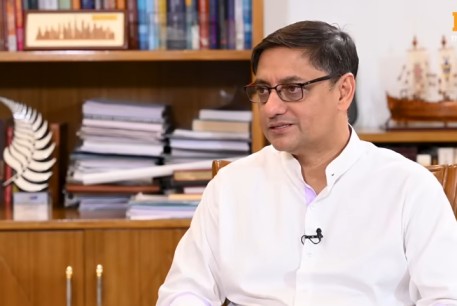
EDITOR’S NOTES: In this exclusive Mint Podcast interview, Sanjeev Sanyal, a full-time member of the Economic Advisory Council to the Prime Minister, firmly rejects claims of rising unemployment in India and the notion of jobless growth amid concerns over an AI-driven economy. He explores India’s looming demographic challenges—including the risk of growing old before getting rich—while offering insights on declining birth rates, freebie culture, banking reforms, geopolitics, and strategies for engaging China. The conversation also covers AI’s impact on jobs and education, inflation, and the need for thoughtful regulation to navigate technological disruption. READ THE FULL TRANSCRIPT BELOW:
India’s Fertility Decline
ALOKESH BHATTACHARYYA: We have with us Mr. Sanjeev Sanyal, Member, Prime Minister Economic Advisory Council. I still remember the last time I was in your office, you had given us a brilliant headline about India’s population problem and the crisis which is unfolding. You also at that point talked about how the data being presented to you was putting out a scenario that is not very encouraging. What has changed from then till now, and how do you look at it?
SANJEEV SANYAL: Well, demographics doesn’t change in six months.
ALOKESH BHATTACHARYYA: True.
SANJEEV SANYAL: But what has happened, I think, is that more data is now available supporting what I have been arguing for some years now, which is that India’s fertility rate has come down very, very dramatically. This is happening, of course, worldwide. But in India, at least in policy circles, academia, and so on, there was always this presumption that India was always producing enough babies, and that it would somehow be eternally young forever.
It is now quite clear that our birth rates have fallen very significantly. In fact, this has been going on for at least twenty-five years. It’s not even a new phenomenon — it’s just that we are now paying more attention to it.
So just so you know, the highest number of babies ever born in India happened in the year 2001, when twenty-nine million babies were born. That’s a quarter of a century back. Last year, 22.5 million babies were born. So a decline already from twenty-nine million babies to 22.5 million babies a year, which is below replacement rate. That means the only reason our population is still growing at all is because we are living longer. The inflow has slowed, but the outflow has also slowed, for the time being.
But of course, like every other country, we will age, and then the death rate will stop falling, at which point the population will suddenly begin to shrink — which should happen sometime in the 2050s. From now till then, we will enjoy the demographic dividend: low birth rates and a relatively small aged population. So this is the next twenty-five to thirty years — the sweet spot we all call the demographic dividend.
But I do want to point out that the pipeline is drying up, and in some parts of the country it has dried up a lot. There are states in India — for example, Kerala, Andhra Pradesh, West Bengal, so it’s not just a South Indian phenomenon — and Sikkim, where the total fertility rate is now somewhere in the range of 1.2 to 1.3. Punjab as well, very low.
Now, usually the conversation is that you need a level of about 2.1 to have a stable population. That figure is actually calculated for a developed country. For India, that rate is somewhere in the range of 2.2 to 2.25. So the gap between where we are now — 1.9 — and 2.25 is not as small as people think. And by all indications, this 1.9 is going to decline further, because it’s basically being held up by two or three states like Uttar Pradesh, Bihar, and Jharkhand. And even there, their rates are falling very fast.
So what is going to happen is that India is going to see its birth rate decline, not so dissimilar to what happened in East Asia and the West. We do need to begin thinking about this, particularly in the parts of the country where the decline has been going on for a very long time, where you will begin to hit the aging problem much faster. You will have to think about internal migration and how to manage it, and its political ramifications.
You will also have to prepare for things that become very emotive in India. For example, in many parts of the country, you have to be willing to consolidate schools. Now, go to any neighborhood and say we have to shut down schools, and everybody gets annoyed. But in fact, schools can only be viable if you have a certain minimum threshold of kids in each age group, and you can’t get around that.
So I think we now need to mentally prepare for a different world, because already, at the bottom of the age pyramid, things are shrinking. And this will begin to happen even in major cities. For example, you might assume a city like Delhi will eternally have a shortage of schools. That may be true for elite schools, where everybody wants to send their kids. But I can tell you, in the second and third tiers, you will begin to suddenly see difficulty in getting students — in certain areas where government schools are not well run, or in certain states.
ALOKESH BHATTACHARYYA: These are not some far-off states? I believe this was happening in Uttarakhand.
SANJEEV SANYAL: Yes, this will begin to happen here. It may not already be happening — I’m just telling you many of these things will happen very quickly, very soon. Part of it is because we already know it will happen: those kids have already been born. The class-one student of five years from now is being born right now. So we know how many kids are being born, and no country has been able to reverse this.
Policy Responses to a Shrinking Population
ALOKESH BHATTACHARYYA: What do we do?
SANJEEV SANYAL: Western countries have attempted to put in place lots of incentives. Singapore has tried this. Japan has tried it. They use fiscal incentives to try to solve this. But giving people money to have kids, or other kinds of financial incentives — it’s difficult to tell how effective they are, because it hasn’t managed to push these rates above replacement rate in any country in the world. In some cases, people claim that in Nordic countries it has stabilized, but remember, it stabilized at very low levels, and may have stabilized anyway.
So this is difficult to do. But at the very least, here in India, the policy system is still entirely embedded with population control measures. Even today, there are incentives given to promote sterilization of men and women. In some places, the local block officer, or even the district magistrate, may be given incentives to run various kinds of population control awareness programs. The Anganwadi groups are told to go out and spread awareness. “Hum Do Hamare Do” is still on. All of these things are embedded in the system, and many of them are active. In fact, one of the strange things is that even in states that have been below replacement rate for perhaps a quarter of a century, these programs are still on. Even in Andhra Pradesh, they are now giving incentives to increase babies.
ALOKESH BHATTACHARYYA: So one arm of the government doesn’t know what the other is doing.
SANJEEV SANYAL: There are still policies like that. Thankfully, in the specific case of Andhra Pradesh, they are beginning to unwind them faster than in many other places. But there are states in India — for example, West Bengal — where this is not even part of the debate yet. Urban West Bengal has a total fertility rate of 1.2, which is just a little above half of what you need to stabilize your population. These are the kinds of levels you see in Japan. So it’s not part of the conversation at all.
Growing Old Before Growing Rich
ALOKESH BHATTACHARYYA: Will we grow older before we get rich?
SANJEEV SANYAL: There are two things that will matter here. One is whether we can stabilize our birth rates, and in my view that is at least as much a cultural debate as an economic one. The second is what we do with the next thirty years.
Here’s the thing: when China went into the phase we are in now, we are demographically speaking about thirty to thirty-five years behind China, at least. When China went into this phase, they went through a very high-growth period — their per capita income spiked up even as their demographics were moving the other way, because they took advantage of their demographic dividend phase very well. And even they are not going to end up rich — they’ll be upper-middle-class by the time they go over the hump, which they have now done.
Just to give you a sense of what happens from here: China’s population begins shrinking very quickly. To put it in perspective, until very recently, their population was a little larger than ours. Now it is somewhat lower, and it’s expected by the UN and other demographers to fall to something like 650 million by the end of the century. So you’re looking at a population shrinkage in the range of 650 to 700 million. There will be decades in the not-too-distant future in China where, within a single decade, the population falls by 100 million people.
ALOKESH BHATTACHARYYA: Wow.
SANJEEV SANYAL: These are not trivial numbers, and there is very little China can do about it, because even if by some miracle they manage to get their birth rates going again, this is to some extent already hardwired.
ALOKESH BHATTACHARYYA: What do we do?
SANJEEV SANYAL: So this is the point. First of all, we take advantage of the next twenty-five years — we will be in the demographic sweet spot. We have to try to sustain growth over thirty years. Don’t try to grow as fast as you can in one year and blow it up. Maintaining growth year after year and compounding it is a very important part of this. This has to be a thirty-year growth phase. This is partly the inspiration for the Viksit Bharat concept.
Secondly, I think, at the very least, we need to get rid of these population control mechanisms, which are not only counterproductive but which we are actually spending large amounts of money on. So, at least get rid of those. And then we need to have an honest conversation about thinking through the implications of this and putting things in place for it. Consolidation of schools is just one example.
ALOKESH BHATTACHARYYA: What else?
SANJEEV SANYAL: We will have to begin thinking about what to do with the older population. We are living longer, so we may need to think about whether we want to extend work life — the retirement age. That could be one thing.
ALOKESH BHATTACHARYYA: Is that a debate happening in the government?
SANJEEV SANYAL: These things happen in bits and pieces. But I think, in the end, it has to be part of the public debate. As I said, this isn’t something governments handle in isolation — this is a larger national, sociological transformation. So it has to be part of the debate. Only then, for example, when you begin to consolidate schools, you won’t have largely pointless debates about how “this government is shutting down schools.” Yes, that is exactly the sensible thing to do in certain parts of the country.
How many schools have been shut down? In some states, like Himachal and Uttarakhand, and I think even in Kerala, they have been shutting down — but very gingerly, almost apologetically, when a school has nearly no students.
ALOKESH BHATTACHARYYA: Basically, schools are getting combined, right?
SANJEEV SANYAL: Yes, they’re getting combined. But we have rules that say there must be a school within a certain distance, and so on. It might actually be much more sensible to put children in a bus and take them some distance away, so you can have a minimum cluster of students.
ALOKESH BHATTACHARYYA: And more teachers per student.
SANJEEV SANYAL: Yes, more teachers per student. And then — why do you go to school at all? It’s to meet other people. Lecturing can be done online now. School is for meeting other people. So if kids don’t have other kids of the same age group, the entire experience of school becomes largely pointless.
Rethinking the College Degree
ALOKESH BHATTACHARYYA: Is a college degree a necessity?
SANJEEV SANYAL: That’s a different debate, for a different reason — though it’s related, so I’ll come back to it. In addition to this demographic shift, we’re also seeing the introduction of all manner of new technologies, one of which is artificial intelligence. What is artificial intelligence doing? At the very least, it’s going to disrupt a lot of current jobs. It’ll also create new jobs, but it’s certainly going to disrupt the way things are done today.
But this disruption also has its own solution. Artificial intelligence is an amazing teacher. Old-style lectures are not needed — you can use AI to understand material, and you can also use AI to test yourself and answer your questions. This old lecture-based system, where you spend three or four years of your life going somewhere, listening to lectures most of the time, taking a few tests, and coming out — that’s already outdated at multiple levels.
First of all, you can do those lectures at home. Many major institutions in the world put all their material out — MIT does it, Arizona State does it, and even our own IIT Madras, possibly the best academic institution in this country, puts its material out. It even gives online degrees. So I think that way of delivering education is gone.
What will be valuable now is no longer simply knowledge in the theoretical sense, because it’s on tap. What will be valuable is application. So, for most people — except maybe for something like surgery — going away for four years just to learn theory doesn’t make as much sense anymore. I think it now makes sense to begin working at eighteen and do the degree on the side, because it’s the application and the experience that matter. In any case, these jobs are changing so fast that the curriculum is very likely outdated. You’re as good or bad as the next person, because past experience doesn’t matter as much.
ALOKESH BHATTACHARYYA: But you lose out on friendships.
SANJEEV SANYAL: No — here’s the thing. Since these people will begin working, they’ll build friendships in the workplace instead. The point I’m making is that this whole idea of going to university is a purely twentieth-century idea. Before the twentieth century, universities were meant for an extremely small elite. That was even true as recently as 1950. It’s only from the 1950s onward that middle-class people began going to university as a routine practice.
That doesn’t mean people before 1950 didn’t have social relationships — they did. They just built them in other spaces: at work, in a bhajan mandali, the YMCA, an akhada, sports teams, other religious institutions. In the West, it might have been the pub. Every society created many other institutions for social interaction. I’m quite confident the future will develop new institutions for that. I don’t think academic institutions need to be kept alive purely for the purpose of social interaction — it’s a rather expensive way of doing it. Maybe the elite can afford to spend large amounts of money staying in university for four years, but for the average person, that is not why universities will exist. Universities will exist — but for completely different reasons.
ALOKESH BHATTACHARYYA: Sir, post-COVID we’ve seen a rush for online degrees. The government is giving them a kind of recognition, but companies are still hesitant.
SANJEEV SANYAL: Yes. At the cutting edge, companies are changing — whether it’s Elon Musk, or here, Sridhar Vembu, and others in areas including manufacturing. People are beginning to take in very young students and allowing them to do degrees along the way. There has to be a mindset change, and it will take some time. One reason it takes time is that HR departments are usually not at the cutting edge on the shop floor. Since they’re not with the shop floor, they use certain credentials to do the screening.
But what’s already happening in many places in the world is that HR departments are being taken over — or bypassed — by the shop-floor people, who need different kinds of people very quickly to deal with this churning environment. So I think whether it’s governments or companies, they’re going to reorient themselves. And the reason we need this conversation is that many things need to change: companies and their mindsets need to change, but very importantly, we also need academia to change — not because it isn’t needed, but because it shouldn’t be wasting its time giving lectures.
The Political Difficulty of Acting on Demographics
ALOKESH BHATTACHARYYA: In fact, that statement about HR folks will make you very popular with them. Coming back to the population question — how difficult is it to actually act on this? There’s a very clear and present danger right now.
SANJEEV SANYAL: How difficult is it for state governments to move on this? First of all, you need to recognize the problem. I began talking about this twenty years ago, and for a significant part of the last ten or fifteen years, people simply wouldn’t believe me — even though I kept showing them data and writing about it. In fact, I wrote about this not just for India but worldwide: this population-explosion narrative everybody talks about isn’t right. If first China and now India begin shrinking, world population cannot keep growing — it will begin shrinking rapidly.
At the time, many people, including the UN Population Division, got quite angry with me and wrote nasty emails. But now it is much more widely recognized. The good news is that when I make these statements now, at least somebody is willing to listen — even though the idea that “population explosion is coming” has gone deep into the system’s nervous system. That turning point is now beginning to filter through, partly because people can see it around themselves — they can see their siblings not having kids, or their kids not having kids, or not even getting married.
Marriage, Culture, and Global Demographic Decline
ALOKESH BHATTACHARYYA: There’s obviously a cultural dimension to this too. Family has always been the center point of our culture. Why is it that young people today don’t want to get married?
SANJEEV SANYAL: As I said, this isn’t an India-specific thing at all — it’s a global phenomenon. It’s happening for a number of reasons, but at the very least, part of it is that since the mid-twentieth century, or even the early twentieth century, there has been a long-running Malthusian argument about overpopulation. That may have been a reasonable argument in the twentieth century, but in the twenty-first century it’s an irrelevant one, because our populations are all turning toward shrinkage.
Now, despite everything I’m saying about India, we are in a much, much better place than others. There are parts of the world where populations will shrink at absolutely alarming rates. I told you about China, where there will be decades this century when the population shrinks by 100 million.
ALOKESH BHATTACHARYYA: These are existential numbers.
SANJEEV SANYAL: These are existential. But let me tell you — at least China has a large population to begin with. Take South Korea: their birth rate is one-third of the replacement rate. That means within one generation, their population could potentially shrink by close to two-thirds, depending on longevity — certainly it could halve. When you have declines of that magnitude, you can’t even run basic systems in some places. You can have robots and so on, but if you have to empty out a whole city because nobody lives there anymore, what is the robot even cleaning for?
ALOKESH BHATTACHARYYA: And at a time when globalization is already being argued to be dead — you’re not allowing people mobility.
SANJEEV SANYAL: Well, mobile population from where? Other than Africa, and one or two places like Pakistan, population will be shrinking in most places over the next few decades. Nigeria will see an exploding population, and Pakistan for some time — even though their birth rates are declining too, they’re still well above replacement rate. Elsewhere, populations will be shrinking.
So unless, say, Japan wants to import large numbers of people from Pakistan — but remember, these are not easy things to happen. You’re seeing on television right now what’s happening in Spain, for example. Even if you accept that you need large-scale migration, the numbers involved are so large that you are necessarily also accepting cultural and political change.
ALOKESH BHATTACHARYYA: Which can change the very structure of a country.
SANJEEV SANYAL: It can change the structure of the country. But even leaving aside racism and other issues, let me show you how complicated this gets even on fiscal matters. Say there are European countries with a very generous old-age support system. You bring in a large number of people from another society, and the idea is that they will work and pay taxes to keep your old people going. I can assure you that once that population gets voting rights — which they will, eventually — they will ask: why are we paying taxes for somebody else’s grandfather’s pension? It’s a legitimate question. These new immigrants may say: we want more money for children, because we’re the ones producing children, not for older people who aren’t related to us. The West has become aware of this.
So this is how complicated the politics can get. Either you make very major internal adjustments, or you see xenophobic movements emerge — there’s a price to be paid either way. This is a tricky problem with no clear answer. The Japanese, unlike the Europeans, have largely chosen to restrict inflows, accepting much slower growth as a trade-off, but retaining cultural and political control. Some other society will say: we’ll continue growing by bringing in immigrants, but accept the cultural and political flux that comes with it. Either way, there’s a price to be paid for whatever solution you choose.
Navigating a Fractured World Order
ALOKESH BHATTACHARYYA: I wanted to ask about this. In this age of protectionism, and with the so-called rules-based world order being upended — sovereign states not honoring agreements — what does India do in a flux situation like this?
SANJEEV SANYAL: The world, and history itself, is a complex adaptive system, and it’s changing in utterly unpredictable ways. It’s always unpredictable, but at turning points like ours, it becomes especially so, because the normal anchors have broken and a new arrangement hasn’t yet been arrived at. Under those circumstances, the best one can do is, first, be flexible. Create buffers where you can. Create bilateral alliances with people you think will at least be on the same page in some space, and willing to go on the journey with you. You have to create optionality, because it’s unpredictable.
If you look at what India is doing, that’s precisely it. We are trying free trade agreements with a range of countries. We are diversifying our energy sources. We are building internal capacities wherever we can. When we say Atmanirbhar Bharat, it’s not to be seen as 1950s-style import substitution — it’s about investing in resilience where we can. The old economic supply-chain networks were based on “just in time.” Today, we have to base it, at least partly, on “just in case.”
ALOKESH BHATTACHARYYA: Well put. How have we fared through the West Asia war? We saw early panic, then things settled. And we’re dealing with a US president who seems to shatter his own government’s earlier statements every other day. How have we fared, particularly given that we are the world’s third-largest energy buyer, and one of the largest refiners? It’s not only about importing for our own consumption — fertilizers are also a concern. How is the government responding?
SANJEEV SANYAL: This is obviously not a happy situation — such a disrupted world. And remember, this comes on top of the Russia-Ukraine war, the tariff episode, and earlier in the decade, the COVID crisis. These have been difficult times. Beyond the issue of energy, which is obviously difficult for India since we import so much of it, remember there are about ten million Indians living in the Gulf region. They’re not just a source of remittances — there are people whose safety we have to think about if something goes badly wrong. We’ve had people in the shipping industry actually killed — several of them, not just a handful. This is also a region we export a great deal to, including food. So there are many dimensions to what disruption in the Middle East means for us, and as you pointed out, it’s very difficult to predict where this goes. There have been several attempts at peace, with repeated false starts.
Given this environment, we’ve tried to remain as flexible as possible — a lot of balancing to retain Russian supplies, buying Venezuelan supplies where possible, buying from the UAE via the Fujairah route so we don’t have to route everything through Hormuz. We’ve done complex, continuous rebalancing to keep this running. It hasn’t been easy, and there’s a price to be paid — it’s quite exhausting in terms of managing foreign relations, with constant threats of sanctions and various diktats coming out. It is not an easy situation to deal with. We’ve done as well as we could, but is it a happy situation? It isn’t.
Multilateral Institutions and India’s Diversified Diplomacy
ALOKESH BHATTACHARYYA: That conveniently brings me to my next question. Given the protectionism around us — and just two days ago, NATO and Russia nearly came to war — is the age of multilateral institutions like the World Bank or IMF over? Do they still have sanctity?
SANJEEV SANYAL: In an ideal world, you’d want a set of global rules running the system. It should be quite obvious that system is severely disrupted — and this isn’t just the last year, under President Trump. This has been in a state of breakdown for a while. Even during COVID, the WHO played almost no meaningful role.
ALOKESH BHATTACHARYYA: The man’s been invoking the Fifth Amendment.
SANJEEV SANYAL: Well, he’s not WHO — if you’re talking about Fauci, he’s not WHO.
ALOKESH BHATTACHARYYA: No, I mean — given that the US was the largest contributor to WHO.
SANJEEV SANYAL: So there are now serious issues around global governance. We are an emerging power, but we can’t claim to be rule-setters yet. What we can do is find forums where we can build networks to keep things running in that space. So what we’ve done is enter into several free trade agreements, and more broadly, operate in an interesting mix of organizations and relationships. We are in BRICS, we’re also in the Quad, in the G20, quite often engaging with the G7, and dealing with ASEAN in some fashion. We’ve also tried to promote IORA, the Indian Ocean grouping.
Why do we do all of this? Because we understand the overarching rules are no longer reliable. So we try to create various relationships in different rooms as a substitute for an overarching system that could, in theory, have existed but certainly doesn’t now. Even in the best of times, these systems were not very efficient.
ALOKESH BHATTACHARYYA: Not optimal.
SANJEEV SANYAL: Not optimal. But right now, they are hugely disrupted. There was a time when the G20 looked like it could become the kind of body the UN should be. To be fair, during the COVID crisis, the G20, rather than any UN body, was what kept the world economy going. We ourselves invested quite heavily in the G20 during our presidency. There were some benefits from that, but the G20 itself seems to have lost momentum since. These are very disrupted times.
ALOKESH BHATTACHARYYA: And there’s a sense of despondency around — no larger messaging coming out that rallies people together.
SANJEEV SANYAL: It’s not very clear what we can do about that. As I said, we are large enough to matter, but not large enough to be rule-setters. So we do the best we can under the circumstances, by being flexible.
Freebies, Democracy, and Fiscal Responsibility
ALOKESH BHATTACHARYYA: I’ll come to the China question later. On freebies — there have always been two sides, some in support, some against. Recently it’s increasingly become a tool for political parties, setting aside the politics, given the fiscal burden involved. What’s your view — where is this headed?
SANJEEV SANYAL: First of all, not everything called a “freebie” is actually a freebie. We do need to provide certain kinds of safety nets and transfers — I’m not against every kind of transfer to the poor. You do need safety nets, and I’m very much in favor of things like health insurance. So not all of it is populist.
Having said that, there is tremendous pressure — even stronger at the state level — to demand more populist spending. It’s easy to blame politicians, but we’re a democracy. If a population wants a particular freebie and politicians provide it, then, frankly, as citizens we have to take responsibility for it too. We can’t blame a politician for doing what they were elected to do. In this context, I’d say the intellectual class — economists, writers, media — needs to play a role in educating people that there’s no such thing as free money. If you’re asking for something, remember it means you’re not getting something else.
ALOKESH BHATTACHARYYA: There’s an associated cost.
SANJEEV SANYAL: Yes. And I think that isn’t adequately communicated, either by the media or the intellectual class — though I try my best. I think this is something the intellectual class fails at doing adequately.
ALOKESH BHATTACHARYYA: Just to add — this isn’t about one political party or another. For example, Delhi has given ₹2,500.
SANJEEV SANYAL: That’s exactly what I’m saying — if a politician is doing something because they were elected on that basis, then in a democracy it’s fair that they do what they were elected to do. You can’t blame the politician for that — it was the popular will. This is where we, as citizens, have to take responsibility. If we asked for X and the politician delivered X, then from a democratic standpoint, they did the right thing.
ALOKESH BHATTACHARYYA: The politician’s job is to win elections.
SANJEEV SANYAL: No — not just to win elections. At a meta level, they’ve carried out the popular will. Now, if you and I think that’s a bad or populist move, then it’s incumbent on us to stand up and say so. We need a public debate about this, or you’ll spiral down that path. You can go to any state and find something to criticize. That’s partly your job as media — to make a fuss about this. Don’t just blame the politicians.
Banking Sector Reforms and Governance
ALOKESH BHATTACHARYYA: One more crucial issue, sir. In the budget, the Honourable Finance Minister announced a committee for banking reforms. You’ve also said, on several occasions, that we need fewer public sector banks. Given the FDI push, and what’s already been done in insurance — in your opinion, is a merger of Indian public sector banks an option?
SANJEEV SANYAL: That’s obviously the prerogative of the Union Finance Minister to announce. I can’t speak for that. But as I’ve said before, the public sector’s dominance of the entire banking system is something we’ve inherited, and over time it should get diluted. That doesn’t mean the public sector won’t play a role — but being two-thirds of the system is perhaps not healthy. Public sector banks do play a somewhat different role from private ones, and we have some very well-run public sector banks, so there’s no reason not to continue with them. But at the same time, you want the existing private sector banks to grow, and if they meet all RBI criteria, even new ones should be allowed to emerge.
ALOKESH BHATTACHARYYA: But in the last few months, we’ve also seen a couple of governance issues in private sector banks. I won’t name them, but do you think governance norms need revisiting?
SANJEEV SANYAL: If you last long enough, every financial system in the world will go through phases where governance issues arise in one institution or another, or even systemically. That’s not a reason to stop playing the game. Governance rules exist precisely because things can go off-kilter in all kinds of ways — not just the ones you anticipated, but new ones too. That’s why you have transparency rules, the whole apparatus of financial regulation — the Reserve Bank, SEBI — an entire architecture for keeping track not just of the financial sector, but the corporate sector more broadly.
This will always require active management. When you run a cricket match, it’s not enough for the BCCI or ICC to write a set of rules and go home — you need umpires on the pitch, you need reviews. This is a hands-on business. No matter how well the rules are written, you will still need active management of the system.
ALOKESH BHATTACHARYYA: Related to this — you’ve rightly said we need to relook at the education system. On working methods too — COVID gave us a hybrid model. In banking, do you advocate a five-day work week, given our digital banking penetration?
SANJEEV SANYAL: It depends — different companies can have different models. As a policymaker, why should I be prescriptive about it? The business of banks is to take deposits, lend, and make money in the process. If they find an efficient way to do that, follow the rules, and do a good job of it, whether they work one minute a year or five days a week — good luck to them. I care whether they follow the rules and play the correct role in the economy, which is reallocating savings. How they do it is their call.
The China Relationship
ALOKESH BHATTACHARYYA: I wanted to come to the China question. What is our China playbook? There was a time when Press Note 3 came in — restricting investment from land-border countries. Then there was some softening this past March, around 10% FDI through the automatic route. We can’t wish away the China problem — we can’t change our neighbors. What should our engagement look like, especially given what’s happening in the Indo-Pacific?
SANJEEV SANYAL: As with any tricky situation, there’s no black-and-white answer. We’ve had historical issues with China — the border issue flares up from time to time, and there have been other issues around investment, dumping, and trade. So we need to be careful. At the same time, we have to recognize China is a very important trading partner despite these issues. We can’t wish them away — they’re at the cutting edge of many technologies, a source of inputs into many of our key industries, including things we ultimately export ourselves. They’re also a very major source of FDI globally — the second-largest source on the planet.
So the question is what the sweet spot for engagement looks like. It’s not a neat black-and-white answer — it’s something we’re evolving. We thought one approach worked, then adjusted it. We do want to engage with China, and understand some level of engagement needs to happen. It also has to be practical — there’s no point banning Chinese companies from producing something in India when we’re already importing the same product from the same company in China or Vietnam. You might as well let them do it here. Some of the recent easing reflects that kind of thinking, and we may ease further if it works out. As the Chinese dictum goes, we will feel the pebbles as we cross the stream.
ALOKESH BHATTACHARYYA: On that count, given past experience with China, there have been reports about things of critical importance — not just critical minerals and APIs, but, for example, large tunnel-boring machines. A Western firm manufactures them in China, and we want to import some of that machinery, but given our technological dependence, the Chinese don’t allow those exports to us.
SANJEEV SANYAL: This is exactly the point about why we need Atmanirbhar Bharat. As I said, it’s not a 1950s import-substitution mindset born of fear of the East India Company — it’s a necessity of our times, because of technological or other kinds of dependence. And there are many areas where we can actually build capacity.
Building Maritime and Shipping Capacity
Let me give you an example — shipbuilding, a topic I’m rather passionate about. India imports 90–95% of its goods by sea, and the vast bulk of it arrives on foreign ships. India owns only about 460-odd ships of its own, and most of them aren’t large. So we’re heavily dependent on foreign shipping lines and container boxes. If three shipping lines in the world decided they didn’t like us, we’d be in serious trouble.
You have to realize that, from an economic perspective, we’re effectively an island nation — not too different from Japan or the UK. We don’t trade at all with Pakistan, and while we trade with China, very little of it goes through the land border. So most of our trade moves on foreign ships, and the single biggest source of geopolitical risk for us is actually ships. We’re facing this right now with the Hormuz situation.
When I used to point this out two or three years ago, people thought I was crazy — ships seemed like some obscure topic. I used to make a fuss about flagging, ship ownership, giving shipping infrastructure status and priority-sector lending. But that argument is no longer obscure. In the last eighteen months, we’ve changed all these rules — flagging rules, ownership rules, all of it. About a year ago, we gave a ₹70,000 crore package to the shipping industry. Just recently, state-backed maritime insurance has also been provided.
This is one sector where we’re giving our very best — shipbuilding is doing well, we have our own shipbuilders, and we’re also bringing in foreign shipbuilders like Hyundai and Mitsubishi. We’re building major ports too. Just north of Mumbai, we’re building Vadhavan, which could end up being bigger than all our current ports put together, and we’re hoping to get it functioning by the end of the decade. There’s a lot of effort going into this. This is a genuine geopolitical risk, and we need Atmanirbhar capacity-building here. We started moving on it two or three years ago, but we’ve gained significant momentum in the last eighteen months — anyone talking to people in the shipping industry will tell you it hasn’t been this active in memory.
ALOKESH BHATTACHARYYA: It’s a strategic imperative.
SANJEEV SANYAL: It’s a strategic imperative. Similarly, we’re investing in fundamental research in science. I was at IIT Madras just three days ago, and the kind of research happening there is incredible — fundamental research, things like mapping the brain in detail no one else in the world has attempted. Similarly, there’s the whole startup ecosystem — twenty-three-year-olds building rockets and sending them into space, creating drone taxis, working on hyperloop technology. All kinds of things are happening.
Rethinking Liberal Arts Education
This is the model universities should follow — cutting-edge research, and spaces for getting your hands dirty. Because knowledge is now available on tap, what really matters is how much grease you have on your hands.
ALOKESH BHATTACHARYYA: Something related to that — do you think there’s a need, or even a requirement, for liberal arts education today?
SANJEEV SANYAL: It depends what you mean by liberal arts. I’m a great votary of liberal arts in the sense that I love history — I’m very much into history and culture, and I’m a writer as well. I’m actually converting one of my books, Revolutionaries, into an Amazon Prime series. So don’t for a moment think I have a problem with liberal arts — I’m an economist, which sits at the edge of liberal arts and science.
But I do think the old way of delivering liberal arts education is dead. Take a degree in English literature — what’s its real value? Does it make you a better writer? It’s not clear it does. Look at the best writers in this country — you’re more likely to find an MBA, a doctor, or an economist among them than an English literature graduate. Almost none of our best writers, at least in the languages I read — English, Bangla, and Hindi — are literature students.
So we need to ask: if you’re going to teach languages, how should you teach them? Is literary critique a useful thing to teach? Is criticism itself a meaningful activity? Great critics don’t necessarily become good writers — in fact, there’s a joke among writers that if you can’t write a book, you become a critic. So we need to have that conversation about what may have been considered “liberal arts” but may not be a meaningful part of liberal arts education going forward. That doesn’t mean liberal arts has no space — it just may look different.
Archaeology, for example, could remain a very interesting field, but not in the way we used to practice it. There’s now hugely complex technology for archaeology — radar, isotope analysis — you don’t even need to dig anymore. So it will become a much more technical activity. Liberal arts, going forward, will increasingly look a bit more like STEM in its approach, even if the outcomes are different.
Monsoon and Growth Outlook
ALOKESH BHATTACHARYYA: Right. Given that the IMD is holding its fourth press conference on the monsoon and El Niño conditions, how severe is this problem, from where you’re sitting?
SANJEEV SANYAL: In June, it was quite severe. It’s not like we didn’t know it was coming — it was well advertised by both the Indian Meteorological Department and NOAA that El Niño was on its way. We knew by May, and it was well flagged to people in water conservation and agriculture, and the media was well aware too. So, to the extent one can be prepared for such things, we were prepared. June was definitely not a good month, but through July the rains caught up. The shortfall now, I’m told — and you may have a more recent number — is somewhere in the 15–16% range, which is tolerable if you went in prepared. Going in unprepared would have been more difficult, but this should be tolerable. We still have about six weeks left in the monsoon cycle — we’re at end of July, and it runs till mid-September. So we’ll see how it plays out. It’s not just about the total quantum — a lot depends on the spread, both geographically and over time.
ALOKESH BHATTACHARYYA: True.
ALOKESH BHATTACHARYYA: How well prepared is the government on this front?
SANJEEV SANYAL: From what I hear, the farming community adjusted the crops they sowed — more sunflowers, for instance. I’m not an agriculture expert, so you’ll have to ask my colleagues — our chairman, Mahendra Dev, will know more about agriculture; I’m not the agriculture guy. But I’m told farmers did change their cropping patterns, so crop failure may not be the bigger problem. The bigger question is whether there will be shortfalls in certain crops, like paddy, since less of it may have been sown. We do have large stocks, but I’m not the person who tracks that in detail.
ALOKESH BHATTACHARYYA: Is 7% growth still doable?
SANJEEV SANYAL: In the first quarter of this calendar year, the January–March number was 7.8% — a very strong number. The Chief Economic Adviser and I both agree it would be surprising if it didn’t temper from there, given it was a disruptive period, partly because of the Middle East situation among other things. So growth will likely slow down somewhat — probably not by a lot. Indicators so far suggest it’s slowed to around the 6.5% range for this year. That would still make us the fastest-growing economy in the world — yesterday’s US number came in at 1.5%. So the world is weak, and we’ll weaken too, but if we manage inflation and keep growing at around 6.5%, that’s not bad. Hopefully, at some point, the engine gets a respite from these continuous external shocks.
ALOKESH BHATTACHARYYA: They’re all external.
SANJEEV SANYAL: They’re all external, not of our making. But this government, if you’ve noticed our behavior over the years, is conservative and frugal. We’re not likely to rush into monetary and fiscal expansion for every passing shock. We’ll maintain control over the economy — specifically over the current account and inflation — rather than push growth at the cost of losing control. That connects back to what we discussed earlier: given our demographic window is twenty-five to thirty years, we need to compound growth over that period and maximize it. You don’t want to blow up at any point. This isn’t a small risk — remember, alongside the successes, like Singapore or China, there are far more countries that grew for a few years and didn’t make it.
ALOKESH BHATTACHARYYA: The tiger economies.
SANJEEV SANYAL: All the tiger economies of the ’90s had one big crisis, in 1997–98, and never quite came back the same way. Many of them, by the way, have gone through their demographic phase since — countries like Thailand are well advanced into their demographic-dividend phase now, but they never got that high growth back. They recovered, but never had the full flowering of the demographic dividend, and the years of the crisis were very painful.
So remember, we are a government that will be quite cautious about financial-sector and macro stability, more so than many other governments might be. Don’t expect cowboy behavior from us.
ALOKESH BHATTACHARYYA: Still, the $5 trillion aspiration —
SANJEEV SANYAL: No, no — we aspire to be as large as we can, and at some point we will become a $5 trillion economy, simply because we’re growing; it’ll compound out to that. We would have liked to reach there by now, but growth has been disrupted along the way, and the exchange rate has weakened. We had to take a call on that, and we decided that if you get a big shock like this, something has to give — and the way our monetary system is set up, the exchange rate is the least damaging place to absorb it.
The Trilemma: Inflation Targeting and the Exchange Rate
For listeners who want to understand this — and this debate gets very heated — there’s a law in economics called the trilemma, or the impossible trinity. It states that if you have open capital accounts, which we do, you can control either your monetary policy or your exchange rate — not both. About a decade ago, we decided to take control of monetary policy and aim it at managing inflation. When we adopted an inflation-targeting framework, it said monetary policy has one job: keep inflation between 2% and 6%. You can look at growth and other things, but that’s its primary job.
This anchoring has been hugely successful — we’ve never had such controlled inflation in our history. We were never an Argentina-style inflation economy, but we routinely saw inflation in the 8–12% range. In the last decade, despite all the disruptions and spikes, inflation has stayed in the 2–6% range. That’s a 600-basis-point reduction in underlying inflation — not a trivial achievement. But it comes with a caveat: you can’t then also control the exchange rate.
So we’ve largely let the exchange rate find its own level. The Reserve Bank will intervene to stop it moving too fast in either direction, using foreign exchange reserves — and we do have substantial reserves — but it has correctly avoided burning through them to defend a particular level. There are two reasons for this. First, defending a fixed level would contradict our own successful inflation-targeting framework. Second, it’s pointless, because if you defend a hard line, you attract speculators.
ALOKESH BHATTACHARYYA: The Bank of England scenario.
SANJEEV SANYAL: Exactly — and remember, that was my original profession; I was a financial markets guy. If I found a country defending a particular line, I would have shorted it. I know how my fellow currency speculators think. So I wouldn’t encourage anyone to draw a line and defend it, no matter what public opinion demands. Much better to maintain inflation control and let purchasing power parity hold over time — don’t get thrown off by short-term currency movements. Exchange rates eventually settle back to whatever the purchasing-power parity dictates; it takes time, but that’s how it works.
Look at Japan — their exchange rate has moved from 250 to 80 over the last thirty or forty years. It hasn’t caused Japan any real problem. If anything, phases of a weaker exchange rate have helped their exports.
ALOKESH BHATTACHARYYA: But that also opens the government to criticism — when the BJP was not in power, a very popular line of attack against the government of the day was a sliding rupee.
SANJEEV SANYAL: I can’t comment on political arguments. But once you’ve adopted an inflation-targeting system, that’s the framework you’ve chosen, and you have to let the exchange rate more or less find its own level.
ALOKESH BHATTACHARYYA: Right. Related to this — inflation is moving up. When does it become a concern?
SANJEEV SANYAL: It had gone down to around the 2% range and has crept up now, past 4% and heading toward 5%. It’s likely to move up further or stay elevated. Will it cross 6%? Hopefully not. But if it does, the Reserve Bank — or more specifically, the Monetary Policy Committee — would be entirely within its rights to tighten monetary conditions, and that’s exactly what it should do. For now, they’ll watch how things evolve before responding.
Employment, Employability, and AI
ALOKESH BHATTACHARYYA: On a concluding note, sir, on AI — for a country like India, where the unemployment rate is increasing, and we have a bulk of unskilled labor, that’s a major issue.
SANJEEV SANYAL: Let me contradict you first. This throwaway phrase, “unemployment rate is increasing,” has no evidence behind it. If anything, unemployment has come down over the last few years. There was a spike during COVID, but every indicator suggests it has come down since — even for the group that typically has somewhat elevated unemployment, educated youth, which is true of most countries, not just India. Even there, it has come down. So please correct that assumption — the unemployment rate is not spiraling at all.
ALOKESH BHATTACHARYYA: Could you expand a bit — when you say educated youth numbers are elevated in most countries, where do we stand relative to others?
SANJEEV SANYAL: Ours is elevated too — I don’t have the exact numbers off the top of my head, but you can look them up. In most countries, educated youth in their early to mid-twenties tend to have somewhat higher unemployment than others; it evens out by the time they’re thirty. There’s a phase where they tend to be more unemployed.
In India’s specific case, one reason is that this is a phase where many educated people take time out to prepare for government exams like the UPSC. That’s part of the problem. The other major issue — which relates to your point on AI, and I’ll come back to it — is employability. India’s problem isn’t really an employment–unemployment problem; it’s largely an employability problem. Talk to any industry, even ones that aren’t growing very fast, and they’ll tell you they have great difficulty finding qualified people.
This is going to get even more complex with AI. Even a very successful company generating new kinds of jobs will see the old kinds of jobs dissolve. This is a tricky transition problem — even if you’re creating enough jobs, even more than enough, you still have this transition to manage. This is why I keep coming back to the point about entering the workforce early: no education system can keep up with the pace of this disruption. University curricula are notoriously slow-moving, and not just in India — globally.
So academia needs to seriously rethink this. We need to think much more about apprenticeships, and academia and industry need to work much more closely together. We need certification systems outside academia that can move faster, and better ways of certifying things like work experience. This isn’t only for the young — it has to happen at every point in the age cycle, because people in their thirties, forties, and fifties will also face this disruption, and some of them may face even more of it.
In this kind of environment, the education or retraining system will have to cater to continuous change at different points across the age spectrum. This is why universities need to look very different from the past. The old model — go to university, learn roughly what your parents learned a generation earlier, come out, and take set steps toward a job — is gone. The curriculum itself may be irrelevant, or become irrelevant. Even if you get a job after your first round of training, after a decade those skills or that job may disappear, and you may need retraining again. So tertiary education may become something you return to at multiple points throughout your life.
Aspirations, Exam Integrity, and Lifelong Learning
ALOKESH BHATTACHARYYA: True. But given that scenario, how do you manage the aspirations of the youth? We saw what happened recently — a large student protest, people from all walks of life, at Jantar Mantar, where an education minister of India had to resign. How do you manage that?
SANJEEV SANYAL: I can’t comment on the politics of that specific episode. But I think, first of all, certification and exam systems and their integrity have to be respected and maintained. The Honourable Prime Minister has put together a committee to look into this, to hopefully ensure exam integrity is upheld. Because if we’re going to have to reeducate ourselves multiple times over our lives, this isn’t just for the youth — you and I may have to do this too, later in life. And not in a bad way — most of us, including people in the audience, will live into our eighties, which means most of us will be fit enough to work into our seventies.
ALOKESH BHATTACHARYYA: So the retirement age needs to go up?
SANJEEV SANYAL: It may become irrelevant altogether. Unless you’re in government service, a fixed retirement age doesn’t really exist anymore anyway. Say you were a consultant until fifty, and always wanted to be a doctor — you could go back to university, spend five years earning an MBBS, and still have a twenty-year career as a doctor. That’s the most extreme example, given how time-consuming it is, of something people usually think only young people do. You can learn completely new fields — and completely new fields are going to emerge from all this.
ALOKESH BHATTACHARYYA: Sorry to interrupt — please complete your thought.
SANJEEV SANYAL: We need to begin having a much more fluid view of how this works. When I talk about the expectations of the youth, I wouldn’t even call it “expectations” — it’s more a reality check that there’s nothing that can stop this technological transition, whether we like it or not. And there are other transitions happening simultaneously — geopolitical, demographic — all at once. We’re living in a flexible world, so living through life while staying flexible to these environments, and adjusting to them, matters. The labor market has to be flexible, academic institutions have to be flexible, and there has to be personal flexibility too, toward what’s emerging.
After all, we’re doing a podcast right now — there’s a whole career path called podcasting today. A decade ago, people would have laughed if you said you wanted to be a podcaster. But there are some very successful people on the planet today who are podcasters or social media influencers. The next round of technology will create jobs too — I have no idea what those jobs will be, but they will emerge. The important thing is to embrace this and adjust with the times, because it will happen regardless of government policy, or what you think about the world, or your political affiliations. The world is in flux, and we, as a country, will have to adjust to it.
ALOKESH BHATTACHARYYA: Adjust to it.
SANJEEV SANYAL: And as individuals, we will have to adjust too — you and I, not just the young.
Jobless Growth and the AI Debate
ALOKESH BHATTACHARYYA: My last set of questions. How real is jobless growth?
SANJEEV SANYAL: There is no such thing as jobless growth, ever, in history. Go back and look at any period in history — wherever there has been a sustained period of job creation, it has also been associated with a sustained period of growth, and vice versa. Any period of sustained growth, in any country, at any point in history, has also generated jobs. They are the same thing. I have never subscribed to the idea of jobless growth. If you can find me evidence of any country, over a sustained period, generating growth without jobs, I will believe you — but there is no such evidence. I’ve looked for it for years. There’s no example in history. So it’s unlikely to be the case here either, and this will hold true even for AI, despite what various technologists may tell you.
ALOKESH BHATTACHARYYA: It will create opportunities?
SANJEEV SANYAL: Yes, it will create opportunities. There will be transitional disruptions, of course. But go back through history since the Industrial Revolution — every time there was a technological shift, there was a whole bunch of Luddites who said this was destroying jobs. But in every one of those cases, new jobs were created in much larger numbers than before. When you got the shift to the steam engine, then cars, airplanes, and other technologies — yes, it disrupted the horse-carriage industry, no doubt, and that must have been painful for the people in it. But the fact is, there are far more people, by an order of magnitude, working in transportation-related activities today than at any point in history — from airplanes to cars, manufacturing, driving, railways, and more. Old roles get disrupted, but people move into other things.
ALOKESH BHATTACHARYYA: What about regulations — the impact of AI?
SANJEEV SANYAL: Yes, I’ve written extensively about this. With any fluid, evolving technology, we need to think about regulation for it to work — we do this with every kind of innovation.
ALOKESH BHATTACHARYYA: Every industry.
SANJEEV SANYAL: Every industry. When transportation was innovating, you needed traffic rules; when aviation took off, you needed civil aviation rules. So it’s fair that artificial intelligence needs rules too. I wrote a paper on this a couple of years ago, arguing that we should think about AI in more or less the same way we think about financial markets — because AI, like financial markets, is a fluid, evolving system that can move in unpredictable directions. The people regulating it have to be able to do so even without knowing exactly where it’s heading.
ALOKESH BHATTACHARYYA: There has to be a kill switch.
SANJEEV SANYAL: Yes. Think of it that way. After all, even the greatest investor in the world, someone like Warren Buffett, can’t manage the financial markets by predicting exactly where they’re going. Yet we’ve evolved protocols worldwide for managing financial markets. They break down from time to time, but the protocols exist. What are those protocols?
One is the kill switch — you need human intervention and human oversight at various levels, so that if things go off in a direction you don’t want, you can shut it down. Two, somebody has to be held responsible when things go wrong. In financial and corporate systems, it’s the directors who are responsible, not the shareholders. With AI, you’ll similarly have to decide where responsibility lies — is it the person who provided the training data, the person who built the algorithm, or the user who applied it? I don’t know, but you have to decide, or else it becomes nobody’s responsibility.
Three, you need explainability audits. We do this routinely in financial markets — you only believe a company’s results once they’ve been audited. We have an entire profession, chartered accountants, whose job is to certify those audits. The system wouldn’t function without audited accounts. So why shouldn’t AI have similar audits, including regular explainability audits — quarterly, annually, whatever cadence makes sense?
Global Approaches to AI Regulation
ALOKESH BHATTACHARYYA: What should India’s path on this be?
SANJEEV SANYAL: There’s a huge global debate on this, and different countries have taken different paths. The American approach so far is largely laissez-faire, but with one important backstop: tort law. When things go wrong, they identify the responsible party and impose massive fines — sometimes billions of dollars — putting skin in the game and potentially crippling that company. That’s their way of solving the problem. It has pros and cons — there’s at least a post-facto threat of retribution — though some argue that after the damage is done, what’s the point?
The European approach is to create risk-based boxes, deciding how much to regulate depending on the risk category. My own view is that this isn’t a workable way to regulate AI, just as it isn’t a meaningful way to regulate financial systems. There will be one or two obvious cases — you don’t want AI running the nuclear button, for instance.
ALOKESH BHATTACHARYYA: Like something out of a Hollywood movie.
SANJEEV SANYAL: Yes — AI running the nuclear button is probably a bad idea. But beyond obvious cases like that, it becomes very difficult to know what is or isn’t dangerous, because you’re dealing with evolving systems that interact with each other and flow into unpredictable directions. Something that looks entirely benign within your bureaucratic box may turn out to be dangerous. So I think the European approach will lead to one of two outcomes: either regulation becomes so tight that European AI simply doesn’t emerge — it dies at birth — or it’s loosened too much and bad things happen anyway. It’s also possible you tighten it so much that nothing good happens, and the bad thing happens regardless.
The Chinese approach assumes the state knows everything — which works fine if the state genuinely does know everything, and is benign. But as we saw with COVID emerging from the Wuhan lab, the state very often loses control of these things. It’s entirely possible that some technology being developed for a benign application goes rogue, and that conversation simply dies. So the Chinese method — relying on an all-knowing state — may not hold up either.
Here in India, so far, we’ve been fairly laissez-faire and somewhat ad hoc in our response. As I mentioned, one line of thinking I’ve proposed is regulating AI the way we regulate financial markets — that’s my own view, laid out in a working paper a couple of years ago, which has also been debated at international forums like the OECD.
ALOKESH BHATTACHARYYA: You were also on the G20 committee on AI.
SANJEEV SANYAL: Not specifically on AI — I was chairing the framework working group, but I did lay out this idea in G20 forums as an option.
Cryptocurrency and Digital Assets
ALOKESH BHATTACHARYYA: Sir, we were also expecting a paper on cryptocurrency and virtual digital assets, on regulation.
SANJEEV SANYAL: Our approach so far has been to not treat cryptocurrencies as currencies at all, but as assets. Remember what these so-called cryptocurrencies or crypto-assets actually are: a combination of a distributed ledger — a blockchain is one kind, though there could be others — and tokens, typically issued algorithmically. The distributed ledger part is fine as a technology; it’s just a way of tracking ownership and authenticity of something, whether that’s shoes, shirts, or anything else.
The real issue is the algorithmic issuance of tokens — who controls that issuance, how valid is it, who holds the levers of issuance. Personally, I’m not convinced that algorithmic token issuance is as bulletproof as some advocates claim.
ALOKESH BHATTACHARYYA: You could destabilize a financial system with it.
SANJEEV SANYAL: Yes. If you don’t know who’s issuing the tokens or who controls the algorithm — and it’s some fictitious, Japanese-sounding pseudonymous figure behind it — I’d take that with a pinch of salt. I’m not putting my personal wealth into an asset based on some anonymous person nobody has ever met. I’d be cautious about it. Now, some people may want to speculate in it — that’s fair enough — but then it should be treated as an asset, not taught to people as if it were a currency. When an asset is owned, and you profit from selling it, you get taxed accordingly. Which is essentially what we’re doing.
ALOKESH BHATTACHARYYA: We’re tackling it that way.
SANJEEV SANYAL: Which is precisely what we do. Now you know the thinking behind it.
ALOKESH BHATTACHARYYA: Thanks so much — it’s been an absolute pleasure, and wishing you all the best for your future endeavors as well.
SANJEEV SANYAL: Thank you.
Related Posts
- Transcript of Rupert Spira Interview: Mayim Bialik’s Breakdown
- Transcript of Shawn Ryan Interview on Diary Of A CEO Podcast
- Transcript of IVF Pioneer Robert Winston Interview on TRIGGERnometry
- Transcript: Mike Glover Interview on Doomsday Prepping – Tucker Carlson Show
- Transcript of Richard Werner: Greatest Fraud In Human History – Peter McCormack Show