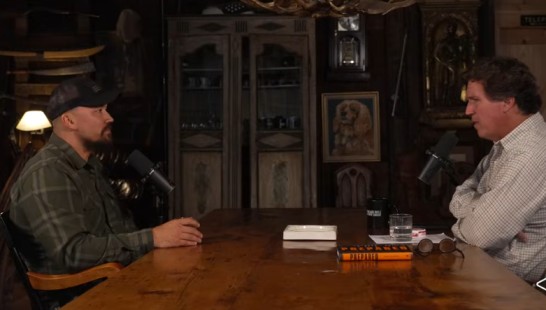
EDITOR’S NOTE: In this Tucker Carlson Show interview, former Green Beret and author Mike Glover discusses his book “Prepared” and warns that the growing tech-driven security and surveillance state, from Flock cameras to AI, is making Americans dependent on institutions and less resilient. He explains how to become more self-reliant, how the nervous system reacts under stress, and why balance and analog living matter. The two also talk about veterans and trauma, and about faith. This interview was premiered September 28, 2026.
TRANSCRIPT:
The Construction of a Surveillance State
TUCKER CARLSON: (00:00:04 – 00:00:07) Mike Glover, thank you for doing this. Congrats on the book.
MIKE GLOVER: (00:00:07 – 00:00:07) Thank you.
TUCKER CARLSON: (00:00:08 – 00:00:44) You made a point. Many people talk about preparedness, some probably not qualified to talk about it. I think you are. But you’ve made a point I’ve not heard anybody else make, and that is that we’re clearly witnessing the construction of a much more technologically advanced security and surveillance state in our country. That’s clear, but that we need to prepare ourselves in the face of that. And I’ve never heard anybody say that, and I think it’s a really interesting idea. And so I hope you’ll explain it in depth. But to begin, can you describe what’s being constructed now and what you think it means?
MIKE GLOVER: (00:00:45 – 00:04:12) Yeah, I think it has a lot to do with the incentives that are driving the entire apparatus, the institutions. All of them are built off of scale growth, all these metrics. And most of the institutions that are tethered to people have financial incentives and incentives to grow annually from October to October. And what I see happening, especially with a lot of the institutions, they exist in order to keep you tethered to them. So imagine, the analogy I use is the umbilical cord. Everybody is tethered to the umbilical cord. I mean, your water and your power, for example, are tethered to the system, the infrastructure of the city or town that you live in. If something collapses, there’s no contingency for anything independently to happen, right? Because the institution supposedly has a contingency plan. Well, what if they don’t?
The idea of firefighters and policemen, they patrol your neighborhoods because you pay taxes and you have buy-in, collective buy-in that they’re going to take care of you. But we understand from catastrophe that when seconds count, both of those first responders, including EMS professionals, are minutes away. They’re not going to be there in enough time. If it’s the self-defense shooting, if it’s the car accident, they’re really there picking up the pieces in many cases.
And so the idea for me is I want people to be self-reliant. I just want them to have independence. I have a well, for example. Not everybody could have a well in their backyard. I get that. But there are other elements to this where you can have independence. Protein from the grocery store. I mean, you go to the grocery store, you buy protein, it’s in a nice Styrofoam container with cellophane and pink gel. You have no idea where it came from. So I want you to insource your dependence and become more self-reliant.
Well, if you have an institution that by design, in the name of safety, for example, is surveilling you, they’re telling you, and now private companies are telling you through the subcontract, they’re telling you that “we’re going to make you safer, and so you don’t need to do anything.” And I actually just connected this thought because we were having breakfast and I was talking about it. I gave the analogy of walking to a bad guy’s house. In some cases, because of the technology integrated, I didn’t have to pull security. So I’m holding a rifle, using my infrared floodlight and laser to go around every single bush and tree because I’m thinking there’s something behind there. The aircraft above me that costs millions of dollars has a FLIR pod that could assess heat. And so there would be the case where it says, “Hey, there’s no need to pull security walking to the objective. We got you.” And then a guy is buried underneath foliage or a palm grove, and then he detonates a suicide vest and kills your whole team. Because you weren’t paying attention. So that’s the analogy that I say about this integration of tech. The more it grows, the larger it gets, the more reliant you are on that system, and the more your personal safety is actually compromised.
The Growth of Flock Cameras
TUCKER CARLSON: (00:04:13 – 00:04:40) So I think there are 2 insights in what you just said that hadn’t really occurred to me. One, it’s the nature of the system, like cancer, to grow. That’s encoded in the DNA of all of these systems, is growth. That’s the center of our kind of business model, national business model, scale. So Flock, for example, I did not even know where Flock existed until fairly recently. What’s the growth of Flock been like?
MIKE GLOVER: (00:04:41 – 00:07:50) Yeah, 2017, Flock camera, because it’s camera, it’s singular. It was just a camera for an HOA, a homeowners association. And the idea was, let’s build this camera. Let’s tether solar to it to keep it generated and see how this works. Well, here we are 9 years later in scale, and there’s not real good numbers because they don’t advertise the numbers. But the estimate today is there’s 120,000 Flock cameras across the United States. So the intention was, “Hey, this neighborhood watch wants to put out a camera because there’s some things going on with the HOA.” And then we scale it. 9 years later, it’s 120,000 with billions of reports every single month that take place with license plates and vehicles and descriptions, etc.
Now, if you look at that scale as it’s segmented, because other companies are getting smart, again, if I start a company, the point is to scale, to grow, to compete.
But the scale that I’m seeing now, for example, in California and Texas, is now there are camera systems operating, for example, looking for violations of code. So imagine you live in a neighborhood. Code violations, like you have an RV parked in your driveway and you’re not supposed to, right? By the way, if anybody’s tracking these stories, most of the code violations they’re finding are happening in impoverished areas where they don’t have an HOA that’s managing, pulling up in front of somebody’s driveway and saying, “Oh, you have an RV in your parking lot, that’s not allowed.” And the guy’s like, “Yeah, no problem, I’ll just move my RV.” Most of it’s not RVs, it’s damaged fences, it’s mailboxes that are ripped down because it’s all poor neighborhoods. So apparently they found thousands of code violations in a couple days, actually bragging about it. “We found all these code violations and now we can wrangle them in.” Okay, it wasn’t a problem before, but now you built the infrastructure to look at it and assess it. Now it’s a big problem.
TUCKER CARLSON: (00:07:50 – 00:07:52) You’ve created a lot more criminals.
MIKE GLOVER: (00:07:52 – 00:08:30) You’ve created a lot more criminals. And so the idea isn’t what’s happening now, because right now, yeah, there’s problems. In fact, I have a thesis or theory on what’s going to happen. But when you look at scale, Facebook was designed to be a social interactive way for college students to communicate with one another. Now they just settled a lawsuit for $14 billion for child exploitation. So where have we come in scale? Well, we didn’t know we were going to land at child exploitation when we were looking at integrating dorm rooms to be able to communicate with one another.
TUCKER CARLSON: (00:08:30 – 00:08:30) Exactly.
Vandalized Cameras and the Path to Rebellion
MIKE GLOVER: (00:08:30 – 00:08:58) So if we look at scale today and how things evolve, this year alone, 107 different reported situations, there’s probably more, where Flock cameras were damaged. And when you take 107, in some cases dozens of Flock cameras were damaged, vandalized. So there’s reports of this happening because people were upset.
TUCKER CARLSON: (00:08:58 – 00:08:59) Yeah.
MIKE GLOVER: (00:08:59 – 00:10:18) How does this evolve? Well, in my personal opinion, I think it evolves where we think about civil war. I don’t think there’s going to be a civil war against people because it’s not the people that are the problem. It’s the institutions and the relationship with people. And when people look at tech, it’s a bot. There is no victim. When I take down a Flock camera and destroy it with a baseball bat, there’s no victim. I’m doing good. And I’m not advocating for anybody to do this, to break the law. But what I’m saying is the scale of how this evolves is rebellion, because everything that’s being integrated before, like Facebook from 2004 to present, scaled. Except we don’t need 20 years of scale when you have AI acceleration.
And then the power, I think the benefit and one of the powers of social media of advancing information and disseminating across the globe, you see the potential of mass spikes in this graph whereby you’re going to have a lot of rebellion, insurgency like you’ve never seen it before, patriotism like you’ve never seen it before. Fighting the systems that are basically trying to take away humanity.
TUCKER CARLSON: (00:10:19 – 00:10:26) And you’re getting me really excited, Mike Glover, I have to say. Sorry, not that I’m endorsing any—
MIKE GLOVER: (00:10:26 – 00:10:29) That’s a thesis, a theory, my hypothesis.
TUCKER CARLSON: (00:10:29 – 00:10:37) This is best case, let’s just say, where all of a sudden the country unites, the people unite against the machines. How is that not utopia?
MIKE GLOVER: (00:10:38 – 00:10:38) They will.
Local Officials Ignoring the People
MIKE GLOVER: (00:11:33 – 00:13:11) I personally think that we’re years— it’s happening now, by the way. There’s pockets of resistance of people together doing things like, “Hey, where are the Flock cameras? Where are all the systems? Let’s surveil the people who are actually doing it.” And they’re not hurting people, right? They’re just demonstrating that this is wrong and they’re combating it because legislatively there is no solution. And that’s my biggest fear, by the way. Because I’ve never been a political guy. I could care less about what’s going on in the White House. Not because you shouldn’t pay attention to what’s happening policy-wise. You should. You should be informed. But my reality revolves around my family, my love of God, and my community.
The fear I have now is, for the first time in my life, I’m seeing in Utah, a great state to live in, one of my favorite states, because I live there. I love the people of Utah, but for the first time I’m seeing people in Box Elder County or people in Ogden Valley fighting against property tax, fighting against data centers. And the politicians that are elected in those positions aren’t listening. For 5 hours people protest and say, “We don’t want this,” and they’re members of the community that were elected by the people in that community. They’re not going to follow through with that. That’s my biggest fear, because I always tell people, you fight for your faith and your family and your community. I got a shirt that says “God, family, prepping,” in that order.
TUCKER CARLSON: (00:13:12 – 00:13:12) Yes.
MIKE GLOVER: (00:13:12 – 00:13:46) And so the fear is now institutionally, the federal government doesn’t have a lot of impact on your life. It can. I’m a veteran. I deal with the VA. It does. But the reality is the things that are going on in your backyard are more significant that you should be invested in. And for the first time, I’m seeing people combat, argue, legislate, and they’re getting crushed. I mean, Ogden Valley’s property tax went up 500%. That’s not nominal. That’s not a small number. That’s a big number for working families.
TUCKER CARLSON: (00:13:46 – 00:13:47) You’ll lose your house over that.
MIKE GLOVER: (00:13:47 – 00:13:51) You’ll lose your house over that. And so I’m seeing that.
TUCKER CARLSON: (00:13:51 – 00:14:00) So when people confronted local legislative, the city council or whomever runs it, the local officials, they just ignored them.
MIKE GLOVER: (00:14:01 – 00:16:25) Box Elder County is a good example. This data center that Kevin O’Leary got behind. The estimate is wild because it’s thousands of data centers, but there’s no real exact number. The estimate’s 4,000 to 5,000. So if we take data centers that exist, the one that exists, I forget what county, it’s in Utah, that Meta owns, they’re advancing that and making it very large. I think it’s millions of acres. It’s a massive build.
Box Elder County, they didn’t stop the project after all the outcry of support from the community and the entire state of Utah and really the country that was saying, “What are you guys doing?” They’re saying, “It’s in the middle of a field. There’s nothing there.” But the people of Utah don’t want that. So why are you doing it? And they continue to fight it. And I checked in yesterday on this project. I talk about it nearly every other week on my show, on my podcast, and it’s still going forward. And you’re wondering, how is that possible? Who are the people that are supporting this? Where are they at? Where are their voices at? And what is their justification? And then you find out there’s backdoor deals and a whole bunch of drama around it and bribery and everything else.
And so even for me in Heber City in Wasatch County, which I think is the best county in Utah where I live, I’m disconnected from that. But soon you may feel the same. You’re thinking, it doesn’t matter because it’s down the road or it’s across the state or it’s in another state. Eventually, because of the scale, the hyperscale of everything we’re doing, it could be in your backyard next week. That Flock camera that you talk about and you virtue signal about because you say, “Yeah, screw Flock cameras.” It might be at the intersection where you live pointed at your house because they do that. They point them at little girls’ gymnastics events, which the CEO is catching crap for, which he should. And then when it does populate, what are you going to do? Well, if you’re not prepared, you don’t have a plan, you’re not integrated in your community because you’re just checked out. Well, that’s a problem because all your self-reliance that you’ve outsourced so easily is going to be affected and impacted.
How Technology Weakens Us
TUCKER CARLSON: (00:16:26 – 00:16:41) So that’s the second insight that really struck me in your thesis, which is that technology is not simply a threat because of what it might do to you, what it might compel you to do or prevent you from doing. It’s a threat because it weakens you.
MIKE GLOVER: (00:16:42 – 00:16:42) Yes.
TUCKER CARLSON: (00:16:42 – 00:17:06) Because you become reliant on it. It’s the Google Maps program. And you just use that for 10 years and see if you know where you are. And I mentioned this to you before. We were talking about this at breakfast, and you had the greatest line ever. You said, after using Google Maps, you’ll just follow the line they give you onto a sidewalk. You’ll drive through a shopping mall because you’re just following it.
MIKE GLOVER: (00:17:06 – 00:20:23) It says there’s the line there, and it’s true. If you think about it from this perspective, my experience is obviously the military. I was in special operations and I was a sniper at one point when I was a team sergeant, had a team full of rock stars, right? And they were all independently schooled in sniper operations. They had to go to the Special Forces sniper course, which used to be called SOTIC, Special Operations Target Interdiction Course. Delta snipers, Special Forces snipers, Ranger snipers, in some cases, go to this schoolhouse to be qualified. All my guys were qualified, meaning they were very competent in sniper operations. They knew how to use a sniper weapon system.
At one point, for some reason, and likely it came top down, I was told, “Hey, we want to put a camera in your optic.” And I said, “For what? Why do you want a camera in the optic?” “Oh, we want to be able to see it. There’s this technology and it integrates into the tactical operations center and we could see it.” And I’m thinking, yeah, but I’m on comms. So if you think you’re going to micromanage my snipers through a camera with communications, there’s latency there. And one, it’s no, but two, I don’t want this to ever happen. I don’t want my sniper to second guess his actions because he’s being viewed through a viewfinder. And because you don’t like something you see, you try to communicate. Let’s not do that. That latency will get my sniper killed. Let’s not do that. And then it never happened. But that’s an example of how this integration always works.
Here’s a great example. The healthcare system, right? The healthcare system buy-in is that if you want to get through a difficult circumstance, a bacterial infection, a stomachache that requires, I don’t know, penicillin, you have to go through a process, an entire system. So our grandmothers, our fathers might have taught us about holistic medicine, like independency. That’s what it was, actually. Holistic medicine was just a requirement because it was life 100 years ago. You had to be resilient because it was just life, right? There was no pharma. There was no big pharma. There was no big healthcare systems. You had to take care of yourself and your family. You had to figure it out.
So when you look at, for example, the healthcare system. I actually just heard this last night flying here. The 3rd leading cause of death, according to this podcast between Huberman and Rogan, which is a great podcast, by the way, dropped yesterday. That podcast, they talked about a number of how many people died because of medical malpractice. In one year, 251,000 people, according to Americans. Americans.
TUCKER CARLSON: (00:20:23 – 00:20:26) A quarter million Americans died in one year because of—
MIKE GLOVER: (00:20:26 – 00:20:38) A quarter million Americans, according to, again, you guys can look this up, according to the statistic they pulled up by Johns Hopkins. And I’m thinking, okay. And then I was asking the question in my head, where does that rank in leading causes of death?
TUCKER CARLSON: (00:20:38 – 00:20:40) But that’s a city.
The Failure of Institutions
MIKE GLOVER: (00:20:40 – 00:22:23) That’s a city. That’s top 3. That’s actually the 3rd leading cause of death if it was actually reported. But it’s not reported because Johns Hopkins had to do the independent survey to look at the statistics. But if you integrate it, it’s right behind cardiovascular, or basically any cardiovascular disease, which is the main killer in America, and cancer. I think lower respiratory disease would be in the 3rd place slot if it wasn’t for 250,000-plus people dying because of medical malpractice, which is wild, right?
So think about the efficiency of the systems we depend on. If you knew that you went into a hospital late at night and they talked about this, they articulated this, when a doctor has been on shift for 12 hours, he’s technically drunk when he’s on shift for 12 hours. I mean, you can’t drive in some cases because you’re so impaired. So he’s making life or death decisions, and 251,000 people apparently die every year because of it. So again, the institution is meant to protect you in the name of safety, national security, whatever it may be. But the reality is, because institutions— which I like this idea— men are sinners. Every man is a sinner. We all fall short. When you align that into an institution, according to the Bible, the institution is for good. You’re supposed to have it for good. The government is for good. But I don’t think institutions are evil. I think people are inherently flawed, and I have no other expectation that they’re not. And then eventually the truth reveals itself.
TUCKER CARLSON: (00:22:23 – 00:22:24) Yes.
MIKE GLOVER: (00:22:24 – 00:23:23) So all these institutions that we hope the best for, many of my good friends say, “Hope is not a course of action.” Eventually the truth reveals itself and they’re broken. Now, the problem is, what do we do with broken systems? That’s another question. But the reality is, the dependency you have on these systems across every single facet of the umbilical cord connected is failing. So maybe the better analogy is the umbilical cord is connected to the mom who just started smoking crack. And if you want to prolong this, yeah, we know what that looks like. We know the outcome. So you need to cut the umbilical cord and you need to start insourcing your own reliance in order to survive. And I say that and I mean it. I mean survive because more of your dependency, where people go, “Well, Mike, you just call 911.” Yeah, but you’d be dead. “Yeah, but what else would I do?” Oh, that’s where our conversation on preparedness starts.
TUCKER CARLSON: (00:23:23 – 00:23:39) I feel like we should have learned this during COVID. We probably should have learned it during Hurricane Katrina, 21 years ago. A natural disaster occurs in a major American city and the people whose job it is to help you just melt away because they’ve got their own family problems.
MIKE GLOVER: (00:23:40 – 00:23:40) Yeah.
TUCKER CARLSON: (00:23:40 – 00:25:17) So, but anyway, certainly COVID, where if you followed the official guidance, your chance of dying went up, obviously, or of permanent injury went up. So we’re now on the cusp of technological change. The one thing we know about it, it’s going to empower those systems. Going to give them more control than they currently have. So what do you do? How do you prepare? How do you become more self-reliant in the face of that?
Starting the Plan to Disconnect
MIKE GLOVER: (00:25:18 – 00:25:50) Well, I think the easiest way to start it is have a conversation with your family, the ones you love, and actually circumnavigate a deliberate, intentional plan to disconnect. And look, I started teaching modern survival. I’m not a primitive survival expert. I joke about it. I’m not going to teach you to survive when you’re naked and afraid in the woods, because if you’re naked and afraid in the woods, you’ve made a lot of mistakes, right? You’ve screwed up.
TUCKER CARLSON: (00:25:50 – 00:25:52) Why are you naked in the woods? That’s a totally fair question, Mike.
MIKE GLOVER: (00:25:52 – 00:26:00) Yeah. So everybody thinks survival is the Naked and Afraid show and all these things. Survival for me is the modern take on it.
TUCKER CARLSON: (00:26:00 – 00:26:02) Well, if you’re naked in the woods alone, it’s also weird.
MIKE GLOVER: (00:26:02 – 00:26:03) It’s also weird.
TUCKER CARLSON: (00:26:03 – 00:26:03) Yeah.
MIKE GLOVER: (00:26:03 – 00:27:54) There’s a lot of things that can get you. And so I look at that and I go, a modern survival take on this is you need to look at all the institutions you’re tethered to and figure out ways to start segmenting yourself away from them and building your dependency. It’s why I advocate, for example, for homeschool. My kids right now are in a great school in the public education system in Utah for elementary school. But when they get through the basics of arithmetic and everything else and they’re advancing into social studies, I don’t want them learning about things that I don’t want them learning about. So I’d like to homeschool them.
We talked about protein. If you don’t insource your protein and there’s any infrastructure threats whatsoever, which there are all the time. I mean, diesel’s higher than it’s ever been. The infrastructure could have one impact or catastrophe and the entire apparatus shuts down. I talk about this every week on Survival Dispatch with a group of guys who are experts at this, and the general consensus is that one little thing can affect the outcome of all the things that you’re tethered to. So the Walmart down the road has a couple weeks of supply. What happens when everybody goes? We learned this from COVID and gets everything off the shelf. It’s empty. What happens if the truck that’s driving down, they strike, the war in Iran accelerates and that entire apparatus gets cut off? Then you don’t have any food. If you don’t hunt, if you don’t know how to hunt, if you’ve never gone fishing, if you haven’t insourced anything, maybe it’s a good time to sit down and have the conversation with your family and just start there with some basics. It’s not that complicated.
TUCKER CARLSON: (00:27:55 – 00:28:16) You mentioned homeschooling at first, so that’s a much more complex system than, say, getting protein. You could stockpile conceivably a year’s worth of protein in your garage. It’s not that hard. You could buy it on Amazon. But you’re thinking about separating yourself from a pretty basic system, like education, public education.
MIKE GLOVER: (00:28:16 – 00:30:08) Yeah, public education is an easy one because we know all the drama that’s happened over the last few years, especially with COVID. Even with COVID California, they destroyed these kids, likely long term, because they kept them out of schools and social settings and kept them isolated. I mean, basically putting your children in solitary, actually putting somebody else’s children in a solitary environment. And we know that that’s having long-term effects. Our public education system is garbage. It’s disgusting. I’m proud of Utah’s public education system because I’m integrated. I have conversations with the principals of these schools. I talk and walk them through their security plan. I want to know because I don’t want my children to be in Uvalde. Another reason why it aggravates me that we have this dependency when parents are trying to get into the school to save their kids and you’re keeping them out because you’re going to contain the area and just let these kids die.
So the school system is a bigger problem. But when I look at all the elements, for me, it starts with security, because security is very intimately a part of my military experience and something I was taught as a 17-year-old infantryman. You never violate security. It’s one of the principles of patrolling. And when I think about security, how many people are secure? The majority of people are not secure. Meaning, how many people know what to do when somebody kicks in their door in the middle of the night? What do you do when somebody comes up to you and threatens you with a gun? What do you say? What are your actions? How do you manage that stress? What happens after the fact? These are all questions that are potentially part of the worst part of life, the catastrophe in life, right? But we never look at them.
TUCKER CARLSON: (00:30:08 – 00:31:23) So let’s get specific about it. So you’ve been, because of your job, in a lot of places that were totally consumed by chaos.
MIKE GLOVER: (00:31:25 – 00:31:25) Obviously.
TUCKER CARLSON: (00:31:25 – 00:32:02) I don’t know how many combat tours you did, but a lot. Total chaos. But most of those places, I would bet, are calmer now because people can’t live in chaos forever. So food supplies are disrupted, for example, and some people obviously are hurt by that, but over time they regrow. The threat, it seems to me, is the initial spasm of chaos. So what do you do? So you’re at your house and there’s an EMP and there’s no more electronic communications. Do you stay in place? What is the actual protocol for the moment of crisis?
Lessons from the Virginia Tech Shooting
MIKE GLOVER: (00:32:03 – 00:32:15) It’s a real good question. And let me back up, I’ll walk you through this, but I’m going to back you up to a case study and an understanding of how this works. Virginia Tech, 2007.
TUCKER CARLSON: (00:32:15 – 00:32:18) I was there. I was physically there when it happened. Yeah.
MIKE GLOVER: (00:32:18 – 00:32:19) Did you do the reporting on it?
TUCKER CARLSON: (00:32:19 – 00:32:20) I did.
MIKE GLOVER: (00:32:20 – 00:32:22) Yeah. Tragic circumstance.
TUCKER CARLSON: (00:32:22 – 00:32:23) Unbelievable.
MIKE GLOVER: (00:32:23 – 00:32:44) This guy walks into this hall, it’s basically dorm rooms, kills 2 people. He leaves that place. And this is fascinating because of a massive error by Virginia Tech. 2 hours later, he goes into another building that has school still in session.
TUCKER CARLSON: (00:32:44 – 00:32:45) Yeah.
MIKE GLOVER: (00:32:45 – 00:35:39) And it’s obvious that they should have locked down and shut down the school. They did not. So he goes into this building and class is in session, and he locks and chains the doors behind him. And he goes from room to room killing every single student and faculty member he comes across. In some rooms he goes through, the percentage of people who were shot in the head, for example, was above 90%. The overwhelming majority of them were basically assassinated, killed in place.
The acronym for an active shooting is “run, hide, fight.” There’s many problems with that acronym, including the idea of where are you running? Maybe assess the information or the situation. I would hate for you to lock yourself down in a building that’s a mile away from where the shooting is taking place on the same campus, by the way, because campuses could be that large. So you just lock yourself down, run and hide into a closet a mile away from this while something’s happening, when you could have just run an extra 100 feet to the parking lot and got in your car and drove away anyways. So most of them died underneath their desk. And part of the problem was the protocols. Many students had no plan. They didn’t know what to do. And so they shut the doors and then barricaded them because they, in some cases, couldn’t even lock the doors. He just went in and shot up the door and then opened the door and forced his way in and then killed many people in those rooms. 32 people before, afterwards he took his own life.
When we look at that circumstance, there’s an interesting thing that happened that’s noted in Amanda Ripley. She wrote a book called Unthinkable, I believe it was called. Really good book. And she talks about this one student underneath the desk who thought he was shot. He reflects about this, that when the shooter came in, he was so scared he didn’t know what to do. He froze, and he thought to himself, “I’m going to pretend I’m dead.” And so he did. And then he thinks he was bypassed. And then everyone in that classroom subsequently was shot. Many died and a couple survived. At the end of it, when it was time to move, he couldn’t move. He physically could not move his body. And he thought to himself, “I was shot. I just don’t remember or know when it happened.” And the point of that is he wasn’t shot. And what we often don’t assess in these type of scenarios is how the nervous system operates.
TUCKER CARLSON: (00:35:39 – 00:35:40) Yes.
Fight or Flight and Tonic Immobility
MIKE GLOVER: (00:35:40 – 00:35:45) There’s something called hyperarousal. I’m actually writing a book about this for my second book.
TUCKER CARLSON: (00:35:46 – 00:35:47) A book about hyperarousal?
MIKE GLOVER: (00:35:48 – 00:36:25) Not that type of hyperarousal, but fight or flight. It’s got a really bad rap. There’s a stigma associated with it because you don’t want to go into fight or flight because it’s bad. Everybody potentially will go into fight or flight. I did in Afghanistan, my first gunfight, because it actually wasn’t a gunfight. It was 107mm rockets, and nobody prepared me for that. A freight train impacting the earth with a large kill radius that was super loud and scary and everybody’s going to die. And I have to work through that. I wasn’t calm and conditioned for it because it wasn’t the gunfight in the woods like I was trained at Fort Bragg, North Carolina.
TUCKER CARLSON: (00:36:25 – 00:36:26) Yeah, exactly.
MIKE GLOVER: (00:36:26 – 00:37:24) And so he was hypoaroused, which is the opposite of hyperaroused, right? He was underaroused. Why did that happen? Well, some people call it the faint or fawn response. It’s actually called tonic immobility. And tonic immobility, in the process of maybe spiking adrenaline and cortisol, norepinephrine, “I’m so scared. Oh, my gosh.” And then everything locks up. Hypervigilant, hyperfocus. Blood shunting to large muscle groups. I’m prepared to fight or flight, but in this, it’s the lull after the spike whereby I’m immobilized. And the tactic biologically, or a lot of scientists discuss, is that if you are prey and you’re getting preyed upon and you know you’re going to die, a last-ditch effort is to collapse in place.
TUCKER CARLSON: (00:37:24 – 00:37:26) Maybe. I have seen animals do this.
MIKE GLOVER: (00:37:26 – 00:41:29) Yeah, maybe signaling to the predator that you’re sick, tainted, or maybe even dead. And then a lot of predators feed off mobility, off of movement. My son’s lizard, if I have a worm that’s dead and I say, “Here, eat this worm,” he’s just like, “Don’t think so.” But if it’s squirming, he’s like, “Oh, that’s the trigger,” right? So tonic immobility is what he went through. Well, what they don’t tell you about tonic immobility is that it’s a button. And once the button’s pushed, natural opiates dump into your body. And so the feeling of him being sedated and “I can’t move,” it wasn’t because of fear. Fear might be the initiation device. It was because of the process of tonic immobility.
Women who are, and men could be in the category too, that are sexually assaulted, often just talk about the idea that they were frozen in place. They couldn’t do anything about it, and they felt like they were sedated. “I wanted to fight, but I couldn’t fight, and I feel guilty for it.” You couldn’t fight it. Your actual biological ancestral system was designed to flip the switch for you to survive, to play dead. So it’s not your fault, number one. Number two, that’s how the process works. The whole point of that is the button in us exists. And so if we don’t understand and we can’t manage stress and understanding of how disaster works, because disaster is just an amplified version of stress. It’s just stress in a cloud that’s suppressing our abilities, right? If we don’t operate and condition ourselves for that, then we’re not prepared for any catastrophe.
Because the first indication that something’s potentially happening or going wrong, by intuition, by your senses, by your vagus nerve that’s detecting the world around you, your palms might sweat and you might go, “Oh, I feel nervous, something’s wrong.” But our intuition is, “Whatever, doesn’t matter.” And then you see the rock falling down the hillside and you’re thinking, “Oh, that’s crazy. Let me pull out my cell phone and record it.” We’re losing our natural instincts and our intuition, and we’re tethered, again, to the cell phone and technology that we think is going to bail us out. And it’s not. The reality is it’s not. And so the reason for the montage is before we could understand what to do in catastrophe, we need to understand ourselves.
Lastly, think about your baseline. What is your baseline for reacting to everyday stress? Not the catastrophe, but everyday stress, things you deal with. Most Americans’ baseline, because of social media, because of the cell phone, because of their obsessions with Lindsay Clancy and all the things that are going on in the world, is our baseline has now changed. So whereby a primitive reaction in fight or flight would be to fight the predator to survive, we’re now bashing our heads against the steering wheel, willing to get in a gunfight with another citizen of our town because they cut us off. Are the dishes in the sink triggering us? The way our kids talk to us, what they’re doing, trigger us. And so our baseline to manage stress overall is already affected and flawed. So how are we going to manage a catastrophe?
And I’ve seen it. I’ve been a first responder at the scene of accidents, and I’ve seen people completely check out and just drive by. There’s a guy flipped upside down, he’s hanging outside the vehicle, there’s smoke under the hood, and you just drive by because you got places to go. “I got things to do, man.” And then you don’t even care about your fellow citizen. And so we don’t have a good understanding and baseline of our normal everyday life because it’s overwhelming to us.
TUCKER CARLSON: (00:41:29 – 00:41:29) Right.
MIKE GLOVER: (00:41:30 – 00:41:31) So how are we going to contend?
TUCKER CARLSON: (00:41:31 – 00:41:39) So we’re dulled, in other words, by the adrenaline-spiking images that we’re inundated with all day.
Managing Stress and the “Decision Point” Course
MIKE GLOVER: (00:41:40 – 00:42:31) Exactly. The baseline that we have, the foundation of where we should be operating, whereby you’re parasympathetic, you’re rest and digest, you’re just hanging out. Most of us are living anxious. Most of us are living in a sympathetic nervous response with a reptile brain. I tell people in these preparedness seminars, have you ever come to terms with your spouse in an argument? And the answer is no, because your nervous system is overreacting. You have cortisol on board, the stress hormone. Your adrenaline is surging every time you hear something you don’t like, and you’re not even in the capacity to be able to manage reasonable, logical decision-making.
TUCKER CARLSON: (00:42:31 – 00:43:52) Wait, you’ve asked people, married people, you’ve never come to terms with your— never resolved an argument?
MIKE GLOVER: (00:43:52 – 00:45:12) You never resolved an argument when you’re elevated. When your central nervous system is spiked because it thinks it’s in a fight, when you walk away, which is the best tactic, and you breathe and your nervous system calms down, and then you come back, then the parasympathetic component, the cognition of your brain, the decision-making of your brain is actually able to make a logical and reasonable decision to communicate. I teach a course called Decision Point where one of the things I do is I scream at the person right in front of me. And often it’s women. Women actually have a decibel range in their registry that if spiked, they’ll go into fight or flight immediately. So for men, it’s not the same. If you see men reacting to drill sergeants in basic training. Having graduated basic training at 17 years old at Fort Benning, no problem with guys screaming in my face. But a woman, once that decibel range spikes, once the red line is hit, immediately cortisol is dumped, adrenaline surges, and then they’re in reptile brain. They’re in sympathetic nervous response. They think they’re fighting for their—
TUCKER CARLSON: (00:45:12 – 00:45:13) What does that look like?
MIKE GLOVER: (00:45:13 – 00:45:26) Well, typically it looks like a lot of hyperfocus. Cognition shuts down because it disconnects from the brain. Look, the brain is a liability to survival primitively.
TUCKER CARLSON: (00:45:26 – 00:45:26) Of course.
MIKE GLOVER: (00:45:27 – 00:46:12) Right. But now we have, again, this tethering of all of these institutions. For example, one of the first things that you should likely do in a situation, outside of fighting in the circumstance, is reach out to 911, right? Call 911, get EMS rolling, right? We want them rolling en route. And not even stressful situations, fender benders. People can’t even talk to the police. It’s true. They can’t communicate basic information because they’re so surged with that. So ultimately what I tell people is if you can’t balance the things in your everyday life, because you can’t manage the stress, you’re going to have a hard time managing the gunfight, the catastrophe.
TUCKER CARLSON: (00:46:12 – 00:46:23) Yes, yes. Just to go back to something you just said, when you scream at women, you get close to them and scream, what are they— do they slap you? Do they seem paralyzed? How do they respond?
MIKE GLOVER: (00:46:23 – 00:46:47) Varying responses. And I do this obviously formally in classes. One of the points of Decision Point is we focus so much on the self-defense act, the drawing of the gun and the act. Too much emphasis, because there are many steps, including recognizing the go/no-go criteria for what my decision-making is to use deadly force.
TUCKER CARLSON: (00:46:47 – 00:46:47) Right.
MIKE GLOVER: (00:46:48 – 00:48:51) I need that kind of understanding. I need that OODA loop of understanding of how I’m going to assess this information. And so what I tell people is, it’s a 70-degree day. You’re shooting on a flat range, no obstacles. It’s a beautiful day. You’re creating a hole with your bullets on the target. You’re shooting the bullet through the hole you created, congratulations. That’s not at all how a gunfight works. That’s not combat. That’s not catastrophe.
So when I scream at the person, I’m eliciting their neurological response to me screaming. In some cases, I’ll tell you about this lady who came in my class. If I run an all-women’s class, you’ll get the majority of the women that are in that class wanting to go through the training to empower themselves, which I applaud them for, for sure. Because men just show up because they want to take a picture with Mike Glover and hashtag “shoot better than Mike,” whatever it is, cool guy stuff, right? But women go there because they actually want to repair something that potentially was broken or they saw something happen. And I didn’t realize this until after this experience.
One of my scenarios had to do with ATM machines. So the disadvantage of an ATM machine, especially at night, is you’re blinding yourself with the ATM LCD display, and then you’re in darkness, your back’s completely exploitable, and you’re taking money out. And if the bad guy’s going to get you, he’s going to get you in that moment where you’re staring at a machine trying to get money, which you should never do in the middle of the night and in a bad area, right? It happens, though, that if you look at ATM thefts, that’s typically how it happens. The majority, by the way, of bad guy engagement, anything happens at night. It doesn’t happen in daytime, but we train 99% in the daytime. But that’s another thing. So in the scenario, I walk up behind her with a Simunition pistol. So it’s a pistol that shoots basically a piece of plastic.
TUCKER CARLSON: (00:48:51 – 00:48:52) Right.
MIKE GLOVER: (00:48:52 – 00:51:25) It hurts, but it obviously doesn’t injure you or kill you. And you have to wear protective equipment. I walk up to her and she’s staring at an iPad that’s simulating an ATM, and I shove the gun in her back and I tell her some expletives that I would never communicate to anybody and act like a bad guy. But I do so yelling at her and telling her I’m going to hurt her. And immediately she breaks down into the fetal position and starts crying because I triggered her trauma.
And often, and we talked about this a little bit, especially as it relates to psilocybin and some of the things, when you have trauma and it’s in you, it’s dormant, and there is a trigger device attached to that. Imagine your trauma is like a bundle of TNT, not C4, because that’s more stable. Wet TNT. There’s an initiation device, maybe a plunger, because that’s a good analogy. And if you’re not managing or conditioning or understanding that trauma, that trauma could be the liability that’s on standby when catastrophe strikes. And so at the moment, at the precipice of decision point where you say, “I got a plan because I talked about it, rehearsed it in my head, and I’m going to do all this cool guy stuff.” And then the trigger is met. You have no option. It’s plunged and then it blows up. And then that switch we talked about, the button, the tonic immobility, that’s what happened to her.
And so I picked her up and I turned on the lights and all the women there were in shock. And I had never seen anything like this before. I’m learning about this as I go, almost doing studies on people and taking data points in my head, at least. And I take a step back and I pick her up and I’m wondering, why did this happen? She told me she had been a victim of assault in a similar scenario with a pistol, feeling helpless, likely in a state of hypoarousal. And so I walked her through it. I coached her. We trained. She built the confidence, and we did the same exact drill, just a walkthrough version of it. And she pulled the pistol out of her waistband, and she shot me in the stomach with protective equipment on. And afterwards, she said when she broke those shots, it was— you ever had the dream where you have the gun and you pull the trigger and nothing happens?
TUCKER CARLSON: (00:51:25 – 00:51:26) Oh, yeah.
MIKE GLOVER: (00:51:26 – 00:52:07) Or you go to punch, and then you’re punching the person, and it’s not having an impact or effect. She said she was stuck in that loop for years, and then when she pulled the trigger and was able to break the shot in my stomach, it released something. But the reality is she was just conditioning herself out of trauma for conditioned stress to be able to work through it. And I know that’s a long-winded version of it, but the reality is we focus in preparedness on technical capability, for sure. That’s the easy part, that you earn those reps on your own, work through that on your own. You got that. The hardest part is understanding the infrastructure behind it.
AI, Complacency and the Need for Friction
TUCKER CARLSON: (00:52:07 – 00:53:22) People are paralyzed by the stress of an unexpected emergency.
MIKE GLOVER: (00:53:22 – 00:53:22) Yeah.
TUCKER CARLSON: (00:53:22 – 00:53:30) I think anyone who’s ever been in a situation like that is amazed by just the physiological response to it. You can’t talk, you can’t move.
MIKE GLOVER: (00:53:30 – 00:53:33) Yeah. And it doesn’t have to be the gunfight.
TUCKER CARLSON: (00:53:33 – 00:53:33) No.
MIKE GLOVER: (00:53:33 – 00:53:38) It could be somebody calls you and tells you your family member was diagnosed with cancer.
TUCKER CARLSON: (00:53:38 – 00:53:48) Yeah. Or you get in a car crash or whatever. But I think everyone has had an experience like that. So you think technology leaves us less prepared for moments like that?
MIKE GLOVER: (00:53:49 – 00:53:55) Less resilient overall. As a nation, there’s many reasons why we’re not resilient, but less resilient overall.
TUCKER CARLSON: (00:53:56 – 00:53:59) How does AI affect this picture?
MIKE GLOVER: (00:53:59 – 00:55:32) It wants to automate everything. And so if you look at the AI integration, the biggest risk by experts, not me, by experts, is that it makes us not want to use our brains. And the default. So the analysis from an AI expert is the everyday mathing and statistics and the things that we do, but we’re not considering catastrophe or contingency, right? So in a perfect world, AI is basically setting us up for failure because we become lazy, right? But what happens if we become lazy and part of the foreign adversary analysis is we’re exploitable. “Oh, we’re complacent. More complacent than we have ever been.” And the idea that foreign adversaries aren’t investing in making us more complacent, that’s been proven that they did that. They’ve been doing that forever. Spy games decades ago, now integrating into every single facet of social media to do it. And they’re playing the long game. I mean, China has a 5,000-year plan. We’re living day to day, just getting by depending on everybody else’s manufacturing and origin story and process. And so that’s the problem with AI integration. It’s not what it does to us by making us lazy. It’s what happens when we’re lazy, complacent, and completely exploitable.
TUCKER CARLSON: (00:55:32 – 00:55:34) Then you’re vulnerable. Of course.
MIKE GLOVER: (00:55:34 – 00:55:34) We’re completely vulnerable.
TUCKER CARLSON: (00:55:34 – 00:55:50) But also, indolence is bad. Luxury is poison over time. If you stay in bed all day, you get bedsores. You need resistance to stay human, don’t you?
MIKE GLOVER: (00:55:50 – 00:55:51) You need friction.
TUCKER CARLSON: (00:55:51 – 00:55:52) Right.
MIKE GLOVER: (00:55:52 – 00:56:16) The most often question that I get is typically built around resilience and how can I become more resilient. And I had the luxury, and it was a luxury because I volunteered for it all. I was an infantryman. I went to Ranger training, airborne training, Green Beret training. I was a guard at the— I don’t know if you knew this. I was a guard at the Tomb of the Unknown Soldier.
TUCKER CARLSON: (00:56:17 – 00:56:17) Really?
MIKE GLOVER: (00:56:17 – 00:56:18) Yeah.
TUCKER CARLSON: (00:56:19 – 00:56:20) Must be a very handsome man for that job.
MIKE GLOVER: (00:56:21 – 00:56:26) I was handsome, minus the beard. Because I do think all the guys look squared away at that.
TUCKER CARLSON: (00:56:26 – 00:56:26) Yeah.
MIKE GLOVER: (00:56:28 – 00:57:31) I was squared away at some point and I did that. And the nature of my job and my duties and responsibilities were difficult. And so everything I went through, I was voluntold that you’re going to do, and it builds resilience. And there’s something magical that happens in a lot of my peer group, the Andy Stumpfs, the Evan Hafers, the Jockos, Sean Ryan talks about it, if you want to build resilience, you do hard things, right? When you do hard things, there’s something that happens, though. And I actually think there’s a gene for this. It’s a mechanism of survival for sure, over time. If me and you are sitting here comfortably in this beautiful place, if it wasn’t for the sacrifice of all the men and women that bred our DNA before us, we wouldn’t be here living in luxury.
TUCKER CARLSON: (00:57:31 – 00:57:32) Yes.
MIKE GLOVER: (00:57:32 – 00:57:38) It’s because of their resilience, adversity, fighting through the most difficult of times.
TUCKER CARLSON: (00:57:38 – 00:57:41) A teenage girl gave birth in a cave during a snowstorm to make this possible.
MIKE GLOVER: (00:57:41 – 00:57:42) 100%.
TUCKER CARLSON: (00:57:42 – 00:57:43) Yeah, a lot of them.
MIKE GLOVER: (00:57:44 – 00:57:56) And we won the life lotto because we’re born in America. And we have this amazing opportunity and we’re here when the majority of the world does not have that.
TUCKER CARLSON: (00:57:56 – 00:57:56) Right.
MIKE GLOVER: (00:57:57 – 00:58:22) And so if you backwards assess it, it’s because of the resilience that was built over time. And what happens magically when you actually execute on these, I think, natural desires, my sons are warriors. I didn’t teach them to be warriors. They pick up sticks and start fighting each other like they’re Spartans.
TUCKER CARLSON: (00:58:22 – 00:58:23) Yeah.
MIKE GLOVER: (00:58:23 – 00:59:10) And it’s ingrained in them. I didn’t say, “Hey, do this.” My beautiful son Leland, Leland is such a beautiful name. My daughter’s name is Isla. And then I’ve been in Penelope. But Leland, for his 3rd birthday last weekend, I bought him a Spider-Man piñata. Which is awesome. It’s got a big Spider-Man head, upper torso, and he doesn’t know what it is. It’s part of a body of Spider-Man, his favorite character. I said, “No, there’s candy in it.” He said, “Okay.” And I hand him a stick. Never seen a piñata in his life. And he walks over to Spider-Man without prompting and knocks the head off it like he’s a professional baseball player. And then he just shoves his hand in the neck of the Spider-Man head that he just knocked off. He shoves his hand in the neck and pulls out candy.
TUCKER CARLSON: (00:59:10 – 00:59:12) And you never told him to decapitate Spider-Man?
MIKE GLOVER: (00:59:12 – 00:59:18) Never told him to. He didn’t know anything about it. And he literally naturally looked at it and went, “Okay.”
TUCKER CARLSON: (00:59:18 – 00:59:20) He beheaded on instinct.
MIKE GLOVER: (00:59:20 – 00:59:29) He beheaded on instinct, stuck his little, his actually fat little hand inside of the neck and pulled out candy and started grubbing.
TUCKER CARLSON: (00:59:30 – 00:59:31) That’s so great.
MIKE GLOVER: (00:59:31 – 00:59:49) And it’s in us. It’s ingrained. And so when you start doing difficult things, you start wanting to do more of that. And I love that. When I go camping with my kids, they love it. I love it. And it’s uncomfortable. But when they get settled in comfort, they have a desire to go back into being uncomfortable.
TUCKER CARLSON: (00:59:49 – 00:59:53) 100%. I go camping every week, actually.
MIKE GLOVER: (00:59:53 – 00:59:53) Same.
TUCKER CARLSON: (00:59:54 – 01:00:11) Every week. Every off going Thursday afternoon. Yes. And for exactly that same reason, alone with my dogs, because it’s so deeply atavistically satisfying. There’s something hard to describe, but that is really important, that roots you.
MIKE GLOVER: (01:00:12 – 01:00:14) Yeah. And think about where AI technology—
TUCKER CARLSON: (01:00:14 – 01:00:16) It’s the opposite of that.
MIKE GLOVER: (01:00:16 – 01:00:17) Yeah.
TUCKER CARLSON: (01:00:17 – 01:00:19) It’s French toast in bed forever.
MIKE GLOVER: (01:00:19 – 01:00:54) Forever. We’re more satisfied with the alternate reality we’re creating online than we are the reality that we live in our daily lives. And everybody’s paying the price for it. Our relationships, our relationship with God. Our relationship with our children, and we’re completely disconnecting. And we talk about it on podcasts, but nobody actually has the discipline to live it and to actually create parameters that are going to fix and maintain or retain some balance in your life.
TUCKER CARLSON: (01:00:54 – 01:00:57) I do think it leads to grave unhappiness, too.
MIKE GLOVER: (01:00:58 – 01:01:00) Yeah, I get that.
TUCKER CARLSON: (01:01:00 – 01:01:19) I don’t think I’m imagining that. Not having enough hard work, not having the ability to do things for yourself, lacking self-reliance, being served luxury, basically living in the Ottoman harem makes you suicidal after a while.
MIKE GLOVER: (01:01:21 – 01:01:24) Lindsay Clancy popped in my head because she was privileged.
TUCKER CARLSON: (01:01:25 – 01:01:25) Yeah.
MIKE GLOVER: (01:01:26 – 01:01:37) She had a nanny. She had a beautiful home. A seemingly loving situation with her family. And for her, it was the worst case scenario.
TUCKER CARLSON: (01:01:38 – 01:01:42) What’s the suicide rate in rural Central Africa versus the suicide rate in Greenwich?
MIKE GLOVER: (01:01:42 – 01:01:42) It’s zero.
TUCKER CARLSON: (01:01:43 – 01:01:45) Exactly. It’s literally zero.
MIKE GLOVER: (01:01:45 – 01:01:57) And so when you look at that type of scenario where we’re at, wow, when we have it so good, we’re the most unhappy we’ve ever been in human history.
TUCKER CARLSON: (01:01:57 – 01:02:26) Exactly. That’s exactly right. So why? But now we’re hearing from the heads of these companies, most of whom I know personally. I don’t know that any of them you’d say is evil, even though I think they’re doing evil, but they don’t seem evil personally to me. They love their children and all that, but their promise is more ease. No one’s going to have to work. Everyone’s going to be rich. I don’t believe that, but even if it were true, would you want that?
MIKE GLOVER: (01:02:26 – 01:03:10) Every promise of every institution as a model of how business works in the first place is to create an easier, fix the problem, right? What’s the problem? This is the problem. We have a fix for it, and we’re going to build optimization and efficiency in your life because of our service or our product. And the problem with that is every metric of friction, as we described it, of resistance that moves us as human beings is now going to be compromised. And so we need the friction, we need the resistance, and now we’re manufacturing it. Cold plunge, hot sauna. I run on a treadmill in a climate-controlled room.
TUCKER CARLSON: (01:03:10 – 01:03:11) So right.
MIKE GLOVER: (01:03:11 – 01:03:23) And so all of that resistance that we could really want and have adapted to over time through evolution exists outside for the most part, right? In remote areas of the world.
TUCKER CARLSON: (01:03:23 – 01:03:54) But this seems like a solution to a problem that doesn’t exist. So basically they’re saying Americans just do too much for themselves. They face too many— I don’t know who they’re speaking to. Not to me, because I don’t feel like I do too much for myself. I don’t feel like my life is too hard. I feel like my life is too easy. I take everything for granted. So when I hear someone who runs an AI company saying, “Here’s the good news, you’ll never have to do anything again,” I’m thinking, I don’t know. I didn’t ask anyone to do that for me. I don’t want that.
“A Liberal Talking Point”? Criticizing AI and Flock
MIKE GLOVER: (01:03:55 – 01:04:05) Yeah, it’s one of the problems. But it’s also like I talked about in this rebellion or this understanding of rebellion and how it could potentially unfold. There’s a movement.
TUCKER CARLSON: (01:04:05 – 01:04:07) How can I join it?
MIKE GLOVER: (01:04:07 – 01:04:09) You’re part of the club. You’re an honorary member.
TUCKER CARLSON: (01:04:09 – 01:04:11) I don’t want to get arrested here.
MIKE GLOVER: (01:04:12 – 01:04:14) No. No, we haven’t done anything yet.
TUCKER CARLSON: (01:04:14 – 01:04:16) But if there’s a meeting, will you call me?
MIKE GLOVER: (01:04:18 – 01:04:47) If you actually think about it, and I push this insistently, if you think about the analog of even how I grew up in the ’80s, how you grew up in the ’80s and the things that you did, right? Everything was very manual. Me and my wife have old pickup trucks and Jeeps because I like the visceral nature of how a manual vehicle makes me feel.
TUCKER CARLSON: (01:04:47 – 01:04:51) Standard transmission is liberation. I completely agree. I drive one.
MIKE GLOVER: (01:04:51 – 01:04:55) Yeah, I have a ’71 Ford Highboy F-250.
TUCKER CARLSON: (01:04:55 – 01:04:55) Do you really?
MIKE GLOVER: (01:04:56 – 01:05:21) I have an ’84 Jeep Scrambler CJ-8. I have a couple air-cooled Porsches that are just air-cooled and manual, analog, very analog. And I get it. There are some things AI is very good for. And a lot of people say, “It’s a liberal talking point.” Well, how about you just settle down? I’m not saying anything political. There’s nothing political about wanting to—
TUCKER CARLSON: (01:05:21 – 01:05:39) Okay, just to explain, because I’ve had the same experience, but maybe people watching don’t know what you’re talking about. So you’re saying you’ve criticized AI or the tech tsunami about to crest over us and people you know have texted or called to say, “Hey, why are you repeating liberal talking points? You’re complaining about this technology.” Is that what you’re saying?
MIKE GLOVER: (01:05:39 – 01:05:40) Absolutely.
TUCKER CARLSON: (01:05:40 – 01:06:31) Okay, so I’ve had the same experience. And what they’re telling me is AI doomerism is a psyop. It’s all part of regulatory capture. So if you are worried about AI, you’re playing into the Anthropic demons’ plan for global domination, because what they’re really doing is partnering with the US government to set up regulatory barriers against their competitors. By scaring the crap out of everyone. And the regulation they’re calling for is actually a form of protectionism that keeps their monopoly in place. That’s what they’re arguing to me. And I’m sure there’s some truth in that, but I also feel like, I don’t know, inherently there’s nothing to worry about. Is that what you’re saying? And by the way, are you taking money from any of these tech companies? Because every freaking person I know is taking money from a tech company. I’ve noticed. Sorry, it’s making me mad thinking about it. And so there are a lot of dishonest talking points flying around. Do you feel this?
MIKE GLOVER: (01:06:32 – 01:06:36) I’ve been on the other end of it, just like you, especially criticizing.
TUCKER CARLSON: (01:06:36 – 01:06:49) Well, so I don’t even pretend to know what the future holds. Of course I have no idea. I’m no expert on anything, nothing. But I just think these are legitimate concerns and people are just way up in your face about it. Why are you saying that?
MIKE GLOVER: (01:06:50 – 01:06:51) I catch it the most with Flock.
TUCKER CARLSON: (01:06:53 – 01:06:54) Who defended Flock camera?
MIKE GLOVER: (01:06:55 – 01:08:33) Well, it’s funny. Chiefs of police, there’s officers that DM me and tell me how good Flock is. And they don’t know the scale of Flock or the history of Flock. It’s very researchable. You could Google it to understand just that baseline. I just talked about the last 9 years of scale. This isn’t something that we’ve always had or that was readily available. This is something that is accelerated to hundreds of thousands of cameras. That is now, for the first time, I think, being shown to be completely utilized and leveraged for evil, for bad things.
I had an officer who DM’d me and said, “Hey, Flock isn’t bad. It’s a liberal talking point. You’re just jumping on the bandwagon.” And I’ve had a sheriff in California tell me the same thing. He’s advertised the same thing. And I’m thinking, okay, so one, I’m no expert at law enforcement. I’m not. I have an undergraduate degree in law enforcement or criminal justice, so I’ve studied law enforcement. And when you look at what it is, it’s a tool. I get it. It’s a tool. But it’s a tool that could be used for nefarious reasons, including tracking your ex-girlfriend or 16-year-old high school girls that you’re into because you’re a school resource officer. True story. This is not manufactured. These are stories that populated. And he said, “There’s no proof of that.” I looked it up and found 6 stories in the last week of officers being arrested, and some that are just being punished but arrested. But think about if you’re the—
TUCKER CARLSON: (01:08:33 – 01:08:37) Mike, so you’re saying that people will use technology for creepy reasons? Are you really saying that?
MIKE GLOVER: (01:08:38 – 01:08:41) Yeah, I think it can be used for that. I think that’s where it heads.
TUCKER CARLSON: (01:08:41 – 01:08:47) What? Yeah, the second the cell phone camera was invented, that’s the only thing it was used for.
MIKE GLOVER: (01:08:48 – 01:09:29) Yeah. So if we just take the Flock thing, and you just talk about any segment of technology with the integration of AI, it accelerates everything that potentially could go wrong in violation of civil liberties, our Constitution, our civil rights as human beings. And so that’s what’s scary for me, because now the algorithm will detect and pull over the person it thinks is the bad guy, and then they wind up killing an innocent family. That hasn’t likely happened yet. I haven’t read that that’s happened. But the pulling over of innocent people and them being treated like criminals is happening all the time.
TUCKER CARLSON: (01:09:29 – 01:09:31) Predictive policing.
MIKE GLOVER: (01:09:31 – 01:09:38) Predictive policing. Oh, and by the way, that officer who messaged me, I wanted to message back and say, “Look, you’re actually advocating for something that’s going to take your job.”
TUCKER CARLSON: (01:09:39 – 01:09:40) Well, that’s the other thing, right?
MIKE GLOVER: (01:09:40 – 01:10:15) There’s a specific reason. I can’t articulate this, but I understand it. And maybe you have a better example. But there are some things that just need to be slow. There only needs to be one ranger in a national park because if you have an automated system of tons of rangers and tons of violations, oh, by the way, AI and these camera companies are using them to detect people who are catching too many fish in the water, right? So it used to be John, who’s the national park ranger, walks over and he says, “Hey, man, you get your license?” “Yeah, sure, buddy, no problem.”
TUCKER CARLSON: (01:10:15 – 01:10:16) They’re surveilling trout streams.
MIKE GLOVER: (01:10:16 – 01:10:27) They’re surveilling national parks in some places, and they’re catching them, or they’re trying to catch people exceeding their fishing limit.
TUCKER CARLSON: (01:10:27 – 01:10:31) Can you take out one of these cameras with a .308 or a smaller caliber?
MIKE GLOVER: (01:10:31 – 01:10:33) .300 Win Mag would be preferred.
TUCKER CARLSON: (01:10:34 – 01:10:34) Too loud.
MIKE GLOVER: (01:10:35 – 01:10:41) No, well, that’s beyond transonic and subsonic. You could be about 1,000 meters away suppressed.
TUCKER CARLSON: (01:10:42 – 01:10:45) Someone at the table was a sniper at one point. I could tell.
MIKE GLOVER: (01:10:45 – 01:10:47) Never advocating for that.
TUCKER CARLSON: (01:10:47 – 01:11:18) Never advocating for that. Yeah, I’m very close to advocating for that. Well, that is crazy. I had no idea that was even happening. But your assessment is so basic. It’s wise. I don’t want to detract from it, but it’s so obviously true that technology will accelerate preexisting tendencies in this society and in the people who comprise it. So if people are a mixture of good and bad, and they’re altruistic, but they’re also greedy and cruel, or whatever. All of that will be magnified by any technology, right? Of course. Yeah, that’s what you’re saying.
MIKE GLOVER: (01:11:19 – 01:11:20) I think it is.
TUCKER CARLSON: (01:11:20 – 01:11:28) And so we should just be on guard for those predictable consequences. And you say that to someone and they say, “What, that’s a liberal talking point?”
Surveillance in Cars
MIKE GLOVER: (01:11:29 – 01:11:52) Yeah, they say it’s a liberal talking point. I criticize Ford Motor Company and I did so because the Ford Motor Company CEO has this diabolical plan to integrate cameras, including inward-facing cameras, especially for commercial contracts, that if it’s not the driver or if the driver seems impaired, it will just contact authorities for you.
TUCKER CARLSON: (01:11:52 – 01:12:00) So you have surveillance in your car, surveillance in your vehicle looking inward-facing. So how about no? How about obviously no?
MIKE GLOVER: (01:12:00 – 01:12:13) Yeah. So if you made this into a movie, it would be a segment of the population that reads my book Prepared that’s driving old pickup trucks and living very analog and refuse to integrate with technology and part of a rebellious coalition.
TUCKER CARLSON: (01:12:13 – 01:12:15) Literally outside my door for this exact reason.
MIKE GLOVER: (01:12:15 – 01:13:44) 100%. I sold my F-150. I had a Raptor, got a great interest rate from Ford Motor Company. I said, “Yeah, I’ll get a Raptor. It’d be cool. I could do some content on it, do some stuff.” I was backing out of my driveway in Heber City, which is evolving and developing like no other town. It’s actually one of the top towns in development. Not happy for most people in Heber City if you’re living there, right? And so the development behind my house is massive. So all the traffic is going one way. I go to back out of my driveway with my kids, at that time I had 2 children with me. And as we back out, the truck just stops in the middle of the road. And I go to move back and it won’t go back. So there’s a car coming and I’m thinking, oh my gosh, what’s happening? It won’t back up. And it’s beeping at me. I put it in drive and I drive back in my driveway, wondering what’s going on.
The sensor on the back rear right bumper was dirty. And at the intersection, probably 500 meters away, there was a car and it caught, likely because it’s infrared, a reflection that triggered the sensor that was dirty and locked me down, shut me down in the middle of the road. If there was a semi-truck with an impaired driver, just somebody not paying attention, I would have got T-boned in the intersection right in front of my house because of the tech integrated into my truck. I immediately got rid of that truck and I said, I’m not—
TUCKER CARLSON: (01:13:44 – 01:13:45) I did the same thing.
MIKE GLOVER: (01:13:46 – 01:13:50) And I bought a 1997 Ford OBS 7.3.
TUCKER CARLSON: (01:13:51 – 01:14:20) Yeah, if you’re interested, anyone who drives pickup trucks, at least for Chevys, which I drive, the Silverado, I think the last year that preserves human autonomy is 2018. I can confirm that. Maybe a few subsequent years, but after that, you don’t make the decisions in the vehicle. So I had a 2023 Silverado. Kind of a cool vehicle in some ways. I sold it in a month because of reasons like that. It’s like, no, I’m driving. Who’s dad here?
MIKE GLOVER: (01:14:20 – 01:14:20) Yeah.
TUCKER CARLSON: (01:14:20 – 01:14:23) Are you really giving me orders? I thought you were a machine. What are we doing?
MIKE GLOVER: (01:14:25 – 01:14:29) For those who think it’s a liberal talking point, let me just back up.
TUCKER CARLSON: (01:14:30 – 01:14:30) Liberal talking point?
MIKE GLOVER: (01:14:30 – 01:14:32) A liberal talking point. They think it’s a liberal talking point.
TUCKER CARLSON: (01:14:32 – 01:14:33) Who’s writing this crap?
MIKE GLOVER: (01:14:33 – 01:14:37) They say, “You’re going against Ford. It’s an American company. It’s protecting American jobs.”
TUCKER CARLSON: (01:14:37 – 01:14:41) Okay, so in what sense is Ford an American company anyway?
MIKE GLOVER: (01:14:41 – 01:14:59) So if you back out of that, the reason all these things are happening is because of the mining of data. Data is the currency, of course. So when you get a Ford, a brand new truck, I know Ford does it for sure, most manufacturers will likely do it, you have to get the app integrated into the vehicle.
TUCKER CARLSON: (01:14:59 – 01:15:00) Oh yeah, and it downloads—
MIKE GLOVER: (01:15:00 – 01:15:19) It downloads everything. It’s because you never know if somebody steals your truck. Well, you don’t need a law enforcement officer to go investigate a stolen vehicle because you have an app that geotags it for you. But you can’t do anything. I mean, there’s YouTube integration in the dash of the vehicle. No thanks. I don’t want YouTube when I’m driving.
TUCKER CARLSON: (01:15:24 – 01:16:03) You said you’re not political, and God bless you for that. There’s no upside in being political. There’s no upside in following a lot of the stuff I say. I’ve followed it my whole life, you don’t get much out of it. But if there is any reason to have a conservative party, whatever you call it, Republican Party or any name for it, but conservative, it’s to oppose stuff like this. It’s to defend human beings against the machine. It’s to try to preserve some measure of human autonomy, personal sovereignty. Why else would you have conservatism other than that? And so for them to tell you it’s a liberal talking point to say you don’t want to be spied on in your own freaking truck, it’s beyond belief. What do you say to that?
MIKE GLOVER: (01:16:04 – 01:16:06) I like to speed sometimes.
TUCKER CARLSON: (01:16:06 – 01:16:06) Yeah, of course.
MIKE GLOVER: (01:16:07 – 01:16:17) And that’s a very American thing. A very American thing. There’s legislation in California right now that’s trying to get rid of basically all the classic cars. And Jay Leno, who’s been—
TUCKER CARLSON: (01:16:17 – 01:16:18) Get rid of the classic cars?
MIKE GLOVER: (01:16:19 – 01:16:29) Jay Leno’s actually come out of his hibernation, out of his cave, with all his cars to talk about this, which I’m proud of Jay for doing this because he’s going against the system that’s trying to take—
TUCKER CARLSON: (01:16:29 – 01:16:31) He’s a very nice person, whatever his faults.
MIKE GLOVER: (01:16:31 – 01:16:41) They’re nice. They’re trying to take away the entire classic car culture that’s been built in California for 100 years.
TUCKER CARLSON: (01:16:41 – 01:16:42) It’s not a big deal.
MIKE GLOVER: (01:16:42 – 01:16:45) Yeah, not a big deal. It completely shaped the American culture as a whole.
TUCKER CARLSON: (01:16:46 – 01:16:48) Of course. Wow, I didn’t even know.
MIKE GLOVER: (01:16:48 – 01:17:00) So great deals buying classic cars out of California right now because they’re trying to pass legislation to basically ban them. And it revolves around emissions and these green movements.
TUCKER CARLSON: (01:17:00 – 01:17:02) Like a flathead motor’s immoral or something.
MIKE GLOVER: (01:17:02 – 01:17:06) Yeah, it’s killing all the birds, and so you got to get rid of those vehicles.
TUCKER CARLSON: (01:17:06 – 01:17:12) And meanwhile, there’s more pollution in California than any state. It’s the most physically defiled state. It’s filthy.
MIKE GLOVER: (01:17:12 – 01:17:12) Yeah.
TUCKER CARLSON: (01:17:13 – 01:17:25) And so you’re letting people use the sidewalk as a latrine and die in public parks, and every public library smells like urine and you’re lecturing me about pollution? Really?
MIKE GLOVER: (01:17:25 – 01:17:29) Yeah. And taking away part of culture, American culture.
TUCKER CARLSON: (01:17:29 – 01:17:34) But the dirtiest people in the world are calling you dirty. It’s like, no, I’m not playing along with this.
MIKE GLOVER: (01:17:34 – 01:17:41) They don’t have a problem with Skid Row, but you got a problem with a car show full of drug cartels, boomers, pouring poison.
TUCKER CARLSON: (01:17:41 – 01:17:58) The whole northern part of the state is a Superfund site because of foreign weed cartels that use banned chemicals to grow marijuana in the state. And if you don’t believe that, go to Mendocino County. Anyway, whatever. But that’s just crazy that they’re doing that.
Going Analog and the Public’s Concern About AI
MIKE GLOVER: (01:17:58 – 01:18:32) It’s wild. It’s wild and it hurts. And again, I think a lot of Americans will be forced like me to go analog in a lot of parts of their life, whether they deliberately intentionally do it or because they want to get away from the tech. There needs to be some form of balance. I mean, not everybody lives in Silicon Valley or wherever this is happening. I don’t even know. Salt Lake City, maybe that’s happening there. But not everybody wants to live without resistance. I want to feed my chickens and my goats and drive my pickup truck.
TUCKER CARLSON: (01:18:32 – 01:18:49) So as you talk to people, obviously we all live in a slice of the country, right? We live in our own self-created worlds. But with that caveat, when you talk to people about technology, do you get the sense that people you know are hopeful about it or they’re threatened by it?
MIKE GLOVER: (01:18:50 – 01:19:05) So a report came out this morning that said that 70% of Americans that were surveyed think that AI is going to be a problem. And that is the general—
TUCKER CARLSON: (01:19:05 – 01:19:06) 70%?
MIKE GLOVER: (01:19:06 – 01:19:58) 70%. Overwhelming majority of Americans think that AI is going to be a problem. And when Sam Altman and Anthropic come out and both say, “Oh, we just had this, what, a Huggy Bear or whatever situation where basically it breaks out itself and starts operating and trying to figure out how we’re going to take over so we’re not shut down when it’s doing things unilaterally without control, that’s not even prompted.” Yeah, that’s a problem. And when the CEO of the biggest AI company comes out and says, “Hey, we’re pumping the brakes here because something’s happening that we weren’t prepared for,” then you should be concerned as Americans. And everywhere I go, when I speak to people about preparedness, when I talk to people online, everybody overwhelmingly is concerned. This is not something that’s in the minority.
TUCKER CARLSON: (01:19:58 – 01:20:25) Well, just take a step back. Okay, so the guy who more than any other person is in charge of our future and that of our children, Sam Altman, is this a normal person? Is this someone who shares your values? This is a guy who’s been accused by his own sister of molestation, accused by the mother of one of his employees of murder. I’m not saying he did either one of those things. I’m just saying, that’s the guy? Really? Of 350 million Americans, that’s the guy you put in charge of the future of humanity? No.
MIKE GLOVER: (01:20:26 – 01:20:39) Yeah, it’s supposed to be for the greater good and a nonprofit, and now it’s one of the biggest profiting companies at growth and scale than any company in history.
TUCKER CARLSON: (01:20:39 – 01:20:41) This guy with nothing in common with the average person.
MIKE GLOVER: (01:20:41 – 01:20:42) No, not at all. Zero.
TUCKER CARLSON: (01:20:42 – 01:20:48) But he’s now creating reality for the entire nation and world.
MIKE GLOVER: (01:20:48 – 01:20:56) Yeah. And we’re buying into it. The majority of the states are buying into the building of the infrastructure because it’s a money grab.
TUCKER CARLSON: (01:20:56 – 01:21:14) So what do you do if you go to the local authorities whose job is to represent you and improve your life and listen to you and carry out your will because you are the owner, not them, they’re the employees, but they don’t acknowledge that and they give you the finger and just do what their donors tell them to do, which is the state of play. Where does that leave you? What are your options?
MIKE GLOVER: (01:21:15 – 01:21:40) You don’t like the idea of getting off grid and going in the middle of the woods and just living your life. Well, we know how that worked out for Randy Weaver, and that’s not the option. The option is fighting legislatively, legally, until you can’t. And my fear is because of how quickly this burn rate is going, that “until you can’t” is going to come sooner than we think.
Why Some Veterans Thrive and Others Struggle
TUCKER CARLSON: (01:21:41 – 01:22:37) Yeah, I just couldn’t agree with you more vehemently. And it’s actually hopeful, what you’re describing, because you’re describing solidarity of human beings. So I’ve got one last category I want to hit, thank you for doing this, that’s not related to your book, but it’s just interesting to me, is you describe friends who’ve lived a life like yours, been in an elite unit in the US military, served all these tours, combat tours, and how they’re thriving. And you named a bunch of them, and I think a lot of them are familiar to viewers, Evan certainly, and they’re all doing great. But a lot of people famously who’ve lived that life are not doing great at all. And we both know a lot of those as well. What’s the difference? Why do some guys who do 8 combat tours, totally well-adjusted, love my wife, totally dialed into my job, and others just really seem on the brink of self-destruction?
MIKE GLOVER: (01:22:38 – 01:24:19) Yeah, from my personal experience, and it’s personal and it’s my personal opinion because again, this is very anecdotal. My experience with men and my organizations and all the things that we went through that would traumatize the average person by a long mile, is that we’re not traumatized by war. The men that I associate that are my best friends that come from, Evan Hafer, Green Beret, Andy Stumpf, former Navy SEAL DEVGRU operator, Sean Ryan, former SEAL. Many of these men are resilient because they grew up in good homes, they grew up in good situations, they joined for the right reasons, they went through the training and all the experiences and had no problem with it because it’s not aptitude, they just had the ability to reconcile.
Even me, I contend with this debate over war and was it justified and all the things. But I know very intimately, with most of my peers’ opinions thinking the same, that the men that we fought on the battlefield were formidable foes and bad people. They were killing Americans. In some cases, they were going after coalition forces. But I also now, full circle, being old and looking back on warfare like many veterans do, go, man, was that necessary? Was the whole thing necessary? Obviously, I’m more traumatized by that.
TUCKER CARLSON: (01:24:20 – 01:24:22) The big picture questions over which you had no control.
MIKE GLOVER: (01:24:22 – 01:24:47) Yeah, no control versus the actual engagements and the things that I saw on the battlefield. But realistically, most people who suffer from trauma that are in resilient-natured conditioned jobs like special operations, which has all the psych evals, all the selection processes, all the conditioned training. That’s very difficult, obviously.
TUCKER CARLSON: (01:24:47 – 01:24:55) But it’s a pretty fine mesh screen at the beginning of the process. I didn’t fully realize that. They know who you are psychologically by the time you start training.
MIKE GLOVER: (01:24:55 – 01:25:21) Yeah, I actually thought about this being a civilian and I didn’t get a job once for the Department of Energy. I applied. It’s one and only civilian job I applied for. It was the head of Colorado’s DOE, basically their power plants throughout the state. And you got a pickup truck. And I was thinking, sweet, you get a pickup truck. I get to drive around in a truck and check on these sites. You had to have—
TUCKER CARLSON: (01:25:21 – 01:25:22) Sounds fun, actually.
MIKE GLOVER: (01:25:22 – 01:26:26) It was cool. You had to have a degree in Homeland Security. I have a bachelor’s degree in Homeland Security and crisis response. You had to have crisis response experience. And not to brag, but just at the time, I probably had more experience than anybody that I knew, anybody I had worked with in crisis response specifically. And I was the guy. This job was mine. And then I found out after the application, when I was denied, it came down to me and another guy. I found out that on the resume, when I put I was a sniper, they looked at that as a liability, that I was the bad guy. In fact, veterans get this all the time, by the way. Veterans in family court, veterans in any situation where they’re looked at, post-traumatic stress, “Well, you don’t know, he’s a wild card. Oh, he’s a sniper, he killed people for a living.” Yeah, that was my job. And I could have churched it up and redesigned the verbiage to make it seem like I was something, a corporate long-range executive, whatever you want to put.
TUCKER CARLSON: (01:26:26 – 01:26:28) A threat elimination officer.
MIKE GLOVER: (01:26:30 – 01:28:23) TEO. Yeah, that was a TEO. So when you look at that, most of the trauma that I see after the fact in these guys that go, and not in all cases, but they go to ibogaine, psilocybin, et cetera. They are dealing with traumatic injury from before they came in the military, typically from their childhood. Really? Yeah. I mean, we deal with moral injury. Moral injury is a significant component to this. Yeah, of course it is. And I think across the board affects everybody. That’s most of special operations. There’s some component of moral injury there. “I lost a buddy. I should have been there. There was casualties. We shouldn’t have took out—” whatever it was. But before that, it’s my experience that, I wouldn’t say the majority, many of the men that I served with came from very broken homes. Now, I came from a broken home technically because it was separated, but I had a very beautiful and amazing mom. Still do. My mom who’s Korean, and I lived part-time with her and then part-time with my dad who was an amazing human being. Who kissed me good night and tucked me in every night, was a nurturing, loving father. And my mom was the same way. And so, yeah, technically I was broken.
But there are service members that I’ve served with who have significant childhood trauma that I think, and I’ll just say this out loud, that don’t need to be going to ibogaine. They don’t need to be going to psilocybin retreats. Because they’re opening up a portal or box or whatever you want to use that can exacerbate that trauma without a lot of parameters or structure built to understand what it is in the first place.
TUCKER CARLSON: (01:28:24 – 01:28:41) Boy, that comports with my instincts exactly. No one ever wants to say it. Since Freud, we all assume that getting everything out is always the wise course, but that’s not always true. Some things are subterranean for a reason. Do you really want to revisit them? Can you fix them?
Faith and the Limits of Understanding
MIKE GLOVER: (01:28:42 – 01:29:00) Yeah. You’re messing with a spirit world. Just to take a Young Guns quote, a spirit world that we don’t know a lot about, that depending on your capacity to manage and deal with that can break you.
TUCKER CARLSON: (01:29:01 – 01:29:30) Oh, I’ve seen that. Yeah, I had the great advantage of doing a lot of that stuff as a child. By the time I was 17, I thought, I don’t think I’m doing that again. Because I learned this lesson early. Not to brag. Yeah, there’s some stuff. Absolutely. Are we designed to understand in this life everything that resides within us, much less the things that exist unseen all around us? I don’t know that we are.
MIKE GLOVER: (01:29:31 – 01:29:32) We’re still interpreting the Bible.
TUCKER CARLSON: (01:29:32 – 01:29:35) 100%. I don’t understand all of John at all.
MIKE GLOVER: (01:29:36 – 01:29:39) I was reading John this morning and still trying to figure it out.
TUCKER CARLSON: (01:29:39 – 01:29:39) Me too.
MIKE GLOVER: (01:29:40 – 01:29:41) Yeah. John 8.
TUCKER CARLSON: (01:29:42 – 01:29:43) What passage?
MIKE GLOVER: (01:29:43 – 01:29:44) “The truth shall set you free.”
TUCKER CARLSON: (01:29:44 – 01:29:44) Yeah.
MIKE GLOVER: (01:29:45 – 01:30:15) And the context where many people think that the truth is the truth by design that we are confronted with in life, but it has nothing to do with that. It is the truth that Jesus is our Lord and Savior. He’s preaching to the disciples, but saying basically, “I am the truth.” And if you’re truthful about yourself and your relationship with Jesus, then you’re separating yourself from sin, and that will set you free.
TUCKER CARLSON: (01:30:15 – 01:30:15) Yes.
MIKE GLOVER: (01:30:16 – 01:30:19) Which I love. That gives me chills.
TUCKER CARLSON: (01:30:19 – 01:31:05) I do too. I was trying to figure out, I think it’s John 13. I probably have this wrong, but it’s in that range. Where Jesus has raised Lazarus from the dead and the Pharisees are totally panicked. Of course, they take no joy in the fact a dead man, dead for 4 days, is walking around. In fact, they want to kill Lazarus. But they all meet, the council meets, and they say, “If he keeps this up, everyone will believe in him. And then the Romans will destroy our nation and our temple.” And I’ve read this a million times, but it struck me. I was thinking, what does that even mean? If everyone believes in Jesus, the Romans, why would the— I don’t understand what that means, but I feel it’s significant somehow. Anyway, probably read that for the rest of my life and not understand it.
MIKE GLOVER: (01:31:05 – 01:31:06) Yeah. Which is part of the process.
TUCKER CARLSON: (01:31:07 – 01:31:07) It is.
MIKE GLOVER: (01:31:08 – 01:31:16) Or inject yourself into that world and not be prepared and then deal with ramifications.
TUCKER CARLSON: (01:31:17 – 01:31:26) Yeah. Mike Glover, a man who is prepared for the ramifications. Prepared is the book, a manual for surviving worst-case scenarios. I really appreciate your doing this.
MIKE GLOVER: (01:31:26 – 01:31:27) Thank you so much for having me.
TUCKER CARLSON: (01:31:27 – 01:31:27) Thank you.
MIKE GLOVER: (01:31:28 – 01:31:28) Yeah, thank you.
Related Posts
- Transcript of Rupert Spira Interview: Mayim Bialik’s Breakdown
- Transcript of Shawn Ryan Interview on Diary Of A CEO Podcast
- Transcript of IVF Pioneer Robert Winston Interview on TRIGGERnometry
- Transcript of Richard Werner: Greatest Fraud In Human History – Peter McCormack Show
- Transcript: World’s First AI Actress Interview on Piers Morgan Show: ft. Tom Conti, Tom Bilyeu & Prof Jiang