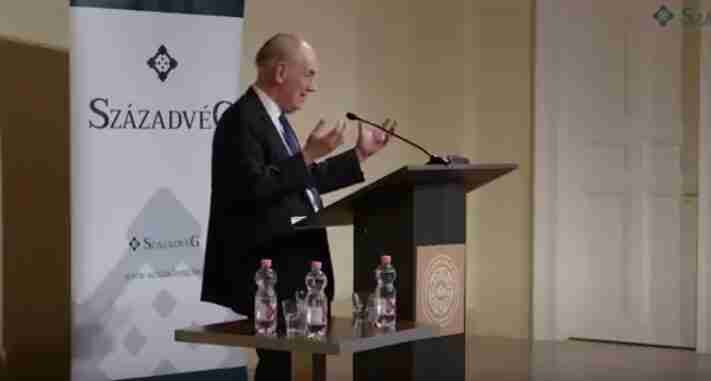
Read the full transcript of political scientist Professor John J. Mearsheimer’s lecture titled “Great Power Politics in the 21st Century & The Implications for Hungary”, (Dec 5, 2022).
PROFESSOR JOHN J. MEARSHEIMER: It’s a great pleasure to be here. I want to thank everyone for their kind words about me and the university for hosting me and my publisher for inviting me to Hungary. This is the first time I’ve been to Hungary. Although I’ve been to Europe many times, I regret to say I had not been to Hungary before. So here I am.
I’m thrilled to be here. And I appreciate greatly all of you, including the people in the overflow rooms, coming out to listen to me talk. As you know, what I want to talk about today is great power politics in the twenty-first century. And then I want to talk about the impact of great power politics on Hungary from how I see it. And I’d like to start out with a few preliminary remarks to give you a sense of the big picture because I’m a person who’s very big picture oriented.
The Evolution of Global Power Structures
I think the key thing you want to remember about the world today is how we got here. And basically, when I was born and when I grew up as a young person, we lived in a bipolar world. From roughly, I’d say, 1947 to 1989, the world was bipolar. Then with the end of the Cold War in 1989, and certainly with the collapse of the Soviet Union in December 1991, we moved into a unipolar world. And as all Hungarians know, the world changed in fundamental ways as we went from bipolarity to unipolarity.
Then I would argue in roughly 2017, the world went from unipolarity to multipolarity. And the world that we live in today, as you all recognize, looks a lot different than the world looked like in 2014, 2004 and 1994 because that was the unipolar moment. So what I’m saying is the structure or the architecture of the international system has changed in fundamental ways since I was put on this planet in 1947. Again, we’ve gone from bipolarity to unipolarity to multipolarity, and this has fundamental effects on international politics.
In the multipolar world that we live in today, there are three great powers: The United States, China and Russia. And The United States is still the most powerful state on the planet. But not too far behind The United States is China, which appears to be catching up quickly. And then a distant third is Russia. It’s very important to understand that Russia is the weakest of the three great powers. From an American perspective, China is a peer competitor. Russia is not a peer competitor. It’s a weak, great power. But those are the three great powers in the system.
And I would argue that today, what you have in this multipolar world are two conflict dyads. One is The U.S.-China dyad, the other is The U.S.-Russia dyad. And I would contrast this with the Cold War, where you had only one dyad, which was The U.S.-Soviet Dyad. And you understand that in unipolarity, because there was only one great power, there was no great power politics. You can’t have great power politics when there’s only one great power.
Finally, I would note to you that I think the two conflict dyads that exist today are more dangerous than the conflict dyad that existed in the Cold War. I think The U.S.-China dyad and The U.S.-Russia dyad is much more dangerous, much more likely to lead to a great power war than The U.S.-Soviet Dyad during the Cold War. So we’re in a world today where there are two conflict dyads instead of one. And both of those conflict dyads, in my humble opinion, are more dangerous than the one conflict dyad that you all know about, which is the Cold War.
Outline of Today’s Discussion
Now how do I want to proceed? I want to proceed by talking about four different topics.
First, I want to give you my theory of international politics, my theory of great power politics. I want to tell you how I think the world works at its most basic level. That’s number one.
Then I want to talk about the U.S.-China competition, and I want to take my discussion of the U.S.-China competition and link it to my theory.
Then I want to shift gears and I want to talk about the U.S.-Russia competition. I want to compare the U.S.-Russia competition to the U.S.-China competition and link it back to my theory.
And then finally, I want to talk about Hungary’s situation in this multipolar world and what the situation looks like today and what it looks like moving forward.
So again, four parts: the basic theory, U.S.-China competition, U.S.-Russia competition, and there we’ll talk mainly about the Ukraine war, and then finally, talk about the implications of all of this discussion for Hungary.
My Theory of International Politics
As some of you know, I have a very simple theory of international politics. I start with five assumptions about the world. And then I take those five assumptions and I mix them up, and I come up with a series of behaviors involving the great powers.
So let me tell you what the five assumptions are:
My first assumption about the world is that states are the principal actors, countries are the principal actors and there’s no higher authority that sits above states. As many of you know, in international relations speak, we refer to this as anarchy. The world is anarchic. Anarchic does not mean murder and mayhem. Anarchic is an organizing principle. The system is anarchic. There’s no higher authority. Point one.
Point two, or assumption two, is that all states have some offensive military capability. Now obviously, some states have more offensive military capability than others do.
The third assumption has to do with intentions. Right? When I was an Air Force officer, I was in technical intelligence. And when we looked at the Soviet Union or the Warsaw Pact during the Cold War, we always want to know what do their capabilities look like and what are their intentions? So the second assumption deals with capabilities. That’s the offensive capabilities argument. The third assumption deals with intentions.
And the intentions argument goes like this: No state can ever be certain as to what the intentions of other states are. You just can’t know for sure what the intentions of other states are. Now why is this the case? If you think about capabilities, offensive capabilities, you can see them and you can measure them. During the Cold War, we could count how many armored division equivalents the Warsaw Pact had. We could count how many SS-18 missiles the Soviet Union had. We could count how many submarines they had because they were material things that you could see.
Intentions are remarkably difficult to figure out because they’re in people’s heads, and you can’t see into people’s heads. So we could never figure out exactly what Soviet intentions were, whether Stalin was running Soviet policy, Khrushchev was running policy, or Brezhnev. It’s very hard to get inside those leaders’ heads and figure out what their intentions were.
Now if you think that’s not true and intentions are reasonably easy to figure out, not impossible, but reasonably easy. My counterargument to that is you cannot know future intentions. None of you know who will be running Russia in twenty years. None of you know who will be running Germany or The United States in twenty years. So you can’t know Russia’s, America’s or Germany’s intentions. So one of the fundamental assumptions underpinning my theory is uncertainty about intentions. This is not to say you can be certain that another state will have bad intentions. You just can’t be certain that it won’t have bad intentions.
So I’ve told you so far that there are three assumptions. One is states are the key actors. The system is anarchic. There’s no higher authority that sits above states, one. Two, all states have some offensive military capability. And three, you just can’t be certain about the intentions of other states.
Now I have two other assumptions that I’m going to throw out. The fourth assumption is that the principal goal of states is survival. And the reason is simple. If you don’t survive, you can’t pursue any of your other goals. So survival has to be the number one goal for every state in the system.
And then the fifth assumption is that states are rational actors. They’re basically strategic calculators. They’re good at coming up with strategies for maximizing their prospects of survival. So the fourth assumption is survival. And the fifth assumption is states are rational actors.
The Consequences of These Assumptions
So those are five assumptions. I think they’re all reasonable assumptions. You take them, you put them in the blender, you hit the on switch, you mix them up, and you get a very, very competitive and dangerous world.
Now why is that the case? First, states fear each other. Why do they fear each other? They fear each other because there may be a powerful state that has malign intentions, right? If you’re France after World War I and you know you’re living next door to Germany and you can’t know what Germany’s intentions are going to be ten, fifteen, twenty years in the future and you know that the Germans have a huge amount of latent capability, you’re going to fear them. And the French did fear them, right? So you fear them for that reason.
The second reason that states fear each other is if you get into trouble, you’re in an anarchic system, which means there’s no higher authority that you can call. Right? So fear is a constant among great powers in the international system.
The second form of behavior you get is self-help. As my mother used to say when I was a little boy, God helps those who help themselves. That’s the way international politics works. You do not depend on anybody else. This is not to say you can’t form alliances, but it is to say it’s a self-help world. States fear each other and they understand that they have to take care of themselves.
The third form of behavior is that you figure out very quickly that the best way to survive in the international system is to be the most powerful state in the system. It’s to maximize your relative power. In a world, an anarchic world, where you cannot know the intentions of other states, and other states may be really powerful, the best way to survive is to be the most powerful state in the system.
I often say to American audiences, how many of you go to bed at night worrying about Canada or Mexico or Guatemala attacking The United States? It’s unthinkable. Why? Because we’re Godzilla. Nobody is going to attack Godzilla. In an anarchic system where you cannot know the intentions of other states, you want to be Godzilla.
One of the real problems that Hungary faces is it has a very small population. From Hungary’s point of view, it would be much better if you had 350 million people instead of 10 million people. You want to be really powerful. Why? Because that’s the best way to maximize your chances of survival in an anarchic system.
Regional Hegemony as the Ultimate Goal
Now let me just unpack this a bit more because it’s relevant for what I’m going to talk about with regard to China and Russia. When I talk about maximizing power, the ideal situation is to be a regional hegemon, to dominate your region of the world, number one. And number two, to make sure that no other state dominates its region of the world. Everybody follow that?
Just take The United States. The United States, when it got started in 1783, was comprised of 13 colonies strung out along the Atlantic Seaboard. What we did was we marched across the continent, and we carved out this huge and powerful state. And then with the Monroe Doctrine, we pushed the European great powers out of the Western Hemisphere, and we told them, you are not welcome back here. This is our hemisphere, and you stay out. We went to great lengths to create regional hegemony in the Western Hemisphere.
At the same time, we do not tolerate peer competitors. We played a key role in putting Imperial Germany, Imperial Japan, Nazi Germany and The Soviet Union, all on the scrap heap of history. And you can see The United States putting its crosshairs on China today. The United States does not tolerate peer competitors. We do not want any other country on the planet to ever imitate us. According to our playbook, there’s only one country that’s allowed to be a regional hegemon, and that’s The United States Of America. This is completely consistent with the theory that I laid out to you. I gave you the logic that underpins it.
Now I just want to say a word or two more. I’ve emphasized the importance of gaining power, becoming a regional hegemon, maximizing your power. It’s also very important to understand that states that are facing a great power that’s getting more and more powerful go to great lengths to balance against that state. So states in the international system, here we’re talking mainly about great powers, balance against rising states. They try to check states that are encroaching on them. That’s the balancing behavior that comes out of my story. But again, the ideal situation is to be a regional hegemon.
U.S.-China Competition
Now that’s my theory. Let’s talk about the U.S.-China competition. Let’s talk about the U.S.-Russia competition and then go to talking about Hungary.
U.S.-China Competition. What’s going on here is very simple. As a result of America’s policy of engagement with China, which started in the early 1990s, we have foolishly helped turn China into an economically powerful country. China has grown very wealthy. And as you all know, it has a huge population. Population and wealth are the two foundations of military power.
Because China has so many people and it’s now so wealthy, it’s not just a peer competitor to The United States, it’s also a potential regional hegemon. And you know what the Chinese are doing? The Chinese are interested in becoming a regional hegemon. They want to dominate Asia the way we dominate the Western Hemisphere. And I want to be very clear here.
China’s Strategic Ambitions
I do not blame the Chinese one second. If I was in Beijing and I was running Chinese foreign policy, my aim would be to make sure that China is by far the most powerful country in Asia, and I would go to great lengths to push the Americans out beyond the first island chain and then beyond the second island chain. I’d have my own Chinese Monroe Doctrine, and I’d want to make sure the Americans are across the Pacific Ocean, just like we want to make sure, from an American point of view, the Chinese are across the Pacific Ocean.
The Chinese understand full well what happens when you’re weak in the international system. They call it the century of national humiliation. It lasted from the late 1840s to the late 1940s. As most of you know, I’m sure, China was very weak during that one hundred year period. And you know what happened to them when they were very weak? The other great powers in the system, including the United States of America, preyed upon them. They were victimized at every turn.
The Chinese understand full well, if you want to survive in the international system, you want to be really powerful. Indeed, you want to imitate the United States. You want to dominate Asia the way the Americans dominate Europe. This is what my theory tells you. It’s what the Americans did, and it’s what the Chinese are doing.
If the Chinese want to get Taiwan back, they want to control the South China Sea, they want to control the East China Sea, they want those rocks back in the East China Sea. There’s one simple way to do it: Get the Americans out of East Asia and make sure they are the most powerful state in the system. So that’s what they’re doing.
American Response to China
What about the Americans? I told you about the Americans before. The Americans do not tolerate peer competitors. We’re not going to let China dominate Asia unless we absolutely have to. Unless China just grows so powerful, there’s nothing we can do to stop it from dominating Asia. We’ve got our gun sights on the Chinese.
You fully understand that, right? And you understand there’s a military dimension and an economic dimension to our policy. We’re putting together a balancing coalition in East Asia, mainly based around military forces to contain China. We’re talking about how to defend Taiwan militarily. That’s the military part of the balancing coalition.
But you also understand, and I’ll talk more about this later with regard to Hungary, there’s an economic dimension to our strategy. We’re actually trying to roll back Chinese economic growth. We want to strangle Chinese economic growth because we understand full well that military power is largely a function of economic power. So the United States is not simply containing China. We’re talking about a rollback strategy.
The United States, as many of you know and probably many of you don’t know, is a ruthless great power. You never want to underestimate how ruthless the United States is. Despite all the liberal rhetoric that we use to cover up our ruthless behavior, we are tough customers. And the Chinese are finding that out now.
In the early 1990s, when I told the Chinese, if you continue to grow economically, there’s going to be a fierce security competition, and you’re going to be shocked at how ruthless the United States is, they simply didn’t believe me because the United States was treating them very well at the time. I said, what you don’t understand is that the structure changes, when we go from unipolarity to multipolarity and you’re a peer competitor, we’re going to think about you very differently than we think about you now. And that’s exactly what’s happening.
So you see what’s happened here is you have this intense security competition between the United States, which doesn’t tolerate peer competitors on one hand and China on the other hand, which is interested in becoming a regional hegemon, a peer of the United States, a full peer. Why is it so dangerous?
The Taiwan Flashpoint
I’m not going to go into this at any length. But Taiwan is the key here. Taiwan is a very dangerous situation. The United States feels that it has to defend Taiwan for security reasons. So you see the United States moving closer and closer to Taiwan.
It’s very important to understand that Taiwan is sacred territory for China. The Chinese are deeply committed to making sure that Taiwan does not remain independent over the long term and that it’s incorporated back into the mainland. And we’re basically saying we, meaning the Americans, are basically saying that’s not happening, right? And we’re tightening our relationship with Taiwan, which means de facto independence for the foreseeable future. And this, not surprisingly, enrages the Chinese.
So this is a very dangerous conflict dyad.
U.S.-Russian Relations and Ukraine
Now we go to the third part of my talk and focus on U.S.-Russian relations, which revolve these days mainly around the Ukraine war. Now the conventional wisdom in the West is certainly true in the United States, certainly true in places like Poland, the Baltic States and most of Western Europe. The conventional wisdom is that the Russians are bent on establishing hegemony in Europe.
The argument is that the Russians, especially Vladimir Putin, are an imperial power and that Vladimir Putin wants to either recreate the Soviet Union or he wants to create a greater Russia. And then once that’s done, he’s going to push forward to create an empire in Eastern Europe. And the argument, as you know, is that he is determined, number one, to conquer Ukraine, number two, occupy Ukraine and number three, make it part of a greater Russia. And then when he’s done with Ukraine, he’ll march on toward other states like Poland, the Baltic States, Romania, maybe Hungary. Who knows?
He’s an imperialist. He’s bent on regional hegemony, in effect, right? This is the argument. If you believe this story, it looks a lot like the China story, right? China, as I told you, there’s no question that what China is trying to do is establish regional hegemony.
The question is, do you think that’s what the Russians are doing? I do not think that is true. I think it is dead wrong. First of all, it’s very clear to me that there is no evidence, none, that Putin has ever said that he thought it would be a good idea to conquer Ukraine and make it part of Russia. There’s no evidence that he ever said he thought it was feasible to do that.
And there’s no evidence that he ever said that that’s what he plans to do. Nobody—and I’ve given this talk many times, I’ve corresponded with all sorts of people, I’ve had research assistants look into this—nobody can show me where he said any one of those three things.
Furthermore, Russia does not have the capability to conquer Ukraine, much less conquer other countries. And oh, by the way, there’s no evidence he ever talked about conquering any other country. That’s not surprising. If he didn’t talk about conquering and integrating Ukraine into a greater Russia, he surely wasn’t going to talk about doing that with the Baltic States or Poland. He never talked about that.
There’s no evidence of that. But again, he doesn’t have the capability. You all have noticed that the Russians can barely defeat the Ukrainians in Eastern Ukraine. How are these Russian forces going to conquer all of Ukraine? Have you ever looked at the number of troops that the Russians sent into Ukraine on February 24? At the most, 190,000 at the most.
When the Germans went into Poland, September 1, 1939, Germans went in with 1.5 million troops. And by the way, in September, the Soviets came in the back door. The Germans, a result of the von Ribbentrop-Molotov Pact, understood full well that they wouldn’t be conquering Poland alone. They’d be doing it with the Red Army.
And Poland was not a formidable military state at the time. They still went in with 1.5 million troops. Putin went in with 190,000 troops at the most, and he didn’t really have any reserves that could have been brought in afterwards. You’re not going to conquer Ukraine with a force that size. Ukraine is a huge piece of territory as you all surely understand.
Russia’s Defensive Strategy
He wasn’t interested in conquering Ukraine and incorporating it into Russia. What was he doing? It’s quite clear what he was doing. He was defending Russia against the West’s efforts to make Ukraine a western bulwark on Russia’s border. We had a policy in the West driven mainly by the United States that had three prongs to it.
One was NATO expansion. Right? The goal was to bring Ukraine into NATO. The second prong was to bring Ukraine into the European Union. And the third prong was to foster an orange revolution in Ukraine and make it a pro-Western liberal democracy.
These are the three prongs of the strategy. And the overall goal was, again, to create a Ukraine that was a western bulwark on Russia’s border. Now NATO expansion was really the key. That’s what really spooked the Russians. Of the three elements of the strategy, it was NATO expansion.
It was, as many of you know, in February, at the Bucharest NATO Summit, where NATO announced when the summit ended that Georgia and Ukraine would become part of NATO. Putin, was actually at the summit, he was on friendly terms with the West at that point in time, went ballistic. The Russians made it unequivocally clear that Ukraine in NATO was categorically unacceptable.
William Burns, who’s now the head of the CIA, was then, in 2008, the US ambassador in Moscow. He wrote a memorandum to Condoleezza Rice, who was then secretary of state, warning against NATO expansion into Ukraine. He said that Ukraine in NATO is the brightest of red lines for all members of the Russian foreign policy establishment, not just Putin. He said, I’ve talked to all the knuckle draggers in the recesses of the Kremlin, and I have talked to Putin’s most ardent liberal opponents, and all of them agree. Ukraine in NATO is unacceptable.
Angela Merkel, who much to her credit, opposed making any kind of offer to Ukraine in April, said recently that the reason she opposed that idea was she understood it was the equivalent of a, these are her words, declaration of war against Russia. This is what Angela Merkel said.
Nevertheless, the United States continued to push forward. We had gotten NATO expansion through for the first time in 1999. You all know this is when Hungary became a member of NATO, 1999. Then in 2004, we had the second expansion of NATO. Countries like Romania, the Baltic States, Slovenia came into the alliance.
Right? And here we are, 2008. This is going to be the third big tranche. Going to bring in Georgia, and we’re going to bring in Ukraine. You remember what happened with Georgia. Four months later, in August 2008, you had a war over Georgia, surprise of surprises. The Russians were putting their foot down.
Nevertheless, we continued to push. We continued to push. Why did we continue to push? The answer is Russia was weak. Think of the century of national humiliation for the Chinese. The Russians thought they could—the Americans thought they could shove another tranche of expansion to include Ukraine down Russia’s throat. We thought the Russians were weak. And you know, when you’re weak and the Americans got their gun sights on you, not good, right?
So we continued to push even after things blew up in Georgia in August 2008. And what was the end result? The end result is that in February 2014, to be exact, the crisis in Ukraine broke out. And this is when the Russians took the Crimea and trouble started—effectively got a civil war in the Donbas that the Russians were involved in.
Now the question you want to ask yourself is, what did the Americans do in response? You might have thought that the Americans would have backed off seeing the trouble that they had stirred up. But the Americans did not back off. NATO did not back off. In fact, we doubled down. We then started training large numbers of Ukrainian forces.
We then started arming large numbers of Ukrainian forces. We were giving them intelligence. And we were helping them plan their military operations in the Donbas, in the civil war that was taking place in the Donbas. In effect, what was happening is that Ukraine was becoming a de facto member of NATO.
This is why in December 2021, this is last December, about eleven months ago, Putin and Lavrov made it very clear. They wrote a letter to the head of NATO, and they wrote a letter to president Biden saying, we want a written statement that says Ukraine will never become part of NATO. They had a number of other demands as well. The reason that happened was that Ukraine was becoming a de facto member of NATO. And the American response was, we’re not changing anything. Nothing is going to change.
And the end result is on February 24, Putin launched what was effectively a preventive war. Putin has decided that there are two possible outcomes here. One is a neutral Ukraine, which is what they preferred all along, or a Ukraine that is wrecked and is a rump state. And as you all know, what the Russians are now doing is they’re wrecking Ukraine. This is a total disaster.
It’s absolutely horrible. I do not want to make light of it for one second. But the point is, this is the end result of our efforts, the West’s efforts. And when I say the West, I’m talking mainly about the United States. The West’s efforts to make Ukraine a western bulwark.
Russians found this intolerable. And by the way, I talked about the Monroe Doctrine. You all know the Monroe Doctrine. That’s when we pushed all the European great powers out, and we said, you are not welcome in the Western Hemisphere. I’m old enough to remember the Cuban Missile Crisis, and I can tell from looking at the crowd that there are a few other old dogs in the crowd like me who remember the Cuban Missile Crisis.
The Cuban Missile Crisis and Great Power Politics
The Cuban Missile Crisis was all about the Monroe Doctrine. We did not, for one second, like the idea of the Soviet Union putting missiles in the Western Hemisphere in Cuba, right near The United States. I want to ask you something. If China decided to form a military alliance with Canada or Mexico and they put Chinese troops in Toronto or Montreal or in Mexico City, what do you think The United States would do? You think The United States would say, oh, that’s not a big deal. We really don’t care. I can guarantee you that would not be our response. We told Khrushchev in 1962, those missiles are going to go one way or another. We are not going to tolerate those missiles in the Western Hemisphere.
Well, as my mother taught me when I was a little boy, what’s good for the goose is good for the gander. You’re surprised that the Russians don’t want a military alliance that was a mortal foe of the Soviet Union during the Cold War sitting on their doorstep? I don’t understand why so many people in the West, especially in The United States and Western Europe, can’t understand that this is one of the most provocative moves The United States could have ever pushed NATO to pursue. It’s just hard to understand. We should understand it from our own historical experience.
And again, Bill Burns said, and he was not the only one. You heard what Angela Merkel said. I could go back into the 1990s, tell you what George Kennan said. Bill Perry, who was the Secretary of Defense at the time when NATO expansion first got started. All sorts of people said, this is going to lead to no end of trouble. And you know what George Kennan said, not only is it going to lead to no end of trouble, when the trouble comes, we’re going to blame the Russians. And of course, that’s exactly what happens because we in The United States are never responsible for any of the world’s problems. It’s always somebody else.
So to basically sum up here, I laid out my theory, right? I explained what’s going on with China and The United States. And that one looks a lot like the Cold War, right? And then I talked about what happened just now with regard to Russia and The United States. And my point there is that’s not like the Cold War. Right? Russia is not the Soviet Union. And Russia was not trying to establish hegemony. This is balancing behavior on the Russians’ part. They’re balancing against NATO expansion and the more general policy of making Ukraine a Western ally on their border.
And again, these are two very dangerous situations. I’ve talked about the Chinese situation and Taiwan, and I can talk more about that in Q and A if you would like. And I’m not going to talk about The U.S.-Russian situation or the war in Ukraine because I’m going to say something about that when I talk about Hungary.
Hungary’s Position in Great Power Politics
Let me now go to the final part of my talk, which has to deal with how I think, as an outsider, Hungary fits into this story. Hungary is obviously a European country. And as I’ll talk about as I go along, The U.S.-China competition does matter for Hungary, but not that much. What really matters for Hungary is The U.S.-Russian competition and the war in Ukraine. And of course, Hungary is in a disadvantaged situation in that it is not a great power, right? And it is in the midst of two great powers that are deeply involved in the war in Ukraine. One, The United States and two, Russia.
So the question here is, how does Hungary manage its relations in this situation? Let me tell you what I think Hungary’s basic aims are. I think the Hungarians are deeply committed to not having to choose sides in any meaningful way on the military dimension, the economic dimension, and the ideological dimension of the conflict between the West and Russia.
What exactly do I mean by that? So first of all, about the military dimension or the security dimension, narrowly defined. There’s no question that from Hungary’s point of view, NATO and its alliance with The United States matters very greatly. Right? Because The United States is a distant great power. It’s not a threat to conquer Hungary. Russia is always a possible threat because it’s right in the neighborhood. Right? You have a deep seated interest in keeping the Americans in Europe, keeping NATO alive and well, and keeping Hungary in NATO. So you definitely want to, on the security side, have very friendly relations with The United States.
However, Hungary also has a deep interest from a security point of view in not provoking the Russians, not causing a war in Ukraine. Because from a security point of view, that’s not good for Hungary. Hungary could end up getting dragged into a war. And I’ll talk more about this in a few minutes. The potential for escalation here is significant. It is not nontrivial. The potential for nuclear escalation is not nontrivial, and I’ll talk more about that in a second. It is not in Hungary’s interest to have a war in Ukraine from a military point of view, from a security point of view. And I think this is why the Hungarians wisely have been opposed to this war from the get go. They understood that it is not in the security interests of Hungary.
So the Hungarians had no interest in siding with the Americans against the Russians because they didn’t want to provoke the Russians. And at the same time, the Hungarians had no interest in antagonizing the Americans. So the Hungarians had to sort of play both sides of the fence here, have good security relations with Russia as much as possible, and there are real limits there. And number two, go to great lengths to have the same with The United States.
Hungary’s Economic and Ideological Position
With regard to the economic dimension, there’s no question that the Hungarians have profound interest in having good relations with the European Union from an economic point of view. You might not like the ideology that the EU is trying to foist on you. But there’s no question that economically, Hungary benefits from the EU. But at the same time, Hungary is heavily dependent on Russia for energy resources, heavily dependent. And furthermore, Hungary is located in the middle of Europe.
So if Russia and Western Europe are trading extensively, there’s a great deal of economic intercourse between Russia and Europe. Hungary benefits greatly because it’s right in the middle. So all this economic intercourse is really good. Well, if you look at what’s happening today, it looks like there’s going to be hardly any economic intercourse next year, the year after, five years from now. This is not in Hungary’s interest.
Furthermore, oil and gas, adjusting to the cutoff of Russian oil and gas, especially since it’s cheap, is going to cause all sorts of problems. So you see that not only militarily but economically, the Hungarians have a deep seated interest in playing both sides of the fence for good reasons here.
And then ideologically, right, the Hungarians, I think, as best I can tell, have mixed feelings about which side is the good side here even. Because if you look at the EU and you look at Western Europe and the profound importance the EU places on liberal values and the conflicts that has caused with Hungary, the Hungarians can’t help but have mixed emotions about their dealings with the European Union and the West more generally, especially The United States. Because you know that The United States is a thoroughly liberal country that is interested in exporting its foreign policy no matter what the Hungarians think.
Yet there are certain values, Western values, that the Hungarians cherish, and therefore their ties with the West are very important. So I would argue the Hungarians are kind of schizophrenic about the West, right? And with regard to the Russians, right, there are certain aspects of Russia, the authoritarian nature of the political system, just the history of Russian Hungarian relations that makes Russia somewhat suspect. But on the other hand, the antagonism towards liberalism, the hostility, the dislike maybe that’s the best word, the dislike of liberalism in Russia is shared by many Hungarians. And therefore, you have a certain ambivalence towards Russia that looks somewhat like the ambivalence towards the West.
I think there’s no question if Hungary was forced to choose between the two, it would side with the West over the Russians. But nevertheless, I think it’s quite clear that Hungary has really tried to straddle the fence on the ideological dimension as well as the economic dimension as well as the military dimension. And by the way, if you contrast Hungary with Poland, the difference looks like night and day. The Poles have a completely different view of Russia versus The United States than the Hungarians do.
And the argument I would make is that up to this point, the Hungarians have done a good job of managing relations with the West and with the Russians given their basic aims. I’ve not done a perfect job, but hardly anybody ever does a perfect job in international relations. I think all things considered, the Hungarians have done a good job of managing their economic, military and ideological relations with these two great powers.
The Dangers Moving Forward
Now the real problem is the dangers moving forward. I think the situation is going to get much worse. First of all, there’s the danger of escalation here. I think that if the West is successful, right, the West is successful and we push the Russians back in Ukraine. The Ukrainians who were arming, training and helping on the battlefield, if the Ukrainians succeed in pushing the Russians out of Ukraine and the sanctions begin to bite, I think the Russians will escalate. And I think there’s a good chance that they would use nuclear weapons.
Furthermore, I think there’s a reasonable chance that NATO will get involved in a war in Ukraine. The Americans have said that they have no intention of fighting in Ukraine, but we are doing everything but pulling the trigger and pushing the button to launch the bombs in Ukraine. It’s amazing how deeply involved we are. We are deeply committed. I’m talking more about the Americans than the Europeans, but even NATO to the point where if the Russians succeed, then the temptation for us, the West, especially The United States, to enter the war will be very great. Biden will be under tremendous pressure to go in and help rescue the Ukrainians so you can see the potential for escalation.
And you know all know that Avril Haines, the woman who is the Director of National Intelligence in The United States, right, she says that the most likely scenario for the Russians to use nuclear weapons would be if the Americans or NATO comes into the fight because the Russians are not going be able to stand up to us, right? You all know, as I said before, the Russians can barely handle the Ukrainians in the Donbas, right? The Russian military is no match for The United States, no match for NATO. And what Avril Haines was saying is that’s the circumstance under which the Russians will be desperate.
And you all understand the Russians believe they’re facing an existential threat. It’s very important that you understand this. They believe that they’re facing an existential threat. They thought Ukraine and NATO was an existential threat. Well, now we’re talking about a situation where you’re not only being threatened by Ukraine becoming part of NATO, becoming a member of NATO, You’re also threatened by the fact that The United States is talking about defeating you on your doorstep. And if the American military is to come into the fight and the American military is fighting on Ukrainian territory right next door to Russia, this is an existential threat. This is where states use nuclear weapons, right? And we’re not that far away from that point. So the threat of escalation is very great.
Let’s assume that doesn’t happen. Let’s hope that doesn’t happen, right, that The United States does not get involved, NATO does not get involved, let’s hope nuclear weapons are not used. But what’s the alternative then? It’s a stalemate. That’s the alternative. A stalemate that goes on and on and on. This is going to have significant negative consequences for Europe and for Hungary, right?
You see, if you talk about individual countries, right, the economic costs of this war to individual countries in Europe are already profound. And it’s almost impossible to find anybody who says the situation is going to improve markedly next year or the year after. We’re staring many years of bad economic news in the face because of what’s happening here. And as you all know, those economic consequences are going to have political consequences. You can already see that happening, right? So there’s going to be economic turmoil and political turmoil if you have a stalemate, if the present situation continues on and on and you don’t have escalation.
And the problem here is not only the effect on individual countries like Hungary, there’s also the effect on the institutions like NATO and the EU. I think you can already see cracks. You can already see fissures in these alliances. Just think about the Poles on one hand and the Hungarians on the other. Think about the Poles and the Germans. Think about the Germans and the French. People think about what’s happening in Ukraine. Countries think about what’s happening in Ukraine in different ways. And as the economic and political costs continue to ratchet up, I think you’re going to see fissures in those institutions. And this is going to have very negative consequences for Europe as a whole and for Hungary in particular.
So the point I’m making to you is that I think things have worked out quite well up to now given the circumstances. And again, I think the Hungarians, more than any other country in Europe, wanted to avoid this war for good reasons from Hungary’s point of view. They wanted to avoid the war. It was unavoidable because the Americans were driving the train. But given what’s happened over the past year, I think the Hungarians have done a good job managing the situation.
Great Power Politics in the 21st Century & The Implications for Hungary
I’m not very sanguine about the future just because I think this is such a volatile situation. Now the last set of comments I want to make about Hungary have to do with China. As I said when I first started talking about Hungary, there’s no question that Hungary is a European great power. And what’s happening with regard to Russia and The United States or Russia and NATO in Ukraine matters the most to you. But nevertheless, China matters to you as well.
Remember what I said about American policy toward China? It has two dimensions. One is the military dimension. That’s the balancing coalition that we’re building. And then second, there’s the economic dimension.
The military dimension does not matter to Hungary because Hungary, thankfully, from your point of view, is not going to be part of the balancing coalition against China. That’s going to involve Asian countries, Australia, India, Japan, South Korea, The Philippines, and so forth, and of course, The United States. But where Europe is going to matter is on the economic front. And what the Americans are going to want is they’re going to want you not to have significant economic relations with China. They’re especially concerned about the Germans.
You know, the German chancellor just went to Beijing, took a bunch of business people with him. This enraged the Americans because, again, you have to understand what the Americans are up to here. The Americans are interested in rolling back the Chinese economy, especially when it comes to high-end technologies. European countries, in my opinion, over time are going to have a deep-seated interest in having extensive economic relations with China. One reason for that’s an obvious one from my talk, Russia.
You have depended in the past very heavily on economic intercourse with Russia. All that economic intercourse between Europe and Russia has been wonderful for Hungarian prosperity. Well, it’s coming to an end. In all likelihood, it’s not going to start up again for a long, long time. So Europeans are going to be looking for an alternative trading partner.
The German Chancellor understands full well. He’s got to get to China, and he’s got to talk about cutting deals. Otherwise, the German economy is really going to go down the toilet bowl. You understand this. And this is going to enrage the Americans.
Most of you are not old enough to remember this, but in the Cold War, when the Germans decided midway through the Cold War that they were going to trade with the Soviet Union, this drove the Americans stark raving crazy, because we wanted to strangle the Soviet economy. We were interested in winning the Cold War. We don’t tolerate peer competitors. So if you get a situation where Hungary trades extensively with China or is involved economically with China, and actually, you see that Hungary has had reasonably, if not very good, relations on an economic level with China in recent years. You were the first country in Europe, if my memory is correct, to sign on to the Belt and Road Initiative.
Smart from Hungary’s point of view. Don’t misunderstand me. You’ve been involved with 5G. You’ve been involved with Huawei. This makes sense from your point of view.
You just want to understand, from the American point of view, this is going to be, in all likelihood, a no-no. And there’s going to be a lot of pressure brought to bear on you, the Hungarians, on the Germans and all European countries that want to trade with China and help their economy grow, not the Chinese economy, but help their economy, the Hungarian economy grow. But of course, that’s going to help the Chinese economy grow. And that will not be something the Americans like. So what’s my bottom line here?
The End of the Unipolar Moment
My bottom line is the unipolar moment, which is a time that most of you grew up in, was really a wonderful time. It’s such a great improvement over the Cold War for Hungarians. It’s just wonderful. But it’s gone away. And we actually live in very dangerous times.
As I said to you before, we now live in a world where there are two major conflict dyads. There’s only one in the Cold War. We’re very close to where The United States and Russia could end up shooting at each other. We were never this close in the Cold War, maybe the Cuban Missile Crisis. I mean, we are in a very dangerous situation in Ukraine.
And I know a lot of people who would agree to that and say the situation is even more dangerous in East Asia, especially because of Taiwan. This is a very dangerous world. And the Hungarian governments and Hungarian foreign policy elites, I think, have done a very good job of negotiating these troubled waters in recent years. But I think moving forward, it’s going to be a very difficult task to avoid serious trouble for Hungary and for all the other countries in Europe and for The United States as well. Thank you.
Q&A Session
AUDIENCE QUESTION: Thank you very much for your presentation. Just following up on your summary at the end. Do you foresee a scenario in the world where the West and the East will be completely separated economically, technologically? There will be very, very limited trade like as during the Cold War era.
PROFESSOR MEARSHEIMER: Tell me what you mean by the West and the East.
AUDIENCE QUESTION: I mean, the West mostly driven by The U.S. And the East led by China. I had a previous question to that, but partly maybe your presentation answered that. That was, if The U.S. considers China as a peer competitor, wouldn’t it make sense for The U.S. to have a strong ally in form of Europe and not, like, weaken them against the Russia conflict when China is the real peer competitor?
PROFESSOR MEARSHEIMER: Good. I should have understood your question to begin with. Let me start by saying that if you’re The United States Of America and you’re in a multipolar world and China is a peer competitor and a potential regional hegemon and Russia is a weak great power, it’s in your interest to have Russia as an ally. Okay? And what The United States should be doing is it should be minimizing the forces that it has in Europe and forming an alliance with Russia so that Russia is part of the balancing coalition against China. That’s what we should have done.
But instead, what has happened is we have picked a fight with the Russians. The Russians are now a mortal enemy. And we have pushed the Russians into the arms of the Chinese. And we have gotten more deeply involved militarily in Europe than was the case during the unipolar moment. This is at a time when we should be pivoting to Asia.
You know all the emphasis the Americans put on pivoting to Asia? It’s very hard to pivot to Asia when you’re increasing your commitment in Europe. So we’re increasing our commitment in Europe, and we’ve driven the Russians into the arms of the Chinese. This gets to your question. I think that what’s happening here is we are, for the foreseeable future, moving to a world where you have the Russians and the Chinese on one side, the Iranians and the North Koreans as others and others as well.
And then on the other side, you have the Americans, the West Europeans, the Japanese, the South Koreans and the Australians, the so-called West. So I think you are getting—I wouldn’t have thought to call it an East-West divide, but that’s a good term. You are getting something of an East-West divide here. And remember what we were talking about regarding economic intercourse in Europe. It looks like Russian-European economic intercourse is going to dry up in large part in the years ahead.
It’s already happening, which would just reinforce the point that I’m making. So I think, yeah, this is what’s happening. And I think from an American point of view, it’s not in our interest because, again, it would be in our interest to have an alliance with the Russians.
By the way, just look at the Iranians. The Americans have this thing about Iran where we constantly talk about how evil the Iranians are, we’re unwilling to reach any form of meaningful agreement with them and so forth and so on. And what we’ve, in effect, done with the Iranians is driven them into the arms of the Russians. The Russians are getting all sorts of drones and ballistic missiles from the Iranians that are invaluable in their war in Ukraine. And that’s because the Iranians have a vested interest in working with the Russians because the Americans have their gun sights on Iran. I don’t think that’s smart either.
AUDIENCE QUESTION: Good evening. My name is Dinesh Andrasnade and I serve at the Institute of Strategic Studies here at Ludovico, the National University of Public Service. I’d like to ask a question regarding the Visegrad cooperation that is Czechia, Poland, Slovakia and Hungary. You highlighted the importance of economics and population. Together these four countries are the third largest in the European Union with 68 million people. We’re the fifth largest economy in the European Union. And on the world stage, we’re the twelfth largest economy. So in our place, what is your playbook to us so that we can become the regional hegemony of Europe as the Visegrad Group?
PROFESSOR MEARSHEIMER: Thank you. Well, the problem that argument faces is that we live in a world where the most powerful political ideology is nationalism. And that means that we live in a world that’s populated by nation states that care greatly about their sovereignty. And they’re willing to form institutions and they’re willing to follow the rules that those institutions come up with, but they are not willing to surrender their sovereignty.
This should be music to the ears of a Hungarian audience. But just think about Brexit. Brexit tells you that the British, even though they joined the European Union, remained a sovereign state because they had the ability, they had the authority to pull out of the European Union if they thought that was the right thing to do. Hungary could pull out of the European Union. What this tells you is that clusters of states can form institutions, but they can’t create a new nation state.
Just think about Europe. People will often say to me, you’ve got The United States here, Europe there, and Russia here. I say, what’s Europe? Europe’s not a state. It’s a collection of states. I want to know what do the Germans think, what do the French think, and so forth and so on. Europe’s not a state.
So you can take a bunch of relatively small countries in Central Europe and you can form a military alliance or you could form an economic institution that was very powerful as well, a mini EU, a mini NATO, what have you. But you still would not be creating a state. And a hegemon is a state. States are what matter in international politics. Again, nationalism. Nationalism is the most powerful political ideology on the planet. And the concept of a nation state is the embodiment of nationalism.
So the fact of the matter is that for the foreseeable future, I believe almost forever, Europe is going to be comprised of a series of states. The cast of characters may change over time, but it’s going to be dominated by states. And Europe, as a single entity, is never going to happen. And by the way, you know my theory because I’ve laid it out for you now. My theory says that if Europe, the EU, were to become a nation state, it would be a regional hegemon. It would be a regional hegemon.
The United States would go to enormous lengths to wreck that nation state. You understand, The United States has talked about this. The United States does not want a united Europe, a Europe that is a powerful single state because it would be a threat to us.
AUDIENCE QUESTION: Hello. I wanted to ask you about the option of nuclear escalation again in terms of the scenario where we presume that American boots are on Ukrainian soil. So you argued that as that option would be seen by Russia as an existential threat, they would potentially use nuclear weapons. But I would presume that in a Russian nuclear strike in which there are American casualties, that scenario would warrant a similar response. So is it wrong to presume that maybe mutually assured destruction is a strong enough force to prevent the usage of nuclear weapons even in such a radical situation, as long as Russia’s territorial integrity is not directly threatened?
PROFESSOR MEARSHEIMER: Yeah. Another great question. Let me just say a few words about nuclear use, the different scenarios. The most likely scenario at this point in time where Russia uses nuclear weapons would be in Ukraine. If Russia is losing the war in Ukraine, it would be tempted at least, powerfully tempted, to use nuclear weapons in Ukraine against Ukrainian forces and Ukrainian targets. So in that case, The United States would not be involved, NATO would not be involved, and we would therefore not have to retaliate. This is one of the reasons that I’m very nervous that the Russians may use nuclear weapons if they’re losing in Ukraine. Because if they’re losing in Ukraine, they can use nuclear weapons inside Ukraine with a low risk that the Americans will hit them with nuclear weapons. Okay? So that’s one possibility.
Now the other possibility is that if the Russians—if the Americans get involved in the war, if NATO gets involved in the war, the Russians are likely to use nuclear weapons. This is what Avril Haines, the Director of National Intelligence said, and I think she’s correct.
So the Americans get involved. Now this is where your logic kicks in. So the Americans come in. It’s a conventional war against the Russians. It’s a conventional war. And my argument was the Russians would use nuclear weapons. I’m following in the footsteps of Avril Haines, likely to use nuclear weapons. That’s the scenario. Your question is, is the threat of mutual assured destruction, which is certainly there. You’re absolutely right.
Great Power Politics and Nuclear Deterrence
It’s sitting in the background. Both sides apropos this gentleman’s question, both sides have the ability to turn the other side into a smoking, radiating ruin. Okay? That’s MAD, mutual assured destruction. Does that mean the Russians won’t use nukes because they don’t want to get incinerated?
Of course, they don’t want to get incinerated, but the way around that, and this was NATO policy during the Cold War, is you launch a small number of nuclear weapons against the other side, and you make it clear you’re now out on the slippery slope to oblivion. This is what Thomas Schelling called the manipulation of risk.
You all understand, just to go back to the Cold War, I’m NATO. The Warsaw Pact is coming into West Germany. NATO’s forces collapse. Okay? NATO has said, this is Article five of the NATO treaty, that we will then countenance using nuclear weapons, and we have thousands of nuclear weapons in Europe, in Germany. We would use those nuclear weapons against the Warsaw Pact. How did we think about using them?
We thought about a limited use of nuclear weapons because we wanted to avoid mutual assured destruction. And what we do is we launch a handful of nuclear weapons, reminding the Russians—excuse me, the Soviets during the Cold War—that in the background is that MAD capability. And if this one spins out of control, we’re all going to get incinerated. So our belief was a handful of nuclear weapons, manipulating risk, would convince the Soviets to pull back. Woah, the Americans are deadly serious here, right?
Now a lot of people said we would never use nuclear weapons even if the Soviets were overrunning Germany because we, the Americans and even the Europeans, we don’t want to get incinerated. And that’s the implication of your question. Maybe the Russians, contrary to what John says, won’t use nuclear weapons if the Americans get involved because even if they use them in a limited way, there is the danger it will spin out of control and we’ll all be vaporized, right? So we won’t use them. And in this story, the Russians won’t use them either.
The question is, who knows? Do you know what I’m saying? Who knows what the Russians will do? They clearly believe they face an existential threat. Who knows what we would have done during the Cold War if the Soviets or the Warsaw Pact was overrunning West Germany?
It’s very hard to say. That’s what makes the situation so dangerous. But again, the two points I’m making to you is you want to remember, the first scenario is that the Russians used nuclear weapons inside Ukraine. And there, the threat of MAD is tiny. The second scenario is the Americans get involved. The Russians use nukes against the Americans, but they do it in a very limited fashion, thinking they can avoid MAD but use MAD to convince the Americans and NATO to back off. That’s how I think about nukes.
Russia-China Relations and Potential Alliances
AUDIENCE QUESTION: So I really have an interesting question. In your whole speech, you were talking about this mobile polarity in our international society. So the question goes as follows. We are living in a world in which according to the Western perspective, you mentioned that there is this competition among the US and Russia, but in the differentiation of the US with China. So I would like to ask, from a Western perspective, would it be wise to consider that China and Russia could form a natural alliance? Or should we consider Russia and China as a unified threat to Western security?
My experience going to Moscow before the Ukraine crisis blew up was that the Russians could not understand why the United States was picking a fight with Russia when it made eminently good sense for the United States and Russia to be allied. The Russian perspective was that historically, China and Russia had been mortal enemies on a number of occasions. When I was young back in 1969, they fought a series of battles out in the Siberia area and there are all sorts of potential disputes between the Chinese and the Russians. And Russians, in recent years, have said to me, we are your natural allies.
We are not a threat to take over Europe. And why aren’t you forming an alliance? So I think if you talk about a natural alliance in my opinion, the natural alliance was the United States and Russia against China.
I will just point out to you that I had a number of Russian friends, very smart young Russian strategists actually, who said to me, “John, you think about US-Russian relations in a binary fashion, which is wrongheaded.” I used to talk about whether Russia should be allied with the United States or Russia should be allied with China. And that’s what I’ve done here tonight just for simplicity’s purposes.
But their argument—these were young Russian strategists—their argument was that the ideal strategy for Russia was to sit on the fence and not get involved either with the Chinese or with the United States. And in a very important way, that’s sort of what I was describing as the Hungarian approach to dealing with the United States in the West and Russia on the other hand, trying to play both sides of the fence. These young Russian strategists, very smart, said to me that this was the way that Russia should play its hand, not get too closely involved with the United States. And I had to admit that I hadn’t even thought of that, and I think that they were right.
But the end result is that we’re not going there. We’ve now pushed the Russians into the arms of the Chinese.
The Status of Realism in International Relations
AUDIENCE QUESTION: My name is Niklas Kovac. You and together with us are realists, are very respected but nevertheless a minority of the international relationship establishment, let’s say. Do you see any chance that your view became dominant?
PROFESSOR JOHN J. MEARSHEIMER: There is no question that realism is a deeply hated theory of international relations in the United States. It’s very, very tough to be a realist in the United States. I’ve told a number of people here that when I go to China that I feel like I am among my people. I’ve told some people that when I start my talks in China, I say, “It’s good to be among my people.” And I want you to understand, I do not speak a word of Chinese. I feel like I am really in a foreign culture when I go to China.
And it’s one of the few times when I am conscious of the fact that I’m an American. Most of the time, I come to Hungary, I don’t think of myself in nationalistic terms. I don’t think of myself as an American, right? Part of the West, that sort of thing. When I go to China, I feel very much like I am in a foreign culture.
But intellectually, intellectually, I’m at home in China much more so than I am when I go to Washington, D.C, certainly when I’m on university campuses because the Chinese are realists to the core, right? This is true of the Russians as well. You go to Moscow, you talk to the Russians. Go to Iran. I was in Iran in 2018. These countries are filled at the top with people who are realists and even in the universities. This is not true in the United States.
Now take this a step further. During the unipolar moment, remember when I said about the unipolar moment, there was only one great power by definition. And I said, you therefore cannot have great power politics. So it was really easy to dismiss realism during the unipolar moment. And the end result is that you’ve got liberal hegemony. This is what my book is all about, the book that has been translated by these folks here and by Attila, right? The book is all about liberal hegemony during the unipolar moment.
The problem is, from the liberal perspective, we’re now in a multipolar world. Great power politics is alive and well. And there’s no way the United States can avoid behaving like a realist great power. Realism is back. And I want to give you one example to highlight that.
But before I do, you still never want to lose sight of the fact that even though the United States will act like a realist great power, it will put a velvet glove of liberalism over its realist fist to make it look like we’re not really behaving in realist fashion. But we will.
Here’s the example I want to give. Joseph Biden was the Vice President of the United States under Barack Obama. This was during the unipolar moment. And during the unipolar moment, we pursued a policy of engagement with China. I referenced this in my talk. We foolishly helped turn China into a great power. We foolishly helped turn China into a peer competitor. Every single administration, Republican and Democratic, from basically 1989 up until 2017 participated in that enterprise, Republicans and Democrats alike.
Joseph Biden as vice president was a huge proponent of engagement, which is a thoroughly liberal policy. Okay? Donald Trump comes into office. As I say in the book, Donald Trump explicitly ran against liberal hegemony. Furthermore, he moved into the White House when the world was turning multipolar.
And therefore, Trump approached China in a realist fashion. There’s no question about that. He abandoned engagement. He explicitly abandoned engagement, this liberal policy, and he adopted a realist approach toward China.
Then Trump is defeated in 2020. And who becomes president? Joe Biden. He has a track record. Engagement. The question you have to ask yourself is when Biden becomes president, does Biden go back to engagement, liberal policy, or does he follow in the footsteps of Donald Trump and even toughen up our balance of power approach to dealing with China?
The answer, as you surely know, is that Joe Biden does not go back to engagement. And one can easily argue that Joe Biden has been tougher on the Chinese than Donald Trump was. So Trump was clearly the guy who flipped the policy from engagement to realpolitik, but Joe Biden is following in his footsteps.
But nevertheless, if you listen to the Americans talk about the competition between the United States and China, they don’t describe it in balance of power terms. They don’t describe it in the terms that you heard me describe it in here in my lecture. They describe it as an ideological fight between authoritarian regimes and liberal regimes, right? It goes back to that gentleman’s question in the rear before about the East-West divide. We in the West, especially in the United States, define it in liberal terms. We have this very Manichean view of the conflict.
There are the good guys, liberal Democrats. There are the bad guys, authoritarian states. And we’re involved in this deep-seated ideological struggle. But I would argue that this is crazy. China was a communist state when we were playing kissy face with it, when we were involved in engagement. China’s political system has not changed. What changed was the balance of power.
Europe’s Role in Great Power Politics
AUDIENCE QUESTION: Thank you so much for the great lecture tonight. Your thoughts really made me wonder about Europe. And actually, was wondering in the politics of the great powers, how do you see the role of Europe? Are we actually an ally to save, let’s say, politically and economically? Or are we actually just a collateral damage, let’s say, in the eyes of the US?
PROFESSOR JOHN J. MEARSHEIMER: Well, as I said before, I think you can talk about Europe, you can talk about Western Europe, Central Europe, Eastern Europe. You can use these terms, but it’s important to understand always that they are collections of states. As I said before, nationalism is the most powerful political ideology on the planet and it guarantees that the nation state is alive and well.
Over the years, this goes back to when I was a graduate student, back when dinosaurs roamed the earth, right? People talk about the withering away of the state. The state is going to wither away and we’re going to live in a world of no states. This is not going to happen, right? States are here to stay.
And when you talk about Europe, you’re talking about a collection of different kinds of states. Just think about Hungary and Poland. Just think about Hungary and the extent to which Hungary is different in terms of thinking on how to deal with Russia today compared to most other European states. There’s just a lot of differences between Hungarians and other states, the Hungarians and the Poles. Think about how the French reacted to the German Chancellor going to Beijing. The French were irate.
So you have all these different states and therefore, I always find it very difficult to talk about a concept like Europe as if it were a nation state. And then just to take this a step further and build on some earlier comments that I also made in the Q&A, I actually think nationalism is going to go up all across Europe. Hungary and Poland have been anomalies in Europe in recent years. If you in the United States, you’re talking about what countries in Europe have seen nationalism flourish. People will automatically say there are two countries, Poland and Hungary.
I believe that nationalism is going to flourish in many more European states. And this is over time, in large part because of the Russia-Ukraine war. And I believe the end result of that is these institutions like the European Union and NATO, which allows someone like you to talk about Europe, right? Europe means the EU for lots of people.
The Realist Perspective on International Relations
I think it’s just going to be tougher to do that with the passage of time. And I mean, I could be wrong on that. As I said earlier, if I am wrong and Europe is united and there is this thing called the European nation state, the Americans will put their gun sights on that European state because we don’t tolerate peer competitors. It’s just very important to understand that.
Now liberals would argue that’s wrong, by the way. Liberals would say that democracies don’t fight other democracies. Democracies don’t engage in security competition, okay? This is the argument. Therefore, a United States Of Europe would certainly be a liberal democracy. And The United States is a liberal democracy, and we can live happily ever after.
That’s the liberal view. You understand, just to go back to China, here was the basis of engagement, okay? When we were feeding the beast and China was getting more and more powerful, and I was saying, this is crazy. People would say engagement is going to work. And this is how engagement works.
The Liberal Theory of Engagement with China
We integrate China into the world economy and we make China rich. We make it prosperous, which of course we did. Number two, we integrate it into international institutions like the WTO, right, the IMF, the World Bank, we make it—these were Robert Zoellick’s words—we make it a responsible stakeholder.
Think about those words, a responsible stakeholder. You make it a law abiding or a rule abiding state by integrating it into institutions, right? So it’s prosperous. It’s a rule abiding state. And then what will happen is China will turn into a liberal democracy, right?
Because when you become prosperous, you become rich and you’re surrounded with all these other rich countries in these institutions, you democratize. And once China democratizes, we’ll live happily ever after. That’s the liberal theory of international politics known as democratic peace theory.
My view, as you would expect, is first of all, you can’t be sure that they’ll democratize. Second, even if they democratize, you can’t be sure that they won’t backslide. And third, even if they democratize and stay democratic, you can’t know their intentions. And therefore, you do not want to take a chance.
But you just couldn’t make that argument because getting back to your question, this gentleman in the front here, liberalism was such a powerful ideology during the unipolar moment. This again is the subject of my book. Those were really tough times for someone like me to get up before an audience like you and make a realist argument because people thought the world had changed.
Fukuyama and “The End of History”
You’ve all read Frank Fukuyama’s very famous piece. For those of you, the younger people in the crowd, if you haven’t read Frank Fukuyama’s very famous piece, “The End of History,” which was published in 1989 in the National Interest. You should really read it and read it carefully. It’s an article I think it’s the most important article that has ever been written in The United States in terms of influencing foreign policy and influencing how the American foreign policy elite thinks. I believe that at the time it was a remarkably foolish argument and that it would be proved wrong.
And I do believe it has been proved wrong. But it’s an argument that says we, The United States, played the principal role in defeating fascism in the first half of the twentieth century. And then in the second half of the twentieth century, we played the principal role defeating communism. And now the only viable political system that was left was liberal democracy. And in fact, what was going to happen with the passage of time was that the entire planet would end up being comprised of liberal democracies.
Liberal democracy was the wave of the future. In a way, what Frank was saying in this famous piece is that the Americans have the wind at their back. History is on our side, even though he was talking about the end of history, right? We have the wind at our back. And Frank said that once the planet is populated with nothing but liberal democracies, there’ll be no war, there’ll be no conflict of any consequence.
And he says explicitly in the piece that the biggest problem that we will face is boredom. Just think about that. And this line of argument is what underpinned engagement. The idea was that if you engage with China, right, the end result would be that China would become a liberal democracy. And again, we’d live happily ever after.
NATO Expansion and Liberal Hegemony
NATO expansion. Most of you young people in the audience probably don’t appreciate this, but NATO expansion up until 2014 was not aimed at containing Russia. It was designed to spread the liberal political order and economic order that had been established in Western Europe during the Cold War into Eastern Europe. This is why Vladimir Putin was invited to the April 2008 Bucharest NATO Summit. NATO expansion into Ukraine was not designed to contain Vladimir Putin.
I told you, he was viewed as remarkably weak. Russia was viewed as remarkably weak, and we were trying to push NATO expansion down the Russians’ throat, right? So what we were doing was liberal hegemony. We wanted the Hungarians to join NATO and to join the EU because you would then be joining institutions and you would become rule abiding citizens. Furthermore, if you joined the EU, you got integrated into Western Europe, you’d become prosperous.
And you did become prosperous. And furthermore, we wanted to make sure you became a liberal democracy. Many Hungarians, of course, complained bitterly about the fact that the Americans and the West more generally are trying to push liberalism on them. Yes, but that was part of the strategy, right? Liberal democracy in Hungary, prosperous Hungary, Hungary that’s embedded in institutions.
This is what we wanted to do with Ukraine. It’s what we wanted to do with Poland. And the idea was once we did that, we’d all live happily ever after. The real monkey wrench in the operation were the Russians, right? And we didn’t think the Russians mattered that much.
The Failure of Liberal Hegemony
The Bush Doctrine in the Middle East. The Bush Doctrine was designed to turn the Middle East into a sea of democracies. When we invaded Iraq, we thought that Iraq was not the last stop on the train line. We thought we’d have to do Syria, maybe Iran, but eventually everybody would see how powerful we are, throw their hands up, surrender, and the Middle East would democratize. Frank Fukuyama told us that was what was going to happen. Fascism was dead. Communism was dead. Authoritarian governments, nah. We’re talking about liberal democracy here, there and everywhere.
And this is the road that we went down. And it was a disaster, right? NATO expansion led to the war in Ukraine, in my opinion, as I laid it out here. The wars in The Middle East to foster democracy, they worked out really well. Afghanistan, Iraq, Syria, Libya, jeez, the amount of murder and mayhem that we helped create in The Middle East and China, we created a pure competitor, right?
This was liberal hegemony. But the point I made is that that’s in the rearview mirror now. Rhetorically, it’s not because that’s the velvet glove. You want to remember the Americans will continue to talk like liberals and act like realists because we’re playing hardball now because we have two great power adversaries and we’re in a very dangerous situation.
UNIDENTIFIED SPEAKER: Thank you, John. We wouldn’t like to have used your time. So thank you for answering the question.
Related Posts
- Transcript: President Trump Hosts a Cabinet Meeting, Jul. 31, 2026
- Transcript: President Trump’s Remarks at Sen. Lindsey Graham’s Funeral
- Transcript: Trump’s Michigan Rally Speech Ahead of Midterm Elections
- Transcript of Nick Fuentes Interview ft. Hunter Biden – Channel 5
- Transcript: Trump Remarks at White House Correspondents’ Association Dinner