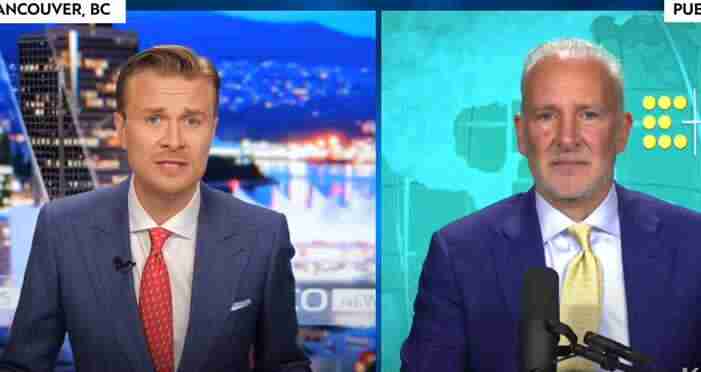
Read the full transcript of a conversation between Kitco News’ anchor Jeremy Szafron and stockbroker Peter Schiff on “This Is the Collapse I’ve Warned About for Years”, April 11, 2025.
Gold Makes History as Global Markets Shift
JEREMY SZAFRON: Welcome back. I’m Jeremy Szafron. Well, gold has just made history yet again. Spot prices surged past $3,250 announced this week, setting a new all-time high and marking the metal’s strongest weekly gain since back in 2020. The rally has stunned markets, vaulting gold nearly $600 year to date and signaling what many now believe is a systemic and seismic shift in global capital flows.
At the same time, the US-China trade war is spreading and spiraling. President Donald Trump’s 145% tariffs on Chinese imports triggered full retaliation from Beijing, which has now raised its own duties to 125% and accused the US of economic coercion. But the deeper fear is inside the US treasury market, traditionally the cornerstone of financial stability here within the global markets. Despite market turmoil, yields remain elevated, and volatility in sovereign debt is now being compared to risk assets.
With Treasuries, the dollar, and US equities all falling at once, some are warning that the traditional flight to safety dynamic is breaking down. Joining me is Peter Schiff, chief market strategist at the Euro Pacific Asset Management. Peter has been warning about this for years, from fiat instability to stagflation and dollar devaluation. And in a post this week on X, he wrote “The US Dollar, bonds and stocks are all getting killed. America’s ride on the global gravy train is about to come to a screeching halt.” Peter, welcome back to the show. Thanks for making the time.
PETER SCHIFF: Thanks for having me on.
The End of America’s Gravy Train
JEREMY SZAFRON: Okay, we’ve got lots to get to, as I pointed out there. I mean, just to put things into perspective for our viewers, gold is heading for its best weekly gain since 2020, up nearly 7% this week alone. And the US dollar is on pace for its worst week since 2022. Now, China’s decision to raise tariffs on US goods to 125% on Friday sparked a new wave of selling. Now, Peter, you’ve been doing this a long time. Describe this week for us in historical terms.
PETER SCHIFF: Well, I mean, this is something that I’ve been predicting for quite some time now. It was inevitable. I always thought it would be an external dollar crisis that would set these events in motion. I didn’t realize that we would do it to ourselves, but we have. We’ve pricked our own bubble and there’s a lot of air that’s going to come out of it.
Donald Trump looked at our huge trade deficits and just concluded that the trade deficits themselves were the problem and that they must be the result of foreigners cheating us and ripping us off. Well, the reality is the trade deficits are the symptom of the problem. The problem is here in America, and we’re not getting ripped off by anybody. Nobody’s cheating. The problem is we as Americans for decades now have lived beyond our means. We consume more than we produce.
Now, how is that possible? Well, we go into debt, we sell off our assets, we outsource our manufacturing, and we borrow money. And we get to live a standard of living that’s higher than what we’re really entitled to based on our collective productivity. Now, it’s the rest of the world that makes that possible. They produce what we don’t. They buy our assets and they loan us the money.
And so what does that mean in America? Well, we have more stuff to buy at lower prices. We get lower interest rates because of all this foreign capital, and our stock prices are higher. So we get to be rich on paper because we have a high stock market and we get low interest rates and low consumer prices.
Now, according to Donald Trump, that’s the world screwing us over, ripping us off, and he wants that to stop. Well, if that stops, the ride on the global gravy train is over. We can’t live beyond our means anymore, so we have to live within our means, which means we have to consume a lot less, we have to save a lot more. It means that our interest rates go way up because we’re no longer borrowing all this money from foreigners. Our consumer prices go way up because we’re no longer getting all their stuff. Our stock prices go down because they’re not buying our stock.
So Americans are going to see a huge decline in our standard of living and a big drop in their net worth. But, I mean, that’s liberation, right? I was warning that Trump was threatening to liberate us from our standard of living and liberating us from our stock market wealth. And that’s what’s happened, and it’s just starting. This is going to play out for the rest of the year, next year. This is a huge trend that’s just going to get more and more momentum.
Gold’s Explosive Rise and Future Outlook
JEREMY SZAFRON: Okay, so this is going to continue out for a little while. Before we get onto the economic outlook, I want to talk about gold here for a second because, I mean, this price action has been wild to watch. We’re seeing this massive move rising nearly $600 this year alone. We know some of the basic major drivers. Obviously, we covered extensively here central banks, what have you. But what’s behind this surge here? I mean, what do you think is going to be the next year here in the gold market?
PETER SCHIFF: Well, gold’s up over $250 in the last three days. So we’re accelerating. Last couple of days we were $100 a day. And maybe we’ll be up again. Maybe we’ll be up another hundred by the time they close today’s trading.
What’s happening—and what I’ve been telling people was happening all last year as the price of gold went from $2,000 to $3,000—is nobody cared and nobody was buying it because everybody was sidetracked by bitcoin and all the talk about digital gold.
Nobody but foreign central banks were buying actual gold. And the reason they’re buying gold is because they’re getting rid of their dollars.
They are preparing for a world where the dollar is no longer the center of the monetary system, where it’s no longer the reserve currency. And so if you’re going to get rid of dollars, what do you replace it with? Well, gold is the most likely alternative to the dollar.
Although I think recently central banks are probably also adding euros. My guess is that the Bank of China is buying euros as it may be selling dollars, because I think they need to replace Americans as customers. And the Europeans—there’s more Europeans than there are Americans. And now that the euro is at a three-year high and soaring, the Europeans are getting richer as Americans are getting poorer.
And so all those goods that China can no longer export to America, they can export those goods to Europe. And China is not going to be importing any more goods from America. And so they’re going to import a lot of the agricultural products or other raw materials that they used to get from us. They’re going to import them from South America. And so now those countries are going to be richer because they’re going to have more export earnings. And now they’re going to be able to afford the goods that China is no longer shipping to America.
See, Trump really overplayed his hand. He thought he had the cards. He had nothing. Because it’s easy to replace consumption because anybody can consume. We don’t do anything hard by shopping. The hard part is production. Supply is what creates demand. It’s easy for China to consume what they produce or to trade what they produce with others. What’s impossible is for America to consume what we don’t produce.
So trade ends. America is stuck. All we have is paper. And that’s why inflation is going to go through the roof in America because we’re going to have all this money with nothing to buy.
Gold Mining Stocks: The Opportunity of a Lifetime
And eventually Americans are going to start buying gold. I mean, they’ve been selling gold, they’ve been selling gold stocks. But I’ve been telling people to buy gold for over 20 years. When I first started recommending physical gold to my clients, it was under $300 an ounce. It’s gone up more than tenfold. In fact, gold has outperformed the stock market for the last 25 years dramatically. I think the S&P is down maybe 65% priced in gold. So the whole bull market is an illusion created by inflation. Gold lets you see economic reality.
But really, for the first time in my career, I’m actually telling people that for now don’t buy physical gold. Just wait. Because even though the gold stocks are at new 52-week highs and they’re up maybe 15-20% and they’re jumping finally, gold stocks are much lower than they were a few years ago or 10 years ago or even 20 years ago. A lot of gold stocks are dirt cheap.
And the reason for that is central banks aren’t buying gold stocks, they’re just buying the physical gold. But they buy the physical gold that the gold mining companies produce and their profits are about to skyrocket. Because oil has never been this cheap in history relative to gold. That is the biggest cost for these mining companies. They’re trading at single-digit multiples.
Gold mining stocks have never been this cheap, not only relative to gold, but relative to the S&P 500. They’re giving these stocks away. When you buy gold mining companies, you’re buying gold that’s still in the ground. And gold in the ground has never been cheaper in all of history than gold above ground.
And so what I’m telling people now is look, I think gold’s going higher. Gold could hit $4,000 this year, but that’s not that big a gain from $3,250. But if gold does hit $4,000, gold stocks are going to catch up. That means they could go up 5x. So rather than making 25%, make 500% by buying the gold that’s still in the ground. So for now, I mean, I don’t know how long this sale is going to be going on. I expect a ballistic increase in these gold stocks. I mean, that’s what I’ve been buying myself. Mainly I’ve been adding to my gold stock position, not my physical gold position.
JEREMY SZAFRON: But are you buying majors? You buy juniors here? Peter, what are you buying in this market? I mean, what are you looking at?
The Case for Gold Mining Companies
PETER SCHIFF: Well, I buy everything. We own a lot of royalty companies. We own a lot of the exploration, the juniors, the big producers. Look, the senior companies are ridiculously cheap. Their earnings, their Q1 earnings are going to be good, but their Q2 earnings are going to be phenomenal. The ones that started in April because of the collapse of the price of oil and the rise of the price of gold.
The analysts are not covering these stocks. Nobody is there. The last major moves were downgrades. I remember in early 2024, like February or March. They downgraded Newmont, they downgraded Barrick, and basically to sells. And the analyst said, the reason we’re downgrading is because gold’s at $2,000 and we don’t see any upside. Everybody thought $2,000 was the top. And I kept saying, no, no, $2,000 is the new floor.
And so Wall Street has completely missed the gold trade. They don’t have any money in these gold stocks. Again, they bought Bitcoin ETFs and all kinds of crap. Bitcoin, since it peaked in November of 2021, is down more than 30% relative to gold. So with all these ETFs, with Super Bowl commercials, with electing the first bitcoin president, with the Bitcoin strategic reserve, all that hype, and bitcoin has gone down by 30% relative to gold.
And nobody wants to acknowledge that because bitcoin is in a massive bear market. But that’s one of the reasons that gold stocks are so cheap, because people that should have been buying gold stocks were buying bitcoin either through the ETFs or through MicroStrategy or any of this nonsense.
I just came out with a special report. People can get it for free at Euro Pacific Asset Management, Europac.com, a special report, “The Best Way to Buy Gold,” in which I really make the case that gold mining stocks have never been cheaper than they are right now and that’s how you got to buy gold. Even though gold is going to go up, the gold in the ground could go up much more.
And then when you triple, quadruple your money in these gold stocks, which I think you could do very quickly, then take some profits and buy more physical. Even if the physical has gone up, it won’t go up nearly as much as these stocks. So it’s like a once in a lifetime opportunity to take advantage of the fact that everybody’s been asleep.
And the central banks have been buying gold and they haven’t had any competition from private investors. Well, when private investors wake up, especially the endowments and the pension plans and then the hedge funds when they finally realize that they’ve got it wrong. Remember all the experts said that tariffs would make the dollar go up. That’s how little they understand of this global relationship. Every single economist, every market strategist kept saying, tariffs are going to be good for the dollar. I’m the only one that said no, tariffs will actually be bad for the dollar. And so when guys figure this out, they’re going to start buying these gold stocks. You got to buy them first.
Is This the Stagflation Moment?
JEREMY SZAFRON: One of the things that I find interesting is you’ve been warning about stagflation for years too. I mean, you’ve been pretty outspoken about it. And I don’t know if you saw, but we had the latest University of Michigan data come out this morning and it might be confirming this. I mean, sentiment just plunged to 50.8 with expectations crashing to 47.2, the worst since 2022. One year inflation expectations jumped to 6.7%, the highest since 1981. And longer term inflation is at 4.4, more than double the Fed’s target. Is this the moment stagflation becomes undeniable?
PETER SCHIFF: Yeah, well, the year ahead inflation expectations now are 6.7%. And I mean, the Fed keeps saying that expectations, long term expectations remain anchored at 2%. What are they talking about? Nothing is anchored at 2%. We’ve been adrift for a long time and now we’re at 6.7%. And you know what? It’s going to be a lot higher than that. The Fed is completely wrong.
It was about a year ago when Powell laughed it off. Somebody asked him, you know, people are a little worried about stagflation. And he said, I don’t know what they’re worried about. I don’t see any evidence of stag, I don’t see any evidence of inflation. I said at the time that that statement would go down with “subprime is contained” and “inflation is transitory.” It was something that was completely obvious that the Fed was oblivious to.
And in fact, they don’t even have a plan for stagflation. When somebody asked him about it at a press conference, he just knocked wood and said, well, we just hope it doesn’t happen. And that’s because they can’t do anything about it.
In fact, all of the stress tests that the Fed puts the banks through when they had the most adverse economic environment has interest rates falling sharply. They’ve never stress tested a bank for stagflation. They’ve never tried to see what would happen to American banks if we had a recession with rising interest rates. And the reason they probably never did that is because they know every American bank would fail. So we have a completely insolvent financial system, which is another reason that people want to pull their money out and buy gold.
Because then you own something. You don’t want to just be a creditor of an insolvent banking system. But rather than buying the gold, buy the gold mining companies, because that’s where if you want to buy gold, somebody’s got to mine it. And there’s so much gold that needs to be bought. All these central banks, if you look at the dollar reserves, especially in the emerging market economies, how much dollars they have to divest themselves of, they have to take all those dollars and turn a lot of it into gold. The gold’s not there, so somebody’s got to pull it out of the ground. And the companies that are doing that are going to make a fortune.
Recession Reality and Trump’s Economic Challenge
JEREMY SZAFRON: According to billionaire Larry Fink, when he talks to CEOs, they tell him that the US is already in a recession. I mean, what’s the timing look like on both of these things?
PETER SCHIFF: Well, I’ve been saying we were in a recession for a long time. That’s why Donald Trump got elected. The government keeps lying to us about the economy because they’re understating inflation and inflation is masquerading as legitimate growth. But the public was living under hard times.
Now they voted for Trump because Trump promised to make everything better. Now they’re going to be very disappointed because things are going to get a lot worse. As bad as the economy was under Biden, it’s going to be worse under Trump. As high as inflation was under Biden, it’s going to be higher under Trump.
Now, the same thing might have happened if we elected Harris. But Donald Trump did accelerate this process. He really upset the apple cart by imposing these tariffs. But if Trump didn’t do it, the market would have done it eventually. But he’s now set it in motion. And now the question is, is there any way to undo it? Is there any way to stop the air from coming out of the bubble? I don’t know, maybe Trump could come out and just call it all off, but it’s hard to say that you’d be able to put these worms back in the can.
The Fed’s Dilemma
JEREMY SZAFRON: Yeah, and I mean, what does the Fed do here, too? I mean, if you’re Jay Powell right now sitting here watching this, you got this data coming in and you’re watching your treasury market, what’s the pivot?
PETER SCHIFF: Well, the Fed needs to raise rates. That’s what they’re supposed to do. But they’re not going to do that. There’s no way they should cut. They never should have cut. They never should have stopped hiking. The Fed never got into restrictive mode. That was a lie. Because credit continued to grow to record levels in the government and the private sector. That meant that credit was too loose. The Fed never had tight money.
Also, look at the price of gold. When Alan Greenspan was Fed chairman, he said that he used gold as a way to tell whether he was too loose or too tight. And he said that if gold got up near $400 an ounce, that meant that he was too loose. And if it got down near 300, that meant he was too tight. Now, obviously, at the time, it was trading at around 350. So he was looking at gold as an indicator of whether or not he had the correct monetary policy.
Well, Powell watched gold go from 2000 to 3000 and cut rates. What was that telling you? Gold was telling Powell that he was making a mistake, that rates needed to be higher. But the reason he’s cutting rates is because we’re insolvent and we can’t afford higher rates.
I think the Fed is eventually going to cut rates and go back to QE. But they’re waiting for everything to collapse. Because they don’t even know that it’s going to collapse. But they’re waiting for some signs that the financial system is buckled. Maybe they want to see big layoffs which are coming. We’re going to have widespread layoffs in the United States because the whole service sector economy is going to shut down because all the imports are going to be cut off. So we got nothing to buy. So all these businesses are going to be going into bankruptcy and laying people off.
But when the Fed cuts and goes back to QE, that sends inflation through the roof. So it’s high and it’s going to be a lot higher and then it sends the dollar through the floor and it’s actually going to send long term interest rates higher. So, we’re at the end of the road here.
Treasury Market Concerns and Global Impact
JEREMY SZAFRON: Hey, get back to that treasury market conversation here too because I mean, it’s sending a lot of worrisome signals for the US and the rest of the financial world. I mean, China is holding the second largest stockpile of US treasury bonds. Analysts, investors, again we’re getting into that question whether or not Beijing might start offloading in response to these tariffs. You were just talking about Europe too. If this happens, I mean, what impact could it have on the US and global financial systems? But more importantly, can the Fed step in fast enough if the confidence of the US sovereign debt collapses or is the policy window already closed?
PETER SCHIFF: Well, I think that there is going to be a massive loss of confidence because it’s been a confidence game the entire time. But look, this is going to be a financial crisis much worse than 2008. But it’s not going to be global. It is a US crisis. It’s not a global crisis. It’s actually liberation for the rest of the world because they’re going to be liberated from the burden of supporting the US economy.
That means more for them. We’ve been living above our means. Well, that’s only possible because the rest of the world has lived beneath their means. Well, they don’t have to do that anymore. They don’t have to produce stuff for Americans anymore. They don’t have to loan their savings to America. They don’t have to invest in the US financial markets. They can invest in their own markets. They can consume their own goods. They can invest their own savings.
So our loss is their gain. And so this is going to be a global boom. It’s like a giant weight has been removed from them. And now the global economy can be a lot stronger without having to drag the US consumer behind.
Gold’s Long-Term Trajectory
JEREMY SZAFRON: So if this happens then, and we’re talking about, obviously, these huge moments within the global economy. Would you characterize the current’s move into gold as a long term shift rather than just a temporary flight to safety? How long is this going to last?
PETER SCHIFF: No, it is a long term shift and it’s been going on for a long time. You know, how do you think we got up to 3200 and change? So no, but gold is going much, much higher.
You know, back in 2009, 10, 11, back when they started QE, I was thinking gold would go to like 5,000. When gold was like 1,000 and it didn’t get there. But now that it’s 2025 and we’ve created so much more money and so much more debt than we had back then. I mean, 5,000 is nothing at this point. That’s just a pit stop on the road to much, much higher prices because we have to catch up to all the inflation that we’ve created.
So now you’re looking. Gold could be 20,000 or more. I don’t know. But a lot of it isn’t gold going up. It’s the dollar going down.
When the United States was first started in 1789, you only needed $20 to buy an ounce of gold. And about 130 years later, when we established the Federal Reserve in 1913, you still only needed $20 to buy an ounce of gold. So the dollar and gold were very stable up until the creation of the Federal Reserve.
Now, that didn’t change until 1933 with Roosevelt and the Great Depression, and he devalued. And now you needed $35 to buy an ounce of gold. But that was the thing until 1971. $35. And then we went off the gold standard completely. And now gold goes from $35 to over 3,000.
So gold has gone up more than 100x, but gold hasn’t changed. It’s the US dollar that has lost more than 99% of its purchasing power. When the dollar was backed by gold, it didn’t lose any of its purchasing power. It was only when we went to a fiat system that the purchasing power was destroyed. So when I’m talking about $20,000 gold, gold is not more valuable. The dollar is a lot less valuable. And so you need a lot more dollars to buy that same ounce of gold.
The Future Reserve Currency
JEREMY SZAFRON: Yeah. And, Peter, if you see the dollar no longer acting as reserve currency here, what will it be?
PETER SCHIFF: Gold. We don’t need a reserve currency. We just need a reserve money needs to back up currency. So all these foreign countries are going to use gold because that’s what they use before the dollar.
Remember in Bretton Woods, we got the world to use the dollar as the reserve instead of gold. They were using gold. But the reason we got them to use the dollar is that we said, hey, the dollar is as good as gold. It’s backed by gold. You can have your gold whenever you want. So just back your currency with dollars, and in the meantime, you can buy our treasury bonds. And you’ll get interest because you don’t get any interest on gold.
So it seemed like a good deal. Have your cake and eat it too. Own gold but get interest. But then of course we screwed them because we defaulted. Hey, we’re not going to give you any gold. You know, you screwed up, you trusted us.
But so the world’s just going to go back to a gold standard. That’s what’s happening. They have other currencies in reserve, but the primary reserve asset has got to be gold. And that’s why there’s so much more gold that central banks need to buy.
Gold Repatriation Trends
JEREMY SZAFRON: So, this is good now because now that I got you, I mean, I got to ask your opinion on these developments and on gold repatriation. I mean, there’s speculation that Germany may look to withdraw more of its gold reserves from the U.S. citing concerns over this Trump’s tariff policy. Germany has already repatriated significant amounts from the New York Fed in recent years. And now there’s more voices when its ruling party calling for further action. What are you hearing on this front and could it encourage other nations to follow suit?
PETER SCHIFF: Yeah, I think everybody is going to want to own their own gold, to have it within their own borders, to keep it secure. Because if you have gold stored in the U.S. what’s to stop the U.S. from just sanctioning you and taking your gold? So it’s not really yours if you let the US Government control it. So I think most countries, if they have gold stored here, they’re going to want to repatriate it to make sure that they’ve got it.
JEREMY SZAFRON: Are you looking over at some of these energy stocks? Anything outside of gold and mining stocks, commodities, agricultural products. Right now when you’re seeing these haircuts, I mean, what is the next big opportunity other than the mining equities? Unless you want to give us a couple of tickers.
Peter Schiff’s Investment Strategy During Market Turmoil
PETER SCHIFF: Yeah, well, you know, I have several mutual funds that are just killing it this year. My foreign dividend payer fund is the number one fund out of like 370 funds year to date tracked by Morningstar. In the global value, I mean, we’re up year to date maybe 14, 15%. In a down market, S and P down 10%. And we’re making money in just foreign dividend paying stocks.
But I think there is value in these energy companies, in other mining because the world traders are pricing in a global recession. It’s not going to be global, it’s going to be in the US for sure. And it’s probably going to be a depression, not just a recession, but it’s going to be an economic boom outside the United States because now the world doesn’t have to finance the US anymore. The world can reclaim all that capital and all that purchasing power.
The overvalued dollar has been a burden on the world. It’s been a boon to Americans. We’ve lived off the overvalued dollar, but that is imposed a cost, particularly on the emerging markets. So I think those are the stock markets that have the most to gain from the dollar’s demise. The emerging markets.
And of course the emerging markets companies, they have a lot of dollar debt. See, the whole world has a lot of dollar debt. And when the dollar crashes, that debt’s gone. It’s like it’s wiped out. So it’s a huge debt jubilee as companies that borrowed in dollars no longer really have to pay it back. I mean, sure they have to pay it back, but so what? The dollars are so cheap it’s easy to pay it back. So it’s a big relief.
So yeah, I’m very optimistic on the global economy and returns that investors will be able to get on global assets. And people can learn more about that at my website, Europe Pacific Asset Management. We have all kinds of strategies that have been designed to benefit from de-dollarization and from the process that is now underway. And all you have to do is look at what’s going on. U.S. stocks are going down, U.S. bonds are going down, the U.S. dollar is going down. You know, it’s all being sold and the money is being redeployed elsewhere.
On U.S. Gold Reserves and Monetary Policy
JEREMY SZAFRON: Hey, we talked about repatriation of gold from Europe and other countries, but do you think that US is going to add to its stockpile? I mean, any news here? If we’re going to get back to the gold standard?
PETER SCHIFF: Well, where are we going to get money to buy gold? We’re broke. We’re running multi-trillion dollar deficits. So how are we going to buy gold? Are we going to just go into deeper debt to buy more gold? No, I mean, it’s the countries that have surpluses that are buying the gold.
We’re borrowing money and we can’t even afford to finance our debts anymore. So the Fed’s going to have to print all the money now, which means massive inflation. You know, unfortunately. They were talking about buying bitcoin for this strategic reserve hopefully at least this puts an end to that nonsense.
JEREMY SZAFRON: Yeah, I thought you had a little bit of a strategic bitcoin reserve going there too, Peter.
PETER SCHIFF: I have to ask you though, I set that up as a joke because, you know, the government said, hey, we’re going to try to have a reserve at no cost to the taxpayer. We’re not going to buy it. So I set up a reserve under the same parameters, but I also did it just to prove that it’s a bad idea because my reserve is probably down about 10% since people funded it. So whereas if we would have just bought gold.
Bitcoin vs. Gold Debate
JEREMY SZAFRON: Gold’s way up while we’re on this topic, because I know you love talking about bitcoin. I mean, it has outperformed nearly every other major asset over the decade. And if here’s a question, I don’t know if you get often, I mean, if gold were invented today, wouldn’t it look more like bitcoin? Wouldn’t it be kind of programmable, borderless and censorship resistant? Is it possible here?
PETER SCHIFF: Well, gold wasn’t invented, it was discovered and it wouldn’t, you know, I mean, bitcoin is just a digital pyramid scheme. Ponzi chain letter. It’s not gold. It’s not digital gold. And by the way, bitcoin’s peak price in 2021 in terms of gold, it’s down 30% since then. That’s three and a half years. So I think the error is already coming out of the bubble.
Bitcoin has been in a stealth bear market. It’s going to be a lot more noticeable when it collapses. But you know, bitcoin is what, $82,000, something like that? You can always go, it’s had a great return since it was created, right? That’s true with every bubble. But it’s going to collapse and then all those paper gains are going to be wiped out. So at some point it won’t be the best performing asset over those time frames because it’s going to collapse. But I already think that it’s headed down and it’s probably seen its highs, and so it’s just going to keep going lower.
Economic Outlook: Stagflation and Dollar’s Future
JEREMY SZAFRON: Okay, I got to end here on your outlook. I mean, is it going to be stagflation? Is it going to be dollar losing reserve currency? Is there any hope to save us what you were just talking about here.
PETER SCHIFF: In the U.S. well, the day of reckoning was long overdue. And again, we ended up pricking our own bubble. But yes, I mean, the dollar’s reserve currency status is going to come to an end. How long that process is going to take, it’s hard, but it’s underway right now.
Yes, we’re going to have stagflation, but not like the 1970s, much worse. We’re going to be in almost like a depression and inflation is going to be much higher than it was back then. So very high inflation, I mean, a horrible recession. So the worst possible stagflation now.
In order to get our economic house in order that pain is necessary in order to correct all the imbalances in our economy that produce these trade deficits, that produce these budget deficits that resulted in the hollowing out of our industrial base, things that Donald Trump rightly points to as problematic.
In order to get to the root cause of that, we have to go through a huge austerity and so we have to go back to work, we have to stop spending, we have to start saving, we have to build factories and supply chains and it’s going to be hard work, but there’s a big payday at the end of that if we do it.
But if we don’t do the right thing, then we’re going to have a lot of pain. But it’s not going to be constructive. It’s not going to lead to long term gain. It’s just going to lead to long term more pain, worse pain. And so, you know, it all depends on what we do. But right now, the people who are advising the President are giving him very bad advice and he has a grave misunderstanding of the US Economy and our place in the world. And what we need to do to actually address the concerns that he has and that I share.
JEREMY SZAFRON: Peter Schiff, chief market strategist at Euro Pacific Asset Management, joining us. I mean, with gold at record highs, dollar under pressure, traditional safe haven starting to crack. It’s clear we’re not in ordinary times here. Peter, thanks for this.
PETER SCHIFF: My pleasure.
JEREMY SZAFRON: Appreciate it. I’m Jeremy Szafron. For all of us here at Kitco News, thank you for watching. We’re going to have some great content coming up all week long. Thanks for watching. We’ll see you next time.
Related Posts