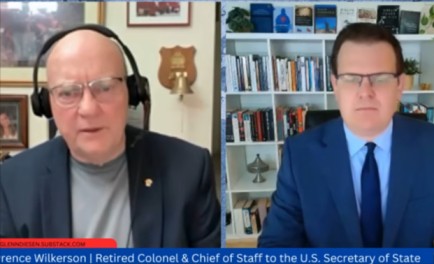
Editor’s Note: In this episode, host Glenn Diesen is joined by Colonel Lawrence Wilkerson, the former Chief of Staff to the U.S. Secretary of State, to discuss the profound geopolitical shifts reshaping our global order. Together, they analyze the complex challenges facing the United States and its allies as they struggle to adapt to an ascendant, multipolar world, driven by shifting power dynamics in Europe, Asia, and the Middle East. From the precarious situation in Ukraine to the breakdown of traditional diplomacy, this conversation offers a stark assessment of the rising risks of international escalation and global conflict.
Introduction
GLENN DIESEN: Welcome back. We are joined today by Colonel Lawrence Wilkerson, the former Chief of Staff to the US Secretary of State. So thank you for coming back on the program.
LAWRENCE WILKERSON: Good to be with you, Glenn.
The Strategic Landscape: China, Iran, and Ukraine
GLENN DIESEN: So there’s a lot of things happening in the world now. For one, Trump appears to be, well, appears to be recognizing that he doesn’t have anywhere to go with the Iranians. I don’t think he’s ready to admit defeat, but we see more of this rhetoric emerging in the United States. But we’re seeing other things as well, the ability of Russia to balance NATO in Ukraine, and also China seemingly prevailing in the economic war.
So if you take a step back, where do you see this going? And how will this compel the US to change course, or do you think it will begin to adjust to being balanced, or do you think the US will continue to push forward?
LAWRENCE WILKERSON: That’s a huge question with both tactical, operational, and strategic implications. Let’s take the top ones first.
One, you know what I think about the inexorable movement of power to the East, and I just say that the strategic situation is that China is winning. And doesn’t want to do anything to interrupt that victory. Will protect its skirts, if you will, but it doesn’t want to do anything to disturb its victory. Very Confucian, very Central Party school, very strategic.
If you look at what Trump is doing, on the other hand, it is all the opposite. And having listened all morning to as disparate characters as Steve Walt and Chris Hedges and David Petraeus and Doug McGregor and a host of others as they essentially opined on what this means, this being the supposed somewhat of an agreement between Iran and the United States. I’m confused, thoroughly confused.
David Petraeus made an ass of himself just as he usually does, both on the Iran War and on Ukraine, claiming that Ukraine was going to be victorious ultimately, it was inevitable and so forth. And I told myself, what’s the new company he’s working for? The BlackRock-sponsored KKR or something like that. He’s shilling for them. So, David, you don’t have Paula Broadwell around anymore, but you do have KKR and they’re just as poisonous.
The Iran Diplomacy Illusion
So all to say that I think we’re to the point where no Iranian interlocutor and US American interlocutor have faced each other, period. There has been no— I have that on really good authority— there has been no talk between a single American diplomat or otherwise, Bradley Cooper, or, you know, what’s his name, Kushner or Whitcomb. There’s been no conversation between an Iranian in responsible position and an American in responsible position. It’s all been, I won’t call them good offices, it’s all been intermediaries. Pakistanis, Omanis, you name it, it’s been intermediaries.
So all of this miracle has been achieved in defiance of the first principle of diplomacy, to quote the man who wrote Relations of Nations— I just lost his name, but he was at Newport at the Naval War College for a while— you can’t do diplomacy without some kind of face-to-face episode, because the first ingredient in diplomacy is trust. And if you don’t have any trust at all and you even have a negative quotient in that regard, you even need it more so to build a little trust. There’s been none of that.
So all to say, I discount this totally. I don’t see anything in this supposed agreement— I’ve read 4 or 5 versions of it— that is feasible, that is going to happen. And I think Donald Trump is frenetic to find a way out of this because he is at least comprehending the disaster he’s causing, in some ways. I don’t for a minute think he’s got the full import of it, but he does have some of it. And the political aspects and the monetary aspects are probably the facets he has the most grasp on.
So I think what we’re looking at is another kabuki show that will wind up with, again, for a third occasion, the Iranians thinking they’re in a diplomatic exchange when the bombs fall again. And this time it’ll be just as ineffective as before, except it will kill a lot of innocent civilians in Iran. And if it includes, as some are telling me it will, a small ground element to try and snatch uranium, we’ll have some prisoners of war and some dead people on the screen in Tehran. So that’s my assessment of where that is.
Ukraine: A Battlefield Laboratory
As far as Ukraine is concerned, as I was telling Lasha this morning, I think Ukraine is being held up by Europe and the United States, and we’re holding them up in part because they are experimenting with incredibly sophisticated technology, and they’re doing it with our dollars and our facilities, really, on their soil. And we’re like Hitler in 1936 in Spain, watching those Stukas dive and amending their performance accordingly.
So in other words, Israel, Britain, the United States, and others are learning from the battlefield in Ukraine and don’t want it to stop. And so they will continue funding Zelensky as long as he is making that continue, and as long as he’s doing this experimentation on new ways of warfare within his country.
So it’s terrible. It’s an awful situation.
GLENN DIESEN: No, I agree. It’s, well, but there’s some—
LAWRENCE WILKERSON: I didn’t mention Putin’s just-ended massive nuclear organization exercise, which tells me that he thinks, one, he’s going to war with NATO inevitably, and two, he might have to use nukes.
Diplomatic Immaturity and Escalation Signals
GLENN DIESEN: Yeah, well, that’s what I mean. I don’t think either the Iranians or the Russians expect any diplomacy or peace coming from the other side. Again, this is the shocking part with the diplomacy, that there is such a desperation to find a peace, yet the Americans and Iranians can’t even sit and talking to each other.
It’s the same with the Europeans. They refuse to even talk to Russia after all these years. It’s very diplomatically immature. I mean, this is absurd that we’re at this stage. But also another similarity is the likely escalation. As I said, neither the Iranians nor the Russians expect that their counterpart will actually want a peace agreement that recognizes a new status quo, that is essentially a post-hegemonic status quo.
And for this reason, the Russians are now having their nuclear drills. The Russians also hit Kiev extremely hard, which we haven’t seen. So they’re signalling a massive escalation. The Iranians are also signalling if the Americans attack again that they will essentially burn the Gulf States to the ground. They will shut off the strait, sorry, the Red Sea as well. So they’re planning their own escalation.
So it’s not a good time for diplomacy. But is this desperation, or how do you see the lack or the willingness to actually mediate with the other side? Because in Europe, it’s again quite absurd. They don’t want the war to continue, they say at least, but they don’t want to talk to the opponent. They demand a seat at the table during negotiations. However, they don’t want to talk to the Russians. It’s quite extraordinary.
How, I mean, your time in the White House, did you see anything similar to this?
Lessons from the White House: Cheney, Bush, and Obstruction
LAWRENCE WILKERSON: I did, in effect, but not necessarily in lasting effect, which was encouraging, at least for a while. And when I say in effect, I saw the Vice President of the United States in the most inscrutable way, that is to say, no one could figure out what he was doing or why he was doing it, block repeatedly the efforts by the Secretary of State, blessed by the President on two occasions, but the Vice President stepping in and even reversing the President. In dealing with North Korea to try and stop them from having the incentive to continue their nuclear program to a bomb.
And very, very decisive moves by the Vice President that one wondered, first of all, where did he get the power to do that? Second, why is the President listening to him? And third, how does that impact what we’re trying to do in a way that we can’t get around it? Which we discovered fairly quickly was that we couldn’t get around it at all. That the Vice President would ferret out whatever we were trying to do, run to the President and stop it.
So I’ve seen that kind of obdurance, that kind of stupidity in my mind before. But never such a sweeping one, and not one that just bespoke itself of total ignorance of what ought to be happening for whatever reason.
Now, I think I understood Cheney’s philosophy as he expressed it was, “you don’t negotiate with evil.” I mean, that’s really putting a— that’s putting too fine a point on it, but he actually said that at one point. “You don’t negotiate with evil.” I think that’s part of why the President, who had this part of him that was truly— and I’m not criticizing Christianity here, but it was truly Christian— and that appealed to the President.
Trump’s Desperation and the Netanyahu Factor
Well, Trump certainly doesn’t have that part of him, but he does have that part of him that says, for whatever reason, I must do what Bibi Netanyahu tells me to do, no matter how much I dislike it or how much I might interpret it to be outside the interest of my own country. Though I don’t think that’s a very frequently used calculus by Donald Trump. I don’t think he gives a damn about the interests of his own country. He just gives a damn about his own interests and his family’s.
So yeah, I’ve seen this sort of thing before, but never in this sort of weird way that Donald Trump has of doing things. I do think right now he’s feeling a sense of desperation. I don’t know if it’s because he’s seeing the things that were going to make him great crack apart, he’s seeing the things that would make him even more billions of dollars not come to fruition. I don’t know what the reason is, but I think he’s desperate.
And I think he’s clutching at straws, trying to find ways out of this. And that straw that he’s going to find is the straw that he found in the first place, and that is resuming military power. And I think he takes some sort of delight in doing it after having introduced the world, so to speak, but certainly America and the parties in the conflict to expectations of hope. I think he likes doing that. He likes then striking and dashing that hope.
Netanyahu’s Dilemma: Blackmail, Desperation, and the Enrichment Impasse
GLENN DIESEN: But we’re hearing all these reports about a massive split emerging between Trump and Netanyahu. Again, I’m not sure if it’s real or not, but also some more credible reports that Netanyahu is also becoming quite desperate, that Israel is in a very difficult spot. Again, this is— the war in Iran, against Iran, isn’t going as planned. The objective was to knock out the main adversary of Israel, begin to reshape the entire region towards its favor, and now gambling everything on this, it’s not going as expected, to say the least. So what are the options for Israel at this point? You know, what to expect from Netanyahu and just try to restart the war and hope for the best.
LAWRENCE WILKERSON: Pull out the Epstein file and fly to Washington and go to Congress. I mean, that’s what I would expect from him. But I don’t think that this is anything but a subterfuge. I think this, you know, Trump telling Netanyahu off, as it were, and Netanyahu being miffed.
The realities of Netanyahu’s situation are, I think, pretty clear. He’s losing in Lebanon badly, if I’m being told correctly. And looking at the post-traumatic stress rates, the suicide rate, and the no-show rate in the IDF, and looking at some of the comments that are actually coming from IDF personnel in Lebanon printed in Haaretz, is a sort of an indication that the IDF is not doing too well. So he’s got these problems, he’s got the political problems, he’s got possibly an election sooner than he thought he was going to have it.
But I think it’s still at a moment which he feels is opportune, even if it happens the way it is happening, being sort of shortened a bit. And if I’m right that he’s got blackmail material on Trump, I don’t know that that’s gone away. So why would Trump suddenly, for example, be willing to expose Melania to what Bibi might release to the press or whatever, when before he wasn’t and seemed to be willing to go to the nth degree to do it? If that’s what the situation is.
If the situation’s Miriam’s billions, I understand that Miriam is a little bit irritated with Bibi Netanyahu right now. So that could be a factor playing in it. But I still think he’s going to go back to the previous course when Iran will not accept ultimately some of these things that he’s saying they’ve got to accept.
The prima facie, prima donna element of which is their enrichment program. I don’t think they’re going to accept that. So how do you back off the one element of it that you were going to hold up as the prize? The pièce de résistance. “I got it. I got what Obama couldn’t get. I got this, a nuclear deal,” and try to camouflage all the defeat with that success, as it were.
I don’t see how this works out for the better. I see it going and getting worse.
The Ukraine War, Russia, and NATO Escalation
GLENN DIESEN: Well, as the United States, stuck in Iran, likely contemplating yet another strike, where does that leave the US in its other campaigns? Because it looks as if Trump wants to dial down the confrontation with China. And, well, meanwhile, it’s unclear where the US stands these days on Ukraine. There’s not much talk about it. We don’t see any pressure on Zelensky or the Russians for that sake. It seems to be something that could change, of course, given that the Russians appear to be, I guess, escalating and, well, essentially putting their foot down, drawing a red line, whatever it might be, to the most recent escalation.
And again, I talked to Douglas McGregor. He was making the point that these drones which have been hitting Russia through the Baltic states, that they’ve been almost certainly directed by US forces as well. So we were talking about a very dangerous area, but on one hand, they don’t talk, they’re not talking about Ukraine, they’re not having any diplomacy with the Russians over this, but the warfare appears to be continuing with US involvement as well.
So where do you see the US going with this? Are they, does the Trump administration still want to put an end to the Ukraine war, or do they want to hand it over to the Europeans? So how do you see this?
LAWRENCE WILKERSON: Well, watch here very, very closely as we conduct a snatch operation either on Havana or wherever Raul happens to be and take Raul Castro out of Cuba. That’ll be a sideshow here coming up very soon for everyone to watch.
That said, I think Putin showed his attention to detail, if you will, with this just concluded, on the 21st of May, I think, major nuclear forces exercise that included Belarus, and almost everything, at least an example of almost everything in Russia’s nuclear arsenal except an actually exploding nuclear weapon. And I kind of halfway thought they might do that, even the exercise details they published, maybe somewhere in the interior of Russia.
He’s fully aware of what’s going on. I think he’s fully aware of who’s helping what’s going on go on. And I think he’s pretty much 60 to 65% sure he’s going to have to go to war with NATO at some point. What that war is going to involve and how big it’s going to become will be principally up to NATO, because I don’t think he will want to widen it after he punishes some little upstart NATO member. There are 3 of them that come to mind immediately, who are doing things they shouldn’t be doing and supporting things they shouldn’t be supporting, whether it’s US or British or whatever troops on their soil doing it or their own people doing it.
So I think we’re in a very dangerous situation here, and I’m glad that Putin is in Moscow, frankly, because he is probably as circumspect a leader in the world as there is, along with Xi Jinping, with regard to this sort of thing. But he’s not going to take it forever and ever. He’s going to respond one of these days, and he’s going to respond in a way that is either going to cause us to have to step aside, step back, move away, or double down.
And I still can’t figure out what Trump’s strategic calculus is, if he has one. I don’t think he has one. I think he just acts. And I’m not sure what kind of counsel he’s getting now. I’m told that his counsel with regard to Iran is definitely not to do what I just said I think he’s going to do. So why do I say that I think he’s going to do it?
If the counsel from the chairman and others — the chairman now, due to the latest amendment to the 1947 National Security Act, has access to the president. He doesn’t have to go through the Secretary of Defense. He doesn’t have to take the Secretary of Defense with him if he goes over to the White House. He can go over on his own as the chairman of the Joint Chiefs of Staff and give his advice as principal military advisor to the President of the United States and the National Security Council. So is Cain going over there and delivering advice that’s contrary to Hegseth’s? I don’t know. But I do think we’re going back to war there, and I think Putin has made up his mind he’s going to have to fight NATO. And I do think that both of these things are very dangerous.
The Risk of Nuclear Escalation
GLENN DIESEN: When you say Russia will fight NATO, do you — again, I would expect a gradual escalation somehow. That is, first you’re going to see perhaps some Ukrainian drones which the Russians have downed and sent back into Latvia. Then you might see a more overt conventional strike before you see something bigger. How do you see the American position on this? Well, how likely do you think it is that the US would join in on the fight, protecting Riga, sacrificing New York in the process, possibly?
LAWRENCE WILKERSON: I think that the calculations in Washington and elsewhere in the military apparatus — and I include the commander-in-chief in that, no matter how distant he is from it — I think that would be: “Okay, it’s done. It’s complete. It’s over. We’re going to chastise you up one wall and down the other.” Or maybe not. Maybe we’re not going to say anything much about it at all. And that should be it. We’re done. No more. “You agree?” “Yes, I agree.” This is a phone call from Trump to Putin, Putin to Trump, and the lesson will be taught and learned, I hope. And people will be more circumspect in future.
That’s what I would hope out of it, but I don’t know that at all. And all of my experience during the Cold War with two very different antagonists, I should say, was very different. Even the slightest use would let the genie out of the bottle and things would unwind from there. I’m not even sure that was the right philosophy then, but I do take it to heart enough to say I think it’s a very dangerous move to make, to be the first one since 1945 to use nuclear weapons against civilians, to use them in anger against a supposed threat. But I do think it’s a possibility, and I do think we’re headed there.
GLENN DIESEN: When you say we’re heading there, do you also think we’re sleepwalking into another world war? I mean, do you see any historical parallels, or how do you view it?
A Unique and Unprecedented Geopolitical Moment
LAWRENCE WILKERSON: I really try to stay away from historical parallels now with this because I think we’re in an entirely new domain. Not in the huge, what you might call the panoply of geopolitical realities, you know, rising power, sinking power, all that kind of stuff — Graham Allison, Mearsheimer, all that. But I do think we’re in a world where technology is changing so fast, militaries are changing so fast, the offense — which, since the blitzkrieg at least, has been dominant on the battlefield — is now not dominant. Defense is dominant.
You’re talking about Ukraine actually working with these, as I understand it, microwaves now that go out and blanket within a few kilometers at least the area that they’re positioned in, and no drone can fly. Takes care of everything, every drone threat in the area. But they’re very expensive. They’re very hard to move around. They have to be manned. They have a short range, 2 to 3 kilometers, and you’d have to saturate the battlefield with them. And there aren’t that many now, and there aren’t that many people to operate them. So the battlefield is changing enormously, more so probably than it’s changed in 100 years, in the speed of time in which it’s changing, in part due to the conflicts, proliferation of conflicts.
So I’m reluctant to go back and try to drag something out of history and say it’s like this or it’s like that, because I think in many respects this is unique. And I think in many respects that is part of the problem, that it is unique and it comes up and hits people in ways that these sorts of things have generically perhaps hit people before, leaders before, but not in the specifics. It’s not 1914. It’s not 1939, 1940. It’s a very different time. It’s a very different set of circumstances, a very different set of militaries and developments, technological and otherwise, a very different set of characters, a very different confluence of powers.
And one of the most unique things is it’s got one power that is clearly dominant in the world now whose entire strategy is: “Let the bastards kill themselves. Don’t do anything to impede that, but if you have to step in at all, step in to arrest the speed with which it’s happening, because that speed in and of itself may blow back on us.” This is a very different set of circumstances, I think, that we’ve had, at least in the modern age. And it’s therefore more difficult to parse and figure out what’s going to happen, if you can even parse it at all.
And you don’t have good leadership either. That’s a similarity with 1914, a very distinct similarity. You really don’t have good leadership except in this ascendant power and the power that doesn’t want to get involved, and in some of its allies, one of whom is significantly involved in Europe. It’s an extraordinary set of circumstances, really.
Capabilities Versus Intentions
GLENN DIESEN: Well, the intentions are hard to read, but in terms of the capabilities, I want to try to see what the Europeans and the United States might do, because you witnessed the Iraq War buildup from inside the government. Do you see something similar now? I mean, are the Europeans ready to fight Russia in any significant way? And has the US prepared itself for another round against the Iranians? How are you seeing the actual buildup? Because it’s very hard to read intentions these days. I’m hoping that some of our leaders don’t actually believe the nonsense they’re spouting, because a lot of this is becoming quite terrifying. But again, you never know who the audience is, if it’s the public or the adversary. But in terms of the pure capabilities which are being built up — or are they being built up at all? Because we’re here in Europe, hearing a lot about the governments arming themselves, but it doesn’t seem to have produced something very significant yet.
LAWRENCE WILKERSON: That’s a key word, I think, for this miasma — capabilities. What are the capabilities? For example, take the United States. It is being stood down and defeated by what aren’t capabilities, supposedly. I mean, there are no aircraft carriers, there are no B-2s, there are no F-15s, no F-15 strike fighters. There’s nothing in Iran’s repertoire. I mean, Trump’s destroyed their navy. He’s destroyed their air force, according to him. They have no capabilities, and yet they’re going to beat us. They are beating us because the nature of warfare and the nature of interpretation of the conflict enshrouding that warfare has changed so greatly, and powers in the world and their capabilities are not keeping up with that change. Their capabilities are not capabilities. They were, but they’re not anymore.
So it’s a very dynamic period, to say the least. And it’s a period in which the predominant powers in the world are one who doesn’t want to get involved at all — and worried that to get involved would probably change the calculus majorly — because it has been watching, it has been studying, it has been doing the kinds of things it needs to do to stay attuned with these changes. And it has an ally that is part and parcel of participating in the changes right now and has also built up its defense industrial base to that regard. And a descending power that’s absolutely lost, both in terms of leadership, the cohesiveness of its governance process, indeed the cohesiveness of its people, and its ability to strike back, except in one way.
And this is the common denominator to a certain extent — nuclear weapons. So there’s never been a time, as the Bulletin of Atomic Scientists keeps saying, that we were closer to the use of these weapons than now. And there are different reasons for that, but I think the predominant reason is rising power, descending power. “And I am going to stop the descent, and this is the only way I can stop the descent. And I have allies who will participate with me, maybe.”
Shifting Alliances and America’s Declining Influence
GLENN DIESEN: Well, this is the uncertain aspect as well, to what extent the allies will still be there tomorrow. I mean, when you have this huge shift in power and the way wars are fought, it’s almost a delusion to assume that the alliances won’t shift as well.
LAWRENCE WILKERSON: And it’s moving very slowly right now, but we’re losing Korea. We’ve already lost 40 and under in Korea, and I’m sorry, but 40 and under is going to be the future very shortly. We are probably losing Japan. We’ve probably already lost the Philippines. We just don’t know it. And you see NATO — where is NATO with regard to the United States? Only with us if they’re in duress to the point where they need us.
GLENN DIESEN: Well, what is happening to Korea though? How serious is the talk there about decoupling from the United States?
The Generational Shift and the Future of US Alliances
LAWRENCE WILKERSON: I think it’s very serious. I’ve been watching the polls for almost 20 years now. I quit going to the peninsula because I don’t— long-range travel, I don’t do it much anymore. But I was on the peninsula almost every year from about 1979 to roughly 2005, 2006, somewhere in there.
And spent a lot of time when I was at the State Department with the Korean Joint Chiefs of Staff. And with people like Bill Perry playing on the US side and their equivalents on the Korean side and playing in Pyeonghwa 1, 2, 3, 4 different exercises. So I’ve watched the Koreans go from having a pretty much solid age group support of the alliance to having increasingly the younger Korean you were, the more you felt the number one threat in the world to you was the United States of America.
And it had to do with our presence in the key areas we were in at that time. We reduced that presence because we recognized that. We moved south. We moved out of some key areas. We got out of the Koreans’ hair, in other words, especially young Koreans. But it’s not helped by things like, okay, we got Israel over here. They’re out of THAADs. Let’s take the THAADs off the Korean Peninsula and send them to Israel. Oh, you don’t think we need them?
I don’t give it much more than a decade, if that, and we’ll be off the peninsula. Plus, they understand that having us on their soil— and Japan is beginning to understand this too— is more dangerous than not having us. More dangerous having Americans on your soil than not having them. Korea doesn’t want to fight China. Japan doesn’t want to fight China, really, regardless of the new belligerents there. They don’t want to fight China. They want to stay in the security relationship because they’re scared to get out of it, but they will eventually. And the Philippines, I don’t even need to talk about the Philippines.
And I even have to go to Australia and I have to go to other countries in the region who should be our friends and ask myself, are you talking about the 40 and below or are you talking about the 41 and above? And it’s usually the latter. It’s like Tom Massey’s election in Kentucky, or failure to be elected, or to be the primary candidate for the Republicans. If you look at the numbers, people below, I think it was 40 to 21, something like 70% of them voted for Massey. 42 to 50, 60%. 50 to 65, 51%. All voted for Massey. 65 and older voted overwhelmingly for his opponent.
That tells you something. That tells you that the old people are running the place. They vote. The young people vote, but not in the numbers the old people do. One, because they gotta work and the old people are retired or whatever. I found this out. Most voting category in America is 65 and above. The reason I used to talk to those audiences all the time, still do.
But that’s the change that’s coming, the generational change that’s coming, and it’s coming in all these allied countries too. I suspect if you went around in Norway and Sweden and Germany and France and other countries too, you’d find a similar demographic divide in terms of the way people vote and what they feel. I don’t know that as well as I do in Asia, but I would guess that there’s a similar phenomenon.
So that’s what’s going to change a lot of what’s happening in the world, including our alliances, because these young people don’t want us. They don’t want us around. They don’t want to be near us. And I will tell you this too, those percentages have been deepened significantly by our support of Israel and Gaza.
Deterrence or Provocation?
GLENN DIESEN: That doesn’t help at all. Well, it seems to me one of the things that could push us over the edge into war is that many of our political leaders seem to quite genuinely believe that what they’re doing is not provocative. They interpret it as being simply deterrence. You heard this rhetoric for a while, and indeed, even when they expand NATO, the common rhetoric is that, well, NATO is not provocative, it’s a defensive alliance.
And it seems also, to get back to the original topic, when there’s a lack of diplomacy, when you don’t really address and reduce the security concern of your opponent, how do you have security then? And it appears, especially in Europe now, the only answer, the only thing that creates security now is deterrence. That is, we need as much weapons as possible pointed at the Russians, and this is somehow the magic silver bullet to gain security. But when does deterrence become provocation? Because I think this is a key in the way that, at least European leaders, are thinking.
LAWRENCE WILKERSON: I think you’re right. I think there’s a very, very delicate balance between deterrence on the one hand and provocation on the other, as you put it. And I think if you go at the world with the idea that your arms buildup, your arms race, whatever, is what really provides deterrence, you’re coming at it from the wrong end.
What provides deterrence, if you will, if that’s the right phrase for it, is diplomacy working out the differences to the point where you trust each other enough to where you don’t have to spend yourself to death building deterrence. And you could say we simply don’t learn that lesson, but part of it’s the dynamics of the way the world’s shifting right now and people’s uncertainty and insecurity in that change. And lack of trust because of that.
I don’t know what you do about that other than you have to talk. You have to talk. You have to deal with one another. The last thing you want to do in an environment like this is cut off talk. Not talk to the Russians. We’re not talking to the Russians. We don’t talk to the Russians. Sure. Joe Biden was a curmudgeon in that regard. “No one in my administration will talk to the Russians. Understood? No one’s going to talk to the Russians.”
That’s dangerous. That’s absolutely the wrong approach to take. The more dangerous the situation, the more you need trust and the more you need talk to build that trust. I mean, that’s the heart of diplomacy. That’s the heart of international relations.
Making Russia “A Little Desperate”
GLENN DIESEN: Well, one month before the April 2008 NATO summit where NATO offered future membership to Georgia and Ukraine, Tony Blair, of all people, according to a WikiLeaks cable, told the Americans that the strategy towards Russia should be to make Russia “a little desperate” about their activities along Russian borders. And in his words, Russia should be “shown firmness and sown with seeds of confusion.” So this was kind of the recipe for stability, to make sure that they feel intimidated and desperate. No one knows what the Americans and British are doing on their borders. Again, it’s hard to understand how this is intended to fuel security.
But we see the same now with the rhetoric around Kaliningrad. The European leaders are saying we have to deter the Russians. So we’re going to put more pressure on Kaliningrad. Again, it’s an enclave. It’s cut off from the rest of the Russian territory, surrounded by NATO countries. We’re talking about blocking access in the Baltic Sea, putting more pressure. There are talks about the ability to invade. And this is deterrence now.
I used to teach deterrence at the university, and this was not in the textbook. Deterrence is supposed to prevent the adversary from changing the status quo, but this is revisionism when you try to put the opponent under increasing pressure. This is seeking capitulation. And if a war sparks in the Baltic Sea over Kaliningrad or the Baltic States attacking, we’re going to hear this word again — “unprovoked.” “We were just deterring them.” It’s quite extraordinary.
America in Deep Trouble
LAWRENCE WILKERSON: I agree with you. I don’t know what lexicon, what vocabulary, what book they’re referring to when they say things like that. And I don’t understand how Europeans in particular, confronted with the power of geography and the power of the past, can talk that way about the giant that is Russia. You have to come to some modus vivendi, and your modus vivendi can’t be based on, “I’m going to pull up to your border and make you really uneasy 24/7 in order to establish this living method with you.” That just— that’s bull. That’s Victoria Nuland. That’s Fred Kaplan. That’s all these people who think that way all the time. I don’t know how you get out of that except to get rid of those kind of people. But they’re all over the place. So that’s hard to do.
But then you come to us and you find a person you can’t even figure out. You have no idea what’s motivating Trump. I mean, you make some good guesses. They’re scary guesses, frightening guesses. But I don’t know how you judge us right now. I have no idea how to evaluate us. What are we doing? Are we trying to establish deterrence by supporting Ukraine? I don’t think so. I think we’re trying to make money for some defense contractors, and we’re trying to do some things that want to be done by MI6, Mossad, CIA, and others. And they think that they’re important. And we don’t have a president who’s willing to step in and bash their heads.
We haven’t had a president willing to step in and bash their heads for a long time, actually, since George H.W. Bush. And he could step in and bash their heads because he lived amongst them for 40 years and he knew them and he’d helped them with some of their most perfidious activities.
Don’t ask me how to solve this problem, particularly not for America. I think we’re in deep trouble. We’re in deep trouble domestically and internationally. We’re in deep trouble.
Failing to Adjust to a Multipolar World
GLENN DIESEN: Yeah, well, it doesn’t matter how the situation changes. We kept expanding for 30 years through all these forever wars. Now you have new centers of power emerging, balancing us, yet there’s no sense about any need to change strategy and just continue to live as if it’s the 1990s.
LAWRENCE WILKERSON: Well, we are all supposedly liberal democracies, so maybe we’re just late with the elections. Maybe we’re going to have a sea change when we have new leadership, and maybe it’ll be in time. I can’t even say that about my own country, though. Supposedly the leader of the free world, as it were. We probably won’t even have elections. That’s my guess right now. I put it 60/40 we don’t have elections.
GLENN DIESEN: Well, on that horrible note, we’ll leave it there. Thank you so much. I hope— I really hope you’re wrong on this. But again, there’s—
LAWRENCE WILKERSON: No one hopes I’m wrong more than I.
GLENN DIESEN: Anyways, so thank you so much for taking the time and I hope to see you again soon.
LAWRENCE WILKERSON: Surely. Take care.
Related Posts