Share & Care!
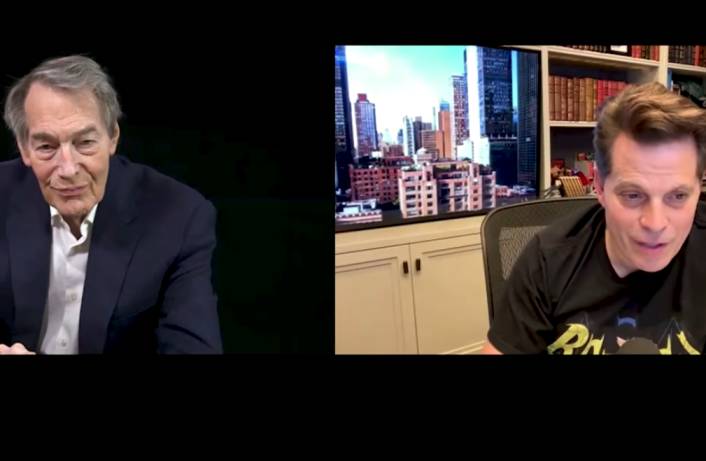
Editor’s Notes: In this episode of A Charlie Rose Global Conversation, Anthony Scaramucci joins Charlie Rose to discuss the evolving landscape of American politics and the future of the country. As a figure who operates at the unique intersection of business, media, and government, Scaramucci provides a candid look into his perspective on Donald Trump’s leadership and impact. The hour-long dialogue explores the current challenges facing the United States and what the road ahead might look like for its citizens and global standing. This deep-dive interview offers viewers an insightful perspective on the shifting dynamics of the American presidency and the national political climate. (Feb 8, 2026)
TRANSCRIPT:
The Crisis of Deficit Spending and Inflation
ANTHONY SCARAMUCCI: George Washington to George Walker Bush, $7 trillion of deficit spending. From Barack Obama, Donald Trump, Joe Biden, Donald Trump, $31 trillion of deficit spending. And so by unclipping us from pay as you go to fight these wars, we touched off an unstructured level of mania that led to a crisis of confidence in the United States. We printed money to pay for these wars.
And sir, you know this as well as anybody. The most pernicious, most regressive form of taxation is inflation. And so what we did is we inflated the money away. And you can go to truflation.com and you can see these numbers, but we’ve lost 28% of the value of the US dollar since January of 2020.
Now, sir, if you own assets, you’re hedged and protected. But if you’re from a working class family like me, where my dad made his money through his labor and had no assets, you’re stealing his time and you’re stealing his life away by devaluing the money that you’re giving him to go purchase things for his family. And this has created a tremendous amount of anxiety in this country.
So the first 25 years of the 21st century were marked by a period of executive incompetence at the federal level. And this has to be restructured. We have to reflect upon this and we have to fix this. And if we fix this, we will heal the tribalism, we will heal the culture war, we will heal the country because this country is still an amazing place.
CHARLIE ROSE: Anthony Scaramucci lives and works at the cross section of business, politics and media. He grew up the grandson of first generation Italian Americans and attended Tufts University and Harvard Law School. He began at Goldman Sachs and later started two companies including Skybridge Capital. He has supported Democrats and Republicans and taken an active interest in political issues.
Scaramucci is the author of numerous books and appears frequently on television. He served for 11 days as the communications director for President Trump in his first term, but later supported President Biden in 2020 and Vice President Harris in 2024. He has co-hosted with Katty Kay the US edition of The Rest is Politics.
This is an important moment in American politics as the country faces the midterm elections and President Trump makes important decisions about the US role around the world. We will talk about many things, including the Trump presidency and the future of America. Anthony Scaramucci is not hesitant to express many things which you and I may not agree with, but we need in America an enlightened debate of who we are and where we are going. I’m pleased to have Anthony Scaramucci join me for this Zoom. Thank you for coming. It’s a pleasure to have you here.
ANTHONY SCARAMUCCI: Well, the pleasure is mine, actually. You know, I’ve been looking forward to this, Charlie. Thank you for bringing me on.
Three Critical Dates in American History
CHARLIE ROSE: I want to start with a notion of three dates, recent dates. One is December 31, the end of the first quarter of the 21st century. Secondly, January 20, the end of the first year of the Trump presidency 2.0. And third, July 4, 2026, America celebrating its 250th birthday. And talk about all the values that you have seen and you believe in. But let me start with Donald Trump. Tell me what’s the best and worst of him?
The Duality of Donald Trump
ANTHONY SCARAMUCCI: Well, I mean, there’s a lot there. And I’m going to go to the three dates in a second. But with Trump, it’s a very complex thing. You know, there’s good Trump and bad Trump. He’s born on June 14th. He’s a classic Gemini. He’s got the evil twin and the good natured twin that he’s constantly fighting with.
So what’s good about him is that he’s relatable to the American people. And what’s good about him, whether people like this or not, he’s identified something core going on in the body politic of America, in the spirit of America, where there’s a lot of people, Charlie, that feel left out of America. We’ve disengaged from a very large group of people.
And these are people that I grew up with. You know, my dad, to know my background, my dad was a crane operator. He worked out here on Long Island. He was an hourly worker. His father, my grandfather, was a coal miner in northeastern Pennsylvania. And so I grew up in a middle income, you know, we would say in the United States, working class or middle class. You know, the Brits don’t use middle class, but I would say working class people.
We had a small house. My dad paid $16,000 for it. He had a 30 year mortgage like everybody else. He had a mortgage burning party. I went to a good public high school and I went on to Tufts and Harvard. And I would describe myself as living in the aspirational working class. My folks thought for sure their kids were going to move classes, live the American dream.
Today’s people in that demographic feel economically desperational.
CHARLIE ROSE: Well, give me the bad part.
ANTHONY SCARAMUCCI: The bad part is that he has demons in his personality, where there’s some level of inadequacy there and there’s some level of insecurity. He’s never felt comfortable on the inside. He’s what I would describe as an uncomfortable outsider. By the way, I’m an outsider. I didn’t even grow up in the outer boroughs. I grew up way out on Long Island. But I see myself as a comfortable outsider.
I don’t mind not being invited to the country clubs. I don’t mind not being in the Upper East Side salon dinners or the various charity boards. Mr. Trump does. It really bothers him if he doesn’t get into Deepdale, a club that you and I know well, which is only two miles from my home. It upsets him. He goes on to make 18 golf courses, that sort of thing.
And so he’s about himself. And rather than serving those people that have galvanized around him, he’s fixated on two things. He’s fixated on your attention, and I mean that universally, the attention of other human beings, and he’s fixated on making money for himself. Those are the two things. He’s not fixated on leading the country, providing a macro vision for the country, restating the elements of that declaration from 250 years ago. He’s not. He’s not focused on any of that. He’s focused on what’s in it for me. And enough of me talking about me, Charlie. What do you think of me? That’s his narrative. And so that’s him.
A Turning Point for Trump
CHARLIE ROSE: Are we at a moment because of Minnesota, because of the Epstein files?
ANTHONY SCARAMUCCI: Yes. I mean, we’re at a moment. We’re at a turning point. He has become a weaker political figure in the last four weeks as a result of over pushing this ideology. And so to set the scene for you, we are in an age of tribalism. We’ll go to the first 25 years of the 21st century, but we’re in an age of tribalism.
And it’s not enough for me to beat you ideologically. I have to own you. Or to use the expression, I have to “own the libs.” And so I have to do outrageous things. I have to put the Obamas in monkey outfits and put their faces on monkeys. And so this is the behavior. It’s not only the ideology that I have to push, but I have to create heat. I’ve got to create anger in the system, seething anger, for that matter.
You know, that’s not spirited, inclusive leadership. Even if you think your side is right ideologically versus the other side, it’s not the way to run a country. It creates a lot of animosity and a lot of dissension. And so he’s become weaker. I think Minnesota has made him weaker. I think the fact that he’s coming up against the lame duck period of his presidency, he’ll jump over that in November, is going to make him weaker, which will probably cause him to lash out more, frankly.
But in truth, we’re at a period of time in the United States where we want to beat each other up ideologically. It’s not enough for me to live my life culturally the way I want to live it. I need to impose my life on you, okay? The left is doing that as well. The hard left wants their lifestyle imposed on you and me, Charlie, and the hard right wants it. And so depending on who gets in power, it’s like this cultural pendulum and they go after each other.
And so Trump’s doing that. And the stuff he’s done in Minnesota is prima facie bad. Okay? It looks like murder. We can have all the equivocation of what’s going on, but we can, you know, don’t believe our lying eyes. It looks like murder. And the American people don’t like it. He’s got a 61% negative approval rating as you and I are speaking today.
CHARLIE ROSE: Is there taking hold something in the country that will change his administration?
America’s 80-Year Cycles of Upheaval
ANTHONY SCARAMUCCI: Well, maybe not his administration, but maybe the future of the country. And remember, I want to break the country up into three 83-year units of time. Okay? We’re a 250-year-old country. And so let’s start with the Declaration of Independence. We go through it in this country every 80 or so years. It’s almost like if Neil Howe’s book “The Fourth Turning” is correct, 80 years, you have this political upheaval, this cultural upheaval.
And so you go 80 years from 1776, that gets you approximately to the Civil War. We have this great war. 600,000 of our fellow citizens die in the attempt to heal the original sin in the Constitution. Eighty years after that, we end up in the Great Depression. Thankfully we get the rise of Franklin Roosevelt, who was a suitable statesman at that time, beating back the forces of Charles Lindbergh and people like Father Coughlin.
CHARLIE ROSE: The America First group.
ANTHONY SCARAMUCCI: Yeah, the America First people. You know, Huey Long, Father Coughlin. So Franklin Roosevelt, very adept politician. And again, you don’t have to agree with every one of his policies or him personally, but he guides the country, he has great popularity, he wins the presidency four times and he helps us set up the next 80 years, which is the American Renaissance or what Henry Luce would have called the American century.
But now we’re at that crossroads again, sir. Right, so 80 years to the Civil War, 80 years to the Great Depression, 80 years out again, or 90 years from the Great Depression. And we are at a crossroads where the younger people don’t remember the fabric and the original design of the post World War II rules-based order.
Political Malpractice by American Elites
And then we did something that our elites have to be prosecuted for. There’s been a political malpractice by our political elites. This is an indictment of both parties. They didn’t hear the call to the working poor. They didn’t hear the call to the lower middle class. They offshored too much manufacturing. They overly bought into the process of globalism. They believed Francis Fukuyama at the fall of the Berlin Wall.
CHARLIE ROSE: The end of the American century.
The End of History and Political Duopoly
ANTHONY SCARAMUCCI: Yeah, and at the end of history. The end of history. And so therefore we’re going to have this collaboration with the Chinese. They’ll eventually move themselves to a democratic form of capitalism as opposed to stay in a single party, hegemonic authoritarian system.
And last but not least, because of Ross Perot. And I really believe this, Ross Perot scared the daylights, Charlie, out of the Democrats and the Republicans in 1992. He got 19.9% of the vote, scared the daylights out of them and they collapsed and strengthened their duopoly. It’s much harder procedurally post-1992 to start a third party, organize a third party, run for president, get yourself on the ballot in 50 states.
And then that emboldened them to take the step of gerrymandering. We’ve been doing the gerrymandering for 200 plus years, but they’ve made it way more ridiculous and way more aggressive. And I’ll just point this out to your viewers and listeners. We have 435 congressional districts, Charlie. Only 22 of them are going to be contested in the midterm elections because we’ve strained out our adversaries. And even though the Congress has a 14% approval rating, we have a 95% incumbency reelection rate.
So this system that has been built, this infrastructure, this architecture for the political class sustains them. They can stay in power. Chuck Grassley, who I think is probably 600 years old, I think he’s older than you and me combined, Charlie Rose. And he’s been in the Senate for, I don’t know, dating back to George Washington. And he’s running for reelection again. And long after you and I are gone, him, Keith Richards and Willie Nelson are going to inherit the earth. And he’ll be the senator from Iowa, long past you’re in my sell by date.
So this sort of stuff is ridiculous. And it hurts the American people. And the last point on this is Citizens United. And so when Scalia said it was okay to give unlimited amounts of your money to political causes or political candidates through political action committees, it geared the entire legislative agenda of the United States to big business, big pharma, big food, billionaires, tax cuts for the rich, corporate welfare, etc.
Go look at the legislative agenda since Scalia rendered that decision in January of 2010. So we are in sore need of structural reform. And you’re saying something by your questions, which I do believe you’re looking at it saying, hmm, Trump has jumped the shark here. Trump has pushed past beyond, through the extremism of what he’s doing, and he’s causing now some reflection for the American people. And that’s what happens to us. We reflect, we then seek redemption.
Growing Resistance to Trump
CHARLIE ROSE: Well, I’m even suggesting, I’m asking rather than suggesting, is there a growing resistance?
ANTHONY SCARAMUCCI: There is. There is, in fact, caused by—
CHARLIE ROSE: I mean, we’ve had other opportunities in terms of what you might have thought it would happen, and it did happen in small part. But somehow Minnesota, and especially those two killings, those two murders seem to have made a difference. I believe it is in terms of how the public. No question, Republicans and Democrats.
ANTHONY SCARAMUCCI: Yeah, I think the optics of that are terrible. I think the American citizens don’t want to be attacked by their government. I think that the American citizens are rightfully fearful of unlawful immigration or illegal immigration. I understand that. Milton Friedman, the great conservative economist, would have said, if you have a welfare state, which the United States does, you have to protect your border. Otherwise market forces dictate that people will flow across the border.
And so Joe Biden, I think, was terrible on the border, and Donald Trump has done a better job. But now he’s brought the border activity into the cities and he’s doing it in blue collar, blue state cities, which I don’t personally like. And I think it’s sending a message to people that there’s a level of impunity and there’s a level of cruelty that the American people are rejecting.
And so I’ll submit to you that what we do in these periods of time, if you study America, it’s a neurally plastic society, lots of immigrants, lots of risk takers, lots of strivers. But what we do is we get dunked. Civil war, depression, this experience we’re now having in terms of the intellectual, tribal civil war. Then we have a period of reflection and a period of redemption, and then we have a period of renewal.
And so I think Trump is ironically going to force that on the American people. I think people are saying, whoa, this is not going the way we had intended. We don’t want the excesses of an imperial presidency. We don’t want the excesses of the abrogation of the rule of law in the society. And a result of which is going to cause—
CHARLIE ROSE: This is not the America I believed in. Some are saying, yeah, well—
ANTHONY SCARAMUCCI: Well, I think they’re saying more than that. I think they’re saying, not only is this not the America that I grew up in or the America I believed in, but I’ve got to now take responsibility and I have to activate as a citizen and I have to decry what’s going on. I have to speak out about it. And that’s something that, frankly, that I have been doing. And I think you are a voice in that. But I think there are many voices and there are voices on the right and left. Lots of people on the right have broken from Trump over the wars, have broken from Trump over what he’s doing in places like Minnesota.
Voices Breaking from Trump
CHARLIE ROSE: Who are they in terms of breaking with Trump? Venezuela is one issue.
ANTHONY SCARAMUCCI: Yeah.
CHARLIE ROSE: But support for Ukraine is another issue. Separate issue.
ANTHONY SCARAMUCCI: Well, yeah, well, listen, look, I’ll give you a couple.
CHARLIE ROSE: Right off the top of Gaza is another issue.
ANTHONY SCARAMUCCI: Tom Massie has broken from Trump. He’s basically telling you that, yes, he supports Republican ideology, but he seems like—
CHARLIE ROSE: A voice in the alone to me.
ANTHONY SCARAMUCCI: Yeah, yeah, well, I mean, Marjorie Taylor Greene is in there with him. Sean Ryan, the very high profile podcaster, has broken from Trump. Joe Rogan hasn’t completely broken from Trump, but Charlie, to your point, he has denounced the killings in Minnesota and he’s called this gestapo-like behavior.
CHARLIE ROSE: Exactly. I was going to say worse than just denouncing. He’s basically said gestapo-like.
ANTHONY SCARAMUCCI: Yeah, exactly. So, and by the way, he’s an interesting guy because he is at the pivot. He’s at the intersection of these swing voters, these single men in their 20s, 30s and 40s, who are sort of the alpha dog males, if you will, that cling to Donald Trump. He’s providing space for them to disagree with Donald Trump.
And listen, I hear you, Massie is, you could say alone, but he’s not alone because you’re a good journalist and Republicans, who I still talk to because I was a lifelong Republican donor, they dislike Trump. Tillis dislikes Trump. He’s leaving the Senate from my home state.
CHARLIE ROSE: Yeah, but my question is, have they not spoken out out of some culture of loyalty, or have they not spoken out because of the fear?
Fear and Intimidation
ANTHONY SCARAMUCCI: Fear, fear. The whole thing is very, very intimidating. He’s taken John Bolton, who has spoken out against him, and he’s trying to prosecute him. General Milley, who has spoken out against them, went to get a pardon from Joe Biden. They took his portrait down from the Pentagon, and they’re trying to figure out a way to demote him. Esper spoke out against him. Tillerson, Mattis, John Kelly. John fired me, actually, but he’s become a very close personal friend.
CHARLIE ROSE: Fired you as chief of staff at the White House.
ANTHONY SCARAMUCCI: Yeah, he fired me when I was a comms director. He fired me after 11 days. Trump wanted me fired, which is fine, and I accepted that firing and always have been accountable for being fired. I didn’t blame the president for that. And I tried to stay loyal to the Republicans. I had to break from Donald Trump when it became impossible, when the goalposts continued to move away from Republican orthodoxy.
Limited government. Trump is for an expanded government. End the forever wars. Trump wants to continue the forever wars. Fight and denounce pedophiles. Trump wants to hide them. Trump is for judicial activism. Trump is not a Republican. He says that I’m a RINO where I’m a Republican in name only, but that’s not true. He’s the Republican in name only.
And I would submit to you that he did a very successful job at decapitating the Republican Party, the party of Abraham Lincoln, and installing the MAGA party inside that party and then keeping the name Republican. It was an M&A transaction that was hostile, but very successful.
What Would You Ask Trump?
CHARLIE ROSE: So if you were interviewing him tomorrow, what would you most want to know?
ANTHONY SCARAMUCCI: I mean, he’s never going to tell you, but what is up, dude? Why are you so wildly insecure? And why do you need to emasculate people and humiliate them in places like Davos or the Oval Office, like you did to Zelensky or the president of South Africa? Why are you such a hollow vessel where you need to punish people who are actually on your side?
And, oh, by the way, what is the deal with the Vladster? Because you support Vladimir Putin uber alles. He’s got a small declining economy, smaller than the GDP of Italy. He has a failing military industrial complex. He’s basically on the verge of collapsing. And but for you, you’re supporting him in a way that’s completely unnatural to the American experiment. So what does he actually have on you that we all would like to know?
CHARLIE ROSE: And you believe he has something?
Putin’s Leverage Over Trump
ANTHONY SCARAMUCCI: There’s no question in my mind that he has something. Charlie, when the windows open and you hear clippity clop, it’s a horse, Charlie. It’s not a zebra, okay? There is no question that story. There’s no question that this guy has something on him, because nobody would act like that. And Trump bullies everybody but the people that have things on him.
Xi has economic might and power on Trump. So when Trump is flexing tariffs and these nonsensical tariffs going on again and off again, all Xi did was flex back a little bit, and Trump folded like a cheap suit. Putin is a totally different story. I think Putin has kompromat on him, as evidenced by everything that you’re seeing in these Epstein files.
And I think he’s got so much on him that Trump will never once waiver. He’ll say a few iffy things about Putin here or there to throw people off the scent, but he will never do anything against Vladimir Putin while he’s in the White House. And he didn’t do anything against him in the first term. And so that is evidence to somebody like me. And by the way, most people close to it, Mattis, all those guys, Kelly, McMaster, we all had the same reaction. What does Putin have on him? None of us know, by the way. But what does he have on him to cause this type of conforming behavior?
CHARLIE ROSE: Wouldn’t you think that somehow it would have come out by now?
ANTHONY SCARAMUCCI: Well, I think that’s the nature of this stuff. If you look at active measures from the KGB and you look at what they’ve tried to do over three or four decades, they’ve tried to honey trap and they’ve tried to ensnare very important, very influential people. And then, of course, they’ve tried to hold this information very close to their vest as a pivot point of influence over those people.
So, no, in fact, if anything, I think when someone says there’s a pee pee tape, that’s typical KGB stuff, they’re throwing you off the scent of what it really is.
Putin’s KGB Background
CHARLIE ROSE: When I interviewed the second time, Vladimir Putin, I said to him, you know, there is talk in Moscow that once a KGB agent, always a KGB agent.
ANTHONY SCARAMUCCI: Yeah.
CHARLIE ROSE: He looked at me and started smiling and he said, “It’s true.” Yeah, true.
ANTHONY SCARAMUCCI: Well, we know, listen, he was an asset in East Berlin, where many of my friends were.
CHARLIE ROSE: The wall came down.
ANTHONY SCARAMUCCI: Yeah, yeah, he was an asset in East Berlin. He has a very interesting story. One of his, his mother barely survived the battle of Stalingrad. He worked with a lot of human rights groups during the dilapidation of the Soviet Union when he was the deputy mayor in St. Petersburg, to try to feed people. He’s another very interesting, very complex guy. But what he does have, and not that I can get fully in his shoes, but he does have a lot of Russian pride and there’s a lot of Russian nationalism as part of his agenda.
CHARLIE ROSE: He clearly does because he talks often about Russian speakers, even in Ukraine and in other places where they clearly—
Putin, Ukraine, and the Failure of Western Response
ANTHONY SCARAMUCCI: Exactly. But the problem for Putin is one that you get. He was trying to be included in the G8, he was trying to be included in Europe. But it’s an interesting landmass and it’s a very difficult political system. It’s covering 13 time zones. It’s really part of Asia and it’s part of Europe, but it’s really not either. And it’s sort of this Eurasian block of land that has never really been run by anything other than an authoritarian for thousands of years.
And so he was never able to make the full tie to the West. And so he broke from the west right after Sochi and he took Crimea. Now, Obama should have brushed him back on that because we had a 1994 agreement. The Pentagon called it the Operation Porcupine. We were sending anti-tank, anti-ballistic missiles, anti-aggressive armory to the Ukraine. And you know this. And perhaps your viewers and listeners know this. Ukraine was the sixth largest nuclear power.
CHARLIE ROSE: Absolutely.
ANTHONY SCARAMUCCI: After the demise of the Soviet Union. And so Bill Clinton wanted those nukes back. He negotiated the recapturing of those nukes in exchange for security guarantees. And the first real blow to this, this sort of Chamberlain-like blow, actually came from Obama, where Obama was like, okay, he’s in Crimea. We’re not going to budge. We’re not going to fight him over Crimea. And I think that was a very big mistake at that moment.
CHARLIE ROSE: Because it gave incentive to him to do it again.
ANTHONY SCARAMUCCI: Well, but not only incentive. Remember how these guys think. The west is weak. The west is weak. I’m strong. The west is pliable. I just pushed them out of Crimea. I’m going to push them out of a large part of Ukraine, if not all of Ukraine. And you know this as well as I know this. At the Munich Security Conference, February 2022, when Zelensky showed up, people thought he was going to dispatch himself to the US or another place in the world to exile himself while the invasion was going to last a week.
But this is the Russian Civil War, my friend. These are brothers fighting brothers over ancestral land. And so you know this as a Southerner, that they’re going to fight it out to the last guy standing unless there’s an intercession from a hegemon like the United States that would create the peace.
CHARLIE ROSE: And with great courage and bravery.
ANTHONY SCARAMUCCI: And with great courage and bravery. That is 100% correct. And that’s what’s going to continue on that front. And because of Trump, it’ll stay as a stalemate through his term. They’ll still be fighting into 2028.
The Greenland Controversy
CHARLIE ROSE: You mentioned Davos and Trump’s speech about Greenland. Do you believe that he’s foregone the idea of invading Greenland?
ANTHONY SCARAMUCCI: Well, he’s been told by senior Republican senators that they don’t have the 20 votes yet to impeach and remove him from office, but they would move on him. They told him that that’s a step too far for them. He had people training for an Arctic invasion, and you had American military calling lawyers because they’re like, okay, if they actually give us an invasion order to a NATO country, some of us are going to want to disavow the order. What are our rights? We’re expecting a Mark Kelly-like the motion and a pay cut, but what are our rights to protect ourselves? Because it would be the first time in US History that the US is attacking a country that we have a peaceful treaty with.
And moreover, we have a 1951 treaty with the Kingdom of Denmark that more or less gives US Military discretion from an international security and NATO perspective of Greenland. So this is absolute idiocy. But if you are a knave, you’re either a useful idiot or a co-conspirator of Vladimir Putin’s.
Let’s go down the list. Number one, let’s destabilize the American democracy. Let’s sow seeds of distrust in the American electoral process, and let’s make at least one third of the Americans feel that these elections are unfair or they’re not legitimate, that they’re quote, unquote rigged.
Number two, let’s attack and weaken NATO and force our NATO allies to feel splintered from the United States and therefore insecure and weaker. Let’s humiliate Volodymyr Zelensky. And since Greenland is something that I can create a lot of acrimony over and it gets me a lot of attention and it delights Vladimir Putin, let me ruffle people’s feathers there.
And oh, by the way, while I’m at it, let me send out something on truth social media to flag arguably our most peaceful ally and one of the longest borders in the world that has no military on the border. That would be the nation of Canada, the sovereign nation of Canada. Let me flag the provinces of Canada on my truth social account with American flags. So now Mark Carney, who’s a personal friend of mine, Charlie, now has to war game with his defense minister, a potential invasion from the United States.
The Rupture of the Liberal Order
CHARLIE ROSE: Speaking of Mark Carney, do you believe what he said about that somehow there has been more than a rupture?
ANTHONY SCARAMUCCI: I do.
CHARLIE ROSE: In the idea. The liberal idea.
ANTHONY SCARAMUCCI: Yes.
CHARLIE ROSE: That came after World War II.
ANTHONY SCARAMUCCI: Okay. So not only do I believe that Charlie, I am very proud of Mark for saying it.
CHARLIE ROSE: Eloquently saying it.
ANTHONY SCARAMUCCI: Eloquently saying it. I had dinner with him and saw him after that speech on Tuesday night. And we were together actually Tuesday night talking about this very issue. I’m not saying it’s forever ruptured, and I’m not saying that we’ve done irreparable damage to the alliance. But I am saying that there’s something systemically wrong with the body politic in the United States that has led to the rise of Donald Trump and populist elements like Donald Trump, a result of which, if you’re a European leader or the Prime Minister of Canada, you have to be worried about the forward direction of the United States and which leaders, which political leaders take over the Executive branch of the United States because we’ve learned that the articles designed by our founders are not working anymore.
Article one is supposed to hand check Article two if article two gets out of control and article one is afraid of article two. And the founders did not anticipate that.
CHARLIE ROSE: And even though NATO came using Article 5 came to the assistance of the United States after 9/11.
ANTHONY SCARAMUCCI: Yeah. And that there were many of them were fighting from the back.
CHARLIE ROSE: Yeah.
ANTHONY SCARAMUCCI: The draft dodger, the four time deferment from the Vietnam War said that those men were fighting from the back. Even though 467 British servicemen died, 43 Danish servicemen died. The great irony is on a percentage per capita basis, there were more Danes that died than any other NATO member helping the US and so these types of comments are absolutely disgraceful. They’re incendiary, but they’re designed to be incendiary because he wants people like you and me talking about them.
CHARLIE ROSE: And he threatened Mark Carney and he threatened Canada with tariffs.
ANTHONY SCARAMUCCI: Yeah, threatened them with tariffs. He’s also suggesting that they should be the 51st state. He’s calling Mark Carney governor now. Mark brushed him back a few times on that.
Who Does Trump Listen To?
CHARLIE ROSE: Before I switch to other subjects, who can go to Trump? Who does he listen to?
ANTHONY SCARAMUCCI: Nobody. I would say nobody. I mean, he listens to Melania a little on certain issues. Trump said something and Maggie Haberman picked this up in her book, which is actually funny because I was there when he said it. Bloomberg called Trump after his electoral success in 2016 and Trump got on the phone with him and said, oh, you know, Mike, you were very rough on me, Mike, that speech was terrible, blah, blah, blah.
Bloomberg said, yeah, you know, I didn’t want you to be the president, but you are the president. I’m wishing you good luck and may you hire people smarter than you. And you know what Trump said to him? “That’s impossible for me to do, Mike. There is nobody smarter than me.” That’s what Donald Trump said. That not only did I hear him say was fact checked by Maggie Haberman in her book The Confidence Man. I’ll pull the page for you and I’ll send it to you.
Iran and Taiwan
CHARLIE ROSE: Do you think that he will invade, attack Iran?
ANTHONY SCARAMUCCI: I don’t think he will do that. No.
CHARLIE ROSE: Do you think that he would come to the aid of the Taiwanese if China decides to go ahead in Taiwan?
ANTHONY SCARAMUCCI: Okay, so that’s a very interesting question. I have to give you a nuanced answer. Because he does not want to help the Ukrainians. And for the large part, he’s cut funding to the Ukrainians. But the system known as the United States has not cut signals intelligence and has not cut human intelligence. And so the system is against Trump on this. The system is for the west, and the system wants to adhere to the security guarantees that were provided in 1994.
So I would say the same thing for Taiwan. He probably would not want to provide support or assistance. But I think we end up providing support and assistance anyway because of the treaties and the mechanisms. And remember something, the Japanese are going to want us to do that. The Japanese want a balance of power in the region.
You may remember this from your interviews with Hillary Clinton and others. We had the TPP up, the Pacific Trade Partnership with the 11 nations. We were going to surround Asia. That was a good treaty that would have helped the United States. It was a multilateral treaty. But you know who was against it? Donald Trump and Bernie Sanders. And then, unfortunately, Mrs. Clinton has a weather vane on the top of her head. She was for it, and then she became against it. You can’t do that to the American people. Just stand for something. Tell the people what you stand for.
Bernie Sanders and the 2016 Election
CHARLIE ROSE: Speaking of Bernie Sanders. Speaking of Bernie Sanders, I was at a dinner recently in Manhattan and several people said if Bernie Sanders had been the nominee of the Democratic Party in 2016, he would have won.
ANTHONY SCARAMUCCI: Yeah, possibly that. Well, it would have been a closer election, possibly. Because Bernie Sanders, we used to go to his rallies because his rallies were attracting the same sorts of people that the Trump rallies were. And remember, Sanders and Trump are both for tariffs. Sanders and Trump are both for capping credit cards at 10%. There’s a lot in common. They look so far apart, but they sort of are so far apart that they’re coming around the circle and touching each other on certain policies.
So the Democrats, for all of their saber rattling about Trump being a threat to the democracy, the number that they did on Bernie Sanders in 2016 was unconscionable. So much so, just to remind people that Debbie Wasserman Schultz was fired on the evening of the 2016 Democratic convention in Philadelphia. I mean, she was caught exposed trying to game the system for Hillary Clinton. So Hillary Clinton was a horrific presidential candidate. Lovely person, very smart.
CHARLIE ROSE: You had supported her, did you not?
ANTHONY SCARAMUCCI: Well, no.
CHARLIE ROSE: In 2016, did you support her or not?
ANTHONY SCARAMUCCI: I didn’t. No, I supported her. Everyone does that to me, because that’s the nature of politics. I supported her.
CHARLIE ROSE: I’m not trying to do anything to you.
ANTHONY SCARAMUCCI: I’m not. Hear me out. That’s the narrative on me. I supported her. In 2000, Daniel Patrick Moynihan was leaving.
CHARLIE ROSE: Right.
ANTHONY SCARAMUCCI: I was a New York business person and I had clients of mine that said, could you please support first Lady Clinton? And so I wrote her a $2,000 check. But I didn’t support her for the presidency in 2016. No, I was with Donald Trump. I did 71 campaign stops with him. And I’m a lifelong Republican. That doesn’t mean I haven’t written checks to Schumer. Who wrote a check to Kamala Harris for her Senate campaign? That would be Donald Trump. He sent a $5,000 check to her. That’s in the FEC filings.
So when you’re an American businessman, you sometimes donate to Democrats or Republicans, particularly if you’re a New Yorker and you’re living in a left leaning state. But with Hillary Clinton, very capable person, likely would have been a good president. But you have to win the presidency. And by the way, Charlie, these are not hiring decisions by the American people. This is a popularity contest. And so you need somebody that has Riz as swag, somebody that can entertain, like a reality television star, but it’s also a policy wonk and also somebody that can connect to the American people.
She didn’t have those faculties. And by the way, the best thing Trump has going for him consistently has been the fiasco on the side of the Democrats. They fielded one competent candidate against him, and that was in the year 2020. And that competent candidate, Joe Biden, beat him.
CHARLIE ROSE: Do you think he will step away from the presidency in 2028?
America’s Future and Presidential Transition
ANTHONY SCARAMUCCI: Unwillingly, I think he will step away from the presidency. He’s not going to leave willingly.
CHARLIE ROSE: Does he have a strategy to stay?
ANTHONY SCARAMUCCI: I don’t think he has a strategy to stay. I think he knows he’s got to leave. You know, people are joking and saying, do you know anybody that does a $300 million renovation on their house and wants to move out after three years?
You know, I think he’s going to move out. And I think the house and the Arc de Trump and all this stuff are monuments to himself, like naming the Kennedy Center after himself. He wants to have some significant monuments to himself before he leaves, but he’s leaving.
The Federal Reserve Nomination
CHARLIE ROSE: What do you think of the new nominee for the Federal Reserve chairmanship?
ANTHONY SCARAMUCCI: Known for a very long time. Like him. He’s incredibly competent, safe pair of hands. I know Stan Druckenmiller for two and a half decades. I’m closer to Ken Langone, who’s very close to both Druckenmiller and to Warsh. I think he’ll do a very good job.
I don’t want to say Trump got bamboozled by picking him, but I think Trump is underestimating the independent mindedness of a Kevin Warsh. The market is certainly sending you a signal after the announcement of his nomination. The market is treating it as a hawkish nominee and I think he’ll do a very good job and I think he’s a good pick for the economy, Wall Street and Main Street.
America at 250: An Economic and Political Assessment
CHARLIE ROSE: Let me turn to America’s 250th birthday. Tell me how you assess America today in terms of its economy, in terms of its politics, and in terms of its culture.
ANTHONY SCARAMUCCI: Okay, so I have to answer that with a little bit of a precursor. So just hear me out for a second. We won the Second World War. We helped to create the post-World War II world, the rules-based world. We were then rejecting communism through the Truman Doctrine. And we made some mistakes. We were reasonably successful in Korea. We were very unsuccessful in Vietnam.
And it weakened the Congress and it empowered the President through the War Powers Act. And then we went through a period of goodwill and what I would argue good executive management. Reagan, Bush 41, and Clinton generally did a good job. And by the end of Clinton’s term, we were running a budget surplus.
And so it’s very important for your viewers and listeners to understand. In March of 1990, Richard Darman, the OMB director, came up with an idea that became—
CHARLIE ROSE: Richard Darman used to say to himself, he was always described as Baker’s aide.
ANTHONY SCARAMUCCI: Yeah, well, Darman was a very smart guy. You can ask James Baker about him. He was also—he went on to become a Carlyle partner. But Dick Darman came up with an idea that George Herbert Walker Bush liked. It became “pay as you go.”
So if you want to cut taxes, no problem. You have to find something in discretionary budget on the federal level to cut as well. If you want to raise social services, that’s no problem, but you have to also raise taxes. And this is very important for the people to understand because we’re going to get to where we are now.
We were on a roll. Clinton took that. Bob Rubin and Clinton took that and said, okay, we’re going to adhere to that. And Clinton, in March of 1993, passed the greatest or the largest tax increase in history up until that time. You may remember that Al Gore came out of the Naval Observatory like OJ in the Bronco, riding down Pennsylvania Avenue to vote on that, to cast a deciding vote.
Why this is important: eight years of that tax policy led to a budget surplus. Osama bin Laden broke the back of America. And I’m going to explain to you exactly what he did. He was upset about the air bases going in in 1991 that Cheney put in Arabia. He asked those to be removed. Cheney said no. He bombed the Trade Center in ’93. He went after those embassies in ’98. He bombed the Cole in the port in Yemen in the year 2000, and eventually took down the Trade Center in 2001.
CHARLIE ROSE: This is all al Qaeda.
The Impact of Forever Wars
ANTHONY SCARAMUCCI: This is all al Qaeda. But what he said in the Dark Web is that America would overreact and they would come to the Middle East and they would spend their blood and they would spend their treasure and they would take their civil liberties away from themselves. That is the Patriot Act. And that he would bleed out America the same way the mujahideen, which he was a part of, bled out the Soviet Union in Afghanistan.
And so we did 20 years of forever wars. $7 trillion of damage to the budget. Thousands of young men and women died. Millions of Middle Easterners either died or were maimed. And it’s very important to understand this because we were on the right track.
We had a debate in the year 2000, Al Gore versus George Walker Bush, about the OMB estimate of a $5 trillion budget surplus at the end of 2010, the first decade of the 21st century. Gore wanted to put it into infrastructure, education, and the environment. Bush wanted to cut taxes, and so he cuts taxes in March of 2001, Charlie. We go to war in October. It’s the first major war that we go to in United States history without a tax increase.
So we cut taxes in March. We go to war in 2001, October, without a tax increase. Why this is important, sir, is we created this structural imbalance in the budget deficit that marched out of control. Said differently, George Washington to George Walker Bush, $7 trillion of deficit spending. From Barack Obama, Donald Trump, Joe Biden, Donald Trump, $31 trillion of deficit spending.
And so by unclipping us from “pay as you go” to fight these wars, we touched off an unstructured level of mania that led to a crisis of confidence in the United States. We printed money to pay for these wars. And sir, you know this as well as anybody. The most pernicious, most regressive form of taxation is inflation.
And so what we did is we inflated the money away. And you can go to truflation.com and you can see these numbers, but we’ve lost 28% of the value of the US dollar since January of 2020. Now, sir, if you own assets, you’re hedged and protected. But if you’re from a working class family like me, where my dad made his money through his labor and had no assets, you’re stealing his time and you’re stealing his life away by devaluing the money that you’re giving him to go purchase things for his family.
And this has created a tremendous amount of anxiety in this country. So the first 25 years of the 21st century were marked by a period of executive incompetence at the federal level. And this has to be restructured. We have to reflect upon this and we have to fix this. And if we fix this, we will heal the tribalism, we will heal the culture war, we will heal the country.
Because this country is still an amazing place. It’s a 50-state free trading bloc with a single currency. It’s got a well-structured legal system where the rule of law generally still prevails and there’s a sense of fairness to the rule of law. American businesses are thriving. Innovation thrives here because of the entrepreneurial culture, which is different from Asia and Europe.
And I’ll say one last thing about America that we should really pay attention to. And this is from Lee Kuan Yew, the founder of Singapore, when he was asked by Graham Allison in one of their last interviews. And of course, Graham being the dean of the John F. Kennedy School of Government, he turned to Prime Minister Lee and said, “Hey, what do you think of America going forward?”
And what he said everybody should heed. He said, “America will always be a hopeful land of opportunity because of its culture. You can come from Italy and in five short years, you can be an Italian American. You can come from Japan, five short years, be a Japanese American. You can’t go from America to Japan and become an American Japanese or here in Singapore or China or other places.” America can draw the intellectual capital from the seven continents, let’s say six.
America’s Wounded Appeal
CHARLIE ROSE: My question is, is that happening today?
ANTHONY SCARAMUCCI: It’s wounded.
CHARLIE ROSE: So it’s wounded.
ANTHONY SCARAMUCCI: It’s wounded.
CHARLIE ROSE: And is it easily recaptured?
ANTHONY SCARAMUCCI: Easily recaptured? I would say not easily recaptured, but capturable.
CHARLIE ROSE: I mean, do people around the world—
ANTHONY SCARAMUCCI: Still look to America? Generally they do.
CHARLIE ROSE: Generally they do.
ANTHONY SCARAMUCCI: Yeah, they’re treating Trump as an aberration. You know, they’re treating Trump as a—
CHARLIE ROSE: And that’s what you hear at Davos, and that’s what you hear when you travel around the world.
ANTHONY SCARAMUCCI: I do. I travel all over the world as a businessman. I travel all over the world. I give speeches all over the world. I’ve spent 17 years in Davos.
CHARLIE ROSE: And young people want to come here to go to college.
ANTHONY SCARAMUCCI: Young people are currently, because of ICE and currently because of the immigration hostility here—and it’s harder to get a green card, harder to get a residency card than ever before—they’re more nervous. But generally they’re still treating this like an aberration.
CHARLIE ROSE: Generally, they still see us as a moral leader.
ANTHONY SCARAMUCCI: I would say no to that. I would say no, generally, no. And I think you know the answer to that. And I think that saddens me because, you know, we generally got a lot of things right after the end of the Second World War, and certainly we’d made our mistakes. I’m not saying that we didn’t, but I would say generally they don’t see us with any level of moral authority anymore.
Donald Trump is an amoral leader. Let’s just go over his actions. And we both know that. And that unfortunately, that stain is on the United States right now.
The Race for Artificial Intelligence
CHARLIE ROSE: Some people think that whoever wins the race to sort of master artificial intelligence will dominate the second half of the 21st century. Do you believe that?
ANTHONY SCARAMUCCI: I don’t, actually. So I think that it’s a match sailing race, whether we like it or not. Our sailboat may be ahead of the Chinese sailboat, but they’re not—
CHARLIE ROSE: Or not.
ANTHONY SCARAMUCCI: Yeah, but—or not. But we’re each watching each other’s sails, right? And so when they turn their sail, we’re turning our sail, or vice versa. It’s a match sailing race, and I think it’ll be close enough where the race will be close enough. The US may still win it, frankly. I think we will. But it’s going to be a close second for the Chinese.
CHARLIE ROSE: Do you believe, though, it won’t be—
ANTHONY SCARAMUCCI: Big enough of a margin for that to be the case.
CHARLIE ROSE: Is there, in your answer, a sense that there is a competition, that the great story of the 21st century is in part the competition between China and the United States to be the dominant power in the world?
Centralization vs. Decentralization
ANTHONY SCARAMUCCI: Yes, I think that there’s a competition, but there’s actually a copy. There’s an idea competition going on. And the idea competition is one between centralization and decentralization. And I submit to you that the more antifragile form of government is a decentralized form of government, because that form of government generally gets off the backs of its people.
CHARLIE ROSE: Well, that also is—is that by another name, simply democracy?
ANTHONY SCARAMUCCI: Yeah. Well, it is, but the checks and balances of the democracy make it very diffused at the top, you know. So you elect the president, but, you know, the great joke—Paul Ryan and I always tease about this, where I was in the Oval Office with Paul and President Trump, and Trump was putting his finger in his chest saying, “You work for me.”
And Paul said, “No, I don’t work for you. I’m in a totally separate article of the Constitution.” Meaning there’s a lot of diffusion of power, which is exactly what the founders intended, which generally keeps the government off the back of the people.
But, you know, so to me, I think it’s an idea competition. We can win that competition, but we can’t have leaders like Donald Trump in those positions that don’t respect the decentralized nature of that power structure. Said differently, Cicero said, “We are slaves to the law.” In order for all of us to be free, we have to be subordinate to the structure, as opposed to have one person take over.
CHARLIE ROSE: Do you believe that? Someone like—I mean, let’s assume that JD Vance—
ANTHONY SCARAMUCCI: Yeah. He’s got no shot, by the way.
CHARLIE ROSE: He has no shot.
ANTHONY SCARAMUCCI: No shot.
CHARLIE ROSE: Why does he have no shot?
The Future of Republican Leadership
ANTHONY SCARAMUCCI: Well, he’s got no Riz. They generate these fat pictures of him looking like a Cabbage Patch doll all over the social media. And so the kids hate his guts. And he is a guy that’s too close to Donald Trump. And Donald Trump is this Shakespearean tragic figure that likes to eat, kill his young and likes to eat his young.
And so Vance and Rubio are going to get destroyed by Trump over the next 36 months. And if you don’t believe me, pick up the phone and call Mike Pence and ask him how his political career is going being Donald Trump’s vice president. And by the way—
CHARLIE ROSE: Well, he probably found that out already.
ANTHONY SCARAMUCCI: Vance has already been humiliated several times by Trump, and he’ll continue to be. And he doesn’t have the rhythm. And you know that. I mean, you know the people that can inspire and, you know, the people that other people will gravitate to. And Vance doesn’t have that. Now, who is that in—
CHARLIE ROSE: Who is that in the Republican Party?
ANTHONY SCARAMUCCI: Well, Charlie Baker has that. He’s running the college sports now, the NCAA. The former governor of Massachusetts has that. He says he’s not running. I would say that, you know, Thune has signs of it, although Thune has been too pliant to Donald Trump. Senate Majority Leader. He’s a guy that could put a coalition together.
Remember, the Trump coalition is fragmenting. Fuentes is going after Shapiro, who’s going after Tucker Carlson, and they’re all fighting with Steve Bannon. And so this coalition, through the strength of Donald Trump’s personality and through his political strength, he’s been able to keep that coalition binded. JD Vance can’t do that. Marco Rubio is worse of a weather vane than Hillary Clinton. I’ve never seen a guy change his mind more quickly than this guy. You know, I mean, he’s totally disingenuous.
Believing in America’s Future
CHARLIE ROSE: So if a young 20-year-old would come to you and say, “You still believe in America, you still believe that America is a country worth fighting for,” you would say enthusiastically, yes?
ANTHONY SCARAMUCCI: Yeah, unequivocally. All the things that made us great. Yes, there—
CHARLIE ROSE: Yeah. They haven’t disappeared.
ANTHONY SCARAMUCCI: Yeah. I said, well, I would say the respect for diversity. We had 25 years of bad executive leadership.
CHARLIE ROSE: 25 years.
ANTHONY SCARAMUCCI: Yes, yes, we did. George Bush screwed us up with the lowering taxes going into the forever wars. Obama, whether he likes it or not, he created Donald Trump. He could have been a transformative and healing president, but he became a very partisan one. And to use Van Jones’s statement, the CNN commentator who once worked for Barack Obama, he called Trump a “white lash.” He said it was a white lash. And so we—
CHARLIE ROSE: He was a response to Obama.
ANTHONY SCARAMUCCI: It was a response to Obama. And so we need somebody that is a healing figure. You know, it’s somebody that may or may not exist, but it’s a Mandela, Martin Luther King. But it’s also a healing figure that both sides of the argument ideologically can look to and say, “You know what? This is what we need to transform the country.”
We need a mature post-partisan vision for the country that brings back and strengthens the decentralization, fortifies the economy. And I’ll submit to you, Charlie, we need somebody that is willing to explain to the American people that the fix is possible, but it’s a 10, 20 or 30-year fix. It’s not a two-minute fix.
CHARLIE ROSE: You know much more about politics than I do. Most people would say Democrats talked about democracy and they should have been talking about affordability. And that’s exactly what Mamdani did in New York City. And that’s why he got elected.
ANTHONY SCARAMUCCI: Listen, he’s a very successful, charismatic political leader. But the problem with Mamdani, he’s on the right issue, but his policy solutions are flawed. Because you know what happens in socialism? You run out of other people’s money and then socialism leads to some form of societal dilapidation.
And I’m just telling you, we both know that the best way out of this is to provide a platform of equal opportunity to everybody, but to allow for the capitalist society to create unequal outcomes. But we’re in a rich enough country where we got to help people with their health care and their education and their job training. But then after that, it’s up to you. Depending on what you’re able to do with your life and your career.
Life Lessons and Formative Influences
CHARLIE ROSE: You seem to, I’m now talking about you, you seem to think about what makes a difference in life. To read about you, to listen to you, to watch you on television, there is a sense about you that you’re looking for the lessons of life and that you incorporate them in your own trajectory. Tell me what’s made a difference for you? What have you believed in? What books have made a difference? What people have made a difference? What mentors have made a difference? What actions have made a difference? What decisions have made a difference?
ANTHONY SCARAMUCCI: Well, I mean, listen, it’s an interesting comment. I think for me, I’ve got five children and so I think the overruling thing for me is actions over words. I’ve got to show my children that I have the courage to speak out against things that I think are wrong. I’ve always wanted to run my own business, so I had to go start my own business. This way I could control my own destiny.
CHARLIE ROSE: You knew that when you were at Goldman Sachs after Harvard Business School?
ANTHONY SCARAMUCCI: I did. Because, you know, my father was economically anxious as a laborer. And when I was 11 years old, I wrote down that I would eventually have my own business because I didn’t want to have to be subservient to somebody. I wanted to be able to control my own destiny. And whatever I made, I would live or die by.
CHARLIE ROSE: Where did you know that from? Just—
ANTHONY SCARAMUCCI: I don’t know, sir. I would say that when my father came home and he got his hours cut, there was a tremendous amount of financial anxiety. And I said, “Okay, I got to go get a job.” I went and got a paper route and I started marketing papers to these middle income Irish and Italian ladies that were friends of my mother. And I guilted them into getting a subscription to the paper.
And I was making $45, $50 a week in 1976, and I was giving it to my mother. And I said, “Okay, I got to hustle my way.” And then I got a really big break. My guidance counselor, who was an Italian American, I had gotten into Tufts and Binghamton, and Binghamton was like one quarter of the price. But my guidance counselor from the public high school I went to went to see my parents and talked to them in Italian and told them that you got to send Anthony to Tufts. My father thought it was spelled T-O-U-G-H-S. He had no clue.
CHARLIE ROSE: Yes. Okay, so when you entered Tufts as a freshman—
ANTHONY SCARAMUCCI: Yeah.
CHARLIE ROSE: Did you say to yourself, “I want to do everything I can. I’m going to work as hard as I can. I’m going to get as good grades as I can because I want to go to Harvard Business School, Harvard Law School,” because I see that as the avenue to accomplish my dreams?
ANTHONY SCARAMUCCI: So the pivotal moment for me was April of 1982, where after John Zanetti had that conversation with my mom and dad, my father gave me a $10,000 check. He had cashed his union life insurance policy. He took the cash value of the union life insurance policy and he handed it to me. And I’m like, “Dad, you don’t have life insurance now?” He said, “No, it’s more important for you to get educated.”
And so, Charlie, that had an epiphany-like effect on me. I was like, “Okay, I got to take this seriously. I can’t let down my parents.” So when I went to Tufts, I was like, “I’m going to go for it. I’m going to try to get the best grades that I can possibly get.” I didn’t have Harvard on my horizon. I didn’t have anything on my horizon other than let me get through this first freshman year.
And by the way, you know, I didn’t have a lot of money up there. And there were kids that were driving around in BMWs, and I was delivering pizzas and delivering the New York Times to their dorm rooms, trying to make extra money. So for me, it wasn’t until 1985, where there was an article in Time magazine that said Cravath, Swaine, and Moore was paying first-year lawyers $65,000 a year.
And then I called my parents and said, “I’m going to law school,” because my dad was making $30,000 a year at the time. And I’m like, “If I’m going to come out of college or law school making double what my father’s making”—this is how naive I was at that time in my life—I’m like, “That’s more money than I could want or need.”
So I went to Harvard Law School, got accepted there, I should say, thankfully. Then I went there, and when I was there, I didn’t really like it. And that’s when I started interviewing for investment banking jobs and got the job at Goldman. So for me, there’s never been a big vision, sir, but—
CHARLIE ROSE: That’s a prized job for people coming out of—
ANTHONY SCARAMUCCI: It was. And it was never a big vision. It was about incrementalism. It was, “Okay, I got to get through my freshman year at Tufts. Okay, I’m doing well here. What should I do? Okay, looks like lawyers get paid a lot of money. Let me go work and let me become a lawyer. Oh, wait a minute. I hate being a lawyer. Let me try the job at Goldman Sachs.”
So it was always a case of incrementalism. But I did say the day I graduated from law school that the day that I paid off my student loans, I would leave Goldman Sachs and start my own company. And I did do that. I paid my loans off in May of 1996, and I left Goldman at the end of Goldman’s fiscal year in 1996 and started my own company.
CHARLIE ROSE: That was Oscar, or what was that, Oscar?
ANTHONY SCARAMUCCI: That was Oscar Capital. Yep. Started that company. We sold that company to Neuberger Berman. I think, you know, George Walker and those guys there. And that was a very successful run for us. And then in 2005, with the help of Michael Dell, which is how I got to the Sun Valley Conference, by the way, with the help of Michael Dell, I started SkyBridge.
Public Office and Personal Priorities
CHARLIE ROSE: Do you think about public office? Do you think about running?
ANTHONY SCARAMUCCI: Well, you know, I think about running for reelection in my marriage is what I really think about, because I was this close to getting my ass divorced. And so, you know, she hated Trump.
CHARLIE ROSE: I never quite understood why she—whatever she said to you, but my impression was because this got some publicity, she basically said, “You have to change if you want to keep this marriage together.”
ANTHONY SCARAMUCCI: My wife felt something that was very, very true about me, and this does not reflect well on me. My wife felt that I had my ego in my decision making, and I put my pride in my decision making. And she said to me that Trump and I were mismatched. There was a wrong psychological fit.
CHARLIE ROSE: So your wife said to you, “It’s a mismatch. You and—”
ANTHONY SCARAMUCCI: My wife told me not to take the job. Moreover, I had a mentor. It would be unfair to name him here, but I had, and I could tell you off the record, but I had a mentor that got offered a job by him, spent six hours with him, and then pulled himself out of the job. And I said, “Geez, that was the job you really wanted.” He said, “It’s the wrong fit. I couldn’t work for Trump and we would end up getting into a fight. He’d end up disgracing me.”
But I had my ego in it, Charlie. And so when you have your ego in something, you can make a colossal decision. But, you know, I couldn’t run for office because I wouldn’t want to expose my kids to the treachery of it.
CHARLIE ROSE: You’re saying that’s your mindset now?
ANTHONY SCARAMUCCI: That’s my mindset now, yeah. But having said that, I’m writing a book which is going to, hopefully maybe you and I can have a conversation about this at the end of the year, but I’m writing a book. What I’m describing to you about America, I’m writing a book from my perspective of being at the intersection of Wall Street, a trained economist, somebody that grew up in a blue collar family, but also went to Davos, Switzerland and Harvard Law School and worked in the White House. I’m at the intersection of a lot of interest—
CHARLIE ROSE: I would add to that media.
ANTHONY SCARAMUCCI: And media.
Writing a Three-Decade Perspective
ANTHONY SCARAMUCCI: And so I’m writing a Three-Decade Perspective. And the title of the book is “All the Wrong Moves: The Three Major Catastrophic Decisions that the United States Made that led to this rise of populism and led to this rise of nationalism.” And after I get, I’ve gotten a—
CHARLIE ROSE: Bit of a sample in this conversation of what you’re going to put in that book.
ANTHONY SCARAMUCCI: Yeah, that’s correct. And I wrote it over the summer, I finished it around Christmas. I submitted the manuscript last month, and the book is coming out in September. And let’s see how the book does. If the book is well received, then we can have a broader conversation about the post-partisan transformative policies.
These are not left-leaning policies or right-leaning policies, but this is about what’s right or wrong for America. And let’s see if we can convince people that this would be a better direction for Americans to go. The first name of the country is United. I don’t remember it being the blue states or the red states. I don’t remember it being the disunited states or the tribal states of America. It’s the United States of America.
So let’s go back to that fabric. Let’s find things that we can work on together, that we have some universality.
CHARLIE ROSE: Reminds me, I remind you—
ANTHONY SCARAMUCCI: Yeah.
CHARLIE ROSE: Of Barack Obama saying when he delivered the keynote speech, 2000, John Kerry, he said, they’re not red states, they’re not blue states. There is the United States.
ANTHONY SCARAMUCCI: Yeah. It was a great line. And it was a—
CHARLIE ROSE: That’s your theme, I guess.
The Challenge of Tribal Politics
ANTHONY SCARAMUCCI: Yeah, but he didn’t act on it, Charlie, if we’re being fair. Look, he’s a good guy. I went to law school with him. I like him and I respect him, and he was a dignified president, but the policies were very tribal. The policies were unyielding. He didn’t get one vote on the Obamacare from the Republicans.
And by the way, the Republicans don’t get any votes for the stuff that they want to do from the Democrats. There’s no meeting in the middle, and there’s no meeting in the middle because we’ve lost the middle due to the structure that we created in the society. The excess gerrymandering that I spoke about, the cable news channels that fragment the markets and have each other talking into their own echo chambers.
All of these different things have made it very difficult for us to govern the country. But I think Trump is going to force a great reset. People are going to look around and say, hey, enough of this. Is there a better, more positive solution for all of us that can get us to the next—
CHARLIE ROSE: You are saying, it seems to me—
ANTHONY SCARAMUCCI: Yeah.
CHARLIE ROSE: You’re saying that the response to Trump is going to be a great healer.
ANTHONY SCARAMUCCI: I think so.
CHARLIE ROSE: And the argument will be, we are the United States.
ANTHONY SCARAMUCCI: Yeah.
CHARLIE ROSE: And what I want to do is bring this country together.
Policies for a Fairer Society
ANTHONY SCARAMUCCI: Yeah. And I think, but not just the pablum of that, not the rhetoric of that. Here are the policies that can make the society fairer. Here are the policies that can reignite working-class aspiration in the country. Here are the policies that will make people feel that they’re getting a fair shake relative to the billionaire class, that the billionaires are not a broligarchy that are running the country alongside of the president.
But there’s actually an opportunity for me to go up the chain and to win for myself. And if not for myself, certainly for my son or my daughter.
CHARLIE ROSE: Yeah. I found, or I find the irony of Donald Trump, who did not lead that kind of life, but is given credit for understanding that angst on the part of so many Americans.
ANTHONY SCARAMUCCI: He does. And let me tell you something about—
CHARLIE ROSE: And speaking to it.
ANTHONY SCARAMUCCI: And let me reinforce that for you, because not only did he understand that, somebody like me should have and I didn’t. And let me explain that. When you hang out at the Sun Valley Conference, Davos, Switzerland, Goldman Sachs hedge fund cocktail parties, you get the confirmed biases of the people that you’re hanging out with.
And it wasn’t until I worked on the Trump campaign and went to Toledo, Ohio, or Albuquerque, New Mexico that I got to see the people that we’re talking about and I detached myself accidentally from those people. I remember being in Albuquerque and saying, oh, my God, Mr. Trump, then Mr. Trump, he wasn’t president yet. He’s talking to people like my dad and they just feel disenfranchised and they feel left out.
And because I wasn’t left out and I was able to create some financial independence for myself and some successful businesses, I got detached from those people. And that is a very dangerous place to be. I submit to you, because you have a very affluent community of people that listen to you, Charlie. I submit to you, be careful with your confirmed biases and the confirmed biases of the people you hang out with.
You got to go meet the people on the ground to understand their angst and their anxiety. And if you like Trump or disagree—
CHARLIE ROSE: How do you know that I don’t do that?
ANTHONY SCARAMUCCI: I’m sorry?
CHARLIE ROSE: How do you know that I don’t do that?
ANTHONY SCARAMUCCI: No, I’m making the assumption that you do because you’re a curious journalist. I’m saying it—
CHARLIE ROSE: And because that’s where I come from.
ANTHONY SCARAMUCCI: I’m saying it more broadly to your viewers and listeners. Because I didn’t do it. And I’m actually saying something that doesn’t reflect well on me. I did not do it until I got on the Trump campaign. I would say from the age of 30 to the age of 52, that 22-year period of time, I got detached from the people I grew up with and I started not to understand their angst like I should have.
CHARLIE ROSE: The worst thing you can do is have contempt or indifference.
ANTHONY SCARAMUCCI: Yeah.
CHARLIE ROSE: That you are contemptuous. Indifferent.
ANTHONY SCARAMUCCI: Indifferent. Yeah. That’s the worst.
CHARLIE ROSE: And uninterested.
ANTHONY SCARAMUCCI: No, I agree with you on that. No, listen, I know about your upbringing. I know about the location of your birth. Your birthday is a day before mine.
CHARLIE ROSE: I know. I was going to say that to you. I’m on January 5th and you’re on January 6th.
ANTHONY SCARAMUCCI: Yeah, well, Trump made my birthday more famous than your birthday, unfortunately for me. But I had Diane Keaton. Yeah, yeah. Also, Charlie Munger was a great Capricorn too. First of January. But for me, what I would say to you, sir, is that this is—
CHARLIE ROSE: I keep saying sir because I’m older than you are or just a nice—
ANTHONY SCARAMUCCI: Way to look up to you. I’m trying to be respectful. But I’m also saying, Charlie. What I would say to you, Charlie, is that I see a very bright future for the country. I see a neurally plastic, pliable country that goes through these 80-year dips and these points of confusion and pulls itself out of those and heads off into the right direction.
The American People’s Instinct
Because Lincoln said something about the American people. Somebody challenged them. I think it was Douglass. He said, well, the American people are not that smart. And Lincoln said, Frederick Douglass? Yeah, Frederick Douglass. He said, the American people are not that smart. He said, no, they’re smart. They have a very good nose. They can smell a rotting cadaver in their basement.
Lincoln said that they have a nose for things. And if you ask the average American today, are we too tribal? Do we need some unity? Do we need lack of this coarse discourse? Most Americans say yes to that. So now we just have to find the person or group of people that can provide that vision for them.
CHARLIE ROSE: It’s almost like you were there. I was at a recent dinner in which somebody was coming up with some theory of what had to happen before something else could happen. And I said, it will not happen without leadership.
ANTHONY SCARAMUCCI: Yeah, of course.
CHARLIE ROSE: Yeah. It’s the demand—
ANTHONY SCARAMUCCI: Mm.
CHARLIE ROSE: For leadership. Leadership, you know.
Thermometers vs. Thermostats
ANTHONY SCARAMUCCI: Well, let me give you a good analogy.
CHARLIE ROSE: Leadership that listens.
ANTHONY SCARAMUCCI: Yeah, well, you’re the great listener. That’s been the whole secret to your success. I would just say to you that we have thermometers. They sense the heat and then they direct towards the heat. That’s a lot of our leadership. That’s the Trump, the Bernie Sanders.
We need thermostats, though, where the heat is at 80, but we got to get the heat down to 72, and they punch in those coordinates and then they guide the public to that temperature, you see? And so it’s a different form of leadership than just being reflective of the current angst that’s going on in this society.
CHARLIE ROSE: What’s the name of the book?
ANTHONY SCARAMUCCI: “All the Wrong Moves.”
CHARLIE ROSE: Thank you for making the right move and coming here for this conversation.
ANTHONY SCARAMUCCI: I mean, listen, this is a—like I said, I look up to you, Charlie, and it’s a pleasure to be on with you. And I hope we can continue our discourse.
CHARLIE ROSE: We will indeed. Thank you very much.
ANTHONY SCARAMUCCI: Thank you.
CHARLIE ROSE: Join me. Become a subscriber to Charlie Rose Global Conversations and make it a better experience. Click this link to subscribe.
Related Posts
- Transcript: Jonathan Swan’s Dive into Trump’s Reality: The Weekly Show
- Transcript: President Trump Remarks in Dublin, Ireland – Sep 12, 2026
- Transcript: President Trump Remarks at the Republican Midterm Convention – Sept 9, 2026
- Transcript: President Trump Signs Executive Orders, Sep. 4, 2026
- Transcript of Senator Ted Cruz Interview: PBD Podcast #851