Here is the audio, full text and summary of Joel Dimsdale’s talk titled “Dark Persuasion – The History of BRAINWASHING from Pavlov to Social Media” wherein he discusses his latest book which traces the evolution of brainwashing from its beginnings in torture and religious conversion into the age of neuroscience and social media.
Listen to the audio version here:
TRANSCRIPT:
Eric: Thank you all for joining us tonight. It’s my pleasure to welcome a close friend, UC San Diego’s distinguished professor emeritus in psychiatry, Joel Dimsdale. I’m sure many of you know Joel and his incredible scholarship and service to UC San Diego. He joined UC San Diego back in 1985 after serving on the faculty of the Harvard Medical School, and even in his retirement, continues to consult and engage in research.
In addition to being a respected scholar, Joel’s an incredible friend and supporter of the library. In fact, just last year, Joel donated a collection of Holocaust survivor interviews that he collected in the late 1960s and early 1970s, and I’m glad to report that just this past week, we finished digitizing those collections.
Joel is with us tonight to speak about his new book, Dark Persuasion: A History of Brainwashing from Pavlov to Social Media. In this book, Joel traces the evolution of brainwashing from its beginnings in torture and religious conversion into the age of neuroscience and social media.
I just finished reading the book this past weekend, and just am so excited to have Joel with us tonight. With that, Joel, thank you so much for joining us this evening.
Joel Dimsdale: Thanks Eric. Thank you very much. It’s really a pleasure to be here at Geisel tonight. I’d like to give a shout out to Geisel and all the research libraries in the world. These are repositories of learning and wisdom that are deeply valuable for our society.
I’d also like to thank all of you who’ve joined us this evening. When I tell people that I’ve been interested in brainwashing, the typical response is, “Joel, this reeks of musty Cold War stuff and bad science and ethically challenged scientists…” Well that’s partially true, but it’s not something that is only from a 100 years ago.
Brainwashing or coercive persuasion continues to be active and to develop even a century later. Yes, there were some bad scientists involved, but there were also Nobel laureates involved. Some were ethically challenged, but I think the story of brainwashing is really the history of those individuals and the social forces they were caught up in.
I’d like to give you an overview of my book by highlighting some of the 20th century events where brainwashing has been evoked. Throughout this talk, please consider two questions. Was this event a manifestation of brainwashing? What aspects of the event shaped your opinion.
Well, in my previous book, Anatomy of Malice, I focused on understanding how state leaders could orchestrate malice on a genocidal level. Subsequently, I started wondering about how a population could be persuaded to follow such a path. Were they inherently murderous, as Daniel Goldhagen suggested? Were they hoodwinked by propaganda or were they brainwashed? What did that term even mean? Where did it come from?
Even despite my interest in the topic, I would probably never have written the book if it weren’t for my neighbors who were members of the Heaven’s Gate commune. A few miles away from us, our neighbors had themselves castrated and then committed a mass suicide so they could teleport to the stars.
It’s one thing when there’s a suicidal cult half a world away, but when it’s your neighbors, it demands study. I began my work on Dark Persuasion.
What Brainwashing Means?
Now, before we go into this very far, we need to ask a question about terminology. It’s a very important topic, particularly with brainwashing. It’s such a flamboyant term. What does this term mean? There are lots of other terms that refer to aspects of persuasion, indoctrination, conversion, propaganda, or even education.
But in its essence, brainwashing involves duress or intimidation. Frequently, the victim is isolated and subjected to harm while being manipulated. The best term is coercive persuasion, but the word ‘brainwashing’ vastly dominates the general usage. People have been coerced by torture for centuries, but it’s not so clear that torture changes actual belief.
Ivan Pavlov And Coercive Persuasion
Religious conversion, likewise, is an old process that has sometimes been coerced, but the beginning of coercive persuasion dates to the Russian Nobel Laureate, Ivan Pavlov, who brought scientific methods to changing behavior.
For decade, the West was preoccupied that Pavlov and the Soviets had made some kind of unholy alliance to change people’s beliefs and actions. As the CIA observed, ‘Soviet psychology is concerned with the concepts of Pavlov – the belief that men can be deliberately made to develop pre-designed types of thoughts and behaviors.’
Some of Pavlov’s observations stemmed from an unusual natural phenomenon, the flooding of the Neva River. Let me read portion from the beginning of my book to describe what happened.
“The dogs were restless, penned in their cages in the basement of the Institute of Experimental Medicine. They were alone and weary from their daytime jobs in the professor’s laboratory, but it wasn’t the dark or the isolation or fatigue that got to them. It was the incessant dripping and a lapping of water on the floor of their kennel. Although it started out as a fairly typical overcast day, the rain increased until the Neva River once again flooded and had headed straight for the dogs. The water level in the kennel rows, and the dogs started barking. At first, their paws sloshed around in the chili water. But as the hours went by, the water covered their bellies and shoulders until they were half floating in the cages with their nostrils pressed anxiously against the wire mesh in the cages.
This was bad enough, but the researchers were also struck by the fact that the dogs had forgotten all of the complex learning they had acquired in the laboratory. The dogs’ memories were wiped clean. The staff talked about the dog’s memory loss for weeks, and the scientists wrote their colleagues about this strange event.
This might have been dismissed as a curiosity, accepted it took place in the laboratory of the Nobel Laureate, Ivan Pavlov. Pavlov built his career on meticulous observation and experimentation. For the rest of his life, he talked about the flood and his comments about traumatic stress and memory reverberated widely, given his relationship with Russia’s communist leaders.
This would all have led just to scientific papers except for Lenin’s interests. He visited Pavlov’s laboratory and ask Pavlov’s help in molding the new Soviet man to build the new world of communism. Pavlov asked, “Do you mean you would like to standardize the population of Russia, make them all behave in the same way?”
Lenin said, “Exactly, and you will help us.”
The Soviets handsomely supported Pavlov, funded him with over 350 researchers for his institutes. Stalin also protected Pavlov, even during the Great Terror when Stalin attacked so many prominent Russians, Pavlov was safe. There is always been a suspicion, the Pavlov influenced how prominent party officials were interrogated and induced to make unusual confessions during the show trials.
Bukharin was the principal target of the third show trial, charged with plotting to assassinate Lenin and Stalin and give Soviet territories to Japan, Germany, and Great Britain. He abjectly confessed to it all saying, “I have no intention of recanting anything, I have confessed. The monstrousness of my crimes is immeasurable.”
Other leading Soviets similarly confessed saying things like, there is no country on earth filled with such happy people, farewell my beloved country. Observers wondered how the Soviets extracted such confessions. They used a mixture of techniques including solitary confinement, sleep deprivation, constant interrogation and demands for confession. They alternated brutality and kindness, all imposed methodically and patiently like a scientific experiment.
When Pavlov died in 1949, a glowing obituary in Pravda commented on his accomplishments in achieving unlimited power over the work of the brain. It is interesting that in the ensuing cases of coercive persuasion in the 20th century, Pavlov’s name is invariably mentioned.
Drugs and Truth Serum
When World War II broke out, the allies and axis countries turned away from a preoccupation with show trials and confession, and focused instead on drugs for interrogation or as they called it, truth serum. Could a way be found to extract information from the enemy rapidly and reliably? Could one protect one’s own agents or soldiers from disclosing secrets under truth serum?
Truth serums were drugs that were redeployed for new purposes. In obstetrics, various drugs were studied to help the pain of childbirth. They became popular after John Snow treated Queen Victoria with chloroform. German doctors found that a combination of scopolamine and morphine were safe and effective in eliciting what they called Dammerschlaf or twilight sleep.
In 1916, Ferris, Texas obstetrician, Robert House, performed a home delivery in a farmhouse using the twilight sleep protocol. He observed a curious phenomenon. After delivering the baby, he looked around for a kitchen scale to weigh the child. No one knew where it was, when the mother who was still under anesthesia piped up and said the scales are in the kitchen on the nail behind the picture.
House was intrigued. He became convinced that twilight sedation made it impossible to lie. Furthermore, he was convinced that the jails were full of people who were wrongly convicted. Sheriffs, prosecutors, and defense attorneys, sought him out to interrogate prisoners to learn the truth. His technique rapidly achieved worldwide prominence.
This illustration of Dr. House and a prison inmate comes from a textbook of forensic psychiatry published in Spain almost a century ago. Meanwhile, psychiatrists were experimenting with drugs to treat catatonia fugue, or dissociative memory loss, and battle fatigue.
Various barbiturate compounds could get patients talking and remembering. My old professor Lindemann noted that after administrating barbiturates, there was a feeling of well being and serenity, a desire to communicate, a willingness to speak about very personal problems usually not spoken of to strangers.
These observations on drugs and truth telling were of great importance to the military in World War II. The Nazis experimented on Dachau prison concentration camp inmates, spiking their coffee with mescaline to see if people would confide their secrets. The Nazis noted that the prisoners became more talkative, but were unconvinced about the drug’s utility for military purposes.
Meanwhile, the United States set up a secret commission to study if truth drugs could be developed to speed interrogation of prisoners of war. Curiously, they focused a great deal on marijuana. The OSS worked with leading academics to study how useful such drugs were, and to investigate if people could really be compelled to tell the truth.
The drugs were hardly infallible, and eventually Justice Potter Stewart ruled that a confession induced by the administration of drugs is constitutionally inadmissible in a criminal trial. That doesn’t stop frustrated courts from occasionally considering their use, most recently in the case of mass shooter James Holmes in Colorado.
After World War II ended, the world sighed with relief but it was a short sigh terminated by worldwide confrontation between East and West. It wasn’t just about empire, land, and trade; the Cold War was also a fervent battle about doctrine and efforts to convert the enemy, thus coercive persuasion entered the next chapter.
József Mindszenty Show Trial
The Cold War started off with another show trial, this time involving a Hungarian Cardinal, József Mindszenty. This slide shows a before and after view of the cardinal. He was an ardent Hungarian nationalist who opposed any encroachment on the rights of the church. He was imprisoned, placed in solitary, starved so much that he lost 50 percent of his body weight, beaten, and drugged, but what got to him most was the solitude.
He wrote, “The quiet of solitary destroys the nerves. The monotony shatters the nervous system and wears the soul thin.” He eventually confessed to a series of unlikely deeds, like trying to steal the Hungarian crown jewels. The West assumed that the confessions were elicited through some special communists breakthrough in coercive persuasion.
Meanwhile, half a world away, the biggest flashpoint of the Cold War took place in Korea. It was a vicious conflict fought in extreme conditions. The United States was unprepared for the war, sent troops to Korea in the dead of winter dressed in summer tropical uniform and the front lurched repeatedly North and South.
In the first year of the war, many American troops were captured. There were high death rates amongst the POWs, and many collaborated with the enemy by broadcasting antiwar messages. When the armistice was finalized, all prisoners were given a choice of where they wanted to be relocated.
American POWs Refused To Come Home?
We crowed when thousands of Chinese and North Koreans repudiated going home and preferred to settle in the West. We were absolutely flummoxed when about 20 American POWs refused to come home, preferring instead to settle in China or Russia. How had this happened? What happened to them in the prison camps?
A retired OSS propaganda agent, Edward Hunter, invented a new term for this behavior, brainwashing. He wrote, “In brainwashing, a fog settles over the patient’s mind until he loses touch with reality.” Brainwashing is something new, which is contrary to human nature and inseparable from communism. He didn’t exactly invent the new word, rather he took a complex Chinese term, xǐnǎo, and repurposed it in a lard term, brainwashing.
US military experts hated his terminology, found it flamboyant and misleading. Instead, they preferred coercive persuasion, a much more accurate term. But brainwashing to this day is the favored terminology in popular culture. If you do a Google search on brainwashing, you discover over 34 million web pages on this topic. Compare that to coercive persuasion with its 48,000 web pages.
The Chinese treated prisoners with a mixture of brutality and kindness. There was an unusual methodical quality to their efforts. They subjected POWs to ceaseless propaganda, forced them to write long confessions, and placed them in groups where they denounced each other.
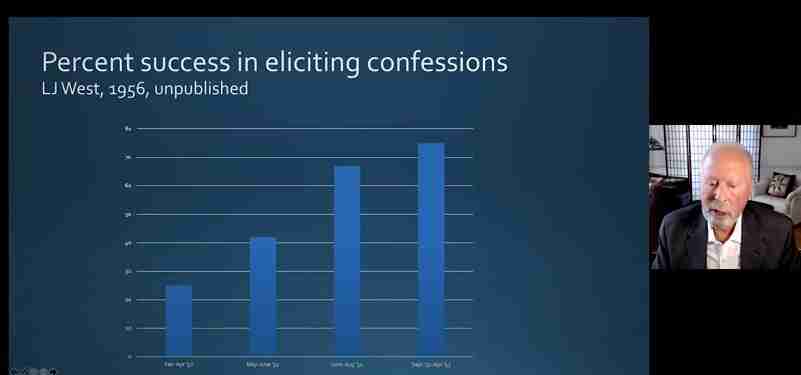
Not only did they get POWs to confess to war crimes and make anti-war propaganda broadcasts, but the Chinese seemed to get better results over time. In the course of just a year and a half, the percent of POWs caving into pressure increased from 25 percent to 75 percent.
POWs who started collaborating with the enemy were treated better, and at the time of the armistice, some declined to return home. America viewed this with consternation. On one hand, there was fear that the Chinese had deployed some secret weapon invented by Pavlov. On the other hand, our troops were viewed as cowards for caving in.
There was no understanding of what they had been through. This Herblock cartoon captures the mood at home. Two executives sit in their private club discussing world events while drinking and smoking cigars. One says to the other that he would never have caved in, instead he would’ve said to the Reds, “Now, see here.”
People lost sight of the fact that the POWs were treated with extraordinary brutality. Indeed, the POW death rates in Korea exceeded those found in Japan or Vietnam.
Two critics of the Korean War were particularly harsh in their judgment of our soldiers, Major William Mayer and journalist Eugene Kincaid. To their mind, the GIs had no gumption, were victims of momism. The fault was that liberals had sapped our strength so much that there was no discipline. It was our fault that 38 percent of the prisoners carelessly allowed themselves to die.
Other voices were not so sure about their judgment. They pointed to the prisoners’ debility due to starvation and exposure to severe cold, their total dependency on their captors, and the constant dread of execution.
In the light of the Korean War experience, President Eisenhower was advised to start a brain war offensive that would bring together the CIA and academic researchers. Allen Dulles, head of the CIA, felt that there was a contest with Russia to develop new techniques of brainwashing. The Russians, take selected human beings whom they wish to destroy and turn them into humble confessors of crimes they never committed. New techniques wash the brain clean of the thoughts.
Indirect CIA funding flowed to university researchers through foundations and research institutes. Harold Wolff and Larry Henkel at Cornell, received funds and channeled money through the Society for the Investigation of Human Ecology. This MK-Ultra funding supported scores of university laboratories across the country.
Wolff at that time was America’s leading neurologist, and Henkel was a brilliant internist who studied stress and heart disease. Henkel worked closely with the CIA on various projects that raised profound ethical considerations. Here we see how Wolff answered a delicate question posed by CIA agent White, who asks, “What is the possibility of working out a graph indicating the state of panic of the enemy based upon the varying degree of pressure used?”
Wolff replied smoothly, “Yours is a very provocative notion and I’m sure it could be documented. Warm regards.” A shocking response from the tacit head of American Neurology at the time.
Wolff’s proposal to CIA started out pretty ominously: “Potentially useful secret drugs and various brain damaging procedures will be tested in order to ascertain their fundamental effect upon brain function. As these drugs are investigated, a concurrent search for antidote or countermeasures will be conducted.”
Then the proposal veered into an even more shocking direction. “Where any of these studies involve potential harm to the subject, we expect the Agency to make available suitable subjects and a proper place for the performance of necessary experiments.” In other words, he wanted the agency to furnish the victims and then dispose of them.
MK-Ultra devoted enormous efforts at studying LSD, determining its dose. If there was habituation with continued use, if there was an antidote, or could it be used to immobilize an enemy?
The studies frequently involved unwitting individuals surreptitiously dosed and there were casualties. Perhaps the most notorious experiments involved Frank Olson, a government scientist who was surreptitiously dosed with LSD, dropped into his quatro. In response, he became severely depressed and agitated. This family photo shows him as a father in happier times.
The CIA took him to see Dr. Abramson, an LSD expert who had ties with the institute. Rather than immediately hospitalized this VIP patient, Abramson sent him back to the Statler Hotel with two CIA minders. Olson died that night after falling out of his hotel window. It’s not clear if it was an accident, if he jumped, or if he was pushed.
The family was not told about the secret LSD dosing for decades. Perhaps some of you are familiar with Robert Ludlum, Jason Bourne books and movies recall the plot. A young soldier played by Matt Damon goes to see an avuncular psychiatrist who agrees to radically restructure the young man’s life.
The doctor destroys the man’s memories and trains him to become a consonant assassin. It’s a compelling story and one that is partially based on one of the most notorious CIA sponsored brainwashing studies. It’s all true. Memory obliteration with LSD and electroconvulsive treatments, and memory restructuring during sleep.
The assassin training was not part of the CIA endeavors in actuality. The work was done in Montreal. Psychiatrist Ewen Cameron, headed up the Allen Institute of Psychiatry. Dr. Cameron believed that psychotherapy could be speeded up if you simply obliterated old memories and started a new.
He repeatedly played tapes to patients about how they should think and feel. He obliterated memory with massive doses of electroconvulsive therapy, as well as cocktails of LSD and other drugs. After weeks of this, he played tape loops up to a quarter million times while his patients slept. He succeeded in destroying memories, but could not show that his patients learned from tape repetitions. The lawsuits are still being adjudicated.
From roughly 1915 to 1965, governments and universities tried to develop tools for brainwashing. They weren’t exactly successful. Torture didn’t persuade people to adopt a different political beliefs, nor did it elicit information reliably. Any number of drugs could sedate, stimulate, or confused people, but they weren’t effective in interrogations or persuasion. Group pressures, sensory isolation, sleep deprivation were promising tools for coercive persuasion, but these required time and finesse.
Epidemiology of Stockholm Syndrome (aka “HOBAS” or Hostage and Barricade Situations)
In the 1970s and 1980s, two unlikely players emerged, demonstrating new techniques in dark persuasion: kidnappers and clerics. On August 23rd, 1973, John Eric Olson robbed the Credit Balkan bank in Stockholm. He took the bank’s staff hostage and held them in the vault, while negotiating with the police.
Over the ensuing days, the hostages started collaborating with their captor, developed fondness for him and began to distrust the police. He didn’t torture, shoot, or rape the hostages. He was solicitous of them and caressed them. As one hostage put it, “When he treated us well, we could think of him as God.”
When the police eventually liberated the hostages, they hugged the bank robber and shook hands in for well, calling out: I’ll see you again. This wasn’t just some Scandinavian liberal aberration. Similar events have been seen off and on, all over the world, sometimes involving terrorists, sometimes kidnappings for money, or sexual exploitation. These situations have become known as HOBAS, or hostage and barricade situations.
We have data on a dishearteningly large number of such situations. To a certain extent, the hostage is correct to distrust to the police. In a kidnapping situation, he or she is more likely to be shot by the police than by the kidnappers. Ultimately, 50 percent of hostages form some positive bond with their captor. The extent of the full blown Stockholm Syndrome is unclear.
Considerable work from all over the world has attempted to define what hostage situation or what victim is more likely to be associated with these paradoxical fondnesses for the hostage taker. Stockholm like phenomenon appear during longer-term captivity, and children appear to be singularly vulnerable.
The Patricia Hearst kidnapping could be considered a variant of Stockholm, another bank robbery, half a world away and half a year after the Stockholm robbery. Her autobiography describes very well her life prior to the kidnapping and since: “I grew up in an atmosphere of clear blue skies, bright sunshine, rambling open spaces, longer green lawns, country clubs with swimming pool, and I took it all for granted. I live now in a private protected street, in a house equipped with the best electronic security system available. I do not live in fear. It’s just that I feel older and wiser now. I am aware of the stark reality that I am vulnerable, that there are forces out there which are ever threatening.”
She had the misfortune to come to the attention of Donald DeFreeze. I’ll let you read for yourselves his manifesto. DeFreeze was a violent criminal who nicknamed himself General Field Marshal Cinque Mtume. He headed a small group called the Symbionese Liberation Army. Most of his rantings ended in the trademark death to the fascists insect, who preys upon the people.
Ms. Hearst was a Berkeley undergrad when she was violently abducted from her apartment. She was seized and hurled in the trunk of a car and then shoved in a closet while the SLA tried to extract a ransom. Her family agreed to distribute food to the poor and they were riots as the food was being distributed.
Within weeks of being abducted, Patricia changed her name to Tania and joined the group as a revolutionary, ultimately robbing a bank with them. It’s important to look at the compressed timeline of events. Ten weeks after kidnapping, she robs the Hibernia Bank, three and-half months after the kidnapping, she engaged in a shootout at Mills Sporting Goods Store. When she was eventually captured, she asserted that she had become a revolutionary. At trial, the defense claimed that she had been forced to do these things against her will.
People wondered, how was she forced? Did it relate to her violent kidnapping and sensory isolation in the closet? The trial essentially focused on psychiatric expert witness testimony. On the defense side, psychologist Margaret Singer observed that her speaking and writing style had changed during her captivity. That her IQ had dropped due to extreme stress, and that she wasn’t herself while being held by the SLA.
Jolly West said that Hearst manifested chronic classic signs of coercive persuasion. That she was debilitated, had total dependency on her captors, and was living in constant dread. Martin Orne said that she was telling the truth as she saw it, that she had dissociated during her time with the SLA or unconsciously split off those memories and actions.
Robert Lifton recalled his experience with victims of Chinese thought reform and pointed out that she caved in under gilt group pressure and terror. The prosecution psychiatrist attacked this testimony, Joel Ford denied there was any such thing as brainwashing, and stated that Hearst had merely converted her beliefs and joined the SLA robberies voluntarily for excitement.
Harry Kozol described her as a frustrated, angry, confused girl who was ripe for the plucking, in a rebel in search of a cause. So the jury had to struggle with two questions. Was she guilty? That is, was it coercion? Or was it her own choice? Secondly, did they want to consider the circumstances of her kidnapping is a mitigating factor.
The jury found her guilty, and the judge gave her no slack whatsoever. Her sentence was the typical first offense sentence for armed bank robbery. However, subsequently, she received presidential clemency and pardon.
How Religious Cults Have Used Coercive Persuasion
I’ve touched on how coercive persuasion evolved in the hands of government and government agencies, academia and criminals. I’d like to finish by discussing how religious cults have used coercive persuasion.
Heaven’s Gate began in Houston and was led by Marshall Applewhite and Bonnie Nettles, who renamed themselves Bo or Do and Ti or Dee. They were convinced that they literally belong with the stars, and that they were trapped on earth in bodies that were actually archaic vessels from space. They started wandering and proselytizing about UFOs and redemption. They formed a group called Heaven’s Gate and preached a life of asceticism. “Get your vehicle under control” was their motto.
They preached eating pure food and avoiding sexuality, which they felt corroded their vessels. Some even had themselves castrated to stop sexual temptation. They emphasized conformity and renamed themselves with peculiar names. They discouraged contexts with family and friends. They had very precise rules to help them find their way in the world. Major offenses were things like deceit or sensuality. Lesser offenses including having private thoughts or being curious.
Over the years, the membership dwindled and the feel of the group darkened. By that time they were living in a mansion here in Rancho Santa Fe. We might never have heard of them, and they might never have killed themselves, except for the bad luck of the Hale-Bopp comet. In 1996 and 1997, this was the brightest and longest lasting comet in known history. It came upon us as a surprise, and Bo was convinced that trailing the comet was a spaceship coming to take them home to the stars.
He persuaded the group that if they killed themselves during the comet’s closest pass to Earth, they would teleport finally to the stars and immortality. The group vowed to kill themselves, but videotaped farewells in advance. Sitting tranquilly in the grounds of their mansion, they talked about their joy in anticipating the next step.
Some tried to head off criticism, anticipating that the press would paint them as disturbed. In their words, “This is my family, laying down this vehicle is going to be great. I’m shutting it like a husk.”
Others stared into the camera and said, “I’m the happiest person on the world to be doing this.” or “I have such joy and wonder if the thought of going home.”
Over the course of one day they killed themselves in three waves. All were dressed identically. They ingested vodka, mixed barbiturates into their pudding, and put plastic bags over their heads. Then they were all gone. When the bodies were discovered and autopsied, pathologists were astonished to find that many of the men had been castrated.
I’ve focused on brainwashing in the 20th century. Well, what’s tempting to talk about current events and controversies. I think we need more distance in time to have a dispassionate perspective. However, I do have some thoughts on things that might develop in the future.
The first challenge will be neuroscience. We were able to do some surprising things in the 1960’s. Robert Heath pioneered in deep brain stimulation, studying how implanted electrodes could modify complex behavior in people. The CIA asked that he work with them on pleasure and pain circuits, but he spurned them saying, I’m a doctor, not a spy. We can do much more today with safer and more precise surgery. We are restrained by a sense of professional ethics by focusing on clinical conditions.
Dark Side Of Social Media
Would that restraint be evident in times of war? I think the bigger challenge will come from social media. Social media offers so much promise, but there is a dark side. We need to ask ourselves, if social media can be weaponized as a tool for coercive persuasion. If social media is associated with bullying, coercion, surreptitious monitoring, and restricted information, one has to wonder if it is a tour for coercive persuasion.
In this sense, social media is just another social intoxicant. As we know so well from the example of drinking and driving, it takes many decades for cultures to develop expectations for how one interacts with new social intoxicants.
George Orwell soberly observed, if you want a picture of the future, imagine a boot stamping on a human face forever. From my point of view, if we ignore the potential of brainwashing and the developments in the 21st century, then we are defenseless and Orwell will have been right.
But I do believe we have a choice. We need to look back and consider how brainwashing developed in the 20th century to prepare ourselves for the new century. We need to listen to H.G. Wells who warned that human history becomes more and more, a race between education and catastrophe. We are in such a race now. It’s up to us to define the emerging contours of dark persuasion. Thank you.
Eric: Thank you so much, Joel. That was a fascinating and very timely topic. If I may, I thought I would get us started with something I’ve been wondering about. Your book contains so many examples of the challenging role that psychiatry’s played in exploring or aiding our course of persuasion. Brainwashing, I guess I’ll say it’s easier for me to say. How do you see the field of psychiatry responding to those ethical dilemmas today?
Joel Dimsdale: Well, it wasn’t just psychiatry, it was psychiatry and it was psychology, it was neurology, neurosurgery. This was a vast academic endeavor in the social behavioral sciences and in all of the health sciences. I think it continues to be that way. I don’t think psychiatry is singularly vulnerable to the allure of brainwashing. It just happened that psychiatrists and psychologists have been involved in this very actively from the beginning.
Eric: I’m reflecting on the changes just in medical research in general that led to institutional review boards. I mean, I think that the training we all get says we learned from those past mistakes and now we’ve reached a new era, where we engage a more ethical research. This is maybe a rhetorical question, but it’s interesting to think about the studies that students will look back on 20 years from now, and how that might influence the notion of ethical research.
Joel Dimsdale: I think the ethical restraints are going to be terribly important, so that we don’t recapitulate this in times of travail and times of war. It’s natural to look for things. But one also has to ask questions about, what is the ethics of investigation? The things that happened. An advocate were under MK Ultra studies were just inexcusable. In the LSD studies, many people were surreptitiously dosed and became psychiatric casualties who had no idea what had happened to them. They’d be at a bar, someone would drop something in a drink. These things happened in the 50’s and 60’s.
Eric: I will say that your chapter describing the work that Miguel was eye-opening for me, that was a new area.
Joel Dimsdale: It is interesting. People just don’t remember this and it’s not that long ago. I think it’s for this reason that it’s important to look back in history. I must say that referring back to some of my comments about research libraries and archives, studying this was a challenge and a pleasure because of the excitement of the hunt for archival data.
Much of the data about the things that went on in Montreal oddly enough are hidden in the archives at UCLA of all places, had nothing to do with UCLA. Similarly, the stuff that went on in Montreal, was accessible in New York Hospital at Cornell. Of course, there’s some logic for why it would be there.
But going into the archives, I would encourage people to do this if you’ve got a research question. It’s a matter of sleuthing and it’s fascinating to look for these information.
Eric: I think you’ve just expertly answered the question that Phyllis asked to have you tell us a little bit more about your research. We’ve got a couple of questions asking about the Manchurian Candidate, the novel and movie. Somebody asks, “Could that brainwashing depicted in that movie actually result in the intended aim?” I don’t know if you know the work, but if you do, I would welcome your reflection.
Joel Dimsdale: It’s a wonderful movie. Just a great tale. I find little evidence to suggest that is possible. The CIA certainly looked hard for that.
Eric: We’ve had a few folks wanting to explore a little bit more about the role of social media in persuasion. Somebody asks, “Could a numerically high number or volume of messages with certain messaging aggressive support have an impact on an individual’s similar to what might happen in the Stockholm Syndrome those examples you gave?”
Joel Dimsdale: I think that’s the question. It’s a question that oddly enough in our polarized times, there are few things that Republicans and Democrats agree on, but the concern about social media is one of them. Any thoughtful person is concerned about this. People are persuaded by social media, that’s the whole point.
So the question is, under what circumstances can social media be coercive? That’s the question for all of us as citizens to ask ourselves. Is there something surreptitious going on in social media? Are algorithms going on behind the screen that we’re unaware of? Is bullying going on on social media? Is there something addictive about social media?
In other words, asking all the questions that one asks about any other circumstance of alleged or coercive persuasion. That’s fair game for social media. The solution is a challenging one, particularly in a democracy. But on some level social media already is regulated and probably needs more regulation. How that will come about in the future remains to be determined.
Eric: Your response makes me think of the work that studies bias and data and algorithms. Just how a small piece of bias coded into a software program has really negative outcomes. Your response is making me think of Twitter bots and other activities where there’s so much automations going into news generation or news filtering that we actually lose the ability to see outside the boundaries.
As an individual you can’t see the world beyond the social media landscape that’s created. I’m curious if this is a new phenomenon for you or it’s very similar to the studies in the past where the world of an individual under a high level of influence has been so contained that perception becomes their entire world?
Joel Dimsdale: Well coercive persuasion becomes all the more powerful in restricted environments. When you are isolated from former friends and family, when you are selectively exposed to only certain information, it becomes harder to struggle against coercive persuasion in those senses.
Going back to Pavlov. Pavlov loved his dogs. Pavlov demonstrated that dogs learn, we all know that. But Pavlov also made a comment, a very shrewd one that we sometimes overlook. And that is that dogs learn best when they are in a restricted environment where they’re not distracted. The best way of training a dog, persuading is in a quiet, restricted environment.
I guess I’d say that to the extent that the algorithms behind social media result in ever more restricted access to information and skewing information, we are in jeopardy.
Eric: Well, thank you so much Joel for your time tonight. Just want to express appreciation and actually I’ll read a quick comment from Douglas who says, “No question, just applause. The interest in and effort in this research is clear. We can infer so much from Professor Dimsdale’s teaching just from his talk.” Douglas goes on to say, “I’m here because of his service to the entire campus, well outside his own field and beyond medicine or health sciences.”
With that, I hope all of our audience joins us in virtual applause for Joel. With that, thank you so much all and have a good evening.
Want a summarized version of this long conversation instead? Here it is:
Summary:
The conversation with Joel Dimsdale titled “Dark Persuasion – The History of BRAINWASHING from Pavlov to Social Media” provides a comprehensive exploration of the history and evolution of brainwashing, coercive persuasion, and manipulation techniques from the early 20th century to the present day. The discussion is divided into three parts, each shedding light on different aspects of this intriguing subject.
Part 1: Historical Overview
The discussion begins with a historical overview of brainwashing, tracing its origins back to Pavlov’s experiments on conditioning and behavioral modification. The emergence of totalitarian regimes and the use of mind control techniques during the Korean War are explored. The conversation delves into the Chinese efforts to break down prisoners of war and extract confessions, highlighting the psychological pressures and tactics employed. The changing perceptions of POWs and the complexities of their experiences are discussed, including the debate around whether they were victims or traitors. The societal attitudes and challenges faced by those returning from captivity are also examined.
Part 2: Ethical Dilemmas and Coercive Persuasion
This section delves into the ethical dilemmas posed by brainwashing and coercive persuasion, particularly in the realms of psychiatry, psychology, and neuroscience. The discussion explores controversial experiments involving the use of drugs, electroconvulsive therapy, and sensory isolation, as well as the challenges of determining the boundaries between coercion and choice. The role of social media in the modern era as a potential tool for manipulation and persuasion is also discussed. The potential impact of social media’s algorithms, biases, and addictive qualities on individuals’ perceptions and behaviors is highlighted, along with the need for ethical regulation.
Part 3: Looking Ahead and Conclusion
The conversation concludes by considering the future implications of brainwashing and coercive persuasion. Joel Dimsdale emphasizes the importance of learning from history to avoid repeating past mistakes. The role of ethics, research regulations, and responsible usage of emerging technologies is underscored, especially in the context of social media. The discussion ends with a call to recognize the potential dangers of manipulation in the 21st century and to engage in thoughtful reflection and action to safeguard against coercive persuasion.
Overall, the discussion offers a thought-provoking exploration of the historical, psychological, ethical, and technological dimensions of brainwashing and coercion, prompting the audience to consider the impact of these practices on individual and collective behavior, as well as the responsibility to prevent their misuse.
For Further Reading:
Jordan Peterson Lecture: Reality and the Sacred (Transcript)
Transcript: Existentialism via Solzhenitsyn and the Gulag by Jordan Peterson
Jordan Peterson on 12 Rules for Life (Transcript)
TRANSCRIPT: Cain and Abel – The Destruction of the Ideal: Jordan B Peterson
Related Posts
- Andrew O’Donohue’s Graduate English Address – Harvard Commencement 2026 (Transcript)
- Zohran Mamdani’s BMCC 2026 Commencement Address (Transcript)
- ‘I Am The Son Of Immigrants’: Astronaut Jonny Kim At Harvard Alumni Event (Transcript)
- Hamza Masoud’s Speech: Harvard Class Day Ivy Oration 2026 (Transcript)
- Daniel Pink 2026 Commencement Address: Columbus College of Art & Design (Transcript)