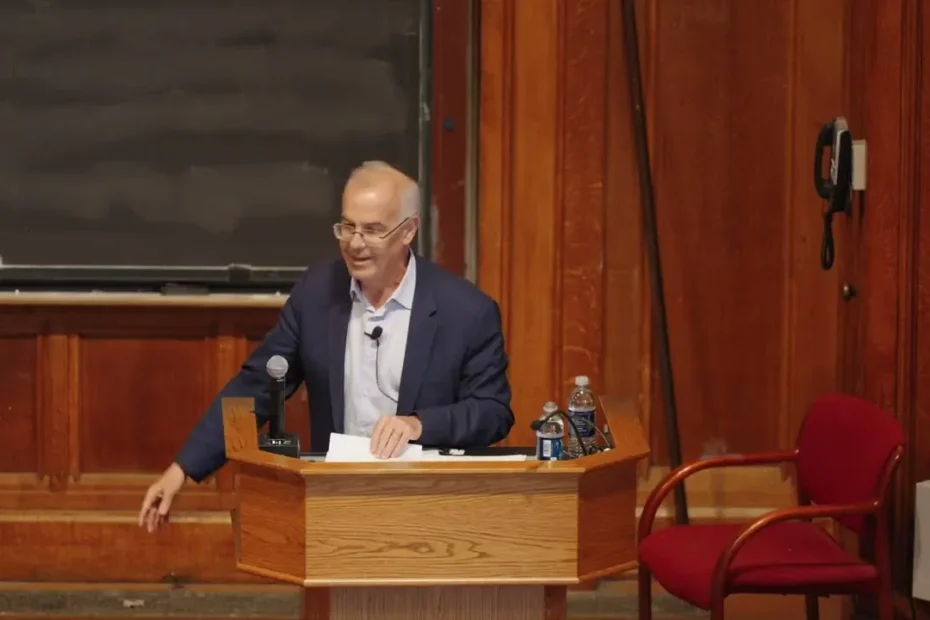
Editor’s Notes: In this lecture at Yale University, David Brooks explores the cultural shifts in America over the last 70 years, moving from a culture of moral realism to one dominated by resentment and distrust. He argues that a decade of loss—including 9/11 and the 2008 financial crisis—has led to a profound decline in interpersonal trust and a surge in populism. Despite this current “doom loop,” Brooks remains an “irrational optimist,” suggesting that the nation is ripe for a “humanistic turn” that champions dignity, virtue, and communal repair. He concludes that true recovery will not come from politicians alone, but through a collective shift in values sparked by individuals, artists, and educational institutions. (April 13, 2026)
TRANSCRIPT:
How America Recovers: The Role of Culture in Shaping History
DAVID BROOKS: Thank you all. Good to be back here for my third. It’s clear none of you went to my first two because they were disasters. Today I’m going to talk to you about how America recovers. And you will understand why I am known as the irrational optimist at all my workplaces.
The story I’m going to tell is based on my predilection. Some people are technological determinists, they think technology shapes history. Some people are economic determinists, they think economics does. Some people are political. I think minds shape history, that culture shapes history. It’s how we think, how we react. And that culture is the main driver of politics, of history, and of just the way we see the world.
Cultural Differences in Perception
There’s a guy at the University of Michigan named Richard Nisbett who did these experiments where he asked people from America and people from Asia to describe a fish tank he put in front of them. And the Asian people tended, not all obviously, but tended to describe the vegetation of the fish tank, the nature of the water, the whole context. The Americans just described the biggest fish.
He did a similar experiment where he looked at people looking at the Mona Lisa, people from Asian cultures, their eye saccades moved all over the painting. People from the U.S., their eyes just looked at the mouth and the nose.
And so his explanation for this, his theory, is that 2,500 years ago a bunch of Greek philosophers like Aristotle described a way of looking at the world that emphasized individual agency. At the same time, a bunch of Asian scholars, people like Confucius, developed a way of looking at the world that emphasizes harmony, context, and interrelationship. And so these cultural differences show up even in the way our eyes move in front of a painting.
Cultural Stability in American Politics
I know about this in politics. If you look at the electoral map of 1896 and the electoral map of 2024, it’s pretty much the same map. The populist, William Jennings Bryan in 1896, won the South, Texas, Appalachia, the West. The American populist of 2016 and 2024, Donald Trump, won mostly the exact same states. They switched political parties, but the populist cultures of those places stayed exactly the same over 100 years.
And there’s a great book called Albion’s Seed by a guy named David Hackett Fischer, a historian who said that New England was settled by people from Southern England who always had a priority they valued, educational, emotional restraint, and being active in civic life. West Virginia, 300 years ago, was settled by the Scots-Irish who came from the northern border of England and Scotland. And they valued military service, honor, and shame. And to this day, people in Appalachia commit more crimes, are more likely to be in the military, have lower educational levels than people in New England. And so that’s 400 years of cultural stability.
Now cultures can be very stable. They can also change really rapidly. And they change the way science changes. There’s a dominant paradigm, and then that paradigm shifts when it stops working for people. And so over the next few minutes, I’m going to try to sprint through the dominant cultural paradigms of the last 70 years.
A Tone of Humility: V-J Day, 1945
So we’ll do this quickly. I was driving years ago in Washington, D.C., and on Sunday nights, our local NPR station broadcasts old radio shows. And I happened to hear a rebroadcast of a radio show named Command Performance, which was a variety show that went out in the 1940s. And I happened to hear the episode that aired on V-J Day, 1945. It was taped live just hours after Americans learned they’d won World War II.
And the host, Bing Crosby, gets out there. They’ve just learned they’ve won the war. And he says, I guess all anybody can think about is to thank God it’s over. And today, our deep-down feeling is one of humility.
I was really struck by this tone of quietness after just winning World War II.
Later in the show, an actor I hope some of you remember, a guy named Burgess Meredith, gets out there and reads a passage from Ernie Pyle. And Pyle writes, “We won the war because our men are brave and because of many other things like great allies and great material blessings. We did not win it because destiny created us better than any other people. I hope that in victory, we are more grateful than proud.”
I was really struck by that tone of humility. So I go inside from the radio show. I turn on a football game. I watch a quarterback throw a pass. The wide receiver gets tackled after a two-yard gain. And the defensive player does what all defensive players do. He does a victory dance in honor of himself.
It occurred to me I watched a bigger victory dance after a two-yard gain in football than after winning World War II. And that suggests a different culture back then. It was a culture of moral realism, an awareness that we’re all sinful and we should be aware of human frailty.
The Culture of the 1940s and 50s
So back then, 1940s and 50s, military, government, corporations, union, and the church, people had faith in authority and trust in institutions and trust in their local community. If you grew up in Chicago, you didn’t say, I’m from Chicago. You said, I’m from 59th and Pulaski. You picked your local neighborhood where you had tight community.
Back then, there was no TV and no air conditioning. So in the summertime, the doors were all opening. The kids from the neighborhood were running into any house, eating at whatever fridge they happened to be closest to at that moment. It was very hard to be a loner in those communities. There was dense community, a lot of social capital, and a lot of neighbors looking after each other, and a culture of self-effacement. I’m no better than anybody else, and nobody’s better than me.
Joe DiMaggio, when he hit a home run, he did not do a bat flip. George H.W. Bush, the elder President Bush who grew up in this culture, when he was running for president, his speechwriters would write paragraphs in his speeches saying, why you should vote for me? Why I’m so great? And he refused to read those speeches because it was part of the culture of self-effacement.
And one day, he finally broke down. He agreed to read the paragraph about himself, and he got a call from his mom. And she said, “George, you’re talking about yourself again. Cut out those speeches.”
The Seeds of Change in the 1950s
So that was the culture of the 40s and 50s. In every cultural moment, the seeds of the future are already present. In the 1950s, there were a lot of people who looked at the culture and said, it’s got some virtues, but it’s got something wrong. First, it’s too suspicious about human nature. There’s a guy named Carl Rogers and Dr. Benjamin Spock who decided, humans are not sinful. Humans are basically good. We should liberate them so they can exercise their goodness.
And then there were other critics within then who worried about the conformity of the 1950s. There were other critics who worried about the lack of opportunity for women, for blacks, for basically all minority groups. And so they wanted to tear down this culture.
The Age of Liberation: The 1960s
And so in the 1960s, they more or less tore it down. The food was terrible. There’s no opportunity. There’s no creativity. There’s too much conformity. There’s too much organization, man behavior. So the 60s, the dominant paradigm is the age of liberation. Let’s throw off restraint so we can have a more fair society, a more creative society. Don’t conform to others. Be true to yourself.
There were two quarterbacks in 1969 who played football in the Super Bowl against each other. One guy was a 1950s kind of guy, Johnny Unitas. High socks, crew cut hair, extremely boring.
The guy on the side I was rooting for in that Super Bowl was a guy named Joe Namath. Long hair, swinger, playboy, Namath wrote a memoir called I Can’t Wait Until Tomorrow Because I Get Better Looking Every Day. So that’s a shift. And little me, I was involved in that shift. I was there.
A Five-Year-Old’s First Step to the Right
In 1966, the hippies in Central Park in New York had a thing called a bee-in where they would go just to bee. And one of the things they did is they had folk dancing and singing. And they set a garbage can on fire and they threw their wallets into it to demonstrate how little they cared about money and material things. I was five and I saw a $5 bill on fire in the garbage can. So I broke from the crowd, reached into the fire, grabbed the money and ran away. And I say that was my first step over to the right.
The 1970s: Creativity and Chaos
But it was part of that moment. Some decades reverse the earlier decade, like the 60s reversed the 50s. Some decades consolidate. And the 1970s consolidated the cultural shift from restraint to liberation of the 1960s. And we harvested a lot of creativity in the 1970s. So some of the classic rock songs were written then, Stairway to Heaven, Free Bird, Born to Run, Bohemian Rhapsody. Some of the great movies were created in the 1970s, The Godfather, Chinatown, Star Wars, Annie Hall, Taxi Driver, Apocalypse Now. That was a benefit.
The disadvantage is the liberatory movement of the 1960s led to chaos, social chaos in the 1970s. Between 1960 and 1980 the divorce rates more than doubled, the share of children born out of wedlock more than tripled, violent crime tripled, drug use exploded. I was living in New York City in the 1970s and everybody got mugged. There was a serial cash trader on the Upper West Side of Manhattan who would lure kids into Central Park and castrate them. His nickname in the paper was Charlie Chopoff. But such was the chaos of New York in those days, it wasn’t even a big story. We just all were used to a level of chaos.
And so the 70s took that creative energy, that individualistic, let’s be free to be me and you, you and me, and they built on it to create a lot of great culture, but it also produced a lot of chaos.
The Collapse of Institutional Trust
And then out of that chaos, a loss of institutional authority. Social trust, trust in institutions collapses in the 1970s. There’s the My Lai Massacre, there’s defeat in Vietnam, there’s Watergate, there’s the decimation of American manufacturing, there’s bankruptcy in New York, there’s hostage taking in Tehran. People lose faith in the idea that our institutions are basically functioning.
The 1980s: Bourgeois Backlash
Out of that chaos comes the next cultural moment in the 1980s, which was, if the 1960s was bohemian liberation, arts, creativity, the 1980s was what you might call a bourgeois backlash. People who looked at Woodstock and didn’t like what they saw decided we need to reimpose bourgeois values. And bourgeois values are things like being self-disciplined, showing up on time, dressing neatly, wearing a suit, being entrepreneurial, and believing in institutions.
And so you saw the beginning of Ronald Reagan, you saw Margaret Thatcher, the vigorous virtues, you saw the emphasis on character. They wanted to reestablish back to basics, more on the conservative side, and there was a James Q. Wilson, a famous Harvard sociologist, who said “the most important change in how one defines the public interest that I’ve witnessed over the last 20 years has been the deepening concern for the development of character in the citizenry.” So it’s basically a reestablishment of old-fashioned bourgeois traditionalism in the 1980s.
I was sort of there for that, too. I graduated from Chicago in 1983, and in that year, alumni of this institution, a guy named William F. Buckley came to campus. He had just written a book called Overdrive, and I wrote a parody of him for being a name-dropping blowhard in the school paper. And I’ll read you the first paragraph.
DAVID BROOKS: I wrote this when I was 21, so forgive me. William Freemarket Buckley was born on December 25th, 1925 in a little town called Bethlehem. He was baptized on December 28th and admitted to Yale University on the 30th. Buckley spent most of his infancy working on his memoirs. By the time he had learned to talk, he had finished three volumes, The World Before Buckley, which traced the history of the world prior to his conception, The Seeds of Utopia, which outlined his effect on the world order during the nine months of his gestation, and The Glorious Dawn, which described the profound ramifications of his birth on the social order.
And so I did a whole series of jokes like that. I remember I wrote, when Buckley was at Yale, he formed two magazines, one called The Buckley Review and one called The National Buckley, which he merged to form The Buckley Buckley. And so at the end of the interview, he says, “David Brooks, if you’re in the audience,” his speech, “I want to give you a job.” And that was the big break of my life.
A Debate with Milton Friedman
Now, sadly, I was not in the audience. I had been hired by PBS to debate Milton Friedman on TV, and I mentioned this earlier, and we were going to debate economics. I was then a socialist, and Friedman was a Nobel Prize winner. And you can imagine how well that debate went on.
You can go on YouTube today, and if you write in the subject line, David Brooks, Milton Friedman, you’ll see a picture of 21-year-old me with a big head of hair, these 1980s large glasses that were apparently on loan from the Mount Polymer Lunar Observatory. And I make an argument I’ve read in a socialist textbook. He destroys it in about six seconds, and then the camera lingers on my face for 30 seconds while I try to think of something to say. That was the show.
The Cultural Shifts of the 1980s and 1990s
And so the 1980s, Friedman and Buckley, with whom I fell into eventually, they, that bourgeois backlash, reversed some of the things that happened in the 60s. But not everything, not the 1960s, not the individualism. And so we have that cultural moment in the 1980s.
But then you shift, and just as the cultural values of the 1970s consolidated the break of the 1960s, the values of the 1990s consolidated some of the things that happened in the 1980s. And basically, the 1990s were an age of cultural synthesis. The primary move was convergence. Things in the 1990s that had divided people began to break down. The Berlin Wall fell. Communism fell. The European unification came together. The Oslo peace process, we thought we were going to have peace in the Middle East.
And I was a foreign correspondent for the Wall Street Journal in those days. And I saw this convergence coming together, opposites seemingly coming together. I saw it abroad. I was in Moscow on the day when the Soviet Union, what was left of it, tried to stage a coup and oust the democratically elected president of Russia, Boris Yeltsin, and tanks rolled to his office, Yeltsin’s office.
Valentina Kosieva: A Life Through Russian History
I followed them, I went there, and I met a woman who was handing out sandwiches to the democratic protesters to defend Russian democracy. She was 93 years old. Her name was Valentina Kosieva. And I asked her her life story. And she said, “Well, I grew up in the household of the Tsar. During the Civil War that happened right after the revolution, I was lined up to be executed by the Reds. And my mother begged them to not kill me, so she didn’t. Then I got married, and my husband, in the 1930s, was sent to the Gulag, and I never saw him again. In the 1940s, my two sons were killed in the Battle of Stalingrad by the Nazis. In the 1950s, my second husband was, they raided our apartment one night, they grabbed him, they sent him to the Gulag, I never saw him again.”
The Bobo Reconciliation: Culture Wars of the 1990s
In the 1960s, she was a member of the Kalmyk people, which is a Muslim community in Russia. She was sentenced to internal exile. So every bad thing that happened in Soviet history happened to her. And my brilliant interviewing technique was the following. And then what happened? And then what happened? And then what happened?
And it seemed like things were coming together. And it seems like things were coming together internationally, and it seemed like things were coming together domestically. The great cultural move domestically in the United States during the 1990s was an attempt to reconcile the bohemian values of the 1960s with the bourgeois values of the 1990s. And you could see it in shopping.
We had the creation of the New York Times wedding page. And in the 1990s, in the information age economy, education was rewarded with money. And if you looked in those years at the New York Times wedding page, the wedding announcements, people back then used to call it the mergers and acquisitions page. It was Princeton marries Yale, Goldman Sachs marries Skadden Arps, Fulbright marries Rhodes, Summa Cum Laude marries another Summa Cum Laude. You would never see a Summa Cum Laude marry a Magnum Cum Laude because the tensions would be so great in that relationship. And so, you know, they would all go reciting their vows while holding the rubber ducky they had during their Supreme Court clerkship.
It was the emergence of a new educated class. And they were people who had bohemian values, but they were upper middle class now. And so they wanted to show, through their spending, the same thing those hippies with the garbage can in the 60s wanted to show. I don’t care about money and material things. I’m not shallow, even though I make seven figures.
And so they created Whole Foods for such people who didn’t want to buy avocado from a store that didn’t take a stand on offshore oil drilling. They created Trader Joe’s for such people where all the cashiers look like they’re on loan from Amnesty International. They solved the snack problem. Snacks are morally problematic because they can lead to obesity. So at Trader Joe’s, they sold snacks like veggie booty with kale for kids who come home and say, mom, mom, I want a snack that’ll help prevent colon rectal cancer. So they had that.
And so there was a whole mode of bobo consumption. You could spend any amount of money on any room that was previously used by the servants. And so if you went into a bobo home, they had these things that looked like nickel-plated nuclear reactors, which were actually the August Sov. And then they had over here this refrigerator that was apparently zero just isn’t cold enough. So they had these sub-zero refrigerators that people went for. And it was a whole mode of consumption.
And it seemed like this reconciliation between cultural opposites, that the culture wars between the bourgeois forces of Jerry Falwell and the bohemian forces of Abby Hoffman, it seemed like they were reconciled.
The 2000s: A Decade of Lost Faith
We shift to the next decade, the 2000s. The 2000s produced a shocking loss of faith in this reconciliation. And so you had a loss of faith in a lot of things. 9-11, we lost faith in our own safety. The Iraq War, we lost faith in our ability to do good abroad. The financial crisis, we lost faith in unregulated capitalism. The internet and social media, we lost faith that we would all come together if we could only communicate with each other. Democracy stopped spreading around the world in what is now a 26-year retreat. And a loss of social connection. And finally, a loss of moral knowledge.
As if you’ve gone to my previous lectures, you know I love the phrase, “all of life is a series of daring explorations from a secure base.” People need a secure base. They need a secure financial base, emotional base with their friends, but they also need a spiritual base.
And for the last 30 or 40 years, we have told successive generations of young people, find your own truth, come up with your own morality. And if your name is not Aristotle, you can’t do that. And so we left successive generations morally naked and alone, without an unformed sense of what’s my moral philosophy, and we left no shared moral order.
If I’m going to have trust in you, I have to have faith that you will do what you ought to do. And that faith is based on the idea that we agree on what we ought to do. And if we don’t agree on what we ought to do, I can’t trust you.
The Collapse of Trust
And so I mentioned in the 1970s, what they call institutional trust plummets. In the 2000s, interpersonal trust plummets. Before then, if you asked people, do you trust your neighbor, 60% said yes. Today, it’s 30% and 19% of millennial. So there’s been a loss of common faith, a loss of common trust.
And when you get that loss of trust, you get surges of populism. Populism is a belief system for people who feel betrayed. Fanaticism is a response to existential anxiety, the existential anxiety of feeling in a world where you can’t trust anybody else.
Pew Research Center asked Gen Z and millennial, do you think most people are selfish enough to get you? And 72% of people in these generations agreed with that statement. That is the definition of high distrust.
And a lot of that loss of faith was a loss of faith in us. And I’m speaking as a member of the educated class. That we, they lost faith not only in each other, they lost faith in us, in the leaders of society. And partly because they’d seen what happened in the 2000s. They said, are you guys running this country?
The Meritocracy Chasm
And secondly, they saw the social chasm that had opened up caused by systems of the meritocracy. That by age three, affluent parents are twice as likely to send kids to preschool than less affluent. By sixth grade, there are four grades levels ahead. By 18, a kid in the top 20% of earners is one in five chance of scoring over 1400 on the SAT. A kid in the bottom of earners have as a one in 50 chance. That produced a chasm that we see today.
People with high school degrees die 10 years sooner than people with college degrees. Five times more likely to have children out of wedlock. Six times more likely to die of opioid addictions. 2.4 times more likely to say they have no friends.
And so it was a loss of faith in each other. A loss of faith in the leadership of society. A loss of faith in ourselves, which led to the sadness, the depression. 45% of high school students now say they’re persistently hopeless and despondent. And then a loss of faith in the future. A loss of faith in our future.
A Nation Losing Faith in Its Own Dream
Ipsos asked Americans, do you think America’s in decline? 59% of Americans say America’s in decline. They asked young people, do you think America’s headed in the wrong direction? Only 13% of young people say America’s headed in the right direction. Gallup asked people, do you trust, do you believe in the American dream? 69% of Americans said they didn’t believe in the American dream.
That is an exocet missile designed aimed directly at our common life together. Because we are a very diverse society held together by a faith in the American dream. And when that faith goes, we fracture.
And so there’s this rise of pessimism, this sense of humiliation. Humiliation is felt when people feel they are not granted equal standing they think they deserve. Humiliation is when people feel they’ve been denied human dignity. Humiliation is when they’ve been denied something like a homeland they think is their right. And so in the crisis of faith of the 2000, it was magnified. And so we get to a point today where a lot of people feel humiliated.
The Power of Humiliation in Driving World Events
And if there’s one thing we know from history, it’s how powerful humiliation is in driving world events. Germans felt humiliated after World War One. The Arab nations felt humiliated after the Six-Day War. Bin Laden felt humiliated by American bases on his homeland. Russia felt humiliated after the Cold War. The China scholar William Callahan writes, “the master narrative of modern Chinese history is the discourse of the century of national humiliation.”
And domestically today in our current culture, and I’m talking about today from 2013 to today, a lot of people have felt humiliated. Less educated people, rural people, religiously Orthodox people, oppressed minority groups, oppressed gender identity groups, struggling young people.
And what happens, I’m doing a fantastic job of showing you how things are getting better, right? What happens is that, I’m just trying to describe the problem before I make the U-turn. Inner pain turns to outer hostility. Humiliation, which is a form of inner pain, turns into resentment.
Resentment: Its Roots and Its Reach
Resentment begins with a feeling of impotence. I can’t control my own life. The system is running me. I’m not running the system. Someone has something I want. Someone has demonstrated a superiority I cannot match. I feel a shortage of agency and control. I feel unseen.
Resentment is about social standing. Someone makes you feel inferior to them. It doesn’t offer you the recognition and the respect that you deserve as a human being. Those people don’t even know I’m here. I go to the Midwest a lot, and it used to be, once a day somebody would say, “you guys think we’re just flyover country.” Now when I go to the Midwest, I hear that seven or eight times a day. People who feel unseen.
And so democratic capitalism, it turns out, according to a German philosopher of the early 20th century, Max Scheller, is the perfect breeding ground for resentment. People in caste societies don’t feel resentment because they don’t think they deserve to be at the top. In democratic societies, we all feel we deserve equal dignity. And when you produce a society that advocates for equality but produces inequality, you get resentment because people have not been given the equal dignity that the system and our culture says they deserve.
How Resentment Ferments and Contracts the Spirit
And so a resentful person ferments. When you feel resentment, it’s often against somebody who’s your social or status superior. And often you can’t express your resentment because you need them. They’re powerful. They’re the boss. So it bottles up and ferments.
And Scheller says the way it ferments is pretty consistent across centuries. Resentful people feel they devalue the things they feel they lack. The things they can’t get access to, whether it’s education, fame, success, virtue, they say, “oh those things aren’t worth getting anyway.” They develop a classic sour grapes response.
And so what Scheller says is resentment creates a spiritual contraction. People begin to think those things, the loftier registers of human life, the things they can’t feel they have access to, they begin to just cut those off. They say those things are not important.
We all sort of know that some, we all want a lot of things. We all sort of have an instinctive sense that some things are higher and nobler than other things. That sensual pleasures are good, but they’re probably not as valuable as career success. Career success is good, but it’s probably not as valuable as friendship and social virtues. Friendship is really good, but it’s probably not as noble as wisdom and knowledge, which is probably not as valuable as justice, which is probably not as valuable as holiness.
So we all know, I think instinctively, that some values are higher than others. And I think instinctively we have a sense that the best life is an ardent life, and the kind of thing we train, we hopefully prepare our students for here, is an ardent life where people are reaching upward to discover the higher things. And the problem with resentment is they do not even see the higher things. They have contracted their value system, so the higher things are declared worthless.
And Scheller says such people are self-poisoned. I remember when his first term, Donald Trump, was in France going to the war cemeteries off the Normandy beaches. And you could see he just couldn’t understand it. He couldn’t understand why anybody would sacrifice their life for a country. He said those people are suckers. And that’s a man who cannot even see the higher virtues that would cause you to want to sacrifice your life for a country.
The love of country is higher than self-interest. Donald Trump could never understand John McCain. What drove McCain? Because he believed in those higher virtues, and Donald Trump, who is resentfulness personified, just couldn’t quite get that.
Nihilism and the Rejection of Higher Values
And what you see on the right, but I think also on the left, is a form of nihilism that believes that whatever is lower is more real. Selfishness, egoism, lust for power, those things are real. Altruism, generosity, honor, integrity, and hospitality, those things are mirages. Ideals are shams that the selfish use to mask their greed.
People are disillusioned by life, who are resentful, who are cynical. They give themselves permission to embrace brutality, saying, “We won’t be fooled again. It’s dog-eat-dog. If we’re going to survive, we need to elect bullies in high places. We need to elect bastards.”
The last time I was in this room was about a month and a half ago, and a professor named Brian Garstin was teaching a class on how to create a better world. And he started the class with a video on that screen. And one of them was Stephen Miller, the Bush aide, saying, “International contracts, those are niceties. But life is about force. Life is about power.”
And then he had another video, Garstin did, of Pete Buttigieg, saying, “No, life is not about force and power. It’s about cooperation and friendship and agreement.” And you see these two worldviews. Stephen Miller is resentment personified.
And in that class, the students went on to debate the Melian dialogue from Thucydides. And in that dialogue, the Athenians say, “The strong do what they can and the weak suffer what they must.” And that is essentially the position of resentful people who have cut off human values at a middle level.
Catastrophism and the Illusion of Seeing Through Idealism
And it creates a sense of catastrophism. And you see this on the social justice left as well as the MAGA right. The systems of society are fundamentally rotten and oppressive. We are facing a catastrophe. And this cynicism begins to peel like wisdom. Because “I see through the sham of idealism. I see reality as it actually is.” And so you congratulate yourself, but all you’re doing is cutting yourself off from the highest values. And that’s what this decade, this decade of resentment, is doing.
The Dark Passions Politicians Exploit
And when you’re in the middle of a decade of resentment, politicians find it easy to motivate people by appealing to their dark passions. It’s not the desire for belonging. It’s not the desire for respect. It’s not the desire for virtue. It’s not the desire for wisdom. It’s anger. Who am I angry at?
It’s hatred. I can be angry at you and still love you. But if I hate you, that’s a comprehensive rejection of who you are. It’s fear. Fear is fine if you understand what you’re afraid of. But when it becomes a generalized fear of everything, it becomes incredibly destructive. It leads to the search for scapegoats.
And finally, politicians find it easy, in an epoch like ours, in this period of resentment, to advertise their urge to dominate, to appeal to the urge to dominate, what St. Augustine called the libido dominandi, the peace within all of us that seeks power over others. And leaders found it very effective to appeal to these dark passions in our age.
I don’t agree with Michel Foucault on much, but he did say that the essential struggle in life is against the fascist in each one of us. And this age arouses that kind of fascism.
Where Is America Headed?
DAVID BROOKS: And so, I’ve tried to describe the moral realism of the 1950s, the bohemian rebellion of the 1960s, the consolidation of that rebellion in the 1970s, the bourgeois backlash in the 1980s, the consolidation and the convergence of the 1990s, and then the loss of faith and the resentment of the 21st century culture. Where are we headed in the future?
Well, it could get worse. One of the things the Democrats think is, if we can show that Donald Trump is doing a bad job, then the voters will swing over to us. I would ask them to look at the polls. Voters are not swinging over to the Democrats. When Donald Trump does a bad job, it’s not people swing from right to left, people swing from crazy to crazier. If, say, the Iran war is a complete catastrophe, it’s not like people are going to say, oh, the Democrats had a better foreign policy. They’re going to say, America is screwed up from top to bottom.
One option is, a decade ahead, we will see levels of distrust, alienation, resentment we’ve never seen before. I don’t think that’s going to happen. I think what’s going to happen is that our people are going to do what they do in moments of cultural pivot, which is they realize, well, this whole paradigm ain’t working for us. The resentment, the loss of faith, this ain’t working for us. They’re going to realize we’ve abandoned our humanistic core.
A Humanistic Turn as the Antidote to Nihilism
All the things that nurture empathy and orient the soul toward justice and virtue and goodness are diminishing in our life. Religious devotion, theology, literature, history, philosophy. We’ve got to get back in touch with those. And so, I think there will be a humanistic turn.
Humanism is the perfect antidote to nihilism. The kind of humanism that gets taught at this university is anything that upholds the dignity of each person. When students are reading about Antigone trying to bury her brother, Lincoln rebinding the nation in the second inaugural, Martin Luther King writing that letter from the Birmingham jail, that’s humanism. Even as simple as Tracy Chapman and Luke Combs singing “Fast Car” at the Grammys, that’s humanism. That’s uplifting the human dignity and introducing people and connecting people to the highest registers of human nature.
Humanism is a worldview based on an accurate conception of who we are, that we’re capable of cruelty, we’re also capable of great achievement and accomplishment. And hopefully what education does in a liberal arts institution like this one is prepare people to have the highest desires so they can control their lowest and egotistical desire.
And they do this by making excellence attractive to the young. They hold up this scientist, this theory, this book, this hero, this writer, this wise person, and they say, life is essentially a struggle on behalf of certain ideals. The person we are reading about in this course has lived that life of struggle on behalf of ideals. You should try it.
Universities, Earnest Admiration, and the Fight Against Resentment
And so I see universities as creators and feeders into of our national passions, of our national life. And the most effective antidote to resentment is earnest admiration. Finding people whose lives are so impressive and so inspiring that it cracks through the feelings of resentment and distrust. You can’t argue people out of them. You have to show them there really are things that are worth dying for. There really are lives that are noble. And so you can read about them and I assign them when I assign books.
And so the question is, does America have the vitality for one more cultural revolution? One more cultural churn? One more shift to the paradigm? And we seem a little demoralized right now. But when I ask people what made them who they are, nobody ever says, you know, I went to vacation Hawaii and that made me the person I am today. Nobody ever says that. They always point to a hard time. They point to a moment of rupture and repair when their life fell apart and they built it back better.
Rupture and Repair: A Personal Journey
DAVID BROOKS: I went through a period of rupture and repair in 2013. My kids were leaving home to go to college. My marriage had ended. And I was living in a crappy apartment feeling intensely lonely.
And I think I mentioned this earlier but in one of the other lectures I read three books. One by a guy named Paul Tillich who said that moments of suffering interrupt your life and remind you you’re not the person you thought you were. They carve into the floor of the basement of your soul and they reveal a cavity below. And they carve through that and reveal a cavity below. So the moments of hardship like the one we’re in nationally you see deeper into your own nation or your own self than you did before.
Second, I read a book on Henry Nowen who said when you are in pain you have to stay in the pain to see what it has to teach you. And I was like, screw that. I’m going to get out of the pain.
Third book was I read by a guy named Frederick Buechner who was a novelist and also a pastor. He said in moments of pain you can either be broken or broken open. And when you’re broken you callous yourself over. When you’re broken open even in those moments of greatest suffering you make yourself even more vulnerable because only if you do that are you capable of change.
Nations That Broke Themselves Open
And I would say in history we have case after case of countries breaking themselves open and saying we need to change. If you look at Britain in the 1820s and 1830s, Australia in the 1970s, Germany and Japan after World War II, South Korea in the 1980s, Rwanda after 1994, Chile after 1990s, or you look at our own country.
Look at those periods of paradigm shift of rupture and repair. The 1770s, the revolutionary period, Andrew Jackson’s populism, 1890s and the progressive era, 1960s. Look at how much culture has changed in the last 70 years. Look at how dynamic our culture is. Do you really think that the same country that shifted in the 60s from the 50s, that shifted in the 80s from the 70s, that shifted in a bad way in the last 20 years. Do we really think our culture has stopped? I just don’t.
I think people are going to see this paradigm is not working for us and we need a change. And I think they will diagnose that the problem is a spiritual one, a psychological one, an emotional one, a cultural one. We need a shift in values, we need a shift in the spirit of the age. The zeitgeist, what we call the dominant paradigm, that’s just tremendously valuable.
Culture Changes From All of Us
And it depends on people. Cultural shift doesn’t happen from the top, it happens from all of us. It happens in universities, but it also happens in the arts. It happens in community organizations, it happens in religious organizations. Culture is the common collective response to the problems of the moment. And people just spontaneously shift. That’s how these cultures change.
And I have every confidence, looking at history, we’ve been through this before. It’s a question of how we all act, whether we decide we’re in a doom loop of resentment and we just say, stop, stop, we’re not going to participate. We’re going to find people who exemplify the higher virtues.
James Baldwin on Humanity
I was at a bar a couple of years ago and if you had seen me there, you would have said, bad guy drinking alone. But I call it reporting. And I was scrolling and it was like a month after October 7th. And as you can imagine, I was on Twitter scrolling through all these brutal images. And it was horrible.
But then I scrolled across an image that was different. And it was an interview, probably done in the early 60s, with James Baldwin. And Baldwin is talking to an unseen interviewer and he says, you know, there’s not as much humanity in the world as one would like. But there’s more than you would think. There’s enough.
And then he says, well, you have to remember, when you walk down the street, every person you see, that person could be you. You could be that person. And that person has so much in common with you. And so you’ve got to look at those people and say, that could be me. I could be that wonderful person. I could be that shitty person. And you’ve got to decide who you’re going to be.
Now, James Baldwin, because of the way he’d been treated by this country, for his race and other reasons, had been treated pretty shabbily in America. He had every right to be calloused over. He had every right to be bitter. And sometimes he was bitter. Sometimes he was angry. If you’ve read his writing. But even in this circumstance, he was making a statement that’s the ultimate source of humanism. That every person you see, you could be that person. That person could be you.
Defiant Humanism
And the phrase that leapt to my mind when I saw that was defiant humanism. That even in the cruelest and most resentful and suspicious and distrustful times, it’s possible to say, no, I’m standing for the higher virtues. I’m standing for the highest ideals. I’m standing for the deepest humility. And I’m standing for a cultural shift against resentment and toward admiration. And I think we’re all called upon to do that today.
Thank you. I have time for comments and questions. And as always, make your questions long and rambling with no question at the end.
Q&A: Catalysts for Cultural Shift
AUDIENCE: You talk about cultural shift. Can you identify any catalyst that might prompt it?
DAVID BROOKS: Mr. Rogers. I realize he’s dead, but when that movie came out a couple of years ago, I don’t know if you ever saw that movie. There was a documentary and a Tom Hanks feature. And I was just struck how people were crying. I was crying. People like that image of goodness.
And the second gospel I’ll cite is the gospel of Ted Lasso. That show took off because there was just a guy who was good. And he had a theory of moral formation. He was asked, what do you hope for your team, FC Richmond? He said, Our goal for this season is not to win a championship. It’s to help these young fellows become better versions of themselves on and off the field.
That’s a perfect definition of moral formation.
People are hungering for that. Anybody who is out there lifting up spirits, uplift, people are ecstatic and hungry for that.
The Hunger for Uplift
Tomorrow, for the third time in my life, I’m getting interviewed by Oprah. I get to tell her about Yale University. And one of the nice things about Oprah is she does uplift. The first time I was interviewed her was in 2013. The second time was in 2019. And after the second interview, she says to me, David, I’ve never seen anybody change so much before. You were so emotionally blocked before.
And that was actually a good moment in my life. Because she’s Oprah, right? She should know.
But it shows. And the sign is you can change. It doesn’t matter how old you are. Humans change through life span. And we’re getting older as a country. But the country can change. And I just find there’s a tremendous hunger for uplift of any variety. Even that Tracy Chapman, Luke Combs variety. And there’s a market for that.
And a lot of Democrats think the way to beat Trump is to be like him, only more left wing. I just think that’s so wrong. I just think people are going to want it. Just as after Watergate, people wanted Jimmy Carter, who they associated with integrity. After living through the last 16 years, people are going to want a complete moral bath.
And the counter-programming smart move to me for a Democratic candidate is to offer uplift. And it wasn’t the time for, say, Cordy Booker or Pete Buttigieg in 2020. But it may be the time in 2028 for that kind of I’m different. You had enough corruption. You’ve had enough sin. You’ve had enough resentment.
A New Cultural Shift
AUDIENCE: Let’s try a little hope. Hi, thank you so much for your lecture. I was wondering if you think the election of Mamdani is the beginning of this new cultural shift.
DAVID BROOKS: I absolutely do. I agree with Mamdani on if it’s 10 percent of issues, I’d be surprised. And yet, watch that guy get interviewed. He smiles when he talks. He’s having a good time. He’s uplifting. He’s happy. He’s inspiring. He believes in the city. He believes in the people of the city. I just think you compare him to a lot of the angry Democrats, frankly. And there’s a reason why he, I think, ran such a magnetic campaign.
So as I was saying, it’s not about policy. I don’t agree with him on rent control, his tax policy. I don’t agree on any of that stuff. But I love watching the guy talk because he reminds me of somebody who loves the city and wants to do right by his city. And he wants to do right by all the cities. And also, I was there on the day 24 inches of snow fell and the streets were cleaned. I was very impressed. So I’m a political foe of Mamdani and a personal admirer. And I think he’s part of the change.
Viktor Frankl, the Gleam of Ambition, and the Ladder of Loves
AUDIENCE: Maybe in the front right here. Thank you so much. I know you’re a reader of Viktor Frankl. And one of my favorite quotes from him is when he talks about how success must ensue as the pursuit of something bigger than yourself. And I was curious how you think that works with the glimmer that you get in your eyes that you talked about last week and also trying to do better for your country.
DAVID BROOKS: Yeah, I talk for those who weren’t here last week about the gleam, the ambition in somebody’s eyes. And it can be in a poor kid. It could be an affluent kid. But that I’m going to make a difference in the world. I think that gleam is not only for career success. I think that gleam is an assertion. I’m going to live a life of true value. It’s not just about the money.
It’s about, you know, I mentioned this ladder of loves. We all have a sense that some of our desires are higher than others. Plato took advantage of this. He said the way you educate the young is you show them a beautiful face. And when they see that beauty, they’ll realize there’s a higher beauty, which is a beautiful person. And when they see that, they’ll see there’s an even higher beauty, which is the pursuit of truth and wisdom. And when they see that beauty, they’ll see an even higher beauty, which is the pursuit of justice. And they’ll realize there’s an even higher beauty, which is the transcendent beauty of the universe from which nothing can be taken and nothing can be added.
And so it’s called the ladder of loves. And I think when people are ambitious in the best way, they want to ascend that ladder of love. They want to chase those ideals.
And Frankl was a psychiatrist who was sent in a Nazi concentration camp, a bunch of them. And he had a few propositions, a few things he learned there. One, that when you take everything away from people, what is remaining, and he says, what we talked about in the camps was food and spirituality. So Abraham Maslow was wrong. Maslow says we need to have some financial security before we can worry about spiritual security. That is wrong. It was wrong in the camps. I’ve been to poor places all around the world. And poor people are just as curious and interested in their spiritual growth as any rich person, and probably more so.
The second thing is the people who survived the camps had something outside the camp they had devoted their life to, a book project, a spouse, some sort of commitment. And so they had a sense of purpose and meaning. And so he says the primary motivation of human beings is not for status. It’s not for money.
Finding Purpose and Meaning
It’s for purpose and meaning. The third thing he attests to is the idea that you can derive purpose and meaning from the way you respond to suffering. If you respond in a dignified way, that’s a source of meaning. And then the final thing he says, that I’ll mention here, is that you don’t find your purpose and your meaning by asking, what do I want from life? Because Frankl didn’t ask to be put in a concentration camp. He says, what is life asking of me? What problem is life asking of me? And so you’ve got to go out to where the problems are.
And it’s hard to find a sense of purpose and meaning in life at an office in McKinsey, frankly. No offense to McKinsey. But so I gave that advice at Suwannee University a couple of years ago. And a woman called me a few months later and said, “Professor Brooks, I just want you to know, I’ve quit my job. I’m walking around Washington, DC looking for my problem.” I was like, don’t take me that literally.
But I do think he’s right. And that I think the job of this place is to give students things to love that are higher even than a nice job at McKinsey, which is fine. And I do think if you don’t, the gleam, the ambition, is not primarily a material ambition. That’s cutting off the high value system. If you really are attached to the highest of values, your ambition is a sort of spiritual ambition, which is what Frankl was talking about.
The No Kings Demonstrations
I’ll give you some work on that side now. Thank you for your wonderful, you know. I’m just so happy to be here. But I’m thinking about the No Kings demonstrations and the amount of love coming out of Minnesota and it’s kind of getting into parts of our communities all over the country. And I think that we are on a shift, a positive one. And I’m very excited about it. And I was just thinking what you think about those demonstrations. I mean, the idea of having fun, like going out and putting on like, you know, these costumes that are, and they’re dancing with you. And it’s just beautiful. It’s beautiful.
You know, I noticed that, like, I became a Catholic nine years ago. And I didn’t know about Catholicism. And I thought, I’ll never go to that church. Never. Because of what they did and all this, all this stuff. And it’s like, you know, I kind of found my spirituality. And so I’m really impressed by how we can always change for the better.
So on No Kings, I was also impressed by them because when you do a protest movement, if you can do it in a way, A, that’s joyful and B, that’s self-disciplined, then you put the regime in an impossible position. They either have to let you do your thing, in which case you own the streets, or they have to crack down on you, in which case they demonstrate their own savagery. And the Civil Rights Movement was an example of this. I thought No Kings, especially the early Minnesota ones, were a perfect example.
And I like them because I’m a center-right guy and I felt comfortable there. If you’re waving a flag, I feel comfortable. If you’re waving a flag, I feel comfortable. I’m getting a little worried. The last round, it was like Bernie Sanders, Jane Fonda, Joan Baez. It was like, getting a little lefty for me. Like, are we really going to relive the 60s? Like, Joan Baez, Jane Fonda, I don’t know. So I want them to be, this is a movement for all of us and not just sort of the boomer NPR listeners. And so I worry a little about that. But in general, I’ve been very impressed and admiring.
Coming to Faith, I came to Faith in 2013. It’s a bit like investing in the stock market in 1929. It was not the best timing. But just one of the, you know, an exemplar.
Dorothy Day and the Life of Radical Service
DAVID BROOKS: I taught a course here, I used to teach Dorothy Day. And Dorothy Day was a young woman who, she read books and she enacted the books she was reading. And unfortunately, she read a lot of Dostoevsky. And so she did a lot of drinking and carousing and whoring around, it was not good. Suicide attempts.
But then when she had her first child, I’m going to mangle the quote, she wrote an essay of what it was like to deliver birth because all the other essays she’d written about delivering were written by guys. And so she wrote, at the end of that essay, she described all the pain. But then she wrote, “If I had composed the greatest symphony, sculpted the greatest sculpture, or written the greatest novel, I could not have felt the more exalted creator than I did when they placed my child in my arms. And with that came a need to worship and to adore.”
And her heart was broken open. And she needed to worship somebody who said it would be God. And she decided it would be the Catholic version because that’s where the people were. And she spent her life not only serving the poor but living with the poor. Life of radical, altruistic service.
And I assigned her book, The Long Loneliness, which she wrote when she was like 35 or 40, and one class with 24 students here. And the final assignment was, of all the books we’ve read in the class, pick one and apply it to a problem in your own life. And 19 of the 24 students picked The Long Loneliness. And the best essays were written by atheists and Orthodox Jews about Dorothy Day. But they were inspired by her.
And my final Dorothy Day story, she was asked at the end of her life by Robert Coles, “Do you think, you wrote that memoir at 35, now you’re 80, do you think about writing another?” And she said, “Well, you know, I tried that once. I sat down with a legal pad, and I wrote on the top, A Life Remembered by Dorothy Day. And I sat there, and I thought of the Lord, and His visit to us was many centuries ago, and I was just grateful to have had Him on my mind all that time.”
And she realized, I don’t need to write anything. And that level of serenity is something I just find so admirable and beautiful. So she’s an example of, you can earnestly, whatever your faith or non-faith, you can earnestly admire the way she lived her life. And that’s the kind of thing that breaks through the cynicism, the nihilism, the resentment.
Why Haven’t We Elected a Woman President Yet?
Maybe if we have time for one more. Which, maybe right here. So why haven’t we elected a woman to be president yet? Is it too early? No, it’s way overdue. Why haven’t we elected a woman president yet?
I think the Democrats are saying that they’ve got to nominate a white guy this time. I think that’s bad thinking. I think the two women who were nominated by the Democratic Party had flaws in their campaigns. Hillary Clinton won more voters of color than Kamala Harris did. Kamala Harris won more men than Hillary Clinton did. If the problem here is racism and sexism, it’s not clear to me that that’s the problem. I think both those candidates were flawed.
Clinton, at a moment of populist uprising, was seen as the epitome of the establishment. Kamala Harris had 100 days to run her campaign ahead of a deeply unpopular party after a candidate was shown to be not ready to run again.
I do not think that a country that elected Barack Obama, that lavishly admires Michelle Obama, is unready to elect the right female candidate who comes along. I think one of the flaws of the Democratic Party is they pay too much attention to demographics and not enough to positions. And if your party is way to the left of the American median on immigration, on cultural values, it doesn’t matter who you are.
Culture Must Shift Before Politics Can Follow
DAVID BROOKS: It’s going to be hard to get elected. And for people rooting for Democrats, the numbers are just terrible right now. Trump is very, very, very, very, very unpopular — except next to the Democrats. And so this is a party that still has some work to do, in my view, to turn the page.
And I don’t blame, you know, Chuck Schumer’s not going to save us. I don’t blame Chuck Schumer. That’s not his job. What I’m emphasizing here is we need a cultural shift. And the cultural shift happens among the artists, among the writers, among the intellectuals, among people who run museums, among all of us.
Politicians are busy fundraising. They’re busy about the next election, the next news cycle. They are not going to lead an intellectual shift. And so when you look at big historical change, you get a cultural shift, you get a civic shift, and then politics follows on.
Donald Trump could not have gotten elected in 1996 because the country was not in a resentful mood in 1996. 2016, he fit right in. And so you’ve got to wait for your cultural moment, and the culture has to shift before the politicians can produce that kind of shift.
Well, thank you so much for all the attention. Thank you. Thank you. Thank you. Thank you. Thank you. Thank you.
Related Posts
- How to Stand Out in an AI World by Thinking Better, Not Faster: Sol Rashidi (Transcript)
- Modern Wisdom: w/ Alex Petkas on True Story Of The Odyssey (Transcript)
- Reconstruction: Malcolm Gladwell Interviews Barack Obama (Transcript)
- Transcript: “How to Win Without Crushing Your Soul” – Graham Weaver
- Why Early Legal Action Matters After a Cryptocurrency Investment Scam