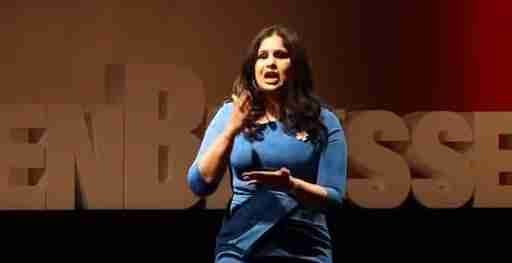
Read here the full transcript of Sangeetha Rai’s talk titled “How to Conquer Stress and Do Hard Things” at TEDxKULeuvenBrussels 2024 conference.
Listen to the audio version here:
TRANSCRIPT:
The Happiest Place on Earth
Have you been to the happiest place on earth? I have. And no, Mickey and Minnie weren’t there. My happiest place?
My grandparents’ coconut farm in this quaint little beach village in Tulu Nadu in South India. Their cottage was surrounded by more than 200 coconut trees and a whole lot of love and positive energy. I still savor the smell of the sea breeze mixed with the heavenly aroma of my grandmother, my Ajji’s fish curry, cooking over the fire pit. Even on the stage, if I close my eyes, I can taste the curry and feel Ajji tapping me on my shoulder and saying, “Be patient, Sanghi, the curry is not ready yet.”
I still remember the voice of my grandfather, my Ajja, animatedly telling me the stories of the love and the triumphs and the battles and the friendships of the heroes and the demons of Ramayana, my favorite Indian epic. Life was simple. Ajja and Ajji had limited resources, six hours of electricity per day, an outdoor toilet, and three meals of boiled rice and fish. But still, they had this way of navigating life with ease and had unconditional love and positivity, not only for me, but for everyone around them.
Lessons in Resilience
As I reflect on their resilience, it seemed to me as though they had a kit for leading their best life. As I ran around the farm, giggled with my cousins, and then rested my head on my Ajja’s chest, I felt loved, that I belonged, and that I was somebody. My teenage years were spent navigating the familiar terrain that most young girls in India faced. I was expected to do well and excel in school, while also preparing myself for an arranged marriage to a suitable boy who would provide for and take care of me.
Coming to America
I came to the U.S. after college. I knew no one, including my husband. I had no contacts, no education in the U.S., and no emotional support network.
I was in technology, a male-dominated field, and I had no experience talking to men because I went to an all-girls school most of my life. On top of that, I had a strong accent, and people couldn’t understand me. Picture this: I was in New York City, and I didn’t even know what a bagel was.
Career Challenges
My first job was in a New York startup. I was hungry, I was excited, I was curious, and I loved what I was doing. But after a few years, my career became an architectural nightmare. I hit the ceilings, the glass and the bamboo ceiling.
As an Asian woman, I was expected to be a contributor, but not suitable for leadership roles. And every single time I asked for feedback, I was told, “You’re a rock star, keep doing what you’re doing. It’ll happen.” And it was frustrating.
I finally got my first promotion after pushing tenaciously for it. But I was horrified by the reaction of the people on my team. The first one was the refuser, who said to me, “You’re not qualified to lead me, I’m not going to work for you.” And he quit, and they joined another team.
The second one was the berater, who constantly undermined me every chance that they got. And finally, we have the patronizer, who said to me, “Sangeetha, keep up the good work, I am so proud of you.” And they’re not my friends, they report to me. Being surrounded by these people was demoralizing.
Hitting Rock Bottom
I started to doubt everything and everyone around me. I had knots in my stomach before starting the next work week. I couldn’t get up to go to work on Sundays. As I lay down in bed each night, I felt trapped by the ceiling above me and the actions of the people around me.
I felt alone. I felt like a nobody. To build resilience, I tried popular media, I tried yoga, meditation, affirmations, but they wouldn’t help me push past the specific stresses that I was trying to conquer. I just felt worse day by day.
I still vividly remember the day that I hit rock bottom. I went to get myself a cup of tea, and I’m not sure what happened to me. I started pacing around my kitchen like a frenzied woman. I had tears streaming down my face.
I couldn’t breathe. I had severe back spasms, and I literally could not move. As I lay down in bed that night, with tears streaming down my face, I looked out the window, and it was raining. The rains reminded me of the monsoons in my grandparents’ village.
Remembering Ajja and Ajji
That moment, I remembered Ajja and Ajji and their unwavering positivity in the face of adversity. When it rained outside for days, and the rains caused leaks in the roofs of their home, Ajja had buckets around the house to collect the water that seeped in. And when the daily fisherwoman, the marakaldi, didn’t show up, Ajji served us dried fish for dinner. And when we lost power for days, Ajja had lanterns around the house to help us and to get light.
Then it dawned on me, they did not rely on a universal solution like I was doing by relying on popular media. They focused on what they could control, and they built customized resiliency kits for each stressor that they were facing. I then wondered if the key to conquering my stressors is to shift my mindset and to build customized resiliency kits. So I decided to try it.
Building My Resiliency Kit
Why not, right? So the first stressor that I had was public speaking.
Throughout my life, I’ve had severe anxiety speaking in front of public. Although 70% of people have this fear, it was compounded for me because people couldn’t understand me.
And I realized that to be a good leader, I needed to be a good speaker. So I built my kit, which consisted of solid preparation, a specific meditation to give me charisma on stage, which hopefully you can see, and a finger press method to help me in the moments of nervousness like I’m doing right now. Armed with my kit, I speak publicly on various topics like technology, artificial intelligence, leadership, and customer experience. I’m able to connect with, authentically and inspire people worldwide at conferences.
I spoke at the world’s largest women’s tech conference, and streaming services worldwide like Instagram, and of course, here on this stage. And once I found success with public speaking, I wanted to try customized resiliency kits for other stressors that would help me become a good leader. And I was able to successfully use it for being bold, negotiating, balancing home and work as a mother, and other things as well. And after I found personal success, I wanted to help others.
Research and Examples
So I conducted research. I read that Serena Williams has lucky socks before she plays a game. And Beyoncé does a stretch and a prayer with her band and sits in a massage chair before she goes on stage. What I realized was that as I saw hundreds of examples of successful people, what I realized was that successful people utilized customized resiliency kits, whether they were aware of it or not.
So I started recommending them to people who I mentored. One of them had a fear of flying. So about 30% of people have a fear of flying, and my friend David was one of them. He would be very anxious before a flight, and he wouldn’t sleep all night, and he needed to fly for work.
So we built his kit, which consisted of a little cheat sheet with data on why flying is safe, a stress relief spray that he sprayed on before he boarded a flight, and a key chain given to him by his mother for that in-the-moment support. After David was able to practice his kit consistently and repeatedly, he was able to train his brain, and he now has a good night’s sleep before he boards a flight. So David also has a fear of taking pictures. So this picture is artificially generated, but I am working with David on a resiliency kit to have confidence in front of the camera.
The Power of Customized Resiliency Kits
As I recommended customized resiliency kits to hundreds of people who I mentored, I saw them step outside their comfort zone and lead more fulfilling lives. And what became clear to me is whether you put buckets around the house, or you use a finger press method, or you sit in a massage chair, or use a stress relief spray, with the customized resiliency kit in your hand, you can enhance the neuroplasticity of your brain, and you will train your brain. Your resiliency kit should not consist of more than five things, and must focus on what you can control. Some examples are preparation techniques, lucky charms, affirmations, exercises, and data.
If you’re not sure how to build or what to put in your kit, you can research online, or you can talk to someone who handles that specific stressor really well, or speak to your mentors and friends. Now let me take you through how to build a customized resiliency kit with the help of my daughter, Sonia, who’s a second year student in college.
So this is the formula for creating a customized resiliency kit:
Step one, identify your one major stressor. Now Sonia’s stressor was balancing her schoolwork with the opportunities that came her way, and when she did pick an opportunity, like 70% of people, she had imposter syndrome. So identify your one major stressor.
Step two is customize. Research, build, and customize your kit for that specific stressor. Now Sonia had in her kit, she included a 20-minute run, and a decision tree to go through all of her opportunities and make her decisions, and an exercise to debunk her fears when she had imposter syndrome.
Step three is practice. Practice your kit consistently and repeatedly to train your brain.
After Sonia was able to identify her kit, customize her kit, and repeat her kit consistently, she’s now able to approach her opportunities with much more clarity and confidence.
And that’s not all. Please allow me to do a little proud mom brag here. Just like me, my daughter also recommends customized resiliency kits to her friends to conquer their stressors. So the right customized resiliency kit not only helps you become a calm, centered, and confident version of yourself, it empowers you to help others and touch countless lives.
The Importance of Resiliency Kits
And this is important because 75 to 90% of all doctors’ visits were due to stress-release and ailments. And when asked how people felt about their life choices, 4 out of 10 said they had wished they had done things differently. So just like we buy specific insurances for specific emergencies like life, medical, and vehicle, we need to have specific resiliency kits for specific stresses. Your resiliency kit, along with your mindset that you can do anything, can help you conquer stressors and do hard things.
A Lesson from the Temple Elephant
I went to the village temple with my Ajja when I was 11 years old. I saw this majestic temple elephant chained and listening obediently to the instructions of the Mahud, who is the elephant trainer. And I asked Ajja, “The elephant is so strong, why doesn’t it free itself?” And Ajja shared with me a profound quote from Swami Brahmananda in my mother tongue Tulu:
“Your mind is susceptible to suggestions. It learns whatever you teach it.”