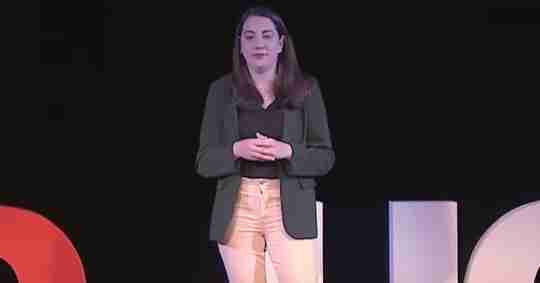
Read the full transcript of Olivia Rothstein Keeffe’s talk titled “How Public Memorials Help Us Heal” at TEDxUGA 2024 conference.
Listen to the audio version here:
TRANSCRIPT:
The Power of Five Seconds
For five seconds, I want all of you to sit still and absorb your surroundings. Try and trust your instincts to tell you when the five seconds have passed. All right, ready? Go.
Now, for each of us, those five seconds felt a little bit different and probably not very significant. But if you were to bring all of us together to talk about what happened during those five seconds, we would form a collective memory. What if we could freeze those five seconds? What if we could take them and turn them into something physical?
That is what memorials can do. They take our collective memories and give them form, freezing a moment in time and providing us a sense of permanence. It’s a daunting task, is it not, to design and build a symbol of hundreds, thousands, or even millions of people’s memories?
The Journey to Understanding Memorials
I started connecting with memorials on a deeper level after an undergraduate Holocaust studies class and a visit to the Memorial to the Murdered Jews of Europe in Germany. It was there I decided to pursue a Master of Landscape Architecture, so I could not only better understand existing memorials but learn to design new ones.
Currently, we use memorials to tangibly and physically honor those we’ve lost. They are physical representations of how we, as communities, address grief. Architectural historian Del Upton asserts that monuments always say more about the people, times, and places of their creation than they do about the people, times, and places they honor.
So when we create a monument or a memorial, we are not just creating it for the people before us, but for everyone in the future, too. It is a statement about ourselves and how we want to be remembered. As communities that choose compassion and understanding. Communities that choose to help each other face grief with resilience rather than repression.
The Vietnam Veterans Memorial: A Turning Point
America’s current culture of commemoration truly began with the dedication of the Vietnam Veterans Memorial on Veterans Day of 1982. Not only did this memorial completely change commemoration throughout the world, it also altered Americans’ attitudes towards veterans, particularly those coming home from Vietnam. Rather than being greeted with parades, praise, and gratitude as we likely would today, many Vietnam veterans came home to scorn and disdain if they were even acknowledged at all. Maya Lin’s design changed that, forcing Americans to face what happened and pushing them towards understanding.
Drawing on the abstract, Lin designed a black rift carving into the earth, listing the 58,281 names of Americans who were killed or went missing in Vietnam. The reflective nature of the granite causes visitors to see their own faces among the names, and ignoring the sheer magnitude of all that occurred is simply impossible. For those of us with little to no connection to the war, the memorial is eye-opening. But for those with a connection to the war, the memorial was and continues to be key to their healing.
In a note to the friends he left behind in Vietnam, one veteran wrote, “It is only now, on my second trip to the monument, that I can admit that you, my friends, are gone forever. That I can say your names, call you my friends, and speak of your deaths.” The memorial itself helped pave his path towards resilience, and he was far from the only person to mention such an experience.
The Era of Postmodern Abstraction
Today, nearly every major memorial built since ties back to the Vietnam Veterans Memorial in some way. From the Memorial to the Murdered Jews of Europe in Berlin to the 9-11 Memorial and Museum in New York City. Maya Lin defined our current era of commemoration as one of postmodern abstraction and inspired an incredible memorial landscape across the globe. No more statues, obelisks, or winged ladies. Today, memorials are about embodying the complex emotions of grief.
COVID-19 and Ambiguous Loss
Now, let’s flash forward to March 2020, when the COVID-19 pandemic hit in full force. Like all families, COVID-19 impacted my own in a million different and permanent ways. My father was forced to grieve his brother from a box on a Zoom call. And my brother-in-law, my best friend, worked unthinkable hours every day as a doctor facing the impossible.
I could not comprehend the depth of the loss I was witnessing because I could not even articulate what it was we were losing. And I saw millions of people across the world face the same dilemma. As I faced these heavy questions myself, I found the answers in Dr. Pauline Boss’s theory of ambiguous loss.
Dr. Boss is a family therapist who worked with the families of missing pilots from the Vietnam War. Through her work, she realized there was not a word to capture the grief and loss these families were experiencing. And so she coined the term “ambiguous loss.” In short, ambiguous loss is a loss that lacks clear resolution. It is when absence and presence coexist, creating a void we do not know how to fill. It can manifest physically with situations like complex deaths and divorce. And it can manifest psychologically with conditions like Alzheimer’s and addiction.
It feels unsettling. And our instinct is to try and seek closure or tie up any loose ends. But the way to face ambiguous loss is not through repression, but resilience.
Addressing Ambiguous Loss in Memorials
As I continue to witness the losses during the pandemic, this theory began to resonate with me in a more meaningful way. And as I read more of Dr. Boss’s work, I had a bit of a light bulb moment. I realized that the Vietnam Veterans Memorial addresses these ambiguous losses.