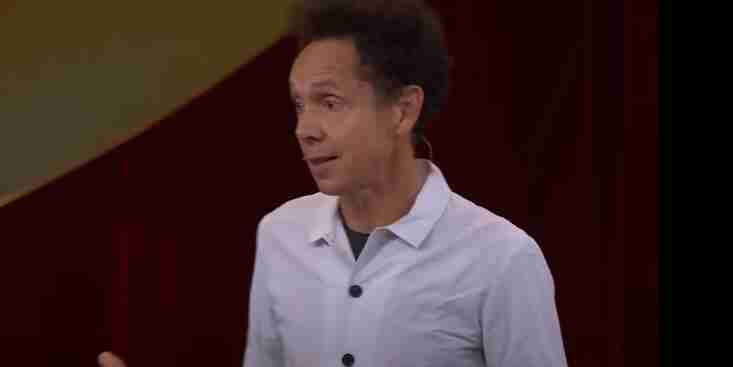
Read the full transcript of author Malcolm Gladwell’s talk titled “The Tipping Point I Got Wrong” at TEDNext 2024 on October 22, 2024.
Listen to the audio version here:
TRANSCRIPT:
MALCOLM GLADWELL: I want to tell you a story about when I moved to New York City in 1993. I was 30 years old, and I was moving to what was known as one of the most dangerous big cities in the United States.
And every night, I would go out with my friends on a Friday or Saturday night, and at the end of every night we would have a little conference and we would pool all of our money, and we would figure out how everyone was going to get home, because you couldn’t go home on the subway by yourself and you couldn’t walk home, and if you were a woman, you definitely were not allowed to go home by yourself at one o’clock in the morning on a Saturday night. That’s what it meant to be in this very scary city called New York.
I used to live in the sixth floor of a walk-up in the West Village, and my bedroom faced the fire escape. And even in the summer, I had no air conditioning, I had to keep my window closed because I was scared that somebody would come down the fire escape into my apartment. And then one day I woke up and I realized that I wasn’t scared anymore. And I kept the window open. And I realized that when I was going out with my friends, we weren’t having that conference at the end of the evening anymore. We were just going home.
This city that I had thought, we all thought, was one of the scariest in the United States wasn’t scary anymore. And I remember at the time I was absolutely transfixed by this transformation. I couldn’t understand it. It was the same city full of the same weird, screwed up people, same buildings, same institutions. Only nobody was murdering each other anymore. And I would call up criminologists and I would ask them, “What’s your explanation?” And no one could give me a good explanation.
The Epidemic Theory of Ghetto Life
And I remember one day — I used to go to the NYU, New York University has a library called Bobst Library. I used to go to Bobst to look for ideas. And I remember one day I was on the sixth floor in the sociology section, HM-1A6, and I was reading back issues, yes, I was, back issues of the American Journal of Sociology, and I ran across an article from 1991 by a guy named Jonathan Crane called “The Epidemic Theory of Ghetto Life.” And I’m going to read to you how it began.
“The word epidemic is commonly used to describe the high incidence of social problems in ghettos. The news is filled with feature stories on crack epidemics, epidemics of gang violence, and epidemics of teenage childbearing. The term is used loosely in popular parlance, but turns out to be remarkably apt.”
And what Crane was saying is that if you look at these kinds of social problems, they behave, they come and they go, they rise and they fall exactly like viruses do. He was saying that that term epidemic is not a metaphor. It’s a literal description.
And I’ll never forget when I read that little paragraph and I was standing in this aisle in Bobst Library, and, you know, it’s a library. It’s got that hush and that musty smell of books. And I’m reading this crazy article from 1991, and I remember thinking to myself, oh my God, that’s what happened in New York. We had an epidemic of crime. And what is the hallmark of an epidemic? It’s the tipping point. It’s the moment when the epidemic order goes up all at once or crashes all at once.
The Tipping Point and Broken Windows Theory
And so I wrote an article for “The New Yorker” magazine called “The Tipping Point,” which was my attempt to use this theory to explain what happened in New York. And then I, because of that article, got a contract for a book called “The Tipping Point,” which did very well. And that book led to another book and another book and another book. And I am standing here today because of that moment in the library 25 years ago.
So “The Tipping Point,” my first book, was about all kinds of things. I talked about Hush Puppies and Paul Revere and teenage smoking. But at the heart of it was a chapter on why did crime decline in New York. And in that chapter I talked a lot about a theory called broken windows theory, which was a very famous idea that had been pioneered by two criminologists called George Kelling and James Q. Wilson in the 1980s, very influential article, in which they argued that very small things in the environment can be triggers for larger crimes.
That essentially small instances of disorder are tipping points for very serious things like murder or rape or any kind of violent crime. It was an epidemic theory of crime, and the New York City Police Department took that idea very seriously. And one of the things they began to do in the 1990s during this crime drop was to say what this argument means is that we can’t be passive anymore. We have to be proactive. We have to go out there and if someone is jaywalking or jumping a turnstile or doing graffiti or peeing on the sidewalk, we’ve got to stop them.
And if we see a young man walking down the street and he looks a little bit suspicious, we’ve got to stop him and frisk him for his weapons. That’s how the NYPD interpreted the broken windows theory in New York.
And my chapter was how millions of people around the world came to understand the crime drop in New York, that it was all broken windows.
Admitting Being Wrong About Broken Windows
And here’s the thing that I have come to understand about that explanation I gave of why crime fell in New York. I was wrong. I didn’t understand this until quite recently, when I went back and I decided on the 25th anniversary of my first book, “The Tipping Point,” that I would write a sequel. It’s called “Revenge of the Tipping Point,” and I went back and, for the first time in a quarter century, I reread my original book.
I’m not someone who likes to revisit things, but I did it, and it was a uniquely complicated experience. It was like looking back at your high school yearbook. You know, when you see yourself and you have some combination of, “Wow, I look young,” and also, “Wow, I really wore that?” It was like that. And what I realized is that in the intervening years since I wrote that explanation of why I think crime fell in New York, the theory of broken windows had been tested. There was a kind of classic natural experiment to see whether that theory worked.
The Floyd v City of New York Case
And the natural experiment was a court case, maybe one of the most famous court cases in New York history called Floyd v City of New York. It involved a young man named David Floyd, who had been stopped a number of occasions by the NYPD and was the face of a class action lawsuit that said the practice of stopping young men, largely young men of color, just because they look a little suspicious to police is not constitutional. You can’t do that, right?
And to everyone’s surprise, the Floyd lawsuit goes before a federal judge. And the federal judge rules in David Floyd’s favor. And overnight, the broken windows era in New York City policing ends. And the NYPD goes from — In 2011, they stopped and frisked 700,000 young men, right. And after the Floyd lawsuit was decided in 2013, that number drops to less than 50,000.
So this is the perfect natural experiment. You have New York before Floyd and New York after Floyd. Before Floyd, the principal tactic of the NYPD is stopping everyone they can. And after Floyd that goes away. They can’t do that anymore, right? This is the perfect test case for whether you think that’s why crime fell in New York.
Everyone Believed Crime Would Rise Post-Floyd
And if you believe in the power of broken windows policing, then your expectation has to be that after the Floyd case, when broken windows goes away, crime is going to go back up, right?
And I should tell you that in 2013, in the wake of the Floyd case, everybody thought crime was going to go back up. The NYPD thought that, the city government thought that, the pundits thought that, even the judge who wrote the opinion saying that stop and frisk was unconstitutional, said in her opinion that she strongly suspected that as a result of this opinion, crime would go back up. I thought crime was going to go back up, right? All of us had internalized the logic of broken windows.
We said, yes, we know this strategy poses an incredible burden on young men, but what choice do we have, right? You know, if the choice is being stopped repeatedly by police or being killed, maybe we’re better off with the former than the latter. This is the price we pay for a safe New York, right?
The Second Crime Decline in New York
So what happens after the Floyd case? Stop and frisk goes away and crime falls. In fact, crime in New York City undergoes a second, even more miraculous decline, right? And what’s interesting about this is, you know, when the first crime declined in the 1990s, you see that decline almost everywhere in the United States, not quite as steep as New York, but crime goes down everywhere. And then in every other city in the United States, crime plateaus. But New York gets rid of broken windows, and crime starts to fall and fall and fall all over again. To the point by 2019 that New York City is as safe as Paris, which is not a sentence I ever thought anyone would ever say in my lifetime.
And what we realize in that second crime decline is that it wasn’t broken windows. It’s not indiscriminate policing that causes crime to fall. Rather, it is the intelligent and thoughtful and selective application of police authority that causes crime to fall.
People Still Act Like Broken Windows Worked
Now, there’s a couple of really puzzling things here. One is that people don’t seem to have internalized the fact that New York underwent this second, even more dramatic crime fall. People still act like it’s the year 2000 when it comes to making sense of New York.
You know, a whole bunch of very, very wealthy hedge fund guys have very loudly left New York for Miami in recent years. And they all say, when they’re packing up their offices in New York, “We can’t take the crime anymore.” Well, violent crime in Miami is twice as high as New York City. If they were really concerned about violent crime, they would leave Coral Gables before they get murdered and move to the Bronx, where it is a whole lot safer.
The other even more important thing, though, is that people act like stop and frisk actually worked. No one seems to have internalized the lesson of the great Floyd case natural experiment. If you listen to people — I’m not going to name their names, but people going around the country now campaigning for higher office, they will say things like, “It’s time to bring back stop and frisk and broken windows policing. It worked so well in New York.”
They’re acting as if we didn’t have that great moment of understanding in 2013. And for that, for that misunderstanding, I think I bear some of the blame. I was the one who wrote this book saying this was the greatest tactic ever in stopping crime.
Making Sense of My Mistake
Now, how do I make sense of my mistake? Well, I can give you all kinds of excuses. You know, I can say I’m not a fortune teller. I didn’t know that David Floyd was going to come along 10 years after I wrote my book and give us this great test case in broken windows policing. You know, I could say that, you know, I was just writing what everybody believed back in the 1996 and 1997.
But I don’t think those excuses hold any water whatsoever. I think that journalists, writers need to be held to a higher standard, right? I wrote — I told a story about how crime fell in New York, and I told the story like the story was over. And like I knew what the answer to this story was. And it wasn’t over and I didn’t know the answer, right? I wrote, “I know this is what happened,” and what I should have said is “This is what I believe happened now,” right?
And those words “I believe happened now” have to be at the center of any understanding of how the world works. We have to acknowledge that we are representing the position of this very moment, and that that position could change if the facts change, right? The great desire of any writer is to write a book for the ages, that will forever explain the way things are, but that’s not possible, and no one should ever try. That was my mistake. And I’m sorry.
Discussion and Q&A
MONIQUE RUFF-BELL: That was some mea culpa, Malcolm. And so I have a couple of questions for you. If you don’t mind, I want to take you back 25 years to that version of yourself. And so you talked about how there was a sense of anxiety and fear about what crime was happening around that time.
I grew up in New York around that time, 25 years ago. Being in my early 20s and having these experiences with my friends where they experienced unfortunate instances with stop and frisk, so much so they had anxiety, hurt and fear. And so when you were thinking about this and the support, did you ever think about what if they got it wrong, what if it was wrong and innocent people were going to have to experience this? What were your thoughts about that back then?
MALCOLM GLADWELL: Well, I wasn’t thinking about that. I mean, it’s funny, I went, when I was sort of trying to figure out what I did wrong in that chapter, I went down to Philadelphia and I went and met with a group of doctors, all of them Black, at University of Pennsylvania, because they had done some really interesting work on crime, and I wanted to get their sense.
And one of the doctors had read that chapter on crime. And she said, “You know, when I read your chapter on crime, you were exceedingly interested –” I opened that chapter with the famous story of Bernie Goetz, the guy who shot the kids on the subway. And she said, “Go back and reread the way you wrote that story, and you’ll realize you spent a lot of time talking about the fear of the white guy, and you have two sentences on the kids. And the kids were every bit as damaged as the guy who shot them.”
And I realized, I think I was just in — like so many of us, I was in a little bubble, and I was seeing the problem from one perspective. And like many, you know, middle- and upper-class professionals in Manhattan, I wasn’t thinking about the world through the eyes of someone in the Bronx or Brooklyn. And some of that has to do with youth, and some of that has to do with foolishness. And I’d like to think I’m a little wiser now.
MONIQUE RUFF-BELL: Right. So you had a quote — “I told this story like I knew the answer and it wasn’t over.” How has that insight affected your thinking and your writing now?
MALCOLM GLADWELL: I’ve tried to be, I mean, I realize when I look back at my younger self, I was way too certain about the ideas that I was putting forth. And I thought that if you wanted to win over an audience, you had to communicate certainty. And now I realize that’s actually backwards, that you’re more willing, you’re more capable of winning over an audience when you admit to the uncertainty and the fragility of your position. People want that. They like that, they appreciate that spirit far more. And people are much more likely, I think, to be suspicious of someone who seems falsely certain.
MONIQUE RUFF-BELL: Well, we appreciate you bringing your thoughts to this platform and sharing that. And so thank you to Malcolm Gladwell for doing that.