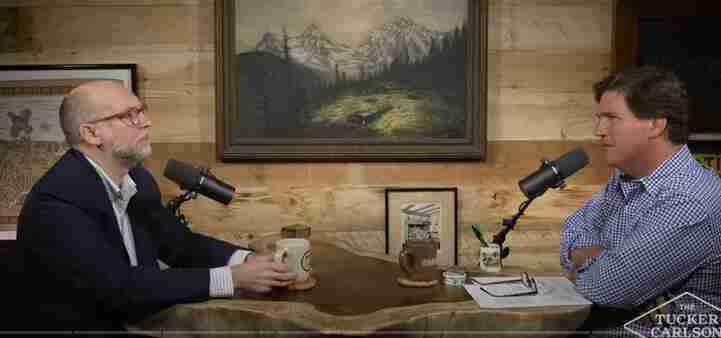
Read the full transcript of Tucker Carlson’s in-depth conversation with Russ Vought in The Tucker Carlson Show ( November 19, 2024).
Listen to the audio version here:
TRANSCRIPT:
The Role and Power of OMB
TUCKER CARLSON: So, you ran OMB before, and you don’t have to comment on this, it sounds like you are very likely to run OMB again. Tell us what OMB is for those who aren’t from Washington, what it does and what you would do with it.
RUSS VOUGHT: So, OMB is the nerve center of the federal government, particularly the executive branch. So, it has the ability to turn on and off any spending within the Office of Management and Budget. Office of Management and Budget. It has the ability to turn off the spending that’s going on at the agencies. It has all the regulations coming through it to assess whether it’s good or bad, or too expensive, or it could be done a different way, or what does the president think? And then all of government execution.
So, anytime you have cabinets, executive branches conflicting with each other or working together on something, for instance, you know, the wall, the president wanted to fund the wall, we at OMB gave him a plan to be able to go and fund the wall through money that was the Department of Defense and to use that because Congress wouldn’t give him the ordinary money at the Department of Homeland Security. So, it really is presidents use OMB to tame the bureaucracy, the administrative state. It was really pioneered, honestly, by FDR, and then President Nixon also was really learning from FDR on how to use it to tame the bureaucracy, and we would have seen that.
TUCKER CARLSON: Did he create the office, Roosevelt?
RUSS VOUGHT: The office was formerly the Bureau of the Budget for the last 100 years, right? And then Nixon renamed it Office of Management and Budget, and it becomes kind of more of a statutory thing, reporting directly to the president, no longer within Treasury. And so, since then, you’ve had it still there, still really important, viewed by the country largely as a budget cutting exercise, but it is the president’s most important tool to dealing with the bureaucracy and administrative state. And, you know, the nice thing about President Trump is he knows that, and he knows how to use it effectively.
TUCKER CARLSON: So, you can’t get any of your domestic policy done without OMB, it sounds like.
RUSS VOUGHT: No, you will be in a situation where you will have, at best, really awesome cabinet secretaries who are sitting on top of massive bureaucracies that largely don’t do what they tell them to do. And you have to have statutory tools at your disposal that force that bureaucracy from the White House to get in line. And that is really the main thing that OMB can accomplish, in addition to what everyone would think of from a budget office, which is, yeah, you cut spending, you figure out how to deal with your fiscal finances and all of that.
The Resistance of Federal Agencies to Democracy
TUCKER CARLSON: You’re making me anxious. I mean, I can’t handle a disobedient dog. I can’t imagine what a disobedient federal agency looks like. How resistant are they to democracy?
RUSS VOUGHT: They’re incredibly resistant. I mean, think about Ukraine and the president in that first term wanted to cut off funding for Ukraine. Why? Because it’s a corrupt country and we didn’t know how it was going to be spent. It’s a totally normal policy process to go through that people lost their minds about. But the bureaucracy was literally just ignoring it. And quite frankly, his political appointees like John Bolton were ignoring him as well. And what we then did at OMB was I had been personally told, you know, I want the money cut off until we can figure out where it’s going.
And we cut the money off. And it was like all hell broke loose within the bureaucracy.
TUCKER CARLSON: We got impeached. Yeah.
RUSS VOUGHT: And so, yeah, and so you have the ability at that point to bring them to come to heel and to do what the president has been telling them to do. And we can do that in foreign aid. We can do that all sorts of ways. It’s kind of crazy.
TUCKER CARLSON: I mean, everything you’re saying I’m familiar with. But if you think about it, that’s the end of democracy, because the only authority in the executive branch comes from the president, the vice president also elected. But it comes from voters as expressed through elections. So bureaucrats and the federal agency appointees in the federal agency have no authority to act independently that I’m under our Constitution, do they?
RUSS VOUGHT: No. And this is really the left has innovated over 100 years to create this fourth branch of an administrative state. You and I might call it the regime, this administrative state that is totally unaccountable to the president that lets it move in the direction that it has been going.
TUCKER CARLSON: But the president is accountable to voters, so are members of Congress. And the system is designed that way. That’s why we say it’s a democracy or constitutional republic, because the voters convey bestow the authority on their leaders. And so this seems not only illegal, their behavior, but unconstitutional. I mean, at the most basic level, unconstitutional, no?
RUSS VOUGHT: Totally unconstitutional. And if you would have seen Woodrow Wilson bemoan our constitutional system, he would have wanted constitutional amendments. The left stopped talking about constitutional amendments because they innovated to this new fourth branch, which is totally different than anything the founders would have ever understood. The notion of independent agencies that think of and Congress has designed them to be divorced from the president. But even the notion of like this is — this is we’re supposed to be technocrats and experts, and we don’t have to listen to what you what you say.
We work for and I caught this, Tucker.
It’s why these bills are written in such a way that they are anything you could read anything into them. Right. When Nancy Pelosi says “we’re going to find out what the bill says,” she wasn’t actually being inaccurate. That’s their strategy. They pass bills and then they let the experts fill them in. But over the phone, they put massive pressure on them to go along with their their directions and their ends. And lo and behold, you get conservatives, Republicans that take office. And then you find that it’s incredibly difficult to wield power to get them to deal with all of that muscle memory to get them to do what you want.
And so you’ve got to have statutory authority that a president kind of steps in and says, I am fully aware of where I sit in the Constitution. I am fully aware of the tools at my disposal. And I’m going to use them on behalf of the American people because I just want a massive agenda setting election. And I’m going to go do what I said I would do.
TUCKER CARLSON: That’s democracy, correct?
RUSS VOUGHT: That is democracy. That is not oligarchy. And when they say we’re going to preserve democracy, we know that they have been meaning all they want to do is preserve their kind of amorphous oligarchy administrative deep state.
TUCKER CARLSON: I don’t think that’s an overstatement at all. I mean, I just think I don’t even see the counter argument against what you just said.
The Ukraine Funding Example
TUCKER CARLSON: So let’s just if you don’t mind walking us through what happened in the example that you gave Ukraine. So you just said the president comes into office in 2017 and says, “Why are we spending all this money to Ukraine? Where’s it going? There’s no audit. We don’t know. It’s the most corrupt country in Europe, one of the most corrupt in the world. Maybe we should find out. We don’t know. OK, we’re cutting off till we know.” I think it’s what you said.
And the agency is like, “No, we’re going to continue to fund Ukraine.” How do they do that?
RUSS VOUGHT: They ignore the president and their — and officials ignore the president. And I think one of the things you’ll see in this next Trump term is policy officials, his political appointees that are not looking to get out of what he has clearly told them to do.
TUCKER CARLSON: Right.
RUSS VOUGHT: So let’s let’s assume that issue is solved. But at the bureaucratic level —
TUCKER CARLSON: The issue, I think what you’re saying is let’s assume that he appoints people who agree with him and will do what he asks.
RUSS VOUGHT: Correct. OK. So, for instance, my staff was part of what we call the policy process, right, where you would go and you defend that and you articulate what you’re trying to accomplish. And we had put the hold on the Ukraine funding. And my guy goes to the all of these meetings and he’s like literally the only one in the room that wants to do what the president has asked him to do.
Everyone’s kind of just ganging up on him. And that is think of that often for all of our political appointees. They are surrounded by people that have no idea about what the reasons and the agenda that the president has been put in office. And they’re just bombarded with reasons of how can you do this? What are you thinking? Did you know that this is you can’t do this? Most of the time, that’s not true. And so you have to cut through all of that and to have the courage of your convictions and quite frankly, Tucker, the know how to know to have read the law, to get in the granular details yourselves, to not be staffed by your people working for you.
This notion that you can just come in and preside is not true. You have to — you have to be in the weeds and to drive these agencies to be able to fix where we have the undergrowth and the muscle memory that we’ve had for decades.
Challenges in Firing Disobedient Employees
TUCKER CARLSON: So why can’t you just show if the president says, again, to refer to your example, “I don’t think we should be funding Ukraine. I’m elected. We’re going to cut this off. If Congress wants to fund Ukraine, they can go ahead and do that. But the agencies are not going to fund Ukraine.” So why wouldn’t you just fire the people who disobey who who try to subvert democracy?
RUSS VOUGHT: You’ve got to know how to fire them. And there are tools to do that. And the president was innovating in that space himself with what’s called Schedule F of essentially saying, if you work for me in your policy, a career official, think your attorneys who are writing regulations, then we’re going to create a new classification for you. And you are going to be what most of the country is, which is at will employee.
That’s where we’re headed. But there was also ways that —
TUCKER CARLSON: I don’t understand the system where a president, any president, Obama, Biden, Donald Trump comes in and doesn’t have control of the executive branch because constitutionally he does have to know. So how come you can’t fire them? Why is it just not as simple as saying you’re fired?
RUSS VOUGHT: It should be. And this is one of the mountains of the administrative state. This is how they have built their institution by essentially having a it be incredibly difficult to hire and fire employees. And so I’ll get another example.
When the president decided to take money from defense to build the wall, we had clear legal grounds to do it that Congress had given us. It’s called transfer authority. And I told this to the Hill. And obviously, this was controversial. It shouldn’t have been controversial. Congress had given us very clear transfer authority. I must have had at least three times someone relitigate that decision from the career staff who work at OMB. “Are you sure? Are you sure? I think we should oppose.” I think this guy’s the decision has been made. Execute the decision.
And you see that everywhere. Right. And if you don’t — if you don’t drive it, you’re going to get better. You’re not going to be able to accomplish what the president needs you to.
TUCKER CARLSON: How about if you were just to start the meeting with any? OK, this is how democracy works. The people elect the leaders. He carries out their will. Anyone standing in the way of that is subverting democracy. We will not allow that. Anyone who does that is fired instantly. Could you do that? And just say “you’re fired for unconstitutional behavior”?
RUSS VOUGHT: You can do that increasingly when you move towards a Schedule F system. And there are other tools in the toolbox.
TUCKER CARLSON: But under the current system, what would happen if you tried that?
RUSS VOUGHT: A few lawsuits, lawsuits…
TUCKER CARLSON: Lawsuits. But if you fire them all.
RUSS VOUGHT: Look, you’ve got a lot of tools on the table.
TUCKER CARLSON: And it’s just so infuriating.
Reversing the Administrative State’s Overreach
RUSS VOUGHT: Look, it is one of the most infuriating things that you could possibly imagine. But I think that the good news and this is, I think, the good news, not just in hiring, firing the good news at large is that most of the time they have been able to get as far as they can because of just it is the way it is. It’s precedent and laws that are not drafted precisely, but purposely vague. And as a result, we can then do it in reverse.
You can have a president who steps in and says, you know what? There’s no constitutional amendment for me to take control of the administrative state. I’m going to do in reverse everything that you have done. And I think that is the great hope.
What you need is people who are able to absorb political heat. They don’t have a fear of conflict. They can execute under withering enemy fire. They are up to speed and they are no nonsense in their own ability to know what must be done. And they are unbelievably committed to the president and his agenda and believed — and truly believe in their bones that they’re not there for their own agenda. They’re there for what President Trump was elected to do. And so his commander’s intent matters a great deal. And that’s the view that I always had, Tucker, is how do I get in the mind of the president to think through what is he trying to accomplish? And then I’m going to go figure out how to do it.
TUCKER CARLSON: Yeah, because once again, he is the authority and no one else does because only he was elected. And I just — I’m fixated on this question of like, where do career bureaucrats think they derive the authority to make these decisions? Like who made them God? I think it’s very no one ever asked that question in D.C. You’re considered a freak if you do. But I think it’s a key question.
The Media’s Role in Thwarting the President
TUCKER CARLSON: And so one of the problems that you had last time was the media. Explain how that works, how the media works in conjunction with the permanent state and the Congress to thwart the president.
RUSS VOUGHT: Well, I think, number one, they are always framing narratives and messages that both are lies and are also designed to destabilize the Republicans in control who want to be for however that narrative is being framed. You used one already with democracy, right?
If you’re not aware that when they say democracy, they mean oligarchy. You’re like, I don’t want to be anti-democratic. The whole point is preserving democracy. It’s what we just did.
And if you have a plan to deal with the administrative state and then they frame it as authoritarian, you don’t want a cast of your own allies saying, “I don’t want to be anti-authoritarian.” We saw this in COVID, right, where we if they decide — if they define something as anti-science or anti-public health, it causes our political appointees to just completely wilt. Right. And so that I think the beauty of President Trump is he’s kind of immune to these media generated narratives that conflict with common sense reality.
That, I think, is the main one, because that’s that is there. That is controlling the skies from a military standpoint. Like that is their ability to to to shape the conversation in such a way that makes it very hard. Number two, they’re obviously working in conjunction with with leakers and individuals with know how to know, you know, when a hold has been put on Ukraine to be able to send that and have it explode in the public arena.
And so you have to — you have to be prevent leaks. You have to govern well from the get go to be able to manage all of that as best you possibly can. And but I also think there’s an opportunity there because they will report on conflict. They will report on confrontation. And when they do that, you can get the word out as to what you’re doing. At least you can get the word out on shows like this and in the new and developing ecosystem.
TUCKER CARLSON: Well, that’s kind of it right there. I mean, that was the basis of my question. I do think things have changed, right? I mean, if you still care what The New York Times or Washington Post say or Ken Delaney at NBC News, like I hope you’re not working there. Right. Do you think anybody still cares what they think?
RUSS VOUGHT: No, the whole ballgame has shifted. Right. Like, I don’t even know why you would do many of these interviews at all, because if you can’t get, you know, you’ve got to be able to get your words out without just complete combativeness. And I think the best example is remember the Kaitlan Collins interview with President Trump. I mean, it’s just constant interrupting and misuse of lies, actually. Right. And so, like, that’s the kind of thing that you’re up against.
But you can shape them. You can, particularly the print media. And I think there are you know, I think it’s important to at least attempt to do that. But you have to make the measure of the person that you’re dealing with. And sometimes they’re just, you know, they’re complete activists themselves.
Skepticism Towards Intelligence Briefings
TUCKER CARLSON: I want to ask you what the Intel agency is. It does seem like one of the main vectors of control is briefings. And the number of people I’ve spoken to Congress executive branch like, “oh, no, no, if you only got the briefing.” I think I lived there too long. I just don’t believe the briefing. You know, maybe sometimes they’re accurate. Sometimes they’re not.
But they’re almost always designed to control the person being briefed. Did you see that?
RUSS VOUGHT: I did. And I very rarely ever learned anything particularly interesting.
TUCKER CARLSON: Is that true?
RUSS VOUGHT: Yeah. They didn’t tell you who killed Kennedy, huh? They did not. Right. And so, you know, I think I came away with the similar skepticism of these briefings and the information and the over classification in the system. They classify everything. You’re really reading this thing. You realize that’s all just normal stuff that’s out in a congressional research service.
TUCKER CARLSON: Yeah, it’s on Twitter.
RUSS VOUGHT: Right. And so like so I think that’s a huge thing that we’ve got to fix, you know, over classification and system. But I think they both create this environment where it’s very exclusive. They are trying to bring you into their kind of priestly role so that no, I saw the briefing. If you had seen the briefing, you would you would you would be OK with us not having a FISA warrant requirement.
TUCKER CARLSON: Exactly.
RUSS VOUGHT: Right. You would be OK with us just another $100 billion for Ukraine. Just we can’t have Ukraine fall. None of it is rigorous analysis. And honestly, I think that’s the biggest thing that I was bemoaning is the extent to which rigorous analysis that I thought would be there wasn’t there.
TUCKER CARLSON: What do you mean by rigorous analysis?
RUSS VOUGHT: I don’t expect people to agree with me constantly. I want to — I want to — I want well-prepared memos that that make that have a conviction to them. And then support them. It’s not these are not like I’m going to plant the flag. And then we can we can say, OK, who’s right? Who’s that? Who has better support? No, no.
It’s like I’m going to give a blob an exercise to report on something. And the blob is going to kind of like all it’s not a Google spreadsheet, but it’s going to all be, you know, an interactive Google spreadsheet to just spit out something that is a consensus document. And you’re reading this thing. You’re like, this makes no real claims other than to affirm the narrative that we just talked about.
Right. So what’s the point other than to preserve the status quo? At that point, the point is just to know what the intelligence community is writing on because you’re not going to learn anything from it.
TUCKER CARLSON: I talked to someone recently in the last few days who works in the intel community, I see who is saying that you can see people who come to Washington for the first time in high positions and other branch before and after their briefings.
And they’re like different people and they they fall for it like all of them fall for it. No. “Now we’re going to tell you all the things you wondered about. We’re going to tell you the truth about the president’s” especially Trump seems, as you said, immune from this.
And he’s done it before. But this person said you should see how much they change, like deep inside. Once we let, you know, lay the bullshit on them, they just they’re not the same. Have you noticed that?
RUSS VOUGHT: Oh, I haven’t seen it. You know, I think part of the problem and this is endemic of not just the IC, but our we don’t read enough in general. We don’t have our own convictions. We don’t search for understanding ourselves.
And so you have people go in and they’re like, “I’m I kind of need this career staff to tell me what to think. I don’t want to look stupid.” Right. And so that has killed us on our side of the aisle, the conservative side to say we don’t have people that are driving policy and bringing their own opinions and their own history.
And so they they are susceptible to feeling like they and they still they still believe that these people have an authoritative stance on things and they don’t have enough skepticism that, in fact, you know, there’s no the emperor has no clothes. Right. And then that is the and you’ve got to bring that perspective.
TUCKER CARLSON: They’re weak inside is what you’re saying. A lot of these people.
RUSS VOUGHT: I do think that’s I do think that’s the case, you know, and, you know, from the standpoint of the IC, the other thing that they would do is they they would keep you from being briefed. Right. The briefing we’ve already discussed of what the brief is and sometimes like what President Trump is saying, “I’m not going to necessarily get the brief.”
Right. But I would find that I wasn’t read into certain things until they needed my signature. So once they needed some reason to get my signature, then all of a sudden I get this brief. Right.
And that’s not the way it should be. If you’re trying to provide oversight and accountability, you need you don’t know what you don’t know. And so you have to be able to be have the whole entire landscape of things that you could. Oh, that that’s interesting that we should do something that President Trump wouldn’t like that.
And I find that was very restrictive unless they needed me. And so I basically said, “look, I’m not going to you are not getting my signature unless you get me briefed up. And I want I want access to all of these things that I need to be able to provide oversight for the federal government.” And one of the things that we did, Tucker, is that.
Changing the System at OMB
RUSS VOUGHT: Since the rise of OMB, that ability to turn funding on and off had always been done by a career individual, not a political appointee. And so we changed that. And it was like the it was like the world was going to end. They said, “look, you’re going to destroy the agency. You can’t you can’t handle the bandwidth. You can’t handle the bandwidth chaos will be will be unmatched.” And we changed it. And next thing you know, everything’s flowing across our desk.
Oh, that’s interesting. We’re not doing that. You know, it was just amazing. And if you don’t know and have that thesis that says this is what must be done, you could be the most incredible conservative in the world.
You could be the most policy consistent person with the president. But you don’t know how to put your hand in the glove and and use that agency for the president’s behalf. The president’s not going to be able to be well served at that agency.
TUCKER CARLSON: I saw David Ignatius, who is a longtime water carrier for the CIA. I don’t know if they’re paying him, but they should be because he does their bidding and has for decades at The Washington Post. And I heard him saying yesterday that we can’t have Tulsi Gabbard at DNI, Director of National Intelligence, because it will cause, quote, chaos because the intel community doesn’t like her. And basically, he’s making the argument that we should not have civilian control of these agencies because the agencies won’t like it. Just say it.
That’s what you really mean.
RUSS VOUGHT: Well, I think that’s basically what he’s saying.
TUCKER CARLSON: So that’s again, that’s dictatorship is what he’s describing. But he used chaos as kind of the threat.
Rooting Out Corruption and Causing Necessary Trauma
TUCKER CARLSON: OK, but you’ve been there. If you really did everything that was needed in order to root out the corruption that defines our government, you will cause some chaos. You would, wouldn’t you?
RUSS VOUGHT: It will certainly read in the papers like, hey, that’s good, fair, you know, as to what’s what, what just is normal, good government behind the scenes, managing, pushing, pushing through whatever.
I think it can be done very wisely and and done in a way that, you know, anyone who had a bird’s eye view into that would be able to say that’s exactly what we put this administration into office. But, yeah, you’re going to have to kick over people’s paradigms. You’re going to have to kick over people’s turfs. You’re going to have to change people’s understanding of things that they have invested their whole life into a view of the world.
And none of this is their views of the world aren’t rooted in the Constitution, in some case, in some cases, any version of the facts. But you’re going to that’s going to cause a lot of turmoil within these bureaucracies and you’ve got to fight through it. And then they’re going to overlay the aspect of, “oh, my gosh, you guys are racist. And, you know, you guys don’t care about us as people.”
You’re going to have to deal with that, too. Right. They are, you know, one of the arguments that they’re using in the press against me right now, as they say, “he he called for trauma within the bureaucracies.” Yeah, I called for trauma within the bureaucracies.
Bureaucracies hate the American people. They want to put a 70, 70 year old and did a 70, 70 year old Navy veteran in jail for 18 months for building four ponds on his ranch to fight wildfires. That’s not the Department of Justice. That’s the EPA.
You go every agency and it’s not just big government. It’s weaponized against the country. Of course. And so, yeah, we we would want to provide trauma against that bureaucracy in a way that frees the American people from the people that have assumed the type of power that the Constitution and no law, no public debate ever gave them.
Does that mean we dislike everyone working at federal agencies and want them to have a bad life? No, of course. There’s a lot of people there who have come to serve and do great public service, and we want to affirm that and we want to turn over the bureaucracies that are traumatizing the American people.
TUCKER CARLSON: Yeah, and the outcomes are terrible and they’re terrible because it’s corrupt. That’s why it doesn’t change. And the D.C. metro area is the richest in the country and they don’t make anything. So it’s just like that’s the most obvious marker for corruption that I can imagine.
Expectations for Congressional Confirmation Hearings
TUCKER CARLSON: Tell us about what. Congressional confirmation hearings are going to look like for Trump’s appointees.
RUSS VOUGHT: They’re going to be they’re going to be exhilarating if you have the right approach. But they’ll you know, they’re going to come at everything we’ve got right, you know, or everything they’ve got with with what they are able to put someone in the dock and that individual is going to have to face the balance of wanting to defend everything that they’ve have done in life and belief. And at the same time, you’re the thing that’s a little hard about is you’re you’re no longer yourself, right? You are yourself, but you are also going to do a job for a person. So what I think about a particular issue doesn’t mean as much as what the president thinks about something like that.
And so it is it is a different thing than than coming on and doing an interview about what your viewpoints are on a particular.
TUCKER CARLSON: No, that’s that’s exactly what it’s not. It’s not a cable news hit.
RUSS VOUGHT: Right now. So but I I think look, I have I’ve had experience. You know, Bernie Sanders went after me very, very hard in my first confirmation hearing as deputy OMB for essentially believing in John 3:16. And it was it.
TUCKER CARLSON: Wait, he hit you. He attacked you on the basis that he said I was a bigot and I should not serve in the federal government because of my Christian faith and believing something that essentially comes down to what’s articulated at sports games with John 3:16.
RUSS VOUGHT: And that was most close.
TUCKER CARLSON: Who’s the bigot? Who is the bigger right? That’s the perfect question.
RUSS VOUGHT: It goes back that most nominees will not go through what I went through, but I will tell them you will get through it. You will get to the other side and it will be the most freeing thing in the world. You will come at through the end of a process like that and you will I find it to be at that point exhilarating because it prepares you to take on an enemy fire.
What are they going to what are you afraid of and calling you bigot, racist, Christian nationalist, authoritarian? If you if you are if you are not afraid of these attacks and you give them no credence, no credibility, then you will be able to get through these things. You will be able to convince enough senators and you’ll be able to serve and you’ll be served more effectively. But but the bright lights and will be on in these confirmation hearings.
TUCKER CARLSON: So how much of it is like theatrical and how much of it is real? Like, so you go into a hearing like that, your confirmation hearing. Do you know the outcome at the beginning or do you think that votes really change based on the testimony of nominees?
RUSS VOUGHT: I don’t think most votes change at all. I think that, you know, you may have one or two anomaly senators that are trying to, you know, have you answered something to their satisfaction or are they’re trying to get a feel for you that they haven’t otherwise. But I think increasingly in the in our the partisan world that we live in, the Democrats are voting now and it’s a matter of making sure you’ve convinced and you’ve brought in the I mean, what’s in I got no Democrat votes, but the Republicans are always voting for the way.
TUCKER CARLSON: I mean, Lindsey Graham will vote for any Democrat. Sorry, I’m not going to put you in an uncomfortable situation, but there are plenty of Republican senators who are liberal Democrats, effectively, and they vote for all kinds of nominees.
But you don’t see that on the other side. You never see that on the other side. And they they have an appreciation that they have to attack our people at every level because they know that every level is a stepping stone for the next level.
RUSS VOUGHT: Exactly. Right. So they don’t make as well as it’s just like the undersecretary.
TUCKER CARLSON: Yeah, exactly. You know, they know we’re opposed to that. That guy will be secretary.
RUSS VOUGHT: Correct. Well, you’re a perfect example, aren’t you?
TUCKER CARLSON: Well, certainly the first term, right, I become deputy. And next thing you know, Mick goes to the chief of staff. And so I have an opportunity to serve as deputy as director. And so that is they understand government. They understand the career path that is opening for people. And they when they sense it’s not always the case. But when they sense that this is a committed conservative. It’s a partisan line down the road.
The Constitutionality of Recess Appointments
RUSS VOUGHT: I have high hopes that they that people are seeing what Trump just accomplished and are going to be pulling the oars to get things done as soon as possible. And I think the jury is out. Right. I think I want to see and I’m hoping to see people looking for ways to move these appointees through the process. And sounds like they’re trying to do that. We’ll see.
But, you know, we have to do things not based on how it has been done recently. Like this whole notion of the recess appointments. Right. You have some people out there who are saying this is unconstitutional.
It’s not the way it was meant to be. It’s totally wrong. Right. It is a specific provision in the Constitution to be able to allow a president if he does if he has to stand up an administration quickly and he’s dealing with a Senate that won’t move quickly enough to be able to install his people so that he can actually function as a government.
Right. That is specifically mapped out.
TUCKER CARLSON: And yet you have. So in the Constitution.
RUSS VOUGHT: In the Constitution. By definition, not a constitutional fair.
TUCKER CARLSON: Fair. So you yet you have Republicans, one of them in particular, like Ed Whelan right now, who’s attacking Trump for even mentioning who’s Ed Whelan.
RUSS VOUGHT: He writes one. He’s one of the main kind of legal luminaries on the right. And ethics and public policy are one of those think tanks. And he’s out there opposing the whole notion of recess appointments for whatever reason.
The Role and Influence of Conservative Think Tanks
TUCKER CARLSON: I don’t know other than he thinks it unseemly and not the way the foundation don’t. I mean, this is a whole separate question, and it’s a broad brush. But in general, conservative think tanks, with some exceptions, are not conservative. They’re tools of the left and sort of repositories have broke down people with no other job prospects. Why would anyone pay attention to them?
RUSS VOUGHT: I think they should increasingly not be. Yeah. And by the way, there are some good ones that, you know, I love Kevin Roberts, Harrison, and they’re good people and something.
TUCKER CARLSON: Thanks for sure. But in general, it’s like the world of Jonah Goldberg. It’s like, who cares what you think?
RUSS VOUGHT: They only matter to the extent that people in the arena listen to them. Right. And that is increasingly they are not being listened to. And I think that’s part of one of the reasons why they’re so up arms about it. Right.
TUCKER CARLSON: I mean, the National Review itself is that’s what is phenomenal. National Review. That was a magazine in the 50s.
RUSS VOUGHT: Right. So and I think that’s but my point is the extent to which people have opposed Trump and the America First agenda, I think ultimately is a loss of power because they didn’t get to set the agenda. They don’t get to be the traffic cop. They don’t get to kind of say, “oh, this is this offends my sensibility” and more.
And no, if you have a radical constitutionalism, and that’s really what I’ve been calling for, given this crazy unconstitutional situation that we’re finding ourselves in, if you have a radical constitutionalism, it’s going to be destabilizing. You may find that you can use the James Madison could have put a whole lot more recess appointments in than you would have ever imagined. But it’s also exhilarating. And why, if you’re trying to preserve the country, would you make arguments against that?
Why wouldn’t you be making arguments for us? That’s one of the reasons we just put out a five page paper. We’ll put out a 40 page paper next as to this is the constitutional grounds for recess appointments of we haven’t just President Trump hasn’t decided to do it. But if he does, he will be in the same vein as our founders.
Recess Appointments and the Senate’s Role
TUCKER CARLSON: It’s a little weird. And again, you haven’t. Well, as of right now, November 18th, you’ve not been nominated.
RUSS VOUGHT: No.
TUCKER CARLSON: Yeah, I think you will be.
RUSS VOUGHT: Hope so. But you haven’t been. So I don’t want to put you in an awkward spot, because if you are, you’re going to have to deal with this.
But why would Mitch McConnell still the Senate leader of Republicans? Why would he say we’re not doing recess appointments?
RUSS VOUGHT: Again, I can’t. I haven’t spoken to Senator McConnell on it.
My guess is that the Senate is going to want to know the argument and they probably have been told and may have been told. And I’m going to just keep it as positive as possible that this is inappropriate. You can’t do it. And I want to show them and know, in fact, you can.
It is entirely appropriate and to win the argument. And then if you win the argument and then people are like, “no, we don’t want to do this,” then it’s a different matter. Right. It’s like it just kind of reveals that they’re they’re not actually on board with those particular nominees going into office.
And that’s a different issue. So I think that we don’t know yet whether will the Senate have an issue. I mean, to some extent, the Senate knows it has an issue because they couldn’t move these nominees fast enough in the first term because the Democrats were filibustering everyone. Right.
And so and by the way, a lot of these hearings and you read the history books and people got approved by the Senate in a day, you know, like the system wasn’t meant to be this slow and it has been bogged down and slowed down. And we’ll see, you know, Senator Thune, Majority Leader Thune will have a chance to put his own imprint on the Senate. And I want to see how he does.
TUCKER CARLSON: Yeah, I’ve got, you know, high expectations, low hopes. I hope I’m wrong. Um, it’d be one thing if the outcome was positive, if the country was thriving, you know, you say, OK, the system’s dysfunctional, but you don’t really need a lot of change right now. So that’s fine. But the outcome is not positive at all. It’s total destruction of the country we grew up in. So got to fix it.
Reasons for Serving in the Trump Administration
TUCKER CARLSON: Why would you want to enter back into this?
RUSS VOUGHT: Well, you know, I I’ve always said last four years, I would never want to miss out on another chance to be at the president’s side. I find in him to be someone who’s so uniquely situated for the moment. And you go back and I’ve done some reading on this. You go back and read some of the Federalist Papers, and they actually designed the system for someone like him whose his his interests would align with the country’s interest to such an extent to which he it actually works like separation of powers is meant to have strong, opinionated, convictional leadership that go as fast as they can and hard as they can in their direction and for the system to then have true separation of powers. Right.
An example of that is is what he’s proposing on recess appointments. If the Constitution allows you to do it, why wouldn’t you do it if it’s in your interest? And then let’s see what Congress does in response to that. But that’s real separation of powers.
It’s not like this kind of fake fourth branch administrative state where none of it works. It’s all kind of cartel behind the scene where all you get is kind of different parts of each of the branch coming together almost as a blob. And I think he’s so unique in terms of being a historical transformative person that we can actually save the country. And that’s really what it comes down to.
The hour’s late. It’s eleven fifty nine. It’s not too late, but it’s really late. And this isn’t an election where you can just have seesaws.
We’ll be up and you’ll be down. No, we if we don’t win and he’s won an electoral mandate. Now it’s time to actually execute. If we if we don’t execute, we may never have this chance again.
And so you have the president who’s ready to go. Now you need know how people who can do that and do it with the attacks that are coming and they will come right. They they will come hardest at the people that they believe are the greatest threats. And but but that’s what the president needs.
The president needs those types of people where he’s not going to be successful and the country won’t be saved. And I just I think that it’s incumbent on those of us who have that skill set, who have have had the experiences we’ve had, you know, we’re put here for a reason. We’re here because we God has given us a particular purpose for a particular time. And it’s incumbent to be responsible with those moments that we’re given.
So I don’t know what the future holds. I don’t know if I serve or if I continue at my center to to be championing the ideas that he’s working on. I’m happy with both of those scenarios, but it’s incumbent on us to to to to give everything we can to be successful in this moment, because I don’t think we will get another moment like this.
The Threat of World War III and Attacks on Trump Allies
TUCKER CARLSON: And if you doubt how serious the opposition is to the public, not just to Trump, but to the majority of the country that voted for Trump, they’re trying to leave him with World War III on the way out.
I can’t imagine a more desperate or evil thing for Tony Blinken, who I think is desperate and evil, my view to do, leave him with a war. A lame duck president trying to start a war with the world’s largest nuclear power, Russia. What do you make of that?
RUSS VOUGHT: It’s incredibly insidious. And then add to the fact that he can’t put two sentences together and he’s largely not in control of his own government. And so you have almost an unelected president with individuals behind the scenes that are doing this. It doesn’t surprise me, though. I mean, these are the same people that have weaponized the Department of Justice, have the lawfare.
I have a colleague of mine, Jeff Clark, who’s, you know, has they’re trying to disbar him because of the the care that he had on behalf of the president to deal with voter integrity and election fraud after 2020. And so the system has thrown everything at the warriors that are on the field. You’ve seen that with Tulsi. You’ve seen that with Matt Gaetz.
TUCKER CARLSON: I mean, why is all of this stuff being thrown at him slanderously? Can you say I thought I’m sorry to digress, but since you mentioned Gates, we don’t accuse. Look, DOJ leaked that he was a child sex trafficker. OK, so at that point, they have a moral, I would say, legal obligation to charge him for child sex trafficking and prove it in court.
And if they can’t shut the up, but they didn’t do that. They did not. They leaked that Matt Gaetz, a guy they didn’t like, whose views were a threat to them, is a child sex trafficker. Let me just let it hang in the air.
And all their repulsive little minions like Joe Scarborough, like he’s a child sex trafficker. You want to live in a world where the secret police can just slander you through the media like that?
RUSS VOUGHT: I read in my Bible this morning that you don’t believe something unless two or three people are witnesses and say and there is none of that.
TUCKER CARLSON: In fact, what’s mosaic law right in there? And in fact, the the weaponized Department of Justice said we don’t have the proof to pursue these allegations. I know. And so then you read in the story accused him of it. They accuse it.
They make the case. The reporter said read it this morning. And then they say “it should be known that Matt Gaetz denies that these allegations has occurred.” Of course, he denies it because they’re not true in the Department of Justice.
There’s no accounting of the fact that these things have been proven not to be not to be true. And yet people and there’s a tendency on our side. And this is very troubling. It’s not just the left, which is kind of state regime propaganda.
There’s a tendency on our side to believe that if there’s smoke, there must be fire. Why do we do that? Why do we — why does our side? Why does Republican congressmen, Republican senators believe that where there must be smoke, there must be fire only because this person has been a confrontational, courageous, convictional leader in a true generational talent? I might add.
RUSS VOUGHT: So that’s that what the last point is indisputable. That’s just a fact. I mean, Gates is the most articulate member of Congress. It’s not something close.
TUCKER CARLSON: Right. So they hate him for that because he’s a danger. My explanation, of course, I’ve noticed that Republicans believe most of what they’re told. Part of it is I think there’s an I.Q. gap, if I’m just being honest. Part of it is they believe in the system.
And Democrats just don’t believe in the system at all. They don’t believe in any system that curtails their power, basically. But Republicans really believe in it to their great credit. And so they’re like, “well, it’s the DOJ. I mean, it’s kind of corrupt on the margins. You know what I mean? There are some bad apples, but most of them are really great.” Really? Why haven’t the great ones resigned?
RUSS VOUGHT: Right, right. I don’t — I don’t think there’s any evidence they’re mostly great at all. I think they’re really dangerous.
TUCKER CARLSON: Heavily armed. Maybe that’s the answer.
RUSS VOUGHT: I think that is fundamentally is twofold. I think the left is made up of revolutionaries.
TUCKER CARLSON: For sure. Right. And they’re Marxist. One, if you’ve read Witness, everyone knows that, right? Like that, that’s not a new phenomena. It’s become militarized over and over. Witness was written in, like, 1955.
RUSS VOUGHT: Correct. Right. So now now what that looks like is not someone who’s a behind the scenes spy. Now that looks like, you know, some of their members of Congress. Right.
Like an AOC, their Marxist revolutionaries are voting in Congress. So that’s their side. And our side doesn’t really grapple with that. We don’t make every decision realizing, like, “that’s what they think and that’s what they’re doing.”
The Need to Dismantle the Weaponized Bureaucracy
RUSS VOUGHT: So I’m not going to listen to what they just kind of chit chat conversation. I’m going to govern and make decisions based on what I know they are pursuing. Know your enemy. Secondly, we do have trust in kind of the media and the institutions like Tony Fauci can’t be lying.
Right. It can’t really he must not have been doing gain of function research if he said he wasn’t. He’s Tony Fauci. Right. Like, that’s what we were up against. And totally true. And that is the wrong approach. You’ve got to have a skepticism of all of these people and their institutions and their bureaucracies.
TUCKER CARLSON: OK. What needs to be done and just just I’ll shut up. I’ll stop with my stupid editorial comments. You just go through the top three or four things that you think this incoming administration, which has a rare mandate, should achieve in order.
RUSS VOUGHT: I believe that there’s a lot of policy issues downstream. The border inflation wars across the world, all of them are downstream of one reality. And that is we don’t the American people currently are not in control of their government. And the president hasn’t been either.
And so we have to solve that. We have to solve the woke in the weaponized bureaucracy and and have the president take control of the executive branch. So my belief for anyone who wants to listen is that you you have to the president has to move executively as fast and as aggressively as possible with a radical constitutional perspective to be able to dismantle that bureaucracy in their power centers. And I think there are a couple of ways to do it.
Eliminating the Notion of Independent Agencies
Number one is going after the whole notion of independence. There are no independent agencies. Congress may have viewed them as such SEC or the FCC, CFPB, the whole alphabet suit. But that is that is not something that the Constitution understands.
So there may be different strategies with each one of them about how you dismantle them. But as an administration, the whole notion of an independent agency should be thrown out, particularly with the Department of Justice, in which there’s literally no law. All it is is precedent from the Watergate era that the attorney general and those lawyers don’t work for the president. And who do they work for?
They think that they work for themselves. They think that they are so they have the power to kill people just because they awarded themselves that power, the power to kill people. I mean, they believe that they have the power for for all of the the prosecutions and that the president doesn’t get a say in any of that. And that we have to go at that as hard as we possibly can, whether that’s the military.
We have a whole military industrial complex of generals. And Tommy Tuberville kind of exposed this this last year with a fight about life. But it really became a fight about whether we have a essentially a military that is not subject to civilian leadership. So you can apply the concept of of destroying independence at every agency.
I even saw it in aspects of OMB with regard to who gets to make the decisions on on statistics. Right. Like there are little pockets of independence that have to be just you guys. We got to remove those.
Right. It’s they’re unconstitutional.
TUCKER CARLSON: Number two, would you include the Fed in that?
RUSS VOUGHT: So I am not a huge fan of the Fed. I can’t I can’t look at the Constitution and the massive decades long decisions that they have made totally undemocratic and and see that that is a place where there deserves to be an exception for. I don’t even understand who controls the Fed. I mean, and where does their authority come from? God, do they are they speaking directly to God?
Like, what is this? No, because they’re wrong and they’ve been wrong for decades. Right. Right.
TUCKER CARLSON: Let’s go to zero interest rates for 11 years, see what happens and see what happens. So President Trump hasn’t run on that. And so I’m not going to speak. But I’m just saying that you’ve looked into the question of what authority does the Constitution bestow unto whom?
No. And give me an example. If you go on TV, if you are watching news, you’re going to have seen in the last two years ads saying “oppose the Fed’s regulations on capital, bank capital.” Right.
Well, who are they supposed to call? They’re not calling a congressman. Congressman has no power. The issue is like the call to action is against the Fed.
Well, sorry, you’re kind of out of luck. And what’s what’s the lever we would use to influence?
RUSS VOUGHT: There is a lever. Right. And so they they have existed with this notion that they have this priestly ability to make decisions. And in fact, I don’t actually think they’re that good at it. I think people like President Trump are, in fact, better at it. And there’s no reason that they should be exempt from the normal democratic process.
If Congress wants to come along and pass rules that says, you know, this is how we want the money supply to go. All of that is in their purview. But I think, you know, this is not some exception to the rule. Doesn’t mean in any way that, you know, President Trump has any interest in doing anything in this area.
But I don’t think it I don’t think it’s the exception that proves the rule on independence being something that is important downstream to the CDC, the NIH. I think everything that people like Bobby Kennedy have been running on and others is about, no, you’re not some priestly role. You are politicians yourselves. You just don’t have to face voters.
Right. So independence is, I think, first and foremost.
Restoring the Executive’s Power of Impoundment
Number two, bring back the notion of empowerment. And this is something that of what of empowerment, the ability to not spend money for 200 years.
Presidents had the ability to not spend a congressional appropriation that has always been the constitutional system. It had been brought. It had been a paradigm that had been brought from from the UK and how we understood the constitutional principle is certainly power of the purse means that Congress gets to set the ceiling. You can’t spend without a congressional appropriation, but you weren’t ever meant to be forced to spend it and has become a floor.
So 200 years presidents are using impoundment. They get money for something. President says, “I don’t think it’s a good idea, or I certainly can do it better. Or I have events that are happening overseas that caused me not to want to spend on the gunboat when I want to get some treaty done.”
All manner of executive decision making that would be a part of that into in the 1970s at the lowest moment of the presidency. Congress steps in and to some extent the courts and they they passed the the Impoundment Control Act, which was really the Impoundment Elimination Act. And in that from that moment, they had destroyed separation of powers on spending on fiscal issues. But it was beyond that.
It wasn’t just about dollars and cents. It was about control of the bureaucracy.
TUCKER CARLSON: So that law effectively meant. The executive branch, the president’s agencies have to spend every dollar they’re sent by the Congress, correct?
RUSS VOUGHT: And and I believe as a budget guy, that was the original sin on why we can’t do anything fiscally from that moment on. It’s also why we get omnibus bills, because if I only need you to get your signature and I lose all of my ability to throughout the rest of the fiscal year to push and pull and not spend and have make different decisions, I just got to get your one signature. So I’m going to put everything in that one bill, right? Thousands of pages, and I’m going to push it through at the most the hardest time for you politically.
TUCKER CARLSON: You might have some diplomatic visit that you’re going on.
RUSS VOUGHT: Yeah, totally. And so impoundment is vitally important, not just to save the country fiscally. It is vitally important to be able to arrest control of the bureaucracy, because when you combine Congress giving the agencies vast authority to interpret the laws that they passed overly broad, make law essentially make law essentially that has no repercussions on the people who voted it right.
They don’t have to vote on what the right blend is for ethanol. And then you say that your funding is going for Congress and the president has no ability. Sorry, Mr. President, you don’t have to.
That’s illegal. You can’t you can’t turn off my funding. Now, imperial Congress still exists, just a lot more subtle. So that’s number two. Bring back impoundment.
Expanding At-Will Employment in the Federal Government
Number three is is dramatically going at restoring at will employment as far as you can.
TUCKER CARLSON: Why would you want that?
RUSS VOUGHT: You only want it from the standpoint of control if you want to be able to say, “you’re going to spend what I tell you you’re going to spend.”
It is nothing more than an institutional desire to force the president to spend X amount of money. But again, it’s never just about that. It’s always about where they have tried to innovate it from really the progressive era. Like they wanted congressional government.
That was the title of Woodrow Wilson’s book. He wanted a system where essentially the agencies largely worked out of the Congress or associated with Congress, not unlike what you would see in the House of Commons, right? Where their cabinet lives in their House of Parliament, and it’s largely, you know, the monarch, the executive over time has become toothless. That’s essentially what they have wanted and have pursued at every turn here.
Post-Watergate Paradigms and the Need for a Return to the Founders’ Vision
RUSS VOUGHT: And you saw that on steroids with them using the events of Watergate to promulgate new paradigms and ways of binding the constitutional system from working. So everything post Watergate is largely, you can just make an assumption is not the way it was meant to work. And so you have our guys defending post Watergate paradigms.
Instead of trying to think through, okay, like, let’s go back, let’s go back to what the founders would have actually envisioned.
TUCKER CARLSON: Amazing. Okay, so to your third point, thank you for this, by the way. So to your third point, that the President has to be able to fire people who are subverting democracy.
Why can’t he? How did federal bureaucrats wind up with a kind of super tenure, where no matter what they do, you can’t get rid of them? Like, I don’t understand they work for the public, right?
RUSS VOUGHT: laws that have been passed, perhaps not challenged, that laws have been passed that give them bargaining power, that give them certain processes that have to be followed before they can be dismissed.
But I think in that, and it certainly made it very, very hard, hard to hire and fire, the current system needs to be changed. But it also can be used to deal with these same kind of actors, if you’re willing to do it. And I don’t want to get into all of the tools that are available, right? But they exist, you know, one of them is the, you know, the reduction force, I mean, you, you can, and Vivek has talked about this, I mean, you can proceed on the basis of what is good for the efficiency and the effectiveness of the agency, to be able to dramatically lower at a macro level, the size of the workforce.
And that will give you certain legal abilities to begin to move people off of the payroll. So there’s a lot of things that are being creatively discussed in this space. But it has to be front and center schedule after the President Trump has already run on, that seems to be like a day one thing he has already instituted in this first term, we just didn’t get to get it across the finish line. Every agency has to go and categories how many of his employees are policy, and therefore subject to at will employment, I put 90% of OMB in that category, because I wanted a it was true.
And B, I wanted to set a high bar for the rest of my colleagues at agency that this should be viewed maximally, you’re willing to fire your own staff, which is another way of saying you’re willing to relinquish some power because personnel manpower is power. And it’s always not just about firing, although there’s certainly going to be mass layoffs and firing, particularly across some of the agencies that we don’t even think should exist. But what I found was that you get better staff work when people are now in their mind realizing, okay, I’m not immune from all accountability. And I would tell people, you know, you have to have these conference calls, we’re in the middle of COVID and explain, you know, what we’re trying to do.
And a lot of a lot of people were very upset. I was like, guys, we’re Republicans. We don’t believe in these, in these, you know, these laws that give you these protections that we think make you less good at your job of serving a particular president.
TUCKER CARLSON: So it’s just on this face outrageous, like everyone else in the country, faces the vicissitudes of the job market.
I’ve been fired so many times with a lot of kids. And I’m not whining. But most people have been had moments like that was like, “Oh, wow, I’m out of money.” Why are the people that we pay with our tax dollars immune to the pressure that the rest of us feel?
It’s like, so it doesn’t mean that you can’t tell your boss what you think. Like, that’s, that’s the most crazy thing in the world. Like we what?
RUSS VOUGHT: Yeah, I mean, you know, I worked for some, I’ve worked for some pretty authoritarian people, by the way, over the years, and the last people I worked for, very nice to me, I will say, but like, they have really strong views on a couple topics.
And I like kept my views on those to myself at dinner.
TUCKER CARLSON: Yeah, they’re my bosses. I mean, I don’t really understand like, what, what, how does an entirely separate set of rules apply to our employees, the public’s employees, our housekeepers, is how I think of them, they work for us. And when they when your housekeeper works for you, you get to fire steals from you, you get to fire her, correct?
RUSS VOUGHT: Yeah. And there’s no other way to run any business, any government, but it’s like, I’m what, what grounds? Did they get to be treated better than every other category of employee in the world?
TUCKER CARLSON: Yeah. And they’re also some of the suckiest employees, as the son of a federal employee, I can tell you, some of them are great. Most are not great, sub great, which is why we have so many contractors running federal agencies, correct?
RUSS VOUGHT: Totally. And that’s like, why is Deloitte, you know, at NSA, right?
TUCKER CARLSON: No, because most NSA employees like suck, and they don’t come in because of COVID. They take three hour lunch breaks. They’re like, not effective. Am I telling the truth here?
RUSS VOUGHT: You’re telling the truth. I know. That’s why you’ve got to have a massive effort to dramatically reduce this so that the good ones rise to the top and everyone else is finding other work.
Dismantling Barriers to Transparency and Accountability
TUCKER CARLSON: Okay, sorry to get so wound up.
RUSS VOUGHT: No. So, you know, and then the last thing is, is dismantling all of the the specific things like over classification, the FBI background checks, all of the things that deny information to the political class, that are the political appointees that prevent them from doing their job.
TUCKER CARLSON: Okay, but this is where people start getting murdered or getting cancer or whatever they’re doing to maintain control. Because if you start threatening, I think this is why they’re terrified of Tulsi Gabbard.
You start trying to expose things to let the public know what its government is doing, you’re going to be exposing crimes because they’re committing crimes. I know that for a fact. I know that you know it too. So that’s like, kind of a scary mission, is it not?
RUSS VOUGHT: It is it is one that causes you to count the costs. But the notion I love it. Tucker, the reality and I think this is I would encourage everyone to think this way. There is no place in America where you’re going to be protected from the walls closing in on you and your family.
And the only extent to which that may not be true yet is the which you know, Kevin Bacon degrees of separation, you don’t have someone that’s immediately in proximity to the FBI raiding their house, or being the victim of lawfare. I mean, I know, two people very, very closely who have been in jail, I know, me too, you know, for people that have multi million dollar lawsuits. And so they’re coming. And the only way to stop that from happening for people that are in this community trying to rebuild from a storm or run their coffee shop, the only way to keep it from happening is for those of us in the political arena, to stand tall and, and, and unabashedly.
And to lean forward, no matter the costs. And that’s the moment that we live in. And so it’s not meant to be provocative, it is, it’s just meant to know that if you are not loud and proud, that’s the wrong way to think about it. But if it is aggressive, in public, and articulate in how you go about it, it will make it so that more and more people can come along beside you, and make it so that the President has enough people that are willing to take on the system.
And I believe that he has a growing number of people that are like that. And it will make it very difficult for them to move against individual actors. And I, you know, the nice thing about being out of office is you get to read and kind of wide and understand what happened, you know, and to have new perspective. And I’m just blown away by the number of people that they went after individually, like, like wounded individuals.
And we never heard about them. I didn’t hear about them until after the administration, true. Adam Lovinger, Mark Moyer, these individuals that blew the whistle on corruption, and their agencies conspired with their political appointees to make them go away. And I don’t think they’ll be able to get away with that this time around, and in some cases really hurt them.
They wasted three or four years, you know, they’re dealing with stuff in their families, life happens, and you’re dealing with the intel agencies, multiple working behind the scenes together, never giving you due process. And, and, and I think that is we know their playbook. And we, we, we know not only what to look for, but how to be prepared to ensure that that cannot happen again.
Stopping Intel Agencies from Influencing Politics
TUCKER CARLSON: I’ve noticed, and I don’t think I’m imagining it that a huge percentage of people who criticize the intel agencies, wind up with kiddie porn on their computers.
One of the reasons I don’t use a computer. I don’t think that’s because yeah, it’s proportionally perfect. Why you would use a computer, you know, first of all, you know, you can’t respond to anything without it being foiled, right? Like, and so we have to have a totally different view about going into government, but the intel agencies are not allowed.
Well, most of them are not allowed to operate domestically period. Well, they were never allowed. They do it, but they’re definitely not allowed to play in American politics to influence election outcomes. And they’re absolutely doing that.
How do you stop that?
RUSS VOUGHT: Well, I think you need to have people that are there who are fearless and obviously Tulsi and RFK and not intel, but saying there are, you know, there are certainly health aspects of national security. Matt being at DOJ. Those are the types of people that you need to get under the hood and to push as much as you possible.
You’ve got to shut their funding off until they can prove to your satisfaction that things are. And then, but wait, we’re not even allowed to know what their funding is. We don’t know what the CIA’s budget is.
TUCKER CARLSON: Well, we don’t even know Blake when you’re within government, you can know those answers.
And so those individuals can, you can know the size of the black budget, right?
RUSS VOUGHT: So I’ve never been in government, but I’ve certainly been around this a lot.
TUCKER CARLSON: They’re huge.
RUSS VOUGHT: Yeah. Yeah. No. And so why do we have black budgets?
TUCKER CARLSON: It’s a great question, Tucker. I mean, there’s dramatically more transparency needed. And I would say it’s one of those areas where, uh, not unlike the over classification, um, there are, there are, there are things we need to know a lot more about. Uh, and I can’t tell you, well, what’s the optimal level of, of transparency on that front, but the extent to which you can’t have a, as a citizen and understanding of what the size of your IC community is, that’s kind of a problem.
TUCKER CARLSON: I just think you’re ensuring corruption and the size of these, these buildings, like you go around and you realize, “oh, wow, that I, that alphabet has an enormous institutional presence that the country’s never even heard about.”
Has a real estate footprint beyond what you can imagine. I, I’ve lived as a child in with my brother in a house in Georgetown in high school that was owned by CIA. Um, so there’s just a lot, you go out to Northern Virginia, Tyson’s corner, you know, take chain bridge from DC and surrounding Virginia. And like how many of those office buildings are owned by the CIA or some other Intel agency, like a huge number.
And so why can’t we know that? I don’t understand.
RUSS VOUGHT: We need to know a lot more and we need to demand that we know more like how, how has Congress and yeah, they can go into a skiff and they can be given a brief. Debates are supposed to happen on the house and Senate floor and you can’t, you’re, you’re providing no ability to be able to share with your voters and us as voters, whether we ever vote for this, did we ever vote for this military industrial complex, this Intel community, the extent to which it’s sprawled all over the country.
Like who, who got a say in that?
TUCKER CARLSON: It doesn’t seem like the Intel, I would say is rather undemocratic. Well, the Intel, um, committees, the oversight committees in Congress, whose job it is to oversee, restrain, keep the Intel agencies within constitutional bounds. I, in my whole life in DC from 1985 until now, I’ve never seen a single member of an Intel committee who wasn’t in the pocket of the Intel agencies.
That’s my perception. Have you, I don’t want to,
RUSS VOUGHT: I would just say this, Devin Nunez was kind of a, uh, a unique character in his ability to provide leadership in that. And they came after him with everything they got and he survived. And I think he’s a model, not unlike when you say day, I mean, the intelligence, the Intel agencies, the forces that are, you know, some out of government, non-government organizations and working with the Intel, running it through foreign countries.
I mean, it’s never like some guy at Langley, you know, and so why don’t we have more Devin Nunez is that, that would be the question that I would ask is what, what fear factor is there, uh, that, and I’m not, I’m not making an accusation of anyone. I’m just saying that with, with all Congress and with all non-government organizations, even our, there’s, there’s this point where you’re like, if I don’t, if I go after these individuals, this issue set, or this, this, this, this area of corruption or this policy set. And I saw it right after Mar-a-Lago was rated and we came out really quickly and said, you know, the FBI should be radically reformed. I think I thought it should be, you know, exploded to a thousand pieces, right?
TUCKER CARLSON: Yeah. There, why, why do we have such fear that that is such a provocative position?
RUSS VOUGHT: Because you don’t own the government, right? And so that, that’s, that’s what we’ve got to go after.
And I think it’s a systemic issue that we’ve got to tackle with everything we’ve got.
TUCKER CARLSON: I couldn’t agree more and you don’t have to respond, but I would just say, you know, if there are members of the, you know, intel committees providing oversight, the intel agencies, they shouldn’t be allowed to serve if they have spouses who work in the intel community. Sorry. That’s like such an obvious conflict that it’s pretty ridiculous that that could exist.
The Potential Impact of Elon Musk and Vivek Ramaswamy on Government
TUCKER CARLSON: And yet it does. So what, tell us on a much happier note, sorry for the dark digression, what exactly are Elon and Vivek going to do, do you think, with this Doge enterprise?
RUSS VOUGHT: Well, I think they’re bringing an exhilarating rush to the system of creativity, outside the box thinking, uh, uh, comfortability with risk and leverage and where they are comfortable. Both those guys are comfortable.
I mean, it’s amazing. And the reason I love it is, I mean, you, in some respects, this does feel like an intractable problem that we’re up against. Yes, yes. And I don’t, I don’t think it is, but I think it feels that way.
And we’re bringing people that, you know, are trying to get to Mars. So I’m pretty sure they can handle, you know, the ability for us to balance our, our, our books and run a government that’s, that’s much more efficient. Uh, so I think that the things that I’ve heard them say, um, are things like really going after, or from a deregulatory perspective, all of the recent court cases that have said, um, and chopped at the feet of, of this administrative state, you know, you don’t have the ability to just come up with new major questions, you know, rank agency, rank and file agency, you’ve got to have actual specific language from Congress. Um, you don’t have the ability to get the deference for every position that you’ve taken as just because you’re a federal agency.
These have been big, uh, ax cuts at these, at the administrative branches. And so I think what they want to do is to use those as the basis for a massive deregulatory agenda and, and, you know, game on. Uh, I also think they want to, uh, look for as much that you can do to start cutting costs without Congress or with Congress, but to be really aggressive in some of the areas that I’ve mentioned, and empowerment would be, you know, a huge part of that, the ability to just not spend the money. Um, and so, um, and then of course, you know, being as radical or aggressive as you can, um, in eliminating and reducing, uh, employees, uh, uh, you know, full-time employees, uh, individuals and going after contracts that make, not make, make sense.
TUCKER CARLSON: So I, I, I, I think that that’s where they’re headed and I think it’ll be an enormous, uh, boon to the country. Can you do it from, so neither one of them is going to become a federal employee himself. That’s my understanding, correct?
RUSS VOUGHT: That’s my understanding as well. I mean, they’re not, I’ll just say that.
TUCKER CARLSON: So how do you do that from outside?
RUSS VOUGHT: Well, I think that you, you know, they will be working with the agencies that do this. I think they’ll be working with OMB, whoever’s in that role, they’ll be working with treasury, who’s ever in that role, and they will be rallying the theory of the case.
I mean, I think ultimately that’s what’s most needed. Tucker is a specific theory of the case about what can be done.
TUCKER CARLSON: That’s right.
RUSS VOUGHT: And then you give it to the people and, and hopefully that’s been a two-way conversation, but you give it to the people that, uh, are on the president’s executive team and his administration and they run with it.
And then you’ve got Doge out there providing a political support for what must be done.
The Unhealthy Republican Coalition and Its Priorities
TUCKER CARLSON: I think that’s right. I mean, even just to publicize the ideas. I mean, the US government at this point is like a it’s like a bankruptcy or stage four cancer.
I mean, it’s so overwhelmingly bad that you don’t see a way out of it. At least that’s how I feel when I assess it from the outside. Like, how would you even fix something like that? I mean, we haven’t had any spending reductions in like 20 years, right?
But we’re bankrupt, right? But we’re bankrupt and there’s just this notion that nothing can be done about it. We still pass $100 billion Ukraine taxes. Even if you thought it was a good idea, you can’t afford it. You never have the affordability conversation at all. Is that true?
RUSS VOUGHT: That’s totally true. Like literally no one ever talks about affordability, what we can do.
And these foreign heads of state show up and like demand money from us. And nobody ever says, “you know, I like your country or I don’t or whatever. I think you’ve got a good point. Love to help you, but we’re just out of dough.”
Like nobody even suggest that or dares think that like what is that? They just assume the gravy train is going to keep on going.
TUCKER CARLSON: I’ve dealt with the most in the military, right? But like what’s that like?
Well, well, you’ve got some road miles on you. You’ve been, you’ve done some stuff.
RUSS VOUGHT: Well, you know, I want to understand these things. I want to understand these systems and these institutions, why people say that what they do.
And there’s just, there’s no understanding whatsoever. There’s like no fiscal conscience at all with regard to the individuals. It’s like, “nope, we’ve got to perform a particular function in the world. I read that somewhere in my educational system.
I now believe it. It doesn’t matter whether that was never voted on. It doesn’t matter if that’s kind of anathema to where our founding fathers would have envisioned. And so we are going to maintain our presence everywhere in the country.”
I, the military get to define my requirements about what’s necessary to win that military objective. You civilian don’t get to ever question my requirements. Those requirements now automatically cost X amount of money. And we wonder why we can’t ever have any cuts to defense.
And we wonder why then defense spending becomes the Praetorian guard for the non-defense spending, right?
TUCKER CARLSON: Okay. I know what you’re talking about, but you flesh it out a little bit, because I think you’ve hit on one of the keys.
RUSS VOUGHT: So for, for what we have been unwilling to cut any non-defense spending, the bureaucracy, which is the discretionary spending, members have a vote on it every single year.
They don’t have a vote on entitlements. Those are on autopilot. They have a vote on the bureaucracy. So everything they hate about government, their members are voting on.
We haven’t been able to have cuts to non-defense, not because Republicans are unwilling, although many of them are unwilling as well, but because there has been a view that those two things have to be constantly considered together. And the Democrats insist and Republican hawks insist that defense has to be growing at X percent to deal with the threats in the world. And that requires you to then bring additional non-defense spending to be able to be for that political coalition. And ultimately, if you get your average Republican member, they ultimately care a lot more about the defense stuff than they do about the bureaucracy.
TUCKER CARLSON: Can you say that again?
RUSS VOUGHT: Ultimately, you have your average Republican member cares more about the military industrial complex than they do about the woke and weaponized bureaucracy that is oppressing.
TUCKER CARLSON: They care more about flexing their power abroad than about fixing their own country. I think that’s, I know that’s true because I know, I know them.
They have zero interest in anything that’s happened, not zero, but they have very limited interest in what’s happening in the United States and the, you know, 100,000 people dying of drug disease every year. That’s bad.
RUSS VOUGHT: Yeah, so bad. My heart bleeds.
TUCKER CARLSON: The invasion of more than 10 million foreigners into our country without permission. No, that’s so bad. Yeah, yeah. “I got to seal the border.”
But what they really care about is toppling some government they don’t like or moving missiles to this military base or whatever. And why is that?
RUSS VOUGHT: Well, I think it goes to the unhealthiness of the Republican coalition for like 50 years, but particularly in since 1989.
TUCKER CARLSON: Tell me what that means.
RUSS VOUGHT: So your, your, your kind of National Republic, National Review coalition, your fusionist Republican coalition was anti-communist. Yes. It was social conservatives, traditional conservatives. Yes.
And it was kind of fiscal libertarians, right? That was your coalition.
TUCKER CARLSON: Absolutely.
RUSS VOUGHT: And it worked until, you know, at a certain level when we had Soviet Union, but when we don’t have the Soviet Union, it, it, it kind of takes on a life of its own.
And now you have to keep us everywhere in the world to be able to justify all of the institutional buildup and the, the, the complex that has been built up all of these, these, you know, defense industrial companies and things like that. And, and Pat Buchanan actually talks about this in his book where he said, “look, this was a specific strategy hashed out of the department of defense by some of the neocons at the time to be able to continue to justify the largest from a defense standpoint that we continue to be tied down to that.”
I also think, you know, is, is, so that’s a big part of, I think, why your average Republican that grows up thinking like, “okay, I’m going to be pro defense. I’m going to be a free market economics, and I’m going to be a social conservative at best,” right?
Those, that’s like, that’s what you grow up to be 100% and you don’t actually then think through, “okay, what does that mean? Does that mean I have to then be for every war that’s been hatched? Does that right? Do I not to be for making a defense that we can actually afford?”
Does that mean that I think that from an economic standpoint that we’re not actually citizens before we’re consumers, like there’s just a lot of unhealth and all of those.
TUCKER CARLSON: Yes. And it’s not a natural coalition. I mean, famously, you see this in the Democratic Party, where you’ve got, you know, Hispanic immigrants alongside transgender activists, and they clearly have nothing in common.
Everyone says that, but fewer say the obvious on the Republican side, which is that social conservatives aren’t natural pro war people. Most of them are Christians for one thing. So why would they be in favor of killing innocents? Like they’re not actually, they they’re believers in a religion that specifically prohibits that specifically and repeatedly.
So I don’t know how they’ve hung together for so long. I mean, obvious about my position on this. I find them repugnant, murderous. So that’s my view, but I don’t think I’m alone in that.
Why are Christians conservatives naturally defense hawks? Like that’s what I’m saying. Not just defense hawks, war hawks.
RUSS VOUGHT: Like what happened in that?
TUCKER CARLSON: Well, how did Christian conservatives wind up? And I don’t want to get too controversial. I don’t want to hurt you, but because I want you to get this job, but yeah, I’ll just stop there.
RUSS VOUGHT: Yes, I agree without being too specific about it, but there are all kinds of acts of violence against Christians around the world.
In fact, it’s almost always against Christians. I have noticed that Christian leaders, including the speaker of the house, like defend on Christian grounds, and I just don’t think obviously I find that evil, but even if I was in favor of it, I would recognize that that’s not something that can last for long because it doesn’t make any sense, right?
Well, I do believe this is why we need to be less doctrinaire on the right and to think, actually think, you know, and read those books you were mentioning earlier, read and to be thinking through and ask the questions and trying to learn more and realize like, you know, a history book may have been written at a time with a particular political benefit and meaning to it, and so maybe we don’t pick everything, you know, I don’t know, maybe some skills we learned in school and just common sense, intuition, this is something that I think is something seems off, it’s off. And that’s a God-given skill that we have.
We were born with it. I think it was given by God, but even if you don’t believe in God, we were born with it and we don’t use it. In some of the attacks on RFK, they say, “well, this hasn’t been proven. There are gaps in our understanding, our scientific understanding.”
That’s like their bureaucratic way of saying, “yeah, your intuition’s right.” We just haven’t proved it to be able to.
TUCKER CARLSON: Well, they train you not to use your intuition. It’s like, wait a second, I remember being in high school reading an abnormal psychology textbook that I bought at the school bookstore that had an entry on autism that was like two paragraphs long at this esoteric disorder whose origins we were uncertain of, whose parameters were unclear, but it was, and I remember thinking, wow, that sounds awful.
And, you know, 35 years later, it’s like a central feature of life in America. Like what the hell? And you’re trained. And by the way, I don’t know what has caused a massive spike in autism, but there has been one.
Right. And so it takes a lot of training to get people to ignore that. And I do think the training is all designed to get you to ignore what is obvious. I think it is.
The Need for New Conservative Institutions and Ideas
RUSS VOUGHT: I think that that’s the systems do it. People get in these and that’s where they kind of get to the paradigm level. “I’m not going to do anything that would hurt national security. I came to D.C. I’m not going to do anything that hurts national security.” I think that’s how we lose people when they go into the skips. Just go back to our earlier conversation.
And you’ve got to have courage to say, “look, what happens if what happens if your time in office, you missed a big issue?” Like Maha is a new issue to me. I admit it. I’m trying to read.
I’m trying to read the means book. I’ve listened to your podcast. You know, it’s a new issue. But like if I didn’t get my head wrapped around it, future generations would have to indict me for me being irresponsible on an existential issue facing our country.
So I don’t think most people think like that. But in general, I think our Republican coalition is unhealthy and has been for a long time because we have and if we are the country will be too secular, too imperialistic and global and too economic. And I come out of the free market economist lane, right? That’s where I got my start.
But we’re not consumers like the notion that the end of all economic good is consumption. And so consumers get to veto on everything. It’s not actually what a citizen in a country and a nation are.
TUCKER CARLSON: And so in each of those, I’m sorry, can you I feel like you’re saying something really important. I just want to make sure that it’s fully explained. What do you mean by that? Too economic, too economic. So you’re not a socialist.
I know you’re not.
RUSS VOUGHT: No, I’m a free market.
TUCKER CARLSON: Of course you are. Yeah.
RUSS VOUGHT: So but I don’t believe that just because Facebook is a corporation, that means that they get to not have to answer questions about how big they are, what they use, what the impact is on our country, whether the wreck in my brain, right? Amazon giving me, you know, same day service on a book or, you know, a product is awesome. I love it. But that doesn’t mean that everything that Amazon does is something that we shouldn’t be thinking through and that our normal disposition of free market economics may make us bad at assessing companies once they get too big.
TUCKER CARLSON: What does seem like there, as you said a second ago, we need to be less doctrinaire. And I, as someone who grew up around as a conservative around conservatives, there were these pillars, you know, hawkish on defense, free market and to a much lesser extent, socially conservative, which no one in D. C. actually took seriously at all.
And they had total contempt for people like you. I assume you didn’t grow up in D. C.
RUSS VOUGHT: I did not.
TUCKER CARLSON: Right. Thankfully, the son of electrician and school teacher.
RUSS VOUGHT: Yeah. So there’s exactly the kind of person everyone in D.C. despised, like some Christian electrician. Please shut up. That was their view.
TUCKER CARLSON: Sorry. I’m sure you know that. But it’s a fact that was there. So but but on the free market stuff, if you asked any questions at all, it was like, “shut up, socialist.”
And you don’t want to be a socialist because that hasn’t worked. And it was embarrassing. But they kind of maintained control of people on behalf of some of the worst interests in the world by invoking that. That’s where you’re a socialist.
RUSS VOUGHT: Oh, you’re a socialist. Did you know I’m talking about?
TUCKER CARLSON: Yeah. I mean, they do in the foreign policy.
That’s a “you’re a useful idiot for Russia” or, you know, we call you a useful idiot for saying that about Tulsi. Right. Yeah. I’ve lived that.
RUSS VOUGHT: Yes. You’ve seen that.
TUCKER CARLSON: Yeah, I have. Yeah.
RUSS VOUGHT: In every one of these things, when they don’t want to have the conversation, they shut it down with a slur. Of course. And that’s but on the economic questions, I think I’ve been almost hesitant to draw obvious conclusions because I don’t believe in government controlling the economy to a greater extent that it does. I’m just not good at it.
And it just it abets corruption. So I’m against that. But it doesn’t mean that we have to, like, be in favor of usury. Right.
TUCKER CARLSON: Right. Like, why is it good to charge 20 percent interest on a credit card? Do I have to nod along with that just because I’m a conservative? And that’s where if the coalition was working, you’d have a lot more interesting conversations.
Yeah. You know, you’d have your Christian conservatives being upset with that, having debates with the free market coalition to say, like, “where is a place that we can land in” in ways that previously the conversation wasn’t because in this to say, “OK, that’s something that would come out of the mouths of of of our adversaries.” And we need more of that, I think.
RUSS VOUGHT: And you’re going to see it in trade, right? Like, yeah, trades like the one big domino that president, I think, finally has now toppled with his election. But there will be a sizable number of Republicans that are very grudgingly going along or opposed to what he wants to do with what I think is a no-brainer policy with regard to universal tariffs and higher tariffs for China. And I want the money to be able to balance the books. But I also want this country to be a manufacturing, producing hub.
And what I found, Tucker, is that even I can win arguments with those who I who are free traders because they themselves have ceded the ground of independence. You know, if you if you are if you’re comfortable with other countries making your stuff, that may or may not be important from a national security standpoint or just period, because we won’t want to have to wait for six months to have a, you know, a refrigerator. You know, if you want independence, you’ve got to make it here. If you don’t want to have to rely on China and have Xi shut down his whole economy because he’s dealing with the covid, of course, then the answer is independence.
And how do you get to making things more here? And just I also zoom out from the standpoint of my parents are paying my rent. I’m still a child. It doesn’t matter how old I am.
Right. And like there is a there is a balance in every community. We’re not all going to be carpenters or plumbers or electricians, right? Like you’re not going to be independent as a person or a community across the board.
But you would kind of hate it if we didn’t have any carpenters in your community, right? You’d hate it if you didn’t have any plumbers in your community. And we’ve gotten to the point as a country where we don’t make this stuff anymore. And that’s a real problem.
And I think it’s just kind of an intuition way of getting at something that has been suppressed for decades.
TUCKER CARLSON: Well, it has been suppressed and there are specific institutions that have made it their mission to suppress it. One is the Wall Street Journal. The other is the American Enterprise Institute, which for my whole life, 55 years have been sort of leading standards in the right wing firmament.
You know, AEI, Wall Street Journal, like people really care on the right what they have to say. And I can’t wait for both of them to collapse. I will celebrate. I really will celebrate when they go under.
I mean that. But like why haven’t people who want to put the country first, its actual interests first, built their own institutions to rival the Wall Street Journal and AEI? I don’t get it.
RUSS VOUGHT: This has been my life’s work for the last four years. And hopefully, you know, over the next 50, if I live that long.
TUCKER CARLSON: How old are you, Russ?
RUSS VOUGHT: Well, you’re big in the Maha thing now, so maybe it’s possible.
TUCKER CARLSON: That’s right. You know, get that 50 on.
RUSS VOUGHT: Look, I think this is what is needed as new institutions. That’s why we created the Center for Renewing America, because we wanted to make sure there was a home to give elites, both in D.C. and in the grassroots, that this is actually how you do what’s necessary to be done. So like if President Trump gives a speech in the first term, or you from your show are articulating something that must be done, we felt there needed to be an institution to actually take that and turn it into the regulations, the translating into actually public policy. And that has to be new. Some exceptions exist.
I mean, Kevin is doing a great job at Heritage, but that’s the exception rather than the rule. My view is that you’ve got to create new institutions that are scrappy, are hungry. It doesn’t take them two weeks to write a paper. It takes them one day to write a paper.
You get it out there. And if that paper is not read, you go and you like get it in front of people so that they understand it. And then when they have read it, you figure “why haven’t you acted on it?” You have to work it hard.
And that’s going to come from not sitting around a board table at a prestigious organization. That’s going to come from people who are hardened, battle tested, and really awesome in their mind as to what they think and what they know.
The Need for Principled Conservative Donors
TUCKER CARLSON: I mean, since we’ve moved toward an economy where you can’t really do anything without a billionaire on your side, I’ve noticed. Luckily, good people now have Elon Musk.
He’s our billionaire, which is great. But big picture, it’s super bad to need a billionaire to do anything meaningful. And you wonder, are Republican donors coming around to the idea that America needs to be saved and that what we’ve been doing isn’t working? Do you think they see this?
RUSS VOUGHT: Look, there’s a lot of awesome conservative donors.
TUCKER CARLSON: There are?
RUSS VOUGHT: Yeah. You would know.
TUCKER CARLSON: And many of them are coming to our banner over time. I think the issue is, do they know about your organization, the impact? There’s a lot of grift, and that’s the problem. You’ve got to show yourself.
RUSS VOUGHT: There’s so much grift. It’s unbelievable. You kind of have to acknowledge there’s a lot of grift out here. But at the same time, do everything you can to just get up in the morning and do your job and do it effectively.
And then people come. Where I feel like the issue is, is that with everyone, you’re educating them on the same journey that I think you have. I think you’ve talked about it, and I know I have. What has been off about conservatism for a while and been, I think, the reason why we have lost and been on the edge of tyranny.
And sometimes there are folks that still have viewpoints on that. When we took Ukraine, we were the first organization out to oppose Ukraine funding. That was risky, right? Because Putin had just invaded and gone over.
And we didn’t want that, but we knew where this was headed.
TUCKER CARLSON: And that was a long time for us to educate all. Can I just ask now? I’m being like mean and bitter, but why would anybody who thought that was a good idea have power ever again?
Shouldn’t that be a litmus test?
RUSS VOUGHT: I do. I do believe the Ukraine should be a litmus test for the national security team, for sure.
TUCKER CARLSON: Well, it hasn’t been unfortunate.
RUSS VOUGHT: Well, it’s certainly in terms of like getting a read on where someone is and then you can have whatever conversations you want to have with them. But like that was obvious to me. I’m a stupid cable news host, not a national security expert, but I’ve been around it a lot. I’m just trying to apply common sense like that was so obvious in February of 2022.
This is going to hurt the United States in very serious ways. And it has.
TUCKER CARLSON: And it has.
RUSS VOUGHT: And so over time, that coalition, that conversation we’re having about what conservatives need, what does conservatism need to be to save the country?
Not protecting, you know, your little niche within that, but to save the country. You were given resources to do nothing else but to save the country. And that’s what your donors are giving. That conversation and the idea is why when you come to one of our events with our donors, I hand out books.
I don’t want you to just necessarily read our policy paper. I’m sure you’re going to do that anyways. I want you reading Wicker Chambers. I want you reading Rusty Reno, The Return of the Strong Gods.
I want you reading this stuff. We’re giving out Pat Buchanan books. I want the whole conservative movement to be going deep in these books so that you’re both enlightened, encouraged, and you come out of fighting for us, whether you are the practitioner here in DC, the funder on the outside, and that’s a long-term project, honestly, but I think it’s one that’s absolutely vital.
The Importance of Pat Buchanan and Other Conservative Dissidents
TUCKER CARLSON: Last question. In retrospect, one of the things I’m most guilty about was being used by Bill Kristol in particular, but just as a young man, I was used by the forces that control Washington to attack both Ross Perot and especially Pat Buchanan. You know, whatever they’re human beings, they have flaws, obviously, but big picture, they were kind of right about a lot of stuff, correct?
RUSS VOUGHT: Yeah, they were absolutely right. They were. They were.
TUCKER CARLSON: Yeah, and this has been an undercurrent that has been popped up at times but is largely suppressed by the Republican establishment and their intellectual Praetorian Guard, National Review, and others, and Pat Buchanan was a major opportunity for it to punch through and then Donald Trump really punched through, and now it’s ascendant, and it’s about us going back and trying to think through, like, “what are some of these viewpoints mean? Like, where were they right or wrong? What does it look like in health?
What does it look like with AI? What does it look like in all of these different areas?” But I think it’s primarily remembering that we’re not, we’re individuals with souls. We’re a nation.
We’re not just an economy. These are the kinds of kind of first building blocks that if you get in place, then you can have a much more coherent, convincing, and satisfying public policy life. But ultimately, I think it’s like Whitaker Chambers married to Pat Buchanan, married to someone like a Donald Trump. I think that that movement over time is something that trying to find out how to give it flourish in life and institutions, and we’ll ultimately, we’ll be successful in saving the country.
TUCKER CARLSON: Man, if you wind up with this administration, I will sleep better. I mean that. So thank you, Russ. I appreciate it.
RUSS VOUGHT: Thanks for having me, Tucker.
Related Posts
- Daniel Davis: Iran Reopens the Strait of Hormuz (Transcript)
- Tucker Carlson Show: w/ Russell Brand (Transcript)
- Transcript: Denmark and the Future of NATO: What Comes Next for Western Security? @ Today’s Battlegrounds
- Transcript: President Trump Remarks on Tax Week in Las Vegas – April 16, 2026
- Transcript: The Real Puppet Masters of America – Tulsi Gabbard @ Modern Wisdom