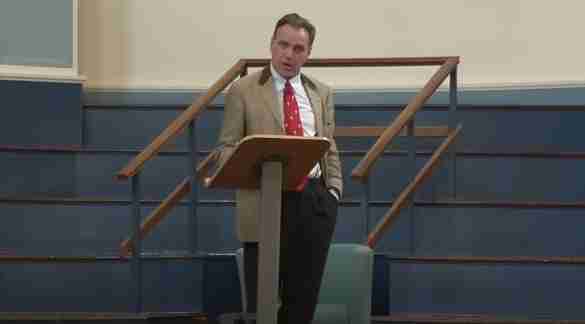
Read the full transcript of Sir Niall Ferguson’s talk titled “How The Nazis Conquered German Universities” – a Pharos lecture (November 7, 2024)
Listen to the audio version here:
TRANSCRIPT:
SIR NIALL FERGUSON: Thank you very much indeed Sir Noel Malcom, as I must learn to call you. I never thought I’d be called an influencer by you of all people, Noel. I’m going to talk about not only the treason of the intellectuals, but also the constitution of academic liberty, and it’s a particular pleasure to do it at Oxford, where I suppose my academic career began many years ago.
The Treason of the Intellectuals
Julien Benda wrote a famous tract in 1927 with the title “The Treason of the Intellectuals,” and he gave it an epigraph: “The world is suffering from a lack of faith in a transcendental truth.” Benda‘s argument was that the intellectuals of his time in the 1920s had begun, and I quote, “to play the game of political passions.” The men who’d acted as a check on the realism of the people began to act as its stimulators, and share in the chorus of hatreds among races and political factions.
The characteristics Benda said of the intellectuals of his time were the exclusive preoccupation with the desired end, the scorn for argument, the excess, the hatred, the fixed ideas. I quote again, “they betrayed their duty which was precisely to set up a corporation whose sole cult is that of justice and of truth.” Instead they’d embrace the cult of the strong state and the military spirit. The logical end, he wrote prophetically, is the organised slaughter of nations or classes. I can well imagine a future war when a nation would decide not to look after the enemy wounded. I can imagine them priding themselves on getting free from stupid humanitarianism.
German Universities in the 1920s
Benda was talking about professors all over Europe in the 1920s, but the examples that illustrated the argument best were in Germany and this might seem a little surprising. A hundred years ago, back in the 1920s, by far the best universities in the world were in Germany. By comparison with Heidelberg and Tübingen, Harvard and Yale were mere gentleman’s clubs where students paid more attention to football than to physics. More than a quarter of all the Nobel Prizes awarded in the sciences between 1901 and 1940 were awarded to Germans; only 11% went to Americans.
Albert Einstein reached the pinnacle of his profession not in 1932 when he moved to Princeton, but in 1914 when he was appointed professor at the University of Berlin, director of the Kaiser Wilhelm Institute for Physics, and a member of the Prussian Academy of Sciences. But this extraordinary German professoriate had fatal weaknesses. For reasons that I think one can trace back to the foundation of the Bismarckian Reich or perhaps even further, academically educated Germans were unusually ready to prostrate themselves before a charismatic leader.
When I was a graduate student back in the 1980s, I remember reading Rudy Koshar’s great study of the university town of Marburg in Hesse, and he showed how the mainly Protestant student fraternities, the Bursch and Schaften, had already excluded Jews from membership before World War I. In March 1920, a student paramilitary group was involved in a murderous attack on communist workers, and in the national elections just a few years later, the Völkische Soziale Bloc, of which the Nazi party was a key component, won nearly 18% of the vote in Marburg.
Lawyers, doctors, all credentialed with university degrees, were substantially overrepresented within the Nazi party, as were university students. German academics were kind of Hitler’s think tank. They put policy flesh on the crude bones of his racist ideology.
Academic Theories Supporting Nazism
I’ll give you an example. In 1920, a jurist named Karl Binding and a psychiatrist named Alfred Hocher published “The Permission for the Destruction of Life Unworthy of Life,” which sought to extrapolate from the annual cost of maintaining one, quote, “idiot,” the massive capital being subtracted from the national product for entirely unproductive purposes.
There’s a clear line of continuity from this kind of academic or pseudo-academic research to a document that was found after the war at the Schloss Hartheim Asylum, which calculated the economic benefits of killing 70,273 mental patients, assuming an average daily outlay of 3.5 Reichsmarks and a life expectancy of 10 years. And I’m afraid many German historians were little better, churning out tendentious historical justifications for German territorial claims in Eastern Europe.
A critical factor in the decline and fall of the great German universities was precisely that so many senior academics were Jews, because Hitler’s anti-Semitism was therefore a career opportunity for non-Jewish ambitious academics.
In April 1933, under the Law for the Restoration of the Professional Civil Service, which I can remember drumming into Oxford undergraduates as part of the Third Reich special subject, all Jewish civil servants, including judges, were removed from office, followed a month later by university lecturers, who in the German system were essentially civil servants.
Now the Nazis’ anti-Semitism led to one of the greatest brain drains, perhaps the greatest brain drain in history. Around 200 of 800 Jewish professors departed, of whom 20 were Nobel laureates. Einstein had already left in 1932 before Hitler came to power in disgust at Nazi attacks on his, quote, “Jewish physics.” And this exodus quickened after the so-called Reichskristallnacht of November 1938. As you all know, the principal beneficiaries, though few came to Oxford and Cambridge, were the US universities. The idea that I want to convey to you is that the non-Jewish pro-Nazi German academics didn’t just follow Hitler down the path to hell, they led the way.
Grotesque Nazi Academic Endeavors
Let me give you more examples. SS Oberfuhrer Konrad Meyer was a professor of agronomy at the University of Berlin, but he was also one of the experts who helped devise Himmler’s “Generalplan Ost,” which was a grandiose vision of an ethnically cleansed Russian empire, a dismembered Soviet Union, with three vast marcher settlements with five million German settlers.
One of the most grotesque examples I know was by a graduate student named Victor Scholz, who submitted a PhD thesis at the University of Breslau with the title, quote, “On the Possibilities of Recycling Gold from the Mouths of the Dead.” This was research that he’d carried out under the supervision of Professor Hermann Euler, who was dean of the Breslau Medical Faculty.
At Auschwitz, SS-Gruppenfuhrer Karl Klauberg, a professor of gynecology at Königsberg, the university of Immanuel Kant, sought to work out the most efficient way to sterilize women prisoners. Among the techniques he experimented with was the injection without anesthesia of caustic substances into their uteruses. So anyone in this hall or anywhere else who has a naive belief in the power of higher education to instill ethical values has not studied the history of the German universities and the Third Reich.
A university degree far from inoculating the Germans against Nazism made them more likely to embrace it. The academic elite were early adopters of National Socialism, and so were their students. And this fall from grace was, of course, personified more than by anyone by Martin Heidegger, perhaps the greatest German philosopher of his generation, who proudly wore a swastika pin on his lapel and was a member of the NSDAP of the Nazi party from 1933 until 1945.
Modern Parallels to Treasonous Intellectuals
Why am I telling you all this history? What is the difference between the clerks, the treasonous intellectuals of Benda’s time, of Heidegger’s era, and the activist professors and lecturers of our time? Well, I’ve noticed that today’s always indignantly insist that they’re on the left, whereas Heidegger and his ilk were on the right, and that somehow makes all the difference.
But I wonder, doesn’t the outcome start to look just a little similar when, for example, in the immediate aftermath of the pogrom by Hamas and Palestinian Islamic Jihad on October 7th last year, more than 30 student associations at Harvard rushed to publish an expression of support for Hamas that somehow laid the blame for the murders, rapes, and kidnappings on the state of Israel? In the aftermath of those events, a very bright light was shone on the universities of the English-speaking world, and what it revealed was not edifying.
I think I’m the son of a Jewish friend of mine, actually an Oxford resident, who’s a graduate student at one of the Ivy League colleges, and not long after October 7th he went to his desk, to the desk assigned to him in the library, to find, carefully placed under his computer keyboard, a note with the words, “Zionist kike,” in large red and green letters. Just as disturbing in their way as that kind of incident was the dismally, were the dismally confused responses of university leaders in the wake of those events.
You may have watched the testimony before the House Committee on Education and the Workforce back in December of the Harvard President Claudine Gay, the MIT President Sally Kornbluth, and the University of Pennsylvania President Elizabeth McGill, which showed that they’d been well briefed by the lawyers that their universities retained for such occasions. They gave technically correct explanations of how First Amendment rules supposedly applied on their campuses.
Yes, context mattered. If all students did was chant, “from the river to the sea,” without necessarily knowing which river or which sea, that speech was protected so long as there was no threat of violence or, quote, “discriminatory harassment.” But the reason these carefully phrased answers were so infuriating was that they were so clearly at odds with the records of, for example, Claudine Gay, specifically her record as Dean of the Faculty of Arts and Sciences in the years 2018 to 2022, a period when Harvard was sliding rapidly towards the very bottom of the FIRE rankings for free speech at American colleges.
Claudine Gay’s Double Standards
In 2020, the killing of George Floyd happened when Gay was Dean, and six days after his death, she published a statement on the subject, suggesting that she felt personally threatened by events in distant Minneapolis. Floyd’s death, she wrote, illustrated, and I quote, “the brutality of racist violence in this country” and gave her an acute sense of vulnerability. She was reminded again how even our, meaning black Americans’, “most mundane activities like running can carry inordinate risk.” “At a moment when all I want to do is gather my teenage son into my arms, I’m painfully aware of how little shelter that provides.” In nothing that Gay wrote did she seem aware last year that Jewish students might have felt the same sense of insecurity after October the 7th.
She wrote a memorandum to faculty on August the 20th, 2020, quote, “the calls for racial justice heard on our streets also echo on our campus as we reckon with our individual and institutional shortcomings and with our faculty’s shared responsibility to bring truth to bear on the pernicious effects of structural inequality. The moment offers a profound opportunity for institutional change that should not and cannot be squandered. I write today to share my personal commitment to this transformational project and the first steps the FAS, the Faculty of Arts and Sciences, will take to advance this important agenda in the coming year.” And advance it, she did.
The Separation of Scholarship and Politics
Now the great German sociologist Max Weber argued in a very important essay that I also used to teach at Oxford, his essay, “Science as a Vacation,” written in 1917, that political activism should not be permissible in a lecture hall or another university building, quote, “because the prophet and the demagogue do not belong on the academic platform.”
And this was also the argument of the University of Chicago’s 1967 Calvin Report, which you may have heard referred to recently, that universities must, quote, “maintain an independence from political fashions, passions, and pressures.” But that separation between scholarship and politics has been entirely disregarded at the major American universities in recent years. Instead, the elite institutions have embraced the kind of institutional change that Gay championed as dean and president.
And I would just say, look where it has led. Just how bad are the established American universities? I have a strong impression that people here underestimate how bad things have become. So let me give you some data.
The State of Free Speech on US Campuses
According to FIRE, the Foundation for Individual Rights and Expression, the number of de-platforming attempts, attempts to cancel an event like this, I’m sure there would have been one if we’d done this at almost any major US university, the number of de-platforming attempts soared to a record high last year. There were 137 attempts in American universities to get a speaker disinvited and an event canceled.
Heterodox Academy does an annual survey. Its most recent one from last year found that 59% of American students were, quote, “reluctant to discuss at least one of five controversial topics they were asked about.” And 62% of students chose “other students would make critical comments with each other after class” as the top reason why they were reluctant to discuss things in class.
Now, if you look carefully, despite the claims that are often made for Chicago’s commitment to free speech, there’s barely any difference in the responses of students at Chicago compared with students at, say, Princeton. In fact, when I looked, Chicago students are actually more inclined to feel, quote, “uncomfortable publicly disagreeing with a professor about a controversial political topic” or “expressing their views on a controversial topic during an in-class discussion.” There is an atmosphere of self-censorship that affects close to 60% of students across the United States.
This is a national average. It gets better. In a survey done in 2021 by the Challey Institute at North Dakota State, which was of 1,000 – a representative sample of 1,000 students in four-year undergraduate programs, the undergraduates were asked, “If many students disagree with the views of someone who’s been invited to speak on campus, should the university withdraw the invitation?” Of the students who described themselves as liberal or liberal-leaning, 39% said yes.
Question, “If a required reading for a college class includes content that makes students feel uncomfortable, should that reading be dropped as a requirement?” Of the liberals, 42% said yes. Here’s an even more chilling example. Question, “If a professor says something that students find offensive, should that professor be reported to the university?”
Liberal Intolerance on Campus
85% of liberal students said yes. And that doesn’t surprise me, because it happened to me on more than one occasion. If a student says something that students find offensive, should that student be reported to the university? 76% of self-described liberal students said yes. So not only reporting on the professor, but reporting on your classmates.
If you doubt that education in many institutions has become indoctrination, consider this question. “Have the classes and other academic activities you’ve participated in during the college year changed your view of the United States?” 7% of the liberals said it had made their views more positive. 55% said it had made their views more negative. Even 32% of the conservative-leaning students said it had made their views of the United States more negative.
Explaining the Change in Campus Climate
So how do we explain this extraordinary change in the climate of campus life? Which I can assure you happened fast. It happened in the space of about 10 years, because I don’t remember any of this when I first began teaching in the United States.
Well, Jonathan Haidt and Greg Lukianoff wrote “The Coddling of the American Mind” to make the argument that it was essentially bad ideas that had taken hold between parenting, high schools, and social media. Bad ideas like, “what doesn’t kill you makes you weaker,” sort of anti-Nietzschean view. Or, “always trust your feelings.” Or, “life really is a battle between good people and evil people.”
But I actually think the bigger problems are different. I think the bigger problems are straightforward. There’s a massive political skew amongst faculty, and that has increased over time. And there is a tendency on the part of administrators and indeed university leaders to appease or even to encourage the new Red Guards on their campuses.
The point about political skew is important because it’s often assumed that professors are always liberal, just as students are always protesting, and this isn’t right. If you look at the data in a paper by Rutzman, Lichter, and Nebit, 39% of the American professoriate described itself as left in 1984, 72% by 1999. Mitchell Langbert has this great study of all the tenure track professors for which he can get data on their political affiliation, whether they’re registered Republicans or Democrats, and he found there were colleges that were entirely Republican free. 39% of the colleges had zero Republicans on the faculty. The mean Democratic to Republican ratio across the whole sample was 10.4 to 1. If you left out the military academies, it was nearly 13 to 1. For history, 17.4 to 1. For English, 48 to 1. And for anthropology, it’s incalculable because there were absolutely no Republican anthropologists. That won’t perhaps surprise you.
The Pendulum is Not Swinging Back
So the question that always comes up is, well, now that Claudine Gay has been forced to step down and replaced, or is being replaced, is the pendulum finally swinging back to the middle? We’ve had resignations. We have new presidents just appointed at Stanford and at Yale. So have we passed Pete Woke? And unfortunately, the answer is no.
Nothing is likely to change, no pendulum is likely to swing back to the middle, when you look at the pipeline of future professors. And here I want to give credit to Eric Kaufmann and the work he’s doing now at the University of Buckingham on this issue. Here’s a great illustration of the point. He asked people at American universities if they agreed with this proposition. See if you do. “My fear of losing my job or reputation due to something I said or posted online is a justified price to pay to protect historically disadvantaged groups.” Anyone want to raise a hand in agreement with that? I thought there wouldn’t be too many. One. Well, 15% of the over 61s in the sample said yes, 20% of people in their 50s, a third of those in their 40s, two-fifths of those in their 30s, 45% of those in their 20s, and more than half of those surveyed aged between 18 and 25.
12% of US professors admitted to discriminating against right-leaning paper submissions or promotion applications, and 20% admitted to discriminating against right-leaning academic grant applications. But if you ask the PhDs, the numbers went up to 24% and 33%. And the British counterparts, because Eric does the UK and Canadian data too, are no different, only slightly better. Between 22% and 24% of British academics admitted that they discriminated against right-leaning grant bids, 28% of UK PhDs.
In many cases, anybody who’s worked at a major US university will tell you the progressive faculty are nothing compared with the woke administrators. Now, to give you some idea of the scale of this problem, for its fewer than 5,000 undergraduates, Yale now employs an army of over 5,600, excuse me, let me get it right, 5,460 administrators.
And heaven preserve you, if you are ever summoned to the office of the vice provost for student affairs, as Trent Colbert was, he was the unfortunate student at Yale Law School who last year invited his friends to a “trap house” party. Now, this led to a complaint by the Black Law Students Association and a summons to the office of student affairs, where the director of diversity, equity, and inclusion explained that the word “trap” could be triggering because of its historical association with drug use in poor black communities, while Colbert’s, and here I quote, “association with the Federalist Society was very triggering for students that already feel like FedSoc belongs to political affiliations that are oppressive to certain communities.” This is a true story.
When he declined to apologize, which they strongly insisted that he do, Colbert found himself being rather unsubtly threatened that not apologizing could hurt his future legal career.
Oxford Following Harvard and Yale
What are we to do about all this? Well unfortunately, the Oxford answer appears to be to follow Harvard and Yale right down the path to hell. Since January of 2023, this university has had a chief diversity officer who coordinates the delivery of Oxford’s race equality strategies, Professor Tim Soutphommasane, whom the university recruited from Australia, where he served as the race discrimination commissioner at the Human Rights Commission from 2013 to 2018. An active member of the Australian Labour Party, he’s the co-editor of a couple of books, “All That’s Left: What Labour Should Stand For,” and “Don’t Go Back to Where You Came From: Why Multiculturalism Works.”
Here’s where he stands on the issue of free speech from a New Statesman article published in September of 2019. Quote, “Not every instance of hateful speech will result in violence, but racist violence will always begin with racist ideas. The conventional liberal wisdom as inspired by John Stuart Mill and others remains that bad speech is best countered with good speech. But we cannot be naive about the marketplace of ideas. There can be market failure. The accommodation of far-right voices in public debates has had the effect of sanitizing white supremacism.”
Now, a little pro-tip. Whenever anyone says that they believe in free speech and then begins the next sentence with the word, “but,” you should be very much on your guard.
Oxford also now has an equality and diversity unit, which according to its website supports the university’s harassment advisory service and harassment advisors network. It’s overseen by the equality and diversity panel, which reports to the education and personnel committees of council. Disability advisory group, BME staff advisory group, and LGBT plus advisory group are formal groups with staff and student representation, et cetera, et cetera. There are 10 listed employees of the EDU, which of course is a puny force by Yale standards. But there’s an equality administrator, a policy advisor, gender equality, and Venus One harassment prevention advisor, harassment prevention coordinator, policy advisor, engagement insight, EDI program manager, policy advisor, student equalities, head of equality and diversity, EDI communications learning and engagement coordinator, staff disability advisor.
Back in April, the head of this unit, Vernal Scott, applauded the mayor and police of Brussels for their decision to close down the National Conservatism Conference, a decision that you may recall was subsequently overturned by the Belgian courts, just as his tweet was subsequently deleted. I warn you, this is how it begins. This is how it began at Harvard. It’s how it began at Yale. It’s how it began at Stanford. And to follow those institutions down that path, after all that we have seen, after all that has been revealed in the past six months, would, I think, be the essence of institutional insanity.
Founding a New University
So what really is to be done? Well, the American answer is to start something new, just like the University of Virginia was started in 1819, designed by Thomas Jefferson. Just as the University of Chicago was started in 1891 by William Rainey Harper, I and like-minded colleagues, Joe Lonsdale, Bari Weiss, Pano Kanelos and others, are founding a new university, the University of Austin.
Q&A: On Experiences with Cancellation
SIR NOEL MALCOM: Well, thank you very much, Niall. You’ve given us a lot to think about. And I must say, it’s not every day one meets someone who’s had the experience of writing a constitution. Everyone should try it. It’s really hard.
Let’s start with this whole phenomenon of what’s become generally called cancellation culture. Well, I can’t resist asking you, have you ever been actually deplatformed, disinvited, or at least, perhaps not successfully, but the subject of a campaign to disinvite you?
SIR NIALL FERGUSON: Yes. I first encountered cancel culture when my wife, Ayaan Hirsi Ali, was disinvited by Brandeis from their commencement. That was ten years ago. And that was when I realized that something was happening, that something was odd. But in 2018, shortly after we had moved to Stanford, I fell foul of the forces of wokeism when I set up a free speech lecture series or speaker series. And I invited Charles Murray to test to see how serious Stanford’s commitment to free speech was. Since, for those of you who don’t know, Charles Murray is regarded as one of the most controversial public intellectuals of the last half century.
And that was a risky thing to do, and it turned out that the risk was substantially greater than the reward. I spent most of the subsequent year battling a sustained campaign against me by radical student groups, progressive faculty, and, above all, administrators. The free speech series, which was called Cardinal Conversations, was canceled, and never resumed. And I had to step down from leading that program.
But what I learned in that searing experience was that you’re suddenly very alone when the cancel mob comes for you, because the people that you kind of thought had your back disappear, and you’re twisting in the wind. The critical threshold that I managed to avoid crossing is the one where somebody declares there’s going to be an investigation. And when that happens, you’re lost, because those can go on for years and usually leave your reputation in tatters. And I’ve seen good friends have their reputations destroyed in this way, and I count myself lucky that I managed to fend off that initiative, that effort. But it was sustained, it was well organized, and I underestimated how powerful they were.
Q&A: On Left vs Right Intolerance on Campus
SIR NOEL MALCOM: You mentioned the FIRE statistics on this, the F-I-R-E organization, which tries to monitor this, but I think it’s not all seeing, all knowing. It picks up media reports or people just right in, and how those figures have grown.
If one goes back through their sort of backlist of all these incidents, of course one has to say that there are cases of people on the right trying to shut down speakers who represent leftist points of view. That is also happening. However, statistically, the majority of these cases come from the left. And it makes me want to ask you such a general question that perhaps it’s almost pointless, but do you think there’s any sense in which one can say that the left, or the modern left, just is more intolerant? I mean, one can find intolerance, well, leave aside the extremes, we’re not talking about Maoists at one end or neo-Nazis at the other, but on the modern political spectrum, do you think there is more intolerance from that side, and if so, why?
SIR NIALL FERGUSON: Well it’s a great question, Noel, and I think it’s true that if you look at the FIRE statistics, the number of cancel initiatives that has come from the left has risen, and really you don’t see much from the right, and that’s of course because there isn’t much of a right on most campuses. I mean, I remember realising that one could fit the Stanford College Republicans into a really quite small room at the height of the great Charles Murray crisis. So it’s possible that we’re not really weighting those statistics sufficiently to allow for the fact that at the typical campus, there’s an overwhelming preponderance of people on the left, and very few people who will acknowledge being on the right.
I mean, a recent survey at Harvard of the politics of the faculty revealed that there were 95% liberal progressive, and as Harvey Mansfield is retiring, that must reduce the 5% who are not to 2.5%. So it’s a skewed landscape to begin with. The irony is that 50 years ago, if we’d had a conversation about this, the left was for free speech, and it was the right that was seen to want to close down radical discussion on campus. And so the left has gone on an extraordinary 180 degree journey from being pro-free speech to being really quite against it.
And I think this reflects the evolution of the left from a fundamentally Marxist or Marx-derived ideological movement to something altogether more heterogeneous, concerned with culture, concerned with identity, concerned with feelings rather than with, say, income distribution, attracted to the rights of minorities, interested in the different cultures of those minorities, and that journey has led to the idea that speech is violence, and that hate speech is a form of violence.
Q&A: The Danger of Equating Speech with Violence
SIR NIALL FERGUSON: And this is a very dangerous notion. It’s already represented here at Oxford, and it’s why the left now wants censorship, and wants to be in charge of censorship, not only on campus but also online. This was one of the interesting plot twists of 2020 when it became clear that the Stanford Internet Observatory was heavily involved in trying to make sure that the censorship didn’t just go on campus but actually went on on the network platforms on the internet.
The battles about COVID, the battles about lockdowns that you’ll remember went on here were extremely ferocious on the Stanford campus and nearly led to the destruction of Scott Atlas’s career, another Hoover Fellow, and Jay Bhattacharya’s, because they resisted the consensus view that we all had to be locked up in our homes indefinitely with multiple masks on our faces.
So I think this is a really interesting intellectual evolution that the left has undergone, that most people who haven’t been close to it tend to underestimate. This is not the left that we used to reckon with when we were undergraduates back in the distant 80s.
Q&A: The Shift from Marxist to Cultural Left
SIR NOEL MALCOM: Well that’s interesting. I mean, what do you say about this shift from a more familiar old-fashioned Marxist left to something sometimes new?
SIR NIALL FERGUSON: I’m quite nostalgic about the Marxist left. I find myself wishing they were still around, because they would debate. They really enjoyed having long arguments about the base and the superstructure and whether income distribution was becoming more or less unequal. I miss all that, because the identity politics, cultural left, are uninterested in those questions and uninterested in debate. They really don’t want to debate.
And it took me a while to realize that it was kind of pointless expecting to have a serious discussion about, say, well Nigel Biggar is here, he and I have fought this battle. You couldn’t have a debate about the costs and benefits of empire, because that debate wasn’t allowed to happen, because it would cause so much hate speech to be emitted by us.
SIR NOEL MALCOM: Well that’s one aspect of it, but we can all see the change you describe has happened. But if I had to construct a very general explanation of this reluctance to debate and take you seriously and therefore the intolerance that goes with that, I would actually go back to some basic principles of Marxist and then sub-Marxist and post-Marxist thought.
If you think your opponent cannot really be putting forward serious bona fide arguments deserving of scrutiny, because you know deep down that they are just representing in some super structural way the interests of late capitalist society, or Bush, or the interest behind colonialism, that they are not as they seem, even if they think they’ve got false consciousness. We’re going back to basic Marx here, but it carries through into the more modern left through people like Foucault or Said on Orientalism, that early 19th century scholar who thought he was finding out wonderful things about the structure of Sanskrit and how it stood behind Greek and Latin and so on. Well he may have thought that, but really we know he was doing something else in the service of imperial power. Once you have that underlying attitude that the other side are not really good, then why should you take them seriously?
SIR NIALL FERGUSON: Yes, I think that’s right, but what’s odd is that there was a time when, at a university like Oxford, the left was quite eager to engage in debate, not only with people like us, but with itself. We all remember the life of Brian Seane when the Popular Front of Judea gets into a heated argument with the People’s Front for the Liberation of Judea, but the left was like that. It was a highly argumentative culture, and when it entered those debates at one’s peril, I can still remember the bitter arguments about what should be bought by the Morton College Library, in which Andrew Sullivan and T. Y. Kong, an ardent Stalinist, would argue about which books could and could not be purchased.
So that argument was very alive in the early 1980s, but at some point, and I think it was after the collapse of the communist regimes and the apparent triumph of the West and the end of history, at some point the left took a tactical decision, this whole debate thing is a waste of time. But you’re right, there’s an ideologically sound basis for not arguing with us. It also works really well.
I mean, it took me years to figure out why I’d published a book that seemed to say some quite controversial things about the history of British imperialism, and there were hardly any real attempts to engage with that book, apart from one review in The Guardian that slated it by an author who subsequently admitted in a weak moment that he hadn’t read the book. Not reading the book is another great defensive mechanism, if you’re really, really intellectually insecure.
Q&A: Cancel Culture on the Right and Social Media
SIR NOEL MALCOM: Well, just to go back to a point I made before, which is that there are manifestations of some sort of similar mentality from parts of the right. They also try to cancel people. And the strong evidence you gave that this is a generational thing, getting stronger and stronger the lower down the age scale you go, one has to wonder whether there are some deeper sort of structural, cultural factors at work here. I suppose the obvious suspect is the effect of social media, which one keeps being told is sort of gradually frying the brains of the young. And certainly, I mean, I’m a complete outsider to this, but the impression I get is on social media people lose the ability to calibrate their judgments or to nuance or whatever.
The dial is switched up to maximum almost immediately, especially if it’s disagreement. And also that this has become an intensely competitive marketplace for publicity. And if you say, well, that’s very interesting, but I disagree on some points, nobody’s going to listen to you. The only way to get notice is to be absolutely as shrill as you can be. So I mean, that’s worrying because it’s difficult to see how you row back from that.
SIR NIALL FERGUSON: Well, Jonathan Haidt’s new book really does target smartphones and social media, not only for cancel culture, but more generally for the epidemic of mental ill health that seems to be a feature, at least for young people in the United States, and I think more widely. And I’m instinctively in sympathy with this view because long before any studies were done, I would police my children’s use of all devices, but just out of a kind of puritanical belief that they should really be reading books or kicking leather balls around and anything that didn’t involve reading books and kicking leather balls, I was sort of against. But I think I was right to resist the addictive power of the phones and the apps, and it didn’t take me long to realize that they were designed to be addictive.
And when I wrote the book “The Square and the Tower,” the goal was to try to understand exactly what the impact of these technological changes was, and I think it goes far beyond teenagers being depressed. I mean, the argument of “The Square and the Tower” was, this is as radical a transformation of the public sphere as the advent of the printing press was in Europe, with quite similar consequences in terms of polarization, radicalization. And I stand by that argument, but I also think that it’s possible to build an Enlightenment even out of a religious war. I mean, if we’re kind of accelerating our way through European history after the introduction of the printing press, maybe we’re in the 30 years war phase.
But I’m hoping we can get to the Enlightenment. And the reason I’m hopeful about this is that there are so many young people who are dissatisfied with the state of affairs as I describe it. That’s what’s most encouraging about doing a new university. People show up, bright, well-qualified students who have the option to go to established institutions, who tell us, we just can’t face four years of self-censorship. We want to come somewhere. We can have a real discussion with the nuance that you talk about. So despite the craziness, there’s a really substantial body of young people who hate it all and jump at the idea that they might actually be able to have serious discussion and not risk being denounced.
Q&A: Totalitarian Behaviors in Free Societies
Now, the one thing that I really want to draw everyone’s attention to is the most surprising thing to me has been the readiness of young people to behave as if they’re in a totalitarian regime when they’re not. Now, you and I knew Norman Stonewell. And one of the things I learned from Norman, who was a great mentor, was that there were certain behaviors that you would associate with a totalitarian regime, whether it was a fascist one or a communist one. And those included people informing on one another, people having their reputations erased when they fell out of favor, people being canceled. And I had always thought, under Norman’s influence, that that’s the kind of sign that you’re living in a totalitarian regime when people behave that way.
But I’d never expected, until it happened, that people would start behaving that way in an entirely free society on a university campus. But the letter of denunciation, which is an art form that we know from studying the Soviet Union in the 30s and looking at the regime of Mao in the Cultural Revolution, the letter of denunciation is alive and well. And probably someone is writing one right now, not far from here. That’s something I never foresaw.
And I thought you needed there to be a kind of dictator in place for those pathologies to manifest themselves. But no, people seem ready to live as if it’s the German Democratic Republic at Princeton. And indeed, the last time I was at Princeton, I was walking around thinking, what is familiar about this? I feel like I’ve been here before. East Berlin. Lovely buildings, Stasi everywhere.
SIR NOEL MALCOM: Yes. Well, I mean, I agree with the basic point. We’re not living in a totalitarian society, thank God. But just on that particular point, I had a conversation with the son of some old friends of mine who’s a student, not at this university, at another one. And he said, he used a striking phrase. He said, well, I think I’ve become bilingual in woke. And I said, what do you mean? He said, well, in the class, in the seminar, I can say all the right things and not when other people say all the right things. And then afterwards, with friends that I trust, I can say what I really think. And I thought, good God.
I spent a lot of time in Ceausescu’s Romania in the 1980s, where there was a small sort of network of dissidents. And it was exactly like that for them. Now, to press the commercial, as you just said, would be absurd when we’re absolutely not living in a totalitarian society. But there’s a tiny element there that really does sort of upset one.
SIR NIALL FERGUSON: It’s like the echoes of the Cultural Revolution, that if you watch that extraordinary episode when my friend Nicholas Christakis has been harangued by a mob of indignant students at Halloween at Yale. This was years ago now. It’s extraordinarily like a kind of low-level parody of a Cultural Revolution struggle session. Now, of course, it’s not exactly the same because people got killed in the Cultural Revolution. And nobody gets deported to the Gulag if they get canceled at Harvard. But I think the disquieting thing is to discover these hideous behaviors can take place in a free society. People can voluntarily engage in writing letters of denunciation. I didn’t expect that.
And it’s been one of the big surprises of my life. And it’s radically changed the way that I think about political order. I now realize that you can subvert free societies as a kind of grassroots movement. The question, of course, is how much help this process is getting from outside. And a heated debate in our household is just how far the process of subversion is to some extent orchestrated as opposed to spontaneous. Ayaan Hirsi is about to publish an essay on this, which I think will be very impactful. If you view it from her perspective, where the Islamists have been a singular presence on American universities, organized, effective, forming bizarre coalitions with the woke left, then you’re probably right to think that this has been orchestrated because a lot of money came in to the universities from the Gulf. And that money has helped to build Islamist networks right at the heart of universities.
When Ayaan was canceled at Brandeis, I remember looking at the petition of the people who signed calling for her to be disinvited. I kept it because I’m from Glasgow and I don’t forget. And I have all the names. And it was when I realized that the professor of queer studies was a co-signatory along with the representative of the Islamist group. That was when the penny dropped that a really unusual and unholy alliance was being formed. And that’s the extent to which this is not wholly spontaneous, I think.
Q&A: Separating Politics from Academia
SIR NOEL MALCOLM: Can I just go back to your sort of central element in your formula for opposing this, or at least trying to escape it, with your new university, which is this separation. Politics, yes, you can say things and write things as a private system, but you do not take that into the classroom. Which sounds like a marvelous, you know, and with one bounty was free, solution in theory. But I’m just wondering how realistic this is. I mean, as you know, philosophers have told us, and I think they’re onto something here, there is no such thing as the view from nowhere. We all of us come with all sorts of assumptions and so on.
And your friend, Eric Hobsbawm, a serious historian, was criticized by reviewers on the 20th century because they could sense he was soft on the history of communism. Now, he might go into a classroom with all the best Fergusonian intentions to keep his politics out, but I think we can bet that the course he gives on 20th century communism is just not going to be the same as the one you give, or the one Anne Applebaum gives, or the one that Bob Conquest would have given. Is it realistic to say you can disentangle these things? And also, even if they’re abandoning everything at the door of the lecture hall of the classroom, but if they’re prolifically blogging and tweeting and so on, I mean, the students are going to want to have conversations with him on these subjects. How much of a separation can you really make here?
SIR NIALL FERGUSON: I think it’s an ideal that Weber enunciated. I’m sure he frequently failed to live up to it, and I don’t doubt that I’ve failed to live up to it over the years. But I remember from the first time that I read those essays on science and politics as vacations thinking, that’s right, I really need to make sure that when I’m teaching, I make a conscious effort not to use my position on a podium or in a seminar room to skew the students’ views.
And one test of this was, I used to say this to myself at Harvard, I wonder how long I can prevent them from working out where I stand. And one way of doing that is to teach against yourself. And the Oxford and Cambridge tutorial supervision system is good from that point of view, because you can quite deliberately take the opposite position from the one that you’ve held in print. And what’s the student going to do? Hey, you didn’t say that in past and present.
I think you’ve got to show students that there’s a political activity that you engage in when you write for the Daily Telegraph or the Spectator, and it’s different from the activity you engage in when you give a lecture on the origins of the First World War, or even a lecture on contemporary politics. So it’s an ideal that I really believe is important. And what’s made me more and more sure of this is watching it be violated deliberately by colleagues at Harvard and elsewhere who would proudly announce that they would not hire a conservative under any circumstances, would politically discriminate in decisions about hiring and promotion.
That, to me, was appalling. That absolutely violated this fundamental division in which we are engaged in the pursuit of truth in a university. We’re not engaged in a political campaign. You can do your political campaigning as soon as you step outside the lecture door, but if you’re doing it in the lecture hall, if you start using this privileged position that you have as a professor to say, and by the way, and you let rip on an issue, that’s wrong.
And this is where the teaching of modern Middle Eastern history is most, most effective. It is extremely, very hard to find anybody who will teach that subject who is not politically engaged and who is not going to simply mingle their political activism with their academic work. It’s rare to find people in that field. They do exist, but I think we have to, and we can see why this issue is therefore so inflammatory, we have to try and push for dispassionate scholarship, even if philosophically it’s always going to be out of reach.
Q&A: Strengths in the UK System
SIR NOEL MALCOLM: Well, we’ve just got a few minutes left. Your comment about the tutorial system, Dr. Nkemish, I think we can add those to that little pile of crumbs of comfort that accumulated in the latter part of your talk, where in some ways we seem to do things differently and perhaps escape some of the worst, although you think the worst is yet to come. Well, that’s the danger.
But do you think, I mean, you know how it works in this country. Nobody can just go off and do what you’re doing at Austin. I mean, it was done in a small way a long time ago at Buckingham. Anthony Grayling tried to do it in a very small way with the College of the Humanities in London. The press conferences when he announced his plans were invaded by people with smoke canisters and stink bombs. I mean, extraordinary hostility to that. But anyway, nobody’s looking at setting up a new major university here as the solution. So we have what we have with, as you said, an accumulating list of officers to police us in all sorts of ways.
But do we have some strengths here which we can draw on if you were going to advise us on how to avoid the worst?
SIR NIALL FERGUSON: Well, I nearly did add a section to the already overlong talk about the peculiarities of Oxford governance. And it’s a good point on which to end, because I know we’re about to run out of time. When I was here teaching in the 1990s, I used to be driven mad by the inertia, by the extreme difficulty of doing anything new.
I mean, I was the cartoon character from Bateman who wanted to use PowerPoint at the examination schools. And you can imagine the indignant faces when that was first proposed. And so I left Oxford partly out of a sense that I’d never get anything new done here, and I needed to go to the US to innovate. Only with the passage of 20 years do I now realize that the inertia is a feature, not a bug, and a desirable one.
Oxford has decentralization, which is admirable, and it has considerable inertia, which makes it hard for a faculty member just to announce, oh, I’m going to teach a post-colonial course on transgender rights, which you can do for the next day at Harvard. There’s no way of preventing faculty members creating new courses. Here, it’s hard. You’ve got to go through a process to create a new course. That’s good.
So I’ve come to see the virtues of inertia in my 22 years of absence, and I hope that inertia will overcome the desire to follow these American fashions. I’ll say it again. It’s very hard to disagree with ideas like equity and diversity and inclusion. You have to understand that those things mean the opposite of the dictionary definition. What they actually mean by diversity is uniformity of outlook. What is meant by equity is lack of due process when you fall foul of the thought police, and what is meant by inclusion is the exclusion of people like Sir Niall, Malcom, and me. One has to be highly skeptical of these initiatives, even with Oxford’s tried-and-tested system of inertia.
I watched Harvard go down the path to hell at high speed, and it really did play out over a decade. Nothing would upset me more than to see that whole tragedy repeated at the great British universities. That’s part of the reason that Pharos exists, part of the reason that we’re trying to build, at least in a small way, new institutions in England, because I think it’s only through new institutions that we can really defend academic liberty and liberty more generally.
Q&A: The Importance of the Pharos Foundation
SIR NOEL MALCOLM: Well, I was just going to end by mentioning Pharos because it is, I think, very appropriate on this topic. No, we can’t go off and build a whole new university tomorrow in whatever is the English accrual of Austin. There isn’t one, sir. Don’t exist. But something major is happening step by step here.
The Pharos Foundation, people in the audience may well associate it primarily with these high-profile lectures, the purpose of which, not uniformly but generally, is to give an opportunity for points of view to be heard quite prominently, the kinds of points of view that don’t always get put onto platforms at a modern British university. But that’s the sort of little, very visible bit of the iceberg, but the larger part below water that people may not see is a growing academic programme with post-doctoral fellowships, with lecture courses, things being put online, with seminars and mini-conferences on subjects, the idea being just to present and develop a model of excellence which will embody, and I was very struck by that phrase you quoted from an earlier Chicago statement, academic study free of political passions, fashions and pressures. And just to get back to free critical inquiry in the humanities and social sciences, I think it’s a really important thing and Oxford is lucky to have it. But no less lucky to have you to talk to us for this evening, so thank you very much, Niall.
SIR NIALL FERGUSON: Thank you, Noel. Thank you very much.
Related Posts
- Modern Wisdom: w/ Alex Petkas – The Rise of History’s Greatest Emperor (Transcript)
- Diary Of A CEO: w/ Ian Bremmer on 2026 Top Risks Report (Transcript)
- Transcript: How America Recovers From All This – Yale Conversations w/ David Brooks
- Transcript: Tucker on the New Religion of Trump’s America @ Tucker Carlson Show
- StarTalk: w/ Andy Weir on the Science of Project Hail Mary (Transcript)