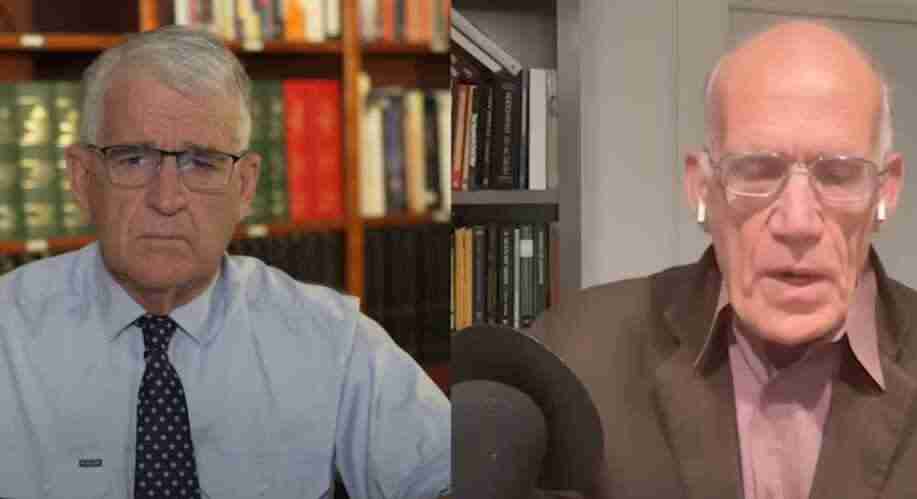
Read the full transcript of former Deputy Prime Minister of Australia John Anderson interviewing American historian Victor Davis Hanson. (Nov 7, 2024)
Listen to the audio version here:
TRANSCRIPT:
JOHN ANDERSON: Victor, thank you so much for giving us your time at this very important moment in human history. One of Australia’s top journalists, Paul Kelly, has just said this about the American election:
“The wide swathes of middle America knew Trump wasn’t any saint, but they turned the electoral map red because they endorsed his bedrock positions, that living standards were in retreat, inflation was too high, borders were not secure, and elites were too arrogant.” Is that a fair assessment?
VICTOR DAVIS HANSON: I think it’s a very fair, it’s a very accurate assessment. I think they also saw that the occasional crudity of Donald Trump was almost a mechanism in their desperation that was necessary to get the attention of the elite. In other words, they wanted somebody who wouldn’t equivocate and didn’t come from that milieu.
They were really saying, “Your agenda has no support and yet you’re ramming it down our throats and you won’t listen to us. You make fun of us. You call us garbage, deplorables, irredeemables, clingers, chumps, dregs.” These are all pejoratives that Biden and Obama and the Clintons have used.
“You forced us to do this, but we have now a champion and he’s going to cut through all of this and remind you that we run the country and not Hollywood or the institutions or academia Silicon Valley.” And so they were in a complete bubble about what this earthquake was about to hit them or this storm. Everybody could see it.
Media Deception and Polling Inaccuracies
I think some of them saw it, but the media felt in the last 72 hours, maybe, or four days, if they rigged the poll in Iowa or they said that it was dead even or that the Senate was going to be held by the Democrats, that would either get people to the polls or it would raise money or create momentum.
But John, there were so many indicators that would prove what Mr. Kelly said, that the registrations were an all-time high for Republicans. They had gained 600,000 registrations since the last time they contested Pennsylvania in 2020. They had been completely dumbfounded in 2020 on non-Election Day balloting, and yet they had more people non-Election Day ballot. They mastered the art of early and mail-in balloting than the Democrats did.
They got almost 25% of black males that really, and then that wasn’t really the key statistic. Black males who did not vote for Donald Trump stayed home. And so these big centers that they count on to swarm rural areas in Detroit, Pittsburgh, Philadelphia, were not there in sufficient numbers.
They said there was a female gap and that Donald Trump was a sexist and he had alienated women. In many states, he got more suburban white women than he did Harris. The Hispanic vote, and we’ve talked about that, I had never seen a, and I live in a Mexican-American community, overwhelmingly so, but I had not talked to a Mexican-American over the age of 40 male who was going to vote for Kamala Harris, and that had not been true in 2016.
They even had the Amish going out. They worked the Arab-American Muslim vote. They split the Jewish vote, which usually is 70-30. All of that was known to the pollsters and to the media, and yet they kept telling us that Donald Trump was dumbfounded by Saturday Night Live, that Donald Trump had threatened to kill Liz Cheney, that Donald Trump wanted to kill the media.
They didn’t, everybody got sick of them. They didn’t like to be lectured to, and they knew what was going to happen.
Everybody that I knew from the middle classes thought Donald Trump was going to win, and I could feel it.
JOHN ANDERSON: Victor, the reality is, as it looks to be the case from here, all the money, all the celebrities, all the so-called influencers, most of the media were absolutely one-sided and painting Trump as a threat to democracy. This is surely actually, in the end, a win for democracy, because people saw through it all. They’re not the mugs that the elites take them to be.
VICTOR DAVIS HANSON: No, as you say, they had academia, Hollywood, entertainment, the celebrities, the money, Wall Street, the foundations. All they lacked was the people, because their agenda, they had lied to the American people.
They had said Donald Trump was a disruptor, a disuniter, and we under old Joe Biden from Scranton in 2020 will unite the country under moderation, and that was a complete lie. They used him as a vessel, an empty vessel, for an Obama extreme agenda of open borders with no health or background checks, 12 million illegal aliens, uninhabitable downtown of our major cities. They were overridden with crime, an attack on fossil fuels, nuclear power, a disastrous foreign policy that you could define it by the Afghanistan debacle, or the two wars in Ukraine and the Middle East, or the Chinese balloon, or China’s threat to Taiwan.
In addition to that, at a time when the supply chains were still stagnant, consumer demand was ascending at astronomical levels after the COVID lockdown. They printed money, and so they put fake dollars in the hands of consumers when they couldn’t get goods, and the result was 9% inflation, and hyperinflation, 30% in total of staples and food, insurance, rent.
So they didn’t care about the middle class, and they kept telling them, “You’re mistaken. The border is secure,” Mr. Mayorkas said. “Inflation is moderate,” Kamala Harris said. “Bidenomics is working. People abroad have never been more impressed with the United…”
The Will of the People
It was all a lie, and the people finally just waited and bid their time, and they said, “We can’t take this anymore, and we’re going to send a message no matter what you said.”
But I don’t think, over there, you wouldn’t get a sense of the unreality where you would talk to people, and they really, really did believe they were going to turn on their TV sets because the New York Times Siena poll, or Nate Silver said that the Washington Post poll had been rehabilitated, or the Quinnipiac poll.
It was just a mechanism of massaging the outcome.
JOHN ANDERSON: Did you see yourself or imagine such a decisive victory?
VICTOR DAVIS HANSON: Did I imagine the victory?
JOHN ANDERSON: Such a decisive victory, yes.
VICTOR DAVIS HANSON: I thought he had a good chance of winning the popular vote, just because if you have a Republican candidate, and the way it works here, as you know, they lose the urban areas and the minority vote, and they count on the rural areas.
Under the Obama massaging, those urban areas had reached such a, you know, when Obama ran in 2012 against Romney for reelection, he won one precinct in Philadelphia, very dubiously so, 30,000 to one. How can you ever make that up?
When you hear that Donald Trump was going to get half of the Latino vote, or he was going to get 25% of the black vote, or he was going to get union people, or the United Auto Workers, or the Teamsters, that hasn’t happened here. And this was a man that they said was racist and polarizing and hateful.
And then when you saw that suburban white women were going over him at the time we were told all they care about is abortion on demand, yeah, you can see that he had made inroads, and you had to superimpose that fact on the reality that unlike a Bob Dole or Mitt Romney or John McCain, he had a fanatical base in rural and small-town America. And I mean fanatical as defined by they would do anything to vote for him.
If there’s a hurricane in rural North Carolina, they didn’t matter. They were going to get out and win him that state. Nobody had ever seen such loyalty by these irredeemables. These were the people of East Palestine, Ohio that the administration completely ignored when they had a toxic fume.
These were the people that were in the hurricane damage that they were very tardy in helping. And so I think it’s a very good lesson because it’s democracy and representative democracy in its best form.
The Electoral College Irony
You know what is another irony? We were told, John, that with the National Voters Compact that the blue states were only 61 votes short of getting rid of the Electoral College, which has a lot of constitutional protections in it and has a long history of utility for both sides.
And these state legislatures had voted to go around the amendment process, which they could never do. You need two-thirds of Congress, three-fourths of the state, and just have the states adhere to the national vote and reject the state vote because they were sure they were going to win the national vote. And they had won the national, every national vote since 2004 for 20 years. And they hadn’t, a Republican hadn’t gotten 51% of the majority vote since 1988.
And guess what? Donald Trump was the first person in 20 years on the Republican side to win the popular vote. He would probably be the first Republican since 1988 to win 51% of the popular vote. And all the states that swore and passed legislation, they would unconstitutionally reflect the national vote.
They’re not doing it. California is pledging all of its electors to Paris, who won the state, as they should. So the more that the aftermath is really making the left look pretty bad.
Prospects for Healing a Divided Nation
JOHN ANDERSON: He moved, Trump moved quite quickly in his acceptance speech, victory speech, whatever you might choose to call it, to say that he would seek to heal America, given that he may in fact have secured that first majority vote for so long and so forth.
Is he in a position to do so? America looks so bifurcated, so at war with itself. I mean, the constant calling on him as a fascist. I have to say, people apparently don’t know what the word means.
VICTOR DAVIS HANSON: You must remember that after 2016, after they were, he and Hillary, she was calling him a Russian agent and he was calling her Crooked Hillary. Somebody thought that given she had destroyed 30,000 emails and the devices upon them and they were under subpoena, that he would have the DOJ go after her. And what did he say? The first thing he said, “She’s suffered enough.”
People went to him and said, “You’ve got to fire James Comey, the director of the FBI. He tried to sabotage.” “I’m not going to do that.” He never did any of that.
But how can he heal the country when Lakita James, a prosecutor in New York who tried to bankrupt him, has said that she’s going to press down? How can you do when Alvin Bragg at the end of the month is going to try to put him in jail? And Jack Smith has re-indicted him, a federal prosecutor. All of these were minor matters that no other prosecutor would have picked up.
They’ve never done it against an ex-president. And now we’re facing a situation where the left is openly saying, “Well, we may have lost the election, but maybe Fannie Willis or Lakita James or Alvin Bragg or Jack Smith can put him in jail.” And that would cause a constitutional crisis. He’s been, two people tried to shoot him.
People are very afraid of his health in the next 90 days until he takes power. Everybody had heard a new Kamala Harris that had rejected 30 years of her radical, very radical socialist agendas to be palatable. But everybody now is so cynical. They know that when she has 90 days left on her vice presidential tenure, she’ll just revert back to what she was before the campaign.
The Elites’ Rejection of Trump
So the hostility is coming from the left. And it’s always been that way in this cycle of politics that we’ve seen. There’s something about Donald Trump that, and you see it in your country, you see it in Europe, among wealthy elites, educated elites. They feel that he should not represent them, even though he has constitutionally won that privilege of representing them.
They still don’t want him to be represented by him. It’s a very patronizing attitude towards democracy and the people’s real right to choose their leader, I have to say.
JOHN ANDERSON: So I would have thought it would call for a little bit of humility, but I suppose that’s wishful thinking. A little bit of humility that might say, “Well, we’re out of step with what the American people want. How do we go back and engage in some genuine reflection?”
VICTOR DAVIS HANSON: No, I wish you were right.
JOHN ANDERSON: How do we go out and meet those people and understand their concerns? Well, that won’t happen, I take it.
VICTOR DAVIS HANSON: No, if you look at the news shows today, and I stayed up last night and watched a lot of the left-wing cable shows, I thought they would say it’s time to do what the Republicans did after they lost to Barack Obama, and that was people said to themselves, “We’re never going to win an election with a Mitt Romney or John McCain. We need to broaden the party,” and that’s what brought in Donald Trump.
But they’re not talking about that. They’re not saying that the border or the economic plan or the third sex, the transgender mania, none of that is polarizing, they think.
So what are they talking about instead? “We’re going to blame Joe Biden. We didn’t get rid of him quick enough. She only had 100 days to campaign.”
VICTOR DAVIS HANSON: Nobody imagined how cruel Donald Trump was, or Fox News didn’t tell the truth. Fox News on a good night has 4 million, and the left-wing network and cables have 25 million viewers. So they’re in la-la land, and I don’t think they’re going to get the message.
If they lose the Senate at some of the levels they’re talking about, we have two tight races, one in Pennsylvania and one in Nevada, but they could very easily be 55-45 disadvantage in the Senate. And the House looks like it will remain Republican with maybe two pickups.
And the thing that I think your viewers should appreciate is this will not be a majority like 2017 when he came in, and there were sizable numbers of never-Trumpers among the Republican ranks that were more hostile to Trump, McCain being one of them. But there is no John McCain. There is no Bob Corker. There is no Jeff Flake in the Senate. There is no Adam Kissinger type. There is no Liz Cheney in the House. The people who are in the majority now are strong supporters to the person of Donald Trump.
And if these trends hold for the next day or two, we have this embarrassing delayed count in some states, he will be able to have initiatives that no one has really had in a quarter century. And there’s things that he’s been talking about informally and to people that they look back at Ronald Reagan and they say he was the best conservative president, but he brought in the right people and the right plans, but he didn’t institutionalize those.
And while they respect the Constitution and Trump will not do something like the left would do, get rid of the filibuster or electoral college, he will do things that are constitutionally substantive, like break up the administrative state, like put the FBI, for example, in Kansas City and not in Washington, or maybe look at one cabinet, the Department of Education, to just abolish it. And so there are they are talking about things we have not heard said before that they feel that would make lasting change and stop these pathologies.
JOHN ANDERSON: He’ll be aided surely by the fact that arguments about election fraud are pretty much bedded down now. I’d be interested in two things. Do you see any evidence of election fraud that they presumably the result is so emphatic that it won’t wash anyway? He has now an authority that won’t be crippled by people questioning the process?
As to be fair, he himself did last time around.
VICTOR DAVIS HANSON: Well, last time Donald Trump had no idea what the left was doing under the pretext of COVID when they went in March and April of 2020, used teams of highly paid lawyers and changed the voting laws in nine or 10 states to the effect of which was 70 percent of the electorate would not for the first time in history vote on Election Day. They would not have identification. The right had no idea what they were doing.
These ballots came in at double their number, and the rejection rate was one tenth. And so that was the basis for the claims of fraud that the ballots were not matching the registrar’s list or they were not fully filled out.
So rather than go down that losing route of complaining about fraud, what happened was the Republicans mastered that Democratic art. So when you started to look at mail-in and Election Day balloting, in many and most states, the Republicans not only mastered the art of getting people to mail in the ballots, but they refined it in a way that the Democrats had not fully appreciated, and that is they scanned people who had hardly voted at all but were conservative, that term that’s been used, low propensity voters.
Then they went out for them. They just ignored other people, but they went after the people who never vote, and they got them registered 600,000 more in Pennsylvania alone, a state they had lost last time by only 80,000 votes. And they got them to mail. Then they got the high propensity voters and said, you can go out.
They knew they would vote on Election Day. So the left was saying, “Well, in our experience, you got to be careful because if you get an early ballot, that just, it’s not an increase, they just don’t show up.” But in this case, the early ballot got people that were entirely different cohorts, and they voted for the first time in their lives for Donald Trump, and then the Donald Trump voter who had two prior occasions voted, voted a third time. So it was very brilliant what they did, and nobody was aware of it.
Fears of Violence and Legitimacy of the Election Result
JOHN ANDERSON: So the Democrats started a process which the Republicans then inherited and trumped them. There were real fears. A cabbie in America expressed this to me the other day when I was in Colorado, that a close result would have produced violence. There’s been no evidence of violence now.
Do you think the emphatic result will actually, I mean, will America settle now for a while, for long enough, in your view, to start to start?
VICTOR DAVIS HANSON: I don’t know what, I can’t say what will happen on Inauguration Day, but they have a problem, and that is there were arguments that he was a little illegitimate in 2016 because he did not win the popular vote. He will win the popular vote. He will win the Electoral College, not by one or two votes, but by a substantial mark.
He will get over 300 electoral votes. He probably will win the popular vote by three or four percent. And more importantly, the left has said, “He’ll do another January 6th if he loses. There will be riots. We cannot have that.”
So they put themselves in a position that if you were even to demonstrate peacefully and patriotically in the fashion that Trump said on January 6th, in the left’s mind, that would be insurrectionist. So now they’re going to try to convince the American people if they hit the street and try to contest a popular and Electoral College defeat, all they’re doing is fulfilling their own prophecies. They’re doing what they’re accusing Trump.
I don’t think it’s going to be very effective, especially because one of the things that people don’t talk about is in 2020, the minority vote was only 12 percent in these large cities. And so there was a racial component that the left said, “You can’t go in and observe mail-in balloting because that’s racist.” But when you have half of the Latino vote and 25 percent of the black vote, and of many blacks and Mexican-Americans that take one group are actually in the larger cities and they’re handling the ballots, then they are eyes and ears that are making sure that their candidate, Donald Trump, is not being cheated. And that was a dimension that no one quite understood.
So there weren’t these big arguments as last time that “You can’t go and look at the votes. We’re not going to let, we’re going to pull the curtains down. We’re going to have drop boxes” because the people who were in charge of that apparatus were themselves Trump supporters, at least in large numbers.
Global Perception and Allies
JOHN ANDERSON: Nonetheless, we have to assume that there will be pushback. So we’ll see over the next four years, I assume, a resumption of resistance, lawfare all over the place, the influences. I notice they’ve been saying, as I understand it, what will the rest of the world think of America for doing this terrible thing?
Well, the rest of the world, if you take my country, you know, the media has just been absolutely unable, by and large, to show any objectivity at all. And in particular, what is distressing to me as an Australian, we’ll come to this in a moment, unable to assess independently what’s best for the rest of the world, which of the two candidates in a very dangerous place might have a greater capability to handle the geopolitical challenges.
But my real point here is we’ve got such a distorted reality from the media that it’s very hard for anyone to be able to make an objective judgment in the rest of the world.
VICTOR DAVIS HANSON: It is. And, you know, I’ve talked to very senior diplomats and I’ve said, “You think there’s something here that Vladimir Putin invaded Ossetia and Georgia under the Bush administration. He invaded the Donbas in Crimea under the Obama administration. He tried to take Kiev and the Biden. But for four years, when he was eager to go, he stayed within his borders under Trump.” Or why was it there was no major war in the Middle East? Or why was Iran broke?
Or why did China not send a balloon over the United States? Or not serially threatened. So they know that. And I think the world knows that.
So it was a far safer place when he was there. As far as Australia, it would be it’s kind of ironic that a lot of the English speaking countries are suspicious of him. And yet in the United States. There has been criticism from the left that he is such a partisan for the Western countries and his mother was from Britain.
And that he is especially pro-Australian, pro-British, even pro-Canadian, given the Trudeau government. And he’s talked very warmly of the Japanese and the South Koreans and the Israelis. And he’s not an isolationist as he’s accused, as we’ve talked before. John, he’s a Jacksonian.
And what I think what it means for Australia, he’s committed to be a strong ally of the United States. And what does that mean in practical terms? He’s not going to let China go into airspace that’s Australia’s, if Australia objects. He’s not going to get into your internal affairs.
But if an Australian diplomat says a Chinese ship is coming into our territorial waters, as they do with the Philippines, or Chinese are overflying, he will call up the Chinese and say, “You are vulnerable yourself. You want me to.” That’s how he’s transactional like that. But he has a strong, a strong sense of affinity with the countries that best mirror image the majority and the traditions of English speaking founded by the British.
And I would think people in Australia and Britain especially would appreciate that. I mean, he’s very anachronistic and he’s been made fun of. He still talks of Reagan and Thatcher and Roosevelt and Churchill and thinks that, you know, that the the British version of the European Western experience is the one closer to the American spirit. And we’ll see.
But I think if I was if I was a member of the former British Commonwealth or the present British Commonwealth, I would feel that this was an opportunity to have an American president that would take political heat to be a very strong ally in a way that we haven’t seen before. And I think you’re going to see that very quickly.
I think he’s going to increase the defense budget. He’s already talked about that, about breaking up the swamp, stopping the revolving doors so we don’t end up building 177 million dollar F-22s or 14 billion dollar aircraft carriers alone. We start to produce, as we did in World War Two, thousands of cheap drones, thousands of Patriot missiles at a cheaper cost, a whole new way of trying to defend the West.
Australia’s Relationship with Trump
JOHN ANDERSON: The thoughtful media in Australia, we do have some, are pointing to the fact that this has to be raised. Both our prime minister and our former prime minister, now ambassador to America, have been personally quite unwisely, in my view, critical of President Trump in the past, and there’s real speculation as to what that will mean for the relationship. It raises the question of people claiming that he can be vindictive.
I’d be interested in your perspectives. I think our prime minister and our ambassador, they’ll be scrambling now, of course, to try and fix the relationship. But they have handed him something of a club, I would have thought.
VICTOR DAVIS HANSON: Yeah, well, that’s what the left says, but most of those charges are projectionist.
So he was in a position to fire all of the DOJ lawyers, 300 of them, that had hounded him out. He did not do that. Obama did that. Biden did that.
He did not do that. Obama weaponized the IRS against his, and Trump did not do that. Trump did not indict, he’s not going to have local or state prosecutors work as surrogates to go after the Biden family. In fact, I would imagine he might even pardon Hunter Biden.
And he’s a transactional kind of art of the deal. So with the Europeans and NATO, he talks a tough game and then he gets them to reluctantly spend $100 billion on arms. And then all of a sudden, the Ukraine war during the Biden administration breaks out and they’re much better, because of Trump, they’re in a much better position to defend themselves. Of course, they don’t give him any credit.
So he talks certain ways, but he’s been actually criticized on the right for not being more vindictive and for not playing tit for tat. I’ve had so many prominent Republican people or conservatives talk to me and say, “You know, somebody’s got to talk to him because he doesn’t understand deterrence. These people attack him and attack him and he mouths off and he replies, but they’re not going to get the message until we start indicting those people or if they want to have sanctuary cities and we have to have sanctuary gun cities or maybe we’ll our sanctuaries, this right wing cities.” But he hasn’t done that at all.
Prospects for Effective Governance
JOHN ANDERSON: And. He will return to Washington, presumably vastly more experienced. He now knows, I think, how the place works. Yeah, that and he will know, I would imagine, who are real change agents and who to put who to build around him, if you like, a good team around himself that presumably with a sympathetic House and Congress, as it appears he will have the cynics might say that will give him unfettered power.
Others might say it will help him govern in a very clean way to respond, let’s face it, to Americans’ vital concerns. The economy is not doing well for them. Immigration is a problem and the elites and their woke ism are mad. He will know now much more effectively how to start to change these things.
Would that be a fair assessment?
VICTOR DAVIS HANSON: I think it is. He doesn’t see that as radical. He sees that he’s called it common sense. He’s taken the example of Mexico. Mexico sent by deliberation 12 million illegals here. We have three hundred and fifty thousand people with criminal records that were knowingly let in from Latin America and Mexico. They’ve created they’ve committed horrendous crimes.
We have the cartels that have killed indirectly, but by design in a way, by masking fentanyl with prescription drugs and candy. A hundred thousand Americans. And Biden was so afraid to say anything to Mexico, the first thing Trump said, and he even said it before the election, “I’m going to call the president of Mexico up and I’m going to say no more fentanyl and no more illegal immigration. I’m going to slap a 25 percent tariff on you and I’m going to probably tax your remittances.
You get 60 billion. We’ll see how you like it.” And he’s serious about that. He’s not trying to bully people, but he does things like that.
So. If you have a international incident where Australia is in a very vulnerable to take your country and they feel that they need the support and encouragement of the United States, he’s not going if he believes that if he were to agree with you, he’s not going to call up and say, “Well, on the one hand, on the other hand,” he would say “What do you need? When do you need it? And I’ll do it.”
And that’s the type of ally he is. He’s not wishy washy, and that’s what bothers the left, they think in nuances or in gradations and incrementalism, he’s not that for better or worse, he’s very decisive. He’s not reckless, but he’s very decisive and he moves very decisively with China, with Russia, with the radical Islamic world.
And if you think what he said he was going to do in 2015, he said he was going to get rid of ISIS. In fact, to use the vulgarity, “I’m going to bomb the SHIT out of them.” He said he was going to deal with the Iranians who had killed Americans in Iraq. That was Soleimani. He said that he was going to cut off Iran and bankrupt them.
He almost did. He would have if they hadn’t uplifted the sanctions. All of those things he did. And I was talking to some Israelis, diplomats, and they said, “We’ve had so many sophisticated people who knew the Middle East and we’ve asked them for support and they always give us a thousand reasons why they couldn’t do it.”
And they were asking me as an American, “What is it with your president? He came over here and our team said to him, ‘We’d like to finally get the embassy in Jerusalem.'” He said “It always belonged there.” And then they said “They keep talking about the Golan Heights, but it’s Israeli.”
He said, “Yes, it is. That’s done.” And then they said, “When Iran is the cause of all these problems, is there any chance that we could discuss the Iran deal or the hundred billion in oil revenue?” He said, “They’re done.
We’re out of the Iran deal. We’re going to get this up.” And then they would say things like “The Houthis are terrorists, but no American wants to ruffle their fur.” “Well, we’ll just call them terrorists.”
And as this diplomat spoke to me, he said he did more for Israel that needed to be done, not just because he liked Israel, but were fair and were for the greater good of the Middle East. He did more in two months than the last 50 years of American presidencies. And he said the odd thing about it was he probably was not as sophisticated or as well read in the intricacies and the nuances of Middle Middle East history and diplomacy, but he had an innate cunning and sense of morality, what had to be done and why it wasn’t done.
And so that’s why he’s kind of, you know, you go to Israel today and he doesn’t mention Israel much. He doesn’t really talk about it. But when you go to Israel, he’s almost a sainted figure because he did more for the autonomy of Israel than any other president has done. And yet he didn’t really he may, John, have got 40 percent of the Muslim vote in Michigan, the more the left pandered to. Yeah, he did.
JOHN ANDERSON: Well, part of it was one of the dark in the way we do have a look in the West that there are many, many people in the Middle East who are quietly cheering Israel on because they’re frightened of Iran.
VICTOR DAVIS HANSON: Yes, he did. And he was he made the argument that Hamas does not represent or it may have been elected once, but it’s not in the interest of the people of Gaza that Iran, if you cut off the head of the snake, then people would be free to deal with Hezbollah and Hamas and the Houthis. A lot of people from the Middle East appreciate that.
And so. I think it’s an exciting time, we’ll see if he gets good people around him. One of the problems that when you talk to people surrounding him in 2016, no one wanted to work for him, the maverick, the outsider. 2020, it was sort of that he had a team.
Now they’re getting six and seven applications for even minor positions. Everybody wants to work for Donald Trump. And I don’t know if he’s going to be able to filter out. But suddenly the thing in Washington is all of these never Trump, anybody wants to be part of this team.
They’re very excited. And they’re going to have a terrible time trying to find people who will not do what happened last time with the anonymous, the person in Homeland Security that was bragging to the New York Times that he was sort of an insurrectionist and derailing executive orders or people in the defense department that were overriding Trump’s orders. He’s got to get a team that is loyal, but he’s got so many people that want to participate.
Israel and Iran
JOHN ANDERSON: He did say, as I understand it at one point, that Israeli should go after Iran’s nuclear capability, presumably he’s likely to revisit that, and presumably the Iranians are now deeply concerned because plainly they’ve been hit much harder already by the Israelis and they’re admitting plainly they now know that Israel is highly effective with American encouragement.
I would have thought the Israelis could do immense damage to Iran and they would be extraordinarily subdued by that at the moment.
VICTOR DAVIS HANSON: Yeah, I would say that because of his. You have a lot of people, RFK, Tulsi Gabbard around him, and he has campaigned strenuously against optional military wars in the Middle East, especially land engagements, cost of benefit analysis. These are not worth it.
But as I understand his message to Netanyahu is, “It would be better for you if you feel that Iran is going to attack you again, either to ride it out and then take and retaliation, given the prompt to take out the nuclear facilities, their military bases, their oil before I’m president, that would be easier.”
So that is the message that I think he’s telling the Israelis. And if they don’t do it, I think the message is “The United States is not going to interfere in your internal affairs. We’re not going we’re not neoconservatives. We’re not going to go try to bomb Iraq and Iran and change the government.”
“But I can tell you this, given the provocations that Iran has leveled at you, we’re going to be very supportive of helping you protect your homeland. And more importantly, the decision of what targets to hit and when to hit them and how to hit them is yours as an agreed sovereign nation. And we will facilitate your decision, but we’re not going to interfere and tell you you can’t do this and you can’t do that.”
And I think that is one reason why Iran is very hesitant. They’re in a situation now where they’ve sent 500 projectiles into Israel. Only about five or six have hit anything. Israel has retaliated twice and demonstrated that they can take out the entire air defense system of Iran.
And the next time they’re provoked, they have the ability to take out all of its oil revenue ability and its nuclear sites, even if that were to take a week with complete impunity. And so Iran now is in a very difficult position. If it doesn’t do anything, it loses face among its satellites. The Houthis has the law.
If it does do something and provokes Israel a third time, they may not have any revenue or nuclear program or any military bases. So there’s nothing that can stop the Israeli Air Force from doing that. And with a new administration that would encourage Israel to take care of its own deterrent needs, I think Iran is going to be very cautious.
Implications for Russia and China
JOHN ANDERSON: This will have enormous implications for Iran’s allies, if you like, I would have thought, particularly the Russians, but also the Chinese.
Coming to Russia first, in a town hall meeting not so long ago, President Trump said, “If I’m president, I will have that war settled in one day.” Presumably he will move to try and force a deal. I’ve heard this line that he might say to the Ukrainians, “You’ll have to cede some territory or we’ll stop helping you.” But he might say to the Russians, “Unless you agree to something now, we’ll give the Ukrainians everything they need.”
That’s the sort of, it would reflect that transactional skill that he seems an ability he has. How do you think he might tackle this?
VICTOR DAVIS HANSON: Well, I think that’s pretty much, he’s a deal maker. So he’s not going to go in as the left alleges and just pull the rug from Ukraine, not because he would agree or disagree with that, but because it would be impossible for him to get a settlement.
He actually is a much more interested in humanitarian questions than the left is. He’s talking always about the 1 million plus dead, wounded, missing on both sides, and largest war in Europe since World War II. So I think we know the outline of what he wants to do.
He wants to tell the Ukrainians, “You have our support. We’re going to continue to arm you. During the Obama administration, Obama never said he wanted to use force to get back the Crimean Donbass. Neither did Trump, neither did Biden.”
And I think people who look at the history of those areas and the long association within the areas and in their surrounding areas with Russia understands that it was militarily impossible for Ukraine to take back Crimea. And I think that will be the bone, one of the two bones that Putin gets. He can tell the Russian people, “I had to go to war to make sure that Crimea remains ours forever, like it has been since 1787. It was an independent country for three years after 89, then Ukraine took it from us.” That will be the propaganda.
And the Donbass, this was stalled for a long time. And I think that will be the bone, one of the two bones that Putin gets. Donbass, this was Stalin, this was Khrushchev’s area. He ceded it stupidly to Ukraine. He thought Ukraine would be part of the Soviet Union forever. Now it’s ours.
And then second, Putin will tell the Russian people, “We went to war to make sure that Ukraine is not in NATO.” And I don’t think Trump will put it in NATO.
And then Ukraine will say, “Well, what do we get out of it?” And he’ll probably say, “You’re free to join the EU. We’ll try to get a demilitarized zone. Russia will go back to where they were on February 24th of 2022. And we will arm you to the teeth.”
And I think that’s the outlines of the deal, more or less. And that would be, I think nobody’s going to be satisfied, but it would stop the blood killing. It would stop the escalation. It would stop the talk of the use of nuclear weapons.
This week, people had suggested that some of the Russians were putting explosive devices on cargo and passenger planes headed to the West. If we don’t do that, there’s going to be an escalation. And I think he doesn’t want that.
So he’s willing to be a broker to cut a deal.
North Korea
JOHN ANDERSON: We know, of course, that he doesn’t like the leader of North Korea very much, refers to him as Little Rocket Man. Little Rocket Man appears to be supplying mercenaries in quite substantial numbers to Russia. I would imagine Trump will be on to that one very quickly.
VICTOR DAVIS HANSON: I think so. He was last time. Even there, though, he confounded the left. The left started out saying that he was too mean, he was too reckless when he said, “My button’s bigger than yours.”
He came in where North Korea was just being a very useful bulldog that the China master cut loose and caused havoc. And then China kind of chuckled about it. And when they started threatening to send missiles into the West Coast, Trump was alarmed and said, “I have a bigger button than you do, and we can do the same thing to you and ours will work.” He said, “Ours will work.”
The left went crazy. And then he did what everybody who read any of his books or followed his career knew he would do. He wrote a letter to North Korea and said, “This is not in your interest to be on the wrong side of my administration. I’m willing to talk.”
They talk. And then he did exactly what he wrote about in his book. He said, “I like Mr. Kim Jong-un. We can cut a deal. I didn’t find him to be a monster.” If you read anything he wrote about, that’s what he always said. When you make a deal, you do not insult your opposition.
And then when you make the deal, you make sure you get an advantage. And then after the deal is over, you did not privately ridicule him, but you praise him to the skies. And that’s exactly what he does.
So I would imagine that he would tell Kim Jong-un in stage one, “What you’re doing is unacceptable. If you keep doing it, it’s going to end badly for you.” Then stage two is, “I’m willing to make a deal” and then make some kind of deal and then praise Kim Jong-un. And that’s where the left came in and said, “Look at this. He’s praising a dictator,” even though they had just told us that he’s deliberately antagonizing a dictator.
VICTOR DAVIS HANSON: They had no idea the modus operandi of how he works, but it was working. And it worked with Putin and it worked with Xi. And we didn’t have a war and it worked with the radical Islamists.
As soon as he did this, he said, “Iran is an outlaw nation.” He killed Soleimani. No one even dared to do that. He bombed the crap he set out of ISIS.
And then Iran called him up and said, “You’ve made us look ridiculous.” And Trump said, “Well, I’m about ready to hit you.” And they said, “Can we send 16 or 17 missiles over to you in Iraq and Syria and get close to your base? We’ll tell you the time and the location, put everybody in. And it’ll save.”
So he said, “Yeah, as long as you don’t kill one American. If you kill one American, we’re going to send a salvo.” So there was some disagreement. The military felt some people suffered shell shock from the, but the Iranians basically did what they said they were going to do.
It was a Potemkin attack. And then Trump didn’t cause a war, but Iran behaved and then he put sanctions on. And yet they criticized him for that. They said he was provoking a war with Iran.
And then when Iran didn’t do anything and backed down and they said, “Well, they sent missiles in and he didn’t reply to them. He didn’t care about America.” So we got to the point, whatever he did, they were going to criticize, but it all had utility and they haven’t come up with any formula or solution that improved on his own. And as soon as he left, the world fell apart.
China and Taiwan
JOHN ANDERSON: It really did. What does bring us to President Xi, there’s a general view in many quarters that the next four or five years, in other words, during the next presidential term, is the most dangerous time of all the warnings that the Chinese military has been told to be ready by 2027 to take Taiwan by force if necessary. I would imagine that Trump’s reelection is hardly being welcomed in Beijing today.
VICTOR DAVIS HANSON: No, it is not welcomed. And of course, on the far right, there was always a conspiracy theory because of the lab leak that people felt. I don’t subscribe to that, but this is a sign of what the right thought of China. They felt that the COVID that originated in China was somehow connected to the Chinese fear of Donald Trump and wanting him out when in November of 2019, he was almost sure that he was going to be reelected. He was ahead of the polls.
He would have been reelected if it had not been for COVID and the lockdown and then the George Floyd riots, which I think in themselves were a result of the lockdown, their intensity.
So China realizes that for all the talk about they are ascendant and they are all powerful and they have a bigger military. They still have, I think, and most economists will agree that they still have only about 70 to 80 percent of our GDP. They have four times the population and a very crude formation that takes four Chinese workers to approximate 70 percent of what one worker does in the United States.
We’re a very productive society and in many areas for all of the Chinese stealing and copying, we’re much more preeminent. And under Trump, I think China will be faced with a lot of things that is going to bother them.
They have over 300,000 students come here. Most people think two or three percent are actively engaged in espionage. I don’t think that’s going to continue. I think that they have a lot of asymmetrical tariffs. They know that. I think for everyone, Trump will try to outdo their tariffs.
Not a blanket tariff, but a tit for tat. I think he will tell the Chinese, “If you go and bully the Taiwanese or the Philippines or any of our more prominent allies, we have ways of retaliating against you and we will do that. And we wish you wouldn’t do that.”
The thing about it is so strange is that under prior Republican administrators, candidates that believed in the same theory of deterrence as Trump, there was kind of a braggadocio that was different than Trump’s. They actually would kind of brag that we want to go to war with them or something.
Trump talks a great game, but he does not want to destroy relations with China or any of our adversaries. He just wants to remind them that they have overreached and what they’re doing is not in their interest and they will stop it. But he doesn’t really want to go to war.
And there’s no idea of going into Iraq or Afghanistan or bombing Libya like Hillary did to create some type of utopia. He doesn’t have any dreams like that. It’s all Jacksonian and he wants to protect the Western world.
And when I go to Europe, it’s very bizarre, John, to hear people who are going to be beneficiaries of Trump’s foreign policy damn him and then praise people who would not lift a finger to help Europe in a crisis. Or would, you know, Trump said to the Germans, “You’re playing with fire with the Nordstrom pipeline, number two, and you’re heavily dependent on natural gas and we better stop that for your own benefit.” Biden then said he was a warmonger or he was alienating our ally and then they went over.
Trump tried to stop the pipeline. Biden came in and greenlighted it, which was, I think, unfortunate. And the same thing they said Trump suspended armaments. He did not. He, everything that the Congress approved, he sent to Ukraine.
Eventually, Biden came in and put another arms embargo on Ukraine and he said he would only react if it was a major invasion if Putin went into Ukraine. He asked Zelensky, “Do you want to ride out? We’ll fly you out of Kiev the first week.”
So it’s a very strange paradoxical disconnect where people who are beneficiaries of American muscularity attack the person who cares for them or wants to help them and then praise the multilateralist people who appease and would allow them to be very vulnerable. And yet it’s all emotional. They just don’t like Donald Trump’s visage. They don’t like the way he looks. They don’t like his accent. They don’t like his mannerisms. They don’t like his language. So they can’t get over that.
Environmental Objectives and Economic Growth
JOHN ANDERSON: You referred to American muscularity. Three questions as we, if you like, bring the boat into harbor. Um, that muscularity depends on the vibrancy of the American economy. First question would be presumably Trump will not support. Decisions that. Around the environment that hobble American growth with any great enthusiasm, you’ll see a resetting of America’s environmental objectives. Would that be a fair reweighting in favor of economic growth and costs?
VICTOR DAVIS HANSON: I think that will be done by executive orders. I mean, he’ll preface it as he always do. He loves, “I love our water. I love our clean air. I’m going to, I’m a conservationist, not an environmentalist. I’m a conservationist.”
But then he will lift the EV mandate that has almost destroyed some of our major automakers. That will be gone. He will promote, especially this new technology of smaller nuclear plant power plants that are much safer and much easier to build and much quicker to build.
He said that when Biden replied to him, as did Harris, “Well, we’re pumping more natural gas and oil than you did.” He just simply said “You weren’t until the midterms. Then you copied my protocols. But you’re not telling the truth because if you’d followed them to their comprehensiveness, you would have been pumping three to four more million barrels.”
And he always prefaces that in terms of Europe. “We could be supplying. It’s a great deal. We could be supplying Europe with all the liquid natural gas they want.” And of course, he said that it was a big mistake for the Europeans and Joe Biden to stop the Greek Cypriot Israel natural gas line to Europe.
He said he’s a businessman. He wants as much production of food, fuel, building. He just said the other day, “I’m a builder. Builders in America unite. We’re going to build houses. We’re not going to have any homeless. We’re going to get the country moving again.”
Again, he tells a story almost every time when he’s addressing people. “Elon, can you imagine with this huge rocket? It’s 10 stories high. It comes down. It’s 10,000 degrees. It’s going to burn up everything or crash in the ocean. And then this arm comes out of nowhere. And I call Elon out. Elon, what did you do? I grabbed a rocket, Mr. President. Can the Chinese do this? Not for 10 years, Mr. President.”
That’s the kind of… It reminds me of JFK. He had that same idea that we were going to get back moving again and build things and be preeminent. And it’s very funny. One of the touchstones is the way he reacts to Elon Musk, who the left hates because of his purchase of X. But his attitude is, “My God, he created an electric company. The vehicles are better than the big three’s vehicles. He’s the only person really to break into the A3. He saved NASA from itself. He revolutionized social media. He’s a renaissance man. We’ve got to cap into this guy’s genius. He’s American. He’s American. This is the kind of guys we want.”
Even people he doesn’t particularly fond of, like Jeff Bezos, he’s been very fair to. He likes people like that, that are entrepreneurial, successful. He’s not envious of them as most people are. So I think it’s an exciting time if you’re an entrepreneur in the United States.
Budget Deficits and Debt
JOHN ANDERSON: Well, Elon Musk himself has identified $2 trillion, I think, in potential savings. And that does lead to the question about America’s loss of control of the budget in recent years and the prospect that, in many ways, President Trump may want to cut taxes, for example, which might have an even more deleterious effect on that bottom line.
Neil Ferguson was in Australia recently, and he made a fascinating comment. I heard him observe that. He’s an economic historian, of course, that down through the ages, no great country has remained great for long when the cost of servicing its debt succeeds what it spends on defense. Will America cross that Rubicon, as I understand it, last financial year?
Getting that budget under control, it means growth, but it also means restraint. Elon Musk is pointing to areas where there can be big savings. How do you see that unfolding? And how worried are you about that budgetary mess that seemed to receive very little attention during the campaign?
VICTOR DAVIS HANSON: It does. I’m very worried about it. That was his great failing in the first term that, of course, it was the COVID stimulus. He hadn’t been as reckless as Obama, but he ended up as being reckless because of the COVID stimulus.
The problem with the $36 trillion debt is that half of it was run up by Republicans. And when Republicans run up the debt, and they’re supposed to be sober and judicious custodians of physical sanity, then the left says, “Well, if they get it, then we’re going to do it because they say they’re tightwads and they’re not tightwads. So what do you expect of us?”
The other thing is when you promise no tips here, no income tax on Social Security, it’s kind of people here have been kaching, kaching, kaching. Mr. President, you’re giving them $4 trillion of lost revenue. And he says, “Well, we’re going to deregulate the economy and grow our way out of it.”
I think people think we can grow partly out of it, but not at current spendings. And then when you put all of the social entitlements like Medicare and Social Security off the budget, what are you left with? Well, the left says you have nothing to cut except defense or trim around the margins.
But now he’s saying, “Yes, there’s a lot to cut because what you think are essential, we’re pretty much products of the great society that we got along fine with without. Why do we need a Department of Energy? Why do we need some of these? Why do we have to have a PRAVDA like National Public Radio or PBS? Maybe we can outsource it.”
They’re talking of all these other areas that are sizable as a way of avoiding to cut Social Security or Medicare, but he’s going to have to get the physical. We’re spending $1.1 billion servicing the debt. We spend $800 million, $800 billion, excuse me, on defense.
So he’s very worried about defense, as you and I’ve talked before, because we’re putting our money into too few platforms and we’re behind. We don’t make things anymore. Our supply chains are dependent on foreign suppliers. We’ve demonized a particular cohort, the white male from the middle class that died at double its numbers in Iraq and Afghanistan, 50,000 short.
We have a whole group of generals who are on retirement, but violate the Uniform Code of Military Justice, attack the commander-in-chief, all of these things he’s talked about, about how to address that. But debt, I think, should be the center of his focus because we can’t go on this way.
And that raises the question of tariffs. I can understand. I really can genuinely understand the motive appeal to somebody like the Vice President-Elect, who in many ways is such an interesting and clear thinking man, and yet he sees the hollowing out of American industry, and yet conventional economic wisdom would say tariffs are not the answer.
JOHN ANDERSON: I can understand, too, why you would want to use the threat against the Chinese when you think they’re not dealing in good faith. That’s a different matter. But tariffs, per se, are generally regarded as counterproductive and inducive to reduce trade at least, a trade war at worst, and a reduction in living standards for all of us. Where do you think that debate might land?
VICTOR DAVIS HANSON: Well, sometimes he’s been very sloppy in the use of tariffs, but when you talk to some of his advisors, like Kevin Hassert, for example, I think who’s his most influential economic advisor, they will clarify it. And they said, “Of course, free trade allows everybody to benefit, but if the free trade is not fair, and by that they mean primarily the Chinese, but also the Europeans. If they have tariffs on goods, on American products, and we don’t have tariffs on the same identical American product, European import, then he’s going to put a tariff to equalize it.”
And then if the free marketer comes back to Donald Trump and says, “Well, you can’t do that because they are more effective, or this particular product is done cheaper and benefits the world because it can be done better over there,” then he will say, “Well, then we’re going to find something that we do that’s better than what they do.”
“But they don’t play fair.” So I think what they’re trying to say is they’re going to look at the totality of import and exports, look at the various tariffs, and as a general rule, I don’t think I’m being chauvinistic, but the reports that I’ve seen show that the United States is one of the most asymmetrically tariffed countries in the world.
In other words, since World War II, it’s been the position of both parties that the United States shall take a hit in trade to allow countries that are allies of the United States, but even neutrals, to develop economically at our detriment based on two realities. One, we can take the hit because we’re so wealthy. And two, that newfound prosperity will eventually end up in freedom and consensuality and pro-Western sentiment. I don’t think that’s operative anymore.
If you drive through my hometown, I will see six or seven major factories have been closed for 20 years, gang activity, poverty, per capita income of $16,000 a year. When I was in high school, it was booming. We made trailers. We made hydraulic lifts. We had one of the biggest canneries in the country. But all of those were put out of business, you could argue, by cheap Chinese, Taiwanese, Korean exports.
Now those countries have reached a level of affluence where that asymmetry is not conducive to anybody anymore. I think he’s going to target those with some exceptions, and the exceptions are countries that are military allies of the United States.
And I think one thing I will say, just to finish, and when I say he’s transactional, I’ve been writing another book about him, just starting, and I’ve been reading a lot about his past. He’s very, I don’t say insecure, but he’s very sensitive, and he feels that if people are going to attack him personally, or the country, the United States, the embodiment of him as president, that he’s going to reply in kind, so they will cease doing it.
And that ended up in the name calling. But I’ve been watching various foreign leaders that have been bullying the United States, and I noticed that they calmed down during the campaign with the idea that Trump might be elected, especially President Erdogan of Turkey. He has not been as boisterous or saber rattling against Trump as you would think, given he would see Trump as more likely to stand up to Turkey than Biden or Harris or Obama.
And I think it’s in all of us as humans that we develop a respect for people who are confident and treat us as equals. And whether we like it or not, maybe we’re ashamed to admit it, but we develop a sense of contempt for people who are weak or considered weak or obsequious or toadish. And we all like to be treated with respect. And Donald Trump doesn’t look at magnanimity as weakness to be exploited. When he sees magnanimity from foreign leaders, he feels they should be reciprocated in kind.
That’s unusual in the leader. So if I was an Australian or a British person or European or Japanese or South Korean or an Israeli, I would feel a sense of relief because the world is more dangerous. We’re closer to the use of tactical nuclear weapons than I’ve seen at any point in my life. And I think that he will restore a sense of deterrence without trying to be chauvinistic and will rock it out so that it would start a non-necessary war.
JOHN ANDERSON: Well, as an Australian, I have to say the biggest criticism I’d make of my country is that we’re asleep on the wheel on the geopolitical dangers that confront us. I believe the Wall Street Journal was right when they pointed out that Kamala Harris seemed to have little experience or interest in this matter and that she, that certain of these bad actors would have tried her on very early on. And I see no evidence that she was equipped for that. So I have to say as an Australian.
VICTOR DAVIS HANSON: It’s very funny because as a historian of World War II, it’s remarkable how of all countries, given the size of the Australian population, how in the world it was able to field crack troops all the way to North Africa, to Burma, all over the world. And the Australian Navy, Australian pilots during the blitz, it had a reputation of a very muscular, tough military that was not afraid to fight for itself.
That’s why it had such a strong affinity with the United States. Still does, as I said before, I think in one of our broadcasts, the last Pew international poll that I saw, it listed Australia as the one country the United States had the highest regard for, the people of the United States.
JOHN ANDERSON: I hope he can develop that relationship.
VICTOR DAVIS HANSON: So do I.
JOHN ANDERSON: Victor, you’ve been very, very kind with your time. Again, your insights have been absolutely magnificent. And I’m hoping that lots and lots of people, the last time we talked immediately after an election, we hit about two and a half million YouTube downloads. So given the importance of what you’ve had to say, I particularly hope this time that people in my country tap in. Thank you so much.
VICTOR DAVIS HANSON: Well, thank you for having me, John.
Related Posts
- Tucker Carlson Show: w/ Ken Silva – Attempts on Trump’s Life (Transcript)
- Pod Force One Interview: w/ Donald Trump – June 2, 2026 (Transcript)
- Jimmy Dore’s Interview on Tucker Carlson Show, June 5, 2026 (Transcript)
- Transcript: Trump Remarks on American Agriculture at Wisconsin Roundtable
- President Trump Remarks on Beautiful, Clean Coal – June 4, 2026 (Transcript)