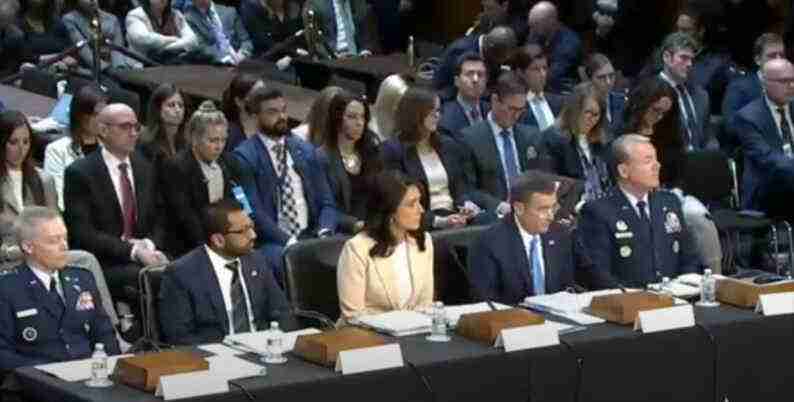
DNI Director Tulsi Gabbard, FBI Director Kash Patel, CIA Director John Ratcliffe, NSA Director Timothy Haugh and Defense Intelligence Agency Director Jeffrey Kruse and other national security officials testified on global threats before the Senate Intelligence Committee on March 25, 2025. Senator Tom Cotton opens the hearing. Sen. Mark Warner is vice chairman of the committee. Below is the full transcript.
TRANSCRIPT:
Opening Remarks
SENATOR TOM COTTON: Good morning. Welcome to the Senate Intelligence Committee Annual Worldwide Threats Hearing. I’d like to begin by welcoming our esteemed panel of witnesses, the Director of National Intelligence, Tulsi Gabbard; the CIA Director, John Ratcliffe; the FBI Director, Kash Patel; the Director of the National Security Agency and Commander of U.S. Cyber Command, General Tim Haugh; and the Defense Intelligence Agency Director, Lieutenant General Jeffrey Kruse.
Thank you all for your appearance. Thank you for your leadership. I also want to recognize the hard work and dedication of the thousands of men and women in our intelligence community whom you are here to represent today. Their successes are seldom celebrated. Their accomplishments are often unseen.
But our nation is grateful to each one for the vital work they do to keep our nation safe, prosperous, and free. Our annual worldwide threats hearing allows for the American people to receive an unvarnished and unbiased account of the real and present dangers that our nation faces. As we will hear from our witnesses, many of the threats we face are truly existential.
Major Global Threats
Communist China is actively working to replace the United States as the world’s dominant superpower. China uses coercive military, economic, and influence operations short of war to shape a world favorable to its interests and hostile to ours.
These methods include the biggest peacetime military buildup in history, rapidly expanding its nuclear forces, providing critical assistance to help Russia withstand U.S. sanctions, obscuring its role in accelerating the spread of COVID-19 beyond Wuhan, turning a blind eye to Chinese companies that enable the production of fentanyl flooding into the United States, and putting space weapons on orbit, among other tactics.
Iran, despite setbacks inflicted on its so-called axis of resistance by Israel over the last year, still aims to destroy what it calls the Little Satan, the State of Israel, and what it calls the Great Satan, the United States. It continues to arm Yemeni rebels to attack global shipping.
Though these outlaws have suffered terrible losses over the last two weeks thanks to decisive action by President Trump and our brave troops. I commend the President, Mike Waltz, Pete Hegseth, and his entire national security team for these actions. Iran also continues its decades-long effort to develop surrogate networks inside the United States to threaten U.S. citizens.
Furthermore, Iran’s nuclear program continues apace. It’s actively developing multiple space launch vehicles, which are little more than flimsy cover for an intercontinental ballistic missile program that could hit the United States in a matter of years. But all this will soon come to an end. The supreme leader of Iran now faces a stark choice, thanks to President Trump. The supreme leader can fully dismantle his nuclear program, or he can have it dismantled for him.
Finally, today’s report also acknowledges that illicit drug production endangers the health and safety of millions of Americans. For the first time, the annual threat assessment lists foreign illicit drug actors as the very first threat to our country. As the report highlights, Mexican-based cartels using precursors produced in China continue to smuggle fentanyl and synthetic opioids into the United States. Last year alone, these deadly drugs tragically killed more than 52,000 Americans, more than the number killed in attacks by foreign terrorists or foreign nations.
Intelligence Community Challenges
Given these threats, we have to ask, are our intelligence agencies well postured against these threats?
I’m afraid the answer is no, at least not yet. As the world became more dangerous in recent years, our intelligence agencies got more politicized, more bureaucratic, and more focused on promulgating opinions rather than gathering facts. As a result of these misplaced priorities, we’ve been caught off guard and left in the dark too often. I know that all of you agree that the core mission of the intelligence community is to steal our adversaries’ secrets and convey them to policymakers to protect the United States. At the same time, it’s not the role of intelligence agencies to make policy to justify presidential action or to operate like other federal agencies.
After years of drift, the intelligence community must recommit to its core mission of collecting clandestine intelligence from adversaries whose main objective is to destroy our nation and our way of life. The reason is not that our intelligence community lacks dedicated patriots who show up to work every day to protect the American people. On the contrary, it has an abundance of them. The reasons are misuse of resources, bureaucratic bloat to default to play it safe, and a past administration that prioritized social engineering over espionage.
Coupled with recent failures, the finding in today’s World Threat Report should be a wake-up call to all of us to get our house in order.
The status quo is proving inadequate to provide the President and Congress with the intelligence needed to protect the American people. As more storms gather, America’s intelligence capabilities require urgent reform and revitalization.
As the Chairman of this committee, I look forward to working with each of you to strengthen America’s intelligence edge and refocus our intelligence community on its core mission, stealing secrets. The American people deserve nothing less. We’ve assembled an impressive team to get this done, and I look forward to hearing your comments.
Now I recognize the Vice Chairman for opening remarks.
Vice Chairman’s Response
SENATOR MARK WARNER: Well, thank you, Mr. Chairman, and good morning, everybody. I want to thank all the witnesses for being here. I got to say, I’ve been on the committee now for fourteen years.
And this year’s assessment is clearly one of the most complicated and challenging in my tenure on the committee.
Yesterday, we stunningly learned that senior members of this administration and according to reports, two of our witnesses here today were members of a group chat that discussed highly sensitive and likely classified information that supposedly even included weapons packages, targets and timing and included the name of an active CIA agent. Putting aside for a moment that classified information should never be discussed over an unclassified system, it’s also just mind-boggling to me that all of these senior folks were on this line and nobody bothered to even check Security Hygiene 101.
Who are all the names? Who are they? Well, it apparently included a journalist. And no matter how many the Secretary of Defense or others want to disparage him, this journalist had at least the ethics to not report, I think, everything he heard. Question I raise is like, everyone on this committee gets briefed on security protocols.
They’re told you don’t make calls outside of SCIFs of this kind of classified nature. We don’t know what I’m going to ask, obviously. Director Gabbard is the executive in charge of all keeping our secrets safe. Were these government devices? Were they personal devices?
Had devices been collected to make sure there’s no malware? There’s plenty of declassified information that shows that our adversaries, China and Russia, are trying to break into encrypted systems like SIGNAL. And I can just say this. If this was the case of a military officer or an intelligence officer and they had this kind of behavior, they would be fired. I think this is one more example of the kind of sloppy, careless, incompetent behavior, particularly towards classified information.
This is not a one-off or a first-time error. Let me take a couple of minutes and review some of the other reckless choices that this administration has made regarding our national security.
Concerns About Administration Decisions
We all recall it seems like it wasn’t that long ago, less than two months ago. In the first two weeks, the administration canceled all U.S. Foreign assistance. Now some may say, how bad can that be? It’s foreign assistance. Well, U.S. Foreign assistance paid for the units in Ukraine that provide air defense to civilian cities being attacked by Russia. Foreign assistance paid for guarding camps in Syria where ISIS fighters are detained. Foreign assistance paid for programs abroad that ensure that diseases like Ebola don’t come home. And until recently, it paid for the construction of a railway in Africa that would have helped given the United States much needed access to critical minerals in Congo. Now that project, China is going try to finance it.
As well, in the first two weeks, Director Patel, the administration fired several of our most experienced FBI agents, including the head of the Criminal Investigative Division, the head of the Intelligence Division, the head of the Counterterrorism Division, the heads of the New York, Washington and Miami field office, all individuals who were distinctly and directly responsible for helping to keep America safe. The irony a little bit was the currently or the recently dismissed head of the Counterterrorism Division was involved in disrupting the ISIS attacks planned for Oklahoma City and Philadelphia and helped lead the effort to bring to justice the key planner of the Abbey Gate bombing in Afghanistan. That killed thirteen U.S. Servicemen and one hundred and fifty civilians.
That very Abbey Gate effort was actually praised by the President in his State of the Union address. If the response the administration’s response to these agents, I believe, good works and years of service will support these folks out. It’s hard to imagine how that makes our country safer. Nor can I understand how Americans are made more secure by firing more than three hundred staff at the National Nuclear Security Administration, including those responsible for overseeing the security and safety of the nuclear stockpile or by ousting one hundred and thirty employees at CISA, the agency directly responsible for trying to take on China’s Salt Typhoon attack? Again, after Salt Typhoon, I would have thought folks on that group chat might have thought twice.
Or how we may safer by stacking one thousand employees at the CDC and NIH, who were actually directly working on trying to keep our country safe from disease by pushing out hundreds of intelligence officers. The amazing thing is our intelligence officers, they’re not interchangeable like a Twitter coder. These intelligence officers, our country makes twenty thousand to forty thousand dollars of an investment just in getting a security clearance. Literally goes into six figures when you take the training involved. Can anyone tell how firing probationary individuals without any consideration for merit or expertise is an efficient use of taxpayer dollars.
And just to make clear that yesterday’s story in the Atlantic was not this rookie one-off. It’s a pattern. I want to acknowledge Director Ratcliffe was not here in his position when this took place. But again, earlier in the administration, when a non-classified network was used, thereby exposing literally hundreds of CIA officers’ identities. Those folks can’t go into the field now.
How does that make our government more efficient? Again, this pattern of an amazing cavalier attitude towards classified information is reckless, sloppy and silly. And perhaps what troubles me most is the way the administration has decided that we can take on all of our problems by ourselves without any needs for friends or allies. I agree that we’ve got to put America’s priorities first. But America first cannot mean America alone.
International Relations and Security Concerns
The intelligence we gather to keep Americans safe depends on a lot of allies around the world who have access to sources we don’t have. That sharing of information saves lives, and it’s not hypothetical. We all remember because it was declassified last year when Austria worked with our community to make sure to expose a plot against Taylor Swift in Vienna. That could have killed literally hundreds of individuals. However, these relationships are not built in stone.
They’re not dictated by law. Things like the Five Eyes are based on trust, built on decades. But so often, that trust is now breaking literally overnight. Yet suddenly, for no reason that I can understand, the United States is starting to act like our adversaries are our friends. Voting in the UN with Russia, Belarus and North Korea.
That’s a rogue’s gallery if you’ve ever heard of them. Treating our allies like adversaries, whether it’s threats to take over Greenland or with Panama Canal, destructive trade war with Canada or literally threatening to kick Canada out of the Five Eyes. I feel our credibility is being enormously undermined with our allies. Who I believe, and I think most of us on this committee regardless of party beliefs, makes our country safer and stronger. But how can our allies ever trust us as the kind of partner we used to be when we, without consultation or notice, for example, stop sharing information to Ukraine in its war for survival against Russia?
Or how can our allies not only not trust our government, but potentially not our businesses with such arbitrary political decision? Let me give you a few examples. As a result of a lot of work from this committee and others in Congress, we made sure America’s commercial space industry is second to none. From space to launch to commercial sensing and communications, the United States has taken a record lead. Yet overnight, this administration calls into question the reliability of American commercial tech industry when Maxar and other commercial space companies were directed to stop sharing intelligence with Ukraine.
I got to tell you, and a business guy I can’t say longer than being an elected official, but pretty close. That shock wave across all of commercial space, and frankly, not just commercial space, I’ve heard it from some of our hyperscalers in the tech community, has sent an enormous chill. Who’s going to hire an American commercial space company, government or foreign business with the ability to have that taken down so arbitrarily? And it’s not just in the case of commercial space. We’ve seen that Canada, Germany, Portugal have all been saying they’re rethinking buying F-35.
I’ve heard from Microsoft and Google directly and Amazon that they’re having questions about whether they can still sell their services. We’ve also seen foreign adversaries and friends take advantage of this rift in our national security areas and our scientists. Germany has already put out ads trying to attract some of our best scientists who’ve been riffed. And the Chinese intelligence agencies are posting on social media sites in the hopes of luring individuals with that national security clearance who’ve been pushed out perhaps arbitrarily to come into their service. So no, the Signal fiasco is not a one-off.
Senate Intelligence Committee Hearing on Worldwide Threats
It is unfortunately a pattern we’re seeing too often repeated. I fear that we feel the erosion of trust from our workplace, from our companies and from our allies and partners can’t be put back in the bottle overnight. Make no mistake, these actions make America less safe. Thank you, Mr. Chairman.
SENATOR TOM COTTON: Before I turn to the witnesses hearing, I want to welcome everyone in our large audience today. I also want to note that we will not tolerate any disruptions of the witnesses’ testimony or senators’ questions and the witnesses’ answers. You’ll note that we have a large contingent of Capitol Police in the room. Any disruptions, either opposed or in favor to the witnesses, will result in prompt removal from the hearing room and my encouragement to the U.S. Attorney to throw the book at the person disrupting the hearing. No offense, but we all came to hear the witnesses, no one else in the room.
Opening Statement from Intelligence Community
DIRECTOR TULSI GABBARD: Thank you, Mr. Chairman, Vice Chair, members of the committee. Thanks for the opportunity for us to be here to present you the Intelligence Community’s 2025 Annual Threat Assessment. I’m joined here this morning by my colleagues from the CIA, DIA, FBI, and NSA.
Our testimony offers the collective assessment of the eighteen U.S. Intelligence elements making up the U.S. Intel community and draws on intelligence collection and information available to the IC from open source and private sector and the expertise of our analysts. This report evaluates what the IC assesses most threatens our people and our nation’s ability to live in a peaceful, free, secure and prosperous society.
As you know, we face an increasingly complex threat environment that is threatening us here at home and our interests abroad. I’ll begin by focusing on what most immediately and directly threatens the United States and the well-being of the American people: non-state criminal groups and terrorists putting American lives and livelihood at risk.
Then I’ll focus on the key nation states who have the capability to threaten the interests of the United States. In this complex environment, non-state and state actors are able to exploit or take advantage of the effects of each other’s activities. Conventional and asymmetrical capabilities, even the traditionally weakest of actors are able to acquire from available advanced technologies creates an even more complex and serious threat landscape.
Threats from Non-State Actors
First, I’ll highlight the threats presented by several non-state actors. Cartels, gangs and other transnational criminal organizations in our part of the world are engaging in a wide array of illicit activity from narcotics trafficking to money laundering to smuggling of illegal immigrants and human trafficking, which endanger the health, welfare and safety of everyday Americans.
Based on the latest reporting available for a year-long period ending October 2024, cartels were largely responsible for the deaths of more than 54,000 U.S. citizens from synthetic opioids. Mexico-based transnational criminal organizations, or TCOs, are the main suppliers of illicit fentanyl to the U.S. market and are adapting to enforcement and regulatory pressures by using multiple sources and methods to procure precursor chemicals equipment, primarily from China and India, many of which are dual-use chemicals used in legitimate industries.
Independent fentanyl producers are also increasingly fragmenting the drug trade in Mexico. The availability of precursor chemicals and ease of making illicit fentanyl have enabled independent actors to increase illicit fentanyl production and smuggling operations in Mexico.
Cartels are profiting from human trafficking and have likely facilitated more than two million illegal immigrants encountered by law enforcement at the U.S. Southwest border in 2024 alone, straining our vital resources and putting the American people at risk. Criminal groups drive much of the unrest and lawlessness in the Western Hemisphere. They also engage in extortion, weapons and human smuggling and other illicit and dangerous revenue-seeking operations, including kidnappings for ransom, forced labor and sex trafficking.
These and other human traffickers exploit vulnerable individuals and groups by promising well-paying jobs while confiscating their identification documents. They operate in the shadows, exploiting lawlessness in various areas and using coercion and intimidation to control their victims.
While these key drivers of migrants are expected to persist, heightened U.S. border security enforcement and deportations under the Trump administration are proving to serve as a deterrent for migrants seeking to illegally cross U.S. borders. U.S. Border patrol apprehensions along the Southwest border in January 2025 dropped 85 percent from the same period in 2024.
Transnational Islamist extremists such as ISIS and Al Qaeda and affiliated jihadi groups continue to pursue, enable or inspire attacks against the United States and our citizens abroad and within the homeland to advance their ultimate objective of establishing a global Islamist caliphate. This includes heightened efforts to spread their ideology to recruit and radicalize individuals in the U.S. and the West. While the New Year’s Day attacker in New Orleans had no known direct contact with ISIS terrorists, he was influenced and radicalized by ISIS ideological propaganda as one example.
Al Qaeda and its affiliates continue to call for attacks against the United States as they conduct attacks overseas. These jihadist groups have shown their ability to adapt and evolve, including using new technologies and tactics to spread their ideology and recruit new followers.
A range of non-state cybercriminals are also targeting our economic interests, critical infrastructure and advanced commercial capability for extortion, other coercive pursuits and financial gain. These actors use a variety of tactics, including phishing, ransomware and denial of service attacks to disrupt our systems and steal sensitive and lucrative information using available technologies and U.S. cyber vulnerabilities.
Ransomware actors last year, for example, attacked the largest payment processor for U.S. health care institutions. And another set of criminal actors conducted cyberattacks against U.S. water utilities.
Some of these nonstate cyber actors also operate as proxies for or emulate similar activities carried out by major state actors. While these non-state cyber actors often seek financial and intellectual property gains, they also carry out cyber operations for espionage purposes, targeting our critical infrastructure.
Key State Actors
Turning to key state actors. The IC sees China, Russia, Iran and North Korea engaging in activities that could challenge U.S. capabilities and interests, especially related to our security and economy. These actors are in some cases working together in different areas to target U.S. interests and to protect themselves from U.S. sanctions.
At this point, the IC assesses that China is our most capable strategic competitor. Under the leadership of President Xi Jinping, the People’s Republic of China seeks to position itself as a leading power on the world stage economically, technologically and militarily. Beijing is driven in part by a belief that Washington is pursuing a broad effort to contain China’s rise and undermine CCP rule. China’s most serious domestic challenge is probably China’s slowing economy and potential instability if socioeconomic grievances lead to large-scale unrest.
Growing economic tensions with the United States and other countries could also weigh on China’s plans for economic growth and domestic job creation. China’s military is fielding advanced capabilities, including hypersonic weapons, stealth aircraft, advanced submarines, stronger space and cyber warfare assets and a larger arsenal of nuclear weapons.
While it would like to develop and maintain positive ties with the United States and the Trump administration to advance its interests and avoid conflict, China is building its military capability in part to gain advantage in the event of a military conflict with the United States around the issue of China’s efforts toward unification with the Republic of China or Taiwan. China’s military is also expanding its presence in the Asia Pacific region with a focus on disputed territorial claims in both the East China and South China seas.
Beijing is advancing its cyber capabilities for sophisticated operations aimed at stealing sensitive U.S. Government and private sector information and prepositioning additional asymmetric attack options that may be deployed in a conflict. China’s cyber activities have been linked to multiple high-profile breaches, including last year’s massive compromise of U.S. telecom infrastructure, commonly referred to as Salt Typhoon.
Beijing currently dominates global markets and strategically important supply chains, for example, with the mining and processing of several critical minerals. In December, China imposed an export ban to the United States on gallium, germanium and antimony, all of which are important to the production of semiconductors and our defense technologies. This is in direct response to U.S. export controls on chips designed to broadly limit PRC access to advanced chips and chipmaking equipment.
China also aims to compete in other critical global industries, including AI, legacy semiconductor chip production, biomanufacturing and genetic sequencing, and medical and pharmaceutical supply production. Leveraging often heavily state-subsidized production at greater scale, lower costs and weaker regulatory standards than required in the West, Beijing’s strategy has given it a leading position in many parts of these sectors and supply chains that support them. In 2023, for example, China had five first-in-class domestic drug approvals and three FDA approvals.
Russia’s Threat Profile
Turning to Russia. Russia’s nuclear and conventional military capabilities, along with its demonstrated economic and military resilience, make it a formidable competitor. Moscow has more nuclear weapons than any other nation that could inflict catastrophic damage on the United States and the world in the event of a major war that Russian leaders feared put them and their regime at serious risk.
In late 2024, Russia announced updates to its public nuclear doctrine, expanding the conditions under which Russia would consider using nuclear weapons. Russia is building a more modern and survivable nuclear force designed to circumvent U.S. missile defense through reliable retaliatory strike potential. Russia intends to deter the U.S. by holding both the U.S. homeland at risk and by having the capabilities to threaten nuclear war in a conflict.
Russia has developed advanced cyber capabilities and has attempted to preposition access to U.S. critical infrastructure for asymmetric options and make it a persistent cyber threat. Russia’s cyber activities have been linked to multiple high-profile breaches, including the 2023 hack of Microsoft.
Russia is also fielding new capabilities in anti-satellite weapons meant to degrade U.S. and allied space infrastructure. Among Russia’s most concerning developments is a new satellite intended to carry a nuclear weapon as an anti-satellite weapon, violating longstanding international law against such activity and putting the U.S. and global economy at risk.
Iran and North Korea
Iran continues to seek expansion of its influence in the Middle East despite the degradation to its proxies and defenses during the Gaza conflict. Iran has developed and maintains ballistic missiles, cruise missiles and UAVs, including systems capable of striking U.S. targets and allies in the region. Tehran has shown a willingness to use these weapons, including during a 2020 attack on U.S. forces in Iraq and in attacks against Israel in April and October 2024.
Iran’s cyber operations and capabilities also present a serious threat to U.S. networks and data. The IC continues to assess that Iran is not building a nuclear weapon, and Supreme Leader Khomeini has not authorized the nuclear weapons program that he suspended in 2003. The IC continues to monitor closely if Tehran decides to reauthorize its nuclear weapons program.
In the past year, we’ve seen an erosion of a decades-long taboo in Iran on discussing nuclear weapons in public, likely emboldening nuclear weapons advocates within Iran’s decision-making apparatus. Iran’s enriched uranium stockpile is at its highest levels and is unprecedented for a state without nuclear weapons.
Iran will likely continue efforts to counter Israel and press for U.S. military withdrawal from the region by aiding, arming and helping to reconstitute its loose consortium of like-minded terrorists and militant actors, which it refers to as its “axis of resistance.” Although weakened, this collection of actors still presents a wide range of threats, including to Israel’s population, U.S. forces deployed in Iraq and Syria and to U.S. and international military and commercial shipping and transit.
North Korean leader Kim Jong Un is pursuing stronger strategic and conventional capabilities that can target U.S. forces and allies in the region as well as the U.S. homeland to bolster North Korea’s leverage and stature, defend its regime, and achieve at least tacit recognition as a nuclear weapons power.
Kim’s recently cemented strategic partnership with Russia supports these goals by providing him greater financial, military and diplomatic support, reduced reliance on China and providing North Korean forces and weapon systems authentic war-fighting experience. Kim views his strategic weapons advances since 2019, its deepening ties with Russia, and North Korea’s economic durability as strengthening his negotiating position against Washington’s demands for denuclearization and lessening his need for sanctions relief.
North Korea is probably prepared to conduct another nuclear test on short notice and continues to flight test its ICBMs to demonstrate their increasing capabilities as leverage in future negotiations.
Growing Cooperation Among Adversaries
Since 2022, China, Russia, Iran and North Korea have grown closer. Removing the accelerant of the war in Ukraine is unlikely to revert these bilateral relationships to a prewar 2021 baseline, leaving room for new strategic priorities and world events to create new incentives or challenges to their currently high levels of cooperation.
Russia has been a catalyst for much of this expanded cooperation, driven heavily by the support it has needed for its war effort against Ukraine, including protection from U.S. and Western sanctions. In addition to its exchange of military and other resource capabilities with North Korea, Russia has relied more heavily on China’s financial and defense industry backing and also has increased combined military exercises with China to signal shared fortitude against the United States and U.S. allies in the Asia Pacific region.
With Iran, Russia has also expanded financial ties to mitigate sanctions. Iran has become a critical military supplier to Russia, especially of UAVs, in exchange for Russian technical support for Iranian weapons, intelligence and advanced cyber capabilities.
Conclusion
In conclusion, the threats that we see to U.S. national security are both complex and multifaceted and put the lives, safety and well-being of the American people at serious risk. As the heads of the American People’s Intelligence Community, we will continue to provide the President, Congress and our warfighters with timely, unbiased, relevant intelligence to keep the United States secure, free, prosperous, and at peace. To the American people specifically, our intelligence community exists to serve you and to ensure your safety, security, and freedom. Thank you.
Questioning on Cartel Threats and Border Security
SENATOR COTTON: Thank you, Director Gabbard. As I mentioned in my opening remarks, the annual threat assessment for the first time lists cartels and traffickers as the very first threat. Director Patel, I’m pleased to say that the FBI’s Little Rock field office has been doing its part in addressing this threat. The field office, along with other federal, state, and local law enforcement agencies, have arrested nearly three hundred immigrants in my state in 2025 so far.
Could you provide some color about the nature of the threats these illegal immigrants have posed, not just to Arkansas but our nation, perhaps including some of the details of the horrific offenses they’ve committed against the American people?
Thank you, Mr. Chairman. Mr. Vice Chairman.
[Interruption by protester]
SENATOR COTTON: The witness will suspend. So that protester was a Code Pink lunatic saying the greatest threat to world peace is funding Israel. I will observe, for the benefit of the audience here and on television, that Code Pink is funded by communist China as well, which simply illustrates… speak up now if you want to be removed as well, whoever’s saying that. If anyone else would like to join them, speak now, please, so we don’t have any more disruptions.
As I was saying, the fact that communist China funds Code Pink, which interrupts a hearing like this about Israel, simply illustrates Director Gabbard’s points that China, Russia, Iran, North Korea, and other American adversaries are working in concert to a greater degree than they ever have before.
Director Patel, back to my question. Could you give us some color about the threat that illegal migrants have posed not only to my state, which has resulted in nearly three hundred arrests in 2025, but also to the nation at large?
DIRECTOR PATEL: Thank you, Mr. Chairman, Mr. Vice Chairman and members of the committee. I appreciate the time to address you all, specifically to Arkansas, Senator.
The priorities that the FBI, which I identified during my confirmation hearing and since, is attacking violent crime along with national security. And every single state in this country is a border state. Arkansas is no exception.
Allow me to highlight the work of the men and women in the FBI and state and local law enforcement in the state of Arkansas. Since February 5 alone, we had 220 illegal immigrants arrested on charges varying from violent offenses, weapons offenses, narcotics offenses, and serious violent felonies.
253 separate individuals have been charged related to those offenses. And here’s something I want the American people to hear about narcotics, encountering narcotics. Thousands of pounds of narcotics were seized in these three weeks in the state of Arkansas. Thousands worth tens of millions of dollars. Everything from fentanyl to meth to cocaine to heroin to marijuana and more, and also including manufactured drugs.
The FBI does have the biggest footprint in Arkansas, but we could not achieve this mission without our state and local law enforcement partners, which has been one of the priorities since I took the helm at the FBI. They provide the greatest ground level intelligence to conduct these operations in Arkansas and in every single state across the union.
Since February 5, we’ve assisted with the arrest of hundreds of criminals and illegals throughout your state. And that was just a three week operation. Prior to that, Senator, there was a bust of seventeen federal indictments relating to a meth lab in the state of Arkansas in the southwest corner of your state.
All of those individuals are now facing prosecution for hundreds of pounds of illegal opioids, guns, and other illicit material. So we will continue to do that work. We will work it seven days a week, 365 days a year, not just in your state, Mr. Chairman, but in every state.
China’s Role in Fentanyl Crisis
SENATOR COTTON: Thank you, Director Patel.
As Director Gabbard highlighted from the annual threat report, Director Ratcliffe, many, if not most, of the chemical precursors for deadly fentanyl produced by Mexican drug cartels originates in China. China, of course, is a techno totalitarian police state. They have technology to monitor their own people that Soviet Russia could have only imagined. Is there any reason, Director Ratcliffe, to believe that China could not monitor and crack down on this flow of chemical precursors to Mexico if it chose to do so?
DIRECTOR RATCLIFFE: Thank you, Senator, for the question.
No, there’s nothing that prevent China, the People’s Republic of China from cracking down on fentanyl precursors. As you well know, Senator, one of the reasons that they don’t is that there are more than six hundred PRC related companies that produce those precursor chemicals in an industry that generates one point five trillion dollars. That is one of the reasons that we see the Chinese efforts to affect the fentanyl precursors are really limited in nature and intermittent in nature and not a dedicated effort to enforce their own laws and regulations to crack down on this.
SENATOR COTTON: Thank you, Director Ratcliffe. I have many more questions I could ask, but I’m going to try to lead by example and stay within the five minute limit. For the benefit of senators, I remind everyone there is a vote scheduled at noon. I hope to finish the open portion of this hearing before that vote closes, after which time we’ll move to the closed portion.
Questions About Classified Information Handling
SENATOR WARNER: Thank you, Mr. Chairman. I’ll be happy to take your extra thirteen seconds.
But I want to go back to what I addressed at the outset. I mean this was not only sloppy, not only violated all procedures, but if this information had gotten out, American lives could have been lost. The Houthis had this information could reposition their defensive systems. So I want to get a little more information about this.
And Director Gabbard, did you participate in the group chat with Secretary of Defense and other Trump senior officials discussing the Yemen war plans?
DIRECTOR GABBARD: Senator, I don’t want to get into the specifics—
SENATOR WARNER: Madam, did you—were you—you’re not going to be willing to—So you’re not—are you denying—will you answer my question, ma’am. You were not TG on this group chat?
DIRECTOR GABBARD: I’m not going to get into the specifics of—
SENATOR WARNER: Why are you going to get into the specifics?
DIRECTOR GABBARD: Because this is currently under review by the National Security Council.
SENATOR WARNER: Because it’s all classified. If it’s not classified, share the text now as the White House previously stated. Is it classified or non-classified information on this?
DIRECTOR GABBARD: I can confirm.
SENATOR WARNER: Director Ratcliffe, were you on the group chat?
DIRECTOR RATCLIFFE: Senator, I was on a Signal messaging group.
SENATOR WARNER: So you were the John Ratcliffe on that chat?
DIRECTOR RATCLIFFE: I was. Thank you.
SENATOR WARNER: Thank you.
DIRECTOR RATCLIFFE: Can I provide some context, Senator, to that?
SENATOR WARNER: Yes. But I’ve got a series of questions.
DIRECTOR RATCLIFFE: Well, I think it’s important because at the outset, you made a couple of comments about Signal messaging using encrypted apps.
So that we’re clear, one of the first things that happened when I was confirmed as CIA Director was Signal was loaded onto my computer at the CIA, as it is for most CIA officers. One of the things that I was briefed on very early, Senator, was by the CIA records management folks about the use of SIGNAL as a permissible work use. It is. That is a practice that preceded the current administration to the Biden administration.
SENATOR WARNER: Mr. Ratcliffe, I’ve got a series of questions. Do you—if you’re making the statement, the Signal is a secure channel.
DIRECTOR RATCLIFFE: Can I answer that?
SENATOR WARNER: Is Signal encryption—
DIRECTOR RATCLIFFE: To finish, it is permissible to use to communicate and coordinate for work purposes provided, Senator, that any decisions that are made are also recorded through formal channels.
So those were procedures that were implemented. My staff implemented those processes, followed those processes, complied with our—
SENATOR WARNER: And finally, just please, so my communications, to be clear, in the Signal message group, were entirely permissible and lawful and did not include classified information.
SENATOR WARNER: Will make that determination because if it’s not classified, share the text with the committee. Let me go on.
Director Gabbard, you are the security executive and set access guidelines for classified information. Did you contact the Defense Secretary or others after this specific military planning was put out and say, hey, we should be doing this in a SKIFF?
DIRECTOR GABBARD: There was no classified material that was shared in that—
SENATOR WARNER: So then if there’s no classified material, share it with the committee. You can’t have it both ways. These are important jobs. This is our national security.
Bobbing and weaving and trying to filibuster your answer. So please answer the question. If this was a right—Director Gabbard, if this was a rank and file intelligence officer who did this kind of careless behavior, what would you do with him?
DIRECTOR GABBARD: Senator, I’ll reiterate that there was no classified material that was shared in that—
SENATOR WARNER: And if there’s no classified materials, share. And then if there’s no classified materials, then answer them. But you can’t even answer the question whether you want the chat. This is strangely familiar, and I think my colleagues will remember when you couldn’t answer the question, is that what’s known a traitor?
Man, I have serious doubts about your—anyway. Patrick Abbott, I’m going to give you this, tweeted just eleven days ago, and I’m quoting you, “any unauthorized release of classified information is a violation of the law and will be treated as such.” So if this information is classified, what are you going to do?
DIRECTOR GABBARD: Senator, two points here. First of all, there’s a difference between inadvertent release versus—
SENATOR WARNER: Careless and sloppy.
DIRECTOR GABBARD: Malicious leaks of classified information. The second point is there was no classified information that was on—
SENATOR WARNER: Information Committee issued that information.
Director, my time is about out and I’m going to use my twelve seconds after the Chairman came. Director Patel, has the FBI launched any investigation of this?
DIRECTOR PATEL: Senator, I was just briefed about it late last night this morning. I don’t have an update.
SENATOR WARNER: I would like to get an answer by the end of the day.
SENATOR COTTON: At this point in the ordinary course of affairs, I would recognize Senator Collins. She asked me to express to you that she is under the weather this morning. She regrets her absence, but anticipates submitting written questions to which I would request your prompt replies for the senator. Senator Cornyn.
Russia-Ukraine Conflict and Nuclear Proliferation Concerns
SENATOR CORNYN: Director Gabbard, I applaud President Trump’s efforts to try to bring an end to the war between Russia and Ukraine. I want to read a statement out of the annual threat assessment and just confirm that you agree with this.
It says “Russia views its ongoing war with Ukraine as a proxy conflict with the West, and its objective to restore Russian strength and security in its near abroad against perceived U.S. and Western encroachment has increased the risks of unintended escalation between Russia and NATO.” Do you agree with that statement? And that is in the annual threat assessment, correct?
DIRECTOR GABBARD: Correct.
SENATOR CORNYN: I’d like to refer to an AP story, Associated Press, dated March 21, 2025. The title of the article is “Western Officials Say Russia Is Behind a Campaign of Sabotage Across Europe.” This AP map shows it. Mr. Chairman, I’d like to ask unanimous consent that the speaker made part of the record.
SENATOR COTTON: Without objection.
SENATOR CORNYN: The document that AP compiled, and I presume this is through open sources, documented fifty-nine incidents, including cyber attacks, spreading propaganda, plotting killings or committing acts of vandalism, arson, sabotage or espionage. Is that consistent with your understanding and impression of what Russia is currently engaged in, in Europe?
DIRECTOR GABBARD: Senator, I haven’t seen that specific article, but I can confirm that we assess Russia’s attempts to conduct such sabotage activities in Europe.
SENATOR CORNYN: Thank you. One of the things that I’m most concerned about following some of the discussions between Russia and Ukraine and the United States and our other allies. Obviously, as I said, peace between Ukraine and Russia is the desirable end state. I think you’d have to be something—you’d have to be crazy to say otherwise.
But I also want to talk a little bit about the unexpected or maybe unintended consequences of European insecurity. I know the incoming chancellor of Germany has talked about the possibility that Germany might share its nuclear weapons with Ukraine and suggested that the UK would be part of that. I know that Poland has talked about acquiring nuclear weapons and perhaps other European countries to make up for what they view as a receding of the American umbrella of protection.
General Kruse, what would be the result of the proliferation of nuclear weapon armed countries in Europe if, in fact, that would occur as a result of our—the perception of Russian—excuse me, European insecurity?
GENERAL KRUSE: Senator, thank you for the question. One of the things that the intelligence community works very hard on is to understand who has nuclear weapons throughout the planet.
And as discussed in the opening statements, both by the Chair and by Director Gabbard, the proliferation and the increase in the types and the lethality of nuclear weapons is one of the things that we have to track and we as a nation are going to have to face. It has changed dramatically in the last five years and will continue to change over the next five years.
The addition of additional countries which have their own deterrence policies and will act in a nuclear dialogue or the presence of those weapons, the security of those weapons, the movement and the threat of use of those weapons complicates the environment by which all of us will operate and will complicate all of the decisions by which all future conflict and the political decisions that we support of the decision—
SENATOR CORNYN: It makes the world a more dangerous place, does it not?
GENERAL KRUSE: Senator, yes, it does.
SENATOR CORNYN: And just by way of history, Ukraine used to be—have the third largest arsenal of nuclear weapons on the planet. But as a result of negotiations between Russia and Ukraine and the United Kingdom, the Budapest Memorandum documented a commitment by Russia and the United States to protect the territorial integrity of Ukraine in exchange for them giving up their nuclear weapons. Did I correctly summarize the content of the Budapest Memorandum back in 1994?
GENERAL KRUSE: Yes, Senator, you did. And Ukraine willingly gave up its weapons for the protection of others.
SENATOR CORNYN: Thank you very much.
Senate Intelligence Committee Hearing on Worldwide Threats (Continued)
SENATOR WYDEN: Thank you, Mr. Chairman. And obviously, colleagues and I feel very strongly about the war planning meeting over unclassified phones. Obviously reckless, obviously dangerous, both the mishandling of classified information and the deliberate destruction of federal records are potential crimes that ought to be investigated immediately.
And I want to make clear that I’m of the view that there ought to be resignations, starting with the National Security Advisor and the Secretary of Defense. Director Ratcliffe and Director Gabbard, have you participated in any other group chats with senior Trump administration officials in which classified information was shared using phones that weren’t cleared for such information? Question for the two of you.
DIRECTOR RATCLIFFE: Senator, thank you for the question. I haven’t—your question was, have I participated in any other group chats sharing classified information? To be clear, I haven’t participated in any Signal group messaging that relates to any classified information at all.
SENATOR WYDEN: Okay. Director Gabbard?
DIRECTOR GABBARD: Senator, I have the same answer. I have not participated in any Signal group chat or any other chat on another app that contained any classified information.
SENATOR WYDEN: Yes. And I just think it’s important to follow through here. Would the two of you cooperate with an audit to confirm that, that is the case?
DIRECTOR RATCLIFFE: I have no objection.
DIRECTOR GABBARD: Senator, I’ll certainly comply with any follow-up that the National Security Council would deem appropriate. But again, to be clear, the use of Signal message end-to-end encryption applications is permissible and was, in this case, used permissibly, at least in my understanding and in a lawful manner.
SENATOR WYDEN: The seriousness of this is so clear. That’s why I want to have an audit. And both of you gave me an answer indicating that you would be open to that, and I appreciate it. Director Patel, you weren’t in this particular group chat, but have you participated in any chats on unclassified phones with other administration officials relating to national security? And if so, on what other topics?
DIRECTOR PATEL: Thank you for your question, Senator. Not that I can recall.
SENATOR WYDEN: Okay. Question I have for you, Director Gabbard, involves this question of Elon Musk wasn’t going to see the military’s China war plans because he said he has business in China and he would be susceptible perhaps to that. That was his comment. So as DNI, you’re responsible for security clearance policies across the government. Under your watch, how are you going to go about carrying out this obligation? Because I think it obviously is a very significant one in terms of American national security.
DIRECTOR GABBARD: Thank you, Senator. As you know, the Office of the Director of National Intelligence provides oversight over these different eighteen intelligence elements. Leaders within those elements are empowered with that responsibility to uphold the trust that the American people have placed in them. In this example that you cited, both Secretary Hegseth as well as President Trump completely denied the assertion that Elon Musk was going to receive any kind of classified war plan brief pertaining to China or any other country.
SENATOR WYDEN: So on the question of whether the President has the prerogative to get clearances is really the area that I want to touch on because you’re formally responsible for security clearance policies, and that’s why I’m asking about it. So can a President decide who gets the clearance?
DIRECTOR GABBARD: Yes.
SENATOR WYDEN: So what about your role? You’re formally responsible for security clearance policies.
DIRECTOR GABBARD: That’s also true.
SENATOR WYDEN: So how do we resolve it? The President just gets his way.
DIRECTOR GABBARD: The elected President and Commander in Chief has the authority to provide a security clearance to those who he deems necessary.
SENATOR WYDEN: Mr. Chairman and to the ranking member, I think we have to have a further discussion on this and figure out what the ground rules are. I think it’s clear what the Director says. I just think we need more clarity because I think you have the formal responsibility for security clearances. And now we’ve heard that this somehow is going to be the President’s project, and I think we ought to have further discussions. Thank you, Mr. Chairman.
Questions on Iran and Border Security
SENATOR LANGFORD: Gentlemen, thank you. Thank you to all of you and your service to the country. It matters. There are a lot of citizens of our country right now that have much greater security in their life because of the work that you do and the people that are working around you today. So I just want to say I appreciate that for the folks in Oklahoma. They would definitely want me to be able to say thank you for your service.
Let me ask a couple of questions on this. Director Gabbard, let me start with you on this. Iran has been listed as one of the top sponsors of terrorism for a very long time. This is they are the primary armors of Hezbollah, of Hamas, of the Houthis. They’re arming the Russians to be able to kill Ukrainians. They continue to be able to destabilize the region. And just in the recent days, when many nations in the Gulf region have talked about how to provide greater stability, Iranian leadership stepped out and made very clear statements. They want a one state solution for Israel, and this is to drive out all Jews.
So this continues to be an issue not just for the region, but for Americans in particular. So my question is on this is the sanctions and the effect of sanctions, what we know about the Iranian response. Under the Biden administration, those sanctions will turn down where, quite frankly, Iran has been able to sell ninety billion dollars in oil on the global market to be able to rearm itself and all the others around the region. Now sanctions are now going back on to Iran again. What do we know about the effect of those sanctions?
DIRECTOR GABBARD: Thank you, Senator, for the question. These sanctions have just begun to be reinstated, so the full effects have not yet borne fruit. But the message that the President has sent with his maximum pressure campaign is certainly heard. As the Chairman mentioned in his opening remarks, President Trump recently sent a letter to the leader of Iran expressing his interest in direct talks in order to try to de-escalate and to prevent war, prevent Iran from gaining a nuclear weapon, but also stated that there would be military consequences if there was no direct negotiations. So President Trump is continuing to carry out his vision and mission of peace through strength, acting in the best interests of the American people. We will see what choices are made from here.
SENATOR LANGFORD: Okay. Thank you. Director Patel, during the last administration and our the very open border policy that they had, we had some years, including twenty twenty two and twenty twenty three, where there were seventy thousand individuals that were released into the country that were identified as special interest aliens. This is something this committee and the Homeland Security Committee tried over and over again to get details on. The Biden administration was unwilling to be able to share any of the details in the special interest aliens, led to a great amount of frustration.
The comment came often back to us is that FBI is going to track all these individuals and to be able to identify them, even though it was seventy thousand a year that were coming into the country. You just walked into this position and trying to get your feet on the ground in so many different issues that are outstanding on that. I raised you the issue of individuals that are currently illegally present in the country going through a process, but are listed as special interest aliens. By definition from the administration, those are individuals that we don’t know their level of risk, but where they’re considered a national security risk. But we don’t know anything else about them from there.
So how are you trying to get on top of the number of people that are criminal aliens in the country, but also these special interest aliens that come from terrorist areas?
DIRECTOR PATEL: Thank you, Senator. I appreciate your question. As far as the FBI is concerned, you hit on it, criminal. So we are focused across our interagency partners at DHS, ICE, CBP, CISA and elsewhere to identify through our information sharing networks that we have stood up with state and local law enforcement to provide us the details on any criminal evidence relating to any of the individuals you highlighted.
And if there’s a nexus there, a case will be opened by the line agents who predicated lawful and factual basis to do so. And we will further refer that matter to the Department of Justice for prosecution. We are reviewing all of these cases anew, and we will report back to you, Senator, with some fidelity on the outcome of that process.
SENATOR LANGFORD: Okay. Thank you. Are you getting good feedback from social media technology companies and cooperation from them on illegal activities that are promoted on their site? All the different sites have rules and standards for what can and can’t be done on that. But for instance, in the border areas, many of the sites are allowing child trafficking or they’re allowing basically the hiring of Americans to come be drivers and such, and they know this is being circumvented. Are they working with you on that to be able to take illegal content off their sites?
DIRECTOR PATEL: Thank you, Senator. And we have engaged directly at the top levels of all the private sector software communities and social media companies. And they have been very helpful because they have known, they have been told that this is a priority for me at the FBI to work with them because they have so much information to share back with us. Now that’s, of course, just on the public systems. We’re not talking about the dark net.
SENATOR LANGFORD: Thank you. Thank you, Mr. Chairman.
Questions on Signal Communications and Fentanyl Threats
SENATOR HEINRICH: Thank you, Chairman. Director Ratcliffe, I want start with you. Who determined that the content of this discussion on Signal was not classified?
DIRECTOR RATCLIFFE: Senator, I guess I’m not— Well, for example, I can speak to my personal knowledge that there was no classified agent mentioned as part of this story.
SENATOR HEINRICH: Normally, that would be classified information. I guess what I’m asking is, did you just determine it was not classified? Or was there any declassification after the fact?
DIRECTOR RATCLIFFE: So to be clear, so everyone understands the process, as we talked about, Signal is a permissible use. I understand—
SENATOR HEINRICH: As you said, the CIA has been approved by the White House for senior officials.
DIRECTOR RATCLIFFE: And appropriate for many conversations. And recommended by CISA for high level officials who would be targeted by foreign adversaries to use end-to-end encrypted apps whenever possible like SIGNAL. In this case, what the National Security Advisor did was to request through a Signal message that there be coordination.
SENATOR HEINRICH: So you mentioned the name of a CIA active officer, correct?
DIRECTOR RATCLIFFE: So I had mentioned the name. You didn’t mention the name. Existence of that. And in the article, the implication was that somehow that was improper. That was not the case. So a CIA officer was not operating undercover. So the request for coordination was for a staff member to coordinate on the high side. So I communicated the name of a CIA officer not operating undercover, completely appropriate, who does openly and routinely coordinate with the White House as a member of my staff. So the intimation there that there was something inappropriate was clearly incorrect.
SENATOR HEINRICH: Did it occur to you that given the sensitive nature of this discussion that it could just move to the high side?
DIRECTOR RATCLIFFE: So that was clearly, Senator, I think the intent was that this was initially set up by the National Security Advisor with the instruction that send a point of contact and then you will be provided with information further on the high side for high side communication. So I think clearly it reflects that the National Security Advisor intended this to be as it should have been a mechanism for coordinating between senior level officials, but not a substitute for using high side or classified communications for anything that would be classified. And I think that, that is exactly what did happen.
SENATOR HEINRICH: So I’m curious, did this conversation at some point include information on weapons packages, targets or timing?
DIRECTOR RATCLIFFE: Not that I’m aware of.
SENATOR HEINRICH: Director Gabbard, same question.
DIRECTOR GABBARD: Same answer and defer to the Department of Defense on that question.
SENATOR HEINRICH: Well, those are two different answers. But you’re saying that did not that was not part of the conversation?
DIRECTOR GABBARD: To my knowledge.
SENATOR HEINRICH: Precise operational issues were not part of this conversation?
DIRECTOR GABBARD: Correct.
SENATOR HEINRICH: Okay. I want to ask you, Director Gabbard, something on a very different track here, which is I very much agree with the conclusion of the ATA that foreign illicit drug actors are a major threat in the United States, and many of you have spoken to this today. Is the IC wrong in its omission of Canada as a source of illicit fentanyl in the ATA? I was surprised, given some of the rhetoric, that there is no mention of Canada in the ATA.
DIRECTOR GABBARD: Senator, the focus in my opening and the ATA was really to focus on the most extreme threats in that area. And our assessment is that the most extreme threat related to fentanyl continues to come from and through Mexico.
SENATOR HEINRICH: So the President has stated that the fentanyl coming through Canada is massive and actually said it was an unusual and extraordinary threat. And that was the language that was used to justify putting tariffs on Canada. I’m just trying to reconcile those two issues. Is it an unusual extraordinary threat? Or is it a minor threat that doesn’t even merit mention in the annual threat assessment?
DIRECTOR GABBARD: Senator, I don’t have the numbers related to Canada in front of me at this time. I’d like to get back to you on the specifics of that answer.
SENATOR HEINRICH: It’s less than one percent of the fentanyl that we are able to interdict. But if you have different information, I would very much welcome that.
SENATOR BUDD: Thank you all for being here. And Director Gabbard, prior to your role here, we had a big storm in Western North Carolina and you were among those first from outside our state to show up. So thank you for your work there. Thank you for your ongoing work there and that of your family as well. It was good to see them when out in Western North Carolina last week. So thank you.
Senate Intelligence Committee Hearing on Worldwide Threats
# Questions on Volt Typhoon and Critical Infrastructure
SENATOR COTTON: Director Haugh, so what do we need to do in regards to Volt Typhoon? There’s a lot of prepositioning that went on there. So where are we with that? And what do we need to do in regards to our power companies, whether it’s generation or distribution, Duke Energy in my home state, or even the rural electric co-ops? What do we need?
DIRECTOR HAUGH: Senator, ninety-nine percent of the critical infrastructure in the United States is controlled by private companies. That really drives us to talk about how do we partner with industry and with the commercial sector, in this case, power sector. Volt Typhoon began when industry came to the intelligence community and said, we’re seeing anomalous activity. Can you help us gain context?
And we were able to bring context to that to be able to understand what the threat was and then to ultimately be able to identify who was behind that threat. Since that time, we’ve continued to work very closely with industry to be able to determine what are the right ways for us to be able to pursue these threats within networks to enable the interagency, to enable our partners and industry to be able to pursue them. That’s the approach we have to take. It is a collaboration between the government and industry to be able to eradicate these threats, and we have continued to pursue them together since our first identification and notification that we did related to this particular threat.
SENATOR COTTON: Thank you. What have you done on the offensive side here in regards to I think there were three, SALT Typhoon, Volt Typhoon and even Flax Typhoon. Maybe there were others, but those are the three that are known.
DIRECTOR HAUGH: Senator, I’ve been given really clear guidance in terms of what the Secretary of Defense expects in terms of our aggressive approach to be able to restore deterrence. And I look forward to talking with you about that in a closed session.
SENATOR COTTON: Look forward to that.
# FISA Section 702 Authority
SENATOR COTTON: Directors Gabbard and Ratcliffe and Patel, thank you all again for being here. So as you’re all keenly aware, Section 702 of FISA is an extremely useful authority to help keep our nation safe. I also know that we need to rebuild American people’s trust and confidence that such authorities are not being misused by the intelligence community to unlawfully target Americans.
So since taking over your respective agencies, can you tell me and tell the American people how effective the recent changes have been in protecting privacy and civil liberties of each and every American? And then, if you will, comment on how useful the authority is in generating intelligence that actually protects the homeland. We’ll start with you, Director Gabbard.
DIRECTOR GABBARD: Senator, Section 702, which authorizes foreign collection of non-U.S. persons outside of the United States, continues to be one of our most effective collection tools to ensure our national security. There are a number of reforms that the Senate passed, that Congress passed last year, that have proven to strengthen the protections of Americans’ Fourth Amendment rights.
In the short time that I’ve been in this seat, I’ve seen a few examples of that directly, most recently through the FISA court calling in an amicus to come in and weigh in on a dispute regarding provisions that would further protect Americans’ Fourth Amendment rights. I’ll be visiting our friends at the NSA next week and doing a “ride along” to observe directly how those reforms that Congress passed are being implemented to protect Americans’ civil liberties and look forward to reporting back after I’ve had that opportunity.
SENATOR COTTON: Thank you. Director Patel.
DIRECTOR PATEL: Thank you, Senator. With my background in FISA and 702, I just want to clearly delineate between FISA Title I and Title III and 702 collection. We need to both ardently defend its use but also ardently support reforms that allow the American public to entrust that those charged with those capabilities are not violating the Fourth Amendment or any other violation.
Speaking to Title I and Title III, when it comes to U.S. persons, I have already included an amendment in terms of FBI language to make sure that when a U.S. person is targeted that the FBI specifically is responsible for calling through all exculpatory information that is reasonably known and satisfying that burden and stating it in the application.
When it comes to 702, Senator, some of the biggest enterprise efforts we have had to thwart national security risk would not have occurred if 702 collection had gone dark. And the FBI continues to use that information to protect the homeland. We’ve had multiple takedowns in the last six months based on 702 and interagency collection processes. But we need to ensure the American public, and I’m working with my team, that even in the 702 sphere, American citizens’ information is protected.
SENATOR COTTON: Thank you all. I look forward to the discussion in the closed session.
# Questions on Classification and Climate Change
SENATOR KING: Thank you, Mr. Chairman. Director Gabbard, I didn’t intend to get into the Jeffrey Goldberg story, but something you said has sort of puzzled me. According to open source reporting at 11:44 on the morning of March 15, Secretary Hedseff put into this group text a detailed operation plan, including targets, the weapons we were going to be using, attack sequences, and timing. And yet you’ve testified that nothing in that chain was classified. Wouldn’t that be classified? What if that had been made public that morning before the attack took place?
DIRECTOR GABBARD: Senator, I can attest to the fact there were no classified or intelligence equities that were included in that chat at any time.
SENATOR KING: I referred to the attack sequencing and timing and weapons and targets. You don’t consider that should have been classified?
DIRECTOR GABBARD: I would refer to the Secretary of Defense and National Security Council on that question.
SENATOR KING: Well, you’re the head of the intelligence community, and you’re supposed to know about classifications. So your testimony very clearly today is that nothing was in that set of texts that were classified. I’ll follow-up on Senator Wyden’s question. If that’s the case, please release that whole text stream so that the public can have a view of what actually transpired on this discussion. It’s hard for me to believe that targets and timing and weapons would not have been classified.
Well, let me move on. You approved this report, this annual report prepared by the Office of Director of National Intelligence. Is this submitted to the White House routinely in anticipation of its public release?
DIRECTOR GABBARD: I don’t know what you mean by submitted routinely.
SENATOR KING: Well, was this report submitted to the White House before its release today?
DIRECTOR GABBARD: It was submitted to them once it was completed. I think probably around the same time it was sent to all of you.
SENATOR KING: I want to move on. One note that surprised me, I’ve been on this committee now for this is my thirteenth year. Every single one of these reports that we have had has mentioned global climate change as a significant national security threat, except this one. Has something happened? Has global climate change been solved? Why is that not in this report? And who made the decision that it should not be in the report when it’s been in every one of the eleven prior reports?
DIRECTOR GABBARD: I can’t speak to the decisions made previously, but this annual threat assessment has been focused very directly on the threats that we deem most critical to the United States and our national security. Obviously, we’re aware of occurrences within the environment and how they may impact operations, but we’re focused on the direct threats to American safety.
SENATOR KING: How about how they will impact mass migration, famine, dislocation, political violence, which is the finding, by the way, of the 2019 annual threat assessment under the first Trump administration? You don’t consider that a significant national security threat?
DIRECTOR GABBARD: For the intelligence community, being aware of the environment that we’re operating in is a given. What I focus this annual threat assessment on and the IC focus this threat assessment on are the most extreme and critical direct threats to our national security.
SENATOR KING: Let me ask a direct question. Who decided climate change should be left out of this report after it’s been in the prior eleven? Where was that decision?
DIRECTOR GABBARD: I gave direction to our team at ODNI to focus on the most extreme and critical national security threats.
SENATOR KING: Did your direction include no comments on climate change?
DIRECTOR GABBARD: Senator, as I said, I focused on the most extreme and direct national security—
SENATOR KING: That’s not a response to my question. Did you instruct that there be no finding in terms of climate change in this report?
DIRECTOR GABBARD: I don’t recall giving that instruction.
# Questions on CISA and Cybersecurity
SENATOR KING: Final questions in a few short seconds that I have left. You all concede, and it’s in the report repeatedly, about the cyber danger from China, from Russia, from Iran. Why then is the administration deconstructing CISA? One hundred and thirty people fired. General Haugh talked about the importance of public-private cooperation. That section of CISA seems to have been disestablished. What possible policy reason is there for undermining CISA’s relationship to the states with regard to elections and to the private sector with regard to cybersecurity when the cybersecurity threat is only growing? Want to tackle that?
DIRECTOR GABBARD: I won’t speak for all of my colleagues here, but I don’t believe any of us have any insight into those specific staffing decisions that have been made.
SENATOR KING: Well, let me ask you this question. You’ve all found the report has found explicitly growing cyber threats, including to elections from Russia, China, Iran. Do you believe that it’s in the national interest to diminish our capacity to deal with those cyber issues? Yes or no?
DIRECTOR GABBARD: President Trump is focused on effects and making sure that the people that we have and the resources that we have are focused on our national security. He and his team recognize that more people doesn’t necessarily always mean better effects. Those are some of the things that are driving the changes that we’re seeing across the administration, is getting all of our agencies back and focused on their core mission.
SENATOR KING: General Haugh, do you agree that—
CHAIRMAN: Senator King, time is expired.
# Questions on Spectrum and National Security
SENATOR ROUNDS: Thank you, Mr. Chairman. First of all, thank you to all of you for your service to our country. With regard to the issues surrounding signal, I’m going to address it, but I’m going to address it in the closed session so that we can get more in-depth into that issue.
In the meantime, I want to direct my first question to Director Ratcliffe. As the debate continues in Washington regarding spectrum, what can you share in this unclassified setting regarding the critical nature of spectrum to national security interests generally?
DIRECTOR RATCLIFFE: Thanks for the question, Senator. I know this is an issue of great interest to the Senate and the potential auction of commercial space on spectrum. As you correctly point out, the discussions about spectrum, I will start out by saying there are national security implications from such an auction where it take to take place to both the DoD and the IC.
I think the discussions that we need to have in a classified setting, I can relate to you that the direction from early meetings that we’ve had is that the discussion about where that might take place would not affect specifically CIA or IC equities. And I hope that’s the case and where the discussion goes. But I think we need to be concerned that a public auction at bands at certain levels would have an impact on our ability to deliver an accurate intelligence picture.
SENATOR ROUNDS: In other words, there are parts of the spectrum which simply cannot be shared with the commercial.
DIRECTOR RATCLIFFE: That’s correct.
SENATOR ROUNDS: All right. Thank you. And we can talk about the specific reasons about why in a classified setting that would cause a diminishment of our ability to deliver a good threat picture to the Commander in Chief.
DIRECTOR RATCLIFFE: And in some cases, life or death consequences.
SENATOR ROUNDS: Absolutely.
# Questions on ISIS Threats
SENATOR ROUNDS: Director Patel, first of all, I just want to thank you for what you are doing. And I know that there’s a number of items that in your previous life you did that simply can’t be discussed. But nonetheless, we’ve appreciated what you have done for your country already.
Today, I just wanted to talk to you about we’ve seen a series of public news reports about ISIS threats within the United States. And there have been several successful interdictions, Oklahoma City, Philadelphia, New York. Although the question remains as to the total number of ISIS operatives who were able to breach porous borders in the months and years before policy changes in January of 2025, to what extent is the FBI tracking operatives who remain in the United States today? And what is the FBI doing to track them down?
DIRECTOR PATEL: Thank you, Senator. I appreciate your question and your comments. So the priorities at the FBI since I took over have been violent crime and national security, and this speaks directly to national security. The direction for the FBI is to track down any individuals with any terrorist ties whatsoever, whether it be ISIS or another foreign terrorist organization, and now to include the new designations of the cartels down south and elsewhere.
So the FBI is utilizing our Joint Terrorism Task Force, which are situated in all fifty-five field offices. But the key to success there is our partnership with state and local law enforcement who have the ground level intelligence in some of these operatives. And as you’ve highlighted, we’ve already shut down numerous threats and we’ve identified publicly where permissible these threats and individuals and where they’re coming from. And I think the FBI is doing a very good job right now in collecting this information through our interagency process. And we will continue to thwart every bad actor affiliated with a terrorist organization or otherwise.
SENATOR ROUNDS: Thank you.
# Senate Intelligence Committee Hearing on Worldwide Threats (Continued)
Cybersecurity and Defense Capabilities
SENATOR: And Director Haugh, first of all, look, you’ve talked a little bit about already about Salt Typhoon, but what I want to really get into is the things that are moving right now that you haven’t had a chance to address, and in particular, CyberComm two point zero and the need to accelerate that particular plan moving forward. Can you talk just briefly, I’ve got forty seconds left, talk to us a little bit about how critical two point zero is in terms of countering the cyber activity that’s going on through nefarious factors.
DIRECTOR HAUGH: Senator, what we were asked to do by Congress was to look at what’s the force generation model for the Department of Defense to be able to generate cyber forces. Based off of that request, I produced a recommendation for the Secretary that outlined three critical things, which is really how we manage the talent, how we develop the talent in the department and also how we equip that talent underpinned by Compute and AI. We’ve brought that plan initially back to Secretary Hegseth. He told us to go faster. We’ve delivered him that plan. And now based off of his guidance, we will now begin to move forward with the rest of the department.
SENATOR: Thank you. Thank you, Mr. Chairman.
Discussion on Signal Thread Controversy
CHAIRMAN: Senator Bennett?
SENATOR BENNETT: Thank you, Mr. Chairman. Thank you very much for holding this hearing, and thank you for being here. Mr. Director Ratcliffe, it sounds to me like your testimony today in the sector and the DNI’s testimony is that there was nothing wrong at all with the signal thread that you were on, that it didn’t include any targeting information or battle sequence. That is your testimony. That’s your testimony. And I’m a little staggered that, that is your view, Director Ratcliffe.
Does the CIA have any rules about handling of classified information? Yes or no?
DIRECTOR RATCLIFFE: Yes.
SENATOR BENNETT: Thank you, Director Ratcliffe. Do you agree Secretary of Defense Pete Hegseth said this morning when asked by members of the press what had happened. He said this morning in Hawaii that Atlantic Editor in Chief, Jeff Goldberg is a deceitful and highly discredited so-called journalist who’s made a profession of providing hoaxes time and time again. Do you share that evaluation, the Secretary of Defense’s evaluation of Jeff Goldberg as a journalist?
DIRECTOR RATCLIFFE: Senator, I didn’t see those comments. I don’t know Jeff Goldberg.
SENATOR BENNETT: So do you share that view of the Secretary of Defense?
DIRECTOR RATCLIFFE: Well, don’t have a view on—
SENATOR BENNETT: Okay. Do you—assuming that he has that view, I’m curious about whether you are the CIA Director, okay? This has happened. We know it’s happened. Did Jeff Goldberg somehow—was it a—did he create a hoax that allowed him to become part of this signal thread?
Don’t answer the question. You don’t insult the intelligence of the American people. Did he invite himself to the signal threat?
DIRECTOR RATCLIFFE: I don’t know how he was invited, but clearly not—
SENATOR BENNETT: Clearly, it was—finish your sentence, please.
DIRECTOR RATCLIFFE: Clearly, he was added to the SIGNAL group.
SENATOR BENNETT: Question is—No, you don’t know that the President’s national security adviser invited him to join the signal threat. Everybody in America knows that. Does the CIA Director not know that?
DIRECTOR RATCLIFFE: I’ve seen conflicting reports about who added the reporter to the signal message—
SENATOR BENNETT: Do you think it is perfectly appropriate that there was a reporter added, especially one that the Secretary of Defense says is deceitful, highly discredited, a so-called journalist who’s made a profession of peddling hoaxes over and over again. Do you—are your testimony that it was appropriate that he was added to this signal threat?
DIRECTOR RATCLIFFE: No, of course not.
SENATOR BENNETT: And why did you not hold—You are the mischaracterizing testimony. Can you answered the question. Let me ask you. When he was added to the threat, you’re the CIA director. Why didn’t you call out that he was present on the signal thread?
DIRECTOR RATCLIFFE: I don’t know if you use signal messaging app.
SENATOR BENNETT: I do.
DIRECTOR RATCLIFFE: Not for classified information, not for targeting.
SENATOR BENNETT: Neither I—send to remote. Neither do I Senator.
DIRECTOR RATCLIFFE: Well, that’s what your testimony is today.
SENATOR BENNETT: It absolutely is not, Senator. Were you not listening at the beginning when I said that I was using it as permitted, it is permissible to use—
SENATOR BENNETT: I agree that’s your testimony. Agree that’s your testimony. You asked me if I use—And I said, not for targeting, not for classified information. And I said, I don’t either. I also know Jeff Goldberg. I don’t use it to communicate with him, but you thought it was appropriate.
By the way, I think he’s one of the more outstanding journalists in America, but I’m shocked to find him on a thread that he’s reading in the parking lot of a grocery store in Washington DC. And your testimony as the director of the CIA is that it’s totally appropriate. Is it appropriate that the president—
DIRECTOR RATCLIFFE: No. The president is not what I—
SENATOR BENNETT: Okay. Go ahead.
DIRECTOR RATCLIFFE: When did I use the word appropriate?
SENATOR BENNETT: Well, go ahead, please.
DIRECTOR RATCLIFFE: Well, didn’t. That—Everybody in America—
SENATOR BENNETT: So clearly, nothing Senator—here is what your testimony is. No, I’ve never said—This is just a normal day at the CIA where we chat about this kind of stuff over signal. In fact, it’s so normal that the last administration left it here for us. That’s your testimony today. That’s your testimony.
DIRECTOR RATCLIFFE: No. That’s not my testimony. That’s what you said.
SENATOR BENNETT: I didn’t say any of those things that you just related to.
DIRECTOR RATCLIFFE: I heard you say it. We’ll let the American people decide. Let me ask you one final point, mister—
DIRECTOR RATCLIFFE: Not surprised.
SENATOR BENNETT: Well, are you going to give me a chance to appropriate. Did you know that the president’s Middle East adviser was in Moscow on this thread while you were as director of the CIA participating in this in this thread? Were you aware of that? Are you—are you aware of that today?
DIRECTOR RATCLIFFE: I’m not aware of that—
SENATOR BENNETT: This sloppiness, this incompetence, this disrespect for our intelligence agencies and the personnel who work for him is entirely unacceptable. It’s an embarrassment.
DIRECTOR RATCLIFFE: Senator, you need to do better. You need to do better.
SENATOR BENNETT: Thank you. I’m being gaveled by the Chairman, and I apologize for going over my time.
Emerging Technologies and National Security
CHAIRMAN: Senator Young.
SENATOR YOUNG: Thank you all for being here. I’ll be asking some follow-up questions, clarifications about the SIGNAL episode in a closed setting and try and work with all of you to bring clarity to that situation. It appears to me there’s some unanswered questions. It will take some time, I think, to get there in a more dispassionate setting.
Director Gabbard, I’m going to begin today asking you some questions about emerging technologies. It’s been a real point of emphasis, I know, of our broader national security community for a period of time. We know that PRC is making generational investments in certain emerging tech, AI, biotech and other areas of technology to reduce their vulnerability against any supply chain disruptions and to lead the world in some areas. As the IC assesses, the PRC is seeking to become a global S and T superpower, surpass the United States, promote self reliance and achieve further economic, political and military gain. So Director Gabbard, can you describe the actions China is taking to operationalize that IC assessment in ways that directly target the security and prosperity of everyday Americans?
DIRECTOR GABBARD: Senator, what we know is that they are trying to use these capabilities as a means to continue to exploit vulnerabilities within our own critical infrastructure and our cyber technology. Critical infrastructure is a key area of concern given what we know has already been exploited, these asymmetric attacks that have been placed within our critical infrastructure that are of serious concern given how they could be exploited, especially during a time of conflict. We know that they are experiencing a boom in their generative AI capability and are competing very heavily against our own AI capabilities. Obviously, AI can and will be used across the multitude of every sector of our society, both here as we are in our own country, and we expect China to be able to continue to do the same there.
SENATOR YOUNG: So two key areas of vulnerability to the United States conceivably, susceptibility to cyber attacks and China’s leveraging of AI towards misinformation increasingly into the physical realm, they can pose threats to us as well.
As follow-up, Director Ratcliffe, we’ve had Huawei, we’ve had TikTok. What do you believe will be the next point of technological friction in competition between the U.S. and China? What should members of Congress be looking for?
DIRECTOR RATCLIFFE: Senator, I think I can answer this question more fully in the classified setting. What I would say is it relates to the issue of emerging technologies and matters of quantum computing and quantum sensing and our ability to stay ahead of China on the top and the technological curve with respect to those issues, I’d be happy to get into that in further detail in the classified setting.
SENATOR YOUNG: Excellent. We’ll dive into that. Director Haugh, General, how do you see biotech playing into this broader competition?
DIRECTOR HAUGH: I think it’s an area that, from our perspective, has increasingly been a priority as we want to understand the approach that China has taken and also to ensure that as we think about the President’s priorities in terms of both economic and technology security, we are certainly, as a community, following DNI’s guidance that we are increasingly putting our resources to be able to ensure that we understand where China is investing in those resources and how that will impact our economy and overall the overall health of our national security.
SENATOR YOUNG: Thank you, General. Director Gabbard, not a lot of time left on this end, but I do have a little crypto interest I wanted to communicate to you. Can you share with this committee how we’re positioned to disrupt foreign cyber efforts to steal cryptocurrency, such as the North Koreans has successfully done. If others would like to pull this thread and weigh in on this question very briefly, that would be great.
DIRECTOR GABBARD: Senator, we’re obviously aware of North Korea’s revenue generating by stealing cryptocurrency has had a significant effect on North Korea’s capabilities. I defer to our technical experts on the actions that are being taken.
DIRECTOR HAUGH: Senator, I think this will be a great topic when we go to close. It’s going to be a busy close.
SENATOR YOUNG: Yes.
DIRECTOR PATEL: I agree with the General. In closed session, I can provide some details.
SENATOR YOUNG: It’s what you get when you visit with a bunch of spies. All right, Chairman.
Further Discussion on Signal Thread
CHAIRMAN: Senator Kelly.
SENATOR KELLY: Thank you, Mr. Chairman. I’m going to come back to the topic of the day here, the signal chain as reported by The Atlantic. Ms. Gabbard and Mr. Ratcliffe, you each testified that there was no information operational in nature, no classified information. So I want to ask each of you just a series of just respond yes or no. I’ll start with Ms. Gabbard.
In the signal chain that we have been talking about, was there any mention of a target in Yemen?
DIRECTOR GABBARD: I don’t remember mention of specific targets.
SENATOR KELLY: Any generic target?
DIRECTOR GABBARD: I believe there was discussion around targets in general.
SENATOR KELLY: Mr. Ratcliffe?
DIRECTOR RATCLIFFE: I think that’s consistent with my recollection. Again, I don’t have access to that.
SENATOR KELLY: Was there any mention, Ms. Gabbard, of a weapon or weapons system?
DIRECTOR GABBARD: I don’t recall specific weapons systems being named.
SENATOR KELLY: I’m not talking about specific—any weapon or weapons system.
DIRECTOR GABBARD: I don’t recall specific names of systems or weapons being used or named within the—
SENATOR KELLY: Well, not asking whether—I don’t want you to tell me what the specific weapon was, but any weapon at all. Mr. Ratcliffe, same question.
DIRECTOR RATCLIFFE: I don’t recall.
SENATOR KELLY: How about anything about timing? Ms. Gabbard?
DIRECTOR GABBARD: I don’t recall specific timing. Was there any—I won’t get into the detail of the conversation. But obviously, there was a significant amount of planning and internal discussions that had occurred prior to and outside of this SIGNAL chat.
SENATOR KELLY: Mr. Ratcliffe, you’re nodding your head. Any mention of any military unit whatsoever? Mr. Ratcliffe?
DIRECTOR RATCLIFFE: Not that I recall.
SENATOR KELLY: Ms. Gabbard?
DIRECTOR GABBARD: Not that I recall.
SENATOR KELLY: Okay. So I understand that DoD policy prohibits discussion of even what is called Controlled Unclassified Information, or CUI, on unsecured devices. Are both of you aware of that DoD policy?
DIRECTOR GABBARD: I haven’t read that policy.
DIRECTOR RATCLIFFE: Not familiar with the DoD policy, but I would say that the Secretary of Defense is the original classification authority for DoD in deciding what would be classified information.
SENATOR KELLY: Ms. Gabbard, does the intelligence community have a policy that prohibits discussion of controlled unclassified information?
DIRECTOR GABBARD: Yes. It does.
SENATOR KELLY: Okay. Controlled unclassified information, according to DoD, includes information that is information that has not been approved for public release. Would you of what’s been disclosed publicly of the signal chain, would either of you feel that, that would be approved for public release? Ms. Gabbard?
DIRECTOR GABBARD: The discussion that took place in that SIGNAL chat group was a conversation reflecting national security leaders and the Vice President around the President’s objectives.
SENATOR KELLY: So yes or no, would you approve that for public release?
DIRECTOR GABBARD: I don’t feel I can answer that question here.
SENATOR KELLY: Because of the nature of this hearing?
DIRECTOR GABBARD: Because of the nature of a private discussion that took place between individual leaders and our government.
SENATOR KELLY: It would make sense that you would not approve it for public release, wouldn’t it?
DIRECTOR GABBARD: There are other factors that would go into that consideration.
SENATOR KELLY: Mr. Ratcliffe, yes or no?
DIRECTOR RATCLIFFE: I wouldn’t approve the release of classified information.
SENATOR KELLY: Again, as I’ve said, I’m not talking about classified information, Mr. Ratcliffe. I’m talking about information that has not been approved for public release. That is information that is considered controlled, unclassified—
DIRECTOR RATCLIFFE: The principles that would have been on that would have been individuals capable of approving that for public release.
SENATOR KELLY: Do you—let me—I got twenty seconds. The deliberation as to whether or not we should launch a strike on another country, would you consider that classified information, Ms. Gabbard?
DIRECTOR GABBARD: The information was not classified. This is—
SENATOR KELLY: I’m not talking about this. I’m just talking about deliberation as from principles as to whether or not we should launch a strike on another country. Would you consider that classified information? I’m not talking about what happened this week.
DIRECTOR GABBARD: There are other factors that would go into determining that classification.
SENATOR KELLY: Mr. Ratcliffe, the deliberation between principles in our national security apparatus about whether or not to strike another country, would you consider that to be classified information?
DIRECTOR RATCLIFFE: Predecisional strike deliberation should be conducted through classified channels.
SENATOR KELLY: Thank you. Thank you
# Senate Intelligence Committee Hearing on Worldwide Threats (Continued)
Clarification on Classification Authority
SENATOR COTTON: Ratcliffe, to your answer there in part. Senator Kelly, it’s been raised at several occasions now in this hearing about whether classified information was discussed in this chat. And you mentioned about the Secretary of Defense being what you called, I think, the original classification authority. Correct. Think it’s important for the public to understand that although you and Director Gabbard are original classification authorities on many matters, you’re not that for all matters that might be classified in the government.
DIRECTOR RATCLIFFE: That’s correct.
SENATOR COTTON: So, if the Secretary of State has classified sensitive diplomatic details, that’s his authority. If the Secretary of Energy has sensitive classified information about our national laboratories, that’s his authority. And the two of you can’t speak to other departments who have their own original classification authority, in which, of course, as Director Gabbard said, ultimately rests with one person, the President of the United States.
DIRECTOR RATCLIFFE: That’s correct.
SENATOR COTTON: Okay. I just wanted to clarify that. It looks like the Vice Chairman wants to weigh in as well.
SENATOR WARNER: Just very briefly. I mean I think it strains the audience and the watching public credibility for talking about timing, packages that somehow this would be okay to put out or just, frankly, senior American officials trashing Europe. I’ve been around this for a while. This is not information you generally put out. And the notion there’s not even acknowledgment of, hey, gosh, we screwed up, is stunning to me.
And the idea somehow, well, none of this was classified, but we can’t talk about it here. You can’t have it both ways. I think the witness’s point is that they can’t speak for every official in the government who has original classification authority.
SENATOR SHERMAN: I don’t—that’s not what we’re—I’m not trying to litigate that. I’m trying to litigate on the face unless, as Senator Bennett said, this reporter is somehow making this all up.
And I think the White House has acknowledged that the text chain that he submitted was authentic. It strains my mind to think—it strains my mind if the shoe had been on the other foot what my colleagues would be saying about this. And again, we’re going to get to the bottom of it. I appreciate your comments, but you guys have both testified under law. There’s nothing classified in that information.
And there was nothing in a sense, I’ve not heard any either one of you say, gosh, we screwed up. So we’ll find out. This is too important to our national security. And again, know we’ve got more members to trust. They testified, it’s my understanding, correct me if I’m wrong, that there’s no intelligence community classified information.
Is that correct?
DIRECTOR RATCLIFFE: That’s correct.
SENATOR SHERMAN: Is that correct, Director Gabbard?
DIRECTOR GABBARD: Yes, Sharon.
SENATOR WARNER: Well, again. That’s not correct. She said repeatedly there’s nothing classified, period. Right, period. You can’t have it both—and again, we’ll see. I cannot believe this is not going to come out.
If it’s not classified, again, we’d ask you to make it—give it to the public today. I’m sure someone of your age back there probably got it on paper. If you’ve got it here, it’s not classified, stand by your position. Or is this just one more example of a careless approach to how we keep our secrets in this administration? With apologies to Senator Moran.
Ukraine War Assessment
SENATOR MORAN: Thank you, Mr. Chairman, and thank you to our witnesses for being here. I want to explore a little bit about Ukraine, and I’ll direct this to Director Ratcliffe or Director Kruse. The ATA assesses that the grinding war of attrition in Ukraine will lead to a gradual but steady erosion of Kyiv’s positions on the battlefield. Are Ukrainian forces at any significant risk of collapse this year?
DIRECTOR KRUSE: Before I turn it over to Director Ratcliffe, I think both sides are working through the equipment that they need, the industrial base they need to support that and the personnel that are required to man all of that equipment and man the front lines. And as we see the battle space in the various portions, whether it’s in Kursk, whether it’s in any of the four point blasts, we see areas where Kyiv will struggle to prevent the slow attritional grind. We do not see an imminent collapse in any of the line of control battlespaces at this point.
SENATOR MORAN: And then vice versa. That answers my question, unless you want to add something, Director.
Whatever advantages in manpower and material they have, can Russia maintain its operational tempo without significant changes to how it’s conducting the war?
DIRECTOR KRUSE: I think our assessment from a military perspective is that Russia has the ability to sustain its campaign longer than Kyiv would. Now when that timeline hits, we do not have an assessment of. But I believe that if this were to go on for more than the remainder of this year, both sides would have a significant challenge maintaining their defense industrial base as well as their operational ops tempo.
SENATOR MORAN: Longer than this year?
DIRECTOR KRUSE: That is correct. And they will each have difficulty at various points throughout the spring, summer and fall as well.
SENATOR MORAN: Thank you. Director Ratcliffe, ATA says continuing the Russia-Ukraine war perpetuates strategic risk to the United States of unintended escalation to large-scale war and heightened insecurity among NATO allies. What are the strategic risks to the United States if Russia were to achieve its maximalist objectives via peace agreement?
DIRECTOR RATCLIFFE: Achieved via peace agreement? Well, I think that clearly, negotiations that are going on reflect that President Trump is seeking a cessation of the war on terms that will end the war permanently. From an intelligence community standpoint and specifically with regard to CIA assets, we’ve taken steps to support that, the President’s goal of an enduring peace. To General Kruse’s comments, I agree with his assessment and generally the public assessment that Russia has the battlefield advantage, is grinding forward slowly.
I want to comment on that, however, to say that with regard to the Ukrainian resistance, the Ukrainian people and the Ukrainian military have been underestimated for a period of several years now. And ultimately, I’m convinced from my reflections in observing from an intelligence standpoint that they will fight with their bare hands if they have to, if they don’t have terms that are acceptable to an enduring peace.
Obviously, to the point of maximalist goals, President Trump has communicated that he is aware of the dangers of that, of Russia getting what they want. And I think that the peace talks that are taking place would reflect, if successful and they are making progress, that both sides would not get everything that they want and no one’s maximalist goals would be achieved.
SENATOR MORAN: Thank you both.
FBI Appropriations Committee Appearance
In the short time I have, I’m going to skip a question and ask the Director of the FBI. Director, I chair the subcommittee that appropriates money for the Department of Justice, including the FBI. It has been our practice that the FBI Director as well as the Attorney General appear before our committee each year. And I would want to make certain that you do not foresee any challenges that I will have in your presence when you come to speak to when we invite you to come speak about your budget. I think when we visited in the office, you made yourself often available, pleased to talk to Congress.
We’re getting ready for the appropriations process to begin. The budget that the President intends to submit is seemingly months away, weeks away, long weeks away. And we may ask you to come testify about your priorities now or sooner than that. Is that a challenge for you that I’d be aware of?
DIRECTOR PATEL: From the FBI, no, as long as the Department of Justice and the Attorney General are good with it.
SENATOR MORAN: Thank you.
Questions About Signal Chat Leak
SENATOR REID: Thank you very much, Mr. Chairman. Director Ratcliffe, you have repeatedly made the point that there was no classified information contained in any of these discussions that were reported in The Atlantic Monthly. Is that correct?
DIRECTOR RATCLIFFE: No, that’s not correct. So Senator, what I’ve related is that any information that was related from my perspective or that I observed from the intelligence perspective was not classified information. With respect to the assertions and the allegations that there was strike packages or targeting information or things that relate to DoD, as I’ve pointed out, the Secretary of Defense is the original classification authority for determining whether something is classified or not. And as I’ve understood from media reports, the Secretary of Defense has said the information was not classified.
SENATOR REID: Are you aware that the Secretary of Defense declassified this information prior to Lucas—
DIRECTOR RATCLIFFE: I’m not.
SENATOR REID: Director Gabbard, same question. You’ve said—you’ve indicated, at least the impression I got, was there was no classified information discussed. Is that correct?
DIRECTOR GABBARD: Senator, my answer is the same as the Director of the CIA’s.
SENATOR REID: So the question has to be posed to Secretary Hegsta, whether he declassified the information and at what point he did declassify it. Do you agree?
DIRECTOR GABBARD: Yes. I defer questions to the Secretary of Defense.
SENATOR REID: Okay. Director Patel, are you conducting an investigation of this—these discussions and activities?
DIRECTOR PATEL: Thank you, Senator. As I informed the Vice Chairman on same question, I found out about this late last night, early this morning, so I don’t have an update for you on that.
SENATOR REID: Well, thank you. When you get an update, we’d appreciate it very much.
DIRECTOR PATEL: Yes, sir.
SENATOR REID: Director Gabbard, were you overseas during any parts of these discussions?
DIRECTOR GABBARD: Yes, Senator, I was.
SENATOR REID: Were you using your private phone or public phone for the SIGNAL discussions?
DIRECTOR GABBARD: I won’t speak to this because it’s under review by the National Security Council. Once that review is complete, I’m sure we’ll share the results with the committee.
SENATOR REID: What is under review? It’s a very simple question. Are you a private phone or artificially issued phone? What could be under review?
DIRECTOR GABBARD: National Security Council is reviewing all aspects of how this came to be, how the journalist was inadvertently added to the group chat and what occurred within that chat across the board.
SENATOR REID: But so you were not going to disclose anything about whether you use the phone?
Director Ratcliffe, there has been indication that the CIA has warned recently retired personnel about the vulnerabilities of signal and other encrypted messaging applications. If that’s the case, why were you discussing these issues on signals?
DIRECTOR RATCLIFFE: Senator, signal use, as I’ve said repeatedly, is permissible for work purposes. I’ve never said that end-to-end encryption apps like SIGNAL are a substitute for classified systems. And I was not discussing classified information in this setting.
SENATOR REID: But as you’ve indicated previously, perhaps the Secretary of Defense was discussing classified information and only he can be held accountable in terms of whether it was classified or declassified at the point we spoke. Is that accurate?
DIRECTOR RATCLIFFE: Well, I didn’t say it that way. I said the Secretary of Defense is the original classification authority. And my understanding is that his comments are that any information that he shared was not classified.
SENATOR REID: But you have no way to verify that?
DIRECTOR RATCLIFFE: I don’t.
SENATOR REID: Again, this is a very troubling example and a great lapse in our intelligence and our discussion.
One further point. If you are not aware of any classified information on the discussions back and forth. Would it be appropriate for the author to release the entire text of what he heard or transcribed?
DIRECTOR RATCLIFFE: I think the author has released—my understanding essentially almost all of the information as it’s been related to me. I don’t know what calculation the author made with regard to what information would be released or not.
SENATOR REID: He asked—I can again confirm that with respect to the communications that were related as to me, there was no classified information. According to the article, the message contained information that might be interpreted as related to actual and current intelligence operations, and the author did not disclose that information. So the question would be, if he disclosed everything he heard in your view—
DIRECTOR RATCLIFFE: That wouldn’t be classified information. I know the context of what that is. And I think the author said might be interpreted as related to intelligence information. It was not classified.
SENATOR REID: So it goes back to my point. If you released all this information he did not release, he could do so without any liability at the federal level.
DIRECTOR RATCLIFFE: I think you’re asking for a legal answer. I’m not able to give you, but Mr. Patel, can you opine?
SENATOR REID: You’re a lawyer and you’re a director of the FBI. Would he face any legal liability if he released the information?
DIRECTOR PATEL: Because of the questions you and the Vice Chairman have put to me, I’m not going to prejudge the situation, and that legal call is ultimately for the Department of Justice.
SENATOR REID: Thank you. Thank you very much, Mr. Chairman.
Further Questioning on Signal Chat
SENATOR OSSOFF: Thank you, Mr. Chairman, and thank you all for joining us and for your service. Just to make sure I understand some of the basics here. So Director Ratcliffe, were a member of the Hootie PC small group signal chain, correct?
DIRECTOR RATCLIFFE: I was. Yes.
SENATOR OSSOFF: And so were the Vice President, the Secretaries of State and Defense, the National Security Advisor and Ms. Gabbard, correct?
DIRECTOR RATCLIFFE: I believe so. I don’t have a list of who was invited to be—
SENATOR OSSOFF: And so was national political reporter Jeffrey Goldberg, correct?
DIRECTOR RATCLIFFE: I don’t know that.
SENATOR OSSOFF: Yes, you do.
DIRECTOR RATCLIFFE: I don’t know Jeffrey Goldberg, and I don’t—I’ve already testified. I don’t know whether or how he was added.
SENATOR OSSOFF: Okay. Well, he was a member of the signal chain. And the discussion included the vice president’s private opinion on the wisdom of proposed U.S. Strikes in Yemen. Correct?
DIRECTOR RATCLIFFE: I don’t recall.
SENATOR OSSOFF: “Vance, I think we are making a mistake. I am not sure the president is aware of how inconsistent this is with his message on Europe right now. There was a strong argument for delaying this a month.” You don’t recall?
DIRECTOR RATCLIFFE: I don’t as you as you—
SENATOR OSSOFF: You don’t recall seeing that?
DIRECTOR RATCLIFFE: Read that. I don’t.
SENATOR OSSOFF: It included the private opinions of the secretary of defense on the timing of strikes in Yemen. Correct?
DIRECTOR RATCLIFFE: I don’t recall.
SENATOR OSSOFF: Director Ratcliffe, surely you prepared for this hearing today. You were part of a group of principals, senior echelons of the US government, in now a widely publicized breach of sensitive information. You don’t recall whether the vice president opined on the wisdom of the strike. Is that your testimony today under oath?
DIRECTOR RATCLIFFE: In that setting, I don’t recall.
SENATOR OSSOFF: Here’s what secretary Hegstaff said, quote, “waiting a few weeks or months does not fundamentally change the calculus. Two immediate risks on waiting.”
Senate Intelligence Committee Hearing on Worldwide Threats (Continued)
SENATOR COTTON: One, this leaks and we look indecisive. Two, Israel takes an action first or Gaza ceasefire falls apart, and we don’t get to start this on our own terms. Your testimony is you don’t recall the secretary of defense sending that message or reading it?
DIRECTOR RATCLIFFE: I recall there being an exchange. I don’t recall the specifics as you’re reading it.
SENATOR COTTON: Well, let’s put it this way, Director Ratcliffe, a discussion by senior U.S. Officials on the timing and risks of a proposed military campaign and disagreements between the president and the vice president about US plans and intentions would be of obvious interest to foreign intelligence services. Would it not?
DIRECTOR RATCLIFFE: Yes.
SENATOR COTTON: And they were discussing the timing of sending US aircrews into enemy airspace where they faced an air defense threat. Correct?
DIRECTOR RATCLIFFE: I’m going to, senator, defer to the other principles that you’re referring to about what the meaning and the context of what they’re about.
SENATOR COTTON: It’s talking about the timing of US air strikes. Correct?
DIRECTOR RATCLIFFE: Yes.
SENATOR COTTON: Yes. And therefore, the timing of sending US aircrews into hostile airspace. Correct?
DIRECTOR RATCLIFFE: Yes.
SENATOR COTTON: And therefore, the time period during which enemy air defenses could target US aircrews flying in enemy airspace. Correct?
DIRECTOR RATCLIFFE: I don’t know that.
SENATOR COTTON: You do know that. Let me ask this question, General Haugh. You lead America’s signals intelligence collection. Would the private deliberation of foreign senior officials about the wisdom and timing of potential military action be a collection priority for you and the US intelligence community?
GENERAL HAUGH: Senator, it’s our job to do indications and warning for both the plans and intentions of adversary leaders and for military commanders.
SENATOR COTTON: And would not information about the timing of air strikes allow a military to preposition or queue air defense systems to shoot down enemy aircraft?
GENERAL HAUGH: I think, senator, from our perspective, advance warning is something that we certainly are trying to protect.
SENATOR COTTON: Director Ratcliffe, this was a huge mistake, correct?
DIRECTOR RATCLIFFE: No.
SENATOR COTTON: Hold on. No. No. You may answer.
DIRECTOR RATCLIFFE: No.
SENATOR COTTON: Director Ratcliffe, I ask you yes or no question, and now you hold on. A national political reporter was made privy to sensitive information about imminent military operations against the foreign terrorist organization. That wasn’t a huge mistake. They characterized it as embarrassment. Is utterly unprofessional. There’s been no apology. There has been no recognition of the gravity of this error. And by the way, we will get the full transcript of this chain, and your testimony will be measured carefully against its content.
CHAIRMAN: Thank you, mister chairman. I thank the witnesses again for their appearance today. I sense the Vice Chairman has something to add. So I will recognize him.
VICE CHAIRMAN WARNER: Well, again, I thank the witnesses. But what you’re saying doesn’t make sense on the face of it. Everyone knows. At least Director Ratcliffe, you had the courtesy of acknowledging you were on the chain. Director Gabbard wouldn’t even touch that, even though we’ve got our initials.
And if you want a comparison, think back to the beginning of the Ukraine war when the United States, in concert with our then ally, the United Kingdom, declassified a lot of Putin’s battle plans that allowed the Ukrainians to push back successfully on the Russian invasion. How was that? That was gone through a real process of declassification.
As Senator Cotton so clearly made the point, this information out potentially where our adversary could reposition its defenses and the unwillingness of the individuals on this panel who are on the chat to even apologize for acknowledging what a colossal screw up this is speaks volumes.
CHAIRMAN: Thank you to our witnesses for your appearance. A few administrative matters. As I mentioned earlier, Senator Collins is under the weather. She regrets that she could not be here for your testimony. Senator Rich, likewise, had to preside over a hearing of the Foreign Relations Committee to include the nomination of my former Governor, Mike Huckabee, a great American and a great friend of Israel, to be the next ambassador to Israel. He also regrets that he could not be here. I anticipate he may have written questions as well. I would urge you all to respond to those promptly.
Now, the audience will remain seated while our witnesses and their aides depart the hearing room. The Capitol Police will ensure this occurs. I want to commend the Capitol Police and our committee security staff for running an orderly hearing today.
For the benefit of members, the vote on the floor has been called. We will adjourn this open hearing, and we will reconvene in closed setting at twelve forty p.m. The hearing is adjourned.
Related Posts
- Transcript: President Trump Addresses the 81st Session UN General Assembly
- Maggie Haberman: Trump’s ‘Unreality Bubble’ Meets the Midterms (Transcript)
- Transcript: President Trump Remarks on Healthcare, Sep. 18, 2026
- Transcript: Jonathan Swan’s Dive into Trump’s Reality: The Weekly Show
- Transcript: President Trump Remarks in Dublin, Ireland – Sep 12, 2026