Read the full transcript of Dr. Sarah Paine’s lecture on “Geopolitics, Cold War Lessons and the Way Forward” at NWC 2025 Issues In National Security Lecture Series, on January 28, 2025.
TRANSCRIPT:
Introduction
DR. SARAH PAINE: Thank you. I got all my goodies on the technology. It’s such a pleasure to be here with you all. Thank you for coming. And here’s my game plan.
We have the current problem now, which is a second Cold War. By my reckoning, it began between 2012 and 2014. Why those dates? 2012 is when Vladimir Putin comes to power. Actually, he disposes of term limits that year. And then you get Xi Jinping coming into power. Then 2014 is when Putin moves into Ukraine. Ever since, Putin and Xi have been emphasizing that they’re not particularly interested in this rules-based order and have other plans for us.
I’ve got a three-part lecture, but really it’s two main parts. The first part is the underlying geopolitics and the second part is how the last Cold War was won, lost and played. Then at the end, based on all this, what is the way forward – and that will be short. If I go at a real rate, I’ll get this done in an hour and five. So here we go.
Continental vs. Maritime Empires
First half, it turns out that Continental and Maritime Empires ran business in fundamentally different ways – how they wanted to organize themselves and how they wanted to organize others. But then the Industrial Revolution came and put both of them out of business and introduced a maritime incoming rules-based order.
For those of you who like animals, and we at the Naval War College, generally speaking, most of us like animals – the maritime powers are the whales, the elephants are the continental powers.
The first distinguishing characteristic of maritime versus continental powers is whether you can or cannot defend primarily at sea. Look at Ukraine. They cannot defend primarily at sea. If you can defend at sea, having a big Navy would be a thing for you. If you can only defend by land, then you need to go to army. These differences have profound not only military, but also economic and political ramifications.
America’s Continental Origins
The United States started out as a typical continental power. Here’s President Monroe, the Monroe Doctrine, typical continental power, spheres of influence telling the Europeans stay out of the Americas, it’s ours. And here’s how the United States expanded again like a typical continental power. It did a series of regional wars with Mexico, the longest counterinsurgency in U.S. history fought against the Native Americans.
But the twist that Americans liked was checkbook diplomacy, paying money to people. That’s what the Louisiana Purchase and buying Alaska were all about. Americans had a name for this and it was Manifest Destiny. It was the obvious manifest fate of America, the United States. We appropriated the name for the entire continent to own at least North America.
This painting, which today goes by the politically correct name of “Westward Ho,” at the time of painting was called “The Course of Empire Takes Its Way.” It hangs in the Capitol. Apparently, there’s some part of the House of Representatives. So Americans in the nineteenth century considered themselves an empire, proud of it.
The Maritime Shift
But the view changes in the late nineteenth century. Alfred Thayer Mahan, who is by far the most famous person ever associated with this college of enduring international influence, looked at the world and thought, actually, it’s not so much continental consolidation that is the origin of power and position in this world, but the wealth accruing from maritime trade.
He said there are six prerequisites for playing this game of maritime security paradigm: 1. You need a moat – insulation from attack
2. You need a dense internal transportation grid to get the goods out in peacetime 3. You need reliable egress by sea to get the Navy out in wartime 4. You need dense coastal population – these are the people running this commerce-driven economy
5. You need the commerce-driven economy that goes with them 6. You need stable government institutions because this means you have stable laws that promote commerce and also promote the Navy
China and Russia’s Geopolitical Limitations
If you look at China and Russia today, neither one of them has the full list of six. Start with moat – they most certainly do not have a moat, either one of them. In fact, they each have more neighbors than any other two countries on the planet. And a lot of those places don’t much like them for excellent reasons.
Moreover, China has an improving internal transportation grid, but Russia’s remains lamentable. Neither one has reliable access by sea because they’re all surrounded by narrow island-cluttered coastal seas that are surrounded by all kinds of neighbors that shut down in wartime. Russia has got the big Arctic thing – well, great if you want to cavort with polar bears, but not for commerce.
In addition, China has a dense coastal population. Russia doesn’t. Russia has never had a commerce-driven economy. Under Deng Xiaoping, China was more so. But in recent years, Xi Jinping has been privileging the crony sector over the private sector.
Neither China nor Russia has stable government institutions. And what would be the defining characteristic of that? Well, regular transparent transfers of executive power – and dictator for life does not remotely qualify. So China and Russia have some maritime ambitions, but they don’t have the geopolitical position actually to play the game. I’m not even clear they understand it.
China’s Continental Reality
If you look at China, it shows you a lot of vertical real estate there. The flat stuff up north, a lot of it, not all of it, is either awfully cold or awfully dry to grow much of anything.
This simplified ethnic map shows that the Han occupy all the prime real estate and the curious might ask, how did that happen? The answer would be they laid waste to the competing Dzungar and Mongol empires. You haven’t heard about the Dzungars – the Qing dynasty wiped them out hundreds of years ago. This is how continental empires run business. Either you get with the program or they will kill you. It’s a binary choice. You become Honorary Han or that’s it. In our own day, I believe the Uyghurs are slated for genocide. This is not a world for the faint-hearted.
Chinese Imperial History
Now for a sanitized version of Chinese history. The Han started out up there in the Yellow River Valley and then they spread and spread and spread. They also walled, spread and did all this crazy stuff, coming and going and going and coming. Then there’s a lot of consolidation before this happens to them.
This is the Yuan dynasty. It looks like just a bigger version of what I’ve been showing you, except there’s a major discontinuity. These Yuan dynasty rulers are Mongols. This is the largest empire in Chinese history and the Han are subjugated people. This grossly understates the issue. The Mongol Empire went all the way west to Hungary, expanding over the Eurasian plain.
But the Han reassert themselves under the Ming – the Mongols only last a century. Then the Ming succumb to the second largest empire in Chinese history. This is the Qing. They aren’t Han either. They’re Manchus.
What’s quite ironic today is when the Chinese government starts claiming what its historic lands are, they go back to the Mongol Yuan dynasty or the Manchu Qing dynasty when, quite ironically, the Han were subjugated people. But the reason for all the maps wasn’t to make that snide remark, but rather to show you lots and lots of shrinkage, lots and lots of expansion and lots and lots of bloodshed while this is taking place.
The Chinese had been raising armies denominated in hundreds of thousands of people for thousands of years. The West does not do that, certainly not on a regular basis until the Napoleonic Wars. So it’s quite a world, this continental world.
Russia’s Continental Expansion
Just to let you know how Russia did it, the Russians’ expansion from the Grand Duchy of Muscovy is like Mongols in reverse. They’re going from west to east across the Eurasian plain.
If you look at Russia’s no-kidding enemies circa 1900, there are lots of them because although in this world of empire, you’re leveraging internal lines of communication, it comes with a corresponding disadvantage of multiple neighbors. These are Russia’s no-kidding security threats. It’s very different from the security world of Britain with its 360-degree “you can’t get me” moat.
Lots of people have come to get Russians over the years – the Swedes, the Mongols, the French, the Germans and most recently in the Cold War, the West – but each time the central position allowed them to rise again.
Continental Power Dynamics
In this sort of world, power is a function of land. Neighbors are dangerous. Even the itty-bitty ones can cause problems because the instability can spread over the border. And the big ones, if they’ve got an attitude, are dangerous because they may come get you.
The purpose for an army in this world is not the Maritime Power Army, which is expeditionary warfare. The expedition means you cross the ocean to go somewhere else. In this world, the army’s number one mission is to keep the ruling regime in power. So if you think People’s Liberation Army, you think it’s the Praetorian Guard of the Chinese Communist Party. The second most important thing for your army is to prevent defections from the empire. And then only third is it border defense.
In this world, away games are rare. Most of the fighting is on home territory and the winner takes and keeps the field.
The Cost of Continental Warfare
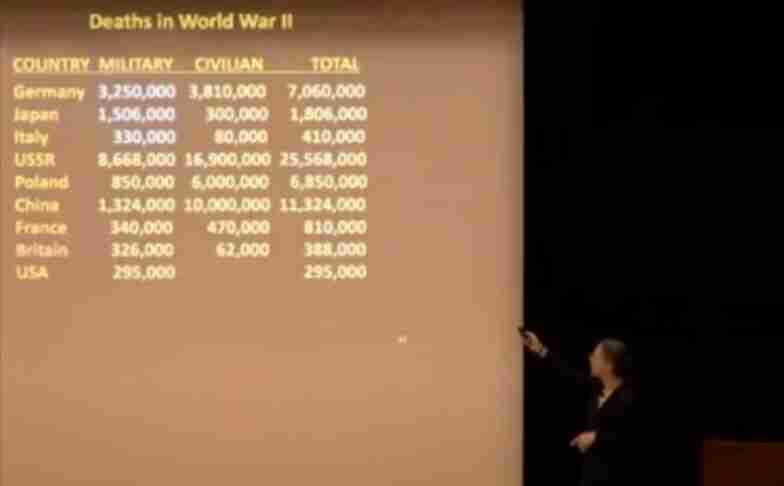
This gives you some of the mathematics of the cost of the home front main front. These are deaths in World War II – a lot of Axis deaths, military deaths. And then a lot of allied land power deaths, high numbers. But when you compare Britain and the United States, the two maritime powers, with France and Italy, by some statistics, they suffer less. And France wasn’t even in the war that long.
If you add in civilian deaths, the difference between the maritime deaths and the continental deaths just skyrockets. Why is this? Because in the continental world, a lot of the fighting happens on home territory, particularly if you lose. Your citizens have no sanctuary from this and there are a lot of deaths associated with it.
No country in their right mind wants to fight on the home front, main front. It’s just so costly. Continental powers just don’t have a choice. Maritime powers have a great point of strategy of whether and when they’re going to get involved.
But there are certain advantages if you win on the main front home front. For instance, Stalin wins World War II – wherever his Red Army is, he keeps Eastern Europe, but it comes at the cost of millions and millions of Soviet deaths to do this.
Rules of Continental Power
There are certain rules to play and win in this particular setup:
1. Neighbors are numerous, so no two-front wars. If multiple neighbors try to come get you, you’re in trouble. 2. No great power neighbors. Why? Because today’s friend can be tomorrow’s foe and that will spell trouble.
So what do you do? You take on your neighbors sequentially, you set them up to fail, you destabilize the rising, ingest the failing, set up a buffer zone in between and you wait for the opportune moment to pounce and absorb. That is Vladimir Putin’s game.
Better yet, you get the neighbors to do the work for you. You sow their mutual resentments by deluging them with fake news and anything else you can think of so that Russia can play the role of a jackal state to steal the kill made by others.
If this is your security paradigm, you’re going to surround yourself with failing states. Look at Russia and China. They have some of the most dysfunctional places on the planet on their borders. Are they unlucky or are they complicit?
Also, there are no enduring alliances because people figure it out. Eventually, the hegemonic power only offers trouble in the long run. And there’s also a tendency for overextension, like there’s no counsel on how much territory is enough before you choke on it.
But before you dismiss this security paradigm, understand this is how the great civilizations of Eurasia ran business. They didn’t care about collateral damage, killing a bunch of extra people. This paradigm is all about wrecking things, killing people to get territory. And you’ve seen it operating in real time in Syria and in Ukraine.
The Continental Vulnerability
Here’s the problem for the likes of Vladimir Putin. In this world, if you botch strategy, your known world can vanish forever. This is what happened to Imperial Russia, Imperial China and many of these great civilizations of Eurasia.
I love this picture of aristocrats’ ruined palace in Russia because those whole social classes were wiped off the face of the map by the Bolsheviks for messing with their strategy. So the continental world is a world without insurance policies.
The Maritime World
Here’s the maritime world. It’s different. This picture shows all of the commerce that’s going on in the nineteenth century and shows the Atlantic as a very busy place, the center of the world economy. All of these lines of communication are connecting trade from all the coastlines that are traversing the ocean, which is a commons, a shared space.
Think about it in our own highly networked age, the seas are the world’s original network, potentially connecting everyone with everything. This maritime world begins or goes back further, but certainly it’s up and starting with the ancient Greeks who had this grimland empire along the Aegean and Ionian Seas where they’re making a lot of money from trade.
Geopolitics of Maritime vs Continental Powers
SARAH PAINE: Roman Empire, similar idea, a Rimland Empire, very different from the consolidated empires of Russia and China. And look at the terminology, Mediterranean, meta, middle, Turanian lands, it’s the sea among the lands, whereas the name for China is Zhongguo, Zhong Central Guo Kingdom, the kingdom among the kingdoms. One piece of vocabulary emphasizes the centrality of the sea, the other the centrality of the land. Now the Silk Road connected these two worlds, East and West. And there has been much money to be made on East West trade for a very long time.
And whoever controlled the Western terminus there, a big toll booth made a lot of money. For a while, the Muslim conquest settled that problem. But then for a while, no one controlled the Rimlands. And this is when the crusades take place, which is in part of who’s going to control the toll booth. For a long time, the Ottomans settled that problem.
They controlled it. And therefore, the Spanish and the Portuguese got creative. They decided to get to Asia the long way around, except they bumped into the new world, new to them, not so much to other people, bumped into gold and silver and decided forget about the high end dinnerware, they’re to do heavy metal instead. So the Dutch are the real people who focus on an empire that’s all about trade and their trading basis. Their problem was their exposed position in Europe so that they could be defeated in Europe.
The British Maritime Empire Strategy
So the real pioneers of Maritime Empire are the British. So whereas every other country in Europe had to maintain a large potentially coup generating standing army that’s expensive and that also is probably going to want to have economic policies privilege the army. Britain could take its disadvantage, its dependence on trade and transform it into an advantage. So if they could make lots and lots of money on trade, that would fund a navy. If anyone tries to invade, you drown it at sea.
So you’ve got homeland defense. And meanwhile, while your adversaries are busy destroying wealth at a really rapid clip, Britain is going to maximize its money. So this is a prevent defeat strategy. No one’s going to invade Britain if they keep a good navy. But it doesn’t deliver victory against continental problems, so the navy won’t do that for you.
Here’s the guy on the horse who’s with the attitude who got the British thinking really deeply about grand strategy. In fact, the British Britain’s coined the term, a grand strategy is grand in the multiplicity of instruments of national power that are integrated because if Britain’s going to align a navy, navies are rarely can deliver victory in a war. Usually you need other things to go on as well. So they’re going be thinking grand And so after much trial and much error, six coalitions, final capstone alliance, they deal with Napoleon. And here is their grand strategy for elephant hunting that they actually used to great effect in World War II as well.
First of all, keep the home economy growing. That’s where your money is. That’s going to fund your military. It’s going to fund your allies. That’s key.
Second, don’t let the enemy elephant forage. You want to shut them right down and force them back for resources on their own dwindling resources and their increasingly embittered allies. And then you want to rent an elephant. You want to find the continental power most directly threatened by your continental problem, and you want to arm and fund that country that is fighting on the main front. And then Britain needs to find a theater peripheral to that main theater that favors maritime access.
And if it can find a good theater to do that, it is going to have cumulative effects on the enemy, more people are getting killed than the enemy. Secondly, you’re going to force the enemy to fight on divided attentions because there are a couple of theaters going on here and you’re going to relieve pressure on the main front you hope. And Britain, if it chooses the right theater, its casualties will be far lower than the Continental problem it’s dealing with. Rule number five is don’t take on the certainly not as your opening move, don’t go toe to toe with your Continental problem. Because Britain’s great strength is not its army.
The great strength of a Continental power is its army. Britain needs to leverage its ability to generate money and help other people and leverage those things. And if Britain is going to get involved on the main front, only do it after you really bled that elephant. And you come in with lots of friends, always gang up on others if you can in this world. As much as the Continental Power might want to do this, can’t.
Why? Because it probably has very constrained maritime access, can’t deploy a Navy easily. And secondly, has a surfeit of neighbors who might cause problems. But if Britain plays this game, it can put itself and its enemies on opposing trend lines. So Britain is going to get wealthier and wealthier and wealthier if it can trade.
And meanwhile, this war is encroaching on your enemies. So it’s going to undermine it’s going to encroach on enemy territory, undermine the economy, morale, productivity, etcetera. So eventually what the story is, they’re going to get exhausted first. It’s strategy of exhaustion. And it focuses not only on military power, but also economics, coalitions, institution buildings and there are certain prerequisites.
One is sanctuary at home. No one can touch your productive base for this really to work well. You need access, access to markets, access to allies, access to peripheral theaters and you need institutional stability at home to run a long term foreign policy. These are some of the things that Mahan would later emphasize.
Maritime vs Continental Power Distinctions
This brings me to the second distinguishing characteristic between maritime and continental powers. Continental powers face contiguous threats. So they got to pay attention to them, focus on national security. And as a result, they tend to want to have be insulated from their neighbors and have exclusion zones that they tend to also want to apply to the seas, exclude people from near seas. Maritime powers, because of their comparative security of a moat, are all about trying to make money by doing international trade.
And so therefore, access to international markets and therefore, they want the seas to be a commons that everyone can share. So the second distinguishing characters characteristic is a focus on installation from landlord neighbors versus access to markets and therefore desire for closed or open seas. We’re starting to get to two very different world orders here.
The Industrial Revolution’s Impact
That’s it for empires. Industrial revolution upended both types of empires because it introduces economic growth whose compounding effects were truly revolutionary. The industrial revolution starts in Britain. And after the Napoleonic Wars settled down, it moves to the continent. It’s been making its disruptive path around the world ever since. And you can see it’s based on a combination of institutional and technological factors.
What it does is it changes the currency of international power. Formerly, was a function of land, right? That’s where you get your commodities that you can buy and sell. That’s where you get your peasant conscripts to man mass armies. Well, once you have compounding growth, the source of power in this world’s money that’s going to come from trade, industry and commerce.
And it is the most disruptive effect for traditional societies. Globe over, suddenly their security paradigms don’t work anymore. I mean look at who’s rich and who’s poor in the world today. It’s degrees of industrialization going on. And ever since the industrial revolution, there has been a gradual expansion with ups and downs of this maritime trading order, which is all about negotiating rule often quite acrimoniously, but negotiating rules for trade.
But it’s a catastrophic event for traditional societies, many of which have never gotten over it. The Chinese never liked the incoming maritime order in the nineteenth century and they aren’t happy about it now. This guy, Malcolm McLean, really sets things moving on the expansion of the maritime order. He ran a trucking company. And he took his trucks minus the chassis and put them on ships, we call containers.
And this radically reduced shipping times, loading times. So it becomes so much cheaper to send things by sea than by land. And then these container size are standardized to go one if by truck, two if by railcar and thousands if by sea. So I guess we got the last dictator or the latest dictator for life, Xi Jinping, who thinks he’s got this two-two train event with Belt Road initiative that somehow this is the great way to get goods around the world. Okay, here’s my argument why his math is flawed.
Maritime vs Land Transportation Economics
In 1960, the average tanker size was twenty thousand deadweight tons. In our own day, the smallest ultra large crude tanker is 0.5 million deadweight tons. This means well, the largest container ships now, and I probably should update the stats, it’s probably even larger, is about twenty-one thousand containers, over one billion dollars in cargo, one ship. Whereas you’re to do a train, six hundred containers, give me a break on what’s going to cost money. Also for the Belt Road thing to work, it’s got to be continuous from end to end.
And it would be nice if we’re all the same track gauge or otherwise you’re loading, unloading, and it would be really nice if the track were continuous. Well, it’s not. Also in peacetime, things will move, but in wartime, Xi Jinping is going to even have trouble with the maritime part of his Belt Road initiative because China is surrounded by narrow cluttered island cluttered seas with lots of neighbors who may or may not like them. In wartime, those seas are closed traffic. You can’t get it through and you even have trouble getting warships through.
So whereas the West that’s going through the high seas, it’s provided you convoy things, can get stuff through. So his Belt Road thing has problems. Anyway, if you look at the inter Cold War period or even at the end of World War II, you look at the skyrocketing international trade that lifts hundreds of millions of people out of poverty. And in the inter Cold War period from the 90s upwards, look at it, it just goes up, up and away. And this is the miracle of our times.
But I’m sad to tell you it’s over. The inter cold war period is over. Everybody there’s going to be this funding and counter funding of insurgencies the globe over, which is going to be incredibly wealth reducing.
Interior vs Exterior Lines of Communication
So this transportation revolution that just makes it so much cheaper to ship things by ship is going to lead me into my third distinguishing characteristic between maritime and continental powers.
Continental powers in the past did quite well with their interior lines of communication, right? It’s to garrison their empire to deploy their armies against people causing them problems. And also it allowed them to form alliances with contiguous places. Whereas the maritime powers are using these exterior lines of communication. That’s what oceans are.
They’re exterior lines of communication, but it’s providing access to global markets, access to wartime allies. And guess what? This one gives you the possibility of a global alliance system, the other doesn’t. So this third assigning characteristic reliance on interior versus exterior lines of communication and whether you can have a contiguous or global alliance system. These two sets of preferences are two mutually exclusive world orders.
Positive Sum vs Negative Sum World Orders
The industrial revolution upended the world not only because of the cheaper transportation, but because it offered the possibility of a new positive some world order. Instead of wrecking all your neighbors, which is what the continental paradigm is, right? You’re destabilizing neighbors, you’re invading and you’re just destroying things. So great, you get territory, but it’s just a wasteland, whatever you get. Instead, the maritime order is positive sum, right?
The Continental order is negative sum. Why? Because the loser’s loss is less than the winner’s win because you’re capturing damaged goods. But in this world, it’s all about positive sum trade transactions where both parties win. That’s why you do the trade.
And in this world, there’s a focus for us to work on freedom of navigation, free trade, international laws and institutions facilitating the trade to minimize the transaction costs. And the insurance system for all of this are alliances so that countries that aren’t maritime by geography, if they join up with enough other people, they can all come out in force with various instruments national power to deal with the continental problems that are going on. And here is the insurance system for all of this created by the greatest generation, the World War I generation, not the World War II claimed it. World War I generation who were conscripts when they were young, trying to raise families during the Great Depression and then they’re the strategic leaders of World War II. They decided that and they’d send their kids to fight World War II.
They decided the solution to World War and Great Depression was institution building on a global scale. And they’re the ones who really rapidly build. They get the UN going, the IMF, NATO, you’re going to get their predecessor institutions of the EU and World Trade Organization to hold the peace institutionally. And it did in the industrialized world until Vlad the bad worked his magic and Ukraine decided to overturn the chess table.
The Invisible Maritime World Order
The maritime world is invisible. And here’s why it took me working here fifteen years for it to dawn on me what was going on. It has to do with the difference between negative and positive objectives. The continental world is all about positive objectives. You’re taking land and when you take it or even when you’re trying to take it, you’re wrecking things so people can see what’s going on.
The maritime world, particularly if you’re successful, is about negative objectives. You’re preventing stuff from happening. So in this continental world, operationally, you can have all these wins, but actually you’re destroying wealth at the strategic level at a rapid clip. Whereas in the maritime world, so what are you preventing, particularly if you’re the Navy? The Navy focuses mostly on negative objectives in peacetime, not always, but mostly.
Geopolitics and Naval Power
And peacetime, by the way, most of the time or it has been of late. The Navy is preventing the destruction of the global trading system. That would be an important mission. Preventing limits on freedom of navigation. If you can’t get goods port to port, pretty useless.
So that would be important. Also navies are about deterring people from trying to take other people’s territory, sovereignty being the bedrock principle of international law. So these are incredibly important objectives. But on a good day, Navy day, absolutely nothing happens. It looks like Navy is doing nothing, but it’s incredibly important.
Maritime powers hold it together with alliances, diplomacy, sanctions, embargoes, containment, all kinds of things going on and Navy’s deterrence, blockades, commerce rating. And you can look at the sanctions and things and go, well, the rogue is still there. True. But if you shave one percent or two percent growth off your rogue, wait a few generations and it’s the difference between North and South Korea. So you’re shrinking the opposing piggy bank.
And you go, well, I’d like to solve the whole problem. Well, great. The whole problem has nuclear weapons. The solution may be Armageddon. And this world is not about operational wins. It’s about the strategic win of making of maximizing wealth for you and your allies.
There were optimists at the end of the Cold War who thought surely this maritime continental thing was over and that everyone would go for liberal democracy. Not so. Here we’ve got Mr. Fit and Misfit, Vladimir Putin and Kim Jong un, who want to hollow out our alliance systems. They want to undermine international law. They want to wreck international institutions to subject all of us to the kind of squalor their own citizens have to endure.
Continental vs. Maritime Powers
To summarize this half, there are three characteristics that distinguish Continental and Maritime powers:
1. The inability or ability to send primarily at sea 2. Focus on installation from versus access to the world 3. Reliance on interior versus exterior lines of communication
And from these accidents of geography comes some preferences. Continental preference, looking at territories, thinking about taking it. Maritime, looking at and thinking, oh, it’s markets. Continental thought about prioritizing self sufficiency, whereas maritime’s interest power interest in access, continental power exclusive zones, maritime power about commons, not only maritime commons but air, cyber, space commons.
And obviously, a lot of countries aren’t strictly one or the other. So there’s a corollary to all of this. You can gain a maritime position by the countries you support, the international institutions that you support. So that collectively, the whole thing can operate on a maritime security paradigm.
The choice is quite consequential because those who choose a continental paradigm these days typically are deep dictators who wind up hemorrhaging their cash either to dominate their own systems, their own citizens or their neighbors.
If you think about China, China by rejoining the maritime system under Deng Xiaoping, it was amazing, transforming a very poor country to a far richer country. But these older continental predilections still exist, and they seem to be taking a U-turn on this road.
Sadly, the continental world, it’s negative sum. The only positive sum that human beings have come up with is this maritime order for all of its flaws. At least there are institutions where you can go to and send your lawyers and diplomats and argue things out that way. The alternative is potentially terminal for mankind if you get into a big war.
Cold War Lessons
There was one that turned out quite well. Is there anything we can glean from this? How did it turn out the way it did?
A lot of people drive comfort and they say Ronald Reagan won the Cold War. That’s one way of looking at it. I’m going to have a lot of arguments and counterarguments because there are many explanations. But this one is a good one to start with.
Those who support it, although this picture seems remarkably cordial at the Reagan ranch after it’s all over and the Gorbachevs seem perfectly happy. But Ronald Reagan did a big military buildup. And the Russians at the end of the Cold War, some have estimated that as much as seventy percent of their economy was devoted to the military. And it was absolutely suffocating. And if you think about the Germans, the Nazis in hot war, they only spent fifty-five percent of their economy on this stuff.
And so it was a problem for the Soviets. I am quoting a lot of Russians today because they thought deeply about what happened to their country, how they lost the Soviet Union, the empire and indeed the world as they knew it.
Here is Valentin Fallen. He was a long time serving Soviet ambassador to Germany. And he said, “Look, the American strategy of our exhaustion, the arms race, it just wrecked our quality of life.”
And also Russia had an arms race not only with the United States, but also problems with China. So the arms race plunged the Soviet economy into a permanent crisis. And here’s Gergey Arvatov, who was the Soviet prime expert on the United States, who’s watching Reagan funding anti-communist counterinsurgencies all over the world. This is how you destroy wealth by having both sides funding insurgencies. And in Afghanistan, he goes, “We got our Vietnam problem for us.”
So some would argue that U.S. victory in the arms race determined the victory in the Cold War.
Alternative Cold War Explanations
I’m going to go through other presidents because there are other arguments, starting with Ford, Carter and the Helsinki Accords. For the longest time after World War II, the Soviets really wanted to hold a European wide conference for everyone to agree on their expanded World War II borders.
And for the longest time, the Europeans weren’t interested. But then by the 1970s, they’re sick of all the drama. The United States isn’t interested, but we show up. And then we say we’re going to have some human rights clauses in here, which we know they aren’t going to respect. And lo and behold, this is the third basket of the human rights clauses of the Helsinki Accords.
Lo and behold, human rights activists in the West and dissidents throughout the Warsaw Pact started trying to hold the Soviet government accountable saying, “Okay, where is the liberation that communism has promised? Why are we dealing with this dictatorship that’s been delivered? And by the way, you signed all of these things.” And this dissident movement, human rights movement took on a life of its own.
And here’s Jimmy Carter who then ran with it and he’s giving a commencement address at Notre Dame. He said, “Look, we have reaffirmed America’s commitment to human rights as a fundamental tenet of our foreign policy. What draws us together is a belief in human freedom. We want the world to know that our nation stands for more than just financial prosperity. We’re bigger than that.”
Carter was emphasizing precisely the political freedoms that were being denied throughout the Eastern Bloc. And here is Oleg Gunesky, a long time Soviet career diplomat saying, “Look, the communist ideology is associated above all with the Soviet Union. And when you reject it, a vacuum, a real problem.”
So some would argue that human rights causes of the Helsinki Accords and Carter’s subsequent human rights campaign destroyed communist belief in communism. And that’s why it all ended.
The China Factor
Another President, another explanation. Others say nonsense, it’s Richard Nixon on the China card. Others would say, no, it’s Mao and the America card, but whatever.
It turns out that in 1969, Russia and China were going at it in a border war and over some islands in the Amur River. And the Russians approached the United States and said, would it be okay if we nuke these people? And the United States said no way.
And Mao figured it out. The one that wants to nuke you is the primary adversary. And this reshuffles the great powers. Prior to this, China and the United States had been the primary adversary of China and Russia. After this is over, China and Russia are each other’s primary adversaries.
And the United States decides since it’s a swing vote, let’s go gang up with China against Russia. And this forces Russia into bankrupting militarization of its long frontier with China. It’s already militarized its European frontier, but now it’s got to put these mechanized nuclear armed forces there. Imagine if the United States had to do this on our long Canadian and Mexican borders. It would be bankrupting and our economy is much larger than the Russian economy.
Some would argue that the U.S. cooperation with China fatally extended the Soviet Union. But another way is to put together all of these presidents to say each one opened opportunities for his successor. So Nixon plays the China card, which then Ford keeps using and then starts playing the human rights card. Carter runs with that, begins a military buildup that Reagan really runs with.
And this puts Reagan and Bush later operating from a position of military and ideological strength. So also for those who think that U.S. Foreign policy wasn’t consistent during the Cold War, you have it wrong, the policy objective was relentless: free trade, democracy, containment of communism. The two political parties, Republicans and Democrats agreed on this. They had different strategies how to achieve it, but they agreed on that.
The Submarine Factor
Others would say forget this great man theory of history business, it’s this platform, the nuclear powered nuclear armed submarine that determined the outcome of the Cold War. Because under Carter and then certainly under Reagan, was a much more aggressive strategy of targeting Soviet nuclear subs in their home water bastions and the Soviets were scared to death that they didn’t have a reliable second strike capability.
And so here you have Marshall Akramayev who is in the United States telling his host, “We’re surrounded. That’s why we’re concerned. We know that you know where our subs are, and we don’t know where yours are. You, United States Navy, you’re the problem.”
So the USSR could not counter technologically or financially the U.S. submarine threat to its retaliatory nuclear forces. So some would argue this is why they had to settle in the Cold War.
The Soviet Perspective
So all the preceding explanations I’ve been giving you are naval explanations spelled with an “E” as in staring at one’s own. They’re all about what Team America did or didn’t do. So let’s get to the other side of the tennis court to see what Team Russia was up to.
And here’s Arnold Toynbee. He was one of the finest historians of the twentieth century observing that civilizations die from suicide, not by murder. So I’ve been talking about the murder. What other countries did to the Soviet Union. Now I’m going to get to the suicide, the self-defeating things that the Soviets did.
The Collapse of Empire
Explanation number one from looking at this the other side of the tennis court net is to say they lost the Cold War because their empire collapsed. That domino theory idea that was supposed to apply to capitalism, actually it applied to communism. Because once the democratic contagion hit one Warsaw Pact country and demonstrations for freedom started coming with increasing frequency, they spread to the other Warsaw Pact countries. And the leaders of these countries no longer had the stomach for the kind of violence it would take to get the demonstrators off the street.
So Gorbachev’s ideas of glasnost, openness and perestroika, rebuilding, they resonated throughout Russia and Eastern Europe. Russians hit the streets demonstrating for political freedoms. And in Eastern Europe, they hit the streets demonstrating for freedom from the Soviet Union and the Soviets may not have gotten that distinction.
But Gorbachev was all about encouraging people to reform. And so he didn’t send tanks into the Eastern Bloc. He said you need to do political and economic reforms the way we are. And these reforms started in Poland. Poland had quite a history that goes back with it. It’s been suffering severe unrest periodically, ’58 on and off. And then a big time in 1980-81, this is when Solidarity, the workers’ movement, gains a national and an international reputation.
It is the only independent opposition movement of any Warsaw Pact country. And then in 1988, it gets really bad because the economy is a mess. The government needs to raise staple prices because the budget’s broke and solidarity hits the streets and the government is afraid of the economy going to free fall. So they offer solidarity a place at the bargaining table if they’ll call off the strikes. And a complicating factor in Poland is the Roman Catholic Church, an institution of enormous legitimacy and which had a partiality for solidarity.
So these talks started taking place in February 1989, the round table talks. And here’s Soviet advice to the Poles: “You’ve got to find some quick solutions. You’re an itty bitty country. So if you make mistakes, they’ll be itty bitty mistakes. But if we make them, they’ll be big.”
They got that one right. The Communist Party in Poland decides to hold elections. And those elections were held on the very same day that Deng Xiaoping calls out the tanks and you have the Tiananmen Massacre, two very different solutions.
And the Communist Party thought in Poland that they had it under control. Why? Because they thought they had these party designated seats that would make sure they controlled everything. So not so much. What happens is solidarity wins every seat but one for which it could compete. And in the party designated seats, the party only gets three. And who gets all the rest of them? The box on the ballot called “none of the above.” That’s the end of Communist Party legitimacy in Poland. And then further democratic reforms are on the way.
DR. SARAH PAINE: The demonstrations cascade into East Germany, which in the past had always sent out tanks. Well, would-be tank man, Eric Honecker, was already out of a job because his disastrous strategy of living off debt since when he came to power, I think it was 1971 or something, had just wrecked the place. He had been forced out. Most of the Politburo had resigned. By the time you get to November 9, they issue some new power travel rules. Why do we care about travel?
Here’s why we care about travel. What’s left of the government, this Gunther Chabosky is at a press conference and he’s being asked, “Well, when are the travel regulations going to be implemented?” And so instead of admitting he didn’t know, he winged it and said, “Immediately.” Well, immediately, huge crowds started massing at the six gates of East Berlin. And at one of them, the border guards decided that discretion is the better part of valor. They opened it and people just streamed into West Berlin.
Within a week, over half the country had visited West Berlin. And it was a pivotal choice, a pivotal event. And like the Polish elections opening the gate, there’s no going back to the way the world was. It’s over.
So Gunther missed that one. And here is Anatoly Kovalev’s take on it. He was long-time Deputy Foreign Minister of the Soviet Union: “There was no confidence whatsoever. The Soviets had no confidence whatsoever whom the Eastern German Army is going to shoot, us or the demonstrators. Same thing for the Poles and the Hungarians.” Great. With an alliance system like this, you’ve got troubles. So unrest in the empire forced the Soviet Union to forfeit the Cold War.
Alternative Explanations for Soviet Collapse
Here’s another way of looking at it, another counterargument for me is no, it’s something different. It has to do with the satellites themselves being terribly unhealthy and that’s the origin of the problem. So if you look at this map circa 1960, all those tempting green places they’re about to become independent. They’re really sick of their colonial overlords, enter Soviet Union with a plan to put them out of business. And there were many takers.
Fast forward to 1980ish and you could see all the promising pink places where the Soviets have got all kinds of new friends. Well, here’s the problem. In the late 1970s, commodity prices, including oil, go way down and these places depend on that. The Soviet Union for some years had as much of its government budget as 55 percent based on oil. So not only did the non-performing pals have no money and need bigger subsidies, but the Soviet Union was less in a position to subsidize them.
And most problematically nationalities simultaneously erupt and they all want to secede. Remember the rule of continental empire, no two-front wars? Well, the Soviets had so many fronts at this point they couldn’t keep track of them.
So you can make an argument that by bankrupting itself in the third world, ignoring its own internal third world, that’s why the Soviet Union lost the Cold War.
The Economic Argument
You could say that the Soviet economy lost the Cold War. Here are the statistics. Economy did quite well rebuilding after World War II, but it really stagnates in the 1970s. And so in the decade preceding when Gorbachev comes into power, the Soviet economy has been growing from one percent to two percent less per annum compared to the West and the compounding effects are really very large.
And then here’s what’s going on. If you have a command economy, you have Moscow Central telling everybody what resources they get, what they’re going to produce. But when you’re a unit on the bottom, what you have to do is you lie about what inventory you have. You say it’s less than it is. And then you lie about how many inputs you need. You say it’s more than you need because you have no idea what you’re actually going to get.
And everyone’s lying to each other. So the macroeconomic statistics are garbage. So people are allocating capital and labor without really knowing what their true values are. No one has any idea of consumer preferences or what productivity is. So the misallocation is horrendous and no one figures it out until it’s catastrophic.
And so under Gorbachev, oil prices have tanked. This mess is starting to deliver troubles and economic growth goes negative. It’s a mess. But here’s Marshall Yazov looking at all of this and saying, “Look, NATO, they’re just rich. We can’t counter these people. We’ve got to figure out some way of calling it off.” So the Soviet economy lost the Cold War.
Gorbachev’s Role
Here is a very famous man, Alexis de Tocqueville and a very famous quotation from him. He wrote a very famous book about the last years of the monarchy before it fell in the French Revolution. And he has this chestnut in there: “The most dangerous moment for bad government is when it begins to reform.”
And people in Russia disagree about many things, but they agree at least on this one point that Gorbachev’s role was absolutely central in how it all turned out. And Gorbachev made his decisions based on a number of incorrect assumptions. First, that history was irreversible. It’s always forward towards communism. And of course Eastern Europe, maybe you turn back to capitalism.
And also here is his foreign policy adviser, Antony Chernayev: “Gorbachev misread the sentiments of the neighbors. Gorbachev thought that the Eastern Europeans would look upon him as their liberator rather than looking upon Russia as their oppressor.” And here’s Chernayev again: “Gorbachev thought that bringing freedom to our Eastern European satellites, that’s already a bad word, who wants to be a satellite, would lead them to adopt socialism with a human face, or whatever that is. He made an enormous mistake because these countries brutally turned their back on us. It was totally unexpected for us, really.”
You invade the neighbors, you kill their leaders, you siphon off their wealth, you impose a non-performing economic model on them and then you never leave and you wonder why these people don’t like you? Give me a break. The United States intervenes in civil wars all over the world, but we deluge them with economic aid and we even leave. People don’t like us. I don’t know why the Russians think they’re so special.
In addition, Gorbachev believed if there was no Warsaw Pact, there would be no NATO, that NATO would disappear. And that if there were no COMECON, that’s their internal trading group, that then there would be no European Community or the EU today. Wrong. Two of those things are still around. He also thought that the United States would be like a continental power. No great powers don’t want them and would oppose German unification.
So Gorbachev goes on vacation while all the unrest is happening in Germany, poor life choice. Because what’s actually going on is President Bush and Chancellor Kohl of Germany are coordinating on the fastest reunification of Germany ever.
Competing Theories
So some would argue that it’s Gorbachev’s sins of commission that cause all the problems, that his foreign policy mistakes are function of his domestic policy mistakes and together it kills the Soviet Union. So the big bozo was playing with plastic bags and he stuck one on his head. So it was suicide by mistake.
Others would argue, no, it’s not about sins of commission. It’s about sins of omission, what the army failed to do. I mean, they would argue the Red Army should have done the Deng Xiaoping solution, send in the tanks and just solve problems that way. So they would argue that timely tank deployments, TTD, this is my contribution to military acronyms, would have changed the outcome of the Cold War.
Others would say, no, it’s not sins of omission, still a sense of commission. But by this charmer, Boris Yeltsin, who’s Gorbachev’s successor, what did Buddy do? He got rid of, I think it’s Article Six in the Soviet constitution, which had given the Communist Party the monopoly of power. Now you’re going to have multi-party competitions. And also he got together with the heads of Belarus and Ukraine and signed a formal document, the Belavezha Accords that dissolves the Soviet Union. So by this way of reasoning, it’s suicide on purpose.
Umbrella Explanations
I can now give you a couple of umbrella explanations. One of them is of the above reasons I’ve just given you, it’s inevitable, or all of the above, barely won.
Here’s how that goes. Let’s start with any of the above. There were so many problems with the Soviet Union that you could argue that its demise was inevitable. It was just brutally inefficient. This is why the West didn’t like it in the beginning. It wasn’t that any U.S. President did anything. It’s the Russians finally figured it out and they invented it and they wanted to get rid of it. So, the Soviet Union was destined to lose. That’s an optimistic way of looking at it.
Here’s a pessimistic way of looking at it. It’s like no, no, no. The Cold War ended very much on Western terms because it required all of these factors, the whole list that I gave you today. And you remove any one of them and you get a different outcome. And you might not even end the Cold War. It took the whole shebang. So the West barely won the Cold War.
Another twist on this one is to say, not only did it take the whole shebang, but you need these two gentlemen to be in office at the same time. George Bush, quite a resume. He’d had stints in Congress, a representative of China, a representative of the UN and then of course he’d been Vice President under Reagan for eight years. So he’s very well qualified.
And Helmut Kohl was the longest serving chancellor of West Germany since his illustrious predecessor, Bismarck. And they worked on fast tracking this. As soon as Helmut Kohl came into power, he decided to unify with East Germany by one tourist at a time. How does that work? East Germans love to travel, but they don’t like to return home. And all of a sudden, East Germany starts easing the travel restrictions in 1988. And you go, why? And the answer would be money.
Helmut started paying them big money to let more people out. And he also gave the Hungarians big money to let East Germans out through Austrian border that way. But then he and Bush do tag team diplomacy where they are doing it so fast and they’re offering really big money to Gorbachev that he can’t react and the Soviet economy is imploding desperately needing the cash.
So they get Gorbachev to agree first to German unification, second to unification with West Germany and NATO, and thirdly unification with both halves in NATO and by paying big money. But complicating factor, a month and a half before the reunification treaty was signed, you’ve got Saddam Hussein invading Kuwait. And Iraq was a major Soviet client state, owed the Soviets between ten billion and thirteen billion dollars. That’s a lot of money for a broke creditor. But Bush finesses this problem. He doesn’t go too far into Iraq to upset the Soviets.
He also finesses these two. This is Prime Minister Margaret Thatcher of Britain and President Francois Mitterrand of France. Neither one of them wanted to see a unified Germany. Why? Because it would eclipse their own countries. They were correct. But Francois Mitterrand eventually finds solace by negotiating the Maastricht Treaty that’s going to create the European Union, that’s going to bring in all the Eastern European countries and merge it with the European Community. But Margaret Thatcher just plain lost out. She wanted to retain some Soviet troops in Germany for the duration. Imagine dealing with Putin today if they’ve had their way. They didn’t.
The Way Forward
That’s it for the underlying geopolitics and for what was done the last time around. Now what do we do?
In the first half, when I talked about elephant hunting, I talked about how the British ran their elephant hunting strategy, which they did quite well when they applied it to World War II, but there’s a huge difference now. It’s precision nuclear strike. None of us has a vulnerable homeland anymore. And so by all means, keep the economy running and probably your friend’s economy is running.
And by all means, down enemy trade. But you probably don’t want to do it with blockades and commerce rating, much better with sanctions. Sanctions is, I’m going to buy stuff or I’m not going to buy stuff. I’m going to sell stuff or I’m not going to sell stuff. You can do all of that.
And then on peripheral theaters, of course, you want to help out people who are beleaguered by continental problems. But you’re going to have to be cautious about how this is done. The goal of maintaining prosperity hasn’t changed.
If you think about how it worked last time around, the West, Japan, South Korea, all together parried the nuclear threat. No one would throw a nuclear bomb at anyone, all maintained economic growth. And so as the maritime world is compounding economic growth, the communists are living in compounded poverty of their own making.
And so unless you despair on all of this, understand that people in the West during the Cold War, not everybody, but most of them were living quite well, certainly much better than compared to how the communists were living. So there was prosperity while all this was going on.
I daresay the current Cold War is going to be going on for generations because you don’t change how other people think. They decide changing what they thought. Gorbachev and his generations changed their minds of what they wanted to do. Deng Xiaoping and his generation changed their minds of what they wanted to do. And it will probably take the Russians and Chinese a long time to change.
So if you look at the Cold War section, I talked about all the reasons for why the war was won or lost. But you can extract what U.S. Strategy was. Extensive military buildup with allies.
Geopolitics, Cold War Lessons and the Way Forward
DR. SARAH PAINE: Also a very broad strategic communications campaign. It wasn’t just human rights at the end, but from the very beginning it’s getting accurate news to the subject populations, Radio Free Europe, Radio Voice of America, etcetera. And then a lot of alliance building for friends and alliance busting for enemies.
What you want to do is amplify overextension of your enemy of all the stupid things they’re doing. In the case of the Soviet Union, it was that they’re overextended because it’s not efficient to occupy someone else’s country and stay there forever.
And also the Russians were quite abusive and we leveraged that. And of course, they had a non-performing economic model. So you want to amplify those errors. Also geography without us lifting a finger naturally contains Russia and China. They’re surrounded by narrow seas.
It’s just facts. And the one up north, there’s not much going on up there. Those narrow seas in peacetime, it’s great. It doesn’t matter, the traffic goes. But if you’re going to do a hot war, the merchant traffic doesn’t go and your Navy won’t go if you’re located on a really narrow sea.
Today’s Geopolitical Landscape
And if you look at Putin and Xi and whoever else is bothering you lately, it isn’t a coherent alliance system. You’ve got basically a bunch of Eurasian dictators. Sure, they share the United States as a shared secondary enemy, but think who the primary enemies are. Russia’s primary enemy right now is Ukraine. China’s primary enemy, I don’t know.
Is it Taiwan? Is it India? Or if they do some Belt Road something, is it somebody up there? But it’s not us. Iran’s primary enemy is Israel.
Pakistan’s is India. North Korea is South Korea. None of this aligns for anyone to make meaningful sacrifices for the others. Whereas you compare the World War II alliance system, there’s an agreement, Germany primary theater, Germany primary enemy, whereas the Axis had different primary theaters, different primary enemies and they dispersed their resources accordingly.
Moreover, in our own day, we got Vladimir Putin who’s trying to reconstitute an empire in the age of nationalism. Good luck with that one. That dominated peoples no longer sit supine and take it. They resist. And you can look at this Belt Road initiative as Vladimir Putin is taking his arsenal and dumping it into Ukraine, it’s leaving him wide open to China in Siberia, the Chinese ambitions. And China is busy peeling away from the Russian, the czarist and the Soviet sphere of influence in Central Asia.
That’s what that Belt Road thing is. It’s quite threatening for Putin, not so much for us. So also if you think in the last Cold War when the Russians kept it cold, right? They fought proxy wars. Other people did the fighting.
Vladimir Putin is doing the fighting himself. And by the way, in the last Cold War when the Russians were smart enough not to do too much of the fighting, Russia was strong, China was weak. Now those tables have turned. And you go, why would that matter? And not only does Siberia have loads of resources that China would like and by the way, if you look at what the territories that the Romanov dynasty took from the Chinese, it exceeds U.S. Territory east of the Mississippi. And you think Chinese have forgotten? Not so much.
Putin says the boundary treaties don’t matter, right? Because he’s ripped up the ones with Ukraine and these historic things that matter. Well, the Chinese can play that back at him because the key resource right now that Siberia has is water. North China has blown through its water table and Baikal has twenty percent or more than that of the world’s surface freshwater. And the Chinese can pipe it down if they would like to. So good luck, good old Vladimir Putin.
The question isn’t if the Sino-Russian relationship is going to break up, but when. And here’s the problem with misidentifying your primary adversary and fighting a recreational war where you don’t need to. Nicholas II tried this. He decided that Japan was his primary enemy and off he goes to the Russo-Japanese war. Great buddy.
So instead of investing in railways and armaments production to deal with Germany, which comes and destroys his dynasty ten years later, he’s fighting Japanese. Well, Putin has emptied out his Cold War arsenals on Ukraine. And Ukrainians never were after Russian territory. The Chinese might well be. So if we play our cards right, the Russians and the Chinese will take care of each other.
But we’re going to be on a long wait while this occurs. And it is better off to have more friends rather than fewer friends in this kind of world. And the maritime order as flawed as it is, is your best bet to work with allies and friends through international institutions to coordinate against these challenges. All right. Well that summarizes what I had to say today.
And thank you for taking time late in the day to listen to me talk. But I’m happy to answer any questions you all might have.
Q&A Session
We’re going to pass out the pop quizzes and nobody gets home unless you get an eighty. So now no quiz, but do have any questions?
Got time for about one or two questions. I’ll hang around afterwards and talk to anybody who wants to.
MATT YOUNG: Army and I’m a senior student here at the Naval War College. So Bush, he wins in Iraq, then presides over the closing of the Cold War basically, closeout of the Cold War and the fall of the Berlin Wall. Then he’s immediately not reelected. What does that say about us as the United States and our ability to focus long term on any type of geopolitical strategy?
DR. SARAH PAINE: Okay. The question is Bush Sr, who very successfully negotiates the end of the Cold War and then he’s very promptly not reelected. And what does this say about us?
A lot of things are not visible until the fullness of time. For instance, I was wondering about, well, are we in another Cold War? And a decade in, I can tell you, particularly with Putin’s invasion, the 2022 event, I can say absolutely I believe, maybe I’ll be wrong. Whereas in 2012, I couldn’t, and then 2014 looks more like it. So a lot of it is it takes time.
And a lot of the decisions that we all make, both the good ones and the bad ones take a long time for their implications to be felt. For instance, President Eisenhower invested in the highway system. And part of that the idea was to have the highways wide enough so you could land planes anywhere you want. Well, not anywhere, there are bridges. But to protect the country, you’d have airfields everywhere.
And actually what that does is allows all kinds of economic development all over the United States, but it takes a long time for all that to happen. So for instance, recently, there’s been a lot of investment in Internet, right, to get Internet to all the rest of the country. And we’ll see whether that has any implications or not. It will be ten years where you go, okay, that was a big nothing sandwich or no, it’s significant.
I think that’s a lot of it. And also this is foreign policy. Americans focus on domestic policy, right? And I think what Americans don’t understand today is their security depends on this maritime order. Think about it. You take your little piece of plastic, you go wherever it is in the world and then you take that little plastic and you go, I want to buy this thing or whatever and they give it to you, right? And so you’ve traded plastic, which is nothing and they even give you the plastic back or a little piece of paper you get.
And then you take the good with you. Well, that only works in a rules-based order, right? We take it for granted. You take it for granted in a business. When you sign a contract that they honor it.
If they don’t, you’re going to have to send armies and things and do gunboat diplomacy. How expensive? So your security is dependent on this maritime order. I don’t think Americans today have a clue about it. And that is why I’m out here lecturing.
I think it’s important that you understand this. And then what decisions you make afterwards is your business. Any other questions?
I’ve called you all to submission. It was so boring you can’t think of anything.
AUDIENCE MEMBER: Hardly boring.
DR. SARAH PAINE: One in the back. Yes, brave person.
[Question about greatest generations and catastrophic events]
DR. SARAH PAINE: So the question is about greatest generations whether it requires a catastrophic event in order to come up with good ideas and how we need to think about things to deal with the second cold war. Well, I have a question about human beings.
I don’t know if human beings require a catastrophic disaster in order to get real. Because you get the Marshall Plan, which is big bucks. There’s no way you would have gotten Americans to agree to that after World War I. After World War I, we’re all about collecting our debts, give us the money back, give us the money back. And then we get World War II and maybe we should have given more money back and it would have been so much cheaper.
So the question is whether human beings require a catastrophic disaster in order to get real. I hope not, but we all know hope isn’t a strategy. But second, your generation is tremendously important for those of you who are veterans of Afghanistan and Iraq. Because you have really important lived experience about what works and what doesn’t work. And I don’t know whether you’re the greatest generation or the next one in the making if you can make wise decisions and learn from your experience.
And also I urge you to publish. This is how one generation passes the baton to the next generation. Write down what your experiences are and analyze them. And there you can write short things in military journals that your peers will see. It’s important.
So we’re in dangerous times. Americans need to stop fighting with each other and treat each other with respect and kindness and honesty and work together. And if we do scorched earth on ourselves and our allies, that is a strategy of suicide and others will assist us gladly if we play that game. Thank you very much.
Related Posts
- Transcript: Maya Angelou’s Greatest Life Lessons on Oprah Podcast
- Transcript: The Next 50 Years: Humanity, AI, Power w/ Yuval Noah Harari
- How to Stand Out in an AI World by Thinking Better, Not Faster: Sol Rashidi (Transcript)
- Modern Wisdom: w/ Alex Petkas on True Story Of The Odyssey (Transcript)
- Reconstruction: Malcolm Gladwell Interviews Barack Obama (Transcript)