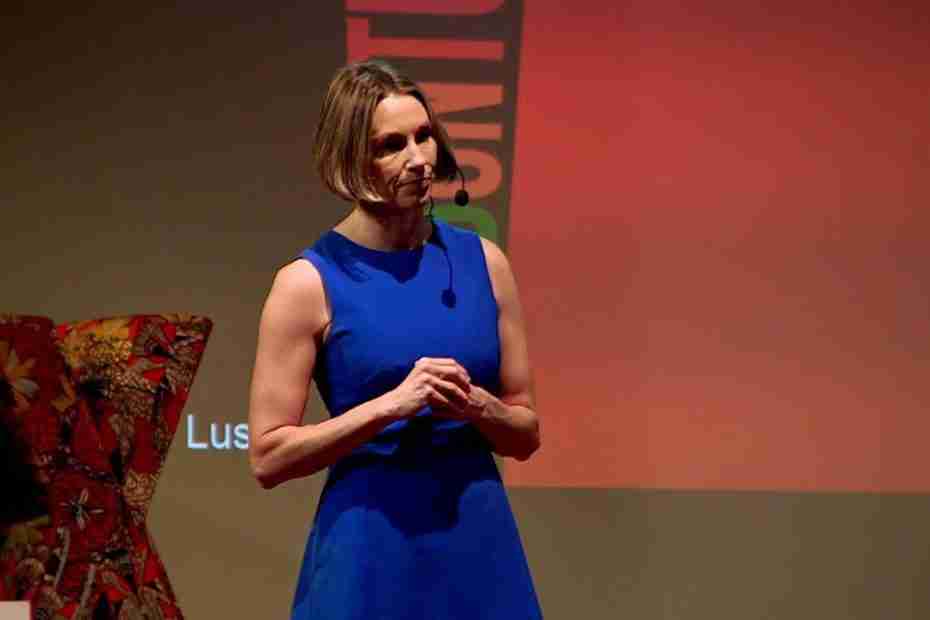
Read the full transcript of Kim Otteby’s talk titled “Do You Know Your Self-Worth?” at TEDxLusaka 2025 conference.
Listen to the audio version here:
TRANSCRIPT:
The Illusion of Self-Worth
How’s your self-worth? If zero is no self-worth and 10 is off the charts, amazing self-worth, where would you be? If you were to ask me a few years ago, I would have told you that my self-worth is just fine. After all, I was successful. I had grown a company in an industry that didn’t exist previously. I was confident. I was courageous even. I set these big goals and I’d go after them. Surely, you can’t do all of that unless you have great self-worth, right? Wrong. Turns out, my self-worth was pretty much non-existent. I had no self-worth. I just didn’t know it.
Deep down, I wasn’t sure whether I was enough. You see, we all have a fundamental primary question that we ask ourselves. This drives our decisions. It drives our actions. It drives our behaviors. This is usually a very deep, unconscious inquiry. My fundamental question pretty much from the day I was born was, “Am I enough?” Am I enough? I wasn’t sure. In order to be valuable, in order to justify my existence, in order to be worthy, I had to be enough. That became my mission, to go out and prove to the world that I was enough, that I deserve to be here, that I was worthy of this existence, and ultimately, that I was worthy of love.
If you take a moment to be completely honest with yourself, you will probably recognize that one of the deepest fears that we have as human beings is not being loved. So in my mind, proving that I was enough, this became a matter of survival.
The Pursuit of Perfection
So how did I go about doing that? Well, I went out in the world and I started to do, and then I did some more. I was the kid in school, always with the top grades. If there was a test, I would get up at 4 a.m. in the morning just so I would have two hours of extra study time in. I strived to get into one of the top universities in the world, and when I did that, I strived to get a top, high-paying job, and so it continued. To prove my worth, I had to go out there and do, achieve, be successful. My worth wasn’t given, it wasn’t innate, it had to be proved, and not just once, but again and again and again. The work was never done.
Terrified of the potential that I may not be enough, I also tried to be perfect. That was always my aim, and everything I did, I tried to be perfect. Not just one area of my life, like every area of my life. The perfect job, the perfect relationship, be the perfect mother, organize the perfect birthday party, have the perfect body, deliver the perfect presentation. You get the picture. I would set these incredibly high standards for myself, and if I didn’t quite reach it, I would be disappointed.
Have you ever done that? Where you’ve set a goal, and maybe you didn’t quite reach it, you felt perhaps that you failed? We have a tendency to do this, but I went a step further. I went from, “I failed,” to, “I am a failure,” internalizing it, proving, reinforcing, again, that, “Kim, you’re not enough.” But perfectionism is actually the lowest standard that we can have, simply for the fact that it is unattainable. We are setting ourselves up for failure, because it doesn’t matter how hard you work, or how much effort you put in, something can always be better, so I wore my perfectionism like a mask. My perfectionism hid my imperfections.
The Consequences of Perfectionism
This has real consequences. I mean, for instance, if you’re always trying to be perfect, you can’t reveal who you truly are. That’s simply too risky. You can’t just be you, because what if someone were to find out that you’re not actually enough, that you’re, in fact, not worthy? And as a result of all this pressure, I ended up developing a severe eating disorder, something that took me over 10 years to overcome, including spending three months in an intensive residential addictions clinic.
The bottom line is this, as long as you believe that you are not enough, you cannot have self-worth. They cannot coexist. They are polar extremes, opposite sides of the spectrum. Now, I desperately wanted to feel worthy, but as long as I held on to the belief that I was not enough, this was simply impossible. So I try to compensate. I try to fill up my bucket of self-worth by doing, and doing, and doing, and by trying to be perfect, but that is a bucket that can never be filled, simply for the fact that it had this gaping big hole at the bottom, so whatever self-worth I was putting in there would just continuously be seeping out, and that hole, that was the belief, “I’m not enough.”
Confidence vs. Self-Worth
But I had confidence. I had self-esteem even. How is that even possible if I didn’t have self-worth? We have a tendency to confuse confidence and self-worth. It’s a common mistake. I don’t know, have you ever thought of the difference? Confidence is all about what you show on the outside. It’s about what you can do, your skills, your abilities, your talents. Self-worth is all about how you feel on the inside. It’s about who you are, your value as a person, regardless of what you can do or what you have achieved.
Confidence is dependent on external circumstances, what’s going on on the outside, and because of that, it can be taken away in an instant. For instance, when my business was doing well, I felt pretty good about myself, but when COVID hit and my business started to fail and started losing a lot of money, my confidence started to dwindle.