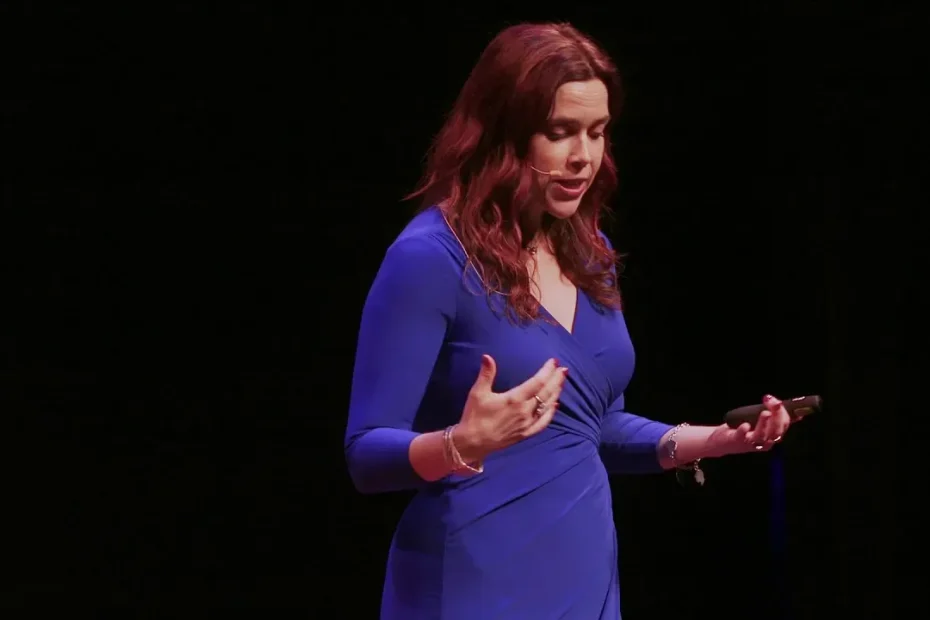
Read the full transcript of Play therapy and trauma expert Paris Goodyear-Brown’s talk titled “Trauma & Play Therapy: Holding Hard Stories” at TEDxNashville 2018 conference.
Listen to the audio version here:
TRANSCRIPT:
Introduction to Play Therapy
PARIS GOODYEAR-BROWN: It was Plato who said you can learn more about a person in an hour of play than in a year of conversation. I am a play therapist and nowhere is this more true than when I’m working with traumatized children. I’m going to share with you this afternoon about play and trauma and the power of one to heal the other.
So when I went to graduate school for clinical social work, I already knew that I wanted to work with traumatized children. I learned some valuable things in my graduate program including how to do differential diagnosis, how to do a suicide risk assessment, and how to do fairly traditional talk therapy with regulated grown-ups. I did not, however, learn what to do with a 3-year-old who is trying to pee on me from across the room or a 6-year-old who is trying to stab me with adult scissors, both things that happened as soon as I got into my first job out of school.
So I was desperate for answers for these children and I went to my first conference on play therapy. It was hosted by the Association for Play Therapy and it was in Orlando, Florida that year and I fell madly in love with the field and really do believe that play is the primary language of children.
And for traumatized children especially, the play is their talk and toys are their words. I’m going to give you an example of that up here on the screen, but first I’d like to lead you in a very brief exercise. If you would turn to your neighbor and share one of your most embarrassing experiences with them. Okay, I’m not going to really have you do that and everyone’s relieved.
But what if instead I had said, turn to your neighbor and share your most shameful sexual experience? I think you would have been hard-pressed to do so, right?
And if we as high-functioning grown-ups find that difficult, how much more challenging is it for the little ones who have limited experience and limited vocabulary?
Play as a Communication Tool
So this is the play creation of a child who’s been sexually abused. He came into my playroom, he undressed the baby doll, he got the doctor’s kit and started to fix it and after a couple of minutes of intense fixing, he sighs and then he goes over, gets the spider, he puts it on the private parts of the baby and he says, “Ms. Powis, take a picture.” He doesn’t have any words to describe his abuse experience, but he can create an evocative image that communicates visceral volumes to us.
So I remember being in my first play therapy workshop and seeing slide after slide of this kind of art and sand and play creations, what I now call the glimpses and snapshots of trauma that children gift us with along the way.
And the speaker was helping us to become kind of bigger containers for this story so that when a child gives us a glimpse of trauma, I can say, “I see what you’re showing me and you can show me more. I see what you’re showing me and you can show me more.” I was hooked. Armed with this new understanding that children can articulate the unspeakable through play, I returned to my little inner city school office and turned it into a playroom.
Very soon after that, I had a young lady come to school who was wearing the same clothes she’d been in the day before, and she was bouncing off the walls, which was highly unusual for her.
So I pulled her aside and I was pretty quickly able to get the kind of superficial, linguistic, linear narrative of what had happened. Her mom had gone out to do her second job. She had forgotten to leave a key under the mat, and my client and her sister had spent the night on the front porch in a very violent neighborhood.
When she comes to school the next day, I’m not going to try to therapize her right away, right? Maslow’s hierarchy of needs.
First, I make sure she has a good meal. Then I put her on a cot in a darkened room for a couple of hours and let her sleep because if she had any sleep at all on the front porch, it was hypervigilant sleep.
And only then do I bring her to my playroom. And even then, I don’t ask her to give me more details of the scary thing that happened. I introduce her to the tools of play. And she goes directly over to the child guitar and starts to strum, pretty frenetically at first.
But as she calmed, I invited her to create a song. And this is her creation. “So it hurts inside so bad.” This is why we do the work that we do. I was aghast at this child’s ability to take those tools of play, combine them with her story and get to deeper and deeper levels of emotional expression. This was a pretty sophisticated telling.
Trauma and Memory
I have lots of other children who don’t have any words to describe their abuse experiences. And some of that has to do with the way trauma gets stored. It’s more in the right hemisphere than in the left.
And children already live more in the right hemisphere than in the left. Trauma also gets stored iconically and somatically, so in pictures and in our bodies.
So the ways in which we invite children to show us and tell us have to honor those ways in which we store trauma.
Johnny is one of my best examples of that. Johnny was playing in the living room with Legos when his mother’s boyfriend barged in high as a kite, grabbed the first thing he could find, which happened to be a clothing iron, and bludgeoned mom repeatedly until she slipped into unconsciousness.
The children thought she had died. She did not die. She, in fact, made a remarkable recovery.
But at the time that they came to see me, the children were living with their grandmother and mom was recovering in the hospital. And so the first day he comes to see me, he draws a picture of mom that looks like this.
So you see the tears coming down mom’s face. You see the wide open mouth where she’s crying for help. He also talked about there being blood on a pillow.
He then went over to my home living section and he took a little wooden iron and he said, “Miss Poweth, can you draw this?”
So I drew the iron and then he looked at it for a minute and he went and got the purple Play-Doh and he stuck it on the iron. What is he showing us? What his words cannot. It would take me some time to get to the gray matter of the brain stuck to a household object, right?
But he was able to tell us quickly through his iconic expression.
The Amygdala and Trauma Response
So it’s these insidious encodings of trauma that hijack us when we least expect it through a little thing called the amygdala. The amygdala is an almond shaped cluster of cells in the midbrain that are sort of the seed of somatosensory memories as they relate to heightened emotional experiences.
So if you have had a joyful memory the day you got married or the day your baby was put in your arms for the first time, you probably have some crystal clear sense memories of that event.
So the taste of the wedding cake or the smell of your new baby’s head, if that is true of your joyful memories, then it is doubly true of the things that terrify us. We are not meant to hold the atrocities that we are often forced to hold. You have a fist come at your face and hit you. The next time a fist comes at your face, you duck out of the way. The thing is that the amygdala is a pretty sloppy processor and so I like to unpack this using a little army guy.
I’ll say to the kids and their parents, let’s pretend like this guy is in Iraq and his job is to take care of the tanks.
So he gets up in the morning and he’s washing the big windshield of the tank and he hears gunshots, bang, bang, and he drops to the ground. His heart starts to race. He freezes. He doesn’t move until it’s over.
When it’s over, he checks himself and he’s safe. He didn’t get hurt. The next day, he and a buddy are out there trying to get the mud off the big tread tires of the tank and again, he hears gunshots, bang, bang, and they drop to the ground. His buddy doesn’t get dropped quite as fast and gets a little bit hurt.
He’s okay. He just needs a Band-Aid, but our guy drops really fast and that keeps him safe and that happens day after day in Iraq and after a year’s tour of duty, he gets to come home and he’s been home for maybe six months and he’s out at the mall doing some Christmas shopping and he is laden down with packages, walking in the parking lot, and he hears a car door slam, bang, what’s he going to do?
And five-year-olds can tell me, he’s going to drop to the ground. We just don’t do it with scientific jargon and tell children, your brain becomes habituated to the stimuli. We don’t do that with kids, but we can give children and their caregivers permission for the idiosyncratic ways that children tell us about trauma. We call this post-traumatic play and Bobby is really my best example of this.
Post-Traumatic Play: Bobby’s Story
He was four at the time that he came to my playroom. He had grown up in domestic violence for the first three and a half years of his life. Mom and Dad then split and he lived with Mom. Dad would come to pick him up for visits. One day when Dad came to the front door, he seemed calm and regulated. He asked to use the restroom, so Mom said sure and let him in. The Dad took Bobby in the bathroom with him, locked the door, and then he shot himself.
Bobby was trapped in the stuff of the trauma for about 15 minutes.
So when he first comes to my playroom, he goes directly over to the red finger paint and he mucks around in it. And then he goes over to my water source and he washes his hands. And then he goes over to the red Play-Doh and he mucks around in it.
And he goes over to the water source and he washes his hands. These are called cleansing rituals in trauma play and we see it when children have a full body dirtying experience from their trauma. They then need a full body kinesthetic experience of being cleansed from trauma. I could tell you more about Bobby’s play process.
It was pretty amazing. When he became more regulated and I could give a more directive prompt, I invited him to choose from the miniatures on the wall a toy to be his mom. And he chose a nicely dressed woman with a cake, pretty nurturing. I invited him to go and choose a toy to be himself.
And he chose a disproportionately small naked baby, which I think shows the vulnerability and the chaos of the aftermath of the bathroom. And then I said, go and choose a toy to be dad. And he gets all the way over to the shelves and he turns to me and he says, “Ms. Perweth, can I choose more than one?”
And I said, “You can do whatever you need to do in here,” which is my standard response. And he chose three. He chose a giant aggressive wrestling figure, a little nondescript kind of wimpy character and Prince Charming. What is that?
It’s the domestic violence cycle. That’s what I went to graduate school to learn about. It’s what we see on the billboards on the side of the road. This four-year-old was more expert in the domestic violence cycle than I will ever be not having lived through it. He did not have the words to show us, but he was eloquently able to articulate the three faces of dad in his play.
The Power of Play in Trauma Recovery
And just because children have words does not mean that will be their chosen form of expression.
So I learned this from Danny. Danny is an 11-year-old boy who was growing up in significant neglect, maltreatment, lots of sexual abuse in his background for the first five years of his life. Then he moved in with a wonderful adoptive mom and afterwards came to see me.
And he’s already taller than me when he comes in three and a half months into treatment. And he says, “I want to wash the babies” and points to the tub on the top shelf. I say, “Okay, we’re going to get the tub down.”
So I bring it down. He fills it with hot water and soap. He gets a baby doll and undresses it. And he begins to wash the head of his baby. And as he washes the head of his baby and he’s looking at it, he says, “My mama used to shove my face in my baby brother’s shit diaper.”
And I say, “That sounds like a really important part of your story. Thank you for sharing it with me.” And I believe so strongly in these glimpses and snapshots of trauma that children gift us with along the way that I keep little sticky notepads under everything at Nurture House.
And so I grab one out and I extend the moment of holding the story with him just a little. “My mama,” and he comes around behind me and he wants to make sure I get it right. And I would suggest to you that he was only able to tell me about that humiliating, shaming experience because he was actively engaged in washing the baby. The play itself mitigates the approach to the trauma.
So why is play so powerful this way? Well, it helps us to understand a little bit about bottom-up brain development.
So the reptilian brainstem begins to grow first in utero and is responsible for breathing and heart rate and respiration. All the basics keeps us feeling good. The limbic brain or feeling brain grows over that and then eventually the thinking brain or neocortex grows over that but is highly underdeveloped in human babies at birth.
So Becky Bailey, a developmental psychologist, created an elegant pairing of simple questions with each part of the triune brain. So the reptilian brainstem is always asking, am I safe? The limbic brain is always asking, am I loved? And then the thinking brain is asking, what can I learn from this?
But if the lower brain region questions aren’t answered satisfactorily, then the thinking brain is offline. I was deeply convicted that I wasn’t giving enough yes to these children yet.
So I went in search of sweet, cozy space that would answer those lower brain region questions.
Am I safe and am I loved with resounding yeses? And that became Nurture House, the trauma treatment center you see on the screen. Everything about the way that Nurture House is put together is based on our most current understandings of the intersection of the neurobiology of play and the neurobiology of trauma. At any given moment when you walk into Nurture House, you will hear laughter and see high fives.
You will see kids eating and jumping and playing, playing for their lives. There’s a secret drama unfolding beneath the surface, an epic neurochemical boxing match in which the stress hormones and the joy hormones are vying for primacy.
And play gives the joy hormones a leg up.
The Neurochemistry of Play and Trauma
So how does it do this? Well, this is my picture of cortisol. Cortisol, and I don’t know what it means that this was my son and I took the picture before I took the cortisol-inducing thing off his head.
So cortisol is the stress hormone and is needed in our bodies for us to move forward. I probably wouldn’t have been here on time today if I didn’t have some cortisol.
But when it is released in massive quantities in our bloodstreams due to overwhelmingly terrifying events, it can make us sick. And it’s responsible for a lot of the big, big behaviors that we see in traumatized children. If this is a picture of cortisol, then this is a picture of oxytocin. Oxytocin is the bonding chemical, and it’s released between mom and baby while they are nursing. Joy chemicals, dopamine, are also released and are enhanced through competency and mastery experiences in play.
So when a baby is in a mommy’s arms and he goes, “ah-ah-ah,” and she goes, “ah-goo-goo,” in that moment the baby learns that he can impact the world, that he has a voice, and that he matters. We want as much oxytocin and dopamine on board during trauma recovery as we can get.
So play becomes the digestive enzyme that metabolizes trauma. How does this digestion happen? It’s bit by bit, and it’s in the presence of an other.
The Importance of Sharing Stories
So play can help to tell the story, but the story has to be heard and held. Maya Angelou wrote, “There is no greater agony than bearing an untold story inside of us.” Sharing it with an other helps to leech the toxicity out of it. I have the great privilege of getting to be an other for the children and families in my care. You have the great privilege of getting to be an other for those in your spheres of influence.
So I would leave you with two questions.
Whose stories are you meant to hold, and how do you bring your playful presence to those around you?