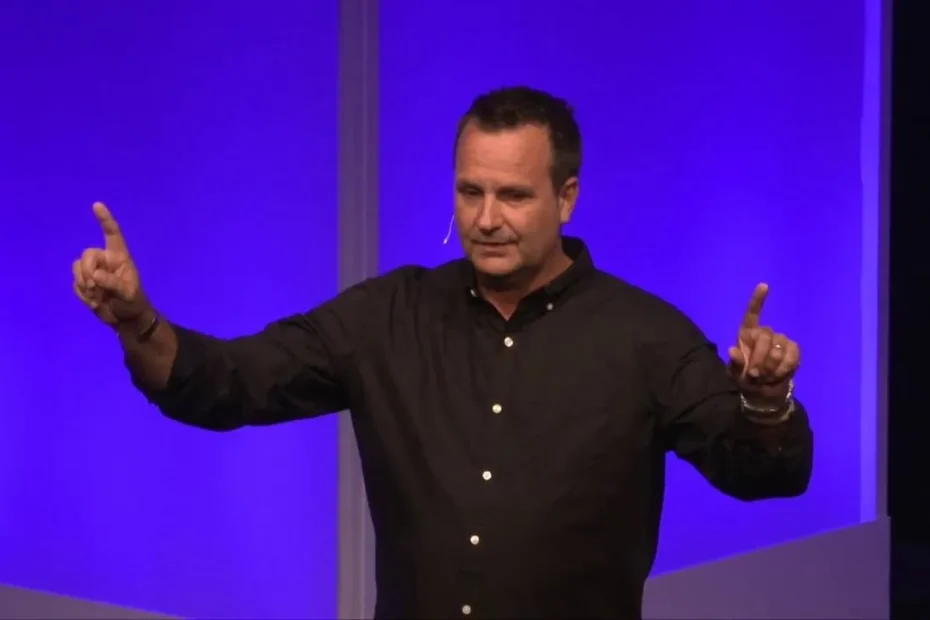
Read the full transcript of former Green Beret Scott Mann’s talk titled “Rooftop Leadership” at TEDxSantaBarbara 2016 conference.
Listen to the audio version here:
TRANSCRIPT:
Introduction: Green Berets and Rooftop Leadership
SCOTT MANN: “There’s no way we’re getting out of here alive tonight.” As a U.S. Army Green Beret, I’ve said those words more times than I care to remember. That’s because we tend to have a bad habit of getting surrounded by the enemy on purpose. You see, Green Berets parachute in below the noise and then we offset away from the chaos. Then we walk in with just 12 guys, where we eventually connect at exactly the right spot with precisely the right person, village elder, tribal chief, and then we immerse ourselves in the language, the culture, and when the time’s just right, we help the little guy stand up against the big guy from the bottom up.
Now, a lot of people confuse us with Navy SEALs, but there are tons of differences.
First of all, if you’ve been to the movies lately, you know Navy SEALs have way better hair than we do. Navy SEALs accomplish strategic results by going on to a target by themselves, executing their mission, and then coming off the target. Green Berets achieve strategic results by, with, and through, indigenous populations, usually who are very, very different than we are, and who live in some of the most conflict riddled places on the planet.
In fact, we often find ourselves leading people who are very reluctant to follow us in the beginning. Nowhere was that more true than Afghanistan, January 2010. We were losing the war. There were more Taliban in the rural areas than when we started in 2002. A handful of us was selected to design and implement a new plan that would put our Green Berets out back in the rural areas, helping Afghan tribes stand up against the Taliban.
The Challenge of Inescapable Shock
Now, the biggest problem with this was the levels of violence that has plagued that country. Imagine your neighborhood having endured 38 years of non-stop fighting right on your block. These little villages of 800 people have seen so much trauma that they are collectively paralyzed between the most basic human functions of fight and flight. They are stuck in what Patrick Christian, the anthropologist, calls inescapable shock.
Now, to work with these folks, we bring them into the courtyard and we simply make three promises. One, if you don’t want us in your village, we’ll leave right now. Two, if you do work with us, it’s going to get harder before it gets easier. Those Taliban thugs down the road, they’re going to come for you and they’re going to come for your children and they’re going to come for us.
And three, when they do, our little team’s going to go up those ladders, up onto the rooftop, and we’re going to fight them, whether you do or not.
The Transformation: From Inescapable Shock to Rooftop Leadership
Now, promise two always comes true first, usually within days, if not hours, of us moving into a community. At night, as locals huddle in their homes and after we’ve gone to bed, contact. Moving!
Now, from this edge of the rooftop, we’re going to fight all night long until the sun comes up, the attack goes down, and then we’ll hobble down those ladders, carrying our wounded and sometimes carrying our dead.
And this goes on night after night. Up those ladders while the Afghans stay down below. And then one night, in the middle of a fight, off to the side we hear a rifle shot, see a muzzle flash, and it’s shooting in the same direction we are, but it’s not from our rooftop. One farmer has made a decision to go up onto his roof and defend his home.
It’s a very small shift in the mood, but we’ll take it. Because within two to three weeks of us going up those ladders, night after night, before we can get to the last rung in the middle of a fight, every rooftop in the village is pouring rifle fire back into the source of the Taliban attack, breaking it off before it ever even starts. Not in one village, not in six villages, but this story played out in 113 villages across rural Afghanistan in less than two years.
Now, local Afghans have always stood up for their villages.
But let’s remember, how did these folks go from inescapable shock to an overt willingness to climb up on a rooftop and stand shoulder to shoulder with men they didn’t even trust two weeks ago, and endure intense rifle and machine gun fire, and then face certain enemy retaliation against their kids? Not because they had to, but because they chose to. That’s what I’ve come to call rooftop leadership.
And these same old school Green Beret interpersonal skills that we use in these rough areas can help you lead a community development project, grow your business, get closer to your children. Because you don’t have to be a Green Beret working in a tribal area to see that your world and the world I lived in are not that far apart. There is a growing body of evidence that shows that regardless of language, or culture, or perceived social evolution, that humans are remarkably similar in how we are wired to interact with each other.
And these lessons aren’t just for the trust or the conflict riddled battlefield. I mean, trust is eroding all over the world. In the United States, for example, Gallup took a poll in 1972 that said one-third of Americans no longer trust their neighbor. Just last year, Gallup took the same poll again.
Now, two-thirds of Americans no longer trust their neighbor. Look, that number is as high as any Afghan village we ever worked in.
And do you really need the polls to tell you this?
Think about your own communities.
How are we doing with trust and leadership these days?
How about our schools where our kids are going? How are we looking on conflict and leadership?
Three Critical Steps of Rooftop Leadership
So how do we lead people who are at least in the beginning too skeptical, angry, or frightened to follow us? There are three critical steps that I have seen rooftop leaders do time and time again that will serve you in this effort. The first one is to connect with humans as if your life depends on it. I learned this from a fellow Green Beret named Jim Gant. About 13 years ago, Jim was leading a mission to form a strategic alliance with the Momon tribe in eastern Afghanistan.
Now, this warlike tribe that lives in the Konar River Valley, they’ve been at odds with the U.S. coalition since the war started. And they’re led by an 82-year-old Mujahideen fighter named Noor Afzal.
Now, Jim knows if he’s going to be successful, he’s going to have to win over Noor Afzal.
So he asks for a meeting.
But this is no ordinary meeting. Jim and his little special forces team, they’re going to be surrounded 100 to 1.
So you can imagine how palpable the tension was as Jim shows up, takes off his body armor, and leaves his weapon by the door as he sits down with Noor Afzal completely unarmed and exposed. The first thing Jim does when he sits down is immediately look him in the eye and atone for the last 10 years of conflict between this tribe and the coalition forces, most of which Jim wasn’t even there for. The emotional temperature in the room goes down dramatically.
Then Jim slides his laptop over and he shows raw video footage of the 9-11 attacks by al-Qaeda on the World Trade Center, and he just sits silent as that elder watches victim after victim plunge to their deaths to escape the oppressive heat of those buildings on that September day.
And when the video goes black, Noor Afzal turns to Jim and he says, “You know, in all the years that you Americans have been here, no one has ever shown me that. I understand why you’re here now.” The talks press on and on into the night. At some point, when he’s pressed about where he’s from, Jim speaks of growing up as a poor kid in the badlands of Las Cruces, New Mexico, and his love for the Native American tribes of the Old Southwest.
In particular, a legendary leader known as Sitting Bull. And Jim starts to regale Noor Afzal with the guerrilla warfare exploits of Sitting Bull against the U.S. government. At some point, Jim pauses and he goes, “You know, the way you fought against the Soviets as a mujahideen, you remind me of Sitting Bull.” From that day forward, that was it.
Noor Afzal had a new name, Sitting Bull. And until the day he died just over two years ago, and even after he adopted Jim as his son, that was his name. And more importantly, the stage was set for a very strategic relationship that was so strategic that Osama bin Laden, the leader of al-Qaeda, openly cited before he died that the relationship between Jim and Sitting Bull was one of the greatest threats to the insurgency in eastern Afghanistan.
The power of a connection is immeasurable when we approach it with a life or death mindset.
Leaving Tracks: The Second Critical Step
But it’s almost impossible to make these kinds of connections if it doesn’t come from in here.
Now, I learned that from a ton of Green Berets, but it was really my dad, Rex, that taught it to me deeply and who came up with the term, leaving tracks. It all came to a head when my cell phone rang. I was sitting in traffic in the spring of 2008. “Hello?”
“Scott, it’s your dad’s doctor, Dr. Hex. Listen, son, his test results have come back and it’s not good. He has stage four non-Hodgkin’s lymphoma and it’s in his bone marrow, very advanced.
My recommendation, son, we’re going to treat this thing, but you need to spend as much time with him as you can before you go back to Afghanistan.” I don’t remember hanging the phone up, but I do remember punching that steering wheel as hard as I could sitting in that traffic.
When I finally kind of got over the initial shock of it, I took the doc’s advice and I went to Kentucky to see my dad every chance I could, and I would go with him to his chemotherapy treatments. I remember one day at the clinic, I’m standing, my back’s against the wall, and I’m trying not to even look at my dad because the smell of disinfectant in that place and just the sterile feel of it reminds me way too much of the Kandahar Field Hospital where I saw so many of my friends lying dead and wounded.
Dad sensed this. “You okay, Scotty Doodle?”
Now, folks, rule. My dad is the only one who can call me Scotty Doodle, but as I heard that old nickname, I couldn’t help but remember the times when that six-foot-tall strapping mountain man would pick my little brother up under one arm and me under the other, and he would walk around the house with us singing when we were kids.
And now I’m looking at this man who’s, you know, slumped over in his chair, his hair’s gone, he’s got that damn port coming in his chest, pumping that rat poison in him. I’m like, “No, Dad, I’m not okay. I know it’s selfish, but I have lost too many friends, and I’m not ready to lose you yet.” He said, “Scotty, I’ve left my tracks in this world.
You know that?” That hit me right in the chest. And my dad, and it really shouldn’t have, my dad spent 43 years in the United States Forest Service fighting those big wildland fires.
And in between those times, he would take my brother and me out in the woods, and whenever he’d see animal tracks, he’d say, “Boys, you see that? I don’t care what you do with your life, you leave your tracks in this world.”
And he wasn’t talking about human footprints. He was talking about those indelible impressions that each of us can leave that serve not those around us but those who follow us. That’s rooftop leadership.
When our higher purpose serves people that we will never even meet, that is when people will follow you up the ladders into the darkness. And I saw it time and time again with Green Berets in those dark places.
But my dad’s still doing it seven years later. He apparently never got the memo on the whole terminal cancer thing. Still leaving tracks.
The Mission Decision Line: The Third Critical Step
But how do we find the courage to go up those ladders when no one’s following us? And that’s the third critical step. You’ve got to get yourself an MDL. Let me explain what I mean.
One of my first combat missions in Afghanistan was in the spring, April of 2005. We’re going into Uruzgan province, way up in the Afghan mountains. Have to go by helicopter. Have to go at night.
Now commitment on these types of missions, these types of journeys starts way before the target. It’s the walk to the airfield when you’re wearing 100 pounds of kit and the oppressive heat and you’re shoulder to shoulder with your teammates trying to pretend like you’re not nervous. We pick our way through the helicopters and we find our helicopter. We crawl up in the door and we’re sitting there shoulder to shoulder with our feet hanging over the edge.
I give a quick head count of my guys and a thumbs up to the loadmaster that we’re ready to go. Immediately the chopper starts to shudder. The rotors start to whine. And that helicopter lifts up slightly and starts picking its way through all the other helicopters out to the active runway.
And as the other mission helicopters line up behind it, with the nose just inches off the ground, it starts streaking down the tarmac toward that 20 foot perimeter fence that is rapidly approaching. And just as the helicopter breaks free into the night sky, the pilots start hugging those big mountains for what we affectionately call Hell’s Roller Coaster.
But my mind is already somewhere else. How long is this flight? What’s my emergency radio frequency?
What happens if we make enemy contact when we land? What the hell am I doing here? I pull my map out to try to focus on the route and the pilots are calling off phase lines as we go into my headset. These are just roads and valleys that are easy to recognize from the air and on the map.
And they’re named after U.S. states for this mission. “Phase line California.” “Roger that.” “Phase line California,” the cockpit calls.
I think I’m going to puke. “Phase line Arkansas.” Wait a minute. That’s the MDL.
The mission decision line. The point of no return. As soon as I heard that, I realized that everybody on my team, all the way to the highest headquarters, realized that there’s no turning back when we cross this line. You know, as soon as I heard that, I actually felt better. I actually felt a sense of relief that there was no longer a plan B. I thought maybe I was losing it, so I looked around the chopper in my guys’ eyes to see what they were feeling.
You know what I saw? Teeth. Big teeth. Grinning.
At the same acceleration of clarity that they were going forward just like I was. Whatever waited for us tonight in those mountains, we were going out to meet it full on. The MDL. A point in our life when we cross it, there’s no turning back.
Conclusion: Applying Rooftop Leadership
You know, it’s hard to lead people who are reluctant to follow us.
But for leaders like you and me, it’s growing every day as a requirement. If the only tool in our kit bag is a hammer, then every problem we face as leaders is going to be a nail.
So to lead in these tough times, here’s what I’m asking you to do. Connect as if your life depends on it. Even if it’s just restoring a relationship like Jim did with Sitting Bull, leave those half-hearted connections at the door with your body armor and go deeper. Leave your tracks in this world. Pretend like it’s 15 years after you’ve passed on and the person who held your hand when you took your last breath is now having coffee with someone who never met you and they’re describing the tracks you left behind.
What will they say? And finally, build your own MDL. Work with your team, your family, yourself, and pick a spot in time or space between where you are now and the tracks you’re going to leave. And agree with all your heart that when you cross it, there’s no turning back.
No plan B. These lessons are not theory. They work. I’ve seen them work in the darkest places, and I learned them from some of the finest leaders on the planet, many of whom aren’t around anymore. They died living these lessons, and in sharing them with you, I share my brothers with you.
And more importantly, if you’ll put them into play when you walk out this door, you’ll find that people will follow you in the darkest of times, not because they have to, but because they want to.