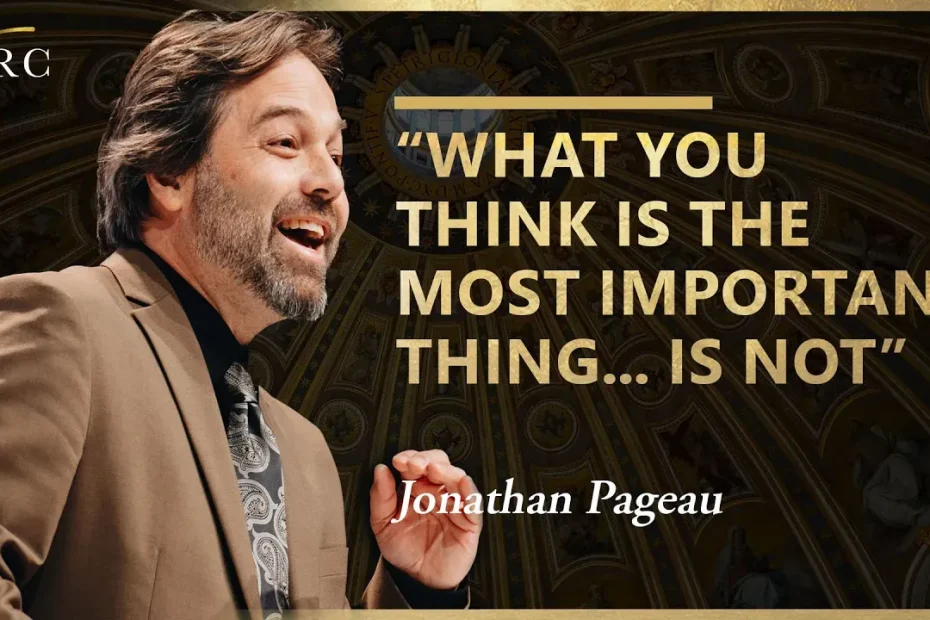
Read the full transcript of Canadian YouTuber and sculptor Jonathan Pageau ‘s talk titled “What is the Supreme Good?” at Alliance for Responsible Citizenship (ARC) conference on Nov 1, 2023.
Listen to the audio version here:
TRANSCRIPT:
Addressing the Elephant in the Room
JONATHAN PAGEAU: Thanks, Philippa. I want to start with something. There’s really an elephant in this room for the past two days. I’ve kind of noticed it, and everyone is kind of tiptoeing around it, and nobody is really addressing it.
And to be honest, it’s a little unnerving to me. There are a lot of religious people in this room. I saw a few guys that had a giant cross. Not the little cross that you put under your shirt, but the big, big cross.
And I even saw a guy with a yarmulke. He’s here, I think. But really, it’s been a strange ghost that’s floating through some of the talks, with funny code words like, transcended this, and faith that.
And then you have Bishop Barron that comes out like a wrecking ball, and he’s like, God and Jesus and Thomas Aquinas is like, whoa, what’s going on? So just out of curiosity, how many people in the room here explicitly identify as belonging to a religious faith or religious tradition? How many people? All right.
And how many people here see themselves as secular or atheist or the like? Wow, okay. We’re taking names, but don’t worry about it. It’ll be okay.
Bridging the Gap
So for many years, I’ve been trying to find ways to actually bridge these two worlds of people and help secular people, reasonable people, understand why these strange stories, these strange rituals are part of our life. And I think that I can do that today, a bit, and so hopefully we can chase that elephant out of the room.
So I was asked to talk about the good, the capital G good, and I’m really grateful that they gave me the easiest subject to talk about. Yeah.
But we’ve also heard little code words related to that, that were floating around in the last few days, like the common good, or that things are getting better, or that things are getting worse. Or we have talked about our values contrasted to dark and dangerous forces.
Plato’s Meaning Crisis
And so this reminds me of a time, a very long time ago, when our good friend Plato was faced with a meaning crisis, a meaning crisis that’s not completely unlike the one we face now. In fact, the meaning crisis which he faced was in large part responsible for the ultimate fall of Athens.
And the thinkers just before him, they were looking to find the Arche, they were looking to find the head, the principle, right? Trying to figure out what is behind everything, and trying to use reason to do so.
And they were having something of a fight, or something of a row over what it is that all of this is pointing to. And of course many answers were proposed as to what the principle behind reality is. Some people said fire, change, or water, the limitless and other ideas like that. Interesting ideas, but there was one guy, this one pesky fellow, Democritus, who proposed that the world was simply void and matter.
Atoms, right? Little unbreakable bits of stuff that bounced around each other, stuck to each other, in order to constitute the things of the world.
And I remember my high school teacher telling me that it was funny how thousands of years later, it was Democritus that had won the debate, right? The world is made of atoms.
Plato’s Eternal Forms
Now, our good friend Plato, recording the words of Socrates, and facing this meaning crisis, came to a different conclusion. That behind the world are eternal ideas, eternal forms. And we often mistakenly think that these forms are just something like concepts or identities, but Plato’s highest form was the form of the good.
Now, that’s different. That’s not just an identity. It’s not just a concept. It’s something like the precondition for identity.
Let me explain that. It’s not just how things exist, but why they exist. They exist to participate in the good. And of course, for later Christians that would convert out of this pagan world, they would look back and find in the book of Genesis something similar.
And they would see that God creates the world, and he says that it is good. And it’s not just that God has goodness, like equality, but as much for the Neoplatonists, as for the rabbis, the Christian saints, and the Muslim philosophers, the transcendent one God, the ineffable source of all things is indistinguishable from the good.
And all things are created to participate and be in communion with that goodness.
The Modern Perspective
So what a strange idea to us today, who know better, right?
Like, we know that the world is made of stuff, right? The Democritus was right. It’s made of atoms and forces and space-time and a Big Bang and billions of years of stuff coming together and this or that way. That’s what we believe.
At least that is the belief that permeates our secular culture. And when we act on that fundamental principle, then all we have to do as humans is understand how stuff works. And we have been amazing at that. I mean, we’ve been unparalleled in the known history of the world at figuring out how stuff works, how to get stuff, how to make stuff, how to accumulate stuff, and how to constantly increase our capacity to get and make stuff.
And in many ways, several of us have convinced ourselves that human flourishing happens when people have enough stuff.
Understanding, Will, and Power
Now, of course, there’s a corollary to that, which is that to understand, get, make, and control stuff, you need three things.
You need understanding, you need will, and you need power. And you will be able to recognize any atheistic system worth its salt because it will always emphasize those three things. Understanding, how stuff works, will, directed energy and action, and power, the energy we need to do your will.
And this was as true of Nietzsche as it was of Marx, and it’s also true of Ayn Rand. And in these three, you have the three strains of modern politics. The communist tendency, the fascist tendency, and the libertarian tendency. All three are posited on understanding, will, and power.
The Lie of Materialism
Now, the problem is that this, this idea that the world is just made of stuff, and all we need to do is understand, make, and get stuff, it’s a lie. And it’s not just a lie, but it’s a lie that has become manifest in one of the very reasons why we are having this conference today.
When we hear pronouncements like we have lost our values, and because of that, the social fabric is fragmented, our societies are breaking apart. This is happening precisely at the moment when we have the most stuff. The refusal of people to have children, the mental health crisis, the loneliness, the despair, and the hopelessness is happening all precisely when, and to a large extent, because we have more stuff than any visible time in history that we can identify.
Now let me translate this for you. What does it mean to lose your values? To lose what you value? It means to lose what is good.
What does it mean to despair, but to be incapable of perceiving that which is good?
And what does it mean to fragment, if not to forget why and how it is good to be together? To forget the reason why we’re together in the first place.
The Danger of Pursuing More Stuff
So I think we have to be careful. And as I see everybody talking about progress, and I hear people talking about human flourishing, we have to be careful and wonder what it is that we actually mean by that. If what we mean is we just need to get the governments out of our way so that we can have more stuff, that we need to tackle the environmental concerns so that we can all have more stuff, and more powerful stuff, and bigger and faster and stronger stuff, then I think there’s a very important warning to be had.
Of course, as a Christian, I believe strongly that we are called to help the poor.
But if all of us, if all we do in the world is get everybody to have more stuff, we will not solve the problem of despair, of sterility, of fragmentation, divorce. In fact, we will increase it. And so it seems like the ideas that Plato brought to light have to be explored and taken seriously once again. It is the world can no longer be described only in terms of forces and stuff.
The World of Care
But it has to be described in terms of categories of human consciousness, like attention, like relevance, like care. And maybe for some of you, that is too much of a jump to say that the world is made of care, or that the world is made of love.
But at least an acknowledgement that the human world is made of care, right? That without care, there is death. That without care, there is paralysis. And if we care for the wrong things, then there is chaos and tyranny in our lives and in our societies.
The Highest Good
And this is where I think that maybe I can help bridge some of the more religious and secular people. What it is that we place as the highest good, that which is placed above us as our guiding star, as the thing that pulls us forward into its good, is indistinguishable from a God. Just like a God, that supreme value will drive us towards it, will subjugate all things to it, and the type of attention it will receive will be indistinguishable from worship.
And if what we put at the top there is not in fact the supreme good, then it will twist reality, it will twist the facts, and it will twist the data into its service. And if we can’t see that, if we can’t understand that, we will never understand what happened to us during COVID. We will never understand. We will never understand that it was the worship of safety and control that made it impossible to weigh it against other goods.
To even posit other goods made you not only wrong, but a heretic that had to be banished and run out of the common space. And so we sacrificed, we subjugated all other goods, the education and mental health of our children, the communion with our families, our religious participations, and so many aspects of life which provide meaning and purpose for nearly two years in some countries.
And then the practical reasons became completely opaque, right?
Two weeks to flatten the curve, and then that no one should die?
Or maybe to keep the hospital safe, then what? That no one should ever get the disease? That everybody had to be vaccinated?
With a vaccine that doesn’t stop the spread of the disease?
So what’s the goal? What’s the goal? It didn’t matter. It no longer mattered what the little goals were anymore.
Once the God has taken possession, all the facts, all the purposes, all the goods will simply serve that God.
Now, safety is a good. Of course it is. Of course safety is a good. It is simply not the supreme good. And it just needs to not pretend to be.
And that’s all we need. And so, so what is it, right, Jonathan? What is the supreme good? And so I’m afraid that this is where the words fail us. Of course, for the good itself is not a good. It is goodness, just like truth itself is not a truth, but the mysterious standard by which we measure true statements.
And it’s the same reason why we notice that beauty is not beautiful. And so the philosophers and the theologians say that the capital G God is ineffable.
Dante’s Vision
So when Dante, in his comedy, reached the highest point of his ascent and entered into that mystery, he said, “Power here failed the deep imagining, but already my desire and will were rolled like a wheel that is turned equally by the love that moves the sun and the stars.” The love, the care that moves the sun and the stars. That’s not bad. That’s not a bad way to talk about it.
A Message for Secular People
But for the secular people listening out there who might wince at the idea of the ineffable, that’s fine. I understand it. The only thing we actually need to know about that is whatever it is you’re chasing right now, it ain’t it. Whatever it is you think is the most important, it’s not. It’s not the most important. The supreme good is not money, it’s not energy, it’s not freedom, it’s not family, it’s not knowledge, it’s not safety, it’s not diversity, and it’s not inclusion.
Though all those things are good, they should never be treated as the supreme good, lest they become idols and gods that will tyrannize us. And so the goods must dance together. They play against each other. They have to be put in proper hierarchies where the more encompassing goods, like the virtues, guide the lower goods, like the stuff. With none of the goods completely ruling the others, or else they might become, once again, vices that will overwhelm you.
Conclusion
And so at least for now, I think, that even for those who are here, those who are watching this, who do not believe and do not worship the supreme, ineffable good, at least keep your eyes high. And at least always look higher.
And don’t let your sight and your perception stop at the goods that you care about today.