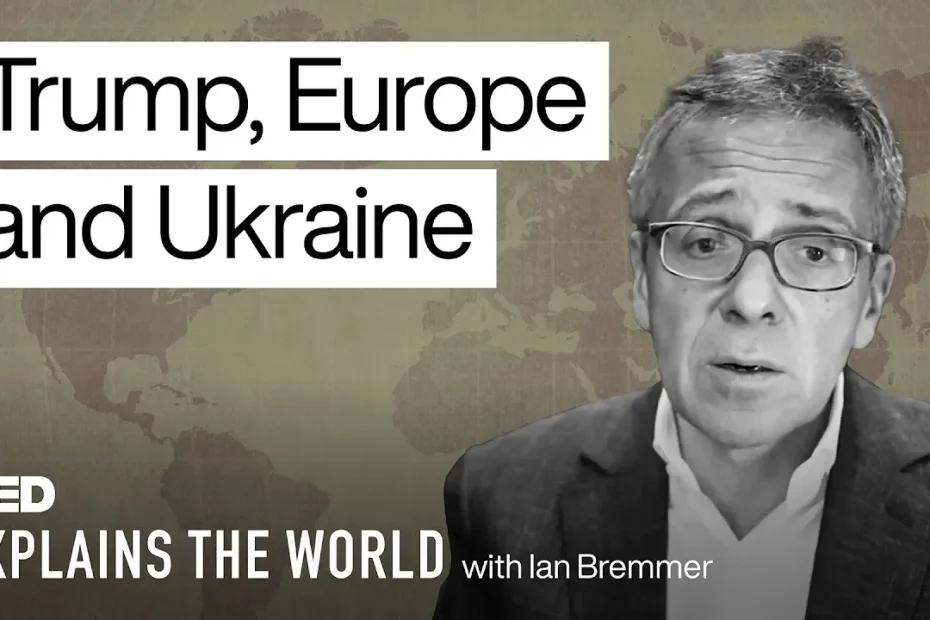
Read the full transcript of a conversation between TED’s Helen Walters and political scientist Ian Bremmer… on “Trump, Europe, Ukraine and the Uncertain World Order – TED Explains the World with Ian Bremmer” on February 24, 2025.
Listen to the audio version here:
TRANSCRIPT:
Introduction
HELEN WALTERS: Hi, everyone. I am Helen Walters, head of media and curation here at TED. Welcome to another episode of TED Explains the World with the one and only Ian Bremmer. It is Monday, February the twenty-fourth, a little more than a month since President Trump was inaugurated once more, and safe to say a lot has been going on.
We figured we’d check in with Ian to determine what we should really be paying attention to amid the extreme noise. Ian, hi.
IAN BREMMER: Helen, great to be back with you.
HELEN WALTERS: We asked the TED community to share their questions for you, and we wanted them to share what they’re most curious to know. We really got some amazing questions that I plan to pepper this conversation with.
So let’s start with one right now. Two months into 2025, where does the US stand?
America’s Global Position
IAN BREMMER: Very powerfully, in the sense that the US economy is performing considerably better than any of the other G7 economies coming still out of the pandemic. Technologically, the only close competitor is China, ahead of the US in some areas, behind the US in other critical areas. But compared to every other country in the world, the US is head and shoulders, neck, waist above them.
Militarily, of course, the US is the only country with global ability to project power. No one else is close, and the US dollar is still the global reserve currency. No one is the proximate challenger.
I say all of those things because those are the things that haven’t really changed over the course of the last few months, but I suspect that isn’t what the questioner was asking.
What they’re really asking is what’s happening politically. And politically, the United States is unwinding its own global order. It is no longer particularly interested in promoting collective security or NATO. It’s no longer really interested in promoting involvement and leadership of multilateral institutions of consistent rule of law and free trade that’s well regulated. Certainly not very interested in promoting democracy around the world.
This is an environment where other countries around the world have to figure out how to adapt to the United States, and the US has become the principal driver of geopolitical risk and uncertainty in the world today. Unlike any other time in my lifetime and yours, that’s perhaps the biggest change.
HELEN WALTERS: That is quite a statement. Alright. You are a geopolitical expert. Let’s talk about Europe.
The Munich Security Conference Incident
HELEN WALTERS: Defense Secretary Pete Hegseth stated that America’s foreign policy focus no longer lies in Europe. Vice President JD Vance caused some raised eyebrows, dropped jaws, and I suspect some choice expletives after his recent speech at the Munich Security Conference in which he accused European leaders of suppressing free speech and warned of the threat from within. So you were in Munich. Was it as dramatic as the stories we read had it, and what happens next?
IAN BREMMER: It was. I was in the room. I was maybe thirty feet away from him when he gave that speech. Standing right in the front, right next to me was the President of Czechia, the President of Finland, the Prime Minister of Sweden, watching all of them and their reactions.
Let’s keep in mind. This is the Munich Security Conference. It’s been going on now for something like sixty-one years. And he was the head of the US delegation. Every year, the head of the US delegation gives a big speech on the state of the Transatlantic Alliance and on global security, and he didn’t do that.
The people in the audience were expecting a challenging speech. They were expecting that the Americans would be less committed to the alignment with the Europeans on Ukraine. The US had just had that direct Trump phone call with Vladimir Putin, ninety minutes long, hadn’t coordinated that with the Europeans, never mind the Ukrainians in advance. So they were definitely prepared for a very challenging plenary, but Vance did none of that.
Vance said, “I’m not gonna talk about Ukraine or Russia or China because the biggest problem is actually what’s happening inside Europe.” The biggest problem essentially are you guys sitting in front of me that I’m speaking to because you’re suppressing free speech. You’re suppressing the far right. You’ve been infected by the woke mind virus, and you aren’t real democracies as a consequence.
And specifically, he attacked the German firewall and said that—and let me explain what the German firewall is. That is a principle by the leaders of all of the mainstream German parties and their supporters that they will not, under any circumstances, work with or enter into coalition with the Alternative for Deutschland party, the AfD. Because the AfD, under surveillance from German intelligence agencies, is considered to be a neo-Nazi party.
And the United States, of course, after World War II, led denazification of Germany. The day before, Vance had actually gone to Dachau and visited a concentration camp and then came to speak in Germany about the firewall needing to be ended. And at that point, someone yelled out from the crowd, “This is unacceptable.” And it was right in the front, and people in the room, about fifteen hundred people in the room, standing room only, couldn’t see who it was. They just see the back of his head.
I saw who it was. It was the German Defense Minister, Pistorius. And in fifteen years of me going to the Munich Security Conference, I have never seen anything remotely like that.
The Aftermath and German Elections
IAN BREMMER: Vance refused to meet with the German Chancellor because he’s basically—well, he’s not relevant.
So that is a very important backdrop for this last weekend’s German elections where the victor, Friedrich Mertz, who is going to be the next Chancellor, actually referred specifically to America’s intervention in German democracy and support of the AfD being every bit as bad as what the Kremlin is doing inside Germany, and also said that the Europeans need to develop a defense policy which is independent of the United States. In other words, essentially saying that it will be the end of NATO.
Again, staggering comments, unheard of, impossible to imagine even two weeks ago. And that’s why it’s very critical that you have the context of what happened between Vance, Elon Musk over the past couple of months, Trump with the Germans, with the Europeans, so you can understand why the incoming German Chancellor would make a statement like that.
The Rise of Far-Right Movements
HELEN WALTERS: What should we make of all of the conversation about the rise of Nazism, the return of Nazism? Obviously, the AfD just won twenty percent in the German election. We’ve also seen people allegedly giving Nazi salutes at various US conventions and speeches. Do you think this is overblown? Is this a fear that people have rationally, and what should we make of that?
IAN BREMMER: In Germany, the Alternative for Deutschland are winning all of former East Germany. This is a group that increasingly understands that they’re never going to really catch up to the rest of Germany. Remember, Germany hasn’t really grown in five years now. They’ve been in recession for the last two. And the average citizen, the average voter living in former East Germany no longer are just angry about not catching up.
They’re basically saying, “I’m done with this system.” So that’s why you’re getting this very strident, revanchist nationalism that is not just taking a hard line on illegal immigrants. The AfD even supports removing citizens of Germany that they claim have not adequately integrated into German culture and nationality. And so this is some very, very strong stuff, stuff that really does feel like what they were doing back in Nazi Germany.
But in former East Germany, they win. They get the largest number of votes, whereas in much of the wealthier part of West Germany, including where I was in Munich, the AfD can’t break out of single digits. So it’s a very, very divided country, and also, the AfD is doing very, very well among young men. There’s a clear gender divide here as well just as there is in the United States.
In the US, I, of course, saw Elon Musk and that sort of grabbing his heart, saying “my heart goes out to you,” and then doing what appeared to be mimicking a Nazi salute. And then Steve Bannon doing the same without the initial heartfelt comment.
It clearly was trolling, clearly was trying to get a reaction from folks. It’s very performative, and it’s meant to also attack and attach, make the left lose their minds on something that isn’t very critical to what the Trump administration is trying to do compared to the revolutionary changes inside the US government that they are very much prioritizing right now.
So I’m very concerned about the rise of neo-Nazism in Germany. I am very much not concerned about that in the US. I’m concerned about other things. I think it’s being used as gaslighting for those that can use distractions or can be distracted by them.
The Future of European Politics
IAN BREMMER: This election in Germany wasn’t surprising. It was exactly as the polls have expected for several months now. But the key elections in Germany and the key elections in Europe are the next cycle. I’ve spoken with a lot of people around the Trump administration that believe that the Europeans are one electoral cycle behind the United States. So in other words, Trumpism is coming, just not quite yet.
In the UK, you’ve got Labor for a full term, but the Reform Party is increasingly the most popular. And just with a little nudge, maybe a little external money, and Elon said he’s already thinking about giving them a hundred million dollars, which is a massive amount in UK politics, not so much in the US, that the conservatives would fragment. A rump group would join with Reform, and they could win the next elections.
In France, you’ve had all of these governments continue to collapse. Macron, very unpopular. Marine Le Pen and the National Rally party could easily win upcoming elections in 2027.
In 2029, in Germany, if the Germans are incapable of turning their economy around, incapable of unwinding their debt brake and spending some of the capital that’s just sitting there. And as their debt to GDP goes down, but their economy contracts at the same time, then AfD could easily win in 2029, and then the firewall is no more.
And then, of course, in the European Union elections overall, in five years’ time, now four and a half, you could easily see the Patriots upfront, which is the equivalence, the far-right grouping, that these parties are a part of. They could all come together and be the dominant party, and then the EU as we know it is really a thing of the past.
So these are existential changes that are happening not just for NATO right now, but also for the EU and quite plausibly for the future of democracy as we know it.
Ukraine’s Future
HELEN WALTERS: Alright. Let’s turn to Ukraine. So President Trump accused President Zelenskyy of starting the war with Russia and called him a dictator without elections. Last week, senior American and Russian officials met in Riyadh to discuss a potential ceasefire with no Ukrainians present. Now Zelenskyy has offered to step down in return for Ukrainian admission to NATO, although apparently he doesn’t really mean this. So what happens to Ukraine now? What should we be paying attention to?
IAN BREMMER: I think he would mean it, if NATO membership happened. I’d love to see Trump call his bluff on that, but, of course, it’s not going to. And he wasn’t saying that six months or a year ago. He’s saying it now that NATO is truly being pulled off the table.
I think it’s the right thing for him to do. It is, again, performative, and helps to remind those around the world that Ukraine is fighting for self-determination. They’re fighting for the ability to join their own alliance as any country in the world should be able to do. But that is not Trump’s belief.
Trump believes that what you get to do is determined by how powerful you are, not by the fact that you happen to run a country. And indeed, territorial integrity is something that is afforded to powerful countries, but not so much for weak countries. And that’s the way he feels about Panama, and that’s the way he feels about Denmark and Greenland, and that’s certainly the way he feels about Ukraine.
So right now, as you and I are speaking, the United States is putting forward a new UN resolution at the General Assembly that says that the war has to end as fast as possible, but does not recognize Ukraine’s territorial integrity, which has been a core precept of the international order that the United States has supported since creating the United Nations and since the end of World War II in 1945. The Americans are now throwing that out, and the Russians, of course, are fully supportive of that.
America’s allies in Europe are not, but the US has gotten the Saudis to agree, and they’re getting a unified Arab bloc. The Americans have privately worked with a lot of poorer countries in Africa, in the Asia Pacific, and other smaller countries, and saying you’re not gonna get any aid from the US unless you vote in favor of this new resolution. I fully expect the resolution is going to pass.
But, of course, what that means is that the Americans are preparing to cut a deal on Ukraine over the heads of the Ukrainians. In other words, the US and Russia together will figure out what a ceasefire should and should not entail as part of a broader US-Russia rapprochement.
The Ukraine-Russia Situation Under Trump
IAN BREMMER: This is obviously a disaster for the Ukrainians. The Ukrainians initially refused to accept this so-called deal on Ukrainian natural resources that would give the Americans $500 billion in access to such resources in return for paying off aid that the Americans had granted to the Ukrainians without conditions or strings, but apparently no longer.
What does this all mean? It means that we have another case of why people shouldn’t trust the United States from one administration to the next because foreign policy will change completely, and what you thought was an American commitment won’t stand. It shows that there is a fundamental rift between the Americans and the Europeans. Indeed, Emmanuel Macron is in the United States right now as you and I speak, hoping that he can do something that will keep Trump from, as Macron believes, essentially surrendering to the Russian position and maintaining some level of coordination with the Europeans, but he doesn’t have a lot to offer.
The Ukrainians are now in a position of desperation where maybe they will end up signing over a lot of their natural resources to the Americans. But what, if anything, will they get in return for that? How empowered will the Russians be in any deal that is cut? Will an independent Ukraine even be able to survive, and what will be the terms required of them?
Of course, Putin is saying things like no European troops of any sort, whether in a NATO formulation or not, would be allowed as peacekeepers in Ukraine. Well, then how would you guarantee security commitments to the Ukrainians? These are all open questions, but apparently questions that President Trump is prepared to largely resolve on Russia’s terms. This is such a dramatic change from where the United States and where the western order was just a month or two ago.
Community Questions on Ukraine
HELEN WALTERS: Let’s take some quick-fire questions from our community related to this topic. I think the first one is particularly pertinent to what you just said. It’s simple: What does Putin have over Trump?
IAN BREMMER: I don’t think that Putin has anything over Trump. If he did, then why wouldn’t Trump have granted Russia more in his first term? In his first term, he gave the Ukrainians those Javelin antitank missiles that Obama refused to give. He increased sanctions against Russia. Now, that was his administration with a lot of hawkish advisers around him that he doesn’t have this time around. They’re all directly loyal to him. But if it was a priority for him, he could’ve stopped it. And if the Russians had something over him, then why wouldn’t they have used it in that case?
So it feels like a conspiracy theory. I don’t buy it. I think we can explain what’s happening very differently because, number one, Trump wants to end wars. It’s very popular with his base. He’s said this on Gaza. He’s said this on Iran, where Israel wants him to support attacks on Iran’s nuclear capabilities, and Trump has said no. And he’s showing this on Ukraine.
He doesn’t want to spend money on the Ukrainians going forward after spending over a hundred billion dollars under the last three years from the Biden administration. He also doesn’t value a strong Europe. He actually thinks that a weak Europe is in America’s interest, where you have more Brexits. He used to always talk to the French about that during his first term. “Why won’t you do Brexit?” He wants all of these MAGA-type populist parties, including the AFD, to win in Europe because that legitimizes his own popularity, just like he loves Milei in Argentina or Bukele in El Salvador.
I think if you put those things together, you actually get to why Trump is doing what he’s doing with the Russians without needing to create a story about Trump somehow being threatened by some secret, shadowy information that the Russians have on Trump that they’ve let him know about, but nobody else knows. I just don’t buy it.
HELEN WALTERS: Great. Okay. Another community question: If the US hands Ukraine to Russia, will Russia keep going? Will they attempt to take over Europe?
IAN BREMMER: It’s interesting that Trump just met with the Polish president, President Duda. It was supposed to be an hour meeting but was only ten minutes, so he would kind of embarrass them at home in Poland. But he did say that the US is still committed to maintaining a troop presence on the ground in Poland. So it’s very hard to imagine the Russians rolling through Ukraine and then into Poland.
Even though there’s been lots of asymmetric warfare, for example, and even Russian missiles launched into Lviv, Ukrainian air defense, with Polish villagers getting killed because of the fighting. So there’s been spillover, but America’s still gonna be in Poland. Why is that? They get along pretty well, and the Poles are heading towards five percent of GDP defense spend this year, which has been the high watermark of American demands of defense spend.
Baltic states are all spending a lot more money on their defense. In principle, you could imagine the United States maintaining these rotational deployments in the Baltics, which would prevent the Russians from invading. But might Trump say as part of a deal, why do we have all those troops there? You mentioned Pete Hegseth saying the Americans need to get troops out of Europe and get them to Asia, which is where their principal competitive strategy is gonna be oriented.
The US hasn’t been pressing the Japanese or the Indians, the principal partners and allies in Asia vis-à-vis China, the way they’ve been pressing the French, the Brits, the Germans in Europe. So I think it is certainly plausible that the Russians will do more, especially with those countries that refuse to align with a Trump rapprochement towards Russia.
The countries I would be most worried about are Moldova and Georgia. I’d be most worried about the countries that are in the so-called near abroad, that aren’t a part of NATO and aren’t going to become a part of NATO, and therefore are much more vulnerable. But certainly, in terms of Russia’s willingness to engage in espionage, to fund actors on the ground for arson attacks, assassinations, critical infrastructure attacks on fiber networks, on pipelines – I think all of those things are likely to increase against European states across the board on the back of this US-Russia rapprochement.
HELEN WALTERS: Okay. Final community question for this segment. What happens if the US no longer supports NATO?
IAN BREMMER: It’s possible that the United States is moving towards a similar posture in Europe that they presently have in Asia, which is strong individual bilateral deals with a number of countries – South Korea, Japan, Australia – but not a collective security agreement where those countries together have more of a call on the United States, and there’s a lot more free riding. So I could imagine that NATO falls apart and becomes that.
The danger is that even though the Europeans now understand the nature of the threat, that it is very plausible and maybe even baseline that the Americans are gonna leave Europe collectively on its own, that seriousness does not equate to the ability to increase spending adequately in the near term.
The Germans did manage to pull together an electoral outcome that will allow for a so-called grand coalition, just barely. So you’ll have a two-party government in all likelihood instead of three. But you also have a blocking capacity on the part of the far right and the far left that will prevent the Germans from really blowing out their spending, including their defense spending, unless they can pull something off before that new government is formed, which is possible but unlikely to be very big.
The Brits are now talking about maybe moving to 2.5 percent of GDP defense spend over years with a very challenging fiscal environment. The Spaniards, not even close. The Italians, not even close. So what does a European military capability really look like? Without the Americans, the answer is it’s not there.
I think that if NATO falls apart, the reality is that most of Europe will be incredibly vulnerable to external attack, especially Russian attack. There won’t be a way for them to defend themselves. Some of them will break and therefore want to work more directly and individually with the United States. And that could be the end not only of NATO, but it could be the end of the European Union.
The stakes are incredibly high. This is an existential challenge for European governments that needed to take this seriously thirty years ago, twenty years ago, certainly in 2014 when the Russians invaded Ukraine, certainly in 2016 when Trump was elected, and certainly in 2022 when the Russians then invaded all of Ukraine. And at every point, the Europeans were basically saying we’re still fine with the Americans basically doing this. And now they are in very serious trouble.
HELEN WALTERS: No time like the present, I suppose. Alright. Let’s move on.
Gaza and Trump’s Riviera Proposal
HELEN WALTERS: So I mentioned the discussions in Saudi, and obviously also on the agenda there were the discussions about Gaza and Trump’s proposal to build a Gaza Riviera. What should we make of that? Or as one of our community members asked, what is the actual solution for Gaza? And surely it isn’t what the US is proposing.
IAN BREMMER: Here’s what’s interesting – Trump says a lot of things. And when they don’t work out, he backs out fairly quickly. Just to stick with Ukraine for one second on this, it was interesting to me that Trump has said that he doesn’t want to talk to Zelenskyy because he has no cards, he has no leverage. So why should he let them at the table? Trump’s gonna cut the deal.
Very interesting that if that is true, then why is it that the Secretary of Treasury brings this deal and says, “You’ve gotta sign this right now, Zelensky,” and Zelensky refuses. And then a few days later, the Americans come back with a new deal with altered terms that are not quite as predatory vis-à-vis Ukraine. Why would the Americans change their tune for someone that has no leverage?
I don’t think it’s because Trump is a nice guy. He’s not going soft at seventy-eight. I think it’s because he overstated how little leverage Ukraine has. Ukraine is very popular among the GOP in the House and Senate, far more than Putin. Zelensky is far more popular in the United States among the voting population than Putin. And, of course, he’s also much more popular among the Europeans and even globally than Putin. So it turns out that maybe there is a little bit of leverage that Zelenskyy has, and maybe Trump does have to give a little bit more.
This is relevant in the context of Gaza because Trump was very annoyed that despite his ability to get a ceasefire between Hamas and Israel over the goal line, his friends in the Middle East were not coming up with a plan for Gaza, where they were supposed to provide security and provide investment and lead reconstruction and deal with the Palestinian populations in the interim. That wasn’t happening.
So Trump, meeting with Prime Minister Netanyahu from Israel in Washington, then after that summoning the Jordanian king who was the ally that is most reliant on the United States, and so therefore most needing to say yes to whatever Trump orders of them, basically says, as you mentioned, Helen, that Gaza is gonna be a Riviera. That the US is gonna turn this into an incredible place. They’re gonna build wonderful homes for the Palestinians someplace else, and the Palestinians will all volunteer to leave Gaza and go to those homes. Gaza will be depopulated, and new people will come in and live there. That was the plan.
When he was asked, standing there with King Abdullah from Jordan, under whose authority, Trump’s response was “under my authority.” And that went over like a lead balloon among America’s allies in the Middle East. They all said, “We’re not up for this. We’re not resettling Palestinian populations. They won’t actually leave voluntarily. This would actually be a huge problem for Israel’s own national security long term, and we’re gonna come up with another plan.”
Their plan will keep the Palestinians on the ground in Gaza. At which point, Trump pivots to work with the new plan, and his advisers say that Trump was only trying to start the conversation, and what he said was his plan is not actually what he’s gonna do.
What would be sustainable would be a lot of Gulf money going in, and maybe some European money too, though they’re gonna be really pressed given everything you and I just talked about, to try to reconstruct a completely devastated Gaza, that eventually some two million plus Palestinians will be able to live normal lives in. The governance will be provided by some technocratic group of a Palestinian Authority that will be working with, selected by those that are involved in the reconstruction and the security, namely the Egyptians, the Jordanians, the Saudis, and the Emiratis.
That is the best possible deal that they’re gonna get, but that’s happening as Israel has just evacuated forcibly another forty thousand Palestinians from refugee camps in the West Bank, sending tanks in for the first time in decades and probably precipitating more Israeli settlers taking more land on the ground in the West Bank.
The Situation in Gaza and the West Bank
IAN BREMMER: And so as we are possibly taking a small step towards a sustainable solution in Gaza, we are taking a slightly larger step away from a sustainable solution for the Palestinians in the West Bank. ‘Twas ever thus, over the past decades in this incredibly horrible problem and conflict.
HELEN WALTERS: And why is Israel doing that? I mean, are they feeling emboldened by the US, or why the incursions in the West Bank now?
IAN BREMMER: Well, I think they’re feeling emboldened by their own successes. They have shown that they are the dominant military power in the Middle East, and they have the ability to determine the level of escalation unilaterally, and their adversaries and enemies can’t really do any damage to them.
They proved that after October seventh in their response to Hamas. They proved that in decapitating and taking out the military capabilities of Hezbollah. And they proved that also with the Assad regime in Syria being gone, which means that the Iranians no longer have a land bridge to get additional weapons to what had been the strongest adversary of Israel militarily, Hezbollah.
So all of that has shown that Israel can decide outcomes. They’re the ones that have all the power here. And also, that depopulation of Gaza is very popular among Israelis. There was a poll recently in the Jerusalem Post, which is pretty mainstream in Israel. Eighty percent of Israeli respondents said they wanted to depopulate Gaza of all Palestinians.
Taking more land is very popular, especially in the West Bank, especially among Netanyahu’s present right-wing coalition that he would like to keep together to continue to govern. And this is a sop to them as he is looking to potentially extend the ceasefire in Gaza, and move from phase one to phase two, which is facing some delays and open questions right now.
So, yes, certainly, the United States has been underpinning that military capability of Israel. And I think it is instructive to remember that not only does the US provide more military aid peacetime to any country in the world to Israel, but that unlike in Ukraine where the Trump administration is saying, “No, I’m not happy with the grants. You’ve gotta pay that back.” The billions and billions that the United States sends to Israel, nobody is suggesting that should be a loan, or that the Americans should get technology rights or mineral rights or anything else from Israel, despite the fact that Trump’s policy is America First. Israel is a very clear exception to America First in Trump’s visioning of it.
China’s Position and Strategy
HELEN WALTERS: Alright. So we talked about the fact that the foreign policy focus of America is shifting to Asia. What are you hearing about how China is feeling in all of this, and what should we be paying attention to on that front?
IAN BREMMER: China has had a couple good weeks economically, specifically on the back of that huge announcement of Deep Seq, which has far less money behind it than the comparable American chatbots, but is performing at an extremely high level. Given the fact that there are all of these export controls on semiconductors and other parts of advanced technology, this is giving people more of a belief that the Chinese really are capable of driving innovation even in that space, and they’re, of course, dominating the post-carbon energy space.
We see that with electric vehicles and batteries, but we’re also seeing that with massive investment now in green hydrogen, for example. We’re seeing it in advanced nuclear capabilities, all of these things. There is more investment in that space that the Chinese are not only driving as a state, but that they’re also increasingly able to raise and move in their own private sector.
The story that you and I have been discussing for the last couple years is that Chinese economy is radically underperforming. That is still true, but there is an emerging counternarrative here that I would be remiss not to mention.
Now more broadly, what the Chinese here are seeing is that Trump’s direct policies are gonna hurt them economically. His tariffs that he’s already announced on China, the ten percent on a whole bunch of Chinese goods for export, the reciprocal tariffs that are global that will clearly hurt China, and it’ll have a hard time negotiating out of, and also the willingness of the United States to expand their export controls and sanctions on China, especially in areas that are considered relevant, even loosely relevant, to American national security.
All of that is gonna constrain Chinese growth. All of that is going to negatively impact the Chinese economy. That’s the downside. And the Americans are doing that not only in bilateral relations with China, but also pressuring other countries to get Chinese tech out of their supply chain. You see that with Americans pushing other countries that produce semiconductors to take the Chinese out.
They’re pushing American allies and trade partners to get China out of the export chain. So Mexico being pushed very hard by Trump to stop allowing China to pass goods through Mexico into the United States. India, same conversation. Vietnam, same conversation. A lot of that going on.
So baseline, the US-China relationship is getting worse. But the Chinese see huge advantages in America’s reversion to unilateralism that we haven’t really seen since the original America First movement in the run-up to World War Two, Charles Lindbergh saying don’t get into the war, don’t fight the Nazis, the US is far away, this isn’t our problem.
And now you have the Americans not only doing that with Russia and Ukraine with the new America First, but you also see that happening with the Americans pulling out of the Paris climate accord again, pulling out of the World Health Organization. You see it with the Americans shutting down USAID. America has historically been responsible for about forty percent of global humanitarian support and aid. And absolutely, some of that is corrupt. Absolutely, some of that is on woke programs that the vast majority of American taxpayers would never support.
But the majority of that money is actually spent on programs that are really important in advancing American soft power and influence over countries in the global south all over the world. The Chinese know that. That’s why they’ve started humanitarian programs. It’s not out of some great love for providing foreign aid for these countries. It’s more because they see it creates influence.
Now the Americans are leaving a vacuum that the Chinese can absolutely take advantage of. And we’ll see this across microstates in the Pacific. We’ll see this across Sub-Saharan Africa. We’ll see this across South America. The Chinese see huge opportunities from the United States creating a leadership vacuum.
And the place they’re most capable of doing that is if the US stops paying dues in the United Nations where China’s number two, and they’ll suddenly have the most influence over all the key positions, which will give them a role in global governance that they’ve really been constrained from happening over the past decades.
The Future of US International Engagement
HELEN WALTERS: What do you think are the chances that the US stops paying its dues to the UN?
IAN BREMMER: You know, if it were up to Congress and only Congress and Trump doesn’t lean on them, I’d say fairly low. I’d say that they’d probably cut back on some programs. But in terms of baseline dues, they keep paying it.
But Trump personally, I think increasingly sees the UN as hostile to the United States. That’s particularly true in terms of Israel policy, which Trump is leaning in on. And, you know, let me put it this way. Tulsi Gabbard did not have the votes to get confirmed. There were Republican senators that were going to vote against her, and Elon called those individual senators and threatened them.
This was fully aligned with what Trump wanted Elon to do, and those votes went away. And the only person that ended up voting against Tulsi was McConnell. And as a consequence, it went through.
So, look, I think that we should not underestimate the level of power and control that Trump and Elon have over the Republican Party this time around compared to 2017, where it was really the Republican Party that was much stronger than Trump, both in his administration creating a lot of guardrails, but also in Congress. This time around, Trump has all the chips, and he’s using them.
So if he decides he wants to stop paying dues, I think that’s what’s gonna happen. This is a much more revolutionary presidency domestically, where last time around, it was much more transactional.
Domestic Policy and the Trump-Musk Alliance
HELEN WALTERS: Alright. Let’s talk a little bit more about what’s actually happening inside the US. You bring up Elon who obviously with DOGE has been sending out emails and asking for information from people and kind of trying to do a lot very quickly.
Some of these high profile moves are—well, I think what’s interesting is that no one would really argue that there isn’t inefficiency in government, that’s an understood reality. But the way that some of these moves are being made are maybe gonna cause irreparable damage, and that’s to people from red states. That’s to scientists. That’s to veterans. That’s to people who voted for Trump, and that’s to people around the world.
You talk about soft power in the United States. But what about actually what’s happening inside the United States? And why do you think that the administration is willing to go so quickly, to go so fast, and to cause such damage?
IAN BREMMER: Well, and you saw Trump this weekend saying that he wants Elon to move faster, to be more aggressive. And I don’t think that was just a troll. I think that’s true. Trump is seventy-eight years old. And with his friends, he talks about the fact that he doesn’t have much time, that in two years’ time, the Democrats could take the house. In four years’ time, you know, that’s it. He’s not talking privately of “I’m gonna be president for life.”
He also knows he was almost killed. He was shot in the head. And do I think that changes somebody? Absolutely. I think that he believes that he was saved by God and that his level of confidence that what he is doing is fundamentally right and necessary now is so much higher than the insecurity that I frequently saw in him in his first presidency.
So I think his willingness to push, push, push, and his view that Elon is a great activator and executor on that intention and someone that he had nowhere near—nowhere close to someone with that kind of capability, and energy and execution ability in his first term, and now he does.
First of all, I think that relationship between Trump and Elon isn’t going anywhere. I think it’s actually very stable. People that say it is are people that want it to go away, but hope is not a strategy. And I also think that the intention of revolutionary politics domestically is to shoot first and ask questions later.
It’s to break things. It’s a view that the bureaucracy has been weaponized against Trump, first and foremost and also against the will of the American people, and therefore, it must be broken. And you’re gonna break eggs when you wanna make that omelet.
Now your point is that there are a lot of Republicans that work in government. There are a lot of Republicans and Trump voters that are losing their jobs, and that are not being treated with a level of care and compassion as a result of what Trump and Elon are doing.
And I think there will be a backlash, but I’m not so sure that a one-term seventy-eight-year-old Trump presidency cares all that much about that. And, you know, if that means that his popularity slips to the high thirties, frankly, in a very polarized country, high thirties isn’t that bad. It still means eighty, ninety percent of the people that voted for him still support him. And I think he’s probably more comfortable with that this time around.
So I think a lot more has to happen before we can start talking about whether there’s really going to be significant pushback against what Trump is trying to accomplish at home.
HELEN WALTERS: Do you expect to see any of Congress standing up to Trump? We saw the governor of Maine recently kind of take him on. Do you expect to see more of that, or do you feel like for the next two years, at least, people will just go where Trump takes them?
IAN BREMMER: Well, sure. But, you know, in the case of Maine, that’s a Democrat. So I don’t know how much that means. I don’t expect to see a lot of Republicans standing up against him. And, of course, since the Republicans control the House and the Senate, that’s the only thing that really matters.
You saw Kash Patel got through. Pete Hegseth got through. Now look, I actually think that a lot of the members of cabinet are very capable. I mean, they’ve been picked for their loyalty, and they will be loyal to Trump, but they’re very capable. I think J.D. Vance is very capable. Mike Waltz, I know quite well. Marco Rubio over the years. These are people that are very well respected, have been by their colleagues, and could have served under any Republican administration.
But there are some people that are completely incapable for the roles that they have been selected. Completely incapable. They would not be selected in a role in any cabinet in any democracy. And yet, here they are serving in critical roles in the most powerful country in the world. And, yes, I’m talking about the Secretary of Defense. I’m talking about the Secretary of Health and Human Services.
The Erosion of Checks and Balances
HELEN WALTERS: I’m talking about the Director of National Intelligence, the Director of FBI. These are important roles, and they were all… And if you’re a Republican senator—not talking about the House here where it’s more diffused and there are more extremists and it’s easier to get in—but senators have always been more responsible and oriented towards bipartisanship. And they are utterly petrified of what it means if they publicly get crosswise with President Trump.
IAN BREMMER: And they’re not willing to do it. I think there’s very little belief that you are going to see Congress step up. I think that you will see justices step up because those justices are independent. The problem is that many of those justices are progressive and have a known progressive lean. And so when cases come up and justices with that political lean oppose something Trump wants, his administration’s willingness to attack them and refuse to execute on that judicial decision unconstitutionally is real.
Now the case will, of course, go up to the Supreme Court eventually, and I don’t feel the same way about Trump refusing to listen to or adhere to the rulings of the Supreme Court. But if there’s a hundred rulings like that and you overwhelm the judicial process, you quickly see how you might erode a court check on executive power in the United States. And Trump and Elon clearly intend to every day test those checks and balances and break them if they can. I mean, that is the intent. That is the intent.
Democracy Under Pressure
HELEN WALTERS: So you mentioned democracy. When we last spoke, you said very clearly that the US is not Hungary, meaning that democracy is not threatened and that the US is not in danger of turning into an autocracy. Do you stand by that?
IAN BREMMER: Yes, I do.
In the sense that I think in two years, we’re going to have midterm elections, and they will be largely free and fair. And in four years, we’ll have presidential elections. US elections are held at the federal level. They’re held state by state. They make the rules. It’s very easy to make people believe that the election has been stolen. It’s extremely hard to actually rig an American election, and I don’t believe that is very likely at all.
The American military, despite the firings that we’ve seen just last Friday, is still an independent and professional military that I believe will carry out its orders and its duties professionally. I see the judiciary in the United States as independent and a clear check on executive power.
Where I see a problem is that the US is becoming more kleptocratic every day. The US was already much more of a kleptocracy over the past ten years under Democrats and Republicans than any other advanced industrial democracy in the world. Clearly, money buys power in America in a way that it doesn’t in any other major wealthy democracy. That is getting dramatically worse.
I saw specifically that Elon Musk, who is a walking conflict of interest at the highest level, met with Narendra Modi, the Prime Minister of India, in Blair House, part of the official White House complex, right after Trump met with him. And Trump was asked later in the day, was Modi meeting with Elon in Elon’s private sector capacity to advance his business interests or his official capacity to advance the policies of the United States? And Trump answered honestly. He said, “I don’t know.”
And how could he know? Because those two things are completely intertwined, but that is not remotely acceptable for rule of law in a functional democracy, and yet nothing is being done about it. In fact, it’s getting more and more entrenched every day. So the single place where the United States was least functional as an advanced democracy is now getting far, far worse. And I don’t see any checks and balances on that. I think that’s a very, very serious problem.
Billionaires and Social Responsibility
HELEN WALTERS: Alright, Ian. Thank you as always for all of your insights. Let’s close out with a couple more questions from our community, and this one indeed relates to the kleptocratic conversation that you were just raising. So why are the billionaires enabling fascism? What do they get out of it?
IAN BREMMER: Fascism is a very politically loaded argument. That’s a political system where the cruelty against a subgroup or a perceived subgroup in the society is the intention, the expressed intention of the policy. And I certainly wouldn’t define the United States as a fascist system today.
But I do believe that billionaires in the United States, at least a significant subset of them, are really uninterested in the well-being of their fellow countrymen and women. This is a country that really makes heroic the individual, and it undermines the community. We’ve seen a significant erosion of civic engagement in the United States and civic associations. The church is not what it was in the US. Fewer people go. Fewer people trust the church.
Public education is not what it was, and wealthy people increasingly opt out. The family is not what it was. It’s increasingly atomized. And people spend much more of their time being isolated and atomized and intermediated by algorithms. And you and I have spoken about that problem in the past.
We are increasingly a society of individuals as opposed to a nation together. I will tell you that that is a real problem when you have large numbers of billionaires that believe that they built it themselves, that they’re not responsible to a collective whole for any of their success, and therefore, they’re not accountable for their fellow citizens. And that’s what I think we have. I think we have a lot of winners in the United States and not a lot of leaders. And when you have winners, you have losers. When you have winners, you don’t have a collectivity.
I will say that in this anti-DEI thing, I have a lot of sympathy for the people that don’t like DEI. I thought it was rammed down the throats of a lot of people, and I’ve said this before. It was well beyond what the average American was willing to tolerate. And it came with a level of high-handedness that basically said, if you’re not with us in supporting these programs, you’re evil. You’re stupid. You’re uneducated. That’s unacceptable too. It was a completely oppositional way to try to have what’s a very challenging conversation.
But I’ve never been a champion of diversity for diversity’s sake. What’s amazing about the history of the United States is despite all of our diversity, we find commonalities with each other. We find connectedness. But that’s what’s amazing, is the connectedness. On this world, we’ve got eight billion people. And despite how different we all are, we all actually connect as human beings.
That is what we need to focus on, not the diversity, the connectedness. And I think that’s what the billionaires today in the United States are losing. They’re doing incredibly well themselves. They’ve got theirs. They’ve got access to power. They’re paying good money for it. They’re gonna get even more. But they’re forgetting that for us to succeed as a society and as a planet, we have to be connected to each other.
You can’t throw out diversity and forget connectedness, and that’s what we’re forgetting right now. That’s why the country feels so much trauma and pain right now. And I think why the United States has given up on a lot of its really aspirational values that made such a difference to the world for many generations, and now we’re giving it all away.
Moving Fast and Breaking Things
HELEN WALTERS: I mean, I think that’s why you find that diversity and inclusion go hand in hand. But in some of the moves that are being made to kind of throw out any type of diversity, to scan documents to find words in order to highlight programs that are wasteful, we’re actually gonna lose what many studies actually highlight as being the benefits of diversity and the fact that you need diversity in order to be actually successful.
IAN BREMMER: Shooting first and asking questions later, moving fast and breaking things—those things make sense in a turbocharged venture capital technology environment. They do not work in government. They don’t work in government at all.
In government, we have something called checks and balances, and we need them. And moving fast and breaking things undermines those checks and balances. So we’re gonna do a lot of damage unintentionally. A lot of people are gonna get hurt. A lot of folks don’t care about that in power right now, but they should because it would be much, much better.
I know people wanna move fast, but actually, to think a little bit, do a little bit of your own research before you decide to kill that program, before you decide to fire that person—you’d be in a lot better shape as a government right now.
Looking to the Future
HELEN WALTERS: Okay. The final question that I have for you actually comes from my ten-year-old son, and it’s a bit of a miserable question. We have a very lovely house, I promise. But his question nonetheless is, are we heading into World War Three?
IAN BREMMER: No. No. I don’t think we’re heading into World War Three, but we are absolutely heading into a world of much greater conflict. I think it’s much more likely, for example, in the next five, ten years that we’ll have a nuclear weapon go off. And I thought that was pretty unlikely since the Cuban Missile Crisis, in other words, the course of my life.
I think we’re gonna see a lot more terrorism at scale, because a lot more people are gonna feel angry and disaffected. You saw that assassination of the CEO of UnitedHealthcare just a few dozen blocks from my house. I think you’re gonna see more things like that.
And so, no, not World War Three because the fact is that outside of the US and China, all the other countries know that they need to work with everybody. And there are even forces inside US and China that are trying to make sure that you don’t throw the baby out with the bathwater. But underneath that World War Three risk, there’s an awful lot of damage that’s gonna get done, an awful lot of crisis that I think we’re gonna have to live through before we start to see what we create on the other side. A lot of defense as well that we’re gonna be playing in this environment.
HELEN WALTERS: Well, Ian, it is always a pleasure to talk to you, and we’re so glad that you are scanning the world to understand what is happening. And then when you come here and you explain it to us all, couldn’t be more grateful, and thank you for everything.
IAN BREMMER: Thanks so much, Helen. Good to see you.
Related Posts
- Tucker Carlson Show: w/ Ken Silva – Attempts on Trump’s Life (Transcript)
- Pod Force One Interview: w/ Donald Trump – June 2, 2026 (Transcript)
- Jimmy Dore’s Interview on Tucker Carlson Show, June 5, 2026 (Transcript)
- Transcript: Trump Remarks on American Agriculture at Wisconsin Roundtable
- President Trump Remarks on Beautiful, Clean Coal – June 4, 2026 (Transcript)