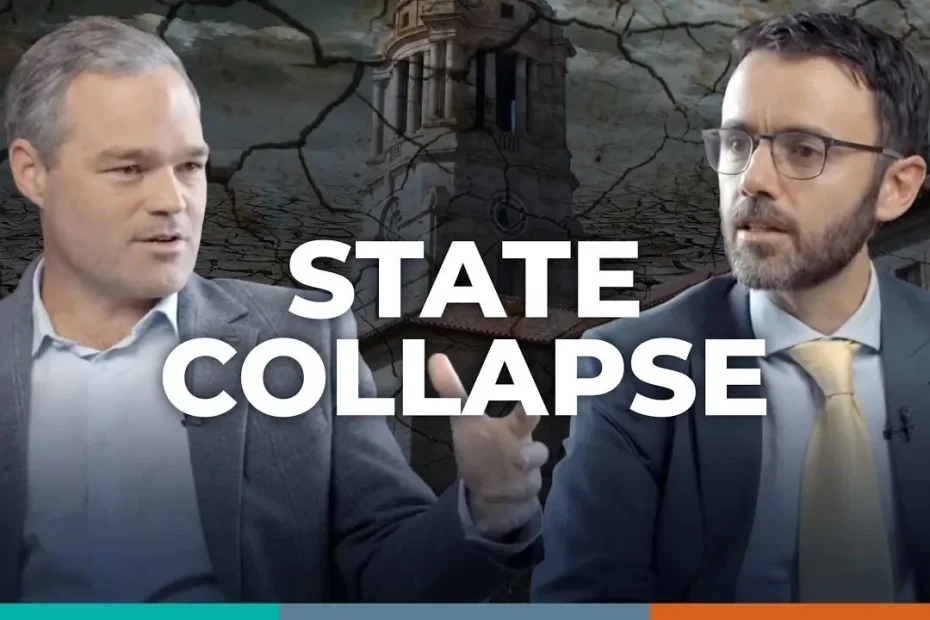
Read the full transcript of a conversation between Sakeliga’s Russell Lamberti and FMF CEO David Ansara on South Africa’s political and economic turmoil, from rising state control to mounting global pressure at The Free Market Foundation. Premiered March 10, 2025.
Listen to the audio version here:
TRANSCRIPT:
The Current Political Landscape
[DAVID ANSARA:] Russell Lamberti, thanks very much for joining us here at the Free Market Foundation. We want to talk about a lot of things, but foremost in our mind is the political economy of South Africa. Where are we at this present juncture? We’re about seven or eight months into the GNU, recently seen the postponement of the national budget, unprecedented. What’s your reading of the landscape at the moment?
[RUSSELL LAMBERTI:] It’s perhaps a bit trite, Dave, to say that we’re in a state of flux and quite a lot of uncertainty. I think a lot of people out there will probably feel like the sand under their feet is a bit shaky and a bit loose at the moment. There are signs that the coalition government that was formed last year is not really proving to be a vehicle for restraining ANC objectives, ANC program, which is to deepen state control over the economy.
Yes, it tries to do that on a kind of, let’s say, a race nationalist kind of basis. You can get into the details of that, but in essence, it wants to gain more and more control over spheres of the economy. That’s what the NHI legislation is about. That’s what the expropriation legislation is about. That’s what the Climate Act legislation is about, and I could list several others.
We’ve seen some degree of restraint, marginal restraint, very recently with the DA being able to push back against this VAT increase. We don’t know for sure that that’s been taken off the table. What we know is that there’s a deferment of the decision to the next budget, which will be held later this month. Immediately after the postponement of that VAT increase in the budget, a conversation about a wealth tax emerged, which would be arguably worse or certainly as bad.
There’s also been other conversations about, well, perhaps the ANC could get the votes it needs from other parties, which starts to maybe even relegate the DA in its kind of standing. Huge states of fluidity domestically compounded clearly by a globe that’s in a tremendous state of flux. I think the Trump administration is accelerating some of that. I think some of these trends were already in place for quite a while coming. I don’t know if this is a long-term redrawing of the global order. None of us can really know that.
Navigating Complexity in Civil Society
We have to wait. Hindsight will be 2020 in 10, 20 years’ time. But things do look like they’re shifting tremendously. That is the context in which we find ourselves as civil society organizations, a think tank like the Free Market Foundation, Sakeliga, a business organization that engages in public interest litigation on matters of economic policy and so on.
We find ourselves dealing with this increased complexity, very stimulating time to be working, but also very, very difficult and very tough to see how and where things are going to shake out. It’s a time for real clear strategy about where we’re going and what we’re doing with our own individual missions and what that’s going to mean in the environment that we’re in.
[DAVID ANSARA:] Hopefully, we can unpack some of that strategy today in this conversation. Getting back to the GNU, I think the initial premise of it, the Free Market Foundation was somewhat skeptical of this narrative, but we understood where it was coming from, that in order to check the worst excesses of ANC governance, you needed these other smaller parties, the former opposition parties, some of whom like the DA had a track record of governance, to be inside the government to act as a restraint on some of the radical National Democratic Revolution impulses of the ANC.
The NDR is a socialist paradigm. It’s a kind of a two-step process, used liberal democratic institutions and multi-party democracy to entrench itself in power and then once in power, use access to the levers of state power to actually work towards a socialist endpoint. This is very clearly documented in ANC literature, going all the way back to 1969, the Moldova Conference in Tanzania, historical relationship with the South African Communist Party and the ANC really drives that.
Socialism is a kind of intellectual lodestar within the party, combine that with African nationalism, you get quite a toxic mix. I think a lot of people welcomed this development of the GNU as a kind of a turning of the page. But what we’ve actually seen, as you mentioned, in the beginning of the conversation, the advancement of significantly hostile pieces of legislation, attempts to nationalize healthcare, dilution of private property rights through the expropriation act, which is now signed into law.
Our organizations are mounting a full frontal assault against the expropriation act. But we also have to be honest that we are in a minority of viewpoints who think that this is a risk factor. So where’s that disjuncture? And do you think the broader public, the business community that you speak to a lot, are they starting to update their model of what the GNU is?
The Reality of the Government of National Unity
[RUSSELL LAMBERTI:] Great question and I really like how you described the NDR, the National Democratic Revolutionary Program of the ANC, really well put together. And I think if we just step back with only a few months of hindsight now, the idea that this was all going to be kind of dismantled, perhaps people didn’t think it would be dismantled, but that it would be meaningfully slowed down, that the coalition government would put sand in the gears of this thing, was always, I guess, kind of perhaps fanciful, just given the level of entrenchment within the state that the ANC has.
And this is 30 years of CATA deployment, personnel deployment, deep, deep entrenchment, number one.
But ultimately, we have the ANC in the driver’s seat, the dominant partner, which could probably govern as a minority government. Yes, there’s constraints to that. There’s parliamentary kind of constraints to that. But on the whole, the evidence so far suggests that in some quite real ways, this coalition government, rather than putting sand in the gears is perhaps putting oil in the gears. Or it’s that the dominant partner, the ANC feels threatened enough that it feels like it’s time to kind of accelerate its policy program. And as it tests the waters in doing that, it’s finding very little resistance within this coalition government.
Now, we’ve seen something like resistance in this budget dynamic. But in other areas, we seem to be seeing either no resistance or something like an anti-resistance, something like a cooperation.
Agricultural Policy: A Case Study
If we look at the agricultural sector, for example, the Minister of Agriculture, John Steenhuisen, appears to be continuing on from the policies of his predecessors. There doesn’t seem to be any meaningful material change from those policies. There certainly hasn’t been a review of those policies. I mean, if you’re taking over a ministry, and this is now the opposition political party coming in, you would think that you would say, we need to put everything on the table and review what has gone before. What is working? What’s not working? What do the farmers want? What don’t they want? And really kind of do a full scale review. I don’t think we’ve seen anything like that. And on paper, we’ve seen a continuation of the policies that were in place for the election.
[DAVID ANSARA:] And what are those policies exactly? What conditions does that place on agricultural businesses?
[RUSSELL LAMBERTI:] So there’s a few policies that are being implemented already. And then there’s a raft of plans and guidelines that are kind of sitting waiting in the wings that the department intends to implement. That essentially, in their fullness amount to an array of race-based licensing and concessions within agriculture.
So within the agricultural sector, there’s various licensing regimes, there’s water licensing that overlaps between different departments, the Department of Water and Agriculture, there’s different overlapping licensing regimes, there’s export and import licensing. There’s a range of things. And then there’s a range of support that comes through various funds and levies and so on that gets dished out to various segments of the agricultural sector. And these constitute a full race-based program for the Agricultural Department.
Now, it could be that the Minister of Agriculture would like to, without changing policy, maybe de facto intends to ignore these plans and guidelines and just try and put them on ice and forestall them and walk this kind of tightrope between seemingly intending to follow through with them, but never quite doing it or just not overtly opposing them, but also not implementing them. If that’s the strategy, we certainly don’t know about it. And we’ve given the Minister a lot of opportunities to communicate that to us through very cordial communications, private, personal communications to the department.
So on the surface of it, it’s an example where we’re just seeing a continuation policy. And we need to see how that continues to shake up. But Sakeliga was opposing AgriBE before the elections. We haven’t seen a meaningful change in the plans, the guidelines, the policies, and certainly what’s been physically signed by the Minister and by his DG, is a continuation of AgriBE, race-based import and export licensing for certain products, race-based transformation funds for certain crops, and so on. So this is just an example of where we’re not seeing meaningful change. We were opposing it before the election, we’re going to continue to oppose it after the election.
Business Perception of the GNU
[DAVID ANSARA:] So that’s kind of just some thoughts on how we see this. It’s a long answer, because what you drove to in your question was, are we seeing businesses starting to reevaluate the coalition government?
[RUSSELL LAMBERTI:] From my vantage point, given the interactions we’ve had with small, medium and also very large companies, is that there’s a growing skepticism about the efficacy of this government. I think when you have an election, you go through a quite well publicized process of negotiation, and you come to this coalition government, so-called government of national unity that purports to be a new direction, to be a government of some compromise, constructive business communities kind of, in July last year, hail this as a great new optimistic direction.
And then you get a raft of signed laws, and they’re just pieces of legislation that are harmful, that will not improve the growth prospects of this country that continue to racialize the economy, that continue to bureaucratize the economy that continue to push for state control of the economy. At some point, you have to stand back and question what’s going on.
And there will be maybe some exceptions to this at the margins, but on the whole, the overwhelming perspective that you get, the overwhelming perception that you get, as you look at what’s coming out of this new government is a continuation or acceleration of socialistic policies. So at some point, you kind of got to go, this isn’t working out. It’s what’s in the box is not what was on the box last year, July or June or whenever it was.
And I think my sense is that there’s a strong realization to that, not just at the kind of small business level, but large privately owned businesses, good businesses, several hundred million, several billion rand turnover a year businesses are looking at this and seeing this is not working in our interests.
Judging the Government on Outcomes
[DAVID ANSARA:] Yeah. And ultimately, we have to judge the government on these outcomes. I think there was a lot of institutions, individuals who were prepared to give the benefit of the doubt, nine weeks into the government, but now, nine months into the government. And we need to judge this government on these outcomes on the policies and the developments that we’ve observed. What have you observed?
[RUSSELL LAMBERTI:] I think in short, David, a government will continue to ask for more time very often. But nine months is quite a substantial amount of time we’re pushing towards a year, the first year of this new government. Some deep reforms do take time. And in many ways, we actually, as Sakeliga have an understanding for and even some patience for that. But what we are looking for is constructive engagement and signs that they’re not just going with the flow.
And something you brought up was the degree to which this is the government that electors didn’t put people into this coalition government to go with the program. And at the moment, just the evidence suggests that the minor parties in this coalition are going with the program and offering a defense of the core ANC program. And I think that’s disappointing. And I think civil society organizations and voters are well within their rights to be pushing back on this and saying this is not what we signed up for.
The Broader Economic Picture
[DAVID ANSARA:] And all of this politics doesn’t happen in a vacuum. There’s also a broader macroeconomic picture, both domestic and global, which acts as a centrifugal force on South Africa. So we’ve seen this budget, and it was halted at the last minute, essentially around this VAT increase, we as the Free Market Foundation welcomed the postponement, because we were very concerned about this proposed two percentage point increase in VAT.
[RUSSELL LAMBERTI:] Yes. But what we want is a lower tax burden in general, right?
[DAVID ANSARA:] So we’re, I mean, actually, that in some respects is a more equitable form of taxation compared to others, but it’s already too high, though.
[RUSSELL LAMBERTI:] Yeah. But it doesn’t help if we now have a wealth tax or an increase in personal income tax, because that’s going to trigger even more capital flight out of the country.
[DAVID ANSARA:] Absolutely.
Budget Priorities and Fiscal Challenges
[RUSSELL LAMBERTI:] I mean, it’s astonishing that tax increases are even anywhere near the conversation in the budget, rather than deep spending cuts, significant spending cuts, many of which can be obtained quite easily. Many of which can be obtained through just doing away with known, highly inefficient procurement processes and policies.
Now, of course, scrapping these things hurt certain very narrow private interests. And those are the interests that are dictating the direction of the budget. This is not a public interest budget.
Regardless of the VAT decision, by the way, all the taxes can stay the same. If the spending is not cut, this is a budget that is against the public interest. It’s a private interest budget.
The minimum level of spending reduction that we need to start seeing in the budget, absolute bare minimum level is of the order of 100 to 200 billion rand. We’re currently running roughly 300 billion rand a year deficits give or take. That means you rack up a trillion rand of new public debt every three years. So just fiddling with little tax tweaks here and there and, I see that the DA shadow finance minister’s come out showing how 60 billion rand’s worth of cuts could be achieved.
That’s welcome. But that actually doesn’t meet my threshold for seriousness. These are massive deficits that are sinking this country into enormous levels and dangerous levels, financially irresponsible levels of public debt that have future ramifications for financial sector stability, the stability of the banking sector, interest rate stability, currency stability, all these sorts of things.
So that increase that raises a few tens of billions is even part of the conversation is completely ludicrous. The only conversation to be having in the short term is, where are 100 to 200 billion rand’s worth of cuts going to come from? And how will the budget be balanced over the medium term?
And when you look at the scale of waste in public procurement, this is absolutely doable. Without cutting people’s social grants off, without being nasty in any of those kinds of ways. The point is, you can actually do this just by cutting waste on procurement spending, and then of course, wasteful departments.
And then you can add to that, because actually, the country needs to cut 500 billion rand’s worth of spending and start running meaningful surpluses to start paying down this enormous national debt that’s racking up a huge interest bill. If the conversation is not somewhere in this zone, we’re just not taking the budget seriously. And we’re just continuing to kind of sleepwalk into the abyss here.
And it won’t happen overnight. It doesn’t necessarily happen next year. But we know that this is an unsustainable trajectory that puts this country into a more and more precarious financial and economic position.
That’s the bottom line. And so again, getting back to this coalition government that you know, is it working or is it not working? Having some success on deferring for now, we don’t know if it’s actually scrapped, this VAT increase is barely scratching the surface of the kind of pushback that we need on the budget.
[DAVID ANSARA:] Yeah. And if they don’t succeed in pushing back there, I think that sends a very clear signal actually, that the DA is a doormat in the GMA. It’s not doing nearly enough.
[RUSSELL LAMBERTI:] Correct. And obviously, I think it’s just worth reinforcing that these are significant fiscal pressures that we’re facing. This is fiscal cliff territory that we’re talking about, I mean, a 76% debt to GDP ratio. Some of the members of the government of the ruling party and of the government are saying that South Africa is running out of or has run out of borrowing capacity.
And that’s quite an explosive statement to say about the budget, but they are using essentially those kinds of words. And I suspect—I can’t know this for sure—but I suspect that the large institutions and the large banks who are the primary funders of the government, they are the primary lenders and buyers of bonds, certainly in the primary market.
But even in terms of the pension funds who hold the bonds, both domestic and offshore, I think are probably having behind closed doors very serious conversations with the government saying, “Guys, we are not absorbing more bonds, you are emitting already too many bonds—300 billion rand’s worth of bonds, new bonds every year.” In addition to the old bonds that are coming due and maturing and having to be rolled over again. And so I think there’s a little bit of a red line being drawn by these institutions.
And that’s what’s put this pressure on because to hike to propose a VAT hike of 2% in a stagnant economy, where people are taxed to the hilt, and where VAT impacts people across the board of society, when you’re a party that did lose an election or didn’t get 50% in an election and are in many ways, on the back foot to international pressure and so on—to then propose that shows some kind of desperation. And yet an inability to cut spending.
And that just shows you how strong those vested private interests are in that procurement structure. And it wasn’t only the DA that was objecting to the VAT increase, it was also the trade unions. You know, the DA has a Minister of Education, which she might be a competent woman, might be making some adjustments on the margins.
But if you don’t address the power of South African Democratic Teachers Union, you’re going to get the same outcomes that we’ve experienced over the last decades in education.
International Pressure and Trump Administration
[DAVID ANSARA:] Yeah. So I mean, if we look at this international context, we also see a big headwind coming from across the Atlantic in the form of the Donald Trump administration in Washington, DC.
And it’s been very interesting, I think, to observe the reaction, particularly in the media establishment in South Africa. There’s a lot of righteous indignation from the government, as you’d expect, a lot of defiance, which I think is a very bold choice of actions in response to the United States. But the reflex is, “Well, we won’t be bullied.”
You know, “We’re going to look elsewhere. And we have BRICS partners behind us. And we want to establish this new world order, which is at odds with the Washington consensus.”
You can argue whether the Washington consensus still exists anymore under Donald Trump. But many of the things that the Trump administration is saying are the types of topics that we’ve been talking about today in this conversation, ratcheting up of race-based laws, diluting private property rights through expropriation.
[RUSSELL LAMBERTI:] Yeah. And the locus of control is with us as South Africans, we can choose to abandon these hostile policies. And I think Donald Trump’s great crime is to point out that the emperor has no clothes in South Africa. You would have read James Myberg from PoliticsWeb put out a great little post on this about the ANC broadcasting on two channels.
And there’s a channel for the domestic audience which is race-based. It’s about the need for ongoing and endless kind of supposed redress. But really, it’s a kind of National Democratic Revolution broadcast.
And then channel two is for the rest of the world, which is “We’re a constitutional democracy. We respect property rights, we don’t have race-based discrimination,” you know, all this kind of stuff. And James pointed out the Trump administration is dialed now into channel one.
You know, it’s seeing the truth. And there’s a lot of people both within and outside the government domestically that really resent the outside world dialing into channel one. And seeing the South African story for what it is—a dysfunctional economy.
People talk about 1% growth. That’s just not true. This is a stagnant economy that falls in per capita terms and has fallen in per capita terms for a decade and a half.
Now, if you’re not growing and going backwards in dollar terms, global purchasing power terms, even further backwards, totally dysfunctional state-owned enterprises, towns, Dave, towns, not one-street villages, but proper towns across this country have actually failed. We’re talking economies that have perhaps dropped in half, maybe more, maybe by two-thirds to 70%. Just the disappearance.
I mean, I’m talking in the worst case scenarios. But just infrastructure, gone, businesses vacated, municipal governments, unfunded and totally dysfunctional, gangsterism, moving into these vacuums. And you get people who hear Trump’s executive orders and his description of what’s going on in South Africa.
And they’ll take a selfie on Table Mountain and joke about, “Look how hard life is, Trump’s obviously wrong,” because look how hard life is, and then the following week, they’re complaining about the water outages. They don’t see what’s going on in large parts of this country. They live in the urban centers, where there is growth, because there’s depression everywhere else.
And there’s this huge influx into the urban space. And so, you know, there’s activity. That’s very temporary.
[DAVID ANSARA:] Well, and not only that, this might, we might get into this in a bit. But that in itself is putting enormous strain on the metros. And so the metros, which were always the functional kind of parts of government, and it was these smaller municipalities that were failing, the metros are starting to undergo a kind of rolling failure.
Joburg experiences this on all sorts of dimensions. You get better-run municipalities like Cape Town, but nonetheless, with significant challenges and a huge strain of population influx. Same with Durban, same with Pretoria, same with East Rand and so on.
So it’s just been incredible to see that kind of backlash. And I think there’s something kind of emotive and guttural there where people don’t like that the story is unraveling. The reality unraveled a while back, and now the story is unraveling.
And there’s a kind of cognitive dissonance there and a wrestling with that. And they don’t like it that it’s coming from someone that they don’t like. You know, they might not like Mr. Trump, and so they don’t like the message. But the message is undeniable. And we know that because that’s actually very much common knowledge domestically. But somehow when foreigners say it, then we kind of get defensive.
And that’s been interesting to see, perhaps to some extent, that’s a natural kind of nationalistic, civic nationalism that’s happening. If that can be harnessed for reform, so that, in other words, if the energy could be, “Let’s make things here so that Trump is actually wrong.” Fantastic.
You know, let’s prove the American president wrong. That’s a challenge.
Policy Response and Missed Opportunities
[RUSSELL LAMBERTI:] But at the moment, what we’ve seen, in several respects, the initial response to this international pressure is kind of a verbal doubling down.
We’ve seen the signing recently of the expropriation act, the proposed introduction of all kinds of new ancillary policies to that that will undermine property rights, and several other things going on, we are seeing an escalation of what we call the third wave of BEE, we’ve got an explainer video on that. So we don’t have to get too much into the weeds on that now we can point people to that in the description, perhaps, but this is what’s going on.
And so to say that this is kind of misinformation, this is the big word that’s being thrown around at the moment. This is all misinformation, is, I think, completely bogus. And we have to recognize that this international recognition, this international dialing into channel one, it might not feel so nice.
But it’s very healthy. And it’s very important. And I think we can rail against the reality of what Donald Trump is doing in Washington.
That doesn’t change the reality itself. We need to choose our response. And I think, particularly the erstwhile opposition are missing a huge opportunity here to leverage that global attention to their advantage.
You know, pushing back against things like expropriation without compensation. Our organizations are doing that through litigation and other efforts.
[DAVID ANSARA:] Yeah. But the political response needs to be there as well.
[RUSSELL LAMBERTI:] Yeah, if I could quickly just say on this, it’s almost like this. It’s like, we’re still living in this delusion of the triumph of moral politic over real politic.
You know, the American President might offend our sensibilities, or we have, we tell ourselves a particular story about the world. And the story we’ve told ourselves about the world is that we actually all get along. And all our differences are imaginary.
And we just have this wonderful constitutional democracy to mediate all these things. And it’s the best constitution in the world and all this kind of stuff. And real politic comes along and says, actually, we’ve got real interests.
The world is a globe, the world map is a map of real competing interests. And even within South Africa, it’s a map of competing interests. We don’t just accept not being issued a license to operate because of the color of our skin.
That’s directly against someone’s economic, vital economic interests. That’s internal sanctions. That’s internal economic warfare.
It’s not just red tape that kind of slows you down. I mean, it’s fascinating, you know, people complaining about AGOA that it might be withdrawn, that the Trump administration could be so diabolical as to kind of withdraw this. Firstly, as if South Africa is a paragon of free trade.
I mean, we are not. The Department of Trade and Industry runs a labyrinthine kind of tariff system. Okay. And it’s through ITAC, and it’s all based on some spreadsheet that they’ve got there.
The Irony of Economic Sanctions
[RUSSELL LAMBERTI:] And it’s central planning deluxe. Number one, number two, we run economic sanctions internally in this country. We have internal economic sanctions, that is what BEE is, it’s a denying of trade opportunities, on the basis of some metric. And the withholding of licensing that we’re seeing in the third wave of BEE is the most extreme form of those sanctions.
So the ironies kind of present themselves, you know, there’s the sense of, “Oh, how could we be sanctioned? And how could we have these privileges withdrawn?” When that’s precisely what’s going on internally, and precisely the policies that the Americans are looking at and saying, “Fix that, and then it won’t be a problem.”
This is supposedly now an attack on sovereignty. No, no, this is called international relations. And it’s time to get real.
[DAVID ANSARA:] Yeah, I mean, I think a very good example, the response, the Minister of Minerals and Mining, Gwede Mantashe, said, “Well, if America is going to play this game, we’re going to withhold our minerals.” But it’s not really his minerals to withhold, it’s private capital that would be bearing the burden of that. And also, we’ve undermined our own national interests.
[RUSSELL LAMBERTI:] Best form of foreign policy is domestic policy, a strong domestic policy. And so through second wave, and now the third wave, we’ve put all of these regulatory burdens on miners to the extent that it’s no longer profitable to do business. And ironically, David, that makes the threat of withholding minerals less potent than it was 30 years ago.
Because our mineral output in this country has absolutely plummeted down global rankings. You know, barring one or two kind of niche metals that we have in relative abundance here, you can get your minerals from many other suppliers. But even more basic than that, withholding minerals, I mean, that doesn’t benefit us.
We turn minerals into foreign currency. And then we turn that foreign currency into appliances, goods, services, supplies for manufacturing industries and medical technology industries. And so we need to be selling our minerals, and we need to be selling them to good partners at good prices.
And that’s what mature kind of statesmanship would actually look like. Now, we don’t seem to have that at the moment, we don’t seem to have a sense of mature statesmanship in relation to these sorts of threats. And that’s concerning to me.
The Risk of Escalating Tensions
Because you’re going to see America continue likely to flex its interests towards South Africa. And I do have a concern that there is going to be ongoing negative reactions to that, which is going to lead to a dialing up of that pressure, which could lead to a dialing up of negative reactions. And I can’t say exactly where that’s going to end and how that’s going to go.
That’s a very complex dynamic. But I have seen several examples of countries around the world where America or the West has dialed up sanctions. And there’s actually been a very negative response.
And that kind of can actually spiral into bad places, where there’s a doubling down on both sides, and you get this kind of real sort of calcification of positions. That could make our jobs tricky, domestically.
My feeling is that, at least for now, this is leading to a ramping up of pressure, and a kind of an escalation of policy threats domestically.
And there might be a release valve for that at some point, maybe the pressure gets dialed up enough from foreign dynamics, to kind of cause a backing down. But I think that the work that we do, the work that you guys do, really is becoming increasingly, incredibly and increasingly crucial in this time, because we do face a risk that a threatened government that’s had no real bright light shone on it for very long, reacts negatively, and turns this country into its kind of own sort of personal harvesting fiefdom, you know, actually doubles down on the policies and goes, “Well, okay, if we’re going to get punished for BEE and we’re going to lose this kind of access. Let’s just double down, then let’s go all in on that.” Because what’s the endgame?
[DAVID ANSARA:] Because we’ve seen countries like Zimbabwe, Venezuela go down this confiscatory socialist path, and they get isolated as a consequence sanctions, etc. And then it feeds on itself. It doesn’t exactly create an environment for flourishing of liberty.
[RUSSELL LAMBERTI:] And those regimes turn inward and start to both those examples. And you know, someone can nitpick that there are differences between South Africa and those countries. And that’s certainly true.
There are some institutional differences, and not everything’s exactly the same. But in those two examples, you saw an incredibly negative response to that harsh reaction. Now, the counter to that might be well, we’re still going to put the harsh pressure on because we disagree with what you’re doing.
And let’s not forget that it started with Chavez’s socialism, his undermining of property rights, his nationalizations, his confiscations, let’s not forget that that’s where it started. But where it can end is hyperinflation, and total collapse, you know, and we’re not there. But this is precisely why this is the time for serious diplomatic efforts, both state to state, non state to non state, and non state to state, and decentralized diplomacy is very much the order of the day.
South Africa’s International Relations
[DAVID ANSARA:] Yeah, I think South Africa is really ahead of the curve in that respect. I mean, the organization has engaged in diplomatic efforts with a variety of countries and also other organizations. But yeah, I think one of my concerns is that perhaps there’s a general sense that the US relationship to South Africa is important.
And that’s shared by many South Africans and agricultural space manufacturing, what have you, but that perhaps the ANC doesn’t value that relationship and is actually deliberately trying to sever that relationship. If you look at the decisions, who is appointed as the ambassador to the United States? What is the diplomatic posture that is taken towards the United States?
I think the Trump administration has been very effective in its engagements with Colombia and Canada and the Greenland example where they’ve, they know the extent of the bargaining power. Yes, that if you threaten Canada, very quickly, you’ll get some kind of response because that relationship is important. Yes.
But maybe that strategy won’t be as effective in the South African example. What I’d like to maybe post to you is why, is a hubris? Like, what makes our government sit there and go, we don’t need this relationship to be so good?
Do they really believe that? Or is it just complacency from decades of everything you say and do in South Africa, guys, is great, and you’re just going to get access and you’ve got the moral high ground. And that’s where that’s the way we are.
I mean, perhaps they’ve just been, is it like that they’ve been lulled into that? Or do they perceive like a hard politic ability to turn to pivot away from the US to? I mean, people talk about BRICS.
I’m not sure that’s actually even a thing. But yeah. Look, maybe we can’t get into the whole relationship with Iran in this conversation.
[RUSSELL LAMBERTI:] But I’ve had conversations where people suggest that there’s a resource component to that patronage component, but also an ideological aspect to it, where the, I think the relationship with the United States has always been, again, on this kind of two channels kind of level, where at various fora, the ANC government has been happy to denounce American imperialism, on the one hand, but then also to take PEPFAR funding, on the other hand. And I think the post Cold War, institutional global arrangements have allowed that to kind of happen. But I think Trump has really ripped away at that consensus.
And so now the ANC can’t play that game, they’re either friends or foes. And I think perhaps they’re moving towards being foes and quite intentionally.
[DAVID ANSARA:] Yeah. And I mean, if this order is changing as rapidly as it looks like it might be, really interesting question too, as one spans the globe is who’s going to change with it? Who’s going to adapt quicker, quickest, and who’s not? A country like India, I think is engaging a very effective strategy.
India’s part of BRICS, they’ve had a historical conflict with China. They had border wars. And even within recent years, they had conflicts with not hot conflicts, but people beating each other with sticks in the Himalayas.
But they are prepared to engage. I think it’s so important that you raised India. Friends with America, very good friends with America, trade with Russia, trade with Russia, part of BRICS.
I don’t know for sure, but seem to keep kind of silent or neutral in the Middle East kind of situations that are able to manage those relationships maturely. Might have a bit of tension with China in some respects, they have a very similar sphere of kind of influence. I’m not an expert on Indo-Chinese relationships.
But this is mature. This is like very mature international relations and acting within the national interest. What’s in the interest of India?
So throwing tantrums when things don’t go your way in international politics is definitely not the mature approach.
[RUSSELL LAMBERTI:] So you were going to add on I guess the point is Charles de Gaulle’s famous aphorism that countries don’t have friends that have interests.
[DAVID ANSARA:] Yeah. And what is South Africa’s interest?
Local Governance and Decentralization
[DAVID ANSARA:] But yeah, maybe we should zoom right in from the international to the domestic and get a bit more granular.
And Sakeliga has been doing some fantastic work in trying to arrest the decay of some of these hinterland or platteland kind of municipalities that have collapsed. And how do you protect business interests in a context like that? Because there’s still a lot of value there to be preserved.
And we sit here in Northwoods house in Johannesburg, an emblem really of the greatness of old Johannesburg and the wealth that was created here. And we certainly have a beautiful view behind us of northern Johannesburg. But when you get down into the ground level, you see a lot of the symptoms of misgovernance.
[RUSSELL LAMBERTI:] Below all those trees.
[DAVID ANSARA:] Yeah, yeah. I often joke that Joburg is nice from far but far from nice.
But yeah, so, you know, and I think part of the conversation I think should be around the effects of centralization. Because we have this vast metropolis that is equivalent in size to some other cities like Los Angeles or Mexico City, that is governed over there in Braamfontein, or rather misgoverned. And the mayor often challenge people to name who the mayor of Johannesburg is.
[RUSSELL LAMBERTI:] Don’t ask me on camera.
[DAVID ANSARA:] Yeah, don’t worry. If you don’t know, you’re not alone in that.
But he was refreshing in his honesty when he came to power. He said, “Listen, don’t expect anything to change.” I was grateful that he was upfront with the public.
But now, my request to him is that I cannot please no longer pay you my rates, because can we start trying to change something?
[RUSSELL LAMBERTI:] Yeah. You know, and I think that a lot of people, there are communities here, schools, businesses, institutions that people care about. And they don’t just want to join the great backtrack down to Cape Town. Their lives are here, and they want to see a city that flourishes.
But part of that is about saying, Okay, well, actually, let’s be honest, has this paradigm worked? The city of Jo’burg as a political administrative unit is only really about 25 years old. The city itself is about 125 years old.
[DAVID ANSARA:] Also young.
[RUSSELL LAMBERTI:] Yeah. But it’s very plural, it’s very diverse, you know, regionally, geographically, in terms of the different cultures that reside here.
And so these neighborhoods, these communities, I think the only answer really should be that they should have more authority over their affairs. And so I’m a big proponent of actually splitting up the city of Johannesburg into smaller administrative units.
[DAVID ANSARA:] Yes.
[RUSSELL LAMBERTI:] But very importantly, that’s not just a kind of a zoning question. They must actually have authority of a rate collection, and how those rates are spent. Otherwise, you’re just going to get bureaucratic duplication, more costs.
So I think we’re starting to see the genesis of this in the city. We have initiatives like the Reimagine Randburg, for example, which has gone through serious service delivery problems. The various security companies, ratepayers associations, the community policing forums, a lot of people, civic minded people care about the city and want to kind of help to ameliorate some of the worst effects of the failure that’s coming from from the center.
But it’s not just enough to kind of put band aids everywhere. Yeah, you actually need to change the entire governance model. And I think that’s, I think the moment for that is upon us.
Decentralized Scale: A New Model
[DAVID ANSARA:] I really love this direction of thinking. And of course, getting from here to there is hurdles. It’s tricky.
It’s politically difficult. There’s a whole bunch of things. But the direction of thinking, I think, is spot on.
We think of this concept of the idea of you get centralized scale. And that’s typically something like a central point of failure. So you get, it’s very scalable in many ways, but it’s a central point of failure.
ESKOM is a good example of that in the energy space. And then you get kind of decentralized non scale. Okay, and that’s like a solar panel on everyone’s roof.
It’s decentralized, but that’s not scalable. Everyone has to buy an individual unit of solar panel and battery and so on and rig it up. And it’s very expensive, but it gives you some resilience.
But there’s something very beautiful in between, which is decentralized scale. And in the energy space, that would look something like non-ESKOM power stations around the country, you know, with local grids, regional grids, connecting into interprovincial grids, and so on, where you get, but you’re still getting meaningful scale. A lot of what you see in a place like Joburg is some really good initiatives.
Decentralized Solutions for Urban Renewal
[RUSSELL LAMBERTI:] You get people trying to fix the potholes in Parkhurst, and you get people trying to solve crime issues in Edenvale and their little local place. And some of those are fantastic. A lot of them, though, constitute something like decentralized non-scale. So they’re expensive. They’re hard to replicate. And they create nodes of resilience.
But I think, and so they must continue. But I would love to see something building up into something like decentralized scale. And I think that’s what you’re talking about.
Kind of these administrative zones that start to really be able to, in a more decentralized way, repair, restore, and start fixing Johannesburg. But with enough scale. So Randburg, whatever you call Randburg, whatever you demarcate Randburg to be, it’s going to be a few hundred thousand people. I mean, at least right, this is a big area. I don’t know a place like Edenvale and Edenglen. Or Bedford View, those sorts of areas, or areas in the south. I mean, these all constitute seriously big areas. So already they would actually be tricky disaggregations to manage.
But we have this ridiculous situation under this new dispensation, where we’ve created these metros that have the same population as a country like Denmark, with very, very poor executive capability, very little revenue raising capability, very ineffective. And so you have a dysfunctional group, sitting in Braamfontein, trying to run an entity that’s the size of Denmark population wise, and much more complex than Denmark, probably because it’s high density.
It’s not culturally homogenous. You’ve got major wealth disparities; Denmark’s a very income-equal country. So the complexities of trying to run Johannesburg are enormous.
So yes, we have to start reimagining what urban, what metro renewal looks like. De-amalgamation on the books, it seems to me to be a very difficult concept to politically get there. Because the cities were set up like they are for major redistributional purposes, where wealthy ratepayers in Sandhurst, or somewhere in Johannesburg are going to subsidize Soweto, or Alex or what have you.
However, even if you concede that kind of redistribution imperative, I think you can still get it with a lot of this decentralization, quite frankly, by breaking up Ekurhuleni, breaking up Johannesburg, breaking up Pretoria. So I really like the direction of thinking. How we get from A to B, we haven’t gamed that out.
Clearly, most of our work happens in small town municipalities, where we’re trying to create the jurisprudence and the legal precedent for real kind of recovery and for well-organized non-state entities to be able to take over core functions of those towns. My sense is that there could be a similar model in the metros, but at that kind of local intrametro level.
Professionalizing Services Through Privatization
[DAVID ANSARA:] On the weekend or join a night patrol and I think that is a valid concern and as proponents of free markets we believe in a division of labor. Correct. So part of that is embracing privatization as well as decentralization to say there’s nothing fundamental about the reticulation of water.
[RUSSELL LAMBERTI:] And professionalizing these services, that’s also where the scale comes from. So one guy fixing potholes doesn’t scale. So yes by all means fix the pothole but that really isn’t a scaled solution and it’s very expensive per unit.
So actually professionalizing something at a level of organization and that means coordination and that means a bit of politics—not in the political party voting sense necessarily—it just means that life’s complex and if you want to get things done at a reasonably aggregated scale even just in these suburbs below us here, you’re going to run into the WhatsApp groups that are angry and you’re going to run into people with different ideas of how to do things and so there’s a kind of local diplomacy that requires.
And so yes it’s privatization meets, I think, for-profit execution capability meets some kind of nonprofit structured entities that are non-state as well that can facilitate the quite complex coordination that’s required at reasonable aggregation and scale. And so that might sound very abstract to the viewers—it is a bit because to concretize that is difficult and it means different things in different areas with different dynamics and different income groups and all sorts of things—but we’re talking about meaningful coordinated solutions that are outside the state paradigm to the extent that formal politics allows for this decentralization if possible, but outside the state paradigm if necessary.
[DAVID ANSARA:] Yeah I think that’s a very important mindset shift as well that it’s not just about voting harder and hoping that better political leaders come along that can now occupy these seats of governance and then things will start to turn around.
You actually have to build power outside of those structures in order to act as a check against that and the consequences are quite dire just south of us. I mean I am part of a running club that starts off in Parkview and we go for long runs through the Johannesburg CBD and you see the consequences of capital flight in suburbs that used to be very prosperous, Killarney, Yeoville, Berea. These are places that once were hives of activity and now you see many vacant buildings, hijacked buildings, dereliction and that is the consequence of not taking action so I think we need to internalize the locus of control and also think a bit more imaginatively about how we can offer these scalable solutions to state failure.
Building Power and Legal Strategies
[RUSSELL LAMBERTI:] Absolutely and only footnotes I want to add to that is—and it really latches on to what you’re saying—is when we talk about creating decentralized centers of power, influence and leverage, so important because the question comes down to if you try and solve a problem and someone else can come and stop you from doing it, you haven’t amassed sufficient power to in turn say to them “no, actually we will solve this, you’re out of jurisdiction here.”
That gets into grey and sticky and tricky areas around the law and so on which is also why when we do a lot of this work in smaller towns it’s a two-pronged strategy. There’s an organized entity that can execute on mission and there’s a litigation strategy in parallel to that that creates the space through real concrete litigation that allows the space for these entities to work and to start taking over, taking authority in these towns for the public interest and for the good of everyone because having water is better than not having water. There’s no debate about that.
It’s not a political issue. Solving these problems is better than not solving them and so a good litigation strategy can work alongside a really hands-on kind of practical strategy. I think a lot of times we see a good lots of chutzpah and gusto with the practical strategy.
A lot of very active WhatsApp groups. Yeah active WhatsApp groups and even people getting on the ground and solving some physical real things on the ground there but I’ve also heard stories probably just a few hundred meters from here where residents have tried to fix things and the city has come and tried to stop them at their own expense from fixing things and in this particular instance this little group actually pushed back, got their own private security to kind of surround them while they literally fix potholes in Johannesburg.
So it was like a contest between the guys who wanted to fix the potholes and the guys who were saying you’re not allowed to but we’re also not going to do it. Really crazy situations but imagine those kinds of efforts. Imagine a thousand of them happening in Johannesburg today.
The city cannot react to that and so we’re getting there. We’ve got to try and really figure out the paths and mechanisms to this kind of outcome.
[DAVID ANSARA:] Nobody wants to see state failure but there’s also an opportunity there that as the state becomes weaker independent civil society groups from the bottom up can start to fill the void left by the retreating state and we have a choice there as well.
It can either be a disorderly process where you have criminal gangs and syndicates coming and taking over and filling that void or you can have responsible civic organizations that are rule-bound but also bold in acquiring power and building value for the future for all South Africans. So I think that’s what our respective institutions, our organizations are trying to achieve and we hope that many South Africans can see the value there and support our cause. Dave, great to chat and I would love to do it again in the future.
You’ve got such a lovely venue here at Northwoods House and I’m glad we got into some really important topics today. Thanks.
[RUSSELL LAMBERTI:] Thank you for the conversation Russell.
[DAVID ANSARA:] Thank you for watching this conversation between myself, David Ansara and Russell Lamberti of Sakeliga. Organizations like the Free Market Foundation, like Sakeliga and other civil society groups are pushing back against hostile policy in defense of your freedom. If you value our work please do contribute to the cause of the Free Market Foundation.
There’s a link in the description below where you can help us financially and if you can’t help us financially you can assist by liking this video, subscribing to the channel and also sharing this content with your friends or family. My name is David Ansara. Remember, stay free.
Related Posts
- Daniel Davis: Iran Reopens the Strait of Hormuz (Transcript)
- Tucker Carlson Show: w/ Russell Brand (Transcript)
- Transcript: Denmark and the Future of NATO: What Comes Next for Western Security? @ Today’s Battlegrounds
- Transcript: President Trump Remarks on Tax Week in Las Vegas – April 16, 2026
- Transcript: The Real Puppet Masters of America – Tulsi Gabbard @ Modern Wisdom