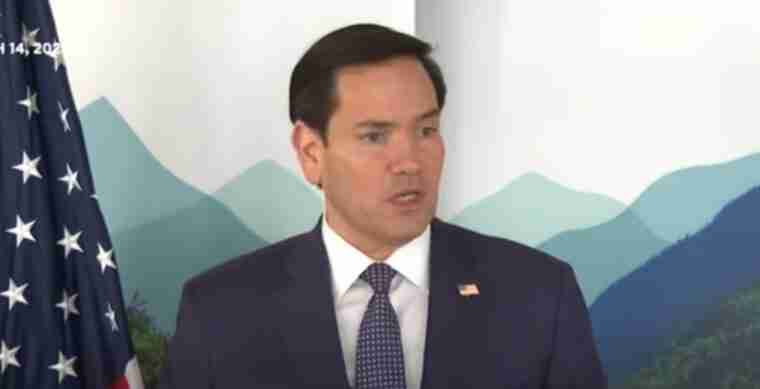
Read the full transcript of Secretary of State Marco Rubio remarks at the G7 Summit in Quebec, Canada, March 14, 2025.
TRANSCRIPT:
Opening Remarks on G7 Summit and Bilateral Relations
[MARCO RUBIO:] I just had a couple points and I’ll answer your questions and I’m sure you’re dying to get home. First I want to thank Canada, they did a great job of hosting this, and Foreign Minister Joly who had to leave here, she’s going to go be sworn in, remain in her post, and she’s become a friend in the last few weeks as we’ve worked together. I knew her a little bit before, but gotten to know her now, obviously, in this role. They did a great job of hosting at a beautiful place, and so we’re grateful to them.
I think we have a very strong statement from the G7, hopefully you’ve gotten that by now and have been able to see it. Very strong statement on a number of issues of mutual concern, we touched those topics, it was a really good engagement, and obviously there’ll be some follow-up. And it sort of sets up for the leaders meeting later on this year, and we hope that’ll be equally productive. But we felt really good about the statement, worked hard on it, I think it reflects our points on a number of topics.
And I would just say the one takeaway, you’re going to ask me questions about things that are going on in different bilateral relationships and so forth, but I think what’s important and something I said at the outset, which everybody agreed with, is that we’re not going to allow the things we disagree on, and we’ll disagree on things, to keep us from working closely on the things we agree on, and there are a lot of those. And hopefully the statement reflects that and our actions will reflect that. And so, I think we feel really good about it.
Update on U.S.-Russia Negotiations
The other announcement, and I think that’s already reflected in the President’s statements, there was a, what we felt was a very positive and productive engagement yesterday with President Putin and Special Envoy Whitkoff. Hopefully he is on his way back, he should be back, and hopefully we’ll convene this weekend, we’ll examine the Russian position more closely, and determine, the President will then determine what the next steps are.
Suffice it to say, I think there is reason to be cautiously optimistic, but by the same token we continue to recognize this is a difficult and complex situation. It will not be easy, it will not be simple, but we certainly feel like we’re at least some steps closer to ending this war and bringing peace, but it’s still a long journey. It’s a journey of many steps. But this is positive momentum, obviously we’ll see what Russia and others are willing to do. It’s not just Russia, obviously it has to be things acceptable to Ukraine.
But it’s been a good week on that front, but there’s a lot of work that remains to be done. But there’s reason to be cautiously optimistic, but we’ll know more once Special Envoy Whitkoff, Ambassador Whitkoff returns, and we have a chance to all convene and talk about it. Obviously the President is the ultimate decider on next steps for the United States. Okay.
Questions from Reporters
[REPORTER:] Do you trust Putin?
[MARCO RUBIO:] I think it’s an irrelevant question. I think in foreign policy, it’s not about trusting, it’s about actions, it’s about things that you do. So in the end, on something like this, you can’t just say you want peace, you have to do peace. And that’s true for both sides in any conflict, in any war, in any engagement.
So I think ultimately, all these things, I would just encourage you guys if we’re going to be serious about foreign policy to sort of navigate away from some of the, this is not a reality show, this is not about personalities, this is very simple, you either do things or you don’t. There are things you are doing and things you’re not doing. And that’s what foreign policy is driven by, and that’s how our decisions should be driven by.
So unfortunately in foreign policy, oftentimes you will have to work with, and I’m not talking about President Putin in particular, I’m talking about generally, you will have to work with people you don’t like in foreign policy, and oftentimes you will have disagreements with people you like. Sometimes you will have to figure out how to work together with nations that are not aligned with you on most issues. And in other cases, you may find yourself unaligned on an issue with a nation that you work with very closely on a bunch of other things. That’s not just now true today, that has been true throughout the history of mankind and certainly the relations between nation states.
So I think it’s important, I get there’s this temptation to cover foreign policy the way we cover domestic policy and the way we cover other things in our society, but foreign policy about nation states pursuing what they have interpreted to be in their national interests and balancing that is what the art of diplomacy and the work of foreign policy is all about. So we need to sort of be mature and open-eyed and realistic without losing our idealism, without losing what we hope the world will look like and want to shape it and be a part of. But by the same token, we have to make pragmatic decisions every single day, and that’s not true today, that’s always been true, always.
[REPORTER:] Do you have any tough lines from Mr. Witkoff? This was a late meeting, it went hours long. Is there anything that he shared? And then when you do examine the Russian position, that the comments by President Putin were quite convoluted and tough to decipher.
I wonder if you think that he’s playing for time.
[MARCO RUBIO:] Well, I think you’re not going to, this is not something that’s going to play out in press conferences as I stand at a press conference. But this is, again, I go back to the point I just made. When you want, if you think about the most recent example of ceasefire negotiations, which was what happened in Gaza and with Israel and so forth, yeah, there were newspaper and there were articles and there was news stories about it, but ultimately you found out what the results were after the fact. And in the meantime, you saw public statements from different sides in regards to what they were going to do. I think this will be no different.
So certainly, we’re not going to make our foreign policy decisions on the basis of what a leader says, simply says at a press conference that somebody puts up on social media posts because you’re some blogger close to the Kremlin or something like that. And likewise, I don’t think that they’re going to do that either. So I would just say that this is going to play out the way things of this nature and caliber have traditionally and normally play out. And that is with the leaders of the countries involved speaking, not in front of the cameras, not in front of the media, but in these negotiations that happen and these talks that happen.
So I don’t want to, I’m not going to comment on what President Putin said other than he said he agreed with it in concept. So well, again, he said that at a press conference, as I said, and I go back to the phrase I used earlier, I think there is reason for cautious optimism that something good could come of this. But ultimately, we’re going to wait for Ambassador Witkoff to return. He’s not back yet. We’re going to reconvene. Obviously, I spoke to him late last night and he spoke to the President well before that. I may have spoken to other members of our team. I’ve been here. But ultimately, we’re going to reconvene and the President will have options available to him and decisions will be made after that. But I don’t want to speculate or characterize anything beyond what I’ve just said until we have had a chance to sit down with Ambassador Witkoff, who’s still overseas and in travel.
[REPORTER:] I just want to follow up on that point, then, Mr. Secretary, because on the way here, you said you were seeking an unconditional acceptance. I mean, clearly, Mr. Putin is adding a whole series of conditions, and also the President says this should be unconditional.
[MARCO RUBIO:] Well, how do you know he’s adding conditions?
[REPORTER:] From what he said publicly.
[MARCO RUBIO:] Well, I go back to the point I made. Let this thing play through, okay? And then let’s figure out what – let me at least talk to – let’s let the team get together on a state side of this and talk to Ambassador Witkoff and go through some of —
[MARCO RUBIO:] Again, we’re not going to be involved in this process where I’m being asked to take a position of U.S. policy on the basis of what someone said at a press conference yesterday. So we’re going to work through this thing in a normal, sane fashion. We’ll figure out where we are based on what I know at this moment with my conversation with Ambassador Witkoff – he’s not here yet – is we’re going to – I feel like there’s reason for cautious optimism. I think the President shared that today in his two social posts. There’s a lot of work.
I have never told anybody that this is going to be easy, fast, simple, slam-dunk. It’ll be hard, but it’s important work. We are a better place today, I hope, I believe – we have reason to believe – than we were a week ago, but we still have a long way to go. It could come together pretty quickly if everyone aligns, but I don’t know how aligned we are yet. That’s what we’re about to find out. So cautious optimism is about the best phraseology I could use at this moment based on what we know. We’re going to keep working on it. But the fundamental element of the President’s proposal was to be an immediate ceasefire.
[REPORTER:] And that’s the proposal. How long does Putin have?
[MARCO RUBIO:] Well, in terms of long for what?
[REPORTER:] How long does – because there are those who say he’s playing for time, but this is adding conditions, adding conditions.
[MARCO RUBIO:] Well, this war’s been going on for three years, so I think the question – and with no end in sight at this point without this intervention by President Trump. So I think the question is – the fundamental question really is not how long. I think the question is are we actually moving towards a ceasefire or is this a delay tactic?
I’m not going to answer that because I can’t characterize that for you right now. I think we’ll know sooner rather than later, and a lot of that will be based on the conversation Ambassador Witkoff had yesterday and other factors that are in play. But we’re not there yet, but we will get there. We want it to be – the President wanted it to be yesterday and the day before. But we’re certainly at least talking about peace for the first time in three years. And now we’ll have to figure out how close we truly are, and that’s going to take some time. And Witkoff’s not here yet, so – here meaning stateside.
Security Arrangements for Ukraine
[REPORTER:] The Joint Statement says that there is a need for robust and credible security arrangements for Ukraine. How would you define that based on your conversations here at the G7? What are robust and credible security arrangements?
[MARCO RUBIO:] Well, that’s to be determined by the negotiations. Here’s what I want to encourage everybody to do. Bifurcate two things, okay? The ceasefire and the conditions for everybody to stop shooting at each other. What will it take to get everybody to stop shooting at each other? And then moving to a negotiating table on settling the war with finality. Two separate processes.
Process number one is, what do we need from both sides in order to stop the shooting and the fighting? So that you can get to a negotiating table. That’s the second phase. As part of that second phase, there will obviously – every country in the world has a right to security, has a right to defend itself, has a right to protect its territory. That will have to be part of that conversation. And it will have to be something that involves not simply the views of the United States, but other countries that are involved in that.
I’ve repeated this over and over again. The European Union has imposed significant sanctions on the Russian Federation and on individuals inside of Russia. So they will have to be consulted and they’ll have to be engaged in this process and so forth. So let’s not predetermine or start putting everything ahead of itself here.
The process of what long-term security means for Ukraine, that will be something that Ukraine will obviously have to agree with and that will have to be worked through as part of that second phase. But we can’t get to the second phase until we get through the first phase. We think it’s very difficult, very difficult to negotiate lasting peace and security in the midst of an all-out war. And so we have to try to lower that so that it makes it possible to move to phase two of this.
Potential Sanctions and Costs on Russia
[REPORTER:] Mr. Secretary, the statement that you issued a little while ago also notes that the G7 discussed ways to impose costs on Russia should that become necessary to include caps on oil prices, additional support for Ukraine using seized sovereign Russian assets. But it said it discussed them. You didn’t agree on them. Is there any agreement within the G7 on these particular measures and just what they should be in what order and what might trigger them? And why did you discuss them? It appears so cautiously optimistic.
[MARCO RUBIO:] Well, first of all, they were raised because the Europeans have their own set of sanctions and new ones they would like to impose. And certainly the United States is not a member of the EU. We don’t have a vote at the EU. And so whatever they determine and decide to do, we can’t control it. They ask us for our input, we’ll give it to them, but that’s not what’s happening right now.
So yes, it was discussed. As far as U.S. sanctions are concerned, the President’s made clear – the President on a number of occasions in the past week has reminded everybody that the U.S. has these options available to it. But he doesn’t want to do that right now because he’s in the hopes of attracting people both sides to a process where we can negotiate peace. And I’ll leave it at that. There really is nothing to add to that at this point.
Ukraine’s Territorial Integrity
[REPORTER:] The agreement reaffirms unwavering support for Ukraine’s territorial integrity, which has been largely absent in various U.S. statements since January 20th. What led you to subscribe to this at the time?
[MARCO RUBIO:] But that’s not a change in public policy. The United States has never said that Russia – I’ve never heard President Trump say that Russia has a right to take all of Ukraine and do whatever they want there. So that’s not inconsistent with that statement.
That is separate from the issue we face today, and that is that as it stands today, there is a war going on that has no military solution to it. Neither Russia nor Ukraine can achieve its maximalist military aims. The only way to end this war is through a process of negotiations. Be it in business, in commerce, or in geopolitics involves both sides giving something, both sides making concessions. That’s just obvious.
I don’t think that should be sort of a newsmaking statement. That’s the reality of any conversations that exist in order to end wars, is that there has to be some level of concessions. What those concessions are remains to be seen. That’ll have to be part of the negotiation. But it’s not going to be helpful to enter into those negotiations making blanket statements that may give an excuse for one side or the other not to participate in it. So we’ll have to get to that stage where these things are discussed. And ultimately, both sides – whatever happens, both sides will have to agree to it. And that’s true of any negotiation when you’re trying to end a war.
U.S.-Canada Relations and Tariffs
[REPORTER:] Mr. Secretary. I’m understanding your point about this not being a reality show or personalities. Ukraine, or anything else for that matter, your boss has, shall we say, a rather strong personality. And I’m wondering, in light of that and his repeated comments about Canada becoming or should be the 51st state, the whole tariff situation, which intensified as we were on our way here after your big announcement in Jeddah, did that complicate your discussions at all?
[MARCO RUBIO:] In our – I mean, obviously, with a foreign minister, Canada has. But it was not a topic. It was not on our agenda. I told you that would not be discussed.
Tariffs were. So let me explain on the tariffs. This is important for everybody to understand. This keeps being characterized as a hostile move against our allies. These are global tariffs on steel, on aluminum, on autos, on semiconductors. And actually, the President stated this. And then-
[MARCO RUBIO:] In April, the intention to put tariffs, assuming that the study comes back and so forth. But what they’ve discussed is a global reciprocal tariff. Understand what that means. That means basically whatever some country charges us, that’s what we’re going to charge them. The goal the President has made very clear is he wants to reset the baseline of international trade, which he believes, and I agree, is unfair to the United States. This is not meant as a hostile move against Japan or Germany or anybody else. This is about balancing and fairness in trade.
So he wants to reset the baseline and once that baseline is reset, then you can enter into bilateral negotiations with individual countries about changes that can be made to our bilateral trade so that it’s fair for both sides. That’s his goal. In his first administration, the President did tariffs as well. What he was disturbed by in hindsight is the fact that they included a bunch of exemptions that basically made them meaningless. And so what he wants to get back to is basically fairness in trade. It’s as simple as that. We want to charge other countries what they charge us.
And then ultimately, once the baseline is reset, and then in addition to that, there are industries that are critical to the United States and to our domestic security and our future. And he’s identified them. Steel, aluminum, semiconductors, automobile. These are things that we believe are in our interest to have a domestic capacity and we have to protect these industries from what we feel is subsidization and unfair competition from abroad.
This is not meant to be hostile towards anybody. It is meant to be friendly and supportive of our national interest as a country. Once the baseline of trade is reset in a way that’s fair and equitable, then we can engage in the process of bilateral negotiations with individual countries, including our allies, to set up a more sustainable and fair long-term trade arrangement between our respective countries.
Questions on Canada-U.S. Relations
[REPORTER:] Excuse me, Mr. Secretary, at your meeting with Foreign Minister Jol, do you understand why the Canadians are taking such umbrage at these comments coming from the President?
[MARCO RUBIO:] The Canadian government has made their position, how they feel about it, clear. The President has made his argument as to why he thinks Canada would be better off joining the United States for economic purposes. There’s a disagreement between the President’s position and the position of the Canadian government. I don’t think that’s a mystery coming in and it wasn’t a topic of conversation because that’s not what the summit was about.
[REPORTER:] Mr. Secretary, you said that the tariff policy was not hostile. However, President Trump yesterday in his social media post said that the EU previously had been hostile and abusive towards the United States. How do you square that? And secondly, is he serious when he’s talking about the 51st state being Canada?
[MARCO RUBIO:] I’ve already answered the question about Canada. We’re not discussing that here today because that’s not what the purpose of this meeting was about. As far as the question that you’re asking me about hostility, yeah, you look at the EU. The EU has a GDP basically comparable to that of the United States. The composition of their economy is similar to ours. These are not developing countries, these are developed countries, and yet they have a significant trade surplus with the United States, even though our economies are pretty much the same. These are not low-wage countries. That’s a problem.
All the President is saying is we need to equalize treatment. Whatever they do to us, we need to do to them, in addition to pointing to certain sectors that we have to protect. Who can argue against the idea that if some country charges us X to export our products, we should charge them the same?
I get it. If you’re a country or the EU that’s benefiting from the status quo, you feel it is hostile to change the status quo because it’s to your benefit. The problem is the President of the United States is looking out for the United States, both in national security and in economic relations. We will reset the basis of our trade relationship, and then we can enter into negotiations for something that’s enduring and fair to both sides. That’s what the President seeks to do, and that’s what begins by resetting at a reciprocal way the amount of tariffs we charge one another in our trade relations.
[REPORTER:] Mr. Secretary, I know that we’re not speaking about Canada becoming the 51st state at this meeting, but I’m asking you now, do you consider what the President has said about Canada becoming the 51st state, is he serious?
[MARCO RUBIO:] I’ll tell you how that came about. He’s in a meeting with Trudeau, and Trudeau basically says that if the U.S. imposes tariffs on Canada, Canada couldn’t survive as a nation-state, at which point the President said, well, then you should become a state. And that’s where this began. That said, the President has made an argument for why. He says he loves Canada. He says he made an argument for why Canada would be better off joining the United States from an economic perspective and the like. He’s made that argument repeatedly, and I think it stands for itself.
Immigration and Visa Policies
[REPORTER:] Mr. Secretary, the Trump administration is expected to invoke the Alien Enemies Act of 1798. We have to dust that off. A lot of people are not familiar with it. Can you help us understand how the Trump administration plans to use these powers?
[MARCO RUBIO:] That’s a question for DHS. It’s not a question for us. What I can tell you is, from our perspective, unrelated to that, is that we will continue to look for people that we would never have allowed into this country on student visas had we known they were going to do what they’ve done. But now that they’ve done it, we’re going to get rid of them.
And we are continuing to look for that. And so in the days to come, you should expect more visas will be revoked as we identify people that we should never have allowed in because they lied to us. When they said they were coming here to be students, they didn’t say they were coming here to occupy university buildings and vandalize them and tear them apart and hold campuses hostage. If they had told us that, we would never have given them a student visa. Now that they’ve done it, we will revoke those visas. And as the days go on, every time we have a chance to revoke them, we will because it’s not in the national interest of the United States for them to be here.
Relations with China
[REPORTER:] The seventh joint statement has some very strong language on China. Could you please describe the sentiment of the discussion behind closed door? And also, do you have anything on a potential meeting between President Trump and CCP Secretary General Xi Jinping? Will that be in China or in the United States? Thank you.
[MARCO RUBIO:] Well, I have no… I think the President at some point will meet. They will meet. I don’t know when that will be. I don’t believe there are any plans currently for that to happen, but I’m sure it will happen at some point. The President engaged with him in his first term, and I expect he will do so again. And he should. These are the leaders of two big, important, powerful countries. And the leaders of powerful countries, whether they agree on things or not, should communicate for the safety and well-being of the world.
As far as the statement is concerned, I think it reflects a growing acknowledgement that the Chinese Communist Party has pursued both economic and foreign policies that allow them to benefit from all the good things about the global order, but ignore all of its responsibilities in ways that leave us in danger of being, not just us, but the broader world, of being overly dependent on China for critical supply chains, for rare earth minerals, for key technologies.
In the case of Europe, you will continue to hear a lot of frustration on their part that Chinese overproduction, for example, of electric vehicles are dumped into their economies. And so guess what they have done? They have imposed tariffs. You know what Canada did? They’ve imposed tariffs on China as well, because that’s what countries do when they feel like they’re being treated unfairly in trade and commerce. And we support them in doing that. We think that was the right choice in their regard. And we’ve imposed tariffs on China as well. Yes, sir.
REPORTER: [Question Inaudible]
[MARCO RUBIO:] Well, I think our priority always, as the U.S. government, …is that we care about all the hostages. We want all the hostages released. We believe they should all be released. By the way, we talk about hostages. We’re also talking about bodies. And these trades being made are ridiculous trades. 400 people for three. These are nuts. And on top of that, you see the condition these people are being released in.
Think about what we’re talking about here. We’re sitting around as the world sort of accepting that it’s normal and okay for you to go into a place, kidnap babies, kidnap teenagers, kidnap people that have nothing to do with any wars, that are not soldiers, that are not anything, and taking them and putting them in tunnels for almost a year and a half. And we’re acting like this is a normal exchange. This is a normal thing that happens. This is an outrage.
So they should all be released. I’m not going to comment on what we’re going to accept and not accept. Other than all of us, the whole world should continue to say that what Hamas has done is outrageous. It’s ridiculous. It’s sick. It’s disgusting. It should never have happened. And we shouldn’t accept it as normal, as a normal negotiation. We’re just dealing with some savages. That’s it. These are bad people, terrible people, and we need to treat them as such. But that said, we want all the hostages out.
Questions on Executive Orders and International Relations
[REPORTER:] Mr. Secretary, there was a report that required the State Department as one of the first executive orders asking for countries to be identified that had insufficient vetting. Has that report gone over to the White House yet?
[MARCO RUBIO:] I’m sure. You mean we had a deadline to meet that? I’m sure we’ve met the deadline, but I have to take that back. We can get you an answer for that specifically.
[REPORTER:] Is there an offering for the trade war, Mr. Secretary?
[MARCO RUBIO:] About what?
[REPORTER:] Territorial integrity.
[MARCO RUBIO:] Yeah, you already asked that.
[REPORTER:] Yeah, so you said that Ukraine would have to make concessions. Both sides, right?
[REPORTER:] What is your description of territorial integrity when it comes to Ukraine?
[MARCO RUBIO:] Guys, again, that’s what… let’s please… I get it, but let me just put it to you this way. There’s two processes here. Process number one is, how can we get shooting to stop? Because we think it’s very difficult to negotiate peace while there’s still shooting going on and attacks. What can we do to get it to stop to the extent possible? How can we get as much hostility as possible to stop so we can get to phase two of this process, which is negotiating the things that you’re asking me about?
I’m just stating the obvious. When people sit down and negotiate and end the wars, there’s usually a give and take. What that give and take is depends on the parties that are at the table. We’re not going to predetermine anything, but that’s what it’s going to take to end the war.
On U.S. Trade Relations
[REPORTER:] If there’s an off-ramp on the trade—
[MARCO RUBIO:] It’s not about an off-ramp on the trade. There’s not a trade war. This is the United States resetting its trade relations globally, okay, and resetting relations globally to a level of equilibrium, to a level of reciprocity. And then once that’s reset, we can then engage in the process of bilateral talks with Japan, with the UK, with France, with Germany, with the EU, whoever, to figure out, okay, how do we reset our trade relations so that it’s fair?
Because right now it’s not fair. It’s as simple as that. The President has stated that repeatedly. And so these are the steps that it takes to get us to that point. If you do it the other way, which is let’s renegotiate. Why would they renegotiate their trade relationship with the United States if the status quo is beneficial to them? Why would someone give up something that’s good for them? You have to make it fair, and then you can negotiate out how do we get to a place that’s mutually beneficial, because the current piece of it is just not sustainable. All right?
Thank you, guys. Thank you.
Related Posts