Read the full transcript of Professor Sarah Paine’s lecture series titled “Why Japan Lost” Episode 2, followed by Q&A on Dwarkesh Podcast, [Jan 26, 2025].
TRANSCRIPT:
Disclaimer
SARAH PAINE: Before I get going, I’ve got to make a disclaimer. What I’m saying are my ideas. They don’t necessarily represent the US government, the US Navy department, the US Department of Defense, let alone where I work, the naval war college. You got it? This is just me here. Nobody else.
The Problem with American Analysis
SARAH PAINE: Americans have a penchant for what I call half court tennis, which is they like to analyze international affairs and wars by focusing on team America, what Americans did or didn’t do, and then that explains causation in the world.
Americans, on the other hand, their beloved sport, I believe, is football. And those people who love football, many Americans—my understanding of it—I’m just someone who reads books. I don’t follow football. But that’s disqualifying, I suppose.
But, anyhow, Americans who follow football, they study both sides. Right? They look at their home team, but then they also look at, not just one opposing team, but many down to the individual player. And they would no more follow a football game by looking at one half of the football field. And yet Americans, when we do foreign policy, that’s often what we do, and it gets us into all kinds of trouble.
For instance, in the Iraq war, Americans thought that the Republican Guard was going to be really tough, and it turns out it wasn’t so tough. But then there was this post-conventional phase insurgency that went on and on and on that surprised Americans.
Well, the problem isn’t actually a new one. In World War Two, Americans were terribly surprised by the things that Japanese did, starting with Pearl Harbor. Right? That was a surprise. But also, it was the entire way the Japanese fought the war, the way they fought to the last man, the suicides, the brutality, not only to the POWs and civilians, but to their own wounded.
Understanding the Other Side
SARAH PAINE: And the question is, is there any way to anticipate in advance how other people are going to behave? Is there any way to get a sense of the other side of the tennis court net?
Now here are the two gurus of warfare. One is Sun Tzu for Asia, and the other one, Clausewitz, is the big guru of warfare in the west. And both of them would say, hey. You want to understand the other side? You’ve got to make a net assessment. What’s that? You would look at political, military, geographic, economic factors, the strengths and weaknesses of all sides to get a sense of things.
And today, I’m going to make a case for culture. You need to look at that as well. And it’s often said that mirror imaging is not what you’re supposed to do. What’s mirror imaging? It’s, we get into a situation, and then I decide what I think you’re going to do based on what I would do. I project me and mirror image on you, and that doesn’t work so well.
Okay. If I’m not supposed to generalize on the basis of my experience, what am I supposed to do instead? And I’m going to get at this problem today. How do you analyze the other side of the tennis court net by looking at Japanese behavior in the thirties and forties? But the method of analysis I’m using, you could apply to anyone you want. You want to think about Russians today or whatever, you can apply it that way.
The Importance of Culture
SARAH PAINE: So culture, it’s important, but it’s as amorphous as it is important. For instance, if I’m going to try to figure out the defining characteristics of another culture, it would be difficult to figure out what the list is of all the different things I would need to look at. And even if I could come up with that list, still, how would I figure out how that would work in something like warfare? Hard to know.
But the difficulty of the problem doesn’t make it go away. And so, I’m going to look at it today, and we’re going to look at Japanese theorists and belief systems and that if you believe these things, how this influences your practice.
Tojo Hideki said in December first 1941 that “our country stands on the threshold of glory or oblivion.” He got that right. And he’s in an imperial conference where he is confirming with Hirohito that Pearl Harbor is going to be a go. But he felt that Japan really needed to do something rather than being ground down being passive.
And here is Admiral Yamamoto Isoroku who was the man who came up with the operational plan for Pearl Harbor. He thought it had really long odds of being successful. General Tojo gave it a fifty-fifty chance. Admiral Yamamoto wasn’t even sure that it was that good, but he felt it was the best possible plan for Japan to get out of its predicament.
Now from a Western point of view, this makes no sense. You’re talking about getting the United States potentially into a war with Japan that’s already overextended in China. Who does this? Either you need to ratchet back the policy objective and/or you need to downgrade your strategy to something a little less costly or risky.
And I suppose what you can do is go, “Oh, they’re stupid.” Okay. I guess if I call you stupid, that makes me so smart because I can denigrate you. That explains nothing. So rather than do that, these are very intelligent men. And why are they doing this? Why do they consider their actions rational and rational in what context? So this is what I’m going to be up to.
A Telling Story
SARAH PAINE: And I can start with a little story to illustrate my point.
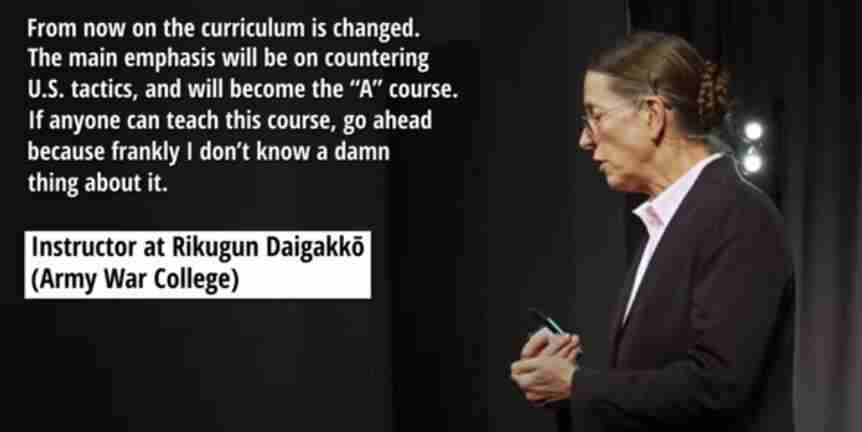
Talk about being unprepared for seminar. And then think about it. Where are the Japanese actually fighting most of the time? What is the country that most matters to them at the end of the day? It would be China, and that’s not what their war colleges are studying. Something’s up here.
Now they’re clearly making a really bad net assessment about the United States. Okay. This country also is known for lousy net assessments. I don’t believe ours about Vietnam was particularly good either, and that’s one part of the problem.
Game Plan for the Lecture
SARAH PAINE: So here’s my game plan for this evening. I’m first going to talk about Japanese traditional Japanese theorists, and then it’s going to be talking about Japanese practice. How if you have this belief system, how explanatory is it for practice? This is my game plan right now.
Japanese Theoretical Foundations
SARAH PAINE: So the Japanese don’t have just the one book like Sun Tzu’s The Art of War or Clausewitz’s On War. What they have is Bushido, Code of the Samurai. It’s a whole literature, and it was written in the Tokugawa period, which quite ironically was a period known for peace, not warfare. Never mind.
And what’s interesting about this literature from a Western perspective, it’s really not about military strategy. It’s about deportment. It’s how a samurai should conduct himself. And this reflects Japanese values and the things that they emphasize.
And so I’m going to go through it with you. Here’s the game plan on the theorist. First, I’m going to talk about the philosophical origins of Bushido, then the values that underpin it, and then the operational preferences that grow out of it. That’s the game plan for first half.
Nitobe Inazo as Cultural Bridge
SARAH PAINE: And I’m going to use as my cultural bridge this man, Nitobe Inazo, who wrote a book much later in 1900, Bushido: Soul of Japan. Why am I doing this? He provides a concise definition of Bushido. And you can see he’s an important figure in Japan. Not everybody gets their mug on the five thousand yen note.
So he’s an important figure in Japan. He has spent eighteen years abroad, and he had received higher education in Japan and a variety of Western institutions. He married, believe it or not, I don’t make up these things, a Philadelphia Quaker, and he converted to Christianity. And he spent his life trying to serve as a cultural bridge, and that’s how I’m going to use him today.
And what he said is unlike in the West where notions of morality come from religion, in Japan, they come from Bushido. And what is it? It’s a code, a chivalrous code of honor for the warrior class, these precepts of knighthood.
The Three Pillars of Bushido
SARAH PAINE: There are three pillars of bushido, according to Nitobe. They’re Buddhism, Shinto, and Confucianism. From Buddhism is where you see Japanese fatalism, the origin of it. And here you have Nitobe saying, “it’s this calm trust in fate, a quiet submission to the inevitable of friendliness with death.”
And it strikes westerners reading this Bushido literature as a preoccupation with death, that, for instance, Clausewitz will talk about violence and warfare, but he’s not interested in what constitutes an honorable death, let alone choreographing a soldier’s final moments—different culture.
And from Buddhism, there are four noble truths of Buddhism: 1. One is that existence is suffering, pessimistic view of this life. 2. Second, it’s caused by craving and attachment, so don’t cling to this life, or the things in it. It’s all ephemeral. It’s like a cherry blossom. Boom, sardine. It’s gone. 3. But there’s a good ending to it all, which is nirvana. 4. And how do you get there? The fourth noble truth is through forms of right conduct.
So the emphasis isn’t on what you achieve in your life. It’s how you lead it. It’s this focus on deportment. It’s different from the west.
Second pillar is Shinto, this extreme patriotism, reverence for the emperor. And the third pillar is Confucianism, these imported ideas from China. Confucianism is at heart of how it’s organizing a society and regulating it through interlocking social obligations, hierarchical, and through ritual and etiquette.
So in the West, there’s much talk about equality. Right? And in the West and the East, it’s duty. It’s what you owe other people. In the East, there is no such thing as social equality in China or Japan. Even twins have a birth order, and it’s not about freedom either. It’s about what you owe others.
So, if you think that these value systems seem really different—yeah. No kidding. It has nothing to do with the Greco-Roman Judeo-Christian West, completely different value system. And so, Alice, welcome to Wonderland. Buckle up. We’re off for a ride.
The Hagakure and Bushido Values
SARAH PAINE: And I’m going to start—here’s my first piece of the Tokugawa literature, Yamamoto Tsunetomo’s the Hagakure that he wrote in the early eighteenth century. It translates variously as “hidden leaves” or “hidden by the leaves.” And in it, he is describing—I’m going to read you some short passages from it all.
What was it? He was a retainer for a daimyo, a feudal lord in Japan. He hadn’t actually done any fighting even though he’s writing all about it. So if you don’t do, what do you do? You publish. And I will tell you what the man had to say.
So here we go. One of the first things is this preoccupation with death. And here’s Yamamoto:
“The way of the samurai is imagining the most sightly way of dying. Merit lies more in dying from one’s master than in striking down the enemy. The way of the samurai is found in death. It is not necessary to gain one’s aim, but if you live on without achieving it, it’s cowardice. However, if you don’t gain your aim and die, that’s okay.”
This is really different from Clausewitz where it’s all about achieving the policy objective. It’s not about how the soldier is leading his life. And here, you can see the consequences of this. Right? If you’re focusing on no fears of death and if you can’t succeed, living on is a disaster. Think of the banzai charges when Japanese remnants would go headlong into oncoming machine gun fire knowing full well what was going to happen. This is not the way other armies have behaved. Different value system.
Honor and Shame
SARAH PAINE: Alright. In addition to death, this Bushido literature’s emphasis on honor, back to Yamamoto:
“The way of avoiding shame is different. It’s simply death. Even if it seems certain that you will lose, retaliate.”
Think of General Tojo and Admiral Yamamoto Isoroku. Now and here’s the if you suffer a catastrophic defeat, here’s the solution. In the event of a mortifying failure, you’re going to wind up committing suicide because the alternative, if you live on in shame, you’re bringing everyone you’re associated with shame, and I’m going to use Nitobe to be the cultural bridge.
He said:
“In our minds, this mode of death is associated with the instances of noblest deeds and most touching pathos. So this vilest form of death assumes a sublimity and becomes a symbol of new life. It’s a way to escape from disgrace.”
And in Japanese literature, there is the tragic hero who is pursuing noble but unattainable aims, and rather than making disagreeable compromises goes down in flames. This is what seppuku is all about. And Nitobe is saying, “look. Death involving a question of honor was accepted in Bushido as a key solution to many complex problems,” and you can think in World War Two. Yeah. It was. Complex problems like battle plans not working out and a war that was truly not working out.
Loyalty as a Core Value
SARAH PAINE: Alright. So in addition to death and suicide, and honor, we’ve got loyalty. It’s another key value. Back to Yamamoto:
“Being a good retainer is nothing other than being a supporter of one’s lord. A man is a good retainer to the extent that he earnestly places importance in his master. Having only wisdom and talent is the lowest tier of usefulness.”
So much for Silicon Valley.
“For a warrior, there is nothing other than thinking of his master.”
And so back in the day, it’s thinking of your feudal lord. In more recent times, it’s prioritizing your company over family. In China, it’s a reverse priority. It’s family over company. And it’s different cultures, different priorities.
# Why Japan Lost – Episode 2 (Continued)
Strategic Implications of Bushido Values
SARAH PAINE: There are strategic implications. If this is your value system, this is what arises from it. First of all, you’re looking at damage limitation, damage control, not in terms of the physical cost of losing lives, having property blown up, but in terms of honor. Also, there’s a tendency to equate operational with strategic success. Operational success is I win this battle here and now.
Strategic success is, okay. We’re in a war for some reason. What is the reason you’re in the war? Japan’s reasons for being in China had to do with containing communist expansion and also stabilizing the place so they could make money out of business. So that’s your strategic objective.
It’s not your operational one. But the Japanese samurai are equating the two saying if I take this hill, somehow it’s automatically going to deliver the strategic objective. And in fact, they won most of the battles in China, but they lost that war. Also, there’s this focus on what constitutes an honorable death. It’s not the Western focus of literature is all about preparing the field of battle in advance for success, whereas this literature is all focusing on what to do after disaster.
Death Ground and the Refusal to Surrender
SARAH PAINE: Here are some more implications. Once the Japanese are failing in battle, operational failure, they are on death ground. What does that mean? Death ground means the only way you survive is if you fight harder. This is what’s going on in Ukraine right now – when you decide you’re going to annihilate an entire culture, you put people on death ground, and then they have very few choices on what they do next. For the Japanese to feel that they’re on death ground when they’re failing means they’re not going to give up.
They’re going to fight brutally, against overwhelming odds. So in the West, when we like to mirror image, we want to think of the rational actor with some kind of mathematically based cost benefit of when you should give up, when the costs are so high above whatever your value of the object is. You ought to call it quits. Well, that kind of calculation does not translate well across the divides between civilizations.
I’ve got a nice picture here of Lieutenant Onoda who had been hanging out in Philippine jungles for thirty years after the end of the war, carrying on the war in isolation. I don’t believe this is how most other armies work or soldiers in them. Different culture, different things you do with your life.
And here is Sir William Slim, Field Marshal, British Fourteenth Army that he led in Burma commenting on his experiences:
If five hundred Japanese were ordered to hold a position, we had to kill four hundred ninety-five, the last five committed suicide before we could take the place. And it was this combination of obedience and ferocity that made the Japanese so formidable.
The Emphasis on Willpower
SARAH PAINE: This brings me to another value that’s emphasized in Bushido: willpower, back to Yamamoto. “There is nothing that cannot be done. The way of the samurai is in desperateness simply become insane and desperate, and it’ll somehow work out for you. One can accomplish any feat.”
Think of Pearl Harbor. And this emphasis on willpower and just trying harder, it denigrates strategy. And here you see a picture of the supreme example of honor and loyalty and willpower, and they’re kamikaze pilots. But if this is what you’re doing, you’re denigrating strategy.
And here, Yamamoto’s talking about tactics, but it has operational strategic implications. He says:
Learning such things as military tactic is useless. The way of the samurai is one of immediacy, and it is best to dash in headlong. If one is informed of military tactics, you would have many doubts.
So the idea is if you think about these things in peacetime, you’ll start hesitating in wartime. It won’t work out for you if you do this.
During times of peace, when listening to these stories of battle, we should never say, in facing such a situation, what would a person do?
Well, so much for my job at the Naval War College. So much for the case studies.
No matter what the circumstances might be, one should be of the mind to win, once you be holding the first spear to strike.
Implications of the Samurai Mindset
SARAH PAINE: Here’s the implications if you believe this. What you’re doing is very an analytical way to approach wars. It’s all about whatever it is you want, you just steel the will and go for it, and somehow you’ll get it if you want. There’s a lack of grand strategy. What’s grand strategy? It’s integrating all the instruments of national power, not just the army or the army and the navy, which is what the Japanese are trying to do, but all instruments of national power in pursuit of the bigger aim.
If the bigger aim is to stabilize China and keep the communists out, there ought to be some diplomacy and some other things going on. But that’s not what’s happening. In the samurai literature, it’s a focus on the military instrument exclusively.
So I’ll give you an example of how this works out. Before the Imperial Japanese Army and the Imperial Japanese Navy invaded French Indochina, neither one of them did a little study saying, “Hey. If we do that, let’s check the other side of the tennis court net and see how other people might react.” They just steel the will and march right in. Okay. That triggered the US hundred percent oil embargo. That’s a problem. Operational success, strategic mess.
So it is this focusing on just the operational level that’s the basis for this ill-founded optimism with which the Japanese just took territory after territory without saying, “Hey. What about the cost of actually occupying these places? Oh, we’re going for these places for resources. So maybe we ought to check it out with the finance ministry about how we’re ever going to get these resources back home.” None of that’s going on. It’s a disaster for them.
Secondary Theorists of Bushido
SARAH PAINE: I’m going to talk about a couple of secondary theorists. One of them is Taira Shigesuke, who is a contemporary of Yamamoto because he provides a really concise definition of the operative values of samurai culture. “Only three things are considered essential, loyalty, duty, and valor, so steadfastly loyal, in battle as to disregard his own life.”
What he’s actually talking about is group loyalty. In the West, the basic unit composing society is the individual. Well, in the East, it’s the group, and group interests take primacy over individual interests. And for the Japanese, society is divided by in-groups and out-groups. The most basic in-group, biggest overarching one is the Japanese people vis-a-vis everybody else.
But within Japan, everybody comes from a different province, a different locality. They go to different educational institutes. They graduate from different kindergarten classes, I kid you not, and college classes. They work for different companies or they’re in the military, they’re in different branches, and you also have family loyalties. And you owe each of these nested and overlapping groups different obligations.
And sometimes these obligations conflict, and if the conflict’s really awful, that’s another reason for committing suicide. And then if you look at the Japanese language, the moment a person opens their mouth to speak to another Japanese, you can immediately listen to the grammatical forms that are being used, the specific word choices to know what’s the degree of hierarchy, like, where do they sit in this unequal hierarchy and whether it’s in-group, out-group.
So everybody feels or most people feel some level of group loyalty. This is human. But in Japan, the levels of membership are much more finely calibrated, and they’re reemphasized by these social, cultural, and linguistic reasons. So this group membership and stovepiping ultimately is going to be a much stronger feature of Japanese culture than some other places.
Miyamoto Musashi and Operational Preferences
SARAH PAINE: Alright. Last theorist is Miyamoto Musashi, who, unlike the other two, actually did a little fighting. He was born a little earlier, and he was a master samurai who taught people martial arts. And from him, you get a sense of some of the operational preferences deriving from these values.
And I’m going to go through all of these in turn. First is risk intolerance, because remember at the beginning, I started with the two flag officers saying, well, we’re going to do this war in the Pacific when it’s unlikely we’re going to succeed. We’re going to do it anyway. And here is Miyamoto:
Furthermore, to fight even five or ten people single-handedly in duels, that’s what my military science is all about.
So what’s the difference between the logic of one person beating up ten people and a thousand people beating ten thousand? Logistics, my friend, but never mind. And then another thing that he emphasizes – don’t expect long odds to deter the Japanese back in the day.
The Element of Surprise
SARAH PAINE: Surprise is another one. Think about a situation that has stalemated and is going nowhere, which is what the China theater was for the Japanese, and how do you get out of it? And the answer that Miyamoto has is not come up with a new policy objective, but come up with a tactic that’ll somehow put your enemy off balance and then get what you want that way.
And the way the Japanese did this was often by opening a new theater in a war, by surprising people by the new places that you were going to start engaging in military operations. And here’s how it worked. China had been a failed state since 1911, and it had had an escalating series of warlords fighting each other in this multilateral civil war. And the Japanese were appalled particularly after the United States passed the Hawley-Smoot tariff of 1930 that cut them off from international trade. So then they’re thinking now what?
Well, we’re going to need an empire big enough to survive since no one’s going to trade with us. And so they invade all of Manchuria in 1931, and they have it pretty much stabilized by 1933. So, okay, that was surprise number one. But the rest of China is a mess. And China is coalescing into a bilateral communist-nationalist fight, nationalist under Chiang Kai-shek, communist under Mao Zedong, with increasing dosages of Soviet aid.
And the Japanese are appalled with all this. And so it’s time to surprise everybody again in 1937, and that’s when they invade all the way down the Chinese coast and up the Yangtze River. And it works. They take a lot of territory really fast, but then they get to the end of the railway system. Oh, and by the way, China’s not pacified. It’s just churning. And so now Japan is even more overextended.
As a result of doing that, Russian aid goes up, and then you’re going to get US aid in there. So the problem’s actually getting worse. Okay? Time for another surprise, really big one. On that infamous day in December ’41, it wasn’t just Pearl Harbor. That’s Team America focusing only on Team America. The Japanese attacked all across the Pacific that day.
Now what? China had never been able to threaten the Japanese home islands while the United States was totally isolationist. Most Americans couldn’t find Japan on the map. Well, after Pearl Harbor, they sure could. And suddenly, the United States isn’t isolationist anymore, and they’re coming to get the Japanese.
So you can see the samurai values in operation here. Just try harder, more dosages of willpower. Eventually, you’ll win or you’ll die trying.
Preemptive Attacks and Breaking the Enemy’s Will
SARAH PAINE: Another operational preference that you can see, which is part of the surprise or preemptive attacks. And this is how Japan began all of its wars, the first Sino-Japanese war and the second Sino-Japanese war, Russo-Japanese war, and the Pacific war. This is how all of them begin.
And finally, Miyamoto offers some advice on how you break the enemy will. In this case, it’s you’ve already won conventionally, but they’re waging an insurgency against you. I’m modernizing the terminology. And the idea, it’s you want a psychological victory. You want them just to quit, and somehow you’re going to break their will to resist. And I suspect this is what the Japanese thought they were doing in the rape of Nanjing and other atrocities, that they were going to do these horrifying things, and that would break the will of the other side.
Be careful whom you put on death ground. The Japanese were repeating a mistake done by the Nazis, which is, if you’re dealing with even a failing state, which Russia was – Stalin had shot so many of his officers in the thirties, and then he’d inflicted a famine on Ukraine. But when the Nazis came in and they were going to wipe out not only the Russian government but also the Russian people, you will superglue people, government, and military, and you will transform a failing state into a lethal adversary. And this is what Nazi brutality does to Russians, what Japanese brutality does to Chinese, and what Russian brutality today is doing to Ukraine. Don’t do it. Bad strategy.
Final Strategic Implications
SARAH PAINE: Alright. There are strategic implications from these values. One is this emphasis on the offensive preemption. It’s this focus on military action to solve all your problems, and you have a fixed policy objective. Whatever it is, and if you’re in a given battle, you have to win that battle.
It’s not, “Oh, I have an overarching objective. It’s too costly here. I’m going to call off this battle, and I’m going to try again somewhere else.” No. The moment your plan has failed, you’re a failure.
So they’re not thinking of planning in terms of branches of sequels, and there’ll be unexpected events that take place you’ll adapt to. None of that. You’re a failure. Funny that stuff happens to you. So there’s a real insensitivity to risk, and there’s no grand strategy.
But if you believe these things, you will be lethal in warfare. You’re not going to give up easily at all. And so you look at the Japanese at the end of the war and go, why didn’t they quit a lot earlier? Well, it’s because, in a way, they’re already dead men. They suffered social death, and so they’re going to keep on, until the very, very end of all of this.
Why Japan Lost: Strategic Failures and Interservice Rivalry
The absence of grand strategy was a great sin of omission for Japan. They weren’t the only ones guilty of this – belligerents in World War I made similar mistakes by focusing solely on military instruments. The Japanese had vague ambitions and wanted to exploit opportunities, but never defined what “winning” the war meant. How much territory should Japan take before declaring victory? Their territorial acquisitions were simply a function of what they could take, driven by anger rather than strategy. No matter what they did, they never managed to pacify the China theater.
Sins of Omission: Logistics and Sea Lines of Communication
Japan never produced more than 1/13th of US steel and coal production, and never exceeded 10% of US munitions production. If you do the math, each US soldier had four tons of equipment, while each Japanese soldier had about two pounds. Japanese main weapons in this war were the grenade and the bayonet. Their artillery and machine guns were obsolete at the start of the Pacific War.
By contrast, the United States had about eighteen personnel in supply services supporting each rifleman at the front. Other militaries in this period had about an eight-to-one ratio. Japan had about one-to-one. Japan was already suffering food shortages before Pearl Harbor.
By winter 1942-43, the Japanese faced critical oil shortages, preventing them from deploying their fleet at will. This made convoying impossible due to fuel constraints. By 1945, they predicted zero aviation fuel by year’s end, yet the government insisted on fighting on for “honorable” reasons – these Bushido ideas of perseverance, loyalty, honor, and duty.
Admiral Fugake Matome’s Perspective
Admiral Fugake Matome, who was chief of staff of the combined fleet until his plane and Admiral Yamamoto Isoroku’s plane were shot down (US code breaking identified their location), survived and later commanded an air fleet on the home islands sending kamikaze flights.
His last diary entry on August 15, 1945, after two atomic bombs had been dropped and the Russians had deployed into Manchuria, stated:
There are various causes for today’s tragedy, and I feel that my own responsibility is not light. But more fundamentally, it was due to the great differences in national resources between the two countries.
This realization came too late. US production statistics had been available all along, but when Japanese officials read these numbers, they thought they were propaganda and discounted them. Those who knew better – who had served in Britain or the United States – weren’t promoted because they were considered defeatist.
Admiral Ugaki maintained his diary because he was an honorable samurai who believed in Bushido – the ability of willpower to compensate for inferior resources. When the war’s outcome proved him incorrect, as an honorable samurai, he paid with his life.
The Critical Shipping Problem
Prince Higashi Konohiko, the last prime minister of Imperial Japan, identified the basic cause of defeat: “I think the basic cause of defeat was the loss of transport shipping.”
By war’s end, Japan was down to one-ninth of its transport shipping, paralyzing the empire. What’s the point of taking territories if you can’t transport resources back? The Japanese Navy had focused on fleet-on-fleet engagements following Alfred Thayer Mahan’s doctrine, but neglected convoy duty, which Mahan had called a “promising secondary operation.” In reality, convoy protection proved primary in the Pacific, as US submarine services paralyzed Japan’s sea lines of communication.
Admiral Ogaki Matame eventually recommended a more defensive strategy rather than fleet-on-fleet engagements, but by then Japan lacked both fuel and assets to implement it. Earlier in the war, he had remarked: “It’s too bad for the officers and men of the submarine service that they have not yet sunk any important men of war, only merchantmen.” His disdain for this target would prove costly.
Later, regarding the Battle of Guadalcanal, he noted: “The aim of supply and transport to the front has not even been half fulfilled each time. It led those on the verge of death, i.e., the army, to be extremely skeptical about the navy and thinking that the navy is just sacrificing the army.”
Interservice Rivalries
Tremendous interservice rivalries existed between the Japanese army and navy, rooted in prewar budget wars. As a resource-poor country, Japan couldn’t fund both services’ “essential” requirements. These disagreements became brutal during wartime when expenditures increased.
The in-group/out-group differences that created problems weren’t just between army and navy, but within each service as well.
# Army Example
The Guangdong army (Japan’s army in Manchuria) decided to invade all of Manchuria in 1931 without authorization from Tokyo, triggering a fifteen-year war. These officers believed they knew what was best for Japan and how to defend the empire. Meanwhile, a series of coup attempts occurred, mostly within the army. Even at the very end, when Emperor Hirohito was capitulating, there was one final coup attempt. If you have coups occurring, that is not unified command – it’s a mess.
# Navy Example
During the war, US air services alternated combat and training missions, bringing back combat survivors to teach new pilots how to avoid getting killed. In Japan, however, in-group/out-group dynamics meant you signed up together, trained together, fought together, and died together. The Japanese could have transferred people between groups, but culturally it wasn’t natural.
Additionally, the US military conducted “hot washes” after operations – critical reviews of what went wrong to improve future performance. Cultural factors made this approach difficult in Japan.
Toxic Interservice Relations
By 1944, the army and navy finally established regular liaison meetings in Tokyo – just in time to plan capitulation. The army wanted to unify the two high commands, but the navy refused, fearing they’d become merely a transport service for the army. By 1945, they unified only their information department, allowing them to coordinate propaganda, but there was no planning for coordinating assets to protect the home islands, not even air assets.
This dysfunction had deep roots. After their successful war against Russia ending in 1905, the army and navy were allowed to have completely separate war plans by 1906. The army planned to fight Russia for land in Eurasia, while the navy targeted the United States and Britain for Pacific expansion. These plans were kept secret from the other service, yet each assumed the other would perform crucial supporting roles.
The army eventually supported the navy’s southern advance plan after being defeated by the Russians at the Battle of Nomonhan in 1939. Initially, this seemed successful – in 1942, the Japanese army conquered more territory across a more dispersed theater than any country on the planet, while the navy hadn’t lost a single ship.
However, the navy hadn’t told the army they weren’t fully prepared, needing an outer perimeter reinforced by airfields. The army learned this on August 17, 1942, when the US attacked one of these airfields on Guadalcanal, which the army didn’t even know about. The navy needed army help at Guadalcanal, but the Japanese 17th Army had been ordered to take Port Moresby in New Guinea – targets 1,000 kilometers apart.
This created a logistics nightmare. The army lied to the navy about troop numbers at Guadalcanal, fearing inadequate rations. The navy indeed failed to provide sufficient supplies, causing starvation. When the navy wanted to withdraw from Guadalcanal, the army – following samurai tradition – insisted on fighting on, expending enormous resources.
This had strategic consequences. Before Guadalcanal, the Japanese army wanted to continue pursuing the Chinese Nationalists, who had fled to Chongqing after Japan conquered Nanjing in 1937. In 1943, the Japanese were planning to attack Chongqing.
Japan’s Strategic Failures (Continued)
SARAH PAINE: And then at that point, I think if you’re a nationalist, you’re fleeing into Burma. And if that had happened, then the Japanese could have probably pulled hundreds of thousands of people out of the China theater and put them elsewhere, and that would have caused all kinds of problems. Also, the Japanese had to call off their plans to invade Australia. So Guadalcanal has enormous strategic implications. So if you’re focusing samurai on one battle, Guadalcanal, well, it has implications in places called China and Australia that are a long way off.
The United States also had interservice rivalries, right, between our army and navy, and that’s why you have two separate campaigns for admiral Nimitz and general MacArthur. Big egos, one campaign for each ego, and, apparently, that wasn’t even big enough for MacArthur. But even so, I don’t believe the inner service rivalries in the United States were remotely on the scale that they were in Japan.
I have one final example to prove that one. So after Pearl Harbor, they’ve been tremendously successful for Admiral Yamamoto. He wanted to do the next thing was to attack Midway because you US facing there. And the army said, I don’t want we’re not going to do this. And Yamamoto goes, I’m going to resign.
And the army, we don’t care. I’ll commit suicide. We’ll buy popcorn. And here’s what changes this. So after Pearl Harbor, Americans wanted to let the Japanese know that we were thinking about them.
And so this is where lieutenant colonel James Doolittle the Doolittle Raid’s named after him. In April 1942, it was a one way trip, off an aircraft carrier because they had so much fuel in order to get to Japan. The idea was they’re going to go bomb Japan and then ditch in China whoever survives. Very brave people who did this. And are they going to cause massive damage in Japan?
Well, yeah, if you’re directly underneath, you won’t appreciate it. But in general, it causes minor damage. But it has a major unanticipated strategic benefit. Think samurai. The army, all of a sudden, is backing the navy that they’re going to now do Midway with them.
And it’s, like, don’t think, retaliate, avenge honor. The army was appalled that anyone had been able to bomb Japanese skies, so now they’re all over it. Okay. So how does Midway work out? Really poorly for the Japanese.
They lose four aircraft carriers. They’ve only got twelve. They’ve lost a third. Oops. And here we go, in group out group.
The navy doesn’t tell anyone for three or four months. Incredible in a war. Right? So they’re thinking about their little stovepipe, and they’re ignoring Japanese interests when this is going on.
The End of the War
Different story. So they do get their operational end to the whole thing. It’s called the firebombing of Tokyo. The whole place went up in flames. In fact, it got so hot, the canals boiled.
It’s an operational solution. It’s unconditional surrender after a protracted war of annihilation that destroys just about every single Japanese city, minus a couple that survived. What broke the stalemate? And here’s what happened. It’s three really bad things that happened in four days.
Talk about a concentration of really bad events from a Japanese point of view happening all at once when you want to talk about this is the psychological shattering that actually happens to the Japanese. First, the United States drops an atomic bomb on Hiroshima. Two days later, the Russians pour one point five million people into Manchuria, the nightmare scenario of the Japanese army. And they know if this war protracts, the Russians are going to come down through Manchuria, down the Korean peninsula, onto Hokkaido, and down the home islands. It’ll yield a divided Japan if it goes on for a long time.
And then you have the next day, the United States drops the second atomic bomb with a bluff. The idea being we’re going to keep doing this daily or every other day, except we don’t have any more atomic bombs, and we cannot build them quickly for a long time. So that’s big bluff. But the emperor then has had enough, and he breaks the deadlock in the cabinet, and the cabinet allows the deadlock to be broken the next day. And then he makes an unprecedented radio broadcast, never had had that happen before, to his subjects telling them game over.
And then the next day, he sends three imperial princes to the Manchurian Chinese and Southern theaters conveying his orders at game over. And from that moment on, his samurai obeyed him, and they absolutely cooperated with the occupation. There’s no insurgency, no nothing going on after this.
And at the end of the war, the United States came to understand the Japanese. At the beginning, totally misread the situation with the oil embargo that’s meant to deter and state that it precipitates the war that we didn’t want.
But at the end of the war, the United States realizes you’re going to need some level of Japanese cooperation if you’re going to occupy the place, and they’re going to use emperor Hirohito for this. Hirohito is scared to death that it’s not so much that he’ll be hanged, but that the United States will extinguish his dynasty, kill him and his son, and then that it’s over. And so he’s willing to sign any piece of paper that McArthur puts under his pen. And one of those is the constitution of Japan that is going to change their civil and military institutions, demilitarize the place, and try to get a democracy going there. It’s the constitution was written in one week by MacArthur staff.
They’re running around raiding, bombed out libraries for examples of Western constitutions, and they cobble this thing together. And this is the unamended constitution of Japan still in power in effect to this very day, MacArthur’s gift to Japan.
Cultural Explanations and Lessons
All right. I’ve been incredibly critical of the Japanese. But to sum up here, there are cultural explanations for their neglect of grand strategy, inability to cut their losses, inability to coordinate, and the ferocity with which they fought.
So if you look at their values, and they’re explanatory of what may well happen when things get set off. But I’ve been really critical of Japan. I want to even out the story by ending on the United States a little bit because the United States played a good game or bad game of half court tennis and mirror imaged at the beginning of this war. So when the Japanese go into Manchuria in 1931, we want them out. We don’t ask, well, why are you doing this?
And their answer would be, well, hey. You passed the Holy Smoot tariff. That means, this we’re trade dependent. Whom are we going to trade with? And once you did the tariff, everyone retaliated, so you’ve now shut down international trade.
So we need an empire that’s big enough to survive, so that’s why we’re in Manchuria. And by the way, there are way too many communists here, and we gotta get rid of those. And then in 1937, when they up, the ante and going into the rest of China, we didn’t inquire what’s going on. And the from the what the Japanese want to do is wall off communism. Don’t want that.
And then they want to stabilize China so that you could have some productive economic growth. And if you go, well, what were US post war objectives for China? Oh, sounds remarkably familiar. Communist out, stabilize the place.
Well, how does the war affect all this? Well, actually, the warfare that went on wiped out the two barriers to communist expansion in Asia. What are the barriers? Well, one, it’s Chiang Kai shek and the nationalist in China. The Japanese wipe him out.
They don’t totally defeat him, but they have so weakened him and so discredited him that by the end of the World War two, he is really poorly positioned to win the Chinese civil war, which he promptly loses. And then what does the United States do? What’s the other barrier to communist? Well, it’s the Japanese. We wipe them out.
So what do you get? A unified communist China, which makes really complicated wars in the Korean War and the Vietnam War. And the problem is the gift that keeps on giving. We’re still dealing with this problem today. So take a little word from Sun Tzu.
Know your enemy or the other side. Know the person you’re talking to. Don’t play half court tennis. It’s a really dangerous game. Rather, try to analyze why ask yourself why is someone doing whatever they’re doing.
And just because you’re trying to understand it doesn’t mean you’re condoning it. It’s just trying to figure out the logic of the other person. It’ll set you up for more informed choices.
Q&A Session
DWARKESH PATEL: I’m a little bit confused on some of the Bushido stuff and how it explains Japan’s actions in the war.
So look. This Zen Buddhism stuff, the cherry orchards that are blossoming and you must act with the generosity of a samurai, all this bushido moral stuff, how does that square with the conduct of Japan during the war, the rape of Nanking, the killing of millions of Chinese, the treatment of prisoners of war, which rivaled the fatality rates of the Nazi extermination camps? It seems like there’s a where’s the Buddhism there?
SARAH PAINE: Well, I’m not an expert on Buddhism. But, see, you’ve got a lot of things conflated in there. If you’re asking about, the part of the brutality of the war is Japan’s totally out of resources, and you’re thinking it’s going through a massive area of territory. They actually had no ability to take POWs. Or if they took POWs, they’d have to halt the military operation, and then you gotta put these people somewhere. And so they just slaughtered them instead.
And there were cases of hostile civilians who also got slaughtered because they had very limited numbers of people to deal with this. So on one hand, you’ve got absolute desperation. I don’t think any people behave well when they’re desperate. The war had been going on for years by the time we get interested in it. Right?
It starts in ’31. So you have desperate people. There’s another piece. I can just add little pieces. I can’t explain a whole people that in the prison camps so in Japan, if I’m going to be let’s say you were Japanese.
You and I are looking each other in the eye. That’s how you do it in the west, show that you’re paying attention. That’s not how you do it in Japan. In Japan, if you’re Japanese, I’m looking at your shoulder. It’s rude to look people in the eye.
It’s just too intrusive. You’re getting too much information probably from that person’s face. So you can imagine a Westerner in a prison camp looks his guard in the eye, and the guard is going, oh, who is this arrogant person? You’re a peer you can imagine bad things are then going to be happening. These are guesses on what’s going on.
There are certain values that I’ve talked about. There’s certain desperation that’s going on, and then there’s the dehumanization of what wartime is all about. Right? Initially, conscripts go in of all armies, having trouble killing people, and then they get better at it over time. This is a tragedy of human beings.
I don’t know if I answered your question. I don’t know that I know the answer.
DWARKESH PATEL: Okay. So here’s another thing that I want to clarify. Look.
If you were trying to understand Britain’s conduct in World War One, why they initiated it, and why they conducted it in the way they did, and you try to understand it using cultural explanations, what some British guy wrote in the seventeenth century, I don’t know how far you’d get. And maybe the more illuminating thing is just to look at, like, immediately what was happening in the 1910s, what were the proximal strategic objectives. So with Bushido, why are we looking back at what people were writing in the 1700s?
SARAH PAINE: I’m going to break up the British thing into two parts. So one analytical framework is you can look at wars, in terms of underlying causes and proximate causes.
The underlying causes are like the tinder of grievances on both sides. And there can be cultural components to that or other components. And so there’s this accumulating tinder of where you’ve got two different sides at least across purposes. But then there’s the match, the proximate cause, which is a whole series of matches. And finally, the last one’s Pearl Harbor, and you are off and running to a place you might not want to go to.
Right? So there’s that. And then there’s culture. Let’s look at Britain, strategic culture. And I’m no expert on British strategic culture, but these are some basics.
Japan’s Strategic Thinking
SARAH PAINE: So they’re an island, and they want to be able to trade with the world, but they don’t want any one power dominating the continent. So this is their strategic thinking from way back. And if there is a power that’s on the verge of dominating the continent, you want to back the other side to prevent that outcome. That’s very much a part of British thinking, goes back a long time, and you can read things going back a long time describing that situation.
There’s another piece that goes back a long time in the British thinking. Navies are rarely decisive in warfare. What I mean by decisive is you actually get the goal that you’re after for fighting, whereas armies can be. If your goal is “I want to occupy all of France” or better yet, Holland, something smaller, an army might be able to do that for you—one instrument of national power. But Britain’s reliant on a navy and doesn’t like to have a big standing army, so they’re thinking in terms of diplomacy and allies, and working economics, making money from trade.
They are the ones who coined the term grand strategy. It is their gift to us, and it absolutely informs their thinking at a very macro level. So no one thing is entirely explanatory. Also, we human beings game the system. The moment I tell you you’re Japanese and you think this way is the moment we go, “Oh, that’s what she thinks. We’re going to think different.”
Loyalty and Contradiction
DWARKESH PATEL: Right? The loyalty precept, wasn’t one of the problems with the Japanese military that they weren’t loyal, that they were trying to do these coups all the time, and the young officers were insubordinate?
SARAH PAINE: Yeah. It’s an excellent question. And what you’re doing is feeding me back the Greek principle of logic, which is the law of non-contradiction. You cannot simultaneously believe mutually exclusive things. So what’s going on? You’re telling me it’s all hierarchical, and now you’re telling me junior officers are doing or mid-level officers are doing things. What’s going on here?
That’s a fundamental principle of logic that the West puts great credence on. Not necessarily the case in the East. We’re going back to a time where people are not looking in terms of having a logically consistent argument. Rather, there are these social values that we are going to prioritize. And if my subgroup is going to be my unit or whatever, that’s how that’s going to go.
So you’re doing a wonderful piece of Western logic. It’s excellent. And this is why other cultures find dealing with Westerners like battery acid because they have these different belief systems, and you go like, “Okay. You have women, and we got women. Our women drive cars, and yours are like, where? Is there something wrong with your women?” It’s battery acid on other cultures.
The Brutality of World War II
DWARKESH PATEL: I was struck when you’re describing how the Nazis were putting their enemies on death ground. The Japanese are putting their enemies on death ground. And in both cases, it was detrimental because you’re preventing the other side from surrendering. That seems even worse than what was happening before that period. You can think over time that our norms about civility and war crimes are improving over time. But it seems like in World War II, the way people were acting was even worse than they were acting in World War I. The way Germany and Russia were fighting in World War I was probably more civil than how they were fighting in World War II. And then, obviously, what Japan was doing in China at the time—what was going on around the world that people just got so demonic during this period?
SARAH PAINE: No. Warfare is not civil. You’re killing people. I love when people talk about just wars—it’s rather a horrible piece of human existence.
There are a number of things that have gone on with the industrial revolution. You can now kill people on an industrial scale. When you’re doing it with bows and arrows, it takes a lot more time to create the mayhem. So that’s one thing, the ability just to wipe out people.
World War I, on the western front, was all entrenched. On the eastern front, there was a great deal of movement, but on the western front, it was entrenched, which meant civilian populations weren’t really touched by it. Where the initial fighting happened, yes, they’re leveled. But once you get a trench, you’re not. And then we in the West don’t actually study too much what happened to the civilians on the eastern front where it’s moving around. This is back to my half-court tennis, so we’re not paying attention to those civilians. So for the West, very few civilian casualties.
Whereas when you get to World War II, you’re bombing people. You now have technologies. You can get at people. And invading is also the lesson of World War I—the feeling that the Germans really hadn’t felt their defeat, and that allowed them to make up this story about how they weren’t defeated. The Jews did it or whoever. They were betrayed.
And Churchill and Roosevelt decided there would be a march to Berlin to disabuse them of that. And that involves killing a lot of civilians to get to Berlin. And, of course, the Russians were determined to pay back for what the Nazis had done to them. And we had no sympathy for what the Russians were up to because the Nazis had been so heinous.
Japanese Brutality and Social Death
DWARKESH PATEL: This is probably wrong. I want you to correct me. But maybe one way you can explain why the Japanese were so brutal in their campaign around this time is if you think that when you lose, you have this idea that you have social death. It’s better to kill yourself than go back to your family and say, I surrendered. Maybe they just applied—this is their failure to empathize with or think from the perspective of their enemy. But they were just thinking, “Listen. If we lost, we would commit seppuku. When they lose, they forfeit human rights.” And in some sense, they were just applying the principle of social death to their enemy.
SARAH PAINE: The whole war is brutal. They’re doing a lot of hand-to-hand brutality, and part of it has to do with lack of equipment. That firebombing of Tokyo happened in one night. I think it’s eighty thousand Japanese are incinerated. Okay. Let’s talk about brutality.
Now the reason why Americans did that is because they knew the alternative was sending American kids onto Japan who would die doing that. And so the decision was it was better to kill a lot of Japanese civilians than it was to kill American soldiers. And that’s also the reason that went into the atomic bombing. That’s controversial. Why did they drop atomic bombs on the Japanese?
There was no disagreement about that in the United States at the time because it was a question of, are you going to send American young men your age? Millions of them would have died hitting the home islands, or are you going to do the bombing? And, of course, the Americans did the bombing. So there’s brutality all around in this war. Wars don’t come up with clean hands.
Winning the Pacific War
DWARKESH PATEL: Was there any way for the West or for America to win the Pacific War without the firebombing?
SARAH PAINE: Well, this is a whole other topic. What does “win” mean? For us, it was put Japan back in its box. But this is a whole problem for Japan. What’s win? Or this country in Afghanistan, what’s win? Is it booting Osama bin Laden out of Afghanistan? Once that happens, it’s a day. Is it overthrowing the Taliban at a particular period, or is it trying to turn the whole place into a democracy? Those are all radically different things, but you need to make up your mind what it’s going to be.
I think it’s a miracle. If you’re going to have the win be that the United States transforms Japan into a functional democracy or sets them on the road so that they will become that, if that’s what the win is, no. Because I showed you the three horrible events in four days. That’s quite incredible to have that much bad news happening in a half a week. And that absolutely shattered the Japanese, and it also opened the door for those who thought they were in crazy land to capitulate.
If you don’t do that, okay, we invade the home islands. Americans were sick of the war, and you start losing lots of American kids in Japan. I think, at some stage, we decide to pull them out of Japan and blockade them internally. And then you’ve got Japan like a new North Korea, just this eternal, non-functioning society.
So no. These wars are tragic. And also, don’t think that you have all the cards that you’re going to make the decisions about what’s going to happen. The other side’s going to put you into corners where you’re going to choose from very unpleasant alternatives.
Miscommunication and the Start of War
DWARKESH PATEL: I want to ask you about how the war starts. So there’s obviously the ten years before, and you’ve got the tariffs, and that creates the incentive to build an empire. But even months before when there’s negotiations between Japan and America to get rid of the embargo, it’s striking to me how much miscommunication and the inability for both sides to just understand that there was a compromise here was such a big factor. I feel like if Prince Konoe and FDR could get on, like, a Zoom call, I feel like the war—
SARAH PAINE: You’re an optimist. Think about sunk costs, and I’m going to talk about sunk casualties. By the time you’re there, the Japanese have suffered six hundred thousand casualties in China. There is no easy out of that one. And so the United States’ minimum program is you get out of China. Not happening if you’re Japanese.
Look at the government. The government’s definitely on death ground with that one because there’s no way they stay in power if they get out of China. And particularly this is why Hirohito is mister silent for most of the war. Initially, he’s all for it until it goes sour, then he’s less so. He knows that he’ll be, if not assassinated, declared insane, and then his perfectly serviceable adolescent son or however old his son was would be the token emperor. So I don’t think the Zoom call is going to change the fundamentally high stakes that are involved for both sides.
DWARKESH PATEL: Oh, you really think if Hirohito had stepped in and said, “No. We’re not doing this,” that he would have been usurped as emperor?
SARAH PAINE: Yeah. Early on.
Oh, there’s another piece. Let’s look at the United States in 1941. Great Depression, isolationist. This is where the first America Firsters are. They’re the ones who created the idea. They didn’t want to know about all these foreign places. Totally isolationist.
Hawaii wasn’t even a state. Doesn’t become a state until 1959. If you’re Japanese, you’ll be like, “Oh, it’s a colony.” So it’ll be like sort of the dog that barks. You take a newspaper and flap him a few times, and maybe the dog will start barking. Because what the Japanese want is the United States to just mind its own business, stay out of Asia. “It’s our backyard. It’s not your backyard.” And Japan looks at the United States. United States doesn’t have that much trade with Asia compared to the rest of the world. Sure. It sells Japan most of its oil, but that’s not most of US trade.
Diplomatic Failures
DWARKESH PATEL: I was reading about this before preparing to interview you and the particular cases where diplomacy broke down. There are examples where the translators between Japan and America are—and I can’t believe this is true. You can tell me if this is not. But they’re exaggerating what each side is saying to make them more vivid to read. Like, if Tojo says something conciliatory, that’s exaggerated to make it sound—and that’s obviously not the role of a diplomatic translator.
And there’s many cases where after the war, Tojo says if we had gotten the modus vivendi that FDR apparently was contemplating sending to us, if we saw those agreements, we would have agreed. Or they apparently misunderstood that the final agreement they got from Secretary of State Hull where it said that you must return China, they thought it included Manchuria. Hull didn’t intend it to include Manchuria. They might have said yes to that. It seems like the war really could have been averted if a couple of mistranslations were avoided.
SARAH PAINE: I wouldn’t take Tojo as my source for anything. He’s a guy who, before graduating class of cadets or something, was talking about how even media people had said that he was mediocre, but look where he’d risen to be, and he’s this great man. Also, at the end, he’s got this whiny answer of, “Oh, it wasn’t my fault. It’s all your translators.”
And the piece on Manchuria, no. I don’t know that that would have been a compromise because the League of Nations had sent in something called the Litton Commission, which had told the Japanese they had to get out. And, by the way, it is a fiction that Manchuria is not a part of China. It is an integral part of China, has been for the longest time.
What the Japanese did is they kidnap the last Qing emperor, Manchu—Manchuria, whose ancestors came from Manchuria—popped him in, Henry Puyi, made him the emperor to try to come up with this fiction that, “Oh, Manchuria is a separate place.” Excuse me.
Why Japan Lost – Episode 2 (Continued)
SARAH PAINE: It’s not. It’s part of China. It’s the internationally recognized territory of China. So I wonder if one of the problems here is, look, it was not in the vital strategic interest of America to secure or liberate China. In fact, the outcome of the war, obviously, is a natural as soon as the communists take power.
And as we’ll talk about in the next lecture, that was the very opposite of liberating China. So, basically, America puts in this oil embargo and knows that the outcome of failed negotiations on getting rid of that embargo is a total world war of this kind. And it’s not even for the main strategic objective, which is, you know, you have to get Hitler. You have to go beat Germany. What I mean, wasn’t this just our failure in grand strategy to realize why are we doing this?
What strategic objective could you put in here? We weren’t fighting Germany. The only reason we fought Germany is because Hitler made a major blunder. He had an alliance with Japan that said if Japan was attacked, he would come in. Not if Japan attacked someone else that he would come in.
He interprets it broadly, and he declares war on this country. That is how the United States got into World War Two in Europe. If Hitler had not made that blunder, FDR would have been in a world of trouble trying to explain why he’s suddenly going to be fighting Nazis over an attack on Pearl Harbor by Japanese. So that’s a separate issue.
The main thing that Americans who thought deeply cared about is the international system, that we should deal with each other through laws, through freedom of navigation. So this is how you run your commercial transactions, that big countries don’t get to overrun small countries because if they do, the entire international system goes down. And the logic that you’re describing is excellent logic, and this is what the Japanese are saying. It’s like, why would the Americans care about this? Americans care deeply about the international system or people who are thoughtful about it.
And it’s also, like, why not let the Russians eat all of Ukraine? Why are the Europeans suddenly all over this problem? Right? And they’ve unified very recently on this, it’s because the whole system is at stake. Yeah. So it is really high stakes at a strategic level.
The Japanese are looking at the operational level and going, why do you care about these countries? We care about the entire system because our prosperity is based on it.
America’s Strategic Choices
DWARKESH PATEL: So I wonder if the problem here is that America isn’t, at least at the time, wasn’t willing to give enough concessions to the factions within Japan that care about peace so that they can save face and actually argue for ending war where the just the idea that they’re going to give up Manchuria as well. Obviously, that’s not going to happen. And when Secretary of State Hull just sees these vacillating telegrams from the Japanese, he assumes that’s because they’re fickle or something. It’s like, no. It’s a civilian part of the government trying its best to prevent the military from taking over. And you have to give them something to save face. You know?
SARAH PAINE: That faction had already lost, and they lost in 1936. Takahashi Korekiyo is Japan’s longest serving finance minister, and he was a very distinguished man. In fact, he brought the Japanese economy out of the Great Depression before anyone in the West was doing it. It was through government spending and trying to get people to spend at home.
And he told the army, he said, “Fellas, if you go on this bent for empire, you’re not going to actually get resources because you’re going to spend a lot of money fighting with people, resources doing that, and then it’s going to take you years of investments to access these resources. So you have to be able to cover these investments for years and years and years and cooperate within the international system. That is the way to prosperity for Japan.”
Well, that was the February young officers’ revolt where he and I can’t remember how many others were murdered. They came to his home in the middle of the night, and as he stood up to talk to them, they literally hacked him apart. They’ve lost. That whole game is over.
But Prince Konoe doesn’t like—he knows—he’s the person who’s prime minister in 1941 realizes that they’re going to lose a war against America, and he doesn’t want to do that. It’s just that Tojo, the war minister at the time, doesn’t answer to him. Like, there are people that the prime minister doesn’t want war. Oh, wait a minute. Don’t give him enough to save face. They have a huge army there that’s more than capable of assassinating people when they get in the way. So that ship has sailed.
And then you can make—this is what a pivotal decision is. Once you’ve made it, there’s no going back to the way the world was. And Japan lost too many people, and there are too many figures in the army. We think that it’s an inevitable outcome of having the world the way it is now with this Japan, this wonderful country now. They’re just at the lead of so many different areas of human endeavor, and we think, “Oh, that’s the inevitable outcome.” It’s not.
DWARKESH PATEL: I guess what I’m trying to ask you is, is there anything America could have done in the immediate years leading up to the war that could have prevented this outcome? Because the fact that there is a world war—like, from a philosophical standpoint, you should assume that if there is a world war, things weren’t done optimally. Right? Right? That doesn’t mean everybody’s equally at fault. But is there anything that could’ve been done optimally?
SARAH PAINE: But this is serious. We all live—that Smoot-Hawley Tariff is a game of half court tennis. You’re looking at the United States. It’s in a terrible depression. You want to protect jobs here, and so you raise these big tariff walls. And then, okay, what’s the other side of the net going to do? They’re going to raise their tariff walls and pay you back.
What’s that going to do? It’s going to cost a lot of American jobs if you play that game. You need to be talking with other people. So, once you have set the conditions, hothouse conditions, for fascists to take over in Germany and in Japan, you are in a world of hurt. The easy solutions are no longer there anymore.
The Oil Embargo Question
DWARKESH PATEL: So, maybe I’ll ask the question this way. The oil embargo, was it a mistake? Because the idea is to protect the international system, prevent empire. Well, we got more empire. We got a world war. We got communists taking over in China. Whatever was going to happen if we got rid of the oil embargo, it can’t have been worse than that. Right?
SARAH PAINE: Well, what Roosevelt was really scared of was that the Japanese would attack Russia. He was so worried because then he thought Russia would fall. And if Russia fell, he thought the Nazis would win. So at least the Japanese attacked us. That was actually better than attacking Russia.
DWARKESH PATEL: So let’s say you don’t do it and Japan never attacks us, and then the Russians are down and you’ve got Nazis in control of the world, so it must be better. Doesn’t seem—and but you don’t have that world war with America. Like, it doesn’t seem insane to think that.
SARAH PAINE: And we’re still going to find the Nazis. You’re not going to have an international system. Oh, and if that’s the case and the Nazis were gearing up because, eventually, they’re going to fight us.
Because this is another problem. Another concept that I think is useful is limited versus unlimited objectives. A limited objective or an unlimited objective is I want to do regime change on your country. The most unlimited variety is that not only do I want to do regime change, but I want to kill all your people while I’m at it.
So, if that is what your opposite number is planning, if you compromise with them, you are simply setting them up and putting them in a stronger position when they come at you for the final kill. If they have limited objectives, then by all means, compromise with them and negotiate away on what is it you want, just this little sliver of territory or you want some preferential treatment, we can do that for you. But you’re talking about a world order here, whether it’s going to be based on laws increasingly or these opposing spheres of influence.
DWARKESH PATEL: To keep pushing back on this, I don’t have an answer. You know, I’ve given you what little I can think of, but I’m not the grand profiteer in this world. These questions you’re asking me are way above my pay grade.
People in the YouTube comment section get mad at me when I keep asking about counterfactuals. And I understand, obviously, I don’t understand what’s happening at the time. I’m naive about history, whatever. But I do think it’s important—what are we trying to do when we try to understand history? We’re trying to understand if we had done things differently, what would have happened? What are the lessons we take? And the counterfactuals are the main way we can do that.
SARAH PAINE: I’m all for it. We teach by counterfactuals. There’s a replay, and can you come up with different options? I think you’re in a series of really awful options.
The difference between the Japanese and the Nazis is that the Nazis’ ideology was that we have to kill millions of people. That is what they believed. The Japanese didn’t in the same way have that. And then naturally, they had their continental empire. They also want to trade, and they don’t like communists. They don’t want the communists to take over in China. It just seems like, naturally, if we didn’t go to war with them, we might have been allies as we ended up being later on.
DWARKESH PATEL: Well, they attacked us.
SARAH PAINE: And, as the oil embargo.
DWARKESH PATEL: But the question is, like, should we have done the oil embargo?
SARAH PAINE: Wait a second. The Japanese are saying we have the rights to your oil? And, oh, by the way, this oil is being used to kill Chinese all over the place. This is what their Japanese bombers are running on.
DWARKESH PATEL: I feel like no. I mean, I agree. We don’t like—they don’t own our oil. The question is, like, this is not about whether they are entitled to it. It’s like, should we have given it to them? Would the outcome have been better if we did?
SARAH PAINE: Well I’m telling you, I suspect the outcome wouldn’t have been better, but I don’t know. Right? And you’re asking me things where my experience is—I’m just a professor. I just show up at seminar on time, and I try to do reading and prep. And my experience has not been in government, let alone at the highest echelons of government of what’s feasible and what’s not feasible. And the answers I’ve given you are where I’m at, but I can’t tell you more.
Japanese Optimism and American Response
DWARKESH PATEL: The sort of delusional optimism of the Japanese to think that they could beat America, how much of that is motivated by the idea that they actually do think they’re led by a living deity? Like, did that make it or is that just related to why they thought they could win?
SARAH PAINE: No. But you’re looking at the United States as isolationist. If you’re Japanese and you’re looking at these absolutely isolationist Americans, right, who are letting Britain, their closest ally, potentially go down to Nazis. Right? Because, think about Britain. It had been—fall of Norway, fall of France, then they lost Crete. We aren’t even in the war. They’re about losing everything, and we’re not doing anything.
So the Japanese are looking at it and going, the United States is not bailing out its key ally. Hawaii is a colony. Right? It’s a bunch of white people dominating Hawaiians. So we’re just going to do a little, set an example that, hey, if you mess with us, it’s going to get costly.
And we know you don’t have much trade in Asia. Sure, we want to buy your oil, but overall, most trade is elsewhere. And so they’re looking at it—isolationist. Won’t the answer be the isolationists go, “Oh, this is expensive. Let’s get out of here.” And, of course, that’s not understanding Americans.
I remember I was in seminar the day that 9/11 happened, and the TV, there was TV in the seminar rooms, and there was a break. And after the end of the break, the students had the TV on and were watching tower one had gone down, and then while we’re in seminar, the next one we’re watching, it goes down.
And I thought, oh my. There’s going to be hell to pay for this one. Because this is how Americans are, that if you mess with us, boys, they get ugly. And boy, this is like, don’t think, retaliate. So, the Japanese didn’t understand that part of us.
Why Japan Lost: Episode 2 (Continued)
SARAH PAINE: In fact, a lot of people don’t. They go like Americans. We look like a bunch of hedonists. But if you mess with us, it’s ugly.
DWARKESH PATEL: If you are in the Japanese government a couple years before, like nineteen thirty-nine or something, it sounds like from your earlier answer that you think it was a sort of hopeless situation if you’re the finance minister or if you’re the prime minister. Is there anything they could have done to prevent an inevitable conflict with America?
SARAH PAINE: They brought it up and they say, “Well, we can’t afford this. The resources aren’t here,” and the army wasn’t interested. And they shut up because the last guy had been killed in his house in his pajamas. So they weren’t up for that.
DWARKESH PATEL: How much stock do you put in the idea that, if you have a society that rapidly industrializes, that goes from a feudal state to advanced industrial nation in a generation, that it’s just not enough time for the culture to evolve? And so the way that the Japanese behaved in the lead up to the war and during the war, the feudal values just didn’t have a chance to evolve?
SARAH PAINE: No. It didn’t happen too fast, but institutions take a long time to take root. Look at this country. It’s been an evolving democracy for hundreds of years. Okay. We no longer have slavery, amen. But you look at today, really consequential things about our own institutions.
So now we’re going to go pick on the Japanese because they managed in one generation to westernize their political, judicial, legal, educational—you name it. They westernized them. But there wasn’t enough time for these things to grow deep roots.
And then if you think about who’s doing this, they’re called the genro, this very distinguished generation of Japanese who all knew each other. And their career paths were very broad, covering both civil and military areas. And when they died, they couldn’t transfer their prestige to anyone else, nor had they institutionalized it in some kind of cabinet or something that would force all these different groups to discuss things without giving primacy to the military.
And then understand what is the tradition in Japan. Shogunate. That’s what Japan had before. What’s a shogun? Shogun is the Japanese word for general. So the long history of Japan is military rule. So when it comes back in World War Two, that in a way is a kind of normalcy.
It would have taken a long time. So this comes back to the United States and fooling around with tariff walls, thinking that was such a clever idea. Maybe if the Great Depression had been managed better, it would have given time for these institutions to take deeper roots. No one knows, but I would not criticize the Meiji generation. They’re brilliant. They did so much. But you’re talking just a number of years.
And let’s look at this country. We’re really having major problems with our institutions, wondering whether we’ve got a stalemated legislature, whether we got a skewed court system or whatever it is, and we’re sorting these things out. And then to criticize the Japanese because they couldn’t do it all in twenty-five years.
The System of Irresponsibility
DWARKESH PATEL: The one thing I found really interesting in your book is that you were arguing that not only was the military not in charge of the officers, but like, nobody was even in charge of the military. There was, I think you called it a system of irresponsibility that it was just basically government by committee. Tell me more about that. Why does that lead to mistakes?
SARAH PAINE: Well, I can flip it around and look at how the West has done it. It’s supposed to be, and of course there are exceptions, that it’s not about you if you have a particular job. It’s that your job gives you certain authority by law to do things, and then we have courts to adjudicate when you in that position. Other people think that you’ve exceeded your authority, and they start suing about different things. And that’s how it goes in the West. It’s very legalistic. It goes all the way back to the Romans.
This is when I think about what is the West, it’s Greek logic. It’s Roman law, and then it’s these Judeo-Christian moral values. Those are essential pillars of what the West is all about.
So in Japan, they get laws and they westernize, but they have their own indigenous way of dealing with things. And it’s very much about different in-groups and out-groups handling things in whatever the committee is. And so we’re going, “Well, who actually did that? Whose fault is it?” Because we have this very legalistic way and that fault in law, we’re going to either put you in jail or whatever.
So it’s just different ways of organizing ourselves. But we in the West assume, because going back to Roman times, that institutions are going to be a really big thing, that that’s how things are going to work. So then when we get into somewhere like Iraq and we think the police is going to still be functioning after we blow the government, it’s like, “Woah. Woah. Woah.” It’s not institutionalized.
I don’t know. I’m no expert, but you’re projecting the kind of institutional setup that Western countries typically have to other people. They may name these things the same thing, police or whatever, but they may function in very different ways.
DWARKESH PATEL: When you look at the soldiers who fought these hopeless battles, where tens of thousands of them on a single island might starve or be forced into a banzai charge that they knew was hopeless and they were all going to die, and they knew that they were put in this hopeless situation because of these destructive, petty fights between the navy and the army where one of them isn’t willing to supply the other one. Why didn’t that break their morale where it’s just like, “Look. We’re supposed to die and commit seppuku because you guys didn’t give us the right supplies because you guys aren’t willing to share information or something.”
SARAH PAINE: I don’t know the answer because I’m not a social historian where you would really be doing—I’ve done more diplomatic and military, so you’re looking top down. But what you’re asking is a very important question for how do individuals react to all this, and that I do not know the answer.
And there’s another piece that makes it hard in Japan since people don’t want to talk about failure because it’s considered a loss of face. Whereas in the West, one of the fundamental assumptions of Christianity is we’re all sinners. Right? Original sin. We’re all defective goods from the very beginning. And so there isn’t this expectation for perfection because it’s known. You’re kind of a mess to begin with. And so you could talk about these things.
So that’s a whole other problem of getting people to open up about truly horrible events. So I don’t know the answer. I know that the World War Two generation, they came home. They just didn’t talk about it with their children. And it’s just not a matter for discussion, so I can’t answer that of why they followed.
But you can look in the West, in World War One, soldiers would go up and over the trenches, and they knew exactly what was going to happen to them. And, yeah, there were people who didn’t, and then they were court-martialed and shot. A lot of people were shot in World War One. But there’s been a change in society about what young men are willing to do when their officers start telling them.
The way the Russians solve this problem in Ukraine, but Stalin would do this too. So you send people up ahead, and then you’ve got the KGB or whatever the killer unit. So anyone who tries to go the wrong way in the battlefield, they get machine-gunned by their own side. That’s one way to get an army to go forward, and that’s what Putin is doing right now. But in more democratic places, people aren’t willing to go along with this now. But in the West, we did it too.
Unresolved Questions in Military History
DWARKESH PATEL: When you’re having lunch with your colleagues, with the people who are all experts in this field and you’re discussing, “Look. What are still the big unresolved questions? We don’t understand why this person did x or why events transpired in a certain way.” What are the big things where you guys have to hash it out?
SARAH PAINE: Oh, well, it’s more someone’s decided what the curriculum’s going to be. And then you teach it. Oh, and by the way, as of like six months ago, I’ve moved to the Maritime History Center, so I’m no longer teaching. So I’m just doing research at this stage.
Well, I think the whole point of the curriculum at the War College is to get people out of the operational level. So the junior course is about the strategic effects of operation. It’s like, okay. Pearl Harbor, it’s an example I’ll use. Pearl Harbor is an A+ military operation. They sink everything. Of course, it’s shallow water, and we raise most of it afterwards. They lose nothing. I mean, boy, how can you do a more perfectly choreographed military operation than that one, except it turns an absolutely isolationist country into one hell-bent coming after Japan, and that would be called a strategic disaster.
So you’ve got to be cautious about your military actions and think about what are the strategic consequences, and it’s very difficult to gauge those accurately. So that’s one big issue that you need to get at.
And then for the seniors, it’s okay. Great. You’re an officer, and you understand if you’re in the army, you understand how to use armies and navy, about how to use navies. But how does this integrate with all the other instruments of national power that actually account for how wars turn out? And economics is a huge one.
And you’ll never—there is no definitive answer in these wars. But rather, you can give analytical concepts, and this is my reason for doing these lectures, is to say, “Hey. Don’t play half-court tennis.” Wouldn’t that be a basic thing? Is it going to provide you the answers if you look at the other side? No. It won’t. But it’ll position you to be in a better shape.
Or tossing out limited versus unlimited wars, and unlimited wars are putting people on death ground. Does that answer the question? No. But it goes, okay. If Vladimir Putin has an unlimited objective vis-a-vis the world order, and he’s basically said that he does, then compromising with him would be a mistake on that subject. Right? And you’re going to have to deal with him one way or another.
So it’s—history isn’t over. The long-standing struggle between continental powers that want to divide the world up into mutually exclusive spheres of influence and butcher each other over territory, very negative sum. They tend to be very authoritarian. Or this maritime order says, “Hey. Join the party. Follow the rules. You’ll make money.” Right?
And this is Angela Merkel’s thinking. She was the German chancellor for many years. And she’s thinking, “Putin will sell him a lot of oil. He’ll make money. It’s a win-win. Surely.” Well, he’s back to his continental stuff, destroying wealth and lives. That’s what the alternate world order looks like, is killing people to get things. It’s more promising to spread the other one. It’s been—and this disagreement has been going on for a long, long time.
DWARKESH PATEL: I feel like we had a mini version of this debate in the podcast we did a year ago.
SARAH PAINE: I have a limited number of ideas.
DWARKESH PATEL: You just said, you know, we can’t compromise with people who have these unlimited goals like Putin, who have these territorial goals. If we’re using the analogy as you’re explicitly making it to Japan during World War Two, look, what it took if we wanted to say we’re not going to compromise with your territorial goals, we will stop you at every way. What it took was a world war that led to an unconditional surrender. So if we’re using that analogy, does that imply that no compromise requires some unconditional surrender type event?
SARAH PAINE: No. No. No. No. No. No. This is something that’s not—There’s something called precision nuclear strike, and it has changed things. During World War Two, the United States had sanctuary, which means other people couldn’t touch us at home. And our productive base was not touched, and that was essential. There are many things that were essential for allied victory. Take any one of them away, and the outcome’s different. One of the essential things is this productive base. This time around, all kinds of people can come get the United States.
So, a lot of times in foreign affairs, you can’t solve things, and I don’t know who originally said this, but you manage things. And so, this is where the sanctions and things come in of you give people a time out from the world order. You don’t solve it. You look at North Korea. That is not solved by a long shot. But at least South Korea can go become prosperous, and the North is just sitting with its time out and being more and more malign at home.
But it’s more like that. It’s of not recognizing, for instance, conquest, and this is what went on actually when Stalin took over the Baltic states. We never recognized that. In fact, they ran governments in exile based on the funds that their—I think, oh, yeah.
Japan’s Strategic Challenges and the Costs of War
SARAH PAINE: There were Baltic states that had their funds in US banks. So when Stalin overran them, I think those funds became what funded their embassies. And generations later, we recognized their independence. These things are not solved on anyone’s watch. Basically, the way the last Cold War ended is because the Chinese and Russians changed their minds.
You have to wait for others to come to their own decisions. What is the track record of sanctions actually changing other people’s minds?
DWARKESH PATEL: But just to finish—because you’re advocating that as the way we should proceed, it is worth asking. If we look at the world today, North Korea, we’ve sanctioned them for decades. If the idea is we’re going to deprive them of resources to do these bad things, well, they’re just going to divert resources from their civilians to the military. And you’re just making the people poor. You’re not changing the government’s decisions.
Same thing in Iran, same thing in Venezuela. We’re just making the people poor. We’re not even changing the government’s decisions. What’s the idea here?
SARAH PAINE: I don’t know the answer, and I’m working on an edited book with a wonderful colleague who knows much more about economics than I do. This book will not be a good read, but you want to learn things. I’ve done a lot of edited books to learn things on different kinds of naval operations, and then they feed into the books that are more overarching.
This one’s on sanctions, and we’re in the process of writing the concluding chapter now. The things that you’re bringing up—sanctions don’t seem to make people do what you want them to do. So a lot of people say, “Well, they don’t work,” but they do inflict pain. And then, of course, you’re doing it on a usually authoritarian regime that diverts as much of that pain as possible onto the civilian population and then uses that as an excuse to justify its rather brutal rule.
I don’t have the answer. You’re dealing with these expansionist powers with a limited toolkit, and the question is which tool to use. You’ve mentioned a really good counterargument, and I’ve given you an argument. I don’t know which is better, honestly.
Here’s something to help you with what you’re worried about: thinking in terms of arguments, counterarguments, and rebuttals. You have an argument, I have an argument. On this one, I’m not sure what the rebuttal is. It’s a good way of thinking about things because it allows you to change your mind. You may well be right, or I may be right, or maybe we’re right in one country but not another. I honestly don’t know the answer.
DWARKESH PATEL: It does seem like one of the biggest things you want to try to figure out in strategy in general. If you try to do sanctions, it doesn’t seem to work that well. If you try to replace the regime—people said about Saddam Hussein after his invasion in Kuwait, “This isn’t somebody who has territorial goals, so we can’t have somebody who’s going to keep trying to do this in power.” You try to replace that. That doesn’t work well.
SARAH PAINE: That worked well in Kuwait. In the Gulf War, Bush Senior fought a limited war for a limited objective. Their limited objective was get Iraqi troops out of Kuwait and restore the Kuwaiti government. And then call it a day when you’ve done those things. That’s what he did. And it was an incredibly successful war, and it went to our heads.
When you run a successful limited war, it’s over and it’s over very rapidly. You get stuff with not too much cost, and it’s done. So then we try to do the total makeover of another country and, excuse me, what right does one country have to do a total makeover on another country? And then, of course, the Russians and Chinese are apoplectic watching us do this, and that’s a problem.
Or think about Afghanistan. Maybe you go in there and at least boot Osama bin Laden out of the country and then claim victory and leave.
Japanese Public Opinion and War Strategy
DWARKESH PATEL: Going back to Japan. Do we have some sense of what Japanese public opinion was like through the thirties and forties?
SARAH PAINE: I don’t know. It’s also because it’s becoming more and more authoritarian. That would require really detailed knowledge from a social historian, but I don’t know.
DWARKESH PATEL: I had Daniel Yergin who wrote “The Prize,” which is the Pulitzer Prize winning history of oil. He has a big section in the book about World War II because in his view, oil was a big component of why the war happened the way it did. One of the interesting points he made was that he thinks that the kamikaze missions, a big part of the motivation behind them was that Japan lacked the fuel to have the pilots fly back. Is that accurate?
SARAH PAINE: Oh, it’s worse than that. They don’t have the fuel to actually train the pilots. And as we learned in 9/11, it’s really much easier to learn how to take off a plane and crash it into something than it is to teach them how to make safe landings under weird conditions.
So, the kamikaze was just a guided missile, and it was an act of having very few assets at the end of the war and not enough fuel to fly anyone anywhere. So it’s going to be a guided missile into an aircraft carrier or a battleship or destroyer or something.
DWARKESH PATEL: One of the things I learned from your book is the overwhelming fraction of deaths on the Japanese side during the war happened after it was known that they were going to lose. I think in the last fourteen months, about 1.8 million of the total 2.1 million Japanese deaths—that’s 85 percent of the total—happened in the last fourteen months of the war. And a similar thing is true with Germany where 43 percent of the deaths happened in the last year of the war, about 2.3 million out of the 5.3 million.
Walk me through what is going on inside government when the higher level people must know that they’re losing, but they’re going to make bigger and bigger sacrifices.
SARAH PAINE: You’re conflating Western values about what the purpose of the government is. In commonwealth—commonweal is common good—there’s this notion that governments are about the well-being of individuals. We’re not in societies where we’re talking about individuals, certainly not in Japan.
Then there’s another reason why the deaths are so huge. At the end of these wars, you’ve broken the transportation system that gets produce to hungry mouths, and you’ve also removed so much manpower literally from the fields. You aren’t producing anything, so you’re talking about mass starvation as the result of having done a number of previous years of warfare. This mass starvation helps account for why one side gets shattered and quits.
The thing that ought to give everyone pause is, if Japan’s economy was maybe a tenth of ours in World War II, and these are the kind of costs that they could inflict, watch out on getting into wars with countries that you think you’re vastly superior to. It may not work out. The costs are horrific.
You’re illustrating the problems with this continental order of taking territories. This is how it goes. But sometimes other people visit wars on you, and then you’re into their world of hurt. It’s like Angela Merkel or Neville Chamberlain back in World War II who’s thinking, “Surely, these people don’t want to do this. It’s going to wind up being a bloodbath. Surely, they don’t want to.” So Neville Chamberlain makes the compromise at Munich thinking surely, this will be it. We’ll compromise and they’ll be satisfied. Wrong. They’re going to come in for the whole thing.
DWARKESH PATEL: I still feel like I don’t understand exactly what’s happening. There’s a couple of options, and maybe the correct answer isn’t one of these. One is that there’s just denialism—they genuinely do not understand that they are going to lose the war. Another is that they know they’re going to lose, but they would prefer to just go out dying.
SARAH PAINE: Well, they’re dead anyway, so who cares? This is a problem with nuclear weapons. Push someone into a tight enough corner, maybe they think that, “Well, it’s my last day, so guess what? It’s going to be your last day too.”
DWARKESH PATEL: How much have you questioned the demand for unconditional surrender knowing that most of the deaths in World War II happened? If there wasn’t an unconditional surrender, maybe we could reach peace earlier. Most of the deaths could have been spared.
SARAH PAINE: I think by that time, those deaths are Japanese deaths. For us, we’ve lost a lot of people. And our idea is, “Hey, we’re almost there,” and we’re not worried about Japanese civilian deaths or Japanese military deaths. We’re looking at these people that have killed how many Chinese, and I don’t believe China was ever part of Japan. What were they doing there?
So then you’re asking for tender mercies out of Americans for the Japanese in those days? No. After all that had happened. It’s ugly by the time you’ve killed this many people, the kind of bitterness on both sides.
Japan’s Post-War Military Role
DWARKESH PATEL: Was it a mistake to demilitarize Japan after the war?
SARAH PAINE: Why?
DWARKESH PATEL: A couple of things. One is, they did become an ally afterwards. And if they did have a military, they could have helped us in the Korean War. The outcome might have been different with military help.
SARAH PAINE: That was the secret part. They were the ones who knew about demining. After World War II, we had a big military drawdown, and the navy really got cut back because it was going to be all nuclear weapons, and the air force was going to deliver. So the navy didn’t get a whole bunch of things that it cared about, including minesweepers.
When the North Koreans were throwing a lot of mines around, it’s Japanese that were helping. It was secret. That’s why you don’t know about it. It came out in research recently.
Another thing: when MacArthur does his Inchon landings, it’s very tricky because the tides are enormous—maybe thirty foot tides. You can really get stuck on mudflats if you don’t time that right. Who are the pilots to bring it all in? It’s Japanese.
Also, they’ve always had a Self-Defense Force, and they have a very competent navy. It’s called a Self-Defense Force, but anybody else would call it a navy. But that fits in with what the constitution says they’re supposed to have.
DWARKESH PATEL: Why is it a mistake to demilitarize Japan? Another reason is they had a vested interest in making sure the communists don’t take over in China, so they could have provided some amount of support to the nationalists.
SARAH PAINE: It’s too late. They’ve gutted the nationalist armies. That was a massive strategic error, and part of it comes from arrogance. Don’t denigrate the other side. The Japanese thought China was a failed state. “These people are hopeless. They can’t decide what they’re doing. They’ve got warlords everywhere. We’ll just push them around. We’ll get what we want.”
And they do really well moving into Manchuria. Manchuria is bigger than Germany and France combined. The Japanese actually stabilize it, do lots of investment. That’s why it becomes the most industrialized part of Asia outside the home islands—more so than Shanghai—in the thirties. So they’re looking at things, and they look pretty good, and they think they’ll get away with it. They didn’t.
DWARKESH PATEL: Let’s say in a couple of decades before the war, if you looked at somebody who’s young and ambitious in Japan, the kind of person who might come to Silicon Valley today if they’re in America, what do they want to do? Are they trying to join Zaibatsus? Do they want to become a general in the military?
SARAH PAINE: This is social history. I truly don’t know.
Interservice Rivalries and Global Perspective
SARAH PAINE: It has to do with the fact that there’s so much to know in this world that all of us can only know a corner of it. My corner has been a top-down approach. Actually, my expertise started out with a major field in Russian history and a minor field in Chinese history. Then I realized to deal with those two, you had to understand Japan. So you’re asking me about the social history of that country, and I can’t answer it.
DWARKESH PATEL: My friend Agaridot has this theory that many of the powers we fought in the twentieth century—Japan, Korea, Vietnam—not fought directly in all cases, but at least fought over, we ended up becoming allies with them later on. In fact, they’re some of our best allies now.
There are two ways to think about it. One is that we had especially good diplomacy with them after the war. The second is that despite having the same interests, despite being in a position where we should naturally have been friends, we basically screwed up the diplomacy beforehand, and we didn’t ally ourselves with the peaceful factions within these countries.
Basically, it illustrates a failure of diplomacy on our part that we ended up going to war with countries that should have been our natural allies. There’s no matter of diplomacy that’s going to solve Hitler. One of the lessons is don’t let the global economy melt down. When that happens, Americans will get desperate, but people who are poorer than Americans, which is lots of the world, will be truly desperate. So you don’t want to do that.
As for why the Japanese and the Germans are such wonderful allies as they are, it’s a testament to having a generous peace. The peace after World War II was not about getting even, which had been the approach after World War I, where the Germans were told they had done all this terrible stuff, they were going to pay all kinds of money, and it was all their fault. That doesn’t work well.
Instead, the peace was about how to reintegrate West Germany back into Europe (of course, what the Russians did to East Germany was different). And with the Japanese as well, it was about reintegration. There was also a serendipitous effect of the Korean War. The Japanese economy was a total mess at the end of World War II. The United States was overtaxed because there was Europe to rebuild, and there wasn’t enough money to do everything. But when the Korean War hit in 1950, tons of supplies were bought in Japan, and that’s how the Japanese economy was initially restored—through the Korean War and then the Vietnam War, because Japan was the local place to buy supplies.
So that’s another piece of why things worked out. There are two brilliant generations in Japan’s modern history: one’s the Meiji generation, and the other’s the post-World War II generation that did this incredible makeover. I think of all these wonderful high-quality products they built. I love my Toyota. I want to rent an American car, but I can’t figure out how to adjust anything, whereas Toyota is intuitive.
DWARKESH PATEL: When you were showing the things we learned from the diary entries of different admirals and generals on the Japanese side, as you were going through the archives and looking at these things, I’m curious—were they writing knowing that they were writing for future historians, or was that actually just personal record keeping? What was the motivation?
SARAH PAINE: I did not read that stuff in archives. For Japanese archives, I was doing strictly diplomatic research. The Admiral Ogaki Matame’s diary, which is the one thing I cited on these subjects, was translated into English, so I just read the whole thing. The other quotations, I think I was using secondary sources where someone else had done the archival research, and then I pulled those. So I haven’t done this deep read into all of the Japanese thinking about what motivated them in their careers.
DWARKESH PATEL: Was there some big moment when you were going through all this Japanese material where you suddenly understood why certain things transpired in a certain way?
SARAH PAINE: When I came to the Naval War College in 2000, they assigned me a couple of lectures. Because it’s a group-taught class, and everyone only gives two, three, or four lectures, I was junior and I think I got one or two. I was told to lecture on World War II Pacific, and I thought, “Great. US Navy. This will be a joke, me telling them about World War II Pacific.”
Because I’m a historian with a major field in Russia, a minor field in China, and I’ve only dabbled in Japan, and now I’m supposed to talk about this. My husband said, “Well, I’ve taught this survey of Japan. Read this Bushido stuff,” and he had some of the books at home. So I read that, and then I had read some basic things about World War II.
I think it’s a useful way to approach other cultures: read what they read. What are the key books? Apparently, these were key books. And then you go, “Okay, if I believe this, then rather than mirror imaging, I’m going to take their software, put it in my brain, and then say, does this inform me of what they’re doing in the banzai charges?” I realized, “Oh, that actually makes sense now” instead of saying, “What are these nut jobs doing?” It’s not that. Actually, if you believe these things, then this would explain how you’re doing things. So that’s how that all came about.
Understanding Alliances and Rivalries
DWARKESH PATEL: One thing I was wondering about when you were talking about the interservice rivalries is how the Allies avoided this, not only between branches of the military, but between countries. The Allies—the word literally says that they had to coordinate. Japan wasn’t coordinating with Germany the way America was coordinating with Britain. How were the institutions or culture set up that made this possible?
SARAH PAINE: This institutional rivalry is terrible all over the place, but there’s another concept that’s useful. It’s really helpful in looking at people when you have disagreements with them: who is their primary adversary or rival, not their secondary? They probably have a whole list of people who annoy them, but who’s number one? And then, where is the primary theater of that disagreement? Look at that. And on the disagreement, how big a deal is it?
Is it existential? Japan thought the reason was undeterrable—they thought their entire existence was at stake, that they absolutely had to have territory in China to survive. Whether that’s correct or not is a completely different story. If they believe it, that’s what’s motivating them.
So on the Allied side, who’s the primary enemy? Hitler. Where’s the primary theater? Germany. Even though there’s Japan, it was “Germany first.” And what about the ultimate goals? Well, actually, that doesn’t align at all. The Russians want a communist wonderland, we want everyone decolonized, and the British want the empire in which the sun never sets. But they all shared an intermediate objective that Hitler has to go, and that’s a superglue of an alliance.
Now let’s flip it to the Axis. Italy—what does Italy want? The Roman Empire, whatever it is. So who’s the primary enemy? Well, Britain, because that’s where Britain’s interests are. Hitler—what’s he all about? He wants to do his Nazi Wonderland all over Eurasia. So who’s his primary enemy? That would be Russia. Japan—what do they want? They want the big Japanese empire. Who’s their primary enemy? It’s China. And then when they get us involved, they’ve got a whole new problem on their hands.
None of this aligns, so the Axis aren’t going to be trading many resources with each other, whereas the Allies—and it goes back to your original question about the British—part of their way of running wars is you absolutely coordinate with allies. You give them serious resources, which is what they finally figured out at the end of the Napoleonic wars where they’re paying big money to support different allies, and then you’ve got to put skin in the game to actually send your armies.
So the British, and we take this from them—we’re students of the British on this—do massive sharing with Lend-Lease. Stalin isn’t sharing too much with us, and then we’ve got the unified commands with the British because they’re all about doing that. The Russians won’t even let us on their territory to do things. There are only little bits with the Arctic convoys going up to Murmansk, and there’s hardly anyone who’s up there. So this is a different cultural tradition on how to deal with things.
DWARKESH PATEL: Alright. We’ve come full circle. I think that’s a great place to close things. This was excellent. Thank you so much, Sarah. Thank you for coming.
Thanks for watching. I hope you enjoyed this episode. If you did, please consider watching the other two episodes in this series with Sarah—the former one on India and how the USSR, US, China, Pakistan all fought over India during the Cold War, and the next one about how Mao unified the continent and ultimately caused the greatest catastrophes in human history.
If you’re interested in sponsoring this podcast, go to dwarkeshpatel.com/advertise to learn more. Otherwise, it’s super helpful if you just share it with people who you think might enjoy it. Send it on your group chat, social media, friends. It’s all very helpful.
Alright. I’ll see you on the next one. Cheers.
Related Posts
- Andrew O’Donohue’s Graduate English Address – Harvard Commencement 2026 (Transcript)
- Zohran Mamdani’s BMCC 2026 Commencement Address (Transcript)
- ‘I Am The Son Of Immigrants’: Astronaut Jonny Kim At Harvard Alumni Event (Transcript)
- Hamza Masoud’s Speech: Harvard Class Day Ivy Oration 2026 (Transcript)
- Daniel Pink 2026 Commencement Address: Columbus College of Art & Design (Transcript)