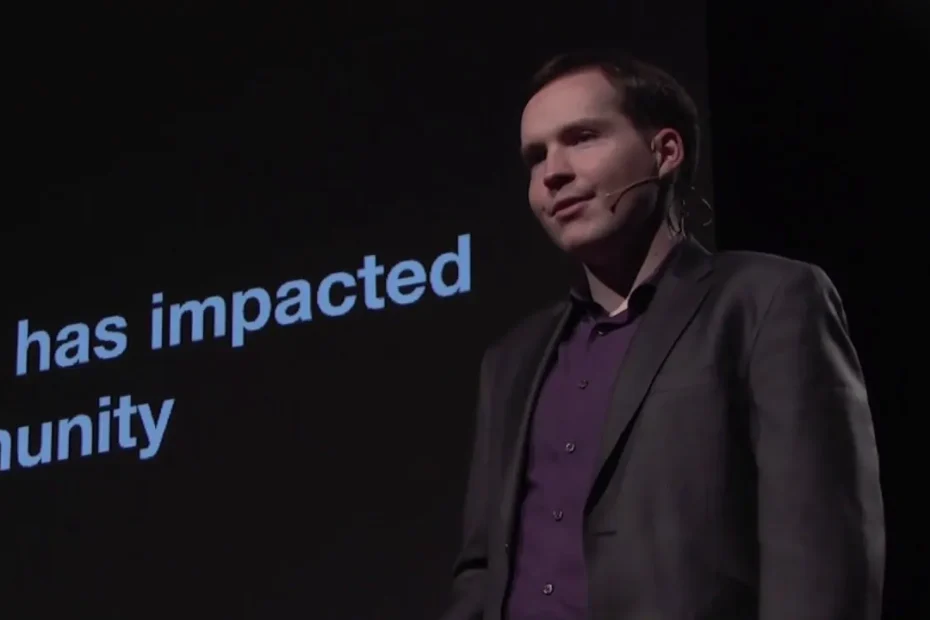
Read the full transcript of award-winning national speaker Kerry Magro’s talk titled “What Happens To Children With Autism, When They Become Adults?” at TEDxMorristown 2016 conference.
Listen to the audio version here:
TRANSCRIPT:
Imagine a World Without Communication
KERRY MAGRO: I want you to imagine something for a second. Imagine that you are unable to tell the people you care about the most in this world that you love them. Imagine a situation where you wouldn’t even be able to tell your loved ones about your basic needs. Imagine not being able to tell your dad that you are hungry or your mom that you are thirsty. For all intents and purposes you were just there with no way of communicating with those around you.
This used to be my reality. Most people that know me have no idea that I actually didn’t speak until I was two and a half years old. I grew up just like any other kid into a loving family and having a warm place to live. But when my parents realized that I didn’t have any words and for a while I didn’t have any sounds, they began to worry about what my future would be.
Thankfully though, my parents became my biggest advocates. While people were telling my parents that, “oh he’s a late bloomer, he’ll grow out of it,” they never took that advice. And because they never took that advice, for the next 18 months they focused on what they could do to help me.
My Autism Diagnosis Journey
Born and raised in New Jersey, they took me to see some of the best physicians, the best therapists, and the best people in our tri-state area. Until when I was four, I was finally diagnosed with pervasive developmental disorder, not otherwise specified, a form of autism. My parents finally sighed a breath of relief. They finally knew what my diagnosis was and could help prepare for my future.
One of the hardest things I think I hear in my profession today as an autism advocate is when I talk to a parent who says that their child was just diagnosed with autism. Not because that kid can’t do amazing things in this world, but because of the uncertainty that autism can bring.
My parents decided to get me focused on rigorous occupational, physical, and speech therapy, which I did for almost 15 years after I was diagnosed. Trust me, it wasn’t easy. While a lot of my friends were making friends, getting into relationships as teenagers, and getting involved with after-school activities, I had IEP meetings, and in-house therapist appointments to attend, and doctor’s appointments to attend, to help with things like not being able to speak, having sensory overload, and having a wide range of difficulties that I can honestly say today, because I’ve been able to progress. They’re no longer a weakness of mine, and many of them have become a strength.
The Transition to Adulthood
So this question of what happens to children with autism when they become adults with autism is what’s happening today. Kids are growing up, such as myself, every single day on the autism spectrum, and we have to be ready for these kids.
I can say because looking at where I came from, I never thought any of this would be possible, let alone speaking on a TEDx stage, and now I give talks across the country as a national motivational speaker. I’ve ran several best-selling books. I’ve consulted on several motion pictures, and I think to some extent, most importantly, I’ve been able to prove the experts wrong. It wasn’t always easy, but now I can say today that I’m here, and that’s a great thing.
So a few years ago, I was speaking at one of my very first autism conferences, and a parent came up to me who had a young son on the autism spectrum. The father must have been in his early 60s, and he came up to me with one question, and I was kind of stunned when he threw that question at me.
The question was, “What will happen to my child when I’m gone?”
This isn’t something that only affects our autism community, but it affects every single one of us in this room. We’re always thinking about, what will happen to my child when I’m gone? Will they have supports? Will they be able to progress, to live their dreams?
And for me, this became the million-dollar question in our autism community. While this father was crying, asking me this question, while his son was just right there, nonverbal, couldn’t really even understand the question, I thought to myself, this is why I do what I do here today. I do it because of people like that father, and because when these kids do become adults, I want to see them live the best life possible, and be able to go after their dreams, just like me being able to give a TED talk in front of all of you today.
Questions Facing Adults with Autism
So when kids do reach adulthood, though, there are many questions that they’re going to be faced. With children with autism, it’s focused on everything from early intervention plans, to how we could get them the best services to get them to adulthood. But once they’re at adulthood, these are some questions that face lots of young adults and adults today in our community.
Think about it for a second:
Will my child be able to find a job?
Will my child be able to go to college?
Will my child be able to find supports after they age out of school?
Will my child be able to live in a group home or independently?
Will my child be supported financially?
Will my child be able to find love one day?
And finally, will my family take care of my child when I’m gone?
Making a Difference in the Autism Community
I’ve tried to answer some of these questions today as an autism advocate.
In 2011, I started a scholarship program that gives out scholarships to young adults with autism who want to pursue a post-secondary education. Even though we’re just starting off, we’ve been able to give out several scholarships to bright, young-minded individuals who are going out there every single day and are pursuing their dreams. And our hope long-term is to give out hundreds of scholarships to these bright individuals who are making a difference in their autism community.
Regardless of where you are in the autism spectrum, one thing we say a lot is “if you’ve met one person with autism, you’ve met just that one person with autism.” And every single person’s story is going to be vastly different compared to the next person you’re going to meet.
Real Stories of Transition
I wanted to share with you a few stories today, though, of individuals who are currently facing this question of the transition to adulthood.
I know of a family, a father actually, who has a young son who just reached adulthood on the autism spectrum and unfortunately just had to place him in a group home. It was probably one of the most heartbreaking transitions this father, let alone his family, ever had to go through. But he decided while all this was going on to become an autism advocate for his son, focused on that transition, he started getting his son horseback riding therapy because he knows his son loves horses. And then he got his first full-time job, not a big job, but he got a job as a janitorial assistant working 40 hours a week. And finally, he started working with his local government to find out what housing requirements he could get for his son as he grows up so that one day he may be able to live independently and have a family.
The second story is of a mom I know down south who has an eight-year-old son on the autism spectrum who has aggressive tendencies. She’s confronted me several times about the fact that although her son has difficulties, she’s worried about the future because he’s so prone to violence. She’s asked me on many occasions, “do you think I will be able to keep my son at home if he continues to lash out at me?” It’s a very difficult question, but what she’s doing right now is she’s working with in-house therapists while she also fundraises for her son to make sure that across the lifespan, because he’s still very young, that he gets the right supports. Because one day his goal is that he is going to be a famous painter and that would be a great thing to see.
The final story is of a very, very young child, a child who’s just four years old who is going into pre-K. This child had progressed a lot since she was diagnosed with autism at two, but in just the past few months, she had regressed and stopped speaking. I think it’s one of the most difficult transitions to have your child say their first words at a very old age, like this girl did, and then to not be able to say anything, let alone make any sounds. But her mom is optimistic.
Creating a Supportive Village for Individuals with Autism
Her mom is optimistic because now she’s looking at the future for her child. What started off as a college fund for her daughter has now become a trust fund for her for her entire life. As she looks at the cost of autism across the lifespan, she is now currently looking to find full-time employment as being a stay-at-home mom is no longer an option. No matter where you are in the autism spectrum, regardless if it’s a child or adult, this is why it hits so many of us.
Steps to Support the Transition to Adulthood
And as an autism advocate, there are many things we can do to focus on that transition to adulthood. First, we need to ask questions. And these are not only for families who have a child, but also just all of us together to help our kids progress.
The first thing you need to do is ask questions when you’re uncertain about different weaknesses that your child is going through in their life. Being educated and having the research there to help provide you with the proper resources is crucial. My parents had to create the wheel because when I was growing up, autism was still very unknown. But today we do have the resources. So stay self-motivated and know that we are finding answers for autism every single day.
Second, self-reflect. After your child goes to bed every single night, write down what they do well and what they had weaknesses and challenges with for that day. As they grow up, read over that journal and reflect on what they have done best and what they can work on, not only with your family, but that child’s village, that child’s school, those child’s therapists.
Finally, advocate. We need to teach these kids as they grow into adults with autism how to advocate for themselves. But that doesn’t mean that we only stop with them. We need to advocate for our kids’ rights every single day because we are their village and they are part of our community.
Supporting Dreams and Aspirations
In closing, I have a 12-year-old mentee whose birthday was actually today. She aspires to be a New York Jets cheerleader when she grows up. And I think about her successes, but then I also think about her challenges. And I think to myself, she shows a lot of the same characteristics that I did when I was growing up. And I want to be there for her. I want to be there for her because when she grows up, she’s going to be the absolute best cheerleader, not only in the NFL, but in the world. And I’m going to be able to go to a stadium and I’m going to be able to say that not only is she the best in her profession, but she’s a role model and an inspiration for what she’s been able to overcome.
That’s my goal for her, but that’s not only my goal for her. That’s the goal for every single individual who has autism, who has a developmental disability. That’s for every single person in this room tonight. We can make a difference for our kids. And that’s because we are learning not only about autism, but so many different things every single day.
The Power of Community Support
And today I can say that I’ve fulfilled many of the dreams that I’ve sought after in my life. When my dad retired, I had just turned 26 years old. And what I was able to tell him while we were cutting the cake for his retirement party was that it was because of you. It was because of you and that village, my mom and dad, my loved ones, my community, that I was able to overcome the obstacles and become an adult who today is currently pursuing his dreams.
Regardless of who is in your village, whether it be a family member or parents or a co-worker or a friend, always be ready to know that you are never, never alone in your village. Always find those supports because my supports and my village and my community, I think are the reason why I’m here today.
Conclusion: Dreams for the Future
And as our kids grow up, I want to see them be able to achieve their dreams. Dreams such as being able to find a job, being able to graduate from college, being able to find love one day, being able to get married. And finally, and I think most importantly, regardless of anything I’ve said tonight, finding happiness in whatever they decide to do in their life. Thank you.