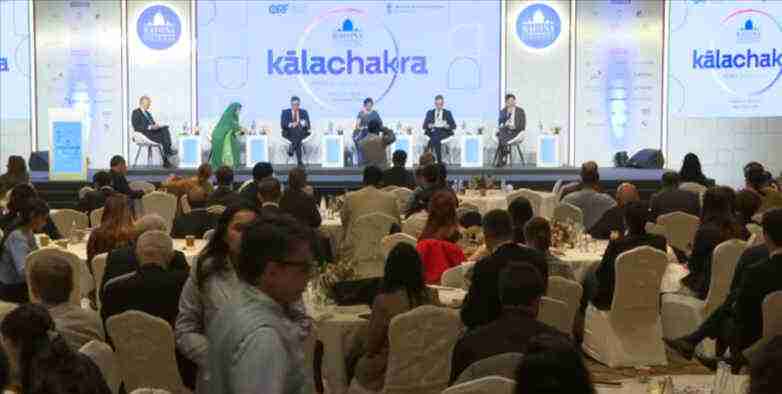
Read the full transcript of a panel discussion titled “Pole Vaults: The Revanchist West and a Rising South”, at Raisina 2025, Premiered Mar 27, 2025.
TRANSCRIPT:
Introduction
KEN JIMBO: I’m your moderator, Ken Jimbo, Managing Director of the International House of Japan based in Tokyo, where I run think tank on geopolitics and geoeconomics. Very pleased to be the moderator for this morning. And welcome to our session entitled “Pole Vaults, the Rebellious West and Rising South.”
We’re going to explore what this really means. We are now on day three of the Raisina Dialogue. As you may recall, over past days, we have heard a wide range of perspectives, including the dramatic shifts taking place in US politics and its implications for global leadership.
The recurring question has been whether we are witnessing the fundamental transformation of the world order with the rise of emerging economies and the expanding influence of BRICS Plus, for example, in reshaping global governance. This discussion this morning remains central to the panel. We will explore how power is being redistributed in the international system and how the world can address the growing mismatch between power and the system.
I believe this is the fundamental policy question that we have – whether traditional allies and partnerships can evolve in this multipolarizing world. I once wrote a controversial article in the Japan Times titled, “The United States is unprepared for a multipolar world.” The value of participating in the Raisina Dialogue is to understand how the world is multipolarizing and how the world requires fair representation.
That is happening from the voices of all of you. But if you go to Washington DC, for example, there is little debate over how the US is adapting itself to emerging dynamics, not in politics, think tanks, and even in academia. Because in my understanding, the United States is unprepared for the multipolarizing world.
But it does not mean that the rest of us are prepared for the leadership role that seems to be absent. We are honored to have distinguished panel experts from diverse regional perspectives. This is going to try to be as conversational as possible.
Recent Putin-Trump Conversation on Ukraine
I’ll direct specific questions to the panelists and encourage close panel engagement as well. I’d like to start by asking Alexander, who is the president of the Primakov National Research Institute and who has been at the forefront of analyzing Russia’s geopolitical strategy and security policies. With permission from all, I want to go slightly beyond the theme of panel in my first question, since President Putin and President Trump have just held a telephone conversation over the ceasefire in Ukraine that happened a few hours ago.
The White House has just described it as the first step in the movement to peace with an agreement to pause strikes on Ukraine’s energy infrastructure. However, it seems there was no indication that Moscow had shifted its broader demands. Is this a tactical de-escalation on Moscow’s terms? Or do you see any realistic path towards more comprehensive settlement? Alexander.
ALEXANDER DYNKIN: Good morning, everybody. I appreciate ORF for having me here.
Answering your question, I believe that was a rather important event. Two months ago, we could not dream about that. Only two months ago, the new president took office.
And the conversation lasted longer than our panel is going to be today. The main outcome, as you said already, is partial ceasefire on energy and infrastructure. It’s launching the technical negotiations about ceasefire on the Black Sea.
There were some ideas regarding non-proliferation of the strategic weaponry. And Putin pronounced the key condition for the ceasefire – canceling of the military and intelligence support of Ukraine.
So I guess it’s quite enough for 90 minutes of conversation.
KEN JIMBO: Right, according to the report, I think President Putin has reiterated his basic stance he has retained for quite some time, which involves NATO renunciation, territorial concessions, and the withdrawal of Western military support over Ukraine. Given Kyiv’s strong opposition to these terms that we heard from the foreign minister yesterday, Alexander, do you think there is any room for diplomatic middle ground, or are we looking at a prolonged impasse from the conversation?
ALEXANDER DYNKIN: Well, I guess yes, and this is part of the agreement between two presidents that the peace process would continue. It couldn’t happen overnight because there are too many problems, but it would continue. And it’s clear, the promise of the two presidents.
KEN JIMBO: Great, so before getting into the main subject, I would also like to get the viewpoint from Paolo on how was your take on the telephone conversation.
PAOLO MAGRI: So far, so good. I mean, nobody would have expected the end of the war in this long conversation. Nobody would have expected Trump to turn down the phone and send Putin out of the Oval Office.
They were on the phone, not in the Oval Office, but nobody would expect that. So they kept the door open. There is a minimal concession on Putin’s side, but it’s clear they don’t want to close the door, and so we should expect, as I said, longer negotiation.
In Europe, we are definitely in favor of a dialogue. We have concern on the output of the dialogue. So far, there is no output, so we are happy.
Strategic Hedging in the Gulf States
KEN JIMBO: Great, so definitely we want to come back to this issue. If you have any questions during the Q&A, please take maximum advantage of this. But I’d like to bring back to the original theme, which we are trying to spend more time on.
I would like to start by asking Dr. Al-Ketbi from the UAE. The UAE and the Gulf countries have played, I would say, a masterclass in strategic hedging and balancing the US security guarantees while engaging China and Russia in the field in Arab states.
Given the growing unpredictability of US policy that we have talked about in past few days, do you see the Gulf permanently shifting away from US engagements, or trying to recalibrate its relationship with the United States?
What has been your take in how the UAE and the region try to deal with the new US presidency and the emerging dynamics that will be taking place?
EBTESAM AL-KETBI: Good morning, everybody. I think Trump is a challenge for the whole world. Maybe it’s an opportunity only for Russia. But maybe the Gulf is the least challenged with Trump because the issue of hedging between China and US was before Trump.
And it’s not about hedging, but if I would say that, in terms of technology, maybe this is the main issue for the Americans, that not to expose their technology to Chinese companies. Look, if you are going to buy the same software or whatever, where the American is giving you $100,000, and the Chinese giving you $100,000, where will you take it from, right?
It’s about that, although also something else. The West, not only the Americans, they don’t share the know-how. The Chinese, they share the know-how. But because the Gulf is traditionally American allies, all their system is American, they don’t have that biggest space to maneuver. They are hedging, right? So economically, they are with China in that relation, but now they are coming back in terms of AI to US.
The Trump challenge, challenge in what, I would say? Trump is asking money, and he’s putting pressure, and we have seen that he took half a trillion from the Saudis, and he offered them that they can host a mediation between American and Russian, between Ukrainian and American.
It’s not about this also. Now, there is US unilateralism, and violating of the global orders, norms, and values. This means the whole world, mainly the global South, should come as alliance.
We have BRICS, we should have others, and talking about reforming the UN, the IMF, which came after World War II, where there is superiority for the major powers, mainly US to have a veto, and everything they don’t like. Now, there is India coming, these are emerging powers – India, Brazil, other Asian countries, Indonesia, Africa as well – they should have representation in those institutions. So, we need to look again at the global order, which should reflect justice between all the nations in the world.
KEN JIMBO: Great, thank you very much. If I may have a follow-up question. It’s quite a complexity that has been taking place in the Middle East. You do have regional cooperation mechanisms, like OPEC, GCC cooperation mechanisms, but at the same time, it was during the first Trump administration that the Abraham Accord was formulated, with attempts to have normalization talks, including Israel.
At the same time, you mentioned about the region representing more in global governance, probably that includes G20, BRICS, so many enmeshments of different initiatives also overshadowing the region. How do you see the prospects of what really is the mainstream of the regional integration mechanism or the representation in the world system? Which do you think is a preferable comfort condition for the region?
EBTESAM AL-KETBI: Look, now I can see the global south gathering and they are trying. And BRICS, I mean, G7, they should make G20 also, because humiliating the global south means not seeing that there are realities, new facts on the ground that this is, and India can be a global power. You cannot neglect that fact.
So, also, GCC Council coming together, I think that kind of coalition can face Trump’s unilateralism. There is another issue I want to mention here – the concept of annexation for Greenland or renaming places. This emboldens those who have the same Trump mentality, which is Netanyahu. And this is very dangerous for the global order. It means anybody can annex or we have a new colonialism or imperialism in the world, and this is shaking the stability in the global order and the trust of the global south in that global order.
Africa’s Role in Global Governance
KEN JIMBO: Thank you, I’ll definitely get back to the point that you have laid out. But I turn to you, Karim. He’s the Executive President of the Policy Center for the New South, and he’s been a leading voice of Africa’s economic trajectory and global governance reforms.
As you all may recall, according to all the projection studies in 2030s, 40s, and 50s, definitely we are going to see that Africa is the power center of economic growth in the decades to come. Even during the 1970s, 80s, and 90s, Africa has developed its own regional cooperation mechanism. The role played by AU, and also if you look at Western Africa, ECOWAS has played huge roles in political coordination, even in conflict resolution mechanisms. The systemizing of African coordination mechanisms is quite remarkable in a sense.
I wonder about the future trajectory of Africa in something beyond the African continent – how much can Africa really play its role in the provision of public goods to others? What is your viewpoint on this?
KARIM EL AYNAOUI: Thank you, pleasure to be here.
I think it’s too early to answer your question. Nobody wants to create public goods these days. There’s no reason. We need to go through a period of adjustment, and this is the period we’re going through. We’re not seeing the world with the same glasses.
I think everybody here could take two minutes and think of how it was before. Because of the current dynamics, we tend to have a romantic view of what was the so-called rule-based order over the past 50 years. We didn’t live this period the same – Japan and Morocco, Congo and Italy, etc. People tend to forget the consequences of foreign interventions in Africa or in the Middle East. They tend to forget interventions in domestic political systems in many countries.
So I think first of all, we need to try to see things, put ourselves in others’ positions. And this is the painful process we’re going through. It is a painful process. It has psychological dimensions. And misunderstandings are coming from that.
We were not surprised at the vote at the UN on Ukraine, the first vote. I was astonished to see my European friends surprised. We were absolutely not surprised. It was a message, a cheap way to send a message. And it was not received the same way.
I think there’s one dimension that is important – there are some countries that are gaining from what is ongoing now. We don’t know what’s the end point. And I think it was Sanjoy Joshi’s point at the introduction of this seminar. This is dynamics which sets back and forth.
The strategic value of some countries has increased. The thing is that advanced economies who have been benefiting mostly from this rule-based order, although we were some free riders as well, but we paid the price too – who are those countries? Take two minutes and list them. I think for advanced economies, Europeans are clearly the losers in a way for the time being, let us see.
So my take from the continent is that countries should focus on their internal politics if they can. It is essential in this more risky world, in this adjustment period, to have strong internal fronts, particularly because populations are asking for a lot from governments. States are under pressure to deliver protection, to deliver quality education and health services, to help manage the demographic transition where it is relevant, and to address the consequences of climate change.
And there’s a long list. Defense spending is increasing. The scars of managing the previous crisis are in the fiscal accounts of most countries. So it’s a tough period. It’s complex policymaking. And I think we can help as think tankers, as academics.
Perspectives on Global Order and Diplomacy
KEN JIMBO: We’re not commentators or news anchors. Otherwise, we won’t be very useful. I salute India’s initiatives with this Raisina Dialogue. The main benefit of such a gathering is really to understand each other.
How do you see the world from Japan, from the Emirates, from India, from Italy, from Russia? To understand each other. We’re not echo chambers of the daily news flows. I don’t think that would be very useful.
KARIM EL AYNAOUI: You’ll find in Africa wisdom and the capacity to discuss and to engage. I think it is essential. And you mentioned the institutions – they’re not perfect, but Africans are proud of those institutions and they are investing in them.
They have many flaws, but the intention is there. And I think it is essential, useful to engage with the rest of the world. So I see Africa as being open to engage with the rest of the world, to go through this adjustment period and find some sort of equilibria in the medium term.
KEN JIMBO: Thank you very much, Karim, especially for the reminder of the value of the Raisina Dialogue – the cross-representing of various points of view from the world. I move on to Manjeet.
Obviously you’re representing India’s think tank academic world. Participating in this Raisina Dialogue and dealing with this turbulent world, there has been quite a stark difference between how much distance and interdependence you have with the United States.
For example, Europe has experienced a deep shock, as has Japan, because we are major allies of the United States. Under those conditions, whoever becomes president, the diplomatic choices that those major allies have will be very limited – to think about plan B and plan C in adapting to the new political configuration in the United States.
But India, with its non-allied traditions and the promotion of strategic autonomy as a major concept for a long time, seems to have significant confidence in navigating these shocks. I wonder how confident you are in looking at this world, positioning India into this, and what is the uniqueness of India in changing these dynamics?
India’s Role in the Changing Global Order
MANJEET KRIPALANI: Thank you, Ken. And thank you all for being here so early in the morning.
This year is the 70th year of the Bandung Conference, the non-aligned movement. Julia here is in the audience and she’s been studying this. It’s a very important time because we need to look again at the non-aligned world, which was really a Global South movement in 1955, and look at its relevance for today.
Really, things have not changed because we are still non-aligned, but the Western world has changed. It has gone from being the writer of rules to a new reality – we are no longer the taker of rules. We are making the new rules.
I think that the West has understood that it has certain limitations because the world has changed. All the things that the West has been saying over the years – the world must step up, we must all become equal, everybody must be developed – that has come to pass.
For India particularly, because of our digital and virtual infrastructure, we haven’t had the beautiful gardens of Europe, but we certainly have beautiful virtual infrastructure. We’ve been able to overcome that. We are 1.4 billion and we are not China. So that is starting to happen.
This is very important because when India solves problems, other countries and continents like Africa, Southeast Asia, and Latin America can use these as replicable models. I find that, as Karim says about Africa, it is very important for countries like India when we start creating new supply chains to think about how we bring the rest of the Global South into those supply chains.
Morocco has been very smart about taking our digital public goods, and I think that is working very well. The effect of how well it’s doing in Morocco and Rwanda – these are things that really should be encouraged by all.
Unfortunately, what’s happened, even in the virtual space, is the world has become divided. You’ve got China, which is run by the state infrastructure. United States is totally privatized. We are somewhere in between. And this is a very good model.
I feel that India plays a very significant role. The non-aligned movement is really maybe a multi-aligned movement. And it’s good for the world to understand it is not necessary now for the G7, which still talks about alliances. The rest of the world is talking about partnerships. That’s much more flexible.
Coming back to what you said about the role of the Middle East in being an interlocutor for the West – when the West has been a mediator, it has done the carrot and stick. That has not worked now. When West Asia becomes a mediator, when Saudi Arabia and the UAE become mediators, they are culturally a little more sensitive. The mediation is more flexible, newer, and has cultural sensitivities. It works and should not be dismissed.
When the African delegation went to Russia and Ukraine to try and mediate, they were dismissed by what I felt was a very arrogant West. They should never forget that Africa has lots of disputes. They mediate with each other very well. And you’re right, Africa has a proud tradition and should be proud. They must be taken seriously because they do have something to offer in this new world.
Europe’s Position in the Changing World Order
KEN JIMBO: Excellent. Sam says that India has the largest population in the world. And if India goes to the BRICS world, authoritarianism and how a non-Western world has a major identity, that really decides the future of the world system. But India, as you mentioned, plays a mediator role, embracing different values and systems coexisting in the world. That is also creating bridging roles.
Everybody mentioned that India is the casting vote nation for the whole world order. It’s an important reminder of how you can really navigate the future of the order with this important nation as directions are taking place.
But coming to Paolo, I really wonder how can transatlantic alliances evolve to stay relevant in this multipolar world? And is there any real appetite within the EU to integrate the aspirations of the Global South, or is Europe more focused on its internal cohesion? What is your take?
PAOLO MAGRI: Thanks. You started saying we are witnessing a fundamental transformation. But then my friend Karim said, wait, it’s too early – not meaning too early for the session at seven o’clock, but too early that we are discussing something which is developing, evolving. Trump is at the White House for 60 days, and we are elaborating on the new world since then.
And we are not TV anchors, as Karim said. So let me exchange with you a few comments on what is emerging after these 60 days and the two years of the Ukrainian war as well. I will take a different view on the short term and the medium term. The short term is the TV anchor; the medium and long term is our role as think tanks.
Europe, in the short term, is losing economically but gaining politically. Losing economically because it started with the new prices of energy after the war, and all was connected to that. We are losing economically because we are clearly moving from the traditional European welfare to a new economy, which is more warfare. And this is completely different. We need money for that.
But we are gaining politically. I think you have been attending several sessions during these days, and I’m sure you have attended several sessions in your life. What is usually on stage when there is a conference like this is that you have the Swedish position, the German position, the French position, the Italian position – 27 positions on stage.
You may have noticed in this conference that apart from two countries, which are actually a little bit lost in transition in Europe, all the other representatives from European countries kept saying “we” – we in Europe, we the Europeans. And this is completely new. That means that what happened with Putin, what may happen with Trump, made us realize that we have to change. There is no more time for big words, big conferences, new constitutions. We need big action.
And big actions are happening. Deciding, as we are deciding in three weeks’ time, to eventually move into arming Europe is something which would have been unthinkable a few months ago.
This has been driven by a leader of a country which is no more there, UK, together with a leader which will be no more there, Macron, and a leader which is not yet there, Merz, the German chancellor. These three people paved the way to something which is a European rearmament – which is something absolutely new.
What about the medium and long term? In the medium and long term, we may gain economically and lose politically. We have to be very honest. Gain economically because investing this huge amount of money – the European one, Germany yesterday decided to cancel the debt brake – and other investment will be needed to innovate Europe. This investment may in the medium term improve growth prospects for Europe and reduce the technological gap – reduce, not eliminate.
But politically, it’s a little bit riskier because there is strong cohesion right now in having more Europe. But everything we will do on rearming Europe, in spending money on this new activity which will prevent us from supporting our traditional welfare, may be used by political parties which are skeptical on Europe in the next months to go against Europe. And they will be supported by Elon Musk and others in the States.
So it’s the same grouping which within all countries may in the future work on jeopardizing the incredible miracle that we have done in the last two weeks, in spite of not knowing what will happen soon. The scenario is incredibly new.
You asked me how this new scenario will have Europe trying to incorporate the Global South. This is also evolving. If you ask me, will we get any change in the financial institutions to incorporate the Global South? My answer is probably no. There is an American veto there.
But if you ask me, for example, if there will be more interesting cooperation in trade between Europe and the Global South, my answer would be yes. Clearly, there is a new approach in looking at relationships with the Philippines, Thailand, India, and Mercosur. Europe will utilize a free-riding approach after being a little bit left aside by the traditional allies. So in that sense, I would say there are opportunities, great opportunities. On the financial institutions, I would not be optimistic. On the UN, it’s a never-ending story. We know that’s very difficult.
Russia’s Perspective on the Global Order
KEN JIMBO: Thank you very much for those great elaborations. I’d like to go back to Alexander. Thank you for your patience.
As you may all know, Alexander has long analyzed the structural shift in global power. Russia has positioned itself as a key player in this multi-polarizing world. I would like to know your current viewpoint about how Moscow sees the evolution of this multi-polarizing global order. What is the direction of Russia in incorporating those global trends?
If you could share with us, especially how the United States Trump administration might try to negotiate with Russia on the particular issue of Ukraine as a source. But I think it goes beyond that, and will include the notion of how the future of arms control might take place, and how those major powers can coexist with each other. With all this in mind, I’d like to know your viewpoint.
ALEXANDER DYNKIN: Thank you. Let me start with some comments about the presentations of the previous speakers.
My take is that the new role of the Gulf States is an important part of the new global order. I believe that Gulf States today have completely substituted Switzerland as a neutral place for negotiations, for financial deals, for trade, commerce, and so on. And this is an important part of the new world order.
I believe that Trump’s policy, his attempt to launch the exit strategy from the Ukrainian conflict, is not only an opportunity for Russia, it’s an opportunity for Ukraine, it’s an opportunity for Europe. And these are completely new developments. We could not imagine this three months ago.
Three months ago, we were listening about the strategic defeat of Russia and continuing support till nobody knows how long. That was the previous administration’s position. It’s completely different now.
Look, I believe that Trump completely rejected this fallacy about the end of history. It was a fallacy, but a very well-traded error. And some events such as Iraq, Syria, Libya, Afghanistan, Ukraine were the consequences of this theoretical mistake, a very strong theoretical mistake.
Regarding Europe, I guess that after recent 30 years of being members of NATO, Europe became a completely strategic free rider without strategic understanding and responsibility. And as Paolo said, yesterday they canceled this budget brake in Germany. So it’s a new development also.
The defense budget in Europe would grow, but at the same time, we are facing a stagnating economy in Europe. What does it mean? It means some problems with the living standards. And what does that mean? It means some support for the ultra-right in Europe. And some from the American administration openly support the ultra-right. It’s also a new development.
So my take is that the world order has entered a stage of very dramatic and dynamic change. I could mention several contours of this dramatic change. I believe that it would be post-liberalism. It would be a plurality of sovereign development models.
Pole Vaults: The Revanchist West and a Rising South
ALEXANDER DYNKIN: It would be multi-polarity. It would be modernization and erecting of the new international alliances and institutions. We already mentioned several of them.
Another take is that for the recent centuries, Europe was the natural kitchen where the next world order was prepared. It would not be anymore. It would be prepared in the larger Eurasia, of course, with United States participation.
If you look at the economic statistics, during recent 20 years, China’s GDP has grown by 10 times, India’s by five times, Indonesia by 4.5, Russia by three times. So according to last year’s IMF database, the top five countries quoting PPP by GDP – there is no one from the wonderful garden from Europe.
Only Russia is in top five. So this is also a new development. And finally, I may tell you that, look, for recent three centuries, Europe was the institutional and cultural role model for Russia, but not anymore, unfortunately.
And this is the choice of Europeans. It’s not Russia’s choice. Russia used to be the very organic, natural economic partner for Russia.
Not anymore. So this is also developments of the new world order. Well, thank you very much.
KEN JIMBO: And we do have slightly over eight minutes, and I’d like to open the floor for anybody who wishes to engage in the dialogues. And let’s take two or three questions in the row. Please send the microphone to the lady.
Q&A Session
AUDIENCE QUESTION: Hi, panel. My name is Anjan Singh. I wanted to ask, the recent development in BRICS and the tension with the Western countries that they’re against the development of BRICS, the thing that is a disturbance of the international order. How Global South will rise with accounting the Western ideologies development of BRICS, especially context of digitalization in this world? Thank you.
KEN JIMBO: And let’s take two more questions. Anybody want to hear?
AUDIENCE QUESTION: Morning. Yeah. I’m Seko. We are a private equity firm from New York. We actually finance a lot of governments worldwide. With the current situation within the Global South is contributing to around 60% of the GDP. While the West is stagnating, EU is having only a growth of 1.2%, while US is carrying a debt of $34 trillion. And hardly IMF, World Bank and other multilateral institutions, they have to be reformed a lot to support the Global South. So should the emerging markets decide, you know, I mean, to leverage their own assets and probably get finances from a firm like us and not look towards Europe and US anymore? Thank you.
KEN JIMBO: Thank you very much. Good morning. Yeah, one is here, sir.
AUDIENCE QUESTION: Hello. Go ahead. Thank you. Yagnia Kudaru here from University of Munich. My question is to Mr. Alexander. At the start of the session, you said that Russia is willing to make diplomatic middle ground. My question to you, sir, is what would be this middle ground? How, what concessions is Russia willing to make in comparison to Russia’s demands at the start of the war? Thank you.
KEN JIMBO: Okay, I think there are two more questions. Let’s do one by one.
AUDIENCE QUESTION: Can I go? This is Kazeme Sajjadpour from Iran and I appreciate the panel. I have a question for the totality of the panel and that is the personalization of international politics. Not too much weight on one person, Trump. And we also see Putin and the argument is also where Trump likes Putin himself and Xi to be the new concept of, let’s say, global international politics. To what extent, especially the unpredictability of the personality of Trump, would be a threat to international peace and security regardless of all deals that he makes? He is very unpredictable. Is this unpredictability conducive to the, let’s say, a situation in which we would have wars and conflicts more than deals? Thank you.
KEN JIMBO: Thank you very much. So final question.
AUDIENCE QUESTION: You know, Joe Biden gave a call for unity of NATO and to fight with Russia in Ukraine. Now, NATO was with Joe Biden. Trump comes to power and he begins a process of the path with Russia. But Europe does not seem to be with Trump right now. Rather, they are feeling aggrieved that without consulting Europe, Biden is directly talking to Putin. My question is, someday maybe in the, it will take a while, but finally a ceasefire agreement will take place and maybe a long peace agreement will also be signed. And after that, what will be the nature of the relationship between this new Europe and Russia?
KEN JIMBO: All right. Thank you very much for all thoughtful questions. I think on the first and second question on the BRICS expansion and global distribution of power and how the institution can really adapt themselves in the future, probably I would like to ask Dr. Al-Ketbi and Karim for those questions. Starting from Al-Ketbi.
EBTESAM AL-KETBI: My country joined BRICS lately. Look, it is with the American pressure, okay? You also need to look for another alliances, okay? That the world is not only West, it’s not only America. There are other power in the world, India, China, Russia, that can balance the reliance on US.
Now, for UAE, if I can, this is an opportunity. It’s not against the West, as been perceived by the West that this is against. It’s opportunity to find for more corridors in other place, in Asia, in Africa.
And as Anwar Gargash yesterday said, UAE is a logistical hub, and this is how its foreign policy also. It goes based on that most of its foreign policy. So BRICS, I think now with the Trump unilateralism, push more members to join BRICS or other alliances.
For Sajjadpur, personal matter, wherever it is, okay? I will give you also an example for Iran. When Khatami came and he was open to his neighbor, to the world, Iranian foreign policy was different. So every time, no matter how is, this is an institutional country, US, nobody thought that there will be a guy come and break the system and break the institution.
So this is what shows that the whole world, when that global power, we all rely on it. This means the global world order is in danger. So it means, this is a shaky moment that needs revisiting the global order from global south angle, from global south angle.
KARIM EL AYNAOUI: Yeah, three points to summarize. The first one is, there is a paradox, which is, it’s a fragmented world, but at the same time, you have an explosion of demand and appetite for cooperation all around the world. So there’s a paradoxical sort of dynamic there, which is interesting to note, which is the human tendency to cooperate, I think will prevail at some point.
The second point, people, personalities, matters, they do history, but at the same time, they’re the symptom of structural and profound dynamics. So don’t be mistaken, what we’re seeing today as started a while ago, and I don’t think you should put this on the account of personalities. I think there are deeper structural transformations and dynamics at play, and it’s just the US don’t have any more an interest for the status quo.
That is it, I mean, you can explain it, and it’s a wake-up call for Europe, and I think it’s a good wake-up call. It’s creating dynamics, and I think this is, we need to usher into a new equilibria, and it is going to be painful to reach it, and we don’t like it, human beings. It was comfortable for Europe, but they thought it was comfortable for the rest of the world, which is not the case.
This is my first point. So it’s also a reality check. So intense thinking is important, curiosity, modesty in this period.
Let us be guarded against sort of one-size-fits-all thinking. On the global south, let us be careful, if I may. This is revolution time, if you agree.
This is very quick way to say it, but we don’t want to be seen as being reactionaries, okay? So that was the trap of the Democrats in the US. In fact, they were the reactionary, and it was the revolutionary. So I think let’s not fantasize and romanticize the past.
We need to build something new, and let’s be fresh in our mind to be able to have this new construction. I think the global south is an interesting idea. It’s a romance, but operationally, technically, there’s so much diversity and heterogeneity, which is the case in all global alliances or associations or groupings in the world.
So let us be, try to bring something new to the table. I believe in regional arrangements. Africa being a region, and here, Indo-Pacific, and let us see where it will guide us.
KEN JIMBO: Thank you. Alexander, a quick point on the diplomatic middle ground, and Karim mentioned about whether new equilibrium will emerge in Europe. What’s your take on this?
ALEXANDER DYNKIN: Look, I forgot to answer your question about arms control, and my take is that the Russian-American relations are much wider than Ukraine or Greenland, because next February, the start expires, and we are facing multipolar nuclear world.
And say, 30 years ago, 95% warheads belonged to these two powers. Today, only 70%. Technological advances in conventional weaponry, cyber, AI, and so on and so forth, so it’s complicated and very scaring and frightening, frightening issues.
So I believe that it’s early to make final predictions, but as I see it today, I believe there would be four major power center in the globe. It would be China, Russia, United States, and India. I guess Europe someday would join this grouping, but not today.
As Pavel said, they try to speak one voice. It’s not always an orchestra. So regarding Russian concessions, I don’t know, because normally, the Russia-US relations is the presidential-level relations.
The concessions is that we already canceled the tech on the energy and the infrastructure object, that we launched this negotiation about the Black Sea. So it’s a long way ahead, and there would be definitely concessions. What kind of them, I don’t know, but first concession that we stop a tech on this critical infrastructure.
KEN JIMBO: Okay, Paolo, your response. Please, yes.
PAOLO MAGRI: One question on what will the relationship between Europe and Russia look like after the ceasefire or the peace.
My short answer is it depends on the ceasefire and peace. If the ceasefire and peace are realistically a mediation, I think there will be a realistic adaptation of Europe to a relationship with Russia. If it is a surrender, that will open up a big issue within Europe, and I would expect that not many country would be ready to go back to business as usual.
KEN JIMBO: Thank you, and Manjeet, for your final remark.
MANJEET KRIPALANI: Very quickly, to remind everybody that, in fact, the world is changing in a positive way, is the IMEC Corridor, which is a partnership with India, the US, UAE, Saudi Arabia, and going on into Europe, Germany, Italy, and France. These are the new corporations that we’re going to see, and they are going to include both the Global North and the Global South.
KEN JIMBO: Thank you very much, and I apologize for the time has already exceeded much, but I really appreciate the great contribution by the panelists, and also excellent questions from the floor. So, join me in thanking all the panelists, and a round of applause, please.
Related Posts