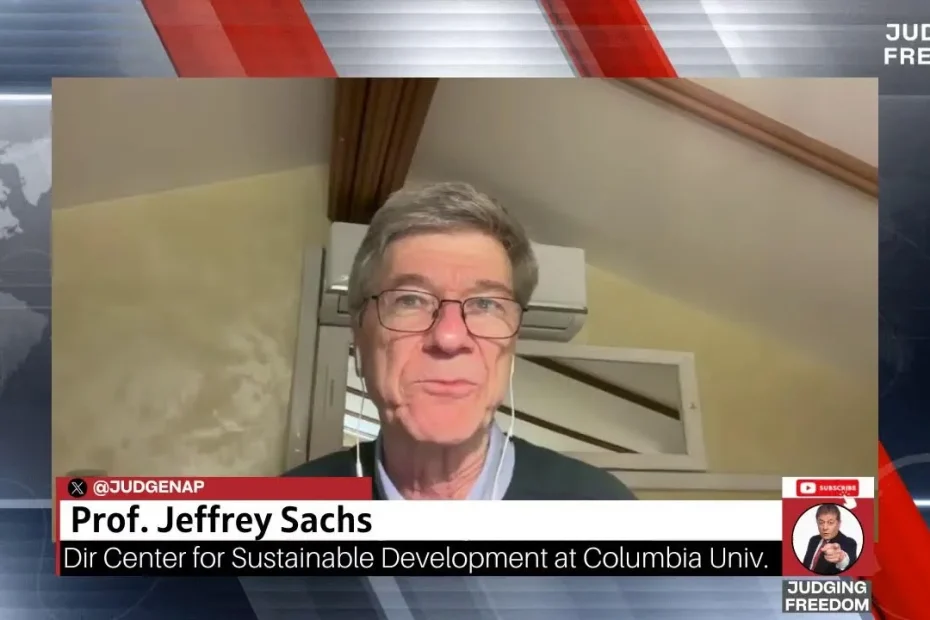
Read the full transcript of a conversation between Judge Andrew Napolitano and American economist and public policy analyst Jeffrey Sachs on Judging Freedom Podcast titled “The Disaster of Tariffs” premiered April 3, 2025.
Now the interview starts here:
Introduction
JUDGE ANDREW NAPOLITANO: Hi, everyone. Judge Andrew Napolitano here for Judging Freedom. Today is Thursday, April 3, 2025. Professor Jeffrey Sachs joins us now. Professor Sachs, thank you very much. Thank you for double duty this week. But you and I communicated with each other yesterday in a fit of anger and fury over the President’s misunderstanding of Economics 101.
We’re not going to talk about Gaza and we’re not going to talk about Ukraine. We’re going to talk about your field as a professor of economics, which you were at Harvard and are at Columbia. The President’s statement, his executive order, which you and I read, as long and absurd, abstruse and boring and nonsensical as it is, hinges on the fact that in his view, we are facing an emergency because it is based on the International Emergency Economic Powers Act of 1977 signed into law by President Jimmy Carter.
That act defines an emergency. And from the definition of an emergency comes the President’s powers to impose a tariff. Now, President Trump originally said the emergency was the introduction of fentanyl in the United States. And then his advisors told him, look, it’s coming from Mexico and there’s a little tiny bit of it coming from Canada, but you want to put tariffs on everybody, so you can’t use fentanyl. And so they concocted the economic emergency.
The definition of an economic emergency under the act, and then I’m going to throw the ball to you, Professor Sachs, is “an unusual and extraordinary threat to the national security, foreign policy, or economy of the United States originating in whole or substantial part outside the United States.” If you read the President’s executive order as you and I have done, it says that this started in 1934. So how can this be an unusual or extraordinary threat if it’s been going on for 89 or 91 years? I’ll let you take it from there. What kind of an emergency is this?
The “Emergency” Explained
PROF. JEFFREY SACHS: It is an emergency. How utterly awful today was in terms of economic policy. Trump has created something, you might call it an emergency, but it’s basically a phenomenal blunder. Now, why did he use the word emergency? Because that’s the only way that he can do this himself.
A tariff is a tax. A tax is the responsibility of the US Congress. Indeed, the proposal to introduce or change a tax must originate in the House of Representatives. So Trump’s use of the phrase emergency is a gimmick. It’s a gimmick that allows him single-handedly to wreck the international trading system.
Otherwise, what Trump has done today would have to be done under the US Constitution by a congressional act. The fact of the matter is Congress would not do such a thing or it would take a little bit of time. So it could be utterly ridiculed along the way and most likely stopped through the ridicule.
As long as we have one person rule in the United States, which we have because the Congress is quiescent entirely, it has seemingly given up all responsibility to our president. As long as we have one person rule, we have the possibility of this kind of utterly profound blunder on the substance. No, there was no emergency yesterday or today that remotely justifies handing such extraordinary power to one person, and in this case, one person who understands nothing about what he’s doing. No justification whatsoever.
Understanding Trade Deficits
JUDGE ANDREW NAPOLITANO: I mean, the other linchpin here, as I see it, and of course I’m a layperson when it comes to the economy, but not when it comes to the law, is there a downside to a trade deficit? I mean, this almost seems childish that this is the economic linchpin, the legal linchpin is the definition of an emergency. You’ve already dealt with that. The economic linchpin, correct me if you read this differently. As I read it, is that we have a trade deficit. It’s caused by other countries ripping us off and now we’re going to get them back. Is that a fair reading of what he wrote or what he signed in his executive order yesterday?
PROF. JEFFREY SACHS: Well, that’s exactly the claim. The claim is again fatuous. It’s a complete misunderstanding. A trade deficit means you’re buying more from abroad than you are selling abroad. It doesn’t mean anybody is ripping you off. It means you’re spending more than you’ve earned. And maybe there’s a justification for doing that. Maybe you’re spending too much compared to your income. So you have to look. But per se, trade deficit has nothing to do with actual trade policy of the other country.
Now this is also quite interesting. The idea that Trump claimed before yesterday was that the US would impose reciprocal tariffs. The idea was if another country puts on a 10% tariff, we would put on 10% tariff. If the country puts on a 20% tariff on us, we would put on 20% tariff. In other words, our tariff level would reciprocate what the other country is doing.
What happened yesterday has nothing at all to do with what the other country is doing in its tariff policy. In fact, the first words of so-called explanation, the methodology by the U.S. Trade Representative’s Office which purportedly made this calculation is, “oh, we don’t know what the other country is doing. That would take a long time. We can’t figure out what they’re doing. So we’re just going to assume that if we are running a trade deficit with another country, they must be ripping us off.”
Not that we see that they are, or that we measure that they are, or that their policy, in fact, is doing that.
We’re just going to say that if we’re spending more in another country than that country is buying from us, they are ripping us off. Well, it is Alice in Wonderland. What was said. There’s nothing reciprocal. There’s nothing about other countries.
We spend more on goods abroad than other countries spend on ours. Most importantly, because we run huge budget deficits. So our government’s like a giant credit card for the American people. It borrows massively trillions of dollars. And that means that it’s putting out lots of purchasing power more than it’s taking in. It’s doing that by running up debt. And that purchasing power is used by American businesses and households to spend. And the result is that they spend more than America produces each year.
What’s the gap between how much we spend and how much we produce? It is exactly equal to our trade deficit. Not close—exactly, because that’s what the trade deficit is measuring.
The Real Cause of Trade Deficits
JUDGE ANDREW NAPOLITANO: So what he’s ranting and raving about, and it is a rant about the trade deficit is caused by the government over which he presides. It is not caused by other countries ripping us off, or it is caused by, just like in your household, you spend more money than you take in, you’ve got a deficit, you’ve got a debt, you haven’t done anything wrong, you haven’t committed a crime. Nobody’s ripping you off.
PROF. JEFFREY SACHS: It’s not a decision. And more than that, it’s exactly like you go shopping on your credit card, you run up a debt, and then you blame the merchant that sold you the goods. They’re ripping me off because I’m running a deficit with them. This is exactly what it is. We buy from abroad, and they’re ripping us off. How do you know they’re ripping us off? Because we’re spending more than they are. Honest to God. This is exactly what just happened.
The Official Response
JUDGE ANDREW NAPOLITANO: Here’s his press spokesperson. This is the official government response to your and my and others. It’s almost universal in your community of economists, criticism of the president. Cut number nine.
[VIDEO CLIP STARTS]
UNIDENTIFIED SPEAKER: This is a national emergency. We have a $1.2 trillion trade deficit. We’ve had 90,000 factories close across our heartland. We’ve had 5 million manufacturing jobs go overseas since 1997. And President Trump is finally doing something about it by implementing these reciprocal tariffs. It’s the golden rule for the golden age of America. As for prices and what the American public can expect, they can expect price stability, they can expect to buy American. It’s a patriotic thing to do.
[VIDEO CLIP ENDS]
JUDGE ANDREW NAPOLITANO: This is political claptrap, but I’ll let you take it on.
The Reality of Manufacturing Jobs
PROF. JEFFREY SACHS: It looks like an AI fake, frankly. You know, is that really someone talking or is that stringing together a bunch of words that absolutely mean nothing? So again, the charge: Look what they’re doing to us, the grievance look, how terrible. What does she know about where jobs went? Why factories close or don’t close.
The fact of the matter is you go to a factory that is producing and it has robotics producing in the factory. That’s where jobs went in. Millions of jobs on the assembly line didn’t go abroad. No one victimized us, no one tricked us. You go to an automobile plant, there are fewer workers because there are robots on the assembly line.
JUDGE ANDREW NAPOLITANO: Ah, but somebody’s making the robots.
PROF. JEFFREY SACHS: No, but it’s not even that. It’s just the jobs, the jobs there are, the jobs are right there before your eyes. The machines are doing them on the assembly line. It’s not that somebody else has stolen that work. That is what automation is and what it absolutely did in for millions of jobs in manufacturing.
Impact on Consumers
JUDGE ANDREW NAPOLITANO: So if I go to Amazon or Walmart to buy a toaster, which today costs $25 because it’s made in China and I’m poor or middle class, my family wants a toaster. What does this do to me? It makes me spend more money. It reduces my choices.
PROF. JEFFREY SACHS: Well, look for the entire country, it’s going to make Americans poorer. It’s actually going to make the world poorer. Because when there’s international trade, both sides gain from trade. We buy things that are relatively inexpensive of other countries to produce. They buy things that the United States produces with a comparative advantage. It’s called gains from trade.
It’s a concept, I think Donald Trump doesn’t understand that actually in a deal, both sides can gain. And if you stop that kind of exchange, both sides lose. And what’s interesting about today, not a surprise, but since Donald Trump single-handedly is trying to blow up the international trade system, stock markets went down everywhere. It’s not like the US Stock market said, “oh, now we win. We’re not getting ripped off.” No, the United States shed trillions of dollars of market capitalization today.
Oh, so you say, “oh, it went abroad. They won.” No, trillions of dollars were lost abroad, too, because both sides, the US and the rest of the world, lose when there isn’t trade. That’s something I think Mr. Trump doesn’t get. The idea that you can have a benefit from exchange, not a winner and a loser.
The Reality of Auto Manufacturing
JUDGE ANDREW NAPOLITANO: The Wall Street Journal, which basically is a supporter of the President and his ideas, I’ve tangled with them many times on the constitutionality of what the President is trying to do, nevertheless is leading the charge against the tariffs. And they hired some people to put together a clip. It’s only about 90 seconds long, but it demonstrates how not a single car in the United States of America, not a single one, is assembled entirely of parts produced in the United States of America. And then it demonstrates how Joe Sixpack with a MAGA hat on is going to have to spend more money to buy a car which he thinks is American and thinks was made here. I’m giving credit to the Wall Street Journal and to Dow Jones, as they are entitled to because they produce this under the fair use doctrine. We’re running it. And here it is.
[VIDEO CLIP STARTS]
UNIDENTIFIED SPEAKER: This chart shows where cars sold in the US are coming from. All of these cars now face that 25% auto tariff. But this 53% of US made cars is also affected by that tariff because of all of those foreign parts. Some of the major components. This is for the Ford F150. They have an alternator create current. It’s from Mexico. We have half shafts. These deliver torque to the wheels from the driveline. They’re from Canada. We have tires, of course, five of them. These come from Korea. Of course, you have to have wheels. In this case, a styled tract of wheels. These all come from Mexico.
Those tires from South Korea would face that auto tariff and any reciprocal or universal tariff placed on the country. Those parts from Canada and Mexico, well, that’s where it gets more complicated. Eventually they would face that auto tariff, any reciprocal or universal tariff, and an additional Mexico Canada tariff. But the White House said parts compliant with the U.S. Mexico, Canada Trade Agreement, or USMCA, remain tariff free until there is a process to apply tariffs to their non-US content. And for some parts like a transmission, there will be a lot of content to consider.
This is going to be disruptive on day one. It’s going to increase the cost of doing business. The total amount depends on the vehicle. A Cox Automotive estimate shows a car made in the US would incur $3,000 in cost from the Canada, Mexico tariffs, plus another $3,000 from the tariffs on foreign made auto parts. Then research shows an added $400 for the steel and aluminum tariffs and more for any reciprocal or universal tariffs.
[VIDEO CLIP ENDS]
JUDGE ANDREW NAPOLITANO: I thought we had a treaty with Mexico and Canada, a free trade treaty. They once called it NAFTA. Trump didn’t like the name of that, so they changed. It’s like he doesn’t like the names of a lot of things. They changed the name, but it basically was a free trade agreement, was it not?
Global Supply Chains and Tariff Impact
PROF. JEFFREY SACHS: Well, the basic point here is that throughout the manufacturing sector, it’s not only automobiles. You’d find it in every single sector. US production is part of global supply chains, sometimes often from Canada and Mexico under the USMCA, the US-Mexico-Canada Free Trade Arrangement, the one that Trump renamed, but also from many other places in the world. And that means that when tariffs are imposed, industries now have higher costs for their inputs.
If our industries were actually exporting their goods to world markets, they’re getting squeezed by these tariffs. They’re not getting protected by these tariffs. Even if they are selling into the US Market to US Consumers, their input prices are going up steeply. The idea that these tariffs are a protection for US Manufacturing is a very naive idea given the fact that our industry is part of global supply chains.
And there was a quite careful study recently published of Trump’s tariffs put in place in 2018 and 2019, because this is the first time that Trump has put in tariffs. He did that in the first term. Also, it turns out that higher tariffs in a given industry was predictive of lower employment of that industry, not higher employment, as he predicts, because the higher tariff really signified higher input costs. And it also signified, by the way, retaliation in that sector by other countries as well.
So our auto industry or any other industry that is supposedly facing protection, may face a bit of protection from competitors of finished goods, but is getting hammered with higher prices for inputs and will be hammered with retaliatory tariffs on exports from our sector.
Now, when the researchers studied net, net, what happened in 2018, 2019 with the manufacturing tariffs, were they protective even of American industry, no matter the higher prices that others paid? The answer was no, not even that a higher tariff on a given industry led to lower employment of that industry because the two negative effects that that industry faced higher input costs and that industry faced more retaliation abroad dominated any direct benefit.
All of this is to say this is maybe a lot of jargon, but this is to say that Trump kind of put a stick in the spokes of a pretty intricate machinery. And this is why all over the world the market valuation went down. Because we’ve just seen a huge hit, not only to US Production, but to global production from this. It’s a mess. And no, nobody with basic economic understanding would have done this. And if it were not a one person show in the United States. Now, if we had a Congress, if we had a process, if we had deliberation, this kind of thing would have been stopped a long time ago. The fact is the President says emergency no matter what, and suddenly has the individual ability to really mess up the economy.
JUDGE ANDREW NAPOLITANO: Can you tell either from commentary or from examining the documents that you and I examined if any reputable economists advised him or if this is all his own, his own idea from his own mind?
Lack of Economic Expertise
PROF. JEFFREY SACHS: I think that it was his idea. And then the aides run around like crazy to try to justify what the boss said. There’s nothing reputable about any of the documents. There’s a document from the U.S. Trade Representative’s office showing how these crazy tariffs were calculated. I wouldn’t pass a first year undergraduate student with a paper like that, much less someone responsible for a $30 trillion economy.
There were no grownups there. Nobody. This is a fake. The whole approach, the calculations, the so called methodology, and in fact the entire claim, including of that spokesperson, that this is reciprocal, that this is the golden rule, as she said, that this has something to do with what the other country is doing. They say in the first sentence, we don’t know what the other country’s doing. So we’re just going to assume that they’re doing something bad. If there’s a trade deficit of the United States with that country. I mean, you just can’t make this stop up. How irresponsible this is.
JUDGE ANDREW NAPOLITANO: It’s obvious that he did not even use America’s diplomatic arms to consult with other countries because they’re not happy. Here’s a montage of them. Chris. Cut number 11.
International Reactions
[VIDEO CLIP STARTS]
UNIDENTIFIED SPEAKER: We have a fair and balanced trade relationship with the US Negotiations on an economic prosperity deal, one that strengthens our existing trading relationship. They continue and we will fight for the best deal for Britain.
UNIDENTIFIED SPEAKER: There is going to be an impact on the US Economy which will build with time. In our judgment, it will be negative on the US Economy that will have an impact on us. We are going to fight these tariffs with countermeasures. We are going to protect our workers and we are going to build the strongest economy.
UNIDENTIFIED SPEAKER: The tariffs will also hurt consumers around the world. It will be felt immediately. Millions of citizens will face higher grocery bills. Medication will cost more as well as transportation. Inflation will go up. The costs of doing business with the United States will drastically increase. And what is more, there seems to be no order in the disorder.
UNIDENTIFIED SPEAKER: President Trump referred to reciprocal tariffs. A reciprocal tariff would be zero, not 10%.
UNIDENTIFIED SPEAKER: We believe the recent measures and other broad trade restrictions imposed by the US Government could have a significant impact on economic relations between Japan and the US. and ultimately on the global economy and the multilateral trading system as a whole.
[VIDEO CLIP ENDS]
JUDGE ANDREW NAPOLITANO: All US Allies, with which you and I profoundly disagree on war and peace. But on this, they’re rational and they’re angry, and I think they’re correct. But please weigh in.
Global Isolation
PROF. JEFFREY SACHS: Well, what’s happening is Donald Trump is succeeding in uniting the world against the United States. And we’ve actually seen this in recent weeks, some in anticipation of yesterday’s actions. Though I have to say, yesterday’s actions were far worse, far weirder, far more arbitrary, far stupider than anybody imagined. So let me be clear about that.
But there has been, of course, for weeks, the feeling that the United States is not a properly run country and that things are not in control. And what is happening is that other countries are changing their partnerships. They’re discussing among themselves. We can’t go on this way.
For example, Korea and Japan, which purportedly are on, quote, the U.S. side, met with their Chinese counterparts and said we really need to strengthen our relations together. Now, that’s fine with me, because they should. They’re neighbors. So I have no problem with that. But that was provoked by what we just heard from Japanese official. That was provoked by the fact that the United States is utterly unreliable from their point of view.
We’ve had, by the way, again, a good thing in my mind, but a warming of relations between China and India. This too is coming about because both countries understand there’s some weirdness going on in the United States. And so we should really be on normal terms with each other. This will lead to a warming of relations between Europe and China.
The United States, in other words, is just standing alone, no friends in this anywhere. Not our neighbors, not Europe, not Japan, not Korea, not anybody. Because this is an assault on a basic system of exchange in which the world operates. And this assault does damage to everybody, starting with the United States. We had the biggest stock market decline because the impact is most negative of all in the United States, but it’s negative worldwide. And so that montage is really a very clear demonstration of that fact. No one stood up and said, yeah.
JUDGE ANDREW NAPOLITANO: When sales drop, whether it’s a Mom-and-Pop store or whether it’s Walmart or whether it’s Amazon, what do they do? They lay people off.
Economic Consequences
PROF. JEFFREY SACHS: There’s growing expectations, of course, of significant downturn in the U.S. There absolutely should be growing expectations that America’s long term competitiveness is being deeply eroded by this. Like it or not, we’re handing the leadership in the world economy over to China by creating a high cost, inefficient base of operations. Because normal trade, normal supply chains, normal division of labor is being broken.
Because Donald Trump, in his fervent imagination thinks the rest of the world’s ripping off the United States. And he can’t understand that we’ve been on a credit card binge and that’s why we’re spending so much abroad. And if he would properly do the job of the US President, he’d get our budget under control. But he doesn’t want to get our budget under control. He wants to give massive tax cuts for the richest Americans again.
So all of this is going to be compounded by a bizarre set of actions in the coming weeks where Congress, at the bidding of the President, not only will double down on this economic destruction of value that we just had today, but is going to slash the health benefits of the poorest Americans, the most vulnerable people in our country, to try to make partway room for yet more massive tax cuts for the richest Americans in this country.
It’s not going to solve any problem. The budget deficits are going to remain huge. The trade deficits are going to remain huge. We’ll just all be a lot poorer and we’ll be living in a much harsher environment. That’s what’s coming around the corner.
Constitutional Concerns
JUDGE ANDREW NAPOLITANO: The Republican controlled Senate voted 51 to 48 to nullify his determination of an emergency. That’s not enough to override a veto. And the Republican leadership in the House won’t even let it come to the floor, even though there probably is a majority for it. But short of that, Professor Sachs, what remedy is there for this unilateral behavior? I want to say tyrannical, but I realize the statute authorizes it, but it’s a perversion of the statute because it’s not an emergency. This unilateral behavior which is so destructive, what remedy is there?
PROF. JEFFREY SACHS: Well, I think first of all, the first remedy is the one that the founders of the Constitution envisioned back in 1787, remember they were responding to a King, King George III. That’s who provoked our revolution starting in 1776, because Britain imposed taxes on the United States without our representation. Well, Trump has just done the same thing. There’s been no representation in the U.S. Congress. We just had a king who declared an emergency and then single handedly broke up the world trading system with all the damage to the US Economy.
So the first remedy is, my God, somebody in Congress could do their job. Somebody in Congress could read Article 1, Section 8 of the US Constitution, which gives Congress and only Congress the authority to levy duties, tariffs, taxes. That’s their job, not the job of the President of the United States. You read Article 2. The President of the United States has no job, power to levy taxes. And tariffs is a kind of tax. And this declaration of an emergency is so phony that of course, this is a blatantly unconstitutional action.
So the first thing is that members of Congress, if they had any decency and any gumption, would stand up and say this is completely impermissible. And members of the President’s own party should be saying this because their job is not subservience to a king. Their job is to represent the people of the United States, and they’re not doing it.
Now, a second possibility is the Article 3 part of our government. The courts, businesses that are suddenly asked to pay Mr. Trump’s taxes should go to court. And I presume that many will to say the President has no authority to levy a tax on us. Every word of the executive order, every claim of the executive order, that this is an emergency, that this is a harm created by others, which is a major argument of the declaration, is laughably false.
And so I believe that these tariffs will be challenged up and down the country in the courts. And I think that what Trump has done will be found to be illegal eventually. So this is a second remedy. The damage to the United States, to the economy, to the reputation of the United States, to our foreign policy will be extremely severe. But we’re not at the end of this story.
Even in terms of the application, the whole executive order, from my point of view, is phony. He says the President, with the powers vested in me, he doesn’t have those powers. He can’t just wave the word emergency.
JUDGE ANDREW NAPOLITANO: You meant Trump.
PROF. JEFFREY SACHS: God, did I say Biden?
JUDGE ANDREW NAPOLITANO: Yes, that’s all right.
PROF. JEFFREY SACHS: No, no, no.
JUDGE ANDREW NAPOLITANO: The viewers should know it’s after midnight where you…
PROF. JEFFREY SACHS: Exactly. I have that little excuse, but. But just to say there is no legal justification and the fact that we have, I think, rather atrocious legislation on the books that allows for these declarations of emergency does not mean that you get to use the word whenever and however you want.
Judge, you read the definition in the statute, and that absolutely does not apply in the current circumstances whatsoever. So I do think that in the end, well, who knows whether our political system continues to function, but if it does function according to the principles on which it’s established, these tariffs are not only horrible policy, but they’re plainly illegal and I would say unconstitutional because they’re an assertion of power by the executive branch of a power that lies exclusively with the legislative branch.
JUDGE ANDREW NAPOLITANO: Professor Sachs, thank you very much. Been a long day and a long week, and you’re so gracious to come back on for this hot burning contemporary breaking news topic. All the best to you, Jeff. We look forward to seeing you next week. Thank you so much.
PROF. JEFFREY SACHS: Thanks a lot.
JUDGE ANDREW NAPOLITANO: That is it for today. Coming up tomorrow, Friday, the end of the day, the end of the week. The Intelligence Community roundtable with Ray McGovern and Larry Johnson at 4:00 in the afternoon Eastern. Thank you for watching Judge Napolitano, for Judging Freedom.
Related Posts