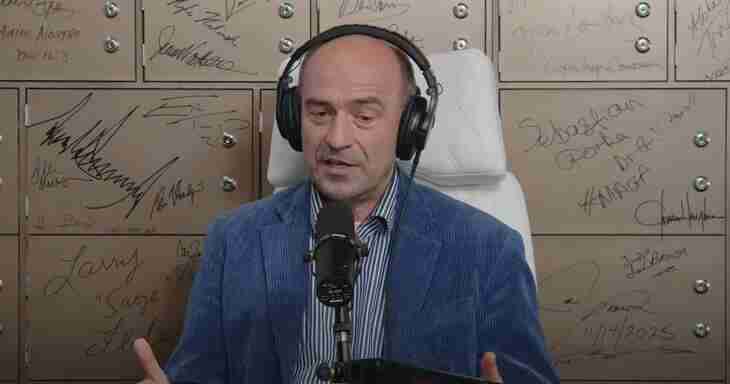
Read the full transcript of economist Richard Werner’s interview on PBD Podcast (Ep. 574) titled “USA vs China Trade War”, premiered on April 9, 2025.
The interview starts here:
Reuniting After Three Years
PATRICK BET-DAVID: So Richard Werner, my guest, we were together three years ago, if I’m not mistaken, June of 2022. So it’s been almost three years.
RICHARD WERNER: Amazing.
PATRICK BET-DAVID: And we had a great conversation last time. The nickname you have is the father of quantitative easing. And when we spoke it was all economy, all data, all fed, all interest rates, all of that. And today the timing of it was so perfect where Rob and Tony were talking like, hey, Richard Werner’s in town. I said we absolutely must do something because everyone’s so concerned with what’s going on today with the economy, tariffs, especially with the big announcement that Trump made. So it’s great to have you back on our podcast.
RICHARD WERNER: It’s great to be here. Thank you very much. Anytime.
Breaking News on Tariffs
PATRICK BET-DAVID: So do you mind if I get right into it?
RICHARD WERNER: Please do.
PATRICK BET-DAVID: So here’s the news. This morning we get word that China announces 84% tariff on US goods in showdown with Trump. And Europe also hits back. European Union announced it would begin collecting retaliatory duties on US imports starting Tuesday.
And here’s what Trump puts on Truth Social about 3 hours ago: “Based on the lack of respect that China has shown to the world’s markets, I am hereby raising the tariff charged to China by US 225% effective immediately. At some point, hopefully in the near future, China will realize that the days of ripping off the US and other countries is no longer sustainable or acceptable. Conversely, and based on the fact that more than 75 countries have called representatives of the U.S. Department of Commerce, Treasury and the USTR to negotiate a solution to the subjects being discussed relative to trade, trade barriers, tariffs and currency manipulation and non-monetary tariffs and that these countries have not at my strong suggestion retaliated in any way, shape or form against the US, I have authorized a 90-day pause and a substantially lowered reciprocal tariff during this period of 10% also effective immediately. Thank you for your attention to this matter.”
He posts this immediately. The market responds accordingly. The one day ends up being 3,000, nearly 8% in a single day. Right after the announcement is made, you can tell that. He makes the announcement there at 37,941, boom. The rest of the day ends up being nearly 3,000 today.
So for you, with this back and forth, this is your world, this is what you do as an economist and somebody that’s watched the quantitative easing and now we’re doing a little bit of quantitative tightening that’s going on. What do you think is going on here? Is this good news? Is this over with? Is China going to come to the table? What do you think?
Market Reactions and Strategic Positioning
RICHARD WERNER: Well, the question is for who? Good news for who or bad news for who? Certainly the markets take the viewpoint that this is good for most of the countries. So stock markets are up not only in the US but also in Europe and any market that’s open.
And actually you wonder because really what’s happened is President Trump, who previously had this longest list of countries that were faced with these new tariffs and partly extremely high tariffs in one go, the longest ever, I think has been announced in one go, but they’re now gone, is all back to a minimum of 10%. Some were at 10%, the UK was 10%. And which one is left over? China.
So you’re really now pinpointing, zooming in on China and clearly China is the target. Now the question is, was this now caving in to the market pressure? Because it’s been relentless selling last week, relentless also Monday, Tuesday. And that really created a lot of pressure at Treasury. They were quite concerned and there were some voices at treasury saying, and actually there was this announcement, I think it was on Monday, that there will be a 90-day reprieve, which was then denied by the White House, said, no, no, that’s not true. That’s a rumor. So clearly it’s been proposed by somebody perhaps from treasury, why don’t we do this? And now it’s become policy.
We can’t know. We can only guess and speculate exactly how it came about, but the result is clear. Trump has made a major statement last week on this Liberation Day on these tariffs and certainly woke up the whole world. They’re paying attention to what he’s saying and what the US is doing, that’s for sure. So he clearly got that attention.
And as he said in his message on Truth Social, so many countries have got in touch with the US and they’re saying, hey, let’s make a deal. That’s of course what he wants. So in that sense, you could say, well, it’s worked. They’re all coming back to the US saying, okay, we realized we did have some tariffs on you guys and you wanted to have a level playing field, so fair enough, let’s come to a deal.
And in many ways, that was clearly the goal. Of course, you need to get those deals worked through and signed and done and dusted. So we’re not there yet. But he’s got the reaction. They know he can be very serious. And if they don’t negotiate properly, it will become serious again. There’s no doubt.
So in many ways, and I think that was in favor of this idea that, let’s have a reprieve, because you’ve got everyone’s attention, they want to negotiate. Negotiations can be tricky, can take a bit of a while.
Who Has More Leverage?
PATRICK BET-DAVID: What do you think is going to happen with this? I mean, this is really going to come down to one of three things. Who needs who more? Who has more leverage and then who has more time? So when you look at the two here, back and forth, 84%, 104%, 125%, who do you think can tolerate this pain long enough until the other has to cave?
RICHARD WERNER: It’s a tricky question. You’re talking about the number one and the number two economies in the world. We’re not talking about, say, the US negotiating with the UK or some other lesser ranked economy in the world. It’s number one and number two. And of course, by some measures, purchasing power parity measures, China could be considered number one in some way. And obviously that’s disputed. But it’s a big thing. This is a big thing.
Now, timing is important because had this happened only 10 years ago or 15 years ago, China clearly would have been in a much weaker position. And it would have been from a US viewpoint, strategically much better to have it done then.
And interestingly, if you go back to some of the old interviews that Donald Trump in those days gave, there’s one I saw from 1988 with Oprah Winfrey, amazing. And he’s already saying, “Hey, we’ve got to have some proper tariffs. There’s some unfair things going on. Our products are being faced with this tariff wall as they’re trying to export to other countries. We need to do this.”
And of course that would have been for some countries, a brilliant time even for the following decades vis-a-vis China, because China was still building up its industrial strength. Now it’s not so obvious. The answer to your question is not so easy because China is now in a very strong position, clearly stronger than 15 years ago or 10 years ago.
And also it has other trading partners. The US remains—and this is the strong side from the US viewpoint, and that’s what President Trump of course is very much aware of and is playing on—the US remains the number one desirable market to export to. There’s no doubt about that. And of course that gives the US a strong hand and that’s the whole point of this way of bringing about trade negotiations.
But having said that, China does have options. We’ve had in the last 10 years, increasingly rapidly, an expansion of an alternative network, the BRICS groups of countries. And in fact the BRICS has grown—more and more countries have joined. Also China has set up this Shanghai Cooperation Organization and there is the Belt and Road Initiative which recently celebrated its 10-year anniversary last year where more than 150 countries signed up and they are in bilateral arrangements and deals with China.
So China has other options. But of course as a single market, the US remains number one also for China, the most attractive single market. With the others, you have to aggregate a lot of countries to get anything close to what the US offers. So it’s fairly balanced.
And I think that’s what the Chinese response also shows. Why have they been so, well, “disrespectful” is how President Trump puts it, but clearly not very accommodating? They seem very self-confident.
China’s Response and Global Impact
PATRICK BET-DAVID: US?
RICHARD WERNER: Sorry, China. So China has not been accommodating and has been quite aggressive in its response, unlike other countries. China has not been accommodating and has immediately said, “We’re not going to be pushed into a corner. We’re just going to do the same. We’re just going to have higher tariffs on the US products.”
And so now we have this literally very aggressive bilateral mutual raising of tariffs which will kill off trade between these two major economies. And that will, even if everything else now is fine, everyone gets a deal and things will be sorted out with all other countries, that still will have a negative impact on global trade and reverberations in many sectors, whether it’s shipping or particular industries where China is a necessary partner—rare earths and various inputs that other countries need, not to mention final products that we’ve been getting quite used to buying from China.
So this trade war has become, at the moment with this 90-day reprieve, very focused on just the US-China trade dispute or trade war if you want. And markets take a view: okay, that’s much better than before with all these dozens and dozens of countries. But it still remains an issue. If that continues to escalate, it will actually hurt the world still.
And to your question, who’s got more time, who’s got more leverage? It’s fairly evenly balanced. On some things, the US is stronger. On some things, China has built up a very strong, formidable position.
Analyzing Trade Numbers
PATRICK BET-DAVID: What are we stronger in? We have the best customer base, we have the best buyer base. I just looked up right now, China’s top 10 biggest trade partners. Number one is U.S., roughly 600 billion. Hong Kong 297. Japan 308. South Korea 328. These are big numbers. Vietnam 260. Germany 202. Netherlands 110. India 138. Malaysia 212 and Russia 245. Right. So it’s not like U.S. is 50% of the trade. It’s not.
China’s total trade in 2024 is 6.1 trillion. So if we divide 582 by 6100, it’s about 9.5%. Still a big number. But it’s not 25% or 40%.
RICHARD WERNER: Now of course this is from the aggregate, 6.1 trillion imports and exports aggregated. If you look at just exports, you probably get a higher figure. But yes, it’s not negligible either way.
PATRICK BET-DAVID: So maybe check, what percent of China’s export is US?
RICHARD WERNER: Yeah, 15%. That sounds right.
PATRICK BET-DAVID: So total is nine and a half percent aggregate, but just export is 15%. If China agrees and says, “You know what, reciprocal tariff zero. We’re not going to put any on you. You put nothing on us.” If that was to be agreed upon, who loses more and who wins more?
The Value of Tariffs in Economic Development
RICHARD WERNER: Actually that is the best scenario. And that’s where actually the standard international trade theory has a bit of a point. Unusually, I’m usually quite critical of mainstream economics, but that’s the one point where they’re perhaps slightly stronger. Everyone would win because trade is really the source of wealth creation for everyone. Trade, whether it’s internal trade or external trade. But actually when you then have the country divisions and you look at how countries are doing compared to each other, you will see that international trade is the main source of wealth creation between countries. So trade is extremely valuable.
Now, most economists very simplistically follow from that that you should never have tariffs, not even unilateral tariffs, not even if the other guys have lots of tariffs against you. You should not respond by putting tariffs on. It’s always better not to have tariffs. That’s the official mainstream economics response and they’re very clear cut about this. That’s not entirely true. And therefore to some extent President Trump has a bit of a point.
Namely tariffs have proven in history to be extremely successful and in fact necessary when you are a developing economy that wants to move up to the next level and you want to raise the level of value added of your entire domestic economy. The principle to be successful as an economy is through international trade and you have to follow the rule of mainly importing raw materials. That means low value added goods. Then you do the adding of value and you export high value added goods. And the US is very good with certain high value added goods and services are included, of course, particularly the services. US is very good. And there’s high value, whether it’s software, technology related and telecommunications and IT and so on.
That’s the principle that applies throughout history to all countries at all time periods. And that’s where tariffs can be very useful. If you want to move up to the next level and you put on tariffs such that you enhance that pattern of, basically you want to get raw materials very cheaply. So you’d never put tariffs on raw materials that you’re importing, import tariffs, you’d never have that. But of course if the other country is mainly exporting finished goods that you’re also trying to manufacture yourself or services they’re offering that you are trying to offer, that’s where the tariffs make sense.
If behind this tariff wall, or tariff protection—I mean it’s only partial protection because you’re not banning those, it’s just getting slightly more expensive depending on the percentage—if behind this protection, you make sure that industry and your domestic players are actually stepping up to the plate and are getting ready. Because in the future you want to take this off and then let them roam freely and let the foreign things come in freely and that pressure has to be there and then it can be extremely successful.
That’s how Japan was in the 20th century. The country that had the most dramatic economic development, only overtaken towards the end of the 20th century and then beginning of 21st by China. Although if you take the whole country because it’s huge and rural areas, some are still not so developed, it’s a bit of a mixed batch, but big chunks of China did beat Japan in that respect. But they all followed the same pattern.
And it’s also true if you go further back in history, German economic development in the 19th century, the US development in the 19th century, overtaking number one economic power Britain happened with the same pattern, namely very selective tariffs. So that this trade pattern was encouraged where you get your raw material imports cheaply and you have development of your domestic high value added goods and services industry and you then encourage the exports.
And so usually it’s a combination of tariffs and subsidies to work on that pattern, but it’s only justified because it is a government intervention. That’s quite clear. This is a government intervention. Tariffs, normally free market is preferred. But if you do it cleverly, you combine this intervention with incentives for the private sector to step up to the plate and deliver shift to the higher level manufacturing or service sector, value added activities, then it’s extremely successful and has been in history consistently. That’s how the US overtook Britain.
Winners and Losers in Zero-Tariff Scenarios
PATRICK BET-DAVID: Yeah, but the question for me, okay, so who’s the biggest loser? So I went, while you’re speaking, I’m trying to see what ChatGPT is going to tell me. The biggest winners and losers are if they agree to zero percent tariffs. Rob, if you’re going to pull this up and ask the question, who are the biggest winners and losers if the tariff on China and US goes to zero, reciprocal tariffs goes to zero?
Here’s what it says. Winners: big US Retailers, Walmart, Target, Amazon would benefit from lower import costs. Consumers would see cheaper goods, electronics, clothing, furniture, toys. Lower prices equals lower inflation, more purchasing power. If they go to zero percent tariffs, US Tech companies, Apple, Tesla, HP, which manufacture heavily in China, would save on costs and avoid supply chain friction. Tech imports like Qualcomm, Nvidia would expand access to Chinese markets. I just saw a story about how much an iPhone will be right now based on what it’s going to cost. Rob, if you want to pull that story up, this is from five days ago.
RICHARD WERNER: I saw that it would be quite a bit. Yeah, $3000 is what I saw.
PATRICK BET-DAVID: $3000 is what I saw. This one’s saying $2,300, 43% increase with what’s going on with tariffs.
Let me continue. Chinese manufacturers and exporters. With US Tariffs gone, Chinese firms in electronics, machinery, textiles regain full access to US Markets because it’s cheaper to get exports. Increases China’s export momentum. Next, US Chinese logistics and shipping firms, global financial markets. Wall Street would rally on improved US China relations, reduced geopolitical risk, investor optimism. South Asian and global suppliers. These are all great winners.
Now let’s look at losers. US Domestic manufacturers, Steel, aluminum, textile, furniture. So that means jobs still going to go over there because it’s going to be cheaper labor there. China substitutes Vietnam, Mexico, India, these countries benefited from US China decoupling the trade war. So a lot of us started sending business to Vietnam, Mexico, India. They would take it. So they may not want reciprocal tariffs with US and China.
US labor unions, which I don’t understand these guys, these are the protectionist policymakers. Unions will likely see a betrayal of bring jobs home. U.S. defense Hawks and China skeptics. Companies that relocated from China during trade war, domestic industries. These are saying who the losers are. For you I see more positive on doing reciprocal than not doing it. Why isn’t China agreeing to do it?
Political Elements and Manufacturing Concerns
RICHARD WERNER: I think we do have a political element here, and that is on both sides. We saw it in the message from President Trump. It was the second or third word of his message “disrespectful.” And the Chinese have the same attitude. They feel what President Trump’s been doing is being very disrespectful. So we do have, I mean, it’s like between humans. It’s the “this has not been the nice way of doing it.” We’re slightly miffed now, and we don’t want to be pushed around. So there is that element.
But in principle, if you have no tariffs on either side, basically each country still has to think, is this a healthy relationship? And there’s this long history, and President Trump is being quite focused on this and willing to have a dramatic policy change, because until now, all the presidents didn’t touch this, and they let the State Department and all the trade negotiators work in line with standard trade orthodox economics.
So there really hasn’t been much of a dramatic policy change, but the end result has been essentially previous administrations overseeing the transfer of labor of U.S. jobs to China. And that’s really essentially also been U.S. policy. And so the U.S. policy has helped in making China very strong because all the US Companies were more or less encouraged. The environment was like that.
And so President Trump is unusual because he doesn’t care about all this economic orthodoxy. He just sees the jobs going and he wants to reverse it. He sees and has seen since the 80s, as we saw from that whole interview, that there isn’t really quite a level playing field when it comes to tariffs. And he just thinks, “let’s change that.”
But in my view, there’s a slight missing element, and that is one needs to combine that with a policy that sets the right incentives. Not to dictate to anyone at all, but to create the incentive structure for the private sector in the US such that you will have still boosted high value added activities expanded in the US. You want to keep that. You want to offshore essentially low value added activities. That’s not the big problem.
And I think where do you draw a line is the question. And I think it’s been drawn at too high a level so that the US has been quite successful in the IT sector and in software and things like that. But too much of the manufacturing has been offshored. And that’s where President Trump has a point. But is this going to change? Is it going to be reversed just through tariff policy and perhaps even this agreement? If you do this agreement, zero-zero, then it’s not going to change, actually.
PATRICK BET-DAVID: You don’t think zero-zero is going to…
RICHARD WERNER: Make any difference for this point, on this point that really you’d like to have more jobs in the higher value added manufacturing sector in the US.
PATRICK BET-DAVID: Create the more jobs here. So it doesn’t solve for that.
RICHARD WERNER: Exactly.
Global Relationships and Dependencies
PATRICK BET-DAVID: Okay, so perfect. So then maybe let me ask this question a different way. So let’s say we’re two vendors. You have a software, I have a software, I have my customers, you have your customers. And there’s about 100 people out there. 195 to be exact. These are countries, right? 195 people that do business with both of us.
Out of these 195, let’s take the top 40. The ones that matter the most, Germany, Italy, Mexico, Canada. The ones that are the real guys. Which one of those, if you had to lose one of them, if one threatened you to say, to be with me, you cannot do business with the other guy, who do they need more?
RICHARD WERNER: That’s quite a complex setup.
PATRICK BET-DAVID: Meaning I’m US, you’re China. Who do they need more? Who can they not afford to lose? The reason why I’m asking this question. Who do you think they need more? Who are they more relied on? Do they rely more on the relationship with us or do they rely more on the relationship with China?
RICHARD WERNER: I think it totally depends. It totally depends on the specifics of the type of software. China has made great progress in creating its own software and still has a price advantage. There used to be the attitude, well, it’s just copying and it’s similar to the US and it’s cheaper. But the US is really where the creative new ideas come and so on.
And that’s also being challenged in China because you’ve got new developments. Things that are not even available in the US are available in China and they’re trying all sorts of things with various apps and combinations of services. And they still have the price advantage. Although this is what a tariff policy could address.
I think really, though, it’s beyond just software, because you’re looking at the sector where the US is doing best. And so perhaps that’s not really the main concern because the US is doing okay with that one. It’s the level below, which is still high value added, but is lower, where there’s still some manufacturing.
There’s an argument for maintaining manufacturing in your country because manufacturing gives you basically the skill set required in having certain assemblies and manufacturing and the people involved in that. That’s also what creates new ideas about processes, how to improve processes, how to offer new things, working with different materials. So important, all the new materials that are being worked on, if you don’t even have the manufacturing, you’ll never get into the new materials. China is making massive progress in new materials, and the US in some areas has lost the skill set because it’s been offshored.
PATRICK BET-DAVID: There’s no question. There’s not even by a little bit, by a lot. Ever since they allowed China to join the World Trade Organization, we sent our manufacturing today. Even Nancy Pelosi talked about this in 96, right, where she said, we charge 2%, they charge 35. Our 2% made us 170,000 jobs. Their 35% made them 10 million jobs. Do you have that clip? Have you seen this clip?
RICHARD WERNER: This is quite romantic, isn’t it? Yeah, but it’s true.
Tariff Disparities Between US and China
PATRICK BET-DAVID: I think it’s interesting to note that the average US MFN tariff on Chinese goods coming into the United States is 2%. Whereas the average Chinese MFM tariff on US goods going into China is 35%. Is that reciprocal on exports? China only allows certain industries into China, of US industries into China, and therefore only 2% of US exports are allowed into China. On the other hand, the US allows China to flood our markets with a third of their exports, and that’ll probably go over 40%, and it’s limitless because we have not placed any restriction.
RICHARD WERNER: In terms of jobs.
PATRICK BET-DAVID: This is the biggest and cruelest hoax of all. Not only do we not have market.
RICHARD WERNER: Access, not only do they have prohibitive.
PATRICK BET-DAVID: Tariffs, not only are our exports not let in very specifically, but China benefits.
RICHARD WERNER: With at least, at least 10 million.
PATRICK BET-DAVID: Jobs from US China trade.
RICHARD WERNER: The President, in his statement requesting this.
PATRICK BET-DAVID: Special waiver said that China trade supports 170,000 jobs in the United States. 170,000 jobs. This is back in the days when she was a Nationalist. Today, she’s more a global. So she’s changed teams because she’s about the world. She’s no longer about what it was about our economy.
So the question, going back to it, who do they rely on more labor. China used to have the cheapest labor, where it used to be $0.20 to $0.50 an hour pre joining the World Trade Organization. At that time, 2001, minimum wage in America was $5.15. So it was, let’s just say it’s 25 cents. It was 20 times cheaper to do it there than to do it here. Now, labor is not that big of a difference, China versus here.
Matter of fact, there’s an article that came up about Hafizon in Mexico, that China’s building Hafizon in Mexico with their BV, whatever that car is that they’re doing the BVD, BVA something. What’s it called, Rob?
RICHARD WERNER: BYD.
PATRICK BET-DAVID: BYD.
RICHARD WERNER: Build your dreams.
Potential Trade Strategies with China
PATRICK BET-DAVID: Build your dreams for $9,600. They’re building it in Mexico because labor is now cheaper in Mexico than it’s in China. So they’re kind of getting competition with labor that’s going different places. Right.
I asked the question about how the other 195 countries, which one of us do they need more is because if you remember what Trump did to Huawei, where he told everyone in the States and he told everyone in China, if you do business with Iran, I’m putting sanctions. You’re done with us. So Iran wanted to do business with Huawei. The CFO, which was the daughter of the CEO, was in Canada doing a deal with Iran. If you remember that, he said, we’re done with Huawei. Done deal was this. The Trump administration hits China’s Huawei with a one-two punch. This was in 2019, six years ago.
So Trump’s got the reputation to show that I’m going to go hard with this. What if Trump calls all the partners that say, “Hey guys, here’s what I need you to do. I need you to not do business with China for three months. And if you do this, I’ll give you zero tariffs for the next three months.” What if he puts that kind of pressure? What if he, because he’s capable of saying something like that, he’s now somebody that’s going to be worried about it. What if he says something like that? What if he says, “I will give you, to save you money, 0% tariffs for whatever, 12 months, 6 months. But in return, you have to tell me that you’re not going to do business with China for 90 days.” What if he does something like that?
RICHARD WERNER: Well, it could work. For some countries, this would be attractive. And if then they say, okay, this would disrupt the supply chains, this would disrupt the relationships, because suddenly, you know, you have to find other sources, you have to find other partners. Once you’ve done that, you have actually let other companies from other countries substitute China. And then you could stick. To some extent, it could stick. So it could work. This hasn’t been tried and it could work.
But really, I don’t know. I mean, in many ways, yes. And, you know, this very aggressive policy with Huawei, at the time, I was a bit surprised how this lady who was the CFO, she was arrested and she was essentially kept – was it house arrest in Canada or something like that? For a long time, a year or more. That was to me, that didn’t seem quite right because these are sort of Soviet methods. You know, that was a bit unnecessary.
But you’re right. As a result, he has his reputation of being very brutal when it comes to China. But is this really the right way of dealing with China? In my experience, it’s not. And that’s I think that’s actually the reason why China has responded this way, because there is this baggage, there’s this history of how President Trump has dealt with China.
And sadly, that brings out this politics where they say, well, we’re not going to be pushed around by President Trump in this way. We also want to be respected. You have to understand. I mean, it’s like on the human level, everyone wants to be respected and countries want to be respected. Russia has the same issue. They want to be respected as an equal. When they talk to the US and now here, President Trump was the first who said, yes, we’ll talk to them as an equal. And it works like magic. Although still a long road to go, but it’s clearly working.
Why isn’t he trying this with China? It would soften up China. You know, it’s particularly Asia, you see, it’s all about not losing face and being spoken to like that forces the Chinese leadership to respond strongly, even though really, perhaps they don’t really want to. They sort of have to. They can’t lose face, you know, within Asia, within all their partners, all the relationships they’ve built up.
And so it’s an unnecessary risk to the world economy to have this very brutal trade, tit for tat, raising of tariffs, when really he should have the same approach as with President Putin and say, “Hey, let’s go and have dinner, I’ll show you some good American whiskey, you’ll show me the multi fairly high obtained stuff.” And this would work very well in China. And let’s come up with, you know, he likes to make deals. The Chinese love to make deals. They’re famous for it.
So why aren’t we talking about proper deals? It’s because, you know, in the past things already fairly early on turned sour and now it’s all about not losing face. And no, we have to be tough to each other. And it’s a pity this is unnecessary. China can be, you know, the relationship with China can be moved so that it’s beneficial for both, also for the US.
China’s Rise and America’s Role
PATRICK BET-DAVID: A part of me, the way I see it is China became a behemoth because of us. And if you take us out, what Nixon did, first time a president visits China in 25 years after the terrible relations, he goes and he opens it up with the ping pong diplomacy deal, whatever that they had for 25 years. No president had ever gone to China for 25 years. Relations weren’t good. We didn’t, you know, so then he goes in, then ’01 the Clinton deal that gets done under Bush, you take us out, who’s China? They needed us to become that. It’s almost like somebody gave him credibility. It’s like all the other countries around the world who’s willing to give China a reference, call US. “Yes, you can do business with them.” All right, we’re doing business with China. And you forget that.
RICHARD WERNER: Yeah, yeah, no, you’re absolutely right. In fact that’s my earlier point. And it took a while, you see. So if the US policy had changed a bit earlier, it could be a totally different story. But it’s happening now when China has, and partly thanks to this policy. It was Nixon, President Nixon and Henry Kissinger and the strategy they had with China, they did a lot to put that in motion.
And then China, you see, of course, why was China then so successful? Because it’s one thing to get the right environment and get the US market, but you also have to deliver. And they managed to deliver because Deng Xiaoping came to power in 1978. That’s really when it took off. He was very pragmatic and Trump would have liked him because he was a pragmatist and not ideological. He said, well, let’s forget about this ideology. Obviously he’s talking about the communist ideology. He couldn’t say it directly, but really that’s what he was saying, let’s do what works, what delivers, and let’s actually find out what sort of policies deliver.
Now he looked across the China Sea and saw Japan doing extremely well. 20 years of double digit economic growth, 15% growth, that means every four and a half years you double national income and then you double it again the next four and a half years. And that’s what Japan did. That’s how you move from being a less developed country, a developing country, to developed country status in a generation. They did it.
And he said, well, I want to do the same. He went to Japan in the first year when he took power, ’78 when he rose to power. And he asked the Japanese fairly openly, although he was sure to meet for dinner, drink the sake and the moutai, you know, it works magic. And the Japanese, he told them, “Tell me the secret of your 15% growth for two decades. Tell me the secret, I want to do the same.”
And you know what, if you do this in Japan, if you ask sincerely, off the record at a dinner with a bit of sake, they will tell you the truth. And the truth was they asked him, “So how many banks do you have?” And he was, “Well, banks, we have one. It’s the Soviet system, One bank.” I mean the Soviet Union, they call it GOS bank, the Mono bank system, central planning.
And the Japanese must have said, “One bank? China is so big at that time, I don’t know, 600 million people perhaps at that time – you need 5,000 banks at least.” Because why? Because growth means more transactions this year than last year. That means more money is used for transactions this year than last year. That’s only possible if you’ve got more money creation, but you’ve got one institution to create all the money. The central bank is not going to work because that’s central planning. And central planning actually doesn’t work.
So you need decentralized money creation. And that means – because who creates money is actually the banks. So you want 5,000 banks instead of five people at the central bank deciding how much money to create and who to give it to. Why don’t you have 5,000 banks in 35 branches with 30 loan officers each receiving small local banks, receiving the loan applications from small and medium sized enterprises. Then you have 5 million loan officers doing the job instead of 5 people at the central bank.
The Secret of China’s Economic Success
PATRICK BET-DAVID: Get out of here. This is the story.
RICHARD WERNER: That’s the truth. That’s the secret. Actually, I published it in two academic journals recently. That’s the secret of the Chinese success.
PATRICK BET-DAVID: Well, the secret goes to his Diplomacy. Good for him. So he went to Japan that they’re whooping on him, and he asked them, what’s the secret? 5,000 banks. 5,000 loan officers. 5 million loan officers.
RICHARD WERNER: Yeah, exactly.
PATRICK BET-DAVID: Wow.
RICHARD WERNER: And then. And of course, you get a multiple of that in loan applications. Maybe 50 million, 100 million loan applications. But it’s local, and you have so many loan officers. They actually, because it’s local and these are small amounts, but that’s more efficient, you see, and more resilient, more stable. They go and kick the tires. They check the loan application. They only give the loan when it makes some sense. Of course, there’s always some mistakes.
But if you do this overall – and small firm lending is actually the safest form of lending. You never have an asset bubble and a banking crisis from small firm lending. There’s never been a small firm lending banking crisis. That’s how you get productive credit creation, which gives you economic growth. And that’s how China managed to have 15% economic growth for four decades, doubling what Japan did for four decades. 15% growth.
PATRICK BET-DAVID: Were they allies in ’78? Were they allies in ’78?
RICHARD WERNER: No, no, not at all. Japan has been in the US Camp, you know, US Troops in Japan. But you see, this is Asia. So if you meet like this, sincerely, and you meet and then you discuss off the record with some alcohol for dinner, they’re people, they want to be helpful and friendly and particularly, I mean, the Japanese, they love to tell you the truth. If you ask off the record, after hours. That’s why they have to work such long hours. Because during the day you have to tell the official story, which is not true.
PATRICK BET-DAVID: So let me ask you, based on history and what you’ve seen work, what would you – if you were in a position of influence and you’re in Trump’s ear, President Trump’s ear, how would you resolve this yourself, knowing how their wiring is, their history is, and where they are today? You also said something very interesting. That’s – how do you pronounce his name? Joannan Jianan. Is this the one you were talking about, the leader in 1978?
RICHARD WERNER: He was under. This one was under Deng Xiaoping. And yes, he is Deng Xiaoping.
PATRICK BET-DAVID: Was he the pragmatic one?
RICHARD WERNER: That’s Deng Xiaoping. He’s the one.
PATRICK BET-DAVID: Okay, so Xi is not. So it’s a different story to deal with a person like this versus him.
The Contrast Between Deng Xiaoping and Mao’s Leadership
RICHARD WERNER: So he was the decentralizer. I mean, he came after, not directly, but essentially after Mao, Chairman Mao, who was the Communist central planning, Soviet style type. And that really doesn’t work that well. In fact, it was a disaster, this Cultural Revolution. It’s like we’re facing it today with the WOKE movement. But anyway, and then the Great Leap Forward, which was a great leap backwards and 10 million people died from starvation. That’s how great it worked.
Deng Xiaoping actually suffered during that because he was always arguing against it. He was imprisoned three times by the previous regime, but he was prominent. And so then when he rose to power, essentially everyone was exhausted with his Mao stuff and it didn’t work. And so then, okay, let’s have Deng now.
The Magic of Banking and Small Firms
He understood the magic of banking. He understood it because in his young years, he was actually involved in setting up some local banks. So he understood, you know, for most employment is with small firms. That’s true for the US as well. 75% of employment is with small firms. And small firms don’t get money from capital markets. The media love to talk about capital markets, big business, big names. But that’s irrelevant for small firms. They can only get external funding beyond family and friends. The external funding is entirely only from banks. But big banks won’t lend to small firms. It doesn’t make sense. Big banks need big deals.
So what’s necessary for high and stable economic growth is to have many, many small banks. And that’s in fact the strength, the historic strength of the U.S. China has now 5,000 banks and America has 5,000 banks. But in the U.S. the number has been declining in the last 20 years. And also in Europe, because the central planners here we have central planners in the central banks. They love the Soviet system. They have been saying we need to reduce the number of banks. They’ve been closing banks.
The FDIC has even closed dozens of healthy banks. There’s a whole study by the Federal Reserve, the Federal Reserve researcher Ashcroft, American Journal, American Economic Review, 2005. What happens when we close healthy banks? Because the economists say, oh, nothing should happen, there’s so many substitutes for the bank lending. But if you close healthy local banks, they found, of course, there’s a negative impact. Why do they even close healthy banks? Why does such data exist? Because the FDIC does that.
So in Europe and America, we’ve been reducing the number of banks. The US used to have more than 10,000 banks. In fact, if you go back earlier, in earlier times, more than 20,000 banks. And that was the strength. We need to go back to that, set up local banks.
There’s one state in the US where they have a state bank, it’s the State Bank of North Dakota. And that has a job, namely to support the small local banks in the state. And as a result, in this relentless drive to concentrate banking systems forced by the central banks through regulation, the various low interest rate policies, punishing banks also with regulations when they lend for productive business investment with jobs where that was punished or do speculation for asset purchase. Oh, that’s great. We encourage that. As a result, the number of banks have gone down, but in North Dakota, not quite as dramatically.
PATRICK BET-DAVID: Wow. From over 8,000 banks in the last 24 years to less than 4,200.
The Decline of Small Banks and Its Impact
RICHARD WERNER: Yes, that’s right. And actually if you just go back a few more years, you’ll find it’s even more dramatic because it used to be, you know, way more than 10,000. 14,000. Exactly. There’s the number. And this is central bank policy in Europe. It’s official ECB policy. Europe is overbanked. We have to close the banks. Well, not the Goldman Sachs. They’re closing the small local banks. They’re crucial for job creation and wealth creation.
And this is in fact my research area. And I’d love to reach out to the Trump administration because you need to have that, the right policy there, then your tariff policy can be extremely successful. If you do the tariff policies because you feel, okay, we need a level playing field, I can understand that. I get all that. But if it’s without the backup of the right policy, and I’m not talking about micromanaging government intervention, not at all, quite the opposite, but some policy, namely to encourage small local banks, that is decentralization, that is the real capitalism. That’s what made America great.
There used to be free banking, used to be super easy to set up a bank. Why is banking now the most regulated industry that favors the big banks? That’s part of this drive to kill small banks. Absolutely. And if we go back to that era, that’s when America had high growth. America was a fast growing emerging economy. Double digit economic growth like China for decades. That’s how America overtook Britain. Britain used to be number one economic power, way ahead of everyone. And then the US and Germany in the 19th century started to create lots of small local banks. And that created this drive, you see.
Germany’s Hidden Champions
Let’s talk about tech industries, not software, but there’s still manufacturing. But at the high end, this is where Germany has been very strong. And the amazing thing is that Germany has the largest number of small firms. And of course Germany used to be the top exporter, even exporting more than China. Even though China is like 30 times the size by population of Germany.
The surprising thing is that many of these exports are by small firms, family owned small businesses. They’re leading in the world in their market niches. They’re called hidden champions. Hidden, because they’re small firms, SMEs, they’re not brand names, we don’t know them. But in their particular market niche they are world leaders. Whether it’s the taps in the bathroom or whether it’s, you know, it’s small things they’re specializing in.
And you’ll find German firms are many, many of these small firms are world leading champion because market share number one, two or three in the world champion, like you know, gold, silver, bronze. With this definition, if you look at how many hidden champions, that means small firms that are top market share, 1,2,3 in the world are there in each country you will see Germany is head and shoulders above everyone else with 1500 plus of these firms. Number two is the US and China is way down the road.
So how is that possible? Because of banking. Germany used to have the largest number of banks in Europe by far, and particularly the vast majority. Over 80% of those banks were small local banks, only lending in the local area for productive business investment.
PATRICK BET-DAVID: What year is this?
RICHARD WERNER: Well, until 2009, Germany was number one exporter in the world. And the data on hidden champions is sort of 2000. It’s a bit late 2014, so it’s not too long ago. Germany’s now been in a recession, terrible government, terrible leftist socialist policies. So it’s a disaster. And they’re killing the banks. Of course, ECB is killing the banks. So at the moment it looks pretty bad. But we know why that is. It’s these wrong policies. But before the strength is due to this, essentially an industrial policy that was non interventionist but creating the right environment.
I just want to make one more point on this because if you compare for example to the other extreme, which is Britain, United Kingdom, five banks dominate the banking sector and then you see the contrast and you see why this makes a difference. So in the UK a small firm gets no loans from the big banks because they’re so huge. Lending to a small firm, £50,000, £100,000, £200,000, it’s too tiny.
PATRICK BET-DAVID: They’re just.
Small Banks vs. Big Banks: A Tale of Two Systems
RICHARD WERNER: Exactly, who cares? They’d rather lend a billion to a hedge fund, private equity fund, that’s how it works. So let’s say we have a UK Firm, small firm, and a German firm, they’re competing in the same market. Now there’s a new innovation. These small firms, they’re not necessarily the innovators. Sometimes it happens, but rarely. They don’t need to be the innovators, but when a new innovation comes out, they need to be able to very quickly apply it. You know, actually apply it, get it.
So what happens in Germany is the leadership, usually the owner of the small firm realize, okay, that’s the new technology my guys have shown me. They go to the local bank. The local bank is headquartered in their village. It’s very decentralized because everywhere you can work, because there’s a local bank everywhere, and that means there’s money everywhere. And the local bank knows the small firm very well.
And the owner explains, look, we need to buy that technology, we need to apply it, otherwise we’ll lose market share, otherwise we’ll fall behind. The bank manager understands, knows quickly, does the figures within 24 hours, sometimes 48 hours. They get the loan, they get the new technology, they buy it, they implement it, they stay ahead of the game. UK, same situation. They will never get the loan. So they can’t apply the new technology. They don’t have the money to do it. They fall behind.
PATRICK BET-DAVID: So funny when you’re hearing this. Now, this is what Sowell and Milton Friedman used to talk about. I remember Gordon Chen when he once came on the podcast, we talked about what China was lacking. China was lacking law schools. They used to only have four law schools, like 50 years ago, 60 years ago.
So when it comes down to competition, business owners didn’t trust the fact that it was such a thing as law and order. So contracts and agreements would be kept. So the moment China started building law schools and students became lawyers, there was actually law and order, there was trust. So if I know it’s no longer a handshake. You have to commit and abide by the agreement that we came up. And that’s a very different conversation than banks, but it’s a similar angle that we’re talking about here.
I just went on the process here just to look at how long. Rob, can you pull up? What does it take to become a bank in the U.S. okay, what does it take to become a bank in the US Just out of curiosity, how much work does it take?
The Difficulty of Starting New Banks Today
RICHARD WERNER: Actually, I looked into this and to get a new banking license, I mean, hasn’t in most states, it even hasn’t happened in the last five years. So the number of new bank licenses given and new bank creations has really dropped. And it’s quite clear the regulators are very reluctant to do this. I mean, banking is very profitable. We need to always create new local banks. Because what we see over time is.
PATRICK BET-DAVID: Let me tell you what it shows you to me. First, decide what type of bank you want to create. Okay. National state charter, credit union, industry loan. Then submit a bank charter application. Okay. At the federal and the state level, which includes business plan, proposed name, cap structure, risk management, market analysis. Number three, meet capital requirements, 10 or $30 million to be a tier one. Number four, apply to FDIC insurance. Number five, build a strong management team, fit in proper criteria. Okay, cool. Number six, set up core operations. Got it. Number seven, undergo on site examination by regulators to come and visit you and view, receive final approval and launch. Once approved. This could take three years. But you’re saying we haven’t done one in a while in America.
RICHARD WERNER: Yeah, yeah, yeah.
PATRICK BET-DAVID: Okay, so go back to Trump. And go back to Trump. And go back to the gentleman we talked about earlier, Deng. What was his last name?
RICHARD WERNER: Xiaoping.
Xi Jinping’s Relationship with Deng Xiaoping’s Legacy
PATRICK BET-DAVID: Then Jiao Ping, then Xiaoping. I went and looked up to see his relationship with Xi, how Xi views him. Does he respect him? Does he not respect him? Does he admire him? Like, is there a level of admiration? Because if there is, maybe that’s a good thing for Trump. Right? That’s an opening for somebody to allot, Nick somebody to go negotiate the deal.
And he says Xi gave high regards to him on the 120th anniversary of Deng’s birthday, August 2024, which was little less than a year ago. Right. And he referred to him as an outstanding leader with high prestige, recognized by the whole party, the whole army, and the people of all ethnic groups in the country. And a great Marxist who made great contributions to a world peace and development. This is what he said.
However, despite this admiration, he’s marked a departure from his approach. Denk emphasized economic reforms and a more collective leadership style, while Xi has consolidated power and reasserted the Communist Party’s control over various aspects of Chinese society. And Alice, note that Xi has moved away from Deng’s low profile foreign policy, adopting more assertive initiatives to reshape the global order.
So this is not Deng. So it’s not like Trump can go to China, sit down, have a conversation with him, or invite him here and say, let’s figure something out. What does Trump do today? I understand what you’re saying with the banks. We need more banks. We’re down to 4,000. We used to have 14,000. Yes, get that. But right now during the tariff. Right now it’s the trade war that they’re having. What should he and his administration do now? Do you have any suggestions or any ideas?
Diffusing US-China Tensions
RICHARD WERNER: I would try to diffuse this now because otherwise we’ll see a standoff where each party, I mean, this is number one, number two, economic power and political power in the world.
PATRICK BET-DAVID: So you want number one to cave to number two.
RICHARD WERNER: Well, exactly. We avoid that. We need to avoid that. Both parties think, oh, I can’t cave in.
PATRICK BET-DAVID: But it is, though.
RICHARD WERNER: No, no, no. Well, you have to. This has to be done the right way. So that, of course, the US also is not caving in or is not seen to be caving in, because likewise, China doesn’t want to be seen to be caving in.
PATRICK BET-DAVID: That’s the whole short term situation.
RICHARD WERNER: Well, of course, ideally you would have never got into this situation, right, because that was pretty predictable.
PATRICK BET-DAVID: But no, but you have to, though, because they’ve been bullying, they’ve been controlling, they’ve been coming up and they’ve been doing things that a lot of people in America don’t feel comfortable with. They’ve been buying properties right next door, military units, they’ve been buying up land all over the place. They’ve been doing certain things where we’re sitting there saying, what is your motive? What are you trying to do long term? Is this close, slowly going up through Mexico and other places. What are you trying to do long term? So it makes a lot of people in America feel uncomfortable.
Private Diplomatic Solutions
RICHARD WERNER: Still. The way to address this each time, I think would have been to sit together, the right people, maybe fairly high level and say, look, you know, we have these and these concerns. Can we deal with this? And this is off the record first. You have these discussions not in public, precisely because you want to avoid a public standoff where each party can’t be seen to be caving in. I think it can be diffused and I think it will be successful. Diffuse it in many ways. Okay, both parties have now shown, okay, there can be tough guys. Both are tough guys. Great, fine. So let’s now get down to business and resolve this issue.
PATRICK BET-DAVID: How do you do it?
RICHARD WERNER: Private meetings, secret meetings that are not official but between, you know, respective top guys, whether it’s Trump himself or potentially, you know, Secretary of State or, you know, you have to find the right level. But meeting their counterparty and saying, look, we want to diffuse this, but of course we want to achieve, you know, we have to understand what we’re trying to achieve. Can we agree that, you know, certain things we are saying are reasonable. And we still get your viewpoint. You don’t want to be seen to be bullied. Okay, so let’s come up with a formula.
They will make suggestions. That’s the Asian way. They will be very creative. Suddenly, okay, we understand. You don’t lose face. We don’t lose face. We’ll come up with a solution. It’s possible. It could be. I mean, there’s all sorts of things you could think of. I mean, potentially even with another party, or you create some kind of diversion where both parties seem to have to now change something because of something else happening. You know, there’s so many things you can do if both parties want to diffuse it. And it’s made clear that we don’t want to lose face.
PATRICK BET-DAVID: You know, I’m convinced Trump wants to diffuse it. I don’t 100%. I’m convinced Trump wants to defuse it.
RICHARD WERNER: Well, that’d be great. That’d be great. Because I mean, I could help, I could help defuse it.
Negotiation Tactics and Port Control
PATRICK BET-DAVID: 100%, I am. I’m not him, but I’m convinced he absolutely wants to diffuse it. But I think the part that needs to be clear in a situation like this is, hey, you’ve gained more from us than we’ve gained from you over the years. Well, and I understand that’s probably not where you’re going to go, but Trump, to him, he’s not going to change from that.
Even that one time when he had Netanyahu there up on the podium, everybody is thinking, oh, he’s going to say this, he’s going to say that he doesn’t even want Netanyahu to sometimes think he’s got full control. He said, yeah, we’re thinking about what if we, the US buys Gaza. That was a surprise. And Netanyahu goes like this, like, wait, what did you just say? He threw him off because you have to kind of throw off sometimes because even your allies sometimes will take advantage of you because they feel behind closed doors they own you. You can’t do that. This is America. I want a leader like him to lead.
But in the situation, and FYI, just said it, curiosity, for my own reasons, how much do you think these two ports, the one that BlackRock is buying from CK Hutchinson, the 43 ports they’re buying, but the two main ones in Panama, do you think that’s going to go through?
RICHARD WERNER: In what sense do you think that deal will finalize?
PATRICK BET-DAVID: Right now there’s a lawsuit saying that CK is breaking some contract laws for taking too much time. Only reason I’m saying this is because this is leverage. If US controls those two ports, we also have a little bit of leverage here.
Mutual Recognition and Appreciation
RICHARD WERNER: Well, I mean this can be part of any deal and it seemed like a bit of a concession that this will become, you know, essentially the Hong Kong company selling those ports. Okay. It seemed like an olive branch from the Chinese side and therefore, I mean, I assumed it will go ahead if it’s also recognized.
I mean this is the thing. Both parties also want their actions to be recognized and appreciated. I think the way to approach it is not to say your Chinese success has been due to us, Americans and America. It’s partly true, but only partly because it was hard Chinese work, very hard work at low wages, people really working their ass off for a long time, long working hours and so on. So the Chinese worked for it, that’s for sure.
But it’s also true at the same time that both in fact the Japanese rise and the Chinese rise wouldn’t have happened in this way and wouldn’t have been so dramatically successful if the US hadn’t been this very open, accommodating market that they could sell into quite nicely. So that is a contribution.
So I think if one appreciates both parties contributions, then what you come to conclusion is well, it’s a team, this is teamwork. We’ve done this together, let’s be proud of it. There’s a way of shaping the conversation where both sides see that, okay, what I’ve done is being appreciated. And yes, now we have some issues, let’s try to resolve them.
I think it’s possible. I mean I’ve been in China, professor of finance at Fudan University in Shanghai for three years. So I’ve spent some time there and you know, met some senior people. I think it’s possible, it’s possible to diffuse it in a way that both parties will be happy and then actually establish a long term relationship.
There is one aspect where I see difficulties and that is the military side because we have this military industrial complex in the US, the deep state. And in China they feel this is so strong we need countermeasures. And the Chinese feel like we’re doing all this because we’re kind of afraid of all the US military threatening here and there and accusing us of stuff. So a lot of work would be needed on that side as well. But it’s good to start with the economy and then you can move onto that trickier bit.
COVID Origins Discussion
PATRICK BET-DAVID: Well look, China stopped the world with COVID. And for the longest time, Fauci and all these people said the virus didn’t come from there. The entire world lost a lot of money. Hundreds of thousands of businesses were decimated. Decimated. Who did that? China did that. The rest of the world is supposed to just sit there and forget about it.
RICHARD WERNER: Was it just China, though? Yes. We know these experiments and sort of research was outsourced to Wuhan. By who? By U.S. institutions. When in Fort Detrick, you know, they were told by judges to shut it down. Then they moved and Fauci moved it to Wuhan. So it was actually on US instructions. That’s often what gets left out.
And of course, you know, all these institutions, I mean, the roads go back to the World Economic Forum and some string pullers there, they’re just using China. And China is saying, oh, this is Americans. We help them. You know, actually, you know, they’ve also been used and tricked, I think, into this because they thought it’s an American virus that they did perhaps in Wuhan, sort of tricked into it in China.
But that’s why there were these very strong lockdowns, because they always suspected, because the US side was working on this genetically targeting viruses. You know, we’ve seen these also in all these Ukraine locations, US locations in Ukraine that Russia has been unhappy about, has been working to shut down where there’s genetic targeting of particular ethnic groups. And once you have evidence for that, the Chinese, of course, felt, well, maybe they’re targeting us. We better be careful and have these extreme shutdowns and lockdowns and extreme measures that were then world famous. Right. And sort of set the stage. I can see that this was sort of triggered by the US Deep State doing all this stuff.
PATRICK BET-DAVID: State is a globalist that’s working closely what are enemies. And I don’t put them as Americans. I put them as people that were for sale that are bought by our enemies, such as China. And China learned how to play puppet master with these guys. But that’s a different story, Richard. Every time you come here, I get smarter. And now for the next two months, I’m going to be repeating the story of what happened in 1978, where a pragmatic guy, Deng. How did you say his last name?
Closing Remarks
RICHARD WERNER: Deng Xiaoping. Deng is actually his last name. Deng.
PATRICK BET-DAVID: Deng Xiaoping.
RICHARD WERNER: Is small. Ping means some plain or even thing. Yeah, Rusty.
PATRICK BET-DAVID: Deng Xiaoping goes to Japan, negotiate, talks to them about the secret, has drinks, and they tell him you need 5,000 banks and 5,000 loan officers, and they do that and the rest is history.
RICHARD WERNER: Five million. In fact, when you have 5,000 banks with 35 branches, 30 loan offices. Insane.
PATRICK BET-DAVID: Insane. Richard, I appreciate your comment. I talk about crazy timing, but thank you for coming. By the way, are you on the next yet or you’re not on my next. I’m sure a lot of you going to have questions for you. You’re not on yet.
RICHARD WERNER: No.
PATRICK BET-DAVID: I’m going to have Tony talk to you about getting on the next question.
RICHARD WERNER: If I could just mention my substack rwerner.substack.com I’d love to have some more subscribers. I put out reports.
PATRICK BET-DAVID: We 100% put it below. We’re going to put your substack below. And on the way out, get an account set up with Tony on Maneet because you’re going to have a lot of people asking you questions. I’m going to send a lot of people your way.
RICHARD WERNER: Excellent.
PATRICK BET-DAVID: Appreciate you coming out again as usual. Thank you.
RICHARD WERNER: Pleasure.
PATRICK BET-DAVID: Take care, everybody. God bless.
RICHARD WERNER: Bye.
Related Posts
- Tucker Carlson Show: w/ Ken Silva – Attempts on Trump’s Life (Transcript)
- Pod Force One Interview: w/ Donald Trump – June 2, 2026 (Transcript)
- Jimmy Dore’s Interview on Tucker Carlson Show, June 5, 2026 (Transcript)
- Transcript: Trump Remarks on American Agriculture at Wisconsin Roundtable
- President Trump Remarks on Beautiful, Clean Coal – June 4, 2026 (Transcript)