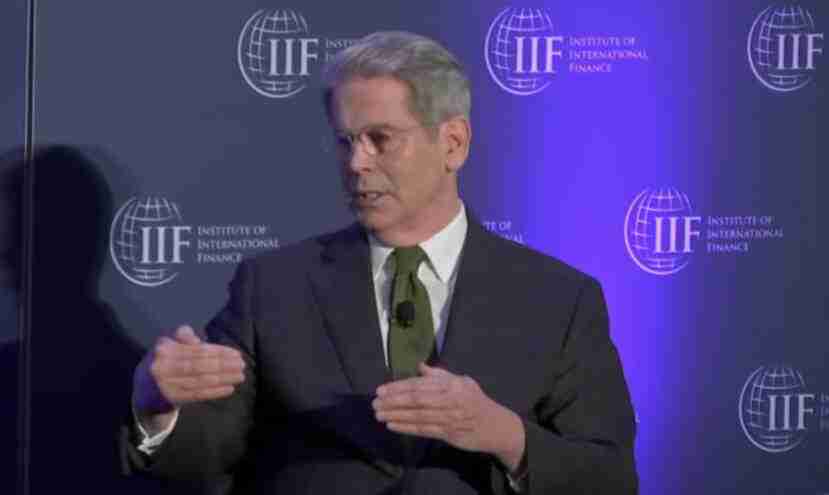
Here is the full transcript of Secretary Scott Bessent’s remarks at IIF Global Outlook Forum in Washington, D.C. on April 23, 2025.
Listen to the audio version here:
INTRODUCER: You can really feel the remarkable energy, and it is with my great pleasure that I have the opportunity to welcome to the stage our distinguished speaker, Scott Bessent, who is the Secretary of the U.S. Department of Treasury.
On January 28, 2025, Scott Bessent was sworn in as the 79th Secretary of the Treasury of the United States. As Secretary, Mr. Bessent is responsible for the U.S. Treasury’s wide-ranging mission to maintain a strong economy, foster economic growth, and create job opportunities for all Americans by promoting the conditions that enable prosperity at home and abroad, as well as managing the U.S. government’s finances. He is also responsible for strengthening U.S. national security by combating economic threats and protecting the financial system.
Mr. Bessent has been in the global investment management business for 40 years, visiting 60 countries, interacting with international leaders and central bankers. He is regarded as a currency and fixed-income specialist. Mr. Bessent is also a frequent contributor to economic journals and business publications.
Secretary Bessent will deliver keynote remarks, followed by an in-conversation session with Tim Adams, who will join the Secretary on stage shortly after. Secretary Bessent, the stage is yours.
Restoring Balance to the Global Financial System
SECRETARY BESSENT: Thank you for that kind introduction. It’s an honor to be here.
In the final months of World War II, Western leaders convened the greatest economic minds of their generation. Their task, to build a new financial system at a quiet resort high up in the mountains of New Hampshire, they laid the foundation for Pax Americana. The architects of Bretton Woods recognized that a global economy required global coordination. To encourage that coordination, they created the IMF and the World Bank.
These twin institutions were born after a period of intense geopolitical and economic volatility. The purpose of the IMF and the World Bank was to better align national interests with international order, thereby bringing stability to an unstable world. In short, their purpose was to restore and preserve balance.
This remains the purpose of the Bretton Woods institutions. Yet everywhere we look across the international system today, we see imbalance. The good news, it doesn’t have to be this way.
My goal this morning is to outline a blueprint to restore equilibrium to the global financial system and the institutions designed to uphold it. I have spent the bulk of my career from the outside looking in on financial policy circles. Now I am on the inside looking out. I am eager to work with each of you to restore order to the international system.
To achieve this, however, we must first reconnect the IMF and the World Bank with their founding missions. The IMF and World Bank have enduring value. But mission creep has knocked these institutions off course. We must enact key reforms to ensure the Bretton Woods institutions are serving their stakeholders, not the other way around.
Bringing balance back to global finance will require clear-eyed leadership from the IMF and World Bank. This morning, I will explain how they can provide that leadership to build safer, stronger, and more prosperous economies all around the world.
America First Does Not Mean America Alone
I wish to invite my international counterparts to join us in working toward these goals. On this point, I wish to be clear. America first does not mean America alone. To the contrary, it is a call for deeper collaboration and mutual respect among trade partners.
Far from stepping back, America first seeks to expand U.S. leadership in international institutions like the IMF and the World Bank. By embracing a stronger leadership role, America first seeks to restore fairness to the international economic system.
Nowhere is the imbalance I mentioned earlier more obvious than in the world of trade. That’s why the United States is taking action now to rebalance global commerce.
For decades, successive administrations relied on faulty assumptions that our trading partners would implement policies that would drive a balanced global economy. Instead, we face the stark reality of large and persistent U.S. deficits as a result of an unfair trading system.
Intentional policy choices by other countries have hollowed out America’s manufacturing sector and undermined our critical supply chains, putting our national and economic security at risk. President Trump has taken strong actions to address these imbalances and the negative impacts they have on Americans.
The status quo of large and persistent imbalances is not sustainable. It is not sustainable for the United States, and ultimately, it is not sustainable for other economies.
Now I know sustainability is a popular term around here, but I’m not talking about climate change or carbon footprints. I’m talking about economic and financial stability, the kind of sustainability that raises standards of living and keeps markets afloat. International financial institutions must be singularly focused on upholding this kind of sustainability if they are to succeed in their missions.
Global Response and the China Challenge
In response to President Trump’s tariff announcements, more than 100 countries have approached us, wanting to help rebalance global trade. These countries have responded openly and positively to the President’s actions to create a more balanced international system. We are engaged in meaningful discussions and look forward to talking with others.
China in particular is in need of a rebalancing. Recent data shows the Chinese economy tilting even further away from consumption toward manufacturing. China’s economic system, with growth driven by manufacturing exports, will continue to create even more serious imbalances with its trading partners if the status quo is allowed to continue.
China’s current economic model is built on exporting its way out of its economic troubles. It’s an unsustainable model that is not only harming China, but the entire world. China needs to change.
The country knows it needs to change. Everyone knows it needs to change. And we want to help it change because we need rebalancing too.
China can start by moving its economy away from export overcapacity and toward supporting its own consumers and domestic demand. Such a shift would help with global rebalancing that the world desperately needs.
Broader Global Economic Imbalances
Of course, trade is not the only factor in broader global economic imbalances. The persistent overreliance on the United States for demand is resulting in an evermore unbalanced global economy. Some countries’ policies encourage excess savings, which holds back private sector-led growth. Others keep wages artificially depressed, which also suppresses growth. These practices contribute to global dependence on U.S. demand to spur growth. They also lead to a global economy that is weaker and more vulnerable than it should be.
In Europe, former ECB President Mario Draghi has identified several sources of stagnation, and he has outlined several recommendations to get the European economy back on the right track. European countries would do well to take his recommendations to heart.
Europe has already taken some long-overdue initial steps that I applaud. These steps create a new source of global demand and also involve Europe stepping up on the security front. I believe global economic relationships should come to reflect security partnerships. Security partners are more likely to have compatible economies structured for mutually beneficial trade.
If the United States continues offering security guarantees and open markets, then our allies must step up with stronger commitments to shared defense. The initial actions from Europe on increased fiscal and defense spending are proof that the Trump administration’s policies are indeed working.
Reforming International Financial Institutions
The Trump administration and the U.S. Treasury are committed to maintaining and expanding U.S. economic leadership in the world. This is especially true at the international financial institutions. The IMF and World Bank serve critical roles in the international system, and the Trump administration is eager to work with them so long as they can stay true to their missions. And under the status quo, they are falling short.
The Bretton Woods institutions must step back from their sprawling and unfocused agendas, which have stifled their ability to deliver on their core mandates. Going forward, the Trump administration will leverage U.S. leadership and influence at these institutions and push them to accomplish their very important mandates.
The United States will also demand that the management and staffs of these institutions be accountable for demonstrating real progress. I invite all of you to join us in working to refocus these institutions on their core missions. It is in our collective interest to do so.
Making the IMF the IMF Again
First, we must make the IMF the IMF again. The IMF’s mission is to promote international monetary cooperation, facilitate the balanced growth of international trade, encourage economic growth, and discourage harmful policies like competitive exchange rate depreciation. These are crucially important functions to support the U.S. and global economies.
Instead, the IMF has suffered from mission creep. The IMF was once unwavering in its mission of promoting global monetary cooperation and financial stability. Now it devotes disproportionate time and resources to work on climate change, gender, and social issues. These issues are not the IMF’s mission.
…these areas is crowding out its work on critical macroeconomic issues. The IMF must be a brutal truth teller and not just to some members. Today, the IMF has been whistling past the graveyard. Its 2024 external sector report was entitled, “Imbalances Receding.” This pollyannaish outlook is symptomatic of an institution more dedicated to preserving the status quo than answering the hard questions.
Here in the United States, we know we need to get our fiscal house in order. The last administration ran up the largest peacetime deficit in our nation’s history. The current administration is committed to fixing this. We are open to critique, but we will not abide the IMF failing to critique the countries that most need it, principally surplus countries.
In line with its core mandate, the IMF needs to call out countries like China that have pursued globally distorted policies and opaque currency practices for many decades. I also expect the IMF to call out unsustainable lending practices by certain creditor countries. The IMF should push more proactively official bilateral lenders to come to the table early to work with borrower countries to minimize periods of debt distress.
The IMF must refocus its lending on addressing balance of payment problems, and its lending should be temporary. When done responsibly, IMF lending is at the very core of its contribution to the global economy. When markets fail, the IMF steps in and makes resources available. In exchange, countries implement economic reforms to resolve their balance of payments issues and support economic growth. The reforms undertaken during these programs are some of the IMF’s most important contributions to a strong, sustainable, and balanced global economy.
Argentina is a fitting example. I was in Argentina earlier this month to demonstrate the United States’ support for the IMF efforts to help the country reset financially. Argentina deserves the IMF’s support because the country is making real progress toward meeting financial benchmarks.
But not every country is so deserving. The IMF must hold countries accountable for implementing economic reforms and sometimes, sometimes the IMF needs to say no. The organization has no obligation to lend to countries that fail to implement reforms. Economic stability and growth should be the markers of the IMF’s success, not how much money the institution lends out.
World Bank Reform
Like the IMF, the World Bank must be made fit for purpose again. The World Bank Group helps developing countries grow their economies, reduce poverty, increase private investment support, private sector job creation, and reduce dependence on foreign aid. It offers transparent and affordable long-term financing for countries to invest in their own development priorities.
The bank, along with the fund, provides extensive technical support to promote debt sustainability among low-income countries, which empowers those countries to stand up to coercive and opaque lending terms from other creditors. These core functions of the World Bank complement the Trump administration’s efforts to foster safer, stronger, and more prosperous economies in the United States and the world.
But the bank, like the IMF, has strayed in certain respects from its initial mission. The bank should no longer expect blank checks for vapid, buzzword-centric marketing accompanied by half-hearted commitments to reform. As the bank returns to its core mission, it must use its resources as efficiently and effectively as possible, and it must do so in ways that demonstrate tangible values for all member countries.
Energy Access and Development
The bank can use its resources more efficiently now by focusing on increasing energy access. Business leaders the world over identify unreliable power supply as one of the primary impediments to investment. The World Bank and African Development Bank’s Joint Mission 300 initiative to expand energy access to 300 million more people in Africa is a welcome effort.
But the World Bank must respond to countries’ energy priorities and needs and focus on dependable technologies that can sustain economic growth rather than seek to meet distortionary climate finance targets. We applaud the recent announcement that the World Bank will seek to remove prohibitions on support for nuclear energy, which could revolutionize energy supply for many emerging markets.
We encourage the bank to go further in giving countries access to all technologies that can provide affordable baseload generation. The World Bank must be tech-neutral and prioritize affordability in energy investment. In most cases, this means investing in gas and other fossil fuel-based energy production. In other cases, this may mean investing in renewable energy coupled with systems to help manage the intermittency of wind and solar.
The history of humanity teaches a simple lesson. Energy abundance sparks economic abundance. That’s why the bank should encourage an all-of-the-above approach to energy development. Such an approach will make World Bank financing more effective, and it will reconnect the bank to its core mission of economic growth and poverty alleviation.
Graduation Policy
In addition to increasing energy access, the World Bank can use its resources more effectively by starting to apply its graduation policy. This would allow the bank to focus on lending to poorer, less credit-worthy countries. This is where World Bank support makes the biggest difference for poverty and growth.
Instead, the World Bank continues to lend every year to countries that have met the criteria to graduate from World Bank borrowing. There is no justification for this continued lending. It siphons off resources from higher priorities and crowds out the development of private markets. It also disincentivizes countries’ efforts to move away from dependency on the World Bank and toward job-rich, private-sector-led growth.
Going forward, the bank must set firm graduation timelines for countries that have long since met the graduation criteria. Treating China, the second-largest country in the world, as a developing country is absurd. While it has been at the expense of many Western markets, China’s rise has been rapid and impressive. If China wants to play a role in the global economy commensurate with its actual importance, then the country needs to graduate up. We welcome that.
Procurement Policies
The World Bank should also implement transparent procurement policies based on best value. It must help countries move away from procurement approaches that prioritize only the lowest-cost bids. Such procurement policies reward distortive and subsidized industrial policies that undermine development. They may also stifle the private sector and incentivize corruption and collusion and result in greater long-term cost.
Procurement policies based on best value are better from both an efficiency and development perspective, and their robust implementation will benefit the bank and its shareholders.
Related to this subject, I wish to send a strong, and I emphasize strong, message about procurement policies as regards Ukraine. No one who financed or supplied the Russian war machine will be eligible for funds earmarked for Ukraine’s reconstruction. No one.
To conclude, I invite our allies to work with us as we rebalance the international financial system, refocus the IMF and World Bank on their founding charters. America First means we are doubling down on our engagement with the international economic system, including at the IMF and the World Bank. A more sustainable economic system will be one that better serves the interests of the United States and all the other participants in the system. We look forward to working with all of you in this endeavor. Thank you.
Q&A Session
TIM ADAMS: Mr. Secretary, thank you for joining us here today, and thank all of you for coming here today. I’m going to point out, you have many great lines in this very meaty and comprehensive set of remarks, but you say, I wish to be clear, America First does not mean America alone. To the contrary, far from stepping back, you seek to expand U.S. leadership in international institutions like the IMF and World Bank.
I must say, there’s a collective sigh of relief across this town right now, because the concern coming into this week is that you were going to do exactly what you said you’re not going to do, which is the U.S. withdrawal. But you want to lead. What you’re asking for is simply getting back to factory settings, right, focused approach, and deal with the issues that you see are most paramount. Correct?
SCOTT BESSENT: Correct. As I said in my confirmation hearings, I think U.S. engagement with the international financial multilateral institutions, we should engage, and we should be in it to win it for the American people, and for the rest of the countries, and for the client countries.
TIM ADAMS: Twenty years ago, a senior U.S. Treasury official gave a speech very similar to this, calling on the IMF and said the IMF was asleep at the wheel and dealing with imbalances. Hank Paulson started the Strategic Economic Dialogue with the Chinese. Every Treasury Secretary since then has had an approach. So how will you do this differently, and how do you think that you’ll proceed in this approach? What is your philosophy, what is your tools, and how will you execute on this?
SCOTT BESSENT: Well, look, I think that our move toward reordering the financial or trading system…
BESSENT: I think that today, as I reaffirm our engagement, but set up a list of core principles and back-to-basics for the institutions, and again, being from the private sector, we want to see results, and we want to see timelines. Global rebalancing has been a topic for more than 20 years. Some countries may have a hundred year perspective, we don’t.
TIM ADAMS: China, obviously, is an important part of this administration’s form and economic policy. You’ll be meeting with your Chinese counterparts. What will you tell them in the sense of how they, they obviously are aware that there’s huge imbalances, their manufacturing capacity is enormous, especially in things like automobiles. How will you help them understand that it’s not just about talking, it’s about executing?
BESSENT: Well, look, I don’t think I have to help them understand. I think they understand very well. And it’s just a matter of impetus and will. I believe I first went to Japan in 1990, 1991, within 12 months of the peak of the bubble, a decade of that unwind, a decade of malaise. And then in 2012, I ran across a fellow in 2011, he was running for prime minister named Shinzo Abe, and he knew that Japan needed change and implemented it very quickly. Ten years later, more than ten years later, Japan has had a remarkable economic run.
I think that our Chinese counterparts will come to this realization. And some of our policies, sometimes it takes an external push. Alternatively, what I have said previously, there is an opportunity for a big deal here. That the US is looking to rebalance to more manufacturing, the identity of that would be less consumption. If China is serious on less dependence on export-led manufacturing growth, and a rebalancing toward a domestic economy, I think they use the term dual circulation. Well, right now it’s really singular circulation. And if they want to rebalance, let’s do it together. This is an incredible opportunity. And I think if Bridgewater founder Ray Dalio were to write something, he could call it a beautiful rebalancing.
Addressing Fiscal Imbalances
TIM ADAMS: Indeed. But a big part of that will also be our own fiscal imbalance. And as you mentioned, we’re running deficit 6% of GDP at the top of the cycle. Not sustainable, as you yourself have pointed out. How important is it to also address our fiscal imbalance as part of this larger rebalancing?
BESSENT: Well, it’s very important. I think most people in this room are trained economists and everyone knows that a trade deficit emanates from three things. External trade policies, which we are intent on addressing. External trade policies can be tariffs, non-tariff barriers, currency manipulation, and the state subsidy of labor and means of production. So terms of trade or trade regulation is one.
Two is our budget deficit. So the larger our deficit, the more it creates a demand suck. Also pushes up the interest rates.
And then three, the level of the dollar. The U.S., we continue to have a strong dollar policy and the dollar will adjust based on markets. Everyone asks me, well, what does a strong dollar mean? And to me, the strong dollar means having the policies in place to deserve capital flows and have confidence. But it doesn’t mean the price on the Bloomberg screen every day. And it also has different meanings in terms of bilateral prices.
So it’s really three prong. But Tim, to your question, I have talked about, we did not get here quickly with the spending. The U.S. does not have a revenue problem. We have a spending problem. And I have suggested, when I first met President Trump to talk about joining his campaign two years ago, that we need to get back to a long-term, sustainable budget deficit, something with the three in front of it, which works. We have 2% nominal growth, or 2% inflation, projected 1.8% growth, which I think could be much higher if we implement our economic policies.
Dollar’s Role as Reserve Currency
TIM ADAMS: You reaffirmed the strong dollar policy first articulated by Bob Rubin. Valerie Giscard d’Estaing in the 1960s talked about U.S. exorbitant privilege of the dollar. There are some in this town who question that privilege and actually see it as a burden. Do you see it as a privilege?
BESSENT: That the U.S. sits at the center of the global economy is enabled by the use of dollars and that it’s natural that the usage would come down over time. And I think that the U.S. will always, for my lifetime, be the reserve currency. I actually am not sure that anyone else wants it. I can’t remember. One of the European officials said today, maybe it was Mr. de Guindos, I can’t remember, said, oh, well, the euro could become a second reserve currency. Well, we’ve just had a substantial appreciation in the euro for export economies. It’s a lot of pressure. And look, I think that the reaffirming our belief in these international institutions is also part of that.
TIM ADAMS: You mentioned the euro. You mentioned in your comments Mario Draghi’s report from last year. There was the letter report before that. I’ve been spending a lot of time in Europe. There does seem to be a much more buoyant atmosphere in Europe. They see this as an opportunity for them. I said something about a possible renaissance. I was heckled a bit, but I actually am pretty positive on Europe. Do you think this is an opportunity to shift some of that demand? The world has relied on U.S. final demand to shift some of that demand for Europe. Is this a positive time for Europe?
BESSENT: Look, I think it can be. And it wasn’t in a straight line. It wasn’t always the way a trained diplomat would have done. But I think we should all congratulate President Trump. He has done what a succession of European leaders have tried to do for the past 26 years since the advent of the euro, that whether it’s the French, the Italians, other European countries have tried to get Germany to increase their fiscal spend and drive the European economy. And I applaud these nascent efforts because it’s a combination. It’s a combination of economic stimulus and it is a combination of burden sharing on the European continent for defense.
And as I said many times before, economic security is national security. National security is economic security. So if this European plan works, I applaud it. I had a private meeting with the Spanish finance minister last week, two weeks ago, and he said you’re going to be pleasantly surprised with where we go on military spending. And this 2% number today, he was right.
IMF and World Bank Reform
TIM ADAMS: So you’re already taking on these tasks. You have China, more consumption, less investment deal with their manufacturing access capacity. Europe’s a great opportunity. The U.S. rebalancing here including on fiscal. So what do you want the IMF to do? What would you like to hear from Kristalina over the next couple of days or the board in a new direction? Again, back to factory settings direction. What do you want to hear from them?
BESSENT: Again, I think it’s just been mission creep and just occasionally you have to trim your garden when the weeds grow. And I think that it’s back to basics.
TIM ADAMS: What are our priorities and how are we going to judge success? And the World Bank you discussed about graduating the medium-sized countries that should have graduated some time ago. That changes the commercial model of the World Bank. But obviously you think that’s important. They need to be graduated.
BESSENT: Yes. I mean, it’s just as President Trump says, it’s common sense that you can’t have the second largest economy in the world. And it’s as I said in my speech, I applaud their rapid growth, but you don’t get both. I’m a teenager who sometimes wants to be treated like a child, sometimes wants to be treated like an adult. I got one of those too. It’s an adult economy.
Energy Policy and Economic Growth
TIM ADAMS: You mentioned energy, specifically nuclear, during the campaign. And since you’ve become Secretary, you’ve talked about energy production is one of your important legs. The U.S. produces about 13 million barrels of oil a day, the largest producer in the world. What more do we need to do here? And how can the World Bank, what do they need to do more to encourage fossil fuels as well as nuclear and I assume all the above?
BESSENT: Look, the sine qua non for economic growth is energy abundance. And we need to drive the right combination of the crawl, walk, run for these countries in charge in terms of sustainable production. But by sustainable, I mean robust and baseload, not what I would call almost a luxury belief that we…
TIM ADAMS: They are worried about pumping water. They are worried about heating their homes, running their hospitals. And we’ve seen that the intermittency doesn’t work. Even in middle developed countries, maybe like South Africa, that seems to have rolling blackouts. So that’s not a model. We want to have a model of strong baseload and then bolting on the alternative production as opposed to beginning with alternative production and then having this latency or intermittency that makes it impossible to industrialize.
In the final minute or two, let me just turn to financial intermediation. You know, there’s a famous adage that capitalism without capital is just another ism. The institutions you see here are important intermediaries both in the capital markets and in other forms of financial intermediation. What is your vision, especially for the U.S., in terms of financial regulation? What do you want the industry to look like? Obviously, the capital markets of the U.S. is a crown jewel of this economy. How should we encourage that not only here but abroad?
SECRETARY BESSENT: Well, I think that I’ve been getting a lot of questions on private credit. And I think that private credit is an interesting addition to the U.S. mosaic. And it is the depth and breadth of our capital and credit markets that powers the U.S. economy. And it’s the innovation there.
I think that private credit’s a very new and interesting part. But it is happening outside of the regulated ecosystem. And I always like to say, I’m not an economist. I’m an economic historian. And I think that is a distortion of the system. And it tells me that the post-2008 regulatory corset is too tight on the regulated institutions. And we want to deregulate them or make them more able to provide the opportunity to lend to the American economy and perhaps into the international economy in a smart, safe, and sound way.
As we’ve seen, the history of financial crises is an overreaction on one side. And I think that we had a regulatory overreaction. I convened something in the U.S. called FSTOC, the Financial Stability Oversight Council, which convenes the regulators. And I think through partnership with the three U.S. banking regulators, Federal Reserve, Controller of the Currency, and the FDIC, we can come up with a system that makes the regulated financial system prosper again.
Supporting Main Street America
And what the U.S. has that is different than most other G7 countries is just the number of financial institutions. We don’t have five big banks, three big banks. And in the U.S., the community and small banks, which provide 70% of agricultural lending, 40% of small business lending, 40% of real estate lending. And in the U.S., we’ve had this incredible boom on Wall Street. I think Wall Street can continue doing well. But I think it’s Main Street’s turn to share in the prosperity. And I think it was the pullback by the small banks, the opposed to GFC, that’s kind of created this stagnation on Main Street. And we’re determined to fix that.
TIM ADAMS: Mr. Secretary, I always say Treasury is the sober voice of reason. What we’ve heard today from you is a sober voice of reason. We wish you all the best. Ladies and gentlemen, a round of applause for Treasury Secretary.