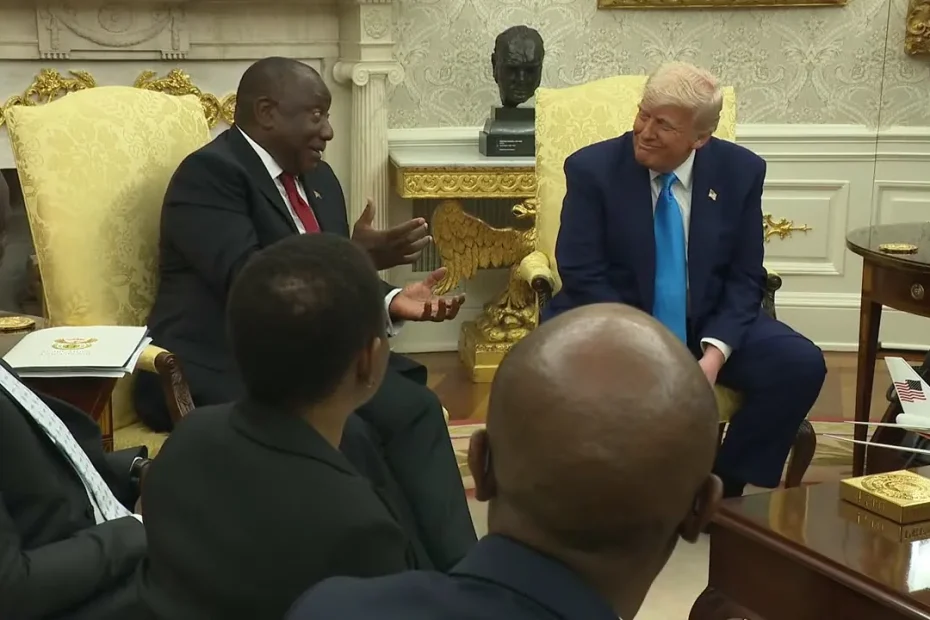
The following is the full transcript of U.S. President Donald Trump hosting South African President Cyril Ramaphosa to the White House for a bilateral meeting on May 21, 2025.
Listen to the audio version here:
President Trump Participates in a Bilateral Meeting with the President of South Africa
PRESIDENT TRUMP: It’s a great honor to be with the President of South Africa, President Ramaphosa, and he is a man who is certainly in some circles really respected, other circles a little bit less respected, like all of us in all fairness, like all of us.
We also have a few of my friends, Ernie Els, the great golfer, he’s a truly great golfer, and Matthew Lucen, who’s another really, we call him really a great golfer too, Ernie, two guys are fantastic, and we could add Gary to the group, Gary Player. What a group of golfers South Africa has had. There must be something in the water, right? It’s something good. These two guys are unbelievable. Gary, Gary’s Gary, and David Frost, also another one that I know is such a great one. Was he as good a putter as they say, David? He’s a putter. He’s a putting machine, right? But he’s another one, so there’s something very good about South Africa in golf, and golf is still doing great in South Africa, and they have young players I hear coming up that are going to be very good.
But it’s an honor to have you here, and my friend, it’s an honor to have you, one of the greatest businessmen in South Africa and long, and long beyond. Thank you for being here. It’s a very, very great honor. I appreciate it.
Discussions on G20 and Bilateral Relations
So we’re going to be discussing certain things. As you know, we have the G20 is going to South Africa. When is that going to be?
PRESIDENT RAMAPHOSA: In November.
PRESIDENT TRUMP: In November.
PRESIDENT RAMAPHOSA: Thereafter, I hand over to you.
PRESIDENT RAMAPHOSA: Yes, we have it next week. You originated the G20, so I’ll hand over later to you, and then you lead the G20.
PRESIDENT TRUMP: We’re going to have it the following year. So we’ll be discussing many things, and some of the things you’ve been reading about in the papers and the media. And I would say that, look, the President is a truly respected man in many, many circles, and in some circles he’s considered a little controversial. But we’re going to be discussing some of the things that are taking place in South Africa and see if we can help. And we want to help.
And we’ve had a long relationship with South Africa. I have because, indirectly, I have so many friends that live there. I have a lot of friends. I mean, these are famous guys, but I have a lot of friends that live there that are tremendous people. And we’ll be discussing that. We’ll have a nice conversation.
And I really appreciate that you guys came along. It’s really – it really helps us in our thought process. But it is a great honor to have you, and I appreciate you called. He called – I don’t know where he got my number, but I picked up.
PRESIDENT RAMAPHOSA: I know.
PRESIDENT TRUMP: He said, I want to come over and see you. That was my honor. Thank you very much for being here.
PRESIDENT RAMAPHOSA: You’re most welcome. Thank you very much.
President Ramaphosa’s Remarks
PRESIDENT RAMAPHOSA: Well, thank you very much for welcoming us to this reformed White House. I’ve been here before, and it looks really fantastic. I must congratulate you.
PRESIDENT TRUMP: Thank you.
PRESIDENT RAMAPHOSA: But I also thank you for allowing our delegation. This is a very mixed delegation that you’ve got. We’ve got people from government, my ministers. I’ve got someone from the trade union movement, who we really collaborate with. From business as well. And our sporting legend.
When I spoke to you, you said, yes, come along and bring Gary Player, bring Ernie Els, and [Ritwik Wilson]. I brought the two of them. Gary Player, I spoke to him, and he said, look, I’m getting rather on in my years, but wishes us luck in this discussion with you. So it’s a real joy.
And I’d also like to thank you for allowing your people to start discussions with us at the trade level. I mean, we are essentially here to reset the relationship between the United States and South Africa. We are long, longstanding partners in many, many ways. We’ve collaborated in many fields, in space issues, in energy, and in trade. And we therefore need to reset that, particularly in the light of some of the announcements that you made on trade and investment.
So we want to advance more trade between the two of us, two countries, and our people now have been empowered by yourself and by myself to start engaging. And we hope that you will be able to fuel that engagement during our talks.
And we also want to discuss issues that have to do with how we promote further investments in both countries. We’ve got about 22 companies from South Africa that have invested in the US, thus creating a number of jobs. And similarly, you’ve got almost 600 companies that have invested in South Africa, and some of them have been in South Africa for more than 100 years.
So our links are really long-lasting, and we would like to recalibrate those relations between our two countries and discuss a whole range of issues, geopolitical, the work that you’re doing, to bring peace around the world, in Ukraine and in the Middle East. So we value that, and we are also a great contributor to peace processes that are going on around the world.
And of course we want to discuss how we can support each other.
So all that combination of opportunity and the products that we buy from you, as well as what we sell to you, I believe makes up a really good and powerful relationship, which we need to strengthen, which we need to agenda. And that is really what has brought us here, and we are really privileged to have great South Africans in the mix, as you said you’d like to see them as well.
And I brought you a really fantastic golf book, it weighs 14 kilograms, and it showcases the golf courses in our country, Johann Rupert wrote, preface, so did Ernie Els, and I want to showcase our golf courses. You might remember when I spoke to you, and we spoke about golf, you said I should start practicing, and I’ve started practicing, so I’m ready, but let me end just the introduction remarks by thanking you, you may not recall that five years ago I spoke to you, during the COVID period, and it was at a time when the whole world was going through a really cathartic moment, and we asked for assistance, and you were able to assist us to rest, I think it’s called respirators, and you kept your word, and you delivered respirators to us, we didn’t have as many in our country, and it really helped to help us deal with COVID, so I’m here also to say thank you, and to thank the people of America for having helped us during a really difficult time, being the small economy that we are, we needed help from around the world, and you were there to provide that, so thank you very much.
PRESIDENT TRUMP: I remember the call, we sent 150 respirators, we became the respirator king, we started making them, nobody had them, we had very few of them, but they were very helpful, but we sent 150, and I appreciated the letter, you wrote me a letter, and thank you, I appreciate it.
PRESIDENT RAMAPHOSA: Thank you very much for that, it really touched my heart, after I spoke to you, and you delivered. It’s a great honor. Thank you very much.
Questions from the Press
PRESIDENT TRUMP: Any questions?
REPORTER: Mr. President, you’ve welcomed white Afrikaner refugees here, can you explain to Americans why it’s appropriate to welcome white Afrikaners here, when other refugees like Afghans, Venezuelans, Haitians, have all had their protective status revoked?
PRESIDENT TRUMP: Well, this is a group, NBC, that is truly fake news, they ask a lot of questions in a very pointed way, they’re not questions, they’re statements. We’ve had tremendous complaints about Africa, about other countries too, from people, they say there’s a lot of bad things going on in Africa, and that’s what we’re going to be discussing today.
When you say we don’t take others, all you have to do is take a look at the southern border, we let 21 million people come through our border, totally unchecked, totally unvetted, they came from all over the world, in many cases they’re criminals, they come from prisons, they come from mental institutions, they come from street gangs, they’re drug dealers, so don’t say that we didn’t take them, we take them, we’re trying to get
PRESIDENT TRUMP: …them out as fast as we can, and we’re doing record business on that, and we just won a big case, we’re allowed to send back hundreds of criminals to Venezuela. Just won that today in the Supreme Court. I’m happy to hear. But we do have a lot of people who are very concerned with regard to South Africa, and that’s really the purpose of the meeting. And we’ll see how that turns out. But we have many people that feel they’re being persecuted, and they’re coming to the United States. So we take from many locations, if we feel there’s persecution or genocide going on.
And we had a lot of people. I must tell you, Mr. President, we have had a tremendous number of people, especially since they’ve seen this. Generally, they’re white farmers, and they’re fleeing South Africa. And it’s a very sad thing to see. But I hope we can have an explanation of that because I know you don’t want that. And it’s a kind of a different meeting. Normally, we have meetings. We talk about trade. And we’ll be talking about trade and other things. But that certainly will be a subject that comes up.
Questions from Reporters
REPORTER: Thank you very much. I’d like to get your thoughts on Letitia James, Director of Pulte. According to him, Letitia James says that the alleged mortgage fraud was simply a mistake. I want to get your thoughts on that. She put down that her father was her husband in order, and this is very similar to, I guess, the false attacks they had on him.
PRESIDENT TRUMP: Well, I don’t know what it is currently, but Letitia James, who’s the Attorney General of New York State, it seemed I’m not involved in that at all. I know that it’s being handled by various groups, I guess. But it’s major fraud, mortgage documents, and fraudulent everything. Yeah, I think she said the father was her husband, which she had to have a husband, or so she chose her father. And she put it down. And she said, had didn’t she sign in Virginia? Yes. She said she lived in Virginia. She’s the New York State Attorney General. She did it for tax reasons so she could take advantage of taxes. And she had the wrong number of units. She had a much different number, which wouldn’t have allowed her to qualify and scam the government. So, I don’t know. I think she’s very bad for New York, but I really don’t know too much about it. But I appreciate the question. Thank you very much. Yes, sir. Yes, sir. Go ahead. Please.
REPORTER: Thank you, Mr. President. So, May 25th will be the celebration of Africa Day, which pretty much a lot of celebration will be taking place around the world, including here in the United States. What is your message to the entire African continent, African people, in this important occasion?
Addressing Africa Day and Peace Initiatives
PRESIDENT TRUMP: Well, I want to see peace and I want to see happiness. I want to see health and, you know, you have incredible land. There’s tremendous value. A lot of countries don’t have that value in the land, the value you have. You know, we have a situation. I think you probably heard about it. We’ve done, through some very talented people, helped settle a war that’s been raging for years. Rwanda and the Congo. And I think we’ve done it. Believe it or not, I think we’ve done it. And could you just say a few words about that, my friend?
UNIDENTIFIED SPEAKER: Yes. A couple of weeks ago, we signed the — they signed the two parties signed the Declaration of Principles, in which they’ve agreed on the way forward. And we’re — they have both submitted the draft peace agreements, and we have put together one that incorporates both of their suggestions. And we’ve given it to them. So we’re in the process of finalizing.
PRESIDENT TRUMP: Looking good, right?
UNIDENTIFIED SPEAKER: Looking very good. Yeah.
PRESIDENT RAMAPHOSA: No, we have to thank you for even those efforts, because the African continent, particularly static, our southern African development community, has for years been seeking to foster peace in the Democratic Republic of the Congo. So all efforts, including those from outside the continent and inside the continent, are really worthwhile. We have just — we are removing our troops from there so that peace can then prevail in that whole area. And we hope that, with the support of the international community, we will really have peace in that area. It’s so vital, so important for the whole region.
PRESIDENT TRUMP: Well, we sent our people there, and I think we did a very good job. I was headed by my friend, and that was great. That was great. I mean, I’m just hearing phenomenal reports because all I’m hearing is death, death, and they’re chopping heads off, and it’s horrible over there. And it was really brave of you to go there, and I really appreciate it. And it looks like that — it looks like we have something very, very substantial.
Global Peace Initiatives and Trade Relations
PRESIDENT TRUMP: We also talked about trade with them in terms of rare earth and all, but really more for the — it’s like if you take a look at what we just did with Pakistan and India, we settled that whole thing, and I think I settled it through trade. We’re doing a big deal with India. We’re doing a big deal with Pakistan. And I said, What are you guys doing? You know, they — somebody had to be the last one to shoot. But the shooting was getting worse and worse, bigger and bigger, deeper and deeper into the countries.
And we spoke to them, and we — I think we — you know, I hate to say we got it settled, and then two days later, something happens and they say, it’s Trump’s fault. But we — Pakistan has got some excellent people and some really good — a great leader. And India is my friend, Modi. And he’s a —
PRESIDENT RAMAPHOSA: Modi? Mutual friend?
PRESIDENT TRUMP: Yeah. He’s a great guy. And I called them both, and we just — it’s something good. We tried to settle Russia-Ukraine, and we spoke with President Putin for two and a half hours the day before yesterday. I think we made a lot of progress. But that’s a bloodbath. Five thousand people are being killed a week. Five thousand soldiers a week, not including people in cities and towns that are also being killed. So we’re trying to help. And it doesn’t affect us. It’s not our people. It’s not our soldiers. It’s not our — it’s Ukraine and it’s Russia. But if we can save five thousand souls, we’ll do it. You know, we’re pretty good at it. But it’s a — that’s a bad situation. That is a really bad situation.
PRESIDENT RAMAPHOSA: Well, you recall when President Zelensky was coming to South Africa. That’s when I spoke to you.
PRESIDENT TRUMP: That’s right.
PRESIDENT RAMAPHOSA: We both agreed that we needed to push the peace message so that there can really be peace. And we’ve been involved in the Ukraine-Russia conflict for quite a while, through my minister of state security here. We’ve been dealing with them, the exchange of children who were taken away, going through names and addresses and all that. So we’ve been invested in that whole process as well. And the moves that you’re making are fully supported by us because we would like to see the end of that war.
PRESIDENT TRUMP: That’s true. I called Zelensky, and they said, he’s in South Africa. I said, what the hell is he doing in South Africa? And we got to speak. I said, what are you doing in South Africa? That’s a strange one.
PRESIDENT RAMAPHOSA: He’s trying to make peace. You know, we were lucky because we had the great Nelson Mandela who taught us how to create peace, to make peace. So we were imparting some of those lessons, some of those learnings. And I specifically mentioned to him that this is how Nelson Mandela taught us, that when you want to have the peace in a country, do it on an unconditional basis and sit down and talk. And that’s precisely what I’m sure he’s going to do.
PRESIDENT TRUMP: Well, we’ll see what happens with that. There’s a lot of there’s a lot of hatred. Yes, a lot of a lot of death. It’s a bloodbath. So I get that. Unfortunately, I get the satellite pictures of that field of that killing field. You never saw anything like it in your life. It’s a horrible thing that goes on. But I think we’ve made big progress. Please go ahead. No, no, not yet. Right here. He’s from South Africa.
REPORTER: What are you expecting on the ICJ case? Are you expecting South Africa to drop that? Is that what you’re trying to do?
PRESIDENT TRUMP: Which case?
REPORTER: The ICJ case against Israel. International Criminal
PRESIDENT TRUMP: I don’t expect anything, to be honest. I really don’t. I don’t know. They’ve got a case. There’s a lot of anger there. Tremendous anger. I don’t expect anything. We’ll see what happens. We’ll have a ruling, and who knows what the ruling is going to mean.
REPORTER: On that subject of Gaza, Mr. President, are you going to be speaking to Prime Minister Netanyahu about Israel’s renewed offensive there? There’s been a lot of concern from European countries. The Pope has expressed concern. Are you going to be asking Prime Minister Netanyahu to tone down the offensive in Gaza to let more aid in?
PRESIDENT TRUMP: Was that a question or a statement?
REPORTER: Mr. President, what will it take for you to be convinced that there’s no white genocide in South Africa?
PRESIDENT RAMAPHOSA: Well, I can answer that for the President.
PRESIDENT TRUMP: I’d rather have him answer it.
PRESIDENT RAMAPHOSA: It will take President Trump listening to the voices of South Africans, some of whom have been his good friends, like those who are here. When we have talks between us on a quiet table, it will take President Trump to listen to them. I’m not going to be repeating what I’ve been saying. I would say, if there was Africana farmer genocide, I can bet you, these three gentlemen would not be here, including my Minister of Agriculture. He would not be with me. So, it will take him, President Trump, listening to their stories, to their perspective. That is the answer to your question.
PRESIDENT TRUMP: But, Mr. President, I must say that we have…No, no, wait. We have thousands of stories talking about it, and we have documentaries, we have news stories. Is Natalie here? Somebody here to turn that? I could show you a couple of things, and I would… It has to be responded to. Let me see the articles, please, if you would. And, excuse me, turn the lights down. Turn the lights down, and just put this on. It’s right behind you.
Video Presentation Showing Controversial Statements
[Video plays showing various clips of statements]
VOICE IN VIDEO: What this Parliament can do, with or without you, people are going to occupy land. We require no permission from you, from the President, from no one. We don’t care, we can do whatever you want to do. Who are you to tell us whether we can occupy land or not? We are going to occupy land. South Africans occupy land. That’s who we are.
VOICE IN VIDEO: Whatever I want to do, I can withdraw my membership from this useless Parliament. You must never be scared to kill. A revolution demands that, at some point, there must be killing, because the killing is part of a revolutionary act.
VOICE IN VIDEO: Shoot to kill. Namaza. Kill the poor, the farmers. Kill the poor, the farmers. Brr-pa. Pa. Brr-pa. Pa. To kill. Namaza. Kill the poor. Brr-pa. Kill the poor. Brr-pa.
VOICE IN VIDEO: The mayor of D.A.N.P.E. is a white man. So these people, when you want to hit them hard, go after a white man. They feel a terrible pain, because you have touched a white man. Not because Majama and Sodhi will not be touched. They will be touched, don’t worry. But we are starting with his whiteness. We are cutting the throat of white men.
VOICE IN VIDEO: Shoot to kill. Namaza. Kill the poor, the farmers. Kill the poor, the farmers. Brr-pa. Pa. Brr-pa. Shoot to kill. Namaza. Kill the poor, the farmers. Kill the poor, the farmers. Brr-pa. Pa. Brr-pa. Pa.
VOICE IN VIDEO: I don’t know what to expect in the future. I’m thinking, well, not wars, but the killing of white people. At least for now. I can’t guarantee the future.
VOICE IN VIDEO: I do understand some people watching that, they freak out. It sounds like a genocidal act.
PRESIDENT TRUMP: I see. Well, this is very bad. These are burial sites right here. Burial sites. Over a thousand of white farmers. And those cars are lined up to pay love on a Sunday morning. Each one of those white things you see is a cross. And there’s approximately a thousand of them. They’re all white farmers. The family of white farmers. And those cars aren’t driving. They’re stopped there to pay respects to their family member who was killed. And it’s a terrible sight. I’ve never seen anything like it. Both sides of the road you have crosses. Those people were all killed.
PRESIDENT RAMAPHOSA: Have they told you where that is, Mr. President?
PRESIDENT TRUMP: No.
PRESIDENT RAMAPHOSA: I’d like to know where that is. Because this I’ve never seen. Okay.
PRESIDENT TRUMP: I mean, it’s in South Africa, Mr. President.
PRESIDENT RAMAPHOSA: We need to find out.
Media Exchange
REPORTER: Mr. President, the Pentagon announced it would be accepting a Qatari jet to be used as Air Force One.
PRESIDENT TRUMP: What are you talking about? Can we have a follow-up on the question? What do you have to do with the Qatari jet? They’re giving the United States Air Force a jet. Okay? And it’s a great thing. We’re talking about a lot of other things. Is NBC trying to get off the subject of what you just saw? You are a terrible reporter. Number one, you don’t have what it takes to be a reporter. You’re not smart enough. But for you to go into a subject about a jet that was given to the United States Air Force, which is a very nice thing, they also gave $5.1 trillion worth of investment in addition to the jet. Go back. You ought to go back to your studio at NBC because Brian Roberts and the people that run that place, they ought to be investigated. They are so terrible, the way you run that network. And you’re a disgrace. No more questions from you.
REPORTER: Talk about that. Please may we have a South Africa question from President Trump? If they’re committing genocide, why invite them to the White House? I’ll be quiet. Sure. That’s my question.
PRESIDENT TRUMP: Let’s go.
REPORTER: Thank you so much, President Trump. Annika Larson from ENCA in South Africa. Thank you very much for hosting us.
PRESIDENT TRUMP: Thank you very much.
REPORTER: What would you like President Ramaphosa to do about the situation?
Trump’s Concerns about Violence in South Africa
PRESIDENT TRUMP: I don’t know. I don’t know. These are articles over the last few days. Death of people. Death. Death. Death. Horrible death. Death. I don’t know. White South Africans are fleeing because of the violence and racist laws. And this is all… I’ll give these to you. So when you say, what would I like to do? I don’t know what to do. Look at this. White South African couples say that they were attacked violently.
REPORTER: President Trump, what would you want people to stop it in?
PRESIDENT TRUMP: Well, I could do that. Look, here’s burial sites all over the place. These are all white farmers that are being buried. And he asked about a jet that was given. You know, you are so bad. You’re such a bad reporter.
REPORTER: Why invite them? Why invite them?
PRESIDENT TRUMP: Why not? This is one after another. This family was wiped out. I’m just looking.
REPORTER: What’s your reaction to those videos?
PRESIDENT TRUMP: There’s no reaction. Well, I think the videos are still… No, no. When you look at the videos, I mean, how does it get worse? And these are people that are officials. And they’re saying that kill the white farmer and take their land. But I have other friends in South Africa. I have people that left. One in particular that says you can’t go there. He said, take your land. They take your land and they kill you. It’s okay. And they say it’s okay to do it. Now, we’re going to talk about it. But this is a tremendous… Look, this is so recent. These are all people that recently got killed. And I don’t know how it can get any worse. These are all people… And, you know, the men that you saw, the people that you saw in that movie, those are officials. Those are people that were in office. They had one march. They had a dance in your parliament, whatever you may call it.
President Ramaphosa’s Response
PRESIDENT RAMAPHOSA: Let me clarify that because what you saw, the speeches that were being made, one, that is not government policy. We have a multi-party democracy in South Africa that allows people to express themselves, political parties to adhere to various policies, and in many cases, or in some cases, those policies do not go along with government policy. Our government policy is completely, completely against what he was saying, even in the parliament. And they are a small minority party, which is allowed to exist in terms of our constitution.
PRESIDENT TRUMP: But you do allow them to take land.
PRESIDENT RAMAPHOSA: No, no, no, no.
PRESIDENT TRUMP: You do allow them to take land. And when they take the land, they kill the white farmer. And when they kill the white farmer, nothing happens to them.
PRESIDENT RAMAPHOSA: No. There is quite…
PRESIDENT TRUMP: Nothing happens to them.
PRESIDENT RAMAPHOSA: There is criminality in our country. People who do get killed, unfortunately, through criminal activity, are not only white people. The majority of them are black people.
PRESIDENT TRUMP: And the people that are being killed in large numbers… And you saw all those gravesites. And those are people that loved ones going, I guess, on a Sunday morning, they told me, to pay respect to their loved ones that were killed. Their heads chopped off. They died violently. And, you know, I mean, we’re here to talk about it. And I didn’t know we’d get involved here.
But I will say this, that if the news wasn’t fake, like NBC, which is fake news, totally, one of the worst, ABC, NBC, CBS, horrible. But if they weren’t fake news like this jerk that we have here, if we had real reporters, they’d be covering it. But the fake news in this country doesn’t talk about that. They don’t want to talk about it. But now they have to talk about it. But they won’t. This won’t even be a subject.
They’ll have him talking about why did a country give a free… Think of this. Why did a country give an airplane to the United States Air Force? Okay? The United States Air… Not to me. To the United States Air Force, so they could help us out. Because we need an Air Force One. Until our… That’s Air Force One. It’s being built. Two of them being built. But Boeing’s a little bit late, unfortunately. So why did they give us a plane to the United States Air Force? That’s what that idiot talks about. After viewing a thing where thousands of people are dead.
PRESIDENT RAMAPHOSA: I’m sorry. I don’t have a plane to give you. I wish you did. I would take it.
PRESIDENT TRUMP: If your country offered the United States Air Force a plane, I would take it. Okay.
PRESIDENT RAMAPHOSA: But coming back to this issue, which I really would like us to talk about, and talk about it very calmly. We were taught by Nelson Mandela that whenever there are problems, people need to sit down around a table and to talk about them. And this is precisely what we would also like to talk about. Including, of course, trade matters, investment matters.
So the issues that concern you as the United States…
PRESIDENT TRUMP: Those are all risks. Those are all deaths.
PRESIDENT RAMAPHOSA: Yeah. In many ways, I mean, one should say you are a partner. Partner of South Africa. And you are raising concerns. And these are concerns that we are willing to talk to you about.
Let me just add quickly. You know, the criminality that we are experiencing in our country needs quite a lot of technological capability. And in one of our areas in South Africa, we’re using U.S. technology, which is able to, in many ways, identify where shootings are happening and all that. And I’d like to talk about that. Because there is support that we can get from you as the United States to help us deal with all these acts of criminality. And that is what I believe partnership is all about. And we are here as a partner so that we can help each other whenever there are challenges. So I’d like us to discuss it, and of course outside of the media, so that we sit down and have a really good discussion that will lead to good outcomes.
Discussing Land Issues and Safety Concerns
REPORTER: Are there any other punitive measures that could be in place should we not be satisfied that South Africa is fixing some of the very bad things in the version of comments that you’ve tweeted are happening?
PRESIDENT TRUMP: Well, there are a lot of bad things happening in many countries, but this in particular has been very, very bad. Very bad. And because of, you know, we’re going to have the whole world watching in another short period of time because you have the G20. And that’s a big deal. And it seems like, yeah, I mean, I want you to look good. I don’t want you to look bad.
But we have hundreds of people, thousands of people trying to come into our country because they feel they’re going to be killed and their land is going to be confiscated. And you do have laws that were passed that gives you the right to confiscate land for no payment. You can take away land for no payment.
PRESIDENT RAMAPHOSA: I want to clarify that. Because we have a constitution. Our constitution guarantees and protects the sanctity of tenure of land ownership. And that constitution protects all South Africans with regards to land ownership. However, we do say, because we’ve got to deal with the past, the government, and as your government also has the right to expropriate land for public use.
PRESIDENT TRUMP: And you’re doing that.
PRESIDENT RAMAPHOSA: And we’ve never really gotten underway with that.
PRESIDENT TRUMP: You’re taking people’s land away from them.
PRESIDENT RAMAPHOSA: We have not.
PRESIDENT TRUMP: And those people, in many cases, are being executed. They’re being executed. And they happen to be white, and most of them happen to be farmers. And that’s a tough situation. I don’t know how you explain that. How do you explain that? They’re taking people’s land away. And in many cases, those people are being executed. And in many cases, it’s not the government that’s doing it. It’s people that kill them and then take their land. And nothing happens to them.
But we have thousands of people that want to come into our country. They’re also going to Australia in a smaller number. But we have thousands of people that want to come into our country. And they’re white farmers. And they feel that they’re going to die in South Africa. And that’s a bad thing.
Questions About Improving Relations
REPORTER: What can South Africa do? What concessions would you like to see them make to improve relations with the United States? And I have one more for President Ramaphosa afterwards.
PRESIDENT TRUMP: Well, you know, we just spoke about it. I got them a very, very complex machine. 150 of them. And I was asked by the President if he could help. And I did that. And, you know, I have great feeling for all countries. Look, I deal with all countries. But I have a great feeling for South Africa because I have friends. I have a couple of friends, a few friends here today. I have many friends from South Africa.
But many of those friends are not – they can’t go back. I have – Elon is from South Africa. I don’t want to get Elon involved. That’s all I have to do, get him into another thing. But Elon happens to be from South Africa. This is what Elon wanted. He actually came here on a different subject, sending rockets to Mars. Okay? He likes that better. He likes that subject better.
But Elon is from South Africa. And I don’t want to talk to him about that. I don’t want to – I don’t think it’s fair to him. But I will say that people are fleeing South Africa for their own safety. Their land is being confiscated. And in many cases, they’re being killed.
And that scene of – you see how many crosses they have. Those crosses, that’s a dead person in every one of them. And those trucks or cars are paying their respects to all of those dead people on a Sunday morning. That’s a rough thing to explain away.
And the problem we have – and the way – you know, a correct and a fair media exposes things. But we have a very corrupt media. They won’t even report this. If this were the other way around, it would be the biggest story. Now, I will say, Apartheid, terrible. That was the biggest story. That was reported all the time. This is sort of the opposite of Apartheid. What’s happening now is never reported. Nobody knows about it.
All we know is we’re being inundated with people, with white farmers from South Africa. And it’s a big problem. Marco Rubio was telling me he’s never seen anything like it. The numbers of people that want to leave South Africa because they feel they’re going to be dead very soon. Yes, please.
REPORTER: 72% of farmers in your country are white. If they flee, do you feel that maybe the economy could collapse? You may not have a gap to fill in those people that need to replace those farmers.
PRESIDENT RAMAPHOSA: You know, I’d like my Minister of Agriculture, who is white, who comes from an opposition party to mine, who’s joined my government at my invitation to address this very issue, including Apartheid.
The question that you’ve just raised. John?
REPORTER: Thank you very much, Mr. President. And, Mr. President, thanks for welcoming us to the White House. I would say we have a real safety problem in South Africa, and I don’t think anyone wants to candy-coat that. And it requires a lot of effort to get on top of it. It’s going to require more policing resources. It’s going to require a different strategy to be able to deal with it. But certainly the majority of South Africa’s commercial and smallholder farmers really do want to stay in South Africa and make it work. I’ve just come from the largest agricultural show in the Southern Hemisphere with organized agriculture and farmers, and the majority of them want to stay. But they, too, they have a memorial to those who’ve died as a result of farm attacks. And as the Minister of Agriculture, it is something that I’m particularly exercised with my colleagues of police and my colleagues in the justice cluster to stop making farm attacks and stock theft a priority crime. And it affects all farmers in South Africa, particularly stock theft. It has a disproportionate effect on smallholder black farmers.
I also want to just say this, that the two individuals that are in that video that you’ve seen are both leaders of opposition minority parties in South Africa, Nkonto Wesizwe under Mr. Zuma, and Economic Freedom Fighters under Mr. Malema. Now, the reason that my party, the Democratic Alliance, which has been an opposition party for over 30 years, chose to join hands with Mr. Ramaphosa’s party was precisely to keep those people out of power. We cannot have those people sitting in the union buildings making decisions. That is why, after 30 years of us exchanging barbs across the floor in parliament and trying to get one over on each other, we’ve decided to join hands precisely to keep that lot out of government. Because the day they get in to the doors of the union buildings in South Africa or control of our parliament, that’s what you’re going to see. And that is why this government, working together, needs the support of our allies around the world so that we can strengthen our hand, grow our economy, and shut the door forever on that rabble getting through the doors of the union buildings, because Ben, South Africa’s future was doomed.
REPORTER: So you denounced that type of language in the video that you saw?
PRESIDENT RAMAPHOSA: Oh, yes. We’ve always done so. As a government, as my own party, we are completely opposed to that. We, in 1955, adopted a document which said, South Africa belongs to all who live in it.
PRESIDENT TRUMP: But why wouldn’t you arrest that man? That man said, kill the white farmers, kill the white farmers. And then he danced, and he’s dancing, dancing, and it’s, kill the white farmers. I think, I’m not sure, but I think if somebody got up in parliament and started saying, kill a certain group of people, that he would be in, he would be arrested very quickly. That man is going all over South Africa. And that’s not a small party. That was a stadium that holds 100,000 people, and I hardly saw an empty seat. That’s a lot of people. That’s a lot of representation.
And those crosses, we have dead white people, dead white farmers, mostly. And you take a look at Australia. They’re being inundated, and we’re being inundated with people that want to get out. And their farm is valueless. It’s valueless. And they just want to get out with their life. And this is a very serious situation. And if we had a Real News or Real Press or media, we don’t have that because they won’t talk about this because they’re all guys like that, idiot. But if we had a Real Press, it would be exposed. And you know, the beauty of exposing it is it’s like a cleansing action. When it gets exposed, it’ll get fixed. That’s when it’ll get fixed. But people don’t talk about it. And I’ll tell you who’s talking about it, the thousands of people that are fleeing South Africa right now.
Questions on Aid and International Relations
REPORTER: The Press is asking about the devastating impact the cuts are having across the African continent.
PRESIDENT TRUMP: You know, it’s devastating. And hopefully, a lot of people are going to start spending a lot of money. And I’ve talked to other nations. We want them to chip in and spend money, too. And we’ve spent a lot. And it’s a big — it’s a tremendous problem going on. In many countries, a lot of problems going on. The United States always gets the requests for money. Nobody else helps, as you know. Europe doesn’t help. Europe hasn’t given anything. All they do is sue our companies. You know, they sue Apple, and they sue all of our companies. Apple had to pay $17 billion on a nonsense lawsuit. Very unfair. But we’re going to always be there to help.
REPORTER: The Press is asking if this African-African issue is resolved. You’re going to go into a room after this, and you’re not going to talk. If it’s resolved, what is the potential for the future of the relationship?
PRESIDENT TRUMP: It’s fantastic. It’s got to be resolved. It should be resolved. I mean, it’s a little bit bad when you see a stadium with 100,000 people in it, because that means it’s more than just a little movement. It’s a pretty big movement in South Africa. So it has to be resolved. It’ll be the end of the country, if it’s not resolved.
REPORTER: But you’re saying all the rest is possible.
PRESIDENT TRUMP: I hope so. That’s why I’m here. I mean, I’m not here for my health. I’m here to see what we can do. No, I’d like to see. I have friends. I can tell you, Ernie Els and Ratif Ghusin, they feel so strongly they wanted to be here on behalf of South Africa, not on behalf of me. And, you know, they said, can we be here for this? Because they love the country. Ernie, do you guys want to say a couple of words or anything? I hate to put you in…
Comments from South African Representatives
TRUMP: This is tougher than sticking a three-footer. And they’ve sank many three-footers.
Ernie Els: Thank you, Mr. President. And thanks for the honor of being here. We’ve known each other a long time. We have spoken. You know, we proud South Africans. I still have my South African passport. We travel with this passport, you know, and I have my visa here. So, you know, but we want to see things get better in our home country. That’s the bottom line.
It’s been 35 years since the transition. President Ramaphosa was right in the middle of the transition time, 1990 and before that. So it’s been 35 years of ANC government. And I know there’s a lot of anger, you know, through the transition. There was a lot of stuff happening in the apartheid days. You know, we grew up in the apartheid era. But I don’t think two wrongs makes a right.
You know, President Mandela, when he came out of prison for all that time, didn’t come out with hatred, you know, and really unified our nation with his sport. You know, we won the Rugby World Cup in 1995. Four times. We won the African Nations Cup, soccer. You know, we won some majors as golfers and so forth. So what I’m trying to say is, you know, this has been a long time coming. That’s why we really wanted to meet you, the administration, and see our way forward. Because we still want to see our country flourish.
You know, we’ve got some great things going on. Business is getting involved with government. Farming. Farmers are getting involved in local municipalities. Trying to rebuild some of the infrastructure that’s been decaying for a long time. So there’s a lot of co-existence going on and help from a lot of areas. But we need, I feel we need the U.S. to push this thing through. We’ve got a great ally. We can have the U.S. It’s always been an ally of South Africa for a very long time. Even in the days of the war, you know, up in Angola. You guys helped us. Very important for us to have your support and get the change we need.
PRESIDENT TRUMP: When did you do that well? You might have done that even better than he plays golf. It’s almost impossible. Johann, please.
JOHANN: President, if you had to wind all of those things properly, you will see I’m the biggest target of that rabble-rouser. Number one for over ten years. Mr. Malema. In fact, the first time I met him, he was in the youth league with that gentleman. And look how he’s changed. Right. We have too many deaths. But it’s across the board. It’s not only white farmers. It’s across the board. We need technological help. We need Starlink at every little police station. We need drones. I actually got drones donated for
JOHANN RUPERT: …the peace parks to stop elephant and rhino poaching. Can these previous tests stop the importation? The United States would spy on us. I mean you are facing the ridicule. So if we can, if you can help us. Remember sir, you and I lived in New York in the 70s. We never thought New York could be what it became. Two commissioners, a tough mayor. We need your help to stop this awful killing.
But it’s across the board. Ernie is right now building a house in George. I’m building three cottages for my grandchildren on a farm outside Trafford. I often go to bed without locking the door. We have a serious problem with illegal aliens who stream across the border. And if you really look at our statistics, a lot of these murders, firstly it’s unemployment and illegal aliens.
And then I met Vice President many years ago at Charlie Rose’s show. My wife loved the book. And she reminded me this morning that you emphasized the devastation that occurs when big companies leave towns and cities. And there’s a culture of dependency that develops. I remember you discussing it. Now that’s our problem. If we don’t get our economy to grow, the culture of dependency and the lawlessness will increase.
I’ve been against apartheid all my life, and I’m their number one target. Please just Google my name and my lemma. You’ll see it, sir. He marched on the farm. The crime is terrible, sir, but Mr. Stearnation won’t admit to it, but he runs the Western Cape, where I live. And the biggest murder rate is in the Cape Flats. Gangs. We’ve got gang warfare, like your M13, these guys. We’ve got equivalents there, but we need your help, sir. And we need Elon’s technology.
PRESIDENT RAMAPHOSA: Well, one of the real areas of support is really in investments. We’ve got to grow our economy, because through growing the economy, we’re then able to create more jobs, because crime really thrives where there is inequality and unemployment. And that is one of the reasons that has brought us here, to improve our investment relations, our trade relations, so that we can preserve the number of jobs that your companies have created in South Africa.
By virtue of what we export to you, we are able to create up to 500,000 jobs in the auto industry, in the agricultural industry, and a number of other industries, mining, where we export things to you. And we also know that as South African companies invest here, you’re also able to create jobs. So it’s a mutually beneficial relationship.
So our main real reason for being here is to foster trade and investment, so that we are able to grow our economy, your support, and so that we’re also able to address all these societal problems, because criminality thrives when people are unemployed, when they have no other hope to eke out a living. So that is what we need to resolve, and your support, your partnership with us, is what is really going to give us a strong, strong capability to move forward.
Professional Golfer’s Perspective on Farm Security
PRESIDENT TRUMP: Excuse me, do you have anything to say? I mean, I don’t want to leave you out. You know, the guy won three or four majors.
ERNIE ELS: No, only two.
PRESIDENT TRUMP: That’s a lot. By the way, two’s a lot. A lot of tournaments you won, too. Do you have anything to say?
ERNIE ELS: Yeah, thank you, Mr. President, President Ramaphosa. I grew up in an area in South Africa that is a farmland area, Polokwane, and there is some issues up there, obviously. My dad was a property developer, as well as a part-time farmer, and yeah, some of these buddy farmers got killed. The farm is still going. My brother’s running, but it’s a constant battle with farms trying to get, they’re trying to burn the farms down to chase you away.
So it is a concern to try and make a living as a farmer, and at the end, they, you know, without farmers, there’s no food on the plate. So we need the farmers to produce the food.
TRUMP: He wouldn’t do it. He wouldn’t even want to do what you’re doing. They love farming. They don’t want to leave, but it’s a struggle.
ERNIE ELS: Yeah, and you know, food, food and fresh water is the most important thing in life. You know, those two things, you can’t survive.
TRUMP: How is the water there?
ERNIE ELS: The water’s great, obviously. All the water comes out of a borehole, out of ground for us. But yeah, it is a battle to get the water out sometimes when all the equipment gets stolen all the time that you’re trying to get the water out.
PRESIDENT TRUMP: So does your family and your brother, do they feel safe on the farm?
ERNIE ELS: They live behind electric fences, you know, try and be at night safe. But it is constant whenever you leave that something could happen. And you know, both of them have been attacked in their houses. My mom’s been attacked in their house when she was lady. So it is difficult, but you know, the guys live a great life despite everything going on.
Labor Union Perspective on Investment and Land Reform
PRESIDENT RAMAPHOSA: President Trump, I’ve brought along the president of the largest trade union in our country, because she leads many, many workers, more than 1 million, too many other workers. And maybe we should give her a chance to say something. She’s come all the way to join us.
TRADE UNION PRESIDENT: Thank you very much, Mr. President Trump for extending the invitation to us as organized labor. And I must say that we are here to support the initiative that has been made by our government business.
Of course, as organized labor, we’ve been coming to Washington on the AGOA trade relations in the previous regime. And I think at the center of it all, for me, it is exactly what Mr. Rupert has said, the importance of us growing the economy. We have always emphasized when we were here and kept on coming and negotiating on AGOA that the 600 U.S. companies that are based in South Africa, as you said, President Trump, of course, the 500,000 jobs will be wiped out.
We need more foreign direct investment in our country. We are not just talking about those that will lose employment, but we are talking about over 40% of people that are unemployed that have no hope of ever finding jobs. And we think that, correctly, as they have said, that we need to deal with the issue of porous borders in our country so that everyone that comes in is documented.
We also need to, and I would have loved, thought that the minister would address the issue of land expropriation and how the policy works in South Africa. Recently, President, as you were preparing to come here on the news, in, I think it was in Nadar, there was a handover of farms. And white farmers were saying, we are donating the land, but also there’s a willing buyer, willing seller in South Africa. So there is no expropriation without compensation, but it is a willing buyer, willing seller. And that white farmer was even saying, President, that they, the government is even paying more in buying the land than what the land is worth of. And I think those are the realities, President, that we must say that we need to address, of course, but also the importance of agriculture linked to agar. People rely on it, and I think as Ratif have said, for survival and living.
But lastly for me, President, is also the issue of the crime statistics. There is no doubt about it that we are a violent nation, you know, for a number of reasons and we’re not condoning anything. But also if you go into the rural areas where black majority are, you would see women, elderly, being raped, being killed, being murdered. And these are black elderly women that would be found, throat slit, raped multiple times, and all of that. And the problem in South Africa, it is not necessarily about race, but it is about crime. And we think that we are here to say, how do we both nations work together to research, to really talk about investment, but also help us in how we can have the technology and everything that is needed, President, to really address the levels of crime that we have in our country. Thank you very much.
PRESIDENT TRUMP: Thank you.
REPORTER: Genocide is a very long word. I’m wondering if you’ve made up your mind as to whether you believe genocide is occurring in South Africa, or are you still in doubt? And if you…
PRESIDENT TRUMP: Well, I haven’t made up my mind. I hate to see it from the standpoint of South Africa. But also, you know, I’m trying to save lives. I’m working with Russia and Ukraine. I don’t have to do that. It’s not our war. It was started by other people. It was helped along by our past administration. And it would have never happened if I were President. But I’m trying to save lives no matter where.
Rwanda. I have nothing to do with Rwanda and the Congo, but I felt I had a very talented person in this administration, and I sent him there. And he did an unbelievable job, I think. I mean, we’re going to find out. He’s done the hardest part of the job. It should happen.
If I can save lives, I want to save the lives. If it’s in Africa, that’s great. If it’s in Europe, if it’s wherever it may be. And it’s a very small investment to do, believe me, compared to what the consequences are. So I hope we can do something.
Look, I have so many friends. These two men, I have great admiration for them because I know what they do for a living. And that’s a very hard living, going from city to city, from country to country, and hitting a ball 350 yards like they do, and getting the ball in the hole. It’s very tough with lots of people watching, right? That’s a very tough living. You know, they’re champions. I respect champions. And I respect very much, and I think the country is very lucky. They really wanted to be here. They could be elsewhere. They could be on a beautiful fairway someplace, and they wanted to be here.
Questions on G20 Summit
REPORTER: Thank you very much. My name is Diana Nogo from Newsroom Africa in South Africa. How important is it for the United States to be at our G20 summit in November, given the relationship between our two countries? You’ve just heard what has been said to you just now. Are you coming, and are you preparing to come?
PRESIDENT TRUMP: Without the United States, the G20, just like the G7, used to be the G8, but brilliantly they threw Russia out, would have been a lot better if Russia was in. You know, a lot of people would say, oh, that’s not good. Because if Russia was in, you probably wouldn’t have this war. And if you had a different president, you wouldn’t have the war either.
But we have a G7. It’s important that the United States is involved. I think without the United States, it’s not… I really believe it’s not very important. It’s not the same meaning.
PRESIDENT RAMAPHOSA: As I said to President Trump, the U.S. really originated the G20. And it’s important that the United States continues to play a key role in the G20. And we are privileged to be the president of the G20, but we are even overjoyed that we are going to hand over to the United States, who are the originators.
And for that reason, I expect the United States to continue playing the leadership role in the G20 together with other countries. And I’ve said, when I initially spoke to President Trump on the phone, I wanted to come to South Africa for a state visit. And I also wanted him to come and participate in the G20. And I want to gladly hand over to President Trump to take the leadership of the G20 forward in November.
PRESIDENT TRUMP: Thank you very much.
Related Posts
- Rebecca Bextel Interview: Tucker Carlson Show (Transcript)
- Full Transcript of Barack Obama’s Ohio Rally Speech – Oct 24, 2026
- Transcript: Secretary Marco Rubio Speaks At Freedom 250 Reception In Mumbai, India
- Transcript: President Trump Remarks at Wichita, Kansas Rally – 10/19/26
- Transcript: President Trump & First Lady Melania Trump Sign an Executive Order – Oct 19, 2026