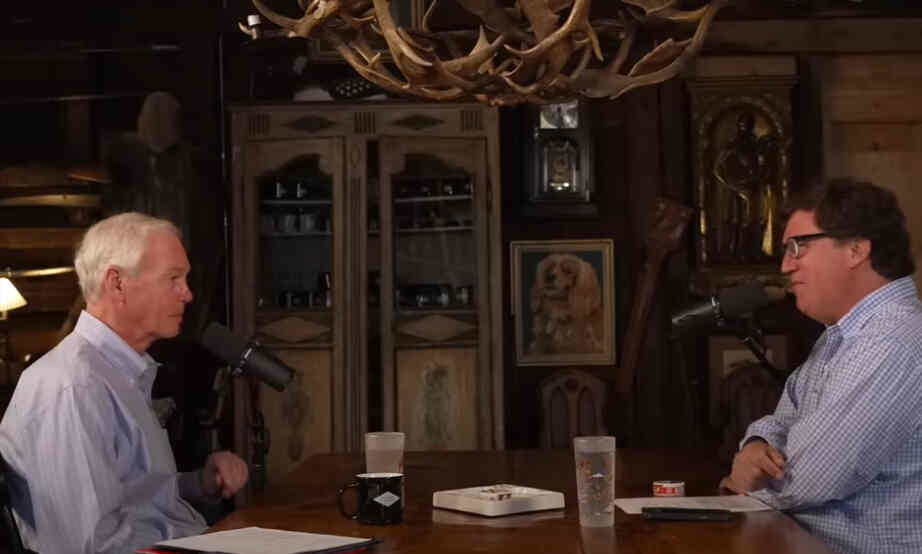
Read the full transcript of Sen. Ron Johnson’s interview on The Tucker Carlson Show titled “Uncovering the Truth About 9-11 and What’s Really in the “Big Beautiful Bill””, May 29, 2025.
Congressional Ignorance About Federal Spending
TUCKER CARLSON: So you told me something that made me laugh at breakfast in a dark way, which is that none of or very few of the people you work with, your colleagues whose job it is to appropriate money to run the US Government, have any idea how much they’re appropriating. They don’t know what the numbers are. Can you walk us through a description of the ignorance of Congress when it comes to numbers?
SEN. RON JOHNSON: So you want me throw my colleagues under the bus?
TUCKER CARLSON: It was just like I was amazed by what you told me…
SEN. RON JOHNSON: …of the dollars they appropriate. They know that. But that’s only 25% of the budget. The story I told you at breakfast is a couple years ago, this was after the COVID spending spree, but we continued on that spending spree. We were in the midst of an omnibus spending debate. And this is where McConnell was doing a deal with Schumer on a massive omnibus spending bill.
And we were going to violate for the first time our conference’s position on earmarks. You know, our conference position is we do not accept earmarks. All of a sudden the Republican senator is going to be accepting earmarks. So I got up in front of the group. I’m generally the skunk in the room or you know, the kid who says the emperor has no clothes. I just asked my colleagues, hey, anybody know how much we spent last year in total? Dead silence. I went out to the Washington press.
TUCKER CARLSON: By which you meant what we spent.
SEN. RON JOHNSON: Last year, in total, the federal government. What the federal government spent in total.
TUCKER CARLSON: Just the bottom line number.
SEN. RON JOHNSON: If anybody knew, they didn’t volunteer. And I went out to the Washington press corps, asked them the same question, and one of the reporters said, well, it was over a trillion dollars. Now, that’s just discretionary spending. That’s about 25% of the budget. I mean, total spending. The answer is, I think, $6.3 trillion.
Understand, the federal government is the largest financial entity in the world. We, in theory, are the 535 members of the board of directors. And nobody really knows in total how much the federal government spent because we never talk about it. And as that relates to the current.
TUCKER CARLSON: What a weird thing not to talk about since that’s your job again.
SEN. RON JOHNSON: But that’s how it’s been set up. Discretionary, which we appropriate, and then mandatory. That just gets spent. It’s on automatic pilot. So it’s out of sight, it’s out of mind, and it’s completely out of control.
How Congressional Appropriations Actually Work
TUCKER CARLSON: May I ask how that works? So I thought the Constitution gave the Congress the responsibility, the duty to appropriate the money.
SEN. RON JOHNSON: So Congress has written laws like the Social Security law.
TUCKER CARLSON: Yeah.
SEN. RON JOHNSON: Then Medicare and Medicaid. And they’ve turned. They call those entitlements. So it doesn’t make. They’re not annually appropriated. It’s just you set up a law saying if you qualify, you get X number of dollars. So it’s on automatic pilot.
TUCKER CARLSON: And there’s no cap on that spend.
SEN. RON JOHNSON: No, none. You qualify, you get it.
TUCKER CARLSON: So whatever.
SEN. RON JOHNSON: What is what has happened over the years is in addition to Social Security and Medicare and Medicaid, they slid what should be in my mind, discretionary spending into mandatory. And so I’m the guy that pointed out the conference. Again, do you guys realize in 2019, other mandatory, again, not Social Security, not Medicare, not Medicaid. Other mandatory pretty well runs the gamut of other appropriation accounts. That was $642 billion last year.
Fiscal year 2024, that was $1.3 trillion. This year, it’s a little over a trillion. And that’s pretty much as far as the eye can see, according to CBO. A trillion dollars. So again, total discretionary spending is about $1.7 trillion, but they’ve literally slid about a trillion dollars now ongoing of other mandatory or what should be discretionary into what they call now other mandatory. A trillion dollars. And I don’t think anybody was really aware of that either.
The Staggering Numbers: Federal Spending Reality
TUCKER CARLSON: So what’s right now for 2025 or let’s say 2024, what did the federal government spend total?
SEN. RON JOHNSON: So let me. So in 2019, total federal government spending was $4.4 trillion.
TUCKER CARLSON: Yes.
SEN. RON JOHNSON: This year we will spend over $7 trillion. So better way, I remember somewhere around during the Obama administration about when I got elected, 2010, 2011, we had our first trillion dollar a year deficit in 2009. You know, there’s $1.4 trillion. And we stopped talking about hundreds of billions, which used to move the needle to now trillions. 1, 2, 3, 4, 5, 6, 7. It just doesn’t seem that much.
$4.4 trillion spent in 2019, $7 trillion spent this year, projected to spend $7.3 trillion next year. And now let’s kind of bring this back to the debate that we’re talking about on the one big beautiful bill.
TUCKER CARLSON: Wait, maybe that’s just one more bottom line number. Okay, so we’re going to spend over $7 trillion this year. How much do we take in in tax receipts every year?
SEN. RON JOHNSON: About $5.1 trillion. So we’ve got a structural deficit of around 6% right now. CBO is projecting over the next 10 years 6%. So federal revenue will be, according to CBO, 18.1%, even though it’s about 17.1%. But they’re projecting that we’re going to increase or have an automatic tax increase next year. So they bumped that to 18.1%. And federal spending is going to be about 23.4%, 23.5%.
TUCKER CARLSON: So that deficit spending, where does that money come from?
SEN.
TUCKER CARLSON: Okay.
Historical Context: Government Growth Over Time
SEN. RON JOHNSON: By the way, put this in even better historical context. In 1930, less than 100 years ago, the federal government spent 3.1% of our GDP. State and local governments back then spent 9.1%. So that was pretty much the vision of our founding fathers, a limited federal government, you know, within the constraints of the enumerated powers and most governing at the point of the states, you know, state and local governments, where it’s more accountable, more efficient, more effective.
You know, we’ve blown that up now. The federal government’s spending close to 24%. State and local governments are over 16%. So now total government spending is about 40%. It’s three times what it was back less than 100 years ago. And I would argue as government grows, our freedoms necessarily recede, of course, because government has more claim on your income or they borrow money, which causes inflation, which is a silent tax.
The Tipping Point: More Receivers Than Payers
TUCKER CARLSON: Do you we have any sense of what percentage of the American population, 350 million or whatever it is in that range are net receivers? Get more from government than they pay.
SEN. RON JOHNSON: In my guess, it’s more than 50%. And of course, that’s the death knell of a democracy, is when the population, the voting public, realizes they can vote themselves benefits at the expense of somebody else. And what they don’t realize, the expenses it’s costing them all because the massive deficit spending, because we’re not taking enough revenue to cover the expenditures, that’s what has eroded the value of our dollar. That’s what caused 40 year high inflation, and that hurts everybody.
TUCKER CARLSON: So you think that most. At this point, your guess is most Americans receive more from the federal government. From government?
SEN. RON JOHNSON: I shouldn’t even say because I haven’t checked that figure. Yeah, my guess is probably more than 50%. I mean, when you consider all the entitlements, whether it’s Social Security, Medicare, Medicaid, and people say that’s my money. Well, in some cases it is. Most people probably get more out of Social Security than they actually did put in. Certainly do that out of Medicare, certainly out of Medicaid. Nobody puts any money into that. That all comes with the general funds. So we, we have food stamps, we have all these, you know, trillions of dollars worth of transfer payments.
Why This Path Is Unsustainable
TUCKER CARLSON: Why is this not sustainable? You often hear it’s not sustainable. What happens if it continues?
SEN. RON JOHNSON: Well, again, we’re. When I ran in 2010, we’d just experienced our first deficits in excess of trillion dollars. We were spending about $3.5 trillion a year.
TUCKER CARLSON: So it’s more than double just in the. Since 2010.
SEN. RON JOHNSON: Yeah. Yes. We were $14 trillion in debt. I remember I announced in April of 2010, started my campaign in basically June 2010, doing parades. And what I would shout is, this is a fight for freedom. We’re mortgaging our children’s future. It’s wrong, it’s immoral. It has to stop. That was my campaign theme.
Again, we were $14 trillion in debt, spending $3.5 trillion. Now we’re almost $37 trillion in debt. We’re spending $7 trillion. And CBO projects over the next 10 years, we will add another $22 trillion to the debt. That’s what our projected deficits over the next 10 years is, $22 trillion.
Again, that’s assuming about a $4 trillion increase because of taxes are scheduled to automatically increase if those taxes don’t increase. First of all, I’m not sure you get the full $4 trillion. But again, take $4 trillion away. If we extend current tax law, which is, I’m in favor of that. I don’t want to increase anybody’s taxes, but I don’t think this is necessarily time to do additional tax cuts, particularly when those things aren’t focused toward economic growth.
But anyway, just real. So we are projecting deficits for the next 10 years of a minimum of $2.2 trillion. And I would argue that is a rosy scenario, particularly when you take a look at what they’ve done with the one big beautiful bill. They’re not seriously reducing spending to what I’ve been calling for is a pre pandemic level.
Comparing Presidential Deficits
Again, the danger is spouting out too many, too many numbers here. I just want to put this in perspective. President Obama over the course of his eight years, his average deficit was $910 billion over the last. And I want to quick do this so I’m accurate. Over the last four years of his administration is about $550 billion. Okay, so half a trillion dollar deficit over his last four years.
President Trump came into office in his first three years, the average deficit was about $800 billion. So he bumped up Obama’s four year average from $550 billion to $800 billion. Then Covid hit and we had a deficit of $3.1 trillion just that one year.
Now what we should have done in 2021 when Biden came into office is we should have returned to a reasonable pre pandemic level. The pandemic was over. We didn’t have to keep, you know, we had unemployment spike up to I think 25 million people. Normal unemployment somewhere between 5 and 6 million. Within a few months it was around 11 million and then returned to pretty much normal early in 2021. We didn’t have to keep stimulating the economy, but Biden did.
Biden averaged $1.9 trillion per year in deficit. So Obama when he left his last four years, $550 billion. Trump before the pandemic, a little more than $800 billion per year. Biden in his four years went up to $1.9 trillion. And now CBO is projecting and again a rosy scenario that will be averaging $2.2 trillion over the next 10 years.
The Debt Crisis Ahead
So we’ll take our debt from $37 trillion up to $59 trillion. And if we extend the current tax law, take away $4 trillion in revenue, roughly that add another $4 trillion. The spending cuts are talking about, they’re paltry, $1.5 trillion. Some of those are fake, some of those are extended way out. They’re offset by 10 years. Yeah. I mean, we’ll spend the money up front for the border, for defense. So that also takes away from that $1.5 trillion in spending.
So at most we’re maybe cutting spending $1.2 trillion. Part of that, a few hundred billion I think, is student loan forgiveness, which the Supreme Court will probably rule unconstitutional. We’re not going to spend it anyway. But they count that as savings. So much of the savings they’re talking about in the one big beautiful bill is phony, it’s fake or it’s in the out years where if Republicans lose power, Democrats would just restore it.
But no matter how you slice it, from my standpoint, CBO’s $22 trillion of 10 year deficit is a rosy scenario. It’ll, it’ll probably be more than that. And what happens then is what’s happening right now in the bond market. Interest rates are creeping up. You can’t control that. If global creditors look at the United States as uncreditworthy, our 50 year average interest payment that we’ve paid on our debt is over 5%. So I think it’s as high as 5.8%. It’s not the most exact figure, but right now we’re borrowing probably about 3.3%. That’s been the average over the last 25 years, 3.3%. And that’s kind of where we’re at right now.
If we increased that interest, if that interest expense increases to or rate increases to 4.3%, add another $4 trillion in deficit spending. If it goes up to the 50 year average of 5.3%, add about $8 or $9 trillion to the $22 trillion. So again, you go $22 trillion plus extending current tax law, add another close to $4 trillion. If interest rates start creeping up and they are just 1 percentage point, add another $4 trillion.
So you can see very quickly you go from $22 trillion to $26 trillion to $30 trillion, add down to $37 trillion or up to $67 trillion in debt. I don’t think we’d ever hit that. I think something’s going to happen. We’ll have a debt crisis. We’ll have failure in our bond auctions, spiking interest rates even more. And again, we’re spending more on interest this year than we spend on defense.
The Chronic Debt Crisis
TUCKER CARLSON: You often hear the phrase debt crisis. What does that mean exactly? What would that look like?
SEN. RON JOHNSON: Depends whether it’s a chronic or a acute crisis. I’d say we’re already in a chronic debt crisis. That is what I would consider the devaluation of the dollar I laid out and we talked about this, my pre pandemic options going back to 98, 2014, 2019. So a dollar you held in 1998 is only worth 51 cents a day.
TUCKER CARLSON: Ouch. A dollar you held, it’s devalued that much since 1980.
SEN. RON JOHNSON: It’s been cut in half. When I ran 2010 that dollar is worth about 68 cents. A dollar you held during Obama in 2014 is worth 74 cents. A dollar you held just in 2019 is only worth 80 cents. So again, that is the devaluation of dollar, that’s inflation.
TUCKER CARLSON: This is why everything is so expensive.
SEN. RON JOHNSON: Yeah. That’s a silent tax.
TUCKER CARLSON: It’s how you spend 300 bucks at dinner and you’re like I didn’t even get drunk. How did that happen? That’s the effect.
SEN. RON JOHNSON: Yeah. And that’s why you had four year high inflation. So that I would consider the chronic debt crisis. It just continues. It’s the danger. We have not tamed inflation yet. We’ve tamed it but we haven’t conquered it. So I think that’s always on the horizon.
Particularly if we continue to deficit spend, particularly if the bond markets start continue to react as they are, keep driving interest rates up higher and you start increasing the amount of interest expense, crowding out other spending. So an acute debt crisis would be where you have a bond market failure and like what happened in Greece, all of a sudden you can’t sell your debt.
So you either print the money, which sparks another round of 40, 50 year high inflation, devaluing the currency rapidly. You know, we’re not necessarily immune to hyperinflation. Other countries have experienced it.
Bond Market Failure
TUCKER CARLSON: So failure to sell your debt in a bond auction, what does that look like? You just put out your bonds and.
SEN. RON JOHNSON: Nobody wants them, nobody buys them. And so again, the advantage the U.S. has over any other country is we are the world’s reserve currency. So we can print dollars so we can get by that moment. Except for you’re printing dollars.
And inflation’s pretty easy to define. It’s too many dollars chasing too few goods. So you just print all those dollars and again the dollar devalues, the cost of your debt is lowered again. It’s a silent way of addressing these massive deficits.
TUCKER CARLSON: How far away from a moment like that are we?
SEN. RON JOHNSON: I don’t know. I would have thought we would have experienced it by now, but we’ve experienced instead is again 40 year high inflation, the devaluation of the currency. I mean, I think that’s pretty shocking when you take a look at that is a dollar just, you know, 11 years ago is only worth 74 cents. You know, six years it’s only worth 80 cents. That’s, that’s, that, that’s an amazing level of devaluation.
TUCKER CARLSON: Yes.
SEN. RON JOHNSON: Now it’s not even close to hyperinflation where, you know, you’ve got inflation rates of hundreds of percent.
TUCKER CARLSON: So when that crisis comes, what do you do?
America’s Wealth vs. Cash Flow Problem
SEN. RON JOHNSON: Well, you have a great deal of turmoil in your society. It won’t be pleasant. It’s what we need to try and avoid. And by the way, why I’m not in a full blown panic, people like Art Laffer, economist of the Laffer Curve, he does correctly point out America has enormous wealth. I mean, hundreds of trillions of dollars worth of wealth.
So 37 trillion dollars in relationship to hundreds of trillion dollars worth of wealth, that’s manageable. It’s just like if you’re a billionaire but you don’t work, you can have some pretty large mortgages on homes, but you still have to generate some income to service the debt. And I think that’s kind of the point we’re making. It’s not irrelevant debt to GDP ratio and we do have massive wealth, but we need to manage the cash flow.
Problem here too, as well as, I mean, just the pernicious impact of all these transfer payments providing encouragement for people not to work. There’s a great article written, I think, in 2017 by Nick Eberstadt of the American Enterprise institute, our miserable 21st century, you know, talking about how 20% of working age men are permanently out of the workforce.
TUCKER CARLSON: Yes.
SEN. RON JOHNSON: You know, on Medicaid, using the Medicaid card to buy opiate drugs to, you know, help finance their living. You know, all kinds. All those pernicious impacts of a society where we literally don’t require people to work, we actually incentivize them not to. That’s, that’s my, to my mind, that’s one of the biggest problems we have.
TUCKER CARLSON: With a big problem, mass immigration to fill the gap.
SEN. RON JOHNSON: Yeah. Somebody’s got to do the work.
TUCKER CARLSON: Right.
The Worker Shortage Problem
SEN. RON JOHNSON: And you know, we were talking earlier when I first entered this political realm going to Dairy Breakfast, the first issue I heard in Wisconsin was, you know, we don’t have enough workers. Now I come from a manufacturing background where for 20 or so years you couldn’t find enough people to work in a manufacturing plant.
Which is why I always kind of scratch my head. Listen, I. There are certainly products that we have offshore that we need to reshore, you know, things that are strategic that impact our national security. But right now I think our biggest problem is we don’t have enough workers. If you bring all this manufacturing back to America, who’s going to work the factories? And we certainly shouldn’t be bringing back high labor content product.
TUCKER CARLSON: Right.
SEN. RON JOHNSON: I think you need to diversify your supply base. You can’t be so dependent on an adversary like China. Spread it around, you know, that would reduce your risk.
Congressional Avoidance of Reality
TUCKER CARLSON: So what you’re saying, like the numbers you’re describing are the bottom line numbers. This is not like higher math. This should be obvious to everybody. What’s the reaction been?
SEN. RON JOHNSON: Well, they just ignore it. Again. One of the reasons I’m digging my heels in as the one big beautiful bill comes over the Senate is we haven’t had the discussion or the debate. The only number you heard about in the whole House debate here was 1.5 trillion dollars, which sounds like a lot, right? I mean, 1.5 trillion dollars in spending reduction.
And of course they’re focusing on programs like Medicaid. The main problem with that is Obamacare, which is now called Medicaid expansion, allowing states to game the system, putting at risk Medicaid for the truly vulnerable. But that’s all you really heard about. You don’t ever put that in context? You know, 1.5 trillion dollars compared to 89 trillion dollars spending over the next 10 years. It’s barely a rounding error. You know, we haven’t been talking about the massive annual deficits. We don’t talk about the debt.
The Pandemic Spending Explosion
TUCKER CARLSON: Why is the. I mean, when you were describing the progression of debt accumulation, it feels like it’s been really rapid in a short period of time. Like the federal government spending almost twice what it was just the other day. Where’s all that money going? How did that happen? What. What is that?
SEN. RON JOHNSON: Well, again, it was really sparked by the pandemic. Yeah, I’ll give the Tea Party movement a fair amount of credit. I ran because we were more generic kids, future. We were running deficits for I think three years in a row over a trillion dollars. But once we got to town, 2011, we started having these budget debates. We had divided government. Obama didn’t get everything he wanted.
We did something called the Budget Control act, which literally reduced discretionary spending for three years in a row until we learned how to weasel around it. So we pretty well flattened out federal government spending at about 3.5 trillion dollars for five or six or seven years. And then the last couple of years of the Obama administration started creeping up.
And then under Trump, it went from about 4 trillion to 4.1 to 4.4, and then it went to 6.5. And we’ve never looked back. And the analogy I use there is I don’t know of an American family. If they had an illness and they had to borrow 50,000 dollars to pay for the medical bills, if that family member got well, you wouldn’t keep borrowing 50,000 dollars and spend at that level. But that’s exactly what we’ve done.
And like nobody other than, you know, I’m the first guy who wrote the Wall Street Journal article about we really need to return to a pre pandemic level.
TUCKER CARLSON: It doesn’t seem radical.
SEN. RON JOHNSON: And I’ve laid out options, you know.
TUCKER CARLSON: Clinton, Obama, COVID pandemic. This was just like a couple years ago.
The COVID Overspending Disaster
SEN. RON JOHNSON: So, I mean, what Biden should have done, we overspent in 2020. And we first were talking about that CARES act is like 750 billion dollars, which, you know, I knew we had to do something fast and massive so markets wouldn’t collapse. But within like a week or two, that. That went up to like 2.2 trillion dollars.
We sent out direct payment checks to 166 million Americans three times. Way late, way, way after unemployment had already returned from the 25 million person high again, 25 million people unemployed when normally you’re at five or six. We sent out direct payment checks to 166 million Americans three times. So we way overspent even in 2020.
So you had trillions of dollars sloshing around the economy. As you come into 2021, the economy is coming roaring back because you have all this pent up demand and all these dollars sloshing around. The last thing you should have done is add more fuel to the fire. That’s what Biden Democrats did again. On average 1.9 trillion dollars of deficit spending over the next four years. We never went came down off of that 6.5 trillion a little bit, 6.2, 6.3, but then started going back up again.
TUCKER CARLSON: And that’s really the moment. That’s when a bass boat suddenly cost 100,000 dollars or your car cost 90,000 dollars. You know, brand new Suburban is 80 grand or whatever. That’s when the country became obviously unaffordable, I think unless I misrepresented or your.
SEN. RON JOHNSON: Your meal deal at McDonald’s all of a sudden jumped from five to ten bucks. When did that happen?
Why No Political Will to Fix It
TUCKER CARLSON: Yeah, I don’t understand why there’s no will to fix that. I mean that seems like pretty basic macroeconomics. In the Congress nobody’s.
SEN. RON JOHNSON: I haven’t heard McConnell say this, but I’ve heard the quote attributed to him and this is one thing I agree with him on. Show me one member of Congress who ever lost because they spent too much money. Yeah, there just isn’t public pressure, there’s not public awareness. We don’t educate our young people.
The news media doesn’t connect the dots. Why people can’t afford things is because of massive deficit spending which sparked 40 year high inflation, devalued the dollar. I mean, to me it’s pretty obvious, but normal Americans, they just get all surly about it.
What a Real Debt Crisis Looks Like
TUCKER CARLSON: Okay, well then let’s meditate for a moment on the consequences of it. I asked what happens when there’s a debt crisis? Why haven’t we had one yet? You said we probably should have had one. I don’t know why we haven’t, but we’re going to get one if we keep doing this. I said, what will the effect of that be? You said, massive instability in the society. What do you mean, what will that look like? Maybe it would awaken people to the threat if they knew what would happen in a debt crisis.
SEN. RON JOHNSON: Well, so if you’re living on different transfer payments or different types of welfare benefits, you know, you may not get those. You can’t borrow more money. So you’re going to have to take what money we spend on other government programs and we’ll have to service our debt. You have to pay it off unless we want to go into full default.
TUCKER CARLSON: And that’s where you just say to Japan and China and Germany and everyone else who’s bought those bonds, like, we’re not paying.
SEN. RON JOHNSON: Yeah, which means you’ll never float more debt. So you can’t, you know, other than print more money, which then creates even more hyperinflation. So now people can’t afford anything.
The Reality of National Debt and Economic Collapse
TUCKER CARLSON: I mean, has anyone ever defaulted, any country ever defaulted on debt and just said we’re not paying, come and come and get it.
SEN. RON JOHNSON: Oh, I’m sure they have. I’m not.
TUCKER CARLSON: But that’s not common.
SEN. RON JOHNSON: Like, I think it happens enough. But what always happens is, you know, companies like us go in there and we help them restructure their debt. I think that’s happened numerous times.
TUCKER CARLSON: But no one’s going to come and help us restructure our debt.
SEN. RON JOHNSON: Nobody can. Again, we will lose our position as the world’s reserve currency and we’ll lose our ability to print dollars that people accept. I mean, it’s a marvelous thing that we just print dollars. We can send them overseas and people will produce products and ship them over here. High quality products are pretty low cost.
I think it’s one of the reasons we’ve been able to keep inflation in check, producing all these massive deficits over the last couple decades is we do import a lot of products. We’ve got billions of people either or underemployed around the world. We provide the capital, they produce the factories, they produce the goods. And then we just give them paper. It’s fiat currency. We print it. We keep printing it. And it’s been working out pretty well. At some point in time that gravy train might stop and then, I mean.
TUCKER CARLSON: Then you have a total collapse of the current system.
SEN. RON JOHNSON: Yeah, again, I can’t predict. I’m trying to avoid it. It’ll be painful. Who really suffers are people at the lower end of the income spectrum that have no safety net. They don’t have any kind of hard assets that will inflate with inflation. They just be destitute, a lot of them. Yeah.
TUCKER CARLSON: In a country that has no kind of organizing principle or national identity where people are not as united as they were in, say, 1929, I had my.
Republican Leaders and the Spending Problem
SEN. RON JOHNSON: Comm staff put together a video. I asked them to find all these Republican leaders that have talked about balancing the budget. We have a spending problem. Starts out with President Trump saying in the State of the Union, I’m going to do something we haven’t done 24 years. Balance Federal budget. Then every Republican leader some form of we don’t have a revenue problem, we have a spending problem.
In those clips, we have Elon Musk saying, if we don’t fix this, there won’t be money left over for anything. And I think that’s a pretty accurate statement.
TUCKER CARLSON: Does this bill get us closer to fixing it?
SEN. RON JOHNSON: No, it exacerbates the problem.
TUCKER CARLSON: How can that be?
SEN. RON JOHNSON: Because we’re not serious about returning to a reasonable pre pandemic global spending. We’ve picked a number out of the air. 1.5 trillion is totally out of context. There’s, you know, it’s not really related to the, the moment. It’s, it’s, it’s missing the moment.
TUCKER CARLSON: Can I ask you, like, who came up with that number? Like, whose lie is that?
The Problem with Setting the Bar Too Low
SEN. RON JOHNSON: I think my best guess is conservatives in the House, who I love, didn’t want to be blamed if this thing failed. So they said, well, listen, in order to, in order for us to accept a $5 trillion increase in the debt ceiling, we’ve got to get at least $1.5 trillion in savings, spending cuts. I don’t think they were looking at the big picture. I think they just pulled a big. I criticized them at the time, privately. I said, listen, you set the bar way too low, you guys, this is completely inadequate.
They set the bar way too low that it should have been easy to meet it, quite honestly. But even that was difficult because they didn’t go through what I would consider the right kind of process. So maybe we can shift in terms of what we have to do. What I’m trying to accomplish here and my digging my heels in DOGE has kind of shown us what we can do here.
We’ve never had a process to control spending in the federal government. We don’t have a balanced budget requirement. I didn’t realize this. Just found out. Do you know they established the appropriation committees because the authorizing committees were big spenders. So the appropriation committees were supposed to be the control on the big spenders. Well, that didn’t work. The Budget control Act of 1974 didn’t work. Simpson Bowles didn’t work. The Budget Control act didn’t work. It did for three years, but then we weaseled our way around it.
So what process could possibly work to control spending? Well, first of all, you have to know the numbers. You have to understand, you know, what, what a deep hole we’re in and have a commitment to, to address it. But DOGE has pretty well shown us how to do it. I come from the private sector. I, I think we probably, I probably spent more time either analyzing my department head budgets or my own overall company budget than Congress in total spends analyzing the $7,000 billion budget of the federal government.
So Doge is showing us if you go line by line, contract by contract, you will discover and uncover spending that if the American public saw, they’d be outraged by it. If you eliminated it, my guess is most Americans wouldn’t even know it’s eliminated. About the only people that would know would be the grifters.
TUCKER CARLSON: Yeah.
A Three-Step Reconciliation Process
SEN. RON JOHNSON: Who have been sucking down the waste, fraud and abuse the ngo. So you have to, you have to go step by step. So that’s why I’ve always been supportive of multiple step reconciliation process here. I was always recommending three steps. First step, give President Trump the funding on the border defense bank, $850 billion of real savings. Not make believe, you know.
Now and Lindsey Graham agreed to this 85 and a half billion dollars each year for four years to pay for the four years worth of spending and then extend that out 10 years, that gives you 850. That’s more than half of what the House budget reconciliation supposedly gives us. Second step, I would just extend current tax law. If we would have been smart enough in 2017, had somebody like Chairman Crapo who really came up with this idea of let’s just use current policy for taxes, then we can make this stuff permanent.
You should never pass in my mind a tax law that automatically expires, just creates all these fiscal cliffs and puts all kinds of uncertainty in the economy.
TUCKER CARLSON: Why do they do that?
Budget Scoring and Tax Policy
SEN. RON JOHNSON: So this gets into real budget wonkery. But for spending, to score it, you use current policy, which means if a spending program ends, if you want to extend it, you score it based on, oh, it was going to be extended anyway. So it doesn’t cost anything. For taxes though, we use current law. So if the tax cuts are ending and you want to extend them, well, you’re scoring that on the fact that they are going to end.
So now to extend them, it’s going to be a trillion dollar score. So then you got to pay for it and it’s hard to pay for it. And so that’s how it was all scored back in 2017, where if we would just use current policy, if we use current policy now, we can just extend current tax law and there’s no score. So that’s really what we’re doing now. But we have to recognize when you’re comparing to the CBO budget, CBO budget is assuming it does, taxes do increase and bring in about another $4 trillion worth of revenue.
So that’s why I say the $22 trillion in projected deficits is probably a rosy scenario.
TUCKER CARLSON: I mean, it seems like the core problems are just so familiar. One is short term thinking and the second is the misplaced belief that you can see what the future will be. And both of those are silly and unwise. Maybe. Are we bumping up against the inherent limits of the system?
Focus on Spending, Not Revenue
SEN. RON JOHNSON: Well, I would say we’re missing the focusing on the right thing. We had to focus on spending. And the reason I say that is spending is pretty certain. Again, who knows what revenue you’re going to bring in? It’s hard to predict spending. That’s pretty easy to predict what that’s going to be. Plus, I personally voted For President Trump because I wanted him to defeat the deep state. You don’t defeat the deep state by continuing to fund it at Biden’s levels.
TUCKER CARLSON: Yeah, I know.
SEN. RON JOHNSON: So again, when you start talking about controlling the deficit, well, you can control the deficit by tariff, revenue or selling the gold card, but that keeps funding the deep state. You have to focus on spending. And we have just gone through an unprecedented level of increased spending other than World War II.
And just quick aside on that, we entered World War II spending 11.7% of our economy of a GDP on federal government, 11.7. That got ramped up to 41% during the war. But by 1948, because we had responsible leaders, you know, the greatest generation, that actually went down to 11.4% of GDP, we returned to a pre war level.
TUCKER CARLSON: And we had a massive recession too.
The Pandemic Spending Problem
SEN. RON JOHNSON: I mean, the war is over. Let’s return to a reasonable pre war level spending. We didn’t do that during the pandemic. And that’s what we have to. You have to focus on do. It’s such a reasonable thing to do. It should have been done in 2021. We didn’t do it for four years, but now we’re just pretty well accepting that.
We’re accepting the fact that Obamacare, now called Medicaid expansion, is putting at risk Medicare for the truly vulnerable. Even though we all ran on repealing and replacing that and obviously failed in the first Trump term. But now we’re all okay with it. Now we’re not going to touch that because they renamed it. Are you kidding me?
TUCKER CARLSON: Well, but this is how it works. Like in 20 years we’ll be like, well, of course you have to protect trans kids. You know, what seems crazy at first becomes accepted and then it becomes the hill to die on. It’s just like your expectations change. Right?
The Scale of the Problem
SEN. RON JOHNSON: So again, I’m trying to force the discussion over the real numbers. Okay? And again, 1.5 trillion in abstract seems like a lot, but we’ve really ramped up from 2019 to this year. That’s over 10 years. That’s $29 trillion of increased spending over 10 years. 29 trillion. And we’re talking about cutting out 1.5 of that?
TUCKER CARLSON: Yeah, it’s a joke. It’s a joke because people don’t want to cut it out. And so I guess that’s my question. You said that the problem with democracy is once the majority figures out they can just steal money, then you’re just headed to the cliff and there’s no pulling back. Are we There.
SEN. RON JOHNSON: Well, again, they’re not stealing it. They just don’t realize that how it’s financed is by printing money and they can’t afford things.
TUCKER CARLSON: If you’re taking other people’s money at the point of a gun, it’s called theft.
SEN. RON JOHNSON: Yeah. They try and tax it, but we’re not taxing anywhere near enough, right?
TUCKER CARLSON: No. Right.
SEN. RON JOHNSON: So we’re going to have to borrow $2.2 trillion for the next 10 years, every year at least.
TUCKER CARLSON: That’s effectively a tax because it devalues money in your pocket. So it’s based on paying 10 bucks for a Big Mac and a Coke.
SEN. RON JOHNSON: Yeah. Inflation is a silent tax. It’s really nasty.
A Grim Outlook
TUCKER CARLSON: Do you have any hope?
SEN. RON JOHNSON: I’m not the world’s greatest optimist. How can you be? I fear we’ve passed the point of no return. The reason I’m digging my heels and Tucker, I don’t want to.
TUCKER CARLSON: I beg you.
Defense Spending and Military Industrial Complex
SEN. RON JOHNSON: I really don’t. I mean, I’m not looking for it. Listen, I love what President Trump is doing. He is such a unique individual, unique political figure, unique president. He is doing things that only he would do, nobody else would do it, and things that have to be done. So I’m so supportive of most of what he’s doing.
But this is a once in a lifetime opportunity here. We’ve never had such an unprecedented level of spending. Returning to a reasonable level is just so common sense and not that hard. It’s not going to be easy. But what I’ve done in laying out those pre pandemic options go back to Bill Clinton 1998, when we actually had a surplus for the first time in 1969.
I don’t think we spent too little in 1969 or 1998, Obama in 2014 or Trump in 2019. There are three options. Leave Social Security, Medicare and interest as they are. Spend what you need to spend, but for all the other outlays, you just increase them based on population growth and inflation. A very reasonable control. You end up somewhere between 5.5 and 6.5 trillion.
Now, I would go back to Clinton recognizing that 9/11 happened after that. So you probably have to plus up defense. Although I’d like to hone how we spend our defense dollars. I think we talked about that earlier. I don’t think we spend them well, but somewhere between 5.5 and 6.5 trillion.
And then I’ve printed out the budgets, a couple thousand lines, and then go through those budgets line by line and just ask the question, well, this is what Clinton was spending, fully inflated. Why are we spending this much more? Or this is what Obama spent. Why is it so much more? Or Trump, why is it so much more? Explain yourself.
Like I said in business, this would be simple. Just say I tell my manager that I said you could increase your budgets based on inflation, the number of customers you serve, you’re 10% above that cut. I don’t care how you do it, just do it. Get back down to that level so it doesn’t harm our business, so it doesn’t harm people’s lives, but just do it.
Because what we were spending, 1998, 2014, 2019, I think it’s probably pretty adequate. And by the way, if you go through it line by line, there will be lines. I think you look at, scratch your head and go, we probably shouldn’t be spending anything on that. I think Doge has taught us that.
So again, for sure, Trump, and again, I think that was brilliant what Trump and Elon did with Doge. But we haven’t realized those savings yet. I think we stopped spending on contracts. But unless we set up and pass a rescission package on the discretionary end, unless we take whatever they discovered in mandatory and eliminate that through the reconciliation process, those monies will just be sitting out there unobligated and some Democrat Congress and some Democrat president will spend it without even having to appropriate it.
TUCKER CARLSON: Can I ask about the defense budget? So it’s in the neighborhood of a trillion dollars. We face no invasion threat. We never have. We’re separated from the rest of the world by two large oceans. Our standing force is not that huge, actually. It’s not like all that money’s going to pay for soldiers and Marines and airmen.
Why are we spending that much on defense? We haven’t won a war in 80 years. So I’m a little… And I know that all Republicans are required to take the Liz Cheney position that defense spending is just by itself nature inherently good. But what is that? What’s all that money going to exactly?
Analyzing America’s Foreign Wars
SEN. RON JOHNSON: We did not heed Eisenhower’s warning. I think the military industrial complex has way too much power. I would love, and we should do this is we should go back at least as far back as Vietnam and analyze each one of these foreign entanglements, each of these foreign wars and ask ourselves and gather some basic information.
First, what was our goal going in? Secondly, what did it cost in human life, ours and our adversary, our enemies, what did it cost in terms of dollars? And then the final question is, did we accomplish the objective?
I think if you do that, and I hate to say this because it’s true, I mean, this is… We’re filming this on Memorial Day. The finest among us.
TUCKER CARLSON: I agree with that.
SEN. RON JOHNSON: People who love this country, who’ve stepped up the plate, willing to serve and sacrifice more than a million, have paid the ultimate price. So I don’t even like saying this, but the fact of the matter is, if you did that kind of analysis, you wouldn’t walk away very satisfied.
TUCKER CARLSON: Well, but doesn’t our respect for the men who died in military service require us to…
SEN. RON JOHNSON: I think it does. So if you would… To do that. I was just recently in Hanoi a couple years ago. What wonderful people. They love Americans. I mean, after even…
TUCKER CARLSON: What.
SEN. RON JOHNSON: They love America because they’re entrepreneur, they’re hard working. They want, like most people in the world, they want what we have. They respect the values of America, the principles of freedom, individual liberty. We never should have been to war with them. We never should have bombed those people, but followed all the way through Afghanistan, Iraq, Syria.
I mean, what have we accomplished with the Ukraine war right now?
TUCKER CARLSON: Oh, I know.
SEN. RON JOHNSON: We have actually solidified the relationship between Russia and China and North Korea and Iran.
TUCKER CARLSON: Yes.
SEN. RON JOHNSON: That’s completely opposite of what our goals ought to be.
TUCKER CARLSON: Yeah.
SEN. RON JOHNSON: So it’s just not working. I mean, we have not accomplished these goals. They’ve been miserable failures. How many people died in Iraq based on that false intelligence?
The best book I read on Afghanistan is written by special ops folks, and they basically made the point that we pretty well accomplished what we need to accomplish in Afghanistan. Before Tommy Frank ever put a boot on the ground, we said, hey, listen, you guys harbored Al Qaeda, don’t do it anymore. Kind of punish the Taliban. And that’s probably where we should have left that.
How many Americans lost their lives? How many Afghanistan citizens lost their lives? What did that cost? Again? It’s almost incalculable.
Military Leadership Accountability
TUCKER CARLSON: Well, given all of that and given that no one has ever been punished, no high ranking military officer I’m aware of has ever been punished for any of these failures. The withdrawal from Afghanistan was humiliating and costly and it was just a disaster in every way. And the only guy who’s punished is Stu Shiller, who’s a Marine officer who points out that it wasn’t a success, but the architects were rewarded.
So given all of that, why are we sending these people even more money?
SEN. RON JOHNSON: Again, it’s the military industrial complex and there’s some just basic metrics people use like percentage GDP spending on defense, where we’re kind of a low level and we should be. I mean we’ve got right now, chairman of the armed services committee, McConnell. They want to dedicate 5% of GDP to defense.
So where are you going to get that money? I realize we’re kind of down at historic low levels, but it’s still a trillion dollars. Where are we spending it? That’s why I would have loved to see somebody like Erik Prince, who wrote an excellent article, “Too Big to Win,” become defense secretary and really take a look at how are we fighting these wars? What do we need to do to defend America?
America’s Industrial Base
TUCKER CARLSON: Somebody said to me the other day, I was talking to an informed person about this, grousing about it, like if you don’t win a war for 80 years, why does your budget keep expanding? And this person said the real reason is America’s industrial base is overwhelmingly military now. So actually the only real thing we make are weapons. And so that’s what that money does.
SEN. RON JOHNSON: I don’t think that’s necessarily true. There’s certainly a… Again, you still have that industrial base. You spend a trillion dollars out of 28 trillion economy, 29 trillion economy, that’s a pretty good chunk, but it’s not the majority of it. We make a lot of stuff. I think that’s kind of a mistaken notion as well.
Industrial production continues to rise here. We don’t have, again, we become more and more productive. That’s a good thing. Again, right now we don’t have enough workers to be manufacturing a whole lot more stuff. I mean, the last thing we should be doing is trying to attract high labor content product back to the U.S. we just don’t have enough people to do it.
TUCKER CARLSON: Interesting. So that’s probably like a Raytheon talking point then.
SEN. RON JOHNSON: I don’t know, I’m just putting the basic numbers.
The Big Beautiful Bill Strategy
TUCKER CARLSON: Oh, that’s interesting. So what happens to this bill?
SEN. RON JOHNSON: Well, again, what I’d like to do is split it into two parts, do the, quite honestly, what has to be done now, and that is provide the funding. I think they’re asking way too much. I pointed this out with Kristi Noem. They’re looking for 46 billion for the fence. Or for the wall.
Well, in the first Trump term, I can’t remember the exact numbers. I think something 485 miles, we spent 6.6 billion, so that’s like 14.4 million a mile. Now they want 46 billion, that’s built over 3,000 miles. So I asked her square that circle for me and she really didn’t. She was actually saying they’re projecting 12 million. I was willing to give her 14.4, even though I was in Israel when I was chairman of Homeland Security. They built their very effective fence for less than 2 million a mile.
But lay that aside. So provide border funding. The price you have to pay for that is more advanced spending. Bank what savings we can, take the good work the House has done, bank that savings, extend current tax law, take an automatic tax increase off the table, provide that certainty of the economy, bump up the debt ceiling for a year to keep pressure on us to come back, and then do the big beautiful bill.
We’ll consider President Trump’s tax proposals. Listen, I’m all for no tax on cash tips. Can’t collect it anyway, so why even try? And that keeps currency circulating through the economy as well. I think that’s a good thing. I don’t want to go to a government backed digital security, so that’s good.
I mean, the other tax proposals he promises to me in the campaign, they’re not pro growth. They’re just going to reduce revenue. No tax on overtime. I ran a continuous shift operation. I think the one time and a half for double time is more than enough incentive. We all live under a tax system. Income is income. Why would we increase the regulatory burden on people that administer payroll to cordon off some of the overtime to don’t tax it. I mean, just be a pain in the butt.
Tax System Reform
TUCKER CARLSON: Why doesn’t everyone just pay the same rate? I don’t understand that. And then everyone has skin in the game. Everyone has a better sense of what their government is spending and on what if it’s coming out of your… And that suggests a kind of equality under the law. That would be sort of nice if everyone’s held. And I mean nonprofits too. I think we should get rid of all nonprofits immediately. Why isn’t Harvard’s endowment paying taxes? Like what is this? Why not just the same rate for everybody, labor, capital, same rate, one rate.
SEN. RON JOHNSON: You can be a non profit by not making a profit.
TUCKER CARLSON: I’ve done that too.
SEN. RON JOHNSON: No, I still pay the fact if you’re a university, church, something like that, you bring in revenue, you spend it, you got no profit, you’re non profit. So now the other reason I wanted to split this into two parts is we need to take the time to go line by line to do a doge impact on the entire budget, to find the outrageous spending, eliminate what people won’t even notice. But also to simplify and rationalize our tax system. We have a grotesquely complex tax system.
The Tax Code and Fiscal Responsibility
TUCKER CARLSON: Everyone’s out of complaints, everybody’s committing a felony unwittingly. Every single person, you, me, every other American.
SEN. RON JOHNSON: So simplify it again using basic principles. Don’t try and socially and economically engineer through the tax code. We’re terrible at it. You can’t, you’re not that smart. So raise the revenue you need. Try not to do any economic or social harm. So that would imply a very simple tax system. They always say lower the rates, broaden the base. But fair.
I don’t personally, I’ve done well in this country. I don’t mind having a progressive tax rate. I really don’t. Certainly exempting a certain amount of income so you know, people can live without having to pay tax and stuff, but within those confines, keep it as absolutely simple as possible.
Now one thing I know, there’s nothing simple about simplifying the tax code. I mean everybody’s got their little tax break and you know, even right now, one of the reasons I’m not looking forward to this ordeal that’s going to come about over the next couple of weeks as I dig my heels in is, you know, there are a lot of people that support President Trump that have supported me. They want no tax and overtime.
They, by the way, if all you live on is Social Security, the chance of you paying a dollar tax on that is almost infinitesimal. So we don’t tax Social Security right now, but let’s face it, if you have Social Security and you have income above that, I mean, why should you exempt some of your income? I think us oldsters have stolen enough from younger generations. I mean, you see the wealth transfer. I used to have a chart on this. But the transfer of wealth from young to old over the decades, it’s literally immoral. It’s immoral. So let’s not exacerbate that problem.
TUCKER CARLSON: It’s disgusting.
SEN. RON JOHNSON: And again, if you can do something in tax, again, I don’t think this is the point. I don’t want to increase people’s taxes, but I don’t think this is a point in time to be cutting taxes that aren’t incentivizing growth. And again, I’d rather not be incentivizing again, trying to use the tax code to try and come up with some way to incentivize growth. Just keep it simple, uncomplicated, rational. Income is income. Basic principles like wherewithal to pay. I mean, design, approach, all of these things with principles.
Because the big problem in the House, what was the goal there? I would think the goal of this Republican budget reconciliation would be to reduce the deficits. Seems like in the House, the only goal was to pass one big, beautiful bill by Memorial Day. Great. You achieved your goal, but you didn’t solve our fiscal situation. You didn’t even come close.
Presidential Leadership and Tariff Policy
TUCKER CARLSON: Yeah, I mean, I’m not impressed by the people managing this in the House. I’m just going to say so. I’m not surprised. But it, of course, needs the Senate as well.
SEN. RON JOHNSON: Well, it needs presidential leadership, and he needs to get behind fixing this problem. Now, he said in the State of the Union he’s going to balance the budget. Fine. But I know in his mind he thinks he’s going to balance a budget with tariff revenue. I’m sorry, tariffs are a tax. We’re not quite sure who pays them. Whereas the foreign companies, the foreign countries, the US consumer, again, the instance of tax is never particularly certain. But tariffs raise the cost of goods for what, again, there’s no doubt there’s certain products, high end semiconductors, pharmaceuticals, rare earth minerals, we got to be basic in those. We have to produce these here. Just from standpoint national security.
Is there a better way of doing that than just generalized increasing of a tax, which is what a tariff is? I would argue there probably is. How about this? We just give you a tax holiday for five or 10 years. Again, you’ve got a high end semiconductor plant in different country. We’re not collecting the tax on it anyway. It’s no skin off our, you know, what’s to just come on over here, produce that here, we’ll just give you a 10 year tax holiday, talk to the people who are going to invest in. What’s it going to take, how long a tax holiday, what’s reasonable? You know, incentivize it that way, but don’t incentivize it by mucking up our tax code.
Or I’d say even worse, you know, things like the CHIPS act where you pay money to grifters that don’t really, you know, fulfill their end of the bargain. Again, we’re just not good at doing these things. The free market’s not perfect, but it is the most efficient allocator capital. So I mean you provide somebody tax holiday and I think you can bring those things back here pretty good. Plus permitting reform. If you want to do precursor chemicals for pharmaceuticals, I mean you got to permit the refineries, you got to permit the mines if you’re going to mine rare earth minerals and if you’re going to refine those things.
So again, we have to look at this, but it requires presidential leadership to go make the case, the logical case, and that from my standpoint, in terms of me digging my heels in, I’m a reasonable guy. But you’re not going to sell me just by saying you got to pass one big beautiful bill. I’m tired of the rhetoric. I’m not prone to slogans. It’s like lay out the case. If you can lay out the case that we are promoting growth and this is what the revenue is going to be and this is how we actually shrink the deficit and this is how we avoid a debt crisis. I want to be on board, I want to see this president succeed.
Senate Coalition and Budget Numbers
TUCKER CARLSON: How many of your colleagues in the Senate have your position on this?
SEN. RON JOHNSON: Well, it’s interesting. There’s a fair number that are coalescing around the number. And I’ve never really, I’ve laid out options, but I’ve never dug my heels in on a number for pre pandemic level spending. But I’ve laid it out, I think logically enough. Most people are, you know, there’s pretty big groups say that it should be no more than $6.5 trillion in the next fiscal year. So that implies about a $800 billion difference between what we’re expected to spend, which would be about $8 trillion of spending reduction over 10 years. It’s a long ways from the 1.5 trillion.
TUCKER CARLSON: Yeah.
SEN. RON JOHNSON: Again, what I’ve always said is I need a commitment to return to a reasonable pre pandemic level spending, realizing we have to get the votes, but maybe even more importantly a process to achieve and maintain it. And that’s that line by do the work. But it’ll take time to do the work. But we need a commitment. I can’t do it. I don’t have access to all the information we really need and why I proposed in one of my Wall Street Journal columns was a budget review panel made up of senators, house members, staff of the OMB Office of Management and Budget. I mean those are the guys that know their stuff.
And then have this as a review panel and bring up just like in business budget review meeting, bring up the department heads with their budget gurus and stuff and explain it. Go line by line again, why are you spending so much more than fully inflated Bill Clinton level or Obama or Trump? Explain yourself. Why should we be spending even a dime on this category right here? So you’ve got top lines within the federal government, more than 2,000 lines under each one of those lines. There’s probably hundreds of lines between all those. So you got a lot of work to do, but it doesn’t get done if you try and rush this thing through now by July 4th is would be the goal for the Senate. So I want to break this up into two parts to give us the time to go through that budget line by line.
The Debt Ceiling Reality
TUCKER CARLSON: Will you get it.
SEN. RON JOHNSON: Right now? I think I’ve got at least four that will dig their heels in and say again, we want to see you succeed. We want to pass this. We want to pass something. We’ll pass what must be passed. Now again, we’ve already set this up in the Senate with our budget resolution to provide the defense and border funding plus $850 billion in savings. Tack that onto the House where we extend current tax law and increase the debt ceiling.
By the way, that’s going to be a massive amount this, it should shock everybody. What we’re going to have to increase the debt ceiling for just to get us by another year, probably 2 to $2.5 trillion because we have to refill the extraordinary measures that, you know, the buckets they’ve taken from, to extend the debt ceiling. We’re right now burning about a half a trillion dollars a quarter. So you’re talking, you know, if you extend in next year five quarters at half a trillion dollars, that’s $2.5 trillion just to get us by, into next year.
That should shock everybody. And that’s my whole purpose here is we haven’t had, we haven’t talked about the numbers, we haven’t put this in context of the big mess we’re in, the deep hole we’ve dug ourselves. And I’m just going to force that debate. I’m not trying to be obstinate, you know, probably be accused of grandstanding. I don’t want to do, I’d rather not do this. I’d rather have the House having really succeeded and the President totally behind again return to pre pandemic level spending. But somebody’s got to do it.
Healthcare Spending and National Health
TUCKER CARLSON: It’s interesting if you pull back a little bit. So as with the defense budget, you don’t win a war for 80 years, but you keep getting more money. A primary driver of the deficits and the debt is healthcare spending. Is the country getting healthier?
SEN. RON JOHNSON: No, we’re getting sicker. And again, that’s shifting gears into really the failure of our healthcare system, of establishment medicine, of pharmaceutically driven medicine. They call it Rockefeller medicine. This is where I’ve been so supportive.
TUCKER CARLSON: Why do they call it Rockefeller medicine?
SEN. RON JOHNSON: He’s really one that really pushed, you know, pharmaceutical drug companies way back when. I don’t understand the full history, but yes, again, that’s all, you know, petrochemical based, you know, chemistry based. And you know, rather than really focusing on health, it’s all, we’ve got a pill for this.
Here’s an example and I think this is true. But there was a debate in terms of what caused heart disease. Is it too much sugar? Is it cholesterol? Yes, from the pharmaceutical industry standpoint, they had a drug to lower cholesterol, statins. So guess what? They chose cholesterol. The winner. The winner. Because we’ve got a drug to manage that now. There are all kinds of emerging serious side effects of statins. One that I read about was sudden hearing loss. Guess who lost their hearing just like that.
TUCKER CARLSON: Who?
Personal Experience with Medical Side Effects
SEN. RON JOHNSON: Me. Two weeks after I returned from Moscow, I just lost my hearing. Just, just like stepped out of the shower and I lost my hearing, my balance in an instant. Like all your hearing in my right ear. So you start researching all this. I mean, you know, NIH reviewed me because thought might have been Havana syndrome.
TUCKER CARLSON: Yes.
SEN. RON JOHNSON: But as I got involved in the whole Covid and I got to meet all these doctors who had a second opinion that weren’t going along with the narrative that were they had the courage and compassion to actually treat COVID patients that took seriously the vaccine injured. It just connects you to just alternate opinions, you know, alternate thinking. And one of them, you know, laid out the list of side effects of statins and one of them is sudden hearing. A lot of people are thinking could be a main driver of Alzheimer’s, but again, they’ll never admit it because that’s a multi billion dollar industry right there.
TUCKER CARLSON: Do you think it’s possible that statins are responsible for dementia?
SEN. RON JOHNSON: People are saying that, I don’t know, I’m not, I’m not a doctor, not a medical researcher, but my eyes have been open.
TUCKER CARLSON: That’s really scary right there. If that’s true. That’s. I mean, that’s, I mean people are.
SEN. RON JOHNSON: Making, are positing that I will, I will say since I. So I took myself off statins, I’ve had a number of health conditions that just improved as a result.
TUCKER CARLSON: Seriously?
Personal Health Experiences and Medical Discoveries
SEN. RON JOHNSON: Yeah, I was complaining for years, quite honestly. So they put me on statins when I went in for a CT scan and they saw calcium buildup on what they call the widowmaker. But that’s external. I can always bust through the arterial wall and caused real problems. But I had a heart catheterization a couple years ago. I woke up from that and go, man, I wish my plumbing was as clean as yours.
So I don’t know because I was on statins all those years, but I know I was going, being treated because I was having pretty severe dizzy spills, almost point of passing out frequently going up a step, whatever. I took myself off statins under doctor’s career. That’s gone.
I’ll give you another one. This is very personal. This is strange. I’m getting into this, but it’s a safe space. So I’ve always had acid reflux for years. Okay. And so I was on everything, you know, Zantac and Prilosec and then Nexium, which by the way were great in terms of relieving symptoms, but also has some pretty nasty side effects.
So again, you know, reading these alternate opinions on stuff. Hydrochloric acid has been known for decades to be a digestive aid. The theory behind what causes acid reflux is you don’t have enough stomach acid. You’re not digesting the food properly, you’re not providing the signal to the, I guess, sphincter muscle, whatever, that closes your stomach off from your esophagus.
So what you do to solve it is you introduce more acid in the form of a natural vegetarian based product. And that’s called hydrochloric acid. So I take one tablet now before my evening meal. I miss it probably at least half the time. I don’t have it anymore, so I don’t take any of that stuff anymore. This worked far better. It’s just completely natural and it’s completely opposite of what all these other patented drugs do for you. So it’s just HCL and they call it betaine or something like that, but it’s just an over the counter supplement and it’s worked great.
TUCKER CARLSON: I mean, you would think, given what…
SEN. RON JOHNSON: So I will get all kinds of guff for talking about this stuff, but it’s just because that’s what they do. This is the…
TUCKER CARLSON: Well, you just described your life improving, your health improving. And that’s somehow a thought crime. Like how does that work?
The Pharmaceutical Industrial Complex
SEN. RON JOHNSON: It will be because the pharmaceutical industrial complex, again, it’s all about drugs that can treat chronic illness, which is why you can’t talk about these things, which is why they completely sabotaged the treatment of early treatment of COVID using things like hydroxychloroquine and particularly ivermectin, which I heard story because I was at the tip of the spear. I got all kinds of people calling me what doctors treat this.
And so I heard the amazing stories of recovery with Ivermectin. We will hold a hearing on this. There’s one attorney that got called into Sui Hospital because somebody’s loved one was in the hospital and they were begging them to use ivermectin. The hospital just refused. So this lawyer went in there and sued, was successful, saved that person’s life.
So in the end, because he did this, I think he had something, this is a rough number, something like 200 families that he went to court for to force the hospitals to use Ivermectin or Budesonide or some of these other drugs. Right. He won about half the cases. Of those hundred cases, I think he lost two or couple patients. Otherwise they all survived. Of the 100 cases he lost, they all died.
TUCKER CARLSON: Whoa.
SEN. RON JOHNSON: So you take a look at these hospital protocols. There’s a great documentary, Vax 3, that really goes through this and just talks about the hospital protocols using remdesivir, which the nurses called run Death. Death is near. The anthropology said this is the treatment. Even though they changed the endpoint from, you know, death to just days in hospital, which I don’t think even that was true.
The number of conflicts of the people reviewing that that were associated with Gilead. I mean, the WHO recommended against using remdesivir and yet we still use it. I mean, you see what happened during COVID thoroughly corrupt. And you know, we just had our hearing on the signals on myocarditis, which they completely downplayed hid for months on the COVID injection.
Pharmaceutical Advertising and Media Control
TUCKER CARLSON: So why are we giving any money to a system that not only fails to improve public health, but actively conspires against it?
SEN. RON JOHNSON: I would say the primary reason at this point in time is because in 1997, Clinton, through regulation, allowed pharmaceutical companies advertise. And you look at those ads, you don’t have any idea what those drugs do.
TUCKER CARLSON: But that’s common around the world, right? Most countries allow that?
SEN. RON JOHNSON: No, only America and New Zealand allow that.
TUCKER CARLSON: I knew the… Yeah, I just want evoke that. So only the United States and New Zealand, out of every country on planet Earth, allow drug pharma companies to advertise right on television.
SEN. RON JOHNSON: And so you take a look at those ads. I have no idea what any of those drugs are treating other than they allow dogs to jump higher and people to play around the pool and make your wife hotter.
TUCKER CARLSON: Yeah.
SEN. RON JOHNSON: Oh, just, you know, I mean, just they look wonderful. And then if you listen to the side effects, you know, spoken, you know, possible death, you know, it’s like again, I sold plastic. I’m used to marketing. There is no way anybody would spend a dollar a dime on an ad for a product where you got to list all the horrible side effects. Why do they do it? It’s not sell again, you don’t know what the drug is for.
TUCKER CARLSON: They’re not selling those drugs.
SEN. RON JOHNSON: No, they are buying the narrative.
TUCKER CARLSON: Exactly. I worked in the media my whole…
SEN. RON JOHNSON: Life and that is what we saw during COVID I mean, that’s what completely opened up my eyes.
TUCKER CARLSON: They’re paying NBC and Fox News and CNN and CBS and everybody else not to criticize the COVID shots I ran.
The Need for Healthcare Reform
SEN. RON JOHNSON: In 2010 after I’d given a tea party speech in two things I said, which my campaign guy said, never say that again, is I defended big oil and big pharma. I said, what am I the only guy that likes a gas station? Every corner of this of the town because I run it down to empty? Or am I the only one that wants a life saving new drug? By the way, there are wonderful drugs.
TUCKER CARLSON: For sure there are.
SEN. RON JOHNSON: That we need, particularly in acute care. But we do need. And this is what, again, I give Bobby Kennedy and Trump so much credit for laying aside their political differences, joining an alliance to focus on a problem that they both agree that needs to be solved. And it’s chronic illness.
Bobby Kennedy says 75% of our healthcare spending is on chronic illness. And so I just laid out, you know, I had a chronic condition, you know, acid reflux. Good. And kept treating with all these pharmaceuticals. They weren’t cheap, you know, Prilosec, like Nexium. They’re not cheap. Alleviated the symptoms but didn’t fix it.
I go to the something that just is far cheaper, I think works better. I don’t have to even take it every day. I think I’ve probably replenished the acid in my stomach, which declines with age. And just so, I mean, every other day I take one, if I remember, as a evening meal. Pretty well solved the condition. I have cured a chronic. I’m not treating it anymore. I was treating it with Prilosec Nexium. I pretty well cured it. Now I still take this because it’s a digestive aid. It’s like you eat the right stuff.
TUCKER CARLSON: Why can’t… If Clinton allowed pharma to advertise, allowed pharma to buy the media, which they did. I can verify that since I worked there. Why can’t that be undone as easily?
SEN. RON JOHNSON: Well, it can. You ought to use your influence with President Trump to make sure he supports Bobby if he decides to do that. But we should do that. And again, I’m a free market guy. I mean, I’m…
TUCKER CARLSON: But we couldn’t even have a debate about the most obvious things during COVID because the media wouldn’t allow it. And again, I can verify that firsthand since I worked there and you just couldn’t. They did not want in any way to criticize pharma companies, period. So that’s where it started. We’re not criticizing these people, period. And it’s because they pay all the bills.
So if you ended that, which you could do, I think with a stroke of a pen, you could have informed consent. Again, people would have a chance to know what they were being prescribed and decide whether or not to take it.
SEN. RON JOHNSON: Right, that would be the hope.
TUCKER CARLSON: Yeah.
Corporate Capture of Regulatory Agencies
SEN. RON JOHNSON: I had a public event and it was really based on your interview with Casey and Callie Means. And so we put that together. Bobby Kennedy showed up and we had a bunch of social media influencers on nutrition. And one of the witnesses, specializing, he’s a psychiatrist specializing in nutrition’s impact on mental health. I think primary, the best little snippet of testimony said, you know, they don’t want to know the root cause of chronic illness. Again, who’s they? I remember listening to you asked that too. What’s that? Catherine Witt?
TUCKER CARLSON: Or you just said, oh, oh, wonderful. Yeah, wonderful woman. Yeah, exactly.
SEN. RON JOHNSON: You asked her who, who are they? Yeah, I asked out on my time myself all the time. My, my guess is they attend Davos, whoever they are, they’re there.
TUCKER CARLSON: They’re not invited to my house for dinner.
SEN. RON JOHNSON: But I thought that was very interesting comment. They don’t want to know, of course, the root cause, because if they find out it is some pharmaceutical product or some pesticide or some herbicide or some toxin in our food that’s going to disrupt multi billion dollar business models. And those businesses are fully engaged in lobbying. They’re fully engaged in having and have captured our regulatory agencies.
I’m talking about, listen, government is power, right? That’s pretty good definition of government. It’s power. And as Lord Acton aptly stated, power corrupts. And so what has happened over the decades is these businesses, I have a great deal of sympathy for them being overregulated by big government. Right. But they’re smart, especially the big ones, they got smart people there. So not only do they figure out how to survive with over regulation, they learn how to capture it, of course.
TUCKER CARLSON: And then they promote it and then…
SEN. RON JOHNSON: They capture it for their benefit to the detriment of their competitors, particularly smaller competitors, and detriment of the American public. And that is what has happened, I would say, across the board in government, whether it’s pharmaceuticals, whether it’s military, industrial complex, whether it’s our big food that’s in my mind, that’s the hope.
That’s what I want to see Donald Trump defeat. And you first defeat it by exposing it. People have to understand this is what’s happened. But certainly what I learned. You learned, Bobby Kennedy learned during COVID It is very difficult defeat. Back then what I called the COVID Cartel. That is a powerful group of interests and they’re not going away.
The Vaccine Injured
TUCKER CARLSON: Let’s start with a really easy one. And those are the vaccine injured. So these would be American citizens who obeyed their government and took a shot that they were required to take on pain and punishment and then were injured by or killed by that shot. They’ve received almost no attention. You’re literally one of the only lawmakers who ever mentions them. You’ve had a bunch of hearings. You know them personally. Describe the scale of the injury and death from the COVID shots, if you would.
SEN. RON JOHNSON: Well, just on VAERS alone, I think we’re over 38,000 deaths associated with the COVID vaccine. VAERS is the federally created vaccine adverse event reporting system.
TUCKER CARLSON: Yes. So that’s… But that’s a government reporting system now.
SEN. RON JOHNSON: Some conditions are mandatory to be reported, but they’re still not. The two complaints about or hits on VAERS is, it doesn’t prove causation, but it also dramatically understates the number of adverse events because people just don’t report them. Sometimes you don’t connect the dots.
So on VAERS system to date worldwide, there’s over 38,000 deaths associated with COVID vaccine. And 24% of those to date either occur on the date of vaccination or within one or two days. Wow.
TUCKER CARLSON: Yeah. I know someone who was killed by it.
SEN. RON JOHNSON: We saw all these athletes dropping like flies on the field. You saw newscasters just toppling over from their anchor chair. And that wasn’t reported. You’d get it through social media, you might have a local news story, but there’s no national news media that hopped out and say what is happening here?
TUCKER CARLSON: No, because that wasn’t real.
SEN. RON JOHNSON: It was all denied. Yeah, it was all denied.
TUCKER CARLSON: A lot of 23 year old soccer players have heart conditions, it turns out.
SEN. RON JOHNSON: Yeah, yeah, that’s, it’s all that exercise they do.
Vaccine Injury Tracking and Long COVID
TUCKER CARLSON: I don’t know why I’m laughing. It’s horrible. So, so 38,000 globally just on VAERS. Is anyone keeping track of the injuries and the chronic illness caused by those shots?
SEN. RON JOHNSON: I think they’re primarily calling it Long Covid now. Okay, that’s, you know, that’s their excuse. And even those that are vaccine injured want to think it’s just a long Covid. I mean, nobody wants to admit that they maybe should have taken a little more time, gotten a little more educated about this experimental COVID injection.
They don’t want to think there may be a ticking time bomb in terms of turbo cancers. But again, more and more evidence is coming out that in tumors, they find the spike protein. The spike protein, as well as the modified RNA. It’s not true mRNA that does degrade very rapidly, circulating the body for months, possibly years.
Again, they’re finding the spike protein in autopsied hearts in tumors. You know, we know from people like Kevin McKernan that there was DNA contamination. It can’t integrate into the cell, could cause cancer. Again, there’s. So, yeah, I hate talking about it because I know 70, 80% of Americans got vaccinated.
TUCKER CARLSON: They don’t want to hear about it.
SEN. RON JOHNSON: No, no, no, they don’t. They want to just move on. That’s why it’s so difficult to hold people accountable for this.
Vaccine Liability Protection
TUCKER CARLSON: Well, here’s an easy way to do it. So if I sell any product, a food product, for example, and it turns out to kill, people get sued. Exactly. So only the vax makers have this exemption granted to them by Congress, the shield. And I’ve never heard a real argument for why they should maintain that or why Congress continues to protect them.
SEN. RON JOHNSON: Why, by the way. So I talked to Barbara Lowe Fisher, who was the mom who really pushed that thing through. That law itself does not provide liability.
TUCKER CARLSON: This is the 1986 law.
SEN. RON JOHNSON: It was regulations, kind of the wink, wink, not now, to get it passed, that they implement, you know, promulgated regulations that actually provide that liability protection. Again, it wasn’t just for the three vaccines, I think at the time that were on the schedule. It exempted all future vaccines, which has led to an explosion because, again, the greatest risk.
TUCKER CARLSON: There’s no downside.
SEN. RON JOHNSON: Yeah. I mean, just keep cranking these things out. That they aren’t tested in a true placebo controlled trial. Sometimes the trial period is meager as it is only lasts for a week. It’s just shocking.
This was. You know, Aaron Seri testified at our hearing last week, and, you know, he’s expert at all this in terms of. The American public would be shocked at how little testing these vaccines actually receive. But you have this. It’s almost a religion around the safety and efficacy of vaccines. I mean, I understand that it’s such an elegant solution, isn’t it just a 100% safe shot in the arm and you never have to worry about that. Maybe there’s problem is just not true.
The Standard of Proof
TUCKER CARLSON: Well, but let’s say it is true. They’re super safe. Peter Hotez is like a legitimate physician position. He’s telling the truth. He’s not deranged. And. Okay, then prove it. Then hold them to the same standard that every other product that you buy, certainly every product is mandated by government, is held to. And that’s one that’s backstopped by the courts.
SEN. RON JOHNSON: Right?
TUCKER CARLSON: Court law. Like, I don’t. I don’t understand. Like, why would there be this one thing that’s exempt from a process that every other thing is subject to?
SEN. RON JOHNSON: Because there were so many injuries manifesting themselves before that law was passed that those manufacturers are going to be sued out of existence. And again, the religion, faith that these vaccines are just so crucial.
Even though you read a book like Dissolving Illusions, you realize the main reason most of these diseases were eradicated is because we no longer live in squalor. We have sanitation. Okay? So, I mean, you see the chart coming down here, and then the vaccines start occurring here, and yeah, the tail goes out. And we, you know, vaccines may have eradicated some of these disease. I don’t deny that. But the main thing is we, you know, we actually improve sanitation.
And what we are ignoring now is treatment. And that came out with COVID It’s like, I mean, I couldn’t. You know, the reason I got into this is I’m chairman of Homeland Security. I’m the only guy holding hearings on this stuff because none of this stuff makes sense.
So why are they just pillorying something like hydroxychloroquine? I mean, if it works, give it a shot. I mean, what’s the harm? It’s incredibly safe. Ivermectin, but that was completely sabotaged, all for the purpose of forcing this injection, what they call the vaccine, on everybody as a solution.
Why aren’t we talking about treating disease measles? Why aren’t we focusing on treatment Again? I’m telling these doctors, generally a very treatable disease, Just about any disease can kill you, okay? But a lot of diseases can be treated. We ought to be focusing a lot more from my standpoint, on treatment as opposed to loading up our children, our infants, with dozens and dozens of doses and not even asking the question.
So, okay, have these been thoroughly tested? I mean, have we tested giving multiple vaccines at the same dose? I mean, every time you put a vaccine in somebody’s arm, you’re messing with their immune system. Why do we have all these autoimmune diseases nowadays? What is causing autism? I mean, we’re just not able to ask the question because to get back to my witness in that last event is they don’t want to know and.
Personal Attacks and Discrediting Tactics
TUCKER CARLSON: They attack anyone who asks, including you. And I mean watching what’s happened to you has really been the greatest of all wake up calls for me because I would say of the senators I know, which is most of them, you’re like the most temperamentally moderate and accountant number based, like not a wild eyed radical at all, at all. And there are some crazy people in the Congress. You’re not, you’re the opposite. You like budgets and stuff. So if they’re calling you a wacko, they discredit themselves. That that’s just as an observer, my.
SEN. RON JOHNSON: Observation again, but that’s what they do, you know. So during COVID quick story here I was, I was on a telephone town hall and this is when Omicron was ramping up.
TUCKER CARLSON: Yes.
SEN. RON JOHNSON: And this is already by the time we’ve got a partisan split on Covid. Right? I mean Republicans don’t wear masks, Democrats do. You know, Republicans aren’t freaked out by it, Democrats are. But again, I’m talking to these doctors. I know they were very concerned for the, for example, on Delta, that variant, it was more difficult to treat. They had to like double and triple the dose of ivermectin to have it actually be effective.
So, you know, nobody knew what was going to happen with Omicron. I think people were thinking it looked like it was going to be more mild. I’m on a telephone town hall with my constituents, probably a couple thousand. I said, listen, take this seriously. Covid can still be a deadly disease. So whether you’re vaccinated or not vaccinated, there are things you can do, vitamin D, you know, you can gargle, you know, that helps reduce the viral load.
Within 10 minutes, my comms team were being contacted by national news outlets saying, what’s this that we’re hearing that Johnson’s saying that Listerine will replace a vaccine? Now of course, I said nothing of the kind. I just said, you know, there are things you can do to help protect yourself, you know.
And they actually went so far as to go up to the governor of, I guess it was New Hampshire, knocked on his door, Republican governor and said, hey, what do you think about this wacko Republican senators says that vaccines can, or Listerine can replace the Vaccines. Well, when batshit crazy knocks on your door, slam the door in his face. I mean, that was the.
TUCKER CARLSON: So again, that was what Sununu said.
SEN. RON JOHNSON: Yeah. What they do, really, one of the.
TUCKER CARLSON: Worst people ever attempts what they do.
SEN. RON JOHNSON: Is they discredit people. So then once they’ve done that, you know, whether as falsely as they discredit you, now you’re discredited. So now next thing that comes up that is true, that you’re talking about things, oh, this guy, he’s thoroughly discredited. This guy’s discredited. He’s discredited.
TUCKER CARLSON: He thinks Listerine is.
SEN. RON JOHNSON: That is what they do. Just like, you know, the CIA used the conspiracy theorist. Just call somebody conspiracy theorists and then don’t have to listen to him anymore. This guy’s obviously a nutcase. So, no, I’ve lived this up close and personal.
The Erosion of Trust
TUCKER CARLSON: The problem is that it does. It does make everyone into a nihilist. It’s happened to me. I’ve tried and fight it. It’s like. It feels like everything’s a lie. So you don’t believe anything. And, you know, you just, like, don’t go to the doctor, for example, which is where I am, or I know a lot of people like that.
And that’s, you know, you should probably go to the doctor. I mean, you know, get a checkup. That’s okay. But they’ve so devalued their own currency. They’ve so discredited themselves through lying and just the most evil. Kind of like blaming you for their problems that it’s. I don’t know, it’s had all these effects on our society that I don’t think we’ve even grappled with.
SEN. RON JOHNSON: Well, I try and tell established members of the medical profession that they ought to be concerned that a very large percentage of American people simply don’t trust them anymore at all. And that’s not good. That’s not good.
TUCKER CARLSON: You know, I think they’re evil.
SEN. RON JOHNSON: When I was chairman of the European Subcommittee on Foreign Relations, we had, I think, Gary Kasparov come in and talk about Russian disinformation.
TUCKER CARLSON: Yeah.
SEN. RON JOHNSON: And I thought it was interesting because it’s. They’re not. Russia is not trying to convince you of something with their disinformation. They just want people not to trust anything. That is the whole purpose of their disinformation.
TUCKER CARLSON: I feel like Albert Bourla did more to achieve that in the United States, the head of Pfizer, than like any Russian ever could, you know, Joe Biden did that, Susan Rice did that. I mean all these people, they just lie right to your face and there’s no recourse. So is there even conceivably a chance that Congress would repeal the protections that the vaccine makers enjoy?
SEN. RON JOHNSON: That’ll probably be a stretch.
The Trial Bar and Vaccine Liability
TUCKER CARLSON: Then can I ask this, where’s the trial bar on this? The trial bar has kind of like wrecked America by encouraging lawsuits for like the most frivolous possible. I get sued all the time by people I don’t like what you said, I’m suing you and you have to deal with it. They come to your house process servers.
But. And that’s because the trial bar has gotten rich from this, from the tobacco asbestos, all these shakedown, these totally fake money making operations that they. Morgan and Morgan with the ambulance chasing and all that. Why aren’t they pushing for the repeal of the protections that vaccine makers uniquely enjoy?
SEN. RON JOHNSON: That’s a really good question.
TUCKER CARLSON: Yeah.
SEN. RON JOHNSON: So as somebody from the private sector, I avoided lawyers in the judicial process. Like a play.
TUCKER CARLSON: Me too.
SEN. RON JOHNSON: So it’s not, you know, I’m not overly enthused about saying, but we need to expose vaccines to that. Check and balance. Okay. And we do. I would say we have to, we have to cap awards. I mean, there’s got to be something.
TUCKER CARLSON: I agree.
SEN. RON JOHNSON: Because we do need pharmaceutical companies. You know, I want those life savings.
TUCKER CARLSON: Can’t be a pinata party for lawyers. But.
Restoring Integrity to Science
SEN. RON JOHNSON: But it’s got to be based on solid science. And that’s why I really think the root cause, I mean the thing that Bobby Kennedy must address is we have to restore integrity to science. Eisenhower warned us about this in his farewell address. It doesn’t get as much coverage, but public financing of science and research would lead to a scientific and technological elite to drive public policy. I would view that corrupted.
So when you pay for science, you get the result you want. Whether it’s climate change, whether it’s vaccines, whether it’s drugs and that type of thing. We need to restore integrity. You know, peer review is a joke. Peer reviewers are basically volunteering. So you’ll get peer reviewers who might have a different paper themselves and they just discredit that. So what is truth?
So you have to restore integrity of science. There’s got to be like everybody from opposing sides have to be at the table. You’ve got to make your data available. So many of these studies are published, nobody gets to see the data. So that I think is the first step that Bobby has to accomplish is try and restore integrity. Particularly for government funded science.
Questioning 9/11: Building 7 and Unanswered Questions
TUCKER CARLSON: Well, you tried the other day to raise science based questions about a pivotal event in American history 24 years ago, 9/11. And you asked a question that I think any honest person would ask, like Building 7 was never hit by a plane. Why did it fall down in exactly the same way the first two towers did? That shouldn’t be verboten. So you asked that question.
I want to read the response from a Republican in the House, a new member called Mike Lawler, I guess from New York. And he said this. I don’t know if you know him. You probably don’t. He just got there. Quote, senator Johnson should stop peddling conspiracy theories about the worst terrorist attack in our nation’s history and one that forever altered the lives of so many of my fellow New Yorkers. Crap like this dishonors and disrespects the innocent lives lost, our brave first responders and all families and survivors who still carry the pain of 9/11 each and every day.
So I think Lawler was like in high school when 9/11 happened. He doesn’t really seem to represent New York anyway, but whatever. The point is, why would he attack you personally for asking the most obvious question ever, one rooted in science, which is how did this happen? What is that?
SEN. RON JOHNSON: Oh, it sure hurt my feelings though.
TUCKER CARLSON: I know you don’t care, but I just thought, why Mike Lawler who literally just got there, got a lot of problems in New York. Why is he mad at you for asking that? You think he would want you to ask.
SEN. RON JOHNSON: What is so off base about that is the only reason I’m looking at this is because the then chairman of the permanent subcommittee investigation, now I’m chair, but you know, Senator Blumenthal, he wanted to do this investigation on Saudi’s negotiation with PGA. And you know he’s doing because he’s from Connecticut and got 9/11 families. They want to know what Saudi involvement was.
TUCKER CARLSON: Yes, fair.
SEN. RON JOHNSON: I didn’t agree with it. I thought this is a private sector negotiation. You know, let them take care of that. Okay. But he did it anyway. So leading up to a pretty well publicized hearing, I started getting 9/11 family members see me in the hallway. They would literally in the hallway in Congress and they would have a heavily redacted document they got from the FBI in terms of what Saudis, the Saudi involvement was in 9/11, what we knew.
And they asked me, can you please get this unredacted? We want to know what the government knows about these things. Now this is 20 some years after 9/11. It’s probably about time. So in the hearing, I asked Senator Blumenthal, would you join me in requesting from the Biden administration this information from the 9/11 family? Well, he had to. But the bottom line is I got down this road because the 9/11 families want to know the answer. And once I opened up that inquiry, now I start getting all kinds of information. Why is that?
TUCKER CARLSON: Things still redacted from 9/11. It was 24 years ago. It changed this country completely. Every American has. I mean, Lawler’s right. In the sense that it really affected every American. Why would our government continue to lie about it?
SEN. RON JOHNSON: I can’t answer the question. All I can say is it raises my suspicion.
TUCKER CARLSON: Yeah.
SEN. RON JOHNSON: And then when you start gaining again, I’m just as prone to everybody else going, though. That’s wacko.
TUCKER CARLSON: Yeah, me too.
The Building 7 Mystery
SEN. RON JOHNSON: You know, so. But then you start getting the information and you start going, wow, was that weird? You know, building, building number seven, you see it come down and we’ve all watched because it’s cool to watch, you know, these buildings being demolished. Boom. Just, you know, free fall.
Well, the only way that happens is if you remove all of their supports at the same time, you blow them all out so that a building can really free fall if it’s collapsing something else. It’s like, you know, you build like a fire and it collapses off to the side or something. Right. So that was pretty strange.
But, you know, the more documentaries I look at this stuff, the more information I receive. You talk to guys like Richard Gage, the head of the architects for 9/11 Truth. They feed you information, and you start asking a lot of questions, and you just realize there’s a lot here that simply has not been answered. And, you know, the firefighters want to know. I mean, there was never a steel structure building that ever collapsed because of a fire.
TUCKER CARLSON: Especially Building seven. Well, you don’t get a lot of buildings that, you know, commercial airliners run into. So you could be like, who knows?
SEN. RON JOHNSON: Right.
TUCKER CARLSON: But Building 7 was not hit by anything. It’s actually quite a distance from the other towers. It’s not right next door. It’s hundreds of yards away, I think. And debris hit it and it caught fire, and then the whole thing collapsed, as we saw on camera. That was not even included in the 9/11 report. There’s no mention of Building 7. It’s like.
SEN. RON JOHNSON: Anyway, the point is, you also have people, because they never explored explosions, but they’re, you know, a guy named Graham McQueen researched this. He dug up, you know, footage filmed at ground zero, 156 witnesses, you know, first responders saying they heard explosions before the buildings came down.
So what is. I mean, there. Trust me, there are a lot of unanswered questions. I mean, things. You just can’t explain that. So I’m not sure where it goes. I know you had Kurt Weldon on. Yeah. He’s got a lot of information on kind of the before and after.
TUCKER CARLSON: Yes.
SEN. RON JOHNSON: Because he’s connected to the firefighting community. The firefighters want to know. So there, there are, there are some very legitimate questions, a lot of them that remain unanswered. All swept under the rug. I mean, they were. And you look at this, news reporters are talking about explosions. By the next day. Nobody was. There’s a lot of power.
A Personal Evolution on 9/11 Questions
TUCKER CARLSON: So I’m interested in your evolution on this. So you said before Blumenthal, your colleague, Senator Blumenthal from Connecticut kind of raised this in a different way. You were not wondering what happened to Building 7?
SEN. RON JOHNSON: No. Don’t think I’ve ever heard of it.
TUCKER CARLSON: Really?
SEN. RON JOHNSON: Yeah, I figured the Twin Towers came down again. I’m not a New Yorker. You know, this, it affected all of us. We all saw them come down. We said, the world has changed. Yes, this changed the world. And it did.
TUCKER CARLSON: Oh, more than any other event in my life.
SEN. RON JOHNSON: Not for the better.
TUCKER CARLSON: No, not at all.
SEN. RON JOHNSON: Okay. This is, this is a seminal event in our lifetime. And the fact that there’s so many unanswered questions, that the Bush administration was so resistant to even a 9/11 Commission, that the commissioners claimed that it was set up to fail, that you’ve got a. Bob Carey, who’s since passed, said, this is a 30 year conspiracy. It’s. I mean, I could go, I could go.
TUCKER CARLSON: Senator. He said that.
SEN. RON JOHNSON: Yeah.
TUCKER CARLSON: Of Nebraska.
SEN. RON JOHNSON: Yeah.
TUCKER CARLSON: The comment, comment in Vietnam, by the way, kind of walking away and go, this is a 30 year conspiracy. What do you mean by that? Nobody ever found out. So again, that’s. I’m just throwing out little snippets. But as I said, it’s amazing the questions that you see, the legitimate questions that have been raised that remain unanswered. That’s all I can say. All I have is questions right now. I don’t have any questions.
TUCKER CARLSON: I get it. But I feel exactly the same way. I have clue. I have no theory of everything in this at all. But my question is, you just came with this cold, though.
Parallels to the Vaccine Debate
SEN. RON JOHNSON: Yeah, no, this was not something that I was, you know, hankering to, to delve into one of the questions. It’s kind of it’s kind of like Bobby Kennedy how he got involved in childhood vaccines.
TUCKER CARLSON: Yes.
SEN. RON JOHNSON: He was giving all these speeches on the environment and all these moms would show up with their T shirts and you know, he kept them at bay for quite some time until one of the moms found out where he lived, came with him, came to his house with a stack of science which he knew how to read because he was an environmental lawyer and said I’m not going to leave till you read this.
And to his credit he sat down and read it. And further to his credit is once he read it, he couldn’t, you know, once his eyes were open, he couldn’t close him as much as he probably wanted to, as much as he realized the morass he was stepping into. I can’t close my eyes. I can’t.
And you know, particularly with childhood vaccine injuries, it’s bad enough with the COVID vaccine, I mean I, you know, the Ernest Ramirez, you know, lost his son. I mean it’s just, it’s just heartbreaking. I mean these Facebook dissolving these groups that were the only lifeline for some of these vaccine injured and they started committing suicide afterwards because they lost that connection that they didn’t have before these groups.
But you, I mean you look at the, the documentary just vaxxed and you see these parents had a, and they have the video of a perfectly normal child and they take them in for a well visit. So they get a vaccine that night, they spike a fever, have a seizure. Now they got a 26 year old son who is extremely autistic, can’t verbalize, acts up as I mean it’s just, it’s horrible.
And you see the stats where you go from it’s hard to verify the 10,001 but I mean we know by CEOs, CDC’s own, you know, hundreds to one to now 30 something to one. What’s by the way, while they’ve actually narrowed the definition of autism, they didn’t expand it, they narrowed it what’s causing that?
And you know when after the, the makers of Vax went on a road trip with a, with a bus premiering this thing and other parents would come up to their boss bus and so they started videotaping their stories and they got something like 10,000 stories of parents almost identical. It’s like perfectly normal child got the video to prove it. Go in. You know, within that night or within days you start looking at the increase in SIDS versus the increase of the you know, vaccine schedule.
Again, I, I’m not a doctor, not a medical researcher. My eyes have just been opened up to how. So much true, so much information, so many questions, probably the best way to put it, have just been suppressed. You can’t even ask them. Anybody who does gets marginalized, vilified, discredited. And that’s how they battle this. They don’t battle it with the truth.
They don’t, you know, in my public event. So I always invited the federal officials, I always invited the executives from the big firemen. You know, come in and defend yourself. This is an open forum. I’ll give you plenty of time. I’ll be very fair. Speak your piece. I want to hear from you. They won’t do it. They will. I mean, Peter Hotez, famously, Mr. Vaccine Pusher, gets offered. What was the final offer? Two point some million dollars. Sit down and argue with not a doctor, a lawyer. Just will debate RFK Jr. And he wouldn’t even do it. What does that tell you?
The Most Troubling Questions
TUCKER CARLSON: He’s just calling people names. So just back to 9/11 for a minute. You never really thought about it like most people. Me too. I yelled at anyone who asked questions about it myself. So I, I’m sympathetic actually in some ways to people who don’t want to hear it. But now that you’ve looked into it and you said you don’t have a coherent theory as to what it was, but you’ve got a lot of questions. Which questions trouble you the most?
SEN. RON JOHNSON: Well, it starts with billing seven.
TUCKER CARLSON: Yes.
Building 7 Collapse Analysis
SEN. RON JOHNSON: Where you look at that and it just. Yeah. I mean this, this is really weird. You know, it does come down just like a, you know, building demolition type of project. You get a documentary of this Alaskan structural engineering professor that does a four year study on it, pretty well debunks NIST analysis again.
You don’t have to be a structural engineer to say this doesn’t, this really doesn’t make sense when you start putting together at what temperature steel melts. They had molten steel in the Twin Towers and I’m not sure they had a number seven. But if one column says one column expanded, went off kilter, and that’s what brought the whole thing down. Well, it wouldn’t come down so symmetrically. You wouldn’t have a free fall.
Then you get deeper into it and there was a, I think his name was Barry Jennings. He was there, went up there, they’d already cleared out Building 7. Even though he went up there to their command center and somebody goes, get out of there. It was predict. I mean, literally predicted to come down even though again, a steel structured building had never collapsed due to fire because they’re protected that way. He heard explosions. He had to got down to the sixth flight, the sixth floor and had to go back up to eight because something had been blown out. And again, what, what caused this building.
TUCKER CARLSON: That was not hit by an airplane?
SEN. RON JOHNSON: No, I mean they, they did. It was damaged. But even this says, you know, not significant damage by the, the Twin Towers falling. So again, there’s just so many things. I mean you could spend quite some time. I mean, I mean the ash contains residual of both burnt and unburnt thermite, which is used to demolish buildings and it’s military grade and there’s nanoparticle thermite and you have all these metal spheres that you only get these iron spheres with extreme temperatures.
And again, jet fuel burns at below, I think a thousand degrees of Fahrenheit and nothing’s adding up. I mean just structurally, just basic engineering, basic physics, it doesn’t make sense. So I would like to. And this took years to conclude, conclude their report to just a layperson. It doesn’t make sense. Particularly when you listen to the, you know, structural engineering professor just, you know, nuke the, the explanation.
They never looked at a plausibility of some kind of controlled demolition. They never put in their report all these reports of people saying there were explosions. There’s just so much ignored. I mean, in fact, the Bush administration dragged their feet obstructed, setting up a 911 commission. Again, I, I could go on and on and on and on. I don’t have any answers. I just have a, a host of questions.
The Need for Truth and Transparency
TUCKER CARLSON: Then if you were upset, if you were Congressman Mike Lawler and you were upset that someone was a conspiracy theorist, and if you were sincerely bothered by that, by conspiracy theories, which, okay, I understand that, then you would know the only way to end a conspiracy theory is with an explanation that makes sense. Why is there no effort to provide one? Why isn’t there a study, a government study of Building seven and just let’s put this stuff to rest, like defeat it with the truth. Why isn’t there?
SEN. RON JOHNSON: My guess is because they are very effective at marginalizing and discrediting anybody who even asked the questions.
TUCKER CARLSON: But why would they want to hide the truth?
SEN. RON JOHNSON: I, you’d have to know exactly what they’re trying to hide to be able to answer that question. I can’t.
TUCKER CARLSON: Of all issues for Mike Lawler to be upset about, this one really caught my eye. Like why do you. Why are you mad about it again? You just got there and you’re attacking a senior senator who’s thoughtful and sober and asking totally real questions. Who are you covering for exactly? Mike Lawler.
SEN. RON JOHNSON: And by the way, it wasn’t like I went out of my way and had an interview just on this. I mean, I was asked to go question probably wandered into a space I maybe shouldn’t have wandered into. But again, I was just describing all the ways the federal government has lied to us.
TUCKER CARLSON: Yes.
SEN. RON JOHNSON: And you know, I’ve been.
TUCKER CARLSON: You’re part of the federal government.
Pattern of Government Deception
SEN. RON JOHNSON: I’ve been targeted by the FBI’s misinformation campaign on Hunter Biden’s computer. I mean, I’ve, you know, they’ve given me BS briefings to throw me off the trail. So I’ve seen this. I, you know, again, I didn’t run for the US Senate because I want to get involved in investigations. I ran because we were more or generic kids future because I knew Obama, Obamacare wouldn’t work.
But you come become chairman of Homeland Security within immediately you’ve got the Hillary Clinton email scandal that’s in our committee’s jurisdiction, Federal records. Plus we’re the oversight committee. So you start doing those investigation. And just one investigation, just more than another. The same cast of characters, the FBI that wrote the exoneration memo for James Comey, transferring the Crossfire Hurricane to, you know, the group that, you know, Vindman and, and the, the impeachment inquiry of, of Trump.
I mean, you just see it all and your eyes are opened up to the total corruption of these federal government agencies. And you realize we’ve just been lied to over and over and over and over again throughout history, at least, you know, history that’s recent in my past.
Why Take the Risk?
TUCKER CARLSON: I wonder why you haven’t just ignored it like everybody else. I, I met you right in early 2011, right. Almost 15 years ago when you, when you first got there, you’re a business guy from Wisconsin, very closely divided state. You didn’t win by a huge margin. You never have won by, you never won by 30 points.
So, you know, whenever you talk about something in public, you’re taking a bigger risk than say the senator from Utah or South Dakota because you could lose an election. I never in a million years thought you of all people would be the guy to like, ask questions about 911 or the VAX or January 6th and a whole bunch of other issues. And yet you have been the only guy in a lot of cases to ask those questions. Why? Why are you doing this, Wouldn’t it just be easier to talk about tax reform or something?
SEN. RON JOHNSON: I would ask you the same question. You know, why have you been so instrumental in broadening the Overton Window on some of these things? And of course the Overton window is all about, this is what you can discuss without threat or without, you know, risk. And, but you got to go beyond that. So.
TUCKER CARLSON: Because I was part of the COVID up and I feel guilty about it. That’s why. And I’m trying to atone for my previous sins.
Responsibility and Empathy
SEN. RON JOHNSON: That’s the real reason in my case, I have a responsibility.
TUCKER CARLSON: Yeah.
SEN. RON JOHNSON: You know, I was chairman of the Senate Oversight Committee. So again, you start there. Hillary Clinton has this email scanned. Well, that’s my committee’s jurisdiction. That has to be investigated. I can’t, I can’t turn a blind’s eye toward that. And then like Bobby Kennedy, once your eyes are open to this, you also can’t turn a blind’s eye.
But I think it’s just the empathy you have for then the vaccine injured. Again, I didn’t reach out to them because I was holding hearings because nobody else was on early treatment when I sailed the chairmanship. People start reaching out to you and then you become aware of these people that are completely being gaslit or being ignored.
I mean, I could not believe in that Milwaukee event I held in June 2021 where I met Brianne Dressen and Manny Daguerre and other vaccine injured. Cheryl Rutgers. Again, I was hoping there would be some measure of sympathy expressed by the news media. They would ask them their stories. Tell us about your experience. Now, the first question was, hey, Ken Rutgers, you just want to try and make money off of a lawsuit here? Is that why you’re doing this?
So you develop, you develop an empathy for these people and then listen, I’m not a New Yorker. I wasn’t impacted any more than the world was by 9 11. Not anywhere like the firefighters who lost their loved ones or the 911 families. But then they come up to you and they’re literally begging you, please, I want some closure here. I want to know what happened. The government’s not being honest. You combine that with the fact that I know the government just frankly freaking lies through their teeth to the American public all the time, which is outrageous.
TUCKER CARLSON: It is outrageous.
SEN. RON JOHNSON: Okay, so, you know, my eyes are opened. Somebody’s got to do it. I actually have a responsibility to do it now. I’m chairman of the Permanent subcommittee on investigations. That’s responsibility. Now you have to pick your targets. I’ve Always said I’m like a mosquito in a nudist colony. It’s a target rich environment.
TUCKER CARLSON: So.
SEN. RON JOHNSON: But I guess I’m focusing on the things where there are legitimate questions by Americans who are grieving, who are suffering because they don’t have an answer because their vaccine injuries aren’t being taken seriously. So we’re not providing the research for it. So they’re not getting treatment. They can’t be helped. So you take up their cause because nobody else is doing it and you have responsibility to take up that cause. So. No, I mean, my life would be a whole lot easier if I just ignored this stuff.
Congressional Response to Vaccine Injured
TUCKER CARLSON: Yeah. What do your colleagues think? It’s such a rebuke. I know you like them and they like you and I’m not trying to cause you any problems, but it’s kind of a rebuke to them. It’s like the vaccine injured show up at their offices too.
SEN. RON JOHNSON: Yeah, that was actually I encouraged the vaccine injured to go because I, you know, I like my colleagues. It’s collegiate place, you know, they’re, you know. So I said show up, you know, request and be pretty insistent. Meet with a sender, meet with your house members, whatever. In so many. So they showed up in mass and I really felt bad afterwards because they were treated horribly in many cases.
TUCKER CARLSON: Seriously?
SEN. RON JOHNSON: Yeah, horribly. Rudely. Staff only met with them. Treat them rudely. It was, it was, it was not a good experience for the vaccine injured. I, again, I didn’t, I didn’t witness it. I just heard the stories. All I can say is I felt terrible having encouraged them to do that. And it ended up being such a bust and such a negative experience in so many cases.
TUCKER CARLSON: And their only crime was following instructions from the U.S. congress and the executive branch. Just like doing what they were told to do.
SEN. RON JOHNSON: Yeah. I mean they were accused the most absurd charge level at them that they’re anti vax. I mean, Maddie Daguerre, her mother signed her up for the trial. Brianne Dressen, she signed up for the AstraZeneca trial.
TUCKER CARLSON: And what happened to them?
Vaccine Injury Stories and Hot Lots
SEN. RON JOHNSON: Well, Brian Dress and close, close to suicide. I mean she, she couldn’t be touched. I mean she was sensitive to light. She has all these neurological problems.
Manny Daguerre has a feeding tube. She was in a wheelchair. I mean, horribly. And in her case, the drug company said that she has a stomachache. Basically that’s how they reported it to their government, reporting this girl who’d been in the hospital, you know, dozens of times. Her, you know, her young life. I wouldn’t say it’s over, but it’s not normal anymore.
No, these people suffered horrible injuries. I mean Ernesto Ramirez, single parent. This is his son? I think 16 year old son, somewhere around that age. His life died suddenly. Boom. And you just heard again, you saw that so many times and it’s still being covered up because nobody wants to admit it.
I mean if you’re a doctor and you push this or recommend it to your patients, you don’t want to know that something you recommend or push on your patients might have killed them or resulted in permanent injury. Members of Congress who cut videos, get the vax, you know, our federal health officials, the news media who relentlessly, I mean Stephen Colbert, you think he’ll ever admit to vaccine injuries after he does his little skits with the little, you know, hypodermic needles in the background.
So no, I mean that’s the whole problem is there’s. You’ve got an entire society that doesn’t want admit they wrong, including people who got the injection that don’t really want to think about it, just move on through life.
And by the way, to provide some comfort. I think they were definitely hot lots. I’ve written oversight letters on this. It looks like probably about 5% of the 4% of the injections created about 80% of the adverse events. I can’t remember the exact percentages but.
TUCKER CARLSON: Really?
SEN. RON JOHNSON: Oh yeah, no. And so I write to the CDC that don’t reply, reply back but it’s just to me manufacturing this is a process out of control. I mean you’ve got, you really do. I mean I don’t have the stats right with me but it’s obvious there were hot lots here which should provide some people comfort. I think about 75% of the vaccine lots. Very few adverse events associated with it all. You know, I won’t speculate why, but they’re hot lots.
But you write about them, you lay out all the stats and the response I get from the CDC is we don’t see any hot lots. We don’t see. It’s just like we don’t see a safety signal. Well, if you’re not looking for it, you’re not going to see a safety signal.
TUCKER CARLSON: But these people are in charge of public health. They’re supposed to care.
The V-Safe System Cover-Up
SEN. RON JOHNSON: They were fully vested in this injection. This was the solution. They pushed it. They ignored the safety surveillance. I mean the V safe system. This was set up specifically to track the safety of the COVID injection. 10 million people volunteered on their mobile device.
Now, the questions they asked were pretty mild. They really weren’t designed to really expose serious adverse events. You know, they had a list of kind of mild symptoms, you know, irritation of the arm, blah, blah, blah, blah, blah. The second part was a little bit more serious. Did you lose a day of work or school? Did you seek medical care? That’s as serious as it got. Okay.
But the results were shocking. And even more shocking, they hid it from the public for two years. It took Aaron Seri two years suing the government to release the results of the online mobile application v safe data.
The results were 25% of the people. Of the 10 million people, 25% lost a day of work or school because their adverse event was, you know, they felt bad enough. 25%, 8%, I think 7.8% sought medical care. And I think more than a majority two or three times. That’s a reasonably. Because I know people with adverse events that suffered and they never sought medical care, so. Well, we’ll get over it.
You know, of course, that’s what the officials told us. Oh, that just shows it’s effective. Your arms burning up, you know, you’re numb, you can’t, you can’t, you know, you can’t walk. Well, that’s, it’s working.
TUCKER CARLSON: It’s supposed to make you sick. It’s working medicine.
SEN. RON JOHNSON: So.
Closing Remarks
TUCKER CARLSON: Well, you remain cheerful and single minded and I think underrated in many ways as a US senator. So I’m grateful that you spent all this time. Thank you.
SEN. RON JOHNSON: Well, thank you. And again, I’ve been watching you. You know, I appreciate what you’ve done, the risks you’ve taken in your career. I mean, all the issues, know, going to Russia, questioning what happened on January 6th. I mean, all these things, I mean, you are, and this is important, you are expanding the Overton window.
You are helping expand what is, can be talked about and the harm done. Because we haven’t even been able to ask some of these questions. We haven’t been able to discuss this. You know, we haven’t had the type of debate that we should have in this country. You’re a big part of that and I thank you for what you’ve done.
TUCKER CARLSON: It’s been easy and fun, but I appreciate it. Thank you, Senator.
SEN. RON JOHNSON: Thank you.
Related Posts
- Daniel Davis: Iran Reopens the Strait of Hormuz (Transcript)
- Tucker Carlson Show: w/ Russell Brand (Transcript)
- Transcript: Denmark and the Future of NATO: What Comes Next for Western Security? @ Today’s Battlegrounds
- Transcript: President Trump Remarks on Tax Week in Las Vegas – April 16, 2026
- Transcript: The Real Puppet Masters of America – Tulsi Gabbard @ Modern Wisdom