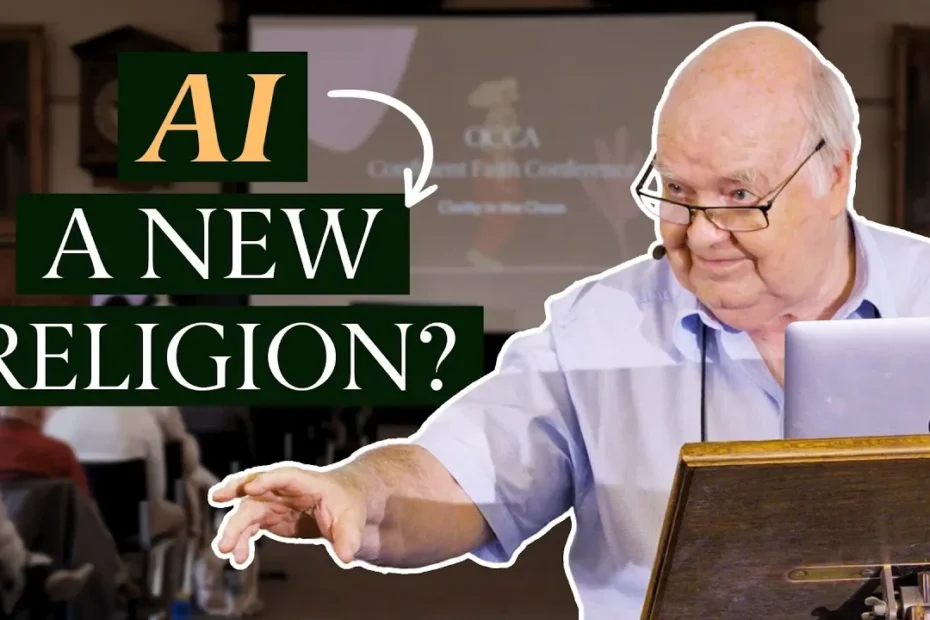
Read the full transcript of mathematician, bioethicist, and Christian apologist John Lennox’s lecture titled “Can We Survive AI? John Lennox on Deepfakes, Death, and the Divine Upgrade”, at Confident Faith Conference, 2024.
John Lennox: Good morning, ladies and gentlemen. I’m delighted you’ve come to hear a geriatric individual.
Living with AI Today
Can we live with AI? We’re already living with AI, with narrow AI. And a narrow AI system is a computer, a huge database, and an algorithm that picks out something from that database.
It simulates intelligence. It’s not really intelligent. And another important thing, it decouples intelligence from consciousness. The narrow AI we live with, with which we’re very familiar, digital assistance, online shopping, medicine, and I’d just point out it’s just been announced by Sam Altman, the CEO of OpenAI. He’s going to transform American Medicare by introducing personal chatbots, which sounds a very interesting potential for the future.
Autonomous vehicles and also a use of AI and facial recognition to pick out criminals from a crowd. All of these things we take upon ourselves voluntarily, but there are people who are forced to live with AI because the same facial recognition that’s used for picking out criminals in a crowd is being used to suppress minorities, in particular, the minority Muslim population of Uighurs in Xinjiang in Northwest China.
That intensive surveillance is intrusive to a colossal extent and is being exported all over China and possibly eventually to the West. Autonomous weapons we’re familiar with, and also the threat to democracy from deep fakes.
Ken McCallum, who’s the director general of MI5 in the UK, says the fabric of society could be undermined by AIs impersonating real people so that it would no longer be possible to distinguish truth from falsehood. Deep fake technology is a threat to democracy and could be harnessed by hostile states to sow confusion and disinformation at the next general election.
The Moral Problem of AI
And when we think of the existing AI, one of its leaders, Joshua Bendigo, wrote about the morality of AI systems. People need to understand that current AI and the AI we can foresee in the reasonable future does not and will not have a moral sense or moral understanding of what is right and what is wrong.
And when we think about the question what we can live with, my mind immediately goes back to two famous dystopias, George Orwell’s nineteen eighty four and Huxley’s Brave New World. And a brilliant analysis of those two books was given by Neil Postman, who said Orwell warns that we will be overcome by an externally imposed oppression.
But in Huxley’s vision, no big brother is required to deprive people of their autonomy, maturity, and history. People will come to love their oppression and to adore the technologies that undo their capacities to think. Orwell feared that what we hate will ruin us. Huxley feared that what we love will ruin us.
And at the present time, we are in a love hate relationship with our technologies. Both things appear to be happening on the grand scale simultaneously.
The Fundamental Questions
And some time ago, the brilliant entomologist wrote this, E.O. Wilson, the real problem of humanity is the following. We have paleolithic emotions, medieval institutions, and godlike technology, and it’s terrifically dangerous. Until we answer those huge questions of philosophy that the philosophers abandoned a couple of generations ago, Where do we come from? Who are we? Where are we going? Rationally, we are on very thin ground.
Those are the three big questions that the philosopher Immanuel Kant asked. E.O. Wilson is wrong, of course. There are many serious philosophers dealing with precisely those questions. Where do we come from? Who are we? And where are we going?
The Path to Artificial General Intelligence
And where we’re going in the opinion of some is towards artificial general intelligence or AGI, which involves building an AI system that equals or exceeds human capacities. In other words, constructing a super intelligence. So, we’re in the realm of transhumanism.
Now, if that were simply a statement coming from the science fiction area, we would probably all ignore it. But this kind of thinking is part and parcel of some of the statements of the most brilliant scientists on our planet.
One of them from this country is Lord Rees, the UK astronomer royal. He wrote, we can have zero confidence that the dominant intelligences a few centuries hence will have any emotional resonance with us, even though they may have an algorithmic understanding of the way we behaved.
The Spectrum of Expert Opinion
So if we ask the question, can we live with AI? You will find a whole palette of scenarios, all of them coming from highly intelligent people. So here’s a sample.
Stephen Hawking, the late brilliant genius from Cambridge. The real risk with AI isn’t malice, but competence. A super intelligent AI will be extremely good at accomplishing its goals, and if those goals aren’t aligned with ours, we’re in trouble.
Elisa Yudkovsky of the Machine Intelligence Research Institute, if somebody builds a too powerful AI under present conditions, I expect that every single member of the human species and all biological life on Earth dies shortly thereafter.
And that kind of view, which is at one extreme, has led to pressure from the Center for AI Safety to mitigate the risk of extinction. This, they write on their website, should be a global priority alongside other societal scale risks such as pandemics and nuclear war.
But on the other hand, there are highly intelligent voices saying something very different. Jobst Landgrebe and Barry Smith wrote a book Why Machines Will Never Rule the World Artificial Intelligence Without Fear. And they argue that just as physics shows the impossibility of constructing a perpetual motion machine, so the mathematics of complex systems show that it is not possible, nor will it be, to engineer AGI machines, even at the cognitive level of a crow, and that therefore the singularity will never happen.
I’m very sympathetic as a mathematician actually to that viewpoint, and it’s supported by one of the most brilliant mathematicians on the planet who lives in this city, Sir Roger Penrose.
Current Risks vs.
Future Fears
So, what some are saying, and this is the most famous scientific journal in the world, Nature, in June twenty twenty three, it’s time to talk about the known risks of AI. Forget machine doomsday. What’s needed is effective regulation to limit the societal harms artificial intelligence is already causing.
And I emphasize that statement because I think it’s one of the most important things for us to think about. Away from the hype of the apparent science fiction, we’ve already got so far that there are huge dangers to society.
And here is Nir Eiszikowitz in The Scientific American not long ago. AI won’t blow up the world, but the increasingly uncritical embrace of it in a variety of narrow contexts means the gradual erosion of some of humans’ most important skills. Algorithms are already undermining people’s capacity to make judgments, enjoy serendipitous encounters, and hone critical thinking.
The human species will survive such losses. Can we live with it? He thinks so. But our way of existing will be impoverished in the process.
The Challenge of Regulation and Control
So what’s to be done? Here’s Sam Altman again of OpenAI. Regulation will be critical and will take time to figure out. Although current generation AI tools aren’t very scary, I think we are not that far away from potentially scary ones.
And Stuart Russell, who gave the Reef lectures last year in Britain, a very famous pioneer in AI, he has several principles for living with AI. First of all, restrict an AI systems goals only to maximizing the realization of human goals. Secondly, keep the AI uncertain about what those goals are so that it must keep asking. Insist that the AI tries to understand the nature of those goals by constant observation of human behavior.
And there is a plethora of rules being rolled out from various sources because it’s quite obvious that the regulation problem is related to the control problem, and we can’t regulate what we can’t control. And some people are very worried about it.
The Omega Project Scenario
Now, another brilliant scientist, a brilliant physicist who’s involved in this raises this question. Are we really in an unavoidable battle with an AI monster to stay alive? Listen to much of the debate, and you could be forgiven for thinking so. Physics professor at MIT, I think, and he has written a book called Life three point zero.
And it’s really a fascinating book because what he does is project into the future the possible scenarios if we are to develop AGI, which in my and many other people’s minds is highly questionable. And he has a whole range of possible scenarios.
But the one he spends most time on, and it fascinated me when I read it, is the so called Omega Project in which a leader takes over the entire world so that there is a global government, an idea that has been suggested by many leaders in the past and is the aspiration of many leaders in the current world.
This great controlling power gets a hold of the economy of the world, and it does it this way. With the excuse of fighting crime and terrorism and rescuing people suffering medical emergencies, everybody could be required to wear a security bracelet that combines the functionality of an Apple Watch with continuous uploading of position, health status, and conversations overheard. Unauthorized attempts to remove or disable it would cause it to inject a lethal toxin into the forearm.
Biblical Parallels to Modern Scenarios
Now when I read that, it reminded me of a much more ancient scenario that occurs, believe it or not, in the book of Revelation because it also talks about a future world government. And you know, my argument is very simple. If we’re going to take seriously the kind of thing that people like Max Tegmark are saying about the future, I say, well look, before you reject it, listen carefully to what the book of Revelation and the biblical worldview has to say.
Now, I’m going to punch straight into this. And I saw a beast rising out of the sea with ten horns and seven heads, with ten diadems on its horns and blasphemous names on its head. And the whole earth marveled as they followed the beast. And they worshipped the dragon, a symbol for Satan, for he had given his authority to the beast, and they worshipped the beast saying, Who is like the beast and who can fight against it?
That is the wild monster from the sea, but there’s another one, a wild monster from the earth. Then I saw another beast or wild thing rising out of the earth. It had two horns like a lamb, and it spoke like a dragon. It exercises all the authority of the first beast in its presence and makes the earth and its inhabitants worship the first beast.
It deceives those who dwell on the earth telling them to make an image for the beast that was wounded by the sword and yet lived. And it was allowed to give breath to the image of the beast, so that the image might even speak and might cause those who would not worship the image of the beast to be slain.
Also, causes all to be marked on the right hand so that no one can buy or sell unless he has the mark that is the name of the beast or the number of its name.
The Reality Behind the Symbols
Beware of taking all of that simply as symbols because as C.S. Lewis pointed out long ago, symbols are used to represent realities. And the reality that stands behind us, I reckon, is explicitly in plain text told us in two Thessalonians where Paul writes this, for that day will not come unless the rebellion comes first and the man of lawlessness is revealed, the son of destruction who opposes and exalts himself against every so called God or object of worship so that he takes his seat in the temple of God proclaiming himself to be God.
Now Revelation is explicit that the number of the beast is the number of a human being. That is a terrifying thing about it. And here is Paul in plain text, no symbolism, telling us that there will arise a leader, a man of lawlessness. That is spiritual lawlessness. He opposes everything to do with God. He will be, of course, an extreme totalitarian dictator and allows himself to be worshipped.
Well think and put those things together. AI in the future creating a system of economic control that is individualized by a bracelet that can kill you. This is as near to that as it’s possible to get.
The Emergence of AI Worship
And if you think of the notion of worship that’s come up in all these contexts, the director of the Center for Professional and Applied Ethics in Montreal in Canada has written this recently, We are about to witness the birth of a new kind of religion. In the next few years or perhaps even months, we will see the emergence of sects devoted to the worship of artificial intelligence.
It’s already happening by the way. For certain AI systems are beginning to exhibit the kind of capacities usually ascribed to deity, such as immortality, omniscience, and omnipresence. These super AIs have prayer like connectivity via the internet, the oracle like capacity of chat GPT to answer virtually any question, produce life advice and even scriptures almost instantaneously, nor do they have needs or desires like humans, only electricity.
Now it seems to me we need to do a lot more thinking around this kind of thing. It is so close to what some of the best thinkers on the planet are projecting for AGI. So now is the time to drop our fear of investigating the book of Revelation and having a serious look at what the Bible says is going to happen.
Hope Beyond the Darkness
Now, this sounds grim. There’s no question about it. Can we live with it? Well, it’s clear that some people will have to live with it, but that’s not the end of the story. It is the end of the Omega Prometheus story, but the end of the biblical story is something much much bigger and better.
And then the lawless one will be revealed whom the Lord Jesus will kill with the breath of His mouth and bring to nothing by the appearance of his coming. The coming of the lawless one is by the activity of Satan with all power and false signs and wonders and deception. I mentioned earlier deep fakes and deception.
The Choice Before Us
The Lord warned His disciples twenty centuries ago that as we come nearer to His return, the biggest thing to watch out for is deceit, and it’s that that’s emphasized massively in the text in Thessalonians and in the book of Revelation.
Now, where does that leave us? Well, it leaves all of us to make a choice. Transhumanism, the fundamental idea is that humans become gods by trusting technology. And you notice that movement turning humans into gods, little g, super intelligent gods.
God Became Human
What is the answer to it? The answer to it is a movement in the reverse direction. The central message of the Christian faith is that God became human. And we need to take that seriously, because you see, we are humans of a certain kind, and the pressure is to continuously transform us by genetic engineering, by cybernetics and cyborg engineering, so that we become something super intelligent. But just a moment.
God has shown His approval of the human beings He created by Himself becoming one. We need to think about that, don’t we?
The Problem Already Solved
So that when people talk to me about their hope for AI, solving the problem of human death, which is one of the main propositions, and transforming the nature of human happiness, I smile and say, “You’re too late.” They say, “What do you mean? We haven’t even got there yet.”
Oh, I say, “You’re far too late. How’s that?” Because the problem of human death was solved twenty centuries ago when God raised Jesus Christ from the dead.
The Divine Upgrade
And secondly, you’re hoping to upload your brains onto silicon or something else so that you’re going to have eternal life. Oh, there’s something infinitely better than that, which I call the divine upgrade.
First stage of it is, “to as many as received Him, to them He gave the right to become children of God.” And the second stage, promised to those who receive Him, is that the trumpet will sound, that the dead will be raised imperishable, and we shall be changed. This mortal body must put on immortality.
And no matter what stage AI gets to in your lifetime, or your children’s lifetime, or your grandchildren’s lifetime or not, lift up our heads as Christians and reaffirm our faith that this world that throughout God’s son when he visited twenty centuries ago has not heard the last of him. And surely he that shall come will come and will receive all who trusted Him to Himself.
Thank you very much.
Related Posts