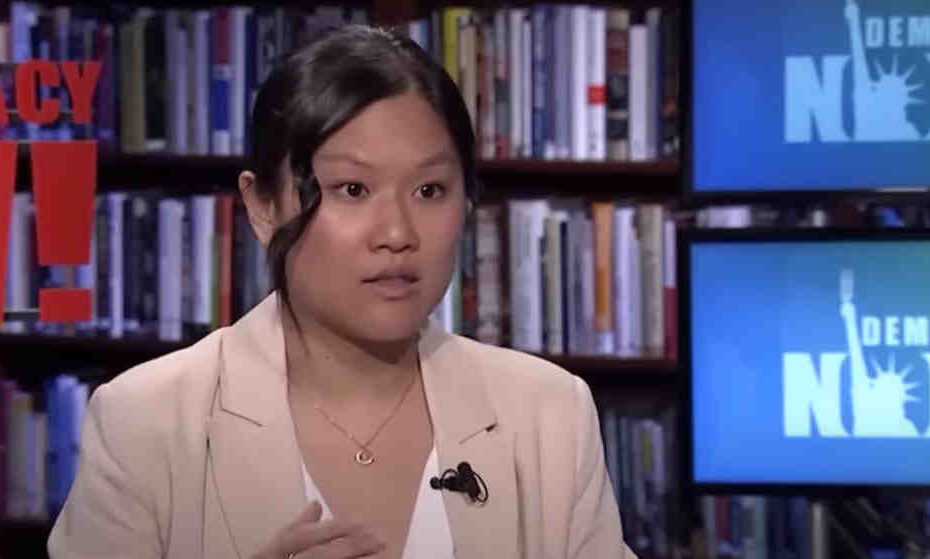
Read the full transcript of journalist Karen Hao’s interview on Democracy Now! with host Amy Goodman on “Sam Altman, OpenAI & the “Quasi-Religious” Push for Artificial Intelligence”, July 4, 2025. Karen Hao is the author of Empire of AI: Dreams and Nightmares in Sam Altman’s OpenAI.
AMY GOODMAN: This is Democracy Now!, democracynow.org, the War and Peace Report. I’m Amy Goodman. In this holiday special, we continue with the journalist Karen Hao, author of the new book “Empire of AI: Dreams and Nightmares in Sam Altman’s OpenAI.” She came into our studio in May. She talked about how AI will impact workers.
The Impact of AI on Jobs and Workers
KAREN HAO: One of the things that we have seen is this technology is already having a huge impact on jobs. Not necessarily because the technology itself is really capable of replacing jobs, but it is perceived as capable enough that executives are laying off workers.
We need some kind of more guardrails to actually prevent these companies from continuing to try and develop labor automating technologies and try to shift them to producing labor assistive technologies.
AMY GOODMAN: What do you mean?
KAREN HAO: So OpenAI, their definition of what they call artificial general intelligence is “highly autonomous systems that outperform humans in most economically valuable work.” So they explicitly state that they are trying to automate jobs away. I mean, what is economically valuable work but the things that people do to get paid?
But there’s this really great book called “Power and Progress” by MIT economists Daron Acemoglu and Simon Johnson who mention that technology development, all technology revolutions, they take a labor automating approach not because of inevitability, but because the people at the top choose to automate those jobs away. They choose to design the technology so that they can sell it to executives and say, “You can shrink your costs by laying off all these workers and using our AI services instead.”
But in the past we’ve seen studies that, for example, suggest that if you develop an AI tool that a doctor uses rather than replacing the doctor, you will actually get better health care for patients. You will get better cancer diagnoses. If you develop an AI tool that teachers can use rather than just an AI tutor that replaces the teacher, your kids will get better educational outcomes. And so that’s what I mean by labor assistive rather than labor automating.
Understanding AI Replacement
AMY GOODMAN: And explain what you mean, because I think a lot of people don’t even understand artificial intelligence. And when you say replace, what are you talking about?
KAREN HAO: Right? So these companies, they try to develop a technology that they position as an everything machine that can do anything. And so they will try to say, “You can use this, you can talk to ChatGPT for therapy.” No, you cannot. ChatGPT is not a licensed therapist.
And in fact, these models actually spew lots of medical misinformation. And there have been lots of examples of actually users being psychologically harmed by the model because the model will continue to reinforce self-harming behaviors. We’ve even had cases where children who speak to chatbots and develop huge emotional relationships with these chatbots have actually killed themselves after using these chatbot systems.
But that’s what I mean. When these companies are trying to develop labor automating tools, they’re positioning it as, “You can now hire this tool instead of hire a worker.”
Sam Altman and the Formation of OpenAI
AMY GOODMAN: So you’ve talked about Sam Altman, and in part one, we touched on who he is. But I’d like you to go more deeply into who Sam Altman is, how he exploded onto the US scene, testifying before Congress, actually warning about the dangers of AI. So that really protected him in a way. People seeing him as a prophet. That’s a P-R-O-P-H-E-T. But now we can talk about the other kind of prophet, P-R-O-F-I-T and how OpenAI was formed. How is OpenAI different from AI?
KAREN HAO: OpenAI is… I mean, it was originally founded as a nonprofit, as I mentioned, and Altman specifically, when he was thinking about, “How do I make a fundamental AI research lab that is going to make a big splash,” he chose to make it a nonprofit because he identified that if he could not compete on capital, and he was relatively late to the game, Google already had a monopoly on a lot of top AI research talent at the time.
If he could not compete on capital and he could not compete in terms of being a first mover, he needed some other kind of ingredient there to really recruit talent, recruit public goodwill, and establish a name for OpenAI. So he identified a mission. He identified, “Let me make this a nonprofit and let me give it a really compelling mission.”
So the mission of OpenAI is to ensure artificial general intelligence benefits all of humanity. And one of the quotes that I open my book with is this quote that Sam Altman cited himself in 2013 in his blog. He was an avid blogger back in the day, talking about his learnings on business and strategy and Silicon Valley startup life. And the quote is, “Successful people build companies, more successful people build countries. The most successful people build religions.” And then he reflects on that quote in his blog saying, “It appears to me that the best way to build a religion is actually to build a company.”
The Quasi-Religious Nature of AGI
AMY GOODMAN: And so talk about how Altman was then forced out of the company and then came back. And also, I just found it so fascinating that you were able to speak with so many OpenAI workers. You thought there was a kind of total ban.
KAREN HAO: Yeah, exactly. So I was the first journalist to profile OpenAI. I embedded within the company for three days in 2019, and then my profile published in 2020 for MIT Technology Review.
And at the time I identified in the profile this tension that I was seeing where it was a nonprofit by name, but behind the scenes, a lot of the public values that they espoused were actually the opposite of how they operated.
So they espoused transparency, but they were highly secretive. They espoused collaborativeness, they were highly competitive, and they espoused that they had no commercial intent. But in fact, it seemed like they had just gotten a billion dollar investment from Microsoft. It seemed like they were rapidly going to develop commercial intent. And so I wrote that into the profile and OpenAI was deeply unhappy about it and they refused to talk to me for three years.
And so when OpenAI took up this mission of artificial general intelligence, they were able to essentially shape and mold what they wanted this technology to be based on what is most convenient for them. But when they identified, it was at a time when scientists really looked down on this term, even AGI. And so they absorbed just a small group of self-identified AGI believers.
This is why I call it quasi-religious, because there’s no scientific evidence that we can actually develop AGI. The people who have this strong conviction that they will do it and that it’s going to happen soon, it is just purely based on belief and they talk about it as a belief too.
But there are two factions within this belief system of the AGI religion. There are people who think AGI is going to bring us to utopia, and there are people who think AGI is going to destroy all of humanity. Both of them believe that it is possible, it’s coming soon, and therefore they conclude that they need to be the ones to control the technology and not democratize it.
And this is ultimately what leads to your question of what happened when Sam Altman was fired and rehired. Through the history of OpenAI, there’s been a lot of clashing between the boomers and doomers about who should actually…
AMY GOODMAN: The boomers and doomers.
KAREN HAO: The boomers and the doomers, those that…
AMY GOODMAN: Say it’ll bring us utopia, the apocalypse.
KAREN HAO: Boomers and those that say it’ll destroy humanity, the doomers. And they have clashed relentlessly and aggressively about how quickly to build the technology, how quickly to release the technology.
The Stargate Project and Trump Administration
AMY GOODMAN: And I want to take this up until today. In January, the Trump administration announcing the Stargate project of 500 billion dollar project to boost AI infrastructure in the United States. This is OpenAI’s Sam Altman speaking alongside President Trump.
KAREN HAO: I think this will be the most important project of this era and as Masa said, for AGI to get built here to create hundreds of thousands of jobs, to create a new industry centered here. We wouldn’t be able to do this without you, Mr. President.
AMY GOODMAN: He also there referred to AGI, Artificial General Intelligence. Explain what happened here and what this is and has it actually happened.
KAREN HAO: So Altman, before Trump was elected, he already was sensing through observation that it was possible that the administration would shift and that he would need to start politicking quite heavily to ingratiate himself to a new administration. Altman is very strategic.
He was under a lot of pressure at the time as well, because his original co-founder, Elon Musk, now has great beef with him. Musk feels like Altman used his name and his money to set up OpenAI, and then he got nothing in return. So Musk had been suing him, still suing him, and suddenly became first buddy of the Trump administration.
So Altman basically cleverly orchestrated this announcement where, by the way, the announcement’s quite strange because President Trump is not… It’s not the US government giving 500 billion dollars. It’s private investment coming into the US from places like SoftBank, which is one of the largest investment funds run by Masayoshi Son, a Japanese businessman who made a lot of his wealth from the previous tech era. So it’s not the US Government that’s providing this money.
Global Expansion and Middle East Deals
AMY GOODMAN: And take that right through to now. That Gulf trip that Elon Musk was on, but so was Sam Altman. To the fury of Elon Musk. And then a deal was sealed in Abu Dhabi that didn’t include Elon Musk, but was about OpenAI.
KAREN HAO: Exactly. So Altman has continued to try and use the US Government as a way to get access to more places and more powerful spaces to build out this empire. And one of the things, because OpenAI’s computational infrastructure needs are so aggressive, I had an OpenAI employee tell me “We’re running out of land and power.”
So they are running out of resources in the US which is why they’re trying to get access to land and energy in other places. And the Middle East has a lot of land and has a lot of energy, and they’re willing to strike deals. And that is why Altman was part of that trip looking to strike a deal. And what they, the deal that they struck was to build a massive data center or multiple data centers in the Middle East using their land and their energy.
But one of the things that OpenAI has recently rolled out, they call it the “OpenAI for Countries” program. And it is this idea that they want to install OpenAI hardware and software in places around the world and explicitly says, “We want to build democratic AI rails. We want to install our hardware and software as a foundation of democratic AI globally so that we can stop China from installing authoritarian AI globally.”
The Reality of “Democratic AI”
But the thing that he does not acknowledge is that there is nothing democratic about what he’s doing. The Atlantic executive editor says we need to call these companies for what they are. They are techno-authoritarians. They do not ask the public for any perspective on how they develop the technology, what data they train the technology on, where they develop these data centers.
In fact, these data centers are often developed in the cover of night under shell companies like Meta recently entered New Mexico under the shell company named Greater Kudu LLC. And once the deal was actually closed and residents couldn’t do anything about it anymore, that’s when it was revealed. Surprise. We’re Meta, and you’re going to get a data center that drinks all of your fresh water.
AMY GOODMAN: And then there was this whole controversy in Memphis around a data center.
KAREN HAO: Yes. So that is the data center that Elon Musk is building. So meanwhile, Musk is saying, “Altman is terrible. Everyone should use my AI.” And of course, his AI is also being developed using the same environmental and public health costs.
So he built this massive supercomputer called Colossus in Memphis, Tennessee, that’s training Grok, the chatbot that people can access through X. And that is being powered by around 35 unlicensed methane gas turbines that are pumping thousands of tons of toxic air pollutants into the greater Memphis community. And that community has long suffered a lack of access to clean air, a fundamental human right.
Energy Solutions and Nuclear Power
AMY GOODMAN: So I want to go to, interestingly, Sam Altman testifying in front of Congress about solutions to the high energy consumption of artificial intelligence.
SAM ALTMAN: In the short term, I think this probably looks like more natural gas, although there are some applications where I think solar can really help. In the medium term, I hope it’s advanced nuclear fission and fusion. More energy is important well beyond AI.
AMY GOODMAN: So that’s OpenAI’s Sam Altman. This is testifying before the Senate and talking about everything from solar to nuclear power, something that was fought in the United States by environmental activists for decades. So you have these huge, huge old nuclear power plants, but many say you can’t make them safe, no matter how small and smart you make them.
The Climate and Nuclear Infrastructure Concerns
KAREN HAO: This is one of the things of the many things that I’m concerned about with the current trajectory of AI development, this is a second order, tertiary order effect. Because these companies are trying to claim that the AI development approach they took doesn’t have climate harms, they are explicitly evoking nuclear again and again and again as nuclear will solve and it has been effective.
I have talked with certain AI researchers who thought the problem was solved because of nuclear. And in order to try and actually build more and more nuclear plants, they are lobbying governments to try and unwind the regulatory structure around nuclear power plant building. I mean, this is like crazy on so many levels that they’re not just trying to develop these, the AI technology recklessly, they are also trying to lay down infrastructure and nuclear infrastructure in this move fast break things ideology.
AMY GOODMAN: But for those who are environmentalists and have long opposed nuclear, will they be sucked in by the solar alternative?
KAREN HAO: So data centers have to run 24/7 so they cannot actually run on just renewables. That is why the companies keep trying to evoke nuclear as the solve all. But solar does not actually work when we do not have sufficient enough energy storage solutions for that 24/7 operation.
China’s AI Innovation Under Constraints
AMY GOODMAN: We’re talking to Karen Hao, author of “Empire of AI: Dreams and Nightmares in Sam Altman’s OpenAI.” You mentioned earlier China. You live in Hong Kong. You’ve covered Chinese AI US AI for years. Explain what’s happening in China right now.
KAREN HAO: Yeah, so I have to sort of explain the dynamic between China and the U.S. first. So the U.S. China and the U.S. are the largest hubs for AI research. They are the largest concentration of AI research talent globally. China, other than Silicon Valley, China really is the only other rival in terms of talent density and the amount of capital investment and the amount of infrastructure that is going into AI development.
In the last few years, what we have seen is the US government has been aggressively trying to stay number one. And one of the mechanisms that they have used is export controls. A key input into these AI models is the computational infrastructure and the computer chips for installing into the data centers, for training these models. And these computer chips are in order to develop the AI models, companies are using the most bleeding edge computer chip technology. It’s like every two years a new chip comes out and they immediately start using that to train the next generation of AI models.
Those computer chips are designed by American companies, the most prominent one being Nvidia in California. And so the US government has been trying to use export controls to prevent Chinese companies from getting access to the most cutting edge computer chips that has all been under the recommendation of Silicon Valley, saying this is the way to prevent China from being number one and like, put export controls on them and don’t regulate us at all so we can stay number one and they will fall behind.
What has happened instead is because there is a strong base of talent of AI research talent in China. Under the constraints of fewer computational resources, Chinese companies have actually been able to innovate and develop the same level of AI model capabilities as American companies with two orders of magnitude less computational resources, less energy, less data.
So I’m talking specifically about the Chinese company High Flyer, which developed this model called DeepSeek, earlier this year that briefly tanked the global economy, because the company said that training this one AI model cost around $6 million when OpenAI was training models that cost hundreds of millions, if not over tens of billions of dollars. And that Delta demonstrated to people that this, what Silicon Valley has tried to convince everyone for the last few years, that this is the only path to getting more AI capabilities is totally false.
And actually the techniques that the Chinese company was using were ones that existed in the literature and just had to be assembled. They used a lot of engineering sophistication to do that, but they weren’t actually using fundamentally new techniques. They were ones that actually already existed.
Trump’s Impact on AI Talent and Brain Drain
AMY GOODMAN: So let me ask you something, Karen. The latest news as you’re traveling in the United States, before you go back to Hong Kong, of Trump’s attack on academia, how this fits in. How could Trump’s attack on international students specifically targeting the, what, more than 250,000, a quarter of a million Chinese students and revoking their visas, impact the future of the AI industry. But not just Chinese students. Because what’s going on here now is terrifying students around the world and because labs are shutting down in all kinds of ways here, US Students as well, deciding to go abroad.
KAREN HAO: This is just the latest action that the US Government has taken over the last few years to really alienate a key talent pool for US innovation. Originally, there were more Chinese researchers working in the US Contributing to US AI than there were in China, because just a few years ago, Chinese researchers aspired to work for American companies. They wanted to move to the U.S. they wanted to contribute to the U.S. economy. They didn’t want to go back to their home country.
But because of what was called the China Initiative, which was the first Trump era initiative to try and criminalize Chinese academics or ethnically Chinese academics, some of whom were actually Americans, based on just paperwork errors, they would accuse them of being spies, that was one of the first actions. Then, of course, the pandemic happened and the US China trade escalations started amplifying anti Chinese rhetoric. All of these led. And now with the potential ban on international students, all of these have led more and more Chinese researchers to just opt for staying at home and contributing to the Chinese AI ecosystem.
And this was a prerequisite to High Flyer pulling off Deepseek. If there had not been that concentration and buildup of AI Talent in China, they probably would have had a much harder time innovating around, circumventing these export controls that the US Government was imposing on them. But because they now have a high concentration of top talent, some of the top talent globally, when those restrictions were imposed, they were able to innovate around them. So Deep Seek is literally a product of this continuation of that alienation.
And with the US Continuing to take this stance, it is just going to get worse. And as you mentioned, it’s not just Chinese researchers. I literally just talked to a friend in academia that said she’s considering going to Europe now because she just cannot survive without that public funding. And European countries are seeing a critical opportunity offering million dollar packages. Come here, we’ll give you a lap. We’ll give you millions of dollars of funding. I mean, this is the fastest way to brain drain this country.
AMY GOODMAN: I mean, what many are saying, U.S.’s brain drain is their brain gain. And this also reminds us of history. You have the Chinese rocket scientist Qian Xue Sen, who in the 1950s was inexplicably held under house arrest for years. And then Eisenhower has him deported to China. He becomes the father of rocket science and China’s entry into space. And he said he would never again step foot into the United States, even though originally that was the only place he wanted to live.
KAREN HAO: Yes. And there was, I believe, a government official, a US Government official, who said that was the dumbest mistake the US Ever made.
Boomers, Doomers, and the AI Apocalypse Debate
AMY GOODMAN: We talk about the brain drain and the brain gain. Okay, again, some more rhyming. The doomers and the boomers. And I want to talk about what an AI apocalypse looks like, meaning how it brings us to apocalypse, but also how people say it could lead us to a utopia. What are the two tracks, trajectories?
KAREN HAO: It’s a great question. And I ask boomers and doomers this all the time. Can you articulate to me exactly how we get there? And the issue is that they cannot. And this is why I call it quasi religious. It really is based on belief.
I mean, I was talking with one researcher who identified as a boomer. And I said, you know, his eyes were wide and he really lit up saying, you know, once we get to AGI, game over. Everything becomes perfect. And I asked him, I was like, can you explain to me how does AGI feed people that haven’t don’t have food on the table right now? And he was like, oh, you’re talking about, like the floor floor and how to elevate their quality of life. And I was like, yes, because they are also part of all of humanity.
And he was like, I’m not really sure how that would happen, but I think it could help the middle class get more economic opportunity. And I was like, okay, but how does that happen as well? And he was like, well, once we have AGI and it can just create trillions of dollars of economic value, we can just give them cash payouts. And I was like, who’s giving them cash payouts? What institutions are giving them? You know, like, it doesn’t, when you actually test their logic, it doesn’t really hold.
And with the Doomers, I mean, it’s the same thing. Like, their belief is ultimately what I realized when reporting on the book is they believe AGI is possible because of their belief of how the human brain works. They believe human intelligence is inherently fully computational. So if you have enough data and you have enough computational resources, you will inevitably be able to recreate human intelligence. It’s just a matter of time.
And to them, the reason why that would lead to an apocalyptic scenario is humans. We learn and improve our intelligence through communication, and communication is inefficient. We miscommunicate all the time. And so for AI intelligences, they would be able to rapidly get smarter and smarter and smarter by having perfect communication with one another as digital intelligences.
And so many of these people who self identify as Doomers say there has never been in the history of the universe a species that was superior to another species, a species that was able to rule over a more superior species. So they think that ultimately AI will evolve into a higher species and then start ruling us and then maybe decide to get rid of us altogether.
Democratic AI Governance and Resource Control
AMY GOODMAN: As we begin to wrap up, I’m wondering if you can talk about any model of a country, not a company that is pioneering a way of democratically controlled artificial intelligence.
KAREN HAO: I don’t think it’s actively happening right now. The EU has had the EU AI act, which is their major piece of legislation, trying to develop a risk based, rights based framework for governing AI deployment. But to me, one of the keys of democratic AI governance is also democratically developing. And I don’t think any country is really doing that.
And what I mean by that is there are AI has a supply chain. It needs data, it needs land, it needs energy, it needs water. And it also needs spaces in which these companies need access to, to then deploy their technology. Schools, hospitals, government agencies. Silicon Valley has done a really good job over the last decade of making people feel that their collectively owned resources are Silicon Valley’s.
You know, I talk with friends all the time who say we don’t have data privacy anymore. So, like, what’s more. What’s. What is more data to these companies? Like, I’m fine just giving them all of my data, but that data is yours. You know, that intellectual property is the writers and artists intellectual property. That land is a community’s land. Those schools are the students and teachers schools. The hospitals are the doctors and nurses and patients hospitals.
These are all sites of democratic contestation in the development and the deployment of AI. And just like those Chilean water activists that we talked about who aggressively understood that that fresh water was theirs and they were not willing to give it up unless they got some kind of mutually beneficial agreement for it. We need to have that spirit in protecting our data, our land, our water and our schools, so that companies inevitably will have to adjust their approach because they will no longer get access to the resources they need or the spaces that they need to deploy in.
AMY GOODMAN: In 2022, Karen, you wrote a piece for MIT Technology Review headlined “A New Vision of Artificial Intelligence for the people.” In a remote rural town in New Zealand, an indigenous couple is challenging what AI could be and who it should serve. Who are they?
Community-Driven AI Development: The Maori Language Revival Project
KAREN HAO: This was a wonderful story that I did where the couple, they run Tahiku Media, it’s a non-profit Maori radio station in New Zealand. And the Maori people have suffered a lot of the same challenges as many indigenous peoples around the world. The history of colonization led them to rapidly lose their language. And there are very few Maori speakers in the world anymore.
And so in the last few years, there has been an attempt to revive the language. And the New Zealand government has tried to repent by trying to encourage the revival of that language. But this nonprofit radio station, they had all of this wonderful archival material, archival audio of their ancestors speaking the Maori language that they wanted to provide to Maori speakers, Maori learners around the world, as an educational resource.
The problem is, in order to do that, they needed to transcribe the audio so that Maori learners could actually listen, see what was being said, click on the words, understand the translation, and actually turn it into an active learning tool. But there were so few Maori speakers that can speak at that advanced level that they realized they had to turn to AI.
And this is a key part of my book’s argument – I’m not critiquing all AI development, I’m specifically critiquing the “scale at all cost” approach that Silicon Valley has taken. But there are many different kinds of beneficial AI models, including what they ended up doing.
A Different Approach to AI Development
So they took a fundamentally different approach. First and foremost, they asked their community, “Do we want this AI tool?” Once the community said yes, then they moved to the next step of asking people to fully consent to donating data for the training of this tool. They explained to the community what this data was for, how it would be used, how they would then guard that data and make sure that it wasn’t used for other purposes.
They collected around a couple hundred hours of audio data in just a few days because the community rallied support around this project. And only a couple hundred hours was enough to create a performance speech recognition model. Which is crazy when you think about the scales of data that these Silicon Valley companies require.
And that is once again a lesson that can be learned – actually there’s plenty of research that shows when you have highly curated small data sets, you can actually create very powerful AI models. And then once they had that tool, they were able to do exactly what they wanted to open source this educational resource to their community.
And so my vision for AI development in the future is to have more small task-specific AI models that are not trained on vast polluted data sets, but small curated data sets and therefore only need small amounts of computational power and can be deployed in challenges that we actually need to tackle for humanity. Mitigating climate change by integrating more renewable energy into the grid. Improving healthcare by doing more drug discovery.
The Horizontal Harm: AI’s Threat to Democracy
AMY GOODMAN: So as we finally do wrap up, what you were most shocked by – you’ve been doing this journalism, this research, for years. What you were most shocked by in writing “Empire of AI”?
KAREN HAO: I originally thought that I was going to write a book focused on vertical harms of the AI supply chain. Here’s how labor exploitation happens in the AI industry, here’s how the environmental harms are arising out of the AI industry. And at the end of my reporting, I realized that there is a horizontal harm that’s happening here.
Every single community that I spoke to, whether it was artists having their intellectual property taken or Chilean water activists having their fresh water taken, they all said that when they encountered the empire, they initially felt exactly the same way. A complete loss of agency to self-determine their future.
And that is when I realized the horizontal harm here is AI is threatening democracy. If the majority of the world is going to feel this loss of agency over self-determining their future, democracy cannot survive. And again, specifically, Silicon Valley’s approach – “scale at all costs” AI development.
Resistance and Reclaiming Agency
AMY GOODMAN: But you also chronicle the resistance. You talk about how the Chilean water actors felt at first, how the artists feel at first.
KAREN HAO: Yes.
AMY GOODMAN: So talk about the strategies that these people have employed and if they’ve been effective.
KAREN HAO: So the amazing thing is that there has since been so much pushback. The artists have then said, “Wait a minute, we can sue these companies.” The Chilean water activists said, “Wait a minute, we can fight back and protect these water resources.” The Kenyan workers that I spoke to who were contracted by OpenAI, they said, “We can unionize and escalate our story to international media attention.”
And so even when I thought that these communities – you could argue, are the most vulnerable in the world, have the least amount of agency – they were the ones that remembered that they do have agency and that they can seize that agency and fight back. And I think it was remarkably heartening to encounter those people, to remind me that actually the first step to reclaiming democracy is remembering that no one can take your agency away.
AMY GOODMAN: Karen Hao, author of the new book “Empire of AI: Dreams and Nightmares in Sam Altman’s OpenAI.” Go to democracynow.org to see the full interview. And that does it for this special broadcast. I’m Amy Goodman. Thanks so much for joining us.
Related Posts