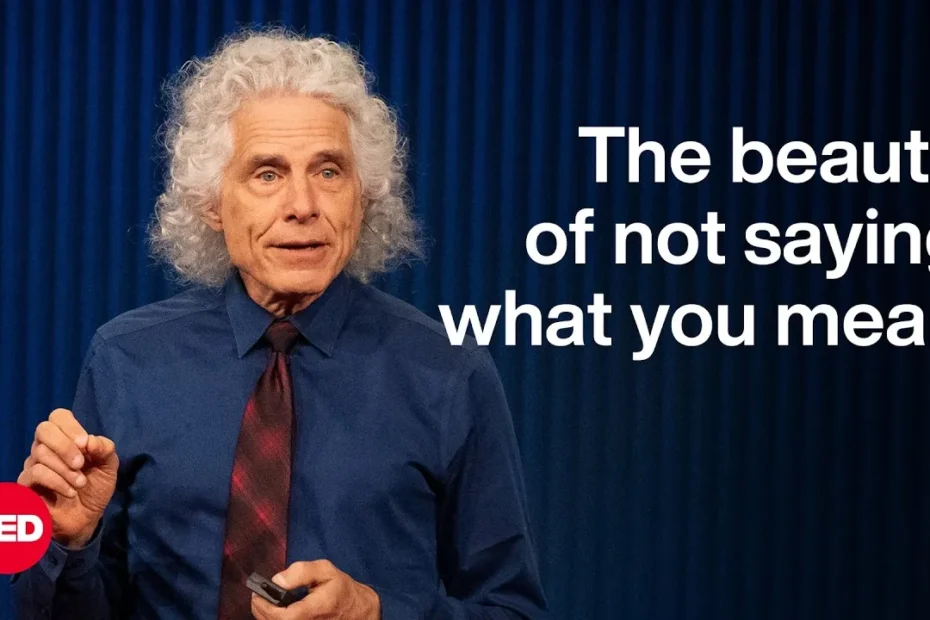
Read the full transcript of experimental cognitive scientist Steven Pinker’s talk titled “How Common Knowledge Shapes the World” at TED2025 on April 8, 2025.
The Emperor’s New Clothes: A Lesson in Common Knowledge
Steven Pinker: When Little Boy said the Emperor was naked, he wasn’t telling them anything they didn’t already know, but he added to their knowledge nonetheless. By blurting out what everyone could see with an earshot of the others, he ensured that everyone else knew what they knew, that everyone knew that, and so on. And that changed their relationship with the Emperor from obsequious deference to ridicule and scorn.
Hans Christian Andersen’s immortal story draws on a momentous logical distinction. With private knowledge, I know something and you know it. With common knowledge, I know that fact and you know it, but in addition, I know that you know it, and you know that I know it, and I know that you know that I know it, add into an item.
The Coordination Problem
Of course, the reason that common knowledge is significant is that it is essential for coordination. In a classic example from Thomas Schelling, a couple is separated in Manhattan, incommunicado, and somehow must find each other. Well, he knows that she likes to browse the aisles of a certain bookstore, so he heads there, but then he realizes that she knows that he likes to hang out in a certain camera store, so he changes course, until he figures that she will anticipate that he will guess that she will opt for the bookstore, so he does another about-face, only for it to dawn on him that it will occur to her that he knows that she is aware that he likes to haunt the bookstore, so he pirouettes once again. Meanwhile, she is whipsawed by the same futile empathy. Nothing short of common knowledge can guarantee that they will end up at the same place at the same time.
Of course, no one can think an infinite Russian doll of I-know-that-she-knows-that-I-know-that-she-knows thoughts. Our heads start to spin with three or four layers, let alone an infinite number. In a well-known episode of Friends, Phoebe says to Rachel, “They don’t know we know, they know we know. Joey, you can’t say anything.” And he replies, “I couldn’t even if I wanted to.”
Instead, common knowledge can be captured in a simple mental intuition that something is public or conspicuous or out there, and that can be conveyed by direct speech, in the case of our separated couple, a cell phone call. Indeed, solving coordination dilemmas may be the reason that language evolved in our species in the first place.
Focal Points and Conventions
In the absence of a public event, the next best thing is conspicuous salience, or a focal point. Schelling suggests that our couple might gravitate toward the big clock in Grand Central Station even if it wasn’t particularly close to the point at which they had been separated, simply because each might anticipate that it would pop into the mind of the other.
A third solution is a convention, a tacit agreement to do something in a certain way for no other reason than they have agreed to do it that way, which is reason enough. Our separated couple might agree that should they ever be separated in the future, they will adopt the convention of chivalry and go to the bookstore, or patriarchy and go to the camera store, or whimsy and go to a lost and found in a department store, or fairness and take turns or flip coins.
At larger scales, common salience or focal points and conventions drive a lot of our legal and financial coordination. An everyday example is driving on the left, or on the right. It doesn’t matter as long as everyone agrees to drive on the same side, as in the joke about the woman who calls her husband during his morning commute and says, “Be careful honey, the radio says that there’s a maniac driving on the wrong side of the freeway.” He says, “One maniac, there are hundreds of them.”
Another everyday example is money. I accept a piece of paper in exchange for an old chair, because I know that my grocer will accept it in exchange for some groceries, because he knows his supplier will accept it, and so on.
The Power of Public Protest
Now, not all the examples are this obvious. Why are autocrats terrified of public protest? Well, the basic reason was explained by Gandhi in the eponymous movie, when he said, “100,000 Englishmen cannot control 350 million Indians if the Indians refuse to cooperate.” The problem is that the Indians can’t refuse to cooperate if each one fears that no one will join him. In a public demonstration, each protester can see the other protesters see the other protesters, and this common knowledge allows them to coordinate their resistance, whether by literally storming the palace or by bringing the apparatus of the state to a halt through boycotts and work stoppages.
This is the basis for a joke from the old Soviet Union, in which a man in Red Square is handing out leaflets to passers-by. Soon enough, the KGB arrests him, only to discover that the leaflets are blank sheets of paper. They say, “What is the meaning of this?” And the man says, “What’s there to say, it’s so obvious.” The point of the joke is that the man was generating subversive common knowledge. In a case of life imitating a joke, in recent years Russian police have arrested several people for holding blank signs.
Financial Markets and the Beauty Contest
Another non-obvious example comes from the world of investing. John Maynard Keynes compared speculative investing to a newspaper beauty contest, in which the winner is not the woman with the prettiest face, but the contestant who chooses the face that is chosen by the greatest number of other contestants, each of whom is anticipating the choices of other contestants, and so on.
This can set off cycles of exuberant recursive mentalizing, as investors desperately search for focal points, each one buying an investment not because of its inherent productive value, but because they hope to unload it at a profit on future investors, greater fools.
This can set everyone off in search of conspicuous focal points, such as Super Bowl ads. Everyone knows that everyone watches the Super Bowl. In 2022, cryptocurrency exchanges ran high-concept ads in which they tried to gin up a common expectation of rising prices, not by touting any of the advantages of cryptocurrency, but by warning, “Don’t be like Larry, don’t miss out.”
Now, of course, it’s only so long that an asset can levitate in mid-air, suspended by nothing but common expectation. Bubbles pop when the market runs out of greater fools who don’t want to miss out on the next best thing, or when the doubt itself becomes common knowledge. This can send investors running to the exit, each desperate to sell a security out of fear that everyone else is desperate to sell it. The result can be a bank run, or hyperinflation, or a Great Depression.
When Franklin Delano Roosevelt said, “The only thing we have to fear is fear itself,” it was not a feel-good bromide, but a theorem of common knowledge.
The Art of Financial Communication
With investors constantly on the lookout for focal points, financial leaders have to be wordsmiths, mystics, and occasionally comedians. Alan Greenspan once said, “Since I’ve become a central banker, I’ve learned to mumble with great incoherence. If I seem unduly clear to you, you must have misunderstood what I said.” After Jimmy Carter told his inflation czar, Alfred Kahn, never to use the self-fulfilling word depression, he said, “OK, but we’re in danger of having the biggest banana in 45 years.”
Common Knowledge in Social Relationships
My own interest in common knowledge comes from its role in social relationships. A relationship is a coordination game. Two people are friends, or lovers, or allies, or dominant and subordinate, or transaction partners, because each one knows the other one knows that they are. And this common knowledge can be cemented by a number of common knowledge-generating signals, like eye contact, where you’re looking at the part of the person that’s looking at the part of you that’s looking at that part of them. Or blushing, where you feel the heat of the reddening of your cheeks from the inside, knowing that other people can see it from the outside. Or laughter, where an unignorable noise can expose the common assumptions among everyone who gets the joke.
Conversely, when we worry about upending a relationship, we might go to great lengths to repress common knowledge. We might avoid looking someone in the eye, or pretend to ignore the elephant in the room, or mumble with great incoherence. This is why in everyday conversation, we often don’t blurt out what we mean in so many words, but veil our intentions in innuendo and euphemism, counting on our listeners to catch our drift.
A classic example is the sexual come-on, “Would You Like to Come Up and See My Etchings?”, which by the 1930s was so familiar that James Thurber could draw a cartoon in which the hapless man says to
his date, “You wait here and I’ll bring the etchings down.” A century later, etchings has become Netflix and chill. We also veil our bribes, as in “G-Officer, is there some way we might settle the ticket here?” And our threats, as in, “I’m so delighted to learn that you’re on the jury of the Soprano trial. It’s an important civic duty that we should all take part in. You’ve got a wife and kids. We know you’ll do the right thing.”
The point of innuendo is not plausible deniability, because these euphemisms don’t pass the giggle test, but rather deniability of common knowledge. If Harry says to Sally, “I want to come up for Netflix and chill,” and Sally turns him down, well, Sally knows she’s turned down a sexual overture, and Harry knows that Sally has turned down a sexual overture. But does Sally know that Harry knows? She could think, maybe he thinks I’m naive. And does Harry know that Sally knows that Harry knows? She could think, maybe she thinks I’m dense.
Without the common knowledge, they can maintain the fiction of a platonic relationship. But if Harry were to have said, “want to come up and have sex,” and Sally said no, well, now Harry knows that Sally knows that Harry knows that Sally knows. With this common knowledge, they can no longer maintain the fiction of a platonic friendship. And that’s what lies behind the intuition that with barefaced speech, you can’t take it back. It’s out there.
Social Relationships and Necessary Fictions
The logic of common knowledge and social relationships explains why we all deplore the hypocrisy and white lies and role-playing of everyday social interaction, but we wouldn’t want to live without them, as dystopian comedies like Liar Liar play out. Our relationships are underpinned by a common understanding of limitless loyalty and generosity. Privately, we know they’re fictions, but making these rude realities common knowledge would pollute the pool of common assumptions that allow us to get along.
The Power of Social Norms
We also have to get along in less intimate relationships, and in those cases we rely on norms—ways of living together that aren’t written down by lawgivers or enforced by the police, but exist because everyone knows they exist. In social life, basic stability depends on norms such as that you don’t brazenly lie, you don’t insult people to their faces, you don’t prosecute personal vendettas.
In the Antarctic global arena, peace depends on norms such as that nation-states are immortal, national borders are grandfathered in, conquest is unacceptable, and nuclear weapons are unthinkable. These norms are propped up by nothing but common acceptance, and so they’re vulnerable to imploding if they are overtly flouted, or even if there is loose talk about flouting them.
Conclusion
I hope that, having explained the logic behind human harmony, I don’t have to explain how these norms are currently under threat, or what is at stake if we lose them. As a man once said, “what’s there to say is so obvious.” Thank you.
Related Posts