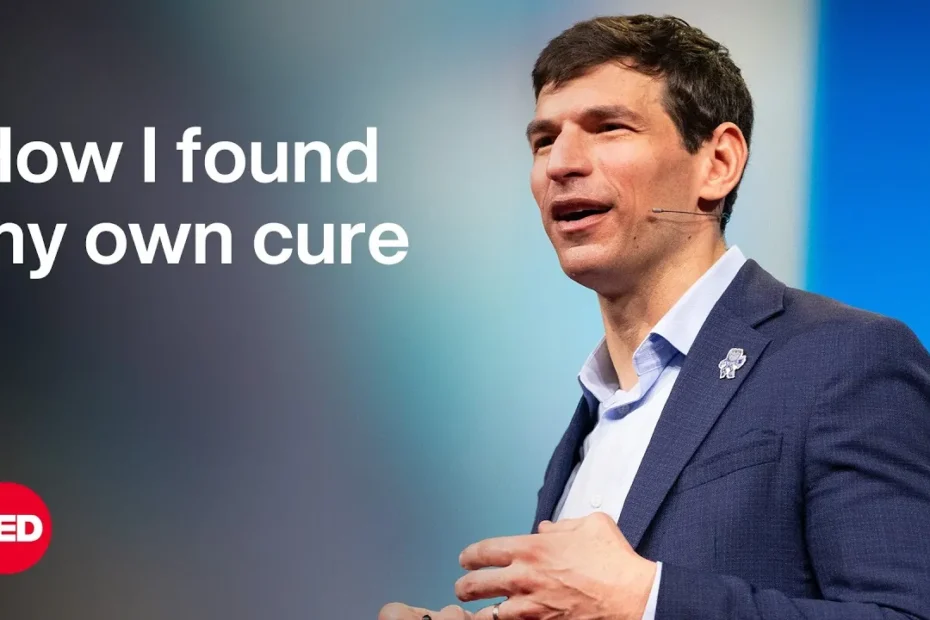
Read the full transcript of physician-scientist David Fajgenbaum’s talk titled “How Nearly Dying Helped Me Discover My Own Cure (and Many More)”, recorded at TED2025 on April 10, 2025.
Listen to the audio version here:
From Death’s Door to Medical Discovery
DAVID FAJGENBAUM: Hi, I’m David Fajgenbaum and this is me in 2010 when all of my organs were shutting down and I was dying for the first time. My doctors came in the room and told me, “David, we’ve tried everything, there’s nothing more we can do.”
But I was so sick, I didn’t really know what my doctors meant until my family came in the room and started hugging me goodbye and a priest read me my last rites. I was 25 years old, a former college quarterback, and a medical student who had dedicated my life to becoming a doctor after my mom died from cancer, and yet here I was literally dying from a disease that I’d never even heard about during medical school called Castleman disease, where your immune system attacks and shuts down your vital organs for an unknown cause.
There were no approved treatments and no cures. But in a desperate effort to save me, my doctors gave me a combination of seven chemotherapies that weren’t meant for my disease. Amazingly, they worked, I survived, I returned to medical school, and I got what I think might be the worst before and after picture of all time.
But then I relapsed again and again. Five times in three years I almost died from my disease. I’ll never forget during my third relapse when I was laying in my hospital bed with my girlfriend Caitlin and my family around me. My gown was drenched in tears. Not just because I was dying, but because of all the things that I would miss out on. The family that I’d never have with Caitlin, the patients that I’d never treat, the cures that I’d never discover in memory of my mom.
Turning Hope Into Action
See, until then I’d been waiting and hoping that some researcher somewhere would discover a treatment that could save my life, but in that moment I realized that hope alone is not enough. If I wanted any chance of survival, I would need to turn my hope into action to try to find a treatment to save my life.
There was just one really big problem. I didn’t have 15 years and a billion dollars to develop a new drug from scratch. The good news is, is that those seven chemotherapies that had saved my life, they weren’t made for my disease. So I thought to myself, maybe there’s another drug made for another disease that could also be repurposed for me.
The Power of Drug Repurposing
This concept of repurposing isn’t new. You’ve probably all heard of Viagra before, right? Well, you may know that Viagra was repurposed from heart disease to its well-known use. But as you know, it’s also now utilized for a rare pediatric lung disease. And thalidomide, which is known for causing horrible birth defects, is now utilized for leprosy and the cancer multiple myeloma.
Now repurposing works because though diseases like leprosy and myeloma may appear very different, they can actually share the same underlying problems or mechanisms in the body and can therefore be treated with the same drug. And amazingly, doctors can prescribe any FDA-approved drug for any disease where they believe the benefit outweighs the risk through something called off-label prescribing. And off-label prescribing is actually very common. In fact, one in four prescriptions written every single day in the U.S. is off-label.
My Personal Breakthrough
So I began to study my own blood in the lab to try to find a repurposed drug for me. I discovered that a communication line in my immune system was turned into overdrive and that a decades-old transplant drug might be able to turn it off. It had never been used before for my disease, but I was out of options. So I began to test it on myself.
In the three years before I started sirolimus, I nearly died five times. But since starting it, I’ve been in remission for over 11 years. Oh, thank you. Thank you.
During this remission, I married Caitlin, who’s here with us today. We had two amazing children. I wrote a book about my journey, “Chasing My Cure,” which is being turned into a film. And I joined the faculty at the University of Pennsylvania to continue to chase cures for rare inflammatory diseases and cancers.
And then in 2022, I co-founded Every Cure, a nonprofit organization that’s on a mission to unlock the full potential of each and every drug to treat each and every disease that it possibly can. Over these years, we’ve advanced 14 repurposed treatments for multiple diseases, saving thousands of lives, like Kyla, who began her freshman year of nursing school after we repurposed a bone marrow cancer drug to save her life, which is now being studied in clinical trials.
And Michael, who walked his son down the aisle on his wedding day after we repurposed a melanoma drug to treat his rare cancer, which is now being used all over the world for that rare cancer.
With every one of these discoveries, all I can think about is how many more life-saving drugs are sitting at our local pharmacies that could be life-saving for patients with diseases today. Because, see, us humans, we’ve developed 4,000 drugs for about 4,000 diseases. But there are over 14,000 diseases that don’t have a single approved therapy. That means that 1 in 10 of us and our kids will develop a rare disease without any approved treatments. And many more of us will develop diseases with limited treatment options.
We know that many of these FDA-approved drugs could treat many more of these diseases, and for less than 1% of the cost of new drug development, and way faster.
So why aren’t we repurposing drugs? Well, the short answer is that it’s just not profitable to pursue a new use for an existing medicine, especially for a rare disease and the 80% of drugs that are already generic. It just costs too much to do the clinical trials, and companies can’t expect to make back the cost in sales. Instead, we focus on new drugs for profitable diseases, and no one, not the NIH, not the FDA, not pharma, no one has taken responsibility for systematically unlocking these hidden cures. Until now.
Using AI to Find Hidden Cures
We’re utilizing artificial intelligence to scan across the world’s knowledge of all 4,000 drugs and all 18,000 diseases to find the most promising opportunities to save and improve lives. You can think about it a bit like Netflix, which uses data on the actors, the directors, and the movies that you watch, and the interconnectedness between them to predict which movies you might like to watch in the future.
Well, we do something similar, but instead we use the world’s knowledge of all approved drugs and all diseases and the connectedness between them to predict which drugs might be useful in new ways, much faster than any team of humans ever could. And then we use artificial intelligence to look across the millions of drug disease matches to identify the best opportunities to reduce suffering and have the greatest impact possible.
Then we take those specific programs forward. We study them in the laboratory, in clinical trials, and sometimes we go right to spotlighting them because the work has already been done to prove that they’re effective.
Now when we first were dreaming about creating Every Cure, my co-founders, Grant Mitchell, Tracy Sikora, and I, we knew all of this was possible in theory, but we didn’t really know how we were going to turn it into reality or how we were going to fund it. Clinical trials are not cheap.
But then I got an email actually from a member of the TED community telling me about something called the Audacious Project, which selects 10 nonprofits every year solving the world’s biggest challenges. And just knowing that Audacious existed and knowing that this community here was supporting this kind of work, it gave us the courage to really take this leap and to start this organization.
We got started and then we applied for funding and we were so hopeful we would get it and then we weren’t selected. But then we applied again and just a few months ago we received this really transformative funding. Thank you all so much, truly, thank you.
Between this funding from the Audacious Project and also from a federal agency in the U.S. called ARPA-H, we are building an AI-powered engine to repurpose 15 to 25 treatments by 2030 and with additional funding to be able to repurpose dozens and even hundreds more treatments.
Already Saving Lives
Now we’ve only been running our full pipeline for a few months, but we’re already helping patients. The very first time we used a high-scoring drug from our algorithm was for a patient with Castleman disease, the disease that I have, but unfortunately the treatments we discovered for me weren’t working for this patient.
He was getting ready to say goodbye to his wife and his daughter because he was getting ready to be transferred to hospice care. We recommended this number one drug from our platform and amazingly it saved his life. He’s been in remission now for over two years. Thank you.
Now this is an example where we discovered a repurposed treatment, but sometimes we actually uncover matches that already exist, they’re just not being utilized.
Discovering Hidden Treatments Through Research
For example, one day I was reviewing through the results of our platform and I came across Leucovorin, this cheap vitamin derivative where there was data to suggest that it could help to improve speech in a subgroup of patients who have antibodies against the folate receptors, so therefore they don’t get folate into their brain. I was so amazed to learn about the work being done by Richard Frye. He had done the first of three randomized controlled trials that showed a benefit for this medicine in this subgroup of patients.
And I learned about Mason, photographed here, who was nonverbal for three years and within three days of starting Leucovorin began to say his first words. And then, yes, it’s incredible. And then Ryan, photographed here on the right, was basically nonverbal for five years and had never shared a complete thought or feeling with his parents and was told by doctors that he probably would never share a feeling with them. Within two weeks of starting Leucovorin, he turned to his dad when he was leaving for work and said, “Daddy, I love you.” It’s just incredible. It’s just incredible.
What’s also incredible is that there’s a blood test that can help to identify kids like Mason and Ryan that is available to help to find these patients and it’s still barely being utilized. This is why we started EveryCure, to unlock these hidden treatments and make sure they reach every patient they can possibly benefit.
Joseph’s Story: A Life-Saving Discovery
Like we did for Joseph, who was dying from POEMS syndrome, which is a rare cancer, and on his 30th birthday was saying goodbye to his girlfriend, Tara, because his doctor had tried everything that he thought was possible. We recommended three drugs that are commonly used for multiple myeloma, which is similar to POEMS syndrome, in a last-ditch effort to save him. And amazingly, they worked. Instead of planning Joseph’s funeral service, Joseph and Tara planned their wedding day and Joseph’s here with us today from Seattle. Joseph, I’m so glad you’re here. Woo! Woo! I’m so glad you’re here, Joseph, in so many ways.
How many of us have sat with someone we loved, like Caitlin did, and like Tara did, and like Mason’s parents did, and heard the words, “We’ve tried everything, there’s nothing more we can do?” What if we haven’t tried everything? What if there’s a solution out there for them and thousands, maybe even millions more over diseased, and what if we all came together to find these solutions? Because we can’t do it alone and we need your help.
Please join us to unlock every cure so that no patient suffers when there’s a life-saving cure sitting on the pharmacy shelf, and instead of hearing “We’ve tried everything,” they can hear “We have something.” Thank you all so, so much. Thank you.
The Pharmaceutical Reality
“David, this feels miraculous. Like, you’re telling me that there are dying people waiting for a drug to be discovered, but actually they can just go down to their corner pharmacy and there might be a cure for them at an affordable price?”
“That’s right. It’s like too good to be true.”
“That’s right. Well, it is, except for the fact that it’s just not profitable to do this. So that’s why it exists. These opportunities that are there, we can help a lot of people, but in the current system there’s just no incentives to do it.”
“One of the other interesting things to me, I studied the history of medicine, and what’s so interesting is, for a lot of history, medicines were cure-alls, right? Like the 19th century patent medicine that was for your indigestion and your infertility and your da-da-da-da-da. And then so much of modern medicine was evidence-based, targeted, laser-focused therapies. And it’s almost like you’re saying, no, no, no, no, we need to broaden it out again.”
“That’s exactly right. In fact, companies will oftentimes consider 15, 20, or even 30 diseases for a given drug, but they have to pick the one or two to focus on. And oftentimes those dozens of opportunities just sort of get lost. And so we’re trying to uncover them, trying to find what’s really been falling through the cracks.”
“What can ordinary people do to help?”
“Well, the first thing is that we really want you guys to all be a part of the solution. So if you’ve ever received a drug that was repurposed for your disease, received a drug off-label, tell us about it. Go to everycure.org slash ideas. And we also, as I mentioned earlier, these trials are very expensive. So donating to us at everycure.org slash donate. And of course, raising awareness. Part of this is running campaigns to get the word out about these treatments.”
So if you see us sharing about treatments that can help patients, please, please help to amplify that. Thank you so much, David Fajgenbaum.