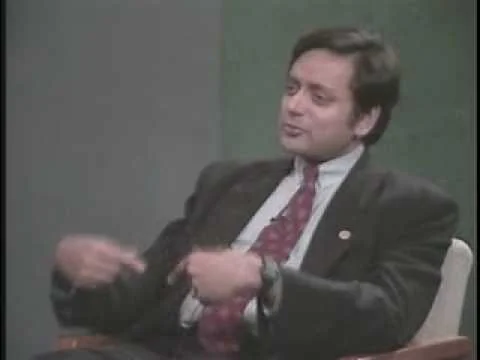
Read the full transcript of UC Berkeley’s Harry Kreisler in conversation with author and diplomat Shashi Tharoor, (5/2000) on: Writing, Diplomacy, and the United Nations.
Welcome and Introduction
HARRY KREISLER: From the University of California at Berkeley, welcome to a conversation with history. I’m Harry Kreisler of the Institute of International Studies. Our distinguished guest is Shashi Tharoor, who is Director of Communications and Special Projects for the Secretary General of the United Nations. He was formerly his executive assistant. Mr. Tharoor has served in the UN since 1978, including tenure as head of the Singapore office of the UN High Commissioner for Refugees.
He is one of India’s leading writers of both fiction and nonfiction. His works run the gamut from history to satire. And rich in the traditions and cultures of his native land, his works grapple with the realities and ideals of modern India. Dr. Tharoor, welcome to Berkeley.
SHASHI THAROOR: Thank you, Harry. Good to be here.
Educational Background
HARRY KREISLER: Tell us about your education.
SHASHI THAROOR: Education? Well, it was all sort of rather hasty, I suppose. I raced through school and college. I finished a PhD at 22, which looking back, made for a somewhat hectic adolescence. But I went to school in Bombay. Initially there was a brief, abortive and not very happy year in a boarding school in South India. High school in Calcutta, College in Delhi. It’s St. Stephen’s College, which is a fairly elite college known for its strength in liberal arts.
I spent, I must confess, more time pursuing other activities than in the classroom. But it was an interesting experience. Came to the Fletcher School of Law and Diplomacy at Tufts. Degree certificates, they both Tufts and Harvard. And it’s an autonomous school. At least it was in those days which I did an MA and MALD, a Master of Arts in Law and Diplomacy and a PhD.
My undergraduate degree in Delhi was in history. I have an honors degree in history and my graduate work was in international affairs, international politics. My PhD thesis was more on the workings of the way in which Indian foreign policy was made during Indira Gandhi’s first administration, 1966 to 1977.
I was very lucky in that I was doing my field research just after the government fell and everybody from the former Prime Minister, Mrs. Gandhi herself, to all her foreign ministers who all happened to be alive, was willing to talk. So it was a thesis that became then published as a book, “Reasons of State.” But in a larger sense, I suppose my education’s still going on. I’m learning as much as I can from the mere process of living.
Influential Teachers
HARRY KREISLER: Who were your influential teachers?
SHASHI THAROOR: Well, there were a number of them. I should have mentioned that the schools I went to had an interesting thing in common. They were all Jesuit schools. The Jesuits have developed an interesting vocation for educating the privileged of the Third World. And I don’t mean that in a disparaging way. I just mean that because they have these excellent schools in the English language in countries like India, they tend to attract members of the Indian urban educated professional classes and their children.
And while there were in fact some relatively less well off children, we didn’t actually have a great cross section of Indian society. What we had was the urban elite. But having said that, the schools are very good, both of them. The school in Calcutta, St. Xavier’s was unquestionably in my day, the best school in the city, particularly in terms of its intellectual rigor.
And I and a couple of my other friends in school came out with the highest possible grades in the school system in the state, largely because of the quality of the teaching. I don’t want to rattle off names that will mean nothing to those who log in here, but a number of the priests at these schools are very well trained themselves.
I remember a young father who actually took us through an epistemological argument for the existence of God, which certainly impressed my 14-year-old imagination no end because I was just beginning to flirt with the ideas of atheism. When you discover rationality, religion suddenly doesn’t seem so impressive anymore. And when you discover the limitations of rationality, it all comes back. But in between I had this very rational, structured philosophical argument from a Jesuit priest and that was very striking.
College in Delhi, St. Stephen’s is an Anglican college, not a Jesuit one, a different culture. And the teachers were largely laypeople, in fact, overwhelmingly people. And there too there were some remarkable people. I remember a history teacher called David Baker, who was actually an Australian who had renounced Australia and come and settled in India, and was an authority on modern Indian history, particularly in the central Indian state.
But because one man had the misfortune of being white, he was obliged to teach British history, which he detested. But in the process I learned a great deal from him. And there were a few other teachers too who made an indelible mark on the process of intellectual formation that college is all about.
At Fletcher we had some very impressive professors as well, some of whom are sadly no longer alive, ranging from John Roche, who’d been National Security Advisor to Lyndon Johnson and who had been called by the New York Times his “hard-boiled egghead.” And he certainly was both hard-boiled and extremely rich in his intellectual range, to my tutor, Alan Henriksen, sort of one of the finest minds in diplomatic history you can find in this country, and many others whom I again wouldn’t want to name extensively, but I think I’ve been privileged with the quality of the education I’ve had at all these stages.
Parental Influence
HARRY KREISLER: And what stands out in the way your parents helped shape your character?
SHASHI THAROOR: Well, my parents were astonishing for Indian parents and for fairly traditional Indian parents in other ways, in the amount of freedom they left me.
But my parents had the typical Indian middle class ambitions for me and I kept coming first in science. So they wanted me to be either a doctor or an engineer. Well, I hated science and I only came first in the subject because I knew how to take exams. So at the end of the eighth grade when you stream in India into different fields already at that age, much earlier than in this country, I said I would not do science, I wanted to do humanities. And to the astonishment of many of my friends, my parents said, “Fine, you should study what you want to study.”
So I went into the humanities. At the end of school again, I’d done extremely well. So they felt, well, he’s not going to be a doctor or an engineer, should at least be a very successful businessman. So they urged me to go into economics and eventually a business degree. And I said no, I’d much rather study history. And again they were kind enough to allow me to do that and so on.
At each stage I was given the intellectual respect for my interests that allowed me to shape my own educational career and my own achievements, I suppose by my own lights, and that was remarkable.
The other thing, and I’d say this particularly for my father, was the amount of encouragement I was given for my writing. I was a rather young child when I began writing, partially for good reasons. I was an asthmatic child and I was also the eldest son in the family, which meant I was often bedridden and I didn’t have elder brothers or sisters as well. Books I could borrow and read, I finished my own very fast. I exhausted those of my parents’ books I could understand.
And I had the inconvenient habit of finishing library books in the car on the way home from the library. So essentially, and of course there was no television in the Bombay of my boyhood. So I wrote as much for my own amusement and my father, my parents both did me the great honor of taking that seriously and they got my writings typed up and they had them circulated to friends.
And I was certainly made to feel at an absurdly young age that I could think of myself as a writer. And by the age of 10, my first story had appeared in print and sent off to a newspaper by my father. I even had a sort of what I thought of as a novel, but I suppose must be a novella serialized with six installments in a magazine, with the first installment appearing a week before my 11th birthday.
Of course, the fact that I was that young was part of the reason why this otherwise indifferent prose was published. But the fact still is that that sort of encouragement definitely shaped both my sense of confidence in myself as a writer, my sense of there being an audience for my writing, but paradoxically also my conviction that I couldn’t do this full time because my parents made it very clear, “You can write, that’s fine, please write, please publish. But you do your studies because no one makes a living as a writer. And you better be good at your academic work.”
And so I ended up throughout my school days writing in part, publishing instead of going to discos, I guess. And I studied very hard. And eventually the same thing happened when I finished my academic work. I went into a regular career at the United Nations and tried to continue writing evenings and weekends and never really felt right from my youngest days, thanks to my parents’ convictions about this, that there was a viable alternative, full-time life as a writer. And here I am as a result.
Literary Influences
HARRY KREISLER: Before we talk about this balancing of these two worlds, one additional question about your background. What sort of books stuck in your mind and really impressed you? I gather a lot of English writers, but also Indian writers.
SHASHI THAROOR: That’s right. I read eclectically and I must say indiscriminately. Remember that reading was my principal activity outside schoolwork. I mean, I loved the game of cricket and I played it very badly. But also I wasn’t often well enough to go out and play. And so that and the absence of television, computer games and all the distractions that my children now enjoy meant that if I wasn’t writing, I was reading.
And actually, there was one particular year, I think the year of my 13th birthday that I decided to set myself the challenge of finishing 365 books in 365 days. And I did, and I kept a list at that point to prove it. So I mean, I was a voracious and rapid reader. And with that kind of volume I obviously read all sorts of stuff.
I read in the English language, but not only from the English language. I read a lot of works in translation as well. And of course a lot of good traditional Indian literature is available in English, often in translations that leave something to be desired, but nonetheless it’s all available.
And so my taste ranged from the humor of P.G. Wodehouse, who in many ways still remains the author who’s given me most pleasure in my life, purely the sheer delight of his use of language as well as of his incredibly complex and clever plotting, all the way up to the traditional tales of the Mahabharata, the great Indian epic that goes back over 2,000 years and lots of things in between.
I read East European writers in translation. I was reading Kundera in my teens. I had read all the Russian classics, sometimes in the British editions, I have to confess, but nonetheless. And of course American and British writers came to us anyway through our possession of their language. And the result was that I was an extremely widely read and perhaps slightly over-read young man by the time I entered college.
Choosing Diplomacy
HARRY KREISLER: You have given us a good explanation of how you wound up as a writer and hence as to why you chose diplomacy. But let’s fill out that part before we talk about balancing these two worlds.
The Path to Diplomacy
SHASHI THAROOR: Well, diplomacy was something which in some ways had appealed to me from a fairly young age. I was always fascinated by the world, not just by my immediate environs, but by the world at large. I was born in London. I didn’t mention that my father was actually working. He’d gone there to study as a young man, as an 18 year old, and stayed on and was the locally recruited London manager of the office of an Indian newspaper called the Statesman. All of his managers in India were Englishmen.
So I was born there. But he was not planning to settle in England at any stage. And he was just waiting for an Englishman to retire so he could apply for a job back in India. And sure enough he came back to Bombay to be the Bombay manager of the Statesman and subsequently its advertising manager in Calcutta, and so on. But nonetheless, the fact is I was conscious of having been someplace else, as it were, and I was curious about all of that and curious about the wider world. That was very much there.
Secondly, a classic sort of career line for people with my sort of background: no great money in the family, an education and an interest in the world, and a skill at taking exams. The classic option was to take the Indian Civil Service examinations. We had this very elite Mandarin corps called the Indian Administrative Service and in those days an even more elite corps called the Indian Foreign Service. I say in those days because since then the priorities of Indian young people have changed a bit and the Foreign Service is no longer seen as the acme.
But in those days, you had 10 to 20,000 kids taking the exams every year of whom about 30 or 40 were selected for the Indian Administrative Service and 5 or 10 for the Indian Foreign Service. So that really was what the brightest kids of the generation were aiming to do. And frankly, it was a sort of natural ambition to be inclined towards.
The Emergency and a Change of Course
However, I went to the US for my graduate studies because I got a scholarship from the Fletcher School. And it happened to be just the time that Mrs. Indira Gandhi had declared a state of emergency and suspended the democratic freedoms that I had grown up taking for granted in India. In fact, one of the first things that happened to me when the emergency was declared was that a silly short story I’d written called “The Political Murder” was banned by the censors because the very notion of a murder taking place for political reasons was anathema in the new dispensation.
Now, that period didn’t last very long. The emergency lasted 22 months and censorship ended fairly early in that period. But while sitting in the US as a graduate student, I found myself coming to terms with my own notion of what I valued about being Indian. I was, like many foreign students when they come abroad, instantly thrust into the position of having to explain and defend my own country. That’s a very common predicament.
For me, that meant having to explain to people why what Mrs. Gandhi had done wasn’t really all that bad. Because the only victims were people like me who could publish articles or agitate politically and make speeches and statements. But the real beneficiaries were the common man. That was Mrs. Gandhi’s argument, who would be freed of all the evils and ills of India.
And the fact is, of course, that in the course of doing these defenses of the government I found more and more information available to me in the US. I even had a roommate who was a journalist. I was getting lots of wire service copy that wasn’t making it to the New York Times. I was getting more and more information about all that was going wrong and how the real victims of the suspension of democracy were in fact the ordinary poor individual Indians who were helpless, who didn’t have the education to rise above these disabilities.
And they weren’t doing well enough to make their compromises with the regime, but instead were being picked up at bazaars and carted off to have their vasectomies done compulsorily as part of a sterilization drive or being thrown into jail without any effect of habeas corpus because the emergency had suspended those rights and so on. And that was a profoundly disillusioning period.
I remember one of the things that really turned me completely against any notion of government service was when an Indian student in, I believe it was Chicago, who had spoken out with anguish against the emergency back in India, applied to the Indian embassy to get his passport renewed to go back home, and the government refused to renew his passport. And I thought, I cannot imagine in the India that I’ve known and grown up and cherished and valued that such a thing could even be possible.
And though the Emergency ended with a fair and free election in which Mrs. Gandhi was routed and the system of suspension of democracy was repudiated once and for all—we’ve never had anything close to it ever since—I felt at that time, because that was the age at which I would have had to take those exams, that somehow the idea of serving the government that could do that, that had done it once and perhaps could do it again, was simply anathema to me.
And so for that reason, I did a PhD instead of going and taking the exams. And I ended up working for the United Nations instead of for my own government. I must tell you that since then, I think, and I say this with sincerity, a lot of my friends, who I would like to think of as just as principled and committed democrats as I am, have served the government with distinction. And I don’t believe anymore that in making the choice I made, I necessarily did something which was right for all time, but it was right for me at that time not to make that particular compromise with a system that had betrayed itself.
Balancing Two Careers
HARRY KREISLER: In our discussion, I would like to cover both of your very distinguished careers. As I mentioned, you’re one of India’s leading writers, having written both histories and two novels, among other things, and you’ve risen to the top, really, at the UN. And so I think that what I would like to ask you at this point is try to talk about both in a way simultaneously. Do the worlds of diplomacy and writing complement each other or are they in conflict?
SHASHI THAROOR: Well, let me answer that very personally. I mean, I see myself as a human being with a number of concerns about the world that I see around me. Some of those concerns I react to through my writing, and some of them I react to through my work. I’ve been privileged in the work I’ve been able to do for the UN. I wouldn’t have considered it classically diplomatic work.
Earlier on, I began my UN career with the UN High Commissioner for Refugees. And in fact, as a fairly young man, I was in charge of the office of the UNHCR in Singapore during the peak of the Vietnamese boat people crisis, where refugees picked up on the high seas were being brought in. And it was my job to help negotiate their disembarkation, get them into a refugee camp, look after them, negotiate their acceptance by other countries for resettlement, and then get them off to new lives.
Which meant that I was able to put my head to the pillow every night, knowing that things I’d done during the day had made a concrete difference to real human beings, to their lives. And in fact these were people I could actually see around me. They were not statistics or figures on a piece of paper. And that was amazingly enriching in all sorts of ways. And it went beyond diplomacy.
It was important that it was the UN, I must say, because when you think of refugee workers, you say, well, church groups are doing work for refugees, lots of volunteers are doing that. What’s so different? Why do you have to do it through the UN? And the answer is that the UN, because it is an intergovernmental body, has clout with governments that church groups can’t have.
And the result is that I could go to a government that was reluctant to let refugees onto its soil and essentially remind them of their legal obligations as a member state of the organization which had voted the High Commissioner the statute of its office and had been able therefore to get things achieved, to bend certain rules, to even help some people on the quiet with the connivance of government officials in ways that no non-governmental organization would have been able to do.
And that frankly was a period that really convinced me of the indispensable nature of the UN for all these problems that cross borders as refugees cross borders. Because ultimately the intergovernmental strength that the UN has makes it truly unique and indispensable as a solution provider to these problems.
From Refugees to Peacekeeping
I then of course, after 11 and a half years of working for refugees, moved to peacekeeping. And there, yes, my life became much more connected to the world of diplomacy. And it’s also true that whereas I had this very direct satisfaction I described to you in the field in Southeast Asia, the satisfactions of working in peacekeeping were quite different. They were not the satisfactions of directly changing human beings’ lives. Because I worked 18 hour days for almost six years and knew that the blood was continuing to flow in the Balkans.
There was a different sort of satisfaction of knowing that I was working in the field of international affairs at a time when this great human cataclysm was occurring. That I had a key role as a small cog in this very big machine, but a role which nonetheless enabled me to leave my own smudgy thumbprints, as it were, on the pages of history. And that was a different source of satisfaction.
Now, how are they connected to the worlds of literature? The honest answer is they’re really not. In my writing too, I kept the two apart. In fact, my writing is almost, so far in any case, almost entirely about India. Both my fiction and my non-fiction. And my work has been completely about any other part of the world but India. Partially as a result of the UN’s very genuine preference for not having people work on their own countries of origin, and partially because the challenges that were given to me happened to be amongst, as I said, the great human events of our time.
And they happened to be the boat people crisis in Southeast Asia, the refugee problems worldwide, and then the peacekeeping challenges of the post-Cold War era, particularly Yugoslavia. None of those happened directly to involve India. So I kept those two interests quite distinct in my life and my work.
The Struggle for Time
In many ways, my work became the enemy of my writing because as I explained, I write evenings and weekends. And one of the first things that happened as my work became more intense was the evenings disappeared. There was no question of getting home and finishing dinner by 8 o’clock. In fact, most often I was getting home well after 8 o’clock. And during the peak of the Bosnian crisis, I was getting home usually between 11 and midnight. And my home, I should tell you, was a 12 minute walk from the office. So it’s not that I was spending my time on a long commute.
The nature of the work demanded that sort of commitment. I had to stay that late because the cables I was sending back to the field, if they weren’t sent that night, would cost somebody a day at the other end with a time difference. So there was this enormous pressure and then the weekends were never mine. I mean, during the peak of the peacekeeping crisis, every shell that landed in Bosnia had to be reported to somebody, and I was the one whom the situation center would call. So there were these constant interruptions. There was also the fact that one traveled, one worked, one took work home.
So writing was always a struggle to carve out time and space. My last novel, when you look back at it, was published in 1992. And I’m a fairly rapid writer, so it’s not that I—it’s simply that to write fiction, you need both time and a space inside your head. A space inside your head to create and inhabit an alternative moral universe, one whose realities have to be consistent in your own mind.
You can’t easily write a fragment of a novel and return to it eight weeks from now. You simply have to find yourself reinventing the novel each time you do that. And I found that an enormous trouble. I have actually begun a couple of novels in these last seven years that I’ve not been able to develop precisely because of these intrusions. And the book I’m currently working on, I think I’ve had, I’m not exaggerating, six weekends in the last year and a half in which I’ve not been traveling, not been out or not at work or bringing work home, and which I’ve been able to devote to it. Now, that’s not quite the way in which you need to—
HARRY KREISLER: But you have been able to devote time to it.
SHASHI THAROOR: Well, those six weekends, yes.
Indian Identity and Cosmopolitan Work
HARRY KREISLER: Yeah, as a writer, I hear you. I want to make a point here that’s sort of emerging from what I’ve read and what you’re saying. As a writer, you’re very much an Indian expatriate, really enmeshed in your country’s culture and history at many levels. As a diplomat, in some ways, you are very cosmopolitan. Basically, you’re not embodying the interests of your country, quite obviously, and so on. So I’m wondering, is it the case that writing, this compartmentalization that you just described, has enabled you to realize an Indian identity which has meaning for India as a whole?
SHASHI THAROOR: Well, Indians are, in fact, fairly cosmopolitan, the educated Indians, largely because, of course, the Indian adventure at its best is of people working together, dreaming the same dreams, even if they don’t look like each other, don’t speak the same language, don’t eat the same kinds of food, don’t dress alike, don’t even have the same kinds of color of skin or whatever. We have this extraordinary diversity in India.
And paradoxically, one could say that’s exactly what the UN is all about, too. At the UN, I’m working all the time with people who, like other Indians, eat and dress and speak differently. And so one could argue that in some ways, Indians are particularly well equipped for the worlds of international affairs and the United Nations. And in that sense, I find no great contradiction between the two worlds.
Having said that, I mean, your question, of course, needs a more direct response, and that is that in some ways, the writing has helped me to reclaim and to reinvent a sense of my Indianness, which I believe has spoken to India in ways that I found very gratifying. I’ve had so many people come up to me saying, you know, what you said were things that we instinctively knew all along, but we’ve never heard them said quite that way.
My last book, India From Midnight to the Millennium, tries to many things at many levels, but one of the things it’s all about is an evocation of a sense of Indianness. I make no bones about the fact that India matters to me and that I would like to matter to India. But in the process, I’m also articulating a vision of India as this home of a rich diversity, of a rich pluralism that’s manifested both in its social institutions and its political democracy. And that this diversity and this pluralism is something we should cherish and be proud of.
And I speak to it and from it quite often to audiences both in this country and in India. And I’m very happy to do that because to me, that articulates a vision that perhaps sometimes, sitting within India, people don’t always see quite that clearly for themselves, because they might sometimes see the trees, but not the wood.
I was distracted briefly in saying that because I was thinking of how this has been done far better than by me, by the first prime minister of independent India, Jawaharlal Nehru. You asked me about books that have influenced me, one that lingers in my memory. It has been book The Discovery of India. And Nehru studied abroad as well. Like me, he returned to India, worked in the nationalist movement, and he wrote many of his early books in jail. And there’s something about being in jail which, rather like being at the United Nations, gives you that distance, that objectivity to see the larger picture. And The Discovery of India is an evocation of the Indian spirit, the Indian identity, Indian history and culture in terms of that still mean a great deal to me today.
Fiction Versus Nonfiction
HARRY KREISLER: As a writer, do you like to work most with nonfiction or with fictional materials?
SHASHI THAROOR: It’s a difficult one to answer because I’ve done both. I think in some ways I would say that nonfiction is slightly easier in the circumstances of my life, and fiction is therefore probably what I would prefer. I say nonfiction as easier in the sense that when this last book, India From Midnight to the Millennium, was written, it was possible to write it, put it aside for six weeks because work supervened, and then come back and resume it. You can do that with nonfiction.
With fiction, as I said, you do have the commitment to engage at a greater level of emotional profundity with what you’re trying to do. I like fiction, of course, because it also gives me greater freedom as a UN official. There are some things in nonfiction that I cannot say because I’m obliged by the traditions and conventions of international politics not to cause offense to member states of the UN.
In fiction, I take far more liberties, though it still means that I’m the only writer, I believe, on the face of this earth whose copyright page carries the disclaimer notice that says, though the author is an official of the United Nations, none of the opinions expressed by the characters in the book should be construed as those of the writer in his official capacity.
Stories a Society Tells About Itself
HARRY KREISLER: And I assume that especially applies to your book about the movies, show business. Let’s talk about, without getting into the detail, because your books are so rich, your novels are so rich. Just why a book about the movies on the one hand, and why a book that is modeled after the great Indian classic Mahabharata on the other?
SHASHI THAROOR: Well, they actually have more in common than you might imagine. They’re both political satires, of course, but what’s more interesting is that they are both, in different ways, about the kinds of stories a society tells about itself.
In my first novel, The Great Indian Novel, I took both the stories of the great epic, which was written sometime between 800 BC and 800 AD and which has certainly permeated the national consciousness of India. And I reinvented these stories as a story, an account of the political history of independent India from the British days to the present. And I reinvented that process, therefore the history of that period as well as the legends of the epic, because both our stories, at a different level, are told and retold in Indian culture.
The tales of the Mahabharata are learned by practically every child at his grandmother’s knee, and the tales of the nationalist struggle, the freedom movement as we call it, are part of the stuff of what we are brought up on in independent India. And by intermixing the two, I was able to cast perhaps a cynical modern sensibility upon the great legends and lessons of the past. But equally, I was able to cast some of the values and the light of that past onto the experiences of the more recent present. And in the process, I tried to illuminate some aspects of the Indian condition of the stories we tell.
In the second novel, I’ve also looked at stories, except that I looked at the show business. I looked at the stories of the popular film industry. Why? Because our country is still 50% illiterate, and films still represent the principal vehicle for the transmission of the fictional experience. Other than your grandmother telling you stories on your knee, you go off and get your fiction by watching a movie.
And so I ask the question, what do these stories tell to Indians? What do they tell about Indians? What can we know about the stories of the world from which these stories come? That is, the world of the filmmakers and the actors who make these films. And in turn, what does all this reveal about India as a society today?
So in looking for one more metaphor to explore the Indian condition, I took cinema as a very natural one for these reasons. And once again, Show Business, which, as you know, is a novel that intercuts extensively the stories, the formulaic films of Bollywood in which the hero and other protagonists of the novel are involved at each stage of the book. The story is about stories, and at the same time, it’s about India. And therefore both the novels have this element in common. They are about the kinds of stories that India is telling about itself today.
The Power of Satire
HARRY KREISLER: One of the elements in your two novels is your devastating and effective use of satire, just one of the elements one has to mention. What is it about satire that enables a writer to reveal truth?
SHASHI THAROOR: Well, because I’ve often found that, you know, when you’re dealing seriously with serious subjects, you’re on the same terms as everybody else. It’s difficult, unless you being crassly provocative, to find something terribly different as a way of looking at these things. If you’re treating issues that are sacrilegious in one sense or the other, there’s a lot of hagiography about the Indian nationalist heroes, for instance, just as there’s a great deal of reverence for the ancient epics.
Satire, on the other hand, enables you to recast and to reinvent both the epics, both the great ideas and the great stories and the great men or women, for that matter, of these times, in a light that is so unfamiliar that it immediately provokes a fresh way of looking at them. And that is something that’s very useful.
A second element is, I mean, if I can borrow that wonderful statement of Molière’s, who said that “le devoir de la comédie et de corriger les hommes en les divertissant,” if you like, if I can paraphrase it. If you want to edify, you have to entertain. And so your duty as a writer is to amuse people enough that they want to read the serious points you want to make and they’ll get that instruction, they’ll get that education, if you like, through the process of having been entertained.
Both novels, I hope, are fairly easy and light reads, even for people who don’t know India, because they’re written to amuse, to distract. But both are infused with fairly serious concerns. And I’ll always be grateful to the British novelist who reviewed Show Business in the Sunday Times and said that, you know, this is a novel that is hysterically funny in very many places, but which manages to be funny without for a moment being frivolous. And that is the distinction that I try in my satire to try and make. Having said all of this, I’ve got to confess the novel I’m working on now is probably not going to be a satire.
The Goals of Writing
HARRY KREISLER: And what do you see as the goal or goals of your writing? To reveal to India itself or what?
SHASHI THAROOR: Both to reveal to myself, my India and to reveal India to myself, but also to reveal India to Indians and other readers around the world. I found I don’t quite know how to explain my conscious desire to reinvent and come to terms with India beyond a certain point. It is beyond explanation, but I have felt so caught up in the nature of the Indian experiment. It is an extraordinary country in so many levels. I mean, there is no other country on earth that embraces quite this wide mixture of geographical diversity, topographical diversity, human diversity, linguistic diversity, and so on and so forth.
HARRY KREISLER: One can go on. Sounds like the United Nations.
SHASHI THAROOR: Absolutely. And yet at the same time, it has a rich millennial history and culture. It has an extraordinarily wide ranging tolerant religious tradition and Hinduism. And it has to grapple with many of the problems, many of the great problems of our day.
In India From Midnight to the Millennium, I talk about the classic dilemmas facing the world at the end of the 20th century. Bread versus freedom, which the emergency is such an example. Pluralism versus fundamentalism. It’s reared its ugly head in India with a new brand of religious chauvinism coming to light. Coca-colonization, the whole issue of globalization versus economic self-sufficiency. And even for a country India’s size, centralization versus decentralization.
All of this makes India such an astonishingly interesting crucible for the things that matter to me intellectually, that I find myself constantly going back to looking at the way in which India and Indians are coping with these challenges. But equally, the richness of that heritage is something that I want to explore for myself, you know, when I go back into the themes of The Great Indian Novel, I’m in a sense saying, these are the things that have shaped me and Indians like me. These are the experiences that have created these people.
In Show Business, I’m talking about these entertainments, these distractions, reveal this about myself and people like me who go to these films. And I hope that in the process, therefore, I am trying constantly, in a sense, but without anxiety. There’s been some critic who’s written somewhat critically of the anxiety of Indianness amongst writers like myself. I’m not anxious, but I’m curious. I would love to go on experimenting with my understanding of this phenomenon of Indianness, which to me is a phenomenon of our times and of our planet that bears repeated investigation and inquiry.
Intellectuals and Political Figures
HARRY KREISLER: As a writer pursuing universalistic themes in an Indian context, you’re trying to find truth in a way and trust. And I’m curious, going back to your role as a man of international diplomacy, what you see as the relationship between intellectuals and political figures. Can truth that intellectuals and writers might come up with, inform power? And if so, easily or not?
Truth and Multiple Perspectives
SHASHI THAROOR: Well, truth is a particularly difficult issue. In fact, I mentioned that it’s actually part of India’s national motto, which is “Satyameva Jayati” — Truth alone triumphs. But the question is, whose truth? There are perhaps as many truths in India as there are Indians.
And in “The Great Indian Novel,” I find myself inspired very much by some of the philosophical dispositions in the ancient epics, asking the question: Is truth a noun that can be modified by a possessive pronoun? Is there my truth and your truth and his truth? And the truth of the nationalist movement in India seems so very differently from the other side of the border in Pakistan that you can well ask yourself, what is truth?
So in my writing, I’ve actually tried to ask more questions than to provide answers, because I’ve essentially implicitly made the argument that the reader will find his or her truth for himself or herself from the writing. And the writing will probe the nature of truth in history, in fiction, in reality, in the contemporary world, but will do so in a way that allows the readers to draw their own conclusions of what is true and what is not true.
In that sense, ultimately, diplomacy isn’t that very different. A lot of the work of the world’s diplomats in international affairs consists of reconciling different forms of truth, different perceptions of truth, of being able to see every international conflict from the point of view of both or all the protagonists — not necessarily to sympathize with them, but to understand that there are more than one answer to every question and more than one way of looking at every particular problem.
So in that sense, those are in common. Does one inform the other? For me, I think that certainly they both inform my view of the world. I’m very slow to judge people harshly. I’m quicker to observe them. I might be able to describe them and comment on them. I’m very slow to judge them because I tend to see that they have their own validity for what they are and for what they believe and how they act.
The Use of Words in Literature Versus Politics
HARRY KREISLER: Accepting that both worlds have multiple truths, I’m curious of your views of the use of words in literature versus their use in politics, especially in our own political system. Talking now about the United States, there is this malaise, the sense that words are used to distort, conceal, to hide.
If you contrast that with what a writer is trying to do, he’s trying to use words to shape reasons, realities that reveal one truth or several truths or whatever. Talk a little about that. Is there a conflict?
SHASHI THAROOR: That’s true. I mean, in the sense that writers obviously want exquisite precision in their descriptions. They want to convey very clearly the sense of place, of feeling that they’re experiencing and wishing to communicate to their readers. Though having said that, I’ll qualify that in just a minute.
In diplomacy, there is a sense sometimes that precision can do harm, that it is better to find a formal word that is agreeable to everybody. Security Council resolutions or presidential statements are classic examples of drafting by committee, where each phrase has usually had 15 hands in it, and ultimately the lowest common denominator is arrived at, rather than the most euphonious or the most explicit sort of phrase.
In diplomatic language, you learn to read between the lines, you learn to read behind the words. You try to think of what has been left out and why, and what the omission implies about the substance of the diplomatic statement. There is always code. There’s this wonderful expression of “frank and cordial talks,” which means they disagreed completely, and this sort of thing. So that, of course, has its own logic in its own subtext.
But I said I would qualify what I said about literature. And there is, of course, this wonderful field of postmodernism, which does suggest that texts should also be read in literature for what they leave out, for what they don’t say, for how they say it, for what’s between the lines, and so on. So maybe from a postmodern sensibility, the two fields are not that different in the use of words, after all.
Peacekeeping at the United Nations
HARRY KREISLER: Let’s talk a little about your recent work at the UN. You’ve been very much involved in peacekeeping, in shaping norms and institutions to deal with the problems that emerged in the post-Cold War world. What has been most challenging in that endeavor? What has been most difficult? And how has this whole area of words and meanings come to play in that endeavor?
SHASHI THAROOR: Peacekeeping has been an extraordinary experience. I came to it, in fact, in October 1989, when I was the sixth civilian in the peacekeeping department. There were three military people as well, so it was a very small office. We had five largely stable peacekeeping operations which employed fewer than 10,000 soldiers and which had not changed a great deal in the preceding decades.
And then I found myself in this part of the UN at the end of the Cold War, when the dramatic changes in the world, the new world disorder, provided so many opportunities for peacekeeping to get involved and to grow. And we shot up from those figures I mentioned to 80,000 troops with 17 major peacekeeping operations by October 1994, with Yugoslavia, Somalia, and Cambodia competing with each other for being the largest single operation in the UN’s history.
And I myself led the team in the Department of Peacekeeping to handle peacekeeping in the former Yugoslavia, which meant that I was working with and on what remains the largest single peacekeeping operation in the history of the United Nations. So all of that was exhilarating in a certain way, exhausting in others, tremendously demanding. We were making up things as we went along.
In many ways, the norms of peacekeeping that you describe were being shaped very much through the actual process of coping with these challenges. It was in some ways like trying to ride a train at breakneck speed while fixing the engine at the same time. And this entire process was remarkable and difficult.
We’ve also seen what were the greatest problems and the opposite problem, which is the way in which peacekeeping became discredited by its application to crises for which peacekeeping as a concept was not ripe for application, particularly in situations where there was no peace to keep. And peacekeepers found themselves being blamed for failing to do things that they were simply not mandated or equipped or financed to do.
And with the result of that, the pendulum now in peacekeeping has swung so far away from it that the UN’s peacekeeping credibility is very much on the line. And the Security Council seems quite unwilling to put the UN on the front lines of the great peace and security challenges of our day. These have been the greatest problems. I’ve shortened drastically my explanation of all of this.
The Power of Words in Peacekeeping
But I would say that in responding to you directly, you asked the question of words and how words come into this. Well, I can give you one example. I talked about Security Council resolutions. There’s the famous example of the resolutions proclaiming safe areas in Bosnia, a phrase itself that conjures up all sorts of notions of safety and security.
And yet what’s unusual is they said safe areas are not safe havens, which are a real concept in international law. The resolutions never actually use the words “protect” or “defend.” They simply expected the UN to deter attacks on these areas by merely deploying a peacekeeping presence. And then the words of the resolution went on to say that if their presence wasn’t enough and the peacekeepers were attacked, they would have the right to use the power of NATO in self-defense.
Now, this resolution was what put the UN soldiers in the impossible positions they were in, where they were actually in these safe areas, unable to go in or out, unable to bring humanitarian aid in, unable to perform the functions or dare to perform without the active cooperation of the Serbs besieging these areas, whom at the same time their critics expected them to attack and bomb.
There’s an American professor who very memorably said that these calls for bombing are a particularly seductive form of military power because they’re like modern courtship. They offer the possibility of gratification without commitment. Because one set of people are willing to drop bombs from a great height and fly away, well, another set of people, the UN peacekeepers on the ground, have to wake up the morning after and live with the consequences.
So this situation showed how words applied for diplomatic purposes can be operationally unimplementable on the ground. But interestingly, as the political will of the international community and particularly the Western world changed, those same words found themselves susceptible to different interpretations.
So that one after the other, the same resolution which had given us this mandate for impotence in this very difficult situation became interpreted to justify the exclusion zones around Sarajevo after the marketplace massacre of 1994, eventually became the basis for justifying the deployment of a rapid reaction force, and finally justified the massive bombing campaigns all over Bosnia, even though the words themselves had not changed.
And so one of the lessons it teaches me as a writer is how much words can conceal, but also how easily words themselves can lend themselves to different political purposes when those purposes change.
HARRY KREISLER: So in a way, that reality, when you’re a man of action, a man of diplomacy, words are given flesh over time by changing circumstances?
SHASHI THAROOR: Absolutely. Words can kill. Words can save. Words have an extraordinary power to lay out the possibilities for people in the world of action.
Lessons for Students
HARRY KREISLER: Let me ask you this. What lessons might students draw from your career? You managed in one persona, living two lives, I guess, to be a man of letters and to be a man of action who’s involved in some of the most tragic but challenging of world events. What would you tell a student who would want to prepare for either or both careers?
Balancing Multiple Careers
SHASHI THAROOR: I would certainly not encourage anyone to try and do it my way because if nothing else, it’s completely exhaustive and that the opportunities. What’s that famous line of Wordsworth? What’s the point of this life full of care if you have no time to stand and stare? Believe me, I have no time to stand and stare.
And the fact is that there is such a thing as feeling from time to time that you really have bitten off more than you can chew. Because every human being has certain responsibilities he must fulfill as a human being. Professional responsibilities, personal responsibilities. And you do wonder sometimes whether in taking on so much, you are failing to do justice to all of them. Do as much as you could have done.
If I had perhaps only been a writer, would I have been a more worthwhile writer? I don’t know. If I had only been a UN official, would I have been able to devote more time to my family in the time that now I try to jealously guard for my writing and for talking about my writing and so on? I don’t know. Looking back later on in life, perhaps I’ll find greater clarity. Right now, I’m too caught up in doing it all.
But I would say one thing. I mean, if anyone is motivated enough to be crazy enough to try and do all of this, I would say do what comes to you naturally, do what you want to do, not because you feel obliged to do it. I mean, I write because, as George Bernard Shaw put it, far better than I can, he said, “I write for the same reason a cow gives milk.” It’s in you. It’s got to come out.
And I know that at this point in my life, I know that if I gave up one or the other aspect of my life, a half of my psyche would wither on the vine. But at the same time, the circumstances that led me both to train, as it were, academically for a life in international affairs and at the same time to develop my skills, such as they are, in my interests and talents as a writer, those circumstances need not necessarily obtain elsewhere for other people. And I think it might well be possible for someone else to be able to do justice to one thing more than to another, while focusing a little bit on what they want to do.
Lessons from Other Writers
I once asked the famous writer Mario Vargas Llosa how he’d coped with writing when he needed a job, because he mentioned to me in this conversation that he couldn’t afford to support himself while writing initially. And he said, “Oh, I just did a couple of jobs that didn’t require the sort of emotional and time commitment that would have made it impossible to write.” And I said, “Oh, what jobs are those?” And he said, “Teaching and journalism.”
And I thought, my God, those are two professions that, to my mind, require an enormous investment of both commitment, time, and emotional energy. And I realized what he was really saying to me was, it doesn’t matter what the job is that you do. It depends on how you do it.
It’s certainly possible, I’m sure, for another international civil servant or diplomat to find himself working in a 9 to 5 job and have plenty of time to write. Unfortunately or otherwise, that has not been my experience. I’ve never known what it’s like to go home much before 8 o’clock in the course of my working life, having begun quite early in the morning.
And so for me, I realized the way in which I do my work at the UN is a reflection of the fact that that’s the way in which I apply myself. And those are the kinds of assignments that I’ve been fortunate enough to have been given, that they’ve demanded that sort of time and that sort of commitment. So ultimately, as long as I do my work in the way in which I feel I should do it, writing will always have to find its space outside it.
But no doubt a time will come. I don’t know when I’ll be able to either reverse those priorities or finally tell myself I’ve done what I can in my professional field. Now let me see what I can leave behind on the bookshelves of my grandchildren.
Closing
HARRY KREISLER: Mr. Tharoor, thank you very much for taking time for being with us today and talking about your fascinating lives.
SHASHI THAROOR: Thank you.
HARRY KREISLER: And thank you very much for joining us for this conversation with history.
Related Posts
- Andrew O’Donohue’s Graduate English Address – Harvard Commencement 2026 (Transcript)
- Zohran Mamdani’s BMCC 2026 Commencement Address (Transcript)
- ‘I Am The Son Of Immigrants’: Astronaut Jonny Kim At Harvard Alumni Event (Transcript)
- Hamza Masoud’s Speech: Harvard Class Day Ivy Oration 2026 (Transcript)
- Daniel Pink 2026 Commencement Address: Columbus College of Art & Design (Transcript)