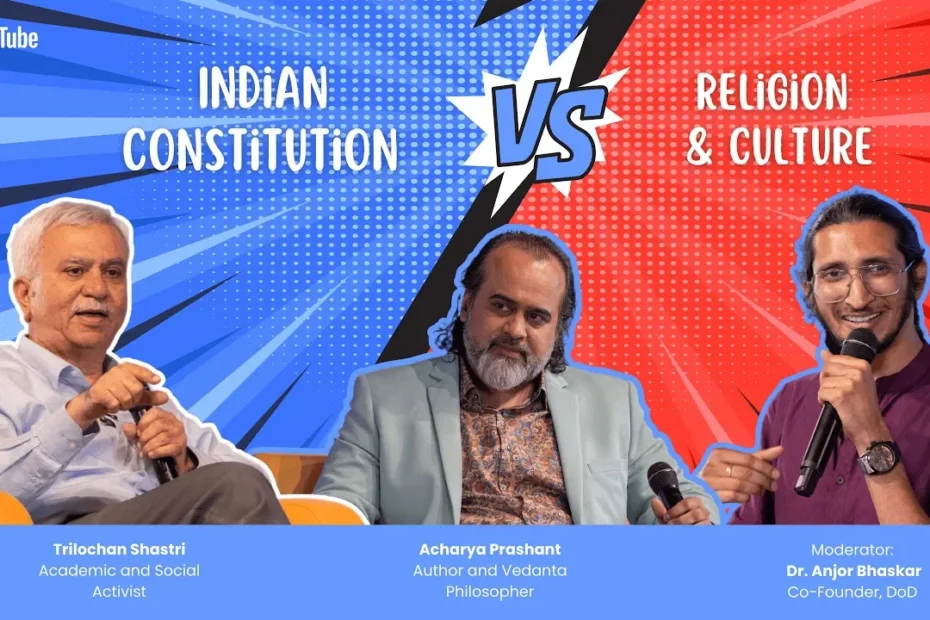
Acharya Prashant, Author and Vedanta Philosopher, and Trilochan Shastri, Academic and Social Activist, moderated by Dr. Anjor Bhaskar, Co-founder of DoD, the discussion explored how true spirituality aligns with the values of the Constitution while cultural biases create conflicts. It was a thoughtful conversation that encouraged reflection, questioning, and deeper understanding.
DR. ANJOR BHASKAR: Thank you to all of you for being here this late evening, spending your time with us. Doctor Ambedkar, the chief architect of our constitution, has famously said that democracy in India is only a top dressing on a soil that is essentially undemocratic.
Basically, a US organization called Pew Research did a survey in India and many countries, and they found that in India, majority of the people believed that an authoritarian government would be more preferable, and that proportion was the highest in India among all the countries that they surveyed.
So while our constitution gives us a democracy and that democracy has certain values aligned with it—the values of liberty, equality, fraternity, justice—the question is: are those values aligned with our societal values? Many researchers feel that democracy in India is only superficial because at the heart of it, we are a very religious society.
Then if you look at the number of religious places of worship in India, that is far, far greater than the number of schools, hospitals, health centers in the country. And they use that as a kind of argument to say that is why you don’t have democratic culture, but you have the dominance of religion and culture in India.
The question is, are these actually in conflict with each other? Is democracy and the constitution in conflict with our religion and our culture? That is the question that we have for us today, and we have two of the best people to enlighten us on this issue. Is there alignment possible between culture, democracy, and religion, or are they perennially in conflict with each other?
Maybe Acharya Prashant can start.
Acharya Prashant on Religion, Culture, and Constitution
ACHARYA PRASHANT: First of all, many, many thanks to Doctor Shastri for being here. And let me tell you first thing that he was my teacher at IIM Ahmedabad. So it’s a very unique privilege, and obviously, the discussion is on a very sensitive and very important topic, and I feel honored I’ll be sharing the stage with him when this conversation will happen.
But beyond the content of the conversation, just the context of the conversation is personally meaningful to me, and I wanted to share that with you. And yeah, now I’ll come to the content part.
See, at the heart of the problem statement—are Indian religion and culture incompatible with the democratic values enshrined in the constitution—at the heart of this problem lies the very definition of religion and culture. If we do not venture into religion deeply, then we will confuse religion for what we see it as practiced. We’ll think that this is what religion actually is.
Very basically speaking, culture means behavior. Culture means how you are choosing to operate in your day to day setup. Your eating habits, the way you greet each other, the way you walk, the way you relate to each other, your values, your beliefs—all that is culture.
Now culture doesn’t necessarily have to do with the essence of religion. And when you talk of religion here, you are referring to the Hindu religion, right? That’s what’s in the question.
The Hindu religion itself can be divided into two, and it must be: the religion of the Shruti, which is the religion of Vedanta, Upanishads, Bhagavad Gita, and the religion of the Smriti, which forms the basis of popular culture. The religion of the Smriti—and Smriti refers to all your dharmashastras, puranas, itihas, kranta, maha kavya, even Shad Darshan—all these come under Smriti.
So the culture that you see practiced is largely based on Smriti, not Shruti. But when you say religion, you conflate these two into one as if these two are one. No, they are not one. They are not one.
So the entire problem is because our culture is based on something that is not really central or essential to the Hindu religion or Sanatana Dharma, whichever way you please. Our culture is based on the very, very periphery of religion, things that got added later on.
Smriti itself was supposed to be a commentary on Shruti, something that would enable the masses to connect to the core of religion. Our culture is related to Smriti largely, not to Shruti. And that’s the reason why culture, as we see, is seen in conflict with constitution, because constitution, as I see it, is founded more on the Shruti.
Even though the framers of the constitution and Doctor Ambedkar, as you mentioned him, would not say that or would probably not look at the constitution from that angle. But if I look at the preamble, if I look at the fundamental rights, if I look at the directive principles, if I look at the fundamental duties, what I see is Vedanta, which is Shruti.
So the constitution is already based on Shruti. Let me set the equation right in brief now. The constitution, in some sense, is already based on religion, the core of religion, which is Shruti. But culture is based on Smriti. So that’s why we find this perceived—it is not perceived, it’s an actual conflict. It is an actual conflict.
So our constitution is already something that resonates very, very closely with Vedanta from where I look at it. Though our culture is not something that resonates with Vedanta, and hence, we find this conflict between culture and constitution.
Trilochan Shastri on Constitutional Values and Spiritual Essence
DR. ANJOR BHASKAR: Sir, please.
TRILOCHAN SHASTRI: Thank you. I will just start with a minor point. The American constitution was drafted in the eighteenth century, and it had all those grand statements—for the people, by the people, etcetera.
Now you could have asked this question: is the American constitution in line with the culture? So in every country, there are cultural practices. Some of them need to change. Some of them may not be in line with the constitution. So for me—yeah, I mean, that’s alright. I’m just want to say one or two things.
I’ll just read out some important phrases from the preamble. I don’t want to get into too much detail, but you know, this is very inspiring for me, so I will read it out.
It says, “justice, social, economic, and political; liberty of thought, expression, belief, faith, and worship; equality of status and of opportunity; and to promote among them all fraternity, assuring the dignity of the individual and the unity and integrity of the nation,” etcetera, etcetera.
This is the preamble, and it’s very nice to see in ringing tones, “We, the people of India, having solemnly resolved to constitute India into a sovereign, socialist, secular, democratic republic.” We may quibble with one or two words there.
Now what does it do? There are two aspects to our culture. One is the deepest culture, the essential culture, and that is the Shruti. Now what does the Shruti say? So if we have to go to the Upanishads, the Mahavakya say all the same thing. They say, “Amritasya Putra”—you are the children of immortality.
It’s saying that the divine principle, whether we believe it or not, I’m just saying, it is there in each and everyone sitting in the room. It is in the dogs and cats roaming around. It is everywhere. Therefore, if that is true, what is the first derivative of those grand statements of the Mahavakyas? It is equality and fraternity.
In one of the principal Upanishads, Yagnavalkya tells Maitreyi that the husband is dear not for the sake of the husband but because of the sake of the Atman. The wife is dear to the husband not for the sake of the wife but because of the sake of the Atman—the son, the daughter, the father, the mother—everybody is dear to us because of that. That is automatically in line with fraternity, justice, liberty, equality. I don’t see any problem with that.
And just for the record, while Doctor Ambedkar, one of India’s great persons of modern India, he had problems with Hinduism and the culture, but he never had any problem with Upanishads. He didn’t have any problem with Upanishads.
Historical Revivals of True Religion
So one thing is that, sir, coming back to your question—I will just take one more minute and stop. If you look at Indian history, because you’re talking about the culture, we are so rooted in our today’s life. These challenges to our culture or the religion, at least four times, this is the fourth time.
The first time it happened was when the ritualistic thing overdominated, and the first person to put it down was in the Bhagavad Gita by Krishna. You go five hundred years later, another great man—his name was Gautam Buddha. He found again this ritualism had taken place. He again tried to put it down.
The third time it happened—now he has become bastion of orthodoxy—was Adi Shankaracharya. Buddhism was in decline, and the priests were back in action with the Vedic rituals, so he again wanted to reorganize it. In fact, Adi Shankara was a heretic and he was bitterly criticized by the pundits of that time because he was saying, “Yeah, don’t waste your time in all these Vedic rituals.”
Now this is happening all over again today. So this will happen in the course of history. Things will go up and down. But the essence of Hinduism, it was revived by Krishna. It was revived by Buddha. According to me, Advaita—Vivekananda says that Gautam Buddha revived true Advaita and Shankara, and maybe people like us will revive it again.
So I would not worry too much about that there is a fundamental difference, but the point is correct. Today, as the culture is practiced, there is a problem, and we need to correct it. But the intellectual or spiritual basis for correcting it is already there. It’s not something we have to rediscover, and we cannot throw the baby out with the bathwater and say, religion is bad.
It will never go. Religion will not go from this country. We have to go back to the purer forms of religion. Thank you.
Summarizing the Core Argument
DR. ANJOR BHASKAR: So just trying to—as a student of these two professors and gurus—I’m trying to summarize what I’ve learned. The basic point that I guess you’re trying to make is that there is no conflict between at least Hinduism and the constitution. The values and the essence of both is the same.
There may be a conflict between culture and constitution, but there’s also a conflict between culture and religion because culture, as you said, has emerged from Smriti, which is not the true essential form of Hinduism. So what you’re seeing as a conflict between culture and constitution is, in fact, a conflict between culture and actual religion.
So if constitutional values are being seen as threatened, maybe a way to defend them is to revive actual religion. The more the actual religion is revived, the more we’ll see that our own constitution is already in harmony with the real religious values. Otherwise, we’ll say, no, we don’t want this constitution, or there will be all kinds of conflicts and problems. Wonderful. This is a new way of thinking. Thank you.
The Challenge of Equality vs. Discrimination
I come down to a specific issue. The specific issue is Professor Shastri just read out the preamble, and one of the things—one of the first things in the preamble—is the message of equality, saying that everyone is equal. But when we grow up in this country, we are taught that everyone has a place, whether that place is decided by their caste.
So some people are meant to do manual work, demeaning work. Some people are meant to do intellectual work. And therefore, some people are meant to be looked down on, some people are meant to be looked up and respected.
Whether that categorization happens on the basis of gender—some people are meant to do outdoor work. They are meant to be strong. They are meant to be the caretakers of the family. Some people are meant to be caregivers only, so they can only do certain kinds of work: education, nurse, doctor, caregiving work, ASHA worker, Anganwadi worker, tailoring, boutique shop.
So there is a categorization that our culture tells us to do on the basis of gender. It tells us to categorize on the basis of class. Those who are rich or well-to-do are there because of their hard work and their perseverance and their dedication, and therefore, we should respect them.
So there’s a rich person in a suit coming to your door. You don’t know them, but you ask them to sit. Someone who looks poor, you make them stand at the door. There’s a categorization based on religion. There are some people you are allowed to marry, some people you are not allowed to marry based on their religion. Some people who you can share your plate with, some people you can’t share your plate with based on your religion.
So we see everyone in these categories, whereas, again, the constitution says everyone is equal. How do we come to terms with this? Where is this? What is the root of this stereotyping, this discrimination? Is it in religion? Is it in culture? And what can we do to address this?
The Root of Discrimination
ACHARYA PRASHANT: See, discrimination is one of the most fundamental human tendencies, right? Because we are born unfulfilled. That’s the ego, ahankar. That’s what takes birth as the body or along with the body. It seeks some kind of fulfillment or contentment, and that it seeks through association with objects in the world.
Now certain objects have to be taken as more valuable than others based on your experience or conditioning or assessment, whatever, and that is discrimination. There is diversity in the world and you cannot hold everything as equal, so something has to be put above something else, right?
Now the question is whether you actually know how to evaluate, whether you actually know what is valuable. So if you’re going to the real, to the actual very root of discrimination—why do I like this more? Why don’t I like that equally?
# Is Religion Under Threat? The Conflict Between Belief and Constitutional Values
Why do I put that above this one? That is something that we are born with and that is displayed even in the animal kingdom. Right? But as human beings, when we do that, that often comes from the wrong center. We need to have a center that takes us beyond our animal nature, and that’s not a moral imperative.
That we need, otherwise, we’ll remain unfulfilled. We need to discriminate definitely. If you will go to Shruti, if you’ll go to Upanishads, they too will say, Vivek. And that’s not discrimination, that’s discretion. That’s discretion.
And what is that? You need to be able to differentiate between that which is really useful to you and that which is not. So sar and asar, nithya and anithya. That’s the discrimination we need. Why?
Because you are born unfulfilled. I have a hollow in my heart, so I do need something that will fill it up. Or I do need some kind of a cure for it or some realization. Something. Something.
I cannot randomly go about associating with everything and valuing everything. So that viveka, that discretion is definitely needed. That is a part of Adi Shankaracharya’s Sadhana Chattushta also, and that’s a very hallowed value, the discretion. But instead of discretion, what we have is random attribution of value.
For example, if you are born in a particular value, in a particular family, then you are higher than the other. If you are born in a particular gender, then you are higher than the other one. Or if you have this kind of material position, then you are better than the other one. Now this is not discretion.
Discretion we need. Discretion means I must know. These here are two books. I must know which one is useful to me in terms of giving me that which I really, really, really need. This is discretion.
And discrimination is based on my preordained values, my cultural conditioning, my physical conditioning, or my blind desires. I just want to probably exploit or do something else random, so I say this is better than this, and I’ll favor this. Even though by favoring this, I might be doing myself a disservice, but I’ll still continue in my blind ways.
The Role of Culture and the Need for Constitution
That is the stupid kind of discrimination that we practice. And then please remember, it is because cultures are that way. Doctor Shastri had very rightly put it. Cultures are like this everywhere because they are popular cultures. Loka Sanskriti. They belong to the masses. They belong to the ground level.
So cultures are flawed everywhere, and that is why constitutions are needed. Had the culture itself been extremely benign or divine or whatever, then you won’t need a most elaborate written constitution as we have. You won’t need the preamble as succinct, as clear and as sublime as we have.
You won’t need articles fifteen to thirty-one fundamental rights as we have. And then they are very closely followed by director principles, thirty-eight to fifty-one, and then your fundamental duties, fifty-one A. Why are all of them needed? They are needed because culture is insufficient.
Culture is flawed, and we cannot quarrel with that. That’s the way it always has been in history, and that’s the way it has been throughout the world. You cannot run a place just based on culture because culture involves a lot of blind conditioning. And if you start running a place on culture, then there will be conflict and suffering. So you require the constitution.
And the constitution that we have, it’s a beautiful one, a detailed one, and it’s based on deeply spiritual values.
Trilochan Shastri: I have nothing much to add there, but go back to your question, what is the root of discrimination? I don’t know the answer, but I have a response. It is human nature, and within human nature is basically selfishness which makes us discriminate against another. Now whether it is part of our religion or not we can debate it. There is, and it’s not acceptable. I’m not justifying it, but some forms of discrimination like caste are very peculiar to India but other forms of discrimination are there in other parts of the world so we have to deal with that.
So to put discrimination entirely at the door of religion, you can put it at the door of popular religion, I have no objection. But to put it at the door of any essential form of religion and spirituality, that’s not true because I just quoted from the operation. Everybody is the same. So all these issues are there. The root of discrimination is human nature and selfishness. That’s what I feel.
Unity Through the Self
Acharya Prashant: You see, when sir was quoting the preamble, what is fraternity for? For the dignity of the individual and the unity and integrity of the nation. Have I put it right, sir? That’s what the preamble reads. Now what is unity?
When you say discrimination, actually, you are rallying for unity. You want a unit and integrity. You don’t want pieces. You don’t want fragments. Shruti tells us that the only point where unity is possible is Atman. There is Prakriti outside of you. This world of sensual experience. And this only has vividhita, diversity. There can be no unity here.
This does not appear the same as this. This does not appear the same as this. And two things that can be manufactured exactly the same, they will be shaped apart by time, by the flow of time. The scientific fact is you can never have two objects that are exactly alike. So there is always going to be diversity in the physical world and this diversity is a great cause of suffering for the individual, the ego, the jeev, because he does not know what to choose.
So he randomly picks one thing over the other and the entire life just keeps wandering and suffering, going from door to door, post to pillar and getting knocked out in the process.
So the unity that you need instead of discrimination is possible only in the Atman, the true self. That’s the point where you are not associated with the world and, hence, you can look at things very clearly. Also, you can see that when it comes to my fulfillment, they are all at the same level, which is level zero. None of them are going to satisfy me.
Hence, if you want real unity, you’ll have to bring people to the self, and that is the goal of Shruti. Bringing you back to the self, and that is where unity is possible. And that is why the constitution and true religiosity, which you can call as self-knowledge, atma gyan, they go together. Our constitution, let me say, is a deeply spiritual one because it calls for unity. And superficial unity, you can any day obtain. But you want real unity? It can only be spiritual.
Trilochan Shastri: On discrimination, one more last thing. The problem is in treating people unfairly or looking down on people or discriminating by creating needless hierarchies. That is a problem. But we have to accept that in society, different people are… now he is a very good cameraman. I mean, I have to stand there, I can’t do the same job that he is doing.
So we let us recognize as he mentioned that there is differences in society. But the one is, of course, atma gyan, which I cannot argue against, but at a practical level, treat everybody with dignity and respect. That is the important thing. The discrimination is not important. That’s what I feel.
Discretion Versus Discrimination
Dr. Anjor Bhaskar: As a student, I will come back to trying to summarize the essence of what I’ve learned from this. And I think this was deeply valuable to me because what I’ve learned is that diversity is given. There is definitely going to be diversity. And therefore, the term you used, I really liked. We need to have discretion. What is useful to us, what is not, what is safe for us, what is not and for that discretion we need some consciousness which you call Atman. Now as I’m understanding it, this is not what you said. May I just simplify the whole thing?
Acharya Prashant: So I have to study statistics. Right? I have my professor in front of me, and I may have a batchmate in front of me or my junior. This was a second-year course. Right? Somebody else. I am going to apply my discretion, and I am going to differentiate. And I’m going to say one person is better than the other in this particular context.
So this will look like a particular form of discrimination, but it is not because it is based on knowledge, realization, understanding, not conditioning, not bias, not ill will. So that is one thing. Diversity is there and for a particular purpose. In this diversity, one thing can be more suitable than the other. That is fine.
Another thing is, I will listen to one man because he belongs to a particular caste or because he is a Brahmin and a male Brahmin or because he is a white European or because he is carrying a certain pedigree. No. This is the blind discrimination that we have to guard against. You are not even giving the fellow a chance. You are robbing him of his dignity and opportunity of life.
And opportunity is another word that the preamble mentions, equality of status and opportunity. Right? So, you know, yes, of course. I mean, my height is not the same as yours, so there is a difference. But if somebody starts judging my intellectual merit based on my height, now that’s foolish discrimination. That’s what we have to guard out against. Right.
So if it’s discretion coming from consciousness…
Dr. Anjor Bhaskar: Realization.
Acharya Prashant: Realization. Not bias. Not bias. Then it’s fine. Okay. I’ve seen two drivers and I know that one is a better one can drive through traffic so I will choose one. The other point is saying that one is a male driver, is a female driver. I cannot trust women as drivers. So let me just go with the male driver. That is discrimination because as I learned, it’s not coming from consciousness. It’s coming from conditioning.
Dr. Anjor Bhaskar: Wonderful.
Is Religion Under Threat?
So there is a trend globally now where people are saying and people who claim to be the guardians of religion are telling people, and I think this is not a nuisance trend, it’s grown recently, telling you that your religion is in danger and therefore you need to stand up for your religion and protect your religion. Now this is happening globally. What would you say to that?
And I’m asking this question in the context that what this is leading to, probably, is it is in conflict with the value that you mentioned, that of fraternity. But if you are threatened by the other person because of their religion, because of their nationality, without knowing the other person, then there’s no way that you can put yourself in the other person’s shoes. So there seems to be a conflict between this philosophy that you need to protect your religion and this constitutional value of fraternity. What do we do?
Acharya Prashant: Not just fraternity. If you go into the fundamental duties, article fifty-one A, inquiry, scientific temperament, and reform, these three happen to be fundamental duties, and they are very threatened when you say, you know, my religion is better than yours or when you are threatening my religion, so I’ll fight you and all that.
See, dharma is never threatened. Only belief systems are threatened. And beliefs are very vulnerable. They would always be threatened. So whenever you cast a belief system as religion, this religion will be extremely insecure and vulnerable.
Your religion is that that blue board created the universe. That’s what your belief system says. Because cosmogenic cosmology are an integral part of all belief system religious belief systems. Where did the world come from? So it came from that blue board. And my belief system says it came from my mic. The world originated from this mic that I’m holding.
Now there is no way your belief system is compatible with mine, so we will fight. Because, see, facts don’t quarrel with each other. X square equals four will not quarrel with x equals plus minus two because these are facts. They won’t quarrel with each other. Even they are expressed differently, facts will always agree with each other. They are compatible with each other.
And when facts are not compatible with each other, then you challenge the theory itself. And then you say we need a better theory because the theory is not matching the fact.
Beliefs Versus Facts
But imaginations, which is nothing but belief, imaginations will always quarrel with each other. You think that particular direction is sacred. My belief is that this direction is sacred. Right? So you do not think this direction is sacred. Right? So you face in this direction and start peeing. But to me, this direction is sacred, and then I’ll fight with you and I’ll slaughter you.
Beliefs will always clash with each other and that’s the fundamental problem that which we call as Lokadharma or popular religion. That is not based on observation and realization. It is just a belief system. I believe this way. And unfortunately, we have given too much respect to this word belief. Astha, maneta, vishwas, dharana. So much respect we give to these things.
A great logician. Somebody coming from an intellectual line, he would not shy away from any kind of argument or debate. Right? He would relish it. Come on. Give me a good debate. It stimulates me. But faced with someone who is expressing his belief, this person would retreat. The intellectual retreat. What is it?
You know, how do I offend his belief? So much respect we have given to belief that belief has dominated religion altogether, not dominated. Belief has usurped religion. Belief has become religion. Whereas when you look at Sanatana Dharma, Shruti, there is no space for belief at all.
It is about atma vallokan leading to atma gyan. You watch yourself, the scientific method. You look at yourself. You look at the world, and there is epistemology. There are Pramanas.
Democracy and the Common Man’s Readiness
Audience Member:
Hello, sir. So my question’s on democracy. We talked about how the constitution is in line with Shruti, and the constitution obviously of India and other countries are democratic—at least our constitution is democratic. And democracy is probably the best system that we have found maybe so far. Maybe there’s better systems, I don’t know.
But at a very personal level, if we look at our everyday lives, nothing is democratic. Like, our organizations are not democratic because there are practical considerations, you know, but democracy is always at this super scale. We’re always looking at democracy.
And this is just an opinion. I just want to hear your thoughts on it. Does the common man really have enough practice with democracy and how democratic systems can be used by people who are greedy or selfish to exploit them? We don’t have that practice in our daily lives. We only have it at the really, really high scales. And as a result, we fall prey to lot of the things that we see today in all parts of the world. So just wanted your views on that.
Trilochan Shastri:
Very important and very good question. Thank you. And it’s slightly removed from—nothing is removed from Vedanta, but I would just answer it in different ways.
Your point that are people today at large ready for democracy, it’s an open question. Some people are, some people are not. This great urge for a great leader, authoritarian leader who will solve everything means that as of now today—doesn’t mean that things are static. Culture is not static. Today’s situation is not. It may change tomorrow.
While in 1947, people were going to jail. Bhagat Singh went and got himself hanged. They were fighting for, you know, very spiritual sense for freedom—not only freedom of the country, but freedom of themselves. So let’s not get despondent that today we are in the situation we are like that only. No. These are dynamic things.
I will quote two, three things, because this is a very important question because we have to understand how we can change for the better. That’s the reason I’m mentioning a couple of things.
The Challenge of Understanding Freedom
So when we became independent in 1947, that time there was no radio, social media, so many things. And the then party which was fighting for independence was called the Congress Party, by the way. Whatever it is today is a different issue.
And they sent their workers into the hinterland of India to tell the people of India that you have become free. So they went, and then many people came back and said that when we told people that you are free, democracy, whatever you want to call it, they will say then, “Who will rule over us?”
And then they said, “No, no. The British are gone.”
“Oh, the British are gone. Then who will rule over us?”
“No, no. Nobody will rule over you. You have to rule over yourself.”
“Is it so? What does that mean?”
The Challenge of Self-Respect in Modern India
No. It’s a truth. It’s a truth. I mean, it’s a factual thing that I’m mentioning. So that is the mindset in 1947. How much it has changed in the last seventy-five years, I’m not sure about. What we can do?
So I will go back to Vedanta on that for what we can do because I, see, I am a bit of a fan of somebody called Vivekananda. Let me make it pretty obvious. Now he says that every country has a national dharma, and he calls our national dharma spirituality. Now we can agree or disagree. America has freedom of the individual. France has some other dharma. England has. He was quite a thinker.
Then he says that we have to build self-respect. This is man-making religion. Let us put it as man and woman making religion because that was the language in those days. So the natural self-respect and self-belief of people is deeply hurt in India according to me. Every group is a minority. Muslims feel wounded. Christians feel wounded. Hindus feel wounded. Dalits feel wounded, women feel wounded, Brahmins feel wounded. Everybody is feeling that they are being discriminated against. So we are almost becoming like that.
Now the root of this is not all the rules. At the root of it is lack of self-respect. A self-respecting person, if you go and abuse him or her, you say, you got angry. You said something. But when you don’t have self-respect, how dare you say this and that? And the whole country is in that. How dare you say this to me? Anything you say, somebody or the other is offended in this country.
Now this is the root of why democracy is, in the true sense, is not—it’s a little psychological. Just think about it. What can we do? Restore that lost self-respect, that wounded self-respect. We have to collectively restore it.
We don’t have to be—when the western countries say that some aspect of India is great, it’s all over social media and say, now we always knew we were great. And if they say that something is wrong, oh, those people are always biased against us. We are so hungry for external validation because we don’t have that level of self-respect as yet as a society and a nation.
We claim ourselves as Vishwaguru. Let us do that. But, you know, no guru says I am a guru. Other people go and say, I’m guru. We are going and announcing. We are becoming a laughing stock in the world. This is a lack of self-respect, self-belief.
The Path to Restoring Self-Respect
It’s not a lost cause. There are many good things in our society. There are many good people. One of them is sitting here. We have to restore that feeling of self-respect and dignity in the true sense. And the basis of that, not only Vivekananda, comes from the Shruti.
So the fisherman becomes a better fisherman. He says, yes. You are a professor. You are an IT expert. You are a rich guy, but your Atman and my Atman is the same. Okay. We are equals in that respect. And he becomes a better fisherman and he has a sense of self-respect.
This maha mantra for unity in this country is that only—that I am Atma Brahma, Aham Brahmasmi. These are the two great mahavakyas: Tatvamasi and Amritasya Putra. Listen, people world over. You are the children of immortal. Everybody, every Indian is, and even non-Indians are.
So this great task of regenerating our own sense of self-worth and self-respect, we can see the beginnings of it. India has the largest number of grandmasters. The youngest grandmaster whoever won in history, we just won. So we are finding the younger people coming up, but our role as concerned people and citizens is to strengthen and restore that. Then only we’ll have—there is no democracy without self-respect. Just think about it. And that task belongs to us, belongs to you, belongs to this young girl sitting next to you and all of us.
Dr. Anjor Bhaskar: Can we say, Professor Shastri, can we say that democracy at its root is a system founded on the belief that everyone is equal? And when you understand democracy like that, what Acharya Ji said, you can be discretionary, somebody can have different roles to play based on their strengths and skills and experience. But when you understand democracy at its root as—when you understand religion at its root, both are saying you have to recognize that we are all essentially the same. We are all essentially equal. And when you gain that realization, then you can understand and respect democracy, and maybe you can understand and respect religion. Am I correct?
Trilochan Shastri: Been wonderfully put by, sir. You see, let’s think very practically on the ground, just extending on this thing.
Self-Respect Through Self-Knowledge
Acharya Prashant: When I’m holding on to something that I know is not factual, then I become a liar in my own eyes. How will I have any self-respect? How will I have any self-respect? For self-respect to be there, first thing that you need is freedom from superstition and belief.
Also, this belief system makes you feel very insecure and vulnerable because you know anybody can challenge it, and you will be shown down. You believe in something, and you know it’s not factual, or at least you have some inkling, some idea. So you’re always aggressive because you’re vulnerable. You’re always prepared to fight. No. No. No. No. No. I know my past is great, this and that. And, you know, there is no factual basis to that.
For self-respect to be there, you need to be very naked in terms of not having any beliefs, internally naked. I have nothing here that can make me insecure or vulnerable. Now who can hurt me? Now who can hurt me? And when you are not vulnerable, then you do not need an authoritarian to lord over you, and that is democracy.
Please understand. The more we carry nonsense within us, the more we lack in self-respect. And this nonsense is what Vedanta challenges. It asks you what are you getting by holding on to this entire system that you have built within, that whole labyrinth with the ego at the center. Why do you need it? Can you go into it? You think this internal thing is your friend. It is not your friend. In fact, it is keeping you down always. It is not allowing you to have a spine.
So self-respect is not that aggressive thing that we see in the movies or find depicted in popular culture. No. I have self-respect. You have a great movie made where the king has self-respect, so he’s, you know, conquering his enemies or, you know, very, very superficial expressions of self-respect.
No. For Vedanta, self-respect is self-knowledge. In fact, the word respect itself, if you see, respect, s-p-e-c-t, and that comes—that’s related—what do you call this thing that you have in your face? Spectacle. Spectacle. So respect. What would that mean? Watch again and again so that you can have more clarity.
So self-knowledge itself is self-respect. Self-knowledge is self-respect, and self-knowledge would mean you don’t need nonsense. I’m needlessly carrying it. If I’m a liar in my own eyes and I go and I become a devotee or do this, this mantra, that puja, how will that help me? I know I’m vulnerable.
Have you seen how insecure deeply religious people feel? You cannot talk to them. In fact, you want to avoid talking to them. If you talk to them, you know that they will be offended. As such there is something, somebody or other will be offended. And especially the religious people, they are so keen to be offended because they are carrying a lie within.
Vedanta is about not carrying that lie within. In fact, there’s this beautiful book that you might want to read on this, “People of the Lie” by Scott Peck. “People of the Lie.” It’s a very religious book. He was a practicing psychologist. It’s a very interesting book. How we deceive ourselves internally. This self-deception lies at the center of pop religion.
Dr. Anjor Bhaskar: Can we say, therefore, that at the root of democracy is self-questioning?
Acharya Prashant: Yes. Yes. Yes. Yes.
Dr. Anjor Bhaskar: And when you start self-questioning—
Acharya Prashant: Yes.
Dr. Anjor Bhaskar: You stop believing—you stop believing in myths that people have told you.
Acharya Prashant: Yes. Yes. You start looking at the truth. And when you start self-questioning, trying to search for truth, then you stop being vulnerable.
Tell me why else is freedom of expression a fundamental right? It’s not so that you can just blabber something somewhere. So that you can openly question. That’s why freedom of expression is required, otherwise falseness will remain and there will be no one to question it. That’s why we need freedom of expression.
The Challenge of Perfect Systems
Audience Member: Maybe at the back. So my question was related in the topic only. Ambedkar, like, I have seen in a documentary that he told that no matter how good we make the constitution, it depends on the one who are implementing that. So how can we approach to make that kind of society where the people that Ambedkar envisioned—that kind of people should come? Where even if you make loopholes in—even in a weak constitution, the society can function well.
Trilochan Shastri: Would you like to take that? A very important question and a very fine statement that you quoted from Doctor Ambedkar and something that I have personally thought about for long because of our work in democracy.
The short answer is it cannot be done because it can never ensure that people of character will always be there. America—there is a president. You just read a speech. Now these things will happen in countries and in history. Ups and downs will be there. If you have a dream that we will create some system where only good people will be there in the government for all times to come, it will not happen. You know why? None of us sitting here including me is perfect. Human beings are not perfect and we want to create a perfect system out of imperfect human beings.
We can increase the chances of good things happening. People of character should be put there in the government. But who is voting for these characters? Donald Trump’s vote? Yeah? And they are highly educated. On paper, they are more educated than India. In India, who is voting for the various governments, different state governments and who’s voting? We are voting.
So it’s a very, very difficult question. And actually the only answer I got from a very practical point of view—not from Vedanta, everything is tied to Vedanta—is it is Roosevelt or what is his great man? He is from Africa, I forget his name. Nelson Mandela or Mohandas Karamchand Gandhi, I don’t remember. Ambedkar’s quote on this, he says the only answer is true education, education, education, education. The truth is not reading, writing only, so that people—all the things that he’s saying—people can think and analyze for themselves. More and more people are aware and educated, democracy will become better, and there’s the chance that we will select people of good character.
Now who’s going to do that? Government schools will do? That’s why these forums are here. And you may be much more educated than me, but then we have to also communicate with the people of India. That may not guarantee everything, but it can improve the chances that better people are there in government. I know you’re not happy because when I was young, I thought we’ll create a perfect world. But think about it. How can you create a perfect world with imperfect human beings? Perfect system.
Acharya Prashant: You want to respond. Then again, it comes to economics of it. Right? You have to have some basic dignity and permission.
Trilochan Shastri: Sir, in Sweden, which has got economic prosperity and equality and all the good thing that we love—somebody said some European Scandinavian held up. What is happening now? Far right-wing governments are being elected. People who are completely racist and far right-wing and authoritarian, they are being elected. So this is a very big puzzle.
See, if you accept that human beings are the same everywhere in the world, there’s not some kind of heavenly people in Scandinavia and some useless, superstitious people in India. Everybody is the same. These things will happen. So Vedanta will say, out your own solution, and you can. Even in the worst situation, you can. That is the only promise. This is something to base. If you wanted, do it. Why ask whether it can happen? Depends on you. That’s what both Vedanta and quantum physics say. Depends on you.
The Beastly Nature of Humanity
Acharya Prashant: If you see, it’s obvious human beings are imperfect. We are animalistic in nature. We share so many of our deepest tendencies with animals. Don’t we see that? Greed, fear, anger, lust, jealousy, covetousness. We are so much like animals.
So if you want a great system in which people of character, etcetera, on. Go ahead and educate people. Go ahead and educate people as to what the real meaning of character is, what is meant by governance, what is meant by constitution. If you don’t educate them, you, me, we all will remain beastly because that’s how we are born. Just leave a kid in the jungle, and what will he become? Mowgli, what will you get out of him?
So there is this beautiful novel, “Lord of the Flies.” A group of kids get stranded on an island, a faraway island, World War Two. Right? And what happens of them? One day, it is found that one of the fat kids has actually been slaughtered, and his head has been impaled on a stick. And lot of flies are swarming around it, so that’s what gives the novel its name, “Lord of the Flies.”
So that’s how beastly the kids become, small kids, five to twelve years old. It’s a very important work. I think we should read it to know who we really are. Otherwise, we just keep professing we are—we are coming from here. We are there. We are potentially divine, but we are actually beastly. And spirituality is the journey from this fact to that potential.
Democracy and Its Challenges
The fact of the matter is we are not good beings, not just flawed, but actually very dangerous people we are. No? That’s why morality is needed. Otherwise, we’ll tear each other apart. That’s why heaven and hell are needed so that some fear of consequences is there.
Otherwise, we can be very dangerous people. We’ll have to turn ourselves into real human beings. So education is the answer. There is no other answer. And you cannot wish for things to happen.
Come on. Get up and make it happen. Do it. If you think it should happen, then it’s your responsibility. Obviously, all this arrangement has an economic angle as well.
But tell me what you can do. Do not tell me where the bottleneck is. When we come to the bottleneck, we’ll fight it. As they say, we’ll cross the bridge when we come to it. But what stops you from making a beginning?
Make a beginning, and when you encounter obstacles, then we’ll see how to deal with them.
Audience Member: Hello, sir. Is democracy—there is populism across the world that we are seeing in US, in Europe, etcetera. So is democracy itself the part of the problem? For example, elections seem like a popularity contest. Popularity can be manufactured with media. Media is controlled by power. Then popularity game in itself is tribal, which will inevitably lead to conflict. The society, the reality of society now, there are information bubbles. My reality is perhaps different from him. So how can we even agree to bring about a change? And now there is this techno imperialist who control information, hence control power. Hence, is democracy just remain the label or is the system capable of self-correction or this system—
Trilochan Shastri: No, no. I understand your question extremely well. It’s a very good question.
You see, democracy as practiced today is what we call representative democracy and not participative democracy. So representative means we elect people. It is based on a western paradigm which is competition and winner take all, most dramatically shown in the American electoral college system where if you get one more vote more than the other, you get all the electoral college seats of that particular state.
So for example, when Donald Trump won first time in 2016, he got four million votes less than whatever her name, Hillary Clinton, but he won. So this Western model of winner take all and competition has played out its course, and it is becoming very ugly.
But democracy is not about competition. Democracy is about all of us living together in some sense of fraternity, some sense of, if not equality, at least equity, and all that kind of stuff. So the structures we have created for elections anywhere in the world is a little complicated.
The best I have seen is in Japan, and I think we can try to adopt it in India, which is what about the forty-five percent who did not vote for the winner? Do they have a representative? So we can have two of both of them. I mean, I’m not talking about the president, but in every constituency. So we have to think of ways of doing that.
And if you go back to the roots of Indian democracy, they claim India is the oldest democracy before Greece. It was there in some part of Bihar. I forget the name. So people, that was participatory. You sit and discuss and say, “Why don’t you become the leader for the next few years, and we will all work with you?” It was more by discussion and consensus or some kind of, you can call it consensus or compromise.
But now it has become an ugly sphere. You spend money, and you vote and buy people, buy votes, and then it’s a winner take all. So that structure of the system needs a change. Popularity, yes. Popularity. All these things are there. That competition of winner take all is the root of all the problems.
Audience Member: Sir, in democracy then, populism just seems inevitable.
Trilochan Shastri: I think we’ll have to have a longer discussion on that. Yeah.
The Prerequisites for Democracy
Acharya Prashant: Would you like to listen? Yeah. You see, democracy, the prerequisite is an educated and awakened population to whatever extent the awakening is there. Otherwise, it’s a bargain. See, I’m a leader. I want your vote. And if the vote can be rather easily had by corrupting you, why will I not corrupt you?
So democracy, in fact, can in a perverse way become a force that pulls the electorate down. Why will the, for example, we talked of fear. The leader will engage in fear mongering if fear mongering gets him votes. So that would mean that you will find yourself stuck deeper in fear at the time of elections compared to other times. Are you getting it?
I need votes. And if I can get votes by arousing all your animal instincts, why will I not do that? Right? And if your animal instincts are aroused, then you will select another animal as your leader, and it’s a vicious cycle then.
So an educated electorate, educated not only in matters of the world, but also educated in matters of the mind, in matters of the inside. That educated electorate is a sine qua non for any democratic system to function, and we currently do not have that as much as we need it.
We need a fully functional system of internal education for democracy to really succeed along with, of course, the things that why should we have a competitive system in which so many people lose, lose representation, let alone participation? So that is definitely there.
But be it India, be it America, what do you find the leaders doing? They’re corrupting the consciousness of their electorate. And the electorate is taking it, taking it. We need a better electorate, first of all, for democracy to be successful.
Rising Above Animal Instincts
Dr. Anjor Bhaskar: Just on that point, and since you’ve mentioned this, that we are not living in a jungle. We are—the goal of religion and the constitution, according to you from what I’ve learned, is to rise above our animal instincts. And those animal instincts, whether they drive us towards competition, whether they drive us towards jealousy. So, therefore, being citizens of a democracy, being real truly religious people means rising above our animal instincts. Beautiful.
Acharya Prashant: Yes.
Dr. Anjor Bhaskar: Does that also mean that we are above animals and many people use that then to justify this which is why I’m raising—
Acharya Prashant: Are you above your own body? The body is the animal. We share this body with animals and it’s the body that generates all the instincts. The hormones that you have, you share with the animals. Right?
Look at the way we become fathers and mothers and the hormones that play their part in the process. The same we find in other mammals. So would we say that we dislike our body or despise our body or we would be cruel to our body? And if we won’t want to be cruel to our body, why do we want to be cruel to animals?
Also, if the goal is liberation from suffering, how will you gain liberation by inflicting suffering on another creature? Another creature. So that’s a very good point you raised that when we keep saying, you know, you have to rise above the animal, have to rise above the animal, aren’t you being a little disrespectful towards the animal?
No, sir. Not really. Just as we are not being disrespectful towards our own body while we say, “naham dehasmi,” at the same time, we realize that the body is the body, it’s a process, and it has to be seen as a fact. It has to be seen as a fact of Prakriti. Neither good nor bad. It exists.
I have no, even in the spiritual process, I have no business tormenting it. And equally, have no business interfering with the functioning of other animals, the way they live, the way they habitate, the way they reproduce, the way their entire system is. I have no right getting into that.
Just as I have no right getting into the essential processes of my own body. Why will I want to, for example, block my heartbeat or interfere with it or temper it? I won’t want to. Just as rising above our animal instinct does not mean that we can exploit our own body—
Dr. Anjor Bhaskar: Yes.
Acharya Prashant: Similarly, we cannot exploit any other—
Dr. Anjor Bhaskar: Yes. Yes.
Festivals and Shruti
Audience Member: Thank you so much for today. My question was listening to Shruti and Smriti and festivals, given that Holi is coming. For fraternity, happiness, equality, perhaps festivals play a role too. The confusion and I don’t know if Shruti speaks of festival or how do we celebrate for happiness and coming together.
But for instance, now when I celebrate my festivals, if it’s Holi, whatever, playing with water, color, when water is scarce, or similarly for Diwali, lighting lamps, lighting crackers, not doing that. I can imagine that there are other ways to celebrate, but is that spoken about in Shruti? What would be the right way to really celebrate that actually brings us all together, or is there a way of celebration or anything at all, if the question is clear? Or is Shruti really about higher things, self, and does it matter?
Acharya Prashant: Shruti doesn’t worry at all about these things. Shruti worries about only one thing, which is your liberation. What you will wear is your liberation. Liberation from your inner bondages and obviously cannot be liberated within if you are in shackles outside. So that too follows.
What you wear, which direction do you face while worshiping? Your customs, your rituals? How many times can you marry? At what age should you marry? Whether or not you should marry? What festivals you should celebrate? Shruti has nothing to do with it. It neither opposes nor supports. It is indifferent.
It says, we leave it to your discretion. Once you are awakened, it is indignity for me, says the sage, to dictate these things to you. My job is to wake you up. And once you are awakened, you take care of these little things yourself. Why should I tell you what men should wear, what women should wear, and when should you send your kid to school, and whether or not you should emit carbon? Shruti is not going to come and tell all these things to you.
But what we call as Loka dharma, popular religion, it goes extensively into these things. How many times a day should you pray? Which direction? Which pilgrimage sites? A long list of dos and don’ts. An entire instruction manual about how to live your life. Shruti has nothing to do with this. Nothing at all.
In fact, Shruti is so disruptive. It challenges even your varnashram dharma. It challenges even the four Purusharthas that we hold with such respect. So if you talk of dharma, artha, kama, moksha, Shruti says nothing doing. We don’t agree to this. We talk about one, your one, so you should do this. Your this age, so you should do this. That is ashram dharma. Similarly, the linga dharma, Shruti does not—you are chaitanya, consciousness.
And what you are, what you are hungry for is liberation. And that is the only subject matter of Shruti and that is sanatana dharma. All else is time bound. All else is changeable. You are intelligent. You figure out how to do it. We don’t want to discontinue it. We are also not encouraging you to continue it. Once you are awakened, you decide for yourself. That’s the approach of the Shruti.
The Vedantic Interpretation of Holi
How to celebrate Holi? How do you celebrate Holi? There is the Puranic myth. There is a Puranic myth, and it can be very, very beautifully interpreted in light of Vedanta.
So the fellow is going right against his own father. So “naham dehasmi,” bodily associations don’t matter. For the sake of truth, I can go even against my father. Please understand. And if you are cunning and drunk with power and authority, some or the other wave will emerge to bring you down, as happened with Hiranyakashipu.
Then the legend of Holika. The fire that you burn for others, you will get incinerated in it. That’s the nature of ahankar. It thinks it is doing bad to others. It operates in a binary. It says, I can gain only by snatching from the other. That is ahankar.
If you operate this way, we do not know whether or not the other would lose, but for sure you will lose just as Holika lost. So Holi is a great festival of awakening if understood in the Vedantic way.
First thing is, you know, and if we go back, he first of all, how did he start? He was a devotee. He was a devotee. And what did he ask for himself? He said, I will not die this way. I’ll not die that way. So blind devotion doesn’t work. You can be a great devotee and still be operating from the center of ego and greed. And then whatever you want is satam. What you are doing is for just your own sake.
So even if you happen to obtain something, it will be used in the service of your ego, and that will bring destruction to everybody just as Hiranyakashipu did. And then emerges somebody from his own family, his own son, who says, even if he is my physical father, I value truth more than my father.
And then “Dharmo Rakshati Rakshitah,” he valued truth and the truth came to protect him. In the legend, it’s in a very physical way, very dramatic way. We know that. Right? In real life, it might not be so dramatic, but then we have to get to the essence of things and not remain trapped in the minor colorful details. Right?
So if you can understand what the story is pointing at, then Holi can be a festival of awakening.
Dr. Anjor Bhaskar: Just to summarize this as a student again. Since the Shrutis talk about liberation, so according to them, our goal as humans is liberation. And if we go out searching where do we find liberation now, there’ll be many people telling now, you burn. After you die, you get liberation by—
Acharya Prashant: He doesn’t say so.
Dr. Anjor Bhaskar: In—further, it is not Shruti that says that your goal is liberation.
The Universal Call for Liberation
Every instinct that you have, every cell in your body is crying for liberation. Why else are you talking to us? Why else do you eat? Why else do we continue breathing? Why else do we get up every morning for the sake of liberation?
So it’s not that Shruti is impressing on you that you must get liberated. It’s a moral thing. No. No. No.
Exist for the sake of liberation. And it’s not that Shruti is needed to advise this to you. You must know it on your own. So Shruti says, go in and discover what your heart is beating for. It is beating to be liberated.
Trilochan Shastri: So that said, why is it gives? I agree with him. So he’s speaking much better than I could have put it. Thank you so much.
Closing Remarks and Future Dialogue
Dr. Anjor Bhaskar: I know that there are so many more questions, and maybe I can use this opportunity. Raise your hands who has more questions left.
Great. Does that mean you want these two people to come back here for another round of this dialogue? Yeah. Should we request these two people to give some time again?
Acharya ji, Bangalore wants you back again soon. Does Bangalore want him back again soon? Yes. Does triple IIT want him back again soon? Yes. Does triple IIT want these two people back again on this stage to continue this dialogue?
Acharya Prashant: Just refreshed. Sorry. What was that? Lovely.
Dr. Anjor Bhaskar: Thank you so much for this extremely insightful dialogue. I’ve learned a lot. I’m sure everyone here has learned a lot and has changed dramatically from the point that we entered this room. I have changed a lot. I’m sure everyone has changed. Thank you so much.
I hope that we all go back being more self-questioning beings, respecting ourselves more, recognizing consciously our need for liberation and working towards it and respecting others. And if that means getting educated, we do it. If that means getting others educated, we do it. But first, of course, we need to get educated ourselves.
Therefore, it’s not just through dialogues like this. We have books by Acharya Prashant and by Professor Shastri, which are fantastic as starting points for us to get educated and then go on and educate others.
Thank you so much. Thank you, Acharya. Thank you, Professor Shastri. Thank you all for being here. Thank you so much. Thank you, everyone.
Related Posts
- Andrew O’Donohue’s Graduate English Address – Harvard Commencement 2026 (Transcript)
- Zohran Mamdani’s BMCC 2026 Commencement Address (Transcript)
- ‘I Am The Son Of Immigrants’: Astronaut Jonny Kim At Harvard Alumni Event (Transcript)
- Hamza Masoud’s Speech: Harvard Class Day Ivy Oration 2026 (Transcript)
- Daniel Pink 2026 Commencement Address: Columbus College of Art & Design (Transcript)