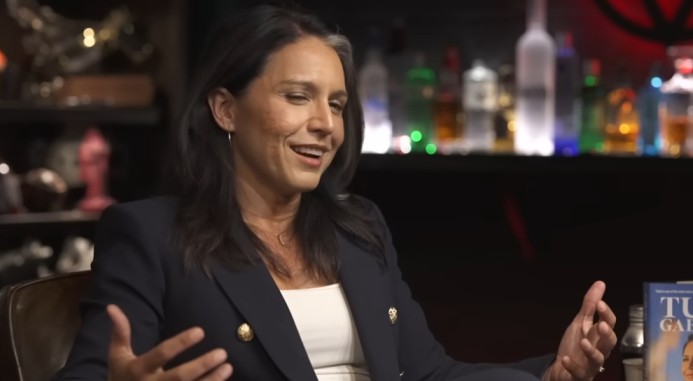
Read the full transcript of Tulsi Gabbard’s interview on Shawn Ryan Show (SRS #131), September 16, 2024.
Brief Notes: Former congresswoman and combat veteran Tulsi Gabbard joins Shawn Ryan to expose what she sees as the “dark behaviors” of today’s Democratic Party, and why she ultimately chose to leave it behind. She details how U.S. leaders have armed jihadist groups abroad, refused to secure the southern border, and used national security powers against political opponents, arguing these decisions put Americans at risk. Tulsi also shares lessons from her Stop Arming Terrorists Act, her fight against open-borders policies, and what ordinary citizens can actually do to hold Washington accountable instead of just yelling at the TV.
Introduction
SHAWN RYAN: Tulsi Gabbard, welcome to the show.
TULSI GABBARD: Thank you.
SHAWN RYAN: We have been trying to make this work for a long time. Several months. And I’m very thankful it’s finally happened.
TULSI GABBARD: Thank you.
SHAWN RYAN: Welcome to Tennessee.
TULSI GABBARD: Thank you.
SHAWN RYAN: This is your first time here?
TULSI GABBARD: I’ve been here a bunch. It’s always very quick passing through, always good, short visits. But this is one of those as well.
SHAWN RYAN: Right on, right on. Well, I’m just super happy to have you here. And you got a new book out.
Writing the Book That Explains Why She Left the Democratic Party
TULSI GABBARD: That’s why it took so long to come here, by the way. There was a period, first of all, the book took me longer to write than I anticipated. It’s the first time I’ve written a book.
And second of all, during that period while I was writing, I just stopped doing any podcast because, as you know, you give up a little bit of time here, a little bit of time there. And for me, it took time to be able to just hone in, and I wasn’t able to stop everything in my life, but I put off doing podcasts for that whole period of time.
SHAWN RYAN: I don’t blame you.
TULSI GABBARD: I appreciate your patience.
SHAWN RYAN: I don’t blame you. I’m sure everybody is trying to get you on. How long did that take you to write, if you don’t mind me asking?
TULSI GABBARD: Let’s see. So I announced that I was leaving the Democratic Party in October of 2022, and I got a call from a publisher who saw my announcement. I made a little video announcing the main reasons why I was leaving the Democratic Party.
Publisher called and said that announcement read like a book outline, and we’d love for you to write a book if you’re interested. So fast forward to book release date was April 30, 2024. I was originally supposed to push the book out, I think the original published date was summer of 2023. It took me a lot longer.
Yeah, I mean, honestly, it all worked out, I think, for the best because the book came out at kind of a fortuitous time, given what’s going on in the country and with this election.
SHAWN RYAN: Yeah. Well, I’m glad you wrote it. Is it doing well?
TULSI GABBARD: Yeah, we made the New York Times bestseller list, which I was surprised by.
SHAWN RYAN: Congratulations.
TULSI GABBARD: I’ve heard so many stories about how that’s very much an editorial decision on the New York Times part. So I’m glad that it broke through. And it’s been encouraging how many people I hear from, it’s been a few months since the book came out, who either tell me that their own experience is reflected in my book about why they left the Democratic Party.
I met a young woman recently. She’s in her mid, late 20s, talking about how her whole family, they’re all Democrats. And she’s just, the Democratic Party doesn’t make sense to me. And so she appreciated the book because it helped her articulate to her family just the insanity that’s going on and hoping that that causes them to have a different look at maybe the party that they’ve always known, which just doesn’t exist today.
So I’m just encouraged that it’s giving people food for thought, as there are a lot of politically homeless Americans who love our country, but who are kind of disgusted by our politics today to understand our role. And that’s really at the end of the book. There’s a call to action. We can talk all day and all night about the problems with our politics in America today. But what good is that unless we actually do something about it?
The Problem: Americans Won’t Get Off the Couch
SHAWN RYAN: Yeah, I mean, that’s interesting that you say that, because I want to do a life story. I don’t know if we have time for that, so I’ll leave it up to you if you want to do that. But I mean, what I think that a major problem in this country, I think it’s on both sides, is that people don’t, they want to point the fingers and they want to hold everybody else accountable and point on everybody’s flaws and mistakes and corruption.
And I love doing that, too. I love holding people accountable, but I also hold myself accountable. And we just kind of went through this with my own audience. I went to Vienna and interviewed Commander Massoud. Do you know who that is, by chance?
TULSI GABBARD: Yeah.
SHAWN RYAN: The leader of the Afghan resistance. Because this administration is sending $87 million a week over to the Taliban, an organization that we both fought for over 20 years in the U.S. and everybody’s been outraged. “Oh, why would we do that? This is enraging. How could we be funding terrorism?”
And this has been a string of interviews that I’ve done to bring light to this. Started with the withdraw, then first broke the money trail with an Army Intelligence Afghan American, then brought on a CIA targeter, then went to the horse’s mouth, Massoud himself.
And we had a petition. I had a petition in the link that I wanted people to sign to get Congressman McCall to bring in Massoud in front of Congress so that he can talk about how the policies that we’ve created with this administration are affecting our allies and how we’re funding terrorism and the things that we need to be watching out for with what the terrorists are using the money for and how it’s going to affect us and our kids, more importantly, our kids later on in life.
That interview at the time had 650,000 views.
TULSI GABBARD: Fascinating.
SHAWN RYAN: All the outrage, all the pointing fingers, all of that. And 66,000 people out of 6 million signed the petition. So then I did a little, I was upset, you know, and I made a little video. I did a post and showing how upset I was. But I said, that’s important, though.
TULSI GABBARD: I mean, this is how we reach people.
SHAWN RYAN: Yeah. And I just, you know, said, this is why nothing ever changes.
TULSI GABBARD: Yes.
SHAWN RYAN: All anybody wants to do is point the finger at everybody else. Nobody wants to hold themselves accountable. Heaven forbid you get up off the couch or click your finger on a link.
TULSI GABBARD: Stay on the couch.
SHAWN RYAN: Yeah, to sign the petition. And I did that. And now we’re over 200,000 signatures, which is, I think, enough pressure to get him in front of Congress, despite State Department blacklisting him. But, I mean, what are your thoughts on that?
The Stop Arming Terrorists Act: A Bill Congress Refused to Support
TULSI GABBARD: About people? Yeah, I mean, I introduced legislation while I was in Congress called the Stop Arming Terrorists Act. And the fact that that would even have to be done at all is a whole conversation in and of itself.
But this was specific to, under President Obama, how they were both directly and indirectly arming actual terrorists in Syria in that regime change war. And again, not thinking through, I mean, they saw, okay, well, these terrorists, you know, Al Qaeda, Al Nusra, these various terrorist organizations there that we as taxpayers were funding because President Obama wanted to topple the regime in Syria.
And obviously, these guys are the most effective fighting force that they thought would be able to do that. But when I, and I served on the Armed Services and Foreign Affairs committees in Congress, as this was going on, and when I asked questions about, “Well, okay, so this is your goal. Your goal is regime change. Who’s going to fill the vacuum? Who is going to lead the country of Syria?”
“Oh, well, you know, there’s this political opposition group.” It’s, that’s bullsh*t. When you’re arming Al Qaeda and Al Qaeda linked terrorist Islamist terrorist groups, they are and will be the most powerful force on the ground. And their goal, you may not agree with it, but their goal, they’ll be happy to take your money or our money as taxpayers and the weapons that we provide, and they will then fill that vacuum of leadership.
That is who would replace the regime and how does that serve our national security interests? How does that serve, you know, how does that make us safer? And so as you were explaining this situation, it is a very similar situation.
And whether the kind of lead time or the consequences of this funding and who are we actually supporting and what are they doing with that money and what are their objectives, you may have your own pie in the sky, fantastical ideas about what you’re doing, which is often the case, especially with my former party.
But it’s not Democrats alone. There were Republicans who supported that under President Obama, as there, I’m sure there may be some now with this funding, you know, they say, “Oh, well, this is what we are trying to achieve.” But very often it is not at all rooted in reality and the world that we live in.
And so I just, it was kind of a blast from the past as you were talking about how we are yet again arming terrorists to our own detriment as a nation. And I remember, first of all, I sent out a blast to every member of Congress encouraging them to co-sponsor the Stop Arming Terrorists Act. And it was my version of what you went through with the petition.
SHAWN RYAN: Man.
TULSI GABBARD: Very, very few. And I don’t remember the exact number. I think we got, I’d have to go back and look at the number. But I think we got Rand Paul in the Senate to introduce it in the Senate. But very, a very small handful of members of Congress actually signed on to this legislation.
SHAWN RYAN: Why do you think that is?
Why Congress Refuses to Stop Arming Terrorists
TULSI GABBARD: They tell themselves that, and this is me guessing, because nobody ever gave me a good reason why not to. What I imagine is they tell themselves, “Well, you know, this dictator’s a bad guy and we got to take him out. And, well, if we got to work with these people or those people, then that’ll help us to get there.”
And then, you know, they don’t actually think it through. I can’t even, even if I were to kind of red team it and put myself in their shoes, I can’t come up with a rational, logical argument about why they would refuse to sign legislation called the Stop Arming Terrorist Act.
Either they are ignorant and choose to be ignorant, or they believe that the ends justifies the means. But the ends that they are looking at, again, they are not rooted in reality. When you look at the real consequences of their policies and their decisions, it turns out time and time again to be an outcome that is counter to the best interest of our security and the interests of the American people.
Actually, there was a reporter just off the House floor. You know, all 435 members of Congress go and you vote. And the reporters, you know, they’ll huddle around the few exits that are there and try to catch people on their way in or out.
And I remember this woman, I forget what outlet she was with, one of the main ones. And she was trying to justify that to me. She was saying, “Well, Congresswoman, don’t you think that sometimes you have to work with people who you don’t like in order to accomplish your objective?”
And I just remember looking at her, I’m saying, “So you are justifying us providing money and weapons to the very exact same terrorist group that attacked us on 9/11. You think there’s justification for that?”
And she’s, “Oh, well, you know, I mean, I just, you know, some people might say, blah, blah,” you know, I was, “Give me a break.”
SHAWN RYAN: They’re cutting our heads off on national television.
TULSI GABBARD: Yeah.
SHAWN RYAN: This isn’t, come on, let’s just work through some disagreements.
TULSI GABBARD: Yeah.
SHAWN RYAN: What?
TULSI GABBARD: Yeah.
SHAWN RYAN: What planet are…
TULSI GABBARD: Yeah. And it’s not, okay, well, these guys are, you know, the drug runners or, you know, they’ve got running diamonds in the black market. I mean, you know, this is not, these are not hoodlums in the neighborhood that they’re talking about here.
SHAWN RYAN: They just burnt a family alive five minutes ago in a cage. Jeez, you know, this isn’t a minor disagreement and trying to work through differences. No, but do you, I mean, when it comes back to the, I’m sorry, the bill. What was the bill?
TULSI GABBARD: The Stop Arming Terrorists Act.
SHAWN RYAN: Great name.
TULSI GABBARD: Yeah, I’m all about the direct approach, man.
SHAWN RYAN: I mean, do you think that they’re, are they smart enough to even see an end game? When you brought up that excuse, are they smart enough to even see the end game?
The Complexity of Foreign Policy Decisions
TULSI GABBARD: I mean, no is the answer. You know, I wouldn’t doubt that there are some nefarious intents by some people or intentions by some people, but I think that any kind of clarity that a normal person would have in looking at this situation—like any normal, common sense person—you don’t have to have served in the military to get this. You don’t have to have some degree in foreign policy and geopolitics to understand how insane this is.
It seems like their judgment and the normal clarity that should be there is clouded by arrogance and this idea that, well, just because we say this is what the outcome will be, that’s what it will be. There are so many different examples of—and I actually asked, I questioned then Secretary Mattis, and this was a few years later, obviously, but I questioned because this was continuing on.
And I asked him in an open hearing in the Armed Services Committee, why aren’t we going after Al Qaeda in Syria, Al Qaeda and ISIS in Syria? Because the focus was on regime change, not on defeating Islamist terrorism at that time. And his answer was, “It’s complicated.”
The Deep State’s Justifications
TULSI GABBARD: Period. Wow. And this is what I see as a common affliction in so much of—you can call it the deep state, permanent Washington, the national security state, people in the State Department, the Department of Defense—they get so, I don’t know, it’s like they get so lost in these complexities that they have created for themselves that somehow justify a position that is not good for our country.
It’s not complicated why we’re not going after Al Qaeda in Syria. It’s not complicated. There’s a reason for it. Tell the American people what the reason is. Why are you not—we have our military there—why are you not prioritizing them, going after and defeating this Islamist terrorist group that attacked us on 9/11?
And yes, they’ve changed—Al Qaeda, Al Nusra, Jabhat al-Sham and all these different names that they’ve used—same groups of people, same radical Islamist ideology that’s fueling them.
In this same example, they took over an entire city in northern Syria and they did so with the promise and protection of the United States government. The name of the leader of that arm of Islamist terrorist groups is still there. He is still ruling that city.
I’ve talked with some of the Syrian Kurds last year. They are working in Washington, D.C., obviously still fighting for the lives of the Syrian Kurds who are under threat from Turkey every single day, but who have been our most reliable fighting force against ISIS. I think we could not have defeated ISIS without them.
And I asked them, I was like, what’s going on with this city? And they said, no, it’s still under the control of Al Qaeda, Al Nusra. And you have to go back. And I believe there is a clip where I was obviously calling for, even under the Trump administration, go after this terrorist organization that is in control of this northern city in Syria.
And I think it was Nikki Haley who was calling for our U.S. Air Force to protect them and go after anyone that tried to attack that city. It was just, you know, these things are to me unexplainable. But I have no doubt that they will come up with some kind—like Nikki Haley will come up with some kind of gibberish to support that position. When you look at it on its face and it just, it doesn’t make sense, man.
Tulsi Gabbard’s Background
SHAWN RYAN: We’re going to dive into this deeper. Let me give you a quick introduction before we get too in the weeds here. Now, I’m really excited to interview, but Tulsi Gabbard, you’re a combat veteran with three deployments to war zones in the Middle East and Africa, a four-term congresswoman and a 2020 presidential candidate.
You’re now lieutenant colonel in the U.S. Army Reserve and still wear the uniform with more than two decades of selfless service. At the age of 21, you were elected to the Hawaii State House and served as the youngest female legislator in our country.
You were elected to Congress and served eight years as a member of the Armed Services, Homeland Security and Foreign Affairs Committees. You are a candidate for the Democratic nomination in the 2020 United States presidential election and the rising star for the Democratic Party. Before leaving the party, you were elected vice chair of the Democratic National Committee.
You are an author of the New York Times bestseller “For Love of Country: Leave the Democratic Party Behind.” You are an independent-minded person who puts country before party and approaches every issue with the aim of ensuring the safety and freedom of the American people. Am I missing anything?
TULSI GABBARD: I think you got, I think you got the big stuff.
SHAWN RYAN: I’m sure I’m missing some stuff. And then just a couple of things. Knockout. So I have a Patreon account. There are top supporters that have been here since the beginning.
TULSI GABBARD: Awesome.
SHAWN RYAN: I wouldn’t be here if it wasn’t for them and neither would you be. So one of the things that I offer them is the opportunity to ask each guest a question. And so this is from Norm Becker and I would love to chime in on this as well, if you don’t mind.
Historically, you are for the reduction of military spending and overall downsizing. What is your stance on that now with the current administration’s open border policy in relation to an attack inside the United States being we have a few hundred thousand undocumented military age men who will be responsible for the safety of Americans?
Military Spending and Department of Defense Accountability
TULSI GABBARD: There’s a few questions in there. There’s a few things going on there. We should have the military that we need to ensure our safety, security and freedom. I disagree with those who say, oh, well, you know, we should cut the military budget in half. That’s an arbitrary statement. Why half? Why not 60%? Why not 20%?
There should be an audit, which has not been done, of the Department of Defense and an assessment of how are we spending our taxpayer dollars in the Department of Defense, and are those dollars being spent making us more safe, making our military as ready as they need to be to keep us safe to defend our safety, security and freedom?
Anybody who says that the Department of Defense is not bloated and spending far more than they should hasn’t been paying attention to what’s going on in the Department of Defense. Their priorities have been—you know, I get the congressional process and authorizations and budgets and everything else—but the fact that the Department of Defense has so far failed every single audit tells us about how irresponsible they have been in managing our taxpayer dollars and spending.
I’ll give you the most current example that I saw as of yesterday. There’s a headline that popped up. Department of Defense is announcing they’re going to give economic hardship bonuses to troops.
SHAWN RYAN: What does that mean?
TULSI GABBARD: 20 bucks a month? About $120 a year? Yes. And so I read the headline. I was like, oh, that’s interesting. Economic hardship bonus. The economy has been tough, especially for junior enlisted service members. Food stamps, going to the food bank, trying to support a family, especially those who have young families. Okay, sounds like a good idea. 20 bucks a month.
Turns out Congress authorized an economic hardship bonus last year and only now is the Pentagon getting around to making these payments and have said, well, this is all that we can afford. And it’ll go to service members of the ranks of E1 to E3. The White House adamantly opposes this until they complete their administration study on military pay and compensation.
SHAWN RYAN: Boom, there’s a budget cut.
TULSI GABBARD: Exactly.
SHAWN RYAN: Get rid of that entire process.
The Pentagon’s Misplaced Billions and Military Readiness
TULSI GABBARD: Exactly. And that’s my point. So this is the same Department of Defense that says, “Oops, we misplaced $4 billion that we just found and now we can send that to Ukraine immediately.” And you’re telling me you can afford roughly 120 bucks a year for our junior enlisted service members because of economic hardship under the Biden-Harris administration?
The whole thing is a freaking joke. But it’s a joke that has very real consequences on the men and women who are serving and on our military, and therefore on our safety and security.
So, you know, yes, I am advocating for cutting the waste and fraud and abuse that goes on in that big building in the Pentagon every single freaking day. Every single day. Closing the revolving door. Making it so that whether you’re a senior civilian or you are a senior uniformed person in the Pentagon, you should not be writing contracts for Lockheed Martin or whoever you want to go and get a job from as soon as you retire out of the federal service.
There are so many changes and reforms that need to be made to make sure, again, our taxpayer dollars are going to serve a military that is best equipped and ready to ensure our safety, security and freedom.
The Border Crisis and National Guard Solution
On the border, huge issue. We have no idea how many people—you know, the question cited a couple hundred thousand—we don’t have any idea how many people have streamed through our borders illegally who pose that direct threat to us here on our own soil.
I would encourage, should President Trump get elected, and I would encourage President Biden today, hey, if you’re really serious about securing our border, which we know he’s not, federalize and mobilize the National Guard. I was in the National Guard for a lot of years. Our job is to support the homeland, whether it’s during times of national disaster or crises or emergency. I would say this is a very serious national crisis and the President has the authority to federalize the National Guard to deploy them to go and actually help secure our border.
Witnessing the Border Reality in San Diego
I was in Southern California, San Diego, and spent a couple days down at the border there just to see for myself. A lot of people talk about Texas and Arizona. Very few people are paying attention to what’s going on in San Diego and went down there. What I saw was astounding to me because within a few minutes we came upon these little camps almost of illegal immigrants. More and more people walking up just as I was there.
This idea of the “gotaways”—you hear about the gotaways on the news all the time. Well, how many gotaways are there? These are people coming across the border, knowing exactly where to go for Border Patrol to pick them up. And they sit there, peaceful, calm, cell phones, candy, snacks, chilling, waiting for Border Patrol to pick them up because they know that Border Patrol come load them in the van. They’ll go to the processing center and they’ll walk out with that white piece of paper, says that they’ve claimed asylum and they are no longer undocumented. They are now documented and they get a plane ticket to go anywhere in the country where they want to go.
And I talked to a number of people there who’d come from all different countries, none of them from Mexico, by the way. Mexico is the only country, apparently, where Border Patrol sends them immediately back across the border. You come from any other country, they go through this process that I just talked about.
Talked to this one guy who came from Colombia, and he said, “Oh, I flew into Tijuana and then walked across. Took me, I don’t know, a couple hours.” And I asked him, “Have you been here before?” “Oh, yeah, I’ve been here before.” Interesting. He had no issue talking, by the way. He was very relaxed. And I said, “Oh, where are you headed?” “So I’m going to Utah.” I said, “Really? What’s in Utah?” He’s like, “Oh, I got a woman there.”
And there were different stories from different people I talked to from Brazil. There were people from Venezuela, people who were very clearly tatted up gang members from Venezuela. One guy super, super high on drugs. All of these people just waiting for Border Patrol to pick them up and essentially be this Uber driver to take them from illegally crossing the border, process them through.
You know, we followed the process through to the train station, to the airport, the whole thing. And then I talked to a guy who’d lived there, lived in that area for decades, and he said, “God, I really wish Texas would send their National Guard to help us out here.” I said, “What about California? You got your own National Guard here.” And he just shook his head and he’s like, “Gavin Newsom will never send our National Guard to actually defend our borders.”
The solutions are there. It takes leadership that really cares about solving this problem with the sense of urgency that it requires to do so.
The California Migration Crisis
SHAWN RYAN: Do you think that they are—why are they so for the open border? Is it really for the vote? Is it so that they can—I mean, we’ve seen the massive migration of people out of California, Tennessee. A lot of the neighborhoods here are 60% California now. 60%. Finding an original Tennessean is trying to find a needle in a haystack anymore. They all got pushed out, you know.
And, I mean, I hate to say it, but every state I visit complains about the same people. And it’s always California, Montana, Utah, Texas, Florida, Tennessee, Nevada, Arizona. Every—I’m, how many of these people are there? Whose life—
TULSI GABBARD: What is there about—I don’t know, 40 million people live in California.
SHAWN RYAN: Wow. Everywhere is complaining about them.
TULSI GABBARD: Yeah.
SHAWN RYAN: And—
TULSI GABBARD: So is—
SHAWN RYAN: Is the Left, is it? Well, I don’t believe anything I hear anymore.
TULSI GABBARD: Yeah.
SHAWN RYAN: On the news, on most podcasts. I have a very select group of people that have a level head with more insight than I do, that I call to give me a sanity check. But is it—is this why they want the border wide open and they’re not addressing it? Are they—they don’t want California and New York and Illinois and all these states where everybody’s migrating out of—they don’t want to—is it that they don’t want to lose the electoral vote?
The Real Reasons Behind Open Border Policies
TULSI GABBARD: That’s certainly a big role. Sure. And it just—they’ll never admit it. Of course, maybe some of them would, but I’ve never heard anyone admit that. But when you start adding one plus one plus one plus one, you have open borders. You have this massive opposition to requiring voter ID and most recently, massive opposition from the Democrats to the legislation the Republicans just passed requiring proof of citizenship to vote.
Massive, vocal, passionate opposition coming from Democrats in the House. We’ll see if the Senate takes it up. Apparently, they just want there to be an honor system. And then you actually have some cities and counties already opening up voting for those positions to people who are not citizens, who are illegal immigrants.
There was a congresswoman out of New York named Yvette Clarke who was—she wasn’t caught on camera. She was doing an interview, and she was just, “Hey, bring him over here. I need more people in my district. We got space because we need to keep my district,” referring to the redistricting. And so I think that’s certainly a huge part of it.
There are those who believe truly in open borders from a philosophical standpoint. They believe that the United States of America—I’m talking about the AOCs of the world, and there are others—they believe that we in the United States should welcome anyone from anywhere who is seeking a better life in America. And therefore they don’t believe in borders.
You go back to—and there are actually, even though they may not say, “Well, I believe that there should be no borders in the world” and kind of one world philosophy—I go back to the, again, the 2020 Democratic primary, where the vast majority of Democrats who were running for President in 2020 believed that crossing the border should result in a civil fine that would equate getting a parking ticket. That’s an open border. Yeah, that’s an open border.
And then the last thought on this is that they have, ever since Trump ran for president in 2016, painted him and anyone else who called for securing our borders and an end to illegal immigration as xenophobes and racists. And “you hate brown people if you are against illegal immigration.”
So it makes it hard for them now to say, “Okay, well, this is way over the top. We have to secure our borders. We have to stop illegal immigration.” Well, okay, so are you now racist also? Do you also hate brown people now? Because that’s the situation that they’ve created.
The Hypocrisy of Immigration Rhetoric
And then even most recently, you saw with J.D. Vance’s wife speaking on the stage at the Republican convention and the headlines that came out of that as she’s talking about her immigrant parents who came from India, she grew up in San Diego, and all of this, and how grateful she is for the life that they were able to provide. And so on.
The headlines were essentially, “Gosh, isn’t she such a hypocrite?” Where she’s speaking at a convention where they are calling for the deportation of illegal immigrants as she is telling the story of her immigrant family, which again, just begs the question, do they just not understand the difference between legal and illegal immigration, the rule of law?
And I refuse to believe that they are that stupid. So it really points to that bigger question, why is it that they’re creating this narrative that anybody who supports secure borders is a racist who hates brown people?
Fixing the Broken Immigration System
SHAWN RYAN: Has there ever been a discussion of let’s just fix the actual immigration policy instead of just opening the borders? Why is the—I mean, it just seems to me there’s no common sense within government anymore. And so, I mean, there’s a lot of good people coming in here and there’s a lot of bad people coming in here. And I think we could always use more good people in this country. And so why hasn’t that discussion—maybe it has been had, but why? To my knowledge, it’s never been had.
TULSI GABBARD: There have been different serious efforts at fixing our—because our legal immigration system is very, very broken. I have a friend who, I don’t know how long he’s been in the Army. He’s a Green Beret warrant officer, I think, 32, 33 years of service. He is retiring. His wife’s family or her sister lives in Italy, I believe, married, kids, kids in school. They have a home, jobs, et cetera, an established life.
They applied for tourist visas to come and attend his retirement ceremony and were denied. They wanted to come for two weeks to the United States to attend this significant life event of their loved one, and they were denied. “Oh, well, you know, you don’t have proof of whatever.” I don’t even know what the reason was. But there are so many different examples of how broken our legal immigration system is.
There have been a few serious efforts over the years toward actually solving it. Ultimately, they have—I think the hyper-partisanship often has been what tanked it. Where in order to pass legislation like that, you’re going to have to have a give and take from both parties who have very different views on what that solution should look like. So by its nature, you’re going to end up with probably a 70% solution.
And ultimately, you know, there was famously, and I forget what year it was. I think it was in the late 2000s. There was the Gang of Eight senators, four Republicans and four Democrats. They came very close to passing reforms, but ultimately it failed.
The Failed Border Security Bill
Some will point to a recent effort that was underway under the Senate to secure our border. It was bipartisan. The mainstream media and Democrats blamed Donald Trump for that legislation failing. But that to me was—I looked at it and there was no way that I could have supported that if I was in Congress then, because the bill’s intent was to secure our border. That’s what they sold it as.
The problem was it institutionalized illegal immigration. It basically said, “Well, we will”—there were a lot of reasons wrong with it, but the crux of it was up to 5,000 illegal immigrants a day will be okay, will be acceptable. Anything beyond that, then we’re going to shut down the borders.
And in my mind, okay, well, let’s go and look at the cartels who are the ones who are profiting off of our open borders. All that says to me is they’ll look at all of their customers and say, “Okay, well, we got 5,000 through today. You got to wait till tomorrow.” It institutionalizes it in our laws to say, “Well, we will accept illegal immigration up until this point.” That is not a solution.
SHAWN RYAN: So they were just talking about taking just any 5,000 people.
TULSI GABBARD: Yeah, just illegally crossing our border.
SHAWN RYAN: Yeah, just come on.
The Border Security Debate and Executive Action
TULSI GABBARD: Not 5,000 people coming to our border and showing papers or applying for a work visa or any of these other things. It was up to 5,000 people illegally crossing our border. What ended up happening was President Biden signed an executive order that essentially did that same thing which he is now touting as. And there has been a reduction of people coming illegally coming across our borders since he did that like two months ago.
After three years of saying our border is secure, obviously an election year ploy. But once again, it doesn’t actually solve the problem just like the legislation didn’t solve the problem.
SHAWN RYAN: Yeah. Wow. Man.
I just, I’m frustrated.
The Power of Informed Voters
TULSI GABBARD: I’m really frustrated with what’s going on, me and most people. And this is, you know, here’s why I am hopeful and why I’m doing all that I can to get out and talk to people, share my own experiences with people, answer their questions and concerns wherever I can on any platform I can, is because I know that there are so many people who feel, as you and I do, incredibly frustrated and not really seeing a way out given how much gridlock there is in Washington and how too many politicians are putting their own self-serving interests ahead of the interests of the country.
This is why we don’t have anywhere close to 80, 90, 100% voter turnout, because people feel hopeless and don’t feel like my vote is and my voice will make a difference. The powers that exist in this broken system are too great. But that’s wrong. It’s not true.
I do understand that feeling of hopelessness, but the only way we change this is at a bare minimum, being informed voters and holding leaders accountable and not turning a blind eye when it’s the party that we like. Not being blind followers, being critical thinkers, not believing everything that you hear and what people say, but actually being informed, being critical thinkers and voting.
That is how in this system we can bring about wholesale change by putting the right people in office who are committed to the Constitution and to our country and who have a backbone and the courage to root out the deep rot of corruption that exists within every agency of our federal government.
SHAWN RYAN: Yeah, yeah. How, other than voting, how do you hold politicians accountable?
Grassroots Activism That Works
TULSI GABBARD: I mean, the thing that you did with the petition, I think that’s a great idea because it forces their hand in a very public way to try to do the right thing. I’ve seen in real time, I experienced in real time, people wonder, if I call my congressman, do they really care if I send an email, if I put out a tweet? You feel like you’re yelling into the darkness and no one is hearing you. And maybe if you’re just one person doing it, that may be true. But if we all kind of throw in the towel, then we’re giving up without a fight.
I’ve experienced in real time, there was a bill that was coming to the House floor for a vote and it had strong bipartisan support. I remember looking at the readout that I got and the assessment that I did before every single vote that came through. I had my staff put together, okay, here’s why the Democrats are saying to vote for or against this bill. And here’s why the Republicans are saying to vote for or against this bill.
Then I could look at, you know, oftentimes very different narratives, all talking about the same piece of legislation. But in this case, the recommendations were of, hey, we need to vote for this legislation because it’s going to do X, Y or Z, and it’s a good thing. And it had overwhelming support. Close to 400. It was expected to pass with over 400 votes of support.
In the four to six hours prior to that vote taking place, there was a flood. It started trending on Twitter, still Twitter back then. And phone calls, you know, phones were ringing off the hook. People were tweeting about why this legislation was not a good idea. And here were the potential unintended negative consequences that would come from this legislation. And it was dead. It tanked. Overwhelming bipartisan opposition to the bill.
And that was within the span of one day. And so, you know, it doesn’t always work out that way, but we have many, many more numbers than them. And ultimately most members of Congress, what they fear most is losing their job. And that’s where we have to recognize the power of our voice. So, yes, through voting, but it’s also actually using our voice to hold them accountable.
SHAWN RYAN: You know, I just had Erik Prince in here yesterday, and I was asking him, you know, I was like, well, shit, now I got two hundred and something thousand signatures, so people are counting on me to do something. I was like, what do I do if this McCall doesn’t, what if he just doesn’t respond?
Yeah, he’s like, oh, that’s easy. You just tell him you’re going to do a fundraiser for his opponent the next election and he’ll fall into line. And I was like, that’s actually pretty, yeah, it makes sense.
The Lobbyist Problem
TULSI GABBARD: And you just look at, okay, you’ve got those 200,000 people. Yeah, they all chip in 10 bucks, 15 bucks. This is how members of Congress have lost their jobs. Because so many of them, however and wherever they started. Again, I’ve seen this firsthand, how so many of them kind of go away from maybe the grassroots that they came from.
SHAWN RYAN: Man, they’re not lying.
TULSI GABBARD: And the vast majority of their campaign war chests now come from lobbyists, corporate lobbyists, and that’s who they spend their breakfast, lunches and dinners with and who they spend their, you know, sometimes their vacations with. And that’s where their attention is focused. You know, really forgetting, oh, well, you know, it’s the voters and the people who are the ones who actually hired me here.
And it’s a, it is the power that we have, but it’s only powerful if we use it.
SHAWN RYAN: Yeah, you know, I see a lot of that in the, but I don’t really pay attention. I pay attention to the Democratic Party, but not individuals as much as I do. I’m very critical of my own party. And as the show’s growing, I’ve gotten to know a lot more congressmen, senators, the political types, and even the, even the veterans, man, that are going into the Republican Party.
I mean, it’s almost like, man, you’ve been in there for six months and you’re already sucked into the establishment. Yeah, but how does it happen?
Staying Grounded in Washington
TULSI GABBARD: Well, I can tell you how it didn’t happen to me.
SHAWN RYAN: Please, please share, because…
TULSI GABBARD: Well, first of all, when you have people who go in, some of them may think, well, if I just play the game, then I’ll get to a place where I can actually make a difference. And that just continues and continues and continues on until they become someone who is unrecognizable and their priorities shift.
It is very easy for people to get sucked into the swamp in Washington. And if people, and maybe this is not what they were looking for when they ran for office, but immediately you are treated like you are something special. Red carpets are rolled out, special access, VIP treatment, fancy parties, people kissing your ass every freaking day.
And if you are not firmly rooted in your purpose, that higher purpose of service to our country and to your constituents, to the American people, I have seen how quickly people fall for that hype. And it’s just, it’s crazy because it’s all fake.
SHAWN RYAN: Yeah.
TULSI GABBARD: People only treat you special because they want something. And the moment you leave, the moment you leave, you don’t exist. They don’t care about you.
And this is, you know, I’m just, I’m grateful that I knew why I was running for Congress. I mean, in a nutshell, it was those experiences that I had during my deployments, and my eyes were opened in a way that I couldn’t pretend, you know, that those lessons that I had learned, experiencing the cost of war, seeing the war profiteering up close and personal, I left those deployments knowing that I wanted to be in a position to do something about it.
Because I was frustrated and pissed off by the politicians who would come in and drop in and you know this, they drop in for a day, shake some hands, take some pictures and take off and go back to Washington talking about, oh, I know exactly what’s going on in the war. I’ve been to war 20 times. Like, bro, no you don’t. You don’t actually know.
You should go and do the research. You should go and actually, instead of just taking a photo op, why don’t you go and sit down with the guys? Not just the stars. Yep, you can listen to them too. But go and actually sit down with the guys at chow and ask them what’s really going on. Actually listen to what’s really going on. Don’t think that you already know.
I just, I came out of that knowing I wanted to be in a position to make those decisions about our country’s foreign policy, about war and peace, and the well-being of our brothers and sisters in uniform, both while they’re in uniform and after they lay it down. I didn’t know exactly where I wanted to be, what position. I looked at a lot of different things, but ultimately that’s what drove me to run for Congress.
And I still carry that sense of responsibility and that sense of purpose with me today. It was never about, I had zero interest in chasing a political title or a specific office or a job. It’s about where and how can I make the most positive impact in service to our country.
The Washington Hype Machine
And so when I was elected to Congress, I was frankly shocked by all of this stuff being thrown at me. You know, the Democratic Party, and they’re like, I wasn’t even sworn into office yet. I went to the Democratic Convention, Nancy Pelosi invited me to speak during primetime about veterans, said, yeah, of course I’ll take that opportunity.
And I went there and there were people on CNN saying, oh, look at her, she’s a rising star of the Democratic Party. I wonder what famous actor’s going to play her in a movie? And all this stuff. And it was so surreal for me because I just, you know, I had no idea what to expect. I certainly wasn’t looking for any of this. And quite frankly, it made me uncomfortable.
I had been sworn in for maybe two, three weeks when I got the call saying, do you want to be vice chair of the DNC? I was like, what is a vice chair of the DNC?
SHAWN RYAN: What is the vice chair of the DNC? It sounds important.
TULSI GABBARD: It does. It’s, you know, I mean, I think there are four or five in the DNC. Maybe a couple more. I’m sure the Republican Party maybe, I don’t know, actually, if they have the same thing. But, you know, in theory, you are an officer of the Democratic National Party, and you have a leadership role in shaping the direction of that party.
I said, yeah, I will go and do my best to make a positive impact there. Vogue magazine called my office one day and said, we want to do a special profile on Tulsi Gabbard. And my press secretary came in and told me. I laughed, literally, you got to be joking. I’ve been buying my clothes from, you know, what is it called? Ross, you know, Vogue wants to talk about me.
I was like, you know, first of all, this is a joke. If it’s not a joke, I’m not wearing a bathing suit because they want to do it in Hawaii. I was like, I’m not wearing a bathing suit on the beach in a photo shoot. I’m not interested in any of that.
Anyway, this stuff kept on happening, and I was grounded enough to recognize, I didn’t come here looking for any of this. This is just weird. The first reception that I went to hadn’t been sworn in yet. They bring all the new members of Congress in a few weeks before you’re sworn into office. They call it freshman orientation. And you get your phone and you get a laptop and you get your ID card, and, you know, you go through a lot of ethics briefings and policy briefings.
SHAWN RYAN: Yes, they must be lacking on that nowadays.
The Culture of Power and Privilege in Washington
TULSI GABBARD: It exists, I promise. But I remember going to this reception that one of the leaders of the Democratic caucus was hosting, and I didn’t know until I got there that it was a reception where every lobbyist in town was invited to meet the new members of the Democratic caucus. And there were 50 in my group of just Democrats.
So I got there, and I was looking around and went to go stand in line to get a soda or whatever from the bar. And this guy who was in front of me, there’s 20 or 30 people in line. And this guy was in front of me was like, “Hey, how are you? What’s your name?” And I introduced myself, and he saw my name tag, and it said Congresswoman Elect.
And he’s like, “What are you doing in line?” It’s like, “Same thing you are. I’m waiting in line to get a drink.” He’s like, “Okay, let me tell you how this place works. You are now a member of Congress, and you will never stand in line in this town ever again as long as you’re in office.”
I remember that to this day because it really took me aback. And of course I stood in line. I’m not going to, “Oh, well, thank you very much. Let me just go cut to the head of the line here.”
A few days later, I was running late for a meeting and went into the Capitol, just on the street level. Asked the Capitol Police officer there. I was like, “Hey, this is where I’m trying to go. It’s in the basement. Can you point me in the right direction, please? Because I don’t know exactly where it is.”
And there’s a woman. She said, “Yeah, sure, I’m going that way anyway, I’ll walk you down.” So I started talking to her as we were walking, and I told her, I was like, “This has got to be kind of chaotic for you guys, because you’re manning the doors. You’ve got a whole bunch of us who are new here and trying to find our way around.”
And she’s like, “Oh, no, no. We like you guys because you’re still nice to us.” I said, “What do you mean? What are you talking about?” She said, “Mark my words, in about six months, maybe only half of you will still be nice to us.” Never forgot that conversation.
A few years later, where my office was, you end up seeing you have the same Capitol Police guys who are stationed at that specific post. So I often would stop by, talk to them, like, “Hey, how’s it going?” Whatever. I got to know them.
So one night after votes, I was standing there inside the door, and somehow I forget what the conversation was, but I went back to this, and I shared this story with them. And they looked at the door, they saw a member of Congress heading towards that door, and they were just like, “Stand behind the corner where you can’t be seen. Watch this.”
Member of Congress walked in. They said, “Hello, sir. How are you?” Totally ignored. Guy just walked right by, like they didn’t even exist. And they looked at me, and they’re like, “See it?”
SHAWN RYAN: It’s infuriating.
TULSI GABBARD: It is. It is. And I’m going back to your original question of what happens to people when they start believing that ultimately they forget why they are supposed to be there. That really cuts to the heart of it.
And whether they care about pleasing party leaders or they care about being invited to fancy embassy parties, or they care about pleasing their special interest corporate lobbyist donors, whatever the thing is, whatever the glittery object is that captures them, what’s wrong is they forget their purpose for being there. And that purpose being to serve the people in our country and support and defend the Constitution.
SHAWN RYAN: Man, that’s infuriating.
TULSI GABBARD: And I think that’s where it’s important to remember in so many ways that the people that you see on TV, politicians, people who are elected into office, it’s no different than you and me. None at all. And so with that, we should set our expectations as such and hold each other accountable as such.
The Social Club of Congress
SHAWN RYAN: Well, I don’t think there’s any holding each other accountable inside Congress. I mean, just what I saw in my very limited snapshot exposure on there, I don’t know, every couple months for whatever reason. But I’ve been to a couple of the parties and what I noticed, the arrogance immediately.
And some people know who I am because of the heights that this podcast has been to, and then others, I’ll get introduced. And I’d say this. “This is Sean, former Navy SEAL.” They could give us two shits. “Former CIA contractor.” Don’t care. “Ranked as high as number two on the podcast charts in the world.” Now all of a sudden, they want to be my friend, and I’m just like, f* you.
TULSI GABBARD: Yeah.
SHAWN RYAN: And you know what? It seems to me that you always hear how it’s the biggest, most elite social club on the planet or whatever, and I think that plays a big role into it. And what I’ve noticed is none of these people go back to their districts.
They’re supposed to be in their districts, talking to their people, figuring out what the people that elected them want, and then go back to D.C. and vote. Right. Well, I don’t think anybody goes. Not very many. I shouldn’t say anybody. But I don’t think there’s very many people that go back to their districts to be with their people, to figure out what they want.
They all stay in D.C. for the parties. Nobody wants to hold each other accountable because it’s the social club.
TULSI GABBARD: Yeah.
SHAWN RYAN: And they don’t want to get ostracized off the island. And so, I mean, am I right here?
TULSI GABBARD: Yeah, you are.
SHAWN RYAN: That’s sad.
TULSI GABBARD: You are.
SHAWN RYAN: I mean, how do you even begin to fix that?
The Power of Citizen Action
TULSI GABBARD: Exactly what we’re talking about already. It is the system that’s in place right now, and how many Americans have become—I don’t want to say apathetic, because I don’t believe that people don’t care. I think people do care. And, you know, even if it’s about, people will say, “Well, I don’t do politics. I don’t like, I don’t pay attention to politics.” But ultimately, you know, you care about your family, you care about the place that you live. High cost of living, high interest rates, you know, crime. I mean, there are basic things in our everyday lives, you know, is the trash getting picked up that people do care about.
Well, those things and people that we care about, like that is directly connected to those who hold public office—county, state, federal level, across the board. We have to turn that care into action. I mean, that’s really what it comes down to. And it can be done, and it has been done where people who are very rich and very powerful have been removed from office when we care enough to take action to do so.
If we cede our power by saying, “Like, could never beat that person in an election, why even bother?” Then, yeah, of course they’re going to stay in power. And so, you know, you look at how much of our politics, for example, is just us versus them. And this is one of the mantras that drove me crazy when I was in the Democratic Party, especially as vice chair of the DNC. I’d go to a lot of these different Democratic Party events in different parts of the country, and I often heard this mantra repeated over and over: “Vote blue, no matter who.”
Telling people, turn off your brain. Don’t pay attention to what’s really going on. Don’t pay attention to what they’re saying or what their record is or what they’re promising that they will do. “Vote blue, no matter who.” Us good guys, them bad guys.
We have to recognize the responsibility that comes with being a citizen of the greatest country in the world. It’s our responsibility. And if we go back and we read our founding documents, we are reminded of that responsibility, that our government only exists with the consent of the governed. So if we don’t like the abuse of power that’s taking place, if we don’t like the corruption that’s taking place, we got to do something about it.
There’s no single politician that’s going to come and ride in on a white horse and fix everything. So, at a minimum, yes, be informed, ask questions, and vote. Maybe you want to run for office. Maybe you’re—and whether it’s a school board, which is, again, there are good stories happening across the country, too, with all this craziness about, you know, drag queens in preschools and elementary schools and actual pornography being given to our kids in schools.
There’s so much that’s going on that parents are waking up to, and they’re saying, “No, hell no. I’m going to go run for the school board” and getting elected. And we’re seeing a transformation happening in many of these different school boards in different parts of the country, because people are just saying, “No, this is unacceptable. I got to do something about this.”
And so this is how change happens. And it is, yes, at the highest levels of power in our country, in the presidency, in the White House, in the United States Senate, United States House. But it’s also just as important at your city or county council, at your board of education, in your state assembly, or your state legislature. And I would say even at that level, you can make change with immediate effect and tangible impact.
You look at California, for example. Again, going back to California and the law that Gavin Newsom just signed into law, the bill that he just signed into law, taking away parents’ rights in the most fundamental way to make it so that the state of California gets to make the decision to allow your child to undergo mutilation, irreversible mutilation surgery, in the name of, quote unquote, “gender affirming care.”
SHAWN RYAN: See, I think that is a—I think things like that are a big reason why people feel hopeless.
TULSI GABBARD: Yeah.
SHAWN RYAN: And it’s not necessarily—it’s not just, how do we hold the politicians accountable for somebody that doesn’t believe that, like myself, who—I’m conservative and I mean, I have, whatever. I have views on both sides of the aisle, but I will never, ever agree with the gender stuff with kids. No, I don’t care. You know what? It doesn’t matter what I believe, but I see that and nobody—it just, it seems like, it seems like the majority of people don’t care.
When I hear that, when I hear that, what just happened in California, I automatically—it registers in my brain that every single person that voted blue is for that.
TULSI GABBARD: It’s not true.
SHAWN RYAN: How can you vote? How can—
TULSI GABBARD: How can—
SHAWN RYAN: Like, what is more sacred than the kids?
TULSI GABBARD: Yeah.
SHAWN RYAN: What is more sacred than—
TULSI GABBARD: I agree.
SHAWN RYAN: Little kids.
TULSI GABBARD: Yeah.
SHAWN RYAN: And we have, we have this MAPs shit going on.
TULSI GABBARD: Yeah.
SHAWN RYAN: Minor attracted persons trying the—I was talking about normalizing pedophilia.
TULSI GABBARD: Exactly.
SHAWN RYAN: And people are like, “Oh, you’re a conspiracy theorist.” No, the f* I’m not. Here it is right here in front of you. And now it’s spreading. It’s way beyond just the West Coast. And I mean, Vanderbilt University was doing it right here in Tennessee, and this is one of the reddest states there.
TULSI GABBARD: Is until they were exposed.
SHAWN RYAN: So how could you—how could you. What’s more important than the kids?
Speaking Truth to Power
TULSI GABBARD: So here’s why I said no is kind of going back to how we started our conversation is that I have heard from and seen, you know, people who’ve been lifelong Democrats who, when they start learning about this, see it for the insanity that it is. And this is where there is hope. And this is where I encourage people who know about what’s going on, reach out and talk to people in your life who you may know.
And again, you have a huge platform here and you are doing it and reaching out to people who may not be informed otherwise and are getting informed through your podcast. People who don’t have podcasts or don’t have a public platform, I tell them, look through your phone. I guarantee you have at least 100 people in your phone. You might even have 1,000 people in your phone. Look at your Facebook friends. If you’re on social media, look through there and call somebody who you think may not be informed or call somebody maybe from high school or college or whatever that you’ve lost touch with and talk about what’s going on.
Because they may not know. And even if they think they know, they may not actually know the truth because again, people are busy in their lives and they’re just trying to raise their kids and go to work and survive and all of this. And I totally get it.
And if all they hear is, and this is what the Democrat elite are doing, and this is what is so insidious about what they’re doing, is they’re saying, “Well, you don’t care about children if you oppose gender affirming care. That if you have a child who believes they’re stuck in the wrong body and they may kill themselves, they may commit suicide unless they receive this gender affirming care.”
That’s how they present these issues and this legislation to people. And unless people are informed with the real facts and the truth, their compassion may say, “Oh, well, I don’t want this.” You heard Elon Musk talk about this the other day with his own son and how, you know, I don’t want to put words in his mouth, but paraphrasing how he was essentially tricked into this by being told that unless you do this and sign this piece of paper, you may lose your son to suicide.
That’s how dark and devious these people are in selling this to parents and to others who may not be directly impacted by this with their own children, but who, you know, I really believe we are by and large a compassionate people. But they’re being sold lies about how in the name of “gender affirming care,” they are destroying our kids. They are destroying our kids.
And so this is, it is a huge challenge because it’s not just, you know, the universities and the doctors and the Democrat activists who are pushing this. They have the power of the mainstream propaganda media doing their work for them as well. You have big tech and social media companies, some of them not X, but some of them blocking certain narratives and using their algorithms to advance others.
So, yes, we are up against very, very powerful forces on these issues. But it is also why we must do our part to have the courage to speak the truth. Have the courage to speak the truth. It’s understandable why you might be afraid because you may have some person who’s your co-worker, your friend or whatever, maybe even a family member who disagrees with you and who will criticize you for it.
Maybe they might call you names, they might call you a transphobe, they might call you this or that, a racist, a sexist, all of these things. I’ve been called almost every name in the freaking book. But the only way we break through these insane woke policies that are destroying our people and our society, the fabric of our country, is by every one of us having the courage to just speak the truth.
In the same way that the old story goes with the child saying that the emperor has no clothes on. Because that is the situation we are in. It is happening in broad daylight. Objective truth is so obvious just in the examples we’re talking about now. Pedophilia is pedophilia, period. Full freaking stop. I don’t care how you may want to couch it so that, so you know, this is their sexual proclivity or whatever it is nice little language that they may try to couch it in, as you said.
If we’re not willing to stand up for the most vulnerable among us in our children, what are we doing?
SHAWN RYAN: I don’t know. And you know, kind of, I guess a maybe an analogy would be it’s—I feel like, I feel like—
TULSI GABBARD: People.
SHAWN RYAN: Standing up for the kids with the pedophilia and the gender affirming care and yeah, guess what? Maybe your eight-year-old does want to be the opposite gender. But he—it’s an eight-year-old.
TULSI GABBARD: Exactly.
SHAWN RYAN: He also wants to be a pilot and he wants to be an astronaut.
TULSI GABBARD: Exactly.
SHAWN RYAN: And he wants to be a YouTuber or whatever, you know, and I was—
TULSI GABBARD: I was a—I was a tomboy of tomboys growing up. I had short hair, wore boys’ shorts and T-shirts everywhere I went. I did martial arts and I went surfing and I was a tomboy of all tomboys. And if I were growing up in our society today, I have zero doubt about the fact that—I was homeschooled. So I wasn’t having to deal with public schools and all of that. But if I were growing up today, whether through public schools or social media, I guarantee you that push and that external push and pressure would have been like, “Oh well obviously you like to do the things that the boys are doing.”
And I thought, you know, I don’t want to play with dolls and you know, I’m not interested in any of that stuff. They would have told me, “Well, you’re obviously stuck in the wrong body. Let us help you feel more at home.” Whatever the nonsense and the bullshit that they’re seeding into our kids’ minds. And yeah, yeah. You know, I still like martial arts, I still like surfing. But you know, you go through these different phases of life, especially as a kid growing up and these things are—the things they are doing are causing irreversible damage.
SHAWN RYAN: I think, I mean, I think a lot of—I think it would feel very similar to the Israelis. You get a little small dot in the middle of the Middle East and everybody around that small dot is united because they want to end them.
TULSI GABBARD: Yeah.
SHAWN RYAN: And that’s kind of how I feel as somebody who conservative views resonate with. Is all of the mainstream media except what, one or two channels, one or two organizations are right leaning. All of the social media platforms with the exception of one. And that’s new.
TULSI GABBARD: Yeah.
SHAWN RYAN: X is all blue.
TULSI GABBARD: Yeah.
The Democratic Party’s Stance on Social Issues
SHAWN RYAN: And that’s all that gets covered. And then back to kind of my question on—I feel like everybody that votes blue is for this. And I think that comes maybe from the top down too. I personally, maybe I’m wrong, but I personally have not seen one Democrat stand up for kids when it comes to this maps stuff.
I haven’t seen one Democrat stand up against the gender affirming surgeries and puberty blockers. I’ve not seen anybody from that side stand up. And so that makes—and I have, I’m embarrassed to even sit. I have extended family that has sat at my kitchen table and told me that a biological male can have a baby.
TULSI GABBARD: Wow.
SHAWN RYAN: And that’s from somebody that voted red their entire life until Trump. And like a complete 180.
TULSI GABBARD: Yeah.
SHAWN RYAN: And I’m like, is this all of these people? Is this entire group of people like this?
TULSI GABBARD: In my experience, the answer is no. But there are—and I’m not ending that with a period because there’s still much work to be done in helping to inform people about what’s really going on. Which is the main reason why I wrote this book, is because people get little snippets, little sound bites, little pieces of narratives and information here and there, but don’t have—
In my book I talk about why I joined the Democratic Party over 20 years ago and the experiences that I’ve had personally both in politics, but really in my life that have informed my worldview and ultimately leading to—and I really dedicate each chapter not to a political issue where both parties have very different ideas on how to solve, like health care, for example, or education policy, for example. I mean, there are very real different approaches to these very important issues.
I didn’t go that route because I wasn’t interested in—it’s not that kind of book. The book, really, in each chapter, I focus on fundamental values and principles that impact all of us. I dedicate a chapter to God and share my own—the most central and important role that my personal relationship with God has in my life.
And how today’s Democrat Party is doing everything that they can to try to erase God from every facet of our public life and going after and targeting people of faith and spirituality, which directly defies our First Amendment and our freedom of religion. I’m not saying you should believe what I believe or casting judgment on anyone. It’s not that. It’s about the Constitution and recognizing that our government should not be weaponized against people of faith and spirituality.
And that freedom of religion does not mean that God does not exist in our public life at all. It means I get to express my love for God, my faith in God, in the way that I choose, whether it be in private or in public at the time of my choosing. And another person who is an atheist also has the freedom to express their views and their belief system.
I dedicate a chapter, obviously, to the topic of war. It’s very personal. I dedicate a chapter to family, the fabric of foundational, fabric of civilization. And in each of these different—I dedicate a chapter to identity politics and how the Democrat Party is racializing everything trying to tear us apart. Dedicate a chapter to free speech.
These are fundamental principles that are grounded and rooted in our Constitution. And they’re not issues per se, but they are factors that impact every one of us. I don’t care what your political party is. My experience is being outlined, and I am encouraging people to leave the Democrat Party behind because that’s the party that I was part of for over 20 years.
But the things that I’m bringing up are things that we should all be concerned about and that should drive us, if we care, to actually want to take action.
The Origins of Radical Agendas
SHAWN RYAN: Where do you think—I mean, you just brought up a whole list of topics that are very important to me as well. And so you brought up kind of in different words, but destroying the families we’ve been talking about kids, we’ve been talking about gender. We’ve been—where are these, you’re talking about taking God out of everything.
Where are these agendas stemming from? Because I don’t—a lot of Democrats in my family growing up, not my immediate family, but—and none of them were like this. And so where did this, where is this, all these ridiculous agendas, where do they stem from?
TULSI GABBARD: At its core, it comes from—it comes from people who ultimately want to be—they want to be God. They want to be the ultimate master. They want to be the ultimate creator. They want to be the controller of all that they survey.
And so when you look at, for example, people who have faith in God, well, if you have faith in God, that means you are not going to be open to having faith in them or their power or the government. And so therefore, they view this as a competition, that they have to compete for our faith and our allegiance and our loyalty.
And that if we believe in an authority and higher power that is more powerful than the government, then that takes away what they view as their oxygen.
SHAWN RYAN: Wow. How many of these people are there?
Fear and Control in Washington
TULSI GABBARD: I mean, I can’t give you a number, but when you look at people who are telling us that what we know to be objectively true in the biological difference between a man and a woman and a boy and a girl, and they tell us you’re wrong, just believe what we are telling you, that a biological male can become pregnant.
Whether they realize—there are definitely politicians out there who are just parroting the talking points because they’re lazy and they’re just trying to go along to get along, and they’re just trying to keep their job, and they care more about keeping the job than actually speaking the truth.
And it’s what we talked about. You don’t want to be ostracized in Washington. You don’t want to be cast out. They see what happens to people like me and what the Democratic Party did to me. Even as I was in Congress and I was running for president on the Democratic ticket, they have done for years all that they could to destroy me.
And I had, even when I was in Congress there towards the end, I was going to work with a Democrat colleague on a piece of legislation or an issue that we had agreed on for years and we had worked together on previously. And that member’s staff told my staff, “No, we’re not going to work with you guys on this because we don’t want our boss to be infected with your boss’s toxicity.”
SHAWN RYAN: Are you serious?
TULSI GABBARD: I’m dead serious. It’s a true story. And so they look at people like me, even people who may agree on some of these things that we’re talking about that just again, it’s common sense. It’s common sense. They are terrified.
So we said not a single Democrat in the House or Senate has stood up for the well being of kids in this issue of gender affirming care. Not a single one. Again that I’ve seen and I’ve looked. Not a single one has stood up against President Biden’s mandate that has destroyed Title IX, which creates a fair and level playing field for girls and women in education and sports.
He destroyed that by inserting gender identity, which then opens the door wide open for any man to go in, as we’ve seen with Lia Thomas and these other examples, to go in and compete—a biological male to compete in biological women’s sports. Not a single one of them has stood up for women and girls.
This is coming from people who claim to be feminists and “we support women” and all this other crap. They are terrified because they see what happens to people like me and they care more about what their friends think of them and what those little circles of back slapping that take place in Washington D.C. than they do about truth and common sense and actually caring for our kids and caring for our young women and girls and caring for the people in our country.
And that’s—so yes, it’s people who believe that they are, they know what’s best for our country more than we do. So they try to take away our ability to make choices for ourselves because they don’t want us to make wrong choices. They try to control what information we see and don’t see because they know what’s best for us, that they need to curate that so that we’re protected from violent speech or hate speech or misinformation or disinformation.
All of these things that they label to try to silence certain people’s voices or certain narratives. They want to limit who we can vote for on the ballot. We saw 32, over 32 states tried to take Trump off the ballot so voters couldn’t even have the right to choose. We talked about the legislation in California. It’s not the only state that’s pushing for this kind of thing.
So we see them putting themselves in a position once again as the ultimate authority that can tell us what is true and what is false. Because they say it is. So that is more powerful and knows better than what our founders laid out for us in the Constitution.
Attacking Faith and the Constitution
For example, Kamala Harris, there’s Article VI of the Constitution talks about how there shall be no religious test for anyone serving in public office in our country. As a senator in the Judiciary Committee, she launched accusations against and opposed judicial nominees by President Trump simply because of their faith.
This judge, Brian Buescher, for example, he was nominated not for the Supreme Court, it was some other federal circuit court judge, I believe, because he was Catholic and a member of the Knights of Columbus. Kamala Harris and our senator from Hawaii, Mazie Hirono, were launching accusations at him for his faith and asking him, “Will you give up your membership in the Knights of Columbus if you are allowed to serve as a judge?” Completely defying the Constitution.
I could go—there are too many examples. But ultimately, what does it come down to? It comes down to power. They care more about power and whether it is those who know exactly what they are doing and the ends justify the means because they believe they alone know what is best for us.
And they really do, at their heart of hearts, hate this country and what it stands for, or it’s those who are sheep following along. The end result is the same. Both groups of these people are people who swore an oath to the Constitution like you and I did, and who are defying and breaking that promise in the oath that they swore and the promise that they made to those who voted for them to serve in office.
How Lobbyists Operate in Congress
SHAWN RYAN: Thank you for sharing that. I wanted to—I want to jump around a little bit. I want to know how the lobbyists approach—
TULSI GABBARD: How they approach members of Congress.
SHAWN RYAN: How they approach members of Congress. How does that happen?
TULSI GABBARD: It is a very cozy relationship. You make friends, you run in the same social circles. There are lobbyists, there are retreats that either members of Congress or political parties host. And lobbyists are very much a part of that.
I’m sure that in some cases they—oh, actually, I know for sure. In some cases they make direct threats that if you vote a certain way. There was someone I knew in Congress that was going to run an ad in their political campaign that was calling for negotiating lower prescription drug prices for Medicare to help seniors who couldn’t afford it, and a couple other, again, common sense reforms that would actually help people and perhaps I wouldn’t even say hurt Big Pharma because they make so much money, but it might reduce a little bit of the profits that they make.
And the industry, and the lobbyist for the industry said, “If you run that ad, we’re going to pull the however million—5, $10 million that we had set aside to run ads supporting your candidacy.” They pulled the ad. They pulled the ad.
And so you have the direct threat approach of pulling back of monetary support. And then you just have lobbyists who build up that friendship. And obviously they’re funding these people’s campaigns and just be like, “Hey, bro, here’s what I need you to do. This is what my boss is asking for. This is why it’s important. I know this probably isn’t a big issue for your district, so this is an easy one. Won’t you just vote this way?”
SHAWN RYAN: Yeah. What about, I mean, is there any direct money? You see all these people. You see all these people show up in Congress, the Senate, the Cabinet, whatever, and not wealthy.
TULSI GABBARD: Yeah.
SHAWN RYAN: And then, let’s fast forward a couple years and they got Steve Aoki DJing their 40th birthday party. How does that happen?
The Reality of Congressional Insider Trading
TULSI GABBARD: I don’t have firsthand experience in this. I have often questioned the same thing. I know a big factor is the insider trading that goes on in Congress. And again, some people will say, “Well, I didn’t know anything about this. I’m just making investments for my family,” or “My wife or my husband is making investments. I don’t know anything about what’s going on.” Maybe they’re being honest, maybe they’re not.
But the reality is you’re in a position where you’re making decisions, either in committee or on the House floor that influence our markets, that influence the outcomes of certain industries, either causing some to tank or others to skyrocket, and the mere perception of insider trading shouldn’t exist.
This is legislation again, I introduced in Congress years ago. No member of Congress should be allowed to do any trading of any stocks. Neither should their spouse, neither should their senior staff, period. These are the people who have access to proprietary private information that’s not open to everybody in the public or certainly before it becomes public. And the possibility of the abuse of power in trading on that information should not exist.
It’s interesting because as we’re seeing, there are some members of Congress who say that share my view on that, but who are continuing to trade stocks themselves. The Senate just passed, I think out of committee, first step legislation that would reflect similar to mine. I think they’re banning members and their spouses. We’ll see where it goes in the Senate.
We’ve heard a lot of talk coming from leaders from both parties, but no action has been taken. That, to me, is the most obvious way that people are going from being elected and having no money and you make, what, $160,000 a year or whatever the salary is now to literally becoming multimillionaires. That is the most obvious way.
If there are kind of stringent requirements of financial reporting that every member has to do, certainly at least once a year, more often if you are actively trading in stocks. But I think it would be a little hard, not impossible, but a little hard if somebody’s just coming and bringing you a sack of cash.
SHAWN RYAN: Okay. I’m just curious.
TULSI GABBARD: It’s not to say that, I mean, I don’t know. This is not a real life example, but, you know, could a lobbyist go and pay the tuition for your kid to go to a fancy private school?
SHAWN RYAN: Makes sense.
TULSI GABBARD: Maybe.
SHAWN RYAN: Makes sense. What you had mentioned earlier about people lose sight of why they ran for Congress, and they lose sight of it. What was, I mean, at age 21, what was, pretty young to be thinking about politics. I mean, very young. And so I’m just curious, what was it at age 21 that, were you just that much more mature than everyone around you or, I wasn’t thinking about this stuff at 21, but, yeah, it’s impressive. It’s extremely impressive.
Finding Purpose Through Service
TULSI GABBARD: A few things. At a really young age, I experienced two very formative things. One was, and the most important was that I felt that I was happiest when I was doing things for other people and trying to be of service. You know, whether it was like, our family used to go and make a bunch of plates and feed homeless people in the park every Sunday.
You know, I grew up around the ocean and learned how to, the first time I learned how to swim was in Ala Moana beach and on the island of Oahu. And so me and my friends would go, we’d pick up trash off the beach on the weekends. You know, something as simple or little as, like, help pushing someone else into a wave in the surf and just watching the joy on their face. It made me happy when I could do things for other people.
And I knew from a relatively young age that I wanted to do that with my life, to be of service to God and to be of service to others. I didn’t know. Not once did the thought of politics cross my mind. I am the fourth of five kids and by far of the five kids in our family, an introvert and shy, using the word shy puts it mildly.
My younger, I just was like, I don’t want to talk to strangers. Answering the phone at our house was like, no, I don’t know who’s going to be on the other line. I don’t want to talk to them. My sister, total extrovert younger sister. I would make her, like, mom says, “Hey, did you guys go to the grocery store and pick up some milk or whatever?” And I would just make her go talk to the clerk. I just was like, I had my friends and I’m good.
And so the idea of, I hated cameras. My dad with his little home movie camera. I literally ran away from the camera at every chance I got. So the idea of giving a speech or going on TV or any of that stuff, it literally never crossed my mind.
The other really formative experience was, and really, I can only attribute this to God, is I was probably 11 or 12 years old, and I had this realization. And I remember just sitting in this room, I was by myself, and I had this realization that life is very short. And I knew I had this powerful feeling of knowing in a visceral way that, you know, I could die at any time.
And so the idea of, like, “Oh, well, you know, you’ve got your whole life ahead of you,” I didn’t feel that way because I didn’t know. Maybe, maybe not. And what came with that was a sense of I need, like, I need to make the most of the time that I have. And so the normal kind of, you know, I was, I guess I was mature for my age. And I think that played a huge role in that, in wanting to do something positive with my life and the time that I had and not, like, stick around and waste time.
The Landfill Fight That Changed Everything
And so what drove me to eventually look into public service and political office was there’s a few things, but one that really showed me how change was possible in our government was there was a big landfill developer that wanted to build a landfill over one of our major water aquifers on the island of Oahu. It provided water, clean drinking water for about a third of the population of approximately a million people.
And so even me as I was a teenager, I was like 16, 17 at the time, maybe 18. And even I knew that that was a bad idea, that if you build a landfill over a water aquifer, possibility of that leaching through and contaminating our groundwater would create a massive crisis. Because we’re the most remote island channel in the world. You can’t just, like, ship in water easily or truck in water from somewhere else.
You knock out a major water aquifer like that, that’s over 300,000 people whose lives are directly affected and impacted. And so I joined a bunch of people, we went out, we started gathering, telling people like, “Hey, did you know that this is what they’re trying, this land again.” Going back to lobbyists and money and politics. This landfill company was very cozy with the president of the state senate, who was kind of greasing the wheels for him to get this thing approved and fast tracked.
And so it was petitions, old school, piece of paper, pen, standing outside the grocery store, telling people like, “Hey, do you know that this is what’s going on in your neighborhood?” And many people saying, “No, I had no idea.” And then signing their names and saying, “Well, of course we have to stop this.”
Long story short, we stopped it. The landfill was never put in place over that water aquifer. And that politician was exposed. And that for me was just like…
SHAWN RYAN: Oh my gosh, made a change.
TULSI GABBARD: You can make a difference. You really can make a difference. And so I was at 21, at a kind of a fork in the road. I was thinking about maybe I should go to school, because I thought I was going to work in the TV and film industry. I went to community college first and studying TV and film production and understanding the power of storytelling and so on, but ended up at this juncture where I thought, “Well, I can go and get a degree in political science and talk about policy and how do you do this and this and that, but I’ve already seen how it can be done.”
There was an opportunity as an opening to run for an open state house seat in my neighborhood. And I thought, “Well, I can talk about it or I can do it.” And the odds were not in my favor. I was 21, didn’t have a bachelor’s degree. I wasn’t like one of these young phenoms who started like a successful tech company when I’m 16 or anything like that, and I was running against people who are very well established, an engineer and a doctor and a nurse, and people who were all of us running for office for the first time. There’s no incumbent.
And I just figured I have the opportunity to take action and offer to serve. If people say, “Yes, we want you to serve,” then I will have the opportunity to actually bring this fresh leadership and problem solving mindset to our legislation. And if people say no, what have I lost? Nothing. I will have only gained experience and knowledge and understanding.
And so that’s what happened. And I knocked on every door in my district over like two and a half times and actually got to listen to people and hear about their concerns. And they allowed me to serve in that role. Man.
SHAWN RYAN: Very impressive. Very impressive dedication. Love it. I want to talk to you about the Hawaii wildfires.
TULSI GABBARD: Yeah.
The Hawaii Wildfire Crisis
SHAWN RYAN: And all the conspiracy that is kind of surrounded it. What, have they received any aid yet?
TULSI GABBARD: They have received some. They’ve received some. But the bureaucracy, like the short answer is the bureaucracy of the government. FEMA in particular, has been extremely constraining and limiting in what people have been able to actually get. The rebuild process hasn’t even begun.
SHAWN RYAN: Are you serious?
TULSI GABBARD: Because the cleanup is still ongoing. There was, the layers of toxic material are, there were underground fuel storage tanks underneath the gas station that were incinerated. And so the cleanup has required digging many, many layers below the surface to get out all of the toxic material before people can begin to go in and start to apply for the permits that they’ll need to start rebuilding their homes.
SHAWN RYAN: Where are all these people living?
TULSI GABBARD: That is the question. Some of them have been, you know, they converted a hotel into kind of a long term place for people to live at the state level.
SHAWN RYAN: Oh, man.
TULSI GABBARD: Staying with family. A lot of people have been forced to leave because, you know, it’s expensive. It’s expensive to live in Hawaii and it’s, there have not been very good solutions. The governor, you know, he was encouraging homeowners who have, you know, vacation homes in Hawaii, like, “Hey, turn your vacation rental home into a long term rental so that these families can, you know, kids in school and they’re like, let them come and actually just rent your house for the next year or whatever.”
Not very many people were willing to do that. And so he took action to essentially limit or stop them from being able to be short term rentals. So that then, you know, okay, well, either you’re not going to rent it at all or you’re going to rent it to a family that’s been displaced. But it’s been a, and continues to be a very, very tough road for these families and these kids.
SHAWN RYAN: Are you aware of any of the conspiracies around it?
TULSI GABBARD: I am probably aware of all of them.
SHAWN RYAN: Is there any truth to the Black Rock? Do you think this was on purpose?
TULSI GABBARD: I don’t.
SHAWN RYAN: You don’t?
TULSI GABBARD: I don’t.
SHAWN RYAN: Well, that’s refreshing to hear.
The Maui Fires: A Firsthand Account
TULSI GABBARD: I can say that not just because of belief, but because I went there. I was in Army training at Fort Leavenworth when this happened, and thankfully I was able to take leave and get back to Maui as quickly as possible. I think it was the second or third day after the fires.
I went directly out to West Maui to go and talk to people. This was a community that was in my district when I was in Congress for eight years, and I wanted to know what happened. Speaking to the firefighters, the people who were there, community leaders, the convergence of events that resulted in winds changing direction, funneling through the valley.
This side of the island is very, very dry. It didn’t used to be that way. There’s a whole long story we don’t have time for right now about how the water was diverted away from a side of the island that used to be very lush and diverted away at the top of the mountain to irrigate the plantation fields on a different side of the island. Land that used to be very lush is now very, very, very dry.
Every single summer there are brush fires that break out. Firefighters are very busy. Often they’re able to put them out in time. But the convergence of the brush fires with these hurricane speed winds funneling through the valley essentially turned this situation into what they described as a horizontal blowtorch that then went directly across that side of the island and within minutes, razing everything that was in its path.
SHAWN RYAN: Is it true that only the blue roofs survived?
TULSI GABBARD: No, I didn’t think so.
SHAWN RYAN: Has Oprah or the Rock or any of these other extremely wealthy people done anything to help the people that have been displaced?
TULSI GABBARD: I haven’t been following it too closely. I saw the video they put out about how they donated $10 million and then they were asking everybody else to give money. I’ll just let that speak for itself.
The Path of Service Over Career
SHAWN RYAN: As far as your political career is concerned, where are you headed?
TULSI GABBARD: Let me first just say that I’ve never thought of politics as a career, period. My constant assessment and reflection for myself in my life is where and how can I best be of service?
We talked about how I was elected to the state legislature. I was campaigning for reelection after my first term, which was two years, when I was in the National Guard, enlisted because of 9/11. Like a lot of people, our brigade combat team was activated for deployment to Iraq. It was going to be an 18-month long deployment.
I was in a headquarters medical unit and was not on the mandatory deployment roster. I called my commander and said, “There’s no way you guys are going without me. There’s no way I’m staying home.” It took some work to make him know that I meant what I said. He’s like, “Oh, you can stay home, keep doing, you’re doing great work in the legislature,” all this other stuff. I said, “You don’t understand. I am not staying back and waving goodbye to you guys as you get on that plane.”
So I suspended my reelection campaign. They found a job that needed filling in what was called the Charlie Med, the medical company in that brigade combat team. I got trained for that job that they needed filling, which was logistics and operations, essentially. I left office and went on that deployment.
The Heavy Cost of War
To say it changed my life is an understatement. Just every day being confronted with that heavy human cost of war. The very first task that I was responsible for every day, I was the brigade surgeon operations officer, basically. The very first task that I had every day was to go down a list of names of every single American who had been injured in combat the previous 24 hours.
We had close to, I think, around 2,500 or 2,600 soldiers from our Hawaii National Guard brigade combat team in four different battle spaces in Iraq. This was in 2005.
SHAWN RYAN: Oh, yeah.
TULSI GABBARD: A lot going on. I went through that list every morning, looking to see if there were any of our soldiers who had been hit and injured the day before. Comms are not always great. We didn’t always know where are they, are they getting the care they needed? I was tracking them down, figuring out what was going on. What did they need? Were they getting the care that they needed? Did they need to be evacuated immediately so that I could make things happen and inform our commander of every single, by name, one of our troops, what was going on?
It’s hard to express in words, both for the friends of mine who I saw on that list, but for every single person, every single name, every single American on that list, understanding in the most real and human way the cost of war.
Coming back from that deployment, people were like, “Oh, you should go back to your job in the state legislature, pick up where you left off. You’ve got a bright political future ahead of you.” I couldn’t do that. I couldn’t do it.
I didn’t know what was next. I started looking at different positions, different jobs, like, let me figure out where and how I can somehow be in a position of influence where I can take this experience I had. And if I can’t be a policymaker right now, then help inform someone who is.
Long story short, I ended up working as a legislative aide for US Senator Akaka from Hawaii, who was the chairman of the Veterans Affairs Committee at the time. I was able to provide him with, you know, you’d get the high-up people from the VA coming and giving him these fancy presentations. “Well, here’s all the great things we’re doing.” And then I would tell him, “Well, here’s what I just went through a few months ago in coming back.”
They’d say, “Oh, we’re informing soldiers about all of this and this and that.” I was like, “Yeah, that was like five slides on a PowerPoint with them saying you’re not allowed to go eat lunch until you watch these slides. Okay, click, click, click, click, click.” Is that a value? No, it’s not.
Being able to bring that real-time experience to him to help better inform what he was doing was my way of at that time taking that experience and putting it into action. All of that is to say, where do I go next? What exactly does that look like? I really don’t know. But I am continuing in my pursuit to be in a position where I can make the most positive impact in service to our country.
SHAWN RYAN: Well, I know you don’t consider it a career, but I hope you stick with it because you have a very powerful voice and I think you’re making a huge difference. It’s just refreshing to meet somebody like you that has the ability to be involved if they want to be. I mean that from the heart.
TULSI GABBARD: It means a lot to me. Thank you.
SHAWN RYAN: So I hope you stick with it and find your place.
A Call to Action for Every American
TULSI GABBARD: I’m all in. We all have our own unique role to play, and it may take different shapes and forms for every one of us. But for every one of us who really loves our country and who values freedom, every single one of us, and for everybody who’s listening or everybody who’s watching, I’m talking to you.
Every one of us has an important and valuable role to play. Each of us has different skills and gifts and abilities. It’s up to us to take that responsibility for ourselves. If we are unhappy with the direction our country is headed in, we are the solution.
It’s not one election, snap of the fingers, “Okay, we’re done.” It’s not like, “Oh, if we only get through this election, everything is going to be fine.” No, that’s unfortunately not the way it works in the world that we live in.
It requires that constant engagement, that constant accountability, that constant ownership, that individual ownership of the responsibility that goes along with the individual liberty that is enshrined in our Constitution. If we just sit back and think like, “Okay, it’s America,” we will lose those freedoms and our individual liberty. And we already are.
So the call to action is not just, “Well, yeah, maybe someday I’ll pay attention.” The time is now. Because the forces of darkness, the forces of evil, the forces who are trying to take away our fundamental God-given rights and freedoms, they are moving forward at full force.
My sincere concern is that if too many of us are complacent in this election and don’t realize what’s at stake and Kamala Harris is allowed to become president, Kamala Harris will continue to do the bidding of the unelected people who have been making decisions in our country, certainly over these last three and a half years, that are all centered around how do they remain in power. Then we will get to a point where we won’t recognize the country that we live in and our freedoms will be so eroded that it will be very difficult, if not impossible, to get them back.
SHAWN RYAN: Very well put. There’s a lot on the line right now. Well, Tulsi, I know you’ve got a jet, but I just want to say, on top of what I’ve already said, I just want to say as a fellow veteran, thank you. Thank you for your service and thank you for your continued service to the country. And I’m just so glad we got to do this.
TULSI GABBARD: Me too. I’m really grateful. I’m grateful to now actually know you. It’s like these things where you listen to somebody on a podcast, you watch them on YouTube, you get a pretty good sense of who they are, which is why these podcasts are great. It’s not just the sound bite. But I am so grateful that you invited me to come here and to actually know you.
SHAWN RYAN: Thank you. That means a lot. And best of luck with your book. It’ll be in the description and we’ll blast it all over every social media platform we can. But I hope to see you again.
TULSI GABBARD: Likewise.
Related Posts
- Bialik’s Breakdown: w/ Channeler Lee Harris -Part 2 (Transcript)
- Scott Ritter: Russia Threatens Strike on Finland & Baltic States (Transcript)
- PBD Podcast #778: Who Is Sadhguru? (Transcript)
- Larry Johnson: Trump’s Naval Blockade & Ceasefire Collapse (Transcript)
- Prof. Mohammad Marandi: What Really Happened in Islamabad (Transcript)