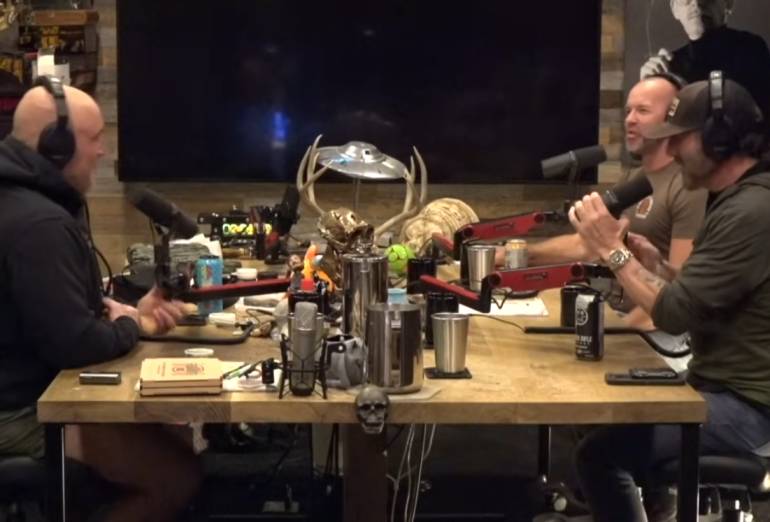
In this episode of Joe Rogan Experience #2426, Joe Rogan reunites with elite bowhunter and endurance athlete Cameron Hanes alongside Australian bowhunter and photographer Adam Greentree for a three-hour masterclass in hunting, wilderness adventure, and mental toughness. The trio swap wild backcountry stories from Alaska to the Australian outback, including close calls with grizzlies, brutal pack-outs, and the kind of near-death moments that permanently change how you see risk and comfort.
Cam breaks down the “undeniable” mindset behind his new book—why he still runs ultras, lifts heavy, and shoots his bow daily in his 50s—and how obsessive consistency, not talent, took him from blue-collar kid to one of the most respected hunters on earth. Adam adds his perspective on conservation, animal behavior, and the ethics of bowhunting, as they dig into what modern life has lost by severing people from nature and hard, meaningful work.
The Mountain Lion in the Lobby
JOE ROGAN: Hey, we’re live. Gentlemen. What’s happening?
CAMERON HANES: What is going on?
JOE ROGAN: Good to see you guys again.
CAMERON HANES: Bow hunting brothers.
JOE ROGAN: Yeah, we’re just talking about the mountain lion that we have in the lobby and how insane that thing is. So, Adam, you shot that mountain lion when?
ADAM GREENTREE: I think it was about six or seven years ago now.
JOE ROGAN: And you ate it. And I ate some of it. You sent some to me. It’s really good. Believe it or not, ladies and gentlemen.
ADAM GREENTREE: You wouldn’t think so, but it’s incredible.
JOE ROGAN: Everybody says it’s like, the way they describe it is, I think Rinella said, “this is superior pork.”
ADAM GREENTREE: Yeah, yeah. It’s like, I think of it as a cross between venison and chicken. And I only did it quick on the barbecue, and I’m not a great cook, but it was that tender and that tasty.
A Murderous Mountain Lion
JOE ROGAN: But the story behind the mountain lion is nuts.
ADAM GREENTREE: It was. I felt a bit funny about it to start with because the dogs do all the hunting, right? The dogs smell it. Dogs find it. They put it up in a tree. But the further I looked into it, I’m like, well, you need the tree because you want to sex it, and you want to age it. You know, you want to make sure it’s a lion that’s old, and it has to be a male to shoot it in Colorado, at least at the time, you had to, anyway.
So it was actually the perfect way to hunt. But then seeing how destructive that individual lion was, at least I was telling Cam about this when we got here, that it must have grabbed the cow like a beef cow. Must have grabbed it on the neck, and the cow couldn’t move, but it was still fully alive internally and vocally, it was still alive.
And when we got there, the mountain lion was eating it from its rear in. And it had been there for at least an hour or two because there was quite a lot of meat that had been eaten out from the cow’s a and kicking its hooves.
JOE ROGAN: Yeah.
ADAM GREENTREE: And it’s just, but the cow couldn’t get up, so it was literally eating it while it was still alive. And as the dogs are running down there, you could hear this cow off in the distance just screaming, like, mooing, flat out, and you could tell something was wrong.
The dogs got there, the lion ran off. We end up calling the rancher in, the rancher come out, put the cow out of its misery, still screaming on the ground right in front of me. I was teared up. I don’t like suffering like the next person. So it was a very horrible moment. So then it was like, now I’m into it. Now I’m into finding this lion.
JOE ROGAN: It’s like a werewolf’s loose in your town, you know. How much did that cat weigh, by the way?
ADAM GREENTREE: By the way, I held it up for size, and I could hold it for maybe 30 seconds, and I literally couldn’t hold it up anymore. And I was trying to show the size of how big that lion was.
JOE ROGAN: It looks like it’s at least 150.
ADAM GREENTREE: Yeah, it’s giant.
JOE ROGAN: So it’s like 170. That’s what you think it would be on the par.
CAMERON HANES: Yeah. As it were. Yeah, yeah. That’s a big animal.
JOE ROGAN: We were standing out in front of it, going, imagine if this thing jumped on you.
ADAM GREENTREE: It’s a living monster.
JOE ROGAN: It is a monster. It’s a real monster. And he’s like, oh, they kill their animal, their prey first. No, they don’t. Just make sure it doesn’t move anymore.
ADAM GREENTREE: Yeah, just whatever’s good for eating, apparently.
JOE ROGAN: They’ll just start eating it.
ADAM GREENTREE: Whatever’s good for eating. It’s on.
Compassion in the Wild
CAMERON HANES: We’re the only thing that has compassion in the wild. The putting out of the misery, like the rancher did. You know, that’s one thing about hunters, ranchers. We do appreciate life and death. And there is a time where, hey, let’s put it out of its misery.
But yeah, man is the only one who thinks about that. An animal, they’ll just start eating, they could care less about. They don’t even know about pain, really, or being merciful or anything like that. It’s just what we do.
ADAM GREENTREE: Yeah. I always say, like the lion in Africa, it stripes a zebra across the back end, and the zebra gets away, and it’s just got blood pouring out of it and it’s got this horrible wound that it’s going to have to live with. That lion has not lost any sleep over that ever in its life. It’s not even a thought.
JOE ROGAN: You know, it’s fascinating that all these different creatures exist with us because we’re so insulated for the most part. Most people are so insulated. Living in cities, traveling on buses and planes and cars and never seeing a thing like this in real life.
And you realize at the same time, while you’re going to Starbucks and picking out the new iPhone, there’s a lion running full speed at a herd of zebras right now. Right now in the world, there’s a lion full speed at the zebra and it’s going to tackle it, it’s going to grab it by its face.
And all these animals exist to keep each other in check. That’s the real beauty of nature. And you really see it. When we saw that, we were out yesterday, Cam and I were hunting for pigs and we saw a feral cat make a pounce on a mouse.
We were in the perfect, it was one of the coolest things because even though it’s a kitty cat, like a little tiny kitty cat, it was fluffy too. It was kind of cute. We watched a predator in the rare moment when you see him executing a kill. I mean, it was only a feral cat, but it was still, we saw his little butt wiggle. We saw that thing that they do with a ding and then up in the air. That is cool. It was so wild.
CAMERON HANES: And that’s going on multiple places throughout on our planet. Right. You know, right now, as you said, everywhere. Yeah. If you could have zoom in on a little camera, all these little interactions of predator, prey. I mean, that’s happening.
JOE ROGAN: Well, if you could see it all at once. If there was a camera on every single predator, prey encounter simultaneously in the world and it was broadcast on a screen that was like 700 feet high. You think, oh my God, we’re at war. There’s a war in the natural world.
Just cats alone. Have you ever seen the numbers of what feral cats alone, just house cats kill? It’s literally in the billions in North America. Billions every year, non-stop time. But imagine how many rats there would be if the cats weren’t out there.
ADAM GREENTREE: Yeah.
JOE ROGAN: It’s all, there’s a balance to it all. Oh, my God, these cats are killing everything. Right. Imagine how many f*ing mice would be out there if there weren’t cats.
CAMERON HANES: That’s true.
JOE ROGAN: It’s all balance.
Wildlife Management and Conservation
CAMERON HANES: Yeah. That to Adam’s point about his lion in Colorado, it’s so managed that that animal actually probably could have been killed off because it was killing livestock.
JOE ROGAN: Yeah.
CAMERON HANES: You know, but when you kill a lion in Colorado, it’s very detailed, very documented and tracked. It’s like you can only take, in the unit I was hunting lion, I didn’t kill one. But you could only kill 35 in the year. And every time a lion comes in, they catalog it, check it, get all the information in there. And then that’s one of the 35. Once you reach 35 quota, you’re done.
ADAM GREENTREE: You’re done.
JOE ROGAN: Let’s put this in perspective, because if that doesn’t happen, and by the way, all money goes back to the state, goes to game wardens. It helps everybody, helps conservation. If you don’t have that, you know what you have? You have what’s going on in Japan, where Japan is having massive brown bear attacks.
So just last year, they had to kill, I think it was 1,000. It’s at least 1,000. I think it was more than 1,000 bears last year.
CAMERON HANES: Right.
JOE ROGAN: And this year is projected to be even higher than last year. So the bears, the f*ing military has to go in and they’re having a war on giant brown bears.
CAMERON HANES: That are killing, I don’t know how many people already this year.
JOE ROGAN: A s* ton.
CAMERON HANES: Yeah, a s* ton.
ADAM GREENTREE: Tonight.
JOE ROGAN: Jamie, put that into Perplexity, our sponsor. How many people have been killed in Japan by grizzly bears? Well, they’re not grizzly bears, but they’re essentially…
ADAM GREENTREE: Brown bear.
JOE ROGAN: Yeah, brown bear. Record surge of brown bear attacks in 2025, with at least 13 fatalities and over 200 injuries. Holy f*. Making it the deadliest year for bear attacks in recent history. Majority of fatal attacks have occurred in Hokkaido, where brown bears are more prevalent. And the number of attacks has prompted emergency responses, including the deployment of military personnel in some regions.
Dude, I’ve been hearing people in Montana and people in Wyoming that have been saying we’re seeing more brown bears than ever before. Guys are going on elk hunts and getting freaked out. They have to delist these f*ing things. They’re totally fearless. They’ve never been hunted, so they have no fear of humans.
How many guys have you heard where the gun goes off and the bear shows up after the gun goes off because it knows that the elk is down or the moose is down?
ADAM GREENTREE: Like a dinner bell.
JOE ROGAN: Like a dinner bell.
Brown Bears in Japan
ADAM GREENTREE: I flew into Hokkaido, Japan, had a period where they would let foreigners hunt, and it had to be of a bow. And I was chasing sika stags over there, and I had no idea they had a brown bear at all.
And I was going through this big reedy area. The reeds are up above your head, and there was just a game trail going in there that the deer had been using. And as I was going through there, I could see that it was starting to open up a little bit more like a flattened out section maybe where the deer had been bedded.
And I got in there and there was a sika deer just like the rib cage all chewed out. And it was just a big muddy clearing where this brown bear had got in there and just rolled around with this carcass. But the prints in the mud were like that. I had no idea. I had no idea there was even bears there.
JOE ROGAN: So wait, what year is this?
ADAM GREENTREE: It’d have to be 10 or 11 years ago now.
JOE ROGAN: But Google was still around, right?
ADAM GREENTREE: Yeah.
JOE ROGAN: You didn’t check, you didn’t go, hey, what’s in the area?
ADAM GREENTREE: Started messaging the outfitter and been like, dude, there’s bears here.
JOE ROGAN: Look at that bear.
ADAM GREENTREE: Yeah. And then he started telling me that it’s some of the biggest brown bears there is.
JOE ROGAN: Bro, that bear f*ed up that guy.
ADAM GREENTREE: That’s a big, that’s a big bear. But the police force, because I believe there was an unarmed police force at the time, they had an issue with a bear where it had killed two hunters there. And he had to go in and shoot this bear.
He had photos on a tractor and I don’t do the gruesome photos, but he’s just flicking through his phone and the next photo is a guy with his face missing from this brown bear attack. And another photo, the bear, when they went in to shoot the bear, the bear was in a stream holding the guy down in the water, eating him in the water.
CAMERON HANES: Oh.
Mountain Lions and Wildlife Management
ADAM GREENTREE: And it like. So, yeah, pretty gruesome. So it’s pretty full on. But up until that point I’d never even knew there was a brown bear in Japan.
JOE ROGAN: Before you go someplace with a bow.
ADAM GREENTREE: That makes sense, do a cursory Internet search.
JOE ROGAN: You know, even if like, come on, you guys have the Internet. Internet, shut the f* up. You were telling me some Starlink things.
CAMERON HANES: Going by, they’re way, they’re way behind and talk about that one. Come on. They just got the Internet.
JOE ROGAN: This guy is a traveling bow hunter and he doesn’t check to see if there’s enormous of the unknown. Oh, that’s cute.
ADAM GREENTREE: That’s cute.
JOE ROGAN: Look, there’s plenty of unknown out there. You know, you don’t need to add to it.
ADAM GREENTREE: It’s all disappearing. All unknowns disappear because of the entire.
JOE ROGAN: A little bit.
CAMERON HANES: Another layer to that Japan story is the reason why they have to deploy the military is because all the hunters are aging out. So there was hunters there. But because hunting is kind of like this dying thing for this next generation. There’s not enough hunters. So they have to get the military involved.
Otherwise it would be hunters like, you know, you going over there and they’ve talked about, like. I mean, I know there’s Americans who had volunteered to do it, but that’s another part of it is this next generation just isn’t hunting.
California’s Mountain Lion Problem
JOE ROGAN: I have another question. Jamie, put this into perplexity, please. How many mountain lions were killed with depredation tags in 2024 in California? Because what I had read on a forum. So it has to be correct because those guys are all experts.
CAMERON HANES: Oh, yeah, they’re.
JOE ROGAN: I had read that an equal number of mountain lions had been killed with depredation tags by, like, experts with dogs, like, to bring them in than if they’d given tags out. So if they had given tags out and let people mountain lion hunt, you would have the exact same amount of mountain lions that they had to kill. And instead of that, you would have revenue.
ADAM GREENTREE: Yeah.
JOE ROGAN: Money for the opposite. Right.
ADAM GREENTREE: Instead of paying and the collection of the meat, obviously. All right.
JOE ROGAN: California’s not yet published a full 2025 total, but the best available data as of July 2025 shows at least 167 mountain lions reported taken under depredation permits in 2020 and 166 in 2022, with annual totals of over 100 in recent years. So every year they have to kill at least 100 mountain lions. Yeah, probably quite a bit more. It looks like 67 more. 66 more.
CAMERON HANES: And I would say it’s only went up since then.
JOE ROGAN: Yeah, well, the thing is, like, they’re doing nothing to curb the population. And this is the thing is, like, people go, “oh, it’s okay. Let nature do its thing.” No, it doesn’t do its thing. It kills your dog. Okay.
One of the things they found out in San Francisco, in the Bay Area, was when they do shoot these mountain lions, they’ve done an analysis of their diet. It’s 50% dogs and cats.
ADAM GREENTREE: Wow.
JOE ROGAN: 50% of their diet is eating people’s pets. So they’re hunting people’s pets. That means you are. If you’re a dog lover, you’re allowing a monster to eat your dog because you think that’s the right thing to do and to be kind with nature.
No, you have to hunt them. You have to get them the f* away from you and keep a healthy population of them. And if you don’t do that. It comes back to bite you in the dick.
Comparing Oregon and California
CAMERON HANES: Here’s. Here’s one other search. Jamie, can you see how many mountain lions were taken in Oregon legally? Because that would be like Oregon’s, of course, just right north of California. Let’s compare the legal harvest. In a state that hunt, we can’t use dogs. But you can kill them when you see them. You can buy a tag in the season.
JOE ROGAN: Well, then it’s very difficult to kill them.
CAMERON HANES: Right. If you can’t use dogs to do that, they have to have the season open all year and they just hope enough are getting killed, but then they still have to kill. Depredation.
JOE ROGAN: And is that a situation where you. You buy like a mountain lion tag, like just an extra tag and you just have it just in case you run into one. So if you’re out in the wilderness and you’re hunting elk, but you have a mountain lion tag?
CAMERON HANES: Yeah, that’s it. So we were hoping, you know, if you see one. Basically, I have a bear tag, lion tag, deer and elk.
JOE ROGAN: It says Oregon kills far more cougars each year than California. But those Oregon numbers can come mainly from sport hunting and agency control, not from depredation tags. Oh, wait a minute. Agency control is what we’re looking at, not depredation. So what is the numbers here? 160.
ADAM GREENTREE: Reword the question.
JOE ROGAN: Yeah, let’s reword the question and ask how many were killed in California from agency control. Put that in there. How many mountain lions were killed in California through agency control? Because we were just looking at depredation tags, which is like what a hunter or, excuse me, a farmer gets.
CAMERON HANES: So it says in Oregon that we could kill 970, but they never kill that many.
JOE ROGAN: Okay. They did not publish a queen state white tally labeled specifically as agency control. Mountain lion kills and current official tables group most lethal removals under depredation permits rather than separate agency control category.
As a result, there’s no single publicly available number that states how many mountain lions were killed through agency control alone. Let’s just put this in. How many mountain lions were killed in California in 2024? Just period. Let’s just ask that question. Yeah, I don’t even know where we’d get this data. I don’t know.
CAMERON HANES: It’d have to be fish and Game. 20.
JOE ROGAN: Hmm. That doesn’t make any sense. Oh, so they’re saying these fig. This figure does not include deaths from vehicle to. But that’s not true because they just said earlier that it was 100 and 480 depredation incidents and 222 depredation permits.
Out of those permits, 52 authorized lethal take and 20 mountain lions were actually reported as lethally taken on depredation permits. That’s weird. This is totally different numbers than it was given us before. So now it’s only saying it was 52 authorized lethal ones.
CAMERON HANES: Yeah.
ADAM GREENTREE: Huh.
CAMERON HANES: I don’t know.
JOE ROGAN: The holidays are in full swing and so are the grinches out there trying to steal your data and personal information. But there’s a simple and easy way to protect yourself, and that’s with ExpressVPN. ExpressVPN is an app that hides your IP address and reroutes 100% of your online activity through secure encrypted servers.
Their best in class encryption ensures that your online activity remains invisible to greedy data brokers and keeps hackers from getting a hold of your sensitive financial data, even on unsecured public WI fi. And right now, the VPN that’s rated number one by the experts at the Verge and CNET is offering three different plans allowing you to customize your experience.
Their basic plan starts as low as $3.49 a month. That’s less than 12 cents a day. You can protect your online data for cheap and still have money for gifs and eggnog. So if you want to get ExpressVPN at its lowest price ever, plus four months extra of service, just tap the banner or go to expressvpn.com rogan.
Again, that’s expressvpn.com rogan for a price as low as $3.49 a month plus four. Four extra months of service. Expressvpn.com rogan and if you’re watching on YouTube, you can get four extra months by scanning the QR code on screen or by clicking the link in the description, I think.
So, okay, it says of the permits, 52 were authorized to kill them. So it says lethal take. So it’s authorized to kill them. And 20 were actually reported as lethally killed. So they’re saying it’s only 20. That seems.
Understanding Depredation Permits
CAMERON HANES: But that is, that’s for like a ranch owner to do the killing.
JOE ROGAN: Okay.
CAMERON HANES: So they, they say, “hey, this lion’s been killing my calves” 480 times. And 222 of those, they said, “okay, go ahead and kill the lion.”
JOE ROGAN: Okay.
ADAM GREENTREE: Right.
JOE ROGAN: So this is permits that were released rather than the agency doing the depredation work.
CAMERON HANES: Right. So you would add this total to the other number we had.
JOE ROGAN: Right, because depredation thing too, you got to think it’s ranchers. Right. So these guys are all out in the middle of nowhere. A lot of the depredations, though, that they might be listing is what we were talking about with San Francisco, where they found that they’re eating people’s cats and dogs.
So maybe they get depredations. It’s not like. But you can’t give it out to the f*ing homeowner.
ADAM GREENTREE: No.
CAMERON HANES: Yeah.
JOE ROGAN: So you only give those tags out to ranchers, right? Seems like.
CAMERON HANES: Yeah. To people that have livestock.
JOE ROGAN: And the rest of depredation is probably done by some sort of a government guy.
CAMERON HANES: Yeah, they would call it. They would call it something other than depredation.
JOE ROGAN: Do you think he uses dogs? How do you think they get him?
CAMERON HANES: Yeah, or snare. Like in Oregon, Wayne has done this where people, they’re losing their goats, their calves, something like sheep, something like that. And then they’ll let you snare it. So you can go in there, you take pictures of the animals that are killed. And another snaring is brutal. Yeah. Or trap.
ADAM GREENTREE: Trap.
CAMERON HANES: It’s a foothold.
ADAM GREENTREE: Yeah.
JOE ROGAN: In Texas, they treat them like coyotes.
CAMERON HANES: Yeah.
JOE ROGAN: You just whack them.
CAMERON HANES: Yeah.
JOE ROGAN: Well, I think that’s the way to go because I think they’re so hard to see. It’s just so hard to find different politics.
ADAM GREENTREE: I’ve seen maybe two in all the hunting that I’ve done. Just naturally in the wild. And you would have seen more, but it’s not a big number. They’re out there, but they’re just so sneaky.
JOE ROGAN: Oh, they’re so fing sneaky. We saw one. I told you the story. We saw the one in Utah with Colton. Yeah. Huge one like that one. He was like as big as yours. It was fing terrifying. Inside of a car 30 yards away and I’m shit my pants. I’m not even.
CAMERON HANES: Yeah.
JOE ROGAN: And we’re armed, you know, and we have bows.
Politics of Wildlife Management
CAMERON HANES: We have, you know, the difference between Oregon and California and Texas, you know, Texas being able to shoot them like coyotes is. That’s politics, you know?
JOE ROGAN: Yeah, of course.
CAMERON HANES: West coast is liberal.
JOE ROGAN: Well, Utah changed it, though. Utah has it now. Like coyotes.
CAMERON HANES: Perfect.
ADAM GREENTREE: Yeah. Yeah.
JOE ROGAN: That’s how it should.
ADAM GREENTREE: I think there has to be like management behind it.
JOE ROGAN: I don’t even know if you have to have a tag in Utah anymore. Let’s find that out. Put that search in. Do you need a tag to get to hunt mountain lion in Utah? Maybe they just give out over the counter tags. Anybody who wants them. And they’re still collecting revenue, which is ideal. That’s the best way to do it.
ADAM GREENTREE: Yeah. And if the numbers are great enough. Yeah, yeah.
JOE ROGAN: But Texas doesn’t even do that. They go, “no, we don’t want to get involved. You go ahead and shoot them” and it’s a f*ing monster in your backyard.
CAMERON HANES: Yeah.
JOE ROGAN: This is coming from someone who loves them. Yeah, I love them.
ADAM GREENTREE: I love. Yeah, they’re amazing.
JOE ROGAN: Okay. Yes, you must have a valid Utah hunting or combination hunting fishing license to hunt mountain lions. But you do not need a separate cougar tag. Okay. So it is like a coyote.
CAMERON HANES: So it’s year round harvest for license hunters and you just have to get it checked in after you kill.
JOE ROGAN: Right. Which is also smart.
CAMERON HANES: Yeah.
JOE ROGAN: Because they want to know what it’s been eating.
CAMERON HANES: That’s how you do it.
ADAM GREENTREE: That’s what diamond boy, that’s how you do it.
JOE ROGAN: Utah way to go.
CAMERON HANES: Good job.
JOE ROGAN: That’s the right way to do it. And of course you should have a hunting license. I think you have to have one in Texas as well to hunt anything.
CAMERON HANES: This, talking about this.
JOE ROGAN: Actually that’s not true, right?
CAMERON HANES: What?
JOE ROGAN: No, I’m thinking that. No, I think in Texas you don’t even need a hunting license to hunt exotics.
ADAM GREENTREE: No, not if they’re on a private.
JOE ROGAN: Right. I think you just go hunt them.
CAMERON HANES: Yeah, yeah.
ADAM GREENTREE: Right.
JOE ROGAN: Okay.
Grizzly Politics and Urban Voters
CAMERON HANES: Talking about politics in different areas. It reminds me of in B.C. they outlawed grizzly hunting. And just recently, maybe last week, a grizzly attacked a school group.
ADAM GREENTREE: I’ve read about that.
CAMERON HANES: That’s another thing. So where in the cities who control a lot of the voting power of the—that’s a province. But states here is that the cities determine it. And people living in the cities don’t—
ADAM GREENTREE: Know what the f* is going on in the wilderness.
CAMERON HANES: So they vote. “Oh, I love lions. I love grizzly bear. I love wolves. We need to have more of them.” Meanwhile, the people out in the mountains are actually dealing with this shit. And so Vancouver, if we’re talking BC specifically, Vancouver pretty much makes the decisions for British Columbia. They said no more grizzly hunting and now it’s just, grizzly bear out of control.
JOE ROGAN: Did you ever meet my friend Mike Hawkridge?
CAMERON HANES: Yeah, we went to dinner.
JOE ROGAN: That’s right.
CAMERON HANES: After a fight once.
JOE ROGAN: That’s right. One of the steakhouses in Vegas. Right. Mike’s great. And he and Ben O’Brien took me on a moose hunt once and he was telling me—this was before the grizzly bear ban—he was like, “There’s so many of them.” And he had to shoot one from six feet away. One was breaking into a cabin and he had to shoot it from six feet away. Like, they’re terrifying up there.
CAMERON HANES: Yeah.
JOE ROGAN: They have so many of them and they have wolves everywhere. We stumbled on a wolf kill. We got there, it was probably a day old, I don’t know. But it was nothing but hair. That was the thing that shocked me. Did it use the moose calf?
ADAM GREENTREE: Okay.
JOE ROGAN: And there was nothing but hair. That was what was weird. It’s like I didn’t anticipate seeing so much hair. Like, the moose hair was everywhere, just everywhere. I thought it’d be like a dead animal, but it was just basically bones and there was, like, a tiny bit of meat on corners of the bones and hair everywhere.
CAMERON HANES: Yeah.
JOE ROGAN: It was just like they went just tearing into this moose calf and coughing up hair.
CAMERON HANES: Yeah.
JOE ROGAN: I didn’t see one when I was up there, although I think we did see one in the distance when we were at John and Jen’s place. We saw one. We thought it was a bear or we thought it was a wolf run across the road. I was either with you or I was with Ben.
CAMERON HANES: Yeah.
JOE ROGAN: I don’t remember who it was, but I’ve never seen a wolf in the wild. Like a real, like, absolute. Like, look at him.
ADAM GREENTREE: Holy shit.
CAMERON HANES: Yeah.
Wolf Encounters
ADAM GREENTREE: Yeah. They look at you in a certain way. Like, one of the first trips I ever did to Canada was up in Northwest Territories, and I actually thought it was caribou coming down the river. Like, just the color of the wolves, similar to a caribou. And then I worked out our wolves, and the guy that I was with, he’s like, “That’s a pack of wolves.” And I’m like, “Can I call them in?”
JOE ROGAN: Oh, God.
ADAM GREENTREE: And he’s Adam Greentree.
JOE ROGAN: What’s wrong with you?
ADAM GREENTREE: He’s like, “Yeah.” And then I got up against the tree and I just started doing, like, a—call it a do for, like, a fox or a wild dog back in Australia. And this whole pack come in like a wounded rabbit. You’d never seen them come in. They were, like, up in our vision up there. Yeah. Like a rabbit call, distressed rabbit. And the next minute, that was just like, they were fully surrounding us and just come in. It was freaking cool.
But I just remember they could fully see me at that point, and they were still just, like, looking through me. And I was like, “Yeah, that’s sick.”
JOE ROGAN: You ever heard Dudley’s story when Dudley and some guy that he was with in B.C.—I think it was BC, pretty sure or—no, it was Alberta. They killed a—I think it was a—I think it was an elk. But when they killed it, they killed it essentially on top of where the wolves den, like, right there. And wolves started circling around them.
And the guide had like one round in his rifle, and Dudley had like two arrows or three arrows left. And they’re surrounded by wolves. And Dudley shot two of them with a bow and arrow, and the guide shot one with a rifle. They shot three wolves. Three wolves. He said there was, like, they were surrounding. He said it was the freakiest f*ing thing he’s ever experienced.
ADAM GREENTREE: It wouldn’t have been a great feeling.
JOE ROGAN: He told the story on the podcast and it was just like, “F that, man. You only have two bullets, you fing asshole. Like, what is wrong with you?”
ADAM GREENTREE: Two bullets in one life.
JOE ROGAN: What do you—what—what the f* are you doing, man?
Mountain Lion in the Tree
ADAM GREENTREE: You know, killed a bull in New Mexico one year, and I killed it late in the afternoon. So we did a pack out. This is just going back to the mountain lion story we took. We did a pack out with me, went back in. In the dark with head torches, and as we’re walking in, I seen a couple of eyes or whatever, and it was just like, deer, mule deer or something like that.
And then I’m like, “Oh, there’s another deer up in front of us.” And as we got closer, the eyes were too high, and it’s just like, “Nah, that’s not a deer.” And it was a mountain lion up in the tree. Like, it was right up in the tree. There was the kill there. That lion stayed in the tree while we grabbed more meat and packed it out.
JOE ROGAN: You grabbed his meat? Yeah, the mountain lion’s meat.
CAMERON HANES: Well, it was his kill. It was your kill, my kill.
ADAM GREENTREE: And I was going back in for it and just thinking it was a set of deer eyes, and as they’re walking up, the eyes were like, up in the tree. And that’s like—so I’ve only seen two. That’s one of them. And it was in the dark, and I swear, if it was daylight, I would have seen one of my whole entire hunting.
JOE ROGAN: Did you see Cam’s brother’s story on—on Instagram? Oh, my God. Cam’s brother was running late at night in California. At night in California. And should we play it?
CAMERON HANES: Yeah.
JOE ROGAN: Did we ever play it on the show? I think we might have. We might have did.
CAMERON HANES: Yeah, yeah, yeah, I know you mentioned it.
JOE ROGAN: F*ing terrifying. Yeah, yeah, it’s terrible.
ADAM GREENTREE: I’ve never seen that in Australia, by the way.
JOE ROGAN: What’s your brother’s name again?
CAMERON HANES: Taylor.
JOE ROGAN: Taylor. It’s like T. Spike.
CAMERON HANES: Yeah. Yeah, Taylor. So it’s a—my—it’s my stepdad and mom had two kids, Taylor and Megan.
JOE ROGAN: Oh.
CAMERON HANES: So those are my brothers or brother and sister.
JOE ROGAN: And then he does ultras too.
CAMERON HANES: Yeah, he’s—he’s actually really good.
JOE ROGAN: Yeah, he seemed like one of them dudes who had to get it in.
Taylor’s 300-Mile Race
CAMERON HANES: You know, he had to get it in at night. He—he did a 300 mile race just last year. He got competing, trying to win the thing, of course, but got second. Wow. The Arizona Monster 300. Oh, my God, that hurts my hips and my joints. That’s the level he’s at.
ADAM GREENTREE: 300 miles or 300 km?
CAMERON HANES: Miles.
ADAM GREENTREE: That makes it so much worse.
JOE ROGAN: You were thinking about kilometers, I thought you’re an American now. Didn’t we convert you?
ADAM GREENTREE: Yeah, we were trying to teach you.
JOE ROGAN: Inches the other night.
ADAM GREENTREE: In my lip for some reason. It’s an American thing.
JOE ROGAN: You guys don’t have pouches. It’s probably illegal over there.
ADAM GREENTREE: Probably.
JOE ROGAN: They’ll take it away.
CAMERON HANES: Government’s going to control it.
JOE ROGAN: Yeah. How’s that working out?
CAMERON HANES: You can—you can do that, but you have to wear a mask.
JOE ROGAN: Did you find Taylor’s video?
CAMERON HANES: It’s—I think it’s on his Instagram.
JOE ROGAN: Yeah, it is. It’s definitely. Did I send it to you at one point in time? Maybe talking about it now.
CAMERON HANES: It’s.
JOE ROGAN: Unless he took it down. I don’t think he took it down. What is his Instagram handle?
CAMERON HANES: It’s T. Spike something. Something like that. T Spike something.
JOE ROGAN: Yeah, I’ll find it.
ADAM GREENTREE: T spike 300 miles.
JOE ROGAN: Coming in second place in 300 miles is bananas.
CAMERON HANES: Yeah.
JOE ROGAN: And meanwhile, how much difference was there between him and number one?
CAMERON HANES: I think a couple hours probably.
JOE ROGAN: Oh, God, that’s insane.
CAMERON HANES: But it took.
JOE ROGAN: Oh, God.
CAMERON HANES: I think he did it in 88 hours.
JOE ROGAN: That is nuts.
ADAM GREENTREE: That’s a serious effort.
JOE ROGAN: That is a serious effort.
CAMERON HANES: There’s some—there’s some freaks out there for sure.
ADAM GREENTREE: I’ll do it one day.
CAMERON HANES: He’s one of them.
JOE ROGAN: Are you going to do it one day for real?
ADAM GREENTREE: Yeah.
JOE ROGAN: T. Spike 2.
ADAM GREENTREE: Couple more visits away as well will be good.
JOE ROGAN: What?
ADAM GREENTREE: Jamie, I don’t know where the video is.
JOE ROGAN: Okay, I’ll find it. I’ll find it. Yeah, he’s—oh, it’s me talking about it. That’s—f*.
CAMERON HANES: Oh, he must have re-shared that or something.
JOE ROGAN: Yeah, here it is. I found it right away. It’s just his face. When you see his face staring at the camera. It says lion. Oh, you got it? Okay. It says lion. Update. Yeah, this is it. Give me some volume.
Mountain Lion Encounter
CAMERON HANES: Restless night of this reoccurring dream of these green eyes hot on my tail. I was coming down the trail last night just after dark, and I see these green eyes off to the side of the trail. I mean, right on the side of the trail. What I thought was a coyote, I just kind of yelled. And then when it stood up, I realized it was a f*ing mountain lion.
I took off running as hard as I could, and I looked over my shoulder and it was right behind me. I ran for probably 100 yards and realized it wasn’t giving up. And I turned around and I kicked rocks and I jumped up and down and I screamed at the top of my lungs. And this thing did not care.
I did that a few times to the point that at one point I almost thought, “I’m just going to lay down here and die because I’m not going to—”
JOE ROGAN: Outrun this f*ing thing.
CAMERON HANES: Another time, it got really close to me and I thought I had no choice but to try to scare it. And I turned and I screamed and I kicked rocks. I mean, to the point it was—I mean, it was right, right there. And I finally decided, “Well, you just got to run. Run for your f*ing life.”
I’ve done some crazy s* in my life. I’ve been pretty scared. But this, this was next level.
ADAM GREENTREE: This was next level.
CAMERON HANES: It terrified me. You know, I think maybe if I’d had a gun, I could have done something. Pepper spray—I don’t think that it was so close that I would have probably pepper sprayed myself. So I don’t know.
I was a half mile from the city in Lake Forest, California. I mean, like straight up, I could hear dogs barking. And at one point I thought maybe that’s what kind of detoured it, but didn’t care.
So this morning, I’m going to ride the bike. Probably won’t go back out there in the dark. I did wait around for the sheriff’s department and fishing game because there was other hikers on the trail that were above me that would have had to have come down. And I just don’t know how other people would have responded.
Like I said, I’ve done some scary s. I’ve been in the woods my whole life, but this was next level. It was terrifying. But I’m all good. Back at it, right? I guess if this only happens one time in your life, I got it out of the way. I’m a lucky fer. Have a good day. All keep at it.
ADAM GREENTREE: Doesn’t work like that.
The Reality of Living with Predators
JOE ROGAN: That is the consequences of letting monsters live in your neighborhood. Yeah, that’s real. And all these wilderness loving people, I guarantee you you’re not out there as much as that guy is. I guarantee you’re not out there as much as you are or you are. That’s the difference between people that really understand what we’re talking about and people that are looking at this from this knee jerk love and compassion for nature perspective.
ADAM GREENTREE: Well, back to what Cam said. It’s like the majority of votes are people that don’t get in that environment. And it’s not just about hunting. That’s for farmers anywhere as well. There’s people in the city that are making votes for people that live in the country and the lifestyle is completely different.
JOE ROGAN: And they don’t understand what they’re talking about. Especially BC band like, “We’re going to ban trophy hunting. Trophy hunting’s bad.” No, but what about monster control? Isn’t that good? I’m on team people, okay? I love animals, but I am on team people.
ADAM GREENTREE: Imagine if they knew how soft we were. They don’t have to spit out hair. The flesh is right here. It’s soft. It’s so easy to get into because—
CAMERON HANES: They usually go in at the stomach, you know, or the a. It’s like our stomach. How soft those are?
ADAM GREENTREE: Straight to the organs.
CAMERON HANES: Yeah, it’s right. Right to the good stuff.
JOE ROGAN: Yeah.
CAMERON HANES: Even I don’t think people like—even a dog can turn into like, I killed a buck, you know, before we went on that last hunt, I killed a buck. And like for the treat, for the dog, you cut off the nuts. Give them the nuts. So it’s got hide on it, it’s got the buck’s nuts, basically. Dog takes off, you’re just ripping into it. It’s like delicacy, right? That’s just a normal dog. So a lion who’s born and bred to kill. I mean, that’s just the level of what animals do.
JOE ROGAN: Your liver is a rib eye, and they haven’t eaten in a week. You’re like, “Oh, baby, look at that liver. It’s right there.”
CAMERON HANES: Yeah. And the dogs there, that deer camp, you give them like a part of the—I don’t know, there’s some skin. It’s not the flank steak, but it’s just some skin there that sometimes you cut off that goes over the stomach and run off. Eat that. Eat pounds and pounds of meat. A regular dog. So a lion—yeah, they’ll eat.
What they do is they just eat as much meat as they can and they just kind of lay around. So that’s the time to actually run from a lion is after a big meal, you know what I mean? Because their stomachs are full of meat. Maybe that’s why Taylor—maybe that lion that chased him had just killed a deer and was full of protein. But, you know, they still hunt. That’s what they do. It’s their instinct. But sometimes you can time it right and maybe that saves your life.
ADAM GREENTREE: Yeah.
JOE ROGAN: Geez. That’s not a risk we should be taking.
CAMERON HANES: No, this is—if you can avoid it, it’s always better.
Mountain Lion Population Management
JOE ROGAN: It’s like they’re so hard to find. People don’t understand you’re not going to put a dent in their population. This is not like any other. It’s not like deer. You can depopulate a deer. Like an environment of deer. If you went crazy and hunted them all and said, “Let’s eradicate all the deer, every hunter. You can shoot as many deer as you want. Just let’s go do it right now.” You can get rid of all the deer. You ain’t ever doing that with cats.
ADAM GREENTREE: Yeah, they’re too sneaky.
JOE ROGAN: Not now. Not now.
CAMERON HANES: Even in Australia, with buffalo, you can fly and eliminate a lot of stuff. Pigs here, deer, buffalo down there, the water buffalo. But you’re not doing helicopter killing of lions.
JOE ROGAN: No. You can do wolves. They’ll lower wolf populations that way. And they do. They do in some parts of the world. They do in Alaska, right?
CAMERON HANES: Yeah.
JOE ROGAN: They do wolf kills from helicopters.
CAMERON HANES: Yeah. And, yeah, I mean, lions are just tough. But I did—I didn’t even realize this, but Oregon, as we were looking at those numbers that Jamie pulled up, Oregon, the goal is 970 lions a year. But we never get to it.
JOE ROGAN: Right.
CAMERON HANES: So what that means is we’re not meeting our objective of lion kills. That means there’s more and more lions every year.
JOE ROGAN: Don’t they factor that into the amount of tags they give, though, that there’s going to be a limited amount of success. So they’ll give more tags than there will be—like, than they actually need to kill.
CAMERON HANES: For lions or for—
JOE ROGAN: For lions do that?
CAMERON HANES: Oh, yeah. I mean, I’m not sure how that—how they do it. It’s supposed to be like a balance, you know, I mean, if—but the—what happens is not enough lions are getting killed. So there’s too many lions. So that means the lions are killing too many deer. No, because there’s—the line number is too high. And that’s what’s kind of happening. There’s areas in Oregon that were great hunting at one time that are terrible now.
JOE ROGAN: Well, here’s a perfect example where I used to live in California. You guys been in my house. A lot of land, a lot of woods. A lot of, like—there’s a lot of, like, wildlife out there. Good luck finding a deer.
ADAM GREENTREE: Oh, yeah.
JOE ROGAN: You might find two, three in a month. In a month. I see deer every f*ing day out here. I see them every day. You know why?
CAMERON HANES: No.
JOE ROGAN: Mountain lions. And you could shoot them. California has a mountain lion problem. Like, it’s a real problem.
CAMERON HANES: Yeah.
JOE ROGAN: The place, the Tohon Ranch, that place, they had a camera out in front of one of their ponds and they got 16 different mountain lions on that camera. Sixteen.
CAMERON HANES: Yeah. And what, the people in LA, that they have no idea what’s going—but they’re voting.
JOE ROGAN: Right.
CAMERON HANES: That’s who controls.
ADAM GREENTREE: And voting with their hearts and—
JOE ROGAN: Yeah, well, they’re—and they’re good people. And I would have voted with them.
ADAM GREENTREE: Right.
JOE ROGAN: Okay. If I had never been hunting and never been in the woods, I would have voted with them. Maybe not. Maybe not, because I’m a little fing skeptical of people’s wisdom. And I probably would have looked into it a little bit and thought about what it’d be like to get eaten by a mountain lion and go, “F. What the f are we talking about? Kill these goddamn things. You fing crazy?”
Don’t kill them all. You don’t have to kill them all. They’re going to exist in the woods where they’re supposed to be. They’re not supposed to be in Pasadena.
CAMERON HANES: Right.
JOE ROGAN: Okay. They’re not supposed to be wandering around the f*ing Hollywood Hills like that one that I have the big picture of. No, that one’s crazy.
CAMERON HANES: That lion. That picture is insane.
The Hollywood Sign Mountain Lion
JOE ROGAN: Insane. The Hollywood sign behind him, and he’s wearing a collar. That picture, to me, embodies, like, everything that’s wrong with California. Like, you know where he is, and he’s in the neighborhood where people live and you just put a collar on him.
CAMERON HANES: Yeah.
JOE ROGAN: So you could track him when he’s f*ing killing dogs. Like, what—what are you saying? You know how many—look at that photo.
ADAM GREENTREE: Yeah, that is a sick photo.
CAMERON HANES: That is—that’s one of the most amazing photos ever.
JOE ROGAN: Ever taken. When—as soon as I saw that photo, I’m like, “Oh, my God, we have to buy a print.”
ADAM GREENTREE: What do you think he’s thinking?
JOE ROGAN: Ordered it from the photographer. What is he thinking? “What am I going to kill next?”
ADAM GREENTREE: And why is this f*ing thing on my neck is the most tastiest.
CAMERON HANES: That’s—that’s right above where Huberman used to live.
JOE ROGAN: Oh, dude, it’s right there. By the way, that’s like, we filmed Fear Factor out there a bunch of times.
CAMERON HANES: Yeah.
JOE ROGAN: Look at that f*er. Oh, my God. Look at his face. Imagine wandering into that. That thing is so big.
CAMERON HANES: How sick of a photo is that?
JOE ROGAN: Amazing.
CAMERON HANES: Yeah.
JOE ROGAN: And it’s all camera traps.
Educating Non-Hunters
CAMERON HANES: Yeah. So—but here’s what’s so critical. And, you know, hunters, we can be our own worst enemies. But part of what discussions like this and talking about how it actually works is so important. It’s not for other hunters. It’s for people who don’t hunt, who do vote.
You know, it’s like, “Hey, let’s just educate people who don’t understand. It’s not your fault you don’t understand. You haven’t hunted your whole life. That’s okay. But just listen to what we’re saying and just say, like, hey, when that vote comes up and it’s like we’re talking about, you know, being able to hunt lions with dogs or black bear with bait. Let’s think about, hey, there’s repercussions if we don’t allow this.”
JOE ROGAN: You know, they just don’t know what it is. It sounds cruel. “Lions with dogs. Like, oh, that’s not even fair. You want to hunt it with a spear. If you want to hunt it like we used to hunt them, hunt it with a spear.”
CAMERON HANES: No. Bare hands is what I see. Kill with your bare hands.
JOE ROGAN: That’s the dumbest argument. That’s the dumbest. How do you think we got to the point where we don’t have fangs, you f*ing dolt?
ADAM GREENTREE: And this—
JOE ROGAN: We got there. We evolved past that because we figured out weapons. Okay? And that’s why we can have cities.
CAMERON HANES: Never kill shit with their hands. At least they had a f*ing wooden spear.
JOE ROGAN: So what are you talking about, bare hands? The dumbest argument of all time. And the conversation don’t understand that we would have never had civilization if we didn’t do this.
ADAM GREENTREE: Exactly.
JOE ROGAN: And it wouldn’t exist.
ADAM GREENTREE: The conversation doesn’t come from a want perspective from me. I’ve got no desire to hunt a mountain lion. Again. I don’t. But as someone that’s in the know, because I have before, you know, and I wanted to educate myself prior to that hunt. I was doing as much reading as I could to find out do I feel good about this is. Yeah.
So it’s not like I want them still on the list to hunt, because I want to go and do it again. I don’t have a desire to do that again myself, but I do see that it’s good management, you know, and instead of necessary, instead of them being culled and not utilized, you know, and it actually costing money, you know, there’s money going into conservation at that point from the hunter and the meat utilized, you know, and as you mentioned, in that case, I gave that meat to a lot of people because I wanted people to see it as a food source as well, you know, because you do. You sort of think of the mountain lion. You’re like, the meat was amazing. Some of the most incredible meat I’ve ever had.
The Reality of Wildlife Management
CAMERON HANES: I mean, even if so just say they didn’t require you to take the meat and you didn’t and you didn’t eat it. Still, they need to be killed. Yeah, that’s all there is to it. Just to make the deer and elk population, just to make it work like it has to work.
Because humans, people will always say, “Well, Mother Nature will take care of itself.” It’s like, no humans have encroached on this habitat. That’s why we need to control this. This isn’t like the wide open west that it once was where, yeah, maybe it’ll work out eventually. It’s not going to work out.
JOE ROGAN: They were here first.
CAMERON HANES: Yes, they were here.
ADAM GREENTREE: We’re part of the system 100%.
CAMERON HANES: Adam, you know, he said he’s killed one, he doesn’t plan on killing another. I’ve never killed one. I’ve never killed a lion in my entire life, but I know it’s important. So it’s not like I’m this big lion hunter that I just have this passion for doing, and I want to kill as many as possible. Never even killed one, but I know that we have to kill them.
And in Colorado there, that’s one thing. You know, you talk about sex and the animal up on up in the tree because you can see what it is. Male, female. You don’t. When I hunted them, I did hunt them. I didn’t kill. But you could kill any lion, essentially, if it didn’t have, you know, it couldn’t be a female with cubs, but or kittens.
But you look at them in the tree and you can decide, “Oh, that’s a female. Probably not the best kill. Let’s kill an old male.” Because it’s just that’s how it just works better that way. Taking old males out and but you can do that and same thing with baiting bear, a bear comes in. A bear is really tough to tell whether it’s a boar or a sow. It’s male or female, for those that don’t know. But at a bait, when you’re looking very closely, you can. That’s an old male. That’s what I want to take.
ADAM GREENTREE: So that’s why.
CAMERON HANES: That’s why there’s it’s not just random, like I’m rifle hunting. It’s 400 yards away, running, and you kill like a bear. And it has cubs. You didn’t realize it had cubs because the cubs are in a tree somewhere that the sow left.
So that’s where baiting is actually the best way to manage these numbers. And it might seem like, “Oh, you just throw out donuts and this and that, and the bear comes in.” I mean, yeah, you could term it like that, or you could say, “No, we’re targeting the right animal to make this work the best, best way it can.”
JOE ROGAN: Well, people need to understand that wildlife biologists and the numbers that they put up and the rules that they apply, especially the rational rules like that, they exist because it’s the only effective way to hunt these things.
Like, there you don’t use dogs to hunt elk. You know, it’s like they because it doesn’t seem right, right? There’s there’s one effective way to get these mountain lions, and you got to tree them. You know, if you don’t, if you don’t have that option and you’re bow hunting, you have to stumble upon one.
And they’re not going to they’re going to know you’re coming forever before you know they’re there forever, hundreds of yards away. They’re going to smell you. They’ll hear something. They’ll turn and look at it. They have amazing eyesight, you know, like, you’re not finding them. And if you want to keep the populations in check, there’s like, California’s got a bear problem, too, and part of their bear problem is you can’t use dogs anymore. Yeah, it was the only way they could really control populations.
Rare Mountain Lion Encounters
CAMERON HANES: In a lot of these places, dogs are baiting. Hey, Jamie, I got another project. So, Cam Canaday, you start spelled with a K. As we were talking about, he had a deer tag. He was deer hunting in Oregon. This is what you do. You just buy a bear and a lion tag just to have with you.
But he killed this giant lion. He was deer hunting. This lion came up, sat on this rock 40 yards away, and he’s just like, “I got a lion tag. Perfect.” Boom. Got put a perfect arrow in this giant lion. But look at this thing.
ADAM GREENTREE: And he’s a big dude. He’s a slob.
CAMERON HANES: He played for the Steelers for like six years in the NFL. Yeah. So that was just like a happen chance. That’s how you get him in Oregon because you can’t use dogs. You can’t do anything else. So that lion just jumped up there and he made a perfect shot on it.
JOE ROGAN: That’s crazy.
CAMERON HANES: But look at that big thing. Yeah. Pretty nuts. And like I said, Cam’s like six, four. I don’t know, two.
JOE ROGAN: Did you ever see the one Derek Wolf killed?
CAMERON HANES: Yeah, that was a giant one.
JOE ROGAN: Giant one. So the Derek Wolf story is a great one too, because he took so much heat online about it. People are so angry at him that he did that. And it’s just people that don’t understand.
ADAM GREENTREE: Yeah.
JOE ROGAN: Why it’s necessary. And first of all, if you know Derek. Derek’s a f*ing legit Viking. He’s a legit Viking. That guy’s a giant human being. So for him to be holding is there another picture? We see like the full length. That’s it. There’s the full length.
CAMERON HANES: 180 pounds or something.
JOE ROGAN: Look at the size of that f*ing thing.
CAMERON HANES: Yeah. So you and I don’t know what the numbers are, but you think a lion kills especially a lion that big has to basically kill a deer every week. Right. So that’s 365 deer a year. That thing is killed or no, not no, that’s 52 deer a year.
JOE ROGAN: Imagine there’s a deer every day. No, but do you know the wolf thing? They say lions are killing more deer now than ever in places where there’s wolves because the wolves scare the lion off. The killer, the wolves, they steal them all the time. So the lions just give up and they go kill another one. They can kill way easier than the deer can. They’re way more effective killers.
CAMERON HANES: So think about so 50, say 50 lion or 50 deer a year for each lion. How many lions are in Colorado?
JOE ROGAN: A lot. A lot.
CAMERON HANES: You know, that’s a lot of f*ing deer or or elk calves or something’s being killed.
JOE ROGAN: Yeah.
Predator Management in Australia
ADAM GREENTREE: Australia’s got a real bad problem with shark population now. And it’s like and I’m taking it there because what’s happening is for like a really good eaten fish, like a Red Emperor, you’ll only get like five Red Emperor. That’s your tap. That’s your quota for the day. You can only catch five and what the sharks are doing now is you’ll hook a Red Emperor and the sharks will just take it off the line.
So you don’t have a Red emperor in the boat anymore, but one’s dead because the sharks got it. So you keep fishing. And then so now the Red Emperor numbers are declining because sharks, that’s like their favorite fish to jump to, grab off a line. You can catch a cod, you’ll get it to the boat because the sharks aren’t going for it. But if it’s a red fish, the sharks are taking it constantly.
And then so what’s happened is because there’s been a ban on shark fishing, shark numbers have gotten out of control. So now Red Emperor numbers have plummeted because the sharks are just eating them constantly.
JOE ROGAN: How many people in Australia get killed by sharks every year?
ADAM GREENTREE: There’s been a few this year already. Yeah, I actually just had I had my girlfriend out a couple of maybe a month or two ago and I took her to this beautiful beach and it was awesome. As soon as we got there, there’s dolphins jumping out of the water and whatnot. Anyway, we never went for a swim just because of how the conditions were.
And a week later, a lady was taken from that beach and her partner may have died as well. I didn’t follow up on the story, but her partner got attacked as well, but got out of the water. And it’s great whites, mostly on the east coast. They seem to be running pretty rampant at the moment. It’s the bleeding hearts that are making the votes.
JOE ROGAN: Four confirmed fatal shark attacks in 2025 so far, with some trackers listing four or five deaths depending on how many incidents are class or how incidents are classified. But think about how much less people are out there in the water than.
ADAM GREENTREE: Oh, yeah, that’s the thing.
JOE ROGAN: It’s like people go, “There’s only four shark attacks a year.” Right. But how many people are in the water?
CAMERON HANES: Yeah, out of 500 people, it’s not.
JOE ROGAN: A lot of people in the water swimming out there.
ADAM GREENTREE: That’s a horrible way to go.
JOE ROGAN: Oh, good Lord.
ADAM GREENTREE: Absolute monster of the ocean.
The Disconnect from Nature
CAMERON HANES: Oh, yeah. Isn’t it weird to think that, I mean, most society doesn’t know anything about the wild these days, you know, I.
JOE ROGAN: Mean, yeah, we’re domesticated.
CAMERON HANES: Yeah. So it’s but even like, I don’t know, I always say that. I mean, we talked about this, I’m pretty sure because I talk about it all the time. But like, I always think that society like this regular life here is fake. It’s like it’s not even not even real. It’s not even how humans were designed to live and survive where the wild is actually were.
That’s how that’s what we’re designed to do. Live in the mountains or hunt and survive, things like that. And so the fake life, I don’t know, it’s just crazy to me to think about that.
JOE ROGAN: The fake life is what we think.
CAMERON HANES: Of as a real life. And it’s not. It’s not real. It’s like what we’re doing. Yeah.
ADAM GREENTREE: It’s just real life. Yeah. We’re made to live in a society that’s not by mine or your design.
CAMERON HANES: Right.
ADAM GREENTREE: You know, and it’s sort of like and that’s I always feel out of it in society because I just feel like it’s not for me, but it is, it’s here and we’ve got to live in it. I do like going the ways to wells and getting a good injection, so but I just want to go when I want to go.
JOE ROGAN: That’s the way to do it. Attack it from the outside.
ADAM GREENTREE: Yeah.
JOE ROGAN: Go in, go to a nice restaurant and get back out to the country.
ADAM GREENTREE: Yeah.
The Natural World Connection
Just f*ing relax. It’s better for people. You ever see that? The old days of Vice, when Vice used to do really cool stuff, they had Vice Guide to Travel. And there’s this one guy who lives in the Arctic Circle and this dude is—he’s been there since the 1970s. He got a job up there and got permitted where he’s like grandfathered in to allowed to live in a small cabin up there. Like the last guy there, he has like a permit on his door.
And this guy has been living up there ever since. He saw 9/11 in a photograph like a year after it happened. Had no idea what was going on. Very smart guy, like, intelligent, interesting guy and lives up there with his wife and all he does is hunt caribou and fish.
And he talks about it and he’s like, “This is how people are supposed to live.” Like when you—he’s not like, he’s a very intelligent guy. So like when he’s talking about it, he’s talking it from like an internal programming. Like this is like this feeling that you get living. Like this is how people are supposed to live. And when you live like this, you’re very fulfilled and it feels normal, whereas most people don’t feel normal.
Most people are depressed, they have anxiety, they’re worried about their career, they’re worried about all this stuff that is like human created. They’re worried about their social status, whether they’re ostracized from the neighborhood or people like them anymore because their political beliefs or whatever the f* it is. There’s none of that out there. There’s none of that because it’s what though. It’s the way we were designed.
But if we want all the things that we enjoy, like f*ing Starlink and cell phones, like you have to have this weird fake world that we’ve created, the human created world. But it’s not conducive to like a healthy mindset for most people. It’s not normal.
And so all the—I have this thought about why exercise is so important for people’s mental health. Because I think at the very least what it does is it gives you like the physical exertion that your body requires. But I think your body requires a connection as well. And that’s what we’re missing. We’re missing the natural world connection.
And you can get some of that out of the physical exercise. You can get some of that out of like, doing. But your body’s literally designed to have to move and to complete tasks in order to survive. And that task could be like that guy out there hunting caribou, building a house, surviving. Like making a homestead, growing a garden. Like, this is a normal way we are, but we’re moving into this abnormal way.
You know, along the way, people are losing their fing marbles. Everyone’s crazy. No one knows what a woman is anymore. Like, everyone, like literally out of their fing mind. Out of their mind with a—if the left win, the democracy will fought the right win. We’re all going to be Nazis and it’s just chaos.
CAMERON HANES: Yeah.
JOE ROGAN: And none of it is normal. None of it is natural. And the reason why it’s so incompatible with most people is because we’re not designed for it.
ADAM GREENTREE: I feel it. I know Cam’s the same, but like, it’s just like time doing those things that are usually in a quieter environment, in a more natural environment. Like, I mentally feel better every time. And then I almost feel myself slipping when I come back to the city, you know, and it’s just like you sort of start letting your guard down. You just slip back into it.
And you’re like, this is—I’m not enjoying this. And then you go back out hunting for us or camping or whatever it is. And then I do. I feel revitalized. I feel healthier mentally and physically. I feel healthier and then—but adding all the other things to it, you know, like, you talk about like, you know, exercise and—yeah, it does touch on it. And I—and I think all those little things help but to really get out in fresh air is the big one for me where it’s just—I do. I feel more flow state.
Depression and Primitive Man
JOE ROGAN: I wonder if like I’m sure, like primitive man felt emotions for sure. But do you think they felt depressed?
CAMERON HANES: No, I think—
JOE ROGAN: You know what I mean.
ADAM GREENTREE: I feel like they were too busy.
CAMERON HANES: I think that survive. I think people—I think this is part of this fake society is like, are you happy? Are you happy? It’s like happy. What the f* is happy? I want to be useful out there. I want to do—do something. I’m not happy. Sad. Nothing.
ADAM GREENTREE: Right.
JOE ROGAN: What is happy? I’m content just being.
CAMERON HANES: Right.
JOE ROGAN: I feel content just being.
ADAM GREENTREE: Yeah.
CAMERON HANES: When you’re in the—in the mountains, carrying your bow, glassing, looking, drinking, eating, looking for place to sleep. What is that? That’s what I want. I don’t know what happened. I don’t know what it is, but that’s like purpose. Like I have a purpose. I’m trying to kill something that is that happy.
JOE ROGAN: Yeah, you’re trying to find food.
CAMERON HANES: To me, that feels—because I don’t know what happy is. I see people, they laugh and they’re f*ing around. Sometimes it’s alcohol induced or drug induced or it’s like, is that supposed to be happy? What is hap—I don’t know. I don’t know. What—what are we—what are we calling happy? Because that’s not like a little kid laughing at a birthday party. But are those both? Are they both happy?
Different Kinds of Happiness
JOE ROGAN: Well, there’s just different kinds of happiness, right? There’s happiness you get on a fun date, you know. There’s happiness you get when you, you know, you do fun, stupid stuff. Like, you go play, like, sandbox games. You pretend you’re shooting zombies with VR. That’s happy. It’s fun. It’s silly you get out of it. Everyone has a smile. You had a good time. That was wild. That’s happy, too.
There’s a bunch of different kinds of happiness. Some of it we’ve created. But there’s content. Like, are you content? Like, are you enjoying your existence?
CAMERON HANES: Yeah.
JOE ROGAN: And I think that’s a real struggle for a lot of people, right? Because there’s a giant percentage of the people that are listening to this right now that are forced to do something they don’t enjoy doing most of the time. Most of the time, most of their day, they’re doing something they don’t enjoy doing because they have to do it in order to do the things that they do enjoy.
So if you want to go on vacation, you got to make enough money to afford the trip to Hawaii. If you want to do this, you got to do that. If you want to do this, you—
ADAM GREENTREE: Got to do that.
JOE ROGAN: So you’re just walking in some stupid cubicle, punching keys, just planning all the fun stuff you’re going to do with the money that you make, doing this thing you hate doing.
CAMERON HANES: It’s pretty nuts.
JOE ROGAN: Pretty nuts.
ADAM GREENTREE: I’ve never—I’ve never felt happy in that.
CAMERON HANES: That’s what I’m saying.
ADAM GREENTREE: To do something, to get to somewhere, sometimes you have to be unhappy.
JOE ROGAN: That’s true, too.
ADAM GREENTREE: And you’re the wrong person to be commenting on this because you’re extreme. You’re never going to be happy because you’re going to continue to chase bigger and better. Yeah, that’s why that’s awesome.
The Joy of Suffering
CAMERON HANES: I don’t know. I mean, and I mentioned this before, I’m happiest when I’m suffering.
JOE ROGAN: Yeah, that’s ridiculous.
CAMERON HANES: No, but, like, doesn’t it feel like—
JOE ROGAN: Adam and I, we just looked at each other? He’s f*ing crazy.
CAMERON HANES: Because when I’m suffering, it’s because I’m doing something that matters to me.
JOE ROGAN: Right?
ADAM GREENTREE: Yeah. You like that. And you know what’s on the other side? That’s what makes it.
JOE ROGAN: Yeah, you’ve sort of programmed yourself to be like that, too. You know, this is like, similar to Goggins, right? Goggins always wants people to know that he wasn’t always like this, that he used to be fat and lazy. And he shows pictures of himself at 300 pounds. He always talks about it. You know, it’s like—it’s like, this isn’t—I wasn’t born like this. Like, I turned myself into this.
And I think one of the reasons why you’ve been able to struggle so much as you figured out a way to enjoy struggle. And a lot of people avoid struggle at all costs. They want the couch. Oh, I want to relax. It’s cold out. I don’t want to get in that f*ing cold plunge. Are you crazy? What’s wrong with you?
ADAM GREENTREE: I love struggle. Because you know what’s on the other side? The growth. Once you’ve done it. So it’s like once you’ve done that, and I think that’s where a lot of people struggle. If they quit or they don’t get to the other side, then you don’t know the reward on it.
JOE ROGAN: What you just said is perfect. That’s why they struggle, because they don’t struggle. It’s like the thing you’re avoiding is causing you to have the exact same thing. It’s just you’re getting a slow dose of that poison and you never get out of it.
Whereas if you voluntarily struggle, then you get this beautiful feeling when it’s over, but you’re not doing that. So you’re just getting the same amount of struggle in these weird little slow doses all day long. So you’re never getting like, oh, my God, I’m in agony. I can’t breathe. But if you did, then the rest of the day would be easy.
Instead you’re getting, oh, my God, the world is closing in on me, and I don’t know why. I’m so freaked out and I’m riddled with anxiety all day long for no fing reason. I’m having a panic attack and there’s nothing wrong. That’s what’s going on. Like, you’re—you’re getting your suffering in, like, little doses all day long, and it’s driving you fing crazy.
CAMERON HANES: Yeah.
JOE ROGAN: And that’s why you get on SSRIs, and that’s why you do this and that’s why you do that, and you join a cult and everyone’s just trying to figure out a way to feel better. Everyone’s just trying to figure out a way to feel better. And one of the ways to feel better is voluntary struggling. Yeah, you got to volunteer to put yourself in stressful situations, difficult situations. Do it on purpose. If you do that, then the regular world is easier.
Respect and Hunting
CAMERON HANES: Yeah, it’s—I think, like, I’m always, of course, biased towards hunting in the mountains, but I also think that men, men specifically, you know, where I grew up and in the environment I grew up, hunters were respected. And if you killed a big buck, you’re like, that meant something in a small town. I was—
JOE ROGAN: Because it’s very difficult to do right.
CAMERON HANES: And it’s like, for men, respect is such an important thing. Where we say, women need love, men need—if you have to choose, men. Love doesn’t mean s*, really. But respect does. And hunting was a way to earn respect from the community.
And that’s why for men, as hunters, I think that’s appealing for people who don’t hunt because they see that image and they’re like, I’m missing that. Because they see that there’s—there’s respect earned there. And that’s what men, whether they want to admit it or not, that’s a big driving force. Like you—even at work, and whatever job you have, you want to be respected.
JOE ROGAN: Here’s a perfect example. That story you were telling me about shooting that bull in the Oregon backcountry. And you—it’s terrible place to kill a bull. And you call up that dude.
CAMERON HANES: Yeah, that guy, Cal Holiday, which sounds—
JOE ROGAN: Like a fake name we’re talking about.
ADAM GREENTREE: That sounds like such a fake name.
The Perfect Badass
JOE ROGAN: It’s a perfect badass name. You call this dude and ask him to help you. Dude drove through. You told him, okay. He said, “I’ll see you there at 8am.” This guy drives through the night. He shows up. How many hours did it take him to get there?
CAMERON HANES: He had a hiker guy, so he had to round up three other guys. So he brought four of like him and three guys. And they live, God, how far away? I mean, at least a couple hours, I think.
And so they had to get together, drive a couple hours, get up on this old logging road essentially into the access point of the wilderness, to the trailhead. Pack in miles, right? So this is like 9 or 10 at night. They said they’d be there at 8 in the morning. So that’s what it took to get there and then miles back to this remote middle of the wilderness, hellhole area by 8:00am. So yeah, it was hours and hours and hours just to get there.
ADAM GREENTREE: And you can’t time that the way. You can’t time that.
JOE ROGAN: But he did about it.
CAMERON HANES: Yeah.
JOE ROGAN: The way you talked about him. That’s what every man wants.
CAMERON HANES: Yeah.
JOE ROGAN: Like that was a f*ing man.
ADAM GREENTREE: Yes, but he earned it too. You know, that’s—and you’re talking about, you know, respect so important, but you do have to earn respect.
CAMERON HANES: Right. Right. And that when—so in that moment, there was me, Wayne Tanner, my son James, my camera guy Gideon. And then he brought four guys. So we had eight guys in that moment. There’s not eight other men I’d rather have or seven other men besides me that I’d rather have there. Because those to do that, that’s special.
JOE ROGAN: That’s—
CAMERON HANES: Not everybody can do that shit. But those guys, that was their purpose. They could probably never be, quote, happier than in that moment. Elk meat on our back. Miles to get to the trailhead out.
JOE ROGAN: Hundreds of pounds of meat.
CAMERON HANES: Yeah. 300 pounds of meat. So we weighed it at the butcher when I took it to get processed. 300 pounds of boned out meat. That’s not—not a bone on there.
JOE ROGAN: So not including your camp, not including everything. So your pack, your body and the head.
CAMERON HANES: I took the head out. So 300 pounds of meat, plus everything else that we had, but eight of us packed it out. And it was the greatest day I can remember probably this season. You know, I mean, it was—that was real. That’s what I say, that’s real.
ADAM GREENTREE: Yeah.
CAMERON HANES: All this other shit, I don’t know what this is, but that was f*ing real. I killed a bull. We have to get it out to take care of this meat. Here’s some badass mountain men who can help me. Does it get any better?
ADAM GREENTREE: No. Yeah. I think I’ve known you for 13 or 14 years now, and you’ve always been like that. I’ve never changed in that sense. Those things are important to you. Those things are meaningful to you. Right? It’s incredible.
CAMERON HANES: No, it’s—thank you. But yeah, it’s—yeah. I mean, that’s all that f*ing matters.
What Most People Never Experience
JOE ROGAN: Most people never experience that. That’s what’s wrong. What’s wrong is most people never experienced that insane, challenging experience where your character’s tested, your will is tested, your commitment is tested.
CAMERON HANES: Just think—so the video on this hunt came out last night and it’s called “The Bowhunter.” But there’s a moment there after we had called, after we’d got my bull processed. So at that time, it was just me, Wayne and Tanner and James, and we’re just sitting there. We had our tent set up. The meat’s all hanging up, middle of the night, sitting there talking.
We’re eating peak meals. I’m like, why are we eating peak meals? Why didn’t you eat elk? We didn’t have a fire, but the meat was processed. It wasn’t time to eat or to break down the bull. But that would have been great. Tenderloins over a fire would have been amazing. We just didn’t do it.
But the point is, in that moment, there’s no other place on earth, no other time in my life that I would rather be. That is—that was the pinnacle of life for me.
JOE ROGAN: That’s a normal, natural experience for primitive man. Yes, that’s what it is. And it’s how we stayed alive. And the way I describe it to people, there’s a feeling. Most people have caught a fish. There’s a feeling when someone catches a fish, even a child.
When I took my daughter bass fishing, she was like six, I think she caught a bunch of bass. And the feeling that she got when she hooked it, her eyes light up. It is built in us. It’s inside of us.
But catching a fish, bow hunting in the mountains, killing an animal, cooking it over a fire with your boys, is that times a thousand. It’s a crazy built in “we did what we have to do, and we’re looking forward to doing it again.” So that—the intense experience, the difficulty, all of it. You’re sitting there, relax, you’re eating, and you have no doubt. You can’t wait to do that again.
You’re not like, “Man, I want to do this again. This is nuts.” You’re like, “Yeah, I’m fing tired. But that was awesome.” Yeah, that was awesome. You take the pack off, like, “Whoo, dude.” You’re sitting there by the fire like, “Holy shit.” You’re drenched in sweat, your legs are gone. Everybody’s around smiling like, “We fing did it. We did it.”
CAMERON HANES: I just don’t know how—I mean, you hope the films can show that and give you a peek to feel it.
ADAM GREENTREE: Oh, yeah.
CAMERON HANES: I would—I wish everybody could feel it, just so they’d know. Yeah, it’ll never happen, but it’s so powerful. It’s life changing.
Israel Adesanya’s Greatest Speech
JOE ROGAN: Do you remember Israel Adesanya’s speech after he knocked out Pereira?
ADAM GREENTREE: Yes.
CAMERON HANES: What’d he say?
JOE ROGAN: He goes, “I wish”—he goes, “People of the world, I would”—let’s play it. Because it’s f*ing amazing. So this is Alex Pereira. This is a guy that had beaten him three times.
CAMERON HANES: Three times, yeah.
JOE ROGAN: Knocked him out in kickboxing, knocked him out in MMA, and then finally he knocked him out.
CAMERON HANES: Yeah.
JOE ROGAN: And this is like, everybody was terrified of him taking this rematch. “Pereira can’t be stopped. Pereira is a destroyer. He’s the scariest guy ever.” But he asked me to give him the microphone. Look at that.
ADAM GREENTREE: What a human.
CAMERON HANES: Yeah. I love Style Bender.
JOE ROGAN: Oh, he’s the best. Holy—he’s the best.
CAMERON HANES: Yes.
JOE ROGAN: Let me just hold the mic real quick. Yes, sir.
CAMERON HANES: Hey, sure, sure.
JOE ROGAN: Listen up. I want to say something, people, Earth.
ADAM GREENTREE: I need to say something.
JOE ROGAN: Listen to me. I hope every one of you behind the screens on this arena can feel this level of happiness just one time in your life. I hope all of you can feel happy, how happy I am just one time in your life.
CAMERON HANES: But guess what?
JOE ROGAN: You never feel this level of happiness if you don’t go for something in your own life. When they knock you down, when they try and on you, when they talk—
CAMERON HANES: About you and they try and put—
JOE ROGAN: Their foot on your neck. If you stay down, you will never, ever get that result. Fortify your mind and feel this level of happiness as you rise one time in your life. But I’m blessed to be able to feel this again and again and again and again and again. Post fight speech of all time.
CAMERON HANES: You know what I love too is even in that moment, there’s a little bit of blood starting to trickle out of his nose. You know, I mean, because he looks really good. He does for just fighting, but it’s like there’s little—you know, the sweat, the blood trickling. Oh, man, he’s getting hit, man.
JOE ROGAN: He’s getting hit. And his left leg was already destroyed.
CAMERON HANES: He didn’t take many of those.
JOE ROGAN: No, he was talking to me about it afterwards. He’s like, “That motherfer got me again. I was thinking that before that he got my fing leg again.” Because that was a part of the problem with the first fight. Yeah, first MMA fight. His left leg was destroyed. He couldn’t move his left leg.
So even though he’s bobbing me, he’s like, “I was okay.” He goes, “But I couldn’t get out of there because I couldn’t move my f*ing leg, man.” He goes, “I was getting hit, but I was still there. I was moving”—he was still moving around, but he couldn’t go away. His leg was destroyed. And that’s what people don’t think about when you like those goddamn calf kicks.
CAMERON HANES: Yeah, he probably knew after the first one he was like, “F*, he got me again.”
JOE ROGAN: He destroys people’s legs and then you’re a sitting duck in front of the scariest puncher in the history of the division.
CAMERON HANES: Hands of stone.
JOE ROGAN: Oh, my God, he’s f*ing terrifying. And for him to catch him with that perfect right hand off the cage like that. Oh my. And then shoot the arrows into him. Greatest fight celebration, greatest post fight speech of all time. There’s not even a second place that really—except Rose Namajunas that one time when she was saying, “I’m the best.”
ADAM GREENTREE: Oh, yeah, that was pretty powerful.
JOE ROGAN: That was pretty powerful too.
The Tent Scene
CAMERON HANES: Could you find that tent scene at the end of that video? But here’s what I was curious about is—oh, he did find it. Yeah, right here. So the difference between Israel’s happiness in this happiness.
JOE ROGAN: But you know, you go until you’re just sick of the weight and you—
ADAM GREENTREE: Get it under the tree in the—
JOE ROGAN: Shade and you get all kind of energized, come back, drink some water, grab another. And then mentally you’re not coming back to here.
CAMERON HANES: Right.
JOE ROGAN: I mean, you get it all across the creek in that flat.
CAMERON HANES: I mean, it doesn’t get any more in the bottom. That was a pack out, but I wouldn’t want it any other—Wayne, he had a horse packer set up. And then I had also talked to Cal Halliday and when I was in there by myself on an opening weekend, he said, “Hey, if you kill a bull in here by yourself,” he goes, “let me know, send me a text or something. I’ll have, you know, four or five guys here within five hours to help pack.”
So no, it wasn’t opening weekend. But I’m like, I told Wayne that and I said, he goes, “Well, who do you want to get a hold of? You want to get a hold of Cal or you want to get hold of the horse pack?” And I’m like, “I think I’d rather have Cal with some other badass, you know, mountain guys and just share this pack out with them.”
JOE ROGAN: Yeah, but less of a jungle too.
CAMERON HANES: So these guys right here, you don’t want any other people. And Tanner’s got so much weight on true form. How they got up, I don’t know what time. Three in the morning, made it all the way there. They said they’d be there at 8am, they were down at my bull at 8:01. And I don’t—I mean, this is miles and miles and miles just, you know, just studs.
ADAM GREENTREE: Yeah.
CAMERON HANES: And so, yeah, it’s like, I’ll never forget that. I’ll never forget the whole—obviously the whole hunt. But that morning was a special one. Cal, Eric, Keith and Ryan.
ADAM GREENTREE: Yeah. So thankful for them.
Finding Your Thing
CAMERON HANES: That bull is massive. So it’s like, here’s it. But that’s a juxtaposition is. To me, that was my Israel Adesanya moment about, I will never be happier. But look how different those moments are. One’s in front of a huge crowd, millions of people watching, being, you know, getting all that attention from all those people, and then I guarantee just as happy or happier right there. Isn’t that crazy?
JOE ROGAN: It is crazy.
ADAM GREENTREE: Yeah. That’s your thing. And you’ve found your thing.
CAMERON HANES: Yeah, Yeah.
ADAM GREENTREE: I always talk about that. Like people just trying to find what’s your thing. Yeah, my things outdoors and bowing.
CAMERON HANES: So Israel’s thing is fighting. So for him, that’s the pinnacle. For us, whatever your thing is, get to the pinnacle.
JOE ROGAN: Right.
CAMERON HANES: That’s the lesson.
JOE ROGAN: Find happiness in that. Do you think whatever it is, whatever.
ADAM GREENTREE: It is for you, that you talking about your daughter catching that fish, and it’s like this primal instinct inside of her that just flares up that fighters have that same feeling? Like, it’s a primal feeling.
The Fighter’s Conflicted Moment
JOE ROGAN: Oh, 100%. Yeah. It’s a little more conflicted, Doug, depending upon how bad you hurt your opponent, when you hurt them really bad, it’s very. It’s a very conflicting moment because, you know, that could have been you. Some guys don’t get that feeling. Some guys, they’re like, good, f* him.
But a lot of guys, it’s like, woof. There’s some guys that knock a guy out real bad and then they almost want to retire afterwards. They’re just like, I don’t want to do that to anybody anymore, you know, Especially guys that have killed guys like Ray Mancini when he killed Duck Kook him. I don’t think he was ever the same again. There’s a few guys like that in history that have had boxing matches where they killed a guy and then they were kind of never the same after that.
ADAM GREENTREE: Yeah. That’s some scary s*.
JOE ROGAN: Yeah. Because you realize, like, this is what. This is what you’re doing. Yeah. This could lead to that happening to you. And you think about your kids watching on TV and crying or even worse there while you’re getting beat up. I always freak out when guys bring their kids. I’m like, oh, man. Bringing a kid to a fight, you know?
Yeah, I’ve seen guys get knocked out in front of their kids and it’s particularly devastating, particularly devastating. Especially when you really like the guy. It’s rough. It’s a rough way to make a living. But those guys, when they get that belt strapped around them, when their hands get raised and the whole audience screams and cheers, it’s like that’s a special moment. That’s a special moment that very few people ever get to experience unless they.
CAMERON HANES: Kill a bull in the wilderness.
JOE ROGAN: I don’t even know if it’s the same. It’s a different kind of happiness. I think yours is more sustained, yours lasts longer.
CAMERON HANES: That’s what I say. It’s like, I don’t know, like Israel said he was happy. Is that. I guess that’s what it is.
JOE ROGAN: But you know what the reality is? After the happiness dies off for a couple of days, then you start thinking about your next fight and you immediately start getting that anxiety.
ADAM GREENTREE: I think that’s a good drive in life though, right? Because you don’t just do that elk hunt and be like, I’m done now. You know, it’s like not, what’s the next one? You know, it’s like that constant pursuit.
The Pursuit of Perfection
JOE ROGAN: And it’s also like constantly recognizing that you’re always going to be at least trying to get better. You’re always trying to get better. Anything that is going to give you like real happiness is going to be very difficult because you’re not really going to ever be able to master it. Whatever it is, it’s like that’s where it is. It’s in the pursuit of it.
And along the way, recognizing that, you consistently keep getting better. But it’s like there’s a dream that you’re chasing that you’re never going to get to. You’re never going to get to. Bow hunting perfection. It doesn’t exist. You can get really close. You’ve gotten really, really close. But we’re human and it’s the wild and there’s all sorts of weird variables that happen.
There’s branches and sticks and wind and this and that, and it’s impossible to be perfect. And that’s part of the magic of it. Part of the magic of it is that but when you’re in the moment and it’s all happening, it’s all so open ended, any result can take place. You really do not know how this is all going to go down.
You haven’t seen it all play out and you might imagine how it’s going to play out, but it’s going to play out in unique situations. Some of them will be similar. Some of them will be completely different, and you’ve got to figure it out. Like you were telling me that crazy story that I was talking to you about, the podcast where you’re shooting down at this bull, like, from, like, a cliff. Straight down.
The San Carlos Cliff Shot
CAMERON HANES: Yeah, San Carlos this year. So I arranged the bull. It was a huge cliff. And what I thought is, I’d get up there and I’d be able to see the flat, and there was some bulls down there. It was a tough year in Arizona, the drought. But from that cliff, I thought that’d be a great vantage point to see where these bulls were and plant a stock.
So get way up there. Actually, there’s sheep right above us, too. It’s like crazy rugged country. But get up there on that cliff. And I’m kind of looking out over the expanse there’s. And then I look straight down. Below me, there’s this big bull. And straight down, I’m like, if you’re hunting mule deer, you know, they always bed up against the cliffs so their back’s protected. The wind’s coming up. They can monitor the down below them with their nose. They know nothing’s coming from the back. That’s how mule deer bed to survive.
Well, this bull had done that same thing, and it was. It had just stood up from the base of the cliff, and I looked down. I range at 42 yards, which people who know. If the range finder is telling you to shoot for 42, that means straight down. That means it’s probably close to 60 yards, you know, because the range. The rangefinder does a calculation. If you shoot flat, that’s the gravity affects one thing. If you shoot straight down, gravity has less effect.
So it’s saying, even though it’s further, you would shoot for less distance, is how that works. So it told me to shoot for 42. That means it’s probably 60 straight down. And that’s a long shot with it with a bow. And then I had to shoot him straight down. I had to. I thought that I was, like, going to go straight through his spine because I was straight above him. I’m like, well, I’m going to come right behind the shoulders, straight through his spine, into his vitals. I thought that should do it.
So I shoot. I hit that bull, like, about, I would say an inch off the spine. I show it. There’s a video of it on that, the video we just watched, for people who are interested. But about an inch off that spine into his chest, and the bull went about a hundred yards. But, yeah, it was. I’ve never. I’ve never done a shot like that before in my life. You know, you think about different scenarios. I’d never even thought about one like that on a bull at that distance, at that angle.
JOE ROGAN: So that is. Even. So where.
CAMERON HANES: Yeah, it’s. It’s back. This is the. That’s the Winneha bull, but it’s back. Jamie, about. I was talking about getting ready for this hunt, and it shows, like, a few clips of the bull I killed in Colorado, then the Arizona bull, Then I did another hunt in Utah, and I killed a bull there to get prepared for. For the Oregon hunt. But, yeah, it was just. I’d never even really thought that that shot would be a potential one.
Oregon’s Jurassic Park
JOE ROGAN: The Oregon hunt is crazy because of the wilderness is so dense. Yeah, Oregon is nuts.
ADAM GREENTREE: Forest hunt.
JOE ROGAN: It’s a. It’s like a rainforest.
CAMERON HANES: It’s like Jurassic Park. And that’s in eastern Oregon. That’s the dry part of the state.
JOE ROGAN: That’s crazy.
CAMERON HANES: But it’s such. Such a hole there. So much moisture down there that it turned into, like, Jurassic park with that bull coming in, bugling. It was like a dinosaur.
JOE ROGAN: There’s nothing that matches that. That aspect of elk hunting makes it so much cooler, is the sound they make when they’re coming in. It’s just like all of your f*ing pores pop up. It’s like you get goosebumps all over your body, back, your neck. The hair stands up. It’s like the scream is like, whoa. It is my favorite sound.
CAMERON HANES: It’s amazing.
ADAM GREENTREE: Oh, they’re incredible animals.
JOE ROGAN: When you’re close and there’s an elk screaming through the woods and he’s coming close towards you, that. That. The thrill of that is like nothing else. Like nothing else.
CAMERON HANES: No. And people who haven’t heard it, they hear that and they’re like, what the f* is that? It’s weird that there’s an animal on this planet that makes that noise. If we hadn’t done this our whole lives and we heard that, we’d be like, what is going on?
JOE ROGAN: Yeah. If you had done what Adam did in Japan and not research, like, what. What. What kind of animals are in the area and you were camping out and you heard that scream, you’d be like, oh, my God, we’re surrounded by demons now.
ADAM GREENTREE: I’ve had people tell me stories like, there’s something really weird in the woods there.
CAMERON HANES: Yeah.
ADAM GREENTREE: And then. But you find out it’s like fallow deer or red deer living in there. And it’s like just their breathing period and they’re just roaring and just people like, what the f* is that? Oh, it’s like.
JOE ROGAN: Actually, it’s just the deer stag have the craziest roar. It’s such a weird.
ADAM GREENTREE: Actually make a real sound compared to.
CAMERON HANES: A. Yeah, yeah, well, like an African lion. Because I heard those when I was hunting over there. Like they’re by the river and so we’re like an African lion in the middle of the night. They’re. Oh, yeah, like, oh my God. It just like reverberates through the. Whatever we were jungles.
JOE ROGAN: If there’s anything that lights up your DNA, the sound of lion mug, just chill your f*ing self.
The New Era of Hunting
CAMERON HANES: Nothing like that either. Nothing like that either. But, you know, here’s one. Here’s an exciting thing so for people listening that maybe didn’t grow up hunting. What? We were talking about this in the green room last night when we’re getting high off all the smoke.
ADAM GREENTREE: We weren’t smoking, but we got high.
CAMERON HANES: What’s crazy is nowadays, you know, we’re 58, you’re 45. Right? But we’re just getting even better physically. So you say you can’t master bow hunting, right? Because you only had a certain window. Like normally how hunting works is you’re young and strong, all the endurance in the world, but you don’t know s*, right? You don’t have the experience.
So by the time you get the experience and you’re old and broke down, you can’t take advantage of the experience. So you have to have wisdom. The wisdom you gained when you were young, you utilize when you’re old to kill. Well, now we can gain all that experience and wisdom. Like I’ve been, I’ve been, you know, hunting for 40 some years, and I’m also at the best I’ve ever been physically. You marry those two up, look out.
JOE ROGAN: That’s what’s nuts is that didn’t exist before, right?
CAMERON HANES: So like we go to ways to wealth today and get stem cell and get, you know, the IV treatments and get everything else to build up, operate at our absolute prime at 58 years old with 40 years of experience. Yeah, that’s. That’s tough. That’s. You’re going to have success if you do it right.
So, yeah, not everybody’s going to be in that situation where they grew up hunting like me. But you even think about jelly roll at 41 years old. So he just started bow hunting. You started bow hunting in your 40s, and now you’ve been doing it for, you know, 15 years. And you’re getting better.
So there’s. There’s hope for even people, 40, 50, whatever. With this new science and treatment and supplements and things like that, you can still be very active and still take on new, intense endeavors like bow hunting or hunting, just hunting in general, and have success, and it might change your entire life. Like, Jelly Roll is a different f*ing person. In two years, he’s a different person, a different human. That should be exciting for people listening.
JOE ROGAN: Yeah, they should learn that you could do it, too. And it’s that and having more energy. Like, say if you’re not into bow hunting, you say, if you’re not, like, I don’t want to be a marathon runner. Whatever. Whatever it is, if your body is healthier, whatever the thing you do.
ADAM GREENTREE: You’re going to be better.
JOE ROGAN: You’ll have more energy.
CAMERON HANES: You can be better at it.
JOE ROGAN: You’re going to be better at it. You’re going to have, like—why do people cognitively decline when they get older? Well, a big part of it is you’re declining overall. Everything’s declining. Everything about you is declining. Of course, your brain is declining as well. Like, your entire existence is fading.
But the more you can have energy, the more you have vitality. The more you can do what—I don’t care if you play chess, whatever the f* it is that you like to do, paint, whatever it is you like to do, the more energy you have, the more energy you’ll be able to apply to that thing you do.
ADAM GREENTREE: The more enjoyable it is, the better quality of life, the happier you are.
JOE ROGAN: Including all the other stuff. You know, just being with your family, you’ll have more energy to do stuff. You’ll be more—you’ll have more life. You’ll have more life energy.
Learning From Every Stalk
CAMERON HANES: Here’s one mindset I’ve tried to take on with, especially with hunting, because that’s all I really f*ing care about, is improving and learning on every time. And I could even think about, like, I was telling somebody, I don’t know who, but on every—I try to learn something on every stalk.
And when I think about when you killed the sable the other day. So we’re there, and you have to weigh out so many things on a stalk when you’re getting ready to kill an animal or potentially kill an animal. But we’re thinking about, okay, we have the wind. The wind is—that’s the biggest thing with bow hunting. So I knew where the wind was.
But then also it’s like, well, do we go stay in the shade so the sun wouldn’t blind you as it was going down. But if we stay in the shade, we’re not perfectly downwind. So I’m like, well, the sun’s going to set. The winds change because thermals change. If we’re to the side in the shade so you don’t have to deal with the sun, then when that wind becomes unstable, it’s more likely to smell us. So we should be all the way downwind.
But that means we’re going to have to shoot before the sun gets too low to where it’s not blinding you. To get to the side, then you have to figure out what’s the path to get there to where we’re not making noise for the animal to hear. Well, it’s straight to the—I don’t know if you remember that tree. And I said, head straight to that tree. And from that tree, then I was thinking, you should have a lane because there was brush all around. But it looked to me like from that tree, you would have a lane to shoot at 28 yards.
But you’re still factoring all these—the wind, the sun, everything else. What’s the animal going to do? It’s just so fascinating to think about. But I know some people hunt, and I don’t think they think about it in those details. You know what I mean? They’re just kind of like, oh, there’s an animal. What do I do? But, like, that’s not how—that’s not how you master the moment.
You master the moment by—and I said this a lot of times, too. On many of these hunts, I was telling Jelly Roll this. I was like, everything matters. Everything. The little thing matters. The big things obviously matter, but everything matters. And that’s what hunting teaches us. And in life, you can make it through regular life on this fake world that I keep talking about by ignoring a lot of things. Not on a hunt.
JOE ROGAN: Yeah, we had to think about a lot of things on that stock.
CAMERON HANES: On a hunt, everything matters.
The Sable Hunt
JOE ROGAN: And one of the big ones that we had to think about was as that sun was dropping. So we were standing there waiting for this sable to get up. It had bedded, and it didn’t know we were there. And we creeped into the spot we were slowly got.
CAMERON HANES: So do you remember that tactic? Remember what I said? If you move slow enough, they won’t pick it up, right?
JOE ROGAN: Because they look for movement. So we were looping. We were moving like, you know, like an inch every 30 seconds. We were, like, barely moving because what—
CAMERON HANES: I found is animals—I’ve been in the wide open on a caribou. Went right at it, but so slow. It was just like, that can’t be anything. Nothing does that.
ADAM GREENTREE: No sideways movement.
CAMERON HANES: Nope. And just—but steady and slow, and they just won’t spook.
JOE ROGAN: Yeah. And we had to figure out where to stand. And then when we got where we were, as we were standing there, we were standing there for quite a while. I realized, oh, this sun is going to be impossible because it’s slowly lowering in the sky, and it’s literally above this sable’s head now.
And I’m like, okay, we don’t get this thing to stand up, I’m not going to be able to see it, because I had my hat on, right. So I blocked myself from the hat. And then I was trying to train my eyes to just look at it through, you know, just, like, the haze of the sun. I was like, this is going to be a real problem.
So we decided, let’s get him to stand up. So Cam took his arrow out of his quiver and started tapping on this branch and then started, like, moving towards it. And Sable are beasts, bro.
CAMERON HANES: Yeah.
JOE ROGAN: First of all, those motherf*ers, they—they kill lions occasionally. Like, they get attacked, and they’re—they’re fierce. Like, they’re not—so it wasn’t exactly easy to spook.
CAMERON HANES: Right.
JOE ROGAN: So you had to kind of, like, move towards a little bit and then started grunting at you like, f off. F off, b*h. And then finally it stood up. And when it stood up, we got him.
CAMERON HANES: Yeah.
JOE ROGAN: But it was—you know, it was a shot where I was like, I got to do this real soon, because otherwise I’m not going to be able to see.
CAMERON HANES: Yeah.
JOE ROGAN: Fortunately, I could. And I can get the pin right where it needed to be. But it was like I was—I was telling you afterwards, I was like, I avoid shooting into the sun when I have my targets. I always put a target in the other way. And I’m like, I can’t do that anymore. Now I have to start shooting into the sun sometimes.
ADAM GREENTREE: Practice it all.
JOE ROGAN: You got to get that feeling. Because that had happened also on a hunt with Tom Land, we were up in Utah, and this bull was a nice bull. It was about 60 yards, and it was coming across this ridge. The sun was right in my eyes, and he’s like, why didn’t you shoot? I was like, I just couldn’t. It was too blurry. It was too—the sun was right f*ing there.
And I remember thinking that at that time, this is years ago. Thinking at that time, I need to shoot into the sun, and I never did. Yeah, it won’t come up. I just won’t take the shot. I’ll do what I did, then I won’t take the shot.
ADAM GREENTREE: And if you’re not comfortable, you don’t have to take the shot in this situation.
JOE ROGAN: I was like, it’s not a long shot. It’s only 28 yards, and—and it’s a big animal, and I’m pretty confident I got this. I was like, I got to factor all these things in and then not let doubt creep into my head. You know, stay totally calm. So there’s all these things going on simultaneously.
CAMERON HANES: It’s a lot. It’s a lot to manage.
JOE ROGAN: It’s a lot.
CAMERON HANES: But also a lot to—a lot of factors to consider and then learn from.
The Toughness of Sable
JOE ROGAN: Yeah. Oh, I learned a lot from that hunt. I learned a lot. First of all, I learned how f*ing tough sable are. That’s the same experience, like I told you I had with Neil guy that I shot that Neil guy in South Texas. And it ran like—I didn’t even hit it. I hit it perfect. The arrow went right through him. It was the arrow. We found the arrow 30 yards past where I hit. It was covered in blood, so we knew he was dead.
But he ran like he never even got hit. He ran full speed, like a cheetah. It was crazy. And the guide I was with is like, yeah, man. They grew up around tigers. Like, these things evolved around tigers. Like, they don’t just take getting hit and go, oh, no, I’m in trouble. They f*ing run. They’re so tough and they barely bleed.
That’s the other thing about these—these animals that grow up around big predators, boy, they clog up their holes really quick. They don’t leave much of a blood trail. It’s not like an elk or a deer. It’s different.
CAMERON HANES: Yeah. I think Adam Addict explains this. Well, sometimes you talk about when you hit them, if they’re stretched out, then when they’re not stretched out, you know, it’s like it just changes that—that the entrance wound and the exit wound, if there is one, it just changes. There’s different layers of muscle and hide over it where it just blocks up that blood.
JOE ROGAN: It seems like they clog up quicker, too. Just period. Like, whatever their anatomy is, the difference is when you hit them, they don’t—they just don’t bleed much.
ADAM GREENTREE: Yeah. I got a buddy that always, you know, someone’s like, it was the perfect shot. And it’s like—well, actually, it wasn’t, because it’d be dead already. So it’s like—and I know what you’re saying, but the truth is, lungs is double lungs. There’s so many variations like that reaction. They close up the gap. Or what broader do you use?
And if the animal’s breathing out when the arrow shoots it through the lungs, or whether it’s just taking a bunch of oxygen in, you know, there’s a larger target. Yeah. And there’s all those different—plus just more energy to run on.
JOE ROGAN: Right.
ADAM GREENTREE: And then, you know, you’ll see certain hunters that shoot something that’s not even dead yet. And they’re like, yeah. And start—Yahoo. And it’s like, what?
JOE ROGAN: Shut the f* up.
ADAM GREENTREE: Because that brings on an adrenaline rush. Animals can run further, whereas you just want a nice, relaxed setup, you know?
CAMERON HANES: Yeah.
ADAM GREENTREE: A hit. They don’t know what’s going on. The beauty of the bow because it’s so quiet. There’s not a loud gunshot behind it or anything. And then, you know, just so they’re relaxed, they don’t want to run as fast. They want to give up earlier because they’ve got nothing to spook from or fight from. So, you know.
JOE ROGAN: And they don’t know what happened.
CAMERON HANES: Yeah.
JOE ROGAN: You know, sometimes they think they got jabbed by another bull or something. Like, what happened? Yeah. Everything’s crazy. They’re all rutting and screaming at each other and clashing antlers, and all of a sudden, whack. Like, what the f* is that?
CAMERON HANES: Right.
ADAM GREENTREE: You know, Utah, this year, the bull that I shot, he’d just been in the fight with another bull, so he was all revved up from that other bull, so I literally hit him. And he just—he thought he got poked by an antler from another bull, you know, and he went 20 yards, was standing for 14 seconds. Drop dead. Nice, beautiful, peaceful. Right in front of me. They don’t all happen like that, but that’s what we’re after.
JOE ROGAN: That’s what you’re after. That’s why you practice. That’s why you shoot so many arrows. To have it drop right in front of you is the greatest thing ever.
CAMERON HANES: And I think that does impact the taste of the meat, too. If you don’t have them shoot that adrenaline back through their body where it’s a peaceful death, I think it does impact the taste.
JOE ROGAN: That’s what they say.
CAMERON HANES: Yeah.
JOE ROGAN: Yeah, it makes sense. I mean, don’t they do that with—when they want to call animals, like if they want to shoot animals rather not call them, shoot them for commercial purposes. They shoot them in the head. Right.
CAMERON HANES: They put a bolt in their head. But yeah, I mean, no, I mean.
JOE ROGAN: Like, in Axis deer. Yeah, they shoot them in the head.
CAMERON HANES: Definitely. No, but even when they kill cattle, they’re not getting those things.
JOE ROGAN: Right. Of course. Of course. You want them to be as calm as possible. The opposite of what that mountain lion did to that cow. Imagine eating that. Yeah, imagine you ate that cow. That would be like… Yeah, I got anxiety probably in the meat itself. I got issues.
The Health Journey and Modern Wellness
ADAM GREENTREE: Taking it back to the health journey. How you were saying, you know, where we are now with modern treatments and wellness is incredible. I feel like my body’s the best it’s ever been, you know, and I’m obviously the oldest I’ve ever been, which is crazy to think of.
How can I feel better than I do? How can I feel better now than I did in my early 20s? You know, we’ve probably had any injuries and stuff like that. So it’s quite… And I’ve got you to thank for that by introducing me to Brigham and Ways the world, so.
JOE ROGAN: Oh, my pleasure. I want more people to know about it. I want everybody to be healthy. It’s possible. Yeah, you can get healthier. Look at Jelly Roll. The guy was 500 plus pounds, and now he’s running now 10k. The day before he came to the studio, and then when we went to the gym together and he ran 2.6 miles on the treadmill while he was talking, we were laughing. He’s joking around. “They don’t know me, son.” He’s having a good old time.
And, you know, he just seems so happy. We got in the sauna together, we were laughing. It’s like he’s just a different guy. He’s got so much and he’s so excited about this journey that he’s on, his journey of self improvement, his journey of health. You know, he’s going to be there for his kids, he’s going to be there for his wife.
Now he’s worried about dying before, you know, he told a story about laying on his arm and he couldn’t get up. He was trapped. And he didn’t have… In bed, in bed, he couldn’t get up. He couldn’t. And he thought he was going to die. He’s like, “I’m so big that I’m laid on my arm and I don’t have the strength to get out of this position because I’m so big.”
ADAM GREENTREE: What a change.
JOE ROGAN: And now he’s running and bow hunting.
ADAM GREENTREE: Yeah, he’s substance now. That substance will just keep him going, you know, to find those things, what makes him happy.
The Path of Self-Improvement
JOE ROGAN: And, you know, the problem is a lot of people oftentimes compare themselves to other people that are already on that path. This is another thing that we talked about. You just get on the path. Don’t worry about how people are ahead of you. Just, you be ahead of yourself.
Next week, you’re ahead of where you were this week, the week after that, you’ll be ahead of you. It’s just a path. Just get… So what if other people have been on the path further than you? That’s how you get better at stuff. And that is what’s exciting about life, is this path of improvement. And whatever you do and actually being a human being, be a better human. You can do that. Everybody can get on that path.
CAMERON HANES: Yeah, yeah. It’s just… That’s what I told Joey, is that, you know, you can wander around off the path for your whole life and never really have, like, f*, I never really figured it out. But once you make it, where he’s on, you know, being healthy, eating better, exercising, the mountains have given him. I always say the mountains heal or nature heals.
So he’s there now. It’s like, yeah, of course there’s people who are way ahead because they’ve been on it longer. There’s people not quite on it. Maybe they’re going to be faster than him and they pass him, but all on the right path, heading the right direction. That’s a beautiful place to be. And that’s where he’s at.
JOE ROGAN: It is. And one of the things that I said to Jelly when we’re on the podcast, I was like, what you’re doing is inspiring millions of people to live a better life. 100%. What you’re doing is so beneficial to human beings all over the world, because now millions of people have seen that podcast. Millions of people have heard that story. Millions of people have seen those clips that have been shared all throughout social media.
And how many people got excited by that? And it gave them fuel and energy to want to go do something. It gave them that inspiration that we all desperately crave to want to go out and take those first f*ing steps. And then once you do that, then you’re operating on momentum and it’s so much easier.
This is another thing that people have to understand. The first steps are the hardest. It’s so hard to move. It’s so hard to get going. But once you get going, then you operate on momentum. Once you have a good day, then you go, “I did it. I had a good day. Let’s do it again tomorrow.” And then you get excited about it and you look forward to waking up.
And then you get through it that day, like, “We f*ing did it again.” And now I’m looking forward to… now I’m eating healthier. Now I cut off the sugar, now I’m drinking water with electrolytes. And now I’m feeling better. I have more energy. And just keep going. Yeah, just keep going.
And momentum is so much easier than that first step. The first step of changing your life is so hard because we’re just so afraid of pain. We’re so afraid of suffering. We’re so afraid of just the discomfort. We’ve been programmed to think that discomfort is a bad thing. It’s not. Yeah, it’s not. It’s necessary.
Jelly Roll’s Impact
CAMERON HANES: I think that Jelly Roll might… I mean, I think we’ve talked about this, but could he impact more people than anyone ever has in that regard?
JOE ROGAN: 100%.
ADAM GREENTREE: We were talking about that today.
JOE ROGAN: 100%.
CAMERON HANES: Because it’s like, it’s not like, you know, even Israel or your favorite NFL guy or NBA, they’re elite, right? So when they succeed, you’re like, well, f*, of course, you know, he’s 6’8″, 260. Of course he’s going to be great. But when you see somebody like Jelly Roll who came from 540 pounds, that’s like, he’s already at the furthest end of what you’d have to overcome.
JOE ROGAN: Yes.
CAMERON HANES: And for him to do that, anybody else is closer to the goal than he was at that time. So it was like… nobody’s in worse shape. Really morbidly obese. You can’t be in worse shape. And if he’s doing it, everyone can do it. Everyone who has something inside him. And maybe he’s going to give them that something.
JOE ROGAN: 100%. And he’s way more famous than anybody who’s ever done this before. That’s the most important aspect of it. He’s loved by so many people. So how many Jelly Roll fans loved him because he was like them. He was big like them. Super talented, amazing guy who’s also big.
Like, “Oh, my God, I thought I was a big slob and no one’s going to love me.” Meanwhile, everybody loves Jelly Roll, so they love Jelly and then all of a sudden, Jelly Roll changes his life. Like, how many people are sitting there watching him and listening to him going, “I think I could do it. He did it. I think I can do it.” And he just do it the way he, you know, he didn’t start out running marathons. He tried to go for a walk.
CAMERON HANES: Yeah.
JOE ROGAN: You know, I mean, he would call…
CAMERON HANES: His walk his run because he couldn’t run.
JOE ROGAN: Right.
CAMERON HANES: But he’d say, tell his family, his wife and that he’s going to go out on his run. There’s not one step of running. But the mindset, the story he told himself was he was running. So it’s that self talk, you know, how we talk to ourselves is important.
So he would tell himself, “I’m going to go run.” Even though there’s not a step of running involved. But that led to running. That mindset, that approach of like, “I’m winning today, I’m winning.” It’s not a run, it’s a walk, but it’s going to be a run.
ADAM GREENTREE: You know, that’s got to be a massive mental achievement for him too, because I’m sure that he had a lot of mind weight to lose as well. Because jail. He was in jail.
JOE ROGAN: Right.
ADAM GREENTREE: Substance abuse, no doubt. Probably a lot of… that’s a lot of negative stuff in someone’s head. So to lose that as well. And you told me that he’s such a positive person, so to, you know, he lost a bunch of weight, which is incredible. But what he’s done to his mind, which we may never know, is really incredible too.
That’s why I was saying to you this morning, this might be one of the best modern day stories of a person changing their life. When you look at Jelly.
JOE ROGAN: Yeah, yeah, yeah. And couldn’t be a better representative of someone who has gone through the struggle and then come out this amazing person. He’s an amazing guy. There’s very few humans that are so kind and friendly and warm. And when he hugs you, he hugs you with his soul. He hugs you with his whole body and his soul. He’s like a perfect person to be the inspiration for people to improve their lives.
The Power of Vulnerability
CAMERON HANES: Well, and that was so touching. When you shared the Grand Ole Opry inclusion for Jelly Roll from Craig Morgan and he said, “Joe, can I get a hug?” I mean, two men. And to me, that was so endearing, but also so important to show that it’s okay for men to say, “Yeah, can I get a hug?”
JOE ROGAN: I mean, it was a man crying. It was one of the most inspirational things you could ever watch.
CAMERON HANES: I mean, but it takes a certain type or it’s one of one who does stuff like that. Him. His heart. That’s what I say. He’s a big man, but he’s got the biggest heart of anybody I’ve ever met. And that was an example of it. He just wanted love.
ADAM GREENTREE: Yeah.
JOE ROGAN: He’s a very important figure in our culture. It really is. It really is. You know, especially now. He always was. His music just alone is important because it’s beautiful music. But the beautiful music is the expression of a beautiful soul, you know. And now he’s also on this path of self improvement. And it’s amazing.
CAMERON HANES: Yeah, that title of his album, “Beautifully Broken.” I mean it’s just so perfect. And he’s… he was broken. Probably will always be broken. In some ways we all are. But he’s putting himself back together and man, he’s…
JOE ROGAN: Are we all broken or do we all have negative thoughts from the past?
CAMERON HANES: Are we telling ourselves we’re broken? Yeah, maybe that’s it. Maybe that’s our self talk.
JOE ROGAN: Obviously we’re functional, so we’re not broken. You know, it’s not that we’re broken.
CAMERON HANES: It’s just a doubt. The self doubt.
JOE ROGAN: Well, everyone’s going to… You’re a human being. The only way you figure out how to get good at something is you have to… It has to be a puzzle. Puzzles include doubt. Yeah, it’s always going to be there. There’s no getting around it.
ADAM GREENTREE: But it’s part being the beauty of it, right? Yes, that’s it.
JOE ROGAN: That’s the beauty of it. And then whatever you do doesn’t… You don’t have to bow hunt. It’s like you probably should, but you don’t have to. Yeah, it could be anything else, but…
ADAM GREENTREE: Yeah, just any struggle in life, you know. That’s how I look at anything like that. That’s testing or trialing or…
The Value of Intelligence Beyond Academia
JOE ROGAN: And it should be interesting for you too. It should be an interesting thing. People also have this weird habit of looking at the mind in terms of only being valuable in human created endeavors. Like the mind only being valuable in mathematics, the mind only being valuable in your ability to recite literature and your knowledge that you’ve gained through schooling like. No, no.
The mind manages stressful situations too. That’s an important aspect of intelligence, is your intelligence in being able to navigate difficult things. That is all your mind. You’re using your mind, like bowhunting, has so much, so many elements of intelligence that are woven into it.
And the difference between a successful person who bowhunts and an unsuccessful person is experience and practice, but also the mind being able to learn from each individual situation and experience and get better and accumulate all this knowledge over time. You know, it’s got a deep, deep learning curve. It’s very deep.
And the people that don’t experience it and that have this classification in their head of what intelligence is. Intelligence means you got a PhD. I know a lot of people with PhD that are fools. They’re fools. They’re emotional children. They’re filled with ego and resentment and they’re shitty and nasty to people. They’re fools.
So they’re not smart. They’re just, they have a functional mind. They’ve applied to human endeavors only. And they’ve never done the big thing, never done the whole package, never put it all together.
CAMERON HANES: Yeah. And I think another key to being intelligent, I don’t know if it’s the key, but having kids, I think is a big part of growth. And to me, it’s like, I lump like, intelligence, just life experience into the package we’d call intelligence. But, like, hunting teaches us that, of course, but also raising kids and being responsible for a family.
Oh, yeah, I think that’s another, it’s like, yeah, school doesn’t teach you that shit. And the degree you got doesn’t signify that. But I don’t know. I think that’s a big part of it, too.
Parenting as a Learning Experience
JOE ROGAN: It’s a giant learning experience, that’s for damn sure. And it also teaches you way more compassion. It teaches you to be way more loving and kind of. And you also just, you understand from watching a baby become an amazing adult human being, you get to understand all the elements that are involved in this child’s development and all the trials and tribulations, how you got to let them fall sometimes and then help them pick themselves back up and talk to them through it.
And when they’re down, explain. Like, I’ve been down, too. I’m always down. I f*ed up everything. Whenever my kids, kids who do anything wrong, one of the things I always say to them, if I was upset at them, I said, listen, I did everything that you did. I’ve done all this stuff. It’s okay, but you can’t do it. And this is why.
I’ve screwed up everything. I’ve done things I shouldn’t have done. I’m doing exactly what you’re doing, right now I’ve done it even worse. You’re a better kid than I was. I always say that so they don’t think that, like, I’m without fault. I always say I’ve done it all, but I got through it on the other side. Now I’m your dad.
And the reason why I’m telling you this is because I love you. And I’m not telling, I’m not, I’m not trying to, like, be upset at you because I’m mean. Like, I’m trying to help you live a better life. And that’s how I try to communicate with them about it.
CAMERON HANES: So in, in my head, that perspective opens up other lanes of intelligence.
ADAM GREENTREE: That’s…
CAMERON HANES: That’s what I’m saying. It’s like, you have, you can’t be that your highest form without that right.
JOE ROGAN: You’re challenged. You’re challenged. And you’re also challenged by the discipline of it. You know, you have people that rely on you, and that is, you can’t f that off. You can’t just like, not show up for work. You can’t just, you know, I just feel like sleeping in today and fing, I’m taking a month off. Like, you can’t do that. You have people that rely on you.
And also, you’re setting an example for them that they’re going to learn from the people that. And your kids are a great example of that. The children of people that are very disciplined almost always have a higher threshold of discipline. I notice it. I see it in your kids, for sure. I see it in my kids. They have more of an understanding of what’s necessary in order to get things done and to be successful.
Now, if you’re a person who’s a parent and you shirk every responsibility, you lie, you steal, you do things you’re not supposed. You take shortcuts, you’re not truthful. You’re, whatever you’re doing where your kids get to see, like, oh, my parent is a kind of a fhead. You know, my parent is kind of, one of two things happens. Either you emulate your parents and you be kind of a fhead, or you go, I don’t like that. And I’m never going to be like that.
Like, some of my friends that grew up with alcoholic parents, they’ve never had a drink in their fing life and they never will. They’re like, I am never touching that shit. I see what that’s like, because I saw my dad lose his fing job, lose his house, lose this, lose that, get arrested for DWI. Get in a bar fight. My dad’s a f*ing loser and I’m not going to be that guy. But it’s, it’s a toss up.
CAMERON HANES: Or some might emulate that.
JOE ROGAN: Some might emulate.
CAMERON HANES: Yeah, yeah.
JOE ROGAN: I mean, some, you see your dad’s a drug addict. Like, let me try it.
Breaking Generational Cycles
ADAM GREENTREE: I grew up like that with a couple of closer friends. And these closer friends were like, I’m never going to be like my dad. Like, we’ll, we’ll to the core, we’ll like that. We’re never going to be like our fathers. And, and that’s one of the reasons I don’t drink, because my father was a horrible alcoholic.
And even though when I drink, I’m happy, I, I’m just turned off it. So I don’t want to do it. And I guess I’ve gone long enough now. That doesn’t interest me. And then I had another friend that I cut off because he turned out to be exactly like his dad. And even though he, the whole time he was like me, I’m never going to be like my father. I’m going to be the opposite for some reason. Some people just, just go down the same path.
JOE ROGAN: I think it’s also the stress of life sometimes it’s overwhelming. You know, this, this thing that we look forward to in bow hunting. This like, not knowing what’s going to happen. Like, you get out there, it’s early in the morning, you put your pack on, you don’t know what’s going to happen today. Who knows?
Some people hate that feeling. They hate that feeling of not knowing what’s going to happen. And the uncertainty about your career and job is a weird uncertainty. It depends on so many factors that are sometimes out of your control. And people just, just, they get overwhelmed and they just want to escape. They just want to escape.
And maybe they’re doing a job they don’t enjoy doing, and then the only time they feel good is when they’re drunk. So they just get off work and they can’t wait to meet their boys and have a laugh. And next thing you know, you’re drinking and one day turns into a month and that’s your…
CAMERON HANES: It’s just, that’s distraction. They want to be distracted off their life or whatever.
JOE ROGAN: And this world will give you a lot of distractions. You could play video games, f*ing get hammered and do heroin. Yeah. Whatever it is. Fill in the blank, man. You could find a lot of stuff that’s not going to be beneficial for you.
The Danger of Blame and Excuses
CAMERON HANES: Yeah. It’s one thing that I think the, well drinking and whatever. But I think the biggest negative thing a parent can offer their kids is blaming other. Like, it’s always somebody else’s fault. So it’s like this disgusting discussion at the house, you know, because kids hear everything, right?
So when the dad’s coming home and he’s bitching about his boss or the guy at work, or he’s getting fed over for this. Or I could do that too. But that guy kissed ass. That’s why he got that. Or the must be nice. Whatever. Like these excuse makers. You’re just fing sabotaging your kids.
It’s just that you never get anywhere by blaming other people for where you’re at. And so many people do that because they won’t accept personal responsibility for their actions or for their place in life.
JOE ROGAN: And I don’t even think necessarily it’s their fault. I think a lot of them have never seen an example of an extraordinary person who doesn’t do that. It’s rare to find a person, unfortunately, in this world, especially in society, it’s rare to find a person of great character. A person who’s just got impeccable character and is always truthful and works really hard and is loved by a lot of people. It’s rare. It’s rare. And so they’ve never experienced it, they never been around it.
CAMERON HANES: Yeah.
JOE ROGAN: So they don’t even know what it is.
CAMERON HANES: Right. They don’t know that they’re sabotaging.
JOE ROGAN: Yeah. And sometimes that’s one of the real places where a guy like Jelly Roll can change people’s lives, is because he does talk about all of the negative shit that he’s experienced and all the negative influences and all the bad people that he was around and how he was living that life, he was trapped in that way, and now he’s not anymore.
CAMERON HANES: And he, so the big things, substance, criminal, lie, overweight, those are usually the big things. And he overcame all of them.
JOE ROGAN: All of them.
CAMERON HANES: So it’s like that’s where that power comes from, where to influence so many people. So what was your issue again? Well, Jelly rolled. Yeah, he overcame that. Wait, was there something else?
ADAM GREENTREE: Oh, that too.
CAMERON HANES: I mean, yeah, it’s everything. All the big things he’s overcome. So what, what else is there? What else are you going to blame?
JOE ROGAN: You just got to find a thing. Find a thing. Get on a path. Yeah, get moving.
CAMERON HANES: On the path.
ADAM GREENTREE: I’m going to go to the bathroom.
CAMERON HANES: Sorry, lads. All right. What?
JOE ROGAN: See, I told you that it’s upside down.
CAMERON HANES: No, it’s an IV. I told him. I said I said, hey, put all that shit in like this much whatever fluid because I don’t want to have to take a piss.
JOE ROGAN: I wonder if it works as good that way.
CAMERON HANES: They made it super concentrated. Did they really? Yeah, they did.
JOE ROGAN: That’s hilarious. Why don’t you just like, wait and pee? I don’t mind peeing, but every time I’ve done that when I come here after an IV, I do the same thing after pee.
CAMERON HANES: Yeah, I know.
JOE ROGAN: Or after the sauna. Because after the sauna I always drink this giant 64 ounce thing of water and electrolytes. And then like an hour and a half in the podcast, I’m like, oh.
Hunting Challenges and Discipline
CAMERON HANES: No, that hits Jelly Roll. He learned that lesson in the blind because we were sitting for hours and like, if you haven’t ever been in a position where, you know, you can’t just get out and go pee or whatever, then you’re like, ooh, I didn’t know what this is holding. You know, he said he was going to piss his pants. He had to make a hole in the blind and pee into covered up.
Because I was like, okay, just make the hole covered up with dirt, whatever. And that’s what he did. But yeah, it’s pretty. When you got a piss, it could be miserable.
JOE ROGAN: Well, there’s a mental challenge of sitting still for long periods of time. Like, I’ve only tree stand hunted once. I did it at Dudley’s place in Iowa. Yeah, and the thing about Iowa is, first of all, it’s in November that you’re hunting and it’s so fing cold. It’s so cold and you have to sit still, right? You can’t fing move a muscle.
And you’re out there for hours and hours and hours just hoping a deer gets it within bow range. And the only reason why they do is just, they just happen to be wandering.
CAMERON HANES: Right?
JOE ROGAN: And it’s total luck. It’s complete luck. I mean, that’s why those guys, like a lot of those, like, real psycho Lee Lakoski guys, they’re out there for months at a time. Yeah, they’ll hunt a single buck for like 38 days or however long the season is. And they’re in that damn blind every day, or they’re in that tree every day, just dark to dark, freezing their d* off, just huddling up with mittens and shit.
CAMERON HANES: And…
JOE ROGAN: And then when the. And sometimes when, if you have a, like a powerful ball, like you pull back, like when it’s zero degrees outside and you go to pull that thing back, you’re like, top.
CAMERON HANES: You might not get it back.
JOE ROGAN: No. Yeah. Oh, no.
CAMERON HANES: And that’s a helpless feeling oh, no. But now. So back in the day, back when I used to, you know, I still tree stand hunt, you know, for blacktail sometimes. But phones have changed. Like how long you can stay because you can just f* around on your phone now.
JOE ROGAN: Oh, that’s true.
CAMERON HANES: And then also there’s heated vests, heated socks.
ADAM GREENTREE: Yeah.
CAMERON HANES: So you can have like. It’s still just standing in a tree or sitting in a tree for 14 hours. Terrible.
JOE ROGAN: Still terrible.
CAMERON HANES: Terrible.
JOE ROGAN: Even with all that stuff, it’s a.
CAMERON HANES: Little easier, but pretty terrible.
JOE ROGAN: Well, thankfully gears a lot better too. Like layering systems. And you could stay like, you could stay alive. Let me put it that way. You’re not going to be comfortable, but you could stay alive out there.
CAMERON HANES: Oh, yeah. Still, dude, I didn’t. So I, you know, signed on with Sitka now, but I hadn’t. I other things. I was, you know, under armour, different, whatever. And I guess I had never had good gear my entire life because I didn’t know I didn’t have to be miserable in a tree stand.
And so Sitka sent me. I don’t know what it is. It’s like some side sideways zip jacket or. Yeah, it’s a jacket. It’s. I can’t remember what it’s called, but it’s polar fleece. And I was like up there going, this is. I feel good. I’m not freezing. And I had never. So like I said, I bow hunted my whole life, I guess always just had like shit that wasn’t the best and just thought it’s part of the deal.
JOE ROGAN: Not just that it doesn’t restrict any of your movement.
CAMERON HANES: No, I have to wear like f*ing seven hoodies, right. Trying to pull a bow with seven hoodies on. But that’s how I had to stay warm. So is this Sitka stuff with John, John Barclays and he’s kind of in design and he’s a bow hunter himself.
But I can have this shit on and it’s not restrictive. I can pull my bow and you know, it’s not. This isn’t like a f*ing ad for Sitka. There’s. If there’s other stuff out there that does that too, great. I just don’t know about it because I’d never had it. But man, that, that shit works good.
Modern Hunting Gear Technology
JOE ROGAN: There’s a bunch of high level gear that’s out there, but it’s like whatever they’ve done with Sitka, they’ve made it so that everything works perfectly. They’ve dialed it in perfectly. The pants, they have the built in knee. Knee pads, which is f*ing huge. I love those pants.
So when you’re crawling on like they’re the perfect knee pads, they’re super lightweight, but you could sneak around on stuff on your knees and not be in f*ing agony. Right. And it doesn’t restrict your movement at all.
CAMERON HANES: The level of detail they have now on these clothes. Yeah, is, is.
ADAM GREENTREE: And it’s more fitted, you know, I remember like stuff that we used to use. We used to complain about it together, but it’s like, who are they making these pants for when the legs are that wide at the bottom still? So you’re walking along hunting and it’s.
CAMERON HANES: Just like bell bottoms and they get wet. They’re fing flopping around and shit. And makes me so pissed. I would take pictures and send a kid when he was at Under Armour or like the Pocket or something. I’m like, what the f is going on? But yeah, this, this stuff fits good.
ADAM GREENTREE: Yeah.
CAMERON HANES: Yeah.
JOE ROGAN: Well, it’s just, I mean, that’s one of the reasons to give them props, so that they stay open, stay alive. Because it’s like that, that kind of gear is so f*ing important, you know, to have gear that doesn’t restrict your movement, totally keeps you comfortable and warm.
Makes you like, so you can move around very quietly. The whatever fabrics they’re using, they got it dialed in. When you’re walking, if your fabric rubs together, you don’t hear a f*ing thing.
ADAM GREENTREE: Yeah. And again, time’s precious. And when we’re doing stuff in this time, we want to enjoy it, so we’re in gear that makes us enjoy it. It’s great.
JOE ROGAN: But it’s just the market for this, this is like one of the things that really is, I think, important. Like the market for these things that are so impactful and important to us is not a. Did I just touch the microphone? That I f*ed something up? Sounded weird on my end.
It’s not a big market. There’s not a lot of us out there, you know, so it’s like, God, I’m so thankful that someone put so much research and development into these products. Whether it’s Hoyt bows or whatever you’re using that you like, you got to think like, how many people had to work tirelessly to figure out how to make this thing that is so critical to your success?
You know, fill in the blank binos, like whatever it is, whatever you’re using. Who f*ing figured out how to make binoculars? How about the Sig ones? That have image stabilizing. Now, who figured that out? Who’s what wizard? What wizard? Scientists. I got a pair of those 16 power SIGs. The Zulus.
ADAM GREENTREE: Yeah.
Image Stabilization Technology
JOE ROGAN: You hit that switch and turn on the image stabilization. And normally if you’re holding, for people who don’t know if you’re holding 16 power binos in your hand, your image that you’re getting on the other end is all wiggly, 16 times larger than what you actually see.
So every micro movement is a giant jiggle in your eyesight, in your eye picture. But with those things, it’s like you’re watching a movie. It’s like fully locked in, like it’s on a tripod. It’s crazy.
ADAM GREENTREE: Yeah, I was looking for friends and I’m like. And I was like, ah, look, the glass isn’t as good in them. And I’m saying that to him, you know, and then because I’m looking through Maya, Maya crystal clear. And maybe the glass isn’t as good in them, but because the image is dead still.
So I’m doing this, I’m putting mine up and I’m like, it’s really clear. And then I put that up and I’m like, they’re not as clear. Now you have to turn the button on. And I press the button on. It’s like, oh, f*. Because the image is still. So you’re really getting to look at.
JOE ROGAN: It’s. It’s. It’s going to be the. It’s the future. Swarovski is now doing it with spotting scopes. So they have a handheld spotting scope that completely stabilizes the image. I mean, you hold like a 65 power spotting scope and you can look around like this. Which is crazy. Well, crazy.
CAMERON HANES: And the reason why that’s so critical to a hunter is we look for movement just like an animal looks for us moving too quickly, but we look for movement like an ear flick or a tail wag or something like. Or they’ll. Sometimes they’re high just if they got a fly lands on them.
So you’re looking for like a small little bit of movement. You can’t do that if you’re. But not if you got movement in your optics. But with that stabilization, it’s dead solid. So you can see when that ear flicks where it’d be flicking before you just didn’t notice it.
So that’s where it’s like so critical. But if you think about all this stuff, this top of the line stuff that we talked about with the bows, the camo, the binos, Bow hunting f*ing still was so hard. That’s what’s so beautiful about it, is it’s so challenging. I don’t care about. All this stuff is great.
JOE ROGAN: No matter what you do, you’re going to stink.
CAMERON HANES: Yeah.
The Challenge of Scent Control
JOE ROGAN: And if the wind catches the back of your neck and you see that animal’s head pop up, it’s a wrap. Yeah, they’re designed to get the f* away from any funky smells of things that eat meat. Yeah, not interested. I’m out of here.
They smell us, bride. We must stink. We must fing smell like hot death to them. Oh, yeah, because when you see an elk or a deer catches a whiff of you and their head is like, oh, no, what is this fing?
CAMERON HANES: They don’t even have to think that long about it.
JOE ROGAN: And you know, they keep making these rules to try to make bow hunting harder, like eliminating certain things. Like that Garmin site. I used to love using that Garmin range finding sight. And then they made it outlawed in Utah. I’m like, oh, guys, come on.
Like, this doesn’t make it any easier. It just makes it so that you’re going to wound less things and have more effective shots. But you know, when you get to that, like it used to be there was no range finders right. When you started out. Was there any range finders at all? Nothing.
ADAM GREENTREE: There was no sights when I started out. No peep sight, no fixed sight.
CAMERON HANES: We shot fingers with compound.
JOE ROGAN: That’s crazy.
CAMERON HANES: So you. I’d have a little glove, three tab glove thing. And you shoot that.
The Evolution of Archery Releases
JOE ROGAN: What year did they invent the archery release?
CAMERON HANES: Well, I got one in 89 finally.
JOE ROGAN: When did they first come out? Like, who’s the first guy that invent? Who’s the first guy that goes, you know what? This is the first thing that I can.
ADAM GREENTREE: I like how Cam’s like, I got one in 89. I was nine years old.
CAMERON HANES: Well, at least you were born.
ADAM GREENTREE: I didn’t know the word elk.
CAMERON HANES: But you knew the word c* because they say it all the time down.
JOE ROGAN: There when you’re a baby. What a cute, tiny little c*. Who was the guy that figured out the Archer release? That guy was a wizard.
CAMERON HANES: Jim Fletcher, was it? The Fletcher release was the first one I had. And it had a little rope in it. I remember you’d have to put the rope around and it hook on the trigger, on the clasp, and then you’d hit the trigger and release it.
And I didn’t get. I had to replace that rope because it start to wear off. So you’d have to have the right knot and then you kind of burn it to get it to hold in there. I didn’t have a good enough. So I didn’t do that knot right. I go to pull the bow back. The release comes off, hit myself in the face.
JOE ROGAN: And so when I first started buying releases, they would come with a little string.
CAMERON HANES: Did they?
JOE ROGAN: Yeah. The first some releases would come with a little rope. And I was like, what the f* is this for? And it must be for guys who had kind of always done it that way and didn’t want to not do it that way anymore, because that was like a part of their thing maybe.
CAMERON HANES: Did you find a Fletcher release.
ADAM GREENTREE: 71?
CAMERON HANES: Oh, yeah. Look at that.
JOE ROGAN: Stanislavski.
CAMERON HANES: Yeah.
JOE ROGAN: Still, they make awesome releases today. Look at that.
CAMERON HANES: That is awesome.
JOE ROGAN: That’s crazy.
CAMERON HANES: Yeah.
JOE ROGAN: Oh. So that was just like a thing that went around your fingers.
CAMERON HANES: Yeah. And it just turns to let it go.
JOE ROGAN: Like a hinge.
CAMERON HANES: Yeah.
JOE ROGAN: Wow. May revolutionize. Look at that image. May revolutionize archery. Look at that. Go back to that. Look at that. May revolutionize Archie. By contributing to unprecedented accuracy. I mean, that’s essentially like a hinge.
CAMERON HANES: Yeah, it is.
ADAM GREENTREE: Was there a fight back on it at the time?
CAMERON HANES: 66.
ADAM GREENTREE: 66.
CAMERON HANES: Wow.
ADAM GREENTREE: Wow.
JOE ROGAN: Touched a bow before. 64. It was like, I got some.
CAMERON HANES: I got an idea for you guys.
JOE ROGAN: Wow. Using the six gold bowstring release to improve their speed and accuracy. Wow. Oh. His two sons, Glenn and his two sons use this release.
CAMERON HANES: I never even heard of this guy’s name.
JOE ROGAN: Look how it works too. Like you hook it with your index finger and then you pull your index finger through and it pops off. That’s crazy. So when you draw it, you have it like that and then you release it. You let it go.
CAMERON HANES: You just let it up with your index finger.
JOE ROGAN: Yeah.
CAMERON HANES: Like a hinge and it turns. Yeah.
JOE ROGAN: A lot of guys shoot a hinge that way. You know, some guys shoot a hinge by pulling down with their pinky finger.
CAMERON HANES: See that piece of rope? Yeah.
JOE ROGAN: Hand released from 1950.
CAMERON HANES: Whoa.
JOE ROGAN: So there’s certain releases. That’s crazy.
ADAM GREENTREE: Look at that thing. Wow. Look at that thing.
JOE ROGAN: It looks like a gun handle.
CAMERON HANES: Yeah.
JOE ROGAN: That’s so weird.
CAMERON HANES: Yeah, it’s.
JOE ROGAN: Huh.
CAMERON HANES: $5.955.
JOE ROGAN: A nice cash.
CAMERON HANES: That’s shipping right now. I mean, you can’t even ship for that.
JOE ROGAN: What a cool looking release. Imagine what a gangster you’d have to be to use that today.
CAMERON HANES: Yeah.
JOE ROGAN: I wonder if they get.
CAMERON HANES: I love all this stuff though.
JOE ROGAN: Look at that one up there. 1977. A sear type release. Go up.
ADAM GREENTREE: Look at the guy with all the girls.
JOE ROGAN: Yeah, that’s what you get.
CAMERON HANES: Oh, see, that’s bow.
JOE ROGAN: Honey, look at this. This is the first hinge style release.
CAMERON HANES: Yeah.
JOE ROGAN: So this is in the 70s, huh? Look how weird that thing looks.
CAMERON HANES: Yeah.
ADAM GREENTREE: It was always hard to get a consistent release with fingers.
CAMERON HANES: Right?
ADAM GREENTREE: Of course. Three fingers.
CAMERON HANES: Oh, yeah, yeah. No, your fingers get cold and shit’s wet.
JOE ROGAN: Totally makes sense.
CAMERON HANES: Yeah. Let’s look at the other ones real quick.
ADAM GREENTREE: There was always a big fight in Australia. Whenever something new come in, like sights.
JOE ROGAN: On a boat, go to that image of that guy, Terry Rag.
CAMERON HANES: Yeah, he was. He shot PSE. Yeah, He’s a legend.
ADAM GREENTREE: PSE, baby.
JOE ROGAN: Look at the girls are on their knees. Oh, my God. You shoot that stick so good.
CAMERON HANES: And that’s still how it is. Pretty much.
ADAM GREENTREE: That happens all the time.
JOE ROGAN: That’s how it is.
ADAM GREENTREE: Pull a release item, wait, they hop.
JOE ROGAN: Out of the trees.
CAMERON HANES: He was. He was a stud. Terry and Michelle Ragsdale. Look at that D Wild. Yeah. He was the wild thing when I first started. He was the man.
JOE ROGAN: Oh, that one has a trigger. That might be one of the first ones with a trigger.
ADAM GREENTREE: Wow.
JOE ROGAN: See that one’s with the string, like.
ADAM GREENTREE: Yeah.
JOE ROGAN: If you would buy old Carter releases, they would come. Some of the releases would come with like a little string.
CAMERON HANES: Yeah.
JOE ROGAN: It was weird. I was like, what is this f*ing stupid string for? I never get it. I never even asked anybody.
CAMERON HANES: Oh, really?
JOE ROGAN: No, it just like didn’t make sense.
CAMERON HANES: See that? I remember that as 2000. So that’s getting newer.
JOE ROGAN: The wind release, that’s nuts.
CAMERON HANES: Yeah.
ADAM GREENTREE: There’s an overdraw up there.
CAMERON HANES: Yeah.
JOE ROGAN: Cool.
CAMERON HANES: Right?
JOE ROGAN: Wow.
CAMERON HANES: Yeah.
JOE ROGAN: So that’s 1990. Look at that funky looking one with wood. That’s kind of looking. That does. So I guess it’s a thumb button. It must be.
CAMERON HANES: Yeah.
ADAM GREENTREE: Right.
CAMERON HANES: Yeah.
JOE ROGAN: Wow. Wow. And see, some of them have strings.
CAMERON HANES: Yep.
JOE ROGAN: So in case people were like, old school.
CAMERON HANES: Yeah. Pretty cool.
ADAM GREENTREE: Wow.
CAMERON HANES: Archery.
Early Archery Equipment and Distance Measurement
JOE ROGAN: So how would you. When you first started, how would you measure distance? Was it all just in your mind?
CAMERON HANES: Instinct.
JOE ROGAN: Instinct. Just like throwing a ball.
CAMERON HANES: Yeah. So you just have to, you know, it’s just like now they have unmarked 3D tournaments where they don’t have it. You just have to get out there and kind of judge. It was definitely harder back then because the bows weren’t as fast. So you could only be off by like a yard or two or you’d miss. Now with a faster, flatter shooting bow, you can be off. You can’t be off by 5 yards.
JOE ROGAN: For people who don’t know what we’re talking about, the slower the bow is, the more it’s going to drop. By the time it gets to the target, the faster the bow is, the flatter it’s going to shoot.
ADAM GREENTREE: You learn your cast on a bow too. So you never wanted to get rid of that bow because you would literally learn the cast of an arrow.
CAMERON HANES: That’s what Adam’s talking about, is the trajectory. So we used to practice this all the time. Like, you’d have a target out there at 60 yards, but halfway in between you and the target, you couldn’t even see the target. So you’d put like you could put a car. And so you’re looking through the car window because you can see through the glass and line of sight. You’re going to go right to break the windows and everything else.
But you just know that at 60 yards, that arrow is going to be 10 yards above that car halfway there. So at 30 yards, arrow has to go up to come down at 60, so you could just aim right at the car, arrows going right over it. So we do stuff like that just.
JOE ROGAN: For fun to figure out the arc of the arrow.
CAMERON HANES: Right. But not even that. It’s like it just in an elementary example, just so people could. Could get what I’m saying. But when we’d get in the woods, then there’d be a branch. Like I, I said, I shot with Levi Morgan. He came out and did lift, run, shoot. I’m like, okay, I’m going to beat this. He’s 16, 17 time world champion.
So I had all these shots where it’s like, okay, this branch, is he going to know? This one shot was like. I think it was 90 some yards at a deer up on the hill, but there’s this big branch halfway in between. And I knew it was kind of hard to tell is your arrow going to go over it or under it? Right? Because you didn’t know that. I think it was about 25 yards away.
I knew what my arrow was going to do because I practiced over and over and over. And I’m going to be like, oh, Levi’s going to f* this one up for sure. I’ll beat him on this target. Sure as shit. He knew exactly what his arrow was going to do. But that’s. He practices that all the time and done it his whole life and, and this and that.
But just fun games like that. And it was only just to make us, because when you’re hunting, that shit happens all the time. But where I would kind of screw myself up is I loved the challenge of shots so much. Like, and I shot between trees so often because that was like, my thing. I could just like. Even if it was just like, like 4 inches, I’d be like, oh, I can’t.
So when I was hunting, if I’d see a challenging shot on an animal, I’d be like, where I could have maybe taken a step to the right and got wide open, I’d be like, I can make this shot. And, like, f*ing up, like, making my hunting shot more challenging because I was just young and an idiot now. I’d be like. I’d be stupid. I can just go right here and shoot. I would do that.
But we’d practice that all the time because it was fun. And then you’d, like, have. You’d want your. I mean, I had so much confidence in shooting. I would shoot hours and hours and hours every day. I remember one time we were at this Henson’s. These guys who used to bow hunt with us, me and Roy were there.
And there’s a bale out there at 70 some yards, and then a piece of foam that was like a broadhead target. Used to be just a square piece of foam, like 2 inches, maybe 3 inches wide, but, like, by 2 foot. By 2 foot. And that was your broadhead target. And that would stop an arrow with a broadhead, orient just that, two or three inches of foam.
Well, the foam target, the broadhead target, was laying flat on the bale at 70 yards. So it was only like 2 inches. You know, we’d, like, have these competitions all the time. I’m like. I said, see that broadhead target on the cedar bale? Yeah. I’m going to hit that broadhead target. And I would hit it.
So we were the best shots ever with no rangefinders. So then Bushnell finally came up with a range finder. And it was like a kind of like a. I remember, like a. Yeah, kind of longer, like an eight track tape. Almost like sort of size. And then it had a dial on it. And the images, it’d be off. And then if you lined up the image like this, that would be. You look at the. Then you’d look at it. Wherever that image lined up, that’d be the yardage.
So then you’d be like, okay, that’s close to 50 yards. Then you know, to shoot for 50. But it wasn’t very accurate. It. It was close.
JOE ROGAN: And did you have a sight tape?
CAMERON HANES: You had pins.
JOE ROGAN: You had pins.
CAMERON HANES: Yeah. The sights didn’t move at that.
JOE ROGAN: So your pins would be set up at like 20, 30, 40, 50, something like that.
CAMERON HANES: Yeah. And they just had like, we called them T dot. So it was like a little plastic sort of like fiber, but it’s like red plastic that would sort of like have light on it. Like a little.
ADAM GREENTREE: Just a little fiber optics or anything.
CAMERON HANES: No, it wasn’t fiber, but it light up a little because it was red plastic.
JOE ROGAN: Yeah, I heard people talking about this the other day. They were talking about Josh Jones and Josh and Tim’s Fireside Chat. Yeah, it’s great podcast.
CAMERON HANES: Yeah.
JOE ROGAN: They were talking about how a site that you buy today for like 25 bucks is so superior to anything that existed in, like 1990.
CAMERON HANES: Yeah.
JOE ROGAN: Like, still made it fiber optics.
ADAM GREENTREE: It still made it a lot more successful. You know, it’s like it was still a big advance at that time.
JOE ROGAN: Yeah.
ADAM GREENTREE: But to think about where it is now.
The Garmin Rangefinding Sight Debate
JOE ROGAN: Well, the Garmin sight, like I was telling you about, that had a few flaws. One, I had one that worked perfectly, and then I had a second one. You know, when you get a new bow, you don’t want to put old sht on the new bow, you want to put new sht on. I did that too. But unfortunately, my first Garmin sight worked perfectly. My second one didn’t work so good.
Like, there would be times where it worked perfectly and then times where I couldn’t get a range. I’d press it. It wouldn’t go. I had full drop press. It won’t go. Press it won’t go. Press it. Finally. But when it does work, you get this, like a red dot. You get a clear screen, and on that screen is a red dot. No pins, no wires, no nothing.
And, oh, I love it when it worked perfect, because then, say if you hit an elk at 50 yards and then he stands out at 80 and he’s still standing broadside, you don’t have to re-range. You press a button on your grip and it instantly gives you a new range.
CAMERON HANES: Yeah. I think we talked about this before, and I think I mentioned that the goal is to try to protect integrity of archery, like keeping it primitive. So it’s like, where’s that line? In Utah, they decided that that Garmin sight was past the line of primitive, you know, so we want to honor archery and the history of archery. And yes, there’s been advancements, but it’s always a moving target on where the line is to keep it primitive.
JOE ROGAN: I get it. But if you’ve ever—I think it’s ignorant because I think if you use one of those things, you realize all it’s doing is taking a step away. It’s still the same exact thing. You’re range finding either way and then you’re dialing to 50 yards and whatever you know you have to do to execute the shot then.
But this way you’re at full draw and the range finding is a part of that. It’s just smarter. If it worked perfectly, it’s smarter and I think they’re going to get better. And I’m sure the software is better. I haven’t used it in two years, but when it worked it was amazing. It’s like this is really what you want.
What you want is to absolutely know the exact distance so you can make an ethical shot. So if you range at 50 and then he takes a few steps and then you’re guessing because you can’t rearrange. Look, we already have less than 10% success rate anyway. It’s not like everyone who gets a tag is going to get an elk. It’s a small number of people that are really successful. Well, all the time.
But that would keep you from wounding and that should be our goal always. I don’t think it’s any easier, it’s just more effective.
ADAM GREENTREE: I think there’s more room for error in it though, isn’t there? Because my binoculars are the range finder so I can definitely get the dot 100% on the animal. Right. Whereas I think with those sights it’s a little bit more difficult to definitely be ranging that animal and not a branch five yards behind it or five.
JOE ROGAN: Not when you’re at full draw. No, they’re really good. So when you’re at full draw, when it worked at full draw, you’re steady like your pin.
ADAM GREENTREE: Right.
JOE ROGAN: So you have a target and the target is like this little red thing. And when you put it on there and then you press the button, then it gives you your pin.
CAMERON HANES: Yeah, but what if you’re not on it? What if you’re—because you said it would eliminate wounding, which it wouldn’t.
JOE ROGAN: No, no, I didn’t say to eliminate wounding. If I did, I misspoke. What I meant was you’re going to get less of that because you’re going to have more effective of exact ranges.
CAMERON HANES: Right, but you said if you needed a follow up shot, that’s where people we know adrenaline goes crazy for sure after the first shot. So if they’re wound up and they’re shooting too quickly because that sight allows it, would that, could that be a negative?
JOE ROGAN: But it’s a follow up shot. Why are you shooting too quickly? That’s a mind management thing. You know, you should figure out how to manage your mind and calm yourself down and make that shot. You would freak out on a second shot. Right? That’s what I’m saying.
And if you had that and you 100% could count on it the same way you count on your rangefinder, that would be the best thing for everybody. Best thing for the animal, best thing for you, best thing for everybody. This is a more and it’s a way better sight picture. The sight picture is amazing. It’s a red dot. It’s just like a red dot on a pistol, you know, like a red dot on a pistol. That’s what it looks like.
That dot is just sitting there. And you’re not—you just can put it right on the vitals and is a beautiful feeling. When you watch through that range, through that range finding sight and you put that pin on and then the arrow releases, then you watch that arrow soar and boink right in there. Oh yeah, hunting, it’s nice.
CAMERON HANES: I don’t doubt that. You know, it’s like I’m just devil’s advocate, but I get it.
JOE ROGAN: Look, I’m a fan of a company that does something like that. I’m a fan of Garmin. I mean I got a Garmin watch on right now. Yeah, I’m a fan of Garmin, period. They make awesome, awesome sht. They make awesome range finding, I mean awesome GPS equipment, they make awesome watches. They make great sht. They make great the chest straps, the workout things. Yeah, they make awesome stuff.
So I’m just happy that someone put the research and development and the money that must have taken to put together a f*ing range finding binocular range finding sight rather. That actually works.
CAMERON HANES: Yeah, I agree.
JOE ROGAN: I mean, I just want a better one. I want it perfect.
ADAM GREENTREE: That’ll get there.
The Leupold Full Draw Five
JOE ROGAN: I want it like my—one of the things that I f*ing love. I have a Leupold Full Draw Five. That’s my favorite range finder of all time because it gives you the arc of the arrow at its peak. That is so huge. And I used it to kill a bull once because—and when I had that Garmin sight, in fact, because I had the Garmin sight and I ranged this elk and it was at 50 yards, but there was a hole only like this where I could shoot through.
And I was like, oh, I don’t know. So then I pull out the Leupold and I hit the button and I see the exact arc of the arrow where it’s going to be at its height and its height was 6 inches below those branches. I’m like, we’re good.
CAMERON HANES: Yeah, we’re good.
JOE ROGAN: So just keep the pin on them and was perfect. See that thing? Ah, f*ing love that thing. That thing’s so huge. So you know exactly. Right, right. There is a little sketch.
ADAM GREENTREE: Right.
JOE ROGAN: Because that could hit it on the way in.
CAMERON HANES: Right.
JOE ROGAN: So that’s the height of your arrow. But that doesn’t mean—where’s that tree? Yeah, like that tree might be 20 yards ahead of you. You might smack right into that f*ing thing. So you have to take that into consideration. But having that extra indication of the height, the high point of the arrow. Huge.
CAMERON HANES: On this.
JOE ROGAN: Huge.
CAMERON HANES: You just take a step to the left.
JOE ROGAN: Exactly.
CAMERON HANES: Then you—or if you’re me when I was younger, you just shoot right there.
ADAM GREENTREE: Shoot straight forward.
JOE ROGAN: You get on your knees.
CAMERON HANES: Yeah, get on your knees.
JOE ROGAN: Get on your knees. But it’s like having that knowledge, what it’s going to keep is that arrow whacking that branch and then sticking in his ass and wounding him, you know. Whereas you might have made a perfect release. But because of that high point of the arrow indication, now you know and you can make a more educated decision. It’s all about making the ethical shot. And so for me, anything that allows you—it’s still going to be really f*ing hard to do. It’s always hard.
Technology in Bowhunting: The Good and the Bad
CAMERON HANES: Here’s—okay, so I’ll just do a list real quick. The biggest help in bowhunting has been the laser rangefinder. That changed the game definitely. Now that was back in the day. Now tapes now. Well, some people. Yeah, some people don’t do well with sight tapes in the heat of the moment as far as dialing the sight.
JOE ROGAN: Right.
CAMERON HANES: But it can make—it’s made me more accurate at longer range for sure to be able to dial the sight and hold right on. Right now the—so a positive has been OnX or the mapping system as far as for hunting the mountains. That has helped so many people and so much confidence. Huge. That’s a giant one.
It’s like that’s one reason why the backcountry definitely has more people in it because more people are confident. Used to be like you said, have to read a 7.5 minute per angle topo map. You don’t have to do that sh*t anymore. So now you don’t have to figure out where your car is anymore. You put the—you mark your car, you’re good to go. So that’s been huge.
There’s a huge negative. Not too many people are talking about. And it’s using optics with—they pick up heat signature.
ADAM GREENTREE: Yeah.
CAMERON HANES: What are those called?
ADAM GREENTREE: Thermals.
CAMERON HANES: Thermals. Yeah, those. Dude, it’s not good for hunting. You don’t—so glassing is an art. We’ve talked about glassing and having good glass movement. Glassing is an art. These thermal optics, you don’t have to be good at anything.
JOE ROGAN: You’re like a predator.
CAMERON HANES: You put them up and it tells you where the animal is. So I’ve never even used one, but I’ve talked to guys who’ve used them and I know that it’s not great because what would take hours to glass and you probably would miss, you know, a bedded mule deer buck, five minutes. You know where every animal is on that hill.
JOE ROGAN: That’s a good argument. There’s a good argument that that’s too far.
CAMERON HANES: That is. That is way too far.
JOE ROGAN: And is that legal in most states?
CAMERON HANES: It hasn’t even hardly been covered, really. It’s kind of a new technology that they don’t even address, really.
JOE ROGAN: But I’m saying California’s outlawed it.
CAMERON HANES: I hope so, because it needs to be outlawed everywhere.
JOE ROGAN: That’s a good point.
CAMERON HANES: So many big animals are getting killed that shouldn’t be getting killed right now by guys using thermals. And is it a loophole? Are they doing it when they shouldn’t be doing it in some states? Or is it because to catch people is tough? You know, hunting is about honor. Honor and respect. It’s what we talk about. We police ourselves. We do it right. You know, I mean, yeah, there’s people who get busted for doing sh*t, but most people are just out there policing ourselves.
Honor and Respect in Hunting
JOE ROGAN: Well, it’s because they want that same respect that you talked about. What’s Halliday’s first name again?
CAMERON HANES: Cal Halliday.
JOE ROGAN: Cal Halliday.
CAMERON HANES: Yeah.
JOE ROGAN: When you talk about that guy they want you to talk about—every man wants you to talk about him like that. He’s not around like that. And they’re not going to—if you’re cutting corners and you’re using some sh*t you’re not supposed to or what is that. What is the law on that, though? Because every state has different laws, right? Like Nevada, you’re allowed to use walkie talkies. And at least you used to be able to. We tell people, hey, he’s right above you.
ADAM GREENTREE: It’s a little bit probably like the e-bike thing where it’s so fresh that they haven’t come up with, you can or you can’t. Right now. It’s a bicycle. No, it’s not. It’s a motorcycle. It’s optics. No, it’s not. It’s thermals, right?
CAMERON HANES: Yeah.
JOE ROGAN: Let’s see what the laws are. Put that into perplexity. What are the laws? What states allow thermal binoculars for hunting? Thermal scopes are not universally allowed for hunting. Yeah, but not thermal scopes. Thermal binoculars.
CAMERON HANES: Yeah.
JOE ROGAN: Does it say thermal?
CAMERON HANES: It says thermal optics down below right there. In Europe, owning thermal optics is often—
JOE ROGAN: Yeah, but what about America? In America, what states allow thermal binoculars for hunting? Put that in there. Not scopes.
CAMERON HANES: That’s the problem.
JOE ROGAN: It’s the word scope is for a rifle scope. Binoculars. Let’s see. How crazy is this AI where it just does this and immediately gives you the answer.
Thermal imaging devices, including binoculars and monoculars are legal to own in the United States. And many states allow them in some hunting contexts, especially predators or nuisance species like hogs or coyotes. However, several states either completely ban thermal for any hunting or ban possession, rather use of thermal devices while taking or locating wildlife.
So examples of state rules. Some states explicitly allow thermal optics for night hunting. For example, Texas, Georgia, Florida, Alabama, Missouri authorize thermal devices for specific predator or invasive species hunts in their 2025 regulations. Other states, such as Alaska, Arizona, California, Colorado, Hawaii, Nevada, New Mexico, Oregon, Tennessee prohibit thermo optics for hunting wildlife altogether or for most game species. So a lot of states. So it seems like a few states are on the ball with this.
CAMERON HANES: Yeah, I mean, it’s a big deal because those animals, to get to trophy status for these animals, they’re old, they’ve survived, they know what it takes. They’ve done it. They’ve outwitted hunters for years. And now in their best bed, where a man would never be able to find them by glassing those—
ADAM GREENTREE: Yeah, they’re behind a tree. But the knees showing out the tree.
CAMERON HANES: It’s like it’s not hunting. It’s not right. It’s not use. It’s not the art of glassing, which is what, you know, how we’ve developed these skills. It’s using technology that makes sense.
JOE ROGAN: It makes sense because it’s like you’re saying there is a line.
CAMERON HANES: Yeah.
JOE ROGAN: You know, and that you are actively campaigning for something that’s going to make your job easier to go away.
CAMERON HANES: Yeah, I wanted to. I wanted to keep the challenge there.
JOE ROGAN: Well, it’s also what he said when you, like you said in the town you grew up, if you killed a big buck, like, people respected you. Why? Because that’s really hard to do. Yeah, those big old bucks are fing smart and they are tuned in, man. They hear branch snap and it’s like, f this boing.
ADAM GREENTREE: They’re that big for a reason. They’re that big for a reason.
CAMERON HANES: Yeah, yeah, it’s a—and I know in Utah, I was going down this creek this year and I saw like, there’s some cedar trees, like a kind of a patch of them there, but basically there’s a tunnel in there and then a deer bed and like, you couldn’t see it from anywhere. And I was thinking, man, if a buck was bedded there, you’d have no idea. Yeah, right.
ADAM GREENTREE: And—
CAMERON HANES: But you would now if you had the thermo optics. And that’s like, that was a perfect example of a buck that found that bed. That story is safe, and that’s how we survived. Now that—
JOE ROGAN: That—
ADAM GREENTREE: Taking that away.
CAMERON HANES: Taking that away.
The Traditional Bowhunting Debate
ADAM GREENTREE: There’s probably trad guys listening to this podcast, though. I’m being like, f* off.
JOE ROGAN: You did that for people who don’t know what that means. Trad guys are guys who hunt with a regular old school bow and arrow.
ADAM GREENTREE: Like a recurve bow, which is a good challenge.
JOE ROGAN: They’re just guessing where that arrow is going to go, you know?
ADAM GREENTREE: Well, hopefully they practice.
JOE ROGAN: Oh, yeah, they practice. But there is a lot of guessing. You’re guessing the yardage, you’re guessing where your arrow is going to hit. You know, I mean, some of those guys that trad bow hunt, do they use range finders? No, none of them. So all of them are just guessing.
CAMERON HANES: It’s instinct.
ADAM GREENTREE: I try and do a couple of tread bow hooks. Instinct. Is it because it’s like when you—
JOE ROGAN: Throw a rock, is that guessing? No, it’s instinct.
CAMERON HANES: Right?
ADAM GREENTREE: Yeah.
CAMERON HANES: Yeah. It’s just like to get good at pitching a baseball.
JOE ROGAN: Right.
CAMERON HANES: You know, I mean, it’s the same. Some people are really good, except the—
JOE ROGAN: Pitcher’s mound and the batter’s box the same distance every time.
CAMERON HANES: That’s true.
JOE ROGAN: Yeah. That’s the difference.
ADAM GREENTREE: Well, if you’re disciplined, you would know that it’s under 20 yards every time and that’s all you’d take.
JOE ROGAN: Yeah, but there’s a lot of guys that can take a poke with a recurve bow. They’re pretty accurate with it. Like they have some different ways of measuring, like where the tip of it is at 40 yards. They know that that’s when it’s going to hit dead on. They look down the arrow instead of like we do through a peephole. They’re looking down the shaft of the arrow. They look all squirrely and like this.
CAMERON HANES: Some people squirrely. They put it on their eye or put it here and they use the point of the arrow, as you said. But yeah, it’s like most people though, like you talk about discipline. Like, I’m going to shoot if it’s 20 yards or less. That’s the only time I’m shoot unless it’s huge.
JOE ROGAN: I had once in a life, it—
CAMERON HANES: It was the biggest thing bull I’ve ever seen. I had to shoot.
JOE ROGAN: Sometimes you think you see things and you’re like, how do I get to that? How do I find them? Even if it’s far away.
CAMERON HANES: Yeah, yeah. Normally like you see stuff. Here’s would be the technology. That would really hurt because you see something a mile away and you know that animal’s there. If I could just get to that tree line. If you could just be there.
ADAM GREENTREE: Yeah.
JOE ROGAN: Well, that’s where those long range rifle guys. That’s a whole different argument.
ADAM GREENTREE: Right?
The Art of Long Range Shooting
JOE ROGAN: There’s some of those guys, they’ll take a poke 7, 900 yards, you know, and they’re real accurate with it.
CAMERON HANES: These guys are so good. Like they’re shooting. Yeah. And that’s a whole nother—
JOE ROGAN: They’re taking into account the wind across the canyon.
CAMERON HANES: And I saw this guy. I’m pretty sure the other Tanner was showing me this because, you know, so much waste of time s on Instagram. But this was kind of cool. He was shooting so far and he’s so good. So he’s prone down. Had his long range. All his s, all everything they do. That’s a whole art.
But anyway, he shot and I think he was—if I remember right, he shot and was so far. He put another shell in. Got another bullet on the way. They both hit steel.
JOE ROGAN: That’s crazy.
CAMERON HANES: They both hit steel.
ADAM GREENTREE: At least it was steel and not like some—
JOE ROGAN: He racked another round in. In the time it took for the bullet to get there.
CAMERON HANES: Yes. And sent the other one on the way. And so it was like dong, dong.
JOE ROGAN: That’s crazy.
CAMERON HANES: Yeah. This guy’s a machine, though. I wish I could remember the page. But guy’s a machine because you can see he’s down in his gun. Just like in and still on that scope didn’t even move. Boom.
JOE ROGAN: That’s a whole nother art form, you know. That’s a whole nother keeping your together crazy long range shooting. I know a lot of guys that get into—my friend Justin got really into that. Once you get into long range shooting, you start just f*ing craving it. They just want to like hit that steel at 1,500 yards.
It’s nuts. Some of these guys, they shoot insane. Like, what is the record for the longest shot ever taken in a competition? Like those long range competitions. What do you think it is?
CAMERON HANES: I mean, it’s 2,000 yards for sure.
JOE ROGAN: Really?
ADAM GREENTREE: Yeah.
JOE ROGAN: That’s so crazy.
CAMERON HANES: I would think that people are shooting at 2,000.
ADAM GREENTREE: I’ll have it crack.
CAMERON HANES: Yeah.
ADAM GREENTREE: 2.4 miles.
JOE ROGAN: Wow.
CAMERON HANES: Wait, really? Did I say yard? What did I mean? Did I mean yards? Yeah, I mean yards.
ADAM GREENTREE: He almost nailed it.
JOE ROGAN: What is it actually?
ADAM GREENTREE: Yeah.
JOE ROGAN: 2.4 miles.
ADAM GREENTREE: Yeah.
JOE ROGAN: Wow. Look. How’d you guess? You—
CAMERON HANES: You look that up somehow.
JOE ROGAN: How could he lives in Australia. They’re not allowed to know this information.
ADAM GREENTREE: I don’t even know how miles is.
JOE ROGAN: If you even search this online, please show up at your door. Holy smokes. 4,224 yard shot at the Clark—this guy was Robert Brantley at the Clark’s Knob ELR match in Kansas. Described as a new world record in long range shooting achieved under match conditions. That’s incredible. That is so crazy.
ADAM GREENTREE: Competition almost double.
CAMERON HANES: Look at that.
JOE ROGAN: Oh my God. In 2022 in Wyoming, a team recorded a 4.4 mile, 7,744 yard hit on steel after dozens of tries.
ADAM GREENTREE: Whoa.
JOE ROGAN: Wow. But not a standard scored competition stage. Wow.
CAMERON HANES: The problem is, guys see that like 4.4 miles. They’re like, oh, I could shoot at a thousand yards then, right?
JOE ROGAN: Look at that thing.
CAMERON HANES: They never f*ing practice. Practice.
ADAM GREENTREE: Good lord.
JOE ROGAN: Yeah. These guys, I mean, the amount of no moving you have to have.
CAMERON HANES: Oh my God.
JOE ROGAN: Dude. It’s crazy.
CAMERON HANES: But yeah, the guy out there with their Buy Mart 30-06. Do they—you got—you guys have Buy Marts here? Ever heard of Buy Mart?
JOE ROGAN: What’s a Buy Mart?
CAMERON HANES: It’s a store.
JOE ROGAN: Oh, no.
CAMERON HANES: Like a sporting good store bite or it’s not a sporting goods, but anyway, like they got their, you know, $250 rifle from Buy Mart 30-06 and they’re like—they see that and they’re like, oh s*, then I could shoot it 600 yards. They shoot at 4.4 miles.
ADAM GREENTREE: That’s the problem.
JOE ROGAN: That is part of the problem.
CAMERON HANES: But people say that about me too. Is like, oh—people will say I always talk about shooting animals at 100 yards, which I have never. One time, but—yeah. I practice at long range, but they try to lump me in. Like I’m ruining and promoting long range shooting.
ADAM GREENTREE: No, you’re just amplifying if you’re off at all, you know, or—it’s good practice.
CAMERON HANES: Yeah, no, it’s great. What I always said is her rifle—
JOE ROGAN: For the 4.4 miles. Whoa, look at that.
CAMERON HANES: Those suckers are heavy, too.
JOE ROGAN: Oh, yeah, look at it. I mean, it looks like a—
ADAM GREENTREE: It’s a longbow. It just needs a string on the—
JOE ROGAN: Like a barbell.
CAMERON HANES: It’s probably—I mean, I bet it’s 30, 40 pounds. I don’t know. Does it say the weight on those things?
JOE ROGAN: Look at the size of that gun. Look at the barrel. Yeah, that’s nuts.
CAMERON HANES: Yeah.
JOE ROGAN: First confirmed and verified world record.
CAMERON HANES: Yeah.
ADAM GREENTREE: This isn’t the actual one. This is 2018.
JOE ROGAN: That shot was taken in 2022. Oh, so is it—this is a world record before the world record.
ADAM GREENTREE: Wow.
CAMERON HANES: Yeah.
ADAM GREENTREE: Aids.
CAMERON HANES: If I touched a gun, I know those guns are heavy.
JOE ROGAN: That’s what the government tells you. You don’t want to touch a gun, you might get aids.
ADAM GREENTREE: Exactly what we said.
CAMERON HANES: It’s only if you stick it up your ass.
JOE ROGAN: I guess now you got to stick it up your ass after somebody stuck it up their ass. Oh, right. Yeah. You got to get a second. It’s like dirty needles.
CAMERON HANES: I hate when that happens. Yeah, but that’s another thing.
JOE ROGAN: It’s like, you know, like the bow hunters look at rifle hunters like, “Oh, that’s kind of easy.” Traditional hunters look at compound hunters like, “Oh, that’s easy.” And then there’s guys out there, “I use a f*ing spear,” you know.
ADAM GREENTREE: Each to their own, too.
CAMERON HANES: Yeah, for sure.
JOE ROGAN: As long as you’re ethical, as long as you could do it. I mean, I’m sure there’s probably some guy out there that knows how to hit a target with an atlatl, you know?
CAMERON HANES: Probably. I mean, if I’m using a spear, I don’t do anything past three yards.
JOE ROGAN: That’s like—
ADAM GREENTREE: Spear buffalo.
JOE ROGAN: We tried to figure out. Did you really?
ADAM GREENTREE: Oh, God.
JOE ROGAN: Probably edit that out. I’m just kidding. I’m just kidding. We were trying to figure out the other day, like, when the actual bow and arrow was invented. And it’s kind of difficult to track down, but it seems—the weird thing is it seems to have been invented or at least seems to exist simultaneously at many spots all over the world at the same time, which is really interesting.
CAMERON HANES: Yeah.
The Origins of the Bow and Arrow
JOE ROGAN: It makes you think, like, I wonder—we really don’t know how much people were traveling back then. We really don’t. So there’s a lot of guessing. And they keep pushing back maritime travel. They keep pushing back, like, the age of when the first maybe even primitive humans were using some sort of a raft to get across lakes and rivers and maybe even oceans.
But, you know, sharing that information, like, who is the wizard that looked at a stick and goes, “If I could just put one of these f*ing things on the end of that stick.”
CAMERON HANES: Why do you have that?
ADAM GREENTREE: Huh?
JOE ROGAN: I always have that. It’s always sitting right here.
CAMERON HANES: Oh, they had in your pocket?
JOE ROGAN: I did, because I put it in my pocket sometimes.
ADAM GREENTREE: Fiddling with it.
JOE ROGAN: Yeah, I play with that thing. That’s a real one. That’s from here.
ADAM GREENTREE: Whoa.
CAMERON HANES: That’s a f*ing good one.
ADAM GREENTREE: Yeah, I found one in New Mexico.
JOE ROGAN: Yeah, that’s a good one, right? Remy said that one was probably used for fish. He said, because it’s so big.
CAMERON HANES: Okay.
JOE ROGAN: That was his guess, but maybe it might have been used for bison.
ADAM GREENTREE: So the mob.
CAMERON HANES: I mean, it’s not—I mean, it would cut. I mean, it’s sort of sharp.
JOE ROGAN: Yeah. I mean, as sharp as you can get it.
ADAM GREENTREE: Huh.
CAMERON HANES: That’s cool, though.
JOE ROGAN: It’s not like modern broadheads. Modern broadheads you could shave your arm with. You know, they cut your eyes when you look at them too hard, bro. Yeah, that’s what you want. You know, that’s the other thing. Like, is that too—is that too good? Is that too easy to go back to flint?
CAMERON HANES: Go back.
JOE ROGAN: Maybe you should make your own arrowheads.
CAMERON HANES: No, I like eating. There’s a guy that I—who went to high school with, but he’s—he would say his dad would, like, shoot his arrows down the road to make him—he would, like, want to make the broadhead dull so it go in and rip a bigger hole.
JOE ROGAN: What? That’s how he thought?
CAMERON HANES: Yeah.
JOE ROGAN: Yeah.
CAMERON HANES: Anyway, people come up with some crazy—
Modern Bow Hunting Equipment and Techniques
JOE ROGAN: Well, if they don’t know, that’s the—one of the things that’s cool about when I got into bow hunting and especially learning it from you, I already knew so much just from talking to you. You had so much information. I didn’t have to, like, figure it out nearly as much. I said to listen, you know?
Like, so many people have already figured out metal broadhead. So, like, we were having a conversation about lighted knocks this weekend, and I’m like, “Damn, I think I’m going to stop using lighted knocks.”
CAMERON HANES: Yeah.
ADAM GREENTREE: Sorry.
JOE ROGAN: The weight on—no, I think you got a really good point. Like that additional 10 grains at the end can’t be good for accuracy. It just can’t be.
ADAM GREENTREE: I think you’ve got to pick the situation, and it’s a little bit, you know, like, if I’m going to the Arctic and there’s no sunlight and I want to see where the arrow hits. Okay. A lighted knock’s going to override the little bit of inconsistency because it’s a dull environment.
JOE ROGAN: It’s hard to see. It’s almost like you’re dusk all day long.
ADAM GREENTREE: Yeah. And I think, like, hunting pigs in their beds. You know, you’re under the trees, it’s dark, it might come into play a little bit more. There’s—but if it’s not required, then, yeah. Why interrupt even a little bit of accuracy?
Because you get to a certain point in bow hunting where we’re talking about the arrow shafts, the better the match grade of arrow shafts you can use. You don’t notice that to start with because you’re just shooting and you’re not super consistent. You’re not super accurate. And then all those little things end up bringing a group from that to that, and there’s the difference. And you’ll notice that at the end, this point in your archery.
JOE ROGAN: Yeah, it makes sense. It totally makes sense. But it’s just—again, thank God somebody figured all this stuff out. If you had to come along and do it all by yourself, like, oh.
Learning Bow Hunting in Australia vs. America
ADAM GREENTREE: It was a hard learning curve. Like in Australia that, like, we didn’t have the—the sort of figures and probably knowledge that you guys did because it’s like, it’s part of your pastime. Right. I was talking to Evan about this. It’s like part of the American pastime, a bow hunter.
Whereas in Australia, it’s not. You know, and it’s not—there’s not all the information out there. And it seemed like Australia was probably about 10 years behind the US on sites, release aids, the knowledge behind it.
And yeah, I think the fact that you guys have, like, we were talking about Fred Bear, you know, like, paving the way for bow hunting in America. And, you know, Australia’s had its idols as well, and people that have paved the way, but a lot slower than here.
To have all the knowledge for you to have someone like Cam is absolutely brilliant because you are—you’ve probably made those mistakes yourself or learn them yourself. And then so you go straight to Joe and be like, “This is a good setup. This works. This doesn’t.”
And then in Australia, the first things I was sold were target sites for bow hunting, you know, and it’s just like—and we didn’t know any better. So as well as wasting time, you wasted a lot of money, you wasted a lot of effort, you wasted a lot of heartache, you know, on finding your way in bowing.
CAMERON HANES: Yeah.
JOE ROGAN: And there’s still guys right now that shoot instinctual with a compound.
CAMERON HANES: Yeah. The Internet has definitely helped, like, educate people. You know, we used to have to learn it all on our own, which is like, I think to Adam’s point, where it’s nice when you have a resource or a mentor. A lot of the times we didn’t have that. We had magazines, we didn’t have Internet. So we just have to figure it out.
But when we talk about, like, the lighted knots, lighted knocks, specifically, you mentioned the weight. The weight is one part, but it’s also the inconsistency of having those electronics back there on the back of the arrow. And you just can’t get as good as a knock or—so that’s the connection point from the arrow to the string. It’s just not going to be as good with electronics in there with—it’s trying to serve a different purpose of lighting up that knock.
Where, in my opinion, that’s going to help me maybe decide on when to go after the animal, knowing where I hit it, but it’s not going to make me any more lethal. It’s going to make me less lethal. I want the most accurate arrow possible. And where that goes, whether I see it or not, doesn’t really matter. I’m going to have to get on that blood trail and recover that animal regardless.
So just knowing where the arrow hit isn’t making it any more deadly or not. You know, it’s just how that might impact how I react to that shot. But I want the most accurate. That’s why I shoot those, you know, the X10s, $50 an arrow, because it’s the straightest, most accurate arrow. It’s what they’ve used in the Olympics since 1996.
So you can use other arrows. They’re not as straight, not as good. You can put lighted knocks on. You’re giving up accuracy. You can do it if you want, and you can say it’s going to help in these other arenas. It’s not going to help with accuracy. So all I care about is that arrow going where I want it to go. That’s how I look at things.
JOE ROGAN: It’s the most important.
ADAM GREENTREE: Yeah, yeah.
JOE ROGAN: It makes sense. It makes sense. And the amount of times where the lighted knock would help you is dwarfed in comparison to the amount of times where accuracy is critical.
CAMERON HANES: Right.
JOE ROGAN: Accuracy is always critical.
CAMERON HANES: Right.
JOE ROGAN: And it’s only a small amount of times where that lighted knock is really going to come into play where it really helps you.
CAMERON HANES: That’s what I—I mean, it’s cool and it’s nice and it looks—I’ve never used one, so. I mean, I have. You—I guess I have a few times, but I just was, like—just thinking about it, like, no, I—it’s not helping me.
JOE ROGAN: I always think about it when I take the regular knocks off and put the lighter ones on. Like, the regular knocks are solid.
CAMERON HANES: Yeah, yeah.
JOE ROGAN: And the lighted ones. There’s a hole in the center of it where you’ve got electronics and a light bulb and a battery.
CAMERON HANES: I know.
JOE ROGAN: Like, there’s a bunch of shit in there that has to have some sort of an effect, right?
CAMERON HANES: Yeah.
JOE ROGAN: Didn’t Tom Miranda used to have something where he had a weight on the back of his arrow? Didn’t he have something crazy, some weird setup, or he had a—
ADAM GREENTREE: Not the breadcrumb, like the tracker.
JOE ROGAN: I don’t remember what he had. No, it wasn’t that. It was like a thing that he did to the back of his arrow. I was like, “That seems counterintuitive.” We had additional weight on the back. I don’t know what I’m talking about. I can’t remember.
CAMERON HANES: I don’t know. But Tom Miranda—that’s old school. So you’re looking at—I mean, he’s still out there getting it done, but that’s—I mean, that’s history.
ADAM GREENTREE: Oh, my God. We were talking about the other day with the—the Tom Miranda.
JOE ROGAN: Oh, he’s had those TV shows on forever.
ADAM GREENTREE: Yeah.
JOE ROGAN: Adventure bow hunting with Tom Miranda.
CAMERON HANES: Yeah, Yeah, I know.
ADAM GREENTREE: Okay. Yeah. Getting around the world, bro.
JOE ROGAN: That guy went all over the world. Hunt. Yeah, all over the world. He was one of the first guys that ever heard about using a sauna to help his hunting.
CAMERON HANES: Really?
Training at Altitude and Recovery Technology
JOE ROGAN: Yeah. Yeah. He felt like, because he was living in Florida and the guy was like, why you want a sauna in your house? You’re in Florida. And he’s like, because it makes you have more endurance. Yeah, it’s better for hunting. I didn’t know. That’s good. Yeah. Pretty cool. Like Tom Miranda.
CAMERON HANES: Yeah.
JOE ROGAN: Old school. Okay.
ADAM GREENTREE: It’s cool to introduce all that stuff in the hunting, like, if you’re that passionate you know, I did this. I got the ice bath at home. I did the hypoxic wellness, which is. I think I was telling Joe about this, where I decked the home gym out. So it’s basically a gym at altitude now. And that’s what I was using before I got to Utah. And it actually made me be able to go from the bottom of the mountain to the top without stopping to take a breath, which is incredible.
CAMERON HANES: So it’s altitude training.
JOE ROGAN: It’s altitude tent.
ADAM GREENTREE: No, it’s the whole room. But a company called Leonics now, they make say it could be the size of this and it would have red light therapy in here, it would have a sauna in here, it would have the hypoxic conditioning in here. So basically pumping nitrogen into the room to drop the oxygen levels. And so you could have gym equipment in here. You could sit in here and read a book.
But the way that I’ve got it set out, I’m doing a workout in it now, and I’ve got a target in the corner. I literally shoot my bow in there at like 14,500 feet. And then to step out of that and like, I live at sea level back in Australia. To step out of that at sea level, like, you feel—
CAMERON HANES: Oh, I bet.
ADAM GREENTREE: Absolutely incredible.
CAMERON HANES: Yeah.
ADAM GREENTREE: And then that’s. So what was Utah? 8,000.
JOE ROGAN: Sometimes seven something.
ADAM GREENTREE: Seven or 8,000 feet.
JOE ROGAN: And I’d probably nine at the highest.
ADAM GREENTREE: Okay. And I’d be training at 14,500. So I felt amazing when I went there.
JOE ROGAN: Yeah, it was all technology.
The Science of Altitude Training
CAMERON HANES: Technology that is. That is useful because, I mean, that’s what athletes do. They go to train high altitude training in the mountains, and then they come down to lower elevation where there’s more. More oxygen and the. There’s more oxygen available to push themselves harder. So their body’s used to that. It created more red blood cells, essentially. I think it’s like a natural. I think that’s what EPO they say does. So it’s a natural way to do that. And—
JOE ROGAN: Yeah, I mean, so it just doesn’t stay very long. Is that right? Yeah, it only stays in your system. Like your system eventually acclimates to whatever the altitude is, but before it does that, you have a nice advantage. Like there’s. That’s why they miss. I think it’s like a couple weeks.
CAMERON HANES: Okay.
JOE ROGAN: I think that’s why they probably put the Olympic training center in Colorado Springs. You know, they want these people to train it. It totally makes sense. Yeah, totally makes sense. Train an altitude.
ADAM GREENTREE: I found mentally, I felt a lot better, too. And then. So now I’ve done a bit of reading up on it and it’s like the plasticity of the brain improves under those conditions as well, and then—
JOE ROGAN: Makes sense. Adapt or die.
ADAM GREENTREE: Yeah. I just feel so happy afterwards. I was sleeping in there in the end because I was trying to fit in as much much, which can be detrimental as well. Like, you don’t want to overdo it. But I was sleeping in there in the end and I’d wake up in the morning and I was just like on a high for like four or five hours.
CAMERON HANES: Why would they say not to overdo it? Because when they go train at altitude, they’re up there the whole time just—
JOE ROGAN: To get acclimated, I bet. Initially. Yeah. Don’t overdo it initially.
ADAM GREENTREE: Yeah.
CAMERON HANES: Okay.
ADAM GREENTREE: Yeah. And I also think that a part of the. You know, it’d be like overdoing your muscles if you just kept doing arms every single day, you know?
JOE ROGAN: Wait a minute. That’s what he does.
ADAM GREENTREE: You can’t help it, can you?
The STPR Bike and Conditioning Equipment
JOE ROGAN: That bike that you sent me is awesome, by the way, because I. I love the, you know, the Airdyne bikes. I love those things. It’s like my favorite conditioning thing. And I love the Echo bike from Rogue, but I think that one’s even—
ADAM GREENTREE: Superior to the binding bike. How can you. Consistent. The drag is on it.
JOE ROGAN: But even more importantly, it’s harder. Yeah, it’s harder to pull back. Like, the Echo bike is easier to pull back. That one has more resistance.
ADAM GREENTREE: Yeah.
JOE ROGAN: And when I. When I first started using that one, I was like, whoa, this one’s tough. Like, whatever you’re getting out of the Echo bike or the Airdyne bike. That’s that times two.
ADAM GREENTREE: Really? Yeah.
JOE ROGAN: What is it called again?
ADAM GREENTREE: STPR. Step.
JOE ROGAN: It’s S, T, P, R, right?
ADAM GREENTREE: Yep.
JOE ROGAN: Yeah.
ADAM GREENTREE: Yep.
JOE ROGAN: That thing rules. Yeah, that thing rules.
ADAM GREENTREE: I’ll get them the deck. Yeah. Because all their equipment’s like that.
JOE ROGAN: Well, that. That bike is the. Because. And it’s also got different grips, different hand grips and different—
ADAM GREENTREE: I’m changing that up.
JOE ROGAN: Yeah, you can. You can mix it up. You can mix up where the resistance is coming from.
ADAM GREENTREE: I actually lift the seat right up so it’s nearly like I’m in the—
JOE ROGAN: Standing position like this Nice.
ADAM GREENTREE: With the seat up and the legs are right down. And it. It burns me. Yeah, absolutely burns me. I love it.
JOE ROGAN: But it’s a great low impact cardio, too. I mean, really conditions the s* out of your legs and your lungs and it’s you know, you’re not taking any pounding while you’re doing it. I think it’s hard.
ADAM GREENTREE: I’m stoked. You like it?
JOE ROGAN: Oh, I love it. Yeah. Because when it was in there, I didn’t know when it got it gotten delivered. And I was like, oh, what the f* is this? And then when it was in the gym, I started trying. The moment I got on, I was—
ADAM GREENTREE: Like, oh, and it’s easy to crank up too. Like it’s right there. There’s no reaching down the handles right there.
Optimizing Performance at Any Age
JOE ROGAN: It’s good. There’s so many different things you could use now. But what were you saying about earlier? It’s like you have the opportunity now to be better than you’ve ever been before because of all this hormone optimization, the ways to well stuff, peptides, nutrition understanding, exercise science and then equipment. You could condition your body and you could be in amazing shape at 58, which is crazy.
ADAM GREENTREE: The knowledge of knowing that actually out there is. I’m grateful for. Oh yeah. Just the knowledge and knowing that we can be better every day, we can be healthier physically and mentally, it’s great.
CAMERON HANES: And I see, I do see a lot of doctors who kind of on BPC or on stem cells and I’m like, whatever you’re saying, cool. But I’ve never felt better.
JOE ROGAN: So there’s a lot of doctors.
ADAM GREENTREE: Here’s the proof.
CAMERON HANES: You could say it doesn’t work.
The Truth About BPC-157 and Stem Cells
JOE ROGAN: There’s a lot of doctors. I’ve talked to doctors that s* on it. And I had this one conversation with a doctor that I like, he’s a nice guy and he was like, I think it’s a lot of placebo. And I go, there’s peer reviewed studies on BPC-157. Like you’re saying this and you haven’t done the research. This is not debatable. BPC-157, there’s a very clear pathway. They show why it works. It naturally exists in the human body and you can enhance your body’s ability to recover from soft tissue injuries. It’s important. It’s good, it’s good for you.
Like the idea that somehow or another this is horses. Like, no, you’re horses. You’re spitting out some nonsense. And the problem is a lot of doctors, in particular a lot of very educated people that are specialists in whatever they’re in. Like, you know, you got a doctor, you went to school, you got a rather you got a medical degree, you went to school, you did your residency, you want to be the one who has all the information.
When someone comes along and says, actually a better way to do it is through stem cells. Like, stem cells? What do you mean? Oh, stem cells. How much do you know? Neil Reardon has written many papers on stem cells. Like, there’s a documented efficacy on neurological conditions, soft tissue injuries, joint rehabilitation. It’s not guessing for a doctor to say, I wouldn’t mess with stem cells. It’s unproven. The FDA hasn’t approved it. It’s because the FDA sucks. It doesn’t mean that it doesn’t work.
Like, there’s scientists that are studying, there’s people that are using it. You got s tons of anecdotal evidence from world class athletes that’ll tell you the benefits of it. There’s a reason why the UFC has partnered up with CPI down in Mexico. But they have to go to fing Mexico to do this stuff. Which is crazy.
ADAM GREENTREE: Where it’s not here and available.
JOE ROGAN: Yeah, but ways to. Wells, Brigham in particular is really working hard to make all that stuff available in the United States. And it’s only good. It’s good for everybody. It’s not bad for medicine. People are always going to need doctors. It’s crazy. It’s just more advancement. And the problem is it’s going to for sure it’s going to interfere with people who want to sell you pain pills. It’s going to interfere with people that want to do unnecessary surgeries. And unfortunately that’s a real thing.
The FDA Approval Myth
CAMERON HANES: That’s where they make their money. And people like to say that, well, it’s not FDA approved. And I’m like, like, have you seen the s* that is FDA approved? It’s like that, that doesn’t mean anything to me. I might not want to take it.
JOE ROGAN: If it is something like 30% of all medications to get approved by the FDA get pulled.
CAMERON HANES: Yeah, it’s just like, that doesn’t mean s* to me because what is the—
JOE ROGAN: Percentage put that in there.
CAMERON HANES: You look at all the f*ing poisonous food they sell us, which is FDA approved. So that’s your argument.
JOE ROGAN: And not approved in other countries. Like, other countries have banned it. Outlawed it. And we’re like, fine, it’s fine. It makes your Cheerios a different way.
ADAM GREENTREE: I’m seeing the difference in ingredients between countries and it’s like crazy.
CAMERON HANES: America has—
JOE ROGAN: So Cheerios is a bad example. Fruit Loops is the best example. Like the fact that like they were like, oh, we can’t do that. Well, you do it in Canada. You sell the f*ing. The same stuff with different dye, with natural dyes. Yeah, it’s not as bright, but it also doesn’t kill you. It’s not poison.
It’s just so gross. They’re so bought and paid for. And here’s the real problem. A lot of these motherf*ers, they go from being working at the FDA to cushy jobs in these major corporations. It’s like they have this golden parachute set. 100%, 2.9% of FDA approved new drugs from 1980 to 2021 were withdrawn specifically for safety reasons. Out of 1,310 total approvals, where 210, 16% were discontinued for overall various reasons, including marketing factors. It’s that low? I thought it was higher than that.
CAMERON HANES: But look at down below where it says antibiotics face higher rates at 41%.
JOE ROGAN: Whoa. Okay. So all told, I wonder what the pharmaceutical drugs that get pulled are.
CAMERON HANES: Yeah, and biotics.
JOE ROGAN: 41% is nuts.
CAMERON HANES: Yeah, well. And 23% of oncology, I mean, indications withdrawn. Wow. It’s like, what the f? I mean, we’re just like guessing on this s.
Pharmaceutical Industry and Misinformation
JOE ROGAN: Well, it’s not guessing. It’s one of the problems with some of these studies is they’re getting information from the pharmaceutical drug companies. I had this lawyer on that was explaining to me how he litigated a case against pharmaceutical drug companies. And that one of the issues that they found was that these guys would run 10 tests and they would find no efficacy.
But so they would rig a test in a very biased way to show the smallest amount of statistical significance and then they would say it’s statistically significant and they would push that. And their only motivation was profit. They weren’t saying, “this is going to cure cancer, this is going to stop blindness.” No, it’s “we can make money on this.”
And there’s even one of the cases with Vioxx where there was emails exchanged with the pharmaceutical drug companies talking about all the problems that it was going to cause. But we think we will do well with this, which is crazy.
CAMERON HANES: I remember we looked that one up before. It’s nuts how this medicine stuff works, but there’s still things coming out with the COVID vaccine. I saw last night on TV about in a small number of cases, it can cause heart issues or whatever the f*.
But we’ve seen a number of these announcements, all these finally negative stuff about the vaccine. Did it do any positive? Probably not, but all this f*ing negative. And that was just coming out years later.
JOE ROGAN: And we were bombarded with propaganda that it was necessary to stay alive. There was one, I think it was the Atlantic that had one headline that said, “if you’re unvaccinated, it might be time to make your end of life will.” And then the same magazine, years later, “COVID vaccines may cause heart damage.” Same exact magazine. F* you.
Because you guys only said that because you were being pressured by your advertisers or you were being pressured by culture or society. You didn’t look at the history of pharmaceutical medication and how much they’re full of shit. They’ve paid some of the biggest criminal fines in U.S. history because they f*ing lied. And the same companies are still selling you shit. You think they came to Jesus? Do you think they’re different now and they don’t just try to make money?
CAMERON HANES: Yeah.
JOE ROGAN: And if you question that, you’re a conspiracy theorist and a kook and you’re taking horse medication. It’s so infuriating how many people buy into stuff. And how they don’t even get in trouble for lying to everybody for so long. For years. Just lies and propaganda. Face no recourse. Not financial, not social.
CAMERON HANES: Nobody’s responsible.
JOE ROGAN: Reputational, no recourse.
ADAM GREENTREE: That’s disgusting.
CAMERON HANES: I’m still waiting for Fauci to be strung up.
JOE ROGAN: It can’t be. He got a giant pardon by the auto pen.
CAMERON HANES: Well, but what’s so frustrating too, is that they basically said, “hey, you have to take this poison or you’re going to lose your job or you won’t be able to do this or you won’t be able to do that. So take this poison.” But then something that we’ve shown works, stem cell BPC, that’s what they’ll shit on. Just what?
JOE ROGAN: They’re just worried about losing control and they’re worried about losing profits and they’re worried about compounding pharmacies making this stuff. And they want peptides. They want all this stuff, but they want to be able to market it only under their brand. They want to own it. They want to have patents for all this stuff. And that’s where the real problem comes. A lot of these really effective things they can’t patent.
CAMERON HANES: Right? It’s all tied to the money. I have a code for peptides that weighs 12. I wish I could remember somebody could use it.
JOE ROGAN: It’s probably Cam. Is it C A M?
CAMERON HANES: It’s probably dumb Buck.
JOE ROGAN: You don’t know what your code is?
CAMERON HANES: No.
JOE ROGAN: Really? Should I call Brigham? What’s the end of this podcast? Well, I don’t want to bother him. We’ll figure it out.
CAMERON HANES: I’ll put it on my Instagram story. I won’t put it on an actual post. That important.
JOE ROGAN: Okay, well put it on whatever. Do whatever the f* you want to do.
Lessons from Bow Hunting Season
CAMERON HANES: Well, okay, so here’s what I wanted to end the podcast with. What’s one thing you learned this season bow hunting? Or wait, is this my call to how we end it?
JOE ROGAN: Yeah, you can do it. What did I learn this season? Oh, I always learn one thing every year. How important leg conditioning is, so important. Gosh, maybe the most, especially elk hunting is the most important thing. Leg conditioning is f*ing everything.
If you can’t get up those mountains and be fit and be able to do it over and over and over again over five days of miles and miles and miles, no matter what I did, I need to do more. That’s what I learned that for sure. That’s a big one.
CAMERON HANES: You can never be in too good a shape.
JOE ROGAN: Never be in too good a shape, never have your legs conditioned enough. And you can over practice archery. I learned that too because I started developing this low back problem that I’ve been going to this trigger point massage. I told you. I went today. Oh my God.
CAMERON HANES: Helps.
JOE ROGAN: I get so scared every time I go into this guy’s office. He fing tortures me. It’s horrible. Especially when he does the IT band with his fing knuckles and his elbow. It’s horrible. But it’s super effective. I just, I got, essentially I got tendonitis in my lower back.
CAMERON HANES: Overuse injury.
JOE ROGAN: Just overuse because I’m pulling back an 80 pound bow a hundred times over and over and over again, days after days after day. And every time it would hurt, I would be an idiot and I would go, “ah, walk through it.” And it got bad. Yeah, I’m a little obsessive. It got bad.
CAMERON HANES: But that’s why you’re great at things too.
JOE ROGAN: Yeah, there’s a double edged sword. But you got to learn, you were talking about not overdoing it in the hypoxic thing. You got to learn. And I don’t learn always, but I try to. I learned those things. Those are huge.
CAMERON HANES: So, okay, what are you going to do for your legs then?
JOE ROGAN: Continue not stopping with leg conditioning ever until September. There was a lot of times one thing is Waisted Well has helped me. I got a f*ing weird left knee. But the latest round of stem cells that I had did real improvement. I really notice it, and I’m protecting it.
I’m not doing anything stupid in the meantime, no jujitsu, no getting heel hooked. Nothing. Nothing that’s going to aggravate it. And just build up my conditioning and maintain it over the year. That’s a big one.
CAMERON HANES: Yeah, that’s good.
JOE ROGAN: What about you, Cam?
CAMERON HANES: Me?
JOE ROGAN: Yeah.
CAMERON HANES: It’s Adam’s turn.
Physical and Mental Health
ADAM GREENTREE: You go. I think I learned a lot this season, but just more about life than just in a bow hunting scenario. But I think the biggest thing that I took away from it is health, as in mental and physical and that you can always step it up and you can always be better.
And I think I just, you know, family life, whatever excuses I can come up with, you know, business, not having the time to put in the extra. But finding the extra time because of how valuable it is and what the payoff in that is. Being physically healthy makes it a lot easier to be mentally healthy.
JOE ROGAN: Because you went for a while where you really didn’t work out much.
ADAM GREENTREE: I didn’t. I just, I bow hunted a lot, you know, and I was on the tools a lot, being in the building game. But it’s not, that’s different. It’s a different sort of health, you know, whereas in actually targeting, you know, losing weight, eating clean, you know, because it’s not just about the gym. It’s everything else that goes with it.
So I learned to eat a lot more cleaner. I started doing the hypoxic wellness studio. And I think a combination of those things and seeing the payoff in two weeks, you know, not talking months, it was in two weeks, I could see a massive difference. When you lined everything up, eating healthy, that made the mountains a lot more easier and a lot more enjoyable.
I’m not saying I did more of the mountains. I think I only covered the same sort of miles, but it was just a lot more enjoyable. And that example that I kept saying to you, going from the bottom of the mountain to the top without having four or five breaks in between when you’re hurting, it was just a lot more enjoyable. I’d stop, you know, and it’s just I wasn’t even taking deep breaths. I was already scanning the mountains for a bull.
And I think it just become a lot more enjoyable. And then getting the headspace from that too. Whether it’s from me feeling better, whether it’s from better plasticity of the mind, I just overall, I just felt a lot better. A lot more connected, a lot more grateful as well. Because you feel good.
CAMERON HANES: Yeah.
ADAM GREENTREE: So it’s easier to think of things more and be more grateful.
CAMERON HANES: I like that. Well, what I took from that is you said climbing the mountain is more enjoyable to me. That means you’re going to make better decisions. Yes, you’re going to be when you’re hunting, you know, because when we’re fatigued, there’s this famous saying, “fatigue makes cowards of us all.”
But it also, we make poor decisions when we’re fatigued. So you being at a higher level just physically allows you to hunt better. Because we’re not taking shortcuts, we’re making better decisions. We’re reading the animal better. We’re instead of looking at the ground more because we’re gassed, so we don’t want to kick things, our heads are up and we’re reading the situation better. So it’s just results in just better hunting. And you enjoy it more.
ADAM GREENTREE: Yeah, definitely.
Sharing the Lifestyle
CAMERON HANES: I love that. What I learned is that I think I enjoy the success of others. And this has been reinforced over the years. But this year specifically, I enjoy being part of the success of others and taking others, new hunters and just sharing our lifestyle with them and just what’s important to me.
And it gives me a chance to share. When you talk to somebody on the phone, you’re not getting deep. But when you’re on a hunt, you get that opportunity and they’re more, I don’t know if they have to listen because they can’t go anywhere or it’s just they’re more interested in listening.
But it allows me to really share why nature in the mountains and what I do is important. And it seems it really resonates with people. And it’s just that has given me so much strength and, I don’t know, I just, and purpose. It’s just sharing our lifestyle with others. That’s what I’ve learned, that that drives me.
ADAM GREENTREE: You’ve been that way for a long time, too. That first buffalo hunt that we went on back in Australia, and you killed a bull. And it was I was as happy for you as if I killed it. And then when I killed my bull, it might have been the last day. It was the same. It was all hugs, and that was awesome. And I could see it glowing in your face. You relish in other people’s success as well.
JOE ROGAN: Gentlemen, this was awesome.
CAMERON HANES: Awesome.
ADAM GREENTREE: Thank you for having the bump.
JOE ROGAN: Always great to hang out with you guys.
ADAM GREENTREE: Thank you.
JOE ROGAN: It’s a pleasure. Love you, too. All right, bye, everybody.
Related Posts
- Joe Rogan Experience: #2429 with Tom Segura (Transcript)
- This Past Weekend: #630 with Stephen Wilson Jr. (Transcript)
- Shawn Ryan Show: SRS #264 with Hunter Biden (Transcript)
- Tucker Carlson Show: Matt Gaetz on ADL, Israel Policy, and Identity Politics (Transcript)
- TRIGGERnometry: Christina P on Woke Culture, Feminism, and More (Transcript)