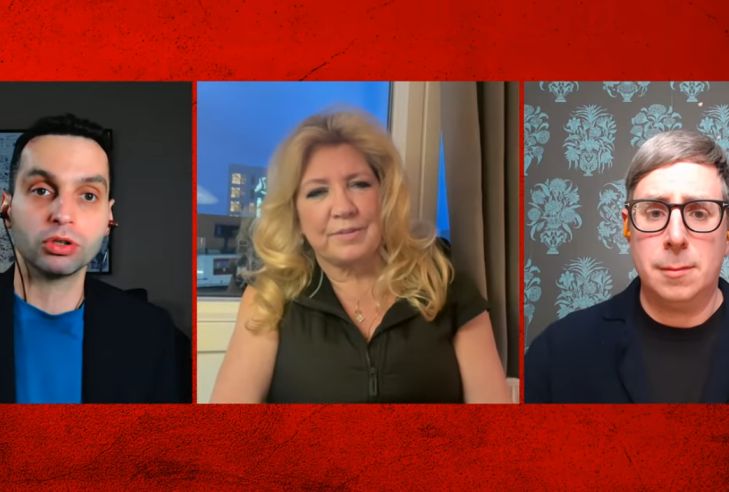
Brief Notes: Broadcasting live from Greenland, this Davos breakdown dives into what world leaders and power brokers are really discussing behind closed doors—and how those decisions could ripple through your money, freedom, and future. Presidential advisor and economist Dr Pippa Malmgren explains the under-the-radar themes from the World Economic Forum, from geopolitical flashpoints to the next wave of economic and technological change. She unpacks how elites are thinking about war, inflation, AI, and shifting global power, translating complex policy talk into practical consequences for ordinary people. If you want to understand where the global system is actually heading instead of just reading headlines, this is the conversation to pay attention to.
Broadcasting Live from Greenland
KONSTANTIN KISIN: Hello, everybody, and welcome to this very live, very special report on everything that’s been going on at Davos and, of course, Greenland. We are joined by a former guest of ours, been on the show a number of times. She’s advised two US presidents, I think Pippa, I’m right in saying, Dr. Pippa Malmgren, and your late father, who was someone we both really respected as well, advised for US President.
So, collectively, I think you’ve got a hell of a lot of knowledge about this. And behind you, we can actually see Greenland, which is a country, didn’t really expect to become relevant in territory, but it has. So, first and foremost, crazy stuff’s been going on at Davos. So much to talk about. Explain to people who’ve been living their lives, feeding their families, going to their things, not really paying too much attention, what on earth is going on?
The Strategic Importance of Greenland
DR PIPPA MALMGREN: It’s so great to see you guys, first of all. And gosh, you know, I know you started out as comedians, and this is a moment where we need humor in dealing with this issue because it’s a lot of heavy stuff.
So bottom line is the United States has said to its NATO partners that it needs to have a greater presence on the island of Greenland, which is the largest island in the world. It’s an Arctic island, and there it is in the background. It’s cold and snowing here.
And under the terms of a treaty from 1951, the United States does have the right to do pretty much anything it wants to militarily here. So the island is part of the Kingdom of Denmark, but it is strategic, security wise, aligned with the United States.
The Greenlanders, and there are only 58,000 of them that live here, they have been going through a process of a kind of a long, slow divorce with Denmark, but it’s not a finished divorce. They’re not independent yet, and their view is they want to be independent of all of you guys.
And they’re annoyed because when President Trump said, “Well, we just got to have Greenland,” and he used the language, “We’ll take it if we have to,” they’re like, “Wait, we live here, so you can’t just take it.” So everybody’s been on very high stress around this.
The Ukraine Connection
I’ll give you my personal view, based on my background working on geopolitics globally, but also I’ve been very focused for the last five years or so on the geopolitics of the Arctic to try to understand why is this happening. And I think part of the answer is Ukraine.
So the President’s trying to bring the war in Ukraine to an end. So far, pretty much everybody agrees. Russia says, “Yes, we’ll get to an agreement.” Ukraine now says, “Yes, we’ll get to an agreement.” The parties that say, “No, we want to continue the war,” are the Europeans for a variety of different reasons.
And so the President says, “Okay, well, the US doesn’t want to continue in this war and we think it’s a stupid war. And if you guys want to carry on, then Greenland becomes critically important because where would Russian nuclear weapons, either on submarines or ships, where would they come through towards the United States?”
They would come through this physical space known as the GIUK Gap, the Greenland Iceland, UK gap. And it’s literally the body of water between Greenland, Iceland and the United Kingdom, Scotland. That becomes a place you would have to have a close eye on to see whether the Russians were bringing nuclear weapons into the Atlantic.
So they’re like, obviously Russia’s going to escalate. If the Europeans continue with the war, how would they do that? Nuclear. Where would they do that? Potentially also aiming at the United Kingdom, because Scotland is the base for all of Britain’s nuclear capability. If Britain wants to continue the war, that becomes a target.
The Space Race and Arctic Control
And so that’s one reason, but I’ll give you one more, and it’s one that is never mentioned in the press, and that is that the Arctic is now central to the space race. So there’s a massive race going on between the US and China, especially to get into space.
Now you say, “But wait, don’t we have enough problems here on Earth? Why are we spending all this money on space?” And the answer is because it represents three very important things: unlimited energy, unlimited resources without having to dig Earth up anymore, and unlimited Internet connectivity.
The unlimited energy is space based solar power, where you beam energy from space to Earth in radio waves so it’s safe. And now you can have energy anywhere you want. That is progressing very fast. Already Google has announced the sun catcher project. So they’re saying we’re going to put our data centers in orbit and on the moon and we’re going to beam back not just data, but energy.
Plus the moon, it turns out, has very special moon dust. It’s called regolith. And in the regolith is something called Helium-3. Now Helium-3 is very rare on Earth.
So there’s a race to get to it, because Helium-3 is very densely packed energy and you need it to do nuclear fusion. And we’re getting closer to nuclear fusion, which would be unlimited energy. And you need it to do quantum computing because you use it to cool down the computers. So it matters who gets there first.
The Data Connection Through the Arctic
Then the second is resources, asteroid mining, which sounds far away, but it’s coming. And third is the connection. And the key to the Arctic is the connection to the mega constellations of satellites that surround Earth.
One of the best ways to get the data to Earth and then to you and me and our cell phones is through one point in the Arctic called Svalbard. And that is the ground station for the polar satellites and the polar related data that then connects to the subsea cables and ends up on your phone and lets you use Uber Eats or DoorDash or whatever it is you use to order food at your door.
Now, in 2022, somebody started cutting the Internet cables that connect the space link to the subsea cables, which is the fastest Internet cable in the world. And you’re like, “Why is that in the Arctic?” And the answer is because this is the umbilical cord for data from space to connect to everything around Earth.
So if somebody’s cutting the cable, then there’s suddenly a need to have a backup. Now where would you have a backup? You need another Arctic site. So where should there be other ground stations? Greenland would be one.
And that helps explain why the United States is suddenly making this a super high priority, is because there’s a point of vulnerability in what the Pentagon now calls the most important war fighting domain, which is space. So that’s another reason why this is suddenly happening.
The Davos Awakening
KONSTANTIN KISIN: Well, we’ll come back to Greenland in a moment. But it’s interesting that you talk about it in that way, because that is not remotely the way it’s being talked about in the media. It’s not remotely the way it’s being talked about by politicians.
And what I saw at Davos, there was lots of different things happening at Davos. One of them was, to broaden out the discussion before we come back to the Greenland issue, is kind of a lot of people who’ve been doing a lot of the stupid stuff that Europe has been doing for a long time, suddenly standing up and saying, “You know, we’ve been doing a lot of stupid stuff and now we’ve got to stop doing the stupid stuff.”
Is that the Trump effect? Is that something else that’s happening there? To see Mark Carney talking about, “Oh, actually, you know, countries need to produce our own energy and they need to have an army to defend themselves.” And all this stuff that, you know, we’ve all been saying for a very long time, suddenly these great bastions of this liberal worldview, I don’t know if it’s, I call it liberal, but whatever it is, suddenly aware of this all of a sudden. Is that because Trump made them or is there something else going on?
Priests Versus Power: The New Global Dynamic
DR PIPPA MALMGREN: Yeah, no. In fact, it was super fascinating. The Prime Minister of Canada, Mark Carney actually said in his speech something to the effect of, “A nation cannot continue to work in a rule system that renders it subordinate.” And Trump would say, “Exactly. That’s been my point all along.” Right? When you got it, great.
And there is this quality of the conversation, and I do think it is Trump. The thing about Trump is that first of all, we have to now put a sports commentator hat on because people are so emotional when they love him or they hate him.
But as someone who is an analyst of global geopolitics, I’m like, okay, let’s park our tribal allegiances for just a moment and instead be like a sports commentator. Just analyze the play, what is happening on the field.
And the reality of what is happening is that nations everywhere are saying, “Actually the rules based system that we’ve had has hollowed out our economies, has not delivered on the promise and therefore we should rethink this.”
They don’t want to turn and say, “Thank you, Donald Trump, for reintroducing the idea that sovereignty matters,” because they’re like, “We hate that guy.” But instead they acknowledge that something has to change.
And I’ve been thinking about this a lot, how to describe this argument, and I’m going to try this out on you guys. I think it’s fundamentally a fight between priests and power.
And by that what I mean is you have a kind of high priest of the world economy, of which, you know, my dad was one. I’ve been involved in that. And there’s a kind of belief system that you have to buy into to be part of that. And that was called broadly globalization.
And the old globalization meant all the jobs went to China and everybody else got services. And that was supposed to be a great result. It ended up not being such a great result.
And now I think we have a new wave of globalization, which is all the jobs are going everywhere. They are no longer only going to China and the west is competitive again. But almost no one in the priesthood who makes the rules has been in favor of that, or they’ve actually been quite opposed to it because they’re like, “Our rules are our rules, and we don’t want a separate conversation.”
Populists, the people who represent the power of the people, they’ve been saying, “Yeah, wait, no, this globalization has not worked to our advantage. We want the new version, which is where capital and jobs migrate back to our countries, whether that’s the US or anywhere else.”
And Trump has been at the forefront of being a populist that said, “Let’s have chip production in the United States, let’s bring auto production back to the United States. Let’s go super high tech.”
And so the priests don’t like the power populace interfering with their game, but they’re also intelligent, and they’re starting to go, “Wait, our system of rules does need adapting, does need changing,” but they don’t really want to say the other guys were right. Does that make sense?
The New Trump Dynamic
FRANCIS FOSTER: That makes total sense, Pippa. I found Trump’s speech, when I was watching it yesterday, very interesting, because from a dynamic point of view, personal dynamics point of view, people used to talk about Trump, and the political rhetoric around Trump was always, “Don’t watch what he says, watch what he does.” But after Venezuela, everybody’s watching what he says now.
Trump’s Davos Speech: A Shift in Tone
DR PIPPA MALMGREN:
Oh, yeah, definitely. Well, I thought—I’ll tell you what I thought was super interesting about his speech. First, it was the tone, because there had been an expectation that he was basically going to come to his NATO partners and effectively read them the riot act. Because from his point of view, the US is not only the senior partner of NATO, it’s paid for everything in NATO for so long.
And so when the US says we should end the war in Ukraine, he’s kind of surprised that the other NATO members said, “No, no, no, we must continue the war.” And he’s like, “Wait, but you guys don’t have any equipment of your own and you don’t have money because your finances are not great and you don’t want to send your kids. So, wait, why are you pushing for that?”
So he already feels that the NATO partners are not being very allied to begin with. Then he says, “Okay, well, if you guys really want to do this, which we think is stupid, fine. But Greenland then becomes really important.” And what did the NATO allies do? They send their troops to guard Greenland from the allied partner. So they’re like, “Wait, what? Where are we with our allies? Are you guys allies or are you not allies?”
And that was the feeling the White House had going into the Davos meeting. But when the President got there, he adopted a completely opposite tone. And he basically said, “We love Europe. We Americans are European, and we are all brothers and sisters, and we think that there’s some other ways we could progress everything.”
Star Wars vs. Star Trek: Two Paths Forward
And I’ll summarize what I think—he didn’t say it this way, but he could say it this way. And as somebody, as you say, I’ve worked in the White House often the problem is, how do you—the President might have a clear policy, but the way they articulate it doesn’t convey it.
So I think what’s happening is the superpowers are basically saying, “Look, we’ve got two choices. One we can call Star Wars and one we can call Star Trek. Star Wars is where we go to war with other human beings. We go to war with people. Star Trek is where we go to war with problems.”
So if we stop doing the Star Wars thing—and it’s a useful analogy for Ukraine, because Ukraine is the first space war, and everybody goes, “What are you talking about? No, no, no. It’s a ground war with tanks.” No, there’s no way that Ukraine would have been able to do the offensive and defensive maneuvering they’ve done against a major superpower had it not been for Starlink. And so it’s a space war. And the Pentagon’s clear that all ground wars are now space wars.
So we are spending money, time, resources, energy on a war with people. And it’s highly destructive. As the President keeps saying, “How many people are dying every month?” And he’s like, “Why?”
On the other side, Star Trek is where you take all those resources, that energy, that time, you stop that war. And now we go to war with physics, with mathematics, with biology, and we solve problems so that you can have abundance. The space race, as I said, is a perfect example. If we have abundant energy, cheap, clean, green energy, if we have abundant resources, if we have abundant Internet connectivity—what is there to fight over?
The Genesis Mission: Opening Up National Labs
So this is one reason he recently announced the Genesis mission, which probably nobody has heard about. It’s not really been covered in the press. It’s the most extraordinary announcement that all of the national laboratories, the national labs of the United States—so that’s Los Alamos and Lawrence Livermore and Sandia. These are the most classified facilities in the United States. There are 42 of them or something.
They’ve announced they’re going to open them up. All the technologies inside—unless they’re nuclear—they’re going to try to bring those into the public. So the public can benefit from things like nuclear fusion, from the incredible advances in new materials technology, et cetera, et cetera. And they’re going to allow the scientists who are not with a classified status to go in.
So this is a way of propelling the United States to the technological frontier much faster so that the public can benefit from the kind of abundance that means, “Guys, we don’t have to have these fights. We don’t have to be at war.” So that’s why I say it’s kind of Star Wars versus Star Trek. And that was the tone in Davos—we’re all on the same team, but we want to get to peace, so how can we do that?
A Yalta-Style Agreement: Solving Multiple Conflicts at Once
And I’ll finish by saying the other complicating factor here is that the media and most people look at each of these geopolitical issues as if it stands on its own. So as if Ukraine is going to be resolved by itself and Gaza is going to be resolved by itself and Taiwan. But that’s not what I think is happening.
I think we have what some people would call a Yalta-style agreement, making reference to how World War II came to an end, which is where the major superpowers sit around the table and they go, “Okay, we’re going to solve all of them all at once. And here’s what everybody’s going to get.”
These are the deals that are being struck and a whole bunch of parties say, “Wait, I’m not at the table.” So they’re mad. A lot of Europeans take that view. But the fact is, this is how superpowers tend to resolve things. And I think that the speech at Davos was signaling we’re trying to solve all these issues all at once.
Greenland, in a way, was a dog whistle. It was a way of getting everybody’s attention onto the fundamental question of do we want peace or do we want war? Because that’s what it’s done, especially for the European public. The core is if you want to keep having the war in Ukraine, then Greenland becomes critical.
FRANCIS FOSTER:
It’s a really good point and very well explained. He did give the Europeans a tongue lashing. When I was watching the speech, he said a few things. I’m like, “Ooh, that’s a bit spicy.” The green news scam, he said, referring to the turbines as windmills and the people who bought them are stupid. I’m like, I see what you mean. But also, there were a little bit of Trumpisms in there as well.
The Tone: Harsh But Gentler Than Expected
DR PIPPA MALMGREN:
Oh, no, no, no. Absolutely. And he was harsh. I mean, and also the—basically the Americans liberated you from the Germans and that era of history. I mean, it was tough. But it was a lot gentler than everybody had expected. They thought that—I mean, honestly, going into that meeting, there was a report that the 11th Airborne in the United States, which is the division of the army that specializes in Arctic warfare, that they were gathering in Minnesota and there was speculation they were going to be flown to Greenland and we were going to have American Special Ops guys dropping into Greenland the way you did into Venezuela.
That I don’t think was ever on the cards. But the fear was that something like that might happen. So relative to that kind of fear, he did a lot to say, “Guys, calm down. We’re not talking about using force.” And actually he never raised that. People around him raised it.
But yeah, it was a bit of a riot act speech, which is also not just, “Whose team are you guys on? Are you with the US or you’re not with the US?” It was also, “Do you want to go do Star Wars or do you want to go do Star Trek?”
If you want to do Star Trek, why are you spending money on technologies that actually turn off all your energy? The US keeps saying—we just said in the national security report that’s just come out, the NSS, it’s called—that Europe has chosen a path of, quote, “civilizational decline.”
KONSTANTIN KISIN:
Yes.
DR PIPPA MALMGREN:
And how can the US be partners with a bunch of countries that have made a deliberate decision to diminish their energy input, which naturally then diminishes their economy’s capacity to function well, and diminishes incomes and livelihoods? And they’re like, “Why? Why is this happening?” So I think that was a core element of the speech.
Challenging the Narrative: Peace or Power Grab?
KONSTANTIN KISIN:
Absolutely. And Pippa, I want to challenge you on something just to probe at the argument you’re making before coming back to the point you made about energy, which I think is super important. But are you not being a little bit generous to President Trump in the sense that you’re saying, all he cares about is world peace and bringing everyone together and solving problems instead of fighting other people?
But then an alternative perspective that a lot of people are persuaded by is actually what President Trump is doing is not remotely that. What he’s doing is what Vladimir Putin is doing, which is seeing that the rules-based order has crumbled and this is our moment to, quote unquote, “get shit done.”
We want to get rid of Maduro, we’ll go in, we’ll take him out. Forget about international law and all this other stuff. We’ve always wanted Greenland to be part of our sphere. We need—you articulated very well the security considerations there. And a lot of people might say, isn’t President Trump simply doing what Xi and Putin want to do and have done, which is using the moment of weakness around the world—let’s be honest—to get one over people he’s always wanted to get one over and to achieve America’s national interest at the expense of everyone else, including its NATO allies?
Venezuela: Regime Change or Strategic Leverage?
DR PIPPA MALMGREN:
Yeah, I totally understand this question. It then raises the question, look at Venezuela then—why didn’t the United States do regime change? Why did they only remove that president, who is, by the way, head of his intelligence, his equivalent of the CIA, NSA. He had left weeks before and was telling Trump and his team exactly who was working with the Venezuelans in the illicit drug trafficking.
And in other words, Maduro probably is also doing the same thing, kind of seeing a canary scenario. But he didn’t go in and say, “We’re going to overthrow the entire government.” He did say—he basically said, “We’re going to use this as leverage to get this government to stop doing the things that are undermining security in the United States.”
And Delcy Rodriguez, who was the vice president, now the leader, has met with the head of the CIA and said, “Yes, we are no longer going to do these things that are detrimental to the United States.” So is that what you describe in your question, or is that a more sophisticated way of protecting American interests?
So, as one example, I think the same question will come up, of course, with the whole issue of Gaza and the Middle East. And we saw Jared Kushner give a whole presentation about a vision for the future of Gaza. And again, is that the US imposing its will to get things that serve its own interest, or what I find interesting is how few people say, “Well, given what has happened, should it be reconstructed for the Palestinians?”
Should America do a Marshall Plan, which is really what Jared Kushner laid out when we reconstructed Germany at the end of World War II, even though they had been America’s opponent? Is America doing the same thing here? I would argue it’s very similar. So is it that America’s doing what you said in your question, or is it that America’s doing the Marshall Plan? Again, I think so much depends on how one has already decided to frame it.
Europe’s Wake-Up Call
KONSTANTIN KISIN:
Yes, it’s why I asked the question, because it’s not one I personally agree with, but that is the narrative. The panicky European chattering classes are basically all saying Trump is Hitler and is invading everywhere and he’s about to take over. And I have to say I do find it quite funny. There was a leader of one—I don’t even remember which country, but probably quite small and irrelevant in the grand scheme of things—who stood up and went, “You know, we are going to defend the international rules-based order and we are going to stand up for—”
With what? Like to your point about energy, Britain itself can’t make virgin steel anymore because we’ve de-industrialized through this suicidal thing called Net Zero. Do you think this is the wake-up call in many ways that Europe has needed to have sanity return to our politics again, and to pursue policies that actually make us better off, stronger, more influential in the world, et cetera? Or do you think they’ll carry on as business as usual?
# Davos Breakdown: The Real Conversations Behind Closed Doors
DR PIPPA MALMGREN: Neither. I think that the current leadership in Europe may now double down and by doubling down they may say, right, the problem, for example, the problem is that people raise objections to net zero. Or the problem is that our choices are questioned.
So look at the whole discussion about should X be banned or should people be arrested for saying things on social media that are critical of any given government, which is exactly the opposite of where we are in the States, which is, you know, anybody can say what they want and we should take into consideration multiple perspectives on things, whether we like it or not.
So is it possible that the Europeans are going to double down? And I know this sounds harsh, but possibly respond to all this by introducing what I might call a digital iron curtain and saying, right, we’re just not going to allow debate now. Already we did see Chancellor Mertz say it was a mistake to turn off all the nuclear. So that is a huge turnaround.
And I do think we will hear the Europeans saying more and more, actually we maybe need to shift direction. Are they going to say we made a mistake before? No, politicians don’t apologize. But at the same time, will they double down on getting the peanut gallery to stop with their criticism and to stop with their liking what Trump says?
Because after all, in Europe you do have a substantial proportion of the electorate that’s increasingly becoming more Trumpy in their interests. But that’s very opposed by the high priests of the rules based system. They don’t want what they call the far right to gain votes.
And that’s another interesting part of this whole thing. We’ve all descended into this tribalism and relativism. So, like, as someone who’s been in this game of geopolitics literally since, like, you know, I first did an internship for Ronald Reagan in 1983, I think it was. So what used to be center, I didn’t change. And now some people would call it right, some people might even call it far right on certain issues. I’m still kind of lefty on others.
But, you know, like, the world has moved in such a way that I actually don’t even think left and right are helpful any longer. What’s more important is to ask, is your direction of travel forward or backward?
If you are interested in fighting with somebody about yesterday’s problem and assigning blame, you’re going backward. If you’re interested in how do we solve problems so that we have a whole different set of options in front of us that are easier to work with, then you’re moving forward.
But people are tribal. And right now, the uncertainty about the world is making people feel very aligned, like they do to a football team. And they’re either with Trump or they’re against him. They’re either with the EU and their agenda, or you’re an enemy of it. There’s like no middle ground.
Trump’s Message to Europe: Where’s the Gratitude?
FRANCIS FOSTER: And that was actually one of the themes of Trump’s speech, because he didn’t use these words, but he almost accused Europeans of a complete lack of gratitude. He goes, America does all of this for you. We do all of this. What do we get from you? And more to the point, if something happens to us, can we rely on you to come in and support us? I don’t think we can.
DR PIPPA MALMGREN: Yeah, yeah, he did say that. And I think, look, he’s capturing a sentiment that does exist in the US and that’s not only from the Trump era. That’s also partly from President George W. Bush, who I worked for. I was there before the events in Iraq.
But there’s still a lot of anger in the world about how the decision was made to go to war in Afghanistan and in Iraq. So that anger about you guys in America are always declaring wars everywhere, it’s very persistent. And so Trump is having to deal with that.
And ironically, he’s like, wait, I’m trying to go the other way and get us to peace deals. But he’s portrayed by many in Europe as a sellout. And this is, now we’re going to get into a very complicated matter, which is like how, for example, the war in Ukraine began.
And whether we agree or we disagree, part of what Trump is doing is going back in time, declassifying a lot of emails and correspondence from within government. And he’s saying, you know, the official story has been that it’s very simple, that the Russians were bad guys, the Ukrainians were good guys, and the Russians just rolled in without any provocation.
Now he’s like, well, it looks like the previous administration actually spent a fair amount of money through USAID and other organizations fomenting the Maidan Revolution and other color revolutions in Eastern Europe. So your hands are maybe not so clean.
And given that that’s the case, maybe we should figure out how to get to a resolution, because it’s no longer so, like, good guys, bad guys. Everybody played a part in making this mess happen. And who’s suffering? It’s a bunch of young kids who had nothing to do with creating this problem.
The Taiwan Question and China’s Economic Reality
Similar his position on Taiwan. He’s had the same position since he was president, the first round, which is that the chip production is moving from Taiwan to Texas and Arizona, and therefore it’s not as strategically important to the United States. So, therefore, there is room to negotiate a deal.
But the implicit message is China’s economy is in trouble, and China needs to learn how to be in the world economy in ways that generate better livelihoods. So you can do a deal on Taiwan if China will be more like Taiwan, but not if China is going to crush Taiwan the way they’re perceived to have done it in Hong Kong.
And of course, China views this as a strictly internal matter and that no other government should have an opinion on. So rather than articulating what I’m articulating, Trump just very quietly goes about making it clear that there’s a deal to be done.
But again, China, what’s your choice? You want to go to war with the United States? You all have had a one child family. Do you want to lose the one child? Like, do you really, with your economy, do you really want to spend all those resources on war with the United States, or do we want to go back to making money?
If we all want to go back to making money and raising incomes and livelihoods, then let’s have a conversation about what are the ways in which we could accomplish that. But again, then he’s portrayed as a sellout.
And so this happens to every president. Just to be clear, every president gets boxed into a corner. And having worked for both Ronald Reagan and George W. Bush, what’s amazing is I remember how hated they were. Hated. And now everyone’s like, could you bring George W. Bush back? And Reagan is a hero.
Now, I’m not saying that you’re going to love Trump one day, but I am saying all presidents are hated while they’re doing the tough work. Later, when everybody’s had a chance to review and assess the results, opinions change. So he’s a little bit like, yeah, whatever. Noise. I need to get deals done that will get us to peace, because that’s where his direction of travel is.
The Greenland Deal: What’s Really Happening?
FRANCIS FOSTER: And he was constantly talking about himself as this consummate deal maker in the speech. And then I woke up today, literally today, and heard that there’s been some kind of deal agreed with Greenland. I mean, what do we know about that? Or is it very basic or is it still up in the air?
DR PIPPA MALMGREN: You know, it happens. I’ve just been at the press conference here in Nuuk in Greenland with the Prime Minister of Greenland, and the press were asking him all exactly this question, and he was like, listen, I wasn’t in Davos, and these were not formal discussions, so I have no idea where we are.
Instead, he said, I have some red lines, right? So sovereignty is not negotiable. But Greenland is a close ally of the United States, and we absolutely want to be in dialogue to accommodate whatever the strategic security needs of the United States are. Because parentheses, we’re only 57,000 people. We don’t have the means to have independent protection of our future.
And like I said, Greenland, they want to be independent. To do that, they have to be aligned with the US and strategic security issues. So basically, what I think is it’s a whole bunch of press generated noise. We don’t have anything substantive.
But I think that there’s now a genuine goodwill effort by NATO, by the White House, by the Greenlanders, to get to a place where everybody’s comfortable. And by the way, I’d like to add to that, the fact that the Greenland government itself, the leadership was in Washington in the meetings, tells us already that both the Kingdom of Denmark and the United States understand that no decisions can be made without the Greenlanders.
So I actually think the bigger issue now is the Greenlanders don’t understand that they do have a position of power and leverage. And instead of only looking for or being willing to accept, let’s say, some kind of financial deal, and I characterize their position as, Greenland is not for sale, but it’s open for business.
Okay, what does that mean? That means okay, what is the business? And I have said to the Greenlanders, you guys should be saying, okay, if you’re going to be doing the space race from Greenland, we should be part of it.
So we want to get space based solar power, we want to get access to free energy, we want to get jobs, we want to get skills upgraded, we want to have Internet available to all the Greenlanders for free. Like, there are many things. Take us with you to the technological frontier and then we can decide which technologies suit this community and which don’t, but at least empower the Greenlanders.
And I think they hadn’t thought of that. And the White House wasn’t going to volunteer that. It’s a negotiation process. And as for Denmark, you know, they also want the best outcome for the Greenlanders and they had already been devolving the authority of political decision making to Greenland anyway.
But I think the way Trump came in, very blustery, then everybody locked into, no, no, no, it’s mine. Right? Like, you can’t have it like children arguing over a toy. The fact is that all of them have an interest in creating a future where all of them have more possibilities than before.
Dealing with Putin and Xi: The Reality Check
KONSTANTIN KISIN: And Pippa, coming back to your point about the fact that we are now in a world in which the superpowers will make deals and sort of settle things, etc. You’re painting, I would argue, a fairly rosy picture of President Trump, which may be accurate. You probably, well, not probably, you definitely know way better than I do.
But nonetheless, I think a lot of people would feel it’s a rosy picture, but he’s going to have to do deals with the Quirin of the Joseph Stalin and whoever would be the Chinese version of that. He’s going to have to do deals with Vladimir Putin and Xi Jinping.
Are you confident that their attitude to all of this is similar in that they also want world peace, kumbaya, make money, etc. Or do you think someone like Vladimir Putin, a KGB colonel who’s grown up in that world, is going to be thinking in a very, very different way about this and will be looking for what’s in the interest, not only actually of Russia, I think, but in this point of his trajectory and his career, what’s in the interest of making sure that he is remembered as Vladimir the Great?
DR PIPPA MALMGREN: So, you know what’s really interesting is who announced that they are open for business and deals with China? Not Trump. Mark Carney said that, the Prime Minister of Canada, where a year ago he had said China was the most significant strategic security threat. And then at Davos, he said, we are ready to do deals with the Chinese.
The British, the French all said, and the Germans too, we are going to be partnering with the Chinese. So again, the Americans were like, wait, what? That’s like right now, the biggest strategic security opponent and you guys would rather do deals with them than the United States? So who’s doing the deals?
Here is the key question. I think your question as well about Russia is absolutely fair. And that’s why again, if we go back and we look at, for example, the meeting that President Trump had with the Russians in Alaska, so the media portrayed as Trump and Putin, but it was also 400 Russian business people.
And Trump was mainly talking to the business people, saying, do you guys really want to continue on this war path, or do we want to find a solution to Ukraine so that we can bring Russia back into the world economy, normalize relations?
And he’s already hinted at the structure of that because I think the Russian position is yes, and we don’t want a border with Western Europe. We want a buffer zone. And that buffer zone looks to me like a revival of the old Polish Lithuanian kingdom. It’s what they call the Three Seas Initiative, which links together the Baltic Sea, the Black Sea and the Adriatic.
So it’s like from Lithuania straight down through Poland. And the US has said we’re going to let Poland take the lead on what will be the largest construction site, reconstruction site since the Second World War. If we get a peace deal, then we’ve got to rebuild Ukraine and Poland will be at the forefront. Plus the Poles relationship with Russia is pretty, let’s say there’s a lot of history there.
KONSTANTIN KISIN: There’s a lot of history there.
The Path from Nuclear Brinkmanship to Reconciliation
DR PIPPA MALMGREN: And so, you know, if you want a guard dog in the night, the Poles, if they think one little thing is out of place, they’re going to start saying, oh, we got a problem here.
And the US has said that they would have a commercial interest in some of Ukraine’s mining, which I think is the cover story for “Don’t Touch Ukraine,” even though it’s not in NATO, because you will be triggering a US Response. So it’s a way of saying it’s protected, even if officially it’s not in NATO.
So Russia’s business community is indicating, yeah, then we could do business inside this triangle and begin to reintegrate Russia into the world economy. And this is important because this is something my dad taught me from his experience in government. In the end, when you reach the point where you’re really threatening nuclear confrontation—and that is where we have been, that if Ukraine continues to escalate, that Russia is prepared to go to nuclear—well, when you get to that point, the human response is no one wants to bring the end of the world about. Nobody really wants to hit that button.
So the only other place you can go is the opposite end of the spectrum, which is a hug. And my dad watched all of these geopolitical conflicts always end in a hug. And I’m like, what? He said, yeah, look at the photograph of Nixon and Brezhnev. Totally, like, embracing. They practically kissed, in fact. Because once you say, we’re not going to kill each other and annihilate Earth, then it’s like, hey, let’s go to the bar. Let’s, you know, hug. Let’s figure out how to work together.
Same thing happened with Reagan and Gorbachev. And that’s when I was working for Reagan. In both cases, no one ever imagined the leader of the Soviet Union was going to meet with the leader of the United States. Like, that was impossible to imagine, let alone embrace. But it’s that embrace that then allowed a dialogue and ultimately allowed Russia to leave its position as the Soviet Union to become Russia.
And so can we be friends with the Russians again? Yes, but there are terms and there are conditions. Same thing with China. Does the US really want to be arch enemies with China forever? China has, what, 1.6, 1.7 billion people? If we can’t find a way for the Chinese to come back into the world economy and believe that their future will be better, then we will be back in conflict.
That’s the thing. If you want to get to a peace deal, then you also are going to have to embrace the peoples of those countries and bring them back into a world family and not treat them as the enemy anymore. It’s hard to do. But that’s what happened with Germany at the end of World War II. It ceased to be the enemy. We made them an ally. We reintegrated them into the world. They are in a very different place than they would have been otherwise.
And so that’s—people kind of don’t think through to the end game. Like, okay, if we’re at war then, and you think you can win, what does winning even mean in an era of nuclear weapons, plus now? I mean, the capability of our weapon systems is so much greater than it used to be. And now we’ve got robotics so what, you’re going to have robots fighting robots? Then who wins? The person who runs the country that runs out of 3D printed material first.
And if you’re going to have robots fighting robots, why don’t they just build hospitals? Like, why are they destroying stuff? Why don’t we program robots to collectively build new housing and new hospitals? And then what are we fighting over?
So, yeah, I agree. I hear you. But I think that that is where the superpowers are leaning, which is that it’s just too expensive, it’s too costly to humanity to continue fights that risk existential outcomes. And it’s better to get to the hug, even if it feels distasteful.
FRANCIS FOSTER: Well, we’re talking about hugs. And Europe over the past 48 hours hasn’t been feeling a lot of hugs, certainly not from Donald Trump and certainly not from Volodymyr Zelensky, who in his speech, he went in and essentially lambasted Europe as well, didn’t he?
DR PIPPA MALMGREN: Yeah, because it’s interesting, he too, has realized, given a choice between escalating and de-escalating, he’d rather de-escalate and save what remains of Ukraine. Because if you stay in this fight, most of the analyses are that it’s not going to be pretty.
And interestingly, Mark Rutte, the head of NATO, came out and said President Trump is right and we should all be on the same page and we should be trying to get the point of ending the wars. So I think, actually, and I think what’s going to happen is there is going to be more and more of a conversation about what are the terms and conditions for ending the war in Ukraine and for Russia and also China to be reintegrated into the world economy. And I think almost no energy has gone into that vision of the future where everybody can play in the same sandbox because we’ve been in such a confrontational mode.
The Strategic Importance of Diego Garcia
FRANCIS FOSTER: We have indeed. And one of the really interesting things as well is Trump has spoken openly about Starmer and the UK letting down the US when it comes to the Chagos Islands. And that’s something that I really wanted to talk with you because I don’t think a lot of people understand the Chagos Islands. I certainly wouldn’t pretend to their significance. The deal. Is Trump correct? Is it hyperbole on behalf of the president? What’s going on? Why is it so important? And is Trump right?
DR PIPPA MALMGREN: Yeah. So Diego Garcia, this tiny little island that is kind of south of India, bottom line is that’s the main base the US uses whenever it’s doing bombing runs into the Middle East. So in terms of our strategic security interest as a nation, Diego Garcia is considered one of the most critical control points on Earth.
And so when the British basically started to negotiate it away, leaving is argued in a vulnerable position to America’s opponents, particularly China, to then begin having a presence. And let’s understand there’s been a kind of jockeying between the United States and China over many, many islands. The islands in the South China Sea, the islands of the Pacific.
Understand, the other main American foothold is Guam, and now this little island underneath it, Tinian, that they’re upgrading to be even more important than Guam. The Chinese have been moving into places like the Solomon Islands. So these are all, like, physical footholds for geopolitical purposes, for strategic security purposes.
So when the previous administration in the US was in office, they didn’t seem to express a view about Diego Garcia, which is the Chagos Islands. And therefore, that process in Britain just progressed. When Trump arrived, he went, no, wait a minute. That’s a really important national security interest in the same way that Greenland is. And you can’t just give that away and have no protections for the national security interests that the United States has. And that’s what’s reopened this whole discussion.
And I mean, it’s clear the relationship between President Trump and his counterparts in Britain, in France, and in Germany. These are not conversations that have been going swimmingly, right? These are very tough conversations. The conversation that’s gone very well has been with Italy. And notice that Italy has been at the forefront of saying, Giorgia Meloni has been at the forefront of saying, let’s figure out how to do a peace deal. Let’s figure out how we’re all allies and we all have common interests, and how do we get sitting around a table to have a conversation about this?
By the way, that’s one thing the Greenlandic prime minister said today was, we’re creating a working group, and the working group is going to figure this out. In other words, let’s talk. So I think that’s kind of where we are, is the president’s talking to the Europeans that will talk to him and the ones that won’t talk to him, we can probably see more fireworks coming.
FRANCIS FOSTER: Because it seems to me that if you’re not going to be talking to the President of the United States, that is, to put it bluntly, a quite moronic play, isn’t it? The US is the world’s greatest superpower, like him or not, Donald Trump is the leader of the world’s greatest superpower. That’s ridiculous not to talk with him. I mean, that’s self harm bordering on suicidal, isn’t it?
DR PIPPA MALMGREN: Well, we’re back to that’s why the United States issued the national security statement saying Europe seems to be on a path of civilizational decline. As you say, they view it as a kind of self-harming position. Whether this is right or not is beside the point. I’m trying to describe what is the view from Washington. And look, the US is always, it is extremely powerful. It’s more powerful now partly because its economy is going so well.
KONSTANTIN KISIN: Yes.
America’s New Demonstration of Power
DR PIPPA MALMGREN: Partly because the President used the events in Venezuela not only to accomplish a specific task which was to signal that the cartel operations across Latin America are no longer going to be allowed. Basically the US is saying we’re going to have order, we’re not going to have this kind of stuff going on in America’s backyard.
And by the way, it was clear message also to Russia and China that if you need Venezuelan oil, it will be available, but if you want to go to war with the United States, then the US can turn the tap off. So, you know, it’s not saying, it’s America’s, only we get to sell it. No. And he actually specifically said the Venezuelans need the revenue because they haven’t had anything. Their own leadership has creamed off the top. So boom, there you have a different way of thinking about it.
But one of the things that happened in Venezuela was a demonstration of capability. And the word is that something like 20 special ops guys were able to physically walk into a highly guarded presidential palace and knock down hundreds of opposition and walk away with the leader intact. Right. Like that is unheard of. And it sent a message to the world that the US isn’t necessarily going to come with old fashioned armaments. We’re not going to show up in the same way as the old days. The US has all sorts of new methodologies for enforcing order and we’ve seen this in many different ways in the last year.
There’s also been this whole issue of controversial as it is, of precision targeting of opponents of the United States with regard to the Iranian leadership. Right. It’s so precise, it’s meant to send a signal that if you really want to be America’s opponent, America can take out an individual at a time, no matter how high you are, no matter how highly protected you are. Now is the world comfortable with that? I don’t know. But the reality is that’s where America is.
So to not negotiate with America or to treat America as an unimportant partner in the alliance, or to dismiss it just because you don’t like the current President doesn’t really serve your national interest.
And finally, I would say another one sort of key point here is especially for the Europeans. And I lived in Europe pretty much my whole adult life, other than my roles in the White House, which is strange and weird, but it worked out that way. So I’m very sympathetic and simpatico with Europe and Europe’s views, its culture.
But the bottom line is most Europeans know the east coast of the United States and the West. So they know New York and Boston and Washington, D.C. and they know LA and San Francisco. These are not representative of where America is. And I really learned that when I worked for George W. Bush, because I come from that background.
KONSTANTIN KISIN: Right.
Understanding the Real America
DR PIPPA MALMGREN: My mom is from LA and I grew up in D.C. and I remember referring to the middle of the United States in an incredibly arrogant, you know, east coast technocrat way of saying it’s the flyover district, like, who will go there? And then I learned, because I went there and I went there during the time I worked for George W. Bush.
And I realized the real power in the United States comes from the middle. And you have to understand that that is the real America. So when you say I don’t like Donald Trump because he’s not like my friends on the east coast or the west coast, you’re like, then you don’t know America. The real America is this middle part that has a very different sensibility. It’s much more conservative than you think it is.
It’s also a part of the country, that part of the country believes that America shouldn’t be involved in wars around the world. And they support the President’s efforts to do limited actions in order to get longer term results. So this is a different America than Europe thought they were dealing with.
FRANCIS FOSTER: Absolutely. And what would you—Go for it, Constantine?
KONSTANTIN KISIN: I was just going to say we’ve come to the end of our hour, actually, so I think we best wrap up and let Pippa crack on with the busy schedule that she has. Thank you so much for joining us. It’s been an absolute pleasure. Anything you want to say before we wrap up here?
Breaking Free from Digital Echo Chambers
DR PIPPA MALMGREN:
Yeah. I’ll just say one thing for everybody listening. I think every one of us has a digital sheepdog by our side 24/7 these days, meaning algorithms that are designed to give you more of what you like and to fence off what you don’t like, and it’s narrowing the aperture of the view through which you get to see what’s going on.
So if you haven’t, for example, clicked on anything on the space race or the geopolitics of the Arctic, just start clicking on a few of those because it will widen the aperture of the view. And I think that would help if the public were more informed about some of these things.
Even though, as you opened, it’s like day to day, I’m just going fishing and buying groceries. Which is exactly how the Inuit people here, they’re like, I’m busy. I don’t know what all these superpowers are doing. I need to go catch some fish and get my kids to school on time.
But when you tell them about this wider set of phenomena—technology, the space race, the reasons—they are like, oh, this is super important, this is interesting. So that’s my recommendation: punch out that view by training your digital sheepdog to widen the array of stories that are brought to you.
KONSTANTIN KISIN:
Dr. Pippa Malmgren, thank you so much for joining us. Really appreciate your time.
DR PIPPA MALMGREN:
Thank you.
Related Posts
- Transcript: President Trump Addresses the 81st Session UN General Assembly
- Maggie Haberman: Trump’s ‘Unreality Bubble’ Meets the Midterms (Transcript)
- Transcript: President Trump Remarks on Healthcare, Sep. 18, 2026
- Transcript: Jonathan Swan’s Dive into Trump’s Reality: The Weekly Show
- Transcript: President Trump Remarks in Dublin, Ireland – Sep 12, 2026