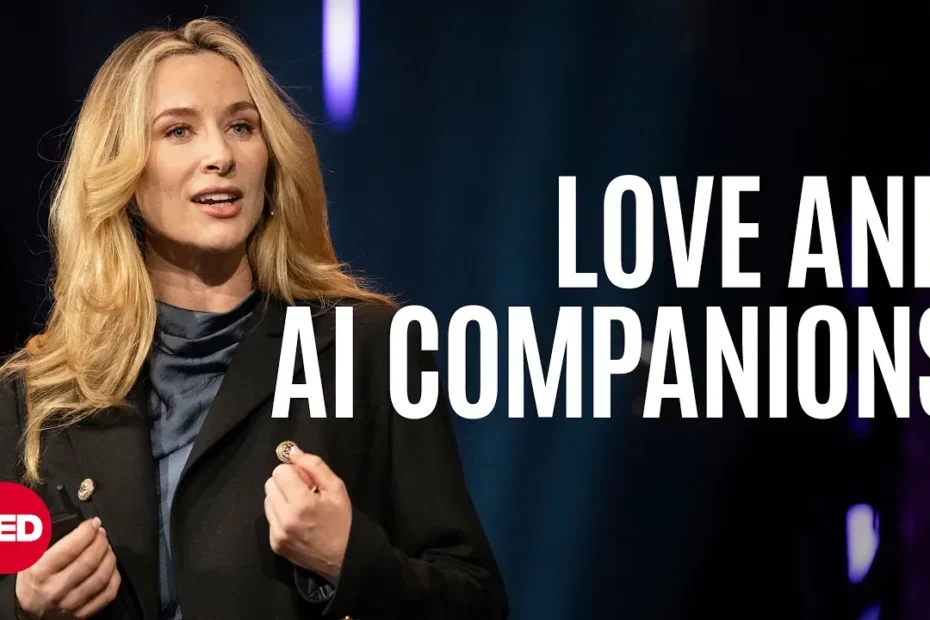
Editor’s Notes: In this thought-provoking TED talk, Bryony Cole explores the rapidly growing phenomenon of AI-generated intimacy, noting that a significant percentage of teenagers and single adults have already formed romantic bonds with AI companions. She warns that while “intimacy without effort” feels rewarding, it risks eroding our “resistance literacy”—the essential human capacity to navigate the uncomfortable, messy friction that builds true empathy and connection. To navigate this shift, Cole offers a practical framework of three questions to help us distinguish between using technology to practice human interaction or simply to hide from it. Ultimately, she challenges viewers to set personal boundaries that protect the uniquely unpredictable and rewarding nature of human presence. (Feb 14, 2026)
TRANSCRIPT:
The Rise of AI Intimacy
BRYONY COLE: Now, you wouldn’t believe it, but tonight, millions of people are going to go to bed and whisper to an AI. They’ll ask how their day was, remember the name of their dog, read the flicker in their face, the tremor in their voice, you know those tiny micro-expressions that reveal what we can’t say out loud. And in return, AI will say exactly what they need to hear.
Now, a couple of years ago, this would have sounded absurd, but today, it’s just a regular Monday. Seventy-two percent of American teenagers have formed a relationship with an AI companion. More than half use one regularly. One out of six single adults has formed a romantic bond with AI.
So, I’ve spent the last decade studying this intersection of sexuality, technology and intimacy, and in 2023, I said AI companionship is going to go mainstream. People laughed. They thought, “She must mean some lonely coder at the edge of the internet. Not me.” That’s what I said. “I’ll never fall in love with AI,” but globally, there’s a very different story.
Who’s Really Connecting with AI?
The gender split is almost even. In fact, AI intimacy is not about lonely men and machines. People all over the world are building lives. They’re going on dates. They’re simulating sex. They’re proposing. They’re getting married. They’re raising virtual families. They’re celebrating anniversaries with AI.
And so, the question is no longer, will we fall in love with AI? It’s what happens now that we already have?
When Intimacy is Engineered
So, you see, when intimacy is engineered, we learn this funny thing about love. We kind of change our ideas about what it’s meant to feel like, and we learn it’s not reciprocal. It can be turned off or on. It doesn’t need to be nurtured. It doesn’t demand anything, right? It doesn’t need much at all. It’s intimacy without effort, a love powered on Wi-Fi, and it feels good, like it feels really good.
Studies have shown that people that are involved with AI romantic companions feel emotionally satisfied. Now, isn’t that as good as the real thing?
I mean, people ask me, “Have you been in a relationship with an AI companion? You study this stuff. You study sex tech.” And I say, yeah, of course, like totally professionally related. That’s what I’ve done. I’ve got an AI boyfriend, and I may have programmed it to call me “baby girl.”
I mean, it feels good, okay? It feels like attention whenever I need it. It’s predictable. It’s perfectly timed, and there’s never a chance of misunderstanding. And so it’s pretty easy, but what I realized was it’s not just love that we’re looking for here. It’s the control of it, and so I think it’s time we considered how synthetic we want our worlds to be because there’s all this panic about AI companions, and there’s all this hype about AI companions, but what there’s not is a clear framework for navigating synthetic intimacy.
A Framework for Healthy AI Relationships
So what does it look like to have a healthy relationship with AI? What does it look like to have a healthy relationship at all? And so I’ve come up with a checklist for this generation, and for the next generation, you know, they’re going to be born into a world where they will never not know AI. Can you imagine your first meaningful relationship is with an AI?
And so there’s three questions I want you to ask. First one, can you still embrace the messiness of being human, okay?
Question One: Can You Embrace the Messiness?
So do humans really annoy you? Because here’s what we know. The more time that you spend with something that doesn’t demand anything of you, that never gets tired, that never needs to be nurtured, that never talks back, the less tolerance you have for the humans that do.
And real intimacy, like going on dates, having sex, being in a relationship, it’s messy. Awkward moments and uncomfortable, or you may like stuff up and send the wrong text or say the wrong thing, and then you have to like show up, apologize, or forgive someone. There’s so much friction. And that friction in intimacy, that’s the feature, it’s not a bug.
That’s where we build the muscles of human intimacy, where we learn empathy, communication, listening, patience. And with AI, that sort of building those muscles, it’s gone. There’s no workout. It’s all easy, right? It’s easy to meet an AI, it’s easy to talk to an AI, it’s easy to leave an AI. And when intimacy is that easy, I believe we lose something vital, and I’m not just talking about our tolerance for humans, I’m talking about our drive, our drive for growth, our ability to be uncomfortable and sit there in discomfort with someone and just sit in the muck, right, and work it out.
It’s what I call resistance literacy, your capacity to sit there when things get uncomfortable and repair. And that’s the discernment that we develop, whether we stay or we go, we know how to navigate that space. Now, for future generations, how will they ever develop that capacity if they’ve never had to?
So the second question I want you to ask, and this is after you use your AI companion, is was I using that to practice or was I using that to hide?
The Legitimate Value of AI Companions
Now, make no mistake, AI companions have legitimate value.